Episode Summary:
Celestia reports back from her hurried day at CSI con, and Ben recounts a news story about a graveyard dowser. Then we look at Halloween subjects: what are the real roots of this holiday, and what exactly is satanic about it? Ben traces the development of “trick or treating” and we find out it’s a bit of religious extortion that used to involve turnip torture. Celestia probes the more recent phenomenon of “Hell Houses” put on by conservative evangelicals as a much, much worse alternative to a haunted house. And then Ben debunks a few typical Halloween societal panics.

0:00:00
Ben Radford: Welcome to Squaring the Strange, the podcast that examines all manner of the mysterious and the mundane through a critical lens. So let’s square the strange.
(MUSIC)
0:00:10
BR: Welcome back to Squaring the Strange. This is episode 77 and I am your co-host, Ben Radford.
Celestia Ward: And I’m your other co-host, Celestia Ward. We’re going to be talking Halloween stuff this week, right Ben?
BR: Yes, yes. It is that time of the season.
0:00:36
CW: Yes, well that time of the season has you pretty busy. You’ve got a few things coming up you should tell the listeners about.
0:00:58
BR: Yeah, for those, obviously we have listeners all over the world, perhaps in other worlds, we don’t really know. But my appearances will of course be of most useful to people here in New Mexico, but for those who are curious, I’ll be giving a talk at Barnes & Noble at Cottonwood Mall on October 27th from 4 to 6 p.m. talking about my most recent book, Investigating Ghosts. On October 30th, I’ll be talking at the Corrales Community Library, my hometown out in Corrales, at 6.30 p.m. on Ghosts of New Mexico, again, sort of based not just on my most recent book but on my other investigations. I’ll be talking at a place called Tractor Brewing which is at Knob Hill. It’s in downtown Albuquerque about a mile away from UNM. I’ll be talking on Halloween night from 7 to 9 p.m. discussing bad clowns, scary clowns and ghosts as well. We’re not done yet because I apparently don’t need any sleep. I’ll be talking on Saturday, November 3rd from 1230 p.m. to 230 p.m. for the Southwest Writers Group. I’ll be giving a workshop on using folklore and fiction. It’s the local writers group. It’s been around for many, many years. And so people are interested in learning how to incorporate folklore in both fiction and nonfiction and its uses by Neil Gaiman, Anne Rice, J.K. Rowling, how headlines can inspire folklore-related writing ideas and things like that, zombies, urban legends, mermaids, that sort of fun stuff. So that’s what I’m up to.
0:02:43
CW: That sounds like a very busy week, Ben. But yes, if you start complaining about not being able to sleep, I will have to punch you.
0:02:50
BR: Yes, I would not complain about that.
0:02:52
CW: Okay, but well despite all the new upheavals at my household, I was able to attend a very exciting event this past week. I got to go for one precious day to go see CSICon, the Center for Skeptical Inquiry puts that on every year here in Vegas or at least for the past three years they have and it was quite an exciting Saturday. I got to meet people who I had corresponded with but not quite met in person. So I got to see like Kenny Biddle and Rob Palmer, the well-known skeptic. And Barry Carr, I met all of them IRL, which was quite cool. There were also a bunch of skeptic luminaries crawling all over the place that I got to see again like, you know, of course, Dr. Angela Mattke and Susan Gerbic and Brian Dunning and Randi and Davey put in an appearance there. It was nice seeing them. And Bill Nye even showed up. I unfortunately missed him because he was there like Thursday and Friday, but yes, I saw all sorts of photos. He was making an appearance.
0:03:52
BR: Yeah, I was not there, as you know. You would have known I wouldn’t have just shown up and not said hi. Sounds like you’re busy enough. Busy enough as it is. Maybe I’ll be invited to speak next year. But meanwhile, what was, what were some of the highlights for you?
0:04:06
CW: Well, one of the standouts for me was Susan Blackmore gave a talk during one of the lunches. Well, the only lunch I got to go to on Saturday. And it was about her journey from being a very hopeful, paranormal researcher as a college student and somebody who had had some psychedelic out-of-body experiences to over the course of 20 years completely disproving herself as she put it and becoming an expert on the science of near-death experiences and out-of-body experiences and that was that was a fascinating talk over lunch and then to start the day Cybabe aka Yvette Detremont gave a really nice talk about how she and her editors avoid lawsuits while she’s taking down mouthpieces for Wu, all the various Wu promoters that she has attacked with her poison pen. She talks about how it’s really important to assassinate their avatar, as she put it, revealing them to be not what they promote themselves as, the granola eating.
0:05:14
BR: Ripping off the mask to reveal old man Jenkins or something.
0:05:19
CW: Well, the granola eating, sandal wearing, anti-consumerist image online is not always what is actually going on. As you know, Food Babe and David Avocado Wolf are very commercial minded when you peel away the layers of hippy dippy.
0:05:35
BR: Right.
0:05:36
CW: Talked also about using humor and coarse language to get your point across while also not being libelous. And those are very relatable points for a cartoonist. So I was taking notes for sure.
BR: And how long were the sessions? Were they an hour long or half hour?
0:05:52
CW: They were actually, the organizers, I got to hand it to them, they tried to pack as much in as they could, which has pros and cons. But the talks were about half an hour long each. And there were a couple of breaks throughout. I got to hear Massimo Polidoro talk about Leonardo da Vinci, and Bertha Vasquez talked about her work with TIES, T-I-E-S, the Teacher Institute for Evolutionary Science, which provides much needed support and backup for science teachers who are still facing battles every day from parents and administrators and students over the teaching of evolution and Coven Synopathy presented a very personal story from her experiences with postpartum OCD and boy could I relate to that. It was just the pressure she felt and the vulnerability a new mother feels when you have all these various things that could possibly harm your child going to help with that, but it’s a very predatory industry with a lot of woo behind it that she slowly learned how to pull herself up from and that led to science moms and everything.
0:07:00
BR: Probably a fair amount of also sort of guilting moms. You don’t want your child to be exposed to this, do you?
0:07:05
CW: You got to be the perfect mom, like doing all sorts of millions of things, keeping every single germ away from your baby. And that’s just not possible. But speaking of being a mom and stuff that’s just not possible, I did have to miss a few parts of talks here and there. Because I was running around, when you’re breastfeeding a kid, you’ve got to find some place to pump. And the organizers did a great job of fitting a bunch of stuff in. But that meant that there were very few breaks. And the breaks they did have tended to shrink a little bit because people were talking a little bit over their time or they had an audio foible here and there that they had to fix. I did miss Steven Pinker. He was there Friday. His new book Enlightenment Now is awesome and I wish I could have seen him, but I missed him. George Harab is ever a delight as always. There’s one thing he did I wanted to mention. mention skepticism in general is is it’s known as an older whiter male community and George Harab did a little audience poll finding out okay who’s you know who’s this and who’s that and we discovered that a lot of the audience CSIcon a lot of the people who actually flew out or drove out to be at this in person conference from my just using my own eyeballs I could see most of them were male, most of them were older, most of them were white. But we have a lot of retired engineers attending, a lot of people in engineering. And I’m not sure what that means, maybe engineers just kind of think a certain way that corresponds to being a hands-on skeptic, but that’s good to know. We also had a lot of teachers. We had a couple, we had a music teacher, that was fun. But speaking of most of the room being older white dudes, the day ended with a conversation, a little sit-down talk with Richard Dawkins and Stephen Fry. One downside to having so much packed into the day is they had, at least Saturday when I was there, they had eliminated any sort of question time. There were no audience members being able to walk up to a microphone and ask questions of each presenter. Now, that can be good and bad. As you know, sometimes questions are the most asinine part of any talk. Often they’re not questions. Oh yeah, that’s George Harab’s song, you know, make sure your question is a question, you know. And I certainly don’t mind going without that, but it would have been nice to have a couple of good questions asked of the speakers here and there. And with the situation with Richard Dawkins and Stephen Fry. Now, Richard Dawkins has over the course of his career said some things that have caused controversy. He has put his foot in his mouth or his cell phone in his mouth with a couple of ill-timed tweets that were not received very well by the public. And he was talking to Stephen Fry, who I’m a fan of Stephen Fry. I bought his new book, Mythos. I had him autograph it. That was a lot of fun. And I got a lot out of his talk. He had some very smart, nuanced ideas that he expressed. But he did in the course of it, he said something kind of off the cuff about being sick about hearing, being sick of hearing about the patriarchy. And he used the phrase regressive left. Now, not unexpectedly, this raised a few hackles. And I heard about it later on Twitter and Facebook. Facebook and at the time it had not immediately outraged me, but I would have wanted him to clarify it and defend his statements right there rather than what happened, which was there was like a dust up on Twitter and Facebook and online and various folks commented and I saw some straw manning and some lumping of Fry into the whole white male cisgender trash heap and screw him skepticism doesn’t need him, you know, and that’s ironically what Fry had been complaining about in the first place. He said this great chasm had opened up, as he called it, and you had all these people in the middle looking up out of the chasm, and there’s people on the far right which are horrible, and there’s people, he said, on the far, far, like what he called the regressive left, and I’m not sure if he meant all of the left was regressive. I didn’t take it to mean that because he himself said that he was a lefty and very liberal and he identified that way. We all know he’s an outspoken homosexual, but he was talking about a particular aspect to tribalism that can pop up when people identify as right and left. You have all these people in the middle who don’t want to join either side or who are outcast from either side because they aren’t right enough or left enough. He has spoken before about people, it’s important to be effective. It’s sometimes more important to be effective than to be absolutely right about everything and he talked about being able to play gracefully with ideas and keep a dialogue open and if And if people hear a triggering phrase like regressive left or patriarchy, and they walk out of a talk, as I did hear one, at least one person did, or complain later and twist around what he said, because I saw some commenters on Twitter saying, Oh, well, you know, this means Stephen Fry is he thinks oppressed people aren’t really people. No, he never said that. So, so yeah, that’s just not productive. So I in the future. I’d like to see a bit more audience participation, you know let Stephen Fry defend what he said or explain the nuances of what he meant and I even if I completely disagree with it I’d like to hear about it and I’d like to hear people raise opposition to it. That is kind of what skepticism is all about in my book. Anyway.
0:12:44
BR: You would think so You know, I I wasn’t there. I only sort of heard peripherally about all that. I was swamped with other stuff. But, you know, it’s also possible that, as you know, sometimes in the process of clarifying and defending, it just gets further twisted. So it’s like in some ways, I mean, I’ve seen that personally where, you know, just, you know, someone said, well, what do you mean by that? And the response is actually perfectly valid and clarifying, but then it’s just more fodder for those who want to twist it around.
0:13:15
CW: Well, yeah, we’re always going to have trolls who like to really keep things going and kind of wave the flag of hatred. But you know, CSICon was an awesome experience overall. I’m so glad the organizers put it together. Thank you, Center for Skeptical Inquiry. I was happy to be there for the day. I got exposed to a lot of cool ideas, a lot of nuanced ideas, a lot of boots on the ground outreach ideas and of course Susan Gerbic had her Wikipedia table there, the guerrilla skeptics of Wikipedia. They were giving out information and stickers and doing some live editing of Wikipedia pages right there. So it was a cool experience all around.
0:13:57
BR: Awesome.
0:13:58
CW: Yeah, well, what has come across your plate in the meantime? Anything you’re skeptical of right about now?
(MUSIC)
0:14:06
BR: Well, a couple of things. One thing that just sort of crossed my antenna or my virtual desk a few days ago, it’s not a big story, but I thought I would just mention it, was there was a story about a retired forensic scientist who claimed that he’s found a way to locate lost graves.
CW: Oh!
BR: Yeah, so I saw a piece on Channel 10 News NBC affiliate outside of Knoxville, Tennessee it was about a guy named Arthur Bohannon who’s a retired forensic scientist and law enforcement official and he was asked to locate lost graves. And there was a story about him and his friend’s great-grandson. And he’s wandering around a cemetery and he says, I can scan a grave and tell you with 99% accuracy if it’s male, female, child, or adult. So, you know, that certainly would be very useful for archaeologists and anthropologists and other fields like that.
0:15:11
CW: And that sounds like a very testable claim.
0:15:14
BR: It does. It does. And he says he says it locates human remains at over a thousand years old. OK, so a thousand years is a long time to identify the gender and age of some some dead person. And he says the city of Severville asked us to scan the old cemetery by the fire station in the high school. There’s a lot of unmarked graves there, and when we got finished, we found 404 unmarked graves. And so I watched a little video clip. There was something a bit weird about this, and it got weirder when he pulled out dowsing rods.
0:15:53
CW: Oh.
0:15:54
BR: Yeah, yeah. All of a sudden, the retired forensic scientist, his credibility took a sharp nosedive with the production of the dowsing rods. And he’s showing his young friend there, I think he’s 8 or 10 or something, and the reporter didn’t really question him about this. He just sort of let him tell the story, it was sort of a human interest story, like, oh, this is great, this retired guy, blah, blah, blah.
0:16:19
CW: You mentioned this is with an 8 or 10 year old kid, so this is just like a grandpa and his kid going fishing, they’re going to go look for unmarked graves.
0:16:27
BR: That’s what they do, that’s right.
0:16:28
CW: Get your sticks out boy, we’re going to go to the graveyard. That’s odd.
0:16:33
BR: Yeah, and so apparently the kid’s name is Charlie, he’s 10 years old, he’s the great grandson of a friend of his or something. And this is a quote from the news story, he says about the dowsing rods, their role is to see where the earth has been disturbed by using divining rods and then you see if it’s a body there or just a water pipe or something else in the ground. Now you know dowsing has a long and storied history and I won’t bore listeners with it, maybe we’ll do a show on that sometime, but I’ll just cut to the chase that the too long didn’t read version is that it has never been proven to work. It’s not been proven to work finding minerals, oil, metal, gold, ghosts, or pretty much anything else. And so there’s a little bit of a problem there. And when he was asked for specifics, he said, quote, it’s still kind of undercover. Now, if you’re going to pull out dowsing rods, and then when I ask you for specifics, say, well, I can’t tell you top secret, I’m going to call it bullsh**. With all due respect to Mr. Bohannon. And it reminds me of a story, and I’ve talked about this story before. I won’t go into the whole long version. There is a little anecdote that I have. Basically I was asked one time, it was a reporter I think in Boston or Baltimore or something, he was asking me. It was actually a very similar story which is why it caught my eye. There was an older guy there who claimed that he could find graves using dowsing. The reporter was very impressed by this. Oh yeah, he’s a local guy, real colorful character, and he’s finding these graves. He says, how does he do it? I said, well, I don’t know. I’m not there. You’ve met him. I haven’t. He said, well, you know, the rods cross when he’s over a grave. I said, and how do you know? He’s like, no. So you don’t really know what he’s finding in graves? No, I guess not. Anyway, I got the same sense in this story here. I watched the video, I read the news story. Nowhere did it mention anything about actually verifying his information, where the dowsing rods cross, whatever else he’s doing. So as far as we know, he hasn’t found anything at all. He just is going from place to place and saying, oh, well, you know, four feet under here, there’s a there’s a 13 year old. And over there, there’s a there’s a 80 year old man. And no one’s actually checking this.
0:19:02
CW: This is like Schrodinger’s corpse. It’s both male and female or non-existent until you dig it up and find out.
BR: Or until or unless you dig it up anyway. So that’s that was that was what crossed my my path recently and and the entire thing could be on the up and up. I’m certain that I’m certain it’s not, but it’s possible that he has somehow found this out. My bigger concern is that the city of Severville is paying him and actually, you know, using public money is based on on what he’s claiming to find.
0:19:33
CW: That’s unfortunate. See, and I can I can imagine a very easy way to test him. It would take one afternoon. You drive him to a graveyard he’s never been to in the neighboring town or something. You cover up the information on the gravestones and just have him douse above all the graves and see if he can get 99% accuracy, guessing which one is Sylvia Porter and which one is Joe Briggs and which one is Andy Smith, you know.
0:20:05
BR: Yeah, and frankly, I’d be happier with much less than 99% accuracy. I’d probably be impressed with 50% or 25% actually.
0:20:13
CW: Well, 50% accuracy, if you’re guessing gender, that’s not hard to do.
0:20:17
BR: Age and whatever else. Anyway, so that’s just one thing that crossed my path recently and tickled my skeptical spidey senses.
(MUSIC)
0:20:47
CW: Okay, so for our main topic this week, we are talking Halloween, which is right around the corner. One of my favorite, favorite pagan holidays.
0:20:53
BR: Yes, as you know, or you can certainly surmise, the month of October and particularly the weeks before Halloween tend to be very busy for skeptics. This is when that and Friday the 13th, of course, because suddenly everybody wants to know about superstitions and bad luck and things like that. Every Halloween for the past, I don’t know, 18 years or something, I’m pretty much guaranteed several emails and calls from journalists and reporters wanting me to comment on some aspect of Halloween and all the spooks and ghosts and whatever else. And so it’s sort of become the annual ritual to look into and in some cases debunk some Halloween myths.
0:21:50
CW: Oh, that’s good. It’s good to be busy. I’m busy for a completely different reason. It’s trade show season out here, so I’ve been burning the midnight oil working for corporations which are almost as scary as ghouls and goblins. But both of us are a little sleep deprived as a result of it being the season. Nonetheless, it’s a really fun season. What can you tell us about, well, Halloween in general? I mean, how did Halloween start?
0:22:15
BR: Yeah, I’ll talk a little bit about the history of Halloween. I mean, you know, I can’t go into too much depth. We’ve only got so much time and of course it’s a very intricate thing and we could do a whole show on that, or several. But basically, the overall gist of the history of Halloween is that you can trace it back thousands of years to an October 31st Gaelic festival called Samhain. Obviously records are sparse going back that long. The DVDs, the videotapes of what they did are no longer with us, unfortunately. But basically, it was an annual communal meeting at the end of the harvest year. It was a time to gather resources for the winter months, and there would often be supernatural and religious aspects to the pagan ritual, although nothing would be considered particularly scary or sinister by modern standards. Southwind is less about evil or death than about the changing of the seasons. If you’re familiar with modern-day witches and Wiccans and whatever else, you know this is very much a part of the cosmology. It’s the changing of the seasons, the rebirth of nature, and those sorts of things.
0:23:24
CW: That’s like a harvest festival.
0:23:26
BR: Yeah, yeah, basically.
CW: Which is ironic because in order to get away from the quote unquote pagan roots of Halloween, a lot of churches are instead throwing harvest festivals.
0:23:37
BR: They are. That’s exactly right. We’ll talk a little bit more about that later, but that’s because of the concerns that there’s some sort of occult or sinister aspects to Halloween. And in fact, there isn’t at all. And that’s probably one of the main myths that I’ve encountered over the years about Halloween is that it’s satanic. as such wouldn’t be invented for many centuries. The people that practice Samhain, they wouldn’t recognize Satan at all. They would have no idea what you’re talking about. That’s a Christian invention that emerged long after Samhain ceased to be practiced. It was associated with darkness and the supernatural, but it was more natural supernatural, if you will. It was part of the natural cycle of rebirth. And one of the beliefs was that on this cusp of the seasons, the turning of the season, that the veil between our world and their world, and the other world, and you can interpret that as sort of the afterlife, or in some cases also the future. So for example, there’s some traditions in which on Halloween and so on, was when you could actually predict the future. And it was believed that a woman who was born on that date could see the future. She had sort of these prophetic powers. So again, there’s this notion of the veil or the boundaries between the worlds being thinner at that point. And in some ways, again, you could use that to your advantage to sort of look ahead and do omens. And there were later Halloween traditions that really sort of showed this. For example, in later traditions, young girls would try and predict the future, usually surrounding marriage and things like that. So they would, one of the traditions would be that they would peel an apple and they would try to keep the skin intact as they peeled the apple and they would throw the apple skin behind them and however it landed, it was believed would reveal the name or the initials of their future husband.
0:25:48
CW: I’m immediately thinking of the grade school thing we used to do with different initials of boys in the class and you make this little paper origami clapper thing that you can put your fingers into and go, you know, 1, 2, 3, 4, 5 and open it different ways until at the end of a chant you discover the initials of whoever you’re going to marry.
0:26:06
BR: And did that work? Have you tested that?
0:26:08
CW: You know, I can’t even remember what initials I got, but I know we did it a number of times and I think there’s been a long and continuing tradition of young girls wondering who they’re going to end up with.
0:26:22
BR: Well, look at it this way. If you have like, if you picture like a string thrown behind you it could easily make an R or an S I mean, how could it not make an S right? There’s an S in there somewhere Steve Smith. Take your pick. There was another one. It was also It was also called nutcrack night and where I’m going with this just just to be clear is The girls would place two hazelnuts in a fire side by side sometimes naming or sexing them So the one would be the man will be the woman and if they burst apart, that was a sign of marital strife. And if they burned together, the marriage would stay together. Other times, each nut would be named with a different boyfriend or potential suitor, and whichever burned the longest would be your husband. So there was a tradition. I mean, all this emerged later on in the Halloween traditions, not in Samhain, but you can see the threads of prognostication and predictions coming around that time.
0:27:17
CW: Also, it sounds like a great excuse to throw crap into a fire that’s going to explode.
0:27:23
BR: Exactly. So, that’s what you find. One of the interesting things about what would later become the Halloween traditions was the gender distinction. So, for example, at the same time that girls were doing sort of more domestic things, bobbing for apples and peeling apples. The boys, the young men or teenagers, would be out pulling pranks. And so it would be unusual, for example, for a girl to go out by herself and pull pranks and do the sort of what we would today consider to be trick-or-treating. That was not really appropriate to be done. So there were very distinct gender roles in terms of what would sort of come to symbolize Halloween. So for the boys, it was going from house to house and asking for things. And that actually traces back to All Souls Day and All Saints Day. So you would have on All Saints Day, that was November 1st, to honor the church members believed to have gone to heaven. And that coincided very closely with Samhain. They sort of influenced each other and sort of combined into what we now call Halloween. But then the trick-or-treating aspect sort of came in with the inclusion of All Souls Day on November 2nd. And that was when the bells were rung for the souls in purgatory. The prayers were offered for those who aren’t up on your Catholic theology. Purgatory is where the souls are trapped between heaven and hell. And so they would ring church bells and other bells. Sometimes they’re actually run to keep away demons. There’s a long tradition in demonology of the idea that loud sounds scare demons and devils.
0:29:04
CW: Another good excuse to blow crap up.
0:29:06
BR: Right, exactly. There’s a whole subversive aspect to it. And on a lot of these things, there’s not just one clear lineage, there’s a couple of things that sort of combine together to develop these traditions. And what would happen is that in the late 1700s in England, it was customary for the wealthier members of a town to give a small token like food or a little bit of money to the poor to pray for the dead. And they were called mummers. And the idea was that somebody had to pray for these lost souls in purgatory. And the rich are too busy being rich. And, you know, they’re outsourcing it. They’re exactly they’re outsourcing prayers. And so these these mummers would go from house to house asking for what were called soul cakes, which is this little baked bread in return for for praying for those in purgatory. And sometimes they would do dances and songs and little rituals. And so…
CW: Ben, have you ever seen the the Mummers? There’s a thriving Mummers community in Philadelphia. Have you ever seen the modern-day Mummers do their parade or…
BR: I’ve not seen that personally I’ve seen I’ve seen I’ve seen reports of it. I have not seen the modern-day Mummers. Is it is it similar to the old traditions?
CW: It’s very reminiscent of Mardi Gras I mean that you know they shake bells and they do all sorts of stuff and they have crazy costumes on and and I don’t know if they still ask for soul cakes but I’ll have to ask one of my friends in Philadelphia about that.
0:30:31
BR: Yes, so that’s one of the origins of the idea of going from house to house in a small community asking for again, it wouldn’t be a huge amount of money, just be a small token or some food or something else and then they would do their ritual and they would go on to the next house and so on.
0:30:49
CW: What I’m getting from all this Ben is that trick-or-treating should be three days long. You’re telling me it’s like All Souls Day and November 1st and 2nd and October 31st. Trick-or-treating should just be three days long, period.
0:31:01
BR: That would be, I’m sure the commercial interests would enjoy that.
0:31:07
CW: As would the children, yes.
0:31:09
BR: Yes, that’s what the children say. But so you have this interesting transition from the mummers getting candy and treats and a little pittance for offering prayers to the tradition of playing pranks and the basically extortion, you know, trick or treat. What happened was that the Halloween traditions basically were brought over by primarily the Irish immigrants. And by late 1800s, the tradition of playing pranks on Halloween was pretty well established. That’s where it comes in where people are going from house to house saying, give me candy or otherwise I’ll play a trick. And it was everything from soaping windows to toilet papering people’s houses and so on. But at the time originally it was things that were sort of much more quaint. They would leave a barn door open, you kids! Or they would maybe break a window or throw someone’s hoe or shovel on a roof or something like that.
0:32:07
CW: Nail an outhouse shut.
0:32:09
BR: Exactly, that’s the old school. And then other traditions emerged, for example, the jack-o’-lantern was, the mummers would often carry with them a hollowed-out turnip with a candle in it.
0:32:20
CW: How do you, hollowing out a turnip seems hard.
0:32:25
BR: Well, they had big turnips in those days.
CW: They’re not exactly big and pulpy like pumpkins.
BR: Well, this is and that’s exactly why when the tradition came to America, they adopted pumpkins. Pumpkins are, of course, a symbol of the harvest, and they’re much easier to carve and do fun things with than turnips.
CW: American ingenuity for the win.
BR: Exactly. And so but the original turnips, again, the original jack-o’-lanterns were turnips and there were others as well, but primarily turnips. And they were hollowed out and, you know, they wouldn’t be the intricate, you know, faces and, you know, things that we see now. It was a pretty simple, pretty simple thing. It was just a hollow turnip with a candle in it. The candle’s light and flickering candle represented the soul of the person. So it was like, you know, hello, poor sir, would you give me some alms to pray for? Oh, look, look at the candle. It’s about to go out. I better pray. Don’t you think so? All right. Thank you, sir.
0:33:23
CW: So it’s kind of like a little bit of extortion, like I’ve got this soul trapped in a turnip. Will you give me some food or money and I’ll pray to get it out?
0:33:32
BR: Yeah, give me money or the turnip gets it. That’s that’s that’s basically what was going on there. So, and keep in mind that originally Halloween was celebrated differently depending on the region. So today, Halloween is very homogenized because of course it’s become very commercialized. But originally, what you see particularly in the British Isles, and to some degree when Halloween first came over with the immigrants, was each town and region had its own version. So some towns might not really do the trick or treating so much. Other ones would do more of the rituals and the candles and things like that. So there were different customs. And so this is, of course, before mass communication, a town in southern England wouldn’t necessarily know what a town in Scotland was doing. They have much more localized rituals and things like that.
0:34:21
CW: That would make traveling in the fall quite much more exciting.
0:34:28
BR: Yes, you would think so. So anyway, that’s again, there’s a lot more detail we could go into, but in a nutshell, those are some of the some of the ways that the origins of Halloween and and some of the traditions we see. And and and again, the other aspect to it is when Halloween was brought over by the Irish and Scottish immigrants in the 1860s and later, it was soon commercialized. In fact, I was reading a report saying that there were Halloween masks for sale commercially in 1870s.
0:34:58
CW: Oh, that’s pretty early.
BR: Yeah, well, they weren’t my little princess, but they were, you know, even back then. And so that’s sort of the history of it. And so there’s this notion of, you know, the people dressing up as witches and clowns and whatever else. But there’s always been this reluctance to it. And particularly the Puritans, for example, as you can imagine, they were not happy with Halloween. That was the work of the devil.
0:35:24
CW: They weren’t happy with anything, Ben.
0:35:26
BR: They were a cranky lot. And so, and actually that’s part of the reason that the costumes became sanitized. Originally, during Samhain, for example, it’s believed that the priests would dress up in animal skins. And they may have had antlers and things like that. And so they were – it was more of a shamanistic thing. They weren’t trying to fool their neighbors into thinking they were actually an elk or something. But they were – it was a more shamanistic, adopting an animalistic persona, regarding nature and the hunt and things like that.
0:36:00
CW: Yeah, that happens in human cultures worldwide.
0:36:02
BR: Right. There’s nothing new about that. But the but because of the fundamentalist Christians and the Puritans associating a horned creature, for example, the goat with Satanism, they said, well, here’s this notion of this pagan horned figure. They immediately assumed was a translation into Satan, again, not recognizing that that their their creation of Satan literally their their imagining Satan came long after This the Sun when traditions had expired and gone away.
0:36:34
CW: So they were responsible for the horny devils in the first place and then they were responsible for banishing them, right?
0:36:41
BR: Right. I mean that’s that they and that that’s what sort of ironic is that again The Sun when festival had long vanished by the time the Catholic Church began persecuting witches, searching for these satanic cabals. If anybody was keeping alive this notion that Satan is among us and doing bad things, it wasn’t anyone practicing Samhain. It was the fundamentalists. And that’s why, for example, you see the sort of sanitization or the sanitizing of costumes. Some parents, particularly Christian parents, are uncomfortable with the idea of little Johnny or little Celestia dressing up as a ghost or witch. Halloween is a beloved holiday throughout most of the Western world and elsewhere, but some parents are still uneasy about the alleged connection to Satanism, and so therefore, they’re more, the conservatives are, not I won’t say the conservatives, some conservatives are more okay with it if the kid is dressing up as a teenage mutant ninja turtle or princess than any ghost or goblin. And part of that traces back to the satanic panic. And I’ve got books on my shelf which are fascinating. They’re written by these fundamentalist Christians who, they are just apoplectic that Harry Potter is sending out evil messages and and they’re serious about it and their belief is that it’s a gateway drug and so their thing is that okay yes it doesn’t really it’s not really that big a deal if a 12 year old dresses up as a witch except that the idea is that if they dress up as a zombie or a vampire or witch, that they will then become interested in witchcraft. And that will lead them down the wrong path. This is classic Chick track stuff. And that’s their fear, is that they will, you know, well, the kid dresses up as a witch and, you know, six months later, she’s sacrificing babies to Satan because that’s what happens.
0:38:45
CW: An appetizer, yeah, it’s an appetizer that will make them desire the main course. And I just find it deliciously ironic that churches today that are putting on harvest festivals to encourage kids and families to not dress up and not go trick-or-treating and not participate in Halloween, rather than getting them further away from the pagan roots, they’re taking them right solidly back to the pagan roots.
0:39:09
BR: Exactly. Well now, Celestia, you did some digging into the Hell Houses, right? What did you find?
0:39:15
CW: Yeah, I looked into Hell Houses, which is a phenomenon I knew about, but I’ve never visited one. There’s a good reason why I’ve never visited one. They actually haven’t had any in Las Vegas for quite some time.
0:39:29
BR: The City of Sin doesn’t have a hell house? Really? This is where Las Vegas draws the line?
0:39:36
CW: I did find a haunted house this year called the quote Gates of Hell put on by the Freakling Brothers and they’re an organization that has haunted houses all over the place including a fun house scary clown themed one that they bring back every year. Have you ever been to one of those Freakling Brothers haunted house? I have not. Okay well back to the hell houses which are a little scarier to me than anything the Freakling brothers could do. They are a quote unquote faith-based alternative to the haunted house. And it’s basically a way for Christianity, specifically conservative evangelicals, to capitalize on what has traditionally been known as a pagan holiday. And I know that’s weird since Christianity does not have any history at all of co-opting a pagan holiday and trying to make it into something else. That just doesn’t happen. Near as I can tell, everybody credits Jerry Falwell with starting the Hell House tradition back in the 1970s. He introduced it at the Liberty University where there was an event called Scare Mare. The first one was back in 1972 and it’s going strong today. I just checked out their website for 2018. It answers 2018, it answers the question, what happens after I die? And of course, the answer to that question is really scary if you happen to be somebody who’s ever used drugs or been gay or had an abortion or didn’t fit their particular narrow definition of what a good conservative evangelical Christian ought to be. They’re still happening today, but the heyday was really back in the 90s and the aughts. Still as recently as 2013, you could buy a kit for about $300 from a place called New Destiny Christian Center in Colorado. They would help you put together your very own hell house, but thankfully that link is now defunct and it goes to a 404 message. I can’t find any such offers online this season. There is a Hell House Outreach group on Facebook that I did find, and it’s followed by a whopping 83 people.
0:41:44
BR: Ooh, big time!
0:41:46
CW: And that’s associated with New Destiny Church, and they have a pretty old message on there announcing that there won’t be a Hell House with New Destiny for 2015, but check back for 2016’s Fire and the Flame stage drama.
BR: Check out our new MySpace page.
CW: Yeah, they apparently took it to the stage rather than having it be a haunted house type experience. So now for 2018 I checked out the New Destiny Church and they are only offering a harvest carnival. So yay! They’re going back to the pagan roots. That’s very traditional of them. That’s good. operating in the South and the Midwest is where you’re going to find the good professional ones. And when I say good, I don’t mean good. I just mean not super amateur. I didn’t find anything here in Las Vegas. And I did talk to a friend of mine who who kind of sought them out back when they were here. And I actually, I found a news article from 1990 written by Marsha Pledge. Church’s free haunted house features graphic abortion scene is the headline here. The free event was held at the Potter’s House Christian Fellowship Church. Now they got a lot of families in there because it was free. And these families were shocked and put off and upset that this they hit their quoting a mother here saying her six-year-old son had nightmares because he was shown a woman a graphic scene of a woman having an abortion and screaming out kill my baby. I’m quoting from the article here by a Marsha pledge Dwayne Rands pastor of the non-denominational church, said that the scene wasn’t meant to be a stand against abortion. It was just, quote, one of many fruits of man’s sin. And they quote him further, it’s graphic and it does step on some toes. No one sin can get you to hell, though. We’re trying to let people know that just going to any church won’t get them to heaven there’s scenes of a nun in hell a Jehovah’s Witness knocking on doors in hell and a Mormon on a bicycle and a person reading a Bible in hell he said. So that’s how he defended the hell house by by saying that’s okay We’re showing all these other people from competing religions burning in hell to blesses. So hey, this is perfectly good family entertainment. Now my friend Todd, giving him a shout out, he’s actually one of the geek shot guys. He does a long running podcast here in Las Vegas. Todd told me his experience was that it wasn’t really a laughably amateur group of people that did the one here in Vegas, but it wasn’t horrifically realistic either. He said they were more like fervent volunteers. They weren’t professional, but they were very into what they were doing. He said that one of the first rooms they went into was people were reading from a Harry Potter book, and they were also, as they read from the Harry Potter book, they were performing a human sacrifice. Because that happens. I can’t recall how many people I knew who read Harry Potter who ended up sacrificing people.
0:45:15
BR: I think it’s just what one does.
0:45:18
CW: There was a room, there was an AIDS room and various rooms that showed the typical car wrecks, domestic violence, that he said there was a guy beating his wife and then he shot her and then shot himself. And that rung with me because I know somebody that happened to. I mean that’s another thing that these hell houses have become controversial about is because they aren’t showing like a wicked witch boiling a cauldron they’re showing things that that can be very triggering to people who have lived through or are close to people who have suffered the same things, you know scenes of alcoholism and suicide and and school shootings. They’re they’re recreating school shootings in some of these hell houses. Todd said that for him, and I think he said he went back in like the year 2000 or 1999 or something, he said the scariest part was at the very end where they led you into a room that was all decked out in white and there were chairs and everybody was made to sit down and sit through a sermon. And then they were handed Chick tracts, you know, those little comic books we’ve talked about before created by Jack Chick. He was like, everybody got Chick tracts and there were church agencies, he said it was like a two to one ratio of people who worked for the church who immediately started recruiting and trying to get you to commit to coming to the church next week, blah, blah, blah. And wow, that sounds awful. But that was his experience here in Vegas. There are ones that are super put together and like I said, super amateur all throughout the country, but mainly the big, extremely well-produced ones are in the south, and, you know, Alabama and Texas and such. Now, the hell houses all follow this same sort of pattern of having different rooms, having demons usher you through different rooms, focused on various societal ills and deadly sins. Like I said, domestic abuse, raves, back in the 1990s, that was a big thing, the drug use at various raves, teen suicide, alcohol, drugs, gay weddings, and of course abortion. Now with the exception of gay weddings, which are often, I have never had a traumatic experience at a gay wedding. I’ve worked several of them, they have all been awesome. Have they been fabulous? They’ve been, yes, more than fabulous. With the exception of gay weddings, all the things I mentioned on that list can be very traumatic and triggering for people who have had experiences close to that. And there was a Vice article written just last year by Josiah Hesse from October 30th, 2017, and he titled it, Evangelical Hell Houses are Walking Nightmares. For an ex-evangelical, returning to the fire and brimstone attractions can open up old wounds and offer insight into the frightening political vision of the Christian movement. And I’m going to quote from a part here. He’s quoting R. Marie Griffith, director of the John C. Danforth Center on Religion and Politics. Quote, scaring people into salvation has often been part of the Christian tradition. Dante wrote about it in the Inferno, and the Puritans had their own way of scaring people into virtue. And it is terrifying. And the author of the article goes on to describe a hell house he went to, which he had not been near since losing his faith. And this particular hell house he describes, which which opens, you know, like I said, this is just last year, he’s writing about this. It opened with Black Lives Matter protesters clashing with Trump supporters and a demon driving them both to hate each other and then gunfire erupts. And then one of the final scenes he describes was, here I’ll read from it, in the next scene we saw a girl who was sexually abused by her father who went on to kill her mother. Later that same girl was tormented by two demons who filled her with shame for being abused, and said the only answer was to kill herself. Weeping and screaming, the girl complied, slitting her wrists with a razor blade. This harrowing scenario reminded me of a close friend of mine who suffered a psychotic breakdown and literally heard demons telling her to kill herself. Like this actor, she listened to the voices and ended her life. If I still believed in supernatural warfare, as these people do, I would probably think that she was a victim of Satan’s soldiers instead of schizophrenia. Yeah, again, like I said, it enters a whole different plane when you’re watching a teenager commit suicide in a haunted house, quote unquote, hell house, rather than ghouls or some guy in a leather face mask with a chainsaw who just chases you into another room. It’s a very different scene and yeah, the nightmares that people are getting from this are different. But like I said, luckily these are shrinking as a fad. It’s not happening as much anymore. And Samantha Bee even made fun of them just recently. Last year she used the hell house trope as a way to talk about climate change. She said, well, we can scare people into believing things and you know, there’s a tradition of that like Hell Houses. So what she did is she took a bunch of climate change deniers through a quote, climate hell house that they put together with the help of some haunted house operators. And these deniers were scared by all sorts of future dangers, like having to eat bugs and having climate refugees like bombard where they live and liberals jumping out of the walls saying, I told you so. For instance, they had John Hodgman pop out of a dark corner and started reading from Al Gore’s 2016 TED Talk and everybody started screaming.
0:51:00
CW: Anyway, if anybody is curious to get a really behind the scenes look at Hell Houses, there is a documentary from 2001 called, appropriately, Hell House, directed by George Ratliff. It was very highly recommended by Todd, who said he owns the DVD and urged me to borrow it. I have not had a chance because it’s been a crazy week because I have a small baby and trade shows this past few weeks. It’s on my list. I’m going to be checking this out. It’s got a 94% fresh rating on Rotten Tomatoes, which is not something the average film can get. It’s a highly regarded documentary from 2001, again directed by George Ratliff. And check it out if you’d like to learn more about the whole phenomenon.
0:51:46
BR: Definitely. Well, the Hell House deep dive was interesting. I’ve of course seen them and I think I went to one like 10, 15 years ago and it was more lame than anything else.
0:52:00
CW: You got one of the amateur ones.
0:52:02
BR: There you go. Plus, you know, I’m not their audience. I’m not going to be scared into not getting an abortion or quitting cocaine because I don’t do that anyway.
0:52:16
CW: Yeah, Ben, whatever you do, don’t get an abortion.
BR: No.
0:52:19
CW: That would be terrible.
BR: They must be confused that they’re preaching to me. But let me just throw a talk about some of the Halloween panics. We touched on a couple before.
0:52:27
CW: Panics are your bag, that’s definitely more up your alley.
0:52:30
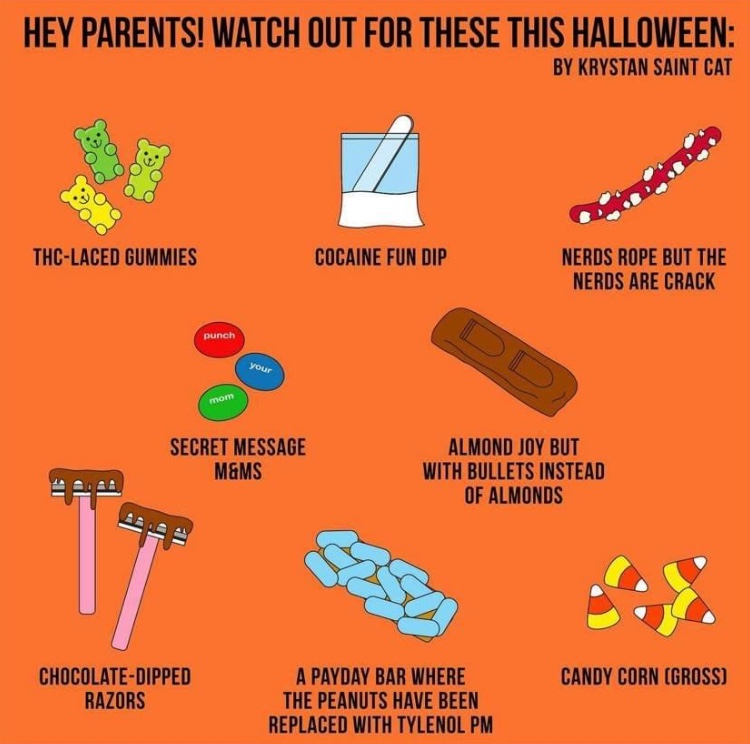
BR: Yes, right. So of course one of the recurring Halloween panics is the poison candy scares. And we’ve talked about this a little bit on the show before and I’ve written about this and a friend of mine Joel Best has researched that as well. And for those who have lived underneath a rock or doesn’t know what I’m talking about. There’s the annual Halloween candy scares involving contaminated candy and hardly a year goes by when police and medical centers aren’t offering x-rays for trick-or-treaters to search the candy for razor needles or pieces of glass, things like that.
0:53:07
CW: I remember that. I mean, I honestly remember us taking our candy someplace where we had it x-rayed first and I don’t think there’s a listener out there who doesn’t have some memory of hearing an urban legend about somebody getting killed with poison candy or some weirdo in the neighborhood possibly spiking candy with LSD or this or that and it freaked me out as a kid. I remember I like candy and I snuck some candy before we had it looked at before your, your quote unquote parents could examine the candy to see if it was safe and it freaked me out. I went to bed, I have a strong memory of going to bed that Halloween night going, I ate some of the candy before I showed it to mom and dad, oh my gosh, am I going to die?
0:53:51
BR: Yeah, well, and it’s a common scare and you know, fear sells and that’s one of the tragedies of the human condition is that scaring people works. It’s popular and it works. Politicians scare people, advertisers scare people, and oftentimes activists will, as we talked about before, the hell houses. In some cases, for example, with the poison candy scare, Ann Landers, for example, has devoted several columns to the Halloween candy scares. But when you actually dig into it, you find that there’s only two confirmed cases of children being killed by poison Halloween candy. In both cases, the children were killed not by a random stranger, but intentional murder by one of the parents. This is an example of what in folklore we call ostentation. It’s people who will act out an urban legend or act out a story. I talked about this a couple of episodes back where there was a young baby, I think in India I think it was, that was being abused and was being scalded by flames and the parents concocted a story about how it was actually spontaneous human combustion. They blamed SHC on these burns on their baby’s bodies when in fact the child is being abused. That same thing happened in 1974 when a guy named Ronald Clark O’Brien in Texas killed his son with laced pixie sticks. He intentionally put cyanide in the pixie sticks and killed him. It’s one of those things where we’re – it’s one of those sort of urban legend type things where people say, well, that means it’s true. No, that doesn’t mean it’s true. Just because an old lady could have, or maybe some old lady did, microwave her poodle in an accident or maybe intentionally, doesn’t mean that the urban legend about microwave poodles is true. In the same case here, just because O’Brien killed his son using Halloween candy doesn’t make the story true. And one of the, of course, the important distinctions is that this was an intentional murder of a particular person. This was not a random stranger.
0:56:14
CW: Well, yeah, if I were one of the lawyers trying to prosecute him, I would bring that fact up that that no, you can’t use, for instance, the the insanity defense or non premeditated because clearly the parent there was intending to do harm to the child and intending to blame it on some unknown stranger who had given him Halloween candy just like the urban legend says so that shows a degree of forethought and planning that that I would if I were in a court of law I would definitely bring up.
0:56:43
BR: Yeah yeah absolutely and it’s a and he was convicted and I don’t know whatever happened to you may have died in prison or maybe still there and yet the fear continues. You know there have been a few cases of candy tampering over the years and in most the cases the victim, I’m using scare quotes here, the victim turns out to be the culprit. Oh. And I track these things. Every Halloween I spend probably an hour or two depending on what my Google alerts bring me, tracking these these cases and for several years, for many years in fact, I would follow up on news stories saying well you know the Memphis, Tennessee X-ray medical center is X-raying candy and I would contact people in different cities in Houston, Boston and say hi, I’m Ben Radford, I’m a writer investigator, I know that you X-rayed candy this past Halloween because there’s a news article about it, what did you find? Did you find any tampering? And the answer was always no. Just over and over and over again, the answer is didn’t find anything, didn’t find anything, didn’t find anything. Now, to be clear, there are a handful of cases where there has been some tampering. And what you found is that in virtually every case, it was either the child or a parent who caught it just before the kid ate it. So it’s not that a seven-year-old was rushed to the emergency room after eating a razor stuck in an apple, because who eats apples anyway?
0:58:06
CW: Who gives apples for Halloween? Who does that?
0:58:10
BR: That’s how you get a brick through your window, right? But instead, there are cases where somebody will say, oh, I’m looking at the candy. Oh my God, there’s a needle in this Snickers bar. I need to call the authorities. And this actually happened, I think it was two years ago, two, three years ago. There were I think two cases in which there was some sort of tampering and the police investigated and they actually arrested the father and the father admitted to tampering with his own kids candy and he said that the reason he did it was to show his kids, teach them a lesson about how dangerous it is that strangers are out to get him and I find this offensive on several levels. First of all, that’s not the, first of all, that’s not how you teach kids the lesson. Second of all, it’s almost a perfect example of the stranger danger fear. The fact is that children are far more likely to be physically abused, sexually abused, killed, or anything else by a parent or caregiver than any random stranger down the street or anywhere else. In this case, the child was not in any real danger because the parent didn’t give his child, I think it was a needle or a piece of metal or something, he didn’t actually give it to the child, he wanted to be the hero. Oh, look, I’ve saved you, son, look at me, I’m being a protective father. Oh, let me call the police, let me call the news media to tell everybody about what a diligent parent I’m being and he’s the one that’s actually doing this.
0:59:47
CW: That’s the parent who cried wolf and it’s unfortunate because if I was that kid I wouldn’t trust my dad as far as I could throw him after that.
BR: Yeah I mean it just doesn’t make any sense. I mean the fact is that you know even though sugar addled kid or teen would notice a razor blade or pin stuck in a candy bar. An x-raying provides a false sense of security because the process might reveal a metal or glass but wouldn’t detect poison, for example. And on a basic level, throw it out. If you have any reason in the world to think that a piece of candy or Snickers bar or something has been tampered with, throw it in the trash. You don’t need to worry about it.
1:00:21
CW: Yeah, or don’t go trick or treating because there is sort of a communal trust you have to engage in if you’re going to walk around and go trick or treating because you’re getting food from your neighbors, you’re eating the food. If you really don’t trust your neighbors or your community or human beings in general, go to the dang store and buy $8 worth of bagged fun-sized candy and just eat that. It will cost you a couple of bucks and you’ll get just as much candy.
1:00:50
BR: Well, and you know, it just, it bothers me for, it’s just, you know, the fact is that the world is much safer than people like to think it is. I mentioned this before, I mean, people love to scare kids and oh my god, this and that, you know, stranger danger. The world is actually very safe for kids. A child is far more likely to be injured or killed crossing the street because of because their mask obscures their vision than to be attacked or or given Contaminated candy by a stranger. It’s just it’s just the priorities are just so messed up. This resurfaced in the wake of the September 11 attacks Actually, there was a media fueled panic over tainted candy and there was a rumor going around that two suspicious Arab men, make of that what you will, had purchased $35,000 worth of candy at a New Jersey Costco.
CW: 35,000, how do you even cart that out of a Costco? I don’t. How does a Costco even have that much candy on hand?
1:01:55
BR: Celestia, you’re already putting more thought into this than the people that shared this thing. One person wrote, quote, I just personally found out through a police department, unnamed of course, that the FBI has taken over an investigation in our area. Arabs bought thousands of dollars worth of candy at local Costco. Well, what’s right around the corner? Halloween! Be careful, all caps. And again, this is, unfortunately, this was in the wake of the 9-11 attacks, clash among Arabs and people of Middle Eastern descent was at a high point. So the FBI looked into this, as they should. If you’re genuinely concerned about this, then this is what you do. You investigate. And they had, in fact, looked into it, and it turned out that there was, in fact, somebody who had…
CW: It was one man, not two, and it wasn’t clear whether he was Arab or not, just a guy. Kind of on the brown side a little bit maybe? It didn’t say.
1:02:54
BR: There was no…
CW: Okay.
BR: So a week before Halloween on October 22nd, the FBI cleared up the rumors. It was one person, not two, who had bought $15,000 worth of candy, not $35,000.
1:03:07
CW: That’s still a lot of candy.
1:03:08
BR: Still a lot of candy. Apparently he was a wholesaler. And he planned to resell the candy and it was part of a routine, legitimate transaction that had nothing to do with terrorism. He may or may not have been dark skinned. We don’t know. But there was no connection whatsoever to terrorism and the whole panic of contaminated candy was essentially manufactured.
1:03:30
CW: Well, I once had to buy about $500 worth of candy with a friend of mine in college. I’m glad we didn’t start any panics, but we were two young white women, so I guess we aren’t labeled dangerous, but we had to buy a ton of candy for a Willy Wonka Festival. We bought it for a college activity to throw it at the audience during various parts of Charlie and the Chocolate Factory. Nobody thought we were going to poison the audience. I don’t know. It was during final exams at college, so I think a kid or two might have been happy to be poisoned and get out of exams.
1:04:04
BR: But well, you know, again, it goes back to stranger danger. I mean, that’s sort of underlying the whole notion of many of these Halloween panics. And in the 1990s, in addition to the Halloween candy scare, there was also a new concern in the form of sex offenders. As before, there’s a sort of moral panic surrounding it. And there was alarmist news media and police warnings that convicted sex offenders were required not to answer the door if trick-or-treaters came by or were in, actually in some cases, including Texas and Arkansas, offenders were required to report to courthouses on Halloween evening for a mandatory counseling session. In some places, there were signs put up in windows that say no candy available at this residence. They were handed out to sex offenders, the idea that to flag the neighborhood that there’s no candy. I don’t know why you couldn’t just keep the door closed and the lights off.
1:05:02
CW: Yeah, the signal was always just turn your porch light off.
1:05:06
BR: You would think, but not when you have stranger danger. You have to creep people out. And so I researched this several years back and I was fascinated to sort of tease it apart and figure out what’s the problem here. Well, the theory behind the laws is that Halloween provides a unique opportunity for sex offenders to make contact with children or to use costumes to conceal identities. I mean, that’s the basis for the scare, right? I mean, the idea is that sex defenders and pedophiles will wait until Halloween to act on their impulses.
1:05:40
CW: Okay.
1:05:41
BR: That’s what they’re selling.
1:05:44
CW: Well, I’m just imagining, okay, there are some older kids who go around by themselves, but usually always in groups. You don’t exactly send your kid in to trick or treat and just, okay, go into this stranger’s house and close the door and whatever happens, happens. That’s not how people trick or treat.
1:06:01
BR: Yeah. I mean, just the logistics don’t make sense. I mean, the fact is that a group of children dressed in costume at a sex offender’s doorway are probably safer than in many other places they could be, including their own homes. You know, most attacks on children occur in their homes by someone they know, as I mentioned before. So the entire premise of stranger danger is greatly exaggerated. So do released sex offenders occasionally re-offend? Yes, it happens. But by far the greatest bulk of people that molest kids are parents and caregivers and family members, not somebody behind a mask at a doorway. I mean, frankly, a released sex offender would have great difficulty molesting a child who’s in costume outside of his or her own front door in front of other people. I mean, that’s not where that happens.
1:06:51
CW: It would still super ick me out to even, you know, think about bringing a kid anywhere near the home of a registered sex offender. That’s a very effective boogeyman because it is a danger. You don’t want your kid around somebody who has been convicted of raping children. That’s an effective boogeyman because it is a danger.
BR: Absolutely.
1:07:24
CW: But I’m also thinking of just the whole false notion of saying that Halloween is a night where sex offenders are ordered to put up a sign or turn their porch light off. I’m just imagining kids or adults, you know, kids or their parents walking through the neighborhood and you know, any given Halloween, some 30, 40% of households are shuttered up with the lights off because the people who live there have decided to go to a Halloween party, or they’re just sticks in the mud who hate Halloween and didn’t want to buy any candy, or they’re at the church harvest festival because they don’t like Halloween. And I’m imagining these people walking through their neighborhood thinking, oh my gosh, 40% of our neighborhood are sex offenders.
1:08:01
BR: Well, it just doesn’t make any sense. I mean there’s no reason to think that sex offenders or murderers or rapists or anything else would choose Halloween of all times to pray on children. I mean there’s so many, if you really wanted to do that, I mean you go to the stores and schools, I mean parks, there’s just the idea that they would choose that one date is just not borne out in the research. In fact, we know that because there was a 2009 study that confirmed that the public had little to fear from sex offenders. It was published in the September 2009 issue of Sex Abuse, a journal of research and treatment. And examined 67,000 non-family sex offenses reported to law enforcement in 30 states over nine years. And they wanted to examine exactly this. Is there in fact an increased danger to children or anyone else from sex offenders during Halloween? And the answer was no. Here’s a quote in the report. There does not appear to be a need for alarm concerning sex abuse on these particular days.
1:09:08
CW: Halloween appears to be just another autumn day when rates of sex crimes against children are concerned. That’s good. Well, I would I would imagine it would. Okay. Again, I’m trying to put myself into the mindset of the enemy here. The time to do something sneaky and try and get away with something involving a child might not be the best night for that might not be when there are thousands of families and vigilant adults with their children roaming the streets.
1:09:33
BR: Right. I mean, it just I’m sure that at some point, somebody somewhere has assaulted a kid on Halloween. I’m not saying it doesn’t happen, but it doesn’t make it a thing, a capital T thing. It doesn’t make it a genuine concern that the public needs to be concerned about. It’s just it’s just such a rarity. I mean, you know, children and everyone else should exercise caution all the time. Things happen and you should exercise caution when driving, personal safety. You should be doing this all the time, but there’s no particular reason that’s unique to Halloween in which there’s any particular threat from either sex offenders or Arab terrorists buying candy or any neighbors trying to taint any candy given out.
1:10:19
CW: You bring up a good point, Ben, and I understand that you’re not saying, you know, look, this never happens, don’t be worried about it. Just be vigilant all the time because the, as that study said that you pointed to, the danger doesn’t go way up as the panic would indicate on Halloween and then go back down to some safe level. There’s always some level of danger. So always be vigilant, but don’t let it take over your life. Cause it’s super rare.
1:10:44
BR: Right. And the other thing to keep in mind is that in some cases, in many cases, uh, there’s public money that’s being spent on this. For example, if you have sex offenders who are being required to be monitored by police, the police will go and check out, maybe they have to do extra patrols because in a given community, there’s 238 sex offenders in this and they need to go door to door. I mean, there are real world consequences, financial and cultural and otherwise, to these sorts of measures. And so, you know, so my position is always evidence based policy. Whatever you want done, whatever policy you want, either socially, culturally, judicially, economically, whatever else, just make sure that it has a track record of effectiveness. Make sure there’s some reason to think that it actually works.
1:11:33
CW: Well, that’s common sense then, yes. And for every dollar saved by not putting it into public awareness over sex offenders during Halloween, that’s more money that we can use for a random guy dowsing for unmarked graves in Knoxville, Tennessee.
1:11:51
BR: Exactly. Know your priorities, folks.
(MUSIC)
1:11:55
Pascual Romero: We would like to thank our sponsor-level patrons, Amy Freshour-Kelly and Dr. Angela Mattke. If you’re interested in becoming a sponsor, or just throwing us a buck or two per episode, check out patreon.com forward slash squaringthestrange. Every bit helps us keep the lights on here in Strange Studios, and we could not keep bringing you content without the support of our generous friends. If you’re looking to provide moral support, head on over to iTunes and give us a five-star review. Every positive review helps us move up the podcast charts.
(MUSIC)
1:12:29
BR: So next week, we’ll be talking about Bigfoot.
1:12:40
CW: Oh, well, we’ve talked about Bigfoot before. What specifically are we going to be talking about, about Bigfoot?
1:12:46
BR: We’ll be talking about the cinematic aspects of Bigfoot. That is…
1:12:50
CW: Bigfoot on film. Yes, that’s right. Now I’ve got that Duran Duran song in my head.
1:12:53
BR: Yeah, girls on film. We’ll be talking about the cinematic Bigfoot. As you mentioned, there are so many angles into the Bigfoot phenomena. There’s, you know, eyewitnesses and there’s footprints and there’s dermal ridges, the fingerprints, and I mean, we could do a whole string of shows on that. But for the next episode, we’re going to focus specifically on Bigfoot in film and photographs. And we’ll be talking some about the Patterson-Gimlan film from 1967.
1:13:22
CW: And my favorite, we’re going to be going into some pop culture film appearances, which are extremely bizarre, some of them.
1:13:28
BR: Yes. Speaking of extremely bizarre, we’re going to have a guest co-host.
1:13:33
CW: That’s right. It’s not just going to be us talking about film, because what do we know about film? We need somebody who knows a little bit more about film than we do, like maybe a filmmaker. Who do we know? How about Eric? Let’s get Eric Myers on there. There we go. I was just asking my Ouija board here and it was going to EKM, EKM. Eric Christopher Myers will be joining us next week to talk about Bigfoot on film. Two minutes later. Have you seen the unrated version of that?
1:14:06
I have.
1:14:07
Yeah. Anyway, so, next episode, Bigfoot on Film, come check it out.
1:14:13
Take care, strangers. Bye-bye. Squaring the Strange is a production of Two Heads Studio, LLC. Copyright 2018. Theme music by Shriekback. Additional music by Memory, Guitard and Feathered, and Pascual Romero. Additional support provided by Ashley Romero, Robert Sundin, and of course our listeners and patrons. The views and opinions expressed in this podcast are those of Squaring the Strange and do not necessarily reflect
1:14:40
the views and opinions of Two Head Studio, Kronos Creative, Center for Inquiry, our advertisers, the views and opinions of Two Head Studio, Kronos Creative, Center for Inquiry, our advertisers, or any affiliated organizations and employers.
Transcribed with Cockatoo
