
Episode Summary:
First, Ben examines some disturbing consequences to child abduction rumors on a popular app in India and Mexico. Then we look at modern plastic surgery oddities and, specifically, the media myth of the Human Barbie, also known as Russian model Valeria Lukyanova. What outrageous things were said about her, and how much of the narrative can be taken as fact? We also compare her to her counterparts, namely the three men who promote themselves as “human Ken dolls.”
0:00:00
Ben Radford: Welcome to Squaring the Strange, the podcast that examines all manner of the mysterious and the mundane through a critical lens. So let’s square the strange.
(MUSIC)
0:00:10
BR: Welcome back to Squaring the Strange. I am your not recently pregnant co-host, Ben.
Celestia Ward: I am your recently pregnant and currently sleep deprived co-host, Celestia Ward. So how you doing, Ben?
BR: Not too bad. Busy, busy these days. We’re on deadline for magazine and a book that I’m trying to pull together and myriad other things, but all in all, not too bad.
0:00:59
CW: Okay. I’ve just, yeah, my past couple of weeks have just been a swirl of half-remembered late nights burping a small infant, but he’s a good kid. We like him. We’re going to keep him, not giving him back.
0:01:13
BR: I’m not sure what the return policy is, but I understand it’s very strict.
0:01:16
CW: Yes, I did go have that error fixed, so it no longer says that I had twins at the hospital. So we’ll see if that actually takes. You never know. You hand in some stack of papers to a bureaucrat and they look at you and say they’ll get right on it and you never know.
0:01:31
BR: Yeah, in fact, it’s funny you should mention that I just earlier today I had someone send send me a link to a story in the Capital Gazette. And the title is, A Fatal Error. Crofton woman finds out from bank that she had been declared dead. And this is something about a woman named Ellen Barron who suddenly went to the bank and they’re like, yeah, according to our records, you’re dead. And the Social Security office is quoted as saying this actually happens quite a bit.
0:02:00
CW: Another thing for me to worry about, I might have to come back from the dead and slap some people.
0:02:04
BR: Well, I mean, it’s, you know, obviously the relevance is to the conspiracy theorists, such as the one that contacted me about Adam Lanza saying, well, you know, it says here that like, yeah, well, you know, don’t put all your eggs in one basket and don’t assume that all the information you get from government drones is necessarily 100 percent accurate.
0:02:26
CW: Yes, yes. And like what like I said, when we had Mick West on it is it is always surprising when somebody points to a piece of information supplied by the government as proof that the government is lying to us. I never got that. So anyway, is there anything you’re skeptical of this week in terms of current events or stuff that’s happening, stuff that’s crossing your desk?
0:02:49
CW: Yeah, I wanted to talk briefly about a concerning situation that’s been going on for a couple months now and it’s unfortunately still going on. And that is, there’s been a series of social media-fueled abduction rumors about children. And I’ve written about this before and I think we’ve talked some on the show, but it happens more often than people realize. realize there’s stories get shared on Facebook and in this case an application called WhatsApp which is owned by Facebook. And we’ve seen these and I, as you know, I sort of collect these stories and write about them from a sort of investigative slash folkloric point of view.
CW: That’s kind of a phenomenon that’s gone on for generations. In the olden days, rumors of Jewish people kidnapping children and using their blood to bake bread and stuff like that.
0:03:42
BR: Yeah, the old blood libel, yeah.
0:03:43
CW: Yeah.
0:03:44
BR: Yeah, and it’s just, you know, I’m continually surprised. I don’t know why I am, because I’ve been following this for years, but it’s just, people just routinely embrace and share rumors about child abductions. Some people fake abductions, some people say that their kids were abducted. There was a case wrote about a couple weeks ago where there was a woman that claimed that some other woman had tried to abduct her child in a Walmart.
0:04:12
CW: Yeah, we talked about that. Where is this happening now with the WhatsApp? What part of the world are we looking at here?
0:04:18
BR: It’s actually happened in several places. The most common place is in India and so far there’s been about 20 people who have been killed in separate incidences across a dozen Indian states.
0:04:28
CW: 20 people? Holy crap.
0:04:30
BR: Yeah, I mean it’s serious business.
0:04:33
CW: I realize India has a lot of people, but 20 people dying as a result of rumors is a big deal.
0:04:40
BR: It is, and some of these are really pretty horrific. I’ll just briefly read one story from the CBC, the July 8th article, it says, three men in a railway station in India were rescued by the army from a possible lynching. They were surrounded by hundreds mistaking them for possible child abductors. The men were begging for alms and at one point appeared to have been speaking to a child. The police officer said that they were from out of town, they were sort of assuming they were strangers, and they quickly emphasized that there are no child-kidnapping gangs circulating around abducting kids contrary to the messages and rumors on WhatsApp. And it’s a very tribal area. That’s one thing you often find is in these cases, there’s a strong sense of community and tribalism. Outsiders are sort of looked upon with suspicion.
0:05:30
CW: Well, it sounds like especially outsiders who are perhaps destitute beggars or ne’er-do-wells or somebody who might be looked at as like more vulnerable.
0:05:40
BR: Yeah, yeah, there’s another case. This is from a NPR story by Lauren Frayer, F-R-A-Y-E-R. She tells the story of Eeram Saba, the mother of two children who live in India with her husband. And one night they heard a commotion out on the streets and they looked out and they found a mob beating five people. And the victims were at the center of the mob, there was a couple, their toddler and two relatives and they’d wandered into town to beg. And this is a different story than the one I just mentioned. Locals feared they were kidnappers and they pulled them into the home just to protect them. The mob set upon the house and were breaking windows and stuff. And it’s really scary stuff. And there was another case that happened. This was in Mexico. So again, most of these have occurred in India. There was a case earlier this year on August 29, 2018, a man named Ricardo Flores and his uncle, they went to a nearby town called San Vinci Boqueron in Mexico. They went in their SUV to buy some building materials. So they were from a nearby town, so they’re out of their element and they just happened to stop in and park near a school. And just as they arrived, there were rumors circulating on WhatsApp, again, the same app owned by Facebook and that’s caused so much difficulty and in some cases murders in India, that said that there were internet rumors circulating that people should be on the lookout for an SUV containing kidnappers.
0:07:09
CW: Well, there’s like a million SUVs out there.
0:07:12
BR: Yeah, yeah, well, I mean, it’s interesting, from a folkloric point of view. Usually it’s like black sedans and vans. This is why –
0:07:19
CW: A white van filled with clowns.
0:07:21
BR: Yeah. No, seriously. I mean there’s a whole folkloric trope. There are certain kinds of vehicles that the narratives go to. It’s not a moped. It’s not a Datsun. It’s usually a black or white sedan or van or something. In this particular case, it was pretty tragic. The villagers noticed them and recognized they weren’t from around there, and they accused them of looking for children to abduct. And they dragged them out into the road, tied them up, beat them, and then burned them alive. They poured gasoline on them and killed them there on the streets. So this is serious business.
0:08:02
CW: Yeah, folklore becomes folklore because it’s popular. It catches the imagination. It spreads easily. It’s almost like a – I think Richard Dawkins came up with the idea of a meme that spreads quickly and easily among people like an idea. And as you said, there are certain tropes, the white van, the black SUV, and people find it easy to believe and they start noticing these things. And who doesn’t want to protect the children in your neighborhood or your own children? It’s a strong desire, but it’s really sad that it’s taken over so many people in such a way that innocent strangers, innocent visitors are getting, as you mentioned, possibly lynched or killed or beaten to death over this?
0:08:51
BR: As you know, I’ve written and researched this sort of thing before. I mean, there’s, you know, witchcraft killings. I mean, in India and Pakistan, primarily, over the past few years, you know, women, usually women, as you mentioned, lower case and lower status, and they’re easy to find targets and scapegoats. And, you know, when I was researching the organ theft urban legends, you know, the kidney snatching and those sorts of things. I found several similar cases where foreigners were singled out and in some cases chased and beaten by mobs, primarily in Guatemala and elsewhere, often in Central America. In fact, I interviewed one woman who lives here in New Mexico who survived such an attack. Maybe one day we’ll do a show on that. But it’s so easy for people to, as you said, it’s, you know, they think they’re doing the right thing. They’re like, you know, I want to protect the children. There’s these roving gangs and there’s this conspiracy behind it and it’s so easy to share and it’s just one of those automatic knee-jerk reactions and people don’t stop to think about the dangers of this.
0:09:51
CW: Yeah, well it’s particularly ironic in that, you know, people who are traveling abroad, you hear all these things about how scary and dangerous Mexico is because of the drug gangs and the cartels. And you actually have to watch out for gangs of well-meaning parents who are trying to protect their children from imaginary kidnappers who they think look like you. That’s ironic. And now you specifically began this by talking about the app, WhatsApp. Can you tell us anything about why this app, I guess, nuclearizes the danger of such a rumor like the kidnapping?
0:10:31
BR: I think partly just because of its popularity. I haven’t used that app myself, but I have a pretty good idea of what it is. It’s pretty similar to other ones. I think part of it is the medium, right? You see the same thing on Facebook. Certain messaging systems and apps, if they’re popular, then everyone’s on there, and people go to those places and use those resources to get a certain kind of news. And it’s not, you know, this is not CNN, this is not CBC, these are social media apps. Now, part of the problem, of course, is that more and more people today are getting their news from social media, from Facebook.
0:11:08
CW: And trusting it, yeah. And I have to admit, this makes sense to me because if I if I can see a hundred different advertisements for for plumbers and I can see Vetted reviews about plumbers, but if I throw out a question on Facebook Hey Does anybody know a good plumber and I hear back from people I know or? Friends of friends and they tell me about a good plumber. I am more prone to trust that it’s like it’s closer the information is closer to getting it, you know firsthand from somebody so you tend to trust it.
0:11:39
BR: Yeah, and you know, so, you know, most of these cases, as I mentioned, it’s part, you know, part of the reason they’re so tragic is that these people genuinely think they’re doing good. I mean, if you, you know, presumably the mob that attacked these people, they didn’t know they were innocent, they thought they were guilty, and so you have this mob mentality, and they’re, of course, they’re going to protest they’re innocent, because, you know, why would they admit to trying to abduct children to do God knows what to them? So it’s, you know, it’s the dangers of not being skeptical and not applying critical thinking to these sorts of claims. I think in most cases, it’s people who are sincerely trying to do good. But in one particular case, there was a video that was a spectacular misfire. And I’ll just talk about that briefly. There was a public service announcement video that aired in India, which was widely shared in India, including on WhatsApp. It had two men on a motorcycle menacingly circling around a young boy walking along the street. It was taken from above, and it’s sort of amateurish. It looks like any standard iPhone video ever else. It’s a short video, and it shows the men grabbing the boy and taking off. And the video was posted to remind parents and children to be vigilant. And so what happened is if you watch the whole video, and again, it’s only 20, 20, 30 seconds or something. In the end, the kidnappers, the kidnappers and scare quotes don’t actually take the child. They stop and they hold up a sign that says it only takes a moment to kidnap a child from the streets. It was intended to be a public service announcement and warn kids and parents, you know, watch out. It only takes a second. But what happened was that somebody stripped out that last bit. Somebody took out that part where the actor holds up a sign saying this wasn’t real kidnapping, but it could have been. Watch out. And they stripped that out. And just the part that’s scary, just the part that told people that there are these people on a motorcycle, you know, driving around looking for children to adopt. That was what was shared and seen.
0:13:46
CW: So it was a raising awareness campaign gone horribly wrong, I’m imagining, for people on motorcycles, certainly.
0:13:50
BR: Yeah, in that particular case, that wasn’t just a theoretical harm. There were actually, there were two men that were, that had stopped on a street asking for directions, and they were beaten to death by people who suspected they were because they came in on a motorcycle. So, you know, they what happens is these these these sorts of rumors and videos, they give people a template. They say, look out for this. And people say, oh, I saw SUV. I saw two guys on a motorcycle and they were near kids and then they just put two and two together and get six. And again, part of it’s what’s so tragic and frustrating is that there never were any abductors. That the whole campaign was intended to stamp out exactly what it what it you know what it caused.
0:14:35
CW: I mean, I’m sure abductions happen.
BR: I mean, the point is that the video, the video of the two actors who were circling a child on the street who was also an actor.
0:14:49
CW: I get what you mean. There were no actual.
0:14:52
BR: That does not depict an actual attempted abduction, which is how it was framed.
0:14:56
CW: I just just wanted to clarify in case anybody thinks that Ben is saying that, you know, abductions and kidnappings are, you know, a myth and a rumor. No, they really happen. But but boy, there is a danger in circling the wagons a little too hard against it. But yeah, that’s that’s definitely something to think about when you wonder what the harm is in passing along a meme or something scary or something that seems like people should be worried about it. Whether it’s a new poisonous spider discovered in the Southwest or gangs of roving people on motorcycles possibly kidnapping children, it pays to check it out.
0:15:34
BR: Yeah, absolutely. And again, it just goes back to just, you know, be skeptical. Don’t share all these sorts of rumors because they really do, you know, they have real consequences. They can lead to beatings and horrible deaths and people being burned alive. It’s not a joke. I think too often people just think of, oh, it’s just a rumor, just gossip. These things can kill.
0:15:56
CW: Yeah. Well, let’s get into our main topic here pretty soon. We’re going to be talking about something a little lighter than deadly rumors. We’re going to be talking about something a little more plastic, plastic fantastic.
0:16:09
BR: Yes, yes. The human Barbie doll and the various incarnations thereof.
0:16:15
CW: And her friends.
0:16:16
BR: Exactly.
(MUSIC)
0:16:17
CW: And we’re here to talk about Barbie, America’s favorite doll, right?
0:16:30
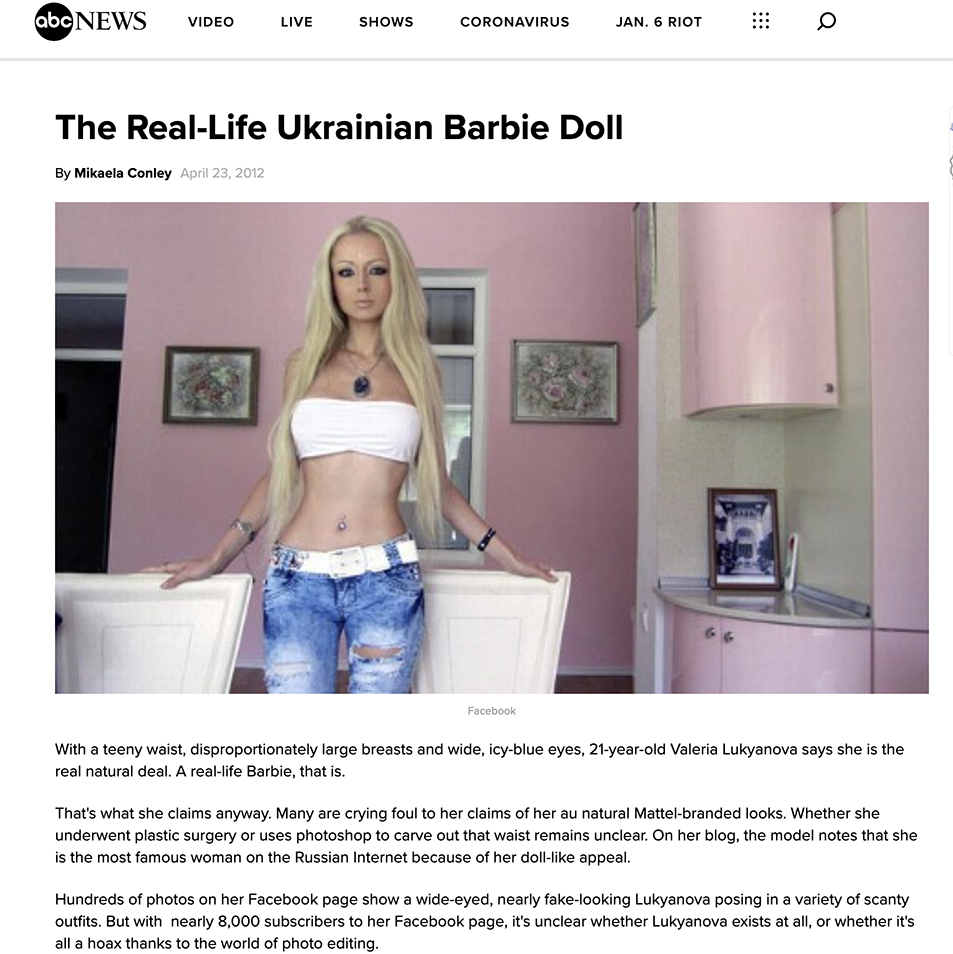
BR: Both beloved and vilified, sometimes in equal measure, yes. She gets tortured sometimes. I had a few Barbie dolls, they lived through some crap. Yes, well, we talked about not just the Barbie doll, but some of the skeptical aspects to it. One angle that I’m bringing to it is a case that I, a case I say, a Russian model. I was searching Russian models, as one does, look for images there. And you know, you got to be careful with what exactly I search for, but in this particular case, I was searching for a model named Valeria Lukyanova. She was the supposed real life Barbie. And she made a-
0:17:21
CW: I remember.
0:17:21
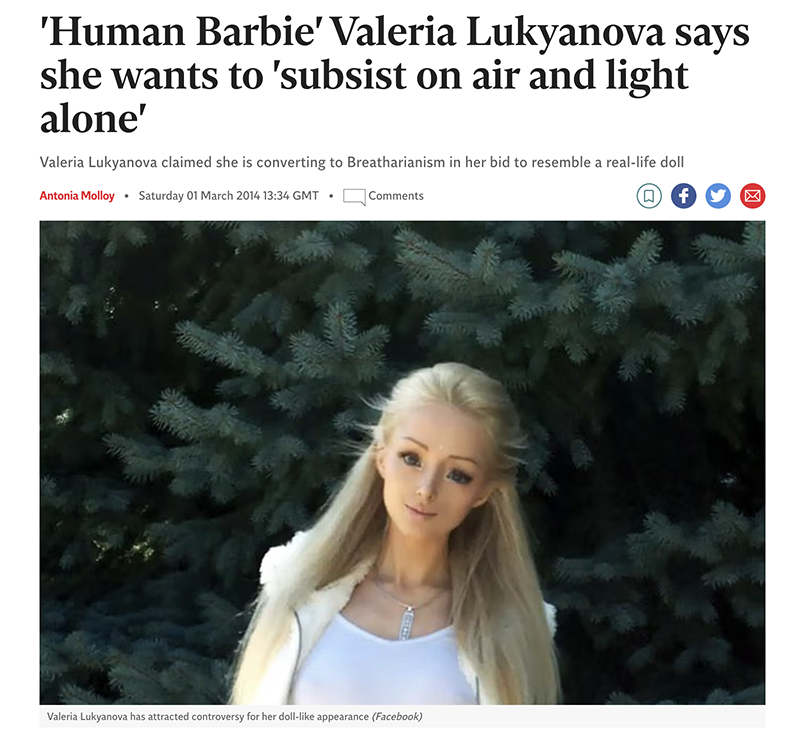
BR: Yeah, she made a national, international news round 2012. And there was lots of sort of, it was just sort of a weird story. And there was some questions about whether she was even real. Was this the whole CGI thing? Was she going through all this plastic surgery in order to become like a Barbie doll is what some people are saying? And I I did some research into that that story. There’s more to it than meets the eye So Celestia, what do you? What’s your what’s your angle into Barbie doll? Did you did you play with them as a kid?
0:17:55
CW: I was yeah I I had a few and my neighbors had a few and I had the best of both worlds because my brothers who were just like a year or two younger than me had like the G.I. Joe dolls, the Stretch Armstrong. Oh Stretch Armstrong! I used to love Stretch Armstrong. The stomper trucks and all the He-Man stuff with the cringer that turned into Battle Cat when you put a carapace on him and I found the thing I was most skeptical of was Barbie dolls Barbie’s feet because they wouldn’t walk they just had that little tiny cusp of a little tiny toe and they were super high arched and I don’t think I paid much attention to her boobs or her waistline just those feet were very distracting and and I found the GI Joe dolls actually had a ball socket right in the ankle so you could adjust the feet so you could put them on tippy toes if you wanted to.
0:18:52
BR: I don’t remember my GI Joe having balls, but maybe the ball socket.
0:18:59
CW: It’s a puppeteering term. It’s a joint.
0:19:03
BR: Oh, like a… Is that why he uses his kung fu grip on his ball socket?
0:19:08
CW: Oh, you had to go there. Anyway, well, moving more toward the topic at hand, you know, plastic surgery and whether or not people do want to look like Barbie, I have a little side trip down a caricature alley about plastic surgery. A story that has popped up a couple of times on my radar is that of Christina Boutel. She is reportedly a 32-year-old woman from Rotherham in the UK and she has claimed that she spent about 200,000 pounds, about you know, $250,000 on a long list of plastic surgeries with the specific stated aim of looking like a caricature somebody drew of her when she was on vacation at the age of 15.
0:19:57
BR: That’s weird.
0:19:58
CW: Yeah, well as a caricature artist, that’s like too much power. Like you often hear people joke around saying, oh, I should take this and show this to my plastic surgeon. But apparently this woman actually did.
0:20:09
BR: Well, as you know, I’m a huge fan of caricature. In fact, that’s one of the ways in which we met. And I collect caricatures of myself, not to be vain, but just because I love the art that’s brought to it and each person’s interpretation. So, you know, I have wildly divergent caricatures. So part of my question would be, which one did she choose? And why did she choose that one? I mean, was it the most beautiful or was it the most weird or?
0:20:34
CW: It was actually pretty exaggerated. And and that’s what surprises me, because there are some pretty tame artists out there who just kind of draw a real safe little like airbrushed, like very, very nicey nice. Nothing’s really too exaggerated. But the thing I’m looking out here, well, the thing that catches my eye are yeah, the, whatever artist drew her, I’m not sure the artist realized she was only 15, because you just do not put a pair of tatas that big on a 15 year old, and these are like each the size of her head.
0:21:00
BR: Wow, okay.
CW: She said it did have giant breasts that Boutel said admiringly looked like quote beach balls.
0:21:16
BR: Maybe she developed early, maybe that’s an accurate caricature.
0:21:19
CW: It could be, could be, but yeah. Anyway, let me see here. The surgeries that she said she got to get her looking more like her caricature include 5 boob jobs, 2 nose jobs, Botox, fillers, lip injections, semi-permanent makeup, tanning injections and quote, a designer vagina labiaplasty. And just speaking as somebody in the caricature business, I’m hoping that last one was not actually inspired by the caricature, because if you’re drawing labia visible on a caricature of a 15 year old, you need to be removed from the premises. That’s not cool.
0:21:57
BR: Yeah.
0:21:59
CW: Well, to hear her talk about it, though, see, what fascinated me, of course, was the psychology of it. She was unabashedly proud of liking the aesthetic of the extreme, fully wanting to look like her caricature in all the crazy, you know, extreme proportions of her breasts. And she wanted the giant lips with, you know, lip injections. And, you know, she she was proud of it. It was it was what she wanted. And she just went for it. It reminded me of a caricature seminar I attended once that brought up an old PBS show, How Art Made the World. Do you remember that show? It was on maybe seven or eight years ago.
0:22:36
BR: Vaguely.
CW: Yeah. It drew parallels between the satisfaction that a human being gets in looking at something that’s been really exaggerated, that is caricatured, and the instincts that you find in the animal kingdom, where like a newly hatched chick, like a seagull chick will respond to the red mark on its mother’s beak by excitedly pecking for food. But when you show an exaggeration of that beak, something that’s not really natural anymore, like a stick with three red markings on it instead of just one little dot, the chick won’t turn away. It’ll get even more excited and peck for food even more enthusiastically. That was kind of based on work by ornithologist Nico Tinbergen, and he did that work in the late 50s. He wasn’t a perfect experimenter. The stuff he did with gulls has been criticized as kind of sloppy, and the experiments had flaws. So, you know, take it with a grain of salt. It’s probably an oversimplified parallel, but I find it to be a good metaphor for how the mind of an animal or of a human being can react quite positively to stimuli that have been inflated, for lack of a better word, far beyond natural appearances.
0:23:53
BR: It sounds like it’s almost sort of the opposite of BDD or body dysmorphic disorder, a fairly fairly recently recognized condition which people will find flaws in their appearance so for example a person will will look at themselves in the mirror and they will basically see a caricature of themselves that doesn’t exist, you know, the smallest imperfection will be magnified in their eyes and In some cases, they’ll they’ll just be horrified that that their co-workers and friends and family, they’re sure that they’re noticing it and just are being too polite to say anything about it, whereas in fact, they either don’t notice it or it’s essentially non-existent.
0:24:35
CW: Yeah, that’s an interesting thing to bring up in comparison there. I mean, certainly a lot of people have multiple plastic surgeries because they have that overbearing sense of, oh, I have this flaw that’s still there that I need to take care of. But then there are people like this woman in the UK who are like no, I’m not like horrified by flaws, I just like this look and I want to get as much of this as I can and there seems to be a joy in it, not a sense of dread and horror at your appearance but rather a sense of celebration and I can’t find fault with that.
0:25:11
BR: Sure, and we’ve certainly seen that more and more over the past, you know, 10 or 20 years. I mean, body modification, there’s people who, I mean, you live in Vegas, you see, who, you know, they’re covered in tattoos from head to toe. And it’s, you know, certainly that was, it’s still unusual, but it’s, people are more and more accepting of all sorts of scarifications and body modifications and tattoos and piercings that they weren’t 20 years ago.
0:25:40
CW: Yeah, it’s like, you know, let your freak flag fly however you want to do it as long as you aren’t hurting anybody else and as long as you aren’t stealing money to fund it. It seems like, you know, a lot of these plastic surgery aficionados are doing it with their own money. I mean, you can’t exactly get the government to pay for your plastic surgery. Although this particular woman, Christina Boutel, she is in the news again recently. There were like another seven or eight stories that went around in April because she did get gastric bypass surgery funded by the NHS, the healthcare system in the UK. But that seems to not really be connected to her plastic surgeries. Apparently that’s a funded procedure you can get if you are a certain percentage overweight, they will fund it for you so it’s not like she’s getting anything that the average person doesn’t get.
0:26:31
BR: Right.
0:26:32
CW: Yeah. Well, now, one thing that people will get all up in arms about in terms of plastic surgeries is if society pushed somebody to do it.
BR: Yes.
CW: So that brings us back to the legend of the human Barbie.
0:26:47
BR: Yes, Valeria Lukyanova. That was a strange sort of social media born case. She made the news a lot in May 2012, if I’m not mistaken, and a little bit before and after that, but it was especially prominent then. And for a long time, it wasn’t clear what was going on, if there was actually a real person behind it. It pretty soon became clear that it was, but at first there were a series of videos that were showing up, for example, on YouTube and elsewhere that seemed to show this too perfect Barbie-like woman that just was had this just perfect skin, this gauze and filtered, but just it didn’t look CGI. I mean, it didn’t look like something that somebody had, you know, as you know, it doesn’t take a lot to get people outraged. I was going to say it was it was so outrageous. There was outrage. But of course, you know, there’s people get outraged over over the smallest things.
0:27:51
So, yeah, I remember the images and they were they were striking in that she seemed to have crossed right into the uncanny valley where looking at her kind of raised your the hairs on the back of your neck like is that a real person I don’t know it doesn’t really look like it anymore.
0:28:10
BR: Yeah yeah well it was there were a couple sort of schools of thought that were sort of theories that were floating by I hate to make some like well there were schools of thought that discussed her in this way you know in in in the hallowed halls of Oxford people were discussing a value of Nova but there are a couple of theories. One of them was that it was sort of a viral marketing scheme, that there was a woman behind it but that there had been lots of photo manipulation and certainly in May 2012 there was, it wasn’t as good as there is today, but it’s still quite good.
0:28:46
CW: You say viral marketing campaign, people thought that Mattel was behind this like the makers of the Barbie doll.
0:28:52
BR: No, no, no, no, I didn’t I didn’t see that we’re suggesting that Mattel was behind it. No, it’s just like, for example, you know, just as oftentimes you see these weird. I mean, there’s a whole genre of strange videos that may be part of some marketing scheme. For example, there are a couple of evil clowns I wrote about in my bad clowns book. Some of those videos were circulating by filmmakers as sort of a teaser for something. So and you see the same thing with many of the hoax videos, the so-called unexplained paranormal videos. Some of them are just people who are out to make a laugh, to test their skills. Sometimes they’re actually trying to create a buzz.
0:29:34
CW: Ah, the ever popular generating buzz videos.
0:29:38
BR: Yes, exactly. But one of the more common responses was horror that that this was sort of the the the culmination of a society that’s obsessed with with idealistic female beauty and Barbie dolls and that sort of thing. There was a Jezebel headline, Ukrainian model has supposedly barbified herself through plastic surgery. And of course this this ties in with fear of the media and fear of media influence and the idea that, oh, my God, you know, this this poor girl is you know, going through these horrific plastic surgeries to to look like this beloved Barbie doll. You know, what are kids doing? I’m wringing my hands, although you can’t see it.
0:30:17
CW: So the thought was that this was just going to be the first of many. We were going to have tons of girls surgically altering themselves because you should look like a Barbie doll and if you if you don’t then you’re failing as a woman.
0:30:32
BR: Exactly, exactly. And you know if There’s a sort of superficial plausibility about that There’s a bit of moral panic involved in these things as well because you know she was she was very popular on YouTube Instagram and elsewhere so she has a lot of followers and so Any time that there’s something sketchy or dodgy on social media, immediately people will be concerned about, well, won’t someone think of the children? In essence, for many people at the time, it was emblematic of all that’s wrong with the beauty ideal and the beauty culture. And it sort of folded very nicely into concern over fashion models and anorexia and things like that. So that was the big concern at the time. So because there was this sort of weird ambiguity about, number one, is this a real person? Number two, is it part of some stunt? Is she really trying to look like Barbie? And so there were a couple of questions that were sort of circulating around. Again, she was often referred to as the human Barbie. And in many cases, in many news stories, they would explicitly say she’s trying to look like Barbie. So I kept seeing all these stories, many, many stories that refer to her as the human Barbie. And again, totally wrapped up in that narrative that she’s trying to look like this impossible ideal. And I was skeptical of that for a couple of reasons. As you know, I’ve done a fair amount of research into eating disorders and media images and perfection and anorexia and things like that, including Barbie dolls and the concerns that Barbie is a sort of an impossible role model ideal. And we’ll talk a bit more about that later. So this seemed to be a weird story. And as you know, one of my one of my interests is in media myths. And this this sort of smells like a media myth in many ways. And so there’s like, there’s something a little sketchy about this.
0:32:28
CW: Yeah, it seems kind of like a freak show headline. Come and see the human Barbie.
0:32:34
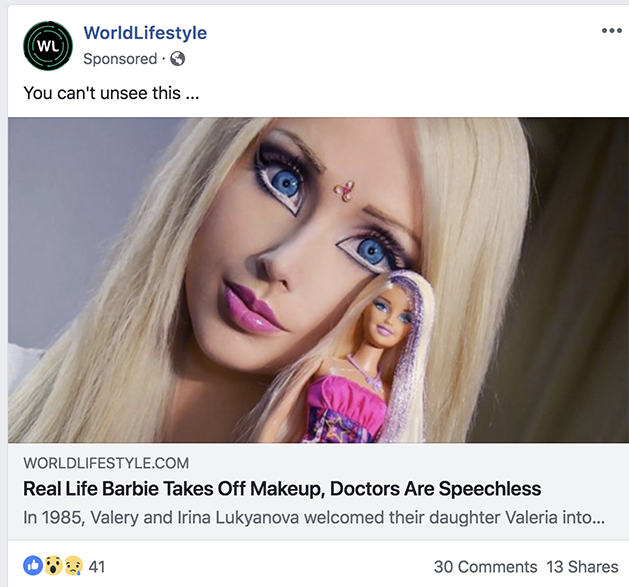
BR: Right, exactly. And so there are a couple of things that I quickly sort of threw. Number one, it was interesting that in my research of her, again, Valeria Lukyanova, there were no photographs of her with a Barbie doll that I could find. And that was very odd because if the reason she’s known is because she wants to look like Barbie, you would expect, at least I would expect, that there would be one or more photos of her holding her Barbie doll that she wants to look exactly like. I mean, that’s a sort of obvious photograph that would be associated with the story. And yet from what I could tell, there were none. Now I didn’t spend months and months looking at Russian models, but I for my quick perusal I didn’t see any that that was that was sort of a red flag for me.
0:33:21
CW: So that that speaks to motivation whether or not she looks like Barbie is one question But whether or not she’s she’s consciously trying to emulate Barbie is the other question.
0:33:33
BR: Exactly and that was and that was the key. I mean if the you know, I would say 80 to 90% of the news stories, the tie-in was Barbie. I mean, that was exactly, you know, the human Barbie, she’s trying to look like Barbie. And that was the key to the stories. And from what I could tell, that part wasn’t true. And so I did a little more digging, and it turns out that she actually never called herself the human Barbie, and she doesn’t like that phrase. She’s accepted it because that’s how she’s known. But I mean, she never called herself the Human Barbie. She never embraced it. She never promoted herself as the Human Barbie. Other people put that label on her and she sort of eventually gave up and said, you know, OK, call me if you want. But that was never her intention. And she never promoted herself in that way.
0:34:20
CW: OK, well, I mean, was she was she trying to look like any other type of doll or what? Did she have a motivation at all that you found?
0:34:27
BR: Well, she wanted to be a model. So again, this is one of those cases in which it was very much a media myth. The news media had a narrative that they were, the narrative was this poor girl wants to look like Barbie dolls, isn’t this horrible, queue hanging and complaints about all the hordes of girls that are going to follow her because she’s beautiful and weird on Instagram. So it turns out that she is and was a model and she had had breast implants, which is not that unusual. You live in Las Vegas. I imagine you’ve seen a few.
0:35:06
CW: I’ve seen quite a few up close and personal. I’ve got quite a few friends who have them.
0:35:11
BR: Yes. So the fact that she had breast implants is not particularly relevant. It’s I guess any more so than anyone else getting a boob job when it’s like Barbie.
0:35:25
CW: As surgeries go, that’s not a tremendously obscure type of plastic surgery.
0:35:31
BR: Right. That is not. In her videos, she wore makeup and contact lenses. So, you know, obviously she was trying to put on a sort of beautiful, placid, strange look and it worked. But she claims, and there’s no reason to doubt it, that she’s naturally slender and she works out constantly and she sticks to a particular diet, which I’ll get into in a second. And so, the point is that, from what we can tell, the premise of the story that this girl is undergoing all these plastic surgeries to look like Barbie, both those, in that one sentence the two main premises are both wrong. She’s not doing it to look like Barbie. She never said she wanted to look like Barbie and she has not undergone a lot of these plastic surgeries. She’s basically just had a boob job, which is not that unusual.
0:36:25
CW: She hasn’t had like ribs removed or.
0:36:29
BR: No. And that was one of the rumors. You know, ribs removed. I guess maybe, you know, she and Marilyn Manson, for different reasons. So, again, it’s that that part of the story just basically turned out not to be true at all. And when I looked at her Web site, the word Barbie doesn’t appear anywhere on there, except again, sort of where other people are calling her that. And so there’s, if you do a Google search, you know, there’s lots of images of her with airbrush, cheesecake, glamour shots, some more staged than others, but again, conspicuously absent or any with her posing with the beloved doll. The Barbie angle was introduced, from what I can tell, by lazy reporters for Jezebel and Huffington Post and ABC News who were just looking for some quasi alarmist angle to attach to it.
0:37:22
CW: And I find it interesting that they all seem to have assumed she had multiple surgeries to look this way. They were saying that?
0:37:27
BR: Yeah, yeah. Which is weird because you would think that that somebody with some savvy of social media would have said, you know, that this can be done without having ribs removed in multiple surgeries.
0:37:39
CW: Well, yeah, there’s so many. Perhaps it’s way more commonplace now than it was eight or nine years ago, but there are so many Instagram accounts that exist just to show transformations, things that you can do to create illusions with contouring makeup, with the baby, they literally call them baby doll contact lenses to make your eyes look extra big Even forget just all the filters and the lighting and the photo manipulations you can use there’s a tremendous amount you can do in front of a cell phone camera that will change your appearance and people on Instagram who do this become Incredibly popular you have people transforming themselves into Disney princesses people transforming themselves into zombies and Hollywood monsters. You have, you know, the drag queen makeup tutorials are phenomenal. You’ll see this, you know, pretty rugged looking guy in the space of a quick 30 second Instagram video turn into this Barbie doll. It’s amazing. Yeah. and no surgery needed.
0:38:46
BR: And it folds right into the concern and we don’t really have time to go into it, but the concern about photoshopping. I’m always bemused when I see alarmist news stories about, well, this magazine or this website is, they’re not going to do any more photoshopping. And then they show these models that, okay, sure, there’s no photoshopping. You can do an amazing amount with lighting, makeup. I mean, it’s just the idea that Photoshop is the realm of perfection is just bizarre. It’s just that’s one of many tools that one can use and it’s just weird.
0:39:27
CW: Yeah, yeah, well, I guess it’s kind of like, we’re gonna be organic with our models. Everything’s gonna be…
0:39:34
BR: There you go.
0:39:35
CW: It’s just kind of like, we’re gonna tie this one hand behind our back, but with the other hand we can do a whole lot. So it’s still going to look nothing like you’re going to look on a Saturday morning.
0:39:44
BR: Exactly, exactly. But we’re doing it with Photoshop. Okay, you’re still, the photo is still manipulated five ways to Sunday, but you didn’t use Photoshop. Good job. The key question of whether it’s artificial or an impossible ideal is put aside with the, hey, we didn’t use Photoshop, so what? But what was going on was, so part of the answer to your question is that other people were taking her photos and doing photo manipulation on them.
0:40:15
CW: Oh.
0:40:16
BR: Yeah, so in some cases, and this is one of the things, if you do a Google search, or any other search, I don’t wanna just use Google, if you do an internet search for photos of her, you’ll see a wide variety. Some of them, she looks impossibly thin. Some of them, she doesn’t, this and that. And the important thing to remember is that some of those photos were manipulated by other people. So it’s easy enough to just take a photo of her. And so she would be the first to admit that not all the photos that you see on the internet are of what she naturally looks like because other people for just as a prank or for fun or whatever else have changed her manipulated and changed her photos.
0:40:57
CW: I hate when that happens! I hate when people randomly take photos of me and make me more beautiful.
BR: Doesn’t that annoy you?
CW: Gosh, like, ah, yeah. I know I look 30 pounds lighter in that photo. Stop it
0:41:06
BR: Well, here’s the thing so so then the question is why right? So if if she wasn’t trying to look like a Barbie doll, and that’s pretty clear, she’s said explicitly she’s not trying to look like a Barbie doll, then why? And the answer is she was doing it, number one, for attention because a lot of people like attention, but mostly because she wanted a venue to espouse her philosophical beliefs and her spiritual practices.
0:41:34
CW: Oh, she wanted to be not just a model, but a spokesmodel.
0:41:38
BR: Yes, yes. And so I have a quote from her. I’ll read it to you. I can’t. She probably has this Barbie doll sing song voice that I’m not going to do. But this is a quote from what she said in one of her videos. Okay. My name is Valeria, but my spiritual name is Amatu. I’m a lecturer on the subject of out-of-body travel and I lead seminars on spiritual subjects. My PR is based only on my physical appearance. Unfortunately, spiritual ideas will never get so much attention. If a nun starts talking about spirituality, will anyone listen to her? No, no one will. But if a beautiful, inspiring young woman starts talking about it, many people will start thinking. So I use my appearance to promote my spiritual ideas. It works perfectly well. That’s why I will always use this tool.
0:42:26
CW: I don’t know how well it worked. I had never, I’d heard of her plastic beauty and Barbie doll appearance, but I had never heard word one of her spiritual ideas.
0:42:37
BR: Well, right. I’m not saying it worked. I’m just saying that was her rationalization. That’s what she was saying. So as it turns out, she is an instructor for out of body travel.
CW: Oh.
BR: So, if you’re interested in traveling outside your body, you can take horses from her, again using her spirit name, Amatu. She’s also a strict raw vegetarian. So she’s one of the people that only eats raw vegetables. And if you’re only eating raw carrots, for example, you can see how you would look like that.
CW: That tends to not pack the pounds on. See, the whole idea was to take the idea of the human Barbie and make it less strange, Ben. You’re actually making it stranger.
0:43:19
BR: Yes, well, no, it gets even weirder. This is the we’re not done with the weird yet.
CW: Okay.
R: So for a while, she was a adherent of Breatharianism.
CW: Oh, one of those.
BR: Yes, she she believed that she didn’t need to eat. This was not a this is not anorexia bulimia, this is not an eating disorder, this is a philosophy or a cult, depending on who you talk to and what their condenses are, of people who believe that you can get all the nutrients you need from the air just by breathing and getting light. I’ve written about some Breatharians before, they don’t last long. Sooner or later, they sort of reluctantly admit that yes, you do need to eat. But so again, this would also help explain her rather thin physique. If you, at least for a while, are a Breatharian, then your calorie intake is zero. She eventually gave that up, as most of them do, sooner or later.
0:44:24
CW: It’s either that or you die a Breatharian.
0:44:27
BR: That is exactly right. It would be a very, very light coffin. But anyway, that’s the story of the human Barbie who was not actually a human Barbie.
0:44:37
CW: Fascinating. Well, yeah, I got to say that that sheds some light on the person behind the plastic image there. And she was sort of held up by a lot of people who were writing stories and needed a good example of how the American beauty ideal as showcased in the Barbie doll can be harmful to young women, correct?
0:44:57
BR: Yeah, I mean, that was in many cases, that was exhibit A. But again, it’s one of those cases where, you know, there needs to be truth behind it. It’s not enough to just sort of have a have a pre-existing template or narrative and then sort of co-opt people into it when in fact they may have no connection to it at all. I mean the fact is that the Luchinova never called herself a Barbie, never wanted to be like a Barbie. She was not doing this to conform to some male ideal beauty. I mean none of that was the case here and yet that’s what she’s best known for certainly among some circles.
0:45:35
CW: I looked at this from the other side of the gender coin and I took a look at the people who’ve become known as living Ken dolls. We actually have three of those right now. There might be more later, who knows, but I uncovered three and I thought it was interesting to note the differences between the human Barbie and the human Ken doll.
0:45:57
BR: Do tell.
0:45:58
CW: Well, the unfortunate news is the human Barbie is not going to be hooking up with any human Ken dolls. Barbie is going to remain lonely because two of the Kens are gay and the other one is dead.
0:46:09
BR: That could be problematic although as I recall in the in the in the real in scare quotes Ken and Barbie the anatomy wasn’t going to work anyway.
CW: I don’t know you did that might have worked for them.
BR: I suppose I never really looked. I didn’t. Anyway, go on.
0:46:29
CW: Yes. Anyway, Ken doll number one is Justin Jedlica. And he’s and see all these Ken dolls are quoted as saying that they are trying to look like a Ken doll. They espouse the title. There’s tons of photos of them with Ken dolls. They are not just getting saddled with it. I took a look at each of them here and Ken Doll number one is Justin Jedlica and he is quoted as saying he watched Lifestyles of the Rich and Famous as a kid and he always wished his family was ultra rich. I’m Robin Leach! Yeah and he just passed away by the way. Vegas icon of sorts. But anyway, as a kid he wished that he had the wealth to get plastic surgery because he associated surgeries like that with the rich and famous. Now his number of surgeries ranges quite a bit. We have an interview from Planet Romeo saying it’s close to 500. Some British tabloids are saying it’s over 300. His website claims around 100 and the Daily Mail of all places is the conservative one saying he’s had over 20.
0:47:38
BR: The Daily Fail is on the low end of this? Wow.
0:47:41
CW: And and I noticed when describing Justin’s surgeries Rather than again, I you know, I did kind of a shallow dive among all the ones I found I didn’t look for you know, the really intense academic journals approach here But all the popular articles I found tended to just sort of hold him up almost like, hey, this guy, it’s an extreme sport. His most dangerous surgery to date. And he designed his back implants himself. Look at this guy. What an amazing guy. And kind of congratulating him, like he’s a, quote, pioneer of the modifiable male aesthetic. So these guys are held up as like, look at them. They are going after the look that they want, power to them, and they are making a living out of it, too, charging tens of thousands of dollars for personal appearances.
BR: Spin me right round, baby, right round.
0:48:36
CW: Yes. None of them were described as victims, except for the fact that these surgeries made them feel like they had overcome that stage of their life. Hmm. Now Ken number two, probably the most Ken doll inspired Ken, is Ceslo Centibane, Centibanes or Centibanes. I’m not sure actually how you pronounce it, but he was born Ceslo Pereira, a Brazilian model and actor. He’s described as a doll enthusiast himself, who grew up with a shelf of dolls of his own. And he was, quote, obsessed with the perfection of physical beauty. Santa Banez started to identify features on his face that did not look like the Mattel brand doll, according to the Latin Times. Multiple surgeries and over $60,000 later, he did look like the Ken doll. His dream was to make a movie with the Ukrainian Barbie, Valeria Lukyanova. He did not get to do that. He did get to launch a line of Cessna dolls in Los Angeles a few years ago, but tragically in the summer of 2015, at the age of 20, he discovered he had leukemia, a pretty rare form and after a five-month battle, he passed away. There was a bit of a deathbed conversion of sorts. Reporters said that he was claiming he no longer cared about aesthetics and that if he lived, he would not have any more surgeries.
0:50:16
BR: So, here’s the question. I know that he’s dead and the other two are gay, but and you know there’s going to be a porn version of this at some point, right? Rule 34. So, here’s my question.
CW: That probably already is.
BR: Would you watch it? If they had Lukinova and one of the Kens, would it be like the puppet sex in Team America? I mean, I’m just trying to think, just how weird would that be?
0:50:37
CW: Now, Ben, you do you do understand that just because they look like Barbie dolls, like like an Instagram doesn’t mean they have smooth non genital areas.
0:50:47
BR: I have the faintest. I’m making no assumption either way. My question is just, the question I’m posing as an academic issue is whether that would be watchable.
0:50:57
CW: You know, I don’t think there’s a type of porn out there that is unwatchable because people watch all sorts of things.
0:51:05
BR: I would probably watch a little bit of it just out of morbid curiosity.
CW: Yes, I probably would too.
0:51:16
BR: Well, speaking of morbid curiosity, Ken Doll number three is Rodrigo Alves and he is a character. He is a very watchable Ken Doll. If you search for video of him, you will be rewarded because he is quite engaging and chatty and larger than life, which explains why he ended up on Celebrity Big Brother, a show that he’s recently been kicked off of because he threw around the n-word.
0:51:43
BR: Oh, unfortunate.
0:51:45
CW: He’s since apologized and says it was due to him having English as a second language, plus he was drunk and he grew up in a multiracial family himself. So it didn’t mean the same thing to him as it meant to other people, he said.
0:51:59
BR: So now of the three, at least two were ethnic, right?
0:52:06
CW: One’s from Brazil. Two were from Brazil. Both Ken number two and number three were from Brazil. The first one, Justin, he is from New Jersey or New York, I believe.
0:52:16
BR: Now, refresh your memory on what Ken looks like. Does he look Brazilian?
0:52:20
CW: Well, uh.
BR: Now, I haven’t seen any of these guys. You’ve spent more time searching for, you know, masculine Ken than I have. So help us out here. Number one, which of these three looks most like Ken? Number two, is Ken Brazilian?
0:52:36
CW: Ken can be whatever Ken wants. The Ken dolls that I saw them holding up were actually all, except for the number three, because number three has got blonde hair. But the other two, Cesslo and Justin, seem to have been brunettes the entire time. And the Ken dolls that they hold up are brunette Ken dolls.
0:53:01
BR: Okay, so there’s, okay, I wasn’t suggesting that one needed to be a certain type to be a Ken doll. I was just curious.
0:53:08
CW: They do tend to all have blue eyes, though. And Ken number two is probably the prettiest. And he didn’t seem to have had that much surgery compared to the other two who made a like a like career out of it. But yeah, Ken number two, the one who tragically died at 20, he very much had like a baby doll sort of look. And apparently he was he was teased for looking like a baby doll for most of his life. And it did not scare him away. It made him embrace it. So, Ken 3, Rodrigo, again the one who just got kicked off of Celebrity Big Brother, he has spent the most out of all the Kens. The latest figure that he claims is about 450,000 pounds or around $600,000. An article in news.com.au says that the number of surgeries he’s had is about 57. And he claims that it all got kicked off because he was bullied as a child for having extra breast tissue and a wide nose. So he wanted both of those fixed right away and then it just the ball kept rolling after that. Like the other articles I was talking about, a lot of the press has focused on the bravery and the dangers he has faced with these surgeries.
0:54:22
BR: Interesting.
CW: One of his nose surgeries left his tissue rotting and required cartilage from his wrist to rebuild the area. Another surgery involving a gel that was injected in his arms left him with both arms temporarily paralyzed.
0:54:41
BR: So, I just find it fascinating that from what we can tell, the main woman that was claimed to be one who like a Barbie never actually want to look like a Barbie and there are actually three men that want to look like Ken’s that are real.
0:54:58
CW: Yes, that are real and that have capitalized on it and and showcase it on their own websites and and to launch themselves into their careers.
0:55:07
BR: Well, that’s that’s interesting. I mean, you know, one of the as you know, one of the big knocks against Barbie is that her figure is unrealistic. And we’ve we heard this over and over again. And so that’s sort of the, the big, well, ha ha, Barbie’s on Barbie’s impossible physiques, that’s always been a sort of a baffling criticism to me. Um, because Mattel has never claimed that Barbie’s proportions were realistic. There’s never been any claim that, that girls should look like this, women should look like this. It was sort of like, I, it’s always seemed odd to me that there’s this sort of notion that, aha, I’m exposing the real truth. Barbie’s, you know, Barbie’s proportions aren’t, are impossible for the, for the real person. Yeah. That’s, that’s, that’s how it is with virtually all dolls. He-Man, She-Ra, um, wrestling dolls, you know.
0:56:05
CW: Stretch Armstrong, we were talking about him.
0:56:07
BR: Yeah, Stretch Armstrong, Raggedy Ann. Raggedy Ann’s, look, Raggedy Ann’s proportions are not realistic. They are totally unrealistic. Aren’t you concerned that girls are going to look at a Raggedy Ann doll and say, I want to look like that? Well, not really because it’s a doll.
0:56:23
CW: Well, it’s kind of a twist on the – we’ve talked about this before, the, oh well, this thing in this movie is not going to affect me, this particular theme in this movie is not going to harm me, but there’s people who aren’t as bright as me, who are going to fall hook, line, and sinker for this, or, you know, and people, who do people assume are the most ignorant and most easily duped? Well, children. Children are very easily influenced. I can only speak to my own memories. And, you know, even your own memories are a little bit whacked up. But I never thought I never looked at my Barbie and thought, wow, I’m going to be a failure unless I can get my waist as small as Barbies. I was just pleased that she fit into the clothing. Pretty cool. I was mad that you couldn’t stand her up because of those damn feet. She just would fall right over. And G.I. Joe, you could he had the ball joints on his ankles. He would stand up. It was a… That was my one issue.
0:57:15
BR: That was true. Well, yeah, you know again there it’s a The the the hate on Barbie and I’m not defending Barbie. I’m not getting any Mattel is not sending me any any shill bucks. No, but it’s interesting the the premise I mean, there’s you know people been criticizing by me, you know Naomi Wolf in her book, The Beauty Myth, talks about Barbies as being the ideal woman. In Time Magazine, Amy Dickinson wrote that, quote, women my age know whom to blame for own self-loathing, eating disorders, and distorted body image. Barbie. There’s a website called Adios Barbie. So it’s sort of the doll they love to hate. It’s just such an easy target. There was an independent film, I think Todd Sullins, if I’m not mistaken, an unauthorized and later shut down because of a lawsuit, short film about Barbie and sort of suggesting that Barbie was using Barbies and suggesting that Barbie was causing anorexia. But anyway, it’s just interesting to see this love-hate relationship with Barbies. One of the world’s best-selling dolls, I think Bratz is coming up there.
CW: And apparently the creator of Bratz was working for Mattel when he came up with the That’s right for Bratz.
0:58:31
BR: More lawsuits more lawsuits But no, it’s just interesting and you know, so you you read these books over and over and over again. There’s this Assumption and that’s exactly what is this assumption this assertion that young women young girls see Barbie dolls and will want to look like that and Barbie dolls and want to look like that.
0:58:51
CW: I looked it up, 90% of young girls have had or do have a Barbie doll. So if somebody comes down with anorexia later, there’s a 90% chance that they also owned a Barbie doll.
0:59:06
BR: Yes.
CW: So there’s a correlation going on, but I’m not sure how much weight it carries, no pun intended.
0:59:13
BR: I well it was it was a I began looking this many years ago And I remember I was in Buffalo at the time and I asked and I’m not claiming this is representative sample, and that’s you know this is just pure anecdote but I did I did ask a couple dozen of my female friends number one who they ever played the Barbie doll number two did they ever feel like they need to look like Barbie virtually all of them said yes? They had played with Barbie dolls and virtually all of them said no like, why would I think that I need to look like a toy? I had lots of toys. She was one of many toys. And so it just, and all of them were familiar with the trope or the idea that the girls are supposed to think they look like Barbies. But all of them, if you actually asked them, virtually all of them said, no. Do you think I’m stupid? I’m smarter than that, Ben. I’m like, I know you are. I’m I’m I’m the one who’s telling people you’re smarter than that.
1:00:08
CW: Yeah, I don’t like people making assumptions without data. And so it is like I said, it’s tricky to get data about this. If you look at somebody who’s got self-esteem problems, chances are they also had a Barbie doll. I’d be hard pressed to say it’s a it’s a one to one ratio because we’d have a lot more self-esteem problems if every Barbie doll led to crushing your soul?
1:00:29
BR: Sure, I mean and again you go, we don’t have time to do too deep a dive into it, but I mean you can look at the rates of for example anorexia in the general population and certainly among women and the anorexia rates are around 2 to 3 percent. So if playing with a Barbie doll and seeing a Barbie doll really had such a strong correlation to anorexia, we should see far higher rates of anorexia nervosa across the board. And certainly, I mean, the Barbie has been around for decades.
CW: She’s coming up on 60 years old next year.
1:01:15
BR: 60 years old. So it’s not as if the doll was introduced five years ago, we don’t have data. The doll was introduced 60 years ago and that’s more than enough time for these effects to have emerged in the data. There are a couple of studies about the Barbie doll. There are fewer than you would expect, certainly for all the controversy that it’s caused. One of them was early adolescence experiences with and views of Barbie which is published in the journal Adolescence Volume 39153 by researchers Tara Cother and Aaron McDonald and they said, ìThe excellent literature about Barbie dolls tends to be opinionated and based on essays and popular media articles instead of science or evidence-based research.î
1:01:59
CW: Ah, pretty much what you said.
1:02:02
BR: It’s like, you know, it’s just 90% or more, it’s just all the discussions about Barbie dolls and what people think about it, what people assume girls think about it and whatever else, it’s blogs and articles and it’s, there’s very little hard, substantive, qualitative, quantitative data in the journals about them. Part of it may be due to the assumption, of course, that Barbies are universally beloved. After all, you know, why bother to spend considerable time and effort designing a study to tell you whether or not girls love Barbie dolls?
1:02:34
CW: Yeah, so she’s Barbie is a victim of her own success.
1:02:37
BR: Exactly, exactly. And what was interesting was, so let me just quickly go back to the Cuthbert-McDonald study. It said the quote, most notably, the girls reported ambivalence towards Barbie dolls. So they’re like, yeah, it’s a toy. Sometimes I’ll play with it, sometimes not. It was not sort of an idolized, idealized figure that girls sort of wistfully glanced at on their dresser hoping to one day look like. It was just one of many toys. And in 2005, a team of British researchers from the University of Bath found, quote, many of the 7 to 11-year-old girls hate the doll so much they physically attack it. Barbie is hated because she is babyish, unfashionable, plastic, has multiple selves, and because she is a feminine icon. So, this is fascinating, right? So, in direct contradiction to the widespread assumption that girls universally love Barbie dolls, when you actually ask girls, you talk to them, they say, well, yeah, I’m ambivalent about it. In many of the studies, for example, the one from the University of Bath, lead researcher Agnes Nairn said, quote, the girls we spoke to see Barbie torture as a legitimate play activity. The types of mutilation are varied and creative, as we were expecting it to be, and range from removing the hair to decapitation, burning, breaking, and even microwaving.
1:03:59
CW: Oh, wow.
BR: The reason, Naren said, was the girls saw Barbie as childish and inanimate object instead of a treasured toy.
1:04:06
CW: Well, I can speak personally from experience that for me it was like a curve. You get a Barbie and oh, they’re cute and they’re fun and you want to play, you know, you play with your friend and you, you know, you play act with the Barbies, you change their clothes, you use them as little actors in your little dramas. And then after a few years, you’re like, this is stupid. And that’s when the torture starts. Once you’ve outgrown it, you just modify the use of the toy.
1:04:34
BR: That doesn’t mean you don’t buy another one, just for fun. Well, look, I mean, I remember doing the same to G.I. Joe. I remember, well, I remember being in, in the place I grew up, we had a 55 gallon drum and one of my chores was to burn the trash. It was like the paper stuff, not plastic or anything, but we’d burn trash and I’d put it in there. Once a week, I’d light the stuff on fire. You probably can’t do that anymore. You can do that here. I remember one time when the trash was burning, I would go get a GI Joe, and I tied a string around his hand, and I dipped him into the flames and it was like, you’ll get it now, Mr. Bond. But of course, it was G.I. Joe, not Bond, but it was coming out of a volcano or something. I forgot exactly what I was picturing. But then after his foot started to melt, I brought him back up and then I got some masking tape and I carefully bandaged his foot that I had just burned beyond recognition. And I played with that figure with a bandage foot for another couple of years and finally got bored of them. The whole notion of torturing toys, that’s what kids do. It was just interesting that again in contrast to the widespread perception and assumption that all girls love Barbie dolls and all girls want to look like Barbie and what for else, you know, when you actually look at the research and look at the data, most of the data shows that girls are ambivalent about Barbie dolls. And for the most part, they don’t say, yes, I want to look like that. Just it’s it’s one toy. I have lots of toys and it’s not viewed as sort of some sort of, you know, idealistic beauty that they need to live up to.
1:06:20
CW: So sometimes the toy is just a toy. And if you if you catch your kid doing horrendous things to a Barbie doll or a G.I. Joe, it doesn’t necessarily mean you have a psychopath on your hands.
BR: Not necessarily.
CW: If your aunt buys your daughter a Barbie doll, that doesn’t mean she’s on a path to hating herself and starving herself and becoming a Russian model.
BR: Exactly.
CW: Well, and I would be remiss since we’re talking about plastic surgeries on this podcast episode, I would be remiss if I did not mention a great episode of 99% Invisible, the fantastic podcast about design and aesthetics hosted by the dreamy-voiced Roman Mars. He’s got an episode out, number 321, came out August 28th called Double Standards. And it’s talking about a certain eyelid surgery called blepharopasty. It’s done to lift eyelids and to make the eyes look a little bit wider. And it’s of course very popular in Asian countries. And many Westerners see this as a troubling thing that these Asian customers of this surgery. The Asian clients who get this surgery are doing it for racially charged reasons.
BR: Because they’ve been brainwashed into the Western beauty ideals.
1:07:45
CW: Yes, and it’s a sign of colonialism. And the Asians who are having it done are saying, no, no, you’ve got that completely wrong. And so I found it interesting to hear the opposing point of view, explaining the surgery and what it means in other cultures. So before you get offended on behalf of another culture, listen to that culture explain it.
1:08:08
BR: I’ll check it out.
1:08:09
CW: Yeah.
(MUSIC)
1:08:10
Pascual Romero: We would like to thank our sponsor-level patrons, Amy Freshour-Kelly and Dr. Angela Mattke. If you’re interested in becoming a sponsor or just throwing us a buck or two per episode, check out patreon.com forward slash squaring the strange. Every bit helps us keep the lights on here in strange studios and we could not keep bringing you content without the support of our generous friends. If you’re looking to provide moral support head on over to iTunes and give us a five-star review. Every positive review helps us move up the podcast charts. Thanks again strangers.
(MUSIC)
1:08:46
CW: Well, that was cool. Thanks for bringing all your knowledge of the human Barbie and what rabbit hole you dove down to find out more information about her.
1:09:01
BR: Yeah, it’s, you know, again, it’s just one of those things that it’s just one of those weird little niches of the Internet. 20, 30 years ago, it would have been on real people, that’s incredible. You know, and it would have been sufficiently, of course, hyperbolized and exaggerated because that’s what one does.
1:09:19
CW: Boy, you just took me back there. I used to love That’s Incredible and real people. They had some fun stuff. It really was like that intersection between like, you know, world news, inquirer, you know, unbelievable stuff and, oh, there might be something to this, you know. But that was before the Internet. Yeah. Before the internet, yeah. Now we should probably mention that in the time that you originally looked up all this information on the human Barbie and now I actually just found this like a day or two ago so it was very recent. I did some web searches and I did find a photograph of Lukianova with a Barbie doll. You had mentioned that you did not find any at the time that you did an extensive dig. So apparently something did change over the past, what’s it been, like six or seven years?
1:10:07
BR: Yeah, I think I forgot when I did that. I think it was maybe four or five years ago. Obviously again, it’s a case of where she is aware that she is being called the human Barbie even though that’s never what she called herself. I mean, she probably just like, all right, fine, I’ll pull it off. So it doesn’t surprise me that at some point she said yeah fine. Let’s do this.
1:10:28
CW: Yeah, so she sold out just a little bit and and and embraced the name a little bit more than she had originally. So we so if you find a photo of her with the Barbie doll Don’t send it to us and say Nanana and we felt we were well aware.
1:10:42
BR: And actually after we recorded that I also found out that she was in a a low-budget horror film I think it was called The Doll with Ron Jeremy.
1:10:53
CW: No way.
1:10:54
BR: Yes.
1:10:55
CW: Now, was this low budget or was this low budget clothing optional?
BR: I did not see it. I’m gonna put it on Netflix just because I feel obligated to watch it at this point. But so yeah, apparently she, if you were looking for wooden acting, I mean, she’s playing a living doll. I mean, that’s that’s you got to love that. That typecasting.
1:11:18
CW: Ron Jeremy has made his entire career out of wooden acting. If you know what I mean.
BR: Oh, you said wooden
CW: Yeah, I met him at a party once. He’s a nice guy. He’s also quite the pianist.
1:11:29
BR: Oh, no, seriously. He plays the piano.
1:11:32
CW: I believe you.
1:11:34
BR: So what was what’s with the groan?
CW: You’re right. I love, I love puns. I should embrace them every which way I can here. Um, anyway, uh, so what are we going to be talking about in the next two weeks? What do we have on the slate here?
1:11:49
BR: So for the next episode, we’re going to be talking about Halloween and the origins of Halloween and some of the different, some of the different, uh, unusual angles into, into Halloween. Uh, so that’ll be the time of year, yeah.
CW: It is the perfect time of year for that.
BR: And speaking of which, for those who are here in New Mexico or in the Southwest and want to fly in to see me, because I really have nothing else to do, I’ll be giving a talk on Friday, October 12th at 7.30pm for the Albuquerque Science Fiction Society. And the talk is titled Behind the Scenes on a TV Ghost Hunting Show. And it’s a, I actually gave this talk about six or seven years ago at DragonCon. And it was, as you know, I’ve done a lot of TV, but there’s one particular mystery quest show that I was, it was especially, by turns, bizarre and enlightening. And so I’ll be talking about a ghost hunting show for the Albuquerque science fiction group. Yes, it’ll be at St. Andrew Presbyterian Church at 5301 Ponderosa. You can use if you’re interested, you can easily find it. Just look up Albuquerque Science Fiction Society and in my name, it’ll pop up.
1:13:09
CW: Yes, I’d be a little bit more worried or disappointed if you were giving such a talk at the Science Fact.
1:13:15
BR: Right, right.
1:13:16
CW: Science fiction totally fits, totally fits. Alright, okay, well until then, stay strange everybody, take care.
1:13:23
BR: Bye bye. Bye bye.
Transcribed with Cockatoo
