
Episode Summary:
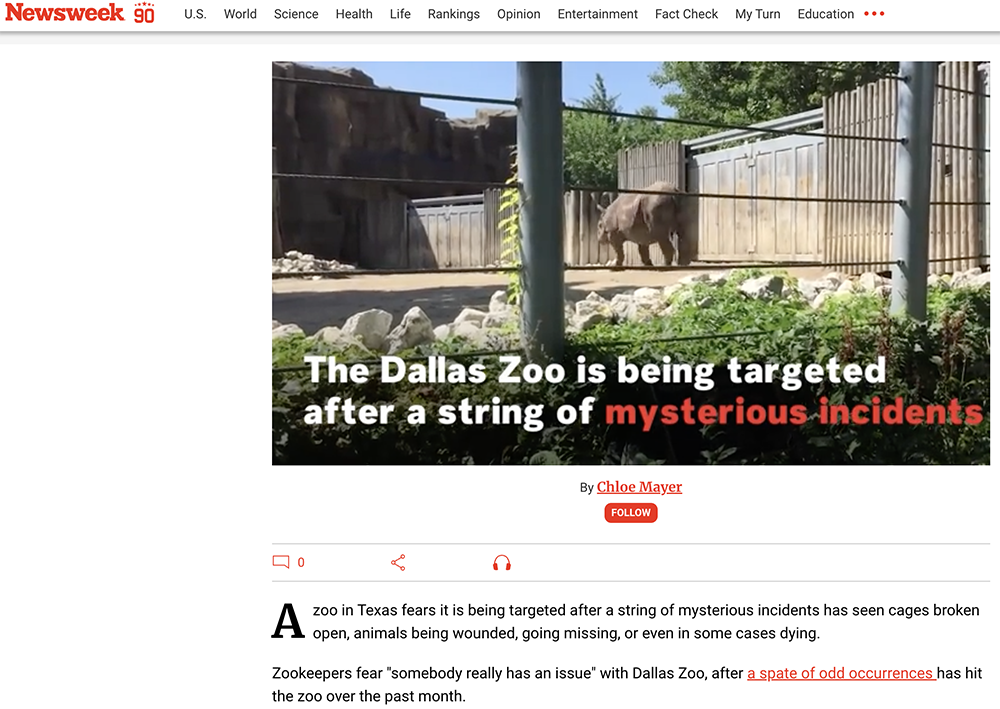
First Ben and Celestia discuss genetically modified potatoes, cougar kitties, and cocaine hippos. Then we are joined by Dr. Kristina Downs of the Texas Folklore Society to talk about a curious case that occurred in January 2023. A series of incidents at the Dallas Zoo escalated from a wandering clouded leopard to a critically endangered vulture turning up dead and a pair of kidnapped monkeys. Along the way we have parody Twitter accounts, cat humor, digs on local nuisances, and rumors of what’s REALLY going on at the zoo — in other words, folklore and conspiracy theories. Then, when the monkeys are found, we see, on a small scale, what happens when crime-solving communities online are faced with a disappointingly mundane answer to their puzzle.
0:00:00
Ben Radford: Welcome to Squaring the Strange, the podcast that examines all manner of the mysterious and the mundane through a critical lens. So let’s square the strange.
(MUSIC)
0:00:10
BR: Welcome back to Squaring the Strange. I am one of your co-hosts, as you’ve probably figured out, Ben Radford, and with me is…
Celestia Ward: Celestia Ward. How you doing, Ben?
BR: Doing good, doing good. A little, getting a little chilly around here, but doing good.
0:00:36
CW: I love the change of weather. It finally doesn’t feel like a melting furnace out here.
0:00:54
BR: Vegas is known for that.
0:00:56
CW: Yes. All right, well, we’ve got some fun stuff to talk about. A little bit of an animal theme going on here, not just in our main segment, but in our Sway Sows as well. What have we got for our main segment later on, Ben?
0:01:09
BR: So this time we’ve got a folklorist colleague of mine, Kristina Downs. She is the Executive Director of the Texas Folklore Society. And we’ll be talking to her about a topic that I actually saw her first present on in England at the Folklore Conference a few months back. So it’ll be interesting. She caught my eye. I’m like, you know, we should do a show on that. Ding!
0:01:32
CW: There’s some interesting, mysterious or not, animal disappearances at the Dallas Zoo. And before we get to that though, we’ve got some interesting things we’re a little bit skeptical of this week.
BR: What are you skeptical of?
(MUSIC)
0:01:47
CW: Well, the first thing is not something I’m really skeptical of, more like I’m happy that other people are getting a little bit less skeptical in parts of the world about a genetically modified food.
0:02:07
BR: I think you’re referring to GMOs.
0:02:10
CW: Yes, the GM Potato Project, which is not General Motors but genetically modified potato project, which has been ongoing in Nigeria, has concluded its first year and the GM potatoes have won.
0:02:27
BR: They’ve taken over. They’re in positions of power. GM potatoes have won.
0:02:31
CW: Well they beat the regular potatoes, so Iím sure everybody will put their pitchforks down and just be fine with genetically modified produce from here on out, there will be no fear mongering, everything will be peachy, well maybe not, but the results were pretty pretty clear there was a uniform yield advantage of over 300% and no fungicide was applied to these potatoes. So over the past year basically in three locations, this has been part of a five-year project operated by the Michigan State University and Feed the Future Global Biotech Potato Partnership and one of the strategic partners was the International Center for Potatoes, which I’ve always found potatoes like the word is kind of funny. So for some reason that makes me giggle, like I work for the International Center for potatoes.
0:03:28
BR: And sounds like the perfect place that just shells out shill bucks. I mean…
CW: Shill bucks and potato chips, I’d be a happy camper.
BR: There you go.
CW: Now potatoes apparently, especially in harvested. So the GM researchers were seeking a way to protect the potatoes from this blight problem and 100% of the GM potatoes showed no blight symptoms.
0:03:53
BR: So in other words, scientists sort of selectively chose different attributes based upon genetics and combined them together for this particular potato, which will hopefully yield loss of additional food, which would otherwise die on the vine or be blighted, saving many lives and improving the quality of Africans and others as well.
0:04:14
CW: Yes, you’ve basically just given a great elevator pitch for GM food. So skeptics have always kind of carried the banner for GM foods. And it’s been a hard banner to carry because there’s no business or agricultural model that’s perfect. So whenever any sort of, whenever Monsanto did something that was a little bit skeevy, it would be hard to defend them. But the article in the Nigerian Tribune which talks about this said that the farmers who participated, some of them who had a really long history of planting potatoes like 20, 30 years of planting different varieties, they were all really excited by the modified variety. They want to plant it and they’re calling for the federal government in Nigeria to go ahead and push through the regulations that would allow them to farm this commercially over there, which is good. We need pressure put on governments when they put bans on life-saving things like GM foods because they have fears that aren’t really backed up by science or evidence, but mainly superstition and fear mongering.
0:05:19
BR: Yeah, I mean, I’ve noticed over the past, probably five or 10 years, of course, we all remember, us old timers, remember, you know, all the fear. And of course, there’s still a lot these days, but it was, of course, it was much worse, you know, maybe 15, 20 years ago, when, you know, GM, Franken foods, there’s all this stuff going on. But these days, it’s not uncommon that I’ll look on the back of some food and packaging and it says, you know, made from genetically modified components. And it’s just getting more and more common. It’s just like, they’re in there. So if you’re worried about it, don’t, because you’re already eating them and you’re fine, or if you’re not fine, it’s not because of that. So people like the food babe aren’t quite as prominent as they once were, thankfully, sharing around misleading memes about how dare you eat that bread or your coffee is one step away from uranium.
0:06:12
CW: Yeah, I wonder whatever happened to Vanny Harry, the food babe. She kind of had her apex like 10 years ago and then I haven’t really seen much of her lately. Not complaining, I’m totally good with that.
BR: Probably somewhere on YouTube.
CW: Well, in other news, going from potatoes to animals, we have another cat has been mistaken for a cougar, this time in Oregon.
0:06:36
BR: Yeah, you know, as you know, cryptozoology is of course right up my alley, and I see the things and there’s the alien black cats, which we need to do a show on, primarily of course in the British Isles. But I’m always bemused by these stories. And I don’t want to spoil this, but yes, go on.
0:06:56
CW: Well, in the town of Tigard, I think that’s how you say it, Tigard, Oregon, about 10 miles outside of Portland, somebody reported seeing a mountain lion and warnings were issued by the city to beware, keep your dogs leashed up, etc., etc. Now, this was on November 16th, so just like not too long ago. And a day later, the Department of Fish and Wildlife had weighed in and cleared things up. So they were quick to hop on that. It wasn’t a mountain lion. It was an orange cat, much like yours, I think, Ben. So by November 19th, the story had gone around with the unveiling of it just being a chonky orange cat. And it showed up in some articles and it made it to late night TV monologues, etc, etc. So the video was shot at a park in Tygaard and it was, you know, an orange house cat, as I mentioned. And on Twitter, which is where these things go first, now known as X, the Department of Fish and Wildlife in Oregon said, How do we know it was a house cat, not a cougar? The video is grainy, but the number one indicator is its size compared to the tree and compost slash garbage bin. Also, the fence is likely six foot, which puts the cat at less than one foot in height. So they use context clues. Very good guys. You should get involved in the Bigfoot research. It could use some keen observers. They also went on to say that it happens more than you think. Quote, you’d be surprised how often other animals like dogs, house cats, coyotes, and bobcats are reported as cougar sightings.
0:08:39
BR: Yeah, it doesn’t surprise me at all. Of course, we’ve talked on the show previously about how badly mistaken eyewitnesses can be. Not always, of course, but oftentimes, especially when you have some animal of unknown size at unknown distance. You see something out there and in this case, of course, if it’s near a tree or a fence or something of known height, you can go investigate. But I have to wonder how many of these are actually people who sincerely think this is a mountain lion and how many of them are, you know, I think a lot of these, they’re shared around, you know, just it’s something fun to share around. They’re not necessarily, if you bet them, you said, hey, that video you just posted, I’ll bet you 50 bucks. That’s not a mountain lion. Be like, I’m not taking it, but it’s cool anyway.
0:09:28
CW: Yeah. That’s another good question. There’s a totally other way we could parse the data. But grainy film, and you can judge size by many things, but when you see it up against a tree, people sometimes think, oh, that must be a really big tree because trees come in many sizes.
0:09:46
BR: Yes, indeed.
0:09:47
CW: Well, what have you got going across your desk in terms of things you’re skeptical of this week?
0:09:52
BR: Well, another recent animal related thing was a story I came across in the New York Times and I posted it on the Facebook page, which I know not all listeners check out, but they should because it’s cool. The story was about Pablo Escobar and his hippos. Do you know that story?
0:10:09
CW: I have heard of Pablo and his hippos. It comes up every once in a while. It’s a good case in point whenever you’re thinking about moving animals to a place where they don’t have a presence.
0:10:20
BR: Yeah, well, of course, I mean, one of the categories of cryptozoology is out-of-place animals. So even though sort of the marquee monsters that people think of when they think of cryptids and cryptozoology are, you know, Bigfoot, Nessie, Mothman, Chupacabra, and so on, strictly speaking, cryptozoologists are just as interested in, or at least should be just as interested in, ordinary recognized animals that are out of places where we would expect them. So for example, you have a whale in the Thames River, for example, or, you know, someone says, oh, I saw this weird, you know, this ape, you know, in Ohio. Well, apes aren’t native to Ohio, so it’s impossible.
0:11:02
CW: I don’t know. I’ve known some guys from Ohio.
0:11:05
BR: Well, your carny friend’s accepted, but that is one of the sort of interesting parts about it. And when you have cases like this, so for those who don’t know, Escobar, of course, the notorious drug lord who was killed in 1993 very ignominiously on a rooftop. Of course, he was fabulously wealthy as drug lords tend to be. And one thing he thought would be fun would be to have his own zoo. And he put the zoo on his plantation where he had tennis courts and pools and bowling alleys and God knows what. And Escobar, a little curiosity, he imported kangaroos, giraffes, zebras and rhinos. And also hippos among other animals. Because if you got that much money, you want a rhino and a zebra, then you know what, sir, we will find you a rhino and a zebra.
0:12:03
CW: Drug lords, in addition to being known for being fabulously wealthy, aren’t really known for good conservation knowledge.
0:12:11
BR: No, that’s not their bailiwick. So as it turns out, and there’s actually a minor connection to our main feature, which is that as it turns out, many of the animals that he got were from Dallas.
CW: What is it about Texas, man?
BR: Florida man, Texas man, I’m not sure. What are you missing? So apparently in the early 80s, Escobar went to Dallas, as one does, you know, got through the border just fine apparently, and he negotiated a deal with a breeding center there. To be clear, not the Dallas Zoo, which is the subject of our main subject. Nevertheless, in Dallas, and, you know, smuggling animals from Dallas to, to, you know, the deep in the Colombian jungle is, I imagine, somewhat easier when you have your own airstrip, your own planes and things like that.
0:13:06
CW: Again, the fabulously wealthy part comes in handy.
0:13:08
BR: Yes. Anyway, at this point, of course, as you might imagine, kangaroos not being native to Columbia, many of them died from the heat and just misery and things like that. Some of them were taken off to zoos, but the most recent story that caught my eye was his hippos. So, apparently, the hippos, they were like, yeah, this is cool. I will accept your largess, sir.
0:13:38
CW: Hippos don’t give a flying fig.
0:13:41
BR: Yeah, they don’t. They don’t. So apparently there were about 170 hippos that were descended from his original herd. This is basically the invasive species type. And they’re now in Columbia. And so, again, for those who don’t know, hippos are not native to South America.
0:14:00
CW: There were only four. You said there were only four originally.
0:14:03
BR: Yeah, apparently they’re they’re very well, I don’t want to prove they’re large mammals.
0:14:08
CW: How long does it take them to breed? Because that’s from the 80s.
0:14:11
BR: I mean, apparently now there’s at least at least 150, maybe as many as 200. And the concern is that the population could grow to a thousand in the next 20 years. So and of course, the problem is anytime you have an invasive species as happens in many parts of the country and around the world of course, it poses a problem for the local ecosystem.
0:14:36
CW: Might I remind everybody, people are part of the ecosystem down there too. Hippos kill a bunch of people. They’re not friendly.
0:14:43
BR: They do. They are actually quite dangerous. I somewhat foolishly approached a hippo in the wild in Africa and I lived to tell the tale but it was not a smart move. I will admit that up front. I’ll save this story for another time but yes anyway where I’m going with this is that the Columbia government is trying to figure out what to do with all these cocaine hippos as they’re called. They’re not dying out, they’re in fact thriving so they had different ideas of culling the herd, euthanizing them, sterilizing some and maybe relocating some. So that’s on the agenda in Colombia these days, is figuring out what to do with Pablo Escobar’s hippos.
0:15:23
CW: Hippo vasectomies, yeah, it sounds like a band.
0:15:27
BR: Yeah, I’m not signing up for that team, that’s beyond my can.
CW: Yeah, even if you manage to sterilize them, how long do hippos last? You’re still gonna have this problem for decades, right?
0:15:32
BR: I don’t know.
CW: You’re not a hippo expert.
BR: No.
CW: Anyway, good luck with those. Now, moving from hippos to another interesting Dallas connected animal story. Let’s talk to Christina Downs.
(MUSIC)
0:15:48
BR: Ok, with us today is Dr. Kristina Downs, she is the Executive Director of the Texas Folklore Society and Assistant Professor of English at Tarleton State University. She and I met first in Merry Old England a couple months back. Listeners will recall that I was out there for a Contemporary Legend conference. Kristina, are you there?
0:16:29
Kristina Downs: I am here. Thanks for having me.
0:16:33
CW: So, Kristina, you are head of the Texas Folklore Society. That’s amazing. Tell us, I mean, what does the Texas Folklore Society do? What are you guys engaged in?
0:16:45
KD: So we are the oldest continually operating state folklore society in the U.S. We were founded in 1909. That’s actually a great story of our founding. We were founded by two different scholars, John Lomax and Leonidas Payne. The very Texas story, they met at a UT, Texas A&M football game on Thanksgiving and got to talking about creating a folklore society in Texas. And then they did. We’re a membership organization. Basically, our purpose is to support the study of folklore in Texas. So similar to what the American Folklore Society does on a national level, we have an annual meeting where people get together and share things that they’ve been researching on. I’d say what makes us most different from a lot of similar membership organizations is that the majority of our members are not trained folklorists. So I have a PhD in folklore. We have a few other members that have studied folklore in a more formal sense, but I would say probably at least 80% of our members are just people who really like folklore. They’re just enthusiasts.
CW: That’s encouraging. I mean, what’s your membership like? How many people are official members?
KD: I think we’re about 350 right now.
0:17:59
CW: Oh, wow. Wow. And one last question about being a folklorist in Texas. I have often said on this podcast that newsrooms need to have a folklorist in their Rolodex or you know, in their email contacts, the current equivalent of a Rolodex, just to get their opinion on various stories and rumors that make the news. My question to you is, have you ever been contacted by someone in the news to ask about a breaking story?
0:18:28
KD: I’m trying to think. I don’t think I have. I’m not about certainly not since I got here to Texas.
0:18:33
CW: Damn it, Texas. I will ask that of every folklorist we have on, but we have you on for a specific reason to talk about some animals that went missing and a convoluted story coming out of the Dallas Zoo in the early part of 2023.
BR: Definitely. So so this is this is one of those quirky things where I when I first saw this in the program, like I remember something about this. It was like it was one of those sort of weird news stories that went that sort of lasted like a week or two. And then it sort of vanished. And I read about it in the New York Times and the Smithsonian. It was this weird case of these mysteriously disappearing animals. And there was lots of questions about what happened. Had they escaped or they abducted or they saw them? All these sorts of things. And again, it was just one of the stories that I heard about and then sort of forgot about. And then all of a sudden you’re talking about this like this is really interesting. So the Dallas Zoo mystery animal theft case. For those who don’t know the story, can you sort of ease us into it and take us back to the time?
0:19:46
KD: Sure. So, it all started on January 13th, which happened to be Friday, so it was a Friday the 13th.
0:19:53
CW: Oh, perfect.
0:19:54
BR: Ominous, ominous.
0:19:55
CW: So, you were right there at ground zero. You were in Texas. Have you been to the Dallas Zoo personally?
0:20:01
KD: I haven’t. I don’t think I have anyway. If I have, it’s been as a young child because I had growing up, my aunt lived in Dallas and I know we visited her several times. And I know that my brother visited her one time with his children and took them to the Dallas Zoo. But I was not on that trip. So I may have been as a child, but I haven’t been recently.
0:20:18
CW: OK, a Texas folklorist, though, that’s perfect to have somebody of your stature in the state when this goes down?
0:20:27
KD: And, you know, I think I got a news alert about it because I’ve got, you know, as a lot of people have, some kind of app on my phone that alerts me to local news stories, which was what tipped me off, that there was something going on at the Dallas Zoo. And as a lot of us do these days, I think I immediately went to the internet to try to get more news. And there wasn’t a lot of news on our traditional news sources. The media wasn’t talking a lot about it, but there was a lot going on on Twitter. And that’s where I started following the story kind of immediately. And it really started with the Dallas Zoo just tweeting that they were closed because of a serious situation and…
BR: A mysterious, ambiguous situation.
0:21:03
CW: Right.
0:21:03
KD: And a short time later, they clarified that it was a code blue, which for them means a non-dangerous animal out of its enclosure. And then they clarified a short time after that that it was a clouded leopard.
0:21:17
CW: Leopards are non-dangerous animals now?
0:21:20
KD: Well, that was exactly how a lot of people reacted. It was sort of a, wait, since when are leopards non-dangerous animals?
0:21:29
BR: Was this like a stuffed leopard? I mean, how does one, how does it, okay, all right. So there’s already a reason to think that, I think that the seeds were planted that there may be some less than forthcoming people involved, right?
0:21:42
KD: Right. And it was, they took them about four hours to clarify what a clouded leopard is, which is that an adult female clouded leopard, which she was female, is only about 25 pounds. So it’s not what we’re thinking of when we think of a leopard.
CW: Okay, alright.
0:22:00
KD: Evidently clouded, and I’m not by any means a biologist or a zoologist, so I apologize to any who know more about this than I do if I get this mixed up, but clouded leopards are an interesting evolutionary offshoot. They’re believed to have been one of the first species to split off of whatever the ancestral cat that all cats come from, and they’re somewhere between great cats and small cats. They have some features of the smaller breeds of cats, like they can purr, and some other features, but then they have other features that are more in common with the great cats.
0:22:32
CW: Okay.
0:22:33
BR: It seems, yeah, so like when you hear, you know, cat escaped, I immediately, of course, think of a tiger, right? Right. I go to a 300 pound tiger that’s gonna rip my face off, like, well, let’s clarify, it’s actually kind of cute and may still rip your face off, I mean, let’s be very clear. But it would take its time at it.
0:22:50
CW: I’d imagine the zoo is probably interested in educating the public a little bit. I mean, zookeepers love to talk about their animals. So this is at least an educational outreach at first, right?
0:23:02
KD: And I think it was interesting watching this all happen because it took about four hours for the zoo to start posting information about what clouded leopards are. And I imagine it’s probably because their staff was really busy that day.
0:23:14
CW: Oh yeah.
0:23:15
KD: Trying to find a leopard. But in the meantime, a lot of other people were chiming in on Twitter going, okay everybody, just so you know, this is what a clouded leopard looks like. And she is adorable, by the way, Nova the Clouded Leopard. I recommend everyone look her up because she does sort of look like an animal that you want to pick up and cuddle, though I understand that would be a terrible idea.
0:23:37
BR: For many reasons. As a cat lover, I would do it anyway. I’ll confess to that right now.
0:23:42
KD: Well, I probably would too. Who am I kidding? But thankfully Noah was recovered later that night on the zoo grounds. She actually got snitched on by a squirrel. She had crawled into an empty habitat in a little cabinet and was kind of peeking her head out and there was a squirrel that was freaking out over seeing a leopard where there shouldn’t be a leopard presumably and the staff looking for Nova went wait why is that squirrel so upset and immediately found her.
0:24:12
BR: Ooh ratted out by the squirrel all right.
0:24:15
AK: They discovered in the process of searching for her that her enclosure had been deliberately cut open and they also discovered that one of the monkey habitats had been cut open but all of the monkeys were inside safe and accounted for.
0:24:27
BR: And there was or was not a really tiny squirrel-sized pair of clips?
0:24:33
KD: Not that anyone found, but you know, the squirrels are crafty. It may have been buried somewhere.
0:24:38
BR: Just wondering. Okay, go ahead.
0:24:40
KD: Then about nine days later, an endangered vulture was found deceased in its habitat.
0:24:47
CW: See, now things turn dark. I mean, it’s all funny, James, if we’re just talking about monkeys and leopards, you know, escaping in the evening for some fun on the zoo grounds. But this animal is very endangered. I mean, there’s only like, how many are in captivity? Like, it’s under, it’s like 27 in the United States, right?
0:25:02
KD: It’s small. It’s a small one. I got it in the rough top of my head, but it’s not many. They described this vulture as having a mysterious wound on it. So they believed that it had been killed by something, that it hadn’t died of natural causes, and taken in conjunction with the fact that there had been this recent case of vandalism at the zoo, people immediately started drawing connections.
0:25:27
CW: Yeah, yeah, it makes makes sense to do so.
BR: And all this wasgoing on over the course of two or three weeks so far?
KD: Right, this is less than two weeks later.
0:25:32
BR: Okay, wow, all right.
KD: And then on January 30th, so about two weeks after this all started, the two of the Emperor Tamarin monkeys were discovered missing from their enclosures. Their names are Bella and Finn.
0:25:46
CW: If anybody has not looked up what Emperor Tamarin monkeys look like, they’ve got these little white beards that very much look like the little anime versions of old Asian wizards you might see in an anime. Very, very cute little monkeys with little white beards.
0:26:03
KD: Right, they’re very cute. They were recovered, I think, two days later after a tip was given to police in an abandoned house. They were in the closet of the house. Police also found several just normal domestic cats in the house and what appeared to be feeder fish like you would use to feed large animals, you know, like a seal or something like that.
0:26:29
BR: So there was clearly they didn’t just sort of escape and happen to be there. There was somebody who had been collecting at least a couple of these, if not all of them.
KD: Correct.
BR: And so it’s my understanding that the Dallas Zoo has a, how do I put this, a bit of a history of animal escapes. I was doing a little bit of research and apparently, if I’m not mistaken, in 2014 there was a 300-pound gorilla that escaped and rampaged around and unfortunately had to be shot. Is that right?
0:27:03
KD: Yes, that’s correct. And injured several people in the process.
0:27:07
CW: That would not be a code blue.
0:27:09
KD: No.
0:27:11
CW: What do they, does anybody know what the color is, if it’s a code red, I’m assuming, if it’s a dangerous animal?
0:27:18
KD: I don’t know. That would seem logical to me. I hadn’t thought about it until several people online pointed out code blue in a medical situation means that someone’s flatlined. People saw code blue and thought it meant an animal was dead. It’s not what it means.
0:27:31
BR: Yeah, there’s a rampaging 300-pound gorilla. How do you code that?
0:27:37
KD: I don’t know.
0:27:38
BR: I think that’s self-explanatory, but anyway. So there’s a bit of a background here, right? So take us through how it went from, again, the sort of like, there was an event to there’s a leopard to, oh, by the way, this and that, and the sort of this whole, I mean, it must’ve been to people certainly living in surrounding areas and to fans of the zoo, like what the hell is going on here? Right. I mean, okay, maybe someone steals an animal, something gets loose, but there’s this sort of cascading series of events. And what were people saying?
0:28:14
KD: It was, yeah, I think it was very much a sort of what is going on. Why can’t you all get it together? Why isn’t there more security? What are you guys doing wrong? You know, and it started with, again, with just the leopard, a lot of people were just kind of amused, especially once it was verified that it was a smaller leopard and wasn’t a threat to anybody. It was sort of a, how do you lose a leopard? Like, you know, you know, I lose my keys, but how do you lose an entire leopard? And there was a lot of humor around it. And then, of course, it started seeming much more urgent when Pin the vulture was killed. And then by the time we get to this third incident, it’s sort of a, you saw a lot of tweets about, do we need to do a GoFundMe to raise some money for some cameras for you all? You know, why can’t you all figure out how to keep these animals safe? And of course, all along the zoo was saying they had increased security and they had taken all these precautions and there was a lot of doubt in that. But obviously you haven’t, or you aren’t doing it effectively.
0:29:15
CW: So there was a bit of blaming the victim here. And I mean, the real victim would be, of course, the animals who are put at risk and everything. But the zoo is being targeted by someone who is trespassing, breaking and entering, messing with the animals that live there. And it’s the zoo’s fault for not being able to stop it, according to a lot of people, I guess.
0:29:40
KD: And as I’ve said a lot of times in relation to a lot of conspiracy theories, it’s really easy for incompetence to look like a conspiracy. And I think that started to happen in this case. It was, okay, so if they say they’re taking all of these security precautions and these things keep happening, is the zoo actually complicit in this? Are there employees at the zoo that are involved in this? This has to be an inside job. Someone is either letting the thieves in or it’s an employee that’s stealing the animals or there are animal traffickers working at the zoo or there are animal rights activists working at the zoo who are setting the animals free in some misguided attempt to liberate them.
0:30:23
BR: What I find interesting about that argument is that it takes them at their word, right? Well, you told us that you’ve increased security. You told us all these things, which logically would mean that these would stop, but they keep happening. So if what you say is true, then how is this possible other than some sort of conspiracy or malice?
0:30:44
KD: Right.
CW: They did manage to get a photo eventually, right?
0:30:48
KD: They did, yes. And so they did release a photo of a young man in a hoodie on the zoo ground saying that they believed he was connected and he was actually caught. He was a 24-year-old man named Davion Irvin who was caught at the Dallas Aquarium where they believe he was plotting perhaps more animal thefts.
0:31:08
BR: And we just talked a little bit about it, but what drew you to this as a folklorist? I mean, I would be interested in it just because it’s a weird story and conspiracy theories and this and that, but what got your folklore senses tingling saying there’s something to this?
0:31:22
KD: Well, I often joke that a lot of times I get started on research projects with seeing something and going, there’s something going on here and I don’t know what it is, but it’s interesting. And then it sort of kind of develops from there. One thing that really caught me was, especially watching it all develop with Nova, the first incident, how much local humor was being employed in a lot of the social media reaction. I’m old enough to remember when folklore studies was still debating whether there was actually folklore on the internet, which nowadays I think to most of us seems like an absurd debate, but –
CW: Is there anything but folklore on the internet?
KD: Right. One of the arguments was always that the local is so integral to folklore and that the internet just kind of obliterates the local because anybody can talk to anybody at any time and therefore the local doesn’t matter. There’s been plenty of scholars that have shown actually, you know, you can trace IP addresses and show that people engage with things, you know, that where they’re located actually does connect with like what legends are they looking at or telling online.
0:32:25
CW: Well, for people who aren’t local to Dallas, which is a lot of our listenership, what would be some examples of bringing the local flavor into this story? Were people posting pictures of themselves on Twitter, taking the leopard to Whataburger or something?
0:32:42
KD: I remember one of my favorite tweets was, Nova’s been missing for about two hours, so she’s probably still in line at Whataburger. Give her another 45 minutes or so and she should be back.
CW: Oh, there was a Whataburger one. I just pulled that off the top of my head from what I remember about Dallas. Great.
KD: Yep. Whataburger definitely entered in there. There was a lot of things about, oh, she’s probably just stuck on traffic on I-35. I-35 is notoriously always under construction between Dallas and Denton. Something again that was, I think, infamous to locals is there was a McDonald’s at the Dallas Zoo that had at one point had all of this kind of jungle theming around it, and they had just renovated it and just made it look like a standard McDonald’s, which was very controversial. A lot of people were upset about it. And so that got brought up about, well, she was just mad that they ruined the McDonald’s.
0:33:31
BR: Screw you people!
CW: People are latching on to this to vent their little pet peeves about their town or their businesses.
0:33:41
KD: Right. There was another one that I remember was, so there’s an area of North Dallas called Highland Park, which is a very wealthy area and very common, targeted derision by people not from Highland Park that are also from the Dallas area. So it’s sort of the place everyone loves to hit on. And there was a thing about, well nobody knows where the leopard is, but if it was a cougar she definitely would have been in her natural habitat in Highland Park.
0:34:07
CW: Oh, okay.
0:34:08
BR: Yeah, so you sort of touched on it before, but just if you could sort of take us through and do a little deeper dive on what some of the suspects were, ranging from, you know, again, PETA activists to, I know that for example, Texas and other places are known for having lots of exotic animals. You know, every now and then there’s a news story. It’s either Florida or Texas, you know, with all due respect. And it’s like, you know, Florida, Texas guy has, you know, 15 rhinos in his backyard. So there’s a sort of broader context here. But what were some of the main suspects in these, other than, of course, the guy that was eventually arrested?
0:34:49
KD: As I said, animal rights activists, I think one of the immediate targets I saw was, oh, it’s PETA or it’s animal rights activists specifically. I guess there had been some sort of PETA event in Dallas fairly recently and so it was sort of a, well, people were drawing connections there or just generally saying, well, they oppose zoos and they don’t care if they injure humans in the first place as collateral damage and freeing the animals. And even with the death of the vulture, there were a lot of, well, you know, they’ve been known to euthanize animals because they think it’s better than being enslaved.
0:35:21
CW: And in fairness, PETA has done some pretty bizarre stuff in the past.
0:35:27
KD: Right. The main thing about PETA is that they’re usually pretty open about claiming responsibility when they do something. And there, of course, was no comment from them on this. So for me, that’s the example that doesn’t really make sense as an explanation. I think probably the next biggest explanation people were offering up was animal trafficking. So yes, that it was either for someone in Texas or someone else. It wasn’t really specified where these animals were going, but just sort of animal trafficking. We know this is a big part of the crime world. And so it must be animal traffickers.
0:35:54
CW: Animal traffiking, I swear that’s a whole category of media stories about animal trafficking where somebody is caught on an airplane with like eight ferrets in his pants or pythons or what was it? Some kind of there was some kind of bird like parakeets or something. Some fella had stuffed dozens and dozens into his clothing at some point to get on a Greyhound bus or something. You guys have heard these stories, right? It’s like right up there with what Florida Man does.
0:36:30
KD: And very much similar to this, the animal trafficking story has kind of run the gamut from being comical to tragic.
0:36:37
CW: Yeah, yeah. There’s an edge of like, oh, there’s animal cruelty going on, but also how many budgies did you have in your pants? You know, kind of just ridiculous stuff. And speaking of Florida Man and animal trafficking, this, you know, we’re still all kind of coming off of that cultural wave of tiger king at this point.
0:36:58
KD: This got referenced a lot. There was a lot of, has anyone checked with Carole Baskin?
0:37:01
CW: Yeah, yeah.
0:37:02
KD: It was being used a lot in the meme. Someone’s creating their own tiger king and Texas does have fairly lax, not the laxest, but our laws related to exotic animals, you do have to have a permit for a dangerous animal. Of course, none of these would qualify as a dangerous animal, I don’t think. We do, you know, in my town or the town next to mine, just a couple months ago, we had a whole thing where there was a kangaroo that had gone missing from someone’s yard, because they were keeping a kangaroo as a pet and it escaped. It was found safe and it’s been returned to its owner and it’s okay.
0:37:37
CW: They were legally keeping a kangaroo as a pet.
0:37:41
KD: Well, it’s illegal to breed them, but it was the animal was neutered. It’s not a dangerous animal.
0:37:47
BR: Hold on, hold on. How I’m trying to do the math. How many wild female or male kangaroos are they going to be?
0:37:58
CW: Are you are you thinking that the kangaroo was neutered so that it did not encounter a stray kangaroo?
0:38:03
BR: Yes, that’s my assumption. I’m not too bright.
0:38:05
KD: I mean, I’m not sure, but you know, you do hear about, there’s the Pablo Escobar’s hippos in Colombia.
0:38:12
BR: That’s right.
0:38:15
CW: See, I’m thinking kangaroos are big. I mean, wallabies are really tiny and cute, but I’ve seen kangaroos close up. They grabbed my friend’s jacket and they can be aggressive. And I’d imagine if neutering will calm them down, especially if it’s a male kangaroo.
0:38:30
BR: That would piss them off, man. I mean, I would not, I don’t, I’ve never, I’ve never been in front of a kangaroo other than a zoo, but I’m not, I’m not going anywhere near anything that dangls. Even I know that.
0:38:44
CW: If I was going to have a male kangaroo as a pet, I’d rather he be gelded. Thank you very much.
0:38:51
BR: In your suburb of Las Vegas.
0:38:53
CW: And we’ve got some exotic pets down here too. There are also stories I could tell you about Sigmund Freud’s house. But as far as the local flavor in Texas, in Northern Texas about all this. So is it pretty popular to hear stories about escaped exotic pets or animal trafficking rings being broken up or whatnot?
0:39:15
KD: I don’t think so. I certainly haven’t heard a lot about it. Like I said, there are things that happen like there is a kangaroo near me. Actually, last weekend I was, a weekend before last, I was at a paranormal festival in San Antonio and there was someone walking around with a baby kangaroo in a pouch on her chest. Like it was in a baby bjorn kind of thing.
0:39:38
BR: Like a support animal or just for fun?
0:39:42
KD: I think it was just that it was not able to be left alone for the hour she was going to be gone. And so it was just to keep it occupied. I’m not quite sure.
0:39:51
CW: So as people speculated as to who was responsible for these various crimes, the killing of the vulture and the attempted escape and theft of the other animals. Did it ever get political that you saw? I mean, I mean, how how are people expressing themselves besides the humorous memes, but besides the, oh, the leopard is in line at at Whataburger or is stuck in traffic or something? You know, how serious did things get with people speculating?
0:40:20
KD: Well, so in terms of political, there was a lot of political humor that you saw, especially there were a lot of side by side images of Marjorie Taylor Greene and Emperor Tamarin Monkey saying, oh, I think I found out where the Dallas monkeys went.
0:40:33
CW: Oh, man.
0:40:34
KD: There were several comparisons of the vulture to Nancy Pelosi.
0:40:38
CW: Oh, okay.
KD: And actually, when the vulture was killed, it was something about, does anyone know where Don Jr. is? Is this his latest hunting expedition? So, there were a lot of kind of pre-existing political tensions that got brought up in this. So, it wasn’t so much that this case itself was really politicized as this became a way to get out the political views and humor that was already there.
0:41:09
BR: So, reframing them with the current, the current it topic.
0:41:14
KD: Yeah, well, I mean, you can politicize anything these days and the examples you mentioned, the templates are already there. I mean, you’ve seen the meme over and over with the photograph of Lauren Boebert, I believe it is, and Marjorie Taylor Greene, where they’ve got their mouths open and it’s very similar to a photo of other primates like howling and everything. And that’s become well known enough where it’s easy to just, oh, there’s a story about a monkey. Boom, got a joke right here.
0:41:45
KD: Yes.
0:41:46
BR: Well, you know what jumped out at me in hearing your talk and also sort of doing some more background on it was the way that animal deaths can be and have been misinterpreted as intentional mutilations. When I was doing my research on chupacabra, for example, and of course, there’s a whole sub-genre of the, you know, Paranormally Explained topics that are talking about animal mutilations. So, you’ve got, you know, some animals or deer that are killed somewhere, and, you know, sometimes there’s claims about the soft parts have been excised. The phrase surgical precision keeps coming up, and I don’t think they really know what that means. But anyway, what I find interesting is that typically, you know, people see something weird or what they think is weird. Often because they’re not experts on animal predation. So they they assume that well this this couldn’t have been a wolf or a canid. It must be a chupacabra or it must be a satanist or cults or aliens or you know, what have you. And I just find it interesting where, again, you have what’s ostensibly the same phenomenon, the same dead cow, that depending on the time and the context, whether it’s 1990s Texas or 1980s New Mexico or Puerto Rico, it’s obviously the result of chupacabras, obviously satanic cults that are doing these sacrifices. And so that sort of jumped out at me in terms of the people leaping to, you know, these sort of these hidden, hidden causes, conspiracies.
0:43:20
CW: Yeah, that raises two questions for me. And the first one is, Kristina, were there any that you know of, were there any rumors that this was done by Satanists who wanted to sacrifice animals from the zoo?
0:43:34
KD: I didn’t hear any rumors of that. What I did hear, which I think might be the modern day equivalent was, I wonder if this is a TikTok challenge.
0:43:43
CW: Oh, interesting. Okay, a TikTok challenge. Because yeah, that would implicate a number of people. Like it could have been each cut enclosure could have been from a different TikToker.
0:43:55
KD: Right, that maybe there’s some kind of thing going around that the kids are doing on the internet where they’re, you know.
0:44:01
CW: Oh, that’s interesting. Bring that into Wow. Okay. And the other question I had that that raised was, the zoo described it as a wound, correct?
KD: Correct.
CW: The vulture, the vulture Paris because of a wound. And they didn’t specify like, they didn’t use the word puncture or laceration. It was just a wound. And I wonder if I mean, I mean, the zoo, you expect them to have experts. They have veterinarians and zookeepers and staff members who know the animals, who know the dangers, who know, you know, a horse can fall down backwards and break its own leg. And zookeepers and people who tend horses know that. I’m wondering why the zoo didn’t describe it in more detail or have some sort of ready-made explanation if they knew what had caused it. Or if they didn’t know what had caused it, why weren’t they more clear in explaining this was not something that happened to the animal from another animal in the enclosure or on its own? Like this was human interference.
0:45:09
KD: And they did, I forget exactly what the language they used, but they did hint that they believed it must have been human-caused, that it couldn’t have been caused by another animal that could have interacted with the vulture. And again, I can’t remember exactly the language that they used on that. What’s interesting is that, to my knowledge, they have never released what they believe was the cause of death for the vulture, because they have not actually charged Davion Ervin in conjunction with the vulture’s death, and they have said they don’t believe he was involved.
0:45:38
CW: Interesting. Yeah, so because initially everybody was thinking this is all the same person or in the case of a TikTok challenge, the same phenomenon, but they might be two unrelated cases. And Ben, you recall there, you know, this, if the zoo experts were misinterpreting what was an accident that killed the vulture, it wouldn’t be the first time.
0:46:00
BR: Yeah, yeah. I was, I remember I wrote a piece about this. There was a case here in Albuquerque at the Albuquerque Zoo. In October 2014, there was a Tasmanian devil called Jasper that was found dead under a log in his enclosure. Clearly, this story was being framed that somebody, somebody, you know, got in and killed this animal. And Jasper was just so cute. I mean, Tasmanian devil, just adorable, and he was on loan from a sanctuary in Australia as part of a sort of animal exchange effort and to try and start a breeding program with endangered species. And because it happened in October, I remember clearly when I was listening to the local news, within a couple days, there were people talking about, well, does it have something to do with Halloween? You know, Halloween’s coming up. And then of course, Halloween and Satanists, and you get the whole annual, you know.
0:46:58
KD: Always, yeah.
0:46:59
BR: Yeah, you get that. And so, and of course, as a folklorist and someone who’s researched this, I’m trying to, you know, I mean, if people ask me, I will, you know, as I have for years, explain, well, sit down. Halloween’s not satanic. It’s a, yes, I win, you have to do the whole thing. But so I was doing my best to sort of, you know, try to tamp down the fears. But what was interesting, so again, it made national news after a day or two because it was this horrific case. And you know, and once again, like in the Dallas Zoo case, they added more guards and more surveillance cameras and they offered a $5,000 reward for information. And when the animal, when Jasper was examined, it was determined he died from a fractured skull and brain trauma. And again, he was found with a piece of asphalt nearby. And so the question is, well, first of all, who would do this to this adorable little Tasmanian devil animal that never hurt anybody? And the other question is, how did they even do that? I mean, there was no evidence of anybody getting into the enclosure. Again, there’s a piece of asphalt nearby, but I mean, where did it come from, this and that? Anyway, eventually they hired a private investigator and I read the report and it turned out that in fact Jasper, it was an accident. So there was no evil, sadistic person or people trying to hurt Jasper and other animals. It was an accident. He flipped over and, you know, a freak accident to be sure, but there was never any evidence that anybody, you know, intentionally harmed him or tried to climb in. But anyway, it was interesting sort of seeing how that whole story sort of unfolded in real time. And once again, you have this sort of the scapegoating and othering, right? It’s Satanist, it’s some sadist at the zoo, it’s this and that. And in the end, you know, it was just a sad accident. So that sort of jumped out at me.
0:48:52
KD: That’s interesting. I think it’s really hard for us, I think, sometimes to accept the randomness of things like that, that things can happen. You see this with, you know, deaths of humans as well, you know, when someone dies in a kind of strange way. Well, there’s got to be more to it, and sometimes there tragically isn’t. It’s just a thing that happens.
0:49:11
BR: Yeah. In fact, the other case that this Dallas story brought to mind was the case of the missing Asian woman in the Cecil Hotel, which you may have heard about.
0:49:24
KD: Melissa Lam.
BR: Yeah, Melissa Lam. She went up there and she ended up climbing into this, probably suffering some sort of mental distress or psychotic break, and went swimming in this water tower and then no one found her and then eventually they were drinking the water. It was this whole creepy story. But meanwhile, there was all these suspicions and conspiracies and there were videotapes, there were edited clips that the public were being shown, and this huge conspiracy that emerged out of it. And this is all the way leading up to, in addition to the sort of random people liking and sharing conspiracies. Was there in this particular case, more of a sort of a true crime element of sort of armchair sleuths who were trying to solve the case?
0:50:11
KD: There definitely was. You saw on a lot of like subreddits, people posting, and it was very, as a folklorist, it was sort of, oh, this is absolutely my, my field, right? A lot of friend of a friend kind of thing. Well, I heard from somebody I know that works at the zoo that they treat their employees really terribly and this might be an employee who wants revenge against the zoo.
CW: Oh, okay.
KD: You know, I heard from somebody who works at the zoo that it’s definitely an inside job and they don’t know much yet, but they think it might be connected with animal trafficking. There was a series of tweets about someone claiming to be the hairdresser that worked with someone at the zoo and they had told her that, you know, I’ve gotten her all the tea.
CW: Cuz you’re going to tell your hairdresser about an extremely illegal activity.
0:50:59
KD: Right, exactly. That’s how these things go.
0:51:03
CW: Well, I mean, there was so much feeling and nervousness and concern. And the stories that I browsed over this, because I remember, you know, when it happened earlier in 2023, but I did a quick perusal just to refresh myself and people were following it like tooth and nail, no pun intended there, in terms of just, OK, here’s the breakdown. And journalists would do timelines of what happened when and a map of the zoo for where each incident occurred. It reminded me that people in general, the public, the news-consuming public, can often get way more emotionally invested in animal victims than they do human victims. Did you notice anything about that?
0:51:52
KD: Yeah, it’s interesting, you know, another thing I didn’t really talk about, but I saw especially with Nova’s escape, the clouded leopard, was and I think this kind of connects with the Texas folklore as well and Texas culture is things that were gun related. There’s a lot of, if anyone shoots that leopard, I’m going to be really upset. They better hope that the zoo staff find the leopard because all those Texans are all excited to hear it’s leopard season. But one of the kind of darkest ones, it was humorous, but also like very dark undercurrent of humor was, I hope they find the that missing leopard before a Dallas cop shoots it.
0:52:34
CW: Again, sort of political there. Yeah.
0:52:35
KD: Right. Very clear framing this in terms of police shooting of unarmed civilians, often unarmed civilians of color. And again, that connection of animals to, I mean, we can take that in a lot of different directions. You can see that as derogatory, but also you can also see that as, you know, sympathetic and interesting.
0:52:56
CW: Yeah. And one of my thoughts was if they catch this person and put them in jail and in prison, you know, oh, what are you in for? Well, I kidnapped two little monkeys from the zoo. And I can imagine things going very badly for that person in prison. Right. Hypothetically, that is to say, because we’ll get to that soon. But how did this become a federal case? And what exactly happened to solve the case, or at least partially solve the case?
0:53:24
KD: Right. So, you know, you’re dealing with endangered animals here, you’re dealing with animal trafficking. So these are things that are both very serious and also kind of worldwide issues or at least nationwide issues and so this is where you had the FBI getting involved and not clear to exactly what extent looking into the case.
BR: It wasn’t just a local cop looking it was it was the SWAT teams this is a big deal.
KD: Right like you said it’s being written up and all of these national publications it was it was I just glanced at some statistics and I haven’t vetted these, so take them for what they are. It’s on the internet so I’m sure it’s 100% accurate. But I have to say that animal trafficking is a $10 billion a year industry, which I don’t actually have a hard time believing. It seems plausible. I won’t vouch that that’s exactly accurate. But the other thing that goes along with this, and of course we see this with the lappet-faced vultures are highly endangered, clouded leopards are not endangered, I think they’re listed as threatened, but there’s a small wild population and animal trafficking has exacerbated a lot of these problems related to endangered and threatened species. And so it’s a really serious issue. It’s not just, oh, somebody wants to have a cute monkey as a pet.
0:54:45
BR: Well, let me circle back for a second to something that I remember you mentioned in your talk, which was speaking of engagement and the reactions on social media. There was at least two parody accounts, right? Wasn’t there including like Nova the Leopard? What was going on with that?
0:55:06
KD: Yeah, so there were at least two Twitter accounts claiming to be from Nova.
0:55:10
BR: The missing leopard.
0:55:12
KD: Yes.
0:55:13
RD: Okay.
0:55:14
KD: It’s funny because I saw a tweet, first of all, that said, I’m really disappointed in the internet. Why isn’t there a Nova the Leopard out on the town Twitter account yet? Because we’ve seen this with other things. There was a python that escaped from a zoo in, I think, Florida or Louisiana. I think it might have been Louisiana that had a whole Twitter account for a while. And there were some zebras in Maryland.
0:55:40
CW: And then there’s of course Devin Nunez’s cow. That got very politically famous as an animal parody account.
0:55:48
KD: I didn’t know about that one.
0:55:49
CW: Oh, apparently he, Devin Nunez, a congressman had claimed all this land for, said he had a farm, but he actually didn’t have a farm. He had like 10 foot by 10 foot or something. Somebody started an account claiming to be a cow owned by Devin Nunez.
0:56:05
KD: Oh, that’s great.
0:56:05
CW: Look into it. There’s a whole lot of it. Apparently, Devin Nunez sued the parody account owner. But that’s another story for another day. That is one thing I will really miss about Twitter once it’s completely immolated is the parody accounts can be so fun.
0:56:17
KD: Yes, and hopefully these will take off on other social media platforms because what was great about the two different Nova accounts was they were polar opposite personalities. So one of them was very much in this kind of frame of Nova’s an adorable curious cat, right? And she’s, I think the worst, like most aggressive thing she tweeted was something about like, did you guys know that there’s a whole pond here at the zoo stocked with waterfowl?
0:56:52
CW: Yeah.
0:56:53
KD: All you can eat buffet.
CW: Oh, this is a wholesome. It’s the wholesome account.
0:57:00
KD: Right. It was very wholesome. It was, you know, and then like, I saw a place that was called restroom, and I thought I would go in there and take a nap. And that is not what that means. Humans are disgusting.
CW: What was the other one like?
KD: So the other one was very aggressive. I think all of its tweets are all in caps. And it has a, as best I can tell, fictional and I hope fictional zookeeper named Wendy that she targeted a lot of her tweets at. And you know, like, Hey, Wendy, what did the leopard say when you left her cage door open? Nothing, because I was already halfway to Mexico. And, you know,
BR: Screw you, Wendy!
0:57:40
KD: Yeah, there was a lot of that. And even when she was recaptured, there was a lot, you know, there was a, the zoo had put out a tweet that said Nova’s happy back in her habitat with her sister. And it retweeted that with lies and propaganda! I don’t even have a sister!
CW: Okay, a folklorist question here. categorize a parody account in the name of an escaped animal or cryptid or Curiosity Rover or any of those as ostention?
KD: Hmm.
CW: Because you’re putting voice to something.
KD: I mean, right.
CW: You’re not actively walking around and doing something, but you’re tweeting something.
BR: Part of a pre-existing narrative. Maybe? I don’t know. What do you think, Kristina?
KD: I think it’s an interesting idea. I’m not fully convinced, but I need to think it through more. I could see it maybe going in that direction. I think that, you know, there’s not, there’s a, you know, kind of an assuming a role and an association with, so I, okay, as I’m thinking through this all out loud, I think some of them would be, I don’t know that the Nova accounts would, but I think some of these, you know, maybe more so like the Devin Nunez’s cow where the cow doesn’t even actually exist, right? It’s part of a legend complex. So you are kind of enacting a legend there, whereas… Good point.
0:59:01
CW: The leopard existed and does exist, yeah.
0:59:04
KD: Right. I don’t know where the enactment of a legend or enactment of a narrative thing would come in there, but…
0:59:10
BR: Well, we did an episode a while back on legend tripping, so listeners can cycle back to that.
0:59:17
CW: And ever since that episode, everything I look at, I’m like, is that ostention? I bet that’s ostention. Look at those furries over there. That’s ostention, you know.
0:59:25
KD: So, I don’t want to go too off topic, but I have – it’s a very folklorist moment. Many years ago, while I was in graduate school, I’d been hanging out with some friends, and I left to drive home pretty late at night. I think it was like about 2 o’clock in the morning. And as I’m driving, I all of a sudden realize that my car smells overwhelmingly like a man’s cologne and there’s no reason my car should smell like a man’s cologne.
0:59:46
CW: Oh.
0:59:46
KD: And I become convinced as I’m driving that there must be a male hiding somewhere in my car.
0:59:52
CW: Oh.
0:59:53
KD: Because why else would my car smell like this? And I’m of course driving down a narrow wooded road. I can’t turn around and check and I don’t want to pull over because if there is somebody in my car, the last thing I want to do is pull over in a deserted area, right?
1:00:04
BR: Right.
1:00:05
KD: I’m getting progressively more worked up about this. And at some point, I don’t know why I brought my hands close to my face and realized it was actually the soap from my friend’s house that smelled like Men’s Cologne.
1:00:15
BR: You had a whole story around that.
1:00:18
KD: I absolutely had, like, totally. And I texted my friend, who was also a folklorist, about this when I got home and he was like this may not be what you want to hear right now but that’s a perfect example of quasi ostention.
1:00:32
CW: Quasi ostention… Nobody’s immune!
1:00:42
BR: And you did or did not pick up a hitchhiker along the way?
1:00:49
KD: I did not.
1:00:50
BR: Okay, I just was checking.
1:00:52
CW: Okay, speaking of people hitchhiking here, let’s talk about the animals that kind of got off zoo property and found their way elsewhere or were absconded with. So just to go through the timeline here and the animals. First, we had Nova, the cloud leopard, that was missing for, it was only a matter of hours before they retrieved her, correct?
1:01:17
KD: Right, I think it was something in the neighborhood of 12 hours, it was somewhere around there.
1:01:20
CW: And she was found on zoo property, correct?
1:01:23
KD: That’s correct.
1:01:24
BR: Ratted out by a squirrel, which I just love that part.
1:01:26
CW: So that could have been a one and done situation, but then they found the rips in a different monkey enclosure. However, none of the monkeys were missing, so it was just vandalism at that point, not actual monkey napping.
1:01:42
BR: There was monkey business afoot, let’s be clear.
1:01:46
CW: And then a matter of two weeks or so passed, and we have a dead vulture, which is very serious, very endangered species. And then a little bit more time passes, and two monkeys go missing off property. Their enclosure has been slashed open, just like the other ones. And these monkeys are found off property. So tell us how they were retrieved, how the police found this fellow, and what did he say about it? And what was the public response?
1:02:14
KD: So the monkeys were found in a closet in an abandoned house that was on a church property. I think it may have been maybe a former parsonage or something like that. It’s hard to piece together. Some news reports say that they were found in an abandoned church, but from what I can tell, the building they were found in was a church, was a house. And they did find security, or they released security camera footage of a man they believed to be connected and were quickly able to, based on public response, find this man, Davion Ervin, who confessed and admitted that he was behind the attempted abduction of Nova and also the abduction of the monkeys. He said that he didn’t have anything to do with the death of the vulture and he has not been charged in that association or in association with that. One of the most fascinating parts of his story is the fact that he was using our light rail system, the dart trains, to get to and from the zoo and that he in fact took the monkeys home on the dart train.
CW: I mean, nobody noticed that?
KD: Apparently nobody noticed the guy with the two monkeys on the dart train late at night. Or they noticed it, we’re just like, what else?
CW: You could you could use a duffel bag or a backpack or something. These are not huge monkeys, but still your backpack would be jumping around and making sounds I’d imagine.
KD: You would think. But there were a lot of jokes, you know, about, I didn’t have turnstile jumping monkeys on my bingo card for 2023.
1:03:43
CW: Yeah, and people love complaining about their public transport system. So I’m sure there were a bunch of Dart memes that went around.
1:03:52
KD: There’s a lot of questions like, you know, when there were headlines that said something like, monkeys rode the Dart train and it was like, wait, you know, with the guy that kidnapped them or are they just latch key kids now?
1:04:04
CW: Yeah. Oh, geez. Now, now, this fellow is not quite he’s not quite competent to stand trial. I actually looked it up. And as of just August 30, he was found incompetent to stand trial. So although he was indicted on a bunch of counts of animal cruelty and such, we’re not going to see any, you know, big public trial or sentencing or anything like that. So he doesn’t have to worry about going to prison. He’ll just be getting some mental care. But what what was the public reaction to this fellow being I mean was was he suspected of being an animal trafficker? Or was he automatically judged by the public to be okay, this guy’s got a screw loose.
1:04:42
KD: It was mixed. So you did see some of the somethings that were a little more sympathetic towards him and the this guy’s obviously suffering from some kind of mental illness, you know, because he said very, he was very direct with the police that questioned him and said, if you let me go, I will steal more animals.
CW: Yeah, and he’s like, I’m going to do it again. Yeah, like animals.
KD: Yep. Yeah, he said, I just like animals. I just wanted them to be pets. He had said that he, with Nova, that he was able to pet her, but that she jumped out of his reach before he was able to grab her.
CW: I’ve got this cartoon dialogue running through my head. I’ll pet him and hug him and call him George, you know.
KD: And there was some sympathy towards him from some people. There was, unfortunately but predictably, there were a fair number of racist reactions in regard to him being a young black man and a lot of really disgusting humor comparing him to a monkey and saying, well, maybe they were family members.
1:05:39
CW: Oh, that’s, that’s disappointing.
1:05:41
KD: And, and worse things that I don’t really want to repeat.
CW: As a folklorist, you have to trudge through the worst of the worst, don’t you?
KD: Right, you do. And it’s often one of those things like, I don’t want to have to talk about this part, but I can’t not talk about this part because it would be dishonest to just leave that out. There was a lot of suspicion that this couldn’t possibly be the correct answer, that either he was kind of a patsy, that this was being pinned on him. And he wasn’t really involved, because this just doesn’t make any sense, that this could just be some 24 year old, housing insecure young man, that seems to be perhaps mentally ill. People just seemed hesitant to believe that. So either he was a patsy or there was something going on behind the scenes.
1:06:34
CW: It was built up so much that they couldn’t handle an ordinary answer.
1:06:39
KD: Right. And I think a lot of my research deals with online crime solving communities. And that’s a thing you see a lot, that there’s this tendency to, I always say they tend to hear hoofbeats and think zebras when they should be thinking horses. That often you get these really complex narratives that get built in these online crime solving communities. And then when the truth comes out, it’s usually pretty mundane. Sometimes you’ll see people that have a hard time accepting that, that it’s no, it has to be more than that. It can’t just be that it was a guy that liked animals that managed to get past all of the security at the Dallas Zoo and then also take the animals home on the DART train. There’s got to be more to it.
1:07:20
BR: A little too mundane for people.
1:07:23
CW: Well has there been some sort of longevity with that? I mean have you seen any instances of suspicions still being cast at the Dallas Zoo like oh yeah they’re run by a bunch of criminals and they’re selling their own animals and careful, you know, they shouldn’t be funded anymore. And I’m just, you know, reaching here but wondering if something like that is quickly forgotten or if reverberations continue even months and months afterwards.
1:07:51
KD: I haven’t seen much in the way of recent discourse on it. I’ll be honest, I haven’t looked in a couple of months, but I’ve looked, you know, by the most recent time I looked, things had really died down. I think where we’ll see it is the next time anything at all happens at the Dallas Zoo, and it could be completely unrelated.
CW: Oh, yeah. It’ll be, yeah, this will be part of the record.
1:08:10
KD: Right.
1:08:11
BR: Maybe Nova will start tweeting again.
KD: Well, and you know, the aggressive Nova account, the really angry one, continued tweeting for quite a while after she was recaptured. I think one of my favorite tweets from her was on Valentine’s Day. It was, you know, Roses are red, Rose is trendy, I’m escaping tonight, go to hell Wendy.
1:08:36
CW: I’m liking this tweet account and I kind of want Wendy from the Wendy’s chain of restaurants to have some sort of Twitter war with her.
1:08:52
KD: That would be entertaining. We can only hope if we’re really good, maybe the Internet will give us that.
1:08:58
BR: So what stood out to you the most about about the memes, especially the cat memes?
1:09:03
KD: Sort of the way that Nova, though, you know, there had been this debate, especially when she was first reported to be a state about whether a leopard qualifies as a dangerous animal and all of that sort of thing. But she very quickly kind of got framed in everybody’s minds as just a kitty cat. You know, she’s just a house cat. She’s cute and cuddly and people started tweeting, you know, things to the zoo about with advice for how to recapture her. So it’s like, you know, have you tried sending out a cardboard box?
CW: Have you tried pstpstpstpst?
KD: That was one that I saw a lot of, you know. What about shaking the treat bag really loudly? And a lot of those kinds of things. And then a lot of people joking about wanting to adopt her.
CW: Cat humor is just never-ending. It’s always, always a well you can go to.
KD: There’s a meme that’s been around for a long time that says, if I’m ever killed by a mountain lion, just know that my last words were, here kitty, kitty. Crossed out mountain lion with clouded leopard.
1:10:04
CW: Oh, great.
1:10:06
KD: There was a lot of, you know, and then like there’s another one that goes around a lot of a large leopard, what we think of with a leopard curled up in a tiny cardboard box with the if I fits, I sits kind of thing.
1:10:18
CW: Those are funnier if it’s a larger leopard, but…
1:10:21
KD: They are.
1:10:23
BR: And probably valid. I mean as a lifelong cat owner or host, you know, that’s that’s that’s what I would do I mean, I’m trying to be helpful here.
1:10:32
CW: Did you just describe yourself as a cat host?
BR: I’ve hosted cats. Yes, and I’m wondering if what water is Celeste you don’t have any cats you have a dog I had a cat.
CW: But the use of the word host makes me wonder if you’re referring to your cat as a guest or a parasite.
1:10:53
KD: Either way sort of works. We’ll tell them A, we’ll tell them B.
1:10:57
BR: Take your pick. Well, this has been super cool. Thank you for coming on. This is, you know, like I said, when I first met you and heard you talk about this in England, I’m like, this is interesting. This is worth talking more about. So thank you for coming on and sharing your research with us.
1:11:16
KD: Thank you so much for having me. This was a lot of fun.
1:11:18
CW: Yeah, this is just like Ben to go completely across the Atlantic Ocean to talk to somebody in his neighboring state about folklore. Now, do you have a website or any sort of social media accounts that people can follow if they want to get more in touch with Texas folklore?
1:11:35
KD: So you can find the Texas Folklore Society at texasfolkloresociety.org is our website. We have a really active Facebook page that posts a lot about different folklore throughout the state, different events that are folklore related that are going on in the state. We have a lot of local areas that have local folklife festivals or just local cultural events related to ethnic groups in the area or this and that. You can find also the Texas Folklore Society on Twitter. We’re just at Texas Folklore Society. And you can find me on Twitter at at Leaping Princess.
1:12:11
CW: Cool.
1:12:12
KD: Screen name I came up with years ago when I was trying to be anonymous on Twitter. I just never went around to changing.
CW: Well, after X or Twitter burns more to the ground, you can be anonymous again on whatever new thing replaces it. All right. Well, it has been a pleasure and a nice conversation. Thanks for bringing all the cat humor and the observations on this bizarre little occurrence in Dallas.
1:12:37
KD: Thank you.
(MUSIC)
1:12:38
CW: Well, once again, Ben, thank you for bringing your folklore friends. I always appreciate that. My pleasure. Now, I’m excited about next episode.
1:12:52
BR: We’re going to be talking about something a little bit, tiny bit grisly, but very also moral panicky, the absinthe murders, and the absinthe moral panic, which is somewhat well known.
CW: I mean, you can find a lot of stuff on the absinthe panic. And of course, being a Vegas person, I have a few connections. I happen to know the Green Fairy herself, who performs at absinthe in Caesar’s Palace every night. So that’ll be fun. That’ll be in two weeks time, you’ll hear us talking about that. In the meantime, we wanted to also throw out a reminder. If you’re not supporting us on Patreon, we don’t hate you, we still love you. But the holidays are coming up and if you’re looking for something nice to give Squaring the Strange, a couple of bucks would be fantastic. You can go on patreon.com and look up Squaring the Strange podcast. And you can click on any of our options and we can send you some swag. Yeah, and again, we Love and appreciate all our listeners and the support we’ve been going on What five years now? Yeah, we’re not one of the the Apex predator podcasts out there. We’re we’re humming along kind of bottom-feeding a little bit
1:14:18
CW: Little under the radar. We appreciate listeners
1:14:21
BR: But yeah, if you if you like what we do and you like the message that we’re trying to send out there, you could throw us a couple of bucks. We’d appreciate it.
1:14:32
CW: Yeah, it helps us keep the lights on here. And you can always review us on any of your podcast dispensers or tell a couple of friends about us and pick your favorite episode and forward it to somebody. That helps us get more views, helps us get more visibility. And yeah, just that’s how podcasts grow. Plus, I’m feeling just warm and fuzzy and grateful. I tend to get that way around the holidays. Thank you one and all for the support you’ve given us and the thumbs up and the joining of the podcast discussion group. Click on there. There’s some fun stuff that pops out every once in a while. And I’m, I’m actually going to be starting to draw my batch of Krampuses. I’m sending those out to the, the skeptic patrons are going to get Krampuses this month.
1:15:15
Very cool.
1:15:16
All right, everybody. Well, we’ll see you next time. Until then, everybody, take care.
1:15:22
Bye-bye.
1:15:24
We would like to extend heartfelt thanks to our top tier sponsor level patrons, Amy Frusciauer-Kelley, Dr. Angela Matkey, Elizabeth Leggett, and Laura Ellis. Thank you for your continued support of our podcast. If you’re interested in becoming a sponsor, or just throwing us a buck or two, please visit Squaring the Strange on Patreon.com and browse our selection of patron rewards. Every bit helps us keep the lights on here, and we are grateful to our generous friends who help us bring you quality content. If you are short on cash and want to just give us moral support, remember to recommend us to a friend. Mention us on social media or give us a review on your favorite podcast dispenser. If you have comments or topics you’d like to see covered, come join our community on the Squaring the Strange podcast discussion group on Facebook. Squaring the Strange is a production of Two Heads Studio LLC. Copyright 2021. Theme music provided by Shriek Back, additional music by Memory, Keytard and Feathered, and Pasquale Romero. Additional support by Ashley Romero, Robert Sundin, and Alicia Jarvis. The views and opinions expressed on this podcast are those of Squaring the Strange, and do not necessarily reflect the views and opinions of Two Heads Studio, Kronos Creative, Center
1:16:45
for Inquiry, our advertisers, or any other affiliated organizations and employers.
1:16:50
Davion Irvin was found. We talked about these monkeys hitchhiking. I can definitely hear that train whistle. OK. I think the absence of ambience is crazy.
1:16:57
I suddenly, I suddenly wish we were talking about like ghost trains with you. I suddenly, I suddenly wish we were talking about like ghost trains with you.
1:17:02
Right.
Transcribed with Cockatoo
