
Episode Summary:
While Pascual recovers, Ben and Celestia discuss outrage over the hypothetical new product “Lady Doritos.” Then we go over Ben’s investigation of a staircase in Santa Fe said to have been built by Saint Joseph in answer to the prayers of the Sisters of Loretto. Lacking a central support, the stairs are the focus of several legends and are said to have no scientific explanation. Upon systematic examination, and with the help of dogged historian Mary Straw Cook, Ben unravels the mystery and gives credit to a long-dead carpenter.
0:00:00
Ben Radford: Welcome to Squaring the Strange, the podcast that examines all manner of the mysterious and the mundane through a critical lens. So let’s square the strange.
(MUSIC)
0:00:10
BR: Alright, so another edition of Squaring the Strange. Pascual is around there somewhere. I think he’s, not only is he sick, he’s got a couple children to wrangle. But with me is the lovely and brilliant Celestia.
0:00:52
Celestia Ward: Hi! I was actually not going to be on this episode, but the guys wrangled me on because Pascual and his whole family are bags of phlegm right now, and so we’re wishing them good thoughts and hoping that they return to health very soon.
BR: We’re sending thoughts and prayers, and good luck with that.
CW: Yeah, so Ben, it’s up to you and me to talk about what’s on our mind this week.
0:01:15
BR: Well, he may be around a little bit, so if we do hear him pop in now and then, don’t be surprised, it’s not someone putting on a voice.
0:01:23
CW: It’s not a ghost?
0:01:24
BR: It’s not necessarily a ghost, we don’t know. But yeah, so why don’t we begin with what we are skeptical of. What’s been on your skeptical radar this week?
0:01:34
CW: Well, I had something really kind of cheesy pop up on my skeptical radar this week. Have you heard of Lady Doritos, Benjamin?
0:01:45
BR: I’ve heard something about it.
0:01:49
CW: Well, an article started making the rounds from NPR and this is by Emily Sullivan. She talks about Doritos for her and apparently the CEO of global giant corporation PepsiCo, which is the parent company of Doritos, the CEO, who happens to be a woman, I hope I can pronounce that right, Indra Noyi. She is the CEO and she went on Freakonomics, another podcast that is actually quite good, and she kind of let the cat out of the bag that they were looking into other versions of their famous corn chip that might appeal more to women. And she indicated that women want something they can shove in their purse, so not a giant bag filled with air that keeps the chips crunchy, but a smaller package. And that men like to lick the cheesy goodness off their fingers, but women don’t so much. And men are okay shoveling the rest of those chip crumbs into their mouth from the bottom of the bag, but women don’t. Now, my first revelation upon reading all this was, oh my God, I’m actually male. Because I don’t mind being…
0:02:58
BR: You didn’t check your chromosomes.
0:03:00
CW: Yeah, I don’t mind. According to this particular gender test, I definitely show up as male, because I do not mind licking my fingers or dumping the crumbs into my mouth. And this created a bunch of outrage and then a backlash against the outrage. There’s already just today there’s been two new articles popped up. Forbes has an article, What Pepsi Can Learn From Its Lady Doritos Debacle, and Slate has one, You Know What? I Do Want Lady Doritos. The Backlash to These Hypothetical New Chips is Absurd by Ruth Graham.
0:03:32
BR: Well let me, because again I clearly know nothing about the topic. So let me, and you know more than I do, so let me parse this out. So presumably this product was being bannied about because there was some market research done. I mean, presumably someone didn’t sit around and think, oh, well, let’s make it pink or something, right? So presumably there were focus groups and presumably women did express an interest in having those characteristics for that particular type of chip.
0:04:10
CW: Yes, there absolutely was market research. This was not just one random person deciding that they were going to, I don’t know, make a pink Bic pen and call it a Lady Bic. This was backed by research. Snack food companies in particular do a tremendous amount of research for making things more appealing and tasty and making you want to eat way more than you should, which is a whole other problem, but you can look at this two different ways. Let’s say Doritos did a bunch of market research and they found that women have certain wants from a snack food. They want it to be quieter or they want the packaging smaller, whatever their wants are. Let’s say Doritos found out that women in general wanted these particular things and they decided to completely ignore it. Well that should outrage women. If women have particular wants from a certain product or snack food and the companies decide to completely ignore them because they don’t view them as a worthwhile market share, then that’s what would be insulting.
BR: That’s certainly problematic, yes.
CW: But instead we have a situation where a CEO makes some comments about wanting to make different varieties of a snack that will appeal more. One of my friends said that it sounds like they’re just kind of coming out with something that is very similar to a Pringles snack pack, which is smaller, less air, you don’t get stuff all over your fingers when you eat one of those, and quite frankly, despite your gender, I think there are snacks that are better to sneak into a movie theater, and snacks that aren’t. If you want something quieter that takes up less space, yeah, that’s a great movie snack or take it into a company meeting in your purse type snack. I see no problem with that, but there are still tons of women tweeting about this saying, oh, we marched for equal rights and this is what we get, we get lady Doritos, so it’s a tempest. It’s a tempest in a teapot.
0:06:22
BR: To be clear, you don’t get lady Doritos, you get the option to buy or not buy Lady Doritos like anything else. So it is sort of a curious argument that, I mean look, if the advertising and the concept were inherently sexist or misogynist, I could see that. But in this particular case, and again, I didn’t listen to the podcast, I know nothing more about it than what you just told me, but this is what a free market is. If you like a product and you support it, you buy it, and if a product comes out and the women don’t want it because it’s pink or blue or because it’s too loud or whatever else, then what happens is women don’t buy it. And then the product goes away.
0:07:15
CW: Yeah, people vote with their dollars. That’s the American way. That’s the free market. But I just find, again, it’s just popped up on my skeptical radar, as you could pick either side of this and decide to get outraged about it. Or you could just decide not to get outraged about it, which is the position I’m taking.
BR: Yeah, and I’m sure there will be people who will be outraged at our lack of outrage.
0:07:37
CW: I’m sure there will be. You’re free to write in giant capital letters with your cheese dust encrusted fingers. I will be happy to read your emails. But yeah, Lady Doritos was on my skeptical radar this week and I figured you, as somebody who probably didn’t know about them, I figured you might be interested.
BR: I did not know about them. So now, so it was just the packaging or the color, the flavor? I mean, for example, if there’s research that shows that women prefer a particular taste, something that’s salty or bitter or whatever else, then why not, right? Was it simply the packaging?
0:08:20
CW: Well, the packaging was a big part of it, but they were also saying, they were talking about the full flavor profile being available on the chip rather than collected in a lot of dust that would end up on your fingers. So in other words, to experience the full taste of the chip and everything that’s in the package, you wouldn’t have to dig around for the crumbs at the bottom, you wouldn’t have to lick your fingers, you would just eat the chip and you’d get everything that there was to offer just in the chip. I can’t believe I’m parsing it down to the dust versus the chip, but that’s what the researchers have done.
0:09:00
BR: I see, I see. Well, I think you and I are on the same page with this one. I find it hard to be really worked up about this particular issue.
CW: Yes, well, that’s why we’re keeping it to five minutes at the beginning of the show rather than doing a whole episode on Lady Doritos.
BR: Now, keep in mind if this thing really blows up and you know there’s you know acts of terrorism based upon this, maybe you know threats, bombings, buildings, you know if legislation has to be involved, we might revisit it.
0:09:29
CW: Of course we will, yes absolutely. Well, we’ll see what happens. I can guarantee you Doritos after this, even after this backlash, they’re not going to, they’re not going to come out with the product and call it Lady Doritos. That would be ridiculous. But they will come out with something, I guarantee it. I’ll probably buy it and try it too.
0:09:51
BR: Why not?
(MUSIC)
0:09:52
BR: So, this week we’re talking about a case that I investigated a few years back and it actually is one of the chapters in my book. I think it’s chapter 6 in my book Mysterious New Mexico where I had done about a dozen chapters on local, mostly local, but certainly New Mexico-based mysteries and miracles and magic and monsters and things like that. And one of the long-term mysteries that I looked into was the miracle staircase in Loretto Chapel in Santa Fe, New Mexico.
CW: Santa Fe is gorgeous. I have been there a couple times, but I’ve never seen this staircase. I assume you went and visited this place in person?
0:10:53
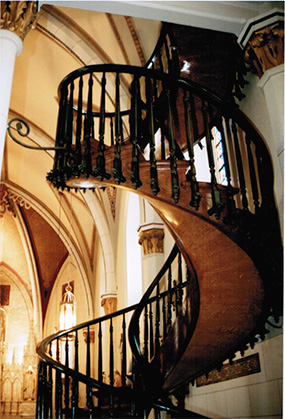
BR: I did. I did actually twice. I did the first time about maybe six or seven years ago, and then I went back again a second time in preparation for writing the book chapter. And it’s in the String Staircase. It’s in downtown Santa Fe. And the chapel itself is quite beautiful. And you go in there, you pay admission fee, I think it’s maybe like $7 or $10 or something, and you walk in. And it’s basically like any other chapel. It’s got lots of crosses, as you can imagine, as many chapels do. But there’s one particular unique aspect to it, which is that in one corner, there is a spiral staircase that makes two complete turns from the floor to the choir loft. And it’s got a dark wood banister on the top and the risers are sort of a lighter color, light brown. And there’s actually several things that make it unique, but one of the most obvious ones is that it has no center support. In most spiral staircases, in fact in virtually all spiral staircases you see, with probably the exception of metal ones, That’s because they’re metal, not wood. There’s a post or support down the center.
0:12:06
CW: Just like a fireman’s pole and then the stair would go around that.
0:12:12
BR: Exactly. I had heard about the staircase growing up. It was never too much on my radar just because I grew up in Albuquerque and Corrales instead of Santa Fe, which is of course where Pascual grew up. So I had heard about it and I hadn’t really, when I first heard about it I wasn’t investigating mysteries and so it wasn’t really on my radar. It wasn’t until later on I said, hey, this is in my backyard, let me go take a look. So let me give you a little bit of the history behind it. So the Loretto chapel was actually built at 1873 at the end of the Santa Fe Trail, where the Sisters of Loretto established a religious school there with about 300 students in 1853. So 20 years later, they decided, hey, let’s put a chapel here and it took about five years to complete. So there’s a handful of things that are said to be particularly mysterious about it and as with many of these cases, it depends on which legend you look at. One of the stories was that it was built overnight from the top down and had no visible means of support. Now, the fact that it has no visible means of support is self-evident. Whether it was actually built overnight from the top down is highly dubious and of course not true. I mean, I guess in theory you could build it overnight, but you probably couldn’t do it in the 1870s. You need a huge team to do that.
0:13:39
CW: Now, when they say no visible means of support, it almost conjures up this image of just something floating, like hovering in midair. But you just mean there’s no central support pole, and so literally each step is just supported by the step before it, correct?
0:13:56
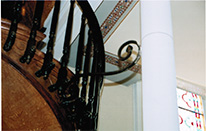
BR: That’s true. Now, actually, there is a support. A support was added a little later on, in fact. In most photos, you can see that. And I noticed that when I first went there, because it was, you know, the miracle staircase with no visible means of support. And I look up and there’s this large metal bracket.
0:14:13
CW: Now with added support!
0:14:14
BR: Well, except for that, you know, but I mean, to be fair, I mean, it’s more of a stabilizing support. It’s certainly not holding up the whole thing. But yeah, so that’s that is that that part of it is largely true.
0:14:27
CW: But it functioned for years and years without that central support before it was added?
0:14:32
BR: Yes. Now, the other thing to keep in mind is that the staircase as you see today and is in most photographs includes the banister, you know, so the railings and the vertical supports that support it. So the staircase as originally built was much smaller. Number one, it was less wood, like physically less amount of wood. Number two, there was somewhat less weight on it at the time because, of course, you didn’t have the added weight of the banister and the support parts. So that was part of the story. So what’s interesting about it, well, there’s lots of interesting things about it. One of them was that it seemed like there was really not much written about it until the early 1900s. The conservative columnist Phyllis Schaffley, who I think died a few years ago, she compared it to nothing less a Catholic miracle than the Shroud of Turin, the burial shroud that my colleague Joe Nickell has done extensive research on. So if you’re comparing it to a miracle to the Shroud of Turin, that’s pretty remarkable.
0:15:31
CW: Was this also, did the staircase turn out to also be a 14th century fraud?
0:15:40
BR: Oh, good one. It did not. It did not. But I took it upon myself to look into it and you know, one of the first things you do obviously when investigating miracles or anything else like that, the first step is to figure out, get a lay of the land. So figure out, all right, well what are the legends being told out? What are the official legends? What are the ones in different books and what have you. So that’s always the first step is spending hours, days, weeks, sometimes collecting as many accounts of how the staircase came to be as you can and then you start looking for similarities. You look for folkloric motifs, you look for different variants of legends and this and that. So that was the first thing. And then the second part was establishing what parts of the different legends are true, what parts are verifiable, or you know, in science would be falsifiable.
0:16:35
CW: Now, as they do with many saints and miracles and miraculous objects, did you find an official statement by the church itself, or at least by the members of this local congregation?
0:16:45
BR: Yeah, so there is an official version of the events that comes from the Sisters of Loretto. And by the way, the church is currently, and the staircase, the chapel is currently privately owned. So you can go in there and you’re welcome to see it and pay the admission fee and buy magnets and t-shirts and things like that talking about the miracle, but it’s now a privately owned place there. When you go back and you research the history according to the Sisters Loretto, I’ll just read from the so-called official version of it. This is how the Sisters Loretto claimed that the staircase came to be. So again, remember, the chapel itself was begun in 1873 and took about five years to complete. So here’s what happened. The chapel work progressed with some financial worries and a maximum of faith on the part of the sisters. It was not until it was nearly finished that they realized a dreadful mistake had been made. The chapel itself was wonderful and the choir loft was wonderful too, but there was no connecting link. Mother Magdalene called in many carpenters to try and build the stairway, but each, in his turn, measured in thought and then shook his head sadly, saying, It can’t be done, Mother. Instead of giving up, the sisters of Loretto prayed for nine days to St. Joseph, and on the last day of the Novena, a gray-haired man came up to the convent with a donkey and a tool chest. Approaching Mother Magdalene, he asked if he might try to help the sisters by building a stairway. Mother gave her consent gladly, and he set to work. The only tools he had were a hammer, a saw, and a T-square. It took him six to eight months to complete the work. When Mother Magdalene went to pay him, he had vanished. She went to the local lumberyard to pay for the wood, at least. They knew nothing of it there. To this day, there is no record stating the job was even paid for. So this is the story behind how the Miracle Staircase came to be. You have a mysterious carpenter with very few tools and now as you heard in this version it took him six to eight months to build instead of overnight. It’s just somewhat less plausible. And so when you look at the legend, certainly as related by the Sisters of Loretto, a couple things jump out as a folklorist and one of them is that this is only one of several stories that are identical to that. In fact, the Loretto Staircase is only one of many similar legends that have been told around the world. There’s stories where a wandering carpenter or a stonemason, for example, will mysteriously appear in a town right when people in their greatest need because of some they need a bridge built or they need a building done and they mysteriously show up just in the nick of time. They do some miraculous work and then they basically disappear.
0:19:41
CW: I’m already forming in my head an image of Michael Landon showing up and this could totally make an episode of Highway to Heaven.
0:19:55
BR: I don’t think it made Highway to Heaven. It was featured in Ripley’s Believe It or Not twice in 1939 and again in 1956. There was also a CBS television miniseries called The Staircase in 1998 to get Barbara Hershey in it. So you, there’s lots of versions of this that have been floating around. So anyway, the first thing as I mentioned that I did when trying to parse out the legend is figure out, okay, what parts of this can we verify? What parts can I test whether they’re true or not? Now, as I mentioned, the staircase is privately owned and this will not come as any shock to you, but they don’t want people poking around. It is a miracle and it will remain a miracle.
0:20:46
CW: They didn’t let you examine the staircase and take a look at how it’s put together or anything?
0:20:51
BR: Well, yes and no. Now, again, you can you can for a nominal fee, you can gain entrance to the chapel and the staircase is right there. I mean, you can you can reach over and touch it. You’re not allowed to climb it. You’re not really allowed to to do anything else on it. But it is you’re certainly not allowed to take samples and bounce on it and do things, understandably. So, you know, I get that. But yeah, it is accessible insofar as, you know, it’s a few feet away and you can look closely at some of the construction. So when I began doing that, I noticed that there were a couple things that were self-evidently not true. For example, the idea that the entire staircase is made of wood. Much of it is in fact wood, but under the treads, under the stairs, it’s actually painted to look like wood, but it’s in fact reinforced plaster. It’s plaster that, of course, would have been used at the time, in the 1870s, 1880s, which is, it’s made of hydrated lime, sand, water, and horse hair.
0:21:55
CW: Is that stronger than wood when it dries, or is that about the same, or what?
0:22:00
BR: It’s, well, I mean, it’s plaster, it’s probably about the same, but again, it’s not really fair to compare it to modern plasters. But it’s sort of like the old thing of thinking about how our forefathers built things, right? Just because somebody built something in 1850 doesn’t mean it was shoddily built. It just means that they used the tools of the day, and oftentimes the tools of the day were perfectly good. I mean, there’s certainly in Europe, for example, and even here in New Mexico, we have structures that are well over 100 years. And of course, in Europe, something that’s 200 years old is a baby, right? So my point is that just because they were using what was then the standard stuff, horsehair, lime, and hydrated lime, and sand, water, and salt. There’s nothing wrong with it. It’s not as strong as the materials we have today, of course, but they’re still perfectly good.
0:22:59
CW: That also begs a point that to be a carpenter back then, to be a tradesperson using materials that are not nearly as strong today, you had to have good craftsmanship. You had to have ways of reinforcing things and ways of making sure that your workmanship would stand up, not just on the strength of the materials, but be as strong as it could be with the limited amount of materials that you had a selection of back then.
0:23:27
BR: No, no, that’s an excellent point. And you’re exactly right. If you look at, this is why, if you go to antique shows and antique markets, there’s well-made furniture that was made 250 years ago that you can still use. It’s because it was well-made and it was well-crafted and the stuff was built to last. And you didn’t have this mass-produced cheap craft you have today.
0:23:53
CW: As they say, they don’t make them like they used to, as the saying goes.
0:23:58
BR: They certainly don’t. So again, in that case, upon first examination, we can immediately dismiss the claim that the entire staircase is made of wood because it’s obviously not. There’s plaster underneath. So that part is not true. It is true that the staircase is held together without any nails, which is odd, to say the least, really quite unusual and pretty remarkable. Now again, given how carpenters and others made things during that time, you know, in the 1870s, sometimes they used, I mean, they certainly had nail. We’ve had metal nails for much longer than that, but oftentimes, particularly with furniture and wooden items, you would use hardwood square pegs, and that’s exactly what you find on the staircase.
0:24:52
CW: Okay.
0:24:53
BR: So, again, just a quick glance at the staircase immediately proves one claim and disproves another. And so then the question becomes, okay, well, it’s here, it’s existing, it’s not an illusion, it’s not a hoax, this staircase is existing and, again, there’s a large stabilized metal brace, but you know it’s nonetheless it’s still pretty remarkable piece. So then the question becomes okay well who made it? And as I mentioned the the Sisters of Loretto are pretty sure that it was St. Joseph.
CW: Oh well case closed. All right.
BR: Well right so I could just pack it up and go home because clearly St. Joseph showed up and…
CW: The nuns would not lie to you Ben.
BR: No no no. Now I didn’t speak to any nuns. Most of the nuns that I’ve spoken to are pretty straightforward, but of course I was just quoting nuns. So even though a nun wouldn’t lie to me, a nun might say something that in retrospect wasn’t entirely true.
0:25:53
CW: Yeah, well, you know, they might lie occasionally, but they don’t make it a habit.
0:25:58
BR: Oh, suddenly I’m back on monster talk. Okay, so what’s happened is because, and just to be clear, I was beginning with the assumption that it was not actually Saint Joseph. I could be wrong, but as a skeptical investigator, I’m working with the assumption that it was not actually a saint that just materialized and did this. So then the question is, well, then who did it? So what’s happened over the years is that the Sisters Loretto had various people that had claimed that they, or more often a relative, had built the staircase. And I read some of these accounts. It’s interesting, when I was doing the archival research, and there were three or four cases that I read where people would contact the Sisters and say, oh, you know, I believe my great grandfather built the staircase or, you know, my uncle, who’s now dead. And it seems like, I mean, I didn’t interview anybody that had said that, but from reading it it’s pretty clear that most of these people were probably sincere. They probably had some family lore. You know, somebody, well, as you know, your grandfather built the staircase, you know, in downtown Santa Fe.
0:27:15
CW: There were probably a lot of people who were carpenters back then, and that’s quite a claim to fame if you can snag it.
0:27:23
BR: It certainly is. It certainly is. So, unfortunately, all the people that came forward to talk to the socials of Loretto and claim that their forefathers had built the staircase, there was never any proof. There was no evidence. It was always just, you know, well, I heard or I was told that, that sort of thing. So all that changed when a Santa Fe historian named Mary Jean Cook did some research into the Sisters Loretto and the staircase and the famous chapel. And I interviewed Mary Jean Cook at her house in Santa Fe for the book. And I love talking to historians because historians are cool. Historians like know a lot. I’m like, oh this is so cool. So anyway, I’m like, yeah, I’m nerding out on historians. But anyway, so this is a case in which, this isn’t ghost hunting or ghost investigation, but this is a case in which actual historians can help solve the case. So, Cook looked into it and as part of her research she happened to have figured out who built the staircase. And I’ll just quote from her book, because it’s much more concise than I can say.
0:28:32
CW: Okay.
0:28:33
She says, After many years of mystery, an elusive Frenchman named François-Eugène Rochas has been documented as the carpenter of the legendary spiral staircase in the chapel of Our Lady of Light. While other carpenters may have assisted him during construction, Rochas was called its builder by his friend Quintus Monier, a contractor of the St. Francis Cathedral in Santa Fe, who also worked on the chapel. In fact, Cook discovered an obituary in the Santa Fe, New Mexican newspaper that confirmed it. It was dated January 5, 1895, and it was written by Monier and it stated, quote, Frank Rochas, a Frenchman, was favorably known in Santa Fe as an expert worker in wood. He built the handsome staircase in Loretto Chapel.
0:29:19
CW: Oh, and this fellow who’s saying that was one of the contractors who worked on the chapel, so it’s not some random family member, it’s actually somebody who would know.
0:29:28
BR: Exactly, exactly. And it was contemporaneous. It was 1895, so this is only, you know, 20, around 20 years after the chapel was built.
CW: So when the chapel was built, nobody thought that Saint Joseph was the carpenter?
BR: Right. Yeah, it was a non-mystery up until fairly recently. And again, the information is crystal clear. It could not, if you’re looking for a smoking gun, it could not be any clearer. You know, there’s only one staircase in the Loretto Chapel. There’s not many of them. There’s only one. And as you pointed out, Monier would be in a position to know firsthand that Rochas has built it because we know for a fact he was there and he knew Rocheste and he was building it.
0:30:14
CW: Cook must have been flabbergasted when she came across such clear information spelling out who built the staircase there.
0:30:22
BR: Yeah. She seemed certainly, I would say, rightfully satisfied with herself as she should be. But yeah, I mean, it was, you know, oftentimes in these cases, it’s not so much that it’s brilliant detective work, it’s just that someone took the time to look into it and that was the case with Cook. And, you know, keep in mind that the Sisters Loretto, they didn’t really have a vested interest in looking too closely at the story. I asked Cook about that and said, how do you think the story came about? And I’ll touch on that a little bit later, but basically, she feels that probably, as you mentioned, at the time, it was a non-mystery. It was like, yeah, Frank Rochas has built it, it looks really cool, good job, he got paid, he moved on to other things. It was a non-event. It wasn’t a non-event, I mean, it’s still an amazing staircase, but at the time it was just, hey.
0:31:21
CW: Not a supernatural event.
0:31:22
BR: Yeah, it was certainly not considered miraculous until much later.
0:31:26
CW: And this is really giving me a reminiscent feeling of the way Roswell exploded after being a non-event for so long.
0:31:34
BR: Yeah, I thought about that parallel too. I mean, that’s exactly right. We have the crash of the Project Mogul balloon in 1947, and there’s a brief flap where there’s a little bit of hubbub about a crashed saucer, and then 30 years go by and it’s a non-story, and then you have people who are essentially mystery-mongering and saying, hey, remember that thing that crashed? Remember the alien bodies? Like, uh, no, don’t remember that. That’s not actually…
0:32:08
CW: Dixon would look much different in the rear view mirror of time.
0:32:14
BR: Funny how that works, right? And classic folklore.
(MUSIC)
0:32:16
Hey Squares and hey strangers, Celeste here with a chocolate-covered skeptical fortune cookie for you for Valentine’s Day.
0:32:30
Let’s crack it open and save the chocolate bits for later. Love, without evidence, is stalking. This is one of my favorite quotes on love, from the lovable Tim Minchin himself. An Australian composer, lyricist, actor, comedian, and one hell of a piano player, Tim Minchin first came to my attention with his short cabaret-style songs, often with delightfully blasphemous commentary, available on YouTube. The frenetic, wild-haired, barefoot Aussie charmed many with his copious amounts of logic and eyeliner. His very skeptical beat poem Storm was turned into a brilliant, eye-catching animated short thanks to the talents of animator D.C. Turner. Tim’s concerts and tours led to a documentary called Rock and Roll Nerd and five concert DVD titles. In 2009, he was tapped to write the music and lyrics for Matilda, the musical, which became a critically acclaimed smash hit. He has also since written music and lyrics for the musical adaptation of Groundhog Day, and he played Judas in the recent arena production of Jesus Christ Superstar. Later this year you can see him as Friar Tuck in Robin Hood Origins. Tim’s observation that love without evidence is stalking is in his piece titled Thank you God from 2010 in which he recounts meeting up with a Christian bent on showing him he believes in plenty of things without evidence such as the ever-popular example love. If you’ve never heard Tim’s early songs and ruminations on YouTube go check them out. You are in for a lovely treat.
(MUSIC)
0:34:39
BR: Let me just explain a little bit about who Franchi Rochas was. So the information on it is kind of sparse, but Cook did a pretty good job of tracking it down given the time removed. He was born September 22nd, 1843, south of Grenoble, France. He was the eldest of four children and he probably moved to New Mexico around the 1870s, not long before he built the staircase. So he was a campagnon, which means that he was a member of a fairly prominent, at least in France, woodworking guild. So he was very specialized and this helps explain why it was that that he was able to construct the staircase. Now keep in mind that part of the legend is that no one else could do it. Remember the story is that they realized this horrific mistake, oh my god we forgot to connect the the choir loft to the bottom of the church. You know you know, presumably they brought in dozens, I don’t know, of people who said, I can’t do it, we can’t do it. And this guy, a Frenchy says, I can’t do it. Oui, I can do it!
0:35:51
CW: Well, he sounds like a carpentry Jedi.
0:35:56
BR: Exactly, exactly. So, this helped explain why it was, so that part of the story is probably true. It probably is true that other carpenters tried and said they couldn’t do it and he said well it’ll be difficult but I think I can do it and sure enough he succeeded. Another piece of evidence that he is in fact the builder is there is a note in the sister’s logbook from March 1881 that says quote paid for wood by Mr. Rochas, $150.
CW: That’s expensive wood back then.
BR: Well, it’s a lot of wood going on there. So what this proves, number one, it proves for a fact that he had in fact been employed by the Sisseloretto as a carpenter, either on the staircase or on the building itself, the Academy building which is completed in 1881. So I mean all the pieces are there. I mean, basically, we have everything but a photograph of him building the staircase. And so, then the question is, okay, well, what happened to him? And the answer is, he moved on. He was basically, he was an itinerant carpenter. One of many, in fact, here in New Mexico at the time, in the 1880s, there were Italians, there were French, there were lots of different nationalities that had come west to the states to build lives, to go to the frontier, and he was only one of many European carpenters here at the time.
0:37:23
CW: He probably got sick of people calling him a Frenchie and decided to head to another town, right?
0:37:28
CW: Yes, right. He wanted to reinvent himself as Pierre or something. So, but this goes to explain partly why it is that he’s not better known today. You know, why isn’t he known as the builder of the staircase, number one, because at the time it probably was known and just no one really thought much about it. Number two, the sisters Loretto and the current owners of the chapel had no real incentive to point out that this is probably the guy that built the staircase instead of a miracle.
0:38:02
CW: Yeah, I was going to ask, since Ms. Cook found this out and published it in the book that she produced, and you have uncovered this as well, has the current owner of the chapel put, I don’t know, say a plaque in there talking about who designed and built this staircase, or is it still a mystery?
BR: Well no, there’s not a plaque, there’s a carving excuse me, just outside the chapel. It is of course of St. Joseph.
0:38:36
CW: Oh.
0:38:37
BR: So, that’s who they want to have the credit for building the staircase. So the current owners have acknowledged that yes, Cook did in fact find this pretty clear evidence that it was probably Rochas and there’s the obituary in the Santa Fe Mexican. I mean, all indications lead to this guy, but they, again, they’re not eager to, they don’t want to rock the boat, you know, whatever. I mean, they’re not going to denounce Cook’s book research, but they’re certainly not going to sell her book in the gift shop. And I confirmed it is not in fact there.
0:39:12
CW: Ah, okay.
0:39:16
BR: So after Frenchy built this, and probably it’s very likely there’s actually other cabinetry and woodwork around Santa Fe that Frenchy also built. Probably just, you know, when carpenters do their work, they typically don’t put their names on it. Certainly, it’s something like a staircase, right? If it’s a building, the architect gets the credit. Right? Designed by blah blah blah or whoever else.
0:39:43
CW: So even even silversmiths have their little impression and potters as well. Man, this is making me really kind of itch to see a special episode of Antiques Roadshow where somebody brings in a really neat wardrobe or something done by Frenchie. We get to hear about the Loretto staircase.
0:39:59
BR: That would be awesome. That would be awesome. So anyway, so it was just in case some people were wondering, so we have some idea of what happened to Frenchy. He went south to a place called Dog Canyon. He built a small homestead. He raised cattle and did occasional carpentry work. And he occasionally traded with the Apaches. And he was later found dead in his stone cabin on Christmas Eve, 1894. He’d been shot probably either by thieves or Apaches.
0:40:29
CW: Possibly by St. Joseph.
0:40:31
BR: You know, he had an axe to grind. Or a lathe to sharpen, if you will.
0:40:39
CW: Oh, carpentry wars can get nasty, man.
0:40:42
BR: It can.
0:40:44
CW: You had also talked about, you had mentioned in this legend that experts had looked at the stairs and not been able to figure it out. Did you consult any experts?
0:40:53
BR: Well, you know, funny story. So, as is often the case, you know, I’ve come across many examples of things that were allegedly scientifically unexplainable. Probably the most famous case that I researched was the Coral Castle in Florida, which is the subject of the Billy Idol song, Sweet 16, by the way. Although I was recently watching a concert, a Billy Idol storyteller’s concert, and he was doing acoustic stuff, and he mentioned, he did an intro to the song, and Billy Idol mistakenly mentioned it as granite. It is not granite, it’s coral. A very big difference between granite and coral, if you’re a geologist. But anyway, in the case of the Coral Castle, and maybe, hey, we should do a show on that.
0:41:41
CW: Pascual, put the ding in right here.
0:41:45
BR: In the case of the Coral Castle, one of the questions is, you know, how was it made? And through, on the websites and all the books and all, it’s all science cannot explain. Engineers are puzzled and, you know, scientists are stumped and all these, all these, you know, sensational phrases. And that was also very much the case with the staircase and so over and over again I saw references to the scientific inexplicability, is that the right word?
0:42:12
CW: Just say baffled, it’s easier.
0:42:13
BR: The bafflement, the scientific bafflement. And of course my question is, which scientists and why are they baffled? I’m not saying that we’re scientists baffled, I’m just asking you to identify the baffled scientists so that I can confirm they are in fact baffled.
0:42:40
CW: And are in fact scientists.
0:42:48
BR: Right, because often days, you know, confusing someone isn’t difficult. It happens on Ghost Hunters all the time. Baffling a scientist is a little trickier than baffling a layperson as it should be. So this was, again, this is part of the mystery. And so what I found was that there had actually only been two scientific or quasi-scientific analyses done of the staircase.
0:43:10
CW: Oh.
0:43:11
BR: Yeah, which surprised me, frankly. I mean, I was… Two is better than zero.
0:43:16
CW: It is, but you’ll see how thin they are in a second. Okay. So you might assume the best scientific minds have been brought to bear on this, and they’ve walked away stumped, tearing their hair out and swearing off the empirical sciences, right? Well, okay, so the only two studies, one of them was done, and I use studies very loosely. Okay. First was done in 1965 by an engineer named Carl Albach, and he’s, by the way, an electrical engineer.
0:43:49
CW: Not a carpenter or a mechanical engineer?
0:43:52
BR: No, no, no, no, an electrical engineer. Now, I’m not casting any shade on electrical engineers, I’m sure they’re very good. It’s not clear to me what expertise an electrical engineer would have on a staircase of wood. Now, you know, I’m just saying. So anyway,
CW: I’ve got two brothers. One of them is an electrical engineer and one of them is a mechanical engineer. And trust me, if they were both going to throw down over stairs, I know which one I’d go to.
BR: So there you go. So so here’s I have a copy of the report right here, in fact it’s right here to my left, I’m looking right at it. And Albach, when it comes to the question, is this a miracle, he simply says, we’re not going to try and answer that question. I’m thinking, no, that’s why you’re here, dude. That’s why you, the electrical engineer, has been brought to this amazing place to look at this staircase and call it a miracle. So what did you begin by saying, you know what, we’re not going to look into whether it’s a miracle or not. I’m thinking, well then why are you here?
0:44:55
CW: I refuse to be baffled!
0:44:58
BR: I reject your bafflement, sir. So his contribution, I use the word lightly, is to note a slightly springy movement as he climbed the stairs.
0:45:12
CW: Okay. I notice that every time I buy new shoes.
0:45:16
BR: Yes, it’s kind of springy.
0:45:18
CW: Yeah.
0:45:19
BR: Well, clearly you’re an electrical engineer, you didn’t know it.
0:45:22
CW: Okay, that’s all he really said about the mechanical construction of the staircase.
0:45:27
BR: Yes, again, it’s not really clear why he bothered. I can see why this is cited by proponents of the lateral staircase because he is an engineer and it has something vaguely to do with it. So they’re probably hoping you don’t actually read the two-page report, which is padded out with a couple of nice photographs. So it’s like, it’s basically like a six-paragraph report that isn’t really reporting anything except that he walked up in the stairs and it was springy, as you would expect it would be. The only other analysis was, there was an analysis in 1996 by a forester with the unlikely name of Forrest Easley that identified the type of wood using, it’s a type of spruce.
0:46:17
CW: Well that’s something, okay.
0:46:19
BR: Yeah, we got that. So, better than nothing, I give credit to that.
CW: That approaches sciencing. They actually looked at it, he identified what type of wood it was.
0:46:31
BR: Right, and you know, good for him. I appreciate that. So apparently, essentially zero scientific efforts or analyses were done on the Miracle Staircase, with the exception of someone deciding this wood.
CW: This staircase has not been x-rayed. It has not been subjected to any sort of imaging technology. It has not been taken apart and reassembled. Nothing. Just a guy walked on it, another guy looked at it.
0:47:01
BR: Right, and identifies wood. Now to be fair, it is a type of spruce not native to the area. Oh! So you can build a miracle there if you like.
0:47:16
CW: Alien spruce.
0:47:18
BR: Well, right. It’s not like, you know, this type of wood is unknown on Earth. It’s like, no, it’s spruce. It’s not a native spruce, but it’s spruce. So there’s that. So, I looked at the folklore behind it and tried to figure out what parts can we test, what parts can’t we test. Then I looked into the actual, you know, person that that by all accounts actually built it. Then I looked into what experiments had actually been done on it, and again with almost no results. So then the question was, okay, well, who would I ask to look at this? Right, of all the possible people with expertise, you could maybe be an engineer, a physicist maybe, I mean it’s not really quite, you know, maybe a botanist.
0:48:13
CW: It’s not rocket science.
0:48:14
BR: It is not rocket science. So probably, it occurred to me that probably the best person to examine and analyze the staircase would be probably a carpenter.
0:48:26
CW: Hey!
0:48:28
BR: Yes, yes. So, much to my surprise, actually not really, apparently no carpenter had ever actually asked to look at it.
0:48:36
CW: Oh, God.
0:48:38
BR: Which seemed to me like a bit of an oversight.
0:48:41
CW: I’m banging my head on my microphone, Ben. They’d never even called a carpenter to ask how this miracle had been assembled?
0:48:49
BR: No, no, they, well, to be fair, they asked an electrical engineer and a forester. When it comes to things like, you know, figuring out how a wooden structure is put together, apparently Carpenter was like the last, they were going down the list. Okay, we got a psychologist, we got an astrophysicist, we got like a chiropractor. Hey, when we’re done with these guys, let’s bring in a carpenter. So I went right to the source.
0:49:20
CW: Okay, up the down staircase we go here.
0:49:24
BR: Exactly. So I actually know a carpenter with 35 years experience. He’s a friend of mine from my hometown of Corrales, New Mexico. I played volleyball with him and in fact, I went to Brazil with him.
0:49:42
CW: You know the old saying, journalists don’t have friends, they have sources.
0:49:47
BR: Yes, yes. Well, Mick was delighted when I called him up. His name is Mick Harper and up until recently he owned a business called Blue Sky Woodworks in Corrales. And so I asked him if he’d be willing to help explain the miracle, and he said sure. Now again, keep in mind that we weren’t actually allowed to, you know, climb on it, cut any parts of it out, x-ray it, or really do much of anything. Nonetheless, we had the reports, we could go to the staircase and look at it, and there’s quite a bit of information we can get just from there, and he had seen the staircase himself.
CW: Okay.
BR: Yeah, so we were both there. So, so I asked him, I said, okay, well, so how, how is this done? Do you have any idea? He’s like, well, he’s, he’s Texan. He’s like, yep. I’m like, but, but hold on here. This is, how can you just say, yep. I mean, it’s, this is a, this is defied scientists for decades, centuries, millennia. Phyllis Schaffley thinks it’s the Shroud of Turin. This is the work of a saint carpenter. He’s like, well, yeah, that’s one idea. So I’m like, all right, Mick, how is this done? He’s like, well, so the first thing that we know about what Frenchy did was he used tubs of water and strong wood glue. And wood glue is still used today. You can buy it at pretty much any store.
0:51:21
CW: I’ve got some in my kitchen shelf, yeah.
0:51:23
BR: There you go. So it’s a common thing. It’s pretty strong. It was a wood glue typically made of horsehide or horse hooves. So this may be an urban legend, but I believe that’s why the Elmer’s Glue has a has a lamb on the front. I think there was some story about how it was like lamb loaves or something.
0:51:42
CW: Oh, I’ll have to put that on my list of logos to research. We could do a whole episode on logo originations.
0:51:49
BR: We should. We should do a show on that. But certainly it is absolutely true and well known that you can make glue out of out of out of horse hooves.
0:51:58
CW: I mean, that’s I think the glue factory has been a long time threat to slow race horses everywhere.
0:52:04
BR: Exactly. So, when you look at how the staircase was constructed, there’s basically 16 long pieces of strong, flexible wood. If you expertly glue them, fitted them, and finished them, as Frenchy could have done and did, it would actually create a very strong structure that’s actually stronger than some of its parts. Because what happens is, wood is an interesting and very useful building material because it’s hydrophilic. That is, it absorbs water and moisture, so it expands and contracts with heat and cold and rain and dry.
0:52:46
CW: So it’s springy.
0:52:47
BR: It’s springy, exactly. And one of the things you can do with wood, one of the reasons that wood is such a good building material is that because it’s an organic material, if you use wood glue, which is what wood glue does, it migrates into the wood’s moisture cells and it basically bonds together. So when you have these wooden splices overlapping in different places, it basically creates a more or less continuous load-bearing column. In fact, of course, there’s two because there’s the stringers, two stringers on the inside and the outside. So what you find is that if you had the wood that was carefully formed and bonded together with wood glue, and don’t forget there’s also the plaster underneath, you could create the staircase that would be very easy, well it wouldn’t be easy, it could easily accommodate certainly its own weight. And keep in mind that the staircase was used for many years. I mean there are photographs of people going up and down, there are photographs of women standing on the spiral staircase and even before it had the banisters on there. So it certainly held a fair amount of weight at one point, although again, you’re not allowed to go on it these days. But one thing that’s important to remember is that the original staircase had no banister and therefore people would naturally sort of tend to walk on the inside instead of the outside where you could fall off, right?
0:54:20
CW: Yeah, I’d feel a little nervous walking towards the outside of a staircase that had no handrail.
0:54:28
BR: Right, yes, that would be awkward. So the point here is that people would necessarily walk on the strongest parts to begin with, so it’s not like there was a whole lot of wear and tear on the outer side. And this is where the mystery of the wooden pegs comes in. Because part of it, as I mentioned was that and that this factoid is true. There’s no nails in it There’s no there’s no metal in it at all except of course the wooden brace which was added later. This was and I asked Nick about it because this is one of the things that that baffled me I mean, it’s clearly true. It’s not it’s not a myth. It’s not a legend It’s you can see the wooden wooden pegs there and to him that that was that was the most that was the most obvious part of it all. He’s like, well, no, here’s here’s what happened. He said, well, actually, the staircase would have fallen down long ago if he had used metal metal nails.
0:55:26
CW: Really?
0:55:27
BR: Yes. And I’m like, well, but metal is stronger than wood. So why? Why would the staircase have fallen down long before and he said well it goes back to you know the nature of wood being hydrophilic and so because it all shrinks and as I mentioned it with heat and cold and rain and dry it all expands and contracts together and what happens if you use metal nails of course metal doesn’t doesn’t doesn’t do the same thing and so if you would have if Frenchy had used metal nails, it actually would have worn a hole in the wood and the nails would have fallen out and the stairway would have, the staircase would have collapsed.
0:56:10
CW: Oh yeah, it would have needed constant repair I guess, yeah.
0:56:17
BR: Exactly, exactly. So it’s interesting because the, for the people that wonder how a staircase could have stood for so long without using metal nails, it’s exactly the opposite. It only could have stayed up this long using the hardwood pegs, because it kept the staircase all together. Yeah, so when you start digging into the nitty gritty on how the staircase is actually constructed, I learned a lot about wood and carpentry, and it’s just interesting to sort of see, well, this is a big mystery. It’s like, well, yeah, but if you talk to experts, then you can figure it out.
0:56:53
CW: That’s always a particularly satisfying little detail to find out that something is happening not in spite of a detail, but because of a detail.
0:57:05
BR: Yeah, absolutely. And that’s the story of despite or because of, right? Where’s that twist.
CW: Yeah.
BR: But anyway, so that was, I mean, there’s more to the story and if people are interested, you know, as I mentioned, it’s one of the chapters in my book, Mysterious New Mexico. But there’s another wrinkle to it, which is the question of whether it’s unique or not. Because if you think about it, the legend would have to have you believe it’s unique, right? Because why would St. Joseph do this four or five times, right? Well, we prayed really hard and he showed up, hey, we prayed hard and he fixed my car, right? There has to be, you know, and so part of the story is this miraculous staircase and the idea is that there’s really only one. Well, in fact, if you question why there are apparently no existing staircases identical, there’s two answers. The first one is, why would there be? Because keep in mind, this staircase was built to solve an architectural mistake. It’s like they built the choir loft and they built the bottom part and somebody forgot to build a staircase. So unless there was another building with the same dimensions where another carpenter had also forgotten to put a staircase between the choir loft and the bottom part, why would there be another staircase? It was essentially a Jerry Rigged, patched up, well-constructed staircase that probably Frenchy himself would be shocked to know it’s still standing.
0:58:40
CW: He MacGyvered it.
0:58:41
BR: He absolutely MacGyvered it. And good on him. I mean, that’s what Mick said. I mean, he never talked to me. He says, look, this is amazing work. This was amazing work in the 1870s and it’s amazing work today. So it doesn’t, it’s difficult arithmetic, it’s really well done. So I mean even today it wouldn’t be impossible to do, it would be difficult to do, but so again the craftsmanship is what’s remarkable. And so whether it’s actually literally a miracle or not is sort of beside the point. And the other thing to keep in mind is that it’s true that a spiral staircase without a center pole, supporting pole, is inherently unstable. Any engineer can tell you that and the architect can tell you that. But just because it’s unstable or it’s suboptimal doesn’t mean it will collapse right away.
0:59:31
CW: That just means it won’t stand up to an earthquake or 300 years of usage. It just means it’s a it doesn’t mean it’s not functional.
0:59:50
BR: Exactly. So for the people who say, well this staircase it shouldn’t have collapsed right away. No, no it shouldn’t have collapsed right away. It’s you know it’s well made and it was a remarkable piece of craftsmanship, but just because it’s unstable doesn’t mean it’s unworkable and it doesn’t mean that with some salvaging, and keep in mind, people haven’t been able to walk up and down that staircase for many, many years. I mean, to be honest with you, it would be much more of a miracle to me if that staircase was supporting dozens or hundreds of tourists a day going up and down that thing with no ill effects and without a metal brace. That would be a miracle.
1:00:34
CW: Perhaps.
1:00:35
BR: Well, that would be astonishing, let’s put it that way.
1:00:40
CW: That would be more impressive than just standing there as a beautiful object of art right now.
1:00:46
BR: So anyway, it’s one of my favorite local mysteries that I investigated for that book and elsewhere. Part of the fun of research and certainly researching the staircase was parsing out, again trying to separate out the myth and the legends and the fact and the fiction and digging into it. I can’t claim to have solved the mystery entirely. Again, Mary Cook, the historian in Santa Fe, did an amazing job identifying the builder, Frenchy Rochas. I don’t know that I could have done that. So my contribution to this mystery is putting it all together. It’s explaining the true story of how the staircase was built. It’s bringing in a carpenter, somebody who actually knows how to build staircases, for example. It’s going piece by piece and examining each of the claims and saying either this is true, this is false, or it’s partially true. And once you do that, once you engage in that exercise and that investigation, you can come to a pretty remarkable story.
1:01:58
CW: You know, and I love mysteries that end up being solved by a skilled craftsperson or, you know, in this case, a carpenter. It just shows you humans are capable of amazing feats that really blow the average person away if you don’t know how it’s done. And it’s like a type of magician. A good craftsman in a field that you’re not familiar with can explain something that looks like a miracle to other eyes.
1:02:28
BR: Yeah, that’s absolutely true. I mean, and your analogy of a magician is perfect. I mean, there’s, you know, I’ve I am a fan of magic. I don’t have the dexterity to be a magician or the patience to become one. But I know many, many magicians and I I love magic and I love I love the craftsmanship behind it. And I’ve been in an audience where I’m a skeptic and I’m not the smartest guy in the room, but I’m reasonably bright. And I’m like, I don’t know how that was done. My mind is blown. I was like, that’s not possible, damn you. You’ve done something impossible. And I know that they haven’t, but I just love the fact that I am stumped and baffled and they know exactly how it was done and probably others in the room either know how it was done or know a way to do it and I just think it’s magic.
1:03:16
CW: Well thanks for sharing some of the magic with us Ben and deconstructing it.
1:03:27
BR: Well thanks for chatting with me about the miraculous staircase of Loretto.
1:03:32
CW: Anytime.
(MUSIC)
1:03:49
BR: Hey Squaring the Strange fans! Word around the campfire, that is, unconfirmed rumor, is that patrons are loving their Skeptic Rates. Hold on, what’s a Skeptic Rate, Pascual?
PR: The Skepticrate is a special bonus gift our $5 and up patrons get once per month. And what are the details of the Skepticrate, Celestia?
CW: The rumors are true. People are loving their Skepticrates. For anybody subscribing at a $5 or over level, once a month we will send out to you a Skepticrate. Now, it’s not actually a wooden crate containing live chupacabras or anything like that. We can’t quite afford that yet. But we’ll send you at least three items that have something to do with skepticism, one of our recent episodes, or something from the personal collection of one of our lovely hosts. So keep an eye out for your goodies and sign up at patreon.com
(MUSIC)
1:04:41
CW: Well, thanks, Ben, for taking us on that tour of a miraculous staircase that turns out to be more of an engineering miracle than anything else. What have we got lined up for episode 45?
BR: So the big 45! uh… one of my one of my sis one of the scariest monsters i’ve come across a as you may recall uh… we did an episode on the rolling calf and uh… part of the reason that i uh… love the rolling calf and i’ve done some research on it was because to scary ass monster uh… and you know, as somebody who researches folklore monsters and has for you know twenty years now, I’m not easily frightened. But there are a few monsters, including the rolling calf, and next week’s topic that I find genuinely creepy.
1:05:49
CW: Okay.
1:05:49
BR: Next week we’ll be talking about Kuchisake-onna.
1:05:53
CW: Kuchi, kuchi, I can never pronounce this one.
1:05:57
BR: Well, the Kuchisake-onna is also known as the slit-mouthed woman.
1:06:01
CW: Okay.
1:06:03
BR: And it is a type of Japanese yokai. So it was sort of a elemental monster, ghost, spirit, I mean, that we could do a whole show on just on yokai. But it’s basically a Japanese monster legend-ish thing that is probably one of the best known in Japan. And she’s a creepy, creepy woman. And we’ll be talking about her next time.
1:06:35
CW: Alright. Okay, well I look forward to that. And Pascual, we hope you feel better.
1:06:40
Hope you feel better, man. Thoughts and prayers. to to
1:06:56
Cronus Creative, Center for Inquiry, our advertisers, or any affiliated organizations and employers.
Transcribed with Cockatoo
