
Episode Summary:
This week, Ben and Pascual dig into the legend of Kuchisake-Onna, aka the Slit-mouthed Woman. From the origins of her terrifying story to the modern day pop culture references, the guys explore every creepy detail.
Also in this episode, Ben is skeptical of what makes something fictional “problematic” and just how serious the implications are.
Link: Pascual references a webcomic, which actually turned out to be a Korean one that has similarities but is not the slit-mouthed woman. Warning: Jump scares.
http://comic.naver.com/webtoon/detail.nhn?titleId=350217&no=31
0:00:00
Ben Radford: Welcome to Squaring the Strange, the podcast that examines all manner of the mysterious and the mundane through a critical lens. So let’s square the strange.
(MUSIC)
0:00:10
Pascual Romero: Welcome back to Scoring the Strange. This is Pascual, believe it or not. I sound a little different right now.
BR: There’s a demon in the studio with me.
0:00:31
PR: Yeah, when I get sick, I lose my voice for probably six weeks. It’s just it’s like just the rule with my body, and I don’t know why that happens, but my doctor said that it’s sometimes normal with certain people I think it’s because I have what’s called sinusitis, which is just related to my allergies basically. Without getting too into detail my voice will be like this for the next probably three or four episodes.
BR: I imagine this this is a bit of a problem given the fact that you occasionally do lead vocals.
0:01:17
PR: Yeah, that that actually was Something I always had to be really careful of thankfully. I never as a vocalist never Got sick on tour. Oh not once.
BR: Wow.
PR: As a bass player and as a tour manager Several times, but never as a vocalist. I think it’s because I’m just a lot more cautious. And I’m also kind of a, I’m not OCD about my hands, but ever since I’ve had kids, I just, it’s like hand sanitizer can not be more than an arm’s length away from me because those kids bring stuff home all the time.
BR: Nasty.
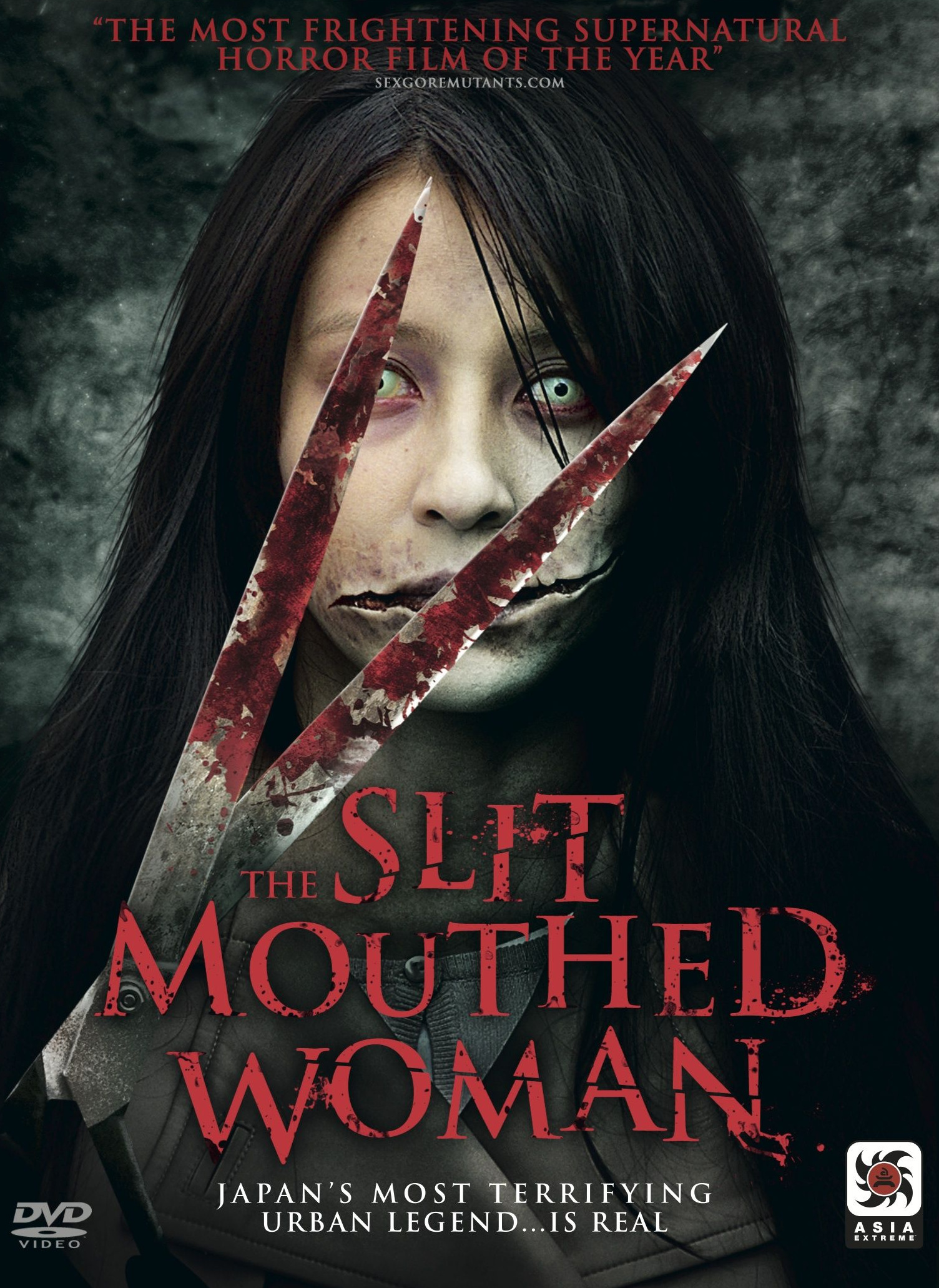
PR: But speaking about nasty stuff, we’ve got a little bit of a nasty character today that we’re gonna be talking about. Kuchisake-onna, she is also known as the Slit-Mouthed Woman. This is one of your researched legends that I actually do have some experience with. In that I’ve always been kind of a fan of Asian horror, particularly Japanese horror.
0:02:21
BR: Called J-horror, if I’m not mistaken.
PR: Yeah. And she has made quite a few appearances, so I’ll talk about that a little and we’ll get into that. But first, Ben, what are you skeptical of this week?
BR: Well, this week I want to start out with a sweet tale of Peter Rabbit.
0:02:39
PR: Yeah, I’m skeptical of him too. I don’t think he exists.
0:02:42
BR: All these legends of things that weren’t true. No, no. I was looking online, which I shouldn’t do, I know that.
0:02:51
PR: No, no, that’s just a terrible place.
0:02:54
BR: That is not a good place to spend your time. So for those of you who do spend any time online, just, you know, just know you shouldn’t be doing that. Other than, of course, to listen to our show. I was looking at something on Twitter, or the Twitter, as they say.
PR: The twits.
BR: The twits. And there was a hashtag, Boycott Peter Rabbit. Why exactly should we even boycott Peter Rabbit? I remember reading the Peter Rabbit stories when I was a kid. They were read to me. It was pretty innocuous. There wasn’t… you know, it’s not like Game of Thrones. There’s no incest, beheadings. It’s pretty straightforward, right? Yeah, well turns out that there’s a new new animated film out or soon to be out, and it has a starring Peter Rabbit, I guess he came out of retirement, and there is a scene, I have not seen this, I’m just going by what the internets say, and almost everyone else’s as well, apparently there’s a scene in which the villain is attacked by, I think it’s blueberries. Now you’re wondering, and why is this problematic? Well, funny story, apparently he’s allergic to them. And this is being called allergy bullying. So the rabbits get together and pelt the villain with the blueberry, which he’s allergic to, and apparently he goes into like, possibly anaphylactic shock or something. And this is a problem. So I, again, I haven’t seen it. I don’t think I would be traumatized even if I had seen it, but whatever. So I would didn’t give it much thought and then I saw a tweet I won’t bother to give you the name you can find it if at the hashtag. I just said it said, “so angry! Today’s my son’s ninth birthday if you haven’t been through this you don’t understand, but that’s no excuse for this violence It goes beyond insensitivity. It’s dangerous. Food allergy mom boycott Peter Rabbit.” Now I’m struggling to think of the danger. You can maybe say it’s offensive. I can maybe see, oh, I could see someone considering it offensive, but calling it dangerous seems a bit of a stretch to me.
PR: I will say I know nothing of the context of what’s going on in this film when that happens or why.
BR: A villain is being pelted with berries. Yeah, that’s, you know, but. And they’re not dingleberries, they’re ordinary berries.
PR: So this is… I mean, I guess I am to presume that Peter Rabbit knew the villain had an allergy or something. So, right. But I mean, you know, okay, maybe it’s a little insensitive to people with allergies. Speaking as a person with a massive number of allergies.
0:05:48
BR: Allergy central here.
PR: Yeah, I’m not offended by it. I really don’t know if that’s even to me. It just doesn’t register as like anything. But the bigger issue just being like, why would it be dangerous?
0:06:05
BR: Well, here we go. So let me touch on another recent controversy. And I use the word very loosely as I have on occasions. And this is about a new film that you may have heard of called 50 Shades Freed.
PR: Oh, okay. So that’s like the, what are we on? Like the third one now or so?
0:06:28
BR: Well it’s the third film there’s a couple books. I’ve not read any of them I I like people reading books period sure so I have a hard time criticizing any books because I think that just getting people to read is useful in and of itself sure even if it’s garbage I mean, I remember you know when I was a kid. I was always encouraged to read comic book. As were you.
PR: Sure, sure.
BR: And the premise was, yeah, these are stupid comic books, but the kids reading. Yeah, absolutely. This is good news, right?
PR: I’m okay with that.
BR: So anyway, let me just sort of quickly touch on Fifty Shades Freed, because you may be wondering how this ties in with Peter Rabbit. Yeah. So I’ll come back to that in a second. So, as I’m sure you know, there’s been some controversy, again I use the term very loosely, about the new film. It’s mostly been panned. As you know, I’m a part-time film critic and I’ve taken screenwriting courses and I know something about film and film festivals. So I have some background in that, as do you actually. And so I sort of come at this from a more sort of, I guess, structural point of view, in terms of I sort of see the bigger picture of what these films do, and also from media criticism. So there’s a piece that appeared February 12, 2018 on punjabba.com, never heard of it, but anyway, it made the rounds in my Facebook feeds. And it’s basically dumping on this film, which is fine.
0:07:54
PR: Yeah, that doesn’t surprise me.
0:07:56
BR: It doesn’t surprise me, but what was interesting was the arguments that were made complaining about the film. And this is where this is gonna come back to Pete Rabbit, believe it or not. So let me just read briefly from this piece. Again, it’s called, the title is, 50 Shades Freed is an Ignorant, Poisonous, Anti-feminist Hate Anthem. Okay, seems a little over the top, but all right, I’ll grant you that. So here, I’ll just, I have it in front of me, I’ll just read a couple lines from it so you get a tenor of the piece. So, the film is, quote, “insulting to every single relationship on the planet it is it is active actively bad for people it’s a blight on humanity.” hmm okay well you know there’s a tradition of going over the top on on hating film that’s sure sure but it says it says “all this is secondary to relationship between Christian and Anistasia and that’s why the movie is such a I won’t use the word nightmare the union between Christian and Anistania is so toxic and awful that it becomes an endurance test to sit through. What’s worse, the film plays all this off as if it’s perfectly normal, as if it’s acceptable behavior.” And then she goes on to – the writer is T.K. I’m assuming it’s a woman. It might not be. The writer T.K. goes on to say, “being into BDSM is a perfectly acceptable choice, As always, you have two willing partners and the author, E.L. James, doesn’t know what’s going on here.” So, again, what I find interesting is, do you remember a couple of episodes back I talked about warrants?
PR: Yeah.
BR: Right. And so a warrant, for those who didn’t hear the show, which you should, is basically, it’s a part of an argument that links a premise to a conclusion. And it’s often, oftentimes in advertising and in public discourse, it’s unstated or assumed. It’s just sort of like it’s sort of glossed over like, here’s this, here’s the conclusion. Don’t doesn’t this all make sense? And as a critical thinker, you say, no, no, hold on. What what evidence or assumptions are you making that are linking your premise to your conclusion?
PR: Right.
BR: This is crucial to understanding arguments and deciding whether they’re fallacious or not.
0:10:04
PR: Absolutely.
0:10:04
BR: And so in this particular case, the complaint is that the film doesn’t accurately reflect reality. I mean, that’s specifically what she’s saying. She’s saying that the depiction of BDSM in this film and previously the other ones don’t accurately reflect a healthy BDSM lifestyle. And to which my response is, why would it? Right, right. It’s not a documentary, and even if it were a documentary…
PR: The jury’s still out.
BR: Jury’s still out there. And it’s interesting, and I see this over and over and over again, particularly with mainstream films, is there’s an assumption by the critics that a film either should or does or is assumed by other people to accurately reflect reality. I saw this another recent film called I, Tonya by the Tonya Harding case. I read a piece by a sports writer who was complaining that I think the title was What I, Tonya Gets Wrong and it was this big long, you know, I was part of that case and I know that the Tonya Harding case, Nancy Kerrigan and the movie got X, Y and Z wrong. It didn’t get it wrong, it’s it was it it’s not claimed to accurately depict the whole situation right it is a fictional representation. Artistic license was taken. Yeah. I’m sorry you don’t understand that but but that’s that’s how screenwriting works that’s you dramatize things. Nobody ever and there was the same thing with the movie American Sniper a couple years back. I was reading complaints, but you know how American Sniper misleads the public? Well they only mislead the public if you assume, and I don’t know why you would, that it tells the complete full accurate story which no one said it did.
0:11:54
PR: Yeah that’s that’s a really important thing to keep in mind going into films that are based on true events. The terms and there is actually a difference in terms of based on and inspired by in film circles. And usually it means, you know, so based on means that this thing happened and we’re telling a story based on what happened, which still means it’s a story, you know, and no, don’t get me wrong, there are movies that have very accurate depictions of things, but they don’t know every word that was said and everything that happened. They have to fill space and the pacing of life does not match the pacing of films. So there has to be a lot of artistic license taken.
0:12:35
BR: It’s called the three-act structure and most human lives in these episodes don’t follow the three-act structure.
0:12:41
PR: And inspired by is an even looser term, which means that Abraham Lincoln, vampire hunter, is inspired by true historical events like the Civil War and the presidency of Abraham Lincoln. The vampire hunting part is debatable.
0:12:56
BR: Okay, now it’d be interesting to sort of see whether there were people who complained that the Abraham Lincoln vampire slaying was not historically accurate.
0:13:06
PR: Yeah, they may have complained about the… Truly, I mean, the events that happen in that story in the book and the film, you know, they parallel Civil War battles and I’m sure I would not be surprised in the least that some, you know, Civil War buff was like, he wasn’t down there when that happened.
0:13:27
BR: They got this all wrong. This is a horrible film. Like, well, yeah, it’s fictional. So, you know, again, in these cases there’s an unstated warrant, an assumption that there is or should be or is assumed to be a link between fictional entertainment and real life. And usually it’s interesting because the complaint isn’t just an opinion. It’s not just, I don’t like this. It’s not, you know, I don’t like waffles or I don’t like the Fifty Shades or I don’t like X, Y, or Z. Usually the writers and the critics, they realize opinion, most of them stink, and you know, right, so what they do is, it’s interesting, what they do is they tie it in with a real, or frankly often imagined, danger to society. It’s not just that I didn’t like Fifty Shades, it’s that there’s a danger here, this is problematic. So it’s not just my these fictional depictions are influencing audiences in some way, usually a negative way. You rarely hear people saying, oh, this film is positively influencing audiences. I mean, every now and then, but for the most part it’s not. And of course, this goes across the board. It’s not just film, it’s video games, comic books, everything else. And of course, as you and I know and have lived through and talked about on a previous podcast, you know, this was the premise behind the moral panic in the 80s and 90s. The Satanism panic, the Satanic panic, the concern over D&D, the Tipper Gore hearings.
0:15:06
PR: Yeah, I mean, it was basically just the same thing where, and well and in you know the difference being that this is a moral panic that was based on an entire An entire just made up thing right there wasn’t even a trailer to tell us about it But but yeah So that you know the entire panic was based on the idea that there were these these cults these satanic cults and these groups of people who organized to you know perform ritual abuse of children to sacrifice pets, to sacrifice humans in some cases. And that all tied in and out of pop culture, kind of wove its way through pop culture in the 80s in the sense that people were blaming, well in the 70s and 80s and into the 90s, people were blaming Dungeons and Dragons, people were blaming video games. And then heavy metal music got real dark during that time, I’d argue possibly in part because of the panic, people started just tying that –
BR: All right you want to go scary We’ll go scary!
PR: Well. You know it’s funny because if you look at heavy metal imagery you know heavy metal arguably started right around 1970 to 75 and Some of the earliest metal bands did use some pretty dark imagery like Black Sabbath and the band pentagram. They used a lot of and now keep in mind this was at a time where this was all pagan stuff. And they were, you know, Druids and pagan cults and some Norse mythology and things like that. But as the satanic panic kind of latched on to pagan imagery, and I mean, the history goes way back of pagan imagery being applied to Satanism, but as the bands got dragged into it, then all of a sudden, sudden all this imagery became satanic. And once it became a panic and people like Tipper Gore in particular started blabbing about it and making such a big deal about it, the bands just doubled down. They’re like, oh, you like pentagrams? But what about upside down crosses or violent depictions of the murder of your deities?
0:17:02
BR: You want to go there? We can go there. Teh kids love us.
0:17:10
PR: You’re not going to win. gonna win, but to wrap that up, that’s a very similar situation where it’s just people thinking that it’s so dangerous for society when it’s not a thing. And it becomes a thing almost because of making such a big deal out of it.
0:17:27
BR: Yeah, it’s the old, you know, the pearl clutching, won’t someone think of the children. And so again, you see how this ties in with the Peter Rabbit, right? So in these cases you have usually what’s missing, as I mentioned with warrants, is the missing evidence link is glossed over. It’s just, it’s assumed to be there. Like, it’s like, don’t you see what’s wrong with rabbits pelting berries on an individual that has an allergy? Don’t, isn’t that crystal clear what damages could do to society?
0:17:54
PR: I know, they should have just shot him like a normal American.
0:17:57
BR: Right, yeah. Just be done with it, right? And I actually, I very politely tweeted to the person that wrote that, again very polite, just I’m genuinely curious, how do you see this as dangerous? Because I don’t see that. I’m not saying you’re wrong. I just think I honestly don’t see this as a danger to society. It may be offensive if you want it to be.
PR: Yeah, I mean I don’t doubt that that could offend some people, but.
BR: But yeah, so my, and again I haven’t gotten a response back, my assumption is that it’s a fear of copycats yeah which is that’s a whole I mean we did a show but so let’s just let’s just bring this back to 50 shades for a minute so let’s say that the 50 shades film not just this one but the other ones is in fact an awful terrible abysmal crappy film. And it probably is.
PR: Yes I wouldn’t doubt that.
BR: And let’s just say that it does in fact depict an unhealthy lifestyle, BDSM or otherwise.
PR: And what?
0:18:58
BR: And then what? What’s the next step in this downfall of society? Where is this link here? I mean the fact is that, again, we’re talking fictional films. Fictional films depict unhealthy lifestyles all the time. Leaving Las Vegas, pick any film, take any film you want and you almost certain to find things that are unhealthy, dangerous, serial killers, The Punisher, I mean just, that’s what films do. Most films depict, most of them don’t depict healthy ordinary lifestyles, that’s why they’re fictional.
0:19:39
PR: Yeah.
0:19:39
BR: Now, now I can see the counter argument, the counter argument. Yes, but this is glamorized. Well, you have a Trainspotting is glamorized. I mean, shooting up is, I mean, there’s, and what one considers glamorized depends on, on your point of view.
0:19:51
PR: Yeah. Well, you know, a great example that I like to use is the movie Scarface. Um, the, the, uh, 1980s remake with Al Pacino and that movie, uh, you know, there’s a lot of glamorization of the character Tony Montana. But if you watch that movie from a storytelling standpoint, they make no apologies for what a horrible human being he is. They make it a point to get him in conflict with and killing people in a way that should make you feel like okay wow this guy is is just morally corrupt and has no allegiance to anyone but himself he’s ruined his own family he kills his best friend and ruins his sister’s life yet you know he still gets glamorized now and and that’s because people pick what they want out of the movies. When I look at it it’s a cautionary tale about don’t you know first off don’t become a drug dealer second off don’t get greedy don’t you know don’t lose yourself in what you’re doing and you know don’t get in a shootout with with gangs you know when you’re when you just finished a pile of cocaine.
0:21:00
BR: That’s not gonna end well or like you know one of my favorite films Falling Down it has a hero yeah and and you know you can you can view the character as a however you want I mean it’s crystal clear if you watch the film and you read the script, now I interviewed the screenwriter, he’s an antihero. He’s not, this isn’t glamorized, the same with Breaking Bad. Sure, sure. Right? Walter White is an evil character. Yet he’s the face of the series and people have tattoos of them, and just because you enjoy a character it doesn’t mean the point is to glamorize it.
0:21:45
PR: Yeah, I mean, Darth Vader is nearly an analog to Hitler. Like, let that sink in when you see those tattoos on people.
0:21:52
BR: No, that’s a great example. So, anyway, the only reason that Fifty Shades would be considered problematic is if you’re assuming that there is some real world damage. That is, if you believe that the audiences are taking messages from Fifty Shades Freed, which that right there is problematic, and applying it to their personal lives, if you believe that premise, and I’ll just be clear, I don’t, then I can see that’s what you’re working from. And the question is, could it influence someone to think that it depicts a healthy BDSM lifestyle? I guess.
0:22:29
PR: Yeah, I would suppose it’d be someone who also had no idea or intention of being involved in that kind of lifestyle. So that alone kind of informs me that we’re talking about a situation where someone who would get the wrong idea is not the kind of person who would also like to get involved in it.
0:22:52
BR: Yeah, that’s a great point. I mean, I look at like, you know, we talked a little bit earlier about the Satanic Panic and the Judas Priest song. There was the album Stay in Class, which was blamed for causing suicides of two kids.
0:23:04
PR: Yeah, the get the gun, get the gun, shoot, shoot.
0:23:07
BR: Right. So, is it possible that two high stoned kids could kill themselves while listening to the album and consider it to be a trigger? I guess. Is that a real danger that most of society should be worried about? Probably not. At the end of the day the question is, what does the evidence show? The question isn’t, what’s possible? The question isn’t, what is your hunch? The question isn’t, do you happen to personally like this film? The question is, is there any good evidence that this film, whether it’s Fifty Shades or Peter Rabbit, is causing real-world damage or is likely to? That’s a different question. And so we can look at a little bit of data here. So in the case of Fifty Shades, there’s two studies that I found. I only have one of them in front of me. It was done by Dr. Bonomi at MSU. And as far as I know, these are the only two that specifically looked at 50 Shades of Gray. She did two studies, one in 2014 and one in 2016. I had the 2016 piece in front of me here. And I actually reached out to her to ask some questions about her research in this particular study. I really I later realized that that’s MSU is where Larry Nassar is so they’re probably not answering the phone anymore. They’re like just unplug the phone don’t answer emails even though it has like you in fact you would think that they’d be happy to talk about something else so she did a couple studies, and I’ll just I’ll just read from the results of this. It says, basically, it says, you know, millions of women are interacting with Fifty Shades of Grey, best-selling adult novel and film. To date, no social site study has been undertaken to examine the women’s perceptions of it. I won’t go to the whole study. I’ll just quickly touch on it. “Concerns over Christian’s stalking, controlling, manipulative, and emotionally abusive behavior, anger and sexual interactions, and neglect of Anastastia’s needs. And it says, when asked where participants would draw the line in their own relationships, participants indicated they would welcome the adventure and gifts, but they would not tolerate being controlled and stalked, having their needs neglected, or having a partner who expressed anger and sexual interactions.” So again, the only real study that looked at this finds that, according to this study, and there may be others out there, according to this, this is the only one, it says that we probably don’t need to be concerned about it because the women that see this, and it’s primarily female audience, recognize that this is fiction, it’s entertainment, they don’t take lessons from it and apply it to their own lives. In fact, they explicitly reject that. We heard the same concerns about the movie Twilight, the Twilight series. There was a novel that came out in 2006, so it’s now been 12 years. There was a film that came out in 2008. And so, at the time, you saw exactly the same concerns expressed. What is this? How, what sort of unhealthy lifestyles is, is, is Twilight gonna, gonna do?
PR: Is my daughter gonna date a vampire?
BR: Let’s see what happens, right? And because, again, in many of these cases, I mean, Fifty Shades was first, was first published in 2011. So it’s not like this is a new thing. It’s not like, yeah, it’s not, we don’t have time or abusive relationships skyrocket in the wake of these things. There is time to see whether these effects occur, and the answer so far is no. There’s no good evidence that I’ve seen that these films, either Twilight or Fifty Shades, have any real effect on the general public. Are there a couple individuals who might absorb these things and sure.
0:27:15
PR: Yeah, I mean there is a way to talk about this stuff. I think that, you know, it’s a valid thing to talk about, that a very popular thing gets something wrong about a certain thing, you know, and I think it’s a valid concern to talk about, you know, does it depict BDSM accurately. You know, that’s fine. If you’re a person who wants to promote healthy ideas around that, then you put out an article that says, here’s what they got wrong about it in terms of how it happens and what happens. Which I also find kind of funny because the entire premise of the entire 50 Shades thing, as far as I know, is about a man in power abusing that power to manipulate a woman. And so BDSM or otherwise, I mean, the problem started right at the top of the story and right and and again, it’s like it’s I it’s perfectly valid to bring up those concerns I just think it might be a little More wise to word it carefully and not say that you know, this thing is the downfall of humanity You know, you might want to say I didn’t like that Peter Rabbit was throwing blueberries at someone who’s allergic to blueberries because that seemed it it’s you know It’s like I don’t personally like that and I think there’s something wrong with it that’s fine but you know that’s not kids aren’t gonna start spiking other kids sandwiches with peanuts you know
0:28:32
BR: Well that’s I wouldn’t think so now now I’ll get it would be a great social experiment right just don’t don’t excise that scene from the film and we’ll just see if there is a rash of children who are pelting allergic kids with or peanuts? I guarantee the answer is no, but I guess it’s possible.
0:28:59
Comic: I can’t let s*** lie. You know what I mean? Like, I can’t walk away from an argument. And I don’t know if that’s because I’m a skeptic or what, but it’s like, I have this thing where I can’t, if you say something factually inaccurate, I physically can’t walk away. yeah cuz you’re probably a skeptic too or maybe a hole that’s what I think because that’s what I get called a lot anybody else?
0:29:19
PR: So this week we’re talking about a very very cool kind of urban legend the slash ghost story slash demon story out of Japan and like I said at the top of the episode I’ve been familiar with her in pop culture, but that is Kuchisake-onna, also known as the slit-mouthed woman or the cleft-mouthed woman in some circles. Why don’t you give us a rundown? Who is she? What does she do?
0:29:51
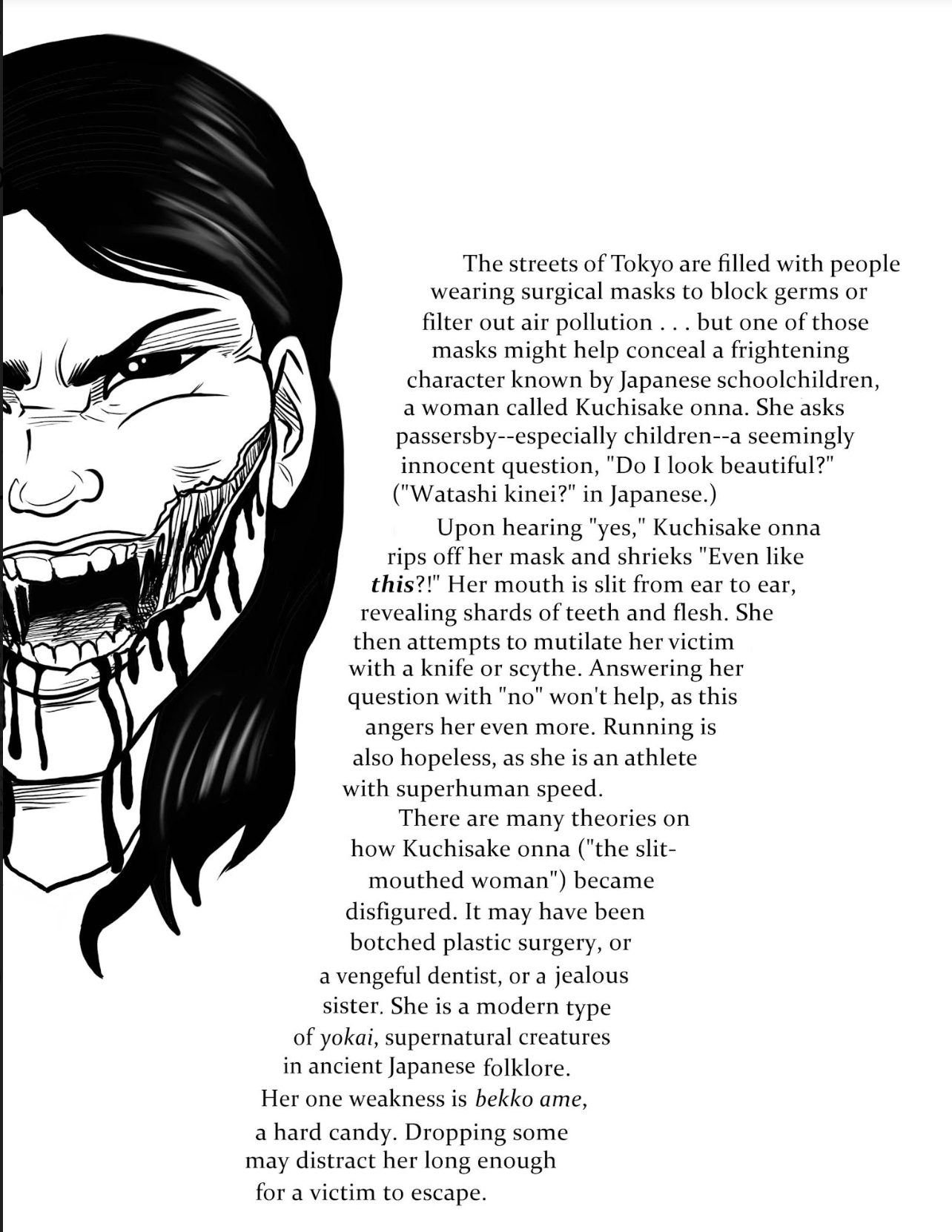
BR: Well, the Kuchisake-onna is a type of yokai, which is a supernatural creature that were said to populate ancient Japanese folklore and just Japanese terrain overall. As many people know, there’s lots of interesting deities associated with Japan and mountains and rivers and stuff. And you see this in a lot of animation, a lot of the Miyazaki stuff, Howl’s Moving Castle, all those great stuff. It’s a rich vein of stuff. So in the case of the yokai, the yokai are, again, they’re sort of supernatural creatures, creature, entity, deity, I mean it’s all demon, it’s all sort of wrapped up together. There’s hundreds of yokai. There’s hundreds of yokai. And unlike Kuchisake-onna, most of them are, as I mentioned, sort of nature spirits. Not all of them, but many of them, they’re associated with rivers and scary places and trees and mountains and this and that. They’re said to be nocturnal and dwell in the countryside. Kuchisake-onna is a distinctly urban figure, mostly seen on the streets of Tokyo and other large cities. And as you know, if people have spent time in Japan, there’s lots of people wearing those white surgical masks.
0:31:17
PR: Right.
0:31:17
BR: It’s just it’s part of tradition there and typically, you know, you see them in the airports all the time.
0:31:23
PR: Yeah.
0:31:23
BR: And it’s never clear whether they’re sick or they just don’t want to get sick.
0:31:27
PR: Right.
0:31:27
BR: Maybe it’s a fashion statement, I don’t know. But typically, or you know, smog, air pollution, that sort of thing. I mean, if you saw that outside of Squaring the Strange Studios, that would be a little bit odd. I mean, not too weird. But on the streets of Tokyo, that’s very common. So you wouldn’t think twice about it. But one thing that’s scary about it is that you never know what’s underneath the mask. In this particular case, it’s a woman named Kuchisake-onna. And what she does is that she’s often seen in wandering streets, maybe leaning against a post in public. And as you go by, she’ll suddenly turn to you and she’ll just get your attention and say something briefly. And if you respond, she’ll say, am I beautiful? Do I look do I look pretty? Watashi kene. I’m sure I just I just butchered that, butchered the Japanese, but it’s something along those lines. And, you know, most people will say yes I mean, that’s it’s a polite thing to do when asked by a stranger. I mean, why would you say no? So most people say yeah, you look beautiful and then with one fell swoop she reaches around and pulls off her mask to reveal a gaping mouth that slid from ear to ear. Sometimes there’s just gums sometimes there’s sharp teeth and of course this just looks horrific. And then she says, even like this? At which point, you poop your pants, and you stand there frightened and you run. And in some versions of the story, she’s carrying a knife or a scythe, and she will reach out and slash at you. Basically, the idea is she’s trying to make you look like her. That’s the general story of Kuchisake-onna.
0:33:14
PR: That’s awesome. I’m pretty familiar with her in the sense that I’ve always been a fan of Japanese horror or J-horror, as they say. Actually, Asian horror in general. There’s some great stuff out of China and Korea as well. But in the 90s and the 2000s especially, there were kind of a lot of movies that had some kind of influence or reference to her. Just looking on Wikipedia, there’s a list of about, I think, maybe 15 movies that have some reference to her or literally about her. And also in manga and anime, there’s quite a bit of that. I’ll look it up and see if we can add the link to the show notes, but there’s there’s one online that’s that’s really cool. It’s kind of a webcomic that gives you a little bit of a surprise at the end, so I won’t spoil it. But that is to say it’s something that if you’re familiar with Japanese horror, even if you haven’t heard the name, you may have seen the character at some point and it’s it’s really definitely super frightening character.
0:34:20
BR: It’s one of the creepiest ones that I’ve encountered, as I mentioned before. You know, one of the other really scary ones was the the rolling calf, which I did a show on. And you know, when you research folklore and monsters and that sort of thing, as I do, after a while, it’s sort of like, yeah, you know, there’s a little version here. But every now and then there’s like, oh man, I don’t want to think about this late at night before bed. But yeah, as you mentioned, it’s very well known. There was one poll that found that 99% of Japanese children knew the story. So just wildly, wildly popular, terrifying. And there’s a couple of theories about where she came from, why is she the slit mouth woman. And one theory, what one would call it an origin story, one theory is that it was a botched dental procedure. How bad is your dental?
PR: Yeah, that’s pretty botched.
BR: That is malpractice.
PR: It’s not a filling falling out.
BR: No, no, no, that’s a serious problem. So, botched dental procedure. Another one is, and this is more interesting, the idea is that it was a, she was the victim of a homely sister who slashed her out of jealousy.
0:35:38
PR: Oh wow.
0:35:39
BR: And this origin story is interesting for a couple reasons. One is, the Kuchisake-onna plays on and trades on notions of beauty. She asks, am I beautiful? So looking out for reassurance and like, do I look, tell me I’m beautiful. Tell me I’m beautiful. So this idea that a jealous sister did this evil thing just, you know, to make her as ugly as I am. And the whole notion of disfigurement as being evil, you know, Phantom of the Opera, Hunchback of Notre Dame. This notion that any sort of physical abnormality reflects an internal personal flaw is pretty common.
(MUSIC)
0:36:21
Celestia Ward: Hey Squares and hey strangers, Celestia here with a skeptical fortune cookie. Let’s crack it open. Logical activity is not the whole of intelligence. One can be intelligent without being particularly logical. This observation is from Jean Piaget, a Swiss psychologist famous for his work on child development and his theories on genetic epistemology. In his 1924 book, Judgment and Reasoning in the Child, he identifies the main functions of intelligence as inventing solutions and verifying them. And though he’s talking about child development, there’s a certain universal application to some of his thinking here. UFO enthusiasts, chemtrail believers, and flat earthers certainly have the component of intelligence that allows them to invent solutions to puzzles they see, such as unexplained lights or streaks in the sky, or what appears to be a flat horizon. But they fail in the verification of these solutions. A common error is to assume that people lacking the critical thinking skills to verify things like this are simply unintelligent. Logic and skeptical thinking are not the only component of intelligence though. In fact, many new studies have shown that intelligent people fall and fall hard for conspiracy theories or other ill-founded types of woo. Their ability to invent solutions, to see plausibility, is working overtime, unchecked by the rigors of proper verification. When confounded by how naive fellow human beings can sometimes seem, just remember, logical activity is not the whole of intelligence. One can be intelligent without being particularly logical. Now, let’s get back to Squaring the Strange.
(MUSIC)
0:38:40
PR: The theme of beauty, especially vanity, going awry is somewhat common in a lot of stories and horror and you know there’s Twilight Zone the episode when she wakes up you know, everyone’s horrified at her beautiful face and there’s just a lot of that in a lot of cultures. I’ve noticed it’s sort of this price of vanity kind of thing and there’s a lot of films that kind of make reference to that so it’s interesting that that’s you know even something that would be rooted in this story as well.
0:39:17
BR: Yeah, and another version of the story, I just gave you two origin stories. Another one is that she pursued beauty too much. Again, exactly as you said, it’s a morality tale, warning against vanity. This could be sort of an updated version of the stories that the church told in the Middle Ages.
PR: Yeah, sure, sure.
BR: You know, when you if you do something bad, if you commit one of the seven deadly sins, demons will come get you. This is the new updated version of where if you do something bad, if you’re too vain, it’ll it’ll, it’ll come back to haunt you. So the story is that she was it was a beautiful woman who was unhappy with her her large mouth. And she went to a plastic surgeon to to get it fixed. But a mistake was made. And somehow the opposite was done. Now I don’t know how that would work. It’s like if you if you’re going in for like leg surgery I can see how somebody might operate on the wrong leg like oh we cut off oh sorry my bad. But it’s like you don’t accidentally slit someone’s cheek from ear to ear so…
0:40:25
PR: Sure, sure.
0:40:26
BR: So the story goes that she underwent this procedure and she thought everything was fine and in classic urban legend theme, she was taking off her bandages in front of a mirror and she took off the last bandage to reveal that it was made even worse and that of course drove her insane. So yeah, so there’s that whole sort of, oh my my beauty is ruined, I was trying to this, then I’m already beautiful, I was trying to, it’s the story of Icarus, reaching too high. And so that drove her insane and in order to, because what do insane Kuchisake-onna first appeared in in 1978 and this is this is another aspect of it that is in some ways unique I mean oftentimes urban legends are notoriously difficult to track down sure often impossible the vanishing hitchhiker story no one’s ever gonna know exactly who first told that. Just over and over I mean there are a few that we’ve sort of figured out where it came from. I mean, I figured out the Chupacabra, which is an urban legend, but that’s, you know, sort of along those lines. But in the case of Kuchisake-onna, there’s a very specific origin, or Slender Man is another perfect example. We know exactly when Slender Man first appeared. So in the case of Kuchizakeyona, she appeared in 1978, in December 1978, and it was widespread by the following summer. And so it was a case of where it was sort of ready made for going viral before things really went viral in 78. But it was just the figure just appeared and it just went everywhere. And it was, there’s a guy named Michael Dillon Foster, wrote a book called Pandemonium and Parade, And he traces it back to some of the first stories, some of the first places that Kuchisake-onna appeared in Japanese media were in women’s magazines, oftentimes along with advertisements for beauty aids. So you have this, you know, so these women are like cosmetic surgery, and then alongside this, you have this sort of Kuchisake-onna, and it’s sort of railing against exactly that sort of thing. So it was, again, it was sort of basically sort of a moral panic mass hysteria that began among school kids in 1979, and in some ways it parallels the phantom clowns that I wrote about in my Bad Clowns book, I think we talked about where it was scaring kids. And this actually ties in with our first segment. It’s this notion of danger to children, like the impressionable among us. What is this message sending to children? Whether it’s Fifty Shades Freed or Peter Rabbit or Kuchisake-onna. And kids were terrified. I saw reports saying that police warn kids to stay away from women in surgical masks, which may be a good idea in general because they may be sick or whatever else. And police dispatched patrols looking for anybody who might be in the same way with the phantom clown panic, the scary clowns that were seen in the 1980s. Scary clowns were allegedly trying to abduct kids and take them away. And so you see this whole stranger danger panic manifesting itself in different ways. So one theme is I want to talk about briefly is the notion of cleanliness and the notion of what is safe and what’s not. Because if you think about it, a surgical mask is metaphorically a barrier. It’s the healthy keeping out the unhealthy or vice versa. So in the case of a surgical mask, it’s either worn by someone who’s already sick to keep it from going elsewhere or it’s someone who doesn’t want to get sick. So again, it’s this metaphorical barrier, the interplay between purity and contamination. And also the notion of concealment. So you have this, there’s so many things are packed into the story. That’s one reason I love it, it’s just so fraught with meaning. So you have the revelation that what you thought was an ordinary person behind a mask is this horrific thing that could otherwise look like any of us. Right? It’s almost like, you know, I mean, some versions of the story you might even have underneath a shirt. Unless you see the person with their shirt off, you wouldn’t see this weird horrific disfigurement or whatever else.
0:45:20
PR: Right, like Quatto from Total Recall.
0:45:23
BR: Right, exactly, I hadn’t thought about that. And so in his book, Foster compares the situation to the rise of industrialism in Japan, again in 78, 79, and around that time. And this was when there was more industrialization coming up and particularly in Tokyo. And he makes the argument that around this time there’s much more air pollution. And so people were wearing masks, I mean, as one would for pollen, allergies, whatever else. And so there was more of a concern about environmental contamination. So all this sort of tied in to sort of wrap itself up in this Kuchisake-onna creepiness. But the good news, in case people are wondering where the good news is, the good news is that there are ways around it.
0:46:11
PR: Oh, okay.
0:46:11
BR: You can protect yourself in Kuchisake-onna. There’s a couple different ways. One of them is apparently Kuchisake-onna has a fondness for hard candy. A particular hard candy called Bekoame. Again, I’m sure I’m mispronouncing it. Apologies to Japanese. Bekoame, and it’s a small, you know, sort of butterscotch type hard candy. But apparently, she’s really fond of this. Pop them right in her mouth, it’s probably easy to open your mouth. And one thing you can do is, is if you carry some of this hard candy with you, and she confronts you. In fact, your first tip-off should be someone saying, am I beautiful with a mask on. That right there, you’re already in deep, right? So the best thing to do at that point is to throw the candy at her or on the ground because she’ll stop because she loves it and go on. However, the wrinkle here is that Kuchisake-onna can run, it is said, 100 meters in a few seconds.
PR: Oh, wow, OK.
BR: So the story goes that in her previous life before she became disfigured and spent her her spare time And on Tokyo Street she was had been an Olympic athlete. So but so you can’t outrun her it’s you’re not going to do it unless of course you you you leave the candy and The the notion of dropping something that would stop the the evil pursuer. We see this, for example, when we talked about the rolling calf. There would be tobacco seeds. And the same with vampires. The idea is there’s folklore that says that if you’re confronted by a vampire, you have a little bit of rice. You spill the rice on the ground, and the vampire will be obligated to stop and count the rice before pursuing you, that gives you time to escape. And same thing with the rolling calf. You spill the tobacco seeds, the rolling calf has to stop and count them. So anyway, there’s all sorts of interesting things.
0:48:13
PR: A lot of weird Rain Man stuff going on with those guys.
0:48:16
BR: Exactly, but there’s another way to do it. Some people say that if you just run into a record shop. Now, I don’t know why, I saw three references that I’m like, why would running into a record shop stop Kuchisake-onna? But apparently there’s something about records that creeps her out. But another aspect is, if you say the word pomade, P-O-M-A-D-E three times, it repels her. Now this is a hair gel. I don’t use the product myself. But the story goes that either saying the word or using the product, the smell of pomade, or pomade, I don’t know how you pronounce it.
0:48:55
PR: Pomade, I think some people say it here.
0:48:57
BR: That will keep her away. And one story that I read was that’s because the surgeon that slit her mouth had this hair gel in his hair. And so she associates that with fear.
0:49:11
PR: Oh, okay.
0:49:12
BR: So, you know, the the sort of her disfigurement is tied to this smell or just the concept of pomade And so if she smells this she’ll she’ll oh, you should she’ll run away. Or again, if you just say the word three times and the idea of repeating the word, you know. You see this in sure, you know Bloody Mary. Yeah, you know all the all these sorts of things. So it’s just fascinating all the different aspects you can see
PR: I wonder if that had any influence on the rise of rockabilly culture in the 2000s in Japan.
0:49:43
BR: That could be. I hadn’t thought about it.
0:49:45
PR: You never know. But that’s really curious because, you know, there’s the idea, I mean, there are a lot of common threads with stuff like that. But, you know, like you mentioned, but.
0:49:56
BR: Well, you said that you’ve seen, I’ve seen, I think I’ve seen two, two films of Kuchisaki Onna, got them through Netflix, but you’ve probably seen more than I have. What are some creepy ones that you saw?
0:50:08
PR: Well, let’s just go back. 2005, there was one called Kuchisake, or in the US, the US version is The Slit Mouthed Woman. That one, yeah, that one was from 2005, and that one was just very, I mean, it’s just obviously very directly based on it. There are several sequels to it as well, so it’s it’s kind of like there’s a Japan, Japanese horror has a lot of sequels, the ring movies there was an original trilogy kept going. And the Slipmouth woman as as I can tell right now. There’s a number of them There’s the Slipmouth Woman O. I don’t know, the Zero thing, a lot of sequels have that too. Ring Zero or Ring O. And then there’s Kuchisake-onna 2. There’s Kuchisake-onna Returns. There’s Slitmouth Woman in LA, which I have not seen. Once I saw that title, I was like, I’ve got to check that.
BR: Yeah, we need to do we need to do movie night.
PR: Yeah, and then there’s one where it’s a kuchisaki on a versus Kashima son, and that’s that’s the most recent one this was last year by now yeah, Asa Numa but but yeah, and then also in manga and anime there are several directly, you know based on the story books and movies or I think maybe even a TV show.
0:51:41
BR: Well, one thing that’s interesting about, as I mentioned, Kuchisake-onna is considered these days to be a yokai, but the link is really sort of more lumped together and assumed. Unlike most yokai, she’s not centuries old. She’s not associated with the rural areas and streams and trees and mountains and things like that right is much more urban environment and originally she was seen as more of a kidnapper figure than a supernatural entity. Yeah, well yeah, which is which is which is curious so when she first came out, it wasn’t like this is a yokai. You know like these other ones. It’s like here’s this crazy scary deformed woman who’s likely to abduct you yeah, and then in fairly short order she was sort of co-opted into the yokai universe. And so today she’s just assumed to be a yokai, but she actually has very different origins.
0:52:38
PR: That’s another really common thread in urban legends or just general folklore. Like here in this region we’ve got La Llorona, which is a woman who, you know, either the spirit of a woman or a woman who, the most common story is she abducts kids, but there’s also the variations that I’ve heard in northern New Mexico, which are that she throws children into the river and drowns them. And so it’s, but it’s kind of the same, you know, it’s in this very same spirit, which is, you know, arguably, probably tales to keep kids from staying out late at night.
0:53:14
BR: Right, absolutely. And this is, when Kuchisake-onna first appeared, she typically appeared in late afternoon. Again, as I mentioned, most yokai are nocturnal. They’re creatures of the night and the wilderness. Kuchisake-onna’s a creature of the daytime in the cities. Typically, again, she’s mostly associated with scaring children, as is Slenderman, as is Bloody Mary. Again, there’s a whole boogeyman tradition of that, so it fits perfectly right in there. There’s one folklorist that found a legend from the early 1800s of a female ghost asking questions of passerby. So there’s some thought that it might have sort of evolved from that. Ghosts, you know, it’s almost like the troll, right? In order to get across the bridge, you have to, you know, Billy Goats, right? You have to answer a question. So there’s a whole tradition of having to answer a question for safe passage to go through an area. There’s a story of of mermen up in the sea around Scotland, Ireland, where they would actually attack mariners. And if the head of the merman would challenge the captain of the ship to a rhyming contest. And if the captain of the ship was quick enough of tongue and had enough wit, he and his men could get a safe passage because he, I think it’s called the blue man, of the isles up there. And so again, there’s this whole notion, this tradition of ordinary people encountering supernatural creatures and having, and being forced into some sort of interaction or you know asking a question or some sort of response.
PR: And occasionally getting into rap battles.
BR: That’s right, exactly, playing the dozens there, right? And in the case of Kuchizaki-onna, so in case people are wondering, what if the answer is no, right? What if you’re stopped and you say, and she’s asked, am I beautiful? Are you saved if you answer no? And the answer is, of course not. She’ll do exactly the same thing. So you’re screwed either way. But it’s interesting, as I mentioned, that Kuchisake-onna only goes back to 78, and that reminded me of the Chupacabra, where you had a pseudo-history. As I mentioned, because Kuchisake-onna is often associated with yokai, which are centuries old and venerable and known all around the place, there’s this sort of notion that she’s always been here. It’s just a sort of a modern incarnation. And you saw that with the Chupacabra, where even though the Chupacabra is only 20-some years old, if you believe in it, then you have to fabricate a history for it, because otherwise you’re like, well, why did it suddenly appear in 1996 in Puerto Rico. Again, you see this pattern of people either intentionally or just sort of through the process of ordinary folklore creating myths and legends to provide a history to these.
0:56:13
PR: Yeah, I wonder if a candy company was responsible for the, carry the candy with you and throw it on the ground.
0:56:20
BR: Absolutely, absolutely. So anyway, that’s, I just sort of wanted to touch on that. I don’t have much more to talk about. It’s just there’s a couple good resources for it. I definitely want to see Kuchizake-onna in LA. You and me got to get together.
0:56:33
PR: Yeah, I’m gonna look that up after we finish recording. I’m gonna figure out where we can get a hold of this because I’m just absolutely fascinated by the idea of her coming to the US and also if anyone, you know, is familiar with Asian cinema, their depictions of the US are always really funny when they film them in Asia. I mean, this is a really great creature, character, ghost, who I, you know, she just really falls right in line with the kinds that I’ve always loved, like Bloody Mary and La Llorona, where it’s just so much more frightening than your typical ghost haunted house story. I mean it’s like something that comes after you and something that you may just encounter randomly and I just I really love these stories and I’m excited to we’ll be touching in on some of these other stories I’m sure we’ll hit La Llorona one of these days and you know we’ll do it we’ll do an episode on that.
BR: Yeah absolutely there’s there’s there’s so much fertile ground here and that’s yeah and that’s one things I love about the show and you know you and I and Celestia, we all have common stories and themes that we just love. We keep coming back to. We cycle back to urban legends and monsters and weird things and psychics just to keep it fresh, keep it interesting. We love this stuff. This is cool. We talk about what we want to talk about.
0:57:54
PR: Totally, totally.
0:57:55
BR: And yeah, this is fun.
(MUSIC)
0:57:56
PR: So that about does it for this week. Real quick I want to give a shout out to Amy Freshour-Kelley for being our sponsor level patron since the very beginning.
BR: Thanks, Amy.
PR: I know we don’t always put that thank you in at the end because we’ve kind of been going through phases of of the editing process that do include you know ads and don’t include the shout outs and stuff but uh but amy you are very much appreciated and the rest of you uh go over to patreon.com forward slash squaring the strange and check out what we’ve got you can give us anywhere from a buck an episode or even just a buck a month if you want, to $5 an episode, which gets you the Skeptic Crates.
BR: I think you mean the awesome Skeptic Crates.
0:58:56
PR: The awesome Skeptic Rates, which is a really cool thing. Check it out over there. It’s a monthly little crate service where you get a few little items every month that are themed from episodes or from our own lives or just any number of interesting things. So check that out. So next week, we’re going to be getting into a really fun topic that’s a little different for us. It’s about documentaries. It’s about bad documentaries, about bad information in documentaries, misleading, and and we were really I’m excited to dig into it because there’s a lot of documentaries that I’ve watched that I’ve always just I’m like where do I express my frustration with what this is saying?
BR: I have pent up bile. Where can I vent?
PR: Especially now that I’m actually not even really on social media much anymore. So this is gonna be a great chance for me to just start Tearing into some some terrible documentaries and terrible parts and documentaries.
0:59:57
BR: I think we should I think we should each and the Celestia will hopefully be with us for that one, I think we should each pick two or three that we want to focus on in terms of why they’re bad and then have like an also-ran, have like an honorable dis-mention or dishonorable mention.
1:00:15
PR: Yeah, totally. We’ll do that. Totally. So until then, we’ll see you next week.
1:00:20
Bye.
1:00:21
Bye-bye.
1:00:22
Squaring the Strange is a production of Chronos Creative LLC. Copyright 2017. Theme music by Shrik Bak, additional music by Memory, Guitard and Feathered, and Pascual Romero. Content producer, Celestia Warren. Audio engineering, producing, and editing provided by Pascual Romero and Kronos Creative Studios. Additional support provided by Ashley Romero, and of course, our listeners and patrons. The views and opinions expressed in this podcast are those of Swearing the
1:00:48
Strange and do not necessarily reflect the views and opinions of Cronus Creative, Strange and do not necessarily reflect the views and opinions of Cronus Creative,
1:00:52
Center for Inquiry, our advertisers, or any affiliated organizations and employers.
Transcribed with Cockatoo
