
Episode Summary:
This week, Ben and Celestia dig into what makes bad documentaries bad.
0:00:00
Ben Radford: Welcome to Squaring the Strange, the podcast that examines all manner of the mysterious and the mundane through a critical lens. So let’s square the strange.
(MUSIC)
0:00:10
BR: And welcome back to Squaring the Strange, episode 46. With me is Pascual and or Celestia. One of the two are on the line.
Celestia Ward: Hi Ben. Due to illness, Pascual has been replaced by your friendly content producer, Celestia.
BR: Yes, he has bronchial issues, we discussed in depth, maybe he can… Now, you remember a few episodes back I talked about the guy that was convinced there was aliens in his mucus?
CW: Yes.
BR: Yeah, fortunately I haven’t heard back from him.
0:01:07
CW: Are we sure that wasn’t Pascual?
BR: Well, you know, it might have been, if so, he’s fooled me more than once.
CW: You can’t disprove it.
0:01:17
BR: Exactly.
0:01:18
CW: Okay. Well, what are we going to be talking about today, Ben?
BR: So today’s topic is misleading documentaries.
CW: We could talk for hours and hours and hours about that.
0:01:29
BR: We could. And I, you know, as you know, and many listeners probably know, I am a fan of film, the cinema, as they say, including short films, of which I’ve made a few, and documentaries. Actually, those were two things that growing up I didn’t even know existed. You know, a movie was, you know, it has, you know, Clint Eastwood and Brad Pitt, and that’s what a movie is. Then I went, I started going to film festivals, including Toronto and High Falls and elsewhere. I’m like, Oh, this is cool. They have other things and I think probably the first documentary I remember seeing was Errol Morris is the Thin Blue Line. Okay, and that was when I first realized oh people make movies about like real things and then since that time documentaries have sort of come more to the fore with with you know Bowling for Columbine and Capturing the Friedmans and many other ones as well, but certainly when I was growing up, documentaries weren’t really on my radar. Now that I’m an adult and I have access to Netflix, it’s cool. I’m digging them, so it’s fun to be able to talk about docs for a while.
0:02:41
CW: Well, documentaries, they’re kind of the straight-up bourbon of movies and moviegoing. Once you’re tired of the cotton candy and the cheeseburgers and the popcorn, all the popcorn flicks, you discover that there’s this sort of quote-unquote grown-up genre of film. The problem that I’m seeing now is a lot of people take watching a documentary to be research. I don’t know how many people I’ve talked to that said, well, I’ve done some research. I saw this documentary, blah, blah, blah, and it’s not really research to watch a documentary. You feel like it’s researched, but it’s not.
0:03:20
BR: Well, right. Or the even more so, I guess, documentary light version, which would be, you know, a one hour TV special or even a half hour show. It’s just shocking to me that I don’t think we’ve talked about my investigation into the psychic and serial killer case of Nancy Weber. Well, we should do a show on that at some point soon. But it is an interesting case. But one thing that surprised me was the guy that challenged me to do that investigation, the basis upon which he believed that this psychic had solved this case was a half hour TV show on cable TV. And I was just like really?
CW: I mean that’s some journalistic integrity there. He’s obviously looked deep into it.
BR: I was just stunned. I mean I had assumed that if you’re gonna challenge me to prove a case or to investigate a case I would have assumed that there’d be at least a two-hour documentary. I mean you know some like nope just half-hour show I saw it I believe it. Like I to this day I’m still I’m still stunned it was a was getting, what’s his name…
0:04:33
CW: Alex circus guy
BR: Yes
CW: I only remember cuz I remember reading into that after after I checked out when your books actually and boy do I regret going down that rabbit hole that guy was in seen the obnoxious.
BR: Well what we will do a show on that at one point, but the point here is that all documentaries have a certain point of view, and if you don’t happen to subscribe to that point of view, you may think that a documentary is misleading. One man’s misleading is another man’s gospel truth.
0:05:04
BR: Exactly. Exactly. So, I think of some documentaries, for example, The Cove, which was about the killing, like the dolphin killings in Japan. I don’t know how you would balance that out. I mean, it’s a horrific film and I saw it and I was moved by it. And, you know, it’s about these dolphins that are brought into this cove and basically bludgeoned and massacred and the whole place is awash with blood. I don’t know what the other side of the story would be other than, hey, this is a tradition.
0:05:34
CW: Yeah, well, there’s definitely, it would be hard, you’d be hard pressed to find somebody who says well No, those were those were false flag dolphins.
BR: Those dolphins deserved it man. Yeah, but you see how they were swimming?
CW: Yeah, but at the same time I just watched a ton of these health and fitness and and how to eat healthy documentaries and they clearly go directly against each other, so So there’s no way they can all be true and you kind of have to look for red flags. I feel like documentaries are the only type of movie that comes with homework. I can’t remember seeing a documentary where my eyebrow didn’t go up at something and I thought I should look up some more on that particular aspect.
BR: Well why don’t you give us some of the red flags that you saw in your new documentary research.
CW: Well okay it’s a long list, so buckle up, kiddos. All right. Again, this is kind of a general list, culled from all the documentaries I’ve ever seen, including the several that I watched just this week. Okay, number one, it jumps around from topic to topic, like the film itself has a short attention span, or it’s designed for people with very short attention spans. If you’re watching a documentary and it starts talking about toxins and that reminds them of pesticides, which reminds them of GMO dangers, which reminds them of antibiotics, which reminds them of how awful pig farming is because it’s mean. If it goes from topic to topic like it’s an episode of a children’s show, that should raise a red flag. They aren’t getting into anything substantial, sort of like a cinematic Gish Gallop, that should raise a red flag. If no one topic is thoroughly discussed, then they just tease you with various frightening things and then lead into some other scary thing. Well, then that’s a red flag. So beware of that. Number two, lots of really big manipulative comparisons. A lot of these documentaries I watched framed things not in percentages or given within the actual context that such a number should be understood within, rather they dress up any sort of number they can get in vivid metaphors like, “This many people die of heart disease every year. That’s like eight jumbo jets full of people or that’s like ten 9-11s”
0:08:00
BR: It’s like five swimming pools or yeah.
CW: It just plays on people’s inability to relate to large numbers or you know much like people can’t really understand the geologic time scale it’s hard to understand that well There’s almost eight billion people on the planet and people are dying every day some of them are going to die from this some of them are going to die from that and Just throwing up a number of how many people die of a certain thing doesn’t tell you historically is that higher or lower? How are human beings designed? What should we be dying of? Is it just normal to die of this? Or is this a radical departure from how human beings are put together? And, you know, like if we had a sudden rise in tonsil cancer killing everybody that would be very concerning but there’s a number of large killers and public health officials watch that and see what goes up and what goes down but they’re clearly trying to make it into a scare tactic when they just talk about it like that’s like everybody you know dying or that’s like you know the Titanic five times over.
0:09:09
BR: Well no I mean that’s exactly right I mean you know that’s another thing of course. Another aspect of that innumeracy is when they present statistics, and I’ll talk about that a little bit later, with no real context. Someone says, well, the number of people dying of this between 1997 and 2003 has doubled. Okay, well, has it doubled from 1% to 2%? Or has it doubled from 20% to 40%? What exactly do you mean by that?
0:09:41
CW: And oftentimes, they’re saving a lot of screen time by not explaining it thoroughly, and then it’s up to you to do your homework and find out if this really is something to get really scared about or not. Number three was movies that make a big deal out of calling random people, people on the quote-unquote other side and they’re calling up these agencies of what the health did this a lot like egregiously so and he would the host of that actually filmed himself a number of times that we got to see a lot of screen time of him just calling up the number for the American Diabetes Association or the American Cancer Association, and he was clearly just getting some phone jockey who was getting paid, you know, nine bucks an hour to answer the phones and take messages and he would hit them with some gotcha question like, like, I’m calling to find out why you have this misleading horrible things on your website and why your medical data isn’t up to date and doesn’t reflect the studies of so-and-so in this other European study and blah blah blah and the person on the phone just says, um, that’s above my pay grade and then he makes a big deal out of the fact that they wouldn’t talk to him. Of course they wouldn’t talk to you. You come off like a raving lunatic and you’re just cold calling people with these supposed gotcha questions.
0:11:02
BR: It’s like when some crank will interview an actual respected scientist with some wacky idea and they look perplexed. Oh, see you can’t answer. Your question doesn’t make sense. It’s not even wrong. How do I answer that?
0:11:21
CW: I know, but if you see a documentary where the documentarian views himself as some sort of gonzo journalist and he’s putting footage in of him not being able to talk to people, that’s a red flag because it tells you that they really don’t have anything of substance to put in the movie if they’re wasting time showing themselves unable to reach people. That should end up on the editing room floor. Can you imagine if every documentarian filmmaker put in the footage of them trying to reach people? You should put in hours and hours of that to do any documentary. You don’t put that in the movie.
BR: Wasn’t that, it’s been years since I’ve seen it, but wasn’t that one of the tactics that Michael Moore did with Roger and Me?
CW: Ah, it’s been a while since I saw that one.
BR: As I recall, part of the, again, it’s been years, as I recall, part of it is him trying to get an interview with Roger, what’s his name, the head of the local automobile factory.
CW: Oh yeah, the whole title, the whole movie was built around that, wasn’t it?
0:12:27
BR: Right, yeah. And so, I think, as I recall, the poster is like him holding a microphone next to an empty chair or a phone or something.
0:12:35
CW: Yeah, well, he certainly started a trend and people are running with it. Along those lines, just when they throw up comments like, so-and-so refused to be interviewed with this project. Okay, sometimes that actually means something. The New York Times and various people will try to get a hold of somebody for a story and not be able to, and it is a bit of journalistic necessity to say, we reached out to so-and-so and they did not get back to us, or they refused to be interviewed. That’s fine, but a lot of documentaries throw up this, so-and-so refused to be interviewed for our project, and okay, you can take that, it sometimes means something but more often than not in these documentaries it doesn’t really mean anything it could just as easily show that the source they’re trying to get is intelligent enough to screen documentary filmmakers and weed out the cranks of which this might be one. Might be dealing with an unqualified amateur they might be a very busy person, or they might have, like the fellow in What the Health, they might have already shown themselves to be a really off-the-rails activist that was absolutely going to edit things unfairly and cast any statement in a bad light, so it would do them no good to be interviewed by this documentarian. So it should be a warning sign, yes, but it’s just as easily a warning sign against the documentary as it is the source.
0:14:04
BR: Good point.
0:14:05
CW: Next, when they hold up dollar figures as implied proof that the companies are nefarious and they are up to no good, they’re keeping people sick for profit, they’re endangering lives, they’re doing this, they’re doing that. Anytime you hold up profit as proof of something, it’s a straw man argument. It simply means that this business has turned a profit. Well, that’s all businesses that are successful anyway. If you show me a business that consistently does not earn a profit, it’s not going to be in business very long.
BR: Right, that’s how that works.
CW: In fact, with two of the documentaries that I watched, for instance, one of them held up the agro business and dollar signs and you hear the ka-ching!, you know, cash register sign over and over as a signal that these entities are evil. And then another one I watched, again, they’re going to be, I’ve watched a bunch of these over this past week. They’re kind of getting mixed around in my head here. But one of the other ones held up, and here’s a wonderful sign of optimism. The organic industry is booming and consumers are making the choice to spend their money on organic produce and even Wal-Mart is having more organic produce because people want it and they showed the profit stacks which again you can hold up those same facts and figures to make a company look evil. They’re showing these profits as a wonderful thing because consumers are making the right choice.
0:15:33
BR: As if the organic food industry is in a multi-billion dollar industry in and of itself.
0:15:38
CW: I know yeah if it’s if it’s if it’s their side profits are evil if it’s our side profits are wonderful and a sign of good things to come.
BR: Well and the other aspect of that is there’s a sort of implicit conspiracy theory behind it.
0:15:51
CW: Absolutely.
BR: You know it’s like well you know well of course we’re going to tell you that they’re making a profit. That’s a non sequitur. I mean, you know, they, it’s not as if, you know, it’s not as if non-profit organizations don’t tell you things. That’s not how that works.
0:16:13
CW: Yeah, well, another red flag I saw is when the documentary framed change of any kind as always bad. Like nowadays, Americans eat more chicken than ever! And they and you have ominous music as you see the rising number of chickens or the chickens are larger, you know, than they ever have been before. Or agribusiness has changed to this other way. And now, you know, they just use this one plant, blah, blah, blah, you know, and there’s no that as you would put it, there’s no warrant there. There’s just unsettling music. And things used to be this way, and now they’re this way. Dun, dun, dun! And I found myself wondering, for a lot of the things they held up, well, okay, that’s, if you look at change and innovation, that’s kind of the American way. Our whole society is built on, you build the better mousetrap, and the world will beat a path to your door. Nobody is holding up, oh, everybody drives automobiles today and that’s terrible because look at how many horse breeders and farriers are out of business now.
0:17:23
BR: The carriage industry is sunk.
0:17:25
CW: Yes, so, okay, so modern farming has changed. All right, you can now get a lot more yield out of a smaller amount of land and we’re now using chemicals that aren’t nearly as toxic as our great-great grandparents did. And there’s all these good changes, but they’re holding up any change as being bad. Like, you know, now we’re, tons of places are using Roundup. And it’s like, yeah, because it’s, it’s way better than DDT, which is what people used to use. And of course, standard red flags to look for are, well, this is something that makes a documentary good, quite frankly, is you see a lot of real emotions and real tragedies and real people, and that’s what makes a compelling story. But you have to sort of dissect that in the coldness of a skeptical mindset and say, all right, nobody can really look at a dead or a suffering animal or hear from the parents of a child who has died without having an empathetic response, but that can be very misleading. One of the movies had a woman whose child had died of E. coli poisoning, and she was a firm advocate against a lot of modern practices with antibiotics and the way that cows are raised, the way that beef steer are raised. But it’s important to remember, yeah, this is a terrible tragedy. This woman lost her two-year-old son because of an E. coli incidence of poisoning, but it just as easily could have happened. In fact, it has a better chance of happening nowadays through organic produce because you have much more E. coli contamination through spinach and other things that are raised organically because of the manure fertilizers they use. One tragedy on screen can be multiplied and multiplied and multiplied in your brain when you see it because it seems like the biggest thing in the world, but again you have to compare it to real numbers. You have to look at things like a public health official. Okay, this is a terrible, tragic story of one person, but then over here you’ve got, if we change things radically this other way, we’ve got these other problems. And you might have 10 parents with grieving over dead children. So you have to kind of look at everything in that way.
0:19:54
BR: Yeah, and I mean, it’s a form of the anecdote versus evidence issue where you’ve got, and this is particularly true with, for example, autism, anything involving children or sick kids, of course, who wouldn’t be heartbroken, whether you’re a parent or not, of seeing some child in a hospital with some sort of injury or illness or something that’s attributed to E. coli or MMR vaccine or whatever else. But it’s another reason why we need to keep in mind that anecdotes aren’t evidence. Compelling stories, they’re emotional and raw and they move us, but we need to have that check, we need to have that safeguard to remember, okay, just because I’m crying over this doesn’t mean it’s true.
0:20:43
CW: Use of testimonials is very common in documentaries. In fact, one I’m going to mention later, the Brzinski story about the cancer clinic doctor, the entire thing he holds up as proof is testimonials. You get to hear three testimonials and that does not a clinical trial make. Yeah, there’s clearly some one-sidedness going on in almost every documentary, but some of these were really egregious like in Fed Up, they actually showed a doctor from the opposing viewpoint, you know, talking about, uh, how I forget what he was talking about, but he was definitely the, uh, actually I don’t have to forget what he was talking about. Cause they never let him talk. They asked this doctor a gotcha question and he started answering and then he said, well, hold on, let me, let me collect my thoughts and answer that better. And then he paused and he took a breath and then they cut away from him and they went to talking to the doctor. Then they went to talking to the doctor who I believe advocated that nobody should be drinking cow’s milk because it’s poison.
0:21:47
BR: I’m surprised they left that in, frankly.
0:21:50
CW: Yeah, so well they just left in the bit of footage that seems to imply that you ask this doctor a question about whether or not some opposing viewpoint has any merit and he starts answering it and then goes, well, hold on, let me collect my thoughts on that one. And he wants to give a good answer and then they don’t even let him. It was very frustrating for me. It’s like, okay, clearly the guy has an answer. He just got a little jumbled, but they’re trying to make it look that, oh, see, look, medical science doesn’t have an answer for this.
0:22:23
BR: Yeah, and I’ve been on the other side of the camera many times before that’s happened where I’ve I can tell from the sorts of questions I’m being asked how they want me to respond and I need to decide there on the spot literally with the lights in my face how I’m going to respond. Am I going to say something that is kind of true but not entirely true just because it can fit in a soundbite? Am I going to give them a response that I can justify knowing that it may get cut anyway? So it’s trickier than it appears to be.
0:23:03
CW: Oh yeah. You give them some little off-step answer and that’s what’s going to end up in there. The last two I’ve really got for as far as red flags that I was noticing that I made a list of here, this goes back to innumeracy here, simplified forecasts of trends, assuming that a linear progression will have no leveling off point. By 2050, half of American children will be obese and one third of them will have diabetes. The same kind of misapplied math that shows 100% of the population will have autism in the next century. It’s just more complicated than that because you see a rise in something. You can take any little rise on any chart and say, “Well, if this trend continues, this huge problem will happen in so many years.” You can look at the Dow Jones and say, “Well, if this downward spike continues, we’ll have another depression in five weeks.” No, no, things go up and they go down, or they go up and then they level off. And if a documentary is throwing these predictions of dire disaster and doom with little cartoon, you know, arrows shooting up into the sky, that’s a red flag to me that they are trying to, they’re trying to cash in on people’s fears based on incomplete data.
0:24:26
BR: Yeah, and another way of looking at that is to keep in mind the idea of regression to the mean and recognizing that at any given time, there will be ups, there will be downs. Everything has natural normal variations. Everything from your body temperature to climate, the stock market, take your pick. And just because something is going up for a while doesn’t mean that it’s not gonna go back down, going back to the average.
0:24:55
CW: Yeah, you know, out here just today it was like 10 degrees cooler than it was yesterday. Which means, oh my God, Ben, in another two months we’re gonna be in an ice age.
0:25:07
BR: If that train continues!
0:25:09
CW: So, yeah, the last thing I have on here is oftentimes I saw on these documentaries one person, and it’s very easy to do this when you’re, because if you’re filming, and you’re interviewing people, you’ve got just one person on the screen. It’s not like a town hall meeting. Often one person is shown representing an entire group. From Food Incorporated, they had one farmer saying, most farmers are disgusted with the prohibition against saving seed. And that kind of set off a little alarm with me because I’ve done a lot of reading on like farm question sites and I know people who write in the industry for as far as GMO stuff goes and most of the seeds out there are hybrids and so saving seeds would produce an inferior product and it’s a pain in the butt. So from everything I’d heard elsewhere, farmers are like, no, that’s ridiculous. Nobody wants to save seeds. Nobody would want to do that. No, we just buy new seeds each season and there’s a number of reasons for that. So I didn’t see any surveys or hard data. Nobody said that farmers are furious about this and they protest it and they want another way. They just have this one guy saying, most farmers were against something that a seed company was doing, they would go to a different seed company or they would find a way around it. But of course, that wouldn’t fit with the narrative that they were pushing. So just be on guard that when you see a documentary and they’ve got one person representing the views of an entire group of people, that might be a disgruntled person, that might be a person with an outlying view that is not shared by the entire group they are said to represent.
0:26:58
BR: Absolutely and keep in mind that typically people who are interviewed on these things, the reason they are being interviewed is because they have an agenda, they have a particular point of view. Now sometimes they are just experts who don’t have a particular agenda there, they are representing the state of scientific knowledge up to that point. But other times, particularly when, you know, when someone says, well, farmers think this, if that’s the red flag, okay, do you mean you? Or who exactly are you referring to here?
0:27:26
CW: Well, again, you kind of have to apply a little bit of common sense and do your homework afterwards. Look up some stuff. If anything, you know, makes your skeptical senses tingle, do a little research afterwards. Like I said, it comes with homework.
0:27:39
BR: Well, that’s a great list of red flags. Thank you for that, Celestia.
CW: What have you got now? Let’s take a look.
BR: Well, I have a couple things. I wanted to of course point out that some documentaries can be accidentally misleading. So we’re not really talking about those, but they’re worth mentioning briefly. So for example, the one that I think of is the Paradise Lost: the Child Murders at Robin Hood Hills.
0:28:06
CW: I have not seen that one, so I’m a blank slate here. Tell me about it.
0:28:09
BR: That is the story of what you may have heard of the West Memphis Three. They were accused in 1993 of killing and sexually mutilating three boys. It was a pretty famous case. There’s been at least five or six documentaries made on their story and involved all sorts of dubious claims, particularly regarding Satanism and mutilation and things like that. And there were three guys from Memphis, so there was a series of three films that were part of the Paradise Lost documentaries. And there was a later one that was done, co-directed by Peter Jackson, he of Lord of the Rings and all that. His documentary was titled West of Memphis and it’s sort of an overview follow up of one of the later documentaries. But in one of the early docs about this case, and again it was a very troubling case, clearly a miscarriage of justice, lots of Satanic panic and things like that. And I think is the first documentary one of the slain boys stepfathers was suggested as being possibly the killer. And It wasn’t explicit, but it was you could tell I mean he sort of is ranting you know he looked a little deranged. For those who have seen the documentary that they know the scene I’m talking about. And again, they didn’t come out and say, you know, we think this guy killed either his child or the other ones, but there was a clear hint that, hey, there’s something weird going on here. Anyway, it later turned out and the case basically unfolded and evolved over the course of many years. Eventually, I think about four or five years ago, finally the West Memphis Three were released from jail. They had to do an Alford plea in which you agree that you could be convicted. Basically, it’s sort of pleading guilty without pleading guilty. So they had to essentially confess to crimes that pretty much everyone agrees they didn’t commit but they had to do that anyway. So again, the case and revelations have sort sort of unfolded and in the final analysis it’s pretty clear that the the stepfather almost certainly did not do it. So again that that’s the case of where you know is that documentary misleading? It is insofar as it sort of pointed the finger to this guy. On the other hand that’s what they thought at the time. It wasn’t intentional. It was like hey you know here’s this weird here’s this weird guy. So if you’re talking about like flagrantly misleading documentaries there’s a couple I’ll touch on. You may have heard of this one, it’s called The Principle.
0:30:55
BR: I’m trying to remember. Is this about an angry fellow with a baseball bat in an inner city school?
0:31:01
BR: No, but that was a good one.
CW: Okay.
0:31:03
BR: This one had Kate Mulgrew as the narrator.
0:31:08
CW: Oh! Oh, I do remember this one.
0:31:11
BR: Yeah, okay. So this is along the lines of a flat earth documentary, although it’s almost as stupid, but it’s slightly different. It is instead the geocentric documentary. That is, the filmmaker believes that the earth is the center of the universe, and that the sun revolves around the earth, not the other way around.
0:31:34
CW: See, there comes a line, when do you call something a documentary and when do you just flat-out call it bullshit propaganda?
BR: So so yeah, so so Mulgrew was narrated this and when it came out, of course, you know a fine actress and she was in you know, Star Trek and Very Serious. So it turns out that she narrated this thing and she was mortified…
CW: I recall.
BR: Now I I you know, I have to say I’m a little, I have mixed feelings on that because I mean if you narrate the film, you know what the film’s about.
CW: Well, you see, it depends.
BR: No, no, no, no, no, no, no, no. If you narrate the film, you know what the film’s about.
CW: Now, okay I’m not an audio or sound expert, boy we need you right now Pascual but from what I understand sometimes narrating something is just a series of they give you a bunch of things to say not necessarily in order they might call you back two weeks later to say another two paragraphs random stuff that they decided to cut in. It might just be a series of, on the other hand, we have so-and-so scientist who believes otherwise.
BR: I’m willing to give her the benefit of the doubt. I look a little askance at a narrator who says she had no idea what was going on. But in any event, she did apologize for it and she distanced herself from the project. But even worse than The Principle, digging a little deeper. So you have, let’s say you’re traipsing through a field and you come across a cow pie that is a fresh patty of cow poop that’s recently been emitted from a cow’s anus.
CW: Yes, Ben, we know what a cow pie is.
0:33:32
BR: Well, okay, so work with me here.
0:33:35
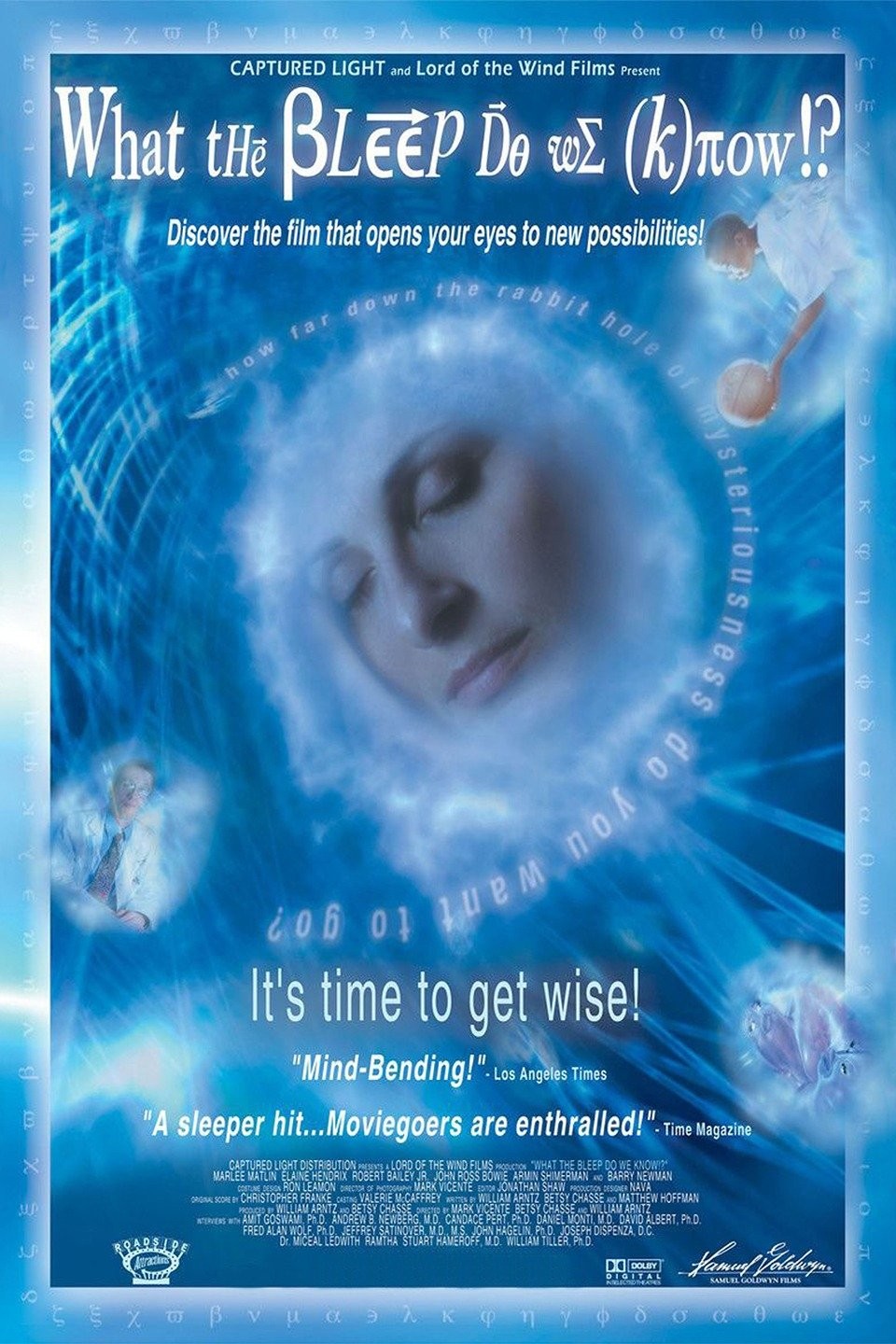
CW: So here’s what you do. So you think that The Principle is it. You’re like, oh, I can’t get any worse than this But no, but no So you take a stick and you move the cow pie over because it’s not it’s not quite hardened So it smears you move it over and that’s where you find. What the bleep do we know?
0:33:52
CW: Oh, this one! I watched this years and years ago with a friend of mine who thought it was a revelation.
0:33:58
BR: So, you know, for those who haven’t seen this, and I’m hesitant to recommend it other than just out of morbid curiosity and you have nothing better to do with, you know, 89 minutes of your time, it’s this weird, new agey, here’s my main memory. I was, a friend of mine was living in Buffalo, I dated a friend out there for a while and she’s reasonably smart and she emailed me a few years ago and she said hey you know I just saw this interesting documentary I didn’t really understand it but you’re smart I think I think you would enjoy it and and it was what the bleep do we know and it was interesting like she she admitted that she didn’t understand it but because I’m smart I would get it. I said no no no no it’s exactly the opposite say because I’m smart I hate it’s loathesome there’s nothing there’s nothing redeeming in there.
CW: What do you remember about it? I have vague memories of my friend being really into it. I remember a lot of stuff that didn’t seem to make sense but they were pushing this like well you never know and I remember dancing fat cells that were impacted by negative thoughts. So I don’t really have a clear memory of the movie. I definitely didn’t take a lot of what it said to heart because otherwise I’d remember it, but it didn’t make an impact on me.
0:35:24
BR: Right, and you know it’s along the lines of The Secret and I mean it’s not exactly the same, but there’s very very similar themes throughout there.
CW: The Power of positive thinking.
BR: All that, the law of attraction and if you just if you just wish hard enough things materialize. Anyway.
0:35:42
CW: Well, a lot of these documentaries, and I meant to say this about all the health ones, and you even mentioned the cow pie, which reminded me of this perfect saying, you don’t make apple pie better when you add cow pie to it. And a lot of these documentaries, one of the main weapons they use is they tell you all this stuff that’s factual and good information. A lot of these health documentaries and from what I recall a little bit of What the Bleep Do We Know, they have legitimate things that they can teach you part of the time. They’ll tell you some real facts like sensible health advice and then they’ll insert along with the real science, they’ll insert all this complete wackadoodle stuff and it gives the whackadoodle stuff an air of credibility that it should not have. Itís almost like hearing somebody in a lab coat spout all this stuff that’s legitimate chemistry. It makes sense, oh and here’s how you make gold from lead.
0:36:45
BR: By the way, did we mention this?
0:36:47
CW: Yeah, and if you haven’t trained yourself to look for when it devolves into that, you might think, oh, that guy knows what he’s talking about, so this must be all right too.
0:37:00
BR: So let me give you a couple quick examples of some of the documentaries that jumped to my mind that I have seen that were misleading at best. One of them was, and again, I’m reluctant to criticize them too much because I know that they were done with good intentions. And you could maybe say the same thing about several of yours as well, because presumably they’re not intentionally trying to mislead people. I mean, they knowingly mischaracterized and cherry-picked scientists’ comments, but they probably thought they were doing it for the greater good, like, oh, well, you know, look, this is, you know…
CW: True believers, much in the way that people fake instances of psychic, psychic nature or a supernatural nature, not because they think the whole thing is hogwash, but they just want to draw attention to this real thing that they do believe. They’re helping it along.
0:38:03
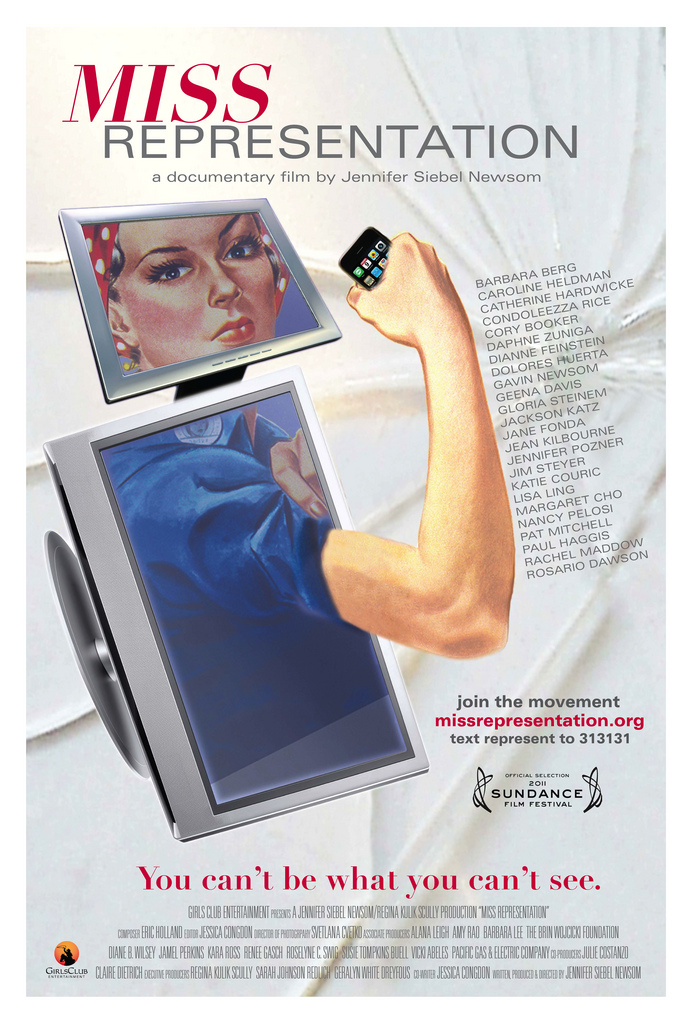
BR: Yes, pious fraud. So again, I’m slightly hesitant to criticize these too much, but on the other hand, these are supposedly educational documentaries, particularly the ones I’m going to talk about. And that, to my mind, is all the more enraging, because these documentaries are in schools, they set themselves up as authoritative documentaries for media literacy classes in high schools and college and elsewhere. And at that point, you are in many cases misleading children. You are mis-educating children and unfortunately a lot of times the teachers don’t really have any – I mean teachers are overworked and underpaid, they don’t have the time and resources to thoroughly vet every documentary. They like, oh, you know, they have some, oh, did you see this? This is on media literacy. It’s encouraging, you know, this, oh yeah, this is great. Let’s show this. And there’s not necessarily anybody that’s taking the time to sort of say, hold on here, what’s the truth behind this? So the one particular one I want to touch on is titled Misrepresentation. And it’s directed by Jennifer Seibel Newsom who is if I’m not mistaken she’s the wife of the the former governor or some lieutenant governors some some official in California and anyway in her in her documentary, she begins it with talking about the media’s influence on girls and women and she includes Nancy Pelosi Katie Couric, Condoleezza Rice, Gloria Steinem, Rachel Maddow and others about some of the messages of the mass media send and the main theme is that the media harms our culture and partly by telling girls that their values is tied not in their brains but inside their beauty. As we talked about a second ago, there is some truth to this.
0:40:01
CW: That’s undeniable. Yeah, I was about to say, so far I’m on board with this.
0:40:05
BR: So far everything is fine. So, which again, you can see why I don’t want to dump on it too much. The problem here is that they start throwing statistics out. So for example, the film’s website talks about, the quote, the film accumulates startling facts and statistics that will leave audiences shaken, armed with a new perspective. So I’m thinking, great, absolutely. I’m a media literacy educator. I think that’s great. Let’s arm kids with a new perspective.
0:40:36
CW: Still with you, yeah.
0:40:37
BR: Still with me so far. So unfortunately, many of the startling facts and statistics that the film gives out are wrong. So for example, it says 65% of American women and girls have an eating disorder.
0:40:52
CW: That’s a lot.
0:40:53
BR: Well, yeah, it’s a lot.
0:40:57
CW: What do they define as eating disorder?
0:41:01
BR: Okay, well, so here we go. I dug into this, as you knew I would. As you know, I’ve researched eating disorders.
CW: Yeah, you did like a master’s thesis involving eating disorders, didn’t you?
BR: I did and particularly regarding misinformation about eating disorders. Okay. And so that’s so and again I it’s not that I’m the you know I don’t need to have a medical doctorate – I just know that 65% of American women do not have an eating disorder just it’s just simply that’s factually inaccurate and like well maybe this is a mistake I mean this is this is this is a factoid that is you know a title on a film screen. It’s not like, this is not mentioned in passing, this is like, absorb this. Like, what, hold on here. So it’s just not true that 2/3rds of American women have eating disorders and certainly not calorie restricting eating disorders such as anorexia. Those rates are closer to 1-3%. And so I was digging, so I actually contacted the director to ask, where did you get these numbers?
0:42:04
CW: As you do.
0:42:05
BR: As I do. And I didn’t get a response. The closest I could come up with is that the 65% included everything from anorexia, which is around somewhat less than 1%, to, for example, overeating.
0:42:20
CW: So, overeating, there’s overeating as a disorder and then there’s like, fill out this questionnaire, have you ever overeaten? Well, of course!
0:42:31
BR: Right, right, yeah, so if you, yeah, so again, if you focus, if you try and spin it that way, then yeah, sure, I mean, two-thirds of Americans, adults are overweight or obese. So, if you’re, if that’s all you mean is if you either you know overeat or under eat then you have an eating disorder well yeah that’s that but that’s not what most people think of when they think of eating disorder so if you define it in such a way that includes two-thirds of Americans then yeah sure why not.
0:43:04
CW: Well that seems to be creating pathology where you don’t necessarily need to.
0:43:11
BR: It does and that’s one of the problems. So again, it’s not just one factoid I mean, I that’s you know, anybody can make a mistake, but there’s a series of them. So for example later on in the documentary Newsom plays really fast and loose with me the claims. So for example, keep in mind that the theme of the documentary is the harm that mass media Mass media messages send you could probably imagine where this is going. So at one point she shows a horrific news headline about young girls being killed and gang-raped directly after a scene from a violent video game. So the clear connection that she’s making in this documentary is that violent video games caused murder and gang rape.
0:43:49
CW: Well I’d be curious to know how they tracked that. Like did they gather up up data like across the country after Grand Theft Auto was introduced or did they did they interview people who said yes I was motivated to do this gang rape and murder because I was just playing this game and I just saved it right after this scene and then I went out and did this thing because that’s kind of what it sounds like.
0:44:19
BR: It’s even worse than that because it’s it is so superficial and this is this is this is my problem with it, is that it’s so superficial that that’s all, literally what I just described is the extent of the research presented in the documentary. It is scary news headline about murder gang rape just before somebody playing violent video games. There was no research given, there are no statistics given about connecting that. In fact, if you looked into this, the fact is that there is simply not good evidence that video game violence causes real world violence. This has been looked at over and over again. There was a book came out late last year called Moral Combat by Craig Ferguson. There’s overwhelming evidence that violent video games don’t cause real world violence.
0:45:19
CW: Yeah, I’ve read a little bit into that myself and I saw clear parallels between this and the comic book scare of like the 1960s, the seduction of the innocent, where certain officials were saying that violence in comic books would lead to this huge crime wave as all of the young people reading these comic books would be seduced into just raping and killing and robbing and all sorts of other gang activity because of comic books. Everything I’ve read said similar things about first-person shooters and violent video games. If people understand, it’s just a video game.
BR: And then from making that frankly literally false link between the murders and violent video games, she goes on to link pornography with rape and sexual assault. Now this is where she really steps in it because the claim that pornography leads to sexual assault has been thoroughly debunked. It’s been even the staunchest feminists who originally claimed that have backed away from it because there’s simply no evidence to that. In fact, if anything there’s an inverse correlation. Rape rates have dropped dramatically over the past few decades at the exact same time that sexually explicit content is more available than ever before through the internet.
CW: I also remember reading that, yeah.
BR: Yeah, so again, the problem is, you know, she’s lumping in valid, useful points. Like, yes, people need to be aware of the messages the media sends. Yes, girls need to recognize that they’re valued for their brains as well as their beauty. Yes, all that’s true, but don’t shoehorn in these, basically, you know, faulty links to violent video games and pornography. If you don’t like violent video games and pornography, that’s fine, but don’t falsely link them to real-world effects.
0:47:27
CW: Yeah, yeah, well that goes back to something else you were saying, I think, last week, that just because you don’t like something doesn’t mean you have to concoct a bunch of social ills to justify your dislike.
0:47:39
BR: Exactly. So, and there’s a lot more. I don’t have time to go into the whole thing on misrepresentation, which it’s ironic that’s called misrepresentation because it actually misrepresents a lot of the data there. So again, I’m sure that Newsome had good intentions and there are some nuggets of truth to it. Unfortunately, it is mixed in with flat out bad statistics, wrong assertions and disproven links that ultimately undermine her message.
0:48:26
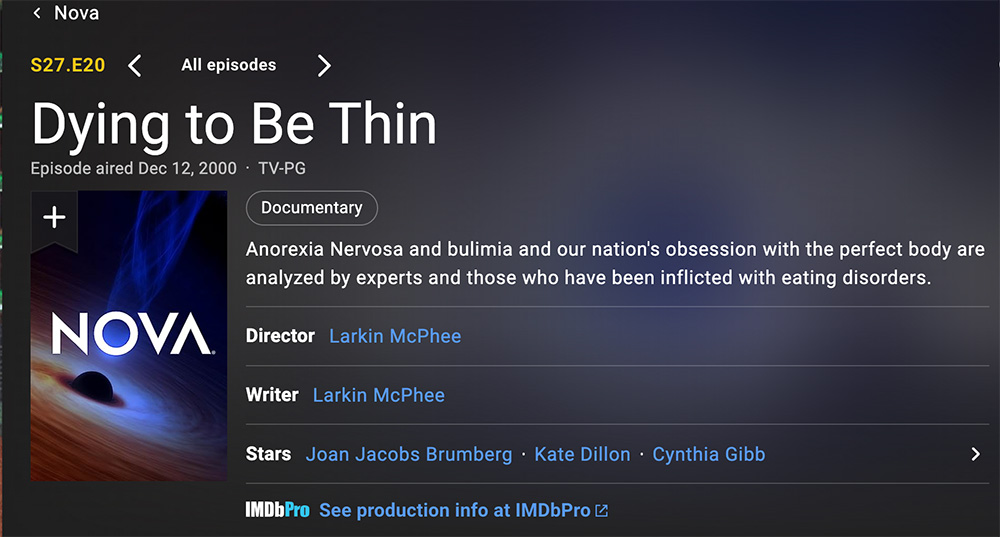
BR: Another one is from a documentary called Dying to Be Thin and as you can imagine this also dealt with eating disorders which again got my antenna up and I was a very good series. I was a very good series and I was a very good host. I was a very good host and I was a very good host and I was a very good host and I was with eating disorders, which again, got my antenna up. And I was watching the documentary, Dying to be Thin. Again, bad statistics. So one of the statistics that was included in the broadcast in the promo copy was, quote, anorexia has been increasing by 36% every five years since the 1950s.
0:49:10
CW: Wait, we’d all be dead. Yep, yep. That just on the face of it mathematically does not add up.
BR: Yes, well apparently you would have been a good fact checker on this particular episode. Well, they didn’t ask me.
0:49:25
CW: Well, they should have because you are ravishingly beautiful and brilliant. So, I’m thinking, well, hold on here. Anorexia has been increasing by 36% every five years since the 50s. No, I’m pretty sure that’s not true. So I looked into it and it is attributed to the Mayo Clinic, which is a respected… That’s surprising. It’s the Mayo Clinic and they make good mayonnaise. So I’m like, well, hold on here. So I contacted them and I said, well, you know, what’s… where… because it didn’t give a journal article or a study, it just said the Mayo Clinic. Well, so, number one, there’s a problem there because if you’re giving valid statistics, just tell us the study’s name, right? Don’t just say, ask the Mayo Clinic. No, I’m doing your job. Okay, fine, I’ll ask the Mayo Clinic. So they said the only one they could think of, the only study they could think of was the article in the International Journal of Eating Disorders in 1999 titled, The Ups and Downs of Anorexia Nervosa by Lucas, Krausen, O’Fallon and L.J. Melton. Anyway the problem here is that that study doesn’t say what the NOVA program says it does.
0:50:42
CW: I’m shocked.
0:50:44
BR: This is your shocked face, right? No, I can read a study, I believe you. I’ve read studies and nowhere in there does it stay or suggest that anorexia has been increasing by 36% every five years since the 1950s and certainly not through the year 2000. So it literally doesn’t appear there. So I contacted the producer, a woman named Larkin McPhee, and I asked her, I said, you know, I’m trying to track this down. I’m hoping you can help me understand. You have this documentary. That’s that’s you know teaching kids and adults about the statistics and the reality behind anorexia, and this claim is is self-evidently false and this the the reference you give it doesn’t appear there. McPhee wrote back and said when I asked her I pinned her down. I’m like, I’m just I’m I’m not saying that there’s any intentional misrepresentation. I’m just, can you help me understand where did you get this number?
0:51:43
CW: Yeah.
0:51:43
BR: And her answer was, well, that the researcher, the lead researcher, Dr. Lucas, who’s now died, unfortunately, gave her that number.
0:52:07
CW: So we don’t know where this guy got it?
BR: Well, it certainly, I can tell you, it doesn’t appear in the article that she cited. In fact, as far as I can tell, it doesn’t appear anywhere. So she, the writer-producer of this NOVA PBS show, Dying to be Thin, was not interested in helping me sort out exactly where this statistic came from. It was just like, well, you know, it was a long time ago and I can’t help you anymore. He gave me that number, but I can’t find the notes and go away.
0:52:41
CW: Well, she is probably a busy producer, but that is a darn shame that you couldn’t get to the bottom of where that came from. Because it sounds like somebody pulled it out of their backside.
0:52:52
BR: It does. It does. Again, I don’t mean to harp on these things. It’s just that I happen to have a background in these topics. It’s easier for me to see a red flag. It’s like if someone’s discussing the chupacabra or something else that I happen to know intimately, it’s much easier for me to flag this and say, “Oh, there’s something wrong here,” than it is for the average person who doesnít certainly have the background in it.
0:53:17
CW: Well, which kind of is disheartening and makes me a little nervous because if you have a background in something and you can pick up red flags for where a documentary goes wrong, it just makes me wonder, Okay, I’ve watched a ton of documentaries about things I didn’t know anything about and does that just mean I missed a ton of factual errors and misleading things because I wasn’t clued into it. I didn’t know. I didn’t have the background knowledge to be able to pick out all the problems.
0:53:48
BR: You know that’s a totally valid concern.
0:53:52
CW: I mean I don’t want to become so paranoid that I can never enjoy a documentary again but it makes you worry.
BR: Well especially I mean we’re talking a Nova PBS series. I mean, I and same thing with, you know, Misrepresentation. I mean, this is you did. Did they not? I mean, in misrepresentation, it has dozens of facts and factoids put up on the screen. This is it’s not just one or two. I mean, there’s just 36% of this. And, you know, the average person sees, you know, seven hours of, you know, advertising, they have all these. And I’m thinking, did nobody really fact-check these these statistics before the movie went out I mean did a writer not look at this did an editor not look at this did did no producers say hey if we’re gonna, if we’re gonna create a documentary that’s gonna… hopefully be used to educate people in schools and the public about these things Maybe we should have like an expert look it over.
CW: Or a few.
BR: Yeah, yeah, you know just a little something like that.
CW: Well it it reminds me of like I again my my background is in editing and we used to have a saying about errors and typos and such they’re like cockroaches if you can spot one immediately that means there are a hundred more that you just can’t see right now
0:55:09
BR: Right that’s another red flag rule right there yeah anyway so the third one I don’t want to spend too much time on, but the third one I was going to talk about was a documentary which I think you may have seen called Fed Up.
0:55:21
CW: I did watch that one this week, yes.
0:55:23
BR: Yes, and I’ll just give a couple of thoughts on it and I’d like to turn it over to you. But one thing is that, so anyway, Fed Up, as you know, because you saw it, it’s about eating and dieting and some of the factors behind the health problems and obesity and this and that.
0:55:39
CW: Yes, a lot of very sad overweight children.
0:55:42
BR: Yes, yes.
0:55:43
CW: It made me hungry.
0:55:45
BR: Well right around the 27 minute mark, because I have notes here, the documentary Blames the Sugar Industry. And it talks about how sugar increases insulin, which then decreases the body’s messages to say that it’s full, which I’m not a nutritionist or scientist, I have no particular reason to doubt that, but it did make you wonder. The logical conclusion would be that people eating sugar-free food should be thinner because of course there are many diet drinks and diet sodas that’s a huge part of the market industry and so if sugar is the evil that it’s portrayed to be, and I’m not saying it is or isn’t, but if that premise is true, then the, and it’s certainly true that the average American eats more sugar than they should, and there’s hidden sugar in all sorts of things, clean bread and all sorts of things, but given the number of sugar-free products that are out there, you would think that this wouldn’t be as big an issue.
0:56:44
CW: Well, I actually had, back in college, I had two roommates, and I remember one of them and oddly enough I was the overweight one and they were the ones that were going on diets more than I was which I guess is one of the reasons why I was the overweight one but one of them went on a completely fat free diet because she heard that fat was the problem and the other one went on a completely sugar-free diet because she heard sugar was the problem and both of them got really lethargic and the one who refused to eat fat started losing her hair. That’s just a case study of two crazy college girls though, so I wouldn’t put any stock in it.
0:57:20
BR: I’ll just touch on a couple of other things. This is one of my bugaboos, again going back to media and things like that, is about the hour mark, the documentary talks about advertising foods, particularly marketing to children. And I’ve read lots on this, you know, there’s lots of anti-consumerist publications and books, everything from Adbusters to Naomi Klein. I’m pretty familiar with the literature and this essentially parrots many of the same points but one of the counter arguments that seems to be totally missing, certainly from this documentary and from most documentaries that even touch on it, is the fact that it is certainly true that there is a lot of marketing bad sugary junk food to kids. That’s undeniable, it’s absolutely true. It’s also true that by and large, kids don’t buy their own food. You know, oh, it’s Tony the Tiger, and Toucan Sam, and all these things, and all this junk food and like, yeah, when’s the last time you saw an eight year old buying cornflakes?
0:58:32
CW: I recall one parent sort of explaining to a doctor why her six year old was 120 pounds. And she said, well, but she likes McDonald’s, but she really, really wants it. And the doctor said, well, does she drive herself there and take herself through the drive-through?
0:58:49
BR: How exactly did your child get there? Did she use her allowance to buy the Big Macs or how does that work?
0:58:52
CW: Yeah, you just have to be and quite frankly if a parent cannot withstand the whining of a child who wants something, well be prepared to buy your child a pony and take them to the circus every week because the kids gonna want a lot of stuff that it shouldn’t have.
0:59:12
BR: Well look and so again this is this is a fraught topic we could do a whole subject a whole show on it, but again, I think it’s important for people to remember that whenever you hear this argument and I see it routinely I saw it last week in the New York Times. Whenever you see this argument that’s out there that that is complaining so loudly about marketing to kids Again, there’s truth to that, but what they’re glossing it over or it sort of it doesn’t help bolster their point is that again the kids by and large don’t make their own food choices they don’t buy their own food they they they buy what if they I mean they may badger their parents but at the end of the day they’re not spending their allowance to buy Big Macs and the junk food so and that’s the stopgap between the complaints that the average child sees four hours of advertising every day and what, they’re buying Buicks? And what? Well, it’s not healthy. I agree it’s not healthy, but children by and large don’t make their own purchasing decisions.
CW: And children are also not in charge of their own screen time. Parents definitely have the ability to limit how much TV a kid gets.
1:00:34
BR: Right. And it’s certainly true that some of the eating habits established as a child can translate and often do translate into adulthood. And so I want to be very clear, I don’t deny that at all, but that’s a separate issue. So again, when I see these documentaries that demonize advertising and demonize the food industry and demonize Big Pharma and demonize Big Sugar and all this, there’s nuances there.
1:01:05
CW: Yeah, well, there’s plenty of other reasons we could demonize marketing and advertising. They’re often liars.
1:01:11
BR: Well sure, sure, and just to wrap up with the Fed Up documentary, at 1 hour and 14 minutes, there’s a quote from an expert who says, “There are so many industries that make profits off of people being unhealthy that it’s in their best interest to have people continue to be unhealthy.” Says Marian Nestle, PhD, professor of nutrition at NYU.
1:01:30
CW: That is one of my biggest pet peeves, the whole conspiracy notion of doctors don’t want their patients to be healthy and it goes right along the lines of there’s a cure for cancer but doctors don’t want you to know because theyíll make more money if they just keep you on chemo.
1:01:56
BR: Again, it’s a conspiracy that’s promoted by Marion Nestle, PhD, professor of nutrition at NYU. Direct quote right there and it’s advocating essentially, it’s a conspiracy theory. She says flat out that doctors don’t want you to be healthy, that the food industry doesn’t want you to be healthy and that’s simply not true.
1:02:19
CW: Well, that’s frustrating and it’s frustrating to a lot of doctors I know. But oddly enough, that kind of leads into something that I had written some notes on to talk about. Ben, you were mentioning a loved one having you sit down to watch a documentary that turned out to be complete BS. And I think all skeptics may have had that experience at one time or another. My husband, Rob, who has given me permission to tell this story on the show, everybody kind of has their pet woo that they sort of fell into for a little while and for him. He still kind of carries this torch for Big business is bad. There’s you know behind the money. There’s nefarious, you know evildoers. He sat me down and said, you know, you should watch this. This this is an important documentary. So I sat down and I watched this documentary with him on the Brzezinski Clinic, for those of you who don’t know, he is a pretty famous doctor in skeptic circles. Various health skeptics have been fighting him for years, as has the FDA. And this Berzinski documentary, which came out, I think, in 2011, just paints him as a maverick doctor who is being hogtied left and right by red tape and the FDA who doesn’t want his absolutely effective cancer cure that can cure most cancers, they don’t want it out. They would rather pump people full of poison. And so we watched this whole documentary and I’m kind of rolling my eyes a little bit through it and Rob afterwards said, so what did you think? And I said, well, I saw a lot of red flags. I had never encountered Dr. Brzezinski before, but we went through and to my husband’s credit, he patiently listened to me. He was only minorly frustrated that I had not come away from that documentary affected the same way that he had come away from it. But I pointed out that, look, all we’re seeing is emotional testimonials. The data that they were presenting seemed definitely kind of a little bit hedgy and I’m not an oncologist so I can’t pick these things out, but I was definitely suspicious and I said you’ve got a lot of manipulative framing whenever they showed a chemo drug, they put the word poison over it with a skull and crossbones and they highlighted nicknames like this drug is called the red death and it used to be part of an insecticide and blah blah blah and I was like okay Rob you do understand that chemo drugs are poisonous that’s what they do they poison the tumor. That is intentional. You are trying to kill part of you it’s the part of you that’s trying to take over you want that part dead there’s a reason for that I’ve known people who’ve gone through chemo if you feel like you’re being poisoned that means it’s working and this over-the-top presentation of Brzezinski as a maverick with ominous voiceovers hawking conspiracy theories about why the FDA is keeping him down and so I was really kind of unable to account for what seemed like miraculous cures on the biopsy reports because they did show biopsy reports saying here she is before the neoplaston treatment and neoplastons for anybody who’s not familiar with Brzezinski. He found this substance in the urine of healthy people that’s not there in people who have cancer and he named it Neoplaston. He started isolating it and then synthesizing it and selling it to people for exorbitant amounts of money. He technically is running what he calls clinical trials, but he’s charging people huge amounts of money to participate. And anyway people are saying it’s a miracle and my child is cured and yeah, I was not exactly convinced so Unable to really parse out the biopsy reports myself I did a quick web search and really I recommend this for anybody who has their their antenna go up when they watch a documentary do a search for that documentary plus the word skeptic and I found a fantastic write-up by David Gorski also known as Orac and I can maybe throw the link in the show notes or something. And he is a cancer doctor and he took this movie I mean this has been his pet project going after Brzezinski and rightly So he went point by point and the entire movie falls apart under his scrutiny he breaks down the clinical reports that are shown briefly with yellow highlighting on the movie and he shows every instance where certain things are missing. He’s like, well, they’re missing a pathology report on this and a pathology report on this. And if this really is a glioma, it’s not acting like it, and every doctor would assume it’s this or that. And sometimes the testimonials didn’t really line up with actual medical practice. Like he said, there was an infant that had abdominal surgery to remove a mass. And he said the parents were saying, you know, our baby was riddled with cancer. It had spread to all these different organs. And he said, you wouldn’t do surgery if that was the case. You do surgery if it’s in one area and you can take it out. And he points to all these things, like such as there are cases where, of course, there’s cases where things spontaneously go into remission. That happens. There are outliers. And if you just grab the people where that happens, you can make it look like you have a miracle cure. But basically what it comes down to is cancer is complicated. I wouldn’t even use the word cancer. I would use the plural cancers because there are a bunch of different kinds. And it’s not hard at all to fudge certain bits of data by showing partial reports, highlighting certain bits of medical data that make it look like something has shrunk, even though it might be, it might appear shrunk because the biopsy you took removed 80% of the mass. That happens too. And presenting it as part of a narrative for the documentary. And it took an oncologist to spot the holes in the evidence, just like you spotted holes in evidence for something you’re familiar with. Dr. Gorski was able to spot all the holes in the Brzezinski documentary, and he did so expertly. And again,
BR: That was in a, it was in an article or a video or what was that?
CW: He’s he, it was on his blog in several places. He, he’s, uh, he’s written many times about Dr. Brzezinski. I went back to the original one that I found and re-read it in preparation for this episode. But I believe he also wrote an article that appeared in Skeptical Inquirer or on the CFI blog, but it’s also on his own personal blog. That was the one that I found.
1:09:04
BR: It occurred to me that it might be interesting and probably legal through fair use to show the Brzezinski documentary and have basically a sort of pop-up video commentary.
1:09:21
CW: Like Mystery Science Theater 3000 or something.
1:09:25
BR: Absolutely. I’m not a copyright attorney, but I know something about fair use. And if you’re doing commentary, which is exactly what that is, that could be really useful as just sort of like, you know, here’s this documentary and just have Gorski just, you know, as you’re watching it, have a voiceover track, say, okay, well, this is wrong. This is wrong. I’m just throwing the idea out there.
1:09:46
CW: That might be a really powerful way to do that.
1:09:49
BR: Comment and criticism. Well, I know Dr Gorski did speak at the amazing meeting back in 2014. And he, he and a, and a, and another skeptic did a sort of a tag team where he did part one and the other fellow did part two. I’m forgetting his name.
BR: Bob Blazkowicz?
CW: It may have been. I’m forgetting his name because I did not write that down.
BR: Bob has done a lot of great work on Brzezinski and I’m very proud of him for that.
CW: I think I did come across Bob’s name on a couple of other bits that I researched.
BR: He’s occasionally on Virtual Skeptics for those who want to check it out.
CW: Well, moving very quickly to the last thing that kind of is optimistic. Ben, you were talking about how some of these very flawed documentaries end up in classrooms. They end up being used to teach students, to misteach students, if I may. One of the most debunked documentaries out there is Super Size Me. You have seen this, I take it?
BR: I have.
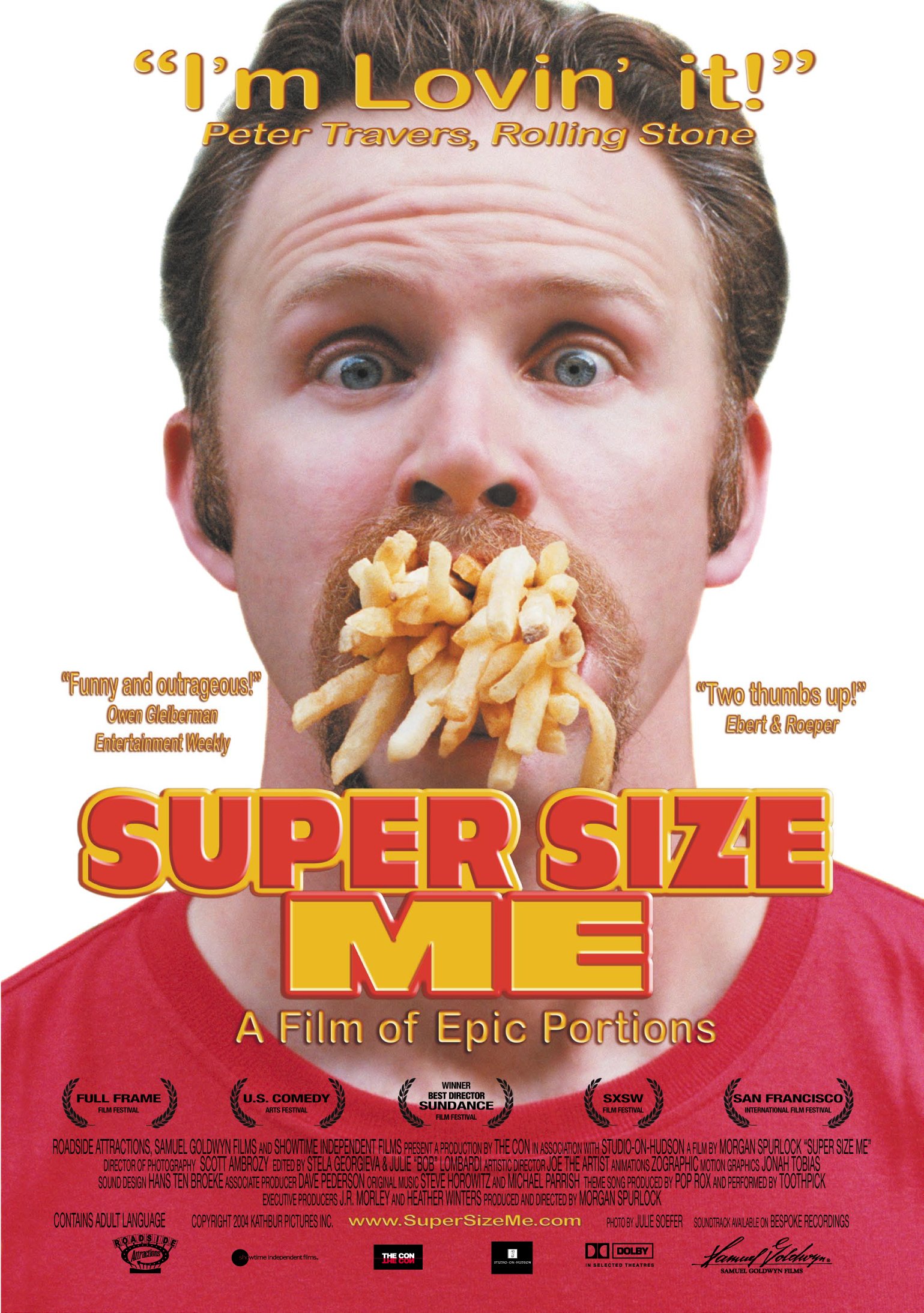
CW: It was wildly popular, and it was debunked on a number of levels. It was debunked by math since one of the things that is said repeatedly is, I was eating over 5,000 calories a day. If you do the math, even if he’s eating a side of large French fries with every meal and a soda, it tends to get up to around 3,600 calories a day if you eat three meals a day at McDonald’s, but getting to 5,000 would require drinking a lot of milkshakes or something too. People questioned him on the math and this was one that I’ve kind of followed a little bit because a lot of people tried to recreate it. Who wouldn’t want to sign up for that? Oh, eat fast food for a month in the name of science? Sure, I’ll sign up for that. The group that did it under controlled circumstances was a Swedish university group at the University of Linköping. When I read about it, they had a group of seven people in their 20s and they had another group doing it as well, who did the same thing. They ate at McDonald’s every day and they reduced their activity and none of them had the dire consequences that Spurlock did. Now, granted these were kids in their 20’s, Spurlock was a little older, but that still is a pretty big bit of evidence against what he was purporting happened when he ate McDonald’s every day for a month. One of my other favorite ones was now a lot of, sadly, a lot of health classes have started showing Supersize Me as just par for the course. It’s one of the documentaries they watch. And a high school science teacher by the name of John Cisna decided to sort of put it to the test and in a real world sort of lesson with his students, he said, well, your choices really matter. You go to any place to eat and you can make terrible choices at home, you can make terrible choices at a fast food joint. So here’s what he did. He had his students pick his food and they had to keep it to about 2000 calories a day, but they had to pick from McDonald’s menu. So they had him eat different sorts of things every day at McDonald’s under 2000 calories and he ended up losing 60 pounds by eating nothing but McDonald’s for 180 days and all of his health markers improved.
BR: Sounds like a good idea to me!
CW: After McDonald’s found out about this because he got written up and everything and ended up on the Today Show and he ended up becoming an ambassador for McDonald’s once they found out and he chronicled his experiences in a little 19-minute documentary titled 540 Meals if anybody wants to check that out. And then the last thing I saw was and I actually watched this one just today, put it on while I worked. Tom Noten, he’s a computer programmer who used to be a stand-up comedian and he produced this, dare I use the word clap back, he produced a clap back documentary against Morgan Spurlock called Fathead. Well, he eats nothing but fast food for 28 days and again, he keeps it to around 2000 calories and he loses weight and his numbers improve, his cholesterol improves, etc. Now this documentary has its own problems. If I were to dissect the entire thing, and it goes directly against a lot of like forks over knives says we should stay completely away from animal protein. The fathead documentary says, we’ve been eating animal protein for our entire existence as human beings and Mother Nature’s no dunce. And they kept showing this Mother Nature graphic with a little dunce cap falling on her head saying, we evolved to eat animal protein, blah, blah, blah. And I’m like, well, that’s sort of the naturalistic fallacy. I don’t know if you could really just go off of that, but regardless, he pretty much dispels, also with just plain old math, something was awry in Super Size Me, because it just doesn’t add up. And there was actually a Super Size Me 2 that came out recently. I don’t know if you heard about that. Did you hear?
BR: I did not hear about that. Did it respond to some of the criticisms?
CW: I don’t know because I wasn’t able to find it Super Size Me 2: Holy Chicken came out in September of 2017 and it was supposed to premiere on YouTube red But YouTube red dropped it after Spurlock’s admissions of apparently being a sexual harasser for decades and cheating on every wife and girlfriend he’s ever had and treating women at the workplace very poorly. I read through a little bit of that and it’s not just a question of a few women misinterpreting things that could be ambiguous. No, he’s flat out a douchebag for a long time. People have dropped him like a hot potato and I could not find the documentary very easily online. So there’s that.
1:16:03
BR: Well, that’s that’s unfortunate. But, you know, it would it would it be nice to hear his responses. I mean, if I’m I’m curious now, I mean, I knew there was some there was some debate about how whether the data was fudged. I’d be curious to know, with the whole thing faked? Did he, did he, you know?
1:16:29
CW: I couldn’t find any indication that he ever spoke to that. The Super Size Me 2: Holy Chicken from what I saw in the trailer and some write-ups, basically was about, oh, well, fast food is responding to my wonderful documentary of Super Size Me, and they’re making efforts to make their fast food more healthy, but are they really? It’s just, they’re making it sound more healthy. And then he opens up a chicken restaurant and does some sort of stunt involving his own chicken restaurant.
1:17:00
BR: I met Spurlock years ago and I probably should have asked him about that, but I didn’t have the balls to say, so did you fake that thing or what?
1:17:11
CW: Well yeah, I’m sorry you didn’t have the opportunity to do that. I wish it had been under different circumstances where you could have pinned him on a couple of things.
1:17:19
BR: I’m glad that you concluded with that one because it is a good example of where people can and sometimes do follow up on these things, right? I mean, in a way, it’s almost like it was an experiment. I mean, it wasn’t a well-controlled scientific experiment. In fact, it may have been a fraudulent experiment. But with anything, I mean, it should be… if Spurlock’s conclusions and results were valid, then there’s no reason in the world why it shouldn’t be able to be replicated.
1:17:51
CW: Well, that’s just it, nobody seems to be able to replicate it. And my hat is off to the teacher, John Cisna, the science teacher, who not only questioned it and saw some holes in it that he could use to the benefit of his students, but he brought the students in on it. He allowed himself to be the guinea pig, so he wasn’t putting any student’s health at risk and he had them sort of take the reins and be the scientists there and he was the lab rat and they learned a few things about how calories work and how choices make a difference rather than, I ate French fries, so I’m going to be fat. No, how many did you eat? Are you eating them all the time? Are you really getting 5,000 calories? Because that’s not good no matter, you could eat 5,000 calories of oatmeal and it’s going to be a problem.
1:18:43
BR: This is true. 5,000 calories is 5,000 calories. There’s obviously many more documentaries that we could touch on. As listeners may recall, a while ago, Pascual and I talked about a documentary about sleep paralysis and some of the creepy things with that. And I imagine that we will be discussing other documentaries in the future, but I’m glad that we got a chance to sort of give a little discussion on misleading documentaries. And I think we got some good pointers out there for how to maybe do a quick analysis of them and see if there’s any red flags.
1:19:18
CW: Yeah, that was kind of fun hopscotching through some of our more memorable ones.
1:19:22
BR: Definitely.
(MUSIC)
1:19:23
Pascual Romero: Hey folks, Pascual here, just checking in a few days after recording. In fact, this is probably minutes before we will be uploading and releasing the episode, but I wanted to check in and let you guys know I should be back next week. My voice is probably about 90% back at this point, and I think I can handle more than a few minutes of talking at a time. Before we go, I’d like to just quickly thank Amy Frushour-Kelley and Dr. Angela Mattke for their continued sponsor-level donations. If you are curious about donating or subscribing to the show, as it were, on Patreon, just go to patreon.com forward slash squaring the strange, and you can check out all the perks we have. At the $5 and up level, you’ll be getting a Skepticrate every month. That is our most popular tier, and it’s a lot of fun. We send you a little package of goodies every month that are usually skeptic themed or have something to do with an episode we did or you know any number of fun and interesting things. And before I sign off here I just wanted to jump in real quick and mention that Brian Dunning is crowdfunding a documentary that he’s working on with Emory Emory. It’s called Science Friction and it is a documentary aimed at examining how scientists are misrepresented by the media, specifically in documentaries as we talked about this week, and how often they just can’t really do much about it because they sign a release to be in the film and they can’t really control how their words are changed or misrepresented. But if you go over to sciencefriction.tv, you can check out the campaign and get some info about how to take part. There’s a lot of really cool perks at different levels. So yeah, just check it out, sciencefriction.tv. Highly recommend getting into that. It looks like it’s going to be a really cool documentary. And make sure to tune in to next week’s episode. We’re going to be having our friend Sharon Hill on. Most of you are probably familiar with her podcasts Doubtful News and 15 Credibility Street, but I’m sure many of you are also familiar with her new book that just came out, Scientific Americans. It’s a book about the colorful characters who go out there with their supposedly scientific equipment and methods and try to prove the existence of everything from Ghosts, Bigfoot, to UFOs and everything in between and they kind of tend to exploit it a little bit and they’re the kind of people who end up with reality shows and such. But go on over to Amazon.com or SharonAHill.com to check out where to buy it. But we will see you guys next week with Sharon on board with a little chat about that awesome new book. Until next week, see ya. Swearing Strange is a production of Kronos Creative LLC, copyright 2017. Theme music by Shriek Back, additional music by Memory, Guitard and Feathered, and Pasquale Romero. Content producer, Celestia Ward. Audio engineering, producing, and editing provided by Pasquale Romero and Kronos Creative Studios. Additional support provided by Ashley Romero, and of course, our listeners and patrons. The views and opinions expressed in this podcast are those of Swearing Strange and do not course, our listeners and patrons. The views and opinions expressed in this podcast are those of Swearing Strange and do not necessarily reflect the views and opinions of Cronus Creative, Center for Inquiry, our advertisers or any affiliated organizations and employers.
Transcribed with Cockatoo
