Episode Summary:
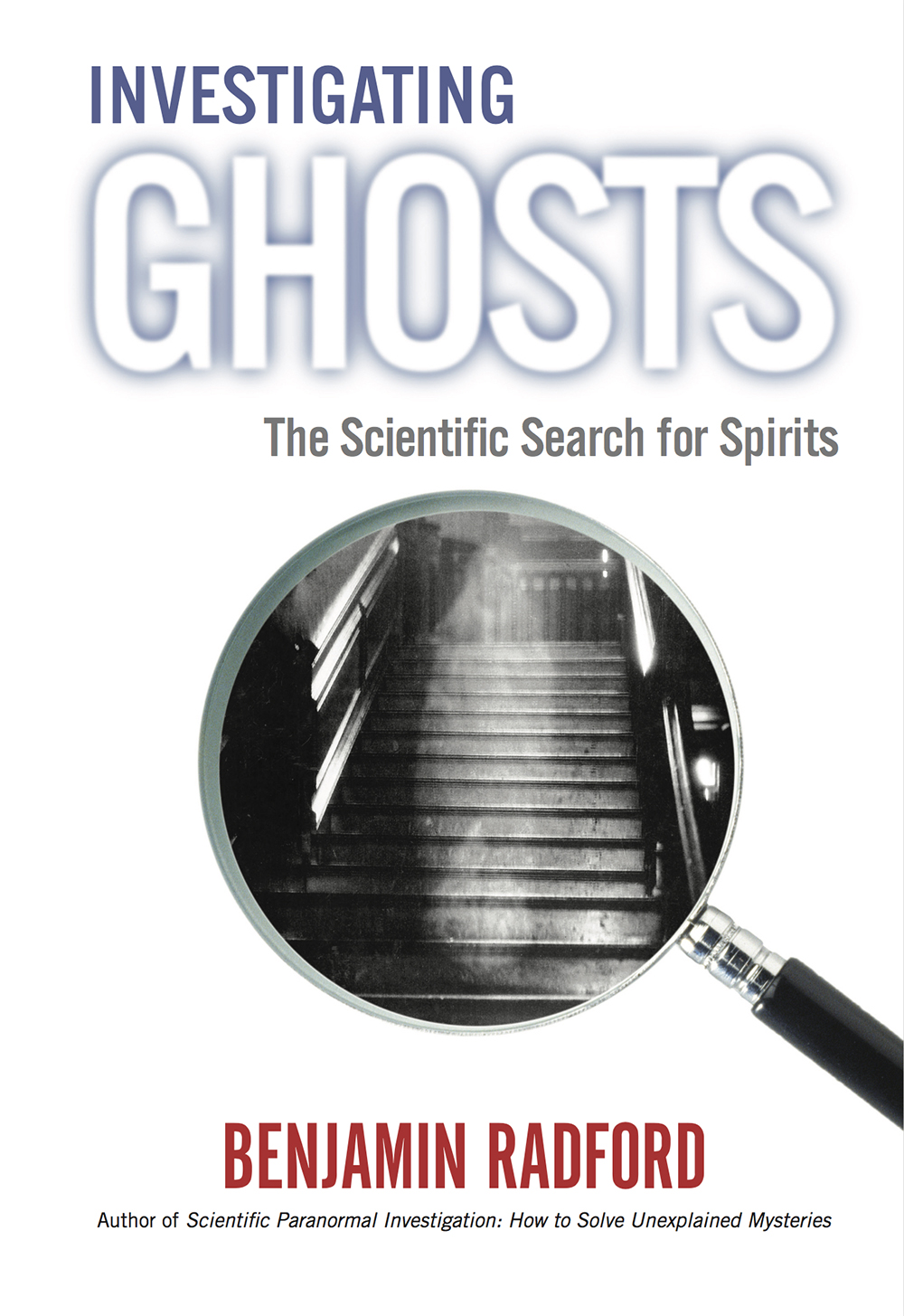
This week, our hosts chat about Ben’s new book, Investigating Ghosts.

0:00:00
Ben Radford: Welcome to Squaring the Strange, the podcast that examines all manner of the mysterious and the mundane through a critical lens. So let’s square the strange.
0:00:11
Pascual Romero: Welcome back to Scoring the Strange. I’m Pascual and with me today is Ben and Celestia. How you guys doing?
BR: Doing good.
CW: Me too. How’s it going? Real good.
PR: This is episode 42 so naturally we’re gonna have the answer to the ultimate question of life, the universe, and everything. And if we can’t figure that out, we’ll have to settle for talking about Ben’s new book.
0:00:57
CW: I’m sure we can cover all that in about 55 minutes and some change.
0:01:00
PR: Yeah, sure, sure. Why not? The book’s called Investigating Ghosts, and it’s a book that kind of sets out to teach us how to properly investigate claims of the supernatural and such. So I guess that means no more stumbling around abandoned houses with EMF meters and camera crews, right?
BR: Only if you want to do it right. If you don’t care about getting real answers, then knock yourself out.
PR: So yeah, we’ll be getting to that in just a minute, but Ben, I heard that you had a little bit of a correction on our last episode.
BR: Yes, apparently I misspoke oh crazy I know I say a lot of words…
CW: Can we get a bell for that instead of just a bell for the new topics for new episodes can we just have a Ben was wrong about something bell?
PR: Yeah I think that’d be funny we should have a buzzer!
BR: I prefer to say that I misspoke but the the thing I misspoke about that Celestia so so so glibly says that I was wrong about which I was was the the Emilia Earhart documentary or pseudo documentary. I had mistakenly said that it had aired a year ago. It was in fact six months ago. So my bad. Sorry, I was I was just my the point remains, it should have been cleared up. But it was six months, not a year ago. I’ve been slapped on the wrist and we can now move on.
0:02:26
CW: And ironically, you are being transparent and forthcoming about your error, which is pretty relevant to what the History Channel is not doing about their own content.
0:02:38
BR: Duly noted. And so, Pascal, what are you skeptical about this week?
PR: This week I am skeptical about Darwinism.
0:02:48
CW: Darwinism? Are you saying you’ve joined the legions of intelligent design people?
0:02:55
BR: Did Ken Ham get to you?
PR: Oh, yes, he did. He did. It was very convincing. I went to the Ark encounter, but no.
BR: Or is it Jesus riding a dinosaur? Clearly science.
0:03:08
PR: So what I’m skeptical of, though, is specifically the casual use of Darwinism as a concept The way people throw it around Kind of loosely on the internet, you know, you see a video of a drunk guy jumping over a bonfire or you know people trying to eat dishwasher detergent as has been kind of a thing lately In the comment section almost immediately when you see this stuff fills up with people saying things like oh, it’s evolution at work, or another Darwin award, or just people failing the evolutionary challenge. We can have a chuckle at the humor of it, but I kind of have to wonder if people are misunderstanding exactly what Darwinism and natural selection, or quote-unquote survival of the fittest is. So I thought we might tackle that a little bit today. Evolution is actually a whole lot of things, and survival of the fittest is just one component of it. So there’s mutations, environmental changes and demands, population shifts, migrations, you name it. I mean, everything contributes to evolution in terms of Earth influencing life. And anything that can happen to a living population contributes to it in some way or another. And to put it crudely, all evolution really cares about is did you get lucky and did it become a kid? That’s pretty much it. If you get to the point where you’ve passed on your genes, you’ve successfully achieved survival of the fittest. So no matter how much boneheaded stuff you did before or after, you’ve officially beaten the odds and therefore you are not necessarily, you know, unless the Darwin Award is to celebrate people who successfully achieved the next step in evolution, there’s no reason to think that these actions and these silly things people do on the internet and on videos are necessarily going to contribute to…
BR: Any real effect on the gene pool…
PR: Yeah, that’s not what evolution is.
0:05:15
CW: Yeah, well also, so says the guy who has two gorgeous kids and neither one of us is reproduced so oh my god, Ben, we’re losers. Darwinism at work! Yeah, well, yeah, this is true. If you actually take the cold hard facts of what Darwinism and natural selection means, somebody filling their prescription for birth control is Darwinism at work!
0:05:41
PR: Right, yeah. Yeah, I mean that’s really what it boils down to. We can certainly joke about it, but survival of the fittest has never been survival of the smartest or survival of the strongest. It’s always survival of whatever conditions need to be met in order to survive to to reproduction and that’s it. That’s that’s pretty much it I mean granted there’s a little more to it like in social species like us, you do have to raise your young and so you’re still gonna have to at the end of the day once you’ve passed on your genetic material your your responsibility Evolutionarily speaking has kind of completed. Anything that happens from there on is sort of just luck.
BR: Well, yeah, there’s sort of an implicit assumption that all the people who have gotten themselves killed or otherwise badly mangled in doing some stupid stunts, the assumption really if you look at it is that they haven’t gotten laid. Because he hasn’t passed on his genes, well, he probably did pass on his genes. That’s why he’s got four kids by eight women. And yeah, so that is not a Darwin Award thing. He may or may not pass any genes from this point on, particularly when his girlfriend sees how stupid he is. It’s like, yeah, you’re not getting any more. But that says nothing about what happened prior to that.
0:07:07
PR: Yeah, exactly.
CW: I don’t know. If you look at so, so many things that are done that don’t seem smart, often it seems to have some sociological roots in proving your manhood and attracting a mate. I mean, you have tribes that at the age of 15, boys would tie a vine to their foot and jump off of some scaffolding, and it would be some primitive bungee jumping that would prove they were man enough to take a wife. You got people eating Tide Pods now trying to look cool on YouTube and get a lot of viewers and score a date to the prom that way. It’s peculiar and it’s definitely not a correct usage of the term Darwinism to say that these people are harming themselves unless they do legitimately stop their ability to reproduce. I’ve got problems with the Darwin Awards in general, but it is true that you will not reproduce if you do something ridiculously stupid and end up injuring your genitals to the point where you will be sterile for the rest of your life. I can’t argue with that.
0:08:14
PR: Sure.
0:08:15
BR: Duly noted.
PR: Yeah, it reminds me of the movie Idiocracy, which is a Mike Judge film that came out probably 10 years ago, I guess. You know it was the whole joke it kind of starts out, what happens is the entire planet presumably it just becomes populated by purely ignorant people who are just, you know it’s hyperbolic but it doesn’t seem too far off sometimes. But the idea was that you know they start the film looking at these two people and there’s this one guy who’s very educated, intelligent guy with his wife and they want to have kids. And then there’s this other guy who’s like this hillbilly who’s always off like jet skiing and doing all kinds of crazy stunts in his yard and stuff. And it goes kind of through the years showing this guy just keeps doing all this dumb stuff and also keeps having tons and tons and tons of kids. And then this educated, smart couple, you know, are having trouble reproducing and then, you know, they only wanted to have one kid or something. And it basically, you know, takes them completely out of the gene pool. And the whole premise is that smart people don’t reproduce at the same rate. And, you know, it’s arguable, you know, how we define smart and what to what end we have.
0:09:32
CW: Career driven, career driven people tend to wait on having kids. That’s a natural fact. If you look at the numbers, a woman having a college degree and a job, a good career, means she will probably have kids far later than a woman who does not. there’s this snide, snarky, just dismissive attitude in using the word Darwinism like that. It’s like, oh, Darwinism at work. Okay, well, not only are you misrepresenting Darwinism, there’s just this dismissive feeling in labeling certain activities Darwinism. Like, oh, these, this, this group of genes put together is far inferior to my group of genes. And it’s so wrong-headed. It’s frustrating as a skeptic because it seems to cheapen our whole movement when people are quick to run to the word Darwinism.
0:10:39
PR: No doubt, no doubt. And that’s what really prompted this for me was I can’t help but feel the need to correct people when they use it. Now I know that it’s funny to just kind of use it loosely like that, and we all get a laugh about it, but I’m not sure if the person saying it understands what they’re saying to enough of a degree that the joke is just the joke and that their understanding of evolution is separate from that. But, you know, you use it too casually, most people are just going to assume that’s what it means. And when they talk about survival of the fittest, I mean, granted, society at large misuses that phrase all the time. I mean they always think survival of the fittest means smartest, strongest, fastest, you know, most handsome, you know. And sure those things may contribute to evolution at some point or another. I mean intelligence got us this far, but at the same time the relative intelligence of, you know, the least in evolution. I mean, as long as you’re smart enough to stay alive long enough to reproduce, that’s as smart as you ever need to be. It’s a little bit of almost intellectual snobbery to just sit here and think that you’re above all these people, and it’s like at the same time they’re outbreeding you. So from an evolutionary standpoint, they’re the ones that are going to win.
0:12:03
CW: That also feeds into the myth pushed by a lot of creationists. They go, oh well, so humans are just going to evolve to the point where we’ve got these massive brains and this and that. No, that’s not. Evolution is not some ladder where you’re constantly reaching a higher apex. Evolution is just the art of the good enough.
PR: Yeah, yeah, that’s absolutely true.
CW: If it’s good enough, it’ll work. That’s why we have quite a few design flaws with the human body. It just has to be good enough to work.
0:12:33
PR: Yeah, that’s true. It’s a very, it’s not the most elegant of things, but it’s always about, you know, we have a solution for whatever problem is facing the population, and it usually is in the form of a mutation or an adaptation and those things are very rarely the perfect thing. They’re just the good enough thing, as he said.
0:12:55
CW: Well, we should let our listeners take a little break and go think about procreating or something. And then when we come back, we’ll talk about the new book on investigating ghosts with Ben Radford.
(MUSIC)
0:13:08
Announcer: You may know that Britt Hermes, who is an international sceptical campaigner about naturopathy, is currently being sued for defamation. Britt used to be a naturopathic practices, including on her own blog, Naturopathic Diaries. She’s been taken to court in Germany by US-based naturopath, quote, Doctor, end quote, Colleen Huber, who is claiming that Brit has defamed her on her blog. Huber is a critic of chemotherapy and radiation therapy in cancer treatment. Instead, she uses quote natural end quote therapies that include intravenous infusions of vitamin C and baking soda. The international skeptical community is concerned that the case against Britt may have the effect of silencing a major campaigner against unproven and disproven quote medical end quote practices through the imposition of considerable legal costs. For this reason, the Australian Skeptics have set up a fund raising campaign to help cover Brits legal costs. If you would like to contribute to the fund or you want some more information, then go to www.sceptics.com.au
PR: So this week we’re talking about Ben’s new book, Investigating Ghosts, the Scientific Search for Spirits. And I have just barely cracked the cover. Ben brought it over to me yesterday and I’m really excited to read it, but it’s unfortunate I haven’t really been able to put a dent in it before talking about it. But that’s why we’ve got you here you can answer all the questions for us.
0:15:43
BR: There you go, there you go I’ll be happy to.
CW: I was lucky to get a pretty early view of this book because I do have a background in editing and I still do editing for for various clients and people and Ben had me look at this early on and so I’ve got a kind of got a behind-the-scenes knowledge of how much work goes into a book like this and it is a tremendous amount of work and Ben has produced a very nice 300 page something 300 something page tome with a very clever index, I might add, on investigating ghosts and Ben what motivated you to do all that work and write this book?
0:16:18
BR: Well there’s a couple things. As you guys know I had written a book in 2010 called Scientific Paranormal Investigation, How to Solve Unexplained mysteries. And that was sort of a how to, you know, basically what it says, you know, how to investigate weird things, everything from crop circles to psychics to ghosts to, you know, you name it. And that book’s been pretty well received, I think partly because it’s a cheap book. It’s like 16 bucks. So people are like, yeah, I’ll plunk down 16 bucks for Ben’s dreck. But you know, part of the reason I wanted to do that was because there’s a natural curiosity about these topics. And as one of really only a dozen or so science-based paranormal investigators, sort of professional ones in the world, people are curious. How do you go about that, right? And so after I would give talks, for example, people would come up to me and say, “oh, this is really interesting. I want to do this, too. How do I do that?” And you know I gleaned some of the techniques just from my own experience, investigations, from learning from Joe Nickell and the amazing Randi and other people, and I wanted to sort of give people a template so they could go out and do the same thing on their own. But one thing about the investigations book in 2010 was, as I mentioned, it covered a lot of materials, you know, crop circles and psychics and this and that. And I realized that ghosts are really their own topic. There’s so much that’s unique to ghosts and ghost lore and ghost folklore. There’s specific types of evidence, for example, orbs and EVPs, the so-called ghost voices. And also keep in mind that among all the paranormal topics that people investigate, certainly amateurs do, ghosts are by far the most popular. Not everybody’s interested in lake monsters or Bigfoot or psychics, but everybody loves ghosts.
0:18:07
PR: Oh yeah.
0:18:08
BR: Virtually any town or city of any size has one or two, often many, self-proclaimed ghost hunters. Sure. And there’s been a sort of democratization of ghost hunting over the last about 10, 15 years due in part to TV shows like Ghost Hunters. And Sharon Hill in her new book, Scientifical American, sort of talks about some of these amateur research groups. And so because ghost investigation has a very specific set of criteria and evidences and different aspects to it, it really needed its own book. So that’s one reason I did it. Another part is that, you know, I wanted to try and bring good evidence and investigation to the topics. And this is something, of course, I try and do all the time, is trying to get people to do good research. I remember, I’ve probably talked about this on the show before, but I remember a few years ago I was speaking at a Bigfoot conference in Pocatello, Idaho. I was sort of the token skeptic and sort of people were bullying me on stage, throwing Bigfoot scat at me. I said, look, I’m skeptical and this is a room full of like 99% believers. I said, look, I’m not the bad guy here. I take Bigfoot seriously. I do research on it. I’ve done research on it. I investigate, you know, different claims and Bigfoot tracks and sightings and stuff. So the point that I was trying to make to these Bigfoot people is like, I’m not the enemy. I’m not the one laughing at you. If you have real evidence that you believe is legitimate evidence, I will look at it. I’m not going to laugh at you. I’m not going to say you’re crazy. I’m not going to say you’re stupid. I will make a sincere effort to understand what you’re doing and see if this could actually be good evidence of Bigfoot. And it’s the same thing with the ghost hunting community. I’ve never made fun of sincere ghost hunters and ghost investigators because ghosts are cool.
PR: Yeah.
0:19:53
BR: I like ghosts. I love the idea of ghosts. I think they’re interesting and fascinating and there’s different aspects. They’re cultural and folkloric and historical and there’s so many aspects to it. And if ghosts are real, I want to know. I seriously, I mean, this is this is cool. So I’m not I’m not a debunker. I’m not dismissive. I’m not trying to disprove them. I want to really find out what’s going on. And the best way to do that is to bring science to it, is to bring good investigation techniques and critical thinking. And so so part of why I wrote the book is in the hope that sincere ghost hunters and ghost investigators will improve the quality of their research and get better evidence for ghosts, either proving the ghosts do in fact exist or alternatively concluding that probably they don’t exist if in fact they don’t. And the other aspect to the book is that it’s kind of a summary of 20 years of investigating ghosts. You know, as you guys know, I’ve been doing this for a long time. I remember a dozen episodes back, we did the piece on the ghost in the last haunted house. And, you know, I haven’t done a ghost investigation in years and I probably won’t do anymore. You know, never say never, I might, but I just, I’ve been there and I’ve done that and sort of, so this book, Investigating Ghosts, is sort of like my attempt to bring all the research and the personal investigation that I can do into one spot and I’m almost kind of done with it. I mean, it’s almost like I remember when my Chupacabra book came out, you know I’ve done I’ve done virtually nothing in in terms of the Chupacabra since since my Chupacabra book came out because It’s there. It’s it’s all written there. I got really nothing else to add. There’s been no real developments. And so if you want to know what I think about ghosts, it’s probably in the book.
CW: So in a way, summarizing all this is sort of your way of passing the torch.
BR: Yeah, it sort of is, and I’m pleased to say that, you know, there’s been a handful of up-and-coming investigators who have really latched on to it. You know, Kenny Biddle, who we had on a couple shows back, doing great ghost research, you know, Sharon, other people like that. So yeah, I mean, I sort of like I’m still interested in the topic I still find it fascinating, but I’m At some point, you know, I’m passing the torch and saying hey man go knock yourself out and and go do good work.
0:22:15
CW: Well, yeah one one theme. I think you definitely got across in this book I know from having read it already is you talk about good evidence versus bad evidence and the fact that a truckload of bad evidence does not really even come close to equaling a teaspoon of good evidence and you only really get good evidence through good research techniques and good investigation and yet there’s a million other books out there on ghosts and on ghost hunting, and they even purport to be how-tos. How does your book differ from these other books that are out there?
0:22:55
BR: That’s a good question. And there’s, as you point out, I mean, you go to the library, you go to the bookstore, and there are shelves and shelves of books in the ghost or occult or paranormal section. And my book is different in a couple ways. One is that it is, as far as I know, the only book to examine ghost investigation specifically from a historical, cultural, folklore point of view. There’s certainly many good books on ghosts in general. There’s books by Owen Davies, Peter Ackroyd. Joe Nickell did a book. There’s lots of good books on ghosts in general and ghost folklore. And there are, as you mentioned, many books on how to hunt ghosts by people who you’ve never heard of. And there’s lots of books that are essentially just sort of collections of ghost stories presented as evidence, you know, true real life stories, terrifying tales, true tales of ghosts, that sort of thing. And that’s all well and good. I mean, I like a good ghost story as much as the next person, maybe a little bit more, but my interest is in approaching it as a mystery to be solved, not just like, oh, here’s a weird story. Oh, isn’t this creepy? No, it’s not. It’s really not.
0:24:13
CW: Where do you go from there? Yeah.
0:24:16
BR: Yeah. And so that’s really the approach that I like to take is looking at it from a folkloric perspective and historical perspective, and not just ghosts generally, but the attempt to empirically prove that ghosts exist. And that’s actually a fairly new phenomenon. It’s interesting, you look at the history of this and there’s nothing new about ghost belief. People have believed in ghosts for millennia. Ghosts are mentioned in the Bible and Shakespeare and elsewhere, Lady Macbeth and elsewhere. So there’s really nothing new about that and ghosts are one of the one of the universal beliefs across cultures. Not all of them have, you know Bigfoot for example, or what have you but but ghosts It means the belief in ghosts is tied to you know belief in the afterlife belief in new death experience of leaving all these other different things. But the idea that you can or would even want to communicate with a stranger’s ghost is it is a whole new idea. That’s very recent. So if you look historically, when people talked about communing with ghosts or contacting ghosts, it was almost always in the context of their forefathers. Right? Their ancestors.
CW: Ancestor worship, yeah.
BR: Yeah, so that’s not uncommon that you would have people like, yes, I took this drug and I communed with the spirits of the dead. But what took an interesting turn over the past few decades is this notion that amateur ghost hunters would go to a given location, say Waverly Sanitarium or Ellis Island or wherever else, and seek out the ghost of somebody who they don’t even know if they ever existed. Oh, I’m trying to contact the little girl that died here in a fire in 1830. Why would they even want to talk to you? Even if the ghost is actually there, they’re like, get away from me, you perv. I mean, it’s like, it’s just interesting how these days, that’s just sort of, well, of course, that’s ghost hunting. Is going, these TV ghost hunters, these amateur groups going into these different places with their little gadgets and stuff trying to communicate with someone’s spirit who they have no connection to.
0:26:33
CW: So you mentioned covering the change in, the changing trends in ghost hunting. What other books, or rather what other topics does your book cover? And I know it’s got over 300 pages, so in one minute run down what you have in the book?
0:26:42
BR: Yeah, I tried to cover basically all the aspects of ghost hunting that I could that I can think of. So one part is the psychology of ghost hunting and the psychology of ghost experiences and that was important to me partly because of my background in psychology, partly because oftentimes the ghost hunters and ghost investigators, they don’t really pay that much attention to the psychology of the ghost experience. They don’t, they, they see it as, as they’re sort of two or three steps ahead of themselves. So instead of dialing it back and trying to examine the experience, what does the ghost mean, for example, on that it’s, it’s, it’s interesting. You find out, for example, that there’s, there’s little or no agreed upon definition of ghost. Uh, there’s incredibly wide variety of, you know, some people say that a ghost is a, you know, a full bodied apparition that goes through a wall. Some people believe that ghosts are mischievous spirits that will make you misplace your keys or trip you at night. Just an odd feeling, a room will suddenly get warmer or colder. They’re just this incredibly broad variety of phenomena that are attributed to ghosts and that’s one of the things that makes it so difficult to pin down. The last section is case studies that I’ve done. So case studies and personal investigations that I’ve done, ghost photographs, ghost videos, things that I’ve been asked to investigate and analyze. And then the middle part of the book is looking at the different types of evidence claimed for ghosts. So everything from automatic writing, you know, it used to be in the days where a ghost would take over someone’s hand and dictate these long letters to loved ones, talking about, oh my dear Mildred, I love you so much, and these days, just sort of knocks and wraps. So, ghost videos, ghost photographs, automatic writing, as I mentioned, spiritualism, channeling, ghost on audio, so that would include like for example electronic voice phenomena EVP different ghost detectors you know, so there’s Ghost hunting equipment things like that. So that’s I try to sort of cover pretty much anything related to ghost investigation or ghost hunting is is covered in the book
0:29:05
CW: Yeah, I see you’ve got your whole part to analyzing evidence is pretty much any sort of physical manifestations that are hailed as evidence for ghosts here. And part one, you’ve got approaching investigation and some very good chapters applying to how one would become a good investigator and get some good evidence if it’s out there to be gotten. So yeah, nice job.
0:29:32
BR: Well, thank you. Again, it was just sort of – I wanted it to be the more or less definitive book on the topic. Maybe all authors do, I don’t know, but that’s one thing that I try to do with my books. For example, the Bad Clowns or the Chupacabra book. I can’t cover everything, but I can cover as much as I can, explain as much as I can, and hopefully people will find it useful.
PR: Now, you mentioned that the ghost hunting as we know it is kind of a relatively new phenomenon, but how long of a history does ghost hunting in general have and how much do you cover?
BR: Well you know I cover pretty much from the beginning which really only goes back to pretty much the Victorian era. As I mentioned you know there’s a long-standing belief in ghosts and spirits and ancestor worship and that sort of thing. But it wasn’t until fairly recently that ghosts were thought to be empirically provable, you know scientifically provable. Before that they were just sort of like oh, they’re spirits, right? But then when you have the Enlightenment come around when you have Scientific methodologies that are being brought to bear on on medicine on technology at this point people are like well, hold on here. If these spiritualists are actually talking to the dead then we should be able to prove that, right? I mean, hold on here, right? So what you find is that the interest in ghost hunting as a vocation, as an actual attempt to validate or prove the existence of spirits, goes back to the mid-1800s, and primarily after the rise of spiritualism, you know, in the 1850s with the Fox sisters in Hydesville, New York who basically faked, they claimed that there was a murdered peddler in a local place there and the murdered peddler, this alleged ghost of this peddler told his story. It’s a classic dead person wants vengeance from beyond the grave story, right? And so I’ve read a little bit about in the book, and there’s lots of other good examples of, if you want to learn more about spiritualism, there’s great books on Lillydale written by Massimo Polidoro and others. But what really happened was that after the 1850s, when spiritualism became really wildly popular in the States and at some point spread across the pond to Europe, in the wake of the Fox sisters and by the way they later admitted that they’d hoaxed the whole thing. Spoiler alert! That was all fraud and fakery. But that didn’t stop other people including the Davenport brothers, Yussefi Paladin and others from latching on to that belief in spiritualism and performing. They would go around to different cities putting on essentially stage shows of talking to the dead. And soon they were hounded after by skeptical investigators including William Crooks and Harry Houdini and others. So that sort of, that gave rise to that. And then what you find is that again in the decades after the 1850s, there were many ghost groups. For example, the Society for Psychical Research, which was founded in London I think 1882 was one of several organizations that was dedicated to more or less trying to actually validate this. They said, okay, hold on here. We have these spiritualists who claim that these knocks are caused by ghosts. They claim that these spirit trumpets fly in the air, in the dark of course, because you can’t have the lights on. And it’s actually interesting that that’s one of the reasons why modern day ghost hunters often investigate with the lights off, is it traces right back to the best conditions under which ghosts could be faked. So think about that for a moment.
0:33:38
CW: Hey, squares and hey, strangers. Celestia here with another skeptical fortune cookie. Let’s see what’s inside. To kill an error is as good a service and sometimes even better than the establishing of a new truth or fact. This ode to the killing of errors was penned by Charles Darwin himself in a letter to a researcher named A. Stephen Wilson in 1879. He was thanking Wilson for tackling a problem that might have been thorny to test and repeat, or as he was fond of calling such things, a fool’s experiment. This one involved Russian wheat and Wilson apparently worked out a clear and elegant solution, which earned him praise from the elder Darwin, as well as advice on where to publish. Charles Darwin, the father of our modern understanding of evolution and natural selection, is still a figure of controversy in some circles. His voyage on the HMS Beagle and his groundbreaking On the Origin of Species are seminal moments in science history, but Darwin produced much more during his long life as a dedicated naturalist, studying and writing about geology, botany, and marine biology. This thought that killing an error is as good a service and sometimes even better than the establishing of a new truth or fact is practically a mission statement for the average skeptic. Seeing the harm that a wrong idea or an outright lie can cause certainly drives home how important it is to root out and exterminate errors where we can. New facts are discovered all the time, but to truly progress, this needs to go hand-in-hand with correcting, or as Darwin puts it, killing errors. Now let’s get back to squaring the strange.
(MUSIC)
0:35:29
CW: You mentioned fakery and the Fox Sisters and spiritualism, the trumpets on string and everything. In your experience of the past 20 years, we know you haven’t encountered anything that you’ve decided was a real provable ghost, but how much of alleged hauntings end up being hoaxes versus someone being honestly mistaken or just falling prey to imagination?
0:36:04
BR: Well, in my experience, the vast majority of people that I’ve talked to, the eyewitnesses that I’ve talked to who claim first-hand experience with ghosts, most of them are sincere people. I’ve come across a handful of liars and hoaxers and this and that, but most of them, and this is actually true across the board, the same thing with Bigfoot eyewitnesses and Chupacabra witnesses and UFO. I mean, just for the most part, people are telling the truth as they believe it. And so, you know, if you’re talking about people that I have personally interviewed who claim to have experienced ghosts, most of them, I think, are sincere people who just misunderstood something they couldn’t explain.
0:36:46
CW: Well, that’s kind of uplifting that you run into mostly honest people.
0:36:51
BR: I do, yeah. And I would say generally honest, but oftentimes mistaken and unfortunately often misinformed by television ghost hunters. There’s been many people that I’ve come across over the years who believe that their house is haunted or they are haunted because of TV shows like Ghost Hunters and Ghost Adventures and these other paranormal lockdown, these other TV shows that are wildly popular and they see these television shows and they assume that they’re reality, they somehow correspond with the real world and so that’s one of my concerns is that people are being misled by amateur ghost hunters who, you know, their goal is to make entertaining television. Frankly, I think they’re failing at that, but that’s their goal. They’re not trying to establish the truth. They’re trying to just get good ratings. So in terms of personal experiences, most people I’ve talked to are not liars and there’s no real fraud or fakery there. You do find a robust history of fraud and fakery in ghost evidence. And so, for example, you can look at the first ghost photographs, which were done by a man named William Mumler in the 1800s, I think 1860s. We know for a fact that he was faking photographs. I mean, it’s crystal clear.
0:38:17
CW: I remember reading that P.T. Barnum helped bring him down.
0:38:20
BR: That’s right. That’s right. I had forgotten that, yeah. Yeah, you have the earliest origins of ghost photographs are frauds. I mean, there’s no getting around that. It’s a simple fact. And when you have ghost photographs that are literally rooted in fakery and fraud, you have a problem. And the situation has not gotten much better since that time. You also have people, for example, there’s the Bridie Murphy cases, Pearl Curran, and others as well, who claimed to and maybe sincerely believed that they were channeling a ghost or spirit in their stories. There’s no good evidence that they were. If you look at the, if you actually investigate the cases, again, like Bridie Murphy, you find that there’s really no good evidence that there was any ghostly influence there. But once again, you have, for the most part, people who are sincere, but they believe that ghosts are guiding their hand.
PR: So with that said, what are some of the most common mistakes by ghost hunters?
BR: Well, that’s… How long do we have? There’s a couple. Well, there’s more than a couple. I’ll just touch on a few.
CW: Pick your top three.
BR: Top three. I would say that one of the most common mistakes is, it’s actually one that is across the board for all investigations, and that is failing to adequately question your assumptions over and over again, regardless of the topic.
0:39:44
People jump to conclusions.
0:39:45
They don’t take the time to distinguish between the two. They don’t take the time to look at the data. They don’t take the time to look at the data. They don’t take the time to distinguish fact from fiction, rumor, myth, verified fact. It’s all jumbled in there, right?
CW: It sounds like confirmation bias.
BR: Yeah, yeah, the psychology of confirmation bias, exactly. You have people who, they believe in ghosts, they sincerely believe in ghosts, and they want to believe that a knocking or a weird orb in a photograph, a light dot, is meaningful. And in my book I talk about what’s called teleological promiscuity. And that is the desire, it’s actually something that children do. It’s the psychological tendency to attribute meaning to random actions. So for example, if you ask a five-year-old, why did a tree branch fall in the car? You might get an answer, well, the tree was mad at the car.
0:41:01
PR: Right.
0:41:02
CW: Teleological promiscuity sounds an awful lot like what a lot of my friends call karma.
0:41:13
BR: But no, and you see this all the time. So, you know, it’s it’s it’s this notion that there must be some meaning behind it In fact, there’s actually elements. I don’t really talk to this much in book. There’s there’s elements of Conspiracy thinking yeah, because it’s the idea that there must be meaning behind it. It can’t just be random, right? It can’t it can’t just be that you know I’m wandering around, you know a hundred house and when I I ask for a sign, you know, let’s say I wander around the house and it’s late at night and I stop every every 10 minutes I ask for a sign. If there’s a ghost here, make a sign. The first 15 times nothing happens. On the 16th time, you know, there’s a thud in the next room or a squirrel scampers on the roof. Oh, did you hear that? The ghost, it didn’t want to make itself known the first hour and a half, but this time this must be a sign. Not necessarily. So that’s one common problem. In the book, Over and Over, I hit on that and I ask people just take a step back. I know you want to believe this is a ghost. I’m not saying it’s not a ghost. I’m just saying you can’t assume that it’s a ghost and you have to not go beyond the evidence. Another aspect that’s actually related to that is a failure of most ghost hunters even ones that purport to do things scientifically and this is this is very common you know if you ask ghost hunters even the ghost hunters on TV they they say in one of their books well we we invest we investigate scientifically we believe in science I’m like I don’t think that word means what you think it means.
0:42:47
CW: No, no, that’s more science-y than actual science.
BR: Right.
0:42:52
PR: Look at all the scientific equipment they use.
BR: It’s beeping. They’re like, well, look at this. It’s beeping. Like, yeah, I see. There’s a meter on it. It’s lighting up and it’s beeping. Like, yeah, I know. It does that. But so one problem is that a lot of these ghost hunting groups, again, they’re sincere. I mean, most of them are sincere. They’ve dedicated, in some cases, years of their lives and tens of thousands of dollars in equipment and time, and they believe they’re on the cutting edge of, they’re about to prove the ghosts exist. So I feel, I sort of feel sorry for them because they’re sincere. They really, they’re like, oh, I’m doing this the right way. And no, no, you’re not. And part of the reason that they’re doing it the right way is they don’t have a good background in statistics, in basic science. Right. So for example, a lot of times you’ll see ghost hunters, they’ll go into a location and they’ll go on with their BB gadgets, EMF detectors, and they’ll take all these sampling things, all these different samples and readings like, okay, here’s the time, here’s the temperature, here’s this and that, and then they’ll list these things. It all looks very impressive, like, here’s a data set, like look at all these things. But what they don’t understand is that in order to get an actual valid baseline, you can’t just sample once or twice. You need to sample dozens or hundreds of times, because you don’t know. If you go into a supposedly haunted location at 6 o’clock in the afternoon, 6 o’clock at night, and you take a sample of the temperature and the different variables going on. And then an hour later, you start your investigation, and then you get different numbers. Oh, the numbers went up. That doesn’t mean anything. It could be that your earlier numbers were actually the abnormal ones. Two data points is not a data set. dataset. And so what they don’t understand is that the idea of sampling the conditions in an environment to look for ghosts is not inherently a bad idea. If you believe that the presence of ghosts means that, for example, a room will get colder, or there will be more EMF waves, or whatever it is, then that’s perfectly valid. I don’t have a problem with that. The problem is when you only take a handful of samples and then you say, oh, this has gone up, this has gone down, it means nothing. Because you don’t know what’s normal for that particular location. It could be that if you had been there the day before or the week before or the month before, you would have gotten even a different set of data. So a lot of it is, it’s not that they’re stupid, it’s just they don’t understand the importance of environmental sampling They don’t realize how much work you actually have to do in order to get a baseline From which to determine what is paranormal and what’s normal.
0:45:48
CW: Yeah, I think any basic science course which we need a lot more of in this country kind of sort of makes you suddenly aware of how much work is involved in doing a sampling of measurements. Because the world is not static. The world is not just a little piece of paper that’s gonna stay eight and a half by 11 inches unless something acts on it. I remember having to do an assignment on, or an animal behavioral experiment with river otters, and I had to watch them for, I had to go back like 10 different times and stay and watch them for like four hours each time So and I only seen them one day and then I saw them the next day I might have been like all these animals are acting weird But if you watch them for like 50 hours you find out that no, that’s not weird at all exactly they go through cycles and just like temperature and microwaves and everything else you can measure.
0:46:40
BR: Yeah and that’s one of the biggest problems is that the ghost hunters are not, number one, they don’t really understand environmental sampling and number two, they don’t want to put in the effort that it takes to actually do a real investigation. They want to hang out with their friends, they want to go hang out in a cemetery and use flashlights and you know use voice recorders and ask for signs and stuff and I get it. It’s what’s on TV. It’s, oh spooky, oh did you hear something? But that’s not investigation. That’s not science. And so that’s really, I’m sort of touching this before, but it’s sort of, I feel bad for them because they’re sincere. They really do want to find ghosts and they’re just
0:47:42
CW: Well, I think you’ve hit on a real difference between uploading something to YouTube or getting published in a peer-reviewed journal. It takes more work.
0:47:53
BR: It does.
0:47:54
CW: Now, we know you’re big on folklore. Does folklore play any sort of role in modern ghost beliefs?
0:48:07
BR: It plays a huge role and it’s largely unrecognized. I’ve occasionally gotten people, I’ve occasionally miffed some ghost hunters when I point out that a lot of what they do is basically what’s called legend tripping. And it’s basically sort of similar to what folklorists call ostention. It’s basically acting out a legend. And that’s what a lot of ghost hunting is. They’re not doing cutting-edge science into the unknown. They’re reenacting a legend, which is fine. It’s cool. It’s interesting. It’s fun to do with your friends. It’s not research. It’s just not.
0:48:47
CW: What would be an example of reenacting something that a ghost hunter would think is research but you recognize as ostention?
0:48:51
BR: Well one thing would be that there’s actually a case a few years back where a ghost hunter was killed because if I’m not mistaken I think it was in Pennsylvania or Kentucky or somewhere maybe Virginia but there was a ghost hunter who believed that a ghost train would be coming around and elevated tracks in the rural area. And the legend had it that on a full moon, which this was a full moon, that if you were there at midnight or whatever time the train supposedly crashed, that a ghost train would come across the tracks. Well, a ghost train did not come across the tracks, but a real one did. And I think he pushed his girlfriend to safety, but he was in fact killed. So there are dangers to ghost hunting, and I talk some in the book because it’s, I don’t want to exaggerate it, but there are real dangers and people have been injured and in some cases killed doing basically bad ghost hunting. It’s one thing to die if you’re like proving that ghosts exist. I wouldn’t mind like losing a limb if I could be the first person in the history of the world to prove that ghosts exist, and I had to sacrifice my left arm,
0:50:11
I’d be OK with that.
0:50:11
I’d be like, this is cool. I’ve done something no one else has done before. But a lot of times, in terms of the ostention, the legend tripping, it’s similar to the people that play Bloody Mary, right? The girls go in the bathroom, they turn on the hot water, and they light a candle, and they see Blood Mary three times or ten times or a hundred times, whatever, and they hope, I guess, that a scary witch will jump out of the window, out of the mirror and attack them. But a lot of times, again, they’re sort of playing the roles without realizing they’re playing the roles. They’re enacting legends, and there’s nothing wrong with that. Again, the problem is often that people mistake ghost lore for ghost research. And a lot of times people’s ideas and perceptions about ghosts will be influenced by what they think is going on. So for example, in a given context, let’s say you see an apparition in Deadwood, South Dakota, or for example, on a Civil War battlefield or in a plantation in Jamaica, your interpretation of what that figure is is going to be influenced by the surroundings, right? So, for example, if you believe that a ghost is a cook and you see some ambiguous form in its hand, you’re going to assume it’s a chef’s spoon, right, or a cooking utensil. If you saw that same exact blurry figure in a Wild West town, well, it’s a gun, right? It’s a gunslinger, right? People will unconsciously pigeonhole these ambiguous stories and forms into whatever cultural scripts that fit the narrative for that particular location. And this fits in perfectly with ghost lore.
0:52:08
CW: That goes in perfectly, again, with the psychology of a ghost experience.
0:52:12
BR: Yeah, absolutely, and that’s one thing that I encourage people to do is to recognize the role that ghost folklore plays in their investigations. Because if, for example, you come across a story, I’ll give you one quick example. So if I’m researching a story in which there are clear motifs that are legendary, it’s a red flag for me. For example, I investigated the La Posada Hotel in Santa Fe, New Mexico. One of the stories there is that the woman, I think Julia Staub, her hair turned white overnight because of the loss of a child. And the fact is that hair can’t turn white overnight. It does not happen, it cannot happen. Hair is dead after it’s extruded. So I mean, unless you dye it, the dead hair follicles literally cannot turn white overnight. It defies physics. So if you see that motif in a ghost story, that’s a good indication that maybe at least that part of the story is not true.
PR: Are there any surprises in the book or rather what surprised you the most in your years of research in ghost hunting?
BR: I think there’s a couple of things that surprised me. One was the inability for so-called ghost hunters to even agree on what a ghost is. I kind of had a sense of it when I began researching it, but there’s a section in my book titled Disorder in the House, which is named after Warren’s Evon song. And in that section I talk about the wide variety of theories about what ghosts are by self-proclaimed ghost hunters who have been on TV and written books about it. And if you look closely at what they say, they’re all over the map. Some people, it’s a hallucination, it’s the spirits of the dead, it’s otherworldly interdimensional entities, it’s psychic vibrations from traumatic experiences that have seeped into the stones or the woodwork and the buildings. these contradictory and disparate theories and explanations of what a ghost are.
0:54:30
CW: Not just about seeing dead people.
0:54:33
BR: It’s not just about seeing dead people and the fact that these self-proclaimed ghost hunters themselves can’t agree on it. I just find that fascinating and it’s like they don’t even recognize like, you know, if you all can’t even agree on whether ghosts are a hallucination or an angry spirit of the dead or an interdimensional being, if you experts can’t even agree on that, what chance do you have to do any real investigation? Because if what you’re claiming to be an expert on and study could be an interdimensional being or it could be a hallucination or it could be the embodiment of an angry spirit, then hey, all bets are off. There’s no basis for assuming that any of it is true. That I think is one of the things that really surprised me about the state of ghost hunting today.
0:55:29
CW: By the way, Ben, that particular aspect of the ghost series led to one of my favorite cartoons in the book. I loved drawing that cartoon. He encapsulated this thought using a ghost Jeopardy theme, and it was a lot of fun drawing those contestants.
0:55:48
BR: You did a great job on the illustration of the book, and I appreciate that. But no, I mean, that’s one of the things that surprised me. Another one was just the the surety with which these experts asserted their knowledge of ghosts. In the first couple of pages of the book, I say, this book is not really about ghosts because we don’t know for a fact that ghosts exist. There’s good evidence, there’s good evidence one way or the other. I mean, there’s interesting evidence to look at. But so that’s why the book is really about the process of investigating ghosts and what does that mean? How has it been done in the past? How has it been done today? Where does it go wrong? And how can it be improved? So that’s sort of my goal with this, as I mentioned before. And I expect, you know, in the book I call out basically all the top name ghost hunters. And I don’t, I’m not trying to be mean. They’re doing bad research. They’re doing bad research and I find it offensive. Because not only are they wasting people’s time, not only are they misleading the public, in some cases they’re doing real harm. I’ve personally met people whose lives have been disrupted by some of the bullsh** they see on some of these TV shows and I, as a skeptical investigator, am often left to clean up the mess and they can cash their checks and do their tours and make their money, but it’s really skeptical investigators and people who are trying to bring some science logic to it that end up having to to patch things up.
0:57:21
CW: Well you mentioned the profession the so-called professional ghost hunters on all the shows uh… they’re constantly using gadgets and devices what’s your take on most of those?
0:57:31
BR: Well you know part of the reason they love their gadgets is because it looks fancy it’s it’s you know to the average person, like, wow, it’s beeping, there’s numbers there, you know, the lights are flashing. But you know…
0:57:49
CW: Instant credibility.
0:57:50
BR: Instant credibility, right? If you want to call yourself a scientific ghost hunter, then you… And they use the terms, you know. And the problem is that virtually all of the devices that they’re using have not been validated to be useful in finding ghosts. You know, for example, they use electromagnetic field detectors, EMF detectors. They’re perfectly good for what they do, which is finding EMFs.
0:58:15
PR: Sure.
0:58:15
That’s fine. That’s not the question. The question is, what is the connection between EMFs and ghosts? And that’s where things get murky.
0:58:23
PR: Yeah.
0:58:23
BR: Because there is no proven connection between EMFs and ghosts. There’s some theories which I talk about in the book, but the fact is that until you know what a ghost is, you can quantify it. Let’s say that ghost researchers determine that ghosts emit a frequency, say 19 megahertz, or there’s a sound, there’s a color, there’s some distinguishing characteristic of a ghost where we can say, this happens when a ghost is here, and this does not happen when the ghost is not here. Once you’ve identified the characteristics of a ghost, then you can search for it. Anything that’s 19 megahertz is a ghost. So if you hear a sound, if you see a red hue, that would mean there’s a ghost there. But as I mentioned, the variety of claimed phenomena that are attributed to ghosts all over the map. Being warm, being cold, feeling uneasy, insomnia, missing keys, hallucinations, hearing things, seeing figures. I mean, it’s all over the map. And because there’s an impossibly wide variety of phenomena that are attributed to ghosts, it’s very difficult to pin down exactly what you would be looking for. So these ghostly gadgets, these ghost hunting gadgets, they’re useful for what they do, again, measuring temperature variations, measuring EMFs, whatever else. The missing link here, in a previous show I talked about warrants. The missing warrant in this argument is that there’s a link between the readings that a particular device generates and ghosts. There’s lots of theories, lots of speculation, but there’s no actual proven connection.
1:00:17
CW: That’s wrong on two levels. You’ve got failure to do a complete sample to find some anomaly, and you’ve got failure to show that that anomaly represents what they’re looking for.
1:00:27
BR: That’s exactly right. It really is a double failure and it’s interesting if you pin them down and as I have before if you force a ghost investigator, a ghost hunter to say how exactly does this work? You use these gadgets, you know, you tell me exactly what the claim is. Many of them will admit, well, you know, we don’t know. It is theorized that, you know, some people say, you know. And it’s like, no, no, no, hold on here, hold on here. It’s like science operates on using devices that you know work.
1:01:09
PR: Right.
1:01:10
BR: That’s how science works, right? If a seismologist wants to measure earthquakes, you use devices that you know for sure measure earthquakes, right? And so on, right? So scientists, real scientists, make sure that the devices and gadgets that they use and the techniques they use accurately and validly measure what they’re not. Of course, there’s always, there’s degrees of error, there’s mistakes with routes, but on the whole, you can prove that scientific gadgets actually measure what they’re claiming to measure. That is not the case with ghost hunters and their gadgets. Instead, oftentimes, they engage in what I talk in the book, in what I call in the book, anomaly hunting, which is basically, instead of trying to identify an anomaly and trying to figure out, okay, what is this weird thing? They generate their own anomalies, right? So they’ll say, oh, well, you know, let’s go into this ghost and let’s record, you know, 20 or 30 hours of audio, 20 or 30 hours of video. We’ll walk around, we’ll do this, and they’ll comb through, and, you know, they’ll look for anything, you know, here’s a weird glitch. And you, Pasquale, as a video and audio engineer, I mean, you would just bust out laughing at the crap that these people find significant.
PR: Yeah, I think it’s funny too because I also worked in communication, so I know a thing or two about EMFs and radio frequency and how to read those things. And I’ve always said, and I’ve mentioned it in podcasts before, that I say that if you have tools that measure for ghosts, then we know ghosts exist. So it’s like a self-feeding loop that will never get solved because you’re, you know, again, you can’t use a device to measure radon if you don’t know what radon is, you know. I mean, they had to figure out what that was, then they figured out how to make a device to, you know, so it’s like, yeah, I mean, sure, EMFs or temperature changes may be significant evidence of something, but we haven’t established the assumption that you’re making to begin with, so you’re just kind of throwing it out there.
BR: Yeah, it’s a failure on multiple levels, exactly as Celestia said. So that’s why I always encourage people, just to sort of touch briefly on the earlier question about other mistakes that they make, oftentimes as a ghost investigator, I investigate specific claims, right? I investigate a ghost photograph. I investigate a ghostly sound. I investigate a phenomena. For example, I did an investigation a couple years back in Cuchillo, New Mexico, a couple hours south of here, and there was a cabinet, a wooden cabinet, that opened up on its own. And it was mysterious, it was weird, and it was self-latching. So there was no… I talk about this case in my book, Mysterious New Mexico, in one of the chapters. But there was this cabinet that opened up on its own when no one’s around. It would happen usually when he wasn’t around, like overnight or something. He’d walk in the kitchen and the whole thing was open. So I investigate things like that that are tangible where I can actually look at and investigate that. So what I don’t do, what I explicitly do not do, is go into a location and turn off all the lights and wander around for eight or nine hours. Video taping, audio recording.
1:04:45
CW: You don’t just wander around and try to get a whole gestalt picture of everything that might be off, like you might have indigestion or you might hear something. Your phone might buzz at just the wrong time.
1:04:58
BR: Right. And again, that’s the biggest problem. So that’s another example of how a lot of times the TV ghost hunters and most amateur investigators go about the wrong way because instead of investigating a specific claim, claim something something person X says that why happened right did happen did not happen if it did happen can we determine how it happened and if it didn’t happen why did the person think it happened this is step one instead they’re like oh yeah this is reputed to be ghost let’s uh let’s set up a bunch of cameras and wander around for a while and then comb through hours and hours and see if we think anything is weird. That ain’t investigation.
1:05:39
CW: Gosh it’s almost like you’re narrowing things down to a disprovable hypothesis.
1:05:44
BR: Well, look, I mean, you know, my thesis is always, you know, my approach is that, you know, it’s basically the scientific method. It’s, you know, for a given phenomenon, there are various hypotheses. There’s various things that it could be, right? So something you see in a photograph or something weird, something happened, there’s maybe two, three, a dozen explanations. And you begin by researching and ruling out the most plausible ones. The same thing like if you go to a doctor and you have a pain in your back. Let’s say that there’s a half a dozen possible explanations, right? It could be some incredibly rare disease that happens once out of every 2.2 million people and not in your demographics, but it could be that. But instead of what the doctor does, the doctor begins with the most likely explanations. So did you pull a muscle? Did you slip a disc? You begin with the most likely explanations that you can rule out, and as you go along, eventually you come down for the less and less likely ones. The same process happens in paranormal investigation. So in the cases that I’ve researched, an actual real ghost is on the list. I don’t rule that out. I would be delighted to actually find a real ghost, but I’m not willing to lower the bar lower and lower each time so that anything can qualify as a ghost. So this is one of the most common problems is ruling out or basically failing to rule out alternative explanations.
PR: Yeah, so this book definitely fills a need in the ghost hunting niche, but the question is do ghost enthusiasts recognize that need? How do you think this book will be received by them?
BR: I would like to think I’d get an email or a thank you? (Laughs) I hurt myself. No, I’m sorry. Oh God. No, I would like to…
CW: Hold on, I’m getting a message from Zach Bagans right now. He just read your book. No, never mind.
1:07:58
BR: No, but look, I mean, the fact is thatI’m not calling out the ghost investigators, especially the ones on TV and the experts, I’m not calling them out to be mean. I’m not pointing out the errors because I don’t like them or I’m trying to be smarter than them or arrogant. I’m calling them out because they are mistaken and they are misleading people. They’re doing a disservice to people, in some cases harming people. Right, right. So my my goal is to improve the quality of ghost investigations and ask them to do the same. So I think that a lot of the the ghost hunters today are so invested in what they’re doing, that they’re not gonna, that I don’t think that this is going to change their minds. Because everybody like, well, you know, Radford, just a skeptic, he’s a debunker, blah, blah, blah. And they don’t, they don’t realize that the amount of time and effort I put into it and trying to make it not a debunking book. And I hope that people, regardless of whether they’re skeptics or believers, will recognize the effort that I’ve made to be fair-minded about it and to say, look, there are real alternative explanations here. Before you waste your time, months or years of your life and Thousands of dollars in in ghost equipment and you know all this other stuff before you invest all that Look at the premises look Understand what what this is really involved in so I I I hope that the the general public will read the book and get a better sense of what science is and How we can use science to investigate these phenomena, particularly ghosts.
1:09:41
CW: I think, well, it certainly makes sense to aim this book, obviously not at the successful TV ghost hunters who have already hitched their gravy train to a whole lot of wrong methodology. You’re not going to save them, but the kids who are watching those TV shows and being excited about being the next big ghost hunter, you can at least show them all the wrong ways to do it so that if they do follow all your precautions and come up with really good evidence, they might be the most successful ghost hunter if they actually find good evidence using good methodology.
1:10:15
BR: Absolutely. As I said, the ultimate goal of this book is to improve the quality of ghost investigations. It’s not to call anybody stupid or crazy. It’s to say, look, ghosts are cool, ghosts are inherently interesting. I find them fascinating. I love researching them. I love reading about them. I love the folklore and the history and the culture. All this is fascinating and cool, but if you’re trying to prove they exist, if you’re trying to actually solve a mystery and investigate and get to the bottom of it, this is how you do it.
1:10:53
CW: And most importantly, the most important question of the hour, how can folks order your book?
1:11:00
BR: Well, my book, Investigating Ghosts, is available as we speak at Amazon.com, a Jeff Bezos invention if I’m not mistaken. It is available as an e-book and in paperback for under 20 bucks. I purposely wanted to keep the price tag, you know, so it’s available and affordable to anybody. I think it’s more important that it be under 20 bucks and have a broader audience than it be, you know, 35.99 and have fewer people see it. You can hopefully buy it at your local independent bookstore which is where I always encourage people to buy it from. And at some point, maybe in the next few months, there may actually be an audio book available at some point.
1:11:43
CW: Having read through it and having edited a lot of books that went on to become college textbooks, I think this would be a very good book to integrate into a college course on critical thinking or paranormal investigation, which there are some college courses springing up on examining the paranormal. So this would be a fantastic book for a professor to look into getting.
1:12:07
BR: It would. I’m actually honored to note that my previous book, well, the book Scientific Paranormal Investigation is actually used in several college courses. I didn’t anticipate that when I wrote the book. But yeah, I know of at least two or three college and university courses that use a book on the scientific investigating the paranormal, which is weird if you think about it, for their students. And I’m humbled that it’s used that way, and I hope some people learn something from it.
1:12:41
PR: Cool. So what’s next on your slate? Do you have another book planned out, or are you going to take some time off and live your life?
1:12:48
BR: Well, you know, I got this podcast that keeps eating up my time, but I enjoy it and I have cool co-hosts, so I’ll keep that out for a while. Yeah, I mean, before this, of course, was my Bad Clowns book and I think I’m done with clowns. The Chupacabra book, I think I’m done with chupacabras. I’m probably done with ghosts for the time being. The next project is going to be a book more on society and culture. I have been working on that. Sort of like this book, it’s one that I’ve been working on for a long, long time. It’s sort of a compilation of all that. But meanwhile, I have a project that Celestia and I have been working on called the Fold and Find, which is a- Yes.
1:13:33
PR: I’ve had the pleasure of previewing it. I have a demo version of it still.
1:13:39
BR: You do. It’s sort of a, I don’t think we’ve really mentioned or talked about it here, but it’s a project that we worked on. It’s basically a puzzle that you fold it, and different forms and creatures drawn by Celestia, expertly I might add, come up. And you can fold in certain ways, and monsters appear. And next to those are little write-ups written by me explaining the true story, as true as they can get, of some of these monsters, including the rolling calf, which we’ve talked about here on the show.
1:14:06
CW: Yeah, some good folklore and some good skeptical notes on the history of these monsters. And if anybody’s interested, we did send some previews out to skepticrate patrons, patrons who are at $5 and up got a free Fold and Find a couple months ago. But if anybody’s interested, they are available at creature-cards.com.
1:14:35
BR: So we’re working on that. And the first edition, as we mentioned, Monsters of the World. And we’re actually working – it’s secret. Should we tell them, Celestia, or should we make them wonder what it’s about?
1:14:47
CW: Oh, go for it.
1:14:49
BR: So the next edition of the Fold to Find is going to be Scary Urban Legends.
1:14:55
CW: Yes.
1:14:56
PR: That’s awesome. I can’t wait to see that one.
1:14:57
BR: It’ll hopefully be out by Halloween. We’ll see. So yeah, just working on that and the usual stuff. I appreciate you guys talking about the ghost and I hope the people enjoy the book. Again, I love the topic. It’s cool, it’s interesting, and I hope people enjoy it as well.
1:15:17
CW: I like the fact that we didn’t have to do hours and hours of research for this episode of the podcast, because you’ve already done all the research.
1:15:25
BR: There you go. Boom. Done. You can work off my sweat. That’s fine.
1:15:32
PR: That’s always my approach to this podcast. Let Ben do it.
1:15:44
PR: So that about does it for this week, and next week, Celestia, we’re going to have you back, and what are we going to be talking about?
1:16:26
CW: Well, we try to make this podcast not too political and not too dangerous, but there’s been a lot of talk lately. There’s plenty of concerns about sexual assault and the reporting of sexual assault, whether or not victims of sexual assault are believed. And it’s a tricky topic to wade into, but I’ve done quite a bit of reading. I know you two have done so as well. And we think we can kind of help the conversation along without adding too much controversy. We’re going to look at some numbers and dissect some common beliefs and some common misconceptions.
1:17:06
PR: Excellent, excellent. I’m really looking forward to that one. It’s certainly a little different for us because it’s a much more serious topic. So I’m really looking forward to being able to approach something that’s really such an important topic right now.
1:17:24
CW: Get behind me guys. I will field all the hate mail for you. Stand behind me.
1:17:29
BR: Well, you know, that’s one of the things I love about this podcast is that we’ve covered the church burnings, the satanic panic. We covered ghosts. We talked about the emperor’s new clothes. I think that’s when I really like the show that we do is that there’s a skeptical theme running through everything, but it’s not just the same stuff every episode and I hope the listeners like the variety as well.
1:17:54
PR: Well, until next week, we’ll see ya.
1:17:57
Bye bye.
1:17:58
Have a good one.
1:17:59
Squaring the Strange is a production of Kronos Creative LLC, copyright 2017. Theme music by Shriek Back. Additional music by Memory, Guitard and Feathered, and Pascual Romero. Content producer, Celestia Ward. Audio engineering, producing, and editing provided by Pascual Romero and Kronos Creative Studios. Additional support provided by Ashley Romero, and of course, our listeners and patrons. The views and opinions expressed in this podcast are those of Squaring the Strange The views and opinions expressed in this podcast are those of Squaring the Strange the world.
Transcribed with Cockatoo
