
Episode Summary:
Quite a few news topics hit our skeptical radar this week, from Disney’s copyright expiration on Mickey to an industrious Welsh mouse (no relation), to a 10-foot-tall alien in Miami and Ben’s bittersweet discovery in a Barnes and Noble. Then our main topic is an overview of Bigfoot — the biggest, footiest member of the cryptid family. Ben gives a summary of first appearances, evidence from the Patterson-Gimlin film to supposed DNA, ret-conning of native legends, and Bigfoot’s role in democratizing science over the decades. What’s our furry friend been up to in the 21st century though? We go over arguments that Bigfoot proponents have put forth as to why the creature has remained hidden so long. And, finally, can a legend ever truly die?
0:00:00
Ben Radford: Welcome to Squaring the Strange, the podcast that examines all manner of the mysterious and the mundane through a critical lens. So let’s square the strange.
(MUSIC)
0:00:11
Celestia Ward: Welcome back to Squaring the Strange. This is one of your co-hosts, Celestia Ward, and with me is…
BR: Ben Radford here, your other co-host.
0:00:32
CW: Yes, we’re here for episode 218, and we’re going to be talking all things Bigfoot and sort of a eulogy for Bigfoot in a way. You’re going to put the big guy to bed a little bit.
0:00:58
BR: As you listeners know, Bigfoot is one of my favorite cryptids along with, of course, Chupacabra, obviously. And it’s one of those things, it’s one of those topics where these sightings or some news about it pops up periodically. And if you are a skeptic, and specifically if you’re a cryptozoology skeptic, and I think there’s like four of us on top of my head that are sort of really in that field, you know, we’re sort of immersed in this, but I was realizing that for a lot of people, probably most people, including many of our listeners, they might be interested in sort of an overview, but we’ll get to that soon enough.
0:01:31
CW: Well, before we get to Bigfoot proper, let’s talk about what we’re skeptical of this week.
(MUSIC)
CW: In the meantime, we have some pretty interesting news. A lot has been happening in the past couple of weeks that definitely counts as strange. Number one, have you heard that Steamboat Willie is now in the public domain? The copyright has expired for Mickey Mouse. At least that’s how some people are putting it.
0:02:05
BR: Yes, I heard something about, of course, copyright extends for a specified period of time. And as with a lot of designer drugs, pharmaceutical companies will slightly tweak a formula and they will basically reapply for patents. So they have over and over and over again. But eventually, in most cases, drug makers are allowed to make generics. And the analogy, of course, is to Steamboat Willie.
0:02:31
CW: That was a weird tangent.
BR: Thank you.
CW: Yeah, it’s almost as if if you have money, you can influence laws and copyright and everything else. But the reason why I threw this up on the leaderboard is because there’s kind of a generalized notion of, yay, Mickey Mouse is in the public domain, we can do anything we want. No, no, you can’t. Steamboat Willie is in the public domain.
BR: Right.
CW: Not all of Mickey Mouse and I’ve seen some interesting little, you know, Steamboat Willie drawings come out. Maybe I’ll share them on the Facebook page soon enough here, but not all of them are rated G.
BR: And of course, if you don’t think that Disney has litigious lawyers lining up, then you haven’t been paying attention in Florida.
0:03:17
CW: Oh, yeah. Yeah, and there is already a horror movie in the works, I heard. I don’t know any details about it, but it’s also like kind of a shrug big deal, you know, because I forget which year, but it was a couple of years ago, Winnie the Pooh entered the public domain. And there was a horror film starring Winnie the Pooh. And do you remember it?
BR: No.
CW: No. Yeah, because it wasn’t all that good. So unless whatever is produced is good and memorable, then we don’t really, we’re not gonna hear about it again.
0:03:47
BR: Yeah, and of course, I mean there’s always been the ability to use some of these within fair use, the fair use doctrine in terms of, you know, a satire or a commentary, things like that. But when you’re talking particularly about such a widely known character as Mickey Mouse, you can expect Disney learners to be taking a very close look at exactly how it’s used.
0:04:11
CW: Yeah, there’s there’s actually some some history there of parodying Mickey Mouse and things and fights between back for it. Yeah, I, I certainly not the time or place for me to go into a long history on that. And I’d have to, I’d have to make notes because it’s a fairly detailed topic. But yeah, I will say that a lot of the quote unquote, you know, ha ha, I’m sticking it to Mickey by doing this drawing of Steamboat Willie. Most of the ones I’ve seen would have qualified as parody. And OK, yeah, you were allowed to do that a year ago, two years ago, ten years ago. But have fun doing it now. Go ahead. Moving along, there was some good news, at least I consider it good news, about RFK Jr., the person we absolutely don’t want to have as president, one of the people we absolutely – as scientific minded skeptics we don’t want to have as president. RFK is pretty high up there on the list.
BR: And well, now, now, to be to be fair, he claims he’s not a and he’s not anti vaccine. He just everything he says is anti vaccine. But he says he’s not. So, there you go.
CW: Well, he’s already good at lying, which makes him qualified for politics, I guess. But he apparently, in that same category of always lying, he announced or his people announced that there was going to be this big gala event, and they had all these celebrity appearances lined up. And then one by one, all these celebrities started saying, what? No, I’m not going to be there. Dionne Warwick led the charge, and Martin Sheen, soon after that, both tweeted out, I’ve never heard of this event. I’m not booked at this event. I’m not going to show up at this event. Why are you using my name? So, yeah, good on them for standing up and saying, no, that’s wrong.
0:05:59
BR: Well, there’s probably some backyard barbecue that Ted Nugent can get away from if he wants to show up for our case in there
0:06:06
CW: Yeah, yeah, that’s just the the reality of it is depending on your politics your choices for entertainment are gonna be limited these days so…
0:06:14
BR: Maybe Kevin Sorbo, maybe Kirk Cameron you may be holding the atheist nightmare of banana.
CW: I think Roseanne Barr could do some stand-up or something.
BR: Yeah. Well, so you know, hey, RFK Jr., start making them calls. Work the phone, see what you can get. So here’s a story that came across my virtual desk, and I think someone shared it on our Facebook page. So yeah, I think you saw the piece about the polter mice, mouse?
0:06:45
CW: Polter mice, that’s a great way to put it. The cleaner upper mouse, yeah, yeah. So tell us about this delightful little critter.
0:06:53
BR: Yeah, so in rural England, there was a retired postman named Rodney Holbrook, 75, who apparently is an avid wildlife photographer and, you know, retired and doing his thing. But he noticed that in his workshop, little small objects would sort of get tidied up basically overnight. And if you’re familiar with folklore, of course, I’d assume it varies. Maybe elves or leprechauns, what have you. It was not in this case. So, apparently for like two months or so, he would come out and the next morning he would find little small items had been placed in a small box. Nicknacks, clothespins, little nuts and bolts, sort of little light things that, you know, he knew for sure he hadn’t put in that box and yet the next morning, there they are.
0:07:45
CW: Well, we know it’s not a crow because they would have stolen the objects and bartered them somewhere.
0:07:50
BR: Yes, that would be, they’re probably on eBay or something. Those crows are very smart.
0:07:55
CW: Yes.
0:07:56
BR: So, it turned out, and you know, and credit to this guy, right? He’s doing some solid investigation. He’s like, okay, this is this is weird. It keeps happening. His wife said it wasn’t her, and of course he believed her, because why would she be getting up in the middle of night to move small objects from his messy desk into this little box? So he’s like, well, I think I might know what it is, but let me double-check. Let me do a little, you know, what we call investigation. So he set up an infrared camera and sure enough he discovered there was a mouse that was being industrious in the overnight.
0:08:34
CW: You mentioned clothespins and stuff like that. Was it creating, was it busy with its mouse brothers and sisters making a giant ball gown for Cinderella?
0:08:44
BR: Not as far as he knows.
CW: Can you prove it wasn’t doing that?
BR: No, no, we can’t. To be fair, you know, it may have been making Cinderella’s… Or again, my initial thought would of course either be ghost or fairies.
0:09:01
CW: Ghost or fairies, yeah.
0:09:02
BR: Whatever.
0:09:03
CW: Well, credit to him for not going with, you know, the first instinct and instead actually setting up a camera.
0:09:10
BR: Yeah, yeah. And so, he decided to call it the Welsh Tidy Mouse, which…
0:09:17
CW: The Welsh Tidy Mouse, okay.
0:09:19
BR: Yeah, they’re not real creative out there. To be fair, he’s a retired postman. I mean, I’m not… Anyway, so then the question becomes, well, why is this mouse doing this, right? So if it’s not Cinderella’s ball, which it probably isn’t, then of course we’re thinking, okay, well, why would this mouse be moving these? First of all, why is Rodney so messy? That’s the first thing I’m like, if you keep seeing all this…
0:09:47
CW: It’s a shed! People let their sheds get messy.
0:09:50
BR: So yeah, so why is this mouse moving these nuts and bolts and clothespins and whatnot? Now as you know, I collect clothespins. I’ve got several hundred of them. They are away from mice for exactly this reason.
0:10:02
CW: Oh, I have the urge to release a bunch of mice into your house now.
0:10:05
BR: No, no, do not do that. I’ve already got a skunk in the backyard that I’m dealing with and that’s the last thing I need. So anyway, so the question then becomes, okay, well, why does the mouse care? Is he helping out Rodney? Is there some sort of bargain going on? The two theories are, one, that the mouse is building some kind of nest.
0:10:25
CW: That’s what they do, yep.
0:10:26
BR: That’s kind of their thing. And rats as well. The other idea was that it might be sort of trying to hide something. And so, so Rodney, one of Rodney’s theories was that there were some nuts in the bottom of the box, that one particular box that perhaps the mouse was trying to, he was covering it over so that if there are other mice around and there probably are, let’s be honest, you see one of those as part of the…
0:10:50
CW: Oh, like burying food with nuts and bolts and clothespins.
0:10:54
BR: Exactly. So the idea was that maybe we’ll hide it from other things. And that strikes me as pretty plausible. I remember…
0:11:00
CW: Absolutely, yeah.
0:11:01
BR: I remember a couple of years back, I was looking out my front window. I saw a bird. I’ve forgotten the type of bird, but it crept up to a little… I had some weed fabric down. And I watched the entirety of this thing. The bird flew down, it moved its head around, it was clearly looking around, maybe for predators I assumed. And it looked around and then it had, I think it was like a twig or something, I couldn’t see it, it wasn’t that far away. And he very, very clearly hid this twig underneath this little bit of fabric that was exposed and then it flew away. It was just, again, I’m watching this whole, the whole thing took maybe a minute or something, but it was just fascinating to see this bird engage in this clearly deceptive behavior, looking around, hiding this thing. And of course, I was outside the window and the window’s glazed, so he couldn’t see me at all. And I later looked it up and sure enough, that’s a pretty common thing. Well, birds, they will take something and they know there’s other birds nearby and they’ll try and hide it. It’s either building material for nests or food or whatever else.
0:12:06
CW: And birds are shifty. They’re shifty creatures.
BR: Shifty folk.
0:12:11
CW: Yeah. And there is this whole story reminds me of an episode of Car Talk I once listened to. Do you remember Car Talk? Click and Clack, the Tappett brothers.
0:12:20
BR: I do recall I wasn’t a fan, but I heard it a couple of times.
0:12:24
CW: Well, I’m dating myself by even mentioning them. But there were this fun duo out by Boston that would talk about various car problems and people would call in with with queries or write in. And somebody wrote in or called in saying that their car was feeding their dog and they could not figure out how.
0:12:42
BR: This is like a Christine thing.
0:12:44
CW: And they said, what, your car is feeding your dog. And and so the story unraveled where every time she would get in the car, the dog of course was very excited to go for a car ride at any time. And a lot of dogs are like that, but this one was a little extra excited. And when she’d turn on the car and let the engine heat up and then she’d turn on the heat, you know, because you got to wait for the car engine to heat up a little bit before you turn the heat on in the car. So she’d crank on the heat, and out of the heat vent would come pellets of dog food. And the dog would gobble them up excitedly, ergo the car was feeding the dog. And they asked, well, you’ve got a dog, let me guess, you’re keeping the dog food in the garage. And she said, yeah, yeah. He said, well, you’ve got a mouse. You’ve got a couple of mice or a mouse, very industrious mouse, has decided that your car is a safe place to build a nest and shove a bunch of food. So that’s what was happening. And so she had to de mouse her car. And then hopefully that took care of the problem.
BR: I like it.
CW: Yeah. But yeah, it’s interesting how does you see the the even that little story, the overlay of psychological motives there, my car wants to feed my dog. And before we leave the mouse topic, I do want to just credit Helen Faulkner, one of our listeners actually brought this to our attention a couple days ago on the Squaring the Strange Facebook discussion page. So if you don’t belong to that yet, join it. It’s fun. Lots of cool stuff gets posted. OK, and still with national news here. I don’t know. Did you hear about the 10 foot alien at the mall in Miami, Ben?
BR: (SIghs)
CW: I take that sigh to mean, yes, I heard about it.
BR: Yes, I, yeah, I heard.
CW: Yeah, it’s one of those things that went viral without hardly any people believing it, I don’t think. Basically, there was a heavy police response to what was termed disorderly teenagers, and a viral video went around showing what maybe kind of sort of looked like, if you turn your head sideways, a really tall figure.
BR: Slender man? What the hell is going on here?
CW: Not even, yeah. So there was a heavy police response to this disturbance at the mall. This is on New Year’s Day in Miami.
BR: Okay, so far I’m not hearing anything that’s suspicious or strange at all.
CW: Exactly. The reason why the police responded en masse was because there was a citywide alert over this disturbance because people thought they heard gunfire. And what it was was fireworks, which are certainly in frequent use around New Year’s Day and New Year’s Eve. And you get suspected gunfire in a mall area, you’re going to get a lot of cops. That’s just you know, that’s good. You should have a good heavy cop response if there’s a ton of cops there because an alien just escaped from somewhere or this or that, or, you know, the government knows, but, you know, insert your own narrative there. Now, I took a look at the video. I’m sure many of you out there listening have seen it as well. And the shadowy figure was, even the police came out and said this, no, it’s a person walking with a shadow. It’s maybe two people. Since then people have come out saying I don’t know what we saw, but it was not of this world and blah, blah, blah. And yeah, okay, sure, buddy, whatever. Yeah. And yeah, William Shatner even got in on this thing on X or Twitter that apparently aliens are now in Miami. So yeah, there’s a lot of stuff going on. I mean, I’m not going to go into the details of what’s going on, but I’m going to say that it’s a lot of stuff. on X or Twitter that apparently aliens are now in Miami. So yeah, the police did release a report saying, quote, that there are no aliens in Miami Bayside marketplace for the moment. At least not extraterrestrial kind. Yeah.
BR: So I have a little thing that came across my desk literally today. I was running over to Barnes & Noble. support local independent bookstores, but in this case, can’t use a Barnes & Noble gift card there. And as I was looking around, I was like, okay, well, what am I going to get? And of course, I already have way too many books as it is, but I was perusing through their stuff and I came across a book titled, Unsolved Enigmas, incredible events that have puzzled the greatest minds.
0:17:15
CW: Oh, that sounds like it’s got Ben Radford written all over it.
0:17:18
BR: Yes, by Sam Pilger and Leo Moynihan. So it’s one of those, it’s one of a raft, a scad, you know, just one of countless, you know, a plague, mystery mongering. And, you know, I mean, there’s nothing new about this. I mean, of course, I grew up with them and many of us did. Anyway, I flipped through it, you know, at first glance, you know, there’s historical enigmas and a lot of the mysteries were ones that I had heard about some there were a couple of new ones or newish ones to me on page 156. There’s something that says, is the chupacabra a dog or figment of the imagination?
0:17:59
CW: And I’m sure you saw your book referenced immediately, right? To end this mystery?
0:18:04
BR: Yes, that’s exactly what happened. No, that’s not what happened. So first of all, and I’m going to try to keep this short. So first of all, the title is, it’s a false choice psychotomy. It’s not that the Chupacabra is either a dog or a figment of the imagination. That’s not a…
0:18:30
CW: Yeah.
0:18:31
BR: But, whatever. So, I had mixed feelings about this, I’ll be honest with you. So I looked at it and it says, Date 1995 to present day. I’m like, they actually got that right.
0:18:43
CW: Oh, so yeah, that’s okay. So they read the first page of your book?
0:18:49
BR: They read, yes. You know, not to sound too inside baseball about it, but I, a lot of people, certainly before my book came out, my research came out, assumed or believed that Chupacabra dated back to, you know, the 1600s, the antiquity and whatnot. So the fact that they actually have the correct date is impressive. It’s clearly based on my research. But nonetheless, again, I’m glad it’s out there. And so I start reading it and the first couple of paragraphs are, it’s clearly lifted, I’m not going to say it was plagiarized from my book, but the authors could not have done anything but read my book or read some Wikipedia version thereof.
0:19:33
CW: So it really smells of disingenuous.
0:19:36
BR: Yeah, so I’m looking through there and it says, you know, chupacabra sightings around the world. It has like in the Philippines and Australia, Russia. I mean, kind of, not really. Anyway, I’m, again, I’ll spare you the thing, but let me focus on page 161 where it says alternative theories. The premise is, is it a dog or figment of imagination? And of course the correct answer is it’s neither one, but in any event. So I noticed on the, on there, it has a poster of…
CW: It has a film poster of a film poster of species.
0:20:10
BR: Yes.
CW: Oh, so they read to page they read many pages of your book.
BR: Right. So I’m like, again, this is part of me is like, wow. I mean, this is kind of mainstream ish validation that wow, they have correctly not only identified the correct date, but they have also recognized that species inspired Madeline Tolentino in her original sighting.
0:20:38
CW: And I’m wondering now, did they mean by their title there, is the chupacabra based on Madeline Tolentino’s figment of her imagination?
0:20:47
BR: Yeah, you’re already putting in more thought than they did.
0:20:50
CW: I tend to do that.
0:20:52
BR: Yeah. I mean, keep in mind that, you know, as is typical with these sorts of books, there’s lots of big illustrations. You know, I didn’t see any outright factual errors. Well, that’s not quite true, but on the whole, it’s better than a lot of it. So here’s where I go in it. So I was like, all right, well, so I’m like, oh, this is cool. They’re going to mention me. So so it says, could the release of the Hollywood Alien Horror Movie Species have influenced the all the first sightings of the chupacabra in America’s 95? Loren Coleman, director of the International Cryptozoology Museum, certainly believes so. And it quotes Loren. If you look at the date when the movie species opened in Puerto Rico, you’ll notice that it overlaps with the first explosion of reports there, which is true.
0:21:40
CW: Did they mentioned Tolentino at all?
0:21:43
BR: They did this. They mentioned her.
0:21:45
CW: OK.
0:21:46
BR: And in fact, it says the first ever witness in Puerto Rico, Madeline Tolentino, admitted she had seen the movie a few weeks before her sighting. All that’s true. What’s missing from this entire thing is any mention of me.
0:21:59
CW: Well, congratulations, Ben. You’ve become your work has entered the realm of common knowledge.
0:22:06
BR: And again, I don’t mean to be the sort of like, I admit, but it’s just, it was, it’s a lot of me. I mean, come on, guys!
0:22:10
CW: You don’t need credit. You have the utmost fame. You’ve discovered something that’s now common knowledge.
0:22:17
BR: Well, and Loren is quoted, Loren is quoted as if he had, he had uncovered this link.
0:22:26
CW: Well, did you call Loren or text him a picture of this and say, what the heck?
0:22:32
BR: No, I mean, I, Loren, I’ve had an on and off again relationship with Loren. Loren wrote the foreword to the book that I co-authored with Joe Nickell, Lake Monster Mysteries.
0:22:45
CW: Oh, okay.
0:22:46
BR: Is this weird thing where, you know, there’s times when Loren does good work. Loren, to his credit, and I do credit him, for example, not that I’m saying this out loud, for example, in The Phantom Clowns, the evil clowns that we talked about in one of the shows, Loren Coleman, he did original research and I’m happy to credit him and I always have in terms of his research on the clowns that scared kids and you know, when they’re back again. So I just had this sort of bittersweet feeling like oh, this is cool I’m picking up this book and it has the right date and it has the connection But still it still doesn’t it still is mystery mongering thing where it says well could could Tolentino have seen a Reses monkey No, no, that’s so it’s like you say a Reese’s monkey resume. Yeah, not not Reese’s Pieces, but
0:23:33
CW: Okay, I thought you said but you talk fast sometimes.
BR: I’m yes, I’m, I’m, I’m emotive.
CW: As an editor, I must call you out on that.
0:23:47
CW: The burning last question to this saga is, did you buy the book?
0:23:51
BR: I did. I have it right here.
0:23:53
CW: They got your money.
0:23:54
BR: I haven’t read it. They got my money, but.
0:23:57
CW: They gave you zero credit and got dollars from you. I love it.
0:24:00
BR: Yeah, well, there’s that. And it’s like, again, I don’t even, I’m happy that my research is shedding light on this mystery but come on guys, I mean, like, you know, come on Sam Pilger and Liam Moynihan. If you’re gonna talk, if you want to talk about the Chupacabra, I’m easy to find. My book’s right there. I’m not having to find it. Just let me tell you all about it.
0:24:25
CW: It’s possible that somebody else, you know, wrote about it and didn’t credit you and they were looking up like third-hand, fourth-hand sources. I’m just playing devil’s advocate here.
0:24:36
BR:Whatever. And just a little button on it, a little twist to it, the last time that I happened to be in Barnes & Noble and picked up a book on mysteries and happened to look at the index about Chupacabra was when I uncovered rampant plagiarism. Remember that story?
0:24:52
CW: Oh, vaguely. Well, you’ve uncovered plagiarism a few times.
0:24:56
BR: I have. So I’m not going to go into the whole thing. Yeah, basically I was just perusing through like, oh, here’s a book on mysteries, Chupacabra. So I picked up a copy of a book titled The Element Encyclopedia of Vampires by Teresa Chung. And I turned to the Chupacabra section, because of course I did, and I saw a bunch of information that I knew just flat out was totally wrong. And I’m like, well, how did, where did she even get this? I was like, I wrote the book on it. I have no idea where she’s getting this. I mean, it wasn’t even like she was promoting some discredited theories. Like, she was coming up with stuff that like I’d never even heard of. So I started digging into it. And it turned out she’d actually plagiarized much of the book. And I did an in-depth investigation. I published it in Skeptical Inquiry magazine.
0:25:44
CW: Well, if you’d never, if she was coming up with stuff you’d never even seen or heard of, what was she plagiarizing from that you’d also never heard of?
0:25:53
BR: Well, yeah, okay, so there’s two answers. One is that she had, she had quoted an alleged Chupacabra researcher. And again, I’m, believe me, I know all of them, and I’d never heard of this person’s name. So I did a Google search, and there was like one reference somewhere that she had basically cut and pasted, and that’s exactly where that came from. It was basically a non-existent person. And then that sort of opened the floodgates. I’m like, well, what else did she get wrong? And so I spot-checked other parts of the book that had nothing to do with chupacabras. I just, you know, and vampires. And anyway, so I spot-checked it and I found, it’s been quite a while, I found I think at least a dozen, maybe 20 clear cases of plagiarism. Anyway, I-
0:26:38
CW: Are you sure this book wasn’t written by AI?
0:26:41
BR: Well, this was in 2009, so I’m guessing it wasn’t. But speaking of skeptical investigations revealing unethical conduct. Let’s remind listeners about Kenny Biddle’s 2020 investigation into Zach Baggins. Remember that?
0:26:56
CW: Yes, it was also a bit plagiarism-y, wasn’t it?
0:27:00
BR: Well, yeah, he had this book titled, Ghost Hunting for Dummies, which I just love the irony there. So, Biddle had busted Baggins cutting and pasting other people’s work, but it got even worse. Because Baggins didn’t even not write his own book. He hired a guy named Troy Taylor to ghostwrite it, and Taylor plagiarized.
0:27:24
CW: Oh, so somebody should be getting their money refunded for that ghostwriting. Not only can he not find ghosts, he can’t find a ghostwriter.
0:27:34
BR: It’s just…
0:27:36
CW: There’s not any substance to either of them.
0:27:40
BR: Yeah. Anyway, kudos to Kenny for doing that investigation. And it actually ended up forcing the publisher to retract it and issue a new edition.
0:27:51
CW: So wow. Well, yeah, see, there’s a reason why persnickety skeptics do good work. They can uncover not just bullcrap in new age stuff, period, but also plagiarism when it shows up.
0:28:05
BR: There you go.
(MUSIC)
0:28:06
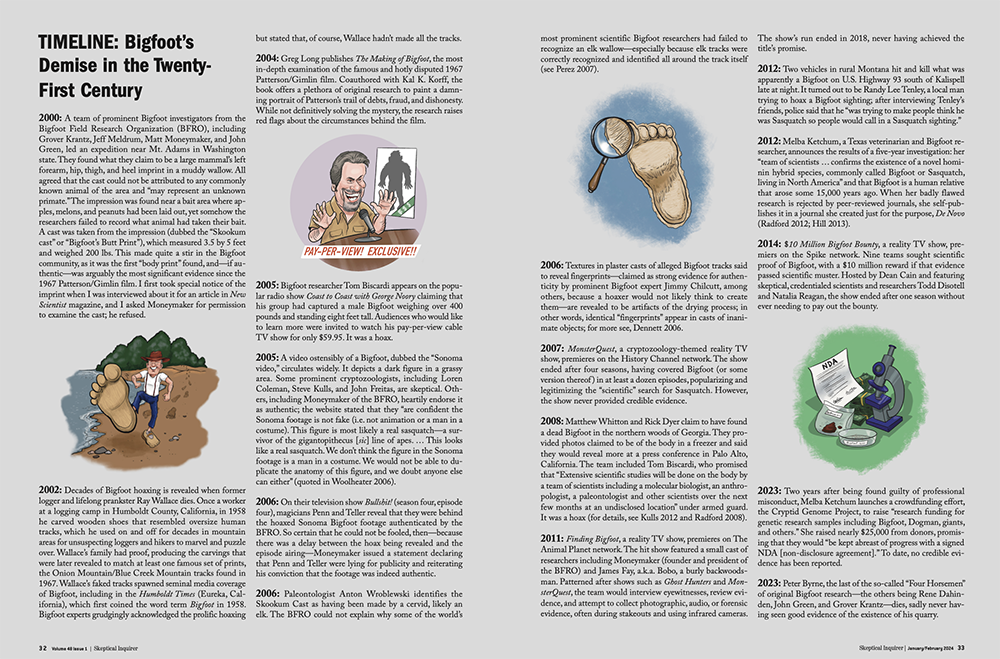
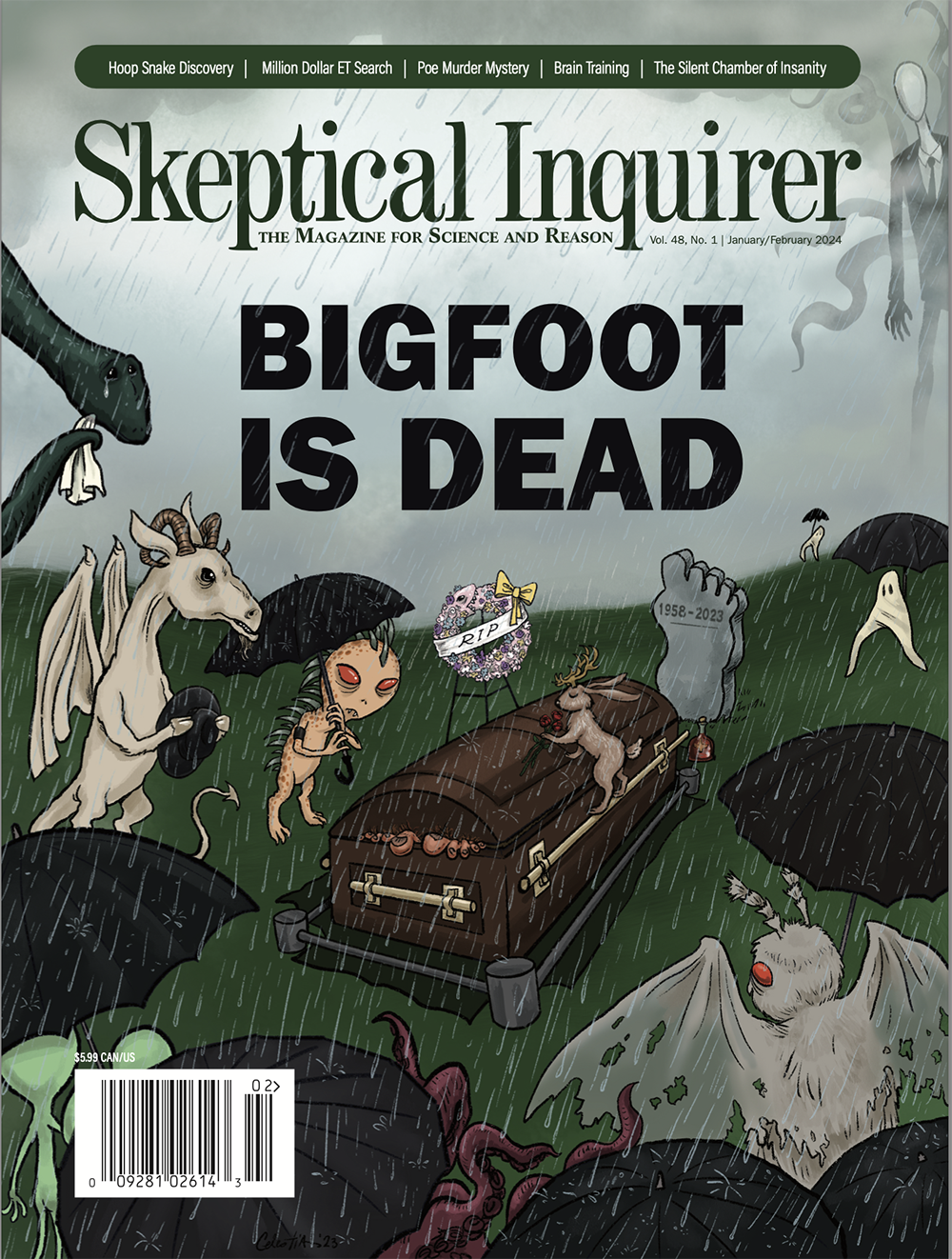
CW: All right, we’re talking about the big guy with the feet, Mr. Bigfoot. Bigfoot. And whether or not Bigfoot is dead, metaphorically, evidentially, non-evidentially, that was the topic of your most recent Skeptical Inquirer column, correct?
BR: Not just the column, the cover article, which you illustrated.
CW: Yes, yes. So I was asking something I already knew about since I illustrated it, but maybe readers don’t get the magazine, you know, not everybody subscribes.
0:28:58
BR: And by the way, just so you know, I read many people saying how much they loved the cover.
0:29:04
CWL Oh, good. All my friends wrote in. That’s fantastic.
0:29:07
BR: Probably more people saying they loved the article. Love the cover. The article sucks, but the cover is great.
0:29:16
CW: It is a long article. It takes a little while to get through. And that’s why we’re doing a whole episode here to talk about all the stuff that you have observed as a Bigfoot skeptic and investigator over how many, how many, okay, first of all, how old is Bigfoot? He’s, cause you did a 50 year roundup like 20 something years ago.
0:29:34
BR: I did. Yeah. So that’s an interesting topic. So just to sort of set the stage here. So in previous episodes, we’ve done sort of deep dives into specific things, right? So we had Steve Coles on talking about his participation in one of the biggest Bigfoot body hoaxes of the past few decades. We had our friend, Matt Crowley, man of many talents, not all of them suitable for public consumption, who was talking about dermal ridges. So being, you know, Bigfoot fingerprints. So I thought it would be interesting to sort of take a step back and sort of look at Bigfoot as a whole and sort of where it fits into the broader context of both cryptozoology and just what’s the current status.
0:30:15
CW: OK. And as I said earlier, you have been looking at this for a long time, and 20 something years ago you wrote a 50 year retrospective. So what has changed from then to now? And your answer can be nothing if you wish to say nothing.
0:30:29
BR: Well as with a lot of things it’s complicated. On a personal note, I mean I think Bigfoot was the first mystery that really got my attention. Not crop circles, not psychics, not aliens. It was Bigfoot. Partly because it was said to be here, you know, here in America in the Pacific Northwest, and as I would later learn, even here in New Mexico and across the country. So it was a more accessible, if one can say, accessible yet elusive, I’m not sure, mystery. It wasn’t some moving coffins in Barbados, it wasn’t the Loch Ness Monster, it wasn’t ETs in the sky over Brazil, it was this, you know, human-like hairy biped that presumably I might conceivably see on a trip to California.
0:31:23
CW: It’s ubiquitous because if you have woods, you have the potential for a Bigfoot sighting. I mean, I’d argue that that’s even more common in North America anyway, than the potential for lake monsters because not everybody lives in proximity to a lake, but there’s, I mean, I live in Las Vegas, a freaking desert, and you can drive half an hour Northwest and you’ll hit some wooded areas up on Mount Charleston. So, yeah, it’s not hard to find a forest. It’s apparently very hard to find Bigfoot in the forest. But it’s not hard to find the conditions you need. And so there’s a lot of Americans who have become very enamored with the idea of there being a Bigfoot. I remember I worked with a guy who was a very fundamentalist Christian, didn’t believe in evolution, but he believed in Bigfoot.
BR: That was where he drew the line?
CW: That always struck me like, wait, you don’t believe in evolution, but you believe in the missing link between ape and man?” And he was like, I never thought of it that way.
0:32:32
BR: Clearly not, Sir.
0:32:35
CW: But go on, tell me what evidence has convinced people and what types of evidence have been brought to the table for Bigfoot and then tell me the best case scenario for each of these categories.
0:32:47
BR: Sure. Well, I mean, first of all, we can begin by sort of, you know, in writing this article and thinking about Bigfoot, it helps to try and sort of establish a signpost. Like, we’re, for example, the Chupacabra, right? We know, I know, that the Chupacabra began in 1995. Not 84, not 76, 1995, and of course we know the reason why. It’s much more difficult to pinpoint a specific time for Bigfoot because it depends on the sorts of evidence that you’re offering for it. So for example, a lot of people put a lot of weight on Native American myths. There was a woman named Kathy Mosfess-Strain who wrote at least one book, maybe two, it’s been a while, talking about Native American myths and sort of trying to rope those into plausibility as eyewitness accounts. And as we talked about in the show, in the context of cryptids including Ogopogo, the lake monster. In the case of Ogopogo in Lake Okanagan, British Columbia, some people were saying that it was known to the the First Nations tribes there as this other creature, Nihahik or Nitaka, and you know that it was it was basically treating the legends as eyewitness accounts and As I talked about on that show if you take a closer look at it, you realize that no They’re not describing that at all.
0:34:11
CW: Yeah, we’ve discussed the the whole nature of retconning these native American legends and other people’s legends to so of fit a cryptid narrative.
0:34:34
BR: No, not not cool and not respectful of Native American First Nations myths as well. But anyway, again, my point wasn’t to go off on a tangent, but just to sort of say that this is why, for example, sometimes you’ll hear people very vehemently saying, no, Bigfoot was known in the 1800s. Well, the reason they’re saying that is because they’re assuming that Native American legends, which do in fact date that far, are evidence of Bigfoot and they’re not.
0:35:01
CW: Yeah, well, I mean, my question was, what kind of evidence was there? And you’re starting at the beginning, which is people claim that legends are sometimes evidence. Ancient peoples’ legitimate, written down, recorded legends indicate proof of XYZ. And in this case, you’re just finding that they’re retconned. They don’t really exist.
0:35:22
BR: Exactly. So, again, you can’t – it’s not suitable to just sort of, you know, force fit that square peg in that hole. By far the most common evidence is, of course, eyewitness accounts. And this is, of course, true for most of the phenomena that we investigate, right? Ghosts being the most obvious example, right? The most common reason why people say that they believe in ghosts is because they had some personal experience or they heard someone who had alleged eyewitness accounts and so on.
0:35:53
CW: The problem with eyewitness accounts is everybody’s got two eyes. Most of them work, but they don’t all work perfectly.
0:36:00
BR: Right. And, and, and again, I mean, I don’t mean to put on my psychologist hat here, but come on guys, if you’re, if you’re a knowledgeable skeptic and critical thinker, you know damn well that eyewitness testimony can often be badly flawed, very fallible. This is not a secret. This is well-known police psychologists, eyewitness detectives, and so on. It doesn’t mean that everything you remember is wrong. It just means that when people are reporting anomalous experiences, a lot of times the details are just really, really poor. And so –
0:36:38
CW: Yeah, your brain messes with it, too, after you’ve seen it. You’re retconning your own memory sometimes if you’ve got an unusual experience that you saw in a flash at night or something. And explaining that in detail is how you get, as a skeptic, is how you get out of jury duty, if anybody’s wondering.
0:36:56
BR: Well, even in Brian Dunning’s recent film, the UFO movie they don’t want you to see, he talks about that in the context of UFOs, right? You have otherwise credible witnesses who, again, they’re not crazy, they’re not stupid, they’re not hallucinating, they’re just simply mistaken. They’re mistaking satellites for UFOs or Mars or take your pick. So this is one of the things I have to come back to is like when I’m challenged by Bigfoot believers, a lot of times they’ll say, oh, you’re just being dismissive. And it’s difficult because I’m generally trying to educate them about the psychology of it, but they’re so certain as to what they saw and they’re like, well, are you saying that no eyewitness testimony can be believed and they just go down this rabbit hole and it’s just frustrating because I’m trying to explain to them.
0:37:47
CW: Yeah, well, it gets very wrapped up in your personal identity. Like if somebody doesn’t believe something that you think you saw, you feel like they’re gaslighting you.
BR: Right.
CW: Or like, oh, that band you like sucks, you know, or any number of things that are like tied up with your identity your senses. What are we if we aren’t our senses? we are what we see and smell and taste and and Experience and that forms a lot of core things about who we are So yeah, some if somebody says now you didn’t really see that. Oh Good fighting words, you know?
0:38:18
BR: Yeah, and a lot of times and I’ve seen this firsthand and the same thing happens a lot with psychics, is that they take it as a personal attack. How dare you tell me what I did or didn’t see? And I’ve never said, this is what you saw. I said, here’s another alternative explanation, right? I wasn’t there. This happened months, years earlier, decades, whatever it is. So I have never told someone, you didn’t see that. What I have said is, well, could it be this? Could it be that? Under these conditions. But you know, when you start questioning those things, especially if it’s an event that helps to define them, if they’re known among their friends in the Bigfoot community as a person that had this experience, maybe they’re a minor celebrity like Travis Walton, for example, in UFO. If you’re challenging that, even if you’re trying to be very diplomatic about it, they get their hackles up.
0:39:14
CW: All right, so eyewitness accounts. What else, what other evidence are we talking about when we’re talking about Bigfoot?
0:39:19
BR: The most obvious is of course, footprints.
0:39:21
CW: They’re big, big footprints, yes, okay.
0:39:25
BR: Named after, that’s what it is. In many ways, I mean, that’s, again, that’s literally what Bigfoot’s named after is evidence that is ambiguous that indicates that something, presumably Bigfoot, was there. So we’re not talking someone saw something, we’re saying, oh my God, here is a track in gravel or mud or what have you, what could have made this? And in some ways it’s what we call an argument from ignorance, right? We don’t know what made this, therefore it’s Bigfoot. Because we want to be able to-
0:39:58
CW: Clearly, yes.
0:39:59
BR: Right, what else could it be? I mean, it’s roughly human foot shaped. And I said, as I said to people, like, well, how do you know what Bigfoot’s foot looks like? Like, well, it looks like a human. How do you know that? I mean, I’m not saying you’re wrong. I’m just saying, you don’t know what Bigfoot’s foot looks. First of all, we don’t know if Bigfoot exists at all. Second of all, for all we know, Bigfoot’s footprint might look like a triangle or a circle or, again, I mean, beginning with the assumption and working that way forward.
0:40:37
CW: But there have been a bunch of sightings and casts of so-called Bigfoot footprints.
0:40:43
BR: Yes. Yeah. And so, yeah, so again, that’s sort of the main thing. Obviously, named after that, the problem is that Bigfoot tracks are rife with hoaxing. And this is a well-documented fact. This isn’t just sort of skeptics being mean.
0:40:57
CW: Are you saying it’s not that difficult to fake a footprint?
0:41:02
BR: It is not. It is, oddly enough. And again, for more details on that, we’re not gonna go too far into it because we covered this, particularly Dermal Ridges, on the show that we talked about with Matt Crowley. So go back and look.
0:41:16
CW: We’ve got several in the backlog, yeah.
0:41:18
BR: Yes, go check that out. But for example, there was a guy named Ray Wallace who is acknowledged even among believers to have made countless hoax tracks using carved wooden feet throughout the 1950s and 60s for decades, right? So someone say, well, I’m in the middle of nowhere. No one would think to put a you know a fake Bigfoot track in this mud wallow in the middle of nowhere Well, yes, somebody would.
CW: What a hobby! First of all he decided to make giant wooden feet
0:41:46
BR: He’s a prankster man!
CW: That in and of itself is a unique individual who decides to do that Exactly they decides to take it with him camping or hiking or whatever he was doing in the woods.
0:42:01
BR: Well, he was working for, he was a logger. That’s what he’s doing out there, right?
CW: I love mischief makers. I mean, I don’t, I don’t love hoaxes, but I got it. I got to tip my hat to, you know, loggers who are whittling giant feet to fool people.
0:42:28
CW: And I can prove it. No I can’t. No I can’t actually prove that.
0:42:33
BR: And it’s the same argument that you hear with crop circle makers, right? And so when you point out to them that well, you know, the original crop circles were made by these two, again, English pranksters, Doug and Dave. We know for a fact they did it. I mean they told people that. They showed people how they did it. And so we know for an absolute fact that they made some of the crop circles. And they say, well, okay, well, yeah, but they couldn’t have made all of them. No one said they made all of them.
0:42:59
CW: So the aliens, so let me get this straight. We’re going to diverge from Bigfoot and talk about crop circles for 30 seconds here. The aliens who are like visiting the planet, saw these two guys, Dave and Bob or whatever they said their names were.
0:43:12
BR: Doug and Dave.
CW: Doug and Dave. And they’re like, oh, what are they doing? Quick, quick Zorg, adjust the bottom of the spaceship to make it look something like that. What a great fad. Let’s make these all over the place.
0:43:25
BR: Why are we wasting our time? You know, using lasers to carve out cow anuses and eyes. We could be doing this. Come on, guys.
0:43:33
CW: The aliens copied Dave and Doug, okay.
0:43:37
BR: Yeah, it’s just so, it’s like, and again, it’s just one of these logical fallacies that at first glance, like, well, they didn’t make all of them. Okay, you’re right, they didn’t. I’ve made crop circles. It’s not that complicated, folks. It can be done. Anyway, so we’re getting off track. But yes, that’s the same premise of the big footprints. And now, do you remember, I want to talk very briefly, because it was a pretty big thing. Do you remember the Bigfoot butt print?
0:44:07
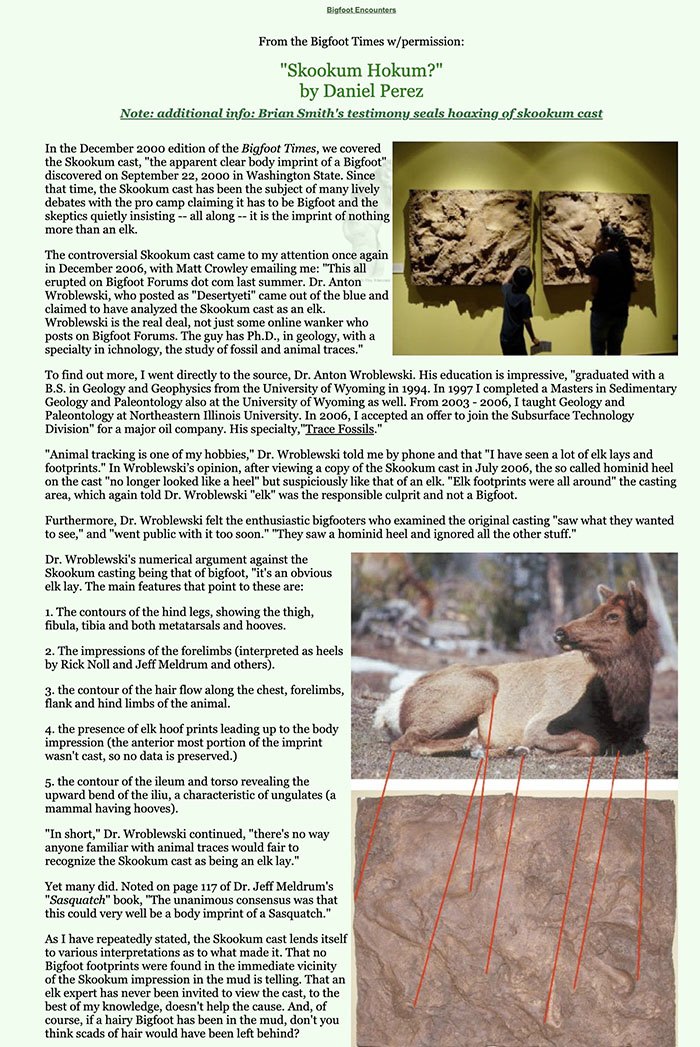
CW: The Skookum cast.
0:44:08
BR: The Skookum cast, that’s right.
0:44:10
CW: Which Matt Crowley did speak with us about on the episode. You can find it in our backlog.
0:44:15
BR: Yes, anyway, check it out. We’ll be sort of hitting back, because there was sort of a rejoinder to that. But anyway, yeah, so again, it’s not just fingerprints, it’s also butt prints that may or may not be Bigfoot butt or elk. So yes, there’s that. So after eyewitness sightings, as valid as they may or may not be, depending on the situation, and of course Bigfoot tracks, we have recordings. The most famous Bigfoot recording is, of course, the Patterson-Gimlin film from 1967. Yeah, shot in Bluff Creek, California, and it’s the one everybody knows.
CW: Indeed, yes, and I think we’ve covered that a couple times over the podcast, so we don’t have to go over it too much again, but every image you see, every popular image you see of Bigfoot in that pose comes from that Patterson-Gimlin film.
BR: We can’t give this short shrift because it is the marquee evidence for Bigfoot. There’s a couple things about it. One is that the provenance of the film is super dubious. Super, super dubious. There’s a book called The Making of Bigfoot by Greg Long. It’s a very good book. It’s not perfect, like no book is, but it’s a very in-depth investigation into the circumstances behind the Patterson-Gimlin film, and in particular, the character of Roger Patterson, who is the main guy that shot the film. Read the book, it’s interesting. There’s a guy that claims to he was in the Bigfoot suit, a guy named Bob Hieronymus. He’s actually one of several people that claim that. I don’t know that he was or wasn’t in the suit, but I can tell you that there are all sorts of red flags on this. One red flag is that the Bigfoot that we see in the image is man-sized, is human-sized. It is not 12 feet tall, it’s not 15 feet tall, is within normal human proportions. Also, despite the claims of some Bigfoot believers, the gait, the movement is possible by humans. So you’ll hear people saying, well, scientists say that humans can’t replicate that gait. They absolutely can. In fact, a colleague of mine, Dave Daigling, did so, and he published it in his book and also in Skeptical Inquirer magazine. So the object, whatever it is, either Bigfoot or a guy in a suit, one of the two, it’s not a hallucination, it’s not a bird, it’s one of the two. So in sum, the figure is human-sized, it’s moving like a human, or that is what’s called compliant gate. So is it the way people normally walk? No. But can a person in a suit walk that way? Absolutely. That’s that is well demonstrated. And then now and then you get people who say, well, that, uh, that the, the technology, the special effects, the costumes in 1967, weren’t that good. That even Hollywood couldn’t have replicated this. That also is not true. We can look, for example, at Planet of the Apes, which had very good costumes. And now, granted, that was a mainstream Hollywood film. On the other hand, it also required the actors to be in close-up. If you look at the Patterson-Gimlin film, it’s blurry, it’s jittering around. There’s a lot, there’s almost no detail. So, it’s true that Patterson and Roger Patterson, Bob Gimlin, didn’t have access to Hollywood special effects artists and costumers, they didn’t need it because the quality of the footage is so bad. It’s just this blurry figure.
0:47:48
CW: I love how Hollywood in the 60s can be anything you want it to be. It can be phenomenal and capable of recreating the surface of the moon and the regolith and exactly how it falls and the lighting, but it can’t be capable of reproducing a Bigfoot walking across a clearing in the forest.
0:48:08
BR: Yeah, I mean, come on guys. Also just to be clear, several prominent researchers, including John Napier with the Smithsonian and also special effects guy said, yes, that is, can I prove it to the guy in a suit? No. Was that possible in 1967? Absolutely.
0:48:30
CW: Okay, so that is the most famous recording. What recordings might we not have heard of? Are there audio recordings claiming to be like Bigfoot mating calls?
0:48:41
BR: Oh, yeah. Oh, yeah. So, yes, there’s lots of them. One that jumped out at me was a CD that I bought many years ago. You can tell because it’s a CD, not a track. Titled, it was by an organization or two guys called Sierra Sounds. And it was claimed to be, it was introduced by Jonathan Frakes, of course, of Star Trek. And it was claimed to be the vocalizations on tape? Well, yeah, they were out in the woods. So there’s a couple things here. So often Bigfoot hunters will go out in the woods and they will do what’s called call blasting. And they will take out large, these big loudspeakers, and they will send out these recorded sounds sounds of what they assume are Bigfoot calls, like, Yes, yes. So, somebody actually contacted a linguist and said, okay, well, does this sound human? And the person’s like, no, this doesn’t sound human. It’s like, okay, well, if they cupped their hands around their mouth, could a human make this sound? Like, oh, yeah, absolutely, sure, yeah. It’s like, okay, well, it’s like the figure in the Patterson-Gimelin film. Like, does it walk like a human? No. Could a human walk like it? Absolutely. Okay, well, then, what are you missing? Right? So, yeah, so even one of the main Bigfoot researchers, Nelson Stead, Grover Krantz, he didn’t put any much stock in it either. So, and there’s lots and lots of videos. We don’t have time to go into all of them. There’s the Sonoma video. There’s the Playboy Playmate video.
0:50:47
CW: Playboy? Playmate? All right. We need to have a Bigfoot after dark. Maybe we’ll do a special patrons only X-rated Bigfoot thing. Oh my God, there’s so much Bigfoot porn and erotica. Time for, that’s another show, a different show. But moving beyond audio recordings and video recordings, how about something tangible like hair or fingernails?
0:51:10
BR: Sure, so this is where we get into like forensics or somatic samples. So again, we’re not talking prints, we’re not talking sounds, we’re talking something that’s presumably testable. And of course, this would be the gold standard, right? This is something that DNA analysis should reveal. And this goes back to our previous episode with Sharon Hill talking about Dr. Melba Ketchum.
0:51:33
CW: Yes, and with Melba Ketchum, we know she very much wanted to prove that she had found samples that would contain Bigfoot DNA, and she went so far as to do some very sketchy things and write her own little journal article and publish it in her own little journal. But really, there was so much contaminant and it just, it’s worthless.
0:51:56
BR: It was just a complete fiasco. And even a lot of Bigfoot believers are embarrassed by the mention of Melva Ketchum. She’s recently made a comeback, as I think we may have mentioned it on the show before. So, to answer your question, there’s been a handful of somatic samples. What happens is that in all these cases, they’re not tested. When they are tested, they turn out to be ordinary things, like their cow or their dog. There was one case, there was a famous case where there were fiber samples that were said to be Bigfoot hair, well it turned out to be dienal fiber used in wigs. Unfortunately the upshot is that in all the alleged samples of hair or blood or whatever else, they always turn out to be either too degraded to get any information from or they’re ordinary animals.
0:52:50
CW: So what I’m hearing is the samples that are found are absolutely 100% bonafide Bigfoot until they’re tested.
BR: Yes, in a nutshell, yes. That’s a…
CW: It’s like Schrodinger’s cat. The mere fact of testing them changes them into mundane DNA.
BR: Right, that’s pretty much it. And there’s other things as well. I just heard it real briefly. For example, people will find evidence, or what they consider to be evidence of Bigfoot in trees, for example, tree topping. So someone will say, they’re out in the wilderness, they say, oh, look, the top of that tree is snapped off. Yeah, well, it’s Bigfoot huts, where there’s what might be some tree branches sort of snapped over and made into kind of a shelter shape. You may be wondering, well, how do we know that it’s not just some hiker or camper? Well, we don’t. And in some cases, it might even just be two branches that happen to fall over a dead tree anyway. So it’s just, you know, and then some people say, well, there’s scraping. So people will point to bark scraped off the tree and they’ll point to this as evidence the Bigfoot’s nearby.
0:54:16
CW: As we’ve gone through the ladder of evidence here, we’re just getting further and further from solid evidence.
0:54:23
BR: Right, that’s pretty much right.
0:54:26
CW: All right, so bearing in mind all of that evidence that has come in over the years, could you maybe sort of trace the timeline here of like what popped up when? When was Bigfoot born? When was he a teenager? When was he married and when did he graduate and get his Ph.D. and become Dr. Bigfoot? Tell me what exactly are the signposts that we should know about as Bigfoot historians.
0:54:49
BR: Sure, well, and by the way, I want to give a shout out to the book, Abominable Science, by Daniel Loxton and Don Prothero. It’s one of the best out there. It’s probably one of the top five or six sort of skeptical cryptozoology books. So if you don’t have it, go out and get it, Abominable Science. It gives an excellent overview of the origin stories on Bigfoot and Nessie and other things like that. And they talk about this there. So again, it sort of depends on where you start counting. But we know, for example, you know, I mentioned Ray Wallace and his hoax tracks. This is back in the 50s. And so one common marker is when Bigfoot went viral before, of course, things went viral. And that would be in 1959, in December 1959, there was an article in the magazine True that described the discovery of large mysterious footprints the year before in Bluff Creek, California, which is where Patterson Gimlin shot the film later on, back in 1967, some years later. And again, this is the same area where people were hoaxing tracks anyway, we know this. So you could say that, you know, sort of 1959, 1960 was when it really sort of became a capital T thing. People were talking about it as, here’s actually this entity out there. I sort of came across it in terms of my own consciousness, probably with the $6 million man. And it came to my, if you look back in the 70s and 80s, Bigfoot was everywhere, right?
0:56:26
CW: Yeah, he was showing up in all the TV shows, movies. Bigfoot was a powerful force in the 80s.
0:56:33
BR: Yeah, and just sort of, you know, monster trucks and pizzas, you know, and some of them are still here. I mean, I don’t want to, I don’t make it sound like that, you know, people aren’t interested in Bigfoot at all, because of course they are. But if you’re sort of tracking the popularity of Bigfoot as a mysterious, elusive creature out there, and we didn’t really even get into that. I mean, that’s another facet to this, which is that for a lot of people, Bigfoot isn’t necessarily this monstrous figure. For a lot of people, it’s a symbol of purity and wild men and untouched wilderness and things like that.
0:57:11
CW: Or a transdimensional creature with psychic powers. You know, there’s people, people define things in whatever way they want to sometimes. But, but back to the timeline here. So the 50s was when it first erupted onto the scene. The 60s, we had the Patterson-Ginland film. 70s, we had Six Million Dollar Man was the 70s, wasn’t it? Or was it early 80s? Like 80s. Early 80s. Okay. And that was a guy, tip of the hat to Andre the Giant playing Bigfoot. And what was the other guy’s name? Sirson R. The one who was also Lurch, I think. There were two guys who played Bigfoot in the Six Million Dollar Man. Because they had, of course, we discussed this on Bigfoot in pop culture, where they had that whole story arc where Bigfoot turned out to actually be, was an alien robot, a robot created by aliens?
0:58:02
BR: Yeah, and the alien was played by the second Darren, I think.
0:58:06
CW: Oh, Dick York?
0:58:08
BR: I think so. It’s been a while.
0:58:10
CW: Oh man, so kitschy, so kitschy. So we have a lot of presence in pop culture, and we have some very serious believers. And when do squatch parties start erupting in terms of like people banding together and having camping trips just to go look for Bigfoot?
0:58:30
BR: I think that’s fairly recent, probably in the 80s and 90s. Again, there’s a strong parallel, and I think Sharon Hill talked about this to some extent in her book, Scientific Americans. There’s a strong parallel between pop culture depictions, right? And so you see these so-called reality TV shows, ghost hunters finding Bigfoot and so on. So this is introducing, in some ways, democratizing these investigations. I talked about this on the show before, where ghost hunters democratized ghost investigation. It was like, hey, you don’t need to be smart or have equipment. You don’t need to be a scientist to look for Bigfoot. We’ve got these two plumbers. Hey, they’re out there looking for ghosts. You can too. It’s the same thing with Bigfoot, right? It’s like, hey, you know, anybody can go out there and look for Bigfoot. Do you have some free time and a good pair of hiking shoes? You could go out there and look for Bigfoot as well.
0:59:24
CW: Don’t let those egghead biologists have all the fun and get all the Nobel prizes. You can get yours too.
0:59:31
BR: You can do this too. There’s always been this sort of synergistic relationship between pop culture depictions of these gaining sort of grassroots interest and I mean and to some extent there’s commercialization Thomas Gardy for example who we’ll talk about shortly is commercialized Bigfoot to some extent there are people that will you can you know go out on on Bigfoot weekends where you know for Couple hundred bucks or or a couple thousand dollars depending on how much you want to spend. You can go out with celebrities, I’m using air quotes here, celebrity Bigfoot hunters, and you can go out there for a weekend warrior thing and go out and hunt. Not hunting, no guns, unless for defense, but you can go out there in the woods and do call blasting and look around for Bigfoot. And of course, if nothing else, you’re out there with friends getting sloshed in the woods. But for my Skeptical Inquirer article, I was interested to sort of look back at the last 25 years, give or take. People hear about Bigfoot now and then, like there’s some recent sighting. A while back we talked about, of course, the Colorado train, Bigfoot that two people saw from a train.
1:00:46
CW: Oh yeah, yeah, that’s right.
1:00:47
That was the most recent thing that popped up. Yeah. Right. So that’s a good example where, you know, people don’t think about Bigfoot for months or years until there’s some, you know, weird news story that’s dubious in the extreme. And then, of course, nothing comes of it. Or maybe they tune into finding Bigfoot or one of the other reality shows, which, of course, again, nothing comes of it. But I want to sort of trace back, OK, well, you know, what about, for example, in this millennium, since the year 2000, what’s happened? I mean, again, we’re almost at, we’re now in 2024, we’ve got almost a quarter of a century, presumably if Bigfoot are out there. And keep in mind, there has to be more than one of them. And, you know, when people talk about, you know, I saw, you know, Bigfoot or the Loch Ness Monster, what have you, right? If these are real creatures, they need a breeding population. There has to be more than one of them. The estimates for Bigfoot are that in North America alone, there would need to be between six and ten thousand of them. The question is not why haven’t we found 50 Bigfoot? Why haven’t we found five Bigfoot? Why haven’t we found one Bigfoot? They should be all over the place. They’re seen in North America. They’re seen in virtually every state, I think except Hawaii. Maybe even there was a recent case in Hawaii, I mean, even though people have this perception that Bigfoot are primarily in the Pacific Northwest, they’re reported, not necessarily cited, because that implies they’re there, they’re reported as being seen in Texas and Pennsylvania and Massachusetts and New Mexico and Nevada and California.
1:02:18
CW: Everywhere there’s woods, yeah.
1:02:20
BR: Everywhere there’s woods and everywhere there’s people that are maybe out there looking for it.
1:02:24
CW: Where campers can get blurry photos of woods. You’re going to find Bigfoot. Now we should, we should mention, I think we’ve mentioned this on other Bigfoot themed episodes that the plural of Bigfoot is Bigfoot.
1:02:36
BR: I’m not going to argue with people about it, but yes.
CW: I don’t know who decided that, but it’s been decided.
1:02:43
BR: So again, so I wanted to, uh, so in my article for Scripps & Enquirer, the January, February 2024 issue out now, which you did illustrations for, by the way, good job.
1:02:58
CW: Yes, thank you very much. So what has Bigfoot been up to since Y2K?
1:03:03
BR: Not as much as you would have hoped for a real creature. Would be the most diplomatic way I can phrase that. I won’t go over the whole timeline again, it’s available in the issue, but basically over the past 25 years, when you would expect that there would be some sort of evidence emerging in some capacity, it’s been this sort of litany of false promises and big headlines and sober follow-ups and just this constellation of crap. I don’t know how else to put it. There was, for example, there was a researcher that I mentioned, Tom Biscardi, who appeared on Coast to Coast with George Norrie, claiming that he had captured a male Bigfoot weighing 400 pounds, and that for a mere $59.95 pay-per-view, you too could tune in to see it.
1:03:57
CW: Did you just pull that figure out of your head, or was it actually $59.95?
1:04:00
BR: $59.95.
1:04:01
CW: Because that’s like, I mean, pay-per-views back in like the aughts in the 1990s, I mean, 1999 was expensive for pay-per-view. And that was like a Mike Tyson fight would be like.
1:04:15
BR: Oh yeah, this is a real Bigfoot. You’re not seeing the big picture here.
1:04:19
BR: This is a 400 pound Bigfoot. You’re seeing Bigfoot peeing here. You’re paying money for this. They’re going to show you the whole thing. Except of course, it was a hoax.
1:04:28
CW: Yeah. Well, did the event actually take place? Did the pay-per-view thing happen, or did it just never get aired?
1:04:33
BR: I didn’t sign up for it. The whole thing collapsed. I’ve forgotten whether he actually, I think basically just collected the money and ran. Except for here’s the thing, that Tom Biscardi, despite this history of this hoaxing, is still around. He’s still doing shows and talks. And this is one of the main problems of the Bigfoot community.
1:04:58
CW: The FTC didn’t shut him down and take away his license for whatever he has there.
1:05:04
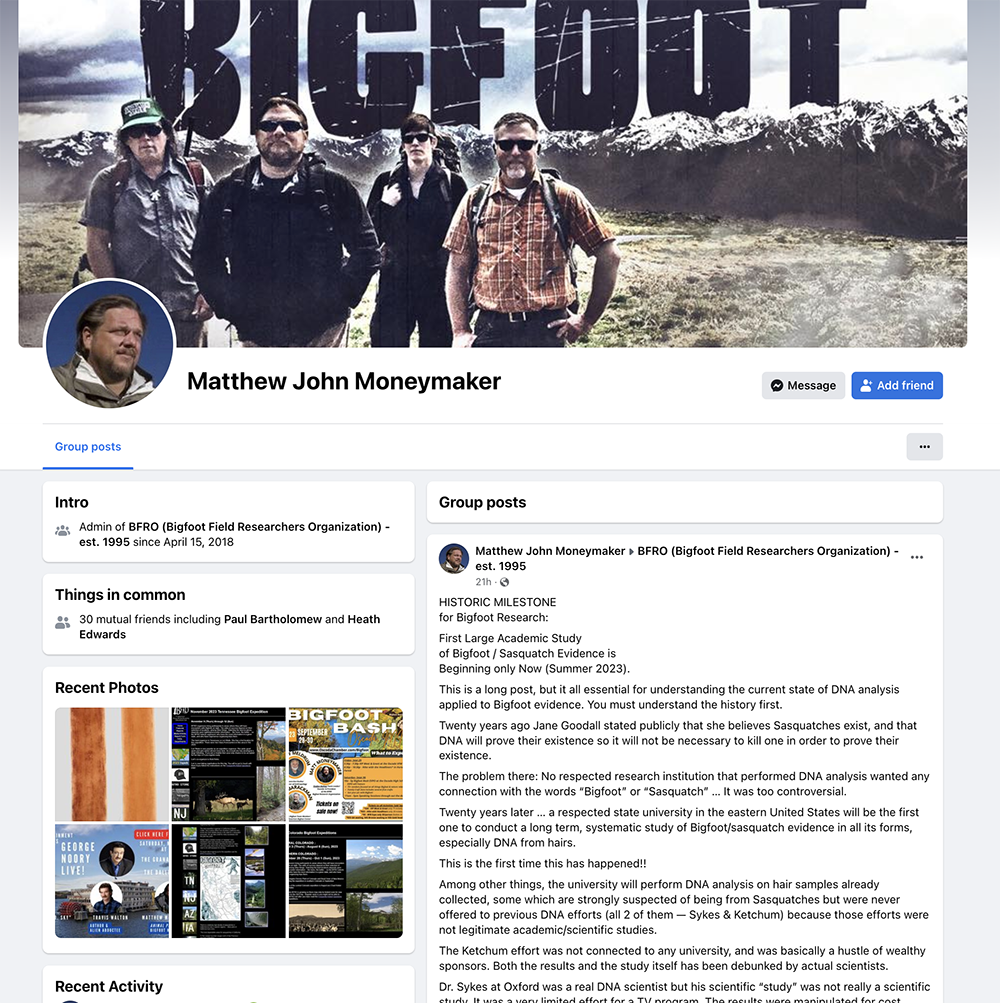
BR: And then, so the same year in 2005 was when there was what was called the Sonoma video, which is of a Bigfoot. Matt Moneymaker of the BFRO, the Bigfoot Research Organization, said yes, this is real, this is not fake, and he was absolutely certain it was authentic. We found out a year later that it was actually a hoax video by Penn and Teller for their show Bullsh**.
CW: I remember that, yeah.
BR: So that was, there was some egg on the Bigfoot expert’s faces there. Around the same time, about a year or so later, was when it was discovered, as Matt Crowley mentioned on the previous episode, that in fact the Bigfoot butt print, the Skookum cast, was almost certainly an elk track. I’ve always been baffled by, again, I won’t go into the whole Skookum cast we talked about on the show before, but it was just bizarre that you had what should have been this crack team of literally probably the top five or six Bigfoot experts in the world, like marquee names. They’re out there, they’re in the woods, this Bigfoot area, they have equipment, they have gear, they have funding, and they lay out this bait, and something makes a track there. They don’t know what, because apparently they weren’t able to film it.
1:06:28
CW: I mean, the guy with the mouse in his shed set up an infrared camera! They just put out bait and they didn’t do anything else?
1:06:36
BR: Yeah, there was some. Yeah, I just I to this day I’m astonished that and I think there was some like excuse like the battery died or there’s some. Come on, guys. You are the dream team of Bigfoot experts, and you have this equipment, you have this gear, you’re making a big deal about it, and you lay out this bait, you wait for something to come and eat the bait, something eats the bait, and you don’t know what it is. And you’re like, I don’t know, it could be. And as it turns out, so there were elk tracks all around this, like literally like identified, well, that’s an elk, that’s an elk, but what’s this big thing in the middle?
1:07:15
CW: It’s an elk. It’s just an elk butt print.
1:07:18
BR: Right. So to this day, and again, this was back in 2000, so 20 years later, nobody has really satisfactorily explained just how this went so far off the rails.
1:07:30
CW: So beyond the Skookum print, what has happened after that?
1:07:42
BR: There was the Dermal Ridges, which Matt talked about on the show before. Melba Ketchum, as who again we also talked about on the show before, came out with her attempts to identify Bigfoot DNA in their self-published journal, and that was a big fiasco. And of course, there were a handful of reality TV shows. I remember some of them, yeah. Finding Bigfoot came out in 2011, which eventually folded, not having found Bigfoot. Although it had a run, I think, of seven, eight years or something.
1:08:13
CW: Oh, wow.
1:08:14
BR: Yeah, and I’m just, in some ways, I’m surprised by that, because you would think that if, it’s like ghost hunters. Well, you had decades to find ghosts, guys. I mean.
1:08:29
CW: This is why I watched the great British Bake Off because every episode there’s cakes. Every episode, without fail, there’s cakes by the end of the episode. You find the cakes.
1:08:39
BR: Yeah. Right, it results, all the buildup eventually leads to a cake.
1:08:46
CW: A cake is not a lie.
BR: That’s right. Anyway, so again, there’s more, we don’t have time to go into it, but yeah, so suffice it to say that for the past 25 years, when you would expect there would have been, if Bigfoot are real, and there really are these out there and they’re living and breathing, and maybe getting shot by hunters or dying of natural causes or hit by a truck.
1:09:12
CW: Well, just the video, because one of the things you go into in your article is we have cameras now with everybody’s got like a 12 megapixel amazing camera on their person pretty much at all times. You don’t have to get out some big fancy camera and like set a flashbulb on it and no, you’re just ready to point and shoot like anything with your cell phone these days. And we’ve got drones, we’ve got so many ways of observing the world around us, and we’ve seen some amazing things, but no Bigfoot.
1:09:43
BR: It just doesn’t make sense to me. And, again, I’m not being sarcastic, I’m not being facetious. I genuinely don’t understand the logic behind why Bigfoot has yet to be found if they’re real. And, again, we don’t have time to go into it. There are people who claim that, well, the reason they don’t find Bigfoot bones is because Bigfoot buried their dead. Well, how do we know that? Well, because we don’t find them. OK, well, how do we know that they’re not teleported to another planet? I mean, so there’s there’s all these sort of ad hoc arguments, these special pleading arguments that people come up with. But at the end of the day, it doesn’t explain why it is that to this day, the best evidence for Bigfoot remains the Patterson-Gimlin film, right?
1:10:26
CW: Okay, well, besides the ad hoc explanations of like, Bigfoot bury their dead or they turn into cheese or whatever, what are the Bigfoot diehards saying, or are they giving any explanations as to why they can’t find any?
1:10:42
BR: Yes and no. I mean, when you talk to them, usually the conversation circles back to the Patterson-Gimlin film, which they are sure is real, right? So let’s say, okay well the short answer is that they they don’t at least so far and maybe I’m wrong and if if a if a Well-informed Bigfoot believer would like to come on the show. I would welcome a debate. We’re happy to talk about it I’ll give you I’ll give you all the time you need to discuss this. I’m genuinely interested in discussing this So I don’t mean I don’t want to you know strawman anybody But my sense of it is that they recognize that the evidence just isn’t there again They revert to well, no one has disproved the Patterson-Gimlin film like well, even if that’s true, let’s just say that you’re right Let’s say that the Patterson-Gimlin film Really is/was of a Bigfoot. Let’s just let’s just say that’s accurate. Where where are they since then right? Was there one Bigfoot this guy just happened to film back during the Johnson administration a Bigfoot?
1:11:46
BR: A Bigfoot endling? Wasn’t that what? Daisy Allstone called the last of any Species that was all pretty much already extinct because there’s no breeding population you have the last remaining Yeah, member of a species the end. I was saying yeah, the Bigfoot endling is what they captured, maybe.
1:12:03
BR: So yeah, so I mean, and that that circles back to the topic of the show, right, and the article, which is that in my research and my investigations, I’ve done both field investigations in different places and research in this net. I don’t see any compelling evidence that Bigfoot are real or exist at all. I think there’s more than enough doubt between the misidentifications, the hoaxes, the outright frauds, the all these sorts of things, there’s not necessarily anything behind it.
1:12:30
CW: Well, there’s there’s evidence of a transformation, I would think, culturally. And I’m talking not about hair or genetics or footprints. I’m talking about ideas and belief and half belief. Like you mentioned that there are squatchers, people who go out, and they don’t really entirely believe in Bigfoot, but they have a good time and they sort of see something. They might get a blurry photo and they’ll, you know, elbow each other in the ribs going, oh, look what we found, you know, and they’ll drink a few more beers. Is the death of Bigfoot, you know, not a thunderous clap, but a whimper of just being relegated to, I don’t want to say fairy stories, but yeah, like fairy stories. Like nobody really believes in Bigfoot anymore, but you know, but you know, we’re gonna put him on labels for beef jerky.
1:13:26
BR: Sure, yeah, so I mean in that regard, you know, certainly Bigfoot will live on. I mean, Bigfoot, there’s a sort of the eternal irony, which is that if Bigfoot are never found, either because they don’t exist or because they died out for natural reasons or conspiracies, whatever else, and the evidence is hidden, then there will always be belief in it. There will always be people looking for Bigfoot in the same way that there’s always ghost hunters. So the fact that ghost hunters, in some cases, personal ghost hunters, have spent decades looking for Bigfoot or whatever else.
1:14:09
CW: So what I’m hearing here is you can’t kill Bigfoot.
1:14:12
BR: Right, you can’t kill Bigfoot. No, I mean it’s always going to be the same thing with a chupacabra. I mean, I pretty much put the nail in the coffin on that one, but that doesn’t mean that people won’t tell stories about it, see movies about them, write horror fiction, or even see them. So it’s a pop culture legend. It’s even if Bigfoot aren’t real, they’re interesting, they’re fascinating by themselves. And that’s how I approach all the topics I investigate. I don’t, as I’ve said this before, I mean, I don’t care. I mean, it’s not that I don’t care whether they’re real or not. I want to know the truth. If the truth is that Bigfoot are out there and they’re living and breathing and they’re actually…
1:14:54
CW: You have a true agnosticism about it.
1:14:56
BR: Yeah, that’s great. Then my question is how do they manage to leave so little evidence, right? If there really is this population of hundreds of thousands and somehow they’re not leaving any tangible evidence of their existence. That’s fascinating. We need to figure out how the hell they did that because, you know, that’s a story in and of itself.
1:15:17
CW: That strikes me as a parallel between, you know, we have people who believe in weird sort of synchronicity or like, oh, there’s this weird coincidence that happens. It had to mean something, you know, and I usually approach that with like, imagine a world without coincidences where you never ever, nobody ever had the experience of thinking about a song and then hearing the song on the radio, or remembering they had to talk to somebody and then that person called on the phone, right, that moment. Imagine if that never happened. That would be amazing. Like the odds against, I mean, because there are so many things that happen every day that things that are a coincidence or seem uncanny have to happen.
BR: By definition.
CW: In that way, like the Bigfoot thing, if if Bigfoot exists, and I have heard, you know, Bigfoot hunters and Bigfoot proponents say that, oh, well, people just aren’t looking and blah, blah, blah. No, no, the the bigger mystery would be how how did this thing go undetected for so long when it is virtually impossible.
1:16:27
BR: Yeah, and I would apply that same argument to the Patterson film, right? And so when people come back to me and say, okay, Mr. Skeptic, well, why hasn’t anybody duplicated that film? In fact, no one’s tried. And I talked about this in one of my recent articles. The real question is, if it’s not that, if that film is hoaxed, why can’t, why haven’t we seen it again? The real question is, if it’s real, why haven’t we seen it again? Or better yet, why haven’t we seen much better footage in the last 50 years?
1:17:03
CW: 25 years, yeah. Oh, 50 years, yeah, you’re right. Patterson-Gimblin goes way back.
1:17:07
BR: I’ll just wrap up with this. I think that it’s one of those things where you can’t prove a negative. And if people want to believe, they’re gonna believe. Same thing with, if you think there’s a monster in the lake and you see something weird in the lake, then it’s a monster. You think UFOs exist and there’s something weird in the sky, there you go. This reminds me of when I was investigating Lake Okanagan in British Columbia with John Kirk, who’s a lake monster researcher up there for National Geographic. And John and I were out on the lake and Joe Nickell was there and we were, we’re taping the show, looking for Ogopogo. And I said to him, well, you know, what would it take to convince you that Ogopogo doesn’t exist? This, this, there is no monster in this lake. He thought about it. He said, well, you’d have to drain the lake. And that was interesting. That was an interesting concept to me because like,
CW: That’s a tall order.
BR: That’s a tall order. That’s a tall order for number one, like draining the lake. To say nothing of the damage done to the ecosystem, if one were to do that, that was an interesting response just sort of in principle, right? Because you’d have to literally take all the water out of the lake and say, oh look, there’s no monster here. Now, of course, that doesn’t mean that someone couldn’t say, well, maybe it was just hidden. So yes, they drained the lake, but there was a hidden cave underneath.
1:18:30
CW: Oh, it’s the famous bottom-dwelling burrowing Okopogo.
1:18:33
BR: Right, that’s a different one, right? There’s an element to this which we haven’t really touched on, which is global warming. I don’t mean to be a gloom and doomsayer. I mean, we’re all very well aware of the perils here. Keep in mind that if you look at Bigfoot as a wild animal, which it presumably is, it has to have the same ecological pressures as other wild animals. Forest fires, droughts, all these other things that are affecting other large animals that we know exist in these regions, would also by definition have to be affecting Bigfoot. So just in the same way that bears and elk and deer and moose and other things are being driven towards human habitation by all these environmental pressures, this should be happening to Bigfoot as well. So unfortunately, as the years go on and on and the earth heats up and ecological damage continues, particularly in North America, we should be seeing more and more encounters with Bigfoot, close-up encounters, and there should be better evidence for them.
1:19:40
BR: I’m going to now sit back and wait for somebody to quote you as saying we should be expecting to see Bigfoot overrun our cities very shortly.
1:19:51
BR: Wouldn’t surprise me. Then we could do a science fiction part two.
1:19:54
CW: You hear that, Brian?
BR: There we go.
(MUSIC)
1:20:01
CW: Well, thanks, Ben. That was cool talking about Bigfoot, sort of the bird’s eye view of where Bigfoot sits right now in the year 2024.
1:20:21
BR: Yeah, it was fun. It’s fun to talk about it again. Too often we sort of get into these little nitty gritty discussions, and I’m happy to talk about the details, but sometimes it’s good to sort of, as you said, do the forest for the trees thing.
1:20:34
CW: Yeah. Yeah. And Pascual wasn’t here for this week, but hopefully he’ll be back next week. And we are going to be talking next week. We’ve got a roundtable discussion planned about AI. And there’s a lot of speculation about AI. We don’t have all the answers, but we have some answers and we have some questions, and we have some theories, and we have some trends, and you know, it’s not going to be like a five-hour episode, but we do get, you know, we do have quite a few things we can talk about, and we’ve got an expert joining us, Kyle Polich from the Data Skeptic Show will be joining us for that roundtable on the next episode. Very cool. Until then, everybody, take care.
1:21:15
BR: Bye-bye.
1:21:16
We would like to extend heartfelt thanks to our top tier sponsor level patrons,
1:21:21
Amy Frusciaro-Kelly, Dr. Angela Matkey, Elizabeth Leggett, and Laura Ellis. Thank you for your continued support of our podcast. If you’re interested in becoming a sponsor or just throwing us a buck or two, please visit Squaring the Strange on Patreon.com and browse our selection of patron rewards. Every bit helps us keep the lights on here, and we are grateful to our generous friends who help us bring you quality content. If you’re short on cash and want to just give us moral support, remember to recommend us to a friend, mention us on social media, or give us a review on your favorite podcast dispenser. If you have comments or topics you’d like to see covered, come join our community on the Squaring the Strange podcast discussion group on Facebook. Squaring the Strange is a production of Two Heads Studio LLC, copyright 2021. Theme music provided by Shriek Back, additional music by Memory, Keytard & Feathered, and Alicia Jarvis. The views and opinions expressed on this podcast are those of Squaring the Strange, and do not necessarily reflect the views and opinions of Two Heads Studio, and do not necessarily reflect the views and opinions of Two Heads Studio, Kronos Creative, Center for Inquiry, our advertisers, or any other affiliated organizations and employers.
Transcribed with Cockatoo
