
Episode Summary:
After some discussion of Ed Sheeran’s day in court, and then Celestia’s day in Calgary for the WeCanReason conference, Pascual and Ben take us on a nostalgic and investigative journey through Chimayo, a small town in New Mexico. Why do 30,000 penitent pilgrims travel here each year? Can the dirt here heal people? Pascual walks us through the tale of a mysterious buried crucifix and Ben details his effort to investigate one man’s story of a miraculous healing that took place over fifty years ago.
Ben Radford: Welcome to Squaring the Strange, the podcast that examines all manner of the mysterious and the mundane through a critical lens. So let’s square the strange.
Pascual Romero: Welcome back to Squaring the Strange. This is episode 201. And this is your host, Pasquale, with me as always are…
BR: Ben Radford here.
Celestia Ward: And Celestia Ward. Hey, guys. Hello.
0:00:51
Well, it’s been an active couple of weeks. I’m excited about our main topic, which is perfect for the month of May. We’re talking about Cinco Chimayo or something. What is that? Cinco Chimayo.
PR: Yes, we’re talking about Chimayo this week, a little town here in New Mexico, and we’ll be digging into the lore behind it.
CW: Now, what’s special about the dirt that we’re gonna be digging into here, allegedly?
0:01:18
PR: Well, allegedly it has some magical properties, but they do grow really good chile up there, so.
CW: Magic of its own sort, yes, absolutely.
PR: Exactly.
CW: Well, I just got back, a few days ago actually, I just got back from the We Can Reason conference in Calgary. Thanks again to Adrienne Hill for being an excellent hostess and for helping put together this gigantic conference It wasn’t gigantic like JRef, you know 1500 skeptics, but they had a decent turnout in fact over what they had hoped for their inaugural event here. This is the first ever. I was put on by the Rocky Mountain Atheists and they got about a hundred and twenty people and I got to hang out with other speakers like Aaron Ra and Seth Andrews and of course Richard Saunders, our podfather, I’ve decided to call him.
0:02:08
He’s been a great help with our show. And speaking of Richard Saunders, you can head over to his podcast, The Skeptic Zone, and his most recent episode has a little walkthrough of the Royal Tyrell Museum in Drumhiller, which is about an hour and a half’s drive away from Calgary. And it is an amazing dinosaur repository. They just have so many fossils set up in so many displays. It really is a very well-designed museum. I could have spent 12 hours in there, but we had about two hours. It was great.
0:02:41
So before we get to, I’m going to say this wrong. Can you tell me how to say chimaeo?
BR: Chimayo.
PR: Chimayo.
CW: All right. See, this podcast teaches me things. Thank you, guys. Chimayo. Before we get to that, is there anything in our skeptical weird news category that you’re noticing, Pascual?
0:03:07
PR: Yep. I actually thought that a bit of interesting news came out recently, and it is that Ed Sheeran just won a pretty high-profile lawsuit in copyright infringement that was alleged by the estate of Ed Townsend, who was the co-writer of Marvin Gaye’s hit song Let’s Get It On.
CW: That was in the news for quite a while.
PR: Yeah. So it finally ended in his favor, and I think rightfully so. I know we did an episode on songs that sounded alike once before and talked about some of the lawsuits that were involved and how that can be a real tricky thing to navigate but in the case of this song, you know I don’t even think personally I think legally, they’ve demonstrated that it’s really a bad case to bring, you know against these four chords that they alleged he stole from Marvin Gaye’s song, Let’s Get It On.
0:04:02
So what I thought I would do is quickly play you four chords and just name the first song that comes to mind when you hear them. (Plays music)
CW: Oh, this feels like name the tune.
BR: My Girl, My Girl.
PR: The My Girl, great example. In fact, the perfect example because it is the same chord progression that Ed Sheeran was being sued over and played quite a while before Marvin Gaye’s 1973 version used in Let’s Get It On.
BR: So you ripped that one off too? Wow.
0:04:47
CW: So really the Temptations should have been suing Ed Sheeran. Exactly and and really Curtis Mayfield could have sued the Temptations and and they all could have sued Shania Twain or Van Morrison. The truth is is that all of those artists have used that chord progression. Many more than that. I’m sure those are just some that come out right away that thankfully Ed Sheeran did use to argue in court that it’s hard to copyright a four chord progression. This is a very standard progression that we call it a 1-2-4-5 progression. You don’t need to worry about what that means. It just means that that’s where they fall on the progressions that we use in songs. There really are only eight full notes in an octave. That’s where the word octave comes from. Twelve total when you include the half steps. So again, you don’t really need to worry too much about everything I’m saying here, but I’m just trying to point out that there’s actually a relatively small palette of notes that can be used in music.
0:05:46
The combination of the notes can become pretty big. You can play a song with 30 different chords in different keys, but functionally you really can only play about 12 sounds that are rooted in single notes. So the reality is is when you’re looking at a pop song that only has you know maybe four different chords that need to be played in the sequence, you actually don’t have a ton of options. I would say that the possibility of four chord songs in 4-4 time, which is the standard time of most pop songs, it’s really in the thousands. Like that’s about all the songs you can write with that particular structure. Basically, everything that could have been written probably already has in that kind of structure.
0:06:32
CW: Well, that’s a depressing kind of artistic thought.
PR: Well, I think, try to think of it like this. All visual art is really based off of primary colors. So that is a very small palette in and of itself, but the way you blend it together can become pretty different and unique from…
CW: Yeah, let’s not even let’s not even start to talk about copywriting colors. I’ll have to have a whole segment about Anish Kapoor.
PR: Oh, sure, sure. And like Vantablack, people try really hard to swing the hammer of copyright in the music world. And frankly, in a lot of a lot of situations, it’s not well justified.
0:07:15
And I think that this case has really shown that Ed Sheeran was able to sit there in court and show these chords to people and show what songs they correlated with and proved that music is using a lot of the same things over and over, just like visual art is using it, just like writing uses a lot of the same concepts over and over. And you have to take art in a kind of relativistic way where you certainly wouldn’t want to use the exact words of another writer when you’re writing a story or use the exact lyrics of another song. But when it comes to the overall framework of the song, just the melody overall or kind of what paints the picture, so to speak, you really have to understand that we are working with a somewhat limited palette. And the fact that a song still can sound new and fresh is really cool.
0:08:09
I mean, the fact that we can use what we have and still be able to make something interesting with it is testament to creativity.
CW: Creativity is still possible. Yay. And can I just say for a second, how cool would it have been… Okay, on the one hand, I’m sure that when they picked the jury for this trial, if you said you were an Ed Sheeran fan, boop, voir dire, you’re out, you’re off the jury. So you wouldn’t have a chance to actually sit there, unless you could, you know, believably hide the fact that you’re an Ed Sheeran fan, but how cool would it have been to be on that jury and just hear Ed Sheeran go through the whole, you know, number of songs that have this chord progression, sit there with his guitar in court and have like a small desk concert performance.
0:08:55
PR: Yeah, I have to say that’s probably one of the better experiences a juror could have in court, even if you don’t love Ed Sheeran, the fact that the defense’s argument boiled down to giving a live performance.
CW: Yeah, I’d far prefer that over like, you know, photos of a murder scene or something.
PR: Well, that’s, you know, financial forensics, you know, in a tax evasion lawsuit.
CW: Oh my God. I’d be pulling my hair out.
0:09:22
BR: And that’s and that’s as we mentioned in the last show, that’s what John Fogarty did. You know, in the courtroom, he’s like he was being sued over. I think it was old man down the road. And he’s like, well, what do you want? You know, you’re accusing me of sounding like myself. Okay.
CW: Hey, Ben, did you hear about any psychics predicting this outcome in court?
BR: I did not know.
CW: Ah, well, we’ll have to ask Richard Saunders if he heard of anybody predicting one way or the other, although I think he’s tired of cataloging psychic predictions.
0:09:56
So he’s probably avoiding them like the plague right now.
BR: Well, I just wish that in the early 90s I had copyrighted the phrase, Hey girl.
CW: You’ve you’ve heard the old South Park joke about how to make any Christian pop song is you just change the hey baby to hey Jesus. Keep everything else the same.
PR: Yeah, it works every time. Yeah, it’s every time and nobody gets sued.
CW: Yeah. Well, before we get into our main topic, I went around We Can Reason up in Calgary and got some people to answer a question for me. So this was an interesting conference in that it was sort of a hybrid between skepticism and humanism and atheism.
0:10:42
So there were some some, you know, heavy hitters in the secular world who were at, you know, more typical to speak at conferences filled with atheists. And there were also a whole bunch of skeptics. So I kind of got some opinions and we can hear them before our main segment.
CW: I’m here with Lilith Thompson, a visitor from BC and opera singer. And tell me, in 30 seconds, what is your definition of skepticism? Skepticism.
LT: Oh Skepticism, that’s a good one. I didn’t prepare a 30-second clip, but all right, fair enough I’d say skepticism is the ability to self-reflect the ability to question the things you don’t want to question and to sit with the unease of Uncertainty.
CW: I love that. That’s very empathetic like you’re putting it in the context of it’s about questioning what makes you uncomfortable to question.
LT: Well I’ve noticed this particularly with a lot of conspiracy theories which unfortunately we’ve all become disturbingly familiar with in the past few years the conspiracy theories that are most likely to catch people and are also most likely to be not only false but incredibly harmful are those that appeal to ego. You are special. Bill Gates really wants to know how many times you’ve been to Walmart and he’s tracking you. He does not care about me.
0:12:11
CW: You’re not asleep and you’re not a sheeple. You’re above all the fray.
LT: Exactly. You have figured out the truth. I think a very good guide to truth when it is difficult to know exactly all the data is that the most probable facts, the most probable true conclusion comes from the perspective that you are not special.
CW: I’m here with Arun Ra. How you do? And tell me in 30 seconds, what is skepticism to you?
AR: Skepticism is not readily believing nonsense. I mean, like, you should put it as the opposite of the definition of faith, which is being too readily accepting of improbable claims from questionable sources and insufficient evidence.
0:12:55
CW: The opposite of faith. I love it. Okay, thank you.
CW: And I’m here with Adrienne Hill, crack reporter for the Skeptic Zone, and also one of the main organizers of We Can Reason in Western Canada. What does skepticism mean to you?
AH: What does it mean to me? I think it’s really important because there’s so much harmful information out there. We need to correct it and set people on the right road. Okay.
CW: I’m here with Seth Andrews from The Thinking Atheist and Seth, hot take, what is skepticism to you?
SA: I think skepticism is having a question mark above you when you enter a room. I think skepticism is curiosity, unfettered, unbridled, unstoppable curiosity.
0:13:42
And I think skepticism is the ability to, if someone says, this idea is sacred and off limits, for you to say, congratulations, that is now the first thing on my list of questions. I think that is skepticism.
CW: Oh, well said, well said. And 30 seconds. Thank you.
SA: You’re welcome.
CW: I’m here with Richard Saunders of the Skeptic Zone. Richard, 30-second hot take.
RS: What is skepticism to you? Well, it’s turned out to be my life’s direction.
0:14:14
How about that? I mean, I do other things, but mostly I’m known for skepticism, and it’s what I’ve dedicated most of my life to, so there you go.
CW: Okay. Oh, well. All right I’m here with Vincent Stevens a volunteer at the we can reason conference and Vincent what is skepticism to you?
VS: What is skepticism to me? Pretty much question many things kind of thing don’t take don’t take a lot for granted Don’t take people at their word because most people are not honest these days.
0:15:00
CW: A whole heaping helpful of caveat emptor. Okay. Well we’re here at the Royal Tyrell Dinosaur Museum now and I’ve found one of the descendants of these dinosaurs, a fellow named Mighty Chicken. Hello. What’s your real name, Mighty Chicken, and why do people call you the Mighty Chicken?
JH: My name is Jeff Herman, and the story is not that fancy, but my nephew and I had a fun game when we were children, and he was called the Super Chicken, and I was the Mighty Chicken, sorry, he was the Super Duck, and I was the Mighty Chicken.
0:15:34
Now, there’s a little more of an adult version of it, but I’m not gonna say it on air.
CW: Okay, and you also work with Arun Rah on his channel, correct?
JH: Yes, I do.
CW: All right. Well, real quick hot take, what is skepticism to you?
JH: Oh, that’s a… okay. Hot take. Skepticism for me is understanding things in the real world and always asking questions and never not asking questions. Saying that it’s okay to not know a thing.
0:15:59
Saying, I don’t know, is the truest thing that you can ever say to yourself or to anyone else if you don’t know something so you can go forth and try to figure it out for yourself.
CW: Brilliant. Spoken like a true chicken.
JH: I fuck around sometimes.
CW: And we’re still here in the Royal Tyrell Dinosaur Museum. I’m here with one of the organizers of We Can Reason. Introduce yourself.
JM: Hi, I’m Janelee Morris. I’m the president of the Rocky Mountain Atheists.
CW: Okay, and what does skepticism mean to you?
JM: Skepticism to me is asking for evidence for your claims, but it’s also about being open to changing your mind when you are presented with that evidence, and it’s different from what you had expected it to be.
0:16:42
It’s about the scientific process, but it’s also about building a community of people with like-minded values that you can share ideas, that you can be challenged about your own ideas, that you can build a community to take on issues in the community that are not evidence-based.
CW: I like that sort of unionized, intellectually flexible people.
JM: Oh, I love that. I’m going to use that as our tagline.
CW: Excellent, excellent.
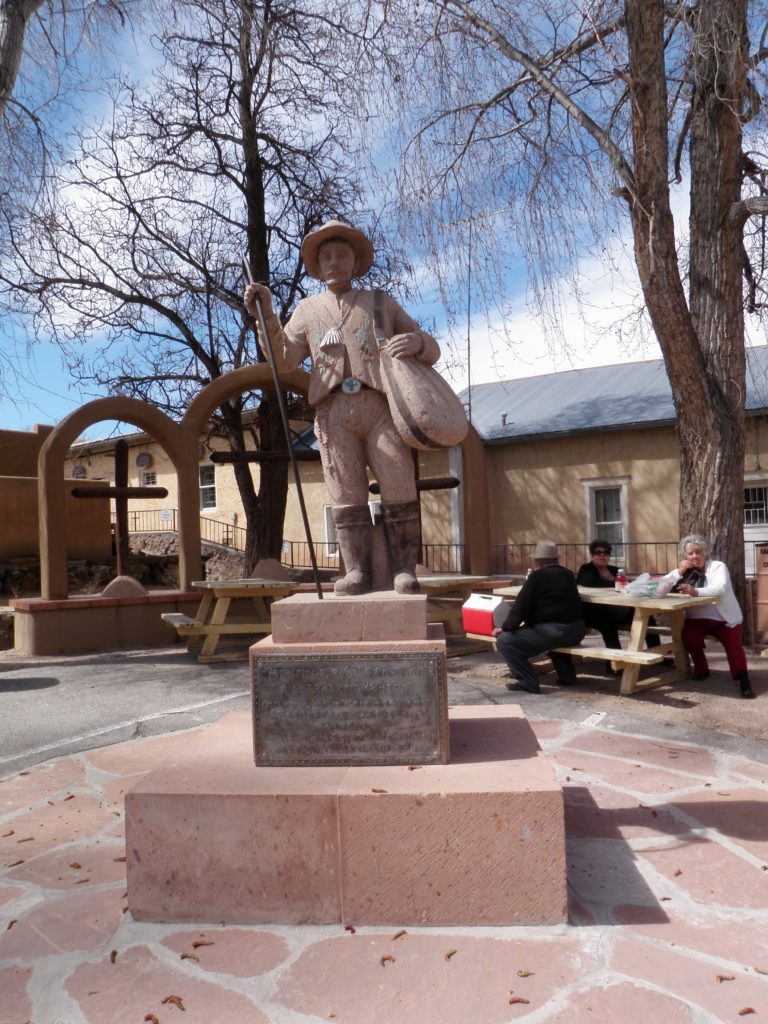
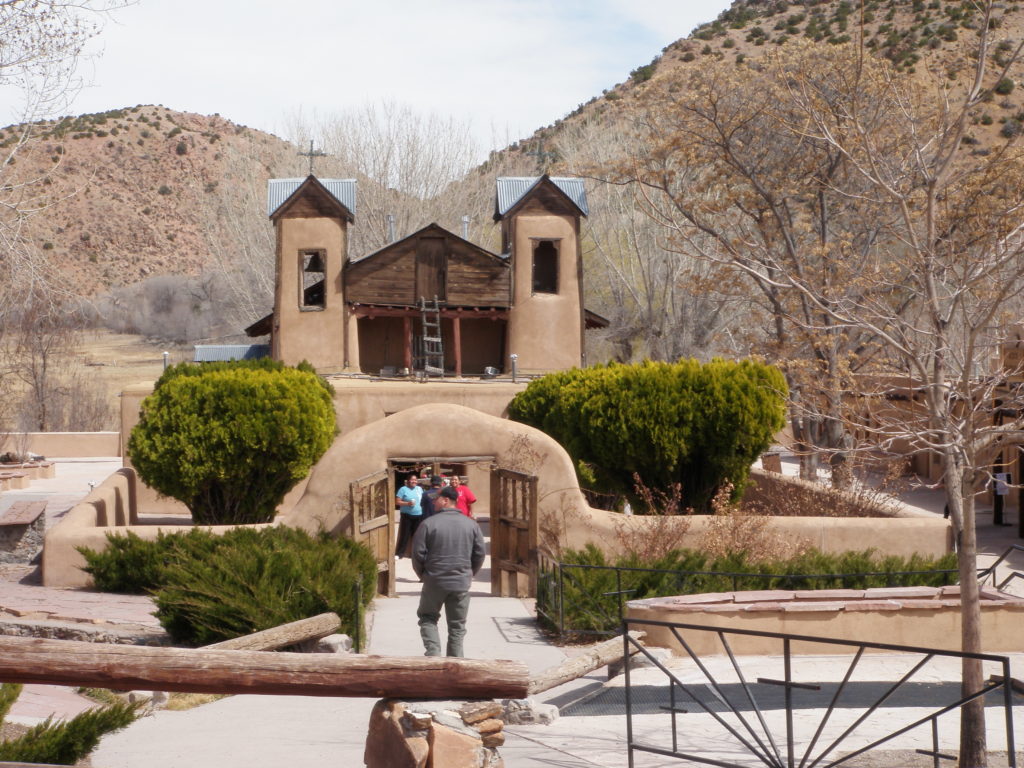
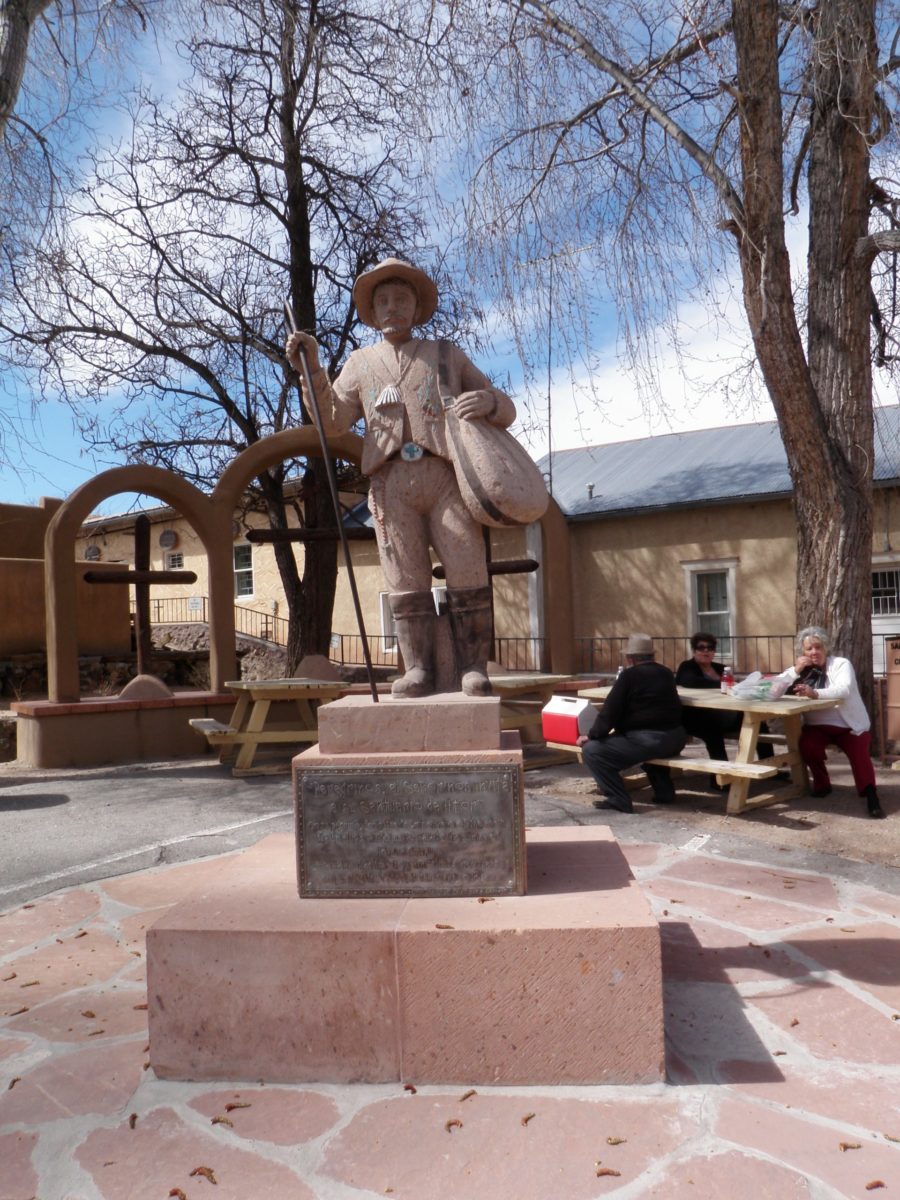
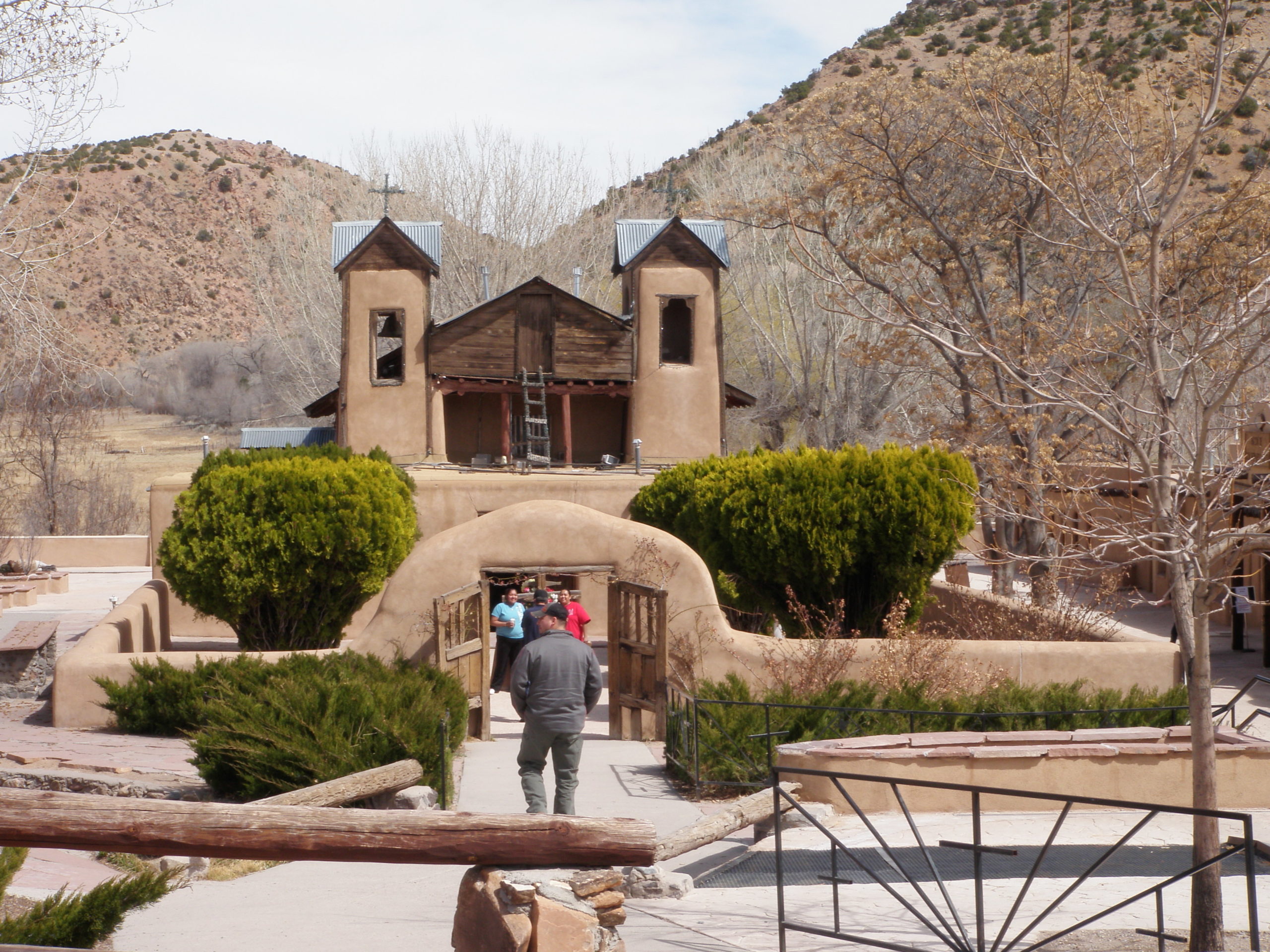
PR: So, Chimayo, New Mexico is a really fascinating place. It’s a beautiful little town just north of Santa Fe, New Mexico, my hometown. As with most northern New Mexicans, I have relatives there, which I think we’re all related if you go from Albuquerque north.
CW: The more I learn about people from New Mexico, I think you’re related to all of them.
0:17:50
Pretty much. Yeah. I just I actually found out at a family funeral recently that I’m related to the current governor, as a matter of fact. But I digress. Yeah, Chimayo is a very fascinating place and it has a massive yearly pilgrimage on Good Friday going to the church there, which we will get into. I don’t want to spoil anything, but the church attracts thousands of people every year on Good Friday. What happens is people actually make a pilgrimage by foot across the entire state. So a lot of people from Santa Fe would walk about I would say close to 30 miles and there’s even people who walk from Albuquerque which puts it closer to a hundred miles and other places throughout New Mexico. But this place is really interesting because there was a wealthy landowner there named Don Bernardo Abeta and he was a very wealthy guy of Basque heritage, which many northern New Mexicans are, including myself.
0:18:55
The story goes that he found a relic cross, a big wooden cross buried in a hillside in 1810, and he brought townspeople to help him dig it out. And they brought it down into town and put it up, and it disappeared overnight. So in the morning it was gone, and apparently it was found right back where they first dug it up.
CW: Dun dun dun!
BR: This wasn’t stolen by miscreants, it was miraculous.
PR: Yeah, it was miraculous.
BR: Miraculous mischief, if you will.
CW: The cross did not want to be moved from where it was.
PR: And since they didn’t have horror movies back then, and they didn’t know better, they grabbed the cross and took it back to town and did the same thing.
0:19:39
Same thing happened two more times though, according to legend. So they eventually did bring it back and it’s decided to stay, I think the third time. But-
CW: Well, the thing about crosses is you’ve got to nail them down.
PR: Exactly. That was their first mistake. Maybe that was why it stayed the third time.
0:19:56
CW: I’m sorry. I know I’m going to hell. I know, I know.
PR: But yeah, the truth is nobody really knows the origin of this crucifix. So it appears to be accurate in that it’s an old crucifix, but there was speculation that it came with the Spanish from Guatemala because the crucifix depicts our lord of Esquipulas, named after the municipality of Santiago de Esquipulas in Guatemala. And so that’s how, you know, we know that’s probably where it came from, but we don’t know exactly when or how. I think that there was, if I recall correctly, someone may have been buried with it, but we don’t know that for sure.
0:20:35
BR: Lots of things are unknown about this. Pretty much anything you say is going to be within the realm of what somebody said at some point.
PR: Might have been aliens, we don’t know. But, and this is, you know, northern New Mexico is full of these stories. I think we’ve briefly spoken about the Loretto Chapel and the miraculous staircase, and there’s a lot of these miracles throughout northern New Mexico, and because there is a deep kind of superstitious Catholic tradition among us here, and a lot of, you know, just part of the culture. I grew up walking the, I grew up doing the pilgrimage a couple times, not for any religious purposes, but because my dad just thought it was something we should experience. I loved it for about the first three miles.
0:21:30
CW: So is this pilgrimage kind of like a tourist parade or just what does it look like?
PR: So these days it’s a pretty, it almost looks like a bunch of people filtering into a festival or something, just walking along the highway. But the reality is that the original people who made the pilgrimage were a group called the Penitentis and they were just a bunch of Catholic men active in northern New Mexico and southern Colorado. They were very much kind of of that tradition that you hear like, you know, if you’ve ever read the very questionable history book, The Da Vinci Code, they talk about people who suffer religious penance for sins.
0:22:32
And they were the original pilgrims to this site, and they would literally, you know, make the walk whipping themselves on the back with these, you know, very medieval devices.
BR: Yeah, it almost looks like barbed wire, and you still see that to this day sometimes. I mean, it’s not common, but you know, on the news, I mean, I’ve seen, you know, they’re like, wow, there’s, there’s some guy whipping his back bloody and this is on like the local news. It’s a little…
CW: I could not imagine seeing that in real life. My only exposure to that as sort of thing has really been Monty Python.
PR: Yeah, that is actually a very similar group of people, but the not, not nearly as funny when you see it in real life, they do, they are still there. And definitely in dwindling numbers these days because I, you know, as extreme as certain religious people can get, this is starting to fall out of favor with the general public. But they’re around.
0:23:27
CW: Now, so you’ve got a temple, a shrine, a church in New Mexico that is said to contain a miraculous cross, the miraculous reappearing cross. And I know New Mexico as you said is kind of littered with miracles. Ben, I’m surprised your book wasn’t titled Miraculous New Mexico, but Mysterious New Mexico has a nice ring to it and it made it into your book, didn’t it?
BR: It did, yes. I think that’s chapter, I think, three in my book Mysterious New Mexico. In fact, when we previously did this show in the Miracle Staircase in Loretto in Santa Fe, that’s another one of the chapters. So I did sort of turn back to, after researching miracles and mysteries all around the world, I sort of went back to my home state and dug into that.
0:24:17
So if people are interested in hearing more about this, they can check out that book.
PR: I know I laid a little bit of groundwork, but there’s a lot more to the miracles in this place than a wooden cross so I approached this as a kid growing up in northern, New Mexico and and repeating the stories I was told and experienced, but you came into this as a researcher, so I’m fascinated at your take. What do you think about all this?
BR: Yeah And it’s it’s cool because again, it’s neat hearing your side of things because I grew up here in New Mexico, but not in the North where you did.
0:24:55
And so I didn’t really come from that tradition. So it’s cool hearing sort of the flip side that I didn’t experience growing up myself. You know, I had heard about Chimayo, as one does of lots of, you know, there’s lots of nooks and crannies and weird things around New Mexico. It’s just, it’s a weird state. Let’s just be honest.
0:25:15
CW: I can’t imagine it not being weird. Both of you guys came out of there.
BR: Well, there you go. There you go. And so really, I would put this case in the context of miracles because not just of course the miracles of the cross disappearing and reappearing where it wants to until at the end it didn’t. It’s funny how like these miracles happen and they usually happen in threes. Father, Son, and the Holy Ghost, threes are very important. And then after a while it’s like, okay, fine, I give up. So there’s always some reason why in the end the laws of miracles are overridden.
CW: Well, they all have a warranty and once the warranty on your miracle expires, you just can’t forget it.
BR: Well, there you go.
0:25:58
The jinn give you three wishes and the miracles apparently have an expiration day after three. But you know, as I mentioned, I had researched the Loretto staircase and, you know, the idea that it was unsupported by any structures keeping it up, and also looking into healing miracles. Now, you know, in many cases, of course, miracles are, well, miraculous. I mean, that’s, they’re something that is amazing and positive and something that is otherwise unexplainable. Sometimes miracles are kind of horrific. In a previous show we talked about stigmata and there’s interesting parallels between that and this. But in Chimayo, really the first time that it came upon my radar as being something other a small little place to check out as New Mexico lore, was when I was hearing about the miracle dirt.
0:26:55
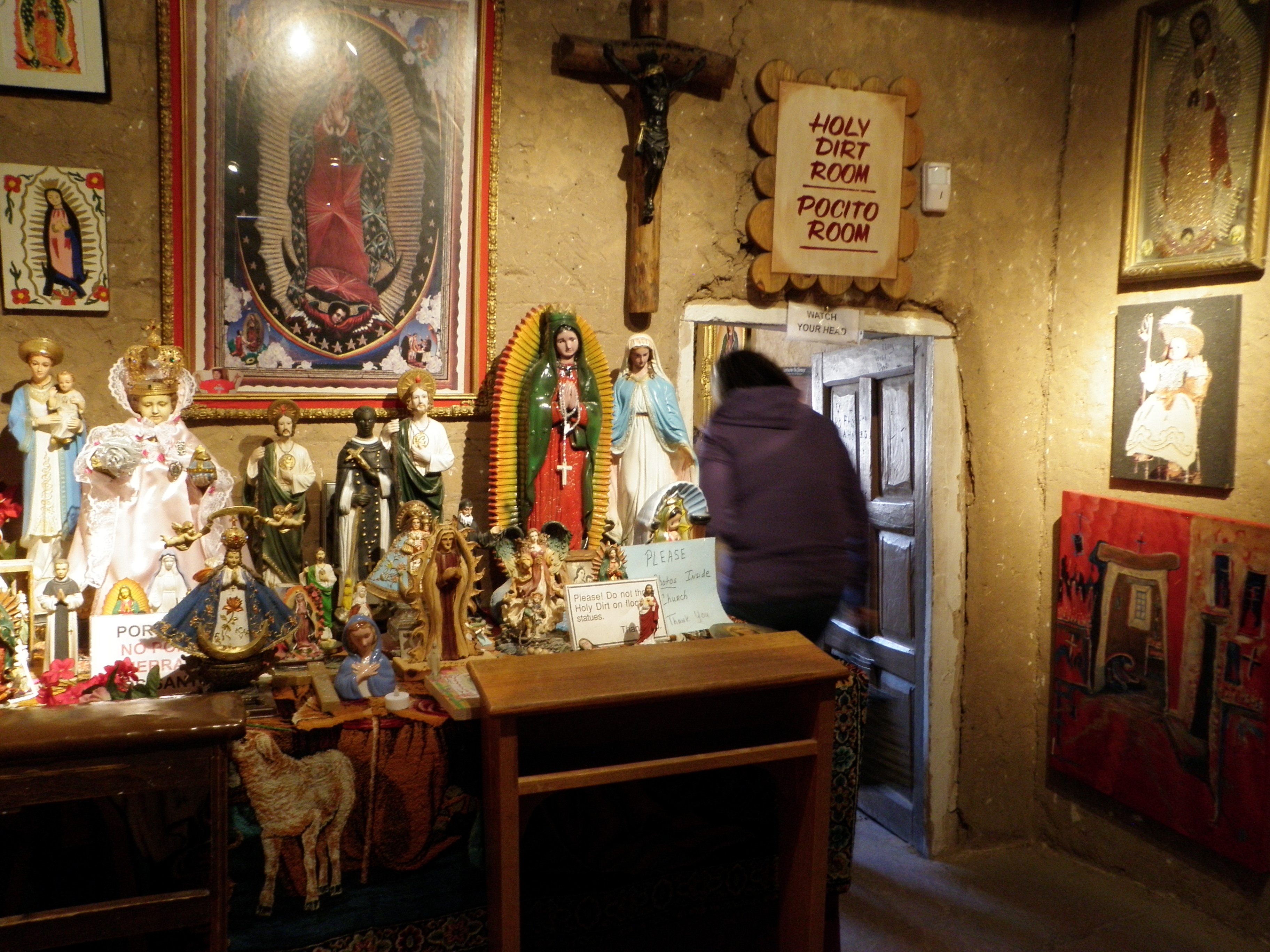
So in addition to the appearing and disappearing cross that Pascual mentioned, there is a pocito, a little well, in one of the rooms at Chimayo, and therein is said to be dirt that can heal.
CW: Healing dirt like a mud pack you’d put in on your face? I’m imagining people just kind of taking these mud baths is that…?
BR: Well, it’s it’s kind of a small room for a Bath, that’s a little that’s a little too touristy even for them If you want to go to the mud bath and go to Ojo Caliente, which is not too far from there actually. Beautiful hot Springs. Pascual, you’ve been to Ojo?
PR: Oh, yeah, my my stepmother actually works there.
BR: Oh, perfect. There you go.
0:27:41
CW: Well, so if you’re not going to be using this miraculous mud to look younger by putting it on your face and letting it leach all the minerals out or in or something, what is miraculous about this dirt?
BR: Basically it’s healing or curative powers. One of the traditions going back to Dhanubaita is that in one version of the story, this is related by historian Alice Bullock in one of her books. One version says that Alberta Grave-il saw the image of his patron saint shimmering in the air across Eusequia, and the saint beckoned him forward. He lurched forward with his last bit of energy and he fell exhausted to the earth.
0:28:25
When he touched the soil, he became cured and energized. And according to some legends, this is the story, this is what spawned the notion that the dirt at Chimayo had restorative or curative powers. So this is why to this day, there are people who make not just the pilgrimages to Chimayo, explicitly to take some of the dirt from this small hole. It’s about 16 inches wide, about nine inches deep. I visited there myself, I took some healing dirt out. They were okay with that. I wasn’t being sneaky there, just like, go ahead, you know, it’s open to the public, as churches are.
0:29:05
CW: Now, just so that listeners can get a picture here, what does this dirt look like and smell like? I mean, what you’re describing to my ear sounds like a compost bin. I’m sure it’s not that. Um, what does New Mexican dirt look like that people have imbued it with this power?
BR: Mostly sandy.
CW: Like yellow sand, black sand?
BR: Yeah, sort of yellow sand. Pascual, you’ve seen it, right? How would you describe it?
PR: Yeah, I mean, it’s, uh, so the the earth there kind of varies from like brown to red. So it is kind of like a pretty brown, I guess like about the most standard dirt color you can imagine.
CW: But it’s not like rich, fertile soil that you would grow in?
PR: No, nothing would grow easily in that, that’s for sure.
0:29:56
Very mineral rich and not very biologically soily.
BR: Yeah, this is about as far from the tropics, rich soils you’re gonna get. But yeah, so there’s actually two different and related aspects about the Miracle Soil. Number one is that the soil itself is miraculously replenished. So no matter how many pilgrims go there and scoop it out by hand, you know, they discourage you from taking out backpacks of this stuff. So you just take a little sample and go. Some people say that overnight or whenever, it miraculously replenishes itself. That is very easily disproven, because if you actually go to Chimayo and you talk to anybody there, including the priest, they’re just like, no, we have a big, it’s basically a big pile of sand out back.
0:30:54
So they do replenish it, but it’s with a shovel, and it takes some guy 10 minutes to do it. So it’s not like the miraculously reappearing cross, for example.
PR: Yeah, yeah, apparently they do bring it down from the hills and then they kind of pile it up on the property. So if you do snoop around a little bit you may notice some strategically placed piles of dirt, especially around Good Friday when the dirt gets has to be replenished much faster than it normally does. So yeah it’s it’s there and it’s not really a secret but I have heard people claim it was a miracle and found that kind of puzzling because the church itself does not call that part of miracle.
0:31:40
BR: Yeah, they don’t even make it as like, no, that’s not a thing. In fact, I learned that from the New York Times. It was published in the Times. So if the priest is confessing to the Times, it’s not a miracle. It’s not a miracle.
CW: I got to say, I think it’s rather quaint to have dirt be a souvenir that you can take. There’s so many places in the world where you’re not allowed to. It’s like, don’t remove the dirt from this or that state park. If you transplant dirt someplace, you could be bringing microbes or seeds that will be an invasive species, but a little jar of dirt saying, I went to the black sand beach of such and such or a little jar of red clay saying, I went to the healing dirt of Chimayo.
0:32:24
BR: Yeah, and of course, you know, keep in mind that the dirt itself has sort of quasi-mystical associations, right? I mean, it’s Mother Earth, literally Earth. It’s the ground we walk on. For many Native Americans, the Earth itself is sacred. There are places that you’re not allowed to, or requested not to photograph: Native American land, things like that. So the idea of the earth being sacred in and of itself is fairly common among cosmologies. And in fact, we see that now. But then, of course, the question comes up, well, how do we reconcile this sort of legend and lore about healing dirt with modern medicine, right? Either this dirt can cure diseases and wounds and not just that, it’s also said to bring good luck.
0:33:18
So this is discouraged, but you can buy Chimayo dirt probably on eBay. In the gift shop, you can buy little baggies of dirt or you can just, you know, get it yourself with a plastic bag from just outside the store. But, you know, you don’t have the receipt to prove it’s miraculous.
CW: So I’m guessing, knowing you, Ben, you launched some sort of way to analyze whether or not this dirt had real healing powers.
BR: I did. So I did a couple things. I went to Chimayo and, you know, took photographs and others that had been there, including Randi, The Amazing Randi himself had been to Chimayo and it’s mentioned in one of his books, I think in Faith Healers. So I was going to say I was following a well-trod path among skeptics, although probably only a few of us avowed skeptics were actually going there with the vast majority of people being of course the faithful pilgrims.
0:34:22
But yeah, so I went there and took photographs and I sampled the dirt and things like that and I wanted to sort of get a sense of well, is there anything special about the dirt even after I had been told explicitly that it’s just ordinary dirt. Certainly, it’s ordinary dirt when it came in, right? So the question then becomes if the priest and the santuario are bringing in dirt that’s ordinary dirt from some landfill nearby or what have you, even if we can all agree on that, is it then imbued with some sort of healing power by virtue of sitting in the posito? Does it become magical by entering the space, the sacred space, for example? So you could argue that, okay, yeah, this is ordinary dirt, but after it leaves there, it’s no longer ordinary dirt.
0:35:07
So I dug into that a bit, but really the first time that I came across a substantive case to investigate was in the case of Desiree Martinez. As with a lot of these cases about miracles, there’s lots and lots and lots of claims, but there are very few actual in-depth investigations. So you see this in Lourdes, France. In fact, Chimayo is referred to as the Lourdes of New Mexico. I mean, it’s world famous for its healing powers, and again, that’s why many people go there.
CW: I was actually kind of surprised to learn from your book that it is the largest pilgrimage site in North America.
BR: Yes.
0:35:46
CW: Number one, I didn’t know North America really had a pilgrimage site, but I mean, how many how many people go there a year, like thirty thousand or something?
BR: Yeah, estimates are between thirty and fifty thousand, depending on the year, of course, up and down with COVID and weather and things like that. But it’s a it’s a big deal. I mean, it’s, you know, again, even if you’re not Catholic, it’s a big deal. And unfortunately, every now and then, there’s some people that are hit by cars.
0:36:13
CW: Oh, because they’re just flooding the streets.
BR: They’re walking along the highway.
PR: Yeah, and unfortunately, New Mexico has the dubious title of like number two most dangerous state in the US for pedestrians. So it’s a bad combo, unfortunately.
CW: Oh, yeah, that’s a sad irony there.
BR: Anyway, as I mentioned, there are lots and lots of claims, sort of headline dramatic claims that you can read about online and blogs about all these people that have been cured, and this is a well-known case.
0:36:44
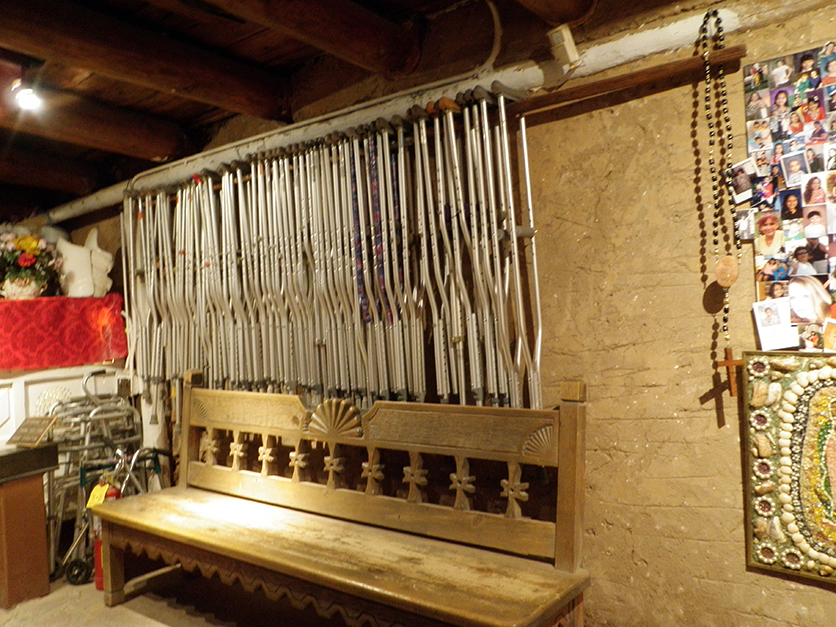
When you go into the Santuario, you will find crutches lining the walls, in some cases wheelchairs, and things like that the obvious assumption of course is that People went in there lame or crippled and walked out dancing jigs.
CW: Is that not what happened are these actually like trophies from people who’ve hit disabled folks with their cars? What are these?
BR: That turned dark didn’t it?
CW: Well, I’m sorry. I’ve still got that on my mind. So we’ve got crutches and wheelchairs like lining the walls of this shrine.
BR: Right. And again, it’s impressive for visitors because the obvious implication is that someone entered the place needing walking assistance on crutches, and they left without it, right, because the crutches are still there. So it’s easy to sort of make that assumption that that’s what happened.
0:37:40
Although, of course, that doesn’t mean it. I mean, you can buy crutches at Goodwill just because there’s crutches there doesn’t logically mean that someone walked in on crutches and is walking out of their own accord. So, you know, I wouldn’t call it deceptive. It’s a little gimmicky, but I mean, who knows? I mean, I can’t.
CW: Well, I mean, did you ask about these crutches and find out for sure that they were just bought at Goodwill, like you say, or does the management say, no, absolutely, those are all from people who were cured?
BR: Well, I did look at some of the crutches.
0:38:15
I did not see any Goodwill stickers, although those can be taken off. I don’t know if you’ve shopped at Goodwill, but you can, if you take your fingernail, usually my right thumbnail, and you do a little digging, they come right off. So the fact that I did not discover any goodwill or price tags on them, and of course that wouldn’t prove anything anyway, because they could have bought the crutch at goodwill.
CW: I guess the underpinning question I have here is, what does the management of the place maintain? Do they state officially that these are from you?
BR: Well, yeah, things get a little murky here, right?
0:38:50
Because strictly speaking, Chimayo, they don’t officially endorse the miracles there. If you ask them if the miracles are there, they will kind of say yes, they’ll imply that. The Catholic Church actually has pretty high standards for declaring miracles and sainthood. There’s a whole rigmarole there.
CW: Oh, so they don’t want to get in trouble with their higher ups in the Catholic chain of command?
0:39:16
BR: Well, again, it’s a little murky, right? Because certainly, Chimayo, as with other places, have reputations for miracles. I mean, that’s undeniable. The extent to which the clergy and the priests and others are officially going on record saying, yes, this is a miracle, that’s another matter. So there’s lots of sort of, I don’t want to say weasel words, but there’s lots of sort of implying that these miracles happen without coming out and being definitive about it, if that makes sense.
CW: Okay.
PR: And one thing about the properties of the dirt, I was just thinking about this while we were talking about possible healing.
0:39:55
My great-grandmother, who I’ve mentioned in the past, was a curandera, which is a kind of a folk healer slash Catholic mystic. There was much ado about what we called caliche soil, which are caliche dirt really, it wasn’t soil. And what that is, is just a type of dirt with a very high mineral content. Typically, it’s my understanding, it’s usually like a lot of limestone or calcium.
CW: It’s the scourge of our existence here in Las Vegas. We have caliche and that’s why we don’t have basements.
0:40:30
You cannot dig in many areas of Las Vegas because it is just impossible to dig through. It’s just like really dense clay.
PR: Yep, and we have a lot of that here too, among other things, and I do recall that it was often, and I think there might be even just a little touch of science in this. You know, maybe not enough to really matter, but it’s there. But you know, limestone is largely calcium carbonate and calcium carbonate, I guess is how you pronounce it, calcium carbonate is the primary ingredient in a lot of digestive aid.
0:41:09
CW: Yeah. I know somebody who was just prescribed essentially pills of bicarbonate to treat a bile disorder.
PR: Yeah, yeah. And so there is a bit of a tradition of various ways of ingesting it. Sometimes it’s mixing it in with what’s called a tole, which is sort of a cornmeal drink. Sometimes they would just figure out ways to just eat it on its own, maybe even by the spoonful. I’m not sure. I never partook. It didn’t really appeal to me very much. But yeah, I almost wonder if there’s maybe just the smallest drop of science to that in the sense that the mineral content of the soil actually does have some possible beneficial properties when it comes to digestion and stomach and your digestive system in general.
0:41:57
BR: Yeah, absolutely. I mean, to the extent that the soil at Chimayo, or sand, again, it depends on what day you’re there, what you put in the hole. But yeah, some of it when it was analyzed it did in fact have calcium carbonate as you mentioned. Keep in mind here that calcium carbonate is useful for when you’re ingesting it. So as you mentioned, you know, antacids and heartburn and things like that. It’s not necessarily going to make a wound heal faster or set a broken leg for example.
CW: Please tell me people aren’t rubbing this on their open wounds.
BR: Oh yes. Let me get it right.
CW: Are you about to get to that?
0:42:39
BR: I’m about to get to that.
CW: You’re telling me there are people who have rubbed this in open wounds. Oh my God.
PR: Haven’t you ever heard of rub some dirt on it?
CW: I thought that was just dad medicine, not like, okay.
BR: I thought it was put a ring on it. I don’t know. It was one of those. Okay. Rub some dirt on it, put a ring on it.
0:42:57
I don’t know.
CW: Keep your day job, Ben.
BR: This is my day job, thank you. Actually, it’s not. So, circling back. So, speaking of people who have put dirt in their wounds, great lead in there, Celestia. So, as I mentioned, one of the first cases that I dug into and to be crystal clear, I sort of dug into it on the backs of a TV show that I was on called The Miracle Detectives. It ran for a while on the now defunct Oprah Network and in that particular case, there was a woman named Desiree Martinez, a teenager actually, who was diagnosed with cancer at 15.
0:43:45
And she had over 20 lesions on her body, and she visited Chimayo from her home in Denver, Colorado, on an eighth grade field trip. And while she was there, being a good Catholic and of course, knowing full well reputed healing powers of the Chimayo dirt. She rubbed the dirt on her lesions and then returned to Colorado to continue her chemotherapy. You can maybe guess where this is going.
CW: Yeah, that last part sounds important.
BR: Don’t jump ahead here, Celestia.
CW: Just a hunch.
BR: Remarkably enough, or not, soon the scans and test results determined that she was in fact getting better and there was significant improvement. Her cancer went into remission. She had non-Hodgkin’s lymphoma and she attributed her recovery or certainly on the path recovery to the healing dirt at Chimayo. Treatments was hopefully not overlooked, but certainly, it’s certainly an important part of the story.
CW: Yeah, and we’re not we’re not snickering at somebody suffering from cancer or being, you know, treated and put into remission.
0:44:58
That’s a wonderful thing when somebody goes into remission from cancer. But we’re kind of chuckling at the like, oh, I did X and I did Y and Y was absolutely the reason why I’m cured, not X.
BR: And keep in mind that that, you know, that her story was told both on Miracle Detectives and elsewhere as a miracle.
CW: Well Oprah loves miracles.
BR: Oprah loves a lot of cranky, wild stuff. And we’ve I think we’ve taken a stick to her a couple of times on previous episodes, including her.
CW: Did you get paid to be on that show Ben? Tell me you got some of Oprah’s money.
BR: They paid expenses I think and I got a per diem.
CW: All right I just want to know that you got like some tiny little bean of Oprah’s money that makes me feel a little bit better.
PR: Couple of five dollar foot loans.
BR: Pretty much. Well I did get to meet Andrea Viscontis who was a wonderful person and we’re not close friends or anything but we stay in touch now and then.
0:46:06
She was an opera singer and she was the token skeptic on the show.
CW: That was not you?
BR: I was the sort of guest token skeptic.
CW: You were the understudy.
BR: Yeah, so basically the show and again I think it ran for one or two seasons and it’s long It had Indre as the skeptic and then a guy named Randall Sullivan as the more believer, for lack of a better phrase. I think I mentioned him on the show one time before. He came up to me and was like, I wrote a book on miracles. I was like, Only one? because he was making such a big deal of it.
0:46:43
CW: Oh, burn.
BR: Well, anyway, so the point here is that Desiree and others were promoting this as a miracle. It wasn’t like, hey, this is a, you know, along with my chemotherapy and this and that, it was like that was, that’s what it was focusing on. So it’s fair enough to say, okay, well, what is their survival rate for pediatric non-Hodgkin’s lymphoma? And the survival rate is between 30 and 75%.
CW: Oh, that’s not zero.
BR: That’s not zero, right? I mean, it’s, it’s wonderful for her.
0:47:15
And again, I, I’m not making fun of her. I’m not taking any way. That’s wonderful. That’s great. But with all due respect, if a third to three quarters of the people in your situation recover fully or mostly, that’s kind of less of a miracle.
CW: You know, and I got to hand it to the higher ups of the Catholic church who decide what’s a miracle and not.
0:47:36
I’m sure that was not lost on them either.
BR: Yeah, yeah, I’m sure that was, yeah, they, there’s a reason why the Catholic Church is surprisingly skeptical of these things, partly because they don’t want to just hand out the miracles left and right. I think they’re not skeptical enough, just to be, to full disclosure, but they are more skeptical than people would assume. They do not rush to validate miracles all the time, contrary to what you might assume. In any event, the reason I bring this up, not only because it was a case that I sort of dug into, again, sorry about the pun. I’ll do that again just to make you happy.
0:48:14
CW: You can’t unhear it now, can you?
BR: I can’t unhear it. I blame you. The reason I bring up the Desiree Martinez case is not just because it was a case that I investigated sort of on the back of the Miracle Detective show, but it also led to another case that I wrote about in Mysterious New Mexico and I’ll be launching on here, which is the case of Armando Córdova. What happened was that, as I mentioned, I had been on a Miracle Detective Show before and I got a call out of the blue from a guy named Armando Córdova. He literally just called me on the phone, and this is back when you would accept calls from strangers, numbers you didn’t know. Oh, the olden days.
0:48:54
And he said, he said, yeah, I saw you on the TV show. I want you to know that I was cured at Chimayo. I’m like, oh, okay. That was not expected. Every now and then there will be people that will basically fall into my lap with their claims. Usually, of course, I have to dig them up and research it and find places. But in this case, this guy called me out of the blue and wanted me to hear his story.
CW: Well, how uncommon is that for you, though? Because I know for a fact you get a lot of mail that’s just like, hey, Mr. Skeptic, you’re wrong.
BR: Yeah, but in this case, he wasn’t saying I was wrong. He was saying that he had been healed by dirt at Chimayo and did I want to hear a story.
0:49:43
CW: Okay, so it was a bit more earnest than just, yeah, well, screw you, I’ve got aliens living up my nose.
BR: No, and you keep, you keep, I keep forgetting about that case, the guy that believed that he had aliens in his snot.
CW: Yes, dear listeners, that’s not a random thing I pulled out of the sky. Ben has had people tell him that in their nasal mucus, they’ve got aliens alive and would Ben like to see a sample?
BR: Thank you for reminding that. As you periodically do, I always push it out of my head and then you bring it up every year or two and I’m like, yeah, that happened.
0:50:22
CW: All right. So this guy said, I was cured. Here’s my story. And do you want to look at it?
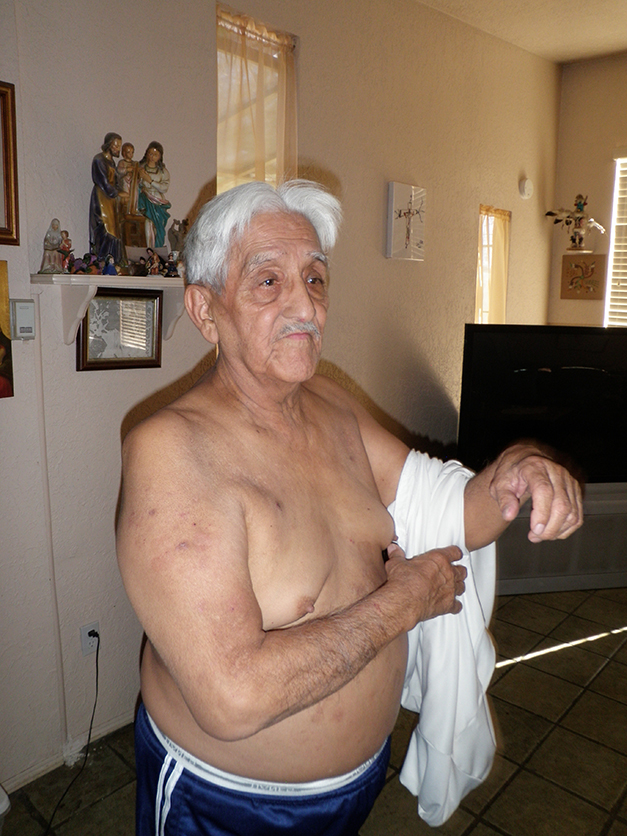
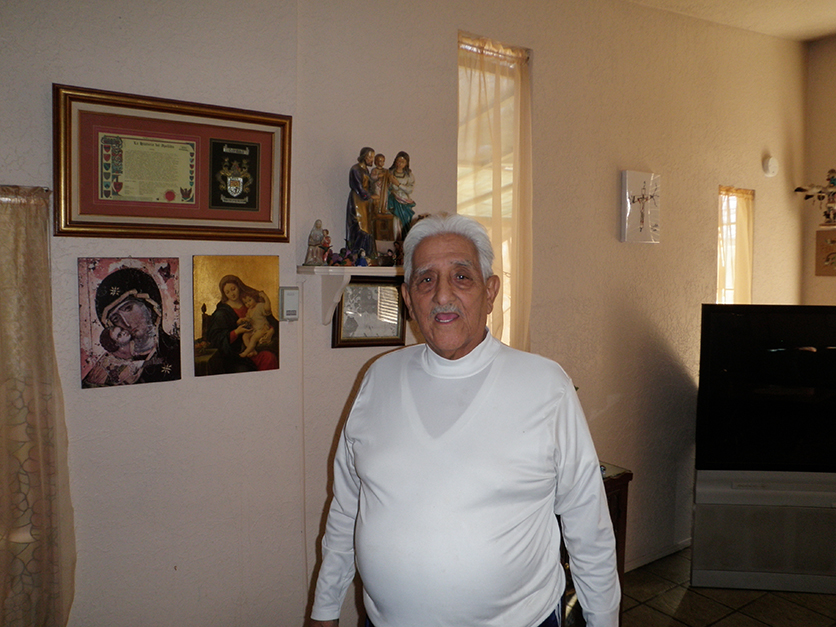
BR: Yes, so I said, absolutely. I mean, he sounded lucid. He sounded, I mean, he didn’t sound like he was hoaxing or pranking. He wasn’t this, it was this elderly gentleman. I think he, I don’t remember his age. I think he was in the seventies.
0:50:43
Very earnest, very sincere. And he invited me to his house, in Albuquerque, to meet with Antonio, his wife, over tamales, which were very, very good, by the way. Pascual is nodding and is like, yep, that’s, he knows where I speak. So, I’m going to summarize the story as best I can. So, basically, he said that he was 21 years old at the time, and he was about 19 days out of the Navy. I’ll just quote briefly from what he told me. He says, in 1954, I was discharged from the Navy around March 19th. We lived in my mother’s house on the west side, and two Sundays after I got home, we were going to baptize my oldest son.
0:51:23
She had a wood fireplace, and they put the wood in there, and I put kerosene on the wood, and I lit it, and it blew up. It hit me, the fire came out at me, I was burned from here up. He was basically motioning to his waist up. And he showed me scars on his arms and chest. And sure enough, there was some burn marks there. You know, I’m recording the whole thing. I’m taking notes. I’m trying to understand, you know, what happened, what set it up, and why does he think this is a miracle. So after hearing Armando tell his story, I asked Antonio, his wife, sort of for her version now, you know, I didn’t separate them in separate rooms like a murder suspect. I was just like, so, you know, what’s your story?
0:52:05
So she says, well, we were getting the baby ready for confirmation. And Armando thought the room was kind of cold because it was in March. So he said, I think I’ll light the fireplace. So he did and threw into the fire what he thought was kerosene, must’ve been gasoline, and that thing just exploded. When it blew up, it somehow ignited the can and he threw it. My mother-in-law had an old-fashioned overstuffed sofa and it fell on that and that was burning. Again, I wanted to sort of, I wanted to hear both their stories. Not that I expected them to be dramatically different, but I wanted to sort of get the nuances from what each person said. See, you know, do they jive in important ways? Do they differ in some ways?
0:52:45
CW: That’s, God, that’s, it sounds like christenings back then were almost as dangerous as gender reveals.
BR: Scary stuff, right? Keep in mind that I’m realizing as he’s telling me the story, this happened 50 years ago.
CW: Yeah. So there’s going to be like memory degradation.
BR: Right. So, I mean, I’m I’m trying to sort of as I’m listening to him, I’m taking notes. I’m trying to think, OK, where in his story and I don’t mean story disparagingly, just where and what he’s telling me in his family lore, can I tease out some falsifiable fact? Where, you know, where can I verify or confirm some of these things independently?
0:53:24
So he said that he went to St. Joseph’s Hospital for three days, not in the burn unit, but waiting to be seen. Now, that seemed odd to me, even for the 1950s, because if you had like third-degree burns you’re not waiting in a waiting room for three days. I mean, that’s yeah I’m sure where you are. That’s not happening.
CW: I’m remembering episodes of MASH in the 50s they would triage people and if your injuries weren’t tremendously bad you could wait.
BR: Yeah, but again, he told me I mean I have all this on tape I mean, I was very carefully said that he waited there for three days waiting to be seen.
0:54:05
Now, as I’m listening to this again, I I’m not saying he’s wrong. Clearly, I wasn’t there. But I’m beginning to suspect that maybe his memory of exactly what happened and how was maybe not the best, as you might imagine. It would be anybody’s memory after after a half a century.
CW: See you could you could frame this a totally different way and say, you know, man terribly frustrated over state of American health care rubs dirt on self and goes home.
BR: I’ll show you, damn it.
CW: Three days is a long, long ass time to wait.
0:54:40
Yeah, I didn’t press him on that. I mean, I sort of, I think I said, OK, you waited three days. And I think he said, yeah. So I just again, I was not there to get in an argument with him. I wasn’t there to debunk him. I was there to hear his story and to the extent possible, help him investigate it and help me understand what happened. So he said that when he was finally seen, they gave him first aid three days later, apparently. I guess this is third aid or something at that point.
0:55:10
And Antonio explained they banished him and we didn’t have any money. So they said, why don’t you take him to Veterans Hospital? So we did. They took him and the gauze had stuck to his wound, so they had to use acid to pull all that skin off.
CW: Acid?
BR: That’s what they said. So it’s not clear how long he was in the hospital. When I’m doing these investigations, as is important, for example, when I solved the Pokemon case, constructing a timeline is essential to understand the mystery.
0:55:39
Because oftentimes, part of the mystery is generated by mistakes in memories and thinking that one thing happened before another thing happened, when in fact, it was the opposite way or they were simultaneous. So oftentimes, again, if people are looking for advice on how to investigate things, step one, construct a timeline. This will serve you well. So I was doing my best to tease out of the two. He said that on the Saturday before Easter, he asked the doctors if he could go to Chimayo. And they said, you’re crazy, you can’t do that. This is the sort of typical, you know, the egghead scientist said I was crazy, but I did it anyway. And sure enough, you know, look at me. So that’s exactly what happened. So even though the doctor said, don’t go to Chimayo, you’re crazy, you’ll kill yourself, you’re going to die. He left them off and because of his faith, he did in fact go to Chimayo.
0:56:34
He said, quote, all I knew was we had to go to Chimayo. Instincts told me I had to be there. It was a strong feeling. And he said, for some reason, we had to drive. I drove all the way to the Santuario, wrapped up like a mummy. Now again, was he literally wrapped up like a mummy? I mean, no lo creo, but I don’t know. Anyway, he says, quote, we got there and lots of people saw me wondering what this mummy was doing there. I love how he sort of builds up this legend story. Like I’m just picturing this sort of mummy in a convertible flying down the roads with the bandages flying behind him. He and his wife pop out and they’re they stomp the way over to the the posito to get the dirt and others saying, what is this? What are we doing here? This is crazy.
CW: I’m curious of the the nitty gritty here. Did he take the bandages off?
0:57:27
Do you rub the dirt over the bandages?
BR: I’m getting to that.
CW: Did he eat the dirt?
BR: I’m getting to that.
CW: Dirt smoothie? All right. OK, go.
BR: He says again, direct quote from him, he says, we went to the chapel, to the posito, I told Antonio, take all this off me. No, she said, what are you going to do? She said, and I said, don’t worry about it, just put the dirt on me. So she did. I left the dirt on and they wrapped me back up. They told me I was crazy, and maybe I was, but it was the faith in God.
CW: So he put the dirt on himself and then wrapped the bandages back around his burns.
0:58:04
BR: Yes.
CW: Oh my God, that would be so itchy. Oh my God, that would be so itchy.
BR: Yeah. Just, yeah, just for anyone listening, don’t do this.
CW: This is not that one cool trick the doctors don’t want you to know about.
BR: This is not that. Regardless of how faithful you are, probably not a good idea. If for no other reason that oftentimes dirt carries bacteria.
0:58:30
CW: Yeah, yeah.
BR: So there’s that. Anyway, so back to the story. So Armando’s mission was completed. They left Chimayo and came back to Albuquerque. Quote, Monday morning I went back to the hospital and when we unwrapped the bandages, it was like a sunburn, bad sunburn. The doctors checked me over and they released me. There was nothing wrong with me.
0:58:49
They looked at me and examined me and got doctors to come in who’d seen me before. They asked, what did you put in your burns? I said, dirt. The doctors said I was crazy, but they released me and I went home happy. So that in a nutshell, that’s the story.
CW: I want, as you said, the timeline is important. So he got burned and then three days passed while he waited in the lobby.
BR: Waiting to be seen.
CW: And I mean, I don’t know, my mind is like, did he sleep in the lobby those three days or did he just go to the lobby, wait for a while and then go back home and sleep and then come back the next day and wait in the lobby and go back and forth.
0:59:29
So three days without actually being seen. And then after that, he went to the VA, the Veterans Hospital, and had the bandages burned off of him with acid. And then…
BR: Well, then the bandages went back on.
CW: Then re-bandaged, and then he went to Chimayo.
BR: Where he insisted that his wife unwrap his bandages and rub the dirt from the posito onto him and then re-bandage him.
CW: Wondering how many days from the initial injury was the dirt?
BR: I was wondering the same thing.
1:00:06
And unfortunately, as with many things in the case, that was murky. So again, as I’m hearing the story, I’m writing it down, my mind is clicking away, okay, well, what parts of this can I verify? What parts of this can I, what’s going on here? So I realized pretty quickly that the key here would be his medical records because all I’m hearing is, and again, I don’t mean that in a disparaging way, but the only information I’m being given is what he and his wife are telling me happened 50 some years ago.
CW: Yeah, and it’s only a miracle if it happens way faster than regular human healing. And a 21-year-old man is going to be pretty robust.
1:00:51
This is not like a 75 year old with a broken hip. This is a 21 year old with with, I’m assuming, you know, pretty healthy skin.
BR: Yes, exactly. Back in the day. So I said Armando and again, he was he was super sweet. And I genuinely enjoyed meeting him and his wife. And I had a good time. And I was trying to walk the line, as I often do with with such people, where, again, I’m trying to I’m trying to investigate the case. I’m not being confrontational. I’m not being mocking.
1:01:18
I’m sincerely trying to understand what happened and help them understand. At the same time, I have to ask questions, right? I mean, I can’t not ask pointed questions. That’s my job. On the other hand, I don’t want him to feel like I’m making fun of him or doubting him or whatever else. So I try and sort of put him on my side, I get on his side. Okay, I believe that that’s what you think happened and that may in fact be what happened. Help me solve this mystery. Help me prove this.
1:01:50
So I said, Armando, I need your medical records. Medical records, of course, here in the States are legally private information. I can’t get them. You know, you can authorize me to access them or you can get them yourself but unless you give me your medical records from the time or even soon afterwards there’s no way that I can prove this story or disprove it either way and he understood he’s like okay now I get I’ll see what I can do about a month later I called him you know what did you get the records he said no they destroyed all the old medical records so at this point I’m thinking, okay, well this is, I’m running out of things I can do with this, right? Because again, I need some other independent corroboration or source to investigate, and with all due respect, I’m just hearing stories. But I realized there may be another way to do it, because I could go back and listen again to my interviews with Armando, and I’m trying to figure out, okay, well, if it wasn’t a miracle, I’m not saying it wasn’t, but if it wasn’t, then what else could have happened here? And so the first step was understanding what was the nature of the fire. Now, he had told me essentially, and I think explicitly, that he had third degree burns. Again, he was not a doctor, he is not a doctor. I mean, it was so…
1:03:12
CW: Third degree is like, that’s like with, that’s to the bone, right?
BR: That’s very, very serious, yeah. So I had to sort of bone up on exactly what are the different types of burns, right? What are we talking about here? The first question was, what kind of fire was it? The second question was, what kind of burns would result from that type of fire? And the third question was, how quickly do those sorts of burns resolve themselves. So going back and reviewing what both of them told me and going over the notes, it was pretty clear that he had thrown what he thought was kerosene under the fire but turned out to be another fuel, probably gasoline. So then the question is, okay, well what happens when gasoline is thrown under the fire? And this also was supported. Remember I told you that he said that the can itself caught fire. That’s what happens. Pascual, jump in here for a second. So are you familiar with gasoline and or kerosene fumes and fires?
1:04:10
PR: My parole officer would not want me to answer that, but yes, I am.
BR: I probably should have interviewed you about this, of course, as before. So that’s great. So a lot of people probably don’t, I personally don’t have a lot of experience with kerosene and most of my experience with gasoline is at the pump. So Pascual, can you give us a quick primer on kerosene, gasoline, and how the two compare?
PR: So gasoline and kerosene, both really, what it is is that the liquid itself is not flammable but the vapor from it is flammable. So the flash point or the temperature which it lights up at is based on where the vapor lights up. And so kerosene is actually considerably less volatile than gasoline. So it will be relatively safe. That’s why you put kerosene – you know, you’ve got kerosene lamps and they don’t just explode when you try to light them. If you did the with gasoline, probably a terrible idea. Yeah, so I would say that the big difference between kerosene and gasoline is that kerosene is significantly safer to store and to use around the house. Gasoline, you probably don’t want to have too much of it sitting around.
BR: Exactly, that was a perfect, perfect introduction. I couldn’t have set you up better for that. So the reason relevant is is by going from their description of of of how the fire Happened and and in the actions of the fire it tells us how severe his his initial burns were right?
1:05:47
So even though all I can see now is his 50 year old scars and there’s no other medical reports or anything else, we can work backwards and say okay. Well, this is what you said happened. If it was that, then what sort of burns can we expect from that?
CW: Roundabout, but clever. Good job, Radford. Thank you. Every now and then I pull it off. So I learned more about the flash fires, like the one that burned Armando. And even though they’re scary and painful, most burn injuries are not life-threatening. In fact, 95% of people who are hospitalized with burn patients survive. So burns, again, they can be really horrific, but particularly if they’re first degree burns, which is what Armando suffered, they’ll heal up usually within a few weeks as long as they’re cared for and kept from infection.
1:06:37
So there’s a couple of different types of burns. There’s scalds, there’s contact burns, there’s chemical burns, for example, acid. But the kind that Armando encountered, again, by his own description, was a thermal burn and this is actually the least type of burn because of simple physics and it’s the same reason that you can walk on on hot coals and and I have and Pascual have you done that?
PR: I have not but I I’m sure I feel like if hanging out with you enough. I might eventually do
BR: Well, I’ll have you over some time we’ll do we’ll do a fire walk.
1:07:14
The last time I had a fire walk, it was over at my mom’s house in Corrales and they actually called the cops and the fire department. It was a big production, so I promised them I wouldn’t do that again.
CW: You should have told them, it’s okay, it’s like we’ve got some dirt here. It’ll be all right.
BR: We went up to Chimayo, exactly. So anyway, the point here is that flames contain much less energy than for example boiling water which is why if you just wave your hand over a lighter or over a campfire, if you do it pretty quickly, you will feel the heat but you are not going to get burned as much as you would if you put your hand in boiling water for example because the energy isn’t being transferred to your hand as quickly.
1:07:57
CW: Now, I’d have to double check this, but just Las Vegas lore here. Pepcon exploded like, what was it, 25, 30 years ago? Pepcon was a big, this big industrial plant. And they, part of what they did was make marshmallows. And we heard that the burns were just insane. It’s people getting coated in like melted marshmallow sugar goo. Because, yeah, way worse than like any type of burn you could ever imagine. And again, that’s just a little lore.
1:08:28
I’d have to actually look it up and see if anybody actually did get severely burned that way. But that’s what we heard about as school kids.
BR: Yeah.
PR: Oh, I hear typing. Pascual, are you looking that up right now?
PR: Sorry. We’ll get back to you next episode.
CW: Yes, it does matter what what substance you’re getting burned with.
1:08:54
Is it water? Is it is it gas as in like vapor air type gas or is it or is it plasma like marshmallows? You know, not the marshmallows or plasma, but you know what I mean?
BR: Yeah. So again, even though Armando and his wife described his burns as being either second or third degree, it was very clear from both their descriptions that in fact they were describing first degree burns. And in fact, the most common causes of first degree burns are flash burns, which happened to him, and sunburns. So we know based on their descriptions that it’s virtually impossible for his burns to have been as bad as he remembered and as serious as they claimed they were. And because of that, then we have to sort of look at the claims in a new light, right? Because yes, if what he is remembering and saying is true, and he had a second or third degree burn, then wow, it did in fact heal up remarkably quickly. On the other hand, if it was in fact a first degree burn from a flash burn, which is what he said happened, that is much more likely to have been painful and all these sorts of things. But if it’s wrapped, as he said it was, with or without the application of Miracle Dirt or anything else, the burns would heal within a couple weeks anyway. So I’m certain that’s what happened.
1:10:26
It’s easy to unconsciously exaggerate or misremember the severity of details, you know, some accident or, you know, things get better than retelling. It happens all the time. So I, I don’t for a second think that Armando or Antonio were trying to fool me or hoax me or mislead me in any way. I think they just simply misremembered how severe the burns were 50 years ago. And again, they didn’t know any better because he had the burns, they put the dirt on, and it healed up. So it’s not like there was a control.
1:11:04
It’s not like, well, we have burns on the left arm, burns on the right arm, we’re gonna put, you know, more healing on the left arm and compare the two. So the only thing they had to go on was the fact that his wounds healed up after two or three weeks and they would have done that anyway.
CW: How did you present this to them and how did they take it?
BR: I told them that based on the research that I could do, I thought it was most likely that in fact it wasn’t quite as severe as they were remembering. I wasn’t there to be mean. I wasn’t there to debunk his story.
1:11:40
He called me and asked me to investigate. I investigated to the best of my ability, given the limited information I had. And I said, look, if somehow you can find your medical records, fine, that’s wonderful. I’m more than happy to see them. But based on what you’re telling me, this is what I think happened. So I didn’t waffle, but I just sort of said, this is what I’m thinking so far, but let me just circle back.
1:12:06
So I moved on to other things, and I called Armando about nine months later to check on and see how it was faring. I got his machine, and his wife called me back shortly thereafter and told me that Armando had died of cancer a few months earlier. He was actually battling cancer throughout the time that I was talking to him.
CW: Oh man, okay.
1:12:29
BR: And he mentioned this, I mean he was sort of going back for this. But we talked about Armando and I passed along my condolences and she told me, she said, I want you to know he really enjoyed meeting you. He talked about that for a while, he loved telling you his story. And that was really touching. I dedicated my book Mysterious New Mexico to Armando because I appreciated him reaching out to me and telling me his story in earnest and just being a sweet guy and just being open about it. So I really enjoyed that.
CW: Oh that’s that’s touching.
BR: And there’s actually a sort of sweet little coda to the story which is that just before Christmas in 2018 I got a instant message from a guy named Francisco Cordova. Didn’t know who it was or anything else.
1:13:17
And he said, hello, I just picked up your book by chance. I saw you dedicated it to my grandfather, Armando. Very cool.
PR: That’s awesome.
BR: I’m like, oh, hi. I said, I really enjoyed meeting him and your grandma’s tamales were amazing. And he said it was a very wonderful surprise. No one knew about the book and I just happened upon it in the library. She got the book for Christmas, so it was a nice little surprise. At this point, I was sort of feeling, at this point I realized that he had read the book and certainly, you know, the chapter that involved his grandfather. Therefore, he knew that I had concluded that it wasn’t true.
1:13:59
So, I was, I responded to him, I said, you know, as you can see, I don’t really think it was a milagro, a miracle, but it was a fascinating story and mystery. So I was trying to sort of say, look, you know, I know I kind of poured cold water. Ooh, that was actually, I poured cold water on his burns as you should do. And he responded, he said, yeah, it was cool to read. I’d never heard the whole story. You did a wonderful job. And I said, thank you, very kind of you. So it was neat that, that in the process of investigating this Chimayo miracle, I had sort of accidentally written down some of the, the Cordoba family lore, uh, which he hadn’t even told his grandkids.
1:14:38
And so it’s, that’s kind of cool.
PR: That is really cool. I, um, and I think it’s, it’s testament to what, uh, you know, good skepticism looks like because clearly there were no hard feelings and, and, you know, it left left a good impression on everyone down to the grandchildren. Well, you’re the best way to do skepticism is coupled with empathy, too.
PR: Yeah, absolutely.
CW: Speaking of empathy here, I was curious, I scrolled through and no people were killed by the marshmallows at Pepcon. Pepcon was a rocket fuel place and it was bizarrely right next to a marshmallow factory just outside of Las Vegas. You can look it up.
1:15:25
Pepcon, explosion, marshmallow factory. The marshmallows smoldered and smoldered for days and smelled great.
BR: I bet that smelled wonderful. The rocket fuel maybe not so much, but the marshmallows, I’m down for that.
CW: But yeah, but people got injured by shattered glass, cracked walls from the initial explosion. But all of the all of the marshmallow workers were able to get out before the fire engulfed their building. Happy ending to that story. Nobody needed dirt. It was all good.
1:15:58
CW: Well, thank you, Ben and Pascual. You guys both brought some New Mexico perspectives to this very New Mexican topic.
BR: We like to think of it as local flavor.
PR: Oh, yeah. Lots of local flavor.
CW: Local dirt flavor. Yeah Rub on your burns. Yummy. Yummy.
BR: It’s a it’s a fun story and a fun investigation even though it’s sort of somber, but it’s it’s it’s neat to check out and again if people are interested you can you can see the whole chapter in my book mysterious, New Mexico.
CW: All right. Well, we got a number of things we’re working on for next episode and thank you listeners for sticking with us for 201 episodes, and we’ll be bringing some more.
1:16:52
We’ve got a ton of topics and the list just keeps expanding.
PR: Yeah, I actually have quite a few in my back pocket at the moment, so I’m looking forward to jumping into those.
CW: Well, until next time then listeners, take care.
1:17:10
Bye. Bye. Bye. Bye. Bye. Bye. Bye. Bye. Bye. We would like to extend heartfelt thanks to our top-tier sponsor-level patrons, Amy Frusciower Kelly, Dr. Angela Matkey, Elizabeth Leggett, and Laura Ellis. Thank you for your continued support of our podcast. If you’re interested in becoming a sponsor, or just throwing us a buck or two, please visit Squaring the Strange on patreon.com and browse our selection of patron rewards. Every bit helps us keep the lights on here and we are grateful to our generous friends who help us bring you quality content. If you are short on cash and want to just give us moral support, remember to recommend us to a friend, mention us on social media, or give us a review on your favorite podcast dispenser. If you have comments or topics you’d like to see covered, come join our community on the Squaring the Strange podcast discussion group on Facebook. Squaring the Strange is a production of Two Heads Studio LLC. Copyright 2021. Theme music provided by Shriek Back. Additional music by Memory, Keytard and Feathered, and Pasquale Romero. Additional support by Ashley Romero, Robert Sundin, and Alicia Jarvis. The views and opinions expressed on this podcast are those of Squaring the Strange, and do not necessarily reflect the views and opinions of Two Heads Studio, Kronos Creative, Center for Inquiry, our advertisers, or any other affiliated organizations and employers.
