
Episode Summary:
Ben and Celestia discuss the nostalgic sense of deja vu when hearing about UFOs and cults these past weeks. Then we are joined by David Thomas, who investigated author Michael Drosnin’s notions of a code hidden in the text of the Hebrew Bible and how cracking that code could foretell the future. These ideas were popularized in a series of books published over 20 years ago, but the same number games are resurfacing today in the form of gematria, a type of numerology advocated by QAnon conspiracy theorists. Dr. Thomas discusses the data-mining programs he wrote in order to demonstrate how subjective, predictable, and ultimately misguided these ideas of a hidden Bible code were.
0:00:00
Ben Radford: Welcome to Squaring the Strange, the podcast that examines all manner of the mysterious and the mundane through a critical lens. So let’s square the strange.
0:00:10
Welcome back to Squaring the Strange. This is episode 195. I am one of your co-hosts, Ben Radford, and with me is/are is?
0:00:33
Celestia Ward: Is, is, just is, singular verb, because it’s just Celestia, Celestia Ward today. Pascual…
BR: Just Celestia. You’re an important part of that. Don’t minimize yourself here.
0:00:58
CW: Well, it is solely Celestia Ward and Ben Radford today. Pascual is out. He’s got a bunch of work stuff to do, but he will be back in time. So what are we talking about today, Ben?
0:01:09
BR: So today we have a longtime colleague of mine, special guest, Dave Thomas, talking about the Bible Code.
CW: The Bible Code.
BR: Yes, so it’s a fascinating story and we’ll dig into it but first are you skeptical of anything Celestia?
0:01:26
CW: So yeah, this past couple of weeks I have had moments where I’ve been skeptical about what decade we’re living in. It really feels like the 1970s out there. I was driving someplace last week and in the space of one hour on NPR I heard a story about UFOs being spotted in our skies and also shot down and then also a story about the dangers of cults to college students.
0:02:00
BR: Hmm, interesting.
0:02:02
CW: Now, the UFO story, I probably don’t need to really preface the UFO story with anything, because y’all have likely heard the whole balloon panic we’ve been experiencing for the past, what, three weeks now?
0:02:14
BR: Yeah, starting with the Chinese spy balloon, which maybe or not probably was a spy balloon, and then all of a sudden people are seeing more things. And is it a result of more things being in the skies, or the same number of things and more people looking for them?
0:02:28
CW: Well, not even necessarily people its radar and we’re you know, we’re talking like 30,000 feet in the air so people aren’t really well, maybe people are spotting them in their backyards, too, but spy balloons, weather balloons, hobby balloons. Specifically, there was one launched by a group in northern Illinois called the the bottle cap balloon brigade I oh you must love that term. It’s a literate. It’s alliterative.
0:02:53
BR: Yeah, I guess.
0:02:55
CW: Well, there’s a whole community of folks that I’ve learned about into something that’s called Pico Ballooning. Have you heard of this?
0:03:03
BR: Pico Ballooning. I’m going to like Pikachu or Pika Boo or Pika.
0:03:11
CW: No, we’re just spacing on a typewriter. You can get balloons for like $12 all the way up to like $200. And there are dozens of these balloons floating around our airspace at any given time. The whole hobby combines ballooning with ham radio. So it kind of scratches two nerd itches at the same time here. And the whole ballooning community is now worried that they’re going to come under fire, literally come under fire, by the US government.
0:03:41
BR: All right.
0:03:42
CW: So, and, you know, I don’t know how much of this news coverage you’ve gotten into. It’s been very interesting to hear government officials say, these are not of extraterrestrial origin and have to repeat themselves. But I was kind of pleasantly surprised that I didn’t see a whole lot of people coming out of the woodwork, screaming that these are absolutely alien of nature. I didn’t see a whole lot of narratives run that way. Did you?
0:04:08
BR: Not too many. I was a bit surprised. I remember reading the New York Times, literally on the front page of the New York Times that the US government had shot down UFOs. I saved the paper. I’m like, wow, this is, you know, for literally decades, you know, people have been saying, well, you know, when will they finally admit it? You know, when will it be on the cover of the New York Times? Well, it was about two weeks ago. It was right there.
0:04:37
CW: And, you know, and the term UFO was used all over the place. They didn’t go with UAP, like unidentified aerial phenomenon. It was a it was UFO. So I’m going to have to dig into that. I wonder if the government actually has or the military branches actually have a specific designation like, this is an object because we know for sure it’s a thing, you know, we have it on radar, we shot it down, or if it’s a UAP, if it could just be light or reflections, and so you can’t really pin it down as being an object. Does anybody know? If you know, write in, tell us on the Facebook page.
0:05:12
BR: I bet Mick West knows.
0:05:14
CW: He probably does, yes. Now, it doesn’t really look good for our military intelligence when they are launching missiles at a $12 Mylar balloon that was put together by a Cub Scout troop, or whoever the Bottlecap Brigade is composed of. But one positive I saw out of this whole balloon panic was that there were enough spokespeople commenting that I feel like a lot of the public got a lesson on what happens when you widen a filter.
0:05:42
And one of the government people talking about it, I can’t remember his name, but he made the comparison to unchecking the boxes on a used car sales website. So like if you are looking specifically for like a hybrid car, you know, that’s a two-seater, you’re getting it like, blue, you’re going to get one hit, but oh, we widened it to sell you 800 cars. These are all things that you want to see. So they did that for the radar and they widened the scope. They unchecked the boxes. There’s no more filters, filtering out things that could just be a goose or a mylar balloon, and you end up with a bunch of hits. So, hey, the more people who can get educated about the better. Now, if only the anti-vaxxers would look at how autism diagnoses parameters have widened over the years, maybe they’d stop their long ongoing panic about the scourge of an autism epidemic taking over the world.
0:06:41
BR: Yeah, when you were saying that, I was going to public health and epidemiology and the broadening of criterion, and it’s a well understood, well known phenomenon. If you make the diagnostic criterion, particularly for diseases, for mental illnesses for example, or things that don’t have a specific test for, an actual…
0:07:08
CW: Blood test, yeah.
0:07:09
BR: Yeah, blood test. When you increase the number of criterion, it goes up exactly as you said.
0:07:15
CW: Yeah, yeah, I mean if you look at the depression, I’m just throwing out a made up example here, but if doctors only diagnosed somebody as having depression if they had like major, major symptoms, and then nowadays if they’re like, oh, well if you’re losing sleep three nights a week, that makes you depressed, well, you know, 30 years ago, people who lost sleep three nights a week were just tired.
0:07:37
BR: Right.
0:07:38
CW: Anyway, now you’re probably wondering what the other story I was talking about was the the cult thing. We’ve had a bunch of cults in the news lately, haven’t we? With like NXIVM. Are there more besides NXIVM that you can recall?
BR: There were a couple. I was actually thinking we should circle back to it and do a do a show on that at some point.
0:07:55
CW: Well, the NPR story again, if you want to check it out, you can probably find it on the on the website. But but yes, the cult story that I happened to hear on the radio was probably something listeners and you might want to know about. There is a new docuseries out on Hulu called Stolen Youth, and it was directed by Zach Heinzerling. I have not yet checked it out, but it follows the story of a cult that took place about 10 years ago at Sarah Lawrence College. You recall this story was from like 2013, 2012. A 63 year old man named Larry Ray was just sentenced this January to 60, six, zero years for sex trafficking, extortion and forced labor. I mean, you know, these are the standard cult leader charges one would get. These all involved his daughter’s roommates at Sarah Lawrence College. And it sounded like an utterly horrific experience for them. He managed to brainwash these girls into thinking that, you know, family members were out to kill them, government was out to kill them, you know, they were terrified. And before anybody feels dismissive, like, oh, I’d never fall for that. There were some really good points made. And we can go into this when we do a show about it, but you don’t have to be dumb or naive to get sucked into a cult. You just have to be human and have the weaknesses of the average human who wants to have a social clique and a group and somewhere they belong. So anyway, if you want to check out the series, it’s out on Hulu now, it’s called Stolen Youth. And I hear it’s really well done. I hear they they treat the subject with the you know the care that it deserves.
0:09:43
BR: Yeah, sounds interesting as you know, I’m a fan of documentaries. I’m not I’m not always huge on true crime, but it’s sometimes interesting.
CW: Yeah, I think you prefer the docuseries about fake crime.
BR: That as well.
CW: Well, I’m assuming you haven’t joined any cults lately or flown any balloons been have you have you been up to anything interesting?
0:10:04
BR: Neither of those two. I did finally get around to writing up a short blog on my visit to the E.O. Wilson Biodiversity Lab at Gorongosa National Park in Mozambique, which I mentioned, to some of our Facebook group fans. And so if people are interested, you can find it at CenterforInquiry.org or check out Facebook links on my Facebook page, Ben Radford, or of course, Squaring the Strange discussion page.
0:10:33
CW: Awesome. Cool. All right. Well without further ado, let’s talk bible code with Dave Thomas.
BR: Well, for this episode, I’m excited to have a special guest. He’s actually been on the show a couple times before. He is a colleague, a physicist, a juggler. He’s a professor in many things. Dave Thomas, are you there?
0:11:08
DT: I’m here.
0:11:09
CW: Yay!
0:11:10
BR: So, Dave, one of the… You and I have known each other for a long, long time, and we’ve done some stuff together, because of course you were one of the leaders of the local skeptics group NMSR, New Mexicans for Science and Reason. But you are best known for a couple things. One of them is today’s topic, which is Jumatri and the Bible Code.
0:11:31
DT: Yep, yep.
0:11:32
BR: So, a lot of listeners may not be familiar with the Bible Code. It’s not exactly an ancient mystery, but it had its heyday some years ago. But you were instrumental in putting out the more logical debunking version of that, if you will. For those who don’t know, can you tell us some about the Bible code and its origins?
0:11:56
DT: Sure. There have been mysterious codes in the Bible or the Torah for a long time, like the Kabbalah movement is an example of that, but in the 80s and 90s, some Israeli mathematicians developed this technique basically where they tried to find the names of not ancient rabbis, contemporary with the Bible, but modern Hebrew rabbis like Maimonides or whoever, and they tried to look for those rabbis and their cities where they were born or where they teach. And so they had like 50 rabbis, 50 cities, and when they did this so-called equidistant letter sequence, basically it treats the whole text, the Torah in this case, as one big long word. It takes out all the punctuation and spaces and periods, commas, apostrophes, all of that. And then it looks for the same skips. So my favorite example of an equidistant letter sequence that you can visualize without trying to, you know, wrap your brain around a book that’s 300,000 characters long is the very short word generalization. And if you start with the third letter of generalization and you take every third letter, you created a secret code for the scourge of the 20th century, the evil empire known as the Third Reich, the Nazi regime, because generalization, every third letter spells out N-A-Z-I. So there’s a secret code for Nazi. And so these Israeli mathematicians, Whitstam, Ripps, and Rosenberg, WRR, they came up with elaborate rules for these comparisons. One of the rules was that these matches, these sequences that you match, should have minimality. So if I was searching for the word generalization and I found one that started in, let’s say, Genesis and ended in Deuteronomy, then the generalization that’s inside there with every three letters, that would trump it. That would invalidate the larger, more spread out example of that word.
0:14:44
CW: So these cryptographers and mathematicians were trying to apply Occam’s razor in some way.
0:14:51
DT: Well, they had this criterion because they were getting so many matches. So they had to come up with a way to limit them. But then basically they published a paper around 1995, I think, in Statistical Science, a bona fide peer reviewed scientific journal and the editors published it. And they said, well, they’re making some claims in here that we’re not equipped to test and normally we wouldn’t print a paper like this, but the claims are so unusual and perhaps controversial that we thought we’d publish it and let our readers take a crack at it. And one of them did. One of those readers was a gentleman Brendan McKay from Australia who’s a mathematician at one of the universities there. He really got into it and basically spent five years proving what the Israeli mathematicians were doing and basically they were taking advantage of the flexibility of Hebrew. It’s easier to get Bible codes, these equidistant letter sequences that spell out words and names and events. It’s a lot easier to get them in Hebrew because the vowels are almost non-existent. So if you’re spelling out comet neowise in English that might be like 13 characters. In Hebrew, it might be seven characters. So it’s a lot easier to get the matches. But then there’s the variability, the slop factor. So there’s, in English, we have one way to spell the word direct, and there’s not a lot of variations. But in Hebrew, there can be like three or four ways to spell not just words but names, proper names. So what the Witsdom, Rips and Rosenberg fellows did was they came up with rules to say these are the rules to limit the nicknames for the cities and rabbis that we’re going to look for and then we’re going to do this big mash-up and see which rabbis ended up next to their cities when we looked for all possible equidistant letter sequences. And they claimed to have better than a million to one odds and and claimed this proved Genesis you know was written with intent. This code was put there on purpose because a million to one against it being just a random occurrence.
0:17:39
BR: Hold on a second. This sounds a lot like data mining to me.
0:17:45
DT: Oh yeah. The way I describe it is, the Bible code is data mining on steroids. And data mining isn’t that… We have earthquake data at the place I used to work at. You know, it goes back for decades. And people can look in that old data for things they never dreamed about looking at, like a climatic variation or winds or whatever. So data mining isn’t bad, but the Bible code is basically this technique where you can adjust what you’re looking for. And that’s what the rabbis turned out, or the Israeli mathematicians were doing with their rabbi search. They were maybe subconsciously, maybe the same kind of way that a Ouija board works, they were adjusting the lists of rabbis and cities so that they got this result. And so Brendan McKay over in Australia, it took him five years, but he looked for rabbis, not in the Torah, but in the Hebrew translation of War and Peace. I don’t know why, but War and Peace is the accepted canonical control text for Bible code experiments, but for the Hebrew version, you’ve got to use the Hebrew version of Tolstoy’s work. And so McKay was able to show that just by tweaking these lists of rabbis and cities a little bit, he could get a million to one results in War and Peace and he said, well I don’t think Leo Tolstoy you know did that on purpose I think it’s data mining and of course the Israeli mathematicians argued back and forth. McKay published in that same journal Statistical Science in 1999 and they’ve come back a few times, but I’ve looked for any recent references for them, and it’s pretty much, there was some people that tried to reproduce the Bible code results later, some fairly influential mathematicians, and they did not succeed. So I think that version of it is sort of had a falling out. The popular version where people look for COVID-19 and whatever, that’s still out there.
0:20:11
I feel like for our Gen Z listeners or anybody for whom the late 1990s is, in fact, ancient history, we should talk a little bit about the cultural context. We had not yet hit Y2K. And Y2K was this big, scary thing that was coming around the corner when we hit the year 2000 that all of our computers were going to explode or turn into rutabagas or something. We weren’t sure exactly what, but a lot of programmers were working hard to make sure that didn’t happen. And then soon after that, we had the scare about the Mayan calendar portending the end of days in 2012 and the Da Vinci code had not yet come out. That was in 2003. And it was sort of like, nowadays we’ve got AI and the singularity, which are like these technological things where we can’t really wrap our heads around, but it means something. And back then, that was what sort of meant something. There was some kind of ancient wisdom like God Stradamus was talking to the Bible through the ages and through technology we could find it.
DT: Yeah, with the power of the computer we could finally unlock the secrets that Jehovah put into the Torah when he dictated it to Moses.
0:21:33
CW: Let me read just a little bit from the New York Times here. “The Bible Code published in 1997 captured the portentous mood of the years before the new millennium. Its promise of ancient prophecy revealed through modern computing was ripe for a culture awakening to the possibilities of the Internet and digital technology. And it offered religious and non-religious readers alike an intriguing world view and a good yarn.” That kind of does summarize the Zeitgeist back then. We had the internet but we didn’t have the internet in our pockets. It was this brand new landscape.
0:22:13
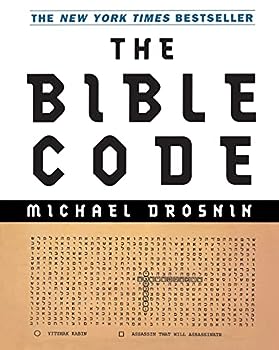
DT: So the book that you’re talking about is by Michael Drozdyn and he wrote I think three Bible Code books and a couple of them were New York Times bestsellers. And so he did, he was basically the popularizer of that whole movement in America and what he did was he wrote this book and explained what the Israeli mathematicians had done but then he took it way farther and he went around and interviewed world leaders like Yasser Arafat or tried to talk to Itzhak Rabin and he would try to warn them of events that were predicted by this Bible code. So the way it works, in the commercial version, and people publish this commercial version of the Bible code, you are locked in to either the Torah or maybe the King James Bible, but you can’t load up War and Peace or any other book, but basically you put in the word to search for. So if Dorothy Higgins in Peoria, Illinois buys this program, she can search for her name in the Torah and chances are you’ll find it. So this gave people this incredible warm feeling, you know, Jehovah knew that I was coming and put me in the Torah.
0:23:41
CW: So, it’s sort of open source. It was kind of out there for anybody who wanted to search for anything.
0:23:51
DT: These commercial programs cost like $200.
0:23:54
CW: But I mean, they were available. It wasn’t just tied to one little university’s research department.
0:24:00
DT: Oh yeah. So Michael Drossin used his version of this program to look for these portentous messages and then he would try to warn world leaders and then he’d write about it in his books. So one of his fabled predictions was Bill Clinton’s re-election in 1996 and he found Bible codes and that one is notable because when he spelled out the word Clinton in the Torah, he started in Genesis and went all the way to Deuteronomy or Numbers, four out of the five books of the Torah and the skip between letters was 33,000. That did happen according to all the Hebrew Hebraic scholars if that would happen then the code would vanish.
0:25:07
CW:God is guiding the hands of the rabbis so if the rabbi makes a mistake
0:25:12
DT: You have to assume that, yeah, And it turns out there’s three other Clintons all inside his Clinton. So his Clinton by the official Bible code rules of minimality was three times invalid. But he didn’t care about that because that’s the one he needed to sell Clinton getting re-elected.
CW: It’s not a long shot. It’s not like he’s predicting which horse is going to win the Kentucky Derby ten years from now.
DT: It’s like the psychics in the tabloids at New Year’s, you know, New Year’s edition. We predict divorce in Hollywood, earthquakes in California, and snow in Alaska.
0:26:16
CW: The re-election of an incumbent president is fairly predictable.
0:26:23
DT: Even with Monica’s scandal. But the other prediction of note was that he found Yitzhak Rabin and he actually did find the only truly minimal occurrence of Yitzhak Rabin who was a prime minister of Israel at the time. And that crossed where the regular Bible was talking about assassins assassinating and the way this Bible code works is if you know the word that you’re finding any any word that crosses over it in any step, that’s that’s related. You know a word from the original Torah that counts so because assassins crossed work where Clinton was flying or not Clinton, but Rabin was flying down. Droznin concluded Rabin is going to be assassinated. I’ve got to warn him. And he sent that letter. He did try to warn Rabin, who of course ignored it. And then Rabin was assassinated. And of course, Droznin tried to take credit, saying I predicted this using the Bible code. It does predict the future. So, and that’s where I came in. I got interested in this and because you couldn’t buy a Bible code program to look at ordinary books, I wrote my own because I’m a computer programmer. I developed a couple versions to look at the Hebrew stuff. I adapted my version to work on the Hebrew Torah so I could look at things. And I got a great bit of help from Brendan McKay, that Australian. He was the main debunker of the original Israeli mathematicians. So what he taught me was a way to speed up the Bible codes like a hundred times. So normally you would look for all the possible sequences that so you consider every letter a possible starting letter and every skip and it would be billions and billions and it would just take forever and in fact the number of possible sequences for a word let’s say you have a 10,000 character text which is less like a chapter of a regular book. So 10,000 characters, so the number of, and let’s say you’re looking for Nazi, four characters, so let’s go Nazis with an S, so we’re looking for five characters. So you take the square of the 10,000, which is 10 to the eighth, 100 million, and then you divide that by four, which is one less than the number of letters, and so that’s 25 million sequences. So in your text of 10,000 characters, there’s 25 million possible equidistant letter sequences for every four-letter word. So that would take just a long time to brute-force search all of those. So McKay said here’s what you do. You get two lists. You find a list. Let’s say we’re looking for Roswell because that’s a great thing to look for in the Bible code because Jehovah didn’t know about that and the green aliens and all that, right? So you make a list of all the R’s and it’s like a vector, so you’d have an array and it might say, well, the first R is at position 23 and the second R is at position 41, and etc. And you have in this text of 10,000 characters, you have 350 R’s and here’s where each one of them is. And then you’d have another array with all the O’s. And so with those two arrays in hand, you take every R and you compare it to every O and that gives you a step and that gives you a huge head start because instead of looking at all the sequences, you’re looking for all the sequences that start out with the first two letters of the word you’re looking for. head start and then you calculate the step for like the third R and the 47th O you calculate that step and calculate where the next letter should be check it if it’s an S which you need to spell Roswell you keep going and if the next one’s a W keep going keep going and if it craps out you just drop that one and move on to the next one. So those two, the big head start and the cutting off of when you crap out speeds up the thing 100 times where you can run it in real time.
0:31:25
CW: So not only did you save $200, you figured out a faster way to do it with McKay.
0:31:30
DT: Oh yeah. So, and in fact in my class, it’s very visual. So I don’t know if it would be that useful to try it on a just an audio podcast but for a visual audience I will call for people to find like one semester Harlem Shake was the big thing that was viral that week so we looked up Harlem and got a bunch of hits for that and looked up Shake and got a bunch of hits for that. In some book of the students choosing, I have several like Alice in Wonderland, Fear and Loathing in Las Vegas, Harry Potter. So we pick a book, find the secret messages, bring them together to where it says Harlem and right next to it, shake. It’s all very visual, but then what I do is I scramble the text. In my little program I wrote, I have a scramble button. You click it, and it takes the text that you have read in, and you’re searching for codes, and it just jumbles it randomly, mixes it up, and then you repeat the search. And odds are that you’ll find whatever pair of words that you were looking for before, you’ll find them again. So if you want to you can scramble your book and then there comes Harlem Shake right back. You can’t make these codes go away. It’s data mining, pure and simple. You’re basically turning the power of the computer loose. I’ve got a great analogy that I often trot out. So when you find one of these Bible codes, when you’re looking in War and Peace or whatever, and you find, if you start at this letter and go every 57 letters and it spells out Roswell, I mean that’s pretty special. That’s like winning the lottery because the odds, all you have to do is the letter frequencies, like what fraction of the letters of the whole text are R and O, and so you just multiply each frequency and what you get is a small probability. And if you have rare letters like J or Q or X, which have small frequencies, that brings your chances way down and makes winning one of those even more like winning the lottery. And if you have long words, like if it’s a certain hardness to find John, it’s going to be not quite twice as hard to find Johnson because it’s three more letters and you have three more numbers smaller than one that you’re multiplying with. So basically, to find any single word in any text, it’s like winning the damn lottery. It’s one in 10 million, one in 15 million, one in 100 million. It’s a long shot. But here’s the trick. What makes the Bible code work is, imagine that you have a really rich uncle that says, oh, David, you enjoy the lottery, do you? Well, here, I bought nine billion lottery tickets for tonight’s drawing. Here they are. Why don’t you hire somebody to go through them and pick out all the winners? You might have five or six Powerball winners where you win millions of dollars.
0:35:14
CW: So that’s like a perfect on both counts, is both an incredible long shot and a sure thing.
0:35:22
DT: And what people don’t realize is the power of the computer to search and especially using this speed up technique that McKay gave me, I mean, you can search the whole text. It’s like getting 9 billion lottery tickets for waiting about 30 seconds on your computer. So you get so many chances to win that, you know, odds are that you’ll… and basically, it’s the number of sequences, the number of letters squared divided by how many letters you’re searching for, which is a huge, huge number times the really small probability of actually spelling out Nazi or Roswell or Robbine or whatever you’re looking for. And if that product is bigger than one, you’ve got a pretty good chance.
0:36:16
CW: Now I feel like if listeners are having trouble visualizing this, I took a look at the visuals that you had in an article you wrote about this. And just imagine a word search, like the standard word searches you got as a kid in high school, except instead of like 10 words by 10 words, it was, as you said, you know, millions and millions and millions of words. And you could, yeah, you could readjust it to any configuration. You could shift it to be, you know, 12 characters high or 15 characters high or 100 characters high. And it would rearrange all the letters in there. And of course, just like those things you see on Facebook nowadays, where it says, the first four words you see will determine how your future year will be. Of course, you’re gonna see some crazy words in there, yeah.
0:37:03
DT: True. It’s very similar to those find the hidden word puzzles. And in fact, I have a different attitude toward those, because you can find words in those puzzles that they didn’t put there, that are not in the list, that they didn’t screen out. So if you get a hankering to find a certain word in a particular hidden word puzzle.
0:37:29
CW: I know I’ve got a memory of finding like naughty adult words in the word searches that we had in junior high.
0:37:35
DT: And they were not put there on purpose, they were put there by data mining.
0:37:40
BR: So David, let me ask you this. So did Drozdyn or any of these other people ever explain why God would bother to hide these messages and these texts that can only be revealed through these complex algorithms?
0:37:54
DT: Yeah. Drozdyn actually claimed to be an atheist or agnostic, and he was just so moved by these powerful messages. So I don’t know how sincere he was. He died a couple years ago.
BR: What was his logic? I mean, it’s one thing to say, look, I’m a believer, I’ve been devout since I was five, and God is revealing this to me because of my passion. But it’s another thing to say, well, the logic behind it escapes me. I mean, if God wants to communicate with us, surely there are easier ways than burying them in every 30,000th letter.
0:38:35
DT: Yeah. Well, let’s just say that there are a lot of religious people that feel the same way. And in fact, the Blue Letter Bible has a lot of commentary, but they’ve looked at the Bible codes and one of their prime objections is, you’re telling me that we need a computer to understand the Bible? It was supposed to be the Word of God, perfect and complete. You’re telling me we need an app for it? Get out of here. So a lot of sincere religious people are no fans of these codes, it does seem to appeal to a certain subset of religious people that want validation. People love science and science proves things and so there are you know several movements where people try to validate the Bible with the science that’s in there. Creationists try to describe the Bible as a scientific framework. You’ve got similar to the Bible codes in the Islamic world you have what’s called code 19 where people are looking for coincidences like the first phrase of the Quran has the name of God, Allah, 19 times. And if you count all the names that God is mentioned in the Quran, it’s a multiple of 19. And so, they have fact after fact, where 19 enters, and there’s too many 19s to be a coincidence, so the Quran was divinely inspired and so I looked up that too. I picked the Declaration of Independence and I picked just the introductory paragraph and I started looking for 19s and I thought let’s just count the number letters in each word and if I have like four words in a row and they have 19 letters I’m going to count that and not only did I find phrases that had 19 letters in a row, guess how many of them were in that first paragraph 19? I think Allah wrote the Declaration of Independence.
0:41:04
CW: There’s also the DNA code searchers. I recall looking for the word of God embedded in our DNA and I just did a quick search here on my phone. Of course, Answers in Genesis has got an article about DNA’s hidden codes and the theory of DNA science. Message from God is a popular YouTube video and other types of fringy attempts at finding the word of God hidden in your nucleus of your cells.
0:41:31
DT: I’ve actually looked at the DNA this guy claims and, yeah, I was not convinced, I actually haven’t published that, but yeah, I did check it out and found a lot more data mining is pretty much all there was.
CW: Oh, it didn’t convince you of God’s supreme existence and desire to communicate with you? No, not on that level.
0:41:52
BR: So one of the things that’s really interesting to me about the Bible code is that it’s sort of this kitchen sink thing, right? There’s, it’s sort of like, you know, if you go to the Roswell Museum, it’s not just about the crash. There’s also people on, you know, with displays on ghosts and psychics and remote viewing and crop circles. It’s this kitchen sink thing. And it’s sort of the same with the Bible code where it’s not just pulling numbers out. It’s pseudoscience, it’s numerology, scripture and fortune telling and all these sorts of angles into it. Can you sort of trace back some of those influences?
0:42:31
DT: Absolutely. Isaac Newton one of the Bible code websites by Rick Sherman is called the Isaac Newton Bible Research Society and and he Actually, you know delved into secret codes in the Bible quite a bit when he wasn’t driving calculus and figuring out gravity. So that’s a tradition that goes back for quite a while. I mentioned how Drozdyn had predicted that Yitzhak Rabin, the Prime Minister of Israel, would be assassinated because he found Rabin’s name next to a place where the regular Bible talked about assassination. And in fact, Rabin was assassinated and Drosnin used that forever after as proof that the Bible code can predict the future. So in my debunking of the Bible code, I was able to find all sorts of secret codes and all sorts of books. I loved it when Drosnin published a new version of the Bible code because Amazon would put a chapter on and I download that chapter and search for secret codes and I think the most elaborate code I found in Drossnin’s own book was a code that spelled out the Bible code is an evil, nasty, silly, stupid hoax. I just went on for a while.
0:43:57
CW: So you were searching for the code, you were searching for code words using the same method in the actual, that’s so meta.
0:44:08
DT: Oh yeah. It was great fun and you know, turnabout is fair play, that kind of stuff. But on the serious side, you know, Drossnin had predicted Rabin’s assassination, so I So I said, I want to predict something, but I didn’t want to predict people getting assassinated. I didn’t want to be a Debbie Downer. And so I started on sporting events and I toyed around with the Super Bowl, didn’t work out that well, and played around with the World Series a little bit. In 1996 or so, I settled on the NBA playoffs and the Chicago Bulls, Michael Jordan was in the Bulls, they were doing pretty well. Months before the playoffs, I found in War and Peace secret codes that linked Chicago and Jordan and the Bulls will win the 98 NBA championship. And lo and behold, three months later, it happened and they did win. And it wasn’t a done deal. Utah Jazz almost took them out. So at any moment, they could have failed, but Tolstoy’s Bulls came through for me. And so since then I’ve been able to say, yeah, it’s data mining. You know, you only get what you look for. If you want to find Roswell, you search for Roswell. If you want to find Yitzhak Rabin, you search for Yitzhak Rabin. You only, you have to decide what to search for. And that’s what makes it so damn subjective.
0:45:58
CW: Now with all this pushing back you were doing with the help of the Australian mathematician Mr. McKay. So did you hear from him? Did he send you a cease and desist letter?
0:46:10
DT: No.
0:46:11
CW: A bag of dog poop on your front door or anything?
0:46:14
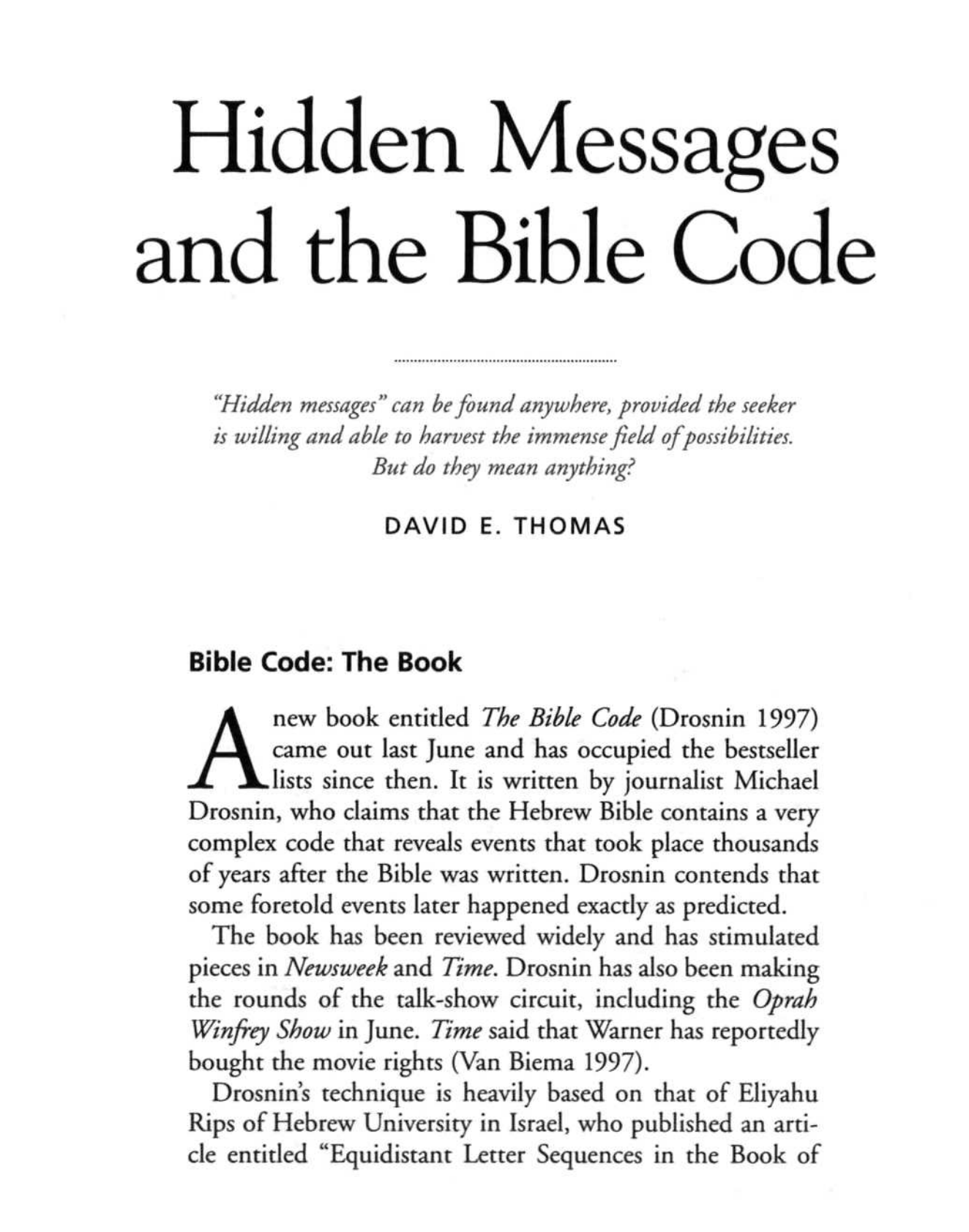
DT: I only heard about him through an interview on CNN. I’m calling it up. I have it. Here it is, Bob Novak in 2002. I don’t have a clip or anything for you, but I can read what was said. So Bob Novak had this CNN show and on December 2, 2002, he was interviewing Drosten and he said, Mr. Drosten, as far as I can see, all the experts, scientists, Judaic scholars think you’re out to lunch on this book. And let me quote one of them now, Dave Thomas. He wrote in 1997, hidden messages can be found anywhere provided you’re willing to invest time and effort to harvest the vast field of probability. What is your response to Dr. Thomas here? And Drozdyn answered, “it’s really silly. In fact, the great scientist who discovered the Bible code, who is the world’s leading expert in group theory, told me just the other day that the evidence for the Bible code is stronger than ever.” And that was it. That was the entire response. I never got a letter from him. And that great scientist that he was talking about is probably Whitston or Rips, is the very same scientist who came up with minimality which Dresden totally violated when he picked a totally invalid Clinton to publish in his book.
0:47:46
BR: And apparently he thought that was a mic drop or something.
0:47:48
DT: eah, oh yeah.
BR: Ooh, got you Dave, take that.
DT: So and in fact I did have a TV debate on a now defunct station called PAX TV and there’s this weird effect where I’d be a guest on the show and the show would get canceled and it happened a couple times.
0:48:09
CW: Oh Ben should we be having him on our show?
0:48:12
DT: Oh no, it’s only TV shows. Oh okay.
0:48:16
CW: Okay, okay.
0:48:18
DT: So but I was on this debate on PAX TV and Lee Strobel, I don’t know if you’ve heard of him, he’s sort of a famous creationist, apologist sort of guy. So he was the moderator and Rick Sherman, who has had this Isaac Newton Bible Code Society website, Rick Sherman was claiming that he had Bible codes that were like 40 characters long, 60 characters long, and remember what I was saying about the longer your word is, the harder it is to actually find a match. So if you could have a good, well-articulated Hebrew sentence that was 60 characters long, I mean, that would be a mic drop right there. That would make the strongest skeptic go, wow, maybe I should reconsider these Bible codes. So that’s what Sherman was claiming. So I took one of his 60 character codes and I took it up to Rabbi Joseph Black up in Albuquerque, New Mexico. He’s a respected Hebraic scholar and I explained it to him and didn’t tell him what the translation was. gave him this passage that Rick Sherman’s Bible translator had translated a big passage about chaos and smell in the sea and Libya and it just went on and on and almost gibberish. So I gave that to Rabbi Black and he actually did recognize a couple of words like chaos was a word he could read and smell, but outside of that there was hardly any correlation between what Rick Sherman’s biblical scholar had come up with and what a legitimate biblical scholar came up with. It was just a bunch of random Hebrew letters and because of the incredible flexibility of Hebrew, every once in a while a few letters came together to spell out like Navy or smell or desert or Libya. And that’s how this Bible code thing works. There was a recent example where a Hebraic scholar was claiming he found COVID-19 right there in the Bible code. And basically, and he said it was so important because it was right there in Leviticus where they were describing rules, what not to eat and don’t eat shellfish and all that. But when you look at what he was doing, he was finding the four Hebrew letters that spell out China. And so that’s not very hard to manage. So what if you found China in Leviticus? That doesn’t prove that COVID was a man-made laboratory disaster or whatever. So that’s pretty much where it’s at. I would like to mention that the people who use Gematria are still out there, and in fact that’s a big chunk of QAnon.
0:51:36
CW: We had Gematria come up on this podcast a while ago when talking about all the people expecting JFK Jr. and JFK to come back from the dead.
0:51:47
DT: Yes. And so there’s this one of the QAnon people, negative 48, and so I actually have a short little clip of negative 48 explaining Gematria as they use it. But it’s a big part of the Bible code because Gematria basically you assign a number to every letter. And so for English Gematria A is number one and B is two and then you can add up things and get all sorts of mysterious messages and I’ve done some of that, but in the traditional Bible code, you can use Gematria to look for years. So, if we were in biblical or Hebrew year 5768, that would be four Hebraic letters that spell out the Gematria equivalent, 5768. You search for that as a Bible code sequence, and that’s how you can figure out that the end of the world is going to be in 2024 or what have you.
0:52:56
CW: It’s so complicated yet so simple.
0:52:58
DT: Yes.
0:52:59
BR: I have to say, Dave, I’m glad that you’re helping us navigate this because I am by no – I’m no one’s idea of a mathematician, so I know some about, you know, the programming and this and that, but it’s great to have an actual expert who can actually generate these sorts of algorithms to explain and walk us through it.
0:53:21
DT: Yeah. So, yeah, basically I wrote my own Bible code and found secret messages everywhere. It’s certainly not the Bible. It’s the technique. It’s a data mining technique. You could do it in the phone book if you wanted. So, speaking about Gematria, it’s a big part of QAnon and theories that JFK is still alive. So here’s a clip talking to a Q proponent, I think his name is negative 48 from QAnon and it’s titled JFK is Jesus Christ. Okay. Tell us about it. What is negative 48?
Recording: Jackson sang about it. A B C E’s use one two three. And so what is gematria exactly? A B C one two three. A being one and Z being 26. So Michael Jackson, was he part of negative 48? No, but he is uh.
You keep saying is. Is he, is he.
He’s alive brother. Michael Jackson’s not dead.
Michael Jackson is alive?
Yes. Absolutely.
OK, let’s bring it. Let’s bring it back back here for a second.
0:54:30
Who do you think? Not dead.
0:54:31
Really?
0:54:32
He was resurrected four days later as Jesus Christ.
0:54:34
Just like wait.
0:54:35
Yeah.
0:54:35
JFK was resurrected as Jesus Christ.
0:54:38
Absolutely.
0:54:39
Absolutely.
0:54:40
And he is your president and Junior is your vice president. As we speak. As we speak right now, JFK senior is president and JFK junior is vice president.
0:54:56
DT: And I wish you could see the puzzled expression on my interviewer’s face.
0:55:02
CW: So that was just a news clip you found on TikTok that interviews that very knowledgeable negative 48. That’s brave of him. Not many people wear their IQ as a badge like that.
0:55:15
DT: Yeah.
0:55:18
CW: Wow, there’s a lot of delusions going on there and rationalizations. Yeah, wow. So Dave, it’s clear that humans like math, and when you involve a computer, you can like math to a whole new level. Do you see this code finding in works of literature and other things. Do you see this ending or just continuing on in recycling and recycling into new forms?
0:55:46
DT: I bet it continues and recycles and continuing but arcane and probably marginally popular ways. It’ll flare up here and there. I don’t think it’s going to be a forest fire that consumes the world, but there may be a few spot fires here and there.
0:56:10
CW: Well, I’m glad there’s people like you who’ve done some serious deep dives into it to sort of spell it out. So, Ben, you’ve often said that skeptics perform a vital service in terms of being a cultural repository for debunking information that just needs to be trotted out every couple of decades or every couple of years.
0:56:29
BR: Yeah, and that’s one reason I thought this was a really interesting case to illustrate to talk about because it’s one where Dave Thomas is uniquely qualified to investigate this. Not that he’s the only one, there’s others as well, but it’s a sort of claim that most journalists are just going to repeat uncritically, you know, Bible code this guy draws in, he did this computer thing, it’s all very impressive. And unless, I mean, I’m sure to a lot of statisticians and other people and many skeptics were like, hold on, there’s also all sorts of red flags here. But certainly, speaking for myself, I wouldn’t have had the knowledge or the wherewithal to even know where to dig into this other than sort of giving commentary about data mining and things like that. So this is why I think this is a great example of the role that skeptics can bring to it. In some ways, it’s a simple case. In other ways, it’s very complex. You’re dealing with Hebrew and algorithms and equidistant spaces and this and that, but it’s just something that a lot of people wouldn’t have even tried to tackle. And so I think it’s great that you guys did.
0:57:40
DT: Yeah, so I’m sort of at the unique intersection of two very different worlds. I’m a computer programmer and most people wouldn’t have the skills to write their own Bible code program. So I had that in my advantage, but then I’m also a skeptic and interested in things like creationism and Bigfoot and whatnot. So I think I was one of the few people that had not just the technical skill, but the motivation to check this out. So I’m glad that people have recognized that I got some good explaining out there. I think my favorite comment was Martin Gardner, who was sort of planning on really digging into the Bible code. And then he said, but Dave Thomas kind of figured it out, so we can move on to other greener paths. That was a high compliment for me.
0:58:39
CW: Yeah, absolutely. And I’m glad you seem to have enjoyed it. Like throughout this conversation, you’ve said things that I cannot fathom saying like, well, so I thought it would be entertaining to do this with war and peace and to write a huge algorithm and to start searching every 30,000th character. These are things that only a small set of people would find very engaging to do.
0:59:03
DT: It helps to have a sense of humor and to look for funny things. Early on, before I’d adapted my book to the Hebrew text, I was still looking at things like the King James Bible, I was able to find in Genesis, in the King James version of Genesis, Darwin was right. So I published that just to interrupt the creationists, well if you think these Bible codes are so special, version has. So one of the most interesting technical things when I was working on the Hebrew version I was trying to match some of these codes that Dresden had and I couldn’t do it and and so McKay said well well I can I said well send me your text I’ll send you mine and so he sent me his Genesis, a computer version of it, and they were slightly different. So then I realized, wow, I can just write a little program to compare Brendan’s Genesis to the one I found, letter by letter, and if there’s a difference call that out and then readjust and keep on looking. And what that did is every single error that either of those transcriptions made showed up like a big red flag. So it’s a general technique if you have you know two copies of a digital text and you want to find where copying errors were made run them against each other and and if they were generated differently chances are the errors in one won’t match the errors in the other and you will find not only the errors in one text, but in both texts as a way to find copying errors. That was pretty neat. It’s one of the benefits of my Bible code research.
1:00:59
CW: Well, I also think that Drozdyn kind of stands out to me as almost a cautionary tale, because he was not a dumb guy. And I don’t know if he fits the standard definition of crank or lunatic or conspiracy nut.
1:01:14
DT: Yeah, Michael Drozdyn was at one time a respected journalist. I believe he wrote a book about Howard Hughes, but then went to the dark side of Gemetria and basically the tea reading tea leaves and casting of bones.
1:01:30
CW: Well, he got hold of this one notion and it sounds like he didn’t have the expertise to ferret out why he was wrong and he didn’t pay attention to the people who did have the expertise and he just latched on to it. Apparently, one of the Times made him a nice little obituary in June of 2020 when he passed away. I’ll quote here, though his Bible code series attracted religious followers as well as a certain fringe element, he didn’t embrace such readers or make a connection with them. He remained the atheist he had been in Hebrew school, firmly believing in the hidden messages but unable to explain how or why they appeared. So he was trying to search for, okay, this is true, he just accepted this is true, and he didn’t necessarily know the meaning behind it, nor did it make him some converted religious believer, but I admire his doggedness, but it’s a real shame that he was just mising that one component.
1:02:54
DT: I think it’s like a Greek traegdy the way it played out. I mean he was traveling the world trying to warn world leaders like Isaac Rabin and really seriously believing all this and that he was in this position where he had to try to change history to avert wars or assassinations. So I think he really did go over the top a little bit.
1:03:15
BR: Well, it’s a good object lesson.
1:03:18
CW: Definitely.
1:03:19
DT: It was a big fall.
1:03:21
CW: Well, Dave, thank you so much for sharing your time with us. And if listeners want to hear more about you or delve into the work that you’ve done, where would you point them to?
1:03:30
DT: I’ve got a website for a science group, nmsr.org. And you can find me on Twitter at SkeptCalJuggler. So it’s skeptical without the I. SkeptCalJuggler is me. And Facebook and whatnot, as Dave Thomas. So I have plans to get a YouTube channel going to debunk some of this flat earth nonsense and other things. So I hope that will be pretty soon.
1:04:05
CW: You’re a busy guy, Dave.
1:04:07
DT: Yes. Oh, and our YouTube channel where we have some, our latest one is a fascinating analysis of that horrible Netflix show, Ancient Armageddon or Apocalypse, the Graham Hancock.
1:04:23
CW: We got a little look at that ourselves. Yeah.
DT: And so on YouTube, look for the NMSR, one word, T-H-E, NMSR.
CW: Yeah. Don’t confuse that with ASMR. You’ll get something completely different.
1:04:36
DT: No, absolutely.
1:04:37
CW: Okay, that was great having Dave join us. I appreciate you bringing in your smart friends, as I’ve told you many times before, Ben.
BR: I like having smart friends. It works out well for everyone.
1:04:55
CW: All right. Well, what do we have on the burner for next episode?
BR: So next time, I thought that we would do sort of a two-parter looking at witchcraft beliefs and magic beliefs in Africa. Of course, we’ve talked previously with Leo Igwe a couple of times on his great work in Nigeria, fighting witchcraft accusations and beliefs. And I’ll tell some of my recent visits to Malawi, where I investigated some witchcraft accusations. And also we’ll talk to Peter Ashe, who’s the head of the organization Under the Same Sun, which promotes for people with albinism, particularly in Sub-Saharan Africa.
1:05:45
CW: Yeah, yeah, there’s some harrowing stories involving both of those. So we look forward to bringing listeners that information and also ways that they can help.
1:05:55
BR: Absolutely.
1:05:56
CW: All right, until next time, everybody, take care.
1:05:58
BR: Bye-bye.
1:05:59
♪♪
1:06:04
We would like to extend heartfelt thanks to our top-tier, sponsor-level patrons. Amy Frusciower Kelly, Dr. Angela Matkey, Elizabeth Leggett, and Laura Ellis. Thank you for your continued support of our podcast. If you’re interested in becoming a sponsor, or just throwing us a buck or two, please visit squaringthestrange on patreon.com and browse our selection of patron rewards. Every bit helps us keep the lights on here, and we are grateful to our generous friends who help us bring you quality content. If you are short on cash and want to just give us moral support, remember to recommend us to a friend, mention us on social media, or give us a review on your favorite podcast dispenser. If you have comments or topics you’d like to see covered, come join our community on the Squaring the Strange podcast discussion group on Facebook. Squaring the Strange is a production of Two Heads Studio LLC, copyright 2021. Theme music provided by Shriek Back, additional music by Memory, Keytard and Feathered, and Pasquale Romero. Additional support by Ashley Romero, Robert Sandin, and Alicia Jarvis. The views and opinions expressed on this podcast are those of Squaring the Strange and do not necessarily reflect the views and opinions of Two Heads Studio, Kronos Creative, Center necessarily reflect the views and opinions of Two Heads Studio, Kronos Creative, Center for Inquiry, our advertisers, or any other affiliated organizations and employers.
