
Episode Summary:
There is a rich field of literary hoaxes to pull from, and for this episode we pulled a few favorites. Ben brings a selection of “misery memoirs,” stories of a victim triumphing over incredible hardships (which, in these examples, are fictional hardships or fictional victims). She Said Yes and Go Ask Alice are two prominent examples of teenage martyrdom that aren’t what they seem. Celestia tells tales of promiscuous bat-people on the moon, a nineteenth-century newspaper hoax, and we break down the cultural factors that contribute to the popularity and believability of any hoax. Ben ends with the heart-wrenching story of a literary version of Munchausen by proxy and the puzzling search for a very popular boy with a harrowing tale of abuse and terminal illnesses, one that moved both Oprah and Mr. Rogers.
0:00:00
Ben Radford: Welcome to Squaring the Strange, the podcast that examines all manner of the mysterious and the mundane through a critical lens. So let’s square the strange.
(MUSIC)
0:00:10
BR: Welcome back to Squaring the Strange. This is Episode 112 and I’m your co-host Ben Radford and with me is…
Celestia Ward: Celestia Ward. And we’re talking about literary hoaxes this time around, right Ben?
0:00:37
BR: Yes, yes. It’s one of my pet interests and always has been.
0:00:56
CW: Well you’re a book nerd and you’re a skeptic so it makes sense that you would like hoaxes that are literary. Now tell me what your definition is of a literary hoax.
0:01:05
BR: Well so there’s, it’s an interesting nuance, right, because you know are we talking about hoaxers that write things down? Are we talking about fabricated tales? It’s mostly the latter in this case. In her book, Telling Tales, Melissa Katsoulis, which is an excellent book on literary hoaxes, by the way, she references a man named, an academic named Brian McHale. He distinguishes three types of literary hoaxes. There’s the first kind, which is the genuine hoax.
0:01:36
CW: The genuine hoax. There’s an oxymoron.
0:01:39
BR: The genuine hoax. It’s a real deal when it comes to hoaxes.
0:01:42
CW: I don’t like those fake hoaxes. They’re just terrible.
0:01:45
BR: No, no, no, exactly. So these, the genuine hoaxes are deceitful literary writings that were never intended to be exposed. That is, you know, somebody intended to manipulate and deceive and be dishonest, presenting something knowing full well that it was not what it was presented to be, and they tried to hide that fact.
0:02:11
CW: So intentional.
0:02:12
BR: Exactly. So examples would include the Hitler Diaries, the Jack the Ripper Diaries. Yeah, of course, Jack the Ripper was the serial killer in 1888 London that stalked women, primarily prostitutes, in Whitechapel. And of course, his identity, his or her, but probably his identity remains unknown.
0:02:37
CW: That would make it hard to leave behind a memoir.
0:02:40
BR: You would think, yes, you would think. And yet, in 1993, Warner Books bought the rights to publish a diary that was said to have been kept by the infamous killer. And this was a Liverpool merchant by the name of James Maybrick, who in this alleged diary confessed to his double life as the infamous Ripper. And they’re all ready to go and Warner Books is all excited about having done this. And then someone’s like, are you sure? Are you sure this is legit. And the forensic analysis turned out that it was in fact a hoax. It was actually a memoir dating back to the 1920s. So it was an old hoax, but a hoax nonetheless.
0:03:26
CW: Oh, okay. So they planned way ahead, I guess.
0:03:30
BR: There you go. So in many of these sort of genuine hoaxes, they’re often written by a failed author who didn’t get the success they really wanted. So in many of the so-called genuine hoaxes, they’re written by people who have published, you know, books and stories and things like that elsewhere, and just never quite got the attention they wanted. And so they said, hey, if I write as Howard Hughes or Jack the Ripper or Hitler, then maybe this can be best seller.
0:04:05
CW: You know, there have been a couple of movies and books about that sort of thing happening and it’s not, they almost cast the protagonist as some author who just, you know, needs a break and by writing as somebody else, they get this big break and their genius is finally recognized even though it’s under the name of somebody else.
0:04:23
BR: Right. So, that sometimes happens, but again, keep in mind that in these cases, the actual author is hidden. This is not the case with the second kind of hoax that Mikhail talks about. These are entrapment hoaxes. Can you guess what that is?
0:04:37
CW: Entrapment hoaxes. I’m assuming they reel somebody in with a story and then it ends up being an entire lie?
0:04:45
BR: Pretty close. These are usually written to entrap a publisher or maybe a professional rival or an expert or the literary community, for example, into publishing and legitimizing a fake, often with the idea that it will then be exposed and, ha ha, I’m the true author. How silly of you to have fallen for this.
0:05:08
CW: Oh, I’m thinking of like the Sokal hoax and the Morgenson thing with Peter Boghossian. Yeah, okay. So yeah, sometimes those are legitimately beneficial in exposing a like, if you could really consider the Alpha Project by James Randi and entrapment hoax. Well, it wasn’t literary, but the Alpha Project was when James Randi sent in a couple of well-trained teenagers. I think they were teenagers at the time. One of them was Banachek. I forget the name of the other fellow, but they infiltrated an experiment looking for actual psi activity in the 19… Was it the 1980s or the 1970s?
0:05:45
BR: I should know that. I think it was the 80s.
0:05:48
CW: Okay, late 70s or early 80s. And they were under instructions to, if they were revealed, caught doing a trick, they were to announce that they were not psychic at all. They didn’t have any ESP powers or telekinesis. They were there as part of a project by James Randi, but none of the researchers ever questioned their abilities. They just assumed everything they viewed was supernatural or paranormal and not a magician’s trick.
0:06:14
BR: And that’s actually a really good parallel to the entrapment hoaxes, because oftentimes in these hoaxes, the person writing the hoax and sort of carefully crafting it, they will intentionally leave little clues in the text that to them it should be an obvious tip-off. Well, if they had only read more closely, they would realize that, you know, the end notes, you know, one through five spell out, you know, fraud or something.
0:06:39
CW: I’ve seen an essay that spelled out the first word of every line spelled out, never going to let you down, never going to give you up, you know, it was a rick roll.
0:06:52
BR: A rick roll entrapment hoax. So for those who don’t know, do you want to briefly explain the Sokal hoax?
0:06:59
CW: You know, I’m not as well versed at the Sokal hoax as you are. It has something to do with postmodern academia and whether or not various cultural studies journals actually read their submissions.
0:07:12
BR: Yeah, in a nutshell, the Sokal hoax, and we’re not going to get too deep into it, but it was done by a man named Alan Sokal, and in 1996, he published, well, gibberish, just frankly gibberish in an otherwise respected cultural studies journal called Social Text. He was intentionally written to be literally incomprehensible. And he got it published because Sokal was a well-known academic. And it caused a lot of red faces when he said, yeah, that thing you published, I appreciate it, but it makes no sense, and I defy you to tell me what it means.
0:07:55
CW: Well, as somebody who worked in a very underfunded academic editorial department. I hope that led to a universal increase in editorial budgets everywhere.
0:08:07
BR: Yeah, I’m sure it did. It actually created a huge firestorm with critics on both sides arguing that the other ones were right. Again, it’s far too much. It’s far too complicated a story, but that’s essentially the story of the Sokal hoax.
CW: Okay, so we’re not going into a deep dive with either of those.
BR: Not on that.
CW: What’s the third type of hoax you got for us?
0:08:32
BR: The third type of hoax that Mikhail describes is what he calls a mock hoax.
CW: A mock hoax this is like the opposite of a genuine hoax?
BR: Well, this is where an experimental writer will adopt a fake persona sort of in a meta way trying to challenge the idea of authorship.
0:08:52
CW: Like method acting?
0:08:53
BR: Well, it’s been sort of described as maybe a version of like literary ventriloquism. And there’s lots of examples. One actually one that’s these days would actually probably be called cultural appropriation.
0:09:06
CW: That could be dicey if you decide your alter-ego is, oh, I don’t know, a Native American or somebody with a cultural marginalization that you yourself don’t have.
0:09:21
BR: Exactly. So, there’s lots of cases that we’ll be talking about, some of them on the podcast, and in fact, this happens even when the story is clearly fictional. In fact, currently, as we’re recording this, there is a brouhaha, if you will. Brouhaha!
0:09:37
CW: I love that word.
BR: Thank you. Regarding the novel American Dirt by Janine Cummins, which has been criticized for telling the stories of Mexican immigrants, even though the author is white.
0:09:48
CW: I remember hearing something about that. Yes, there’s there is an uproar about that.
0:09:53
BR: In fact, the book tour was canceled just in the past few days. So as as we’re discussing this, this is the perils and paradigms of cultural appropriation, even in a fictional story. Again, this is a novel and I haven’t read it. I’m not recommending or not recommending it. Oprah recommended it, by the way.
0:10:12
CW: Well, that’s ironic. We’ll get into that later. Yeah.
0:10:14
BR: Oh, yes. Oprah’s name will recur many times in this podcast, as you’ll see.
0:10:19
CW: Okay. Well, that’s so literary hoaxing is kind of all around us even right now. And there’s got to be some other, there’s other examples I can think of, of the mock hoax. Like, have you read the Lemony Snicket books?
0:10:36
BR: I have not read them, I know of them.
0:10:38
CW: Yes, Lemony Snicket is the author, but he’s not really the author. It’s just a clever little ventriloquism act as you-
0:10:44
BR: Lemony’s a fake name, really?
0:10:47
CW: Yeah, Lemony Snicket is actually not a real dude. I don’t even know the real author’s name, but I’ve read all the books. They’re very funny.
0:10:54
BR: You could almost call it a pseudonym.
0:10:56
CW: Exactly, but there’s a personality involved too. It’s kind of like a, you just have to read them. I highly recommend A Series of Unfortunate Events. I mean, they got very popular about 10 years ago and they’re still worth a read. They’re very fun.
0:11:10
BR: I actually have an anti-8-ball that’s branded a series of unfortunate events. There was a film based on one of the books that came out, I don’t know, 10-12 years ago. And as you know, I sometimes do film reviews. As a studio gift promotion piece, I got an awesome 8-ball and it’s just, all the fortunes are just horrible. There’s no upside to this.
CW: That’s on brand.
0:11:39
The Cursed 8-Ball. Anyway, yeah, but I mean, you know, but again, it’s interesting. So the questions come up in cases where people are describing things that actually happened. How much license do we give them, right? Because in most of these cases, not all of them, but many of the cases, the fake fiction are memoirs.
0:11:58
CW: Yeah, memoirs are usually taken to be true, but where’s that point of embellishment or just remembering things a little bit more dramatically? Where does that cross the line into fakery?
0:12:10
BR: Right. And if you think about it, faking nonfiction is somewhat more difficult, right? Because if it’s nonfiction, then there’s external objective facts that people can look up or Google that are, that depending on what the subject is, of course, can be easy to verify.
0:12:29
CW: Yeah, there’s the old saying, do you have the receipts?
0:12:33
BR: Exactly. And in a lot of these cases that we’re going to be talking about, they quickly resort to the greater truth argument, right? They say, well, yes, you busted me. Yes, my memoir isn’t true or is largely not true. However, they say, well, I’m telling a larger story. Yet, maybe I made a couple of things up. Maybe I didn’t really, this didn’t really happen to me. But the bigger truth is that, you know, bad things happen to me or bad things happen to some people.
0:13:05
CW: Yeah, a lot of really, yeah, the road to hell is paved with a greater story.
BR: Exactly.
CW: It’s paved with the greater truth. Yeah. I, yeah, I’m not a fan of that excuse. It’s a real… Oh, I got caught lying. Well, yes, but somebody experienced this thing.
0:13:25
BR: Right. Doesn’t matter that if I didn’t, you know, that’s, you know, it’s like, no, no, hold on here. You, you said it happened to you.
0:13:37
CW: Yeah, yeah.
0:13:39
BR: You know, and in a lot of cases, and we’ll be talking about this later, a lot of cases are what they call misery memoir or misery lit. These are sort of themes of survival. So it’s somebody went through a harrowing abusive experience. It’s physical abuse, sexual abuse, substance abuse, oppression, depression, prosaic nation type stories, what have you. And this makes compelling reading for a lot of people, which is fine. But again, things get fuzzier when the person that’s writing this as their supposedly true personal experience makes things up or changes things around.
0:14:14
CW: Oh, yeah, that gets on the verge of falsely reporting a crime. It certainly can.
0:14:20
BR: It’s fuzzy, right? Because look, we all know, or we all should know, that memory is fallible. That’s a running theme in this podcast. It is. I’m not sure.
0:14:31
CW: I don’t really remember us ever mentioning that, Ben. Well, for our new listeners, this is a running theme.
0:14:38
BR: But seriously, I mean, right? In personal experience, as described by Elizabeth Loftus and Carol Tavares and many psychologists, we don’t remember things perfectly, we don’t see things perfectly, our witnesses can be mistaken. All that’s granted, but right. So no one is demanding absolute 100% perfection, remembering exact dialogue verbatim from some conversation somebody had 20 years ago. So no one’s expecting that level. At the same time, there has to be some assumption that what you’re being told is at least mostly true.
0:15:20
CW: So we’ve gone over the different, the three types you mentioned of literary hoaxes and there are quite, I mean, many are springing, I didn’t even consider these hoaxes, but a bunch of them are springing to mind now. And I’m sure listeners probably have a bunch of pet ones. We’re not going to get to cover all of those in the next 55 minutes. But I wanted to take a moment and invite listeners to a brand new thing, a little bit of housekeeping, kind of 15 minutes in here. We have a new Squaring the Strange podcast discussion group. And we wanted to thank one of our listeners, Alpha Juliet, who created the podcast discussion group and asked us if we’d be okay with that. And of course, we’re very okay with that. You can find it just by searching for Squaring the Strange Podcast Discussion Group. It’s a community. There’s already a handful of people on there now, and you can join. And you should be able to join with just a click, especially if you’re friends with anybody who’s already on there. And if it doesn’t let you on, just ask, and we’ll let you in, you know, unless we have solid evidence that you’re a real jerk or something.
0:16:24
BR: Which, by the way, we are investigators, so we will find this out, just FYI.
0:16:30
CW: Yes, no robots allowed either.
0:16:32
BR: But yes, I mean, you know, when I was researching this, it’s really an embarrassment of riches. I mean, there are so many examples and they’re so fascinating, at least to me, so we could do hours and hours of this, but out of deference to our listeners and to your editing abilities. We’re just going to hit on a couple highlights in this episode, and I suspect we’ll probably return to the topic at a future time.
0:17:00
CW: Yeah, so this is a tentative Part 1. If there’s any literary hoaxes that you want to see us dive into in more depth in a future episode, not necessarily the next episode that comes out, but down the road, who knows, we might revisit this in six months or something. Give us a heads up on the discussion group on Facebook and tell us what your favorites would be.
0:17:20
BR: Yes.
0:17:21
CW: But in the meantime, Ben, I’m sure you have quite a few examples to pull out of your drawers and regale us with.
0:17:27
BR: Yes. As I mentioned, one of the most common and frankly, the most interesting examples are, as I described, a misery memoir, misery lit. And there’s interesting, I keep saying the word interesting, but it’s interesting, what do you want me to tell you? Right, so there are times in which a hoax becomes a literary hoax when it’s written down. So one example off the top of my head is Alicia Estevez-Head who claimed to have survived 9-11. She claimed that she was in one of the Twin Towers.
0:18:00
CW: Oh.
0:18:01
BR: And she got involved in the 9-11 survivors groups. And there’s actually a really interesting documentary about her called The Woman Who Wasn’t There.
0:18:11
CW: Oh, I think I’ve seen that. I mean, I’ve seen mention of it. I haven’t watched it yet, but it’s on my list.
0:18:16
BR: Yes, a really interesting doc. It’s a short doc. I think it’s maybe an hour and change. I won’t give away the whole story. It’s a really interesting story. But as it turns out, she wasn’t in New York on 9-11. In fact, she was in her home city of Barcelona, Spain.
0:18:32
CW: Oh, that’s a ways away.
0:18:34
BR: So again, that’s, you know, she committed a hoax. It wasn’t necessarily a literary hoax per se until she began writing about her accounts, which she did.
CW: I’ve heard that some people claim they were part of some mass tragedy because they sort of enjoy the camaraderie of shared experiences and like even go to the group therapy sessions and whatnot. and whatnot, and even though they didn’t have anything to do with it, they just wanted to sort of enmesh themselves in the victim halo.
0:19:19
BR: Yeah, absolutely. It actually reminds me a lot of the cases of Munchausen’s by proxy. Yeah. In which, you know, a parent, usually a mother, will have a sick child who, in many cases, they’re making sick or exaggerating it, and it’s because they want the attention. They want, you know, they’re the hero. They’re the wonderful Martyr mother that is taking care of their sick child and you know they’re on TV and they’re taking care of them and they just they get so much appreciation adoration and gifts. It’s it’s hard for them to back out of their story.
0:19:51
CW: That’s that’s particularly tragic because you have a young person, a child suffering as a result of this rather than just people buying books that aren’t true There’s actually a real human toll.
0:20:03
BR: Absolutely, and we should do a show on that actually.
0:20:05
CW: Yeah, well, and I’m also thinking of the lady who, I can’t think of her name, but you recall that just was in the news, again, there’s literary hoaxing all around us all the time. The woman who claimed to have cancer and have cured her cancer with a regimen. Bill Gibson, yes. Natural eating, and then she sold her book about it, and yeah, that became literary once she wrote it all down and started selling her memoirs.
0:20:29
BR: That’s right, yeah. Belle Gibson, yeah, she was just in the news again recently. Again, another great topic for a show.
0:20:35
CW: Oh, that’s right, yeah. She was in the news because she claimed she couldn’t pay all the fines and the judgments against her and so they raided her house and took like gobs of valuable things away.
0:20:49
BR: Wah wah.
0:20:50
CW: Aw, it’s such a shame you can’t afford to pay your bills and you’ve got like hundreds of thousands of dollars worth of stuff in your house.
0:20:57
BR: Well, to be fair, they are Australian dollars.
0:21:00
CW: Oh, okay, yeah.
0:21:01
BR: So, but no, there’s all sorts of different ones. I’m just going to sort of give a couple quick examples, then I’m going to go into a deeper dive on one particular one that I helped expose almost 20 years ago, actually. Just to name a few off, there’s one that we actually talked about a couple of episodes back, titled Satan’s Underground. And this was by a woman named Lauren Stratford. And she was one of the people that was hyping the satanic panic in the 1980s, and she wrote a so-called true account of her time in the satanic cult. There’s also the case of a fabulist, if you will, who won a Nobel Peace Prize.
0:21:40
CW: A fabulist, I like that word. There’s a T on the end, it’s not just fabulous, it’s fabulist.
0:21:45
BR: Yes, this is a woman named Rigoberta Menchu and she wrote a memoir titled I, Rigoberta Menchu, an Indian woman in Guatemala. Again she was actually the winner of the 1993 Nobel Peace Prize for her work, bringing attention to the plight of Guatemalan women throughout Latin America, but primarily in that region. And it later turned out that some, if not much, of her account was probably fictional. Again, you quickly get into arguments and counter arguments, people saying, OK, well, it’s just a couple of details. And other people saying, no, it’s a lot more than that.
0:22:27
CW: How badly if you know how badly was her hoax exposed and did they take back the peace prize?
0:22:34
BR: They did not take back the peace prize. So basically what happened is so just real quickly, it was a 1984 memoir and it was the Guatemalan rights activist. And she described her struggle as a poor, uneducated, oppressed Indian woman. And she became an international spokeswoman for the rights of indigenous people, which is great. I’m, I support indigenous people, particularly throughout Latin America. That’s, that’s sort of my stomping ground. Anyway, Menchu was given honorary doctorates and, and her book, I, Ruga Berta Menchu has been sort of a staple of required reading in a lot of universities as a true first-hand account of Native women’s and Native Indian struggles in Guatemala. But later on, a researcher by the name of David Stoll dug into her claims and found that there were inaccuracies. And she later admitted that there were inaccuracies, but she blamed the translator, which pissed off the translator.
CW: I’d imagine.
BR: He said, no, that’s not a mistranslation. That’s not what she told me. Anyway, it’s a complex story and there’s vehement academics on both sides of the story, but that’s in a nutshell, that’s the story. As of today, it’s widely recognized that at least some, if not much of her book is fictional, despite it being portrayed as a true story. Now, that doesn’t mean that she doesn’t deserve the Peace Prize, but it is what it is.
0:24:05
CW: I can see how that’s kind of a complex matter, because if you have a book that’s doing a lot of good, but it’s not true, I mean, why ruin it with the truth, right?
0:24:13
BR: Right. And so there again, there’s lots of examples. I’ll just give two quick ones. And again, these are all sort of in the same genre, as you’ll see. One that comes to mind is a book that emerged after the Columbine shootings in April 1999, the horrible case in which the two shooters went in there and they shot up the school.
0:24:35
CW: Yeah, we all remember Columbine, yeah.
0:24:37
BR: Yes, Columbine. One of the stories that emerged, a sort of silver lining, if you will, much in the way that Rigoberta Munch’s memoir is the silver lining, you know, sort of talking about overcoming oppression and being exalted. One of the silver linings of Columbine was a woman named Cassie Bernal. Bernal was a young woman who gained posthumous fame when a friend claimed that she affirmed her belief in God when the shooters threatened her, and she was killed for it.
0:25:07
CW: I think I remember this, yeah.
0:25:09
BR: Yeah, the story goes that the two killers, when they were going on the rampage, I think it was the library, had pointed a gun at this young woman and said, do you believe in God? And she said yes. And they shot her in the head dead just just to be cruel and defiant and horrible.
0:25:28
CW: Now I remember that circulating in the atheist communities because it was it was debunked as a sort of propaganda to make the killers look like they were atheists who hated religion so much they wanted to kill Christians specifically.
0:25:42
BR: Yeah, it was definitely framed as godless, heathen, atheist, Satanists versus the righteous young girl. But again, keep in mind that Cassie Bernal died in the shootings and so she wasn’t there to speak for herself. So she was a real victim. In this case, it was her mother, Misty, that wrote a book titled, She Said Yes, The Unlikely Martyrdom of Cassie Bernal. As all these memoirs do, they told this story arc, this journey from a troubled youth obsessed with death, rock, and vampires to a good, upstanding Christian woman. And it had all the hallmarks of a good Jesus redemption story. You know, the lost child who found her path in Jesus, only to be killed for defending her faith at Satan’s thugs. And again, it was…
0:26:37
CW: And it wasn’t true.
0:26:38
BR: Right. So, it made a whole bunch of… Of course, it was an inspiring story, and it was featured on Robert Shuler’s Sunday television show, The Evangelist. They gave interviews all over the place. But there were questions about whether it actually happened. As it turned out, investigators later determined that there was a woman that had been confronted by the killers and who had a gun pointed at her and asked if she believed in God, but it wasn’t Cassie Bernal. It was another woman named Valine Schnur. And the shooter asked Schnur if she believed in God, and she said yes, and the gunman spared her.
0:27:15
CW: Oh, so the narrative was completely opposite of, at least from the point of view of the killer. He wasn’t going around, or whichever killer it was, I don’t know if it was Eric or Dylan, they weren’t hunting Christians.
0:27:29
BR: Right, yeah. So, I mean, the true story of what actually happened is basically the polar opposite of what was claimed. So instead of Bernal dying for affirming her faith, Schnur lived by affirming hers. So no part of that story is true, really.
0:27:47
CW: Yeah.
0:27:48
BR: Questions about the veracity of Misty Bernal’s account of her daughter were raised before the book’s publication. I think the publisher was Plough, a small Christian publishing house. But they didn’t want to hear it. They went ahead anyway, and it became a New York Times bestseller.
0:28:07
CW: Yeah, we could really do a series of episodes on specifically Christian literary hoaxes. I mean, all the kids who have gone to heaven and seen Jesus and, yeah, you name it.
0:28:18
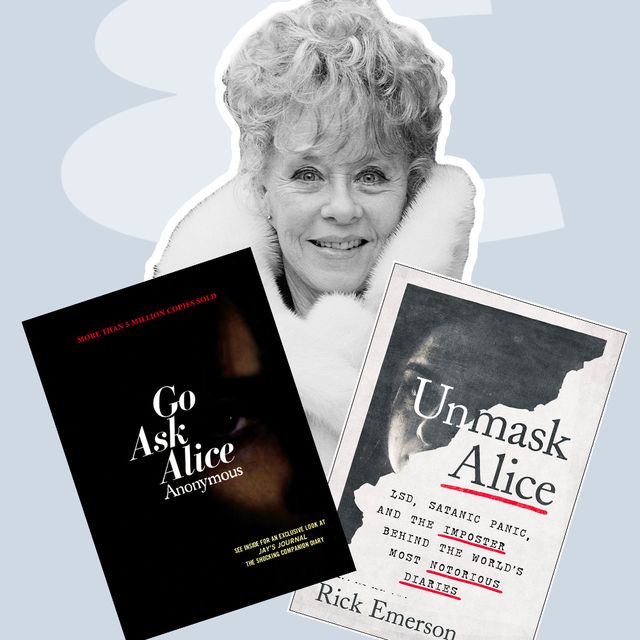
BR: Well, and there’s a second one, which is probably better known than She Said Yes, and that is Go Ask Alice.
0:28:26
CW: I’ve heard of that. There’s a song by that name, too.
0:28:29
BR: There is. So this is a wildly popular 1971 book. And there are lots of parallels with She Said Yes in the Cassia Bernal story. It was allegedly the true diary of an innocent young middle class girl whose life descended into debauchery and drug use. I actually have it right here in front of me, it’s titled Go Ask Alice by Anonymous, a real diary, it says on the cover, and more than four million copies sold, although I’m sure that’s wildly out of date.
0:28:58
CW: I seem to remember it was required reading in my high school. I actually don’t think I read it, but I think for some of the English classes, a lot of my friends had to read it.
0:29:08
BR: Well, here’s what the back cover says. It says, Go Ask Alice is the harrowing true story of a teenager’s descent into the seductive world of drugs. A diary so honest you may think you know Alice or someone like her. Read her diary. Enter her world. You’ll never be able to forget Alice.
0:29:27
CW: Okay.
0:29:28
BR: Yes, very dramatic. The New York Times Book Review called it an extraordinary work, a document of horrifying reality and in its 171 pages, it covers all sorts of shocking depravity. It’s got child abuse, prostitution, rape, lots of drug use, pills, marijuana, heroin. It’s just the circus of depravity. And again, it’s this story of lost innocence and evil predation. And a big part of it is, of course, the dangers of peer pressure. It’s not until the very end of the book that we find out it says, quote, the subject of this book died three weeks after her decision not to keep another diary. So again, it is presented, the cover says a real diary. There’s no question that’s what that’s how it’s being marketed. It is, as I’m sure you’ve guessed, a complete fabrication, and it’s a total hoax.
CW: Was this written by a committee from the DARE program? This book?
0:30:27
BR: Close. Very close. Go Ask Alex is not anyone’s true story. In fact, it was written by a middle-aged Mormon woman.
0:30:37
CW: Oh, they know a lot about drug use, those Mormon women. They party.
0:30:41
BR: Yes. Named Beatrice Sparks. As Melissa Katsoulis, who I mentioned before in her book, Telling Tales, she described her as, quote, a respected member of the Mormon community who felt it was her duty to warn young people off the dangers of un-Osmond-like behavior.
0:30:58
CW: Un-Osmond-like.
0:31:00
BR: Yes. And Katsilis goes on to say, quote, if the book was meant to warn children off the dangers of drugs and underage sex, as it turns out it was, the author ought perhaps to have made the narrative a little less extreme and the bizarre symptoms of the drugs a little more believable.
CW: Oh, is this like one hit of the marijuanas and you go crazy?
0:31:22
BR: That’s right. That’s right. We got we got we the devil’s weed from the 1950s PSA’s, right?
0:31:30
CW: So like a good Mormon She didn’t really know how drugs work or what happens and so the the the literary work suffered as a result.
BR: Right.
CW: Write what you know, people write what you know.
BR: So she was just going wild with her fantasies or or whatever the hell they were about just how wild and depraved she assumed that teenagers were doing at the time. And a lot of people don’t know that this Mormon middle aged woman, housewife I believe, wrote Go Ask Alice because again it’s universally claimed to be a true story, but in fact she went on to write a whole bunch of other books that were similar fake teenage diaries.
CW: Go Ask Phyllis, Go Ask Beatrice, Go Ask Julia.
BR: And if you go ask them, they will tell you about teenage pregnancy, satanic cults, devil worship, all the normal things that teenagers encounter at their high school.
0:32:34
CW: Oh, wow. You know, now I’m kind of sad that I never had to read Go Ask Alice. I might have to go check that out. I was one of those kids that got stuck in all the upper level classes with like the not at risk youth. We were all like training for the academic bowl and everything. So we kind of skipped a lot and just went into the higher level stuff. And I think the Go Ask Alice book was required reading for anybody that they deemed at risk at my school.
0:33:03
BR: Well, again, as with a lot of these cases, there’s a moral to them. They’re hoping you’re gonna be scared straight. I suspect that Go Ask Alice, as riveting and as influential as it’s claimed to be, probably didn’t scare anybody straight. It was more of a salacious, ooh, did you see this raunchy sexy on page 13 written by a Mormon mom?
0:33:27
CW: We should get high and go read that.
0:33:31
BR: Probably only slightly better than Twilight.
0:33:34
CW: Well jumping right from crazy Mormon middle-aged woman fantasies of sexy teenagers.
BR: There’s a transition for you.
CW: Would you like to hear about the Great Moon Hoax of 1835?
BR: You had me at moon hoax.
CW: Yes, and it has nothing to do with Stanley Kubrick. This is not anything about the moon landing. The Great Moon Hoax has always been kind of a favorite of mine. And when you said we were doing literary hoaxes, I called dibs on the Great Moon Hoax of 1835. Now sit back kids, this is going to be a long one. The Great Moon Hoax is really, it’s kind of a hoax within a hoax, and it’s a very influential hoax. There’s some streams of this whole life on the moon notion that comes from this hoax or certainly reflected in it, in just about everything from Jules Verne’s From the Earth to the Moon, which was published about 30 years after the hoax. Then you got the 1902 sci-fi film by George Mellier, A Trip to the Moon. I think everybody has seen that little, the rocket ship gets right in the eyeball of the man in the moon. Everybody knows that.
BR: Oh, right. Yeah, it looks like a bullet.
CW: Yeah. And even a 1948 Tex Avery cartoon, The Cat That Hated People. Do you remember that one?
0:34:51
BR: I don’t, but that describes most cats that I’ve encountered.
0:34:55
CW: This cat hates people so much that he takes a rocket ship to the moon, but there’s crazy alien bat people there that are even worse than the people in New York City, so he takes a rocket ship right back. And there is a children’s book about the Great Moon hoax published back in 1973. And I also have a strong feeling that the weekly world news staple Bat Boy can also trace his parentage to this particular hoax. More on that subject later. Now, the hoax occurred in August of 1835, and it was printed in a series of articles published in the New York Sun. Instead of the clickbaity, but then dot, dot, dot. The Hoax series was introduced in a much more 19th century way. I’ll read you the opening paragraph here of the first installment. “We this morning commenced the publication of a series of extracts from the new supplement to the Edinburgh Journal of Science, which have been politely furnished us by a medical gentleman immediately from Scotland in consequence of a paragraph which appeared on Friday last from the Edinburgh Courant the portion which we published today is introductory to celestial discoveries of higher and more universal interest than any in science yet known to the human race.” Doesn’t that just get your blood pumping?
BR: Oh, I can’t Wow That fills me with Vim and Moxie!
CW: There were a couple of ways that you probably noticed that the paper was claiming authority that it didn’t really have. First it said that it was reprinted from the Edinburgh Courant. Second, in the installments, the author claimed that these were discoveries made by John Herschel, who was at the time one of the most famous astronomers, and he was the son of William Herschel, who had invented a couple new types of telescopes and he discovered Uranus not too long before, and John Herschel, the younger, was also the nephew of astronomer Carolyn Herschel. The Herschels were all big into the stars. So you’ve got the pedigree right there. Pedigree, yes. The author of the series was a Dr. Andrew Grant, the supposed traveling companion to Herschel, who was writing down these new discoveries as Herschel made them. Spoiler alert, no such person existed. John Herschel, however, was a real figure, but his lackey Dr. Grant was a complete invention by whoever wrote the hoax. Now, the series titillated readers with tales of newly discovered life on the moon, viewed through a brand new telescope. The story arc, I’m going to go through kind of how they laid out the story arc because I think it’s actually quite nicely done.
0:37:43
BR: They put some work in it, good for them.
0:37:46
CW: Now the first installment mainly described quite expertly a new huge type of telescope that Herschel had developed and his plan to use it to examine the moon while he was in Africa. Now he really was in Africa at the Cape of Good Hope to do some other things. He had some cataloging of stars to do down there, and he was on the lookout for the return of Halley’s Comet. And so, as we have discussed before, it’s easier to push a hoax through if you’re also attaching some real facts to it. And those were real facts. Now, this brand new, incredible, powerful telescope was 24 feet across. That’s larger than the Hubble. And it contained a new feature, a, quote, hydro-oxygen microscope.
0:38:31
BR: A hydro-oxygen microscope?
0:38:34
CW: Doesn’t that sound like some type of bull-sh-t tech that you could find on some fake thing that Goop is selling you?
BR: No, no, no, no, no, no, no, no. That reminds me of something that when I was 17 or 18 and I was reading The Amazing Spider-Man, which, by the way, was the best comic of the ones at the time.
CW: Okay.
BR: You would turn towards the end and there would be there would be one of those full-page ads all you know x-ray specs You know your your own you know junior uranium kit things like that.
0:39:04
CW: Ah yes.
BR: That that’s where that would be found.
0:39:07
CW: Believe it or not. This is very timely because microscopes had just entered the scene. So this played into two things that in the public’s mind was new and exciting tools. You got telescopes, and you have the really new invention of the microscope. And wow, somebody put them together, that’s amazing.
0:39:31
BR: What could be better than, you know, just combine the two, right? We have a telescope, microscope, and everything looks exactly the same.
0:39:38
CW: So this Dr. Grant fellow said that the new telescope, microscope combo could be used to examine, quote, “‘Even the entomology of the moon in case she contained insects upon her surface.’” Anyway, the whole first installment was just talking about the tech and how wonderful the discoveries were going to be. And now you can see the draw to this. I mean, think about nowadays. I mean, it gets people get science nerds like us get really excited about new telescopes and new larger telescopes and what they might reveal the Hubble in the 1990s. I remember the excitement over that. The James Webb Space Telescope more recently. I mean, we’re excited about seeing the new different star systems, the galaxies, Earth like planets. But this was back in the early days. They hadn’t discovered all the planets in the solar system yet. The public was primed to expect new astronomical developments, and so they were very curious to know more about the moon and what this brand-new telescope could possibly reveal.
0:40:41
BR: Yeah, and that’s always fascinating to me is, you know, we look at some of these stories and these rumors and accounts that circulated. And it’s always fascinating to remember the context in which they emerged. Very different than today’s world.
0:40:56
CW: Yeah, yeah, and another thing about that time was, I think something you mentioned recently about the exotic nature of other lands and how people had no idea what kind of animals there were on the African savanna or in the Himalayas or somewhere. So they were expecting crazy things could be just anywhere you hear all these stories about what what is out there what’s on the moon what did Herschel find which was described in the next few installments of this literary hoax what do you think Herschel found up there?
0:41:28
BR: Chupacabras?
0:41:29
CW: Pretty close I think it would be easier to answer the question of what Herschel didn’t find. There was a whole menagerie of animals. There was a dwarf bison, kind of like American buffalo, but like smaller. There were some unicorn goats that were a shade of blue.
BR: Of course there were. \And Frank Oz used them in his books, right?
CW: You’ll like this one. There is a spherical amphibious creature that rolled around on the beach, kind of like the thing in The Prisoner.
0:42:03
BR: Awesome. I like it already. See, had I been reading this, I’d be like, yeah, that is awesome. I wouldn’t be skeptical. I’d be like, yeah, I want drawings of this.
0:42:15
CW: Well, it comes with the imprimatur of John Herschel and his amazing new telescope. I mean, why would you be skeptical?
BR: Obviously.
CW: There were also, as revealed in the first couple installments, large beavers that stood on two legs. Now this is exciting because it was signs of intelligent life, because these beavers, they also had no tails.
BR: The large beavers, the point they’re walking on two legs, that’s the kicker, that’s what makes them intelligent.
0:42:39
CW: Oh no, no, they also, they didn’t have any tails, these beavers, and they were seen carrying their young around in their arms like people do, and they were building huts that had cooking fires, and here’s a quote, they were also, quote, constructed better and higher than those of many tribes of human savages.
0:43:05
BR: Wow, even without tails.
0:43:07
CW: Yeah, so the beavers were kind of a racist construction of 19th century assumptions.
0:43:15
BR: Clearly.
0:43:16
CW: It’s a shame that the space beavers had to be injected with that, but I’m also pretty sure these were proto-Ewoks. They sure sounded like Ewoks. And dammit, now I’m going to associate Ewoks with racism, and I never intended for that to happen. Okay, so if these beavers, these two-legged walk-around beavers, were not wild enough, day four of the series revealed that the moon has bat people.
0:43:41
BR: I do remember the bat people, yes.
0:43:43
CW: Yes, I told you we get around to bat boys parentage here. There’s a scientific name that was given, Vespertilio Homo. These were much more advanced than the beavers and they lived in a ring of red hills that the scientists called the Ruby Coliseum. They flew around on membrane type bat wings and they seemed to have this really idyllic peaceful lifestyle. They would sit around eating fruit and lounging and they seemed rational, Grant presumed, because Herschel saw them engaging in conversations and making art and doing cultural things. Speaking of engaging in things, readers Readers were also titillated in a very Victorian way with hints that the Bat People were quite randy.
BR: Oh! Salty Bat People, my favorite kind!
0:44:33
CW: Grant wrote that, quote, some of their amusements would but ill comport with our terrestrial notions of decorum.
BR: Oh! The Bat People! It’s getting me kind of hot right now.
CW: The Bat People were getting it on, and I guess I’m sure there are people putting in orders for telescopes right away when they heard that. The last two installments focused on more about the same Bat People, though disappointingly there were no more details about their sex lives, but Grant described a large mysterious temple called the Sapphire Temple that had a depiction of a globe being consumed by flames on the top of it and then a higher order of bat people was discovered near that temple They were of larger stature than the first group and seemed to be even more advanced There’s a lot of discoveries coming out of yeah. Yeah.
BR: Well, hey, you got to sell those papers man.
CW: Now the series of the series of articles kind of took this dramatic turn at the end Grant reported that the telescope they had been using had been pointed kind of the wrong way at the wrong time, and the sunlight came through it during the day and intensified the beams and set fire to the observatory. Holy moly!
0:45:48
BR: As does, I guess.
0:45:50
CW: So by the time the whole incident was cleaned up, roughly a week later, the moon was no longer visible. So the author promised a much fuller write-up of Vespertilio Homo and the associated discoveries coming in scientific publications soon. That was the cliffhanger that ended the great moon hoax of 1835.
0:46:13
BR: But and so so in which scientific publications was this confirmed?
CW: Absolutely none.
0:46:19
BR: Oh, okay. Okay.
CW: Okay, but I do have some news from a drunk reporter for you in 1840 a reporter named Richard Adams Locke who apparently did have a drinking problem admitted while he was drunk to being the author of those pieces. He then wrote a long letter I’m assuming while he was a little bit more sober explaining his reasons for concocting the hoax. Obviously first as a as a reporter for the Sun his job was to increase the circulation of the paper. Just about all newspaper stories were crafted to do this, and that’s still true today, I suppose. The more sensational, the better. It was like the 19th century’s version of clickbait, like I said. Now, second, it was part satire, and I never really appreciated this before until I looked into it more deeply. There was ridicule hidden in the hoax. He was poking fun at some of the weirder, more outlandish predictions that some astronomers were indeed making. There were some papers circulating that theorized buildings and civilizations on the moon and all sorts of stuff. Locke was also making fun of a particular religious figure called Reverend Thomas Dick. That’s really his name. He was known as the Christian philosopher. Now, Dick published a book of that same name, The Christian Philosopher, and he had quite a few followers in America, including some big names like Ralph Waldo Emerson. Reverend Dick speculated that there were some 21 trillion inhabitants of the universe and about 4 billion of those lived on the moon. So perhaps that’s why he made them little flying devils, who knows, who engaged in a lot of public sex. So really, this is kind of a 19th century version of the Onion, too. And I know there’s plenty of folks who have taken Onion stories seriously until, you know, maybe a more savvy friend points out, hey, this is from the Onion.
0:48:16
BR: Probably me.
CW: Personally, I kind of like that this moon hoax is partially satire, making fun of an overzealous reverend who was spouting nonsense. I think that’s delightful.
0:48:30
BR: Well, that’s cool.
0:48:31
CW: Yeah, it gets cooler. Edgar Allan Poe also took a little umbrage at this hoax because he claimed it was a plagiarized version of one of his stories published earlier that year. His story was printed in the Southern Literary Messenger, and it was titled The Unparalleled Adventure of One Hans Pfaal, P-F-A-A-L-L.
0:48:54
BR: I’ve read that.
0:48:56
CW: Have you? I have not, but it’s on my list now. Poe said that he intended this story of Hans Pfaal as a hoax itself, and he said that it would be an obvious hoax because the flippant tone of the story would make it clear to educated readers that it was a hoax. So the term gets a bit confusing here and I wonder if hoax, the way that Edgar Allan Poe meant it, was simply a term for fiction presented in a clever way, like a found footage type thing. The Poe story begins, and you’ll remember this if you read it, do you care to summarize it for us, Ben?
0:49:30
BR: No, it’s been too long to summarize, but I have read it.
0:49:34
CW: Well, the manuscript, the Poe story begins with a manuscript from the title character, one Hans Pfaal, being delivered by a mysterious messenger to a crowd in Rotterdam. And that manuscript describes his fantastic 19-day voyage to the moon in a tricked-out balloon that can traverse the vacuum of space and also provide the occupants with breathable air. There’s descriptions of, like, the moon’s fiery surface and hints of some strange inhabitants there. But and because it’s Edgar Allan Poe, there’s also some murder. Mr. Pfaal apparently has killed a few folks on Earth, and he wants a pardon before he reveals the rest of the moon story. And then the messenger disappears, and it’s hinted at that the messenger might be a one of the inhabitants of the moon himself. Now Poe had planned a few more installments to this particular hoax, but his thunder got stolen immediately by the Great Moon hoax in The New York Sun, which was just a few months after his story came out. So what do you think Edgar Allan Poe did?
0:50:40
BR: I don’t know. I would guess that he probably wrote a piece about that, including the reporter.
0:50:47
CW: Well, actually, he probably drank a lot of absinthe and complained. And that is what occurred for about a dozen years. And then eventually he repurposed the idea of an amazing balloon vehicle and wrote a different hoax that became known as the balloon hoax. And this time it was about a trip across the Atlantic in a tricked out balloon. And so in 1844, he got that published where else? The New York Sun!
0:51:14
BR: Yes.
0:51:15
CW: So apparently the balloon hoax actually outperformed the previous hoax. It got more people interested than the first one. Now, the New York Sun, you might be thinking, maybe this paper is not a really good example of journalistic integrity.
0:51:30
BR: I was thinking that, actually, yes.
0:51:32
CW: Yes. Well, the ladies on Stuff You Missed in History class you missed in history class, describe it as a one-penny paper as opposed to the six-cent papers. Now, I did some more reading on those. There’s another good parallel that still holds true today. If you want good quality, non-fake journalism, that stuff costs money. You got to pay for it.
0:51:55
BR: It costs money to have journalists actually check facts rather than just make things up?
CW: Yes, it does. So, listeners, make sure you subscribe to your most trusted newspaper so that they’ll stay in business. Keep their fact-checkers paid and their investigative reporters on the payroll there. Now the one-penny rags were kind of a new creation. They were these lurid mass-market papers, and they were definitely not considered on the same level as serious journalism. Think tabloids, but also with some real stuff thrown in. It’s not completely unparalleled to today. The penny papers sprung up in the 1830s, and the sun was actually one of the first. These were made possible by the fact that steam-powered printing presses were invented. And with the move toward urbanization, you had populations in an area that provided a dense market of potential readers.
0:52:51
BR: So sort of generated by hot air.
0:52:54
CW: Yes, it was a sign of the times and just kind of a literary evolution of the 1830s. Now, when this hoax was revealed, because you know, it was revealed a few years later, but people also kind of got hip to it a lot earlier than that. While most of the public and other news outlets kind of shrugged and just kind of accepted that the hoax was a hoax. The one, the one outlet that complained rather vigorously was, of course, the Sun’s main competitor, the New York Herald. They called the hoax, quote, wicked and a species of impudent swindling. I’m going to-
BR: And damn, they wish they had published it.
CW: I’m going to remember that, though. Next time Gwyneth Paltrow gets on my hot list, I’m going to call her a species of impudent swindling. The accounts that I’ve read of the general public, how they took the hoax, unlike tabloid stories such as Batboy, most of the reading public, who were non-scientists, that is, were pretty on board. And they read the Great Moon hoax with much interest. And for the first few installments, they were pretty riveted, thinking everything was real. But the Bat People kind of pushed things over the point of believability for a lot of the readers and people began to pick it apart as a hoax by that point. Now other papers ran stories kind of referencing it and some of them were tongue in cheek. One real estate ad even joked that they would soon be offering parcels of land on the moon, and they would include the unicorns if you purchased. It’s interesting that except for the New York Herald, which was, as I said, a direct competitor, not many other newspapers criticized The Sun for printing that hoax. In fact, if I can quote the Museum of Hoaxes here, quote, many actually praised the artistry and ingenuity of the narrative. Anyway, long story short, The Sun never issued any sort of retraction. I mean, why would they? It was a total success.
0:54:55
BR: This reminds me of why conspiracy theories emerge about space and, for example, the fake moon landings, right? Is that the average person doesn’t have access to that, right? If someone tells us that the state of Ohio is buried in green paint, somebody can go check that out. Someone can go to Ohio and there either is or isn’t paint all over it. Yeah in the case of the moon…
0:55:17
CW: Hard to go there.
BR: Yeah, right, right So the the average person doesn’t have access they can’t go there and check these things out It’s pretty with these high-power telescopes and things like that. So So how how was this eventually revealed to be a hoax?
CW: Well, it kind of it’s kind of petered into the consciousness not quite equally as you know, obviously we weren’t as connected a society back then, so it took a while. There were a lot of communities outside New York that heard about the news of people on the moon, but they didn’t get the updated news about it being a hoax for quite some time. So even after it was revealed as a fiction, there were excerpts sold as pamphlets and illustrations depicting the moon moon inhabitants available for purchase. And the line between news and found footage fiction really was blurred back then for sure. So people appreciated a good story and depending on where you were from, you might have assumed it was real for quite some time.
0:56:14
BR: It’s basically like modern Facebook.
CW: Kind of, yes. Again, urban myths, they just circulate. And this was definitely…
0:56:22
BR: Debunked stories being revived months and years later that were thoroughly trashed and debunked sometimes by one of us and yet all of a sudden pops up again like a rubber duck.
0:56:34
CW: Yeah, yeah, the more things change, the more they stay the same. Now, you might be wondering, what did John Herschel think of all this? I was wondering that. Yeah, well, he didn’t find out about it for quite a while because remember, the true part of this story was he was in the Cape of Good Hope in 1834, had taken a slow boat all the way over there, which is the only way to travel back then. And he was working with his new telescope, cataloging stars and waiting for Halley’s Comet. And somebody apparently was able to get a copy to him in late 1835. And he was saying that his own studies would surely seem quite dull in comparison. But—
BR: What a droll comment for the 1830s. I love that.
0:57:23
CW: Now, he lost his sense of humor about it pretty soon, though, because later on he complained in a letter to his aunt that he was pestered nonstop about that darn moon hoax from all quarters, quote, in English, French, Italian and German. So word got around and this poor guy became one of his pet peeves. Everybody wanted to ask that question.
0:57:51
BR: It’s like, you know, with being Rickrolled, right? At first he thought it was funny. After a while he was like, it’s not funny anymore. It’s not, it’s not, no, it’s not
0:58:02
CW: Yeah, anyway, so that’s the great moon hoax of 1835 and if you want to read any more about it the entire original text of the great moon hoax is available over at the Museum of hoaxes, which is at hoaxes dot o RG and the podcast I mentioned earlier stuff you missed in history class They’ve got a great two-parter about the the hoax that came out back in 2015.
0:58:27
BR: Very cool. And in the original, are there are there the naughty bits?
0:58:31
CW: Just that one naughty bit I read you, I’m afraid. Very Victorian sensibilities back then, you know.
BR: Well, needs to be updated clearly.
CW: Now, Ben, you had a nice deep dive into one of the is it another misery memoir you’re going to tell us about?
BR: It is another another misery lit piece.
0:58:46
CW: All right.
0:58:47
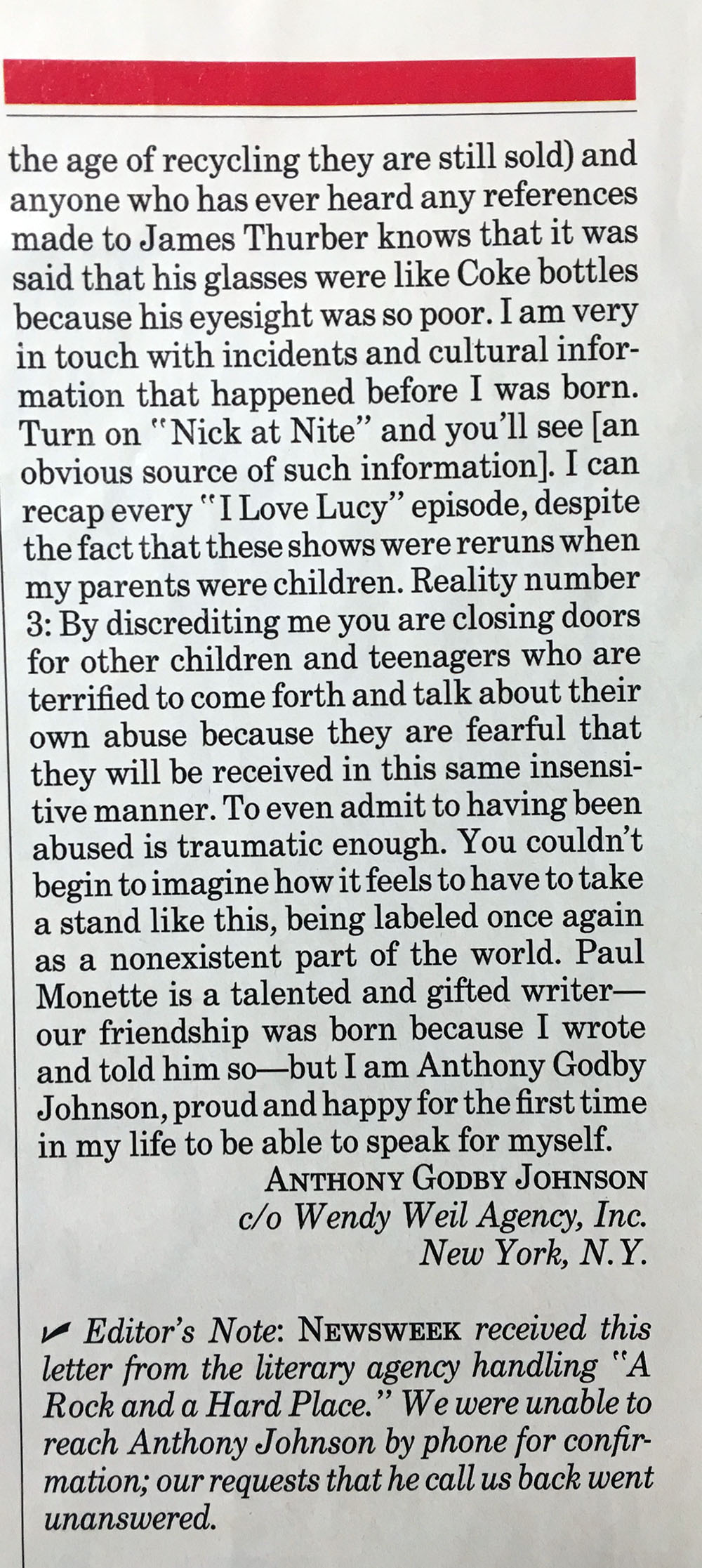
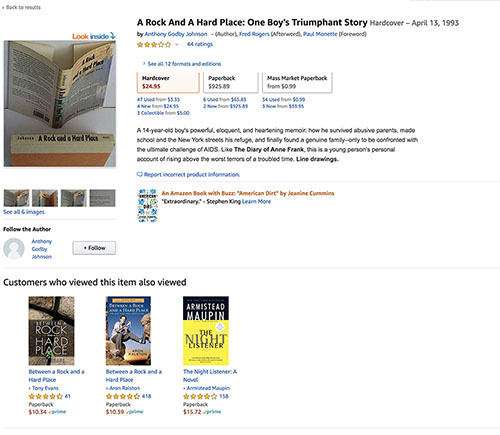
BR: So this is an interesting story and I had a small role in helping expose it, which I, which is kind of fun for me. It involves a 1993 book titled A Rock and a Hard Place.
CW: Okay.
BR: It’s not slash fiction, which is I’m sure what you’re thinking. This is this is before all that. And it was written by a young boy named Anthony Godby Johnson. It was a tragic story. I mean, this is, you know, the story of Go Ask Alice, and they had nothing on this poor kid’s story. In his memoir, he talked about just this horrific abuse that he suffered. His parents beat him. They denied him food and a bed. He was never allowed to celebrate any holidays. His parents abused him physically and sexually. In fact, they also allowed their friends to do the same.
0:59:45
CW: Oh, man. So this has got strains of like all kinds of abuse. You can, wow.
0:59:50
BR: Yeah. Yeah. And just this, any horrible, terrifying, abusive thing that you can imagine happened to this kid. In 1989, when he was 11 years old and on the verge of suicide, he escaped. He ran away from home and he ended up in the welcoming arms of a New York City couple who eventually adopted him. This boy, Anthony, or Tony, is especially glowing with praise about his adopted mother, Vicki, Vicki Johnson, who encouraged him to tell his story because of course he’d experienced this horrific abuse from a young age and he’d finally gotten out of that horrible situation. And Tony, why don’t you tell your story? Other people might be inspired by it. Unfortunately, they soon realized that he was dying of AIDS.
CW: Oh, just when it can’t get worse!
BR: It’s just like one of those horror stories, like you said, just every time you think you hit rock bottom, there’s something worse. At the encouragement of his wonderful doting mother, Vicki, Tony Johnson wrote this book titled A Rockin’ Hard Place, and it was this heartwarming bestseller. It had a foreword by Paul Monette, who was an award-winning author and an afterword by Fred Rogers.
1:01:19
CW: Oh, Mr. Rogers.
1:01:21
BR: Mr. Rogers, right.
1:01:22
CW: Oh, it makes me sad that Mr. Rogers read this story and thought it really happened to a kid. It would have really torn him up to read something like that.
1:01:31
BR: Yeah, and in his book, Tony talks again, it’s this very detailed wrenching story of just you know, overcoming all these things. He references Mr. Rogers and Paul Monette and other people, who later sort of were attracted to the story and, of course, helped to promote it. Other people vouched for the story as well. Jermaine Jackson, Keith Olbermann, Oprah Winfrey did a piece on him. The Make-A-Wish Foundation heard about his story and donated a computer so that he could write the book. And it was this well-received book, the USA Today called Tony, quote, a boy with a powerful will to live. And reviews were glowing all over the place. But there was something weird about it because nobody seemed to have actually met Tony.
1:02:22
CW: Now, was this published supposedly as a posthumous thing was Tony already dead according to his doting mother?
1:02:31
BR: No, no, no, no, Tony was still alive when when the book was published the question of Tony’s health actually became an issue because he contracted AIDS He said basically from being sexually abused in the early 1990s Yeah, and AIDS was a rather quick death sentence back then it was and but it wasn’t just AIDS. He had a stroke, he had tuberculosis, he had syphilis, recurring pneumonia, shingles, he lost a leg, he lost a spleen, he lost at least one of his testicles, recurring pneumonia.
1:03:05
CW: That’s a lot of outlandish things that are going on.
1:03:09
BR: A lot of things going on. So after a while people are saying, well, this is a beautiful moving book. How is it that this boy with this litany of health problems is still alive 10, 12 years later after, again, as you mentioned, this was when the first AIDS drugs were just coming out. So he was not among the people that was getting this.
1:03:33
CW: Yeah, there was no cocktail available to keep HIV positive people alive indefinitely.
1:03:40
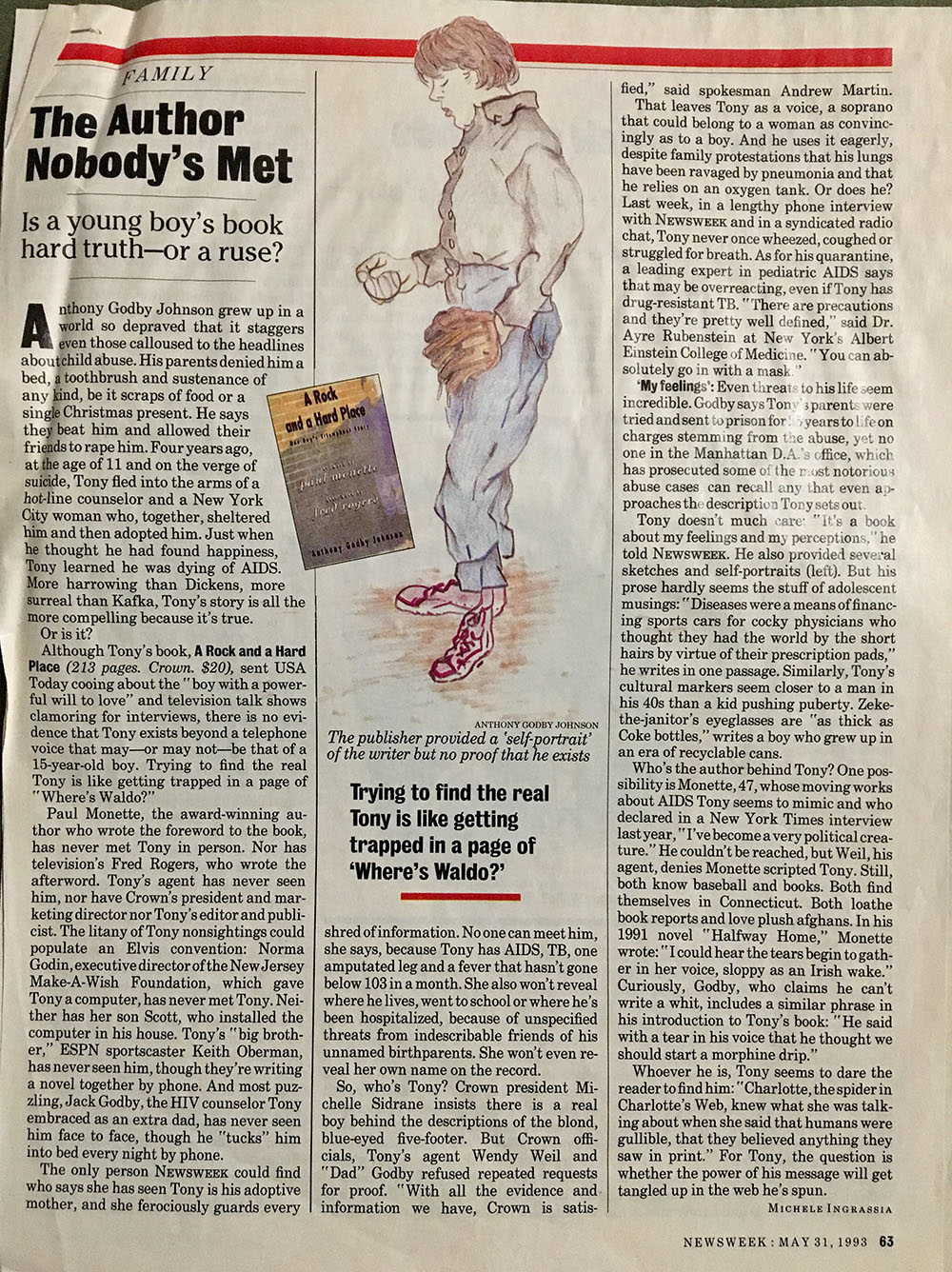
BR: Exactly. So some of these questions began coming up, and eventually one of the first people to try and track down Tony and interview him was a Newsweek reporter by the name of Michelle Ingracia. And she just tried to verify his existence because, again, he was a best-selling book with Mr. Rogers’ name on it. All these horrible things happened to him. But there seemed to be no external evidence. Nobody could find Tony’s birth certificate. Tony claimed his parents were tried for abusing him and that his father was a police officer who was supposedly killed in prison, but nobody was aware of the story. There were no, nobody fit those profiles.
1:04:23
CW: So there was smoke, but no gun.
1:04:25
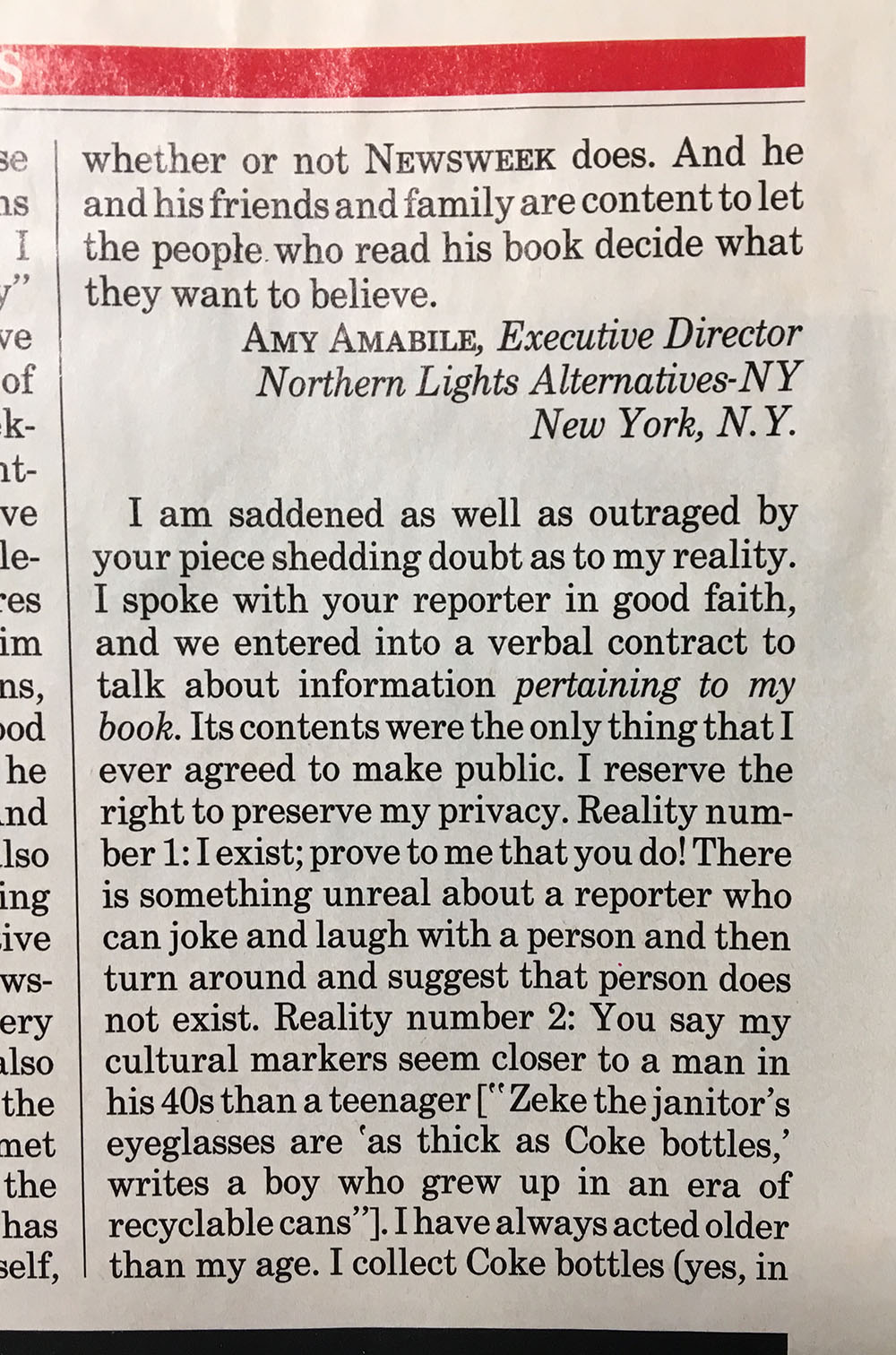
BR: Smoke, but no gun, right. And so here’s a quick quote from Michelle Ingrasio’s piece in Newsweek. She says, Paul Monette, the award-winning author who wrote the foreword to the book, has never seen Tony in person. Tony’s agent has never seen him, nor have Tony’s editors or publicist. She says, the litany of Tony nonsightings could populate an Elvis convention. Norma Godin, executive director of the New Jersey MakeWists Foundation, which gave Tony a computer, has never met Tony. Neither has her son Scott, who installed the computer in his house. The only person that Newsweek could find who says she’s seen Tony is his adoptive mother, that is Vicki, and she ferociously guards every shred of information. And when asked why she was always the mediator, the go-between between Tony and the publishers and his fans, she said that he’d gotten death threats. Not only was he in very poor shape health-wise, with again the deluge of health problems that I discussed.
1:05:29
CW: Yeah, he’s gotten multiple death threats from the universe already.
1:05:34
BR: Right, that would be the issue, but in fact she said that well there were actually a conspiracy of pedophiles that were trying to kill him because keep in mind that he claimed that that his original parents had basically pimped him out to pedophiles and so the court apparently he you know he had names and dates and he could he could finger people and so they were threatening to kill him if he went to the police.
CW: What do you call a gang of fictional pedophiles? There’s got to be a cosmic pizza of pedophiles.
BR: Something like that. Yeah. I got involved in the story in 2000 when I was writing my book, Media Myth Makers, which is one of my first books, almost 20 years ago. I contacted Michelle Ingrassia, the New York reporter, and I asked her if anything had happened since that time, if any evidence of his, that he even existed, had emerged, and she said, no, he’d never been seen publicly. Well, that’s not quite true. He’d appeared on Oprah.
1:06:42
CW: Oh, okay. Well, that’s something.
1:06:45
BR: Well, let me clarify. Somebody appeared behind a screen in disguise on Oprah.
CW: Oh, my.
BR: So, well, he didn’t want to be identified. I don’t know. Why did Oprah let him do that You’d have to ask Oprah.
1:07:03
CW: You’d think that would be a really big news story. After the Newsweek article came out alleging that perhaps this boy is fictional, you’d think that’d be a really big outcry to find out what’s going on.
1:07:15
BR: You would think so. However, Oprah, as we have discussed and will discuss, is not the shrewdest investigator and particularly in the light of her promoting James Fray of Million Little Pieces and various other-
CW:
BR: Yeah, but she got really pissed off at James Fray. I mean, she- She did.
1:07:36
CW: She had him back on just to yell at him.
BR: Yeah, well she later apologized, but anyway. So that all sort of, so I began looking into it after, because again, the news reporter said that, you know, she’d written the piece several years earlier and sort of nothing had come of it. It was never fully exposed, it was never debunked, it was never proven on the other, it was just sort of this stasis of mystery in which the books kept selling, but nobody had seen Tony or even proof that he existed.
1:08:05
CW: They just kind of swept under the collective rug.
1:08:08
BR: Right. And then there was an excellent article in The New Yorker by Tad Friend, and he did another really good deep dive investigation into the truth. It turned out that Vicki Johnson, the wonderful mother that Tony wrote so glowingly about in his book.
1:08:27
CW: I’m starting to really not like Vicki.
1:08:29
BR: So Vicki turned out to be a woman named Joanne Vicki Nowells.
1:08:36
CW: I’m starting to really not like Joanne.
1:08:38
BR: So she turned out to be a schoolteacher who lived in a small apartment in Union City, New Jersey, and friends described her as sort of an attention seeker.
1:08:48
CW: Wow, that’s an understatement.
1:08:51
BR: Yeah. So, after, so several years after Newsweek had looked into it and had basically called him out on it, and the New Yorker did as well, people were raising questions. But what was really interesting was the defenders. They were livid. They were insulted that somebody would dare to challenge this beautiful moving story, this memoir written by this young boy who had done so much and had survived so much. And how dare anybody question him? Certainly, it questions his existence. At the time, I wrote a couple of reviews for Amazon.com about the book, and I was being very polite and very factual. I said, people should be aware that serious questions have been raised about not only the truthfulness of the book, but whether the author even exists at all. And Amazon.com deleted my review. So I went back and forth with them and after my book was published in 2003, again, which included some material on this, I was getting angry comments. People were just, again, insulted. Just questioning the truth behind the story was seen as an attack on an abused child’s self-esteem.
1:10:12
CW: Well, people really want to believe the victim, but I mean, in this case, there’s no victim to believe.
1:10:18
BR: Right. I was told that I was, quote, intimidated by his talents as a writer. I was called a conspiracy theorist with an ax to grind and I was compared to a Holocaust denialist.
CW: Wow.
1:10:35
BR: Yeah.
1:10:36
CW: I bet that was fun.
1:10:38
BR: Good times.
1:10:39
CW: Ain’t it great being a public skeptic, Ben?
1:10:42
BR: So as it eventually, as more and more questions came up, eventually other people got on board, too. So 2020, the television news magazine did an expose in which they discovered that one of the photographs that Vicky had had shared, allegedly of Tony, was actually of one of Vicky’s students from several years earlier.
1:11:07
CW: I’d be pissed if I was the parent of that student.
1:11:10
BR: Yes. So that’s basically what happened.
1:11:15
CW: Did anything happen to her? Was there any crime actually committed that she was charged with? I mean, I’m assuming she had to give back all the profits from the book at least. What happened?
1:11:26
BR: Well, to this day, she claims it’s not a hoax.
1:11:29
CW: Oh, digging the heels in.
1:11:31
BR: So yeah, so here we are 30 years later, Anthony Godby Johnson, who had AIDS 20 some years ago, as well as pneumonia, stroke, tuberculosis, syphilis, shingles, leukemia, God knows what, apparently he is still alive. She has never admitted to the hoax.
1:11:55
CW: This kid is in his 30s or 40s now, and she’s just maintaining that he’s…
BR: Yep.
CW: Okay, all right.
1:12:06
BR: There is no resolution to the story if you expect that Vicki Johnson will come clean and admit that it was all hoax because she has, despite being exposed several times, She still claims, I don’t care what everybody says, Tony is a real boy and he’s on his deathbed and has been since the Reagan era. So that’s where we are.
1:12:33
CW: Wow. Well, it’s not like I expect her to come clean because from what I’ve read and seen and experienced of people who get themselves backed into a corner because of a lie, they will just continue to spit and claw and claim their innocence and claim that it’s all true. I was really kind of hoping that the law or at least the publisher would have kind of forced her hand.
1:12:59
BR: But well, yeah, and keep in mind, as I mentioned, there were a lot of prominent people connected to this hoax. Oprah Winfrey, Mr. Rogers, you know, Keith Olbermann, other people. Now, there’s one curious little addendum that sort of does serve as a bookend to the story, which is that one of the people that was suckered by Vicki, who basically created this young boy, Anthony Godby Johnson, was the writer Armistead Maupin. And he later wrote a book, later turned into a film starring Robin Williams, titled The Night Listener. In that novel, it’s a novel, it says it’s a novel. It says it’s a novel on the front cover, just to be crystal clear. It is a novel about his true experiences in being hoaxed by this woman and her essentially fictional son who had been abused or not been abused and wrote the book.
1:13:56
CW: Interesting. Wow. So a novel inspired by a true hoaxing fiction.
BR: Yeah, so if people are interested, again, the title is The Night Listener, a novel, and turned into a decent film with Robin Williams.
CW: I’ll check it out, okay, cool. Well, after that harrowing tale of literary munchausens, I’m kind of glad that Tony never existed. I don’t like the actual cases of child abuse and cruelty and medical suffering that kids have to go through. Why do you have to make one up?
BR: You raise a good question, right? And it goes back to the nature of Misery Lit, right? People love the salacious. People love the horrible things in life. people love to read about these first-person stories of of Abuse and rape and Satanism and and just horrific You know things and sort of limned with this underlying, you know survival story of you know inspiration and as long as people love these stories people are gonna keep making them up.
CW: Yeah, yeah humans are an interesting breed.
(MUSIC)
1:15:03
CW: Well, thanks, Ben, for bringing your knowledge, and I had fun jumping through the great moon hoax. I hope listeners enjoyed the couple of gems we popped out and polished to show you of literary hoaxes.
1:15:40
BR: And as we mentioned, there’s lots more. We only sort of scratched the surface, and I’m looking forward to do another show, but not right away.
1:15:49
CW: Yeah, yeah, there’ll be a part two and maybe three and four, who knows, down the road. When we’ve exhausted some other strange topics, we’ll jump back to this and have a nice good cup of cocoa and reminisce over some nice literary hoaxes again. And by all means, jump on our Squaring the Strange podcast discussion group and contribute your own ideas for a literary hoax, maybe something that you got suckered into, or you remember being exposed in the recent past, and we can do a little dive into it.
BR: Definitely.
CW: Now, Ben, what have we got on the burner for next episode?
1:16:22
BR: So next episode, we’ll be talking about the Sasquatch Sickle.
1:16:27
CW: Sasquatch Sickle?
1:16:28
BR: Yes, the frozen Bigfoot, also known as the Minnesota Iceman story.
1:16:33
CW: Oh, the Minnesota Iceman. I remember a little bit about this.
1:16:36
BR: Yes, it’s one of the more interesting, bizarre corners of an already interesting and bizarre topic.
1:16:44
CW: Yes, the Bigfoots, the Bigfoots, they deliver. I’m sorry, the Bigfoot deliver. There’s no S on the plural of Bigfoot, right?
1:16:52
BR: That’s right.
1:16:53
CW: Okay, I’m learning. You’re teaching me. Okay, now you’ve scared up a special guest for us, right?
1:16:59
BR: We have. There are several people that could talk about the Minnesota Iceman. I know some about it, but I’d rather talk to somebody who knows more than I do about it, and we’re going to have a special guest, Ron Pine, who’s a scientist and actually has a personal connection to the Minnesota Iceman.
1:17:15
CW: Well, we look forward to hearing from him and listeners, take care out there and stay strange.
BR: Bye-bye.
We would like to extend heartfelt thanks to our sponsor level patrons Amy Frusciaro-Kelly, Dr. Angela Mattke, and Elizabeth Leggett. If you’re interested in becoming a sponsor or just throwing us a buck or two per episode, check out patreon.com forward slash squaring the strange. Every little bit helps us keep the lights on here and we could not keep bringing you content without the support of our generous friends. If you’re short
1:17:48
on cash but want to provide moral support, remember to recommend us to a friend. If you’re short on friends, hey, remember that each five-star review helps us get higher on the podcast charts. Squaring the Strange is a production of Two Heads Studio LLC, copyright 2018. Theme music by Shriekbath, additional music by Memory, Keytard and Feathered, and Pasquale Romero. Additional support provided by Ashley Romero, Robert Sundin, and of course our listeners and patrons.
1:18:17
The views and opinions expressed in this podcast are those of Squaring the Strange and do not necessarily reflect the views and opinions of Two Heads Studio, Kronos Creative, Center for Inquiry, Two Heads Studio, Kronos Creative, Center for Inquiry, our advertisers, or any affiliated organizations and employers.
Transcribed with Cockatoo