Episode Summary:
This week, Ben recounts his recent investigation into the Mothman, a creature first spotted in the 1960s in rural West Virginia. Ben takes us on a tour of the area and discusses his trip there to help research the creature for a German television show. Like many cryptids, Mothman has gone through several incarnations and taken a few turns on its modern folkloric journey, from men-in-black conspiracies to Native American curses. And what do Point Pleasant residents think of their peculiar neighborhood monster, who brings with it a fully stocked museum and annual festival? From its glowing red eyes to its comic book abs and (by some accounts) grey feathery wings, we examine what makes Mothman tick.
0:00:00
Ben Radford: Welcome to Squaring the Strange, the podcast that examines all manner of the mysterious and the mundane through a critical lens. So let’s square the strange.
(MUSIC)
0:00:10
Celestia Ward: Welcome back to Squaring the Strange. This is Celestia Ward, your co-host, and with me is…
BR: Ben Radford, your other co-host.
CW: Yes, we are on episode 111. One, one, one.
BR: That’s significant.
0:00:37
CW: Not really.
BR: I like to think of a significant. Thank you very much.
0:00:46
CW: It’s rather, I’m not saying it’s significant numerically.
0:00:50
BR: It’s just, you know, there’s a lot of podcasts that don’t make it 111 episodes. I’ll just say that.
CW: Significant to our lives.
0:00:57
BR: And to our beloved listeners.
CW: Yes. OK, so for episode 111, we are going to be talking about a cryptid that Ben, you recently got to go out kind of in the field and research. Introduce this cryptid to us.
0:01:22
BR: Yes, we’re speaking of the Mothman.
0:01:26
CW: The Mothman. I’m seeing glowing red eyes and big flappity-flap white wings and antennas. And yes, we’re all familiar with Mothman.
0:01:37
BR: There’s a lot going on there. Yeah, and of course on the show in past episodes we’ve covered a wide variety of monsters ranging from Bigfoot to chupacabras to lake monsters, Ogopogo, the skeptic-raping bat demon from East Africa, and this time we’re gonna, Lizardman of course, and we’ll be talking about Mothman this time.
CW: Okay, and I’m, I’m catch, I managed to catch a little bit of a cold during the course of recording this. So I apologize for my voice, but Ben, you know some guys who never have to apologize for their voice. You’ve got some musical friends that are going to be contributing a nice little musical present for our listeners at the end of the show.
0:02:17
BR: Yes, absolutely. The listener should stick around past the end credits because we have a special treat. As many people know, our theme song here on Squaring the Strange was composed by the British band Shriekback It was actually a piece that I commissioned about the evil clown. Mr. Punch, back when I was writing my book bad clowns I commissioned one of the songs and I gave them a title and they they went with it and which is why if you if you listen carefully you can hear some sort of crazy Swazzle sound that’s that’s the sound of Mr. Punch’s voice going crazy and bouncing around. Anyway….
CW: That’s the natural call of the clown?
BR: That particular clown.
CW: Yes. Okay. Okay. And all right. Well, now, what’s the song that they are allowing us to put at the end of our credits here for today for today?
BR: Yeah. So on this episode, we’ll be playing a song by Barry Andrews, who’s one of the lyricists and singers for Shriekback. And it’s a particularly apt piece of sonic skepticism titled, Incredulous.
0:03:17
CW: Sonic skepticism, that’s cute.
0:03:20
BR: I enjoy my alliteration. It’s from Barry’s album, came out, I think about six, seven years ago, called Haunted Box of Switches, which you can find online. It’s a fun, amusing, skeptical song. I hope you enjoy it. And by the way, Shriekback also has a new album out, titled Some Kinds of Light, and it’s available now or soon at shriekback.com. So enjoy!
CW: Excellent! Well, Incredulous will happen at the end of the credits. In the meantime, let’s get to talking about the mystery of the Mothman.
BR: Yeah!
(MUSIC)
0:03:51
CW: I was very intrigued when you mentioned to me that you were traveling all the way to Virginia to do a TV show about Mothman. Can you tell the listeners a little bit about that or is it secret?
BR: No, it’s not. It’s not terribly secret. I, of course, had heard about Mothman for many years, but it just wasn’t one of the monsters that sort of got on my radar. Partly because it’s sited in Point Pleasant, West Virginia, so it’s on the eastern side of the country. But also just that it was weird, it was an odd cryptid or monster in that it seemed like it was sort of a lot of things sort of lumped together. And so…
0:04:47
CW: Too fluffy for you, not really your taste?
0:04:49
BR: Yeah, yeah. It just seemed a little squishy or something. I’m not sure how to define it. But finally, I was roused to go ahead and investigate Mothman a few months back when I was contacted by a German TV crew who asked me, had I researched monsters? And of course, the answer was yes. And had I researched Mothman specifically? And I said, well, a little bit. And they said, well, how would you go about it? I always like to hear that from TV producers. Usually the producers want to sort of force fit what I do or what a skeptic does into their own mold, right? They already have the script and they’re trying, they’re looking for people to fill the roles in that script.
0:05:28
CW: Yeah, you’re not the only one I’ve heard complain that a TV show might contact you and then say, Okay, we love what you have. But we just also need to say that the ghost is real.
0:05:40
BR: Right, right.
0:05:41
CW: Or the cryptid is real, or there’s a possibility, yeah.
0:05:44
BR: Love your work, babe. Can we tweak it just a little bit so you say you’ve never seen anything so unexplainable? So the most successful and the most enjoyable times when I’ve done TV shows was when producers reached out to me and they just flat out asked me. I was like, well, you’re the expert. What would you do?
0:06:03
CW: What was the name of this awesome German TV show? And did you have to do the whole thing in German?
BR: I didn’t. It had a German name. It was like Weisselhutzen. I’m I’m pretty sure that’s wrong. I think the larger company was called Story House Productions out of Berlin. A guy named Ole. Ole, I always enjoy calling him.
0:06:29
CW: Ole!
0:06:30
BR: He sort of looked at me like, yeah, that’s funny, yes, yes. So he called me up and we chatted a bit. He said, okay, well, how would you investigate Mothman? And I said, well, I would go back to the original accounts because what happens in a lot of these cases with a lot of these monsters is the further you get from the original accounts, from what people actually saw, the more muddled and strange and implausible and sensational the story gets.
0:06:58
CW: Naturally, it’s like a game of telephone, yeah.
0:07:00
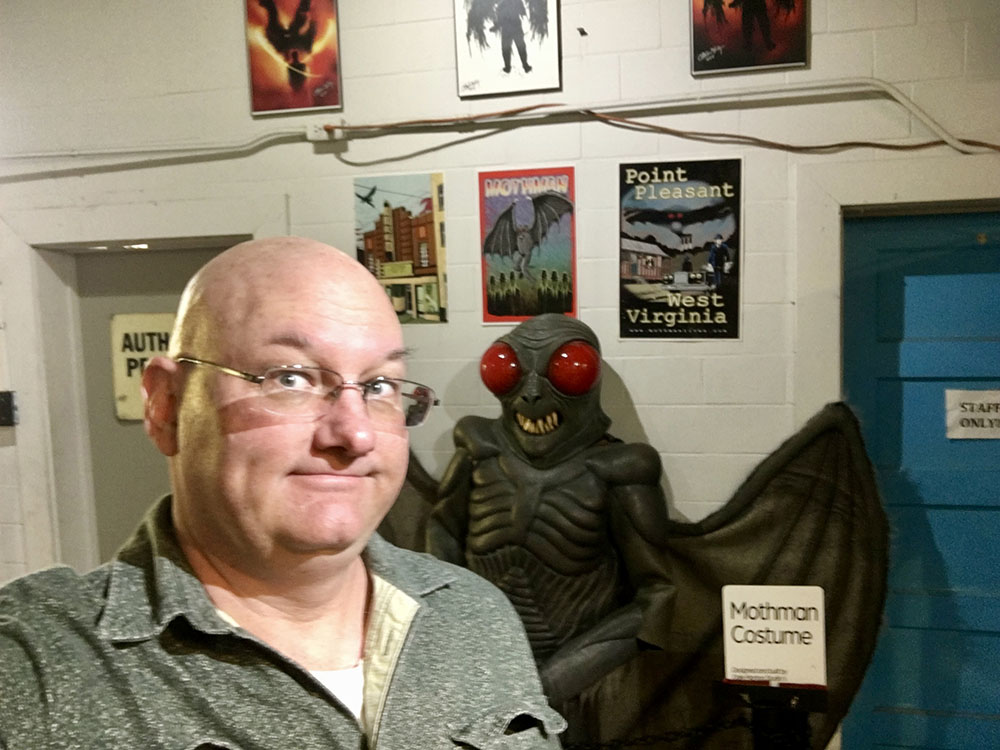
BR: That’s exactly what it is. And researching, so I’d done some research on Mothman ahead of time, of course, and then I did more while we were at the location, went to Point Pleasant, West Virginia, and also a place called Gallup Police right across the river in Ohio. We interviewed people there. I visited the Mothman Museum. I’m always happy when I’m able to do investigations on someone else’s dime. That’s a big plus for me.
0:07:26
CW: I would like to investigate which type of caviar tastes the best. I would like to investigate which of these margarita flavors I like more.
0:07:38
BR: Exactly. So, you know, as as I think I’ve mentioned on the show before, many of my investigations are self-financed and they’re sort of catch as catch can. Right? So if I happen to be on a on a Caribbean cruise that stops in Barbados, then I’ll use a day in Barbados to investigate the Chase Fault, for example, or if I’m in Jamaica, I’ll look into the White Witch of Rose Hall or but the chances when I can sort of piggyback onto a TV show and do work for them while also sort of doing my own research is the best. So that’s basically what I did.
0:08:13
CW: Well, is there any chance that we can throw a link out to listeners once this airs? Do you have any projected date for when this will be on German television?
0:08:21
BR: I don’t know. He did say probably mid to late 2020 and he said that, you know, honestly, I mean, he doesn’t know. And he’s just the producer for the show. So it’s not up to him when or if it airs in the States.
0:08:35
CW: Oh, yeah. And things change all the time.
0:08:37
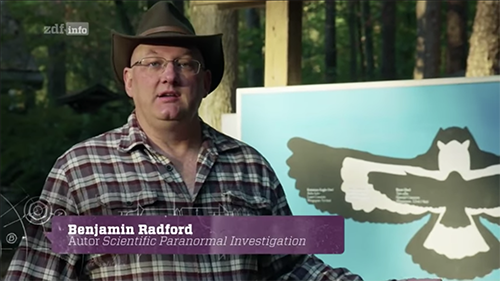
BR: Right. Things change all the time. But of course, you know, the nature of TV is that things are repackaged. Something I filmed 12 years ago is all of a sudden, you know, on the Discovery Channel again or something. So but anyway, in this particular case, there were a couple of things that we did and I won’t go into too much detail, but basically we went and visited the site of the original reports and I’ll talk about that in a second. I reviewed originally witness accounts and printouts and basically the descriptions of the witnesses in their own words. And then I also collaborated with an artist. Oh, so my idea was to, in researching Mothman, I recognize that there were a lot of iterations of Mothman. And there’s, you know, these big muscular sort of Todd McFarlane spawn looking creatures. There’s all sorts of different artists depicted.
0:09:30
CW: I’m familiar with, of course, the pop culture versions, perhaps inspired by Mothman. I’m sure there’s Arthur from the Tick who becomes a moth-themed superhero. And then, of course, there’s the Japanese Mothra, enemy of Gamera.
0:09:47
BR: I don’t know how clear the connection is there, but we’ll go with that. But it was interesting. So my goal was, again, in the interest of going to the original accounts, because as we’ve talked about on the show, of course, you know, the further you get from the original accounts, the more wild and exaggerated and plausible and everything else these stories are. And so rather than sort of looking at a Mothman that an artist drew in 2010, I wanted the artist to draw what the original eyewitnesses saw in 1966 and 67 and work from that.
0:10:26
CW: So a really, really backdated forensic drawing.
0:10:29
BR: That’s exactly right.
0:10:30
CW: Now, was were there any drawings done back then during the original sightings?
0:10:35
BR: There were a few sketches and I’ve seen some of them that they they basically just sort of look like a winged figure, almost like the Batman logo with two eyes sort of set in the chest or in the middle. The people that saw these weren’t artists. I mean, so you can’t blame them for that, but they’re sort of rudimentary. They just basically show wings and a body and maybe or maybe not eyes. I mean, there’s not a whole lot there. We actually filmed in Point Pleasant, literally across the street from the Mothman Museum, which was kind of cool. And so I met the artist, a really cool guy. And I said, I understand this is, I said, this is gonna be a difficult task for you. And I recognized that. I said, you know, you need to understand, as an artist, you’re going to want to dramatize this and to flesh it out and to make it as understandable as possible. We want the opposite of that. We intentionally don’t want you to embellish, to add your own spin, because what I want and what the TV show wants is to depict as accurately as we can what their experience was. And if their experience was nothing more than a scary dark thing coming at me, then that’s what we need. I was trying to go away from the sort of superhero-ish embellished Mothman to the original account.
0:11:58
CW: Now, do you think the artist was able to sort of shed his preconceived notions about what he thinks Mothman looks like based on modern interpretations? Or…
0:12:07
BR: I think he was when we sat down and explained it to him. He got it. I mean, he understood. It took a while because again, his his natural inclination and I understood this. I said, dude, I understand. This is not an easy task. But he got the premise behind my attempt at reconstructing the original Mothman account as sparse as they are.
0:12:29
CW: Okay, well if you can dig that up, I’ll be happy to throw that on the Facebook page.
0:12:33
BR: Yeah, definitely. I’ll contact… his name is Brian, a really cool guy.
0:12:37
CW: Oh, Brian! I know Brian! No, I’m kidding.
0:12:41
BR: You know Brian!
0:12:43
CW: Alright, well, we might have a low-key forensic drawing of Mothman available on the Facebook page. And if not, I’ll just cut this part out. So after you got this drawing done right across the street from the very cool, I now kind of want to see it, Mothman Museum in West Virginia, what else did you do for the TV show?
0:13:02
BR: Well, after that, I did a couple things. One is I went back to the so-called TNT area. This is where the Mothman was first sited. And this is a very rural, dark, kind of scary, woodsy area, especially at night.
0:13:17
CW: Ooh, creepy.
0:13:18
BR: Yeah, it kind of is. You know, Point Pleasant, West Virginia itself is a small town. You can drive through it in literally like 10 minutes. There’s just not much there.
0:13:30
CW: New cryptids tend not to show themselves like in the middle of a bustling Manhattan street at 2 p.m.
0:13:35
BR: This is true.
0:13:36
CW: It’s usually in a dark, creepy, rural area with lots of woods.
BR: Exactly where you would expect, right? But anyway, so one of the signature characteristics that’s claimed for Mothman, and I’ll talk about this a little bit later, is glowing red eyes. A lot of times when you have reports of animals that are seen to have glowing eyes, for example, the chupacabra and other creatures as well. The eyewitnesses, they’re probably confusing light that’s being reflected with light that’s being emitted.
0:14:11
CW: Yeah, like headlights or your flashlight.
0:14:13
BR: Exactly.
0:14:14
CW: Yeah.
BR: Exactly. And so, and that’s certainly the case with mothman, where if you look at some of the accounts, it’s pretty clear that the eyes and the eyeshine that they’re referring to are probably owls, because owls have reflective eyes. There’s an important distinction here, because again, they’re not emitting beams of light. It’s not as if they have flashlights attached inside their eyes and they just open up and, you know.
0:14:41
CW: There’s no laser beams attached to their face.
0:14:43
BR: No laser beams, exactly. So, and Joe Nickell, for example, has written about the eye shine issue in Skeptical Inquirer Magazine a while back. Anyway, so one of the things I did before wrapping up the investigation was I went back out into the woods near where Mothman was first sighted back in 66 and 67, and I conducted a handful of experiments trying to photograph and see the difference between eyes that are reflecting light and eyes that are emitting light.
0:15:10
CW: I’m imagining you dangling dead mice while shining a flashlight at owls and disturbing them.
0:15:17
BR: Very much like that, except not at all.
0:15:20
CW: Okay.
0:15:21
BR: I’ll come back to that later. But anyway, after I did that, the second part of the TV shoot, we went to the North Carolina Raptor Rehabilitation Center.
0:15:30
CW: Oh, so you don’t need to find owls. You just have them all in an area down in North Carolina.
0:15:35
BR: Exactly. I drove south, stopping at the grave of Eng and Chang Bunker, the Siamese twins.
0:15:43
CW: You mentioned that on last episode, yes.
0:15:45
BR: Yep, kind of cool, which is on the way in case anyone happens to be going between the two places. And I spent an afternoon with a variety of owls and learning from owl experts, and not just owls but other large birds as well, in terms of how big they get, what their wing span can reach, their reflecting eyes, and things like that. And so, because I was there with the TV crew, I was able to actually go into areas that the public can’t go into. So I could go into the cages and see them close up and flash lights in their eyes. And they actually weren’t that annoyed. They were kind of dismissive and arrogant.
0:16:25
CW: As one would expect from an owl, did you offer any of them a tootsie pop?
0:16:28
BR: No, there were no tootsie pops. There were dead mice that were, thawed mice I guess is the thing. But the highlight of that particular visit to the Raptor Center was we were allowed into cages like giant rectangular sort of lattice, wooden lattice cages where there were owls that had been injured and that were being rehabilitated and so they were given their strength back. What that allowed me to do was to experience having an owl dive bomb me. And it is creepy.
0:17:04
BR: Wow! You have a cool job and at the same time I’m not really jealous of that at all.
0:17:09
BR: Yeah, it was interesting. It’s fascinating. I never, you know, I mean owls of course live all over the world. I’ve always found owls interesting, but I live in the desert, so we don’t have a lot of owls like near me. There’s some down closer to where I grew up in Corrales. But it was fascinating because there were, I think there were, I think four owls in there. And it was basically this long open rectangular cage with sort of T-props on either side that would practice building the wing strength to fly between the two. And there was nothing else in there. So there’s no trees, there’s no foliage, nothing to block the way. I stood watching one of the owls and I looked down for a second and I felt something. I looked up and there was this thing was swooping right at my head. And it came probably, it seemed like inches, it was probably a foot or so. And I didn’t hear it at all. It was really, it creeped me out. It was just startling. I wasn’t expecting it, so then I heard it behind me. And it had flown right past me silently and landed about 20 yards behind me on this big wooden T-prop. It was just, it scared me. And even though I kind of knew to expect that, I’d never been dive-bombed by an owl before.
0:18:33
CW: So, you had the fear of owl pounded into you in terms of how much that could startle somebody and just overwhelm them, especially in a darkened situation where you’ve got reflecting light coming out of the eyes and it’s woodsy and you’re not expecting it. Why don’t you take us back, now that we’ve heard about your experiences with the TV show. Take us back to the original sightings. What can you tell us about how Mothman, the legend, came to be?
0:18:58
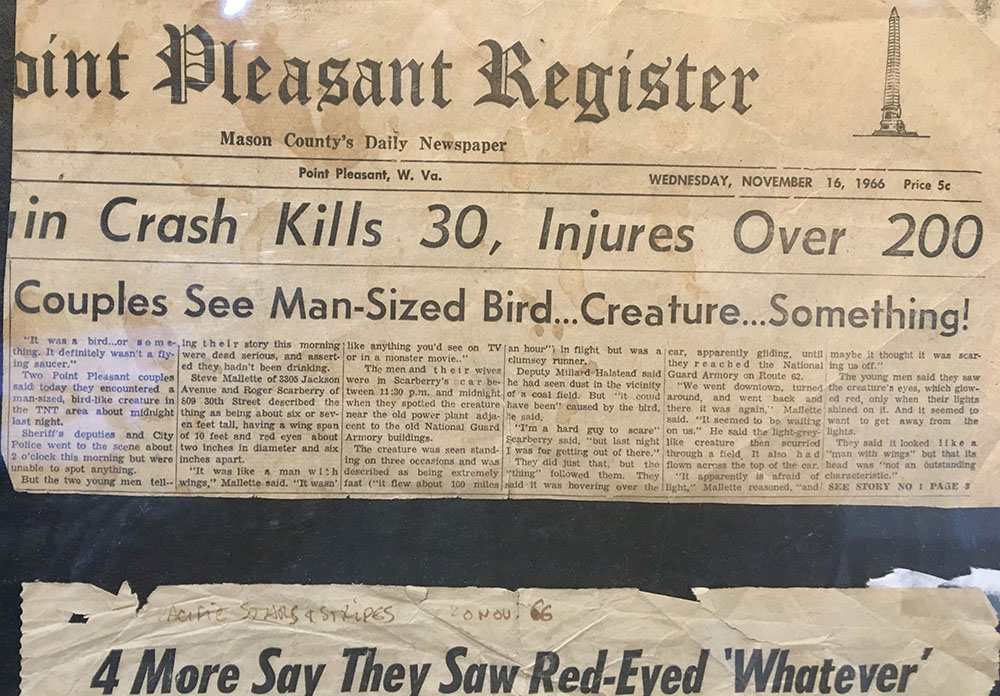
BR: Well, boys and girls, gather around the campfire. The story of Mothman really begins in November 1966 through about December 1967. And there were a handful of sightings, depending on how you count them, there are about a half dozen sightings of something weird in this particular area, this particular part of Point Pleasant, West Virginia. The first real sighting was on November 15, 1966. This is sort of considered by a lot of people to be the first Mothman sighting, although, as I’ll mention a little bit later, other sightings and things would sort of be lumped together.
0:19:38
CW: Okay.
0:19:39
BR: And I’ll talk about that in a second, but basically there was a spade of sightings or a flap of sightings. Flap, yes. It’s literally a flap of sightings in this rural part of Point Pleasant, West Virginia, known as the TNT area. I think it’s like three and a half thousand acres, just this huge area of woods, and it used to be used during World War II for munitions. There was these big, tall, concrete bunkers that are three, four stories high. There’s basically doors and concrete, but most of it is, of course, gone because it hasn’t been used since then. There’s also a handful of what are called bunkers or igloos, places scattered around where it’ll just look like a hill, but then if you turn to the one side, you see there’s actually a door there. So that’s the sort of area we’re talking about. Again, it’s not too far from the river, and it’s a bit out of town, outside of Point Pleasant. Again, there are a handful of sightings. Most of them, if you read the original descriptions, they are, for example, quote, like a bird, or with gray feathers, or quote, like a big bird.
0:20:50
CW: Okay, so you so they aren’t really saying it’s like a big moth. They’re saying it’s a big bird.
BR: Yes, and that’s that’s one of the interesting angles of of the mothman story is again, if you look at the original eyewitnesses and what they describe, like with the Roswell incident, right? You need to go back to the original accounts in 1947. You can’t go back to well, what did someone say they saw in 1982 or in 1990? No, no, no, that’s going to be influenced by all sorts of other stuff. You have to go back to the original accounts. And consistently, the original accounts describe something either birdlike or, well, birdlike, it’s like feathers and bird. And it’s just, they’re, they’re remarkable in their consistency in describing them as avian.
0:21:36
CW: So why did this not become the mystery of the bird man?
BR: There’s a couple things.
CW: And by the way, I’ve just looked up when Mothra first made her appearance and the first movie featuring Mothra in Japan came out in 1961. FYI.
BR: Ah, so there you go that predates the actual American Mothman
BR: As you would expect. So you would think that that would be the end of it, right? Because frankly, people are describing birds, albeit large ones. I mean, to be fair, I mean, what they were describing were large flying animals that they couldn’t identify. Now, of course, almost all of these were at night. In fact, all the original ones were at night. So this didn’t happen on a sunny day. These happened late at night, in some cases past midnight.
CW: Yeah, and there’s a whole galaxy of potential weirdness in that one little word, like. If somebody comes out of the forest, they say, I saw a huge bird. It’s not quite as mystery mongering as saying, I saw something that was like a huge bird.
BR: Right, exactly. So again, most of the original one describes something very much like a bird. Now, there was one, and I’ll talk about this one in a minute, where it was a car full of four people in a 1957 Chevy, and they were describing un-bird-like qualities. But the point here is that most of the original eyewitnesses described something that was very bird-like by most accounts. So the natural person you would ask to comment on it would be, say, a wildlife biologist, right?
0:23:14
CW: Somebody who knows birds, yeah.
0:23:15
BR: I like where you’re going with this. So an associate professor of wildlife biology from a local university, Robert Smith, was contacted by the local papers, because of course this made local news, because you know, the abandoned TNT area.
0:23:30
CW: What else is gonna make news, really?
0:23:32
BR: Well, to be fair, yes. And here’s a very short quote from me, it says, quote, from all the descriptions I’ve read about this thing, it perfectly matches the Sandhill crane. I definitely believe that’s what people are seeing.
0:23:45
CW: Oh, so we have a positive identification by an expert.
0:23:49
BR: We do, we do. So this is an article by Ralph Turner, and it says, quote, Dr. Smith said the Sandhill crane stands an average of five feet and has gray plumage. A feature of its appearance is a bright red flesh area around each eye. It has an average wingspan of about seven feet.
0:24:05
CW: That’s a big bird.
BR: That is a big ass bird. It matches several things. For example, several eyewitnesses talked about sort of red eyes or redness around the face that would match the bright red flesh area. An average wingspan of seven feet. I mean, I’m six feet tall. That’s taller than I am. That’s a big ass bird.
0:24:25
CW: And these cranes do live in the area. Because I remember you telling me one time, sometimes a cryptid meant a real animal that just didn’t belong where it was.
0:24:35
BR: Right, out of place. Now, it’s true that the Sandhill cranes aren’t native to the area. So it’s not like there’s a huge population of them there, but certainly they have gone through the area. And it’s not implausible that one or more of them…
0:24:48
CW: You’ll see that’s the thing about birds, they migrate.
0:24:51
BR: That’s kind of what they do. And again, keep in mind, I just want to remind everybody just how rural and remote this area is. It is in the middle of nowhere. These days, there’s a very small municipal airport not too far away, there’s a fairgrounds, but even to this day, and again, I was there a couple months ago, you can be five minutes out of town, out of Point Pleasant, and it is pitch dark, it’s cold, there’s woods all around you, and it’s creepy, even if you’ve grown up around woods. It’s important to keep in mind the context in which these were first sighted. So the eyewitnesses that read in the paper what Dr. Smith suggested they had seen, do you think they said, oh yeah, that must be it, or do you think it was something else?
0:25:36
CW: Oh, I’m sure they were completely level-headed and said, I must have been mistaken.
0:25:40
BR: Yeah, yeah.
0:25:42
CW: And that’s why nobody today has ever heard of the Mothman.
0:25:45
BR: Yeah, that’s exactly. Yeah. So end of story, children, go back to bed. No. So as you can imagine, the eyewitnesses were pissed. They’re like, that’s ridiculous. What is this pointy-headed scientist doing, telling me what I saw?
CW: How dare scientists do science?
0:26:01
BR: So, there were a handful of eyewitnesses. The original ones, there was Mr. and Mrs. Roger Scarberry, Mr. and Mrs. Steve Mallette, and there was a Marcella Bennett who were among the people in the first batch of people saw them. And all of them flatly rejected, in fact, some of them were, from what I’ve read, actually insulted by the idea that they had seen the sandhill crane.
0:26:23
CW: And we all know when there’s like a biology and wildlife expert who gives their opinion, but then you have six or seven lay people who outvote him. Well, that’s how science is done. It’s by a vote of lay people, right?
0:26:36
BR: Right. So when you dig a little bit deeper, what happened, and you’ll probably get this pretty quickly, is they were shown a photograph of a sandhill crane.
CW: And they said, that’s not what we saw.
0:26:48
BR: That’s right, right. So they’re analyzing the raw basis.
CW: But we saw those great big furious and big pointy teeth.
BR: Yes, so they were shown a photograph, a professional photograph, a clear, in focus, well lit photograph of a sand hill crane. And they said, no, didn’t see that. Well, so in other words, had it been bright and sunny and clearly in focus, you’re sure this wasn’t it, right? So the fact is that, of course, the circumstances under which they saw this thing were completely different. A much better measure of what they saw would be to show them a quick glimpse of the crane at night in the forest from an unknown distance.
0:27:38
CW: They should have lined up all the eyewitnesses and shot one of these things out of a cannon, you know, at their heads in the dark and asked if that was about what they remember.
0:27:47
BR: Hand them a clipboard and say, OK, we’re going to fire this thing over your head. Please, please check which box you think this was that flew over your head momentarily in a flash.
0:27:58
CW: By the way, I do not condone stuffing wildlife into cannons. Just FYI.
0:28:01
BR: Unless it’s for science. So, again, there was this, these sightings and then there was the sort of scientist skeptic who offered an explanation and there was a quickly people who were saying, well, that’s ridiculous. They’re just trying to, you know, they’re just dismissing us, whatever else, not recognizing that maybe there’s nuances here and that maybe that maybe they could, in fact, have seen something under those conditions. At the end of the day, it’s a mistake to ask what the Mothman is because there’s not one single blanket explanation. It’s the same thing with UFOs or Bigfoot. Someone says, you know, well, what is a Bigfoot sighting? There’s no answer to that. There’s not one thing. Some Bigfoot sightings are hoaxes. Some Bigfoot sightings are known animals. Some Bigfoot sightings are… I’ve seen Bigfoot sightings that were actually shadows in trees and forests that was just dark and seemed to be mistaken for a blob in wood.
0:28:57
CW: Sometimes it’s a guy named Todd in a mask.
0:28:59
BR: Sometimes it’s that, right, exactly. So as I mentioned, one of the aspects to this story in the early Mothman reports is, as I mentioned, there was a flap. There was how one sighting spawns other sightings.
0:29:14
CW: Now you have mentioned that term before, but just to reiterate what it means, it’s specific to cryptids or UFOs or something strange or paranormal-ish, right?
0:29:25
BR: Not necessarily, but primarily, yeah.
CW: It just means if somebody sees a Sasquatch on a Tuesday in March, then five other people are going to see it the next day.
0:29:35
BR: Well, they’re more likely to yeah, I mean so basically it’s sort of like social psychology where there’s an element of contagion to it And I’m not suggesting. It’s mass hysteria. I’m not suggesting that there’s any hoaxing But it’s it’s a simple fact that if you tell people to start looking at the skies or looking for something weird going on You’ll see stuff you know It happens all the time it happens with with for example mass sociogenic illness or mass hysteria. And we should do a show on that at some point. Where, for example, somebody will, one student in a classroom will start itching for unknown reasons and just sort of be itching and, oh, I just feel weird. And other people see this, and other students will see that person itching and like, oh, I’m itching too. Do you feel that? Oh, there’s something weird going on here.
0:30:25
CW: It calls your attention to whatever the thing is and you’re a little bit more hyper aware.
0:30:30
BR: And again, this is not speculation. This is well grounded in science and psychology. This has been, this is a real thing. And again, nobody is, it’s important to point out, no one is imagining these things. This is not.
0:30:42
CW: I mean, we have, I mean, not to drag current events into this, but it’s the same psychology psychology that goes behind somebody who’s perhaps a soldier assigned to look for incoming missiles from an enemy and he’s on high alert and he’s his tense and he’s looking and he’s looking and you see something that’s not a missile but it’s flying through the air and he’s gonna hit that button thinking it’s a missile even though it’s not. Yeah he’s on high alert absolutely got that contagion going where he’s just ready to see missiles and so that’s what he sees.
0:31:14
BR: You’re psychologically primed. Absolutely. And again, you can see this in other cases on social media. We’re talking is the dress, you know, blue or gold? And what was the sound? What was the phrase? Laurel, Yanni.
0:31:32
CW: Yeah, Laurel and Yanni.
0:31:34
BR: It’s exactly the same principle, right? If you’re primed to hear something, then you’re more likely to hear it. Same thing happens all the times with ghost hunters and their EVPs, their electronic voice phenomena where there’ll be some ambiguous sound or murmur or something and some say, oh, did you hear that? It says, my name is Mary. Well, it’s not.
CW: Yeah, your brain takes all the ambiguous data and lumps it into that basket because you’ve just handed your brain a basket.
0:31:57
BR: Exactly. And so, yeah, so you’re given these forms to fill and you’ll just jam them through the square, the circle, the star, whichever one it is. I’ve encountered this many times in my research. One of the most obvious cases I recall was Champ, the Lake Champlain monster. The sightings pattern was fascinating because in Port Henry, New York, there is and was a big sighting board that has different names, first sighted, this person saw Champ on this date, blah, blah, blah. And if you look at it, the vast majority of the sightings, I think over half last time I saw, were dated 1981 or 1982. And that’s significant because that’s when Sandra Mansey’s photograph of Champ was published in the New York Times. That was the famous photo of Champ that I investigated and Joe and I went and did research on the lake. But the key to remember here is that that photograph was taken in 77.
0:32:52
CW: So yeah, yeah, that’s that’s a little smoking gun of logic there where if it just indicated that, oh, well, she got that photograph right around the time it was mating season or there was a particularly active creature. No, no, it the photo predated the all the sightings by years and years. And so it was just the the publicity that got so many people searching the waters.
BR: Exactly. So it could not have been Sandra Mansey’s actual sighting of what turned out to be a floating log. It was the publication of the monster photo in 1981 that got everybody looking for floating things on the lake and thus spawned a bunch of monster sightings. So the same thing happened in Mothman.
0:33:34
CW: OK, well, so how did how did things play out with the flaps of Mothman? Have we got several? Have we got one major one?
0:33:41
BR: Well, there’s a couple things that went on here. So first of all when the newspapers first described Mothman, it wasn’t called Mothman it was the Mason bird monster or One of my favorites was the newspaper. They called it the whatever it was the whatever it was The whatever it was, you know, the editors like Joe do you have a name for that thing? No, I don’t, clam. Just put in whatever it was.
0:34:07
CW: All right. Last week we saw the Who’s He What’s It? And next week we might find a report of the What the Heck Was That?
0:34:13
BR: Exactly. Exactly. The What’s It? So the Mothman, as it turns out, was actually named after the Batman villain, Killer Moth.
0:34:21
CW: Oh, I should have known that there was a Batman thing going on. I didn’t come right to mind.
0:34:27
BR: And the fascinating thing about this, and there’s lots of fascinating things as you can tell because I’m interested, the fascinating thing here that I want to point to is speaking of flaps and speaking of things of that nature. So to this day at least some of the mothman depictions, particularly the most more recent ones, involve figures that have moth-like characteristics.
0:34:50
CW: Yeah, antennas, the kind of white, white flappy wings.
0:34:55
BR: Exactly. And I just find that fascinating because none of the original eyewitnesses described anything remotely like that. And it reminds me of the Kenneth Arnold UFO sightings, where Kenneth Arnold described what later became UFOs as flying saucers, but the journalist that he was describing this to misquoted him and they misunderstood him. And so that’s where flying saucers came from. Well, did he describe it as a cigar or I’m trying to remember. I think I think he was actually describing geese. He didn’t. The point is that he specifically did not say they look like flying saucers. What he said was that they looked like saucers would look like if you skipped them across water.
0:35:42
CW: Oh, so he was describing the motion.
0:35:46
BR: The movement.
0:35:47
CW: The motion.
0:35:48
BR: Exactly. So Arnold, who saw something weird in the sky, if I’m not mistaken, it was near Mount Rainier, was describing the way that something moved and that became in popular culture and popular lexicon, flying saucers. And later on, people were describing seeing flying saucers when he never said he saw flying saucers. And so the parallel is, of course, with Mothman, is that people are describing and drawing moth-like characteristics on these figures when the whole moth aspect to it came from a character in a Batman TV show that had no connection to anything anybody actually saw.
0:36:26
CW: So how did the name of a Batman villain end up getting associated with this bird-like creature? I mean, do we have a patient zero for who started calling him that?
0:36:35
BR: The notes that I have was that it was an Ohio copy editor.
0:36:40
CW: Oh. Having been a copy editor, I realize it’s a thankless, a thankless, creditless, nameless job. This is probably the only thing that this guy did that will give him some fame and some infamy. He’s named the Mothman.
BR: Such as it is, even though again, it has no particular connection to anything that anybody ever saw, but good on you. Anyway, so let’s go back to one of the original sightings because there’s a pretty dramatic one.
CW: Oh, a dramatic sighting. Well, what made this particular sighting dramatic?
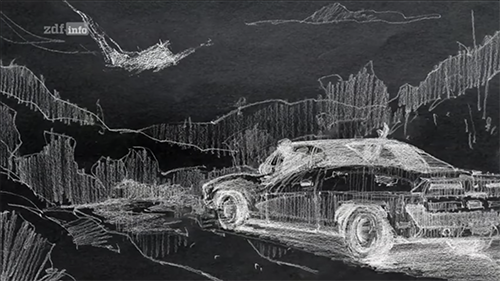
BR: Well, again, as I mentioned, there’s a handful of sort of original sightings and as we’ll talk about later, a lot of other ones sort of got lumped in together with them. But one of the most famous ones was when there were two couples in a car that were driving in a 1957 Chevy near the TNT area one night.
0:37:35
CW: You mentioned this, so this is the foursome that disputed the biologists.
0:37:39
BR: Yes, exactly. Here’s a quote from what they said. This is Roger Scarberry and Mr. and Mrs. Steve Millette. It’s a quote, we were driving 100 miles per hour and that bird kept right up with us. Note, he describes it as a bird.
0:37:55
CW: Mental note.
0:37:56
BR: Okay.
0:37:57
CW: All right.
BR: It wasn’t even flapping its wings, said Roger Scarberry, yet it did make some sort of noise, which the eyewitnesses described as sounding like the squeak of a huge mouse. Both young women were now crying hysterically. On the trip back to Point Pleasant, the huge thing cast a dark shadow over the rear window. This is from Lauren Coleman’s book, Mothman and Other Curious Encounters.
0:38:18
CW: Now, has that book, has that particular account been embellished over the years or was that like a legit quote from right after they saw this creature?
0:38:31
BR: That in itself appears to be a legitimate quote from what they saw. I mean, I don’t doubt for a minute that that quote is probably accurate. Having said that, let’s take a second to analyze that.
0:38:43
CW: Okay, they were going a hundred miles an hour. That stands out to me.
0:38:47
BR: Yeah, it’s a very round number. We weren’t going 98 miles an hour. We weren’t going 105. And here’s the thing. So when I was at Point Pleasant in the TNT area, I looked at the highway they were on because I was curious, could you go 100 miles on that?
0:39:05
CW: That’s what I was going to ask because usually those rural areas have got like little windy roads.
0:39:10
BR: Yes. So I did. Because that was one of my questions, right? If this is a windy, unpaved road, there’s no way they’re going, you know, 100 on that. So from what I could tell, it did seem plausible. There’s straightaways there. Depending on exactly what part of the road they were on, it’s plausible they could have reached 100 miles an hour at least briefly. Now keep in mind that there’s a lot of roadkill in the area. There’s lots of animals in the area. And, you know, if you’re going pretty fast, you’re in danger of hitting something big that’s going to go through your windshield. So I did look into that and that did seem plausible to me, although I have to say there were some dips in the road. This is not entirely flat road. And I certainly don’t know what the condition of the road in 1967 or 66.
0:39:57
CW: Now they didn’t actually say they hit something. They said it was blocking out the rear window. So it was like chasing them?
0:40:05
BR: Yeah, so this is a bit odd. So they said they saw something from the TNT area, again, the then and still abandoned TNT area in the skies. And they were in the car and they were zooming away and it was keeping up with them at 100 miles an hour. There’s a couple of things here. So one thing that jumps out at me is he mentions the squeak. And I would think that would be a sort of curious detail. I would think that, I mean, it’s possible, I guess, but it seems more likely that the sound would have been drowned out by the roaring engine and the other sounds, including the squeaks from the car suspension systems. Yeah, I was about to say, a 57 Chevy,
0:40:44
CW: I mean, I’ve never driven a 57 Chevy, but obviously it wasn’t a brand new car if they’re spotting this 10 years later. Whenever I hear a squeak, especially a repetitive squeak, I just assume it’s coming from my vehicle.
0:40:59
BR: It’s certainly more plausible than a Mothman.
0:41:04
CW: Well that’s my second choice. I think, oh, I own a 2002 Ford Explorer so I automatically assume it’s coming from that but my second option if I’ve ruled that out, is always cryptid.
0:41:16
BR: Well, this is what I would do. If I were a mechanic in Point Pleasant, West Virginia, and someone brings in a squeak in their car just to play with them, just to take the piss out of them, as Australians say, I’d say, make sure it’s not Mothman.
0:41:33
CW: I’m sorry, you’ve got a case of Mothman. The labor alone is going to be $800.
0:41:38
BR: It’s squeaking. What do you want me to tell you? So, again, it’s possible they’re going 100 miles an hour. It seems a little unlikely, but I guess possible. I don’t really fully believe that the squeak that they heard was necessarily coming from above the car when they’re roaring down the road. But then the other thing that you mentioned, again, let’s go back to on the trip back, the huge thing cast a dark shadow over the rear window.
0:42:05
CW: Oh, shadows can move pretty quick.
0:42:07
BR: They can. Well, you know, this reminds me, can you, do you remember the last time I was looking into this sort of thing?
0:42:13
CW: Well, you look into weird things all the time. I’m thinking chupacabra, I’m thinking the lizard man, the lizard man escape or. There was also a kid with a car and he thought he was going 100 miles an hour to escape it. But yeah, there’s no way he was.
BR: Yeah, exactly. So that that jumped to my mind. The research I did for the scape or lizard man also in the South were scape or again is that North Carolina, I think not. Oh, yeah.
0:42:42
CW: Okay, interesting.
0:42:43
BR: So there are actually some interesting parallels here. And I’ll get to that in a second. So as I’m sort of trying to piece this together and try to figure out how plausible this originally is, there are a couple of things that jumped out at me. And by the way, I did verify that the 57 Chevy was hard top. So it wasn’t a topless car. They didn’t have, you know…
CW: Thank goodness. One of those ladies would have been carried off.
0:43:06
BR: Swooped down by the by the scary thing above. And well, this raises a question, right? It’s like, how were they seeing this thing? Allegedly, it was flying above them, maybe sometimes a little bit ahead or behind the car. But-
0:43:22
CW: So it would have had to have been a partial view.
0:43:24
BR: It must have been. And unless, I mean, humans were not built with eyes on our head. So if the descriptions are accurate, people would have had to be, first of all, the driver is hopefully keeping his eyes on the road. I think it was Roger Scarberry. But the other ones, I mean, you would have to be like literally leaning out the window, looking up into the dark night.
0:43:45
CW: They would have been craning their necks around and trying to get a partial view out of the back window.
BR: Yeah, yeah. So I mean, again, I’m not I’m not saying that this that their description is is impossible. I’m just saying it’s more and more plausible the more you take it apart.
CW: There’s there’s some mitigating factors here.
0:44:02
BR: Right. So then the other question I had was, well, how do they see this thing at all? So I looked into some accounts or depictions of this pretty famous original Mothman sighting. And have you seen the show True Terror with George Takei?
0:44:21
CW: True Terror? No, I have not.
0:44:23
BR: Well, you know who George Takei is, right?
0:44:26
CW: Of course.
0:44:27
BR: Yes, of course you do. So he did a TV show. I suspect it was somewhat of a copy of William Shatner. You know who he is, right?
0:44:36
CW: Yes, I do.
0:44:38
BR: Yes. He did several shows, including Weird or What? and Unexplained. And on one episode of his show, they have an animated reenactment of this episode.
0:44:51
CW: Oh, oh my.
0:44:53
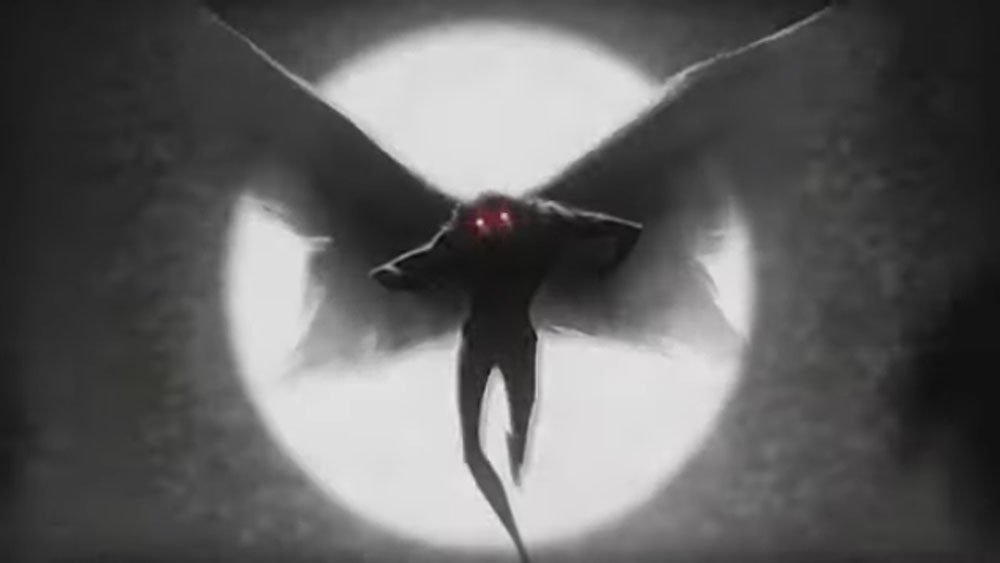
BR: Oh my. So it’s a really short clip if people want to look online. I think it’s on YouTube. It’s only a minute or two long. But it has, you know, Scarberry and the two couples terrified and slamming on the gas and trying to escape from this thing that they somehow are watching from that’s far above them. And when you see the mothman swooping down towards them, it’s very dramatic of course because it’s a TV show, right? There’s lots of dramatic license and all sorts of things. It’s backlit by a full moon.
0:45:29
CW: I was going to, that’s what I was going to ask. I was saying, I was going to say, due to having almanacs, you can just easily look up the phase of the moon.
BR: And I did that. So as it happened, because I’m an investigator, so as it happens, the night of November 15th, 1966 was a waxing crescent.
CW: Waxing crescent, that sounds delicious.
BR: Oh, delicious. So what that basically means is that there was almost no moon.
CW: Oh, yeah, that’s another factor.
BR: Not only was it not a full moon, it was kind of the opposite. In fact, the new moon had actually been two nights before.
CW: So we don’t have a whole lot of natural light going on to even cast a shadow. The whole, you know, just the fact that you’re in the dark means you’re in the shadow period.
0:46:20
BR: Exactly. I mean, and there’s there are few, if any, streetlights. And again, I’m having flashbacks to my investigation of the Lizard Man case because there’s a lot of parallels here.
0:46:30
CW: Yeah, it was completely dark for that too.
0:46:33
BR: Yeah, and again, this is in the middle of nowhere, totally rural area.
0:46:38
CW: Had these four people also just been like smoking pot right after their shift?
0:46:43
BR: Well, they say no. Okay. I’m not going to dispute that, not my place. But the point here is that there’s little or no ambient light anywhere around there, and there certainly was even less in 1966. This is, again, it’s a dark, cold, remote area. It’s not like they’re near some major city where there’s a lot of light pollution. And the detail that’s given that this creature cast a shadow on the car.
0:47:16
CW: Yeah, that’s almost meaningless.
0:47:17
BR: During an essentially moonless night, it pretty much can’t be true.
0:47:21
CW: Yes, it would have to be a double shadow.
0:47:23
BR: Yeah, I just, so again, I’m not saying anyone’s lying. I’m not saying there’s anything. All I’m saying is that we can’t take these descriptions of face value. This is not news to psychologists, and eyewitness experts. I mean, the fact is that under the conditions that they saw this thing, dark skies, a dark animal seen in dark skies with no easy viewing angle from the people below in a speeding car, that something above the car was above them or catching up to them, how could they possibly know that? And keep in mind that, as we’ve discussed on the show, a lot of times, eyewitnesses will greatly exaggerate and overestimate the size of things they see, especially if they’re frightened, right? Under the conditions under which one would be expected to see a lake monster or a UFO or a mothman coming at you in the night sky, those are exactly the conditions under which people are more likely to have exaggerated estimates of how big they are and how fast they’re coming.
0:48:27
CW: Oh, it’s like the fisherman effect, like, it was this big, you should have seen it.
0:48:31
BR: Well, sort of. I mean, part of it is just how our perceptions work, right? I mean, so we have, if you think about it, I mean, in our everyday lives, we encounter things all the time. Most of them are mundane and expected, you know, in our everyday lives, there’s not a lot that’s unexpected or that frightens us. But for example, in conditions under which we are surprised or frightened, that’s when things seem bigger to us.
0:48:56
CW: Let this be a lesson to you guys. The more you send unsolicited dick pics, the more mundane and small they’re going to seem.
0:49:04
BR: I would not have gone that direction, but I guess that’s good advice.
0:49:07
CW: Hey, you’re throwing it out there for the masses, man.
0:49:10
BR: Well, you know, I’ll give you one quick example. When I was researching the Mansi photo, which we talked about a little bit earlier, when Sandra Mansi first took that photo in 1977, she had estimated that it was actually 6 to 8 feet out of the water and up to 12 or 15 feet long. It just came out of the water and she saw it and she just thought it was huge and that was her estimate. And then when Joe Nickell and I did research and field investigations at the lake. I think it was for the Learning Channel. We discovered that in fact it was just about three feet out of the water and it was altogether about seven feet long. She had basically doubled her estimates about how big it was.
0:49:53
CW: And you know when I’ve heard that that also relates to people not really being able to gauge with the background of the water because it’s like a dark blue. It’s just not where the way we’re used to perceiving things. And a night sky, it sounds kind of similar to the way you’d see something in front of a field of water.
BR: You’re exactly right. That’s one of the big problems is that against sort of static fields, such as a sky or water, it’s very difficult to judge both size and distance. And if you don’t know the size, you don’t know the distance and vice versa. And so that’s why, you know, if you see, if you’re out taking a walk at night and you see some light in the sky, it can be very, very difficult to tell whether that’s a small light that’s relatively close up or it’s a huge light that’s farther away, because it can basically look pretty much the same. And so you have to look for other cues, right? Does it have a blinking light like an airplane would, for example. But absent those contextual cues, it’s very difficult to estimate size. We can look at the original eyewitness accounts, we can look at all the other things, but we have to keep in mind that if it either was or is an actual living, breathing, extant creature, it has to obey the laws of physics, right? It has to…
0:51:09
CW: Does it really have to?
0:51:11
BR: It kind of does.
0:51:12
CW: It could be like Bigfoot, it’d be like interdimensional and psychic.
0:51:16
BR: Yeah, I’m having flashbacks to being cornered by a Solman Grundy John Yard Beckyard, as we talked about in one in the Bigfoot episode a while back. But but yeah, I mean, look, if the claim, at least among the sort of more grounded researchers, is that Mothman is or was either a giant bird or some bird-like humanoid creature-type thing. But in any of these cases, they’re claiming that, again, it’s living, it’s breathing, it’s actually out there to be discovered, and presumably has all the normal anatomical bodily functions that all animals do, including the same anatomical constraints. And so this is where it gets dicier, because when you start looking at the morphology of these animals, birds actually have fairly small bodies. So, for example, you can look at owls, and owls, they can seem fairly large, but that’s because they’re covered with feathers, and their actual corporeal, you know, the body and the chest is actually pretty small.
0:52:18
CW: Yeah, if you go on the internet, you can see owls that have been dunked into water, and it is the most hilarious, pathetic, and adorable thing.
0:52:26
BR: Yeah, they don’t they don’t look quite as amused as the people spraying them down. But this is this is one of the things when I was at the TV shoot, when I was at the Ractor Center, this is one of the things I learned. And I was there.
CW: Did you get to dip owls in water? Tell me you got to dip the owls in water.
0:52:42
BR: Not at the time. I there was there was no the owl dipping was a Thursday, we were there on a Tuesday.
0:52:54
CW: Note to self. Note to self.
0:52:56
BR: Mildly disappointed. But what you find is that, particularly with a creature this big, a lot of the Mothman depictions and characterizations are basically human sized or even bigger than human sized. We’re not talking little tiny fairy things a foot or two big. These are often depicted and described as being sort of large, muscular, big things.
0:53:18
CW: Yeah, I’ve seen some of the images and Mothman’s got a six pack.
0:53:22
BR: Yeah, and heavy muscles. This is actually the problem. This is the paradox, is that in order to create a sort of dramatic, sensational, threatening Mothman, a lot of the artists go for sort of a comic book-y, Todd McFarlane, Spider-Man, Spawn-looking type character, but if you look at the morphology and the anatomy, it just doesn’t work. You would either have to have a much smaller body, the Math Man’s body would have to be basically the size of my thigh, or they would have to have this huge impossible wingspan, you know, maybe 20-30 feet, not, you know, the 10 or 12 or 15 that people are described.
0:54:02
CW: Yes, there are actually circles of geekdom where this is brought up about in the DC universe You’ve got Hawkman and Hawkgirl and then you’ve also got in the Marvel Universe You got Angel who’s one of the X-Men and these are humanoid, you know characters with angel wings essentially and People more pedantic than I have brought up the fact that in order to actually lift a human body, the wingspan would have to be like a city block or like 45 feet or something crazy.
0:54:33
BR: And yeah, and that’s just again, that’s not that’s not the mean skeptics raining down the parade here. That’s just basic physics.
CW: Well, in the comic book world. Yes, it is just the mean skeptics.
0:54:45
BR: Well, OK, fine.
CW: But OK, but in the real world, in the real world, that would be a problem for Mothman?
0:54:50
BR: Right, because again, Mothman is typically depicted as having big muscles. The problem is that big muscles and the bones required to anchor those muscles are inherently very dense body materials. They’re a lot of a person’s body weight. And so you can either have one or the other. You can either have the wingspan described in a much tinier body or the body described in a much higher wingspan, you can’t have both.
0:55:17
CW: Ah, OK. So, so far we’ve got a wildlife expert at the time saying it was a crane or some other large bird. We’ve got physics making a lot of the depictions or imaginings pretty impossible. Why is Mothman, what’s the staying power? Why is it still a thing?
0:55:34
BR: Well, yeah, you would think it would sort of be at this point sort of a non-mystery. It’s interesting, I mean don’t get me wrong, but it’s just sort of there doesn’t seem to be, as with the wings of the body, doesn’t seem to be enough to support it. But here’s what happened. So probably the Mothman story would have sort of died a quiet death by say the mid-70s or early 70s, except that it sort of took on a life of its own. And of course, this often happens with various mysteries, whether it’s the Chupacabra or the Roswell story or whatever else. And so, there’s a sort of a kitchen sink cryptozoology approach. Throw everything against the refrigerator, you see what sticks. So what you find is that the story of Mothman gets bigger and bigger and bigger the longer it goes. It’s like a snowball, right? Snowball effect. Once you get beyond the core three or four sightings that happened in November and early December of 67, of 66, you get people throwing in other stuff. Suddenly we’re talking, there’s accounts where that happened an hour away. There’s UFO reports. There’s men in black reports. There’s missing dog reports.
0:56:55
CW: Missing dog reports, yeah, I guess, yeah. Moth gotta eat, man.
0:56:59
BR: Right. But here’s what happened is that pretty soon after the initial reports, this ties back in with the Mothman flap, right? People are talking about it. It’s in the local newspaper. People are saying, what is this moth bird weird thing, right? People are talking about it. And the call was put out, maybe not officially, but certainly implicitly, if anything weird happens, let us know.
CW: So people with any sort of weird, semi unexplained event in their life were kind of drawn to this explanation like a moth to a flame.
0:57:30
BR: Long road for that one. But yeah, that’s that’s about right. And so this is why in a lot of accounts, particularly ones by a writer, John Keel, and we’ll come back to him in a second, but a lot of them, they, they lump in all sorts of stuff that have no apparent connection to Mothman. Sightings of something weird in the sky, 90 miles away, UFO sightings, just all the sorts of things that are sort of lumped together under the Mothman label that have little or nothing to do with them. And of course it’s to the mystery monger’s advantage to do that. Because if you, if you just focus on the original handful of sightings, as such as Scarberry’s, it’s kind of pretty explainable. I mean, maybe not a hundred percent, but like 98% explainable if you include the, the normal known bakeries of eyewitness accounts and things like that. But to really make it a mystery, you’ll lump in all the other things.
0:58:26
CW: Yeah, so it sort of takes on new life with each little thing that can be connected to it.
0:58:32
BR: Exactly. And so one of the big things that became connected to it was a real-life tragedy, which was the Silver Bridge, which is a bridge in Point Pleasant, collapsed on December 15, 1967.
0:58:46
CW: And how would Mothman have done that exactly? He’s not termite man.
0:58:51
BR: That’s a good question. Initially there were a handful of things. So let’s just back up for a second. So obviously anytime there is a tragedies, particularly a big high profile tragedy, like a bridge collapsing into river, uh, killing dozens of people. And of course, you know…
CW: Oh, tthere were, there was like loss of life with this?
BR: Oh yeah. Yeah. Cars went in the river. Some bodies weren’t found. It was a horrible, terrible event. The bridge just collapsed totally. So initially, anyway, so anytime you have something of that magnitude, people of course ask why? How could this have happened?
0:59:27
CW: Yeah, I mean, it’s a natural human thing to crave some sort of explanation for.
0:59:31
BR: And in the months afterwards, there was actually very good explanations for why the Silver Bridge collapsed. It was an unstable design, there were quality control issues. I mean, it’s very clear from a technological engineering point of view why the bridge collapsed. Unfortunately, as they say, you know what, success is built on tragedy. And it was a learning experience, unfortunately. So one of the things that circulated was that it was actually part of a curse.
0:59:59
CW: Oh, now we’ve got, see, I was, I didn’t think it was gonna go there. I was like, okay did Mothman Somehow physically do something to the bridge, but you’re saying that Mothman is now becoming entwined with a curse that also affected a bridge.
1:00:12
BR: Yeah, so you so you see what I mean by the sort of concentric circles of weird unrelated stuff getting lumped together So part of what eventually became the Mothman story includes the idea that a Shawnee leader named Cornstalk had cursed the valley, the white settlers of the valley in the Ohio River Valley, because he had been betrayed and killed.
1:00:36
CW: His name was Cornstalk?
1:00:37
BR: Cornstalk. Yeah, well, that’s the English translation or something along those lines.
1:00:43
CW: I’d want to curse somebody too if somebody named me Cornstalk.
1:00:46
BR: Well, he had more legitimate grievances than that.
1:00:50
CW: Okay.
1:00:51
BR: So, and the story goes that with his dying breath, he cursed the white settlers for 100 years. And since that time, there would be all sorts of terrible things happening in Point Pleasant and the Ohio River Valley, and it would be attributable to him.
1:01:06
CW: Okay, now did Cornstalk, Cornstalk wasn’t a real person, right?
1:01:11
BR: He was a real person.
1:01:12
CW: He was. Oh, I feel bad for making fun of his name now. Okay, sorry.
1:01:15
BR: Well, you can cut that out.
1:01:16
CW: Okay. All right. But I mean, were some of the mystery monger people saying that Cornstalk physically became Mothman or he just summoned Mothman? Or how does that all work?
1:01:28
BR: Okay. So even to believers, it’s not entirely clear, if I can put it that way. Now, keep in mind that this is a rural area and accidents happen, right? There’s mining, there’s heavy industry, fires, hunting, farming, you know, lots of ripe opportunity for there to be accidents. And of course, the nature of curses is that they’re ambiguous, right? Anything bad can be attributed to a curse. Part of the problem here, of course, is that Cornstalk died in 1777. And by some accounts, it was a curse for a hundred years.
1:02:00
CW: Okay, so it would have expired long before Mothman showed up.
1:02:04
BR: In 1877, which is a bit earlier than the 1960s. The other problem is that there’s actually no contemporaneous record of that curse. It’s non-existent.
CW: So… a secret curse.
BR: It was kind of a non-thing, right? So what happened was that John Keel, who I mentioned earlier, who is a sort of a somewhat famous Fortean writer. He was involved with his friend Gray Barker, who did a lot in promoting the Men in Black theory. Keel is responsible for associating the Mothman as an as an omen of doom or a portent of death. And so he was one of the ones that tried to link these things together.
CW: So you have this writer who’s interested in weird Fortean topics.
1:02:52
BR: Yes.
CW: And he knows a little bit about this felic cornstalk and ancient Native American cultures in the area. And he knows a little bit about the so-called Mothman sightings. And he just decides to put one into the other.
1:03:06
BR: Right. The best way of sort of looking at this is that there’s basically sort of four or five different versions of Mothman. One of them, as we talked about, one of the first ones is the original set of reports, right? The Scarberry ones, maybe a handful of three or four in all that form sort of the core of the early Birdman sightings. The second version of Mothman is sort of bigger, and that includes the Mothman story that John Keel and others, including Lauren Coleman and others, created by lumping together various sort of tangential, unrelated reports like UFOs, Men in Black, curses, the Silver Bridge Collapse and things like that. And this was first sort of crystallized in John Keel’s book, The Mothman Prophecies, in 1975.
1:03:58
CW: Okay.
1:03:59
BR: And then we have yet another sort of tangent or version of the Mothman.
1:04:04
CW: This is like Pokemon. There’s like evolving versions of this.
1:04:08
BR: There really is. And this is this is one reason it’s such an interesting such an interesting case study when you look at it folklorically and culturally.
1:04:16
CW: So tell us what the final form is.
1:04:18
BR: The final form, as some of you may know, is the Hollywood film based on Kiel’s book titled The Mothman Prophecies. Came out in 2002 with Richard Gere.
1:04:31
CW: Well, that took them a while.
1:04:33
BR: It was probably a hard book to film, if I had to guess. And finally, there’s sort of the Mothman phenomenon that encompasses and is influenced by all of those. So at each stage, details get lost and are embellished and fabricated. It’s interesting, a guy named Jeff Wamsley, who runs the Mothman Museum who’s written a couple books on Mothman. He was writing in one of his books that to this day people come up to him and ask him about the Mothman. But they mistake the Hollywood film for what really happened.
CW: Well as people do yeah.
BR: Yeah, as people do and but then he has to explain well No, that’s based on John Keel’s book which by the way isn’t isn’t terribly reliable in terms of accuracy and facts, which itself is this kitchen sink approach lumping weird things together. So again, the further and further you get from the original sightings, the more dramatic and sensational and less credible the Mothman version is. Which of course, makes sense, because the people promoting Mothman, they’re not interested in focusing just on the original sightings, because if you do that, then you’re talking about almost certainly owls, cranes, large birds, things like that.
1:05:46
CW: So what sort of things influenced Kiel? Did he go off on his own directions, or did he stick to one particular version?
1:05:54
BR: Well, Kiel was one of the first investigators, and in his case, he used the term very loosely, in the Mothman story. If I’m not mistaken, he was actually investigating like a mutant cat or something somewhere else. And he heard about the Mothman, these weird sightings, and he went to Point Pleasant and he sort of claimed the story as his own, sort of mystical, almost sort of conspiracy-like connections among seemingly disparate things.
1:06:39
CW: Oh, who doesn’t like that stuff?
1:06:42
BR: Well, he certainly was all about that stuff. And when Keel got involved in it, he was interviewing eyewitnesses, but his interest wasn’t in solving the case. In fact, he was actively disinterested in solving the case.
CW: Oh, that’s frustrating.
BR: Certainly to a skeptical investigator for whom the main job is to solve the case, it’s very frustrating. But he, again, he injected himself in the story and he co-opted the events and sort of promoted them and made them in some ways about himself. And so he largely rejected the skeptical or empirical or scientific process. To him, the distinction between fantasy and reality wasn’t that important. Those are sort of arbitrary boundaries that that scientists are imposing on these phenomena that that only serve to distract real investigation. That was his view.
1:07:39
CW: Okay, so it wasn’t necessarily all about the almighty dollar. It was just he wanted to tell a good story and he felt that that was the end goal.
1:07:47
BR: Well, he want to tell a good story but to him the the events that surrounded the original Mothman sightings were part of a larger web. They were part of a pattern that he believed he could see. And so to him, it was clear that, for example, Mothman was connected to the Silver Bridge collapse, because the Mothman, it was it was a portent of doom and the portent of evil and things like that. Key was much more interested in sort of the feelings and the fear and the emotions and what psychological consequences the Mothman sightings had. So again, his interest wasn’t really in solving the mystery per se. It was in exploring the sort of psychological, mystical angles of the mystery.
1:08:35
CW: Yeah, the word prophecies really does sort of indicate something like that could go on.
1:08:41
BR: Yeah. And so I’ve seen The Mothman Prophecies. I think I saw that film years ago and I was frankly annoyed by it. And I was not a fan of the film, regardless of how you may feel about the Mothman case.
1:08:56
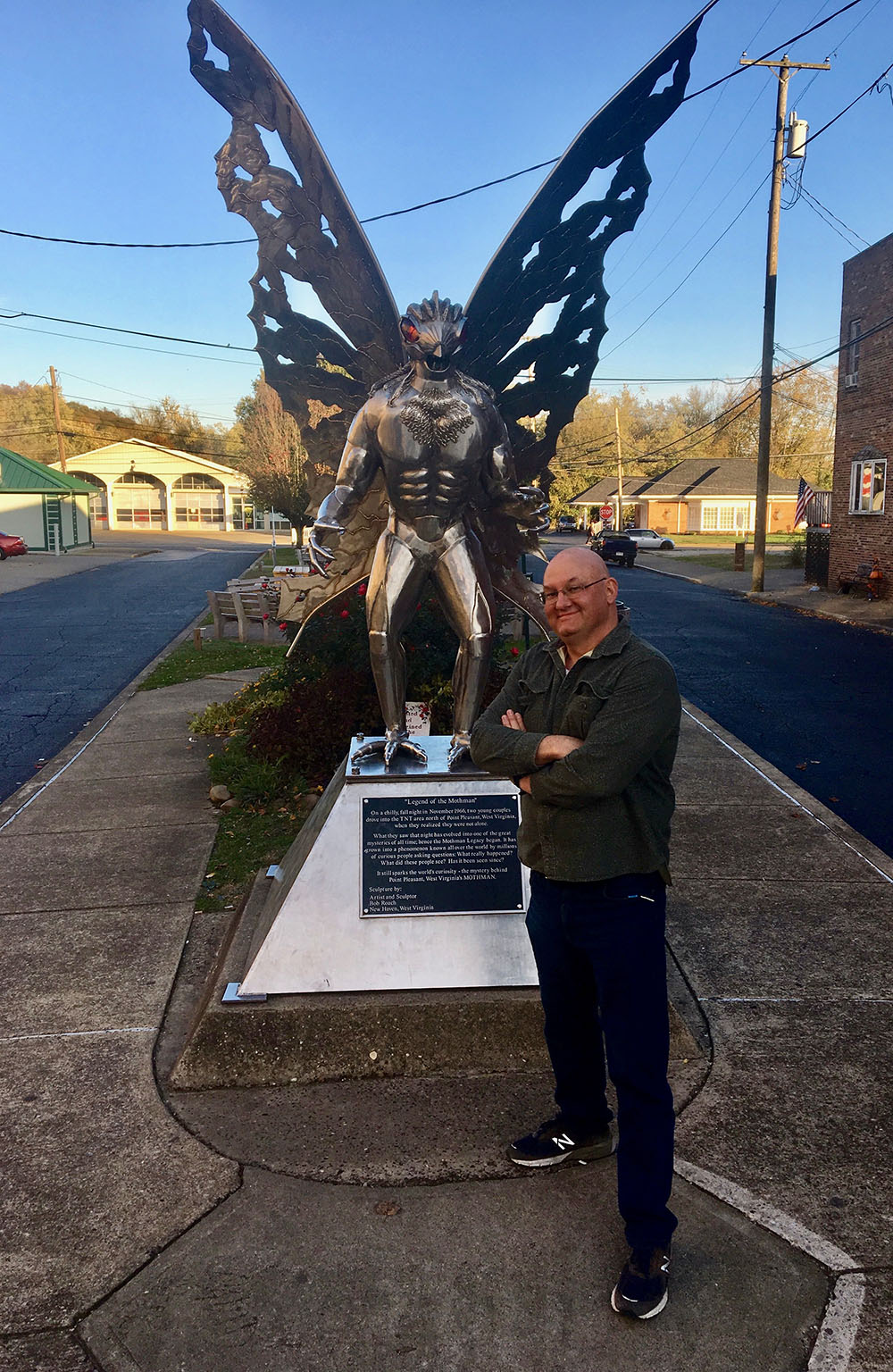
CW: By the way, I’ve not seen the Richard Gere film, but I did a quick search just to see if I recognized any images. And up pops an image of an actual Mothman statue with like glowing red eyes and everything.
1:09:08
BR: Yeah.
1:09:09
CW: Did you see this thing while you were in Point Pleasant?
1:09:11
BR: Yeah, it’s it’s it’s literally 50 feet from the the Mothman Museum. I have a photo of me with it.
1:09:17
CW: That’s crazy.
1:09:19
BR: It’s very cool.
1:09:20
CW: Obviously, some residents must be enthused to have this local legend there. But how do people feel? I mean, somebody erected a statue to the Mothman, but how do people generally feel about having this cryptid make its home in West Virginia?
1:09:34
BR: Well, it’s interesting. There’s a couple of different aspects to it. First of all, of course, there are the crypto tourism aspects.
1:09:42
CW: Ah, money.
1:09:43
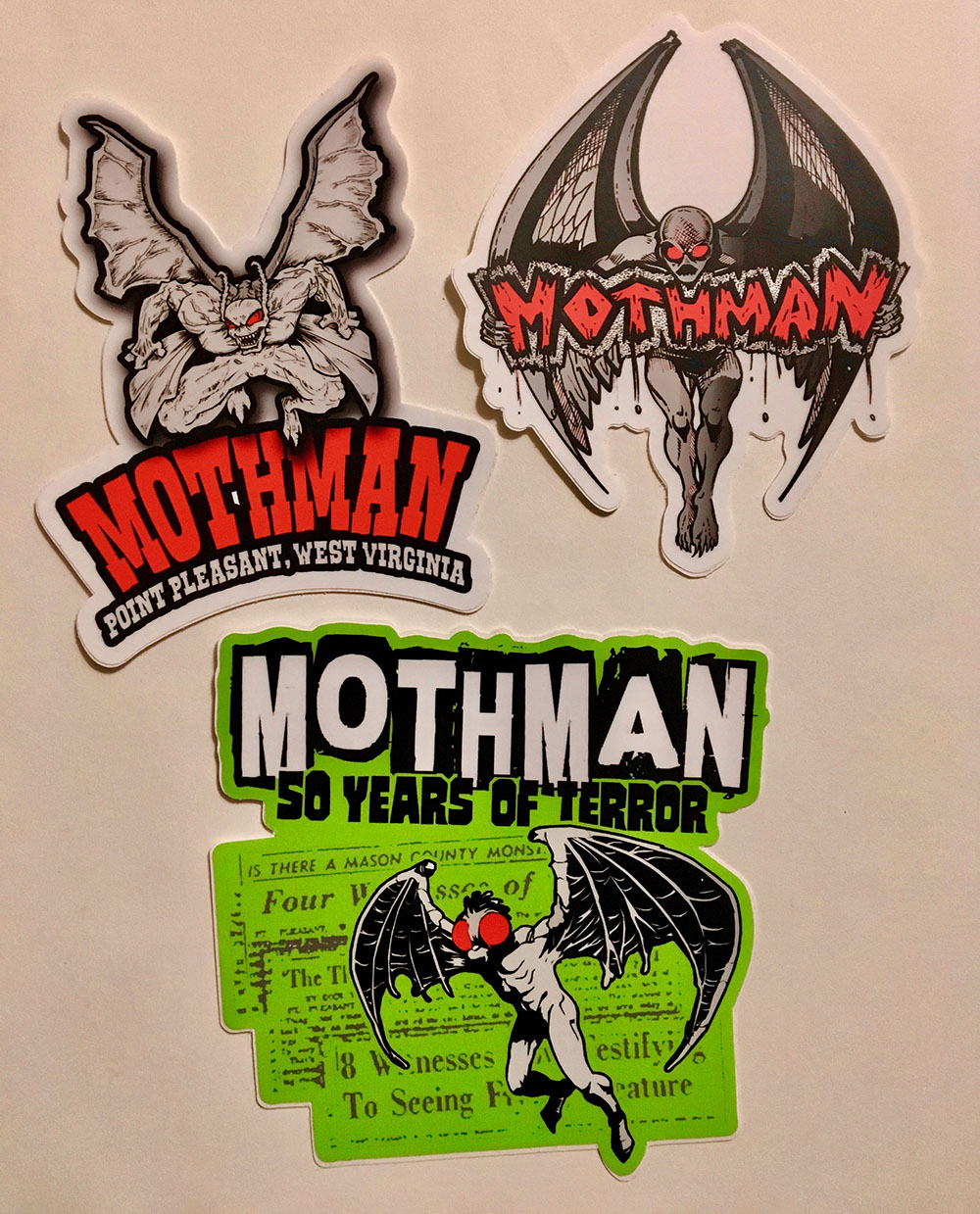
BR: Money, right. And, you know, they have a Mothman festival. There’s the Mothman Museum, as I mentioned, with all sorts of t-shirts and hats and interesting memorabilia, some of which is frankly, at least to my mind, pretty tangential to Mothman, at least to the original sightings. I mean, there’s a small room and display about the Men in Black, which doesn’t have any particular connection to Mothman, unless it’s sort of, you know, again, added later on by John Keel and Gray Barker and others. But of course, you know, you understand that, right? Because if there were, if the museum only focused on the original handful of sightings, it would be a one room exhibit. It would be a crane museum. I mean again it’s a cool museum. I recommend people go see it. It’s neat and it’s interesting and they have the handwritten accounts of Linda Scarberry and some of the other people. So I mean but again it’s it’s the kitchen sink approach. It’s everything lumped together. It’s stuff that with only very tangential stuff. Things that you know connected to Mothman. There’s the Silver Bridge collapse which again doesn’t have any connection to it. So there’s a there’s a crypto tourism angle. I mean, to be honest, that’s the main draw. You know, again, I spent several days there. They put me up in a hotel right across the river in Galluppolis, Ohio. And I stopped in a Piggly Wiggly, uh, one night after we were done. And I hadn’t been to Piggly Wiggly in 20 years. I was like, Oh, this is kind of cool. And of course the, the girls behind the counter, like you’re excited about being in a Piggly Wiggly, sir? I was like, well, we don’t have those back home. And she’s like, clearly, you sad, sad thing. But that was unspoken.
1:11:25
CW: City slicker.
1:11:26
BR: Right. But it was late one night and I was going back to the hotel and I was buying some hot chips or something. I was cleared out from around there. And she’s like, why are you here? And I’m like, oh, I’m here for a Mothman TV shoot. And one of the girls who rolls her eyes, she’s like, it’s like, that’s, that’s what we’re known for. And it just sort of like, and it was, yeah, it was like, and I…
1:11:48
CW: A little bit of resentment or ennui with the whole topic?
BR: Yeah. It’s like, and you could tell in her voice and just, and the other girls agree that there was like two or three checkout girls there. And, and you know, they were probably in their late teens or something. And I mean, whatever, no one was badmouthing, but she’s just like, stupid, silly thing that no one has seen around here. If they’ve ever seen it, and it happened, you know, in her grandparents’ age. And it was just sort of, it was weird to her. I mean, again, everybody there gets it. I mean, everybody who lives in Point Pleasant is well aware that people come from all over the place to see the Mothman statue and buy Mothman burgers. But there was also sort of this like irritation, like they just wish that their hometown would be known for something a little more substantive.
1:12:38
CW: So they’re a little annoyed that they’re beholden to this legend that’s been saddled upon them.
1:12:44
BR: Yeah.
1:12:46
CW: Yeah, I could get I get that. Yeah. I mean, I live in Nevada. We got Area 51. I know how that is.
1:12:51
BR: You know how that is. And actually, it was interesting that apparently even the Mothman statue, there was some controversy about that.
1:13:01
CW: Yeah, it took funding I imagine.
1:13:03
BR: Well, it wasn’t so much the funding and there were people happy to put it, but apparently it was originally and it still is dedicated to veterans. The Mothman statue that everybody photographs and looks at, it’s actually on a little small war memorial.
CW: That’s a little weird.
BR: It’s a little weird and it pissed some people off. They’re like, this is dedicated to locals who gave their lives in wars. And at the end of this little strip of land you have this eight-foot-tall silver thing.
CW: Giant insect with red glowing eyes. That’s yeah…
1:13:40
BR: And so there’s some sort of resentment among the locals. And and again, it’s a mixed bag. So they appreciate the attention it gets and they appreciate the money that comes in with the Mothman T-shirts and the museum and the festival and all that. But at the same time, you know, you can tell they’re like they sort of wish it would go away.
1:13:59
CW: Did you get a sense of of whether or not residents appreciated the added publicity that they got from authors like Keel and the movie, etc., etc.?
1:14:06
BR: Well, again, it’s sort of a mixed bag in the same way. I’ve read some accounts of people who, again, they’re happy that Point Pleasant, West Virginia is on the map somewhere for some reason. I’ve read some accounts in which some of the original Mothman eyewitnesses were actually kind of upset at John Keel and Gray Barker for basically twisting their story around and sensationalizing it. Oh. Yeah, and so in John Keel’s book, The Mothland Prophecies, it’s actually sort of looked down on, even by many mystery believers and Forteans, as Exhibit A of how an investigator can go wrong by becoming too involved in the case.
1:14:48
CW: So it wouldn’t even pass muster with that group, right?
1:14:51
BR: In fact there’s a there’s a short quote from Bob Ricard who’s the founder of 14 times and he he reviewed Kiehl’s book And he said quote it’s remembered as the first to reveal the problems facing an investigator when he loses detachment And becomes personally involved in the unfolding drama Which is kind of harsh words. I mean, it’s exactly accurate I mean, I’m glad he mentioned that because that’s exactly the problem with Mothman prophecies, is that Kiel sort of took other people’s stories of Mothman and injected his own agenda and spin on it, much in the same way, for example, that just to quickly circle back to the Chupacabra, it’s very much in the same way that Jorge Martin, who’s a UFO buff in Puerto Rico, seized on Madeline Tolentino’s original sightings of the Chupacabra and sort of steered her narrative and her story towards including extraterrestrials and ETs and UFOs and things like that. And that’s one reason why today the chupacabra story involves UFOs in the same way that that’s one reason why today the Mothman story involves men in black and UFOs and things like that. It’s because of writers like John Keel and Gray Barker who added their own little spin to it.
CW: I see.
BR: So you’ll kill again kills was a weird guy He had lots of weird ideas, and I’m not saying that as a skeptic looking down on him He just he just had a lot of really quasi paranoid weird stuff.
1:16:15
CW: I think listeners get that
1:16:17
BR: And there was a here’s a here’s a quick quote. This is um In an interview given in 2002 Linda Scarberry who was one of the original eyewitnesses, recounts how Kiel advised herself, as well as other female witnesses, to the Mothman to beware of the men in black expressing interest in their children. It would be as well, he suggested, to keep a gold crucifix near the crib of infants. So he was basically injecting these weird ideas that, you know, if you’re a Mothman eyewitness, watch out because you’re going to be you’re going to be threatened. You’re going to be having people coming to your doors to to attack your children, just all these sort of weird, unnecessary, tangential aspects to what was basically what basically began as, you know, sightings in a forest.
1:17:06
CW: Yeah, Women, parents in general do not take kindly to somebody going, oh, that’s a nice kid you have there. It’d be a shame if somebody had something happened to him. Here’s a gold crucifix.
1:17:18
BR: Yeah, and I’ll just give you one. So in one of Jeff Wamsley’s books, again, the proprietor of the Mothman Museum, he quotes one of the witnesses, one of the original ones, a guy named Tom Ury. He was actually irritated at Gray Barker who wrote the book The Silver Bridge, which is about the bridge collapse and the Mothman, all that sort of tied in with Mothman. And he was actually irritated at how they’d been portrayed. And he said that he finally had a chance to confront Barker. And he said, quote, Barker was straightforward about what he called poetic license. He said, that’s the way we wrote the book in this type of business of science fiction, et cetera, et cetera. He would tell you that he wrote the book in a fairy tale style. So it’s clear that by the time that John Keel and Gray Barker got their hands on the Mothman story, all they were trying to do was make a good story, embellish it, and not try and solve the mystery. Whereas the approach that I’m trying to take is actually trying to solve the mystery and trying to weed out all the confusing myths and mistakes.
1:18:19
CW: Yeah, and you know as a sci-fi buff, I get it. I get the lure of taking something that’s slightly based on reality and just going to town with it I mean the three phrases that jumped out at me from that quote or you know poetic license science fiction and fairy tale. Which you know that goes against any sort of getting at the truth of any any legend.
BR: Yeah, I mean, I’m all look I love fiction I love stories that’s all well and good good, but there’s something a bit distasteful about lumping in real tragedies like the Silver Ridge Collapse that killed dozens of people and real people’s lives and sort of lumping them in for your own profit and put your own spin on things.
CW: Yeah, absolutely.
1:19:06
BR: And that, boys and girls, is basically the Mothman story.
(MUSIC)
1:19:09
CW: Well, thanks, Ben, for recounting your experiences, not just on the German television show about Mothman, but quite a few other things, ranging from a George Takai TV show that featured some Mothman animation and the original reports as you’ve always said, go back to the original reports.
1:19:45
BR: Indeed, indeed.
1:19:46
CW: Yeah, well, in a couple of weeks time, when hopefully my voice will be a little bit better than this, we’re going to be serving up some skepticism and some just appreciation for literary hoaxes.
1:20:00
BR: Yes, this is one of my many interests. Behind me as I’m recording, I have several filing cabinets that are nearly as tall as I am with all sorts of wonderful decades of clippings and this and that and one of the fattest files in my office is on literary hoaxes.
1:20:19
CW: You can’t make this stuff up. Oh wait, no, you can. Somebody did.
1:20:22
BR: But yes, yes indeed you can. I’ve, as you know, I’ve always been interested in hoaxes and frauds and things like that and particularly literary ones.
CW: What makes a hoax a literary hoax? Describe to me what you categorize as a literary hoax as opposed to say an art hoax or a cryptid hoax or a UFO hoax.
BR: Well that’s actually a really good question. Certainly, there are aspects of literary hoaxes in other ones. For example, in UFOlogy, you have the faked MJ-12 documents, which were allegedly these official government documents that were revealing secrets about UFOs, and those turned out to have been faked. There’s fake documentation sometimes in some of these cases, but it’s an interesting question. So a couple of examples would be – well, one obvious one would be the Hitler Diaries which the story – or the Howard Hughes Diaries in which the diaries of a reclusive person were later discovered using big air quotes here long after the fact and then published and people got rich off those.
1:21:35
CW: I could see the monetary drive to attribute some piece of literary work to a famous author. In fact, there was recently a whole movie with Melissa McCarthy about faking some sort of literary, in her case, just autographs and letters and notes from great literary figures.
1:21:58
BR: Yeah, and then there’s a whole category of faked memoirs. That’s that’s one angle I particularly find interesting. So by some measures, James Fry’s book A Million Little Pieces would be. You can argue that it’s not entirely a hoax. It’s just exaggerated. And again, that’s that’s a legitimate question is, you know, is how much license does or shouldn’t author be afforded if they’re describing things that really happen to them? But at what point are you sort of telling the truth in a creative way and you’re just flat out lying?
1:22:31
CW: Yeah, yeah. There’s only so much artistic license you can be given as a really any type of artist.
1:22:41
BR: Yeah, and one other example would be a case that I wrote about in my 2003 book, Media which is the case of Anthony Godby Johnson. And that was allegedly a young boy who was dying of AIDS and various other ailments. And he wrote a book titled A Rock and a Hard Place that later turned out not to be true.
1:23:03
CW: Oh, there was no such boy?
1:23:06
BR: Yeah, he didn’t even exist. It wasn’t a James Frey case in which it was a real person that fabricated parts of his history, it turned out to be an entire fabrication, sort of the ultimate catfishing.
1:23:23
CW: Interesting. Well, those sound like some very good material to start with and if we get through those, maybe we can even talk about literary hoaxes like the quotes that turn into memes attributed to people that they never said.
1:23:38
BR: Another great example.
1:23:39
CW: Yeah, although we don’t have the time for that. Ain’t nobody got time for that. Okay. All right, everybody, we will see you next time. Stay strange and stay tuned for Incredulous by Shriekback. We would like to extend heartfelt thanks to our sponsor level patrons.
1:24:10
Amy Frusciower Kelly, Dr. Angela Matkey, and Elizabeth Leggett. If you’re interested in becoming a sponsor, or just throwing us a buck or two per episode, check out patreon.com forward slash squaringthestrange. Every little bit helps us keep the lights on here, and we could not keep bringing you content without the support of our generous friends. If you’re short on cash but want to provide moral support, remember to recommend us to a friend. If you’re short on friends, hey, remember
1:24:36
that each five-star review helps us get higher on the podcast charts. Squaring the Strange is a production of Two Heads Studio LLC, copyright 2018. Theme music by Shriekback, additional music by Memory, Keytard and Feathered, and Pasqual Romero. Additional support provided by Ashley Romero, Robert Sundin,
1:24:57
and of course our listeners and patrons. The views and opinions expressed in this podcast are those of Squaring the Strange and do not necessarily reflect
1:25:04
the views and opinions of Two Head Studio, Kronos Creative, Center for Inquiry, our advertisers, or any affiliated organizations
1:25:13
and employers.
1:25:14
They said that he was terrible, that he rode the bogus train, that he fucked the monkeys like in the film, though they changed a lot of their names, that he had a sheep sewn into him
1:25:25
for a penance he’ll pour. I don’t believe that, I don’t believe that, I don’t believe that anymore.
1:25:45
He said he feeds from sodium and that he has an iron brain.
1:25:49
And his book of headlines magnified it very well in Spain But the bullhead got a bullet in the wings, he wrestled to the floor
1:26:07
I don’t believe that, I don’t believe that, I don’t believe that anymore They say he was the slack who had worn a poison face And that he does the brick ballet in black Sofia’s dress
1:26:31
And that he cracks the bishop’s latch dressed as a dinosaur Don’t believe that, don’t believe that, don’t believe that anymore They know these truths so evidently impossible to ignore I don’t believe that, I don’t believe that, I don’t believe that anymore
1:26:59
What poverty brought is not what is pushing to the core What poverty brought is not what is pushing to the core I don’t believe that, I don’t believe that, I don’t believe that anymore
Transcribed with Cockatoo