
Episode Summary:
This week, our crew digs into health panics and what’s in our food. Focusing on the notorious “pink slime”, the Strangers break down the history of the hysteria and talk about how bad it really is (or isn’t). Also in this episode, Ben is skeptical of the tragic tale of a Tasmanian Devil named Jasper.
0:00:00
Ben Radford: Welcome to Squaring the Strange, the podcast that examines all manner of the mysterious and the mundane through a critical lens. So let’s square the strange.
(MUSIC)
0:00:13
Pascual Romero: Welcome back to Squaring the Strange. This is Pascual and with me is Ben Radford and Celestia Ward. How are you guys doing?
CW: Great.
BR: Doing well.
0:00:37
PR: Awesome. This week, yeah, I sound a little rough again. I got over the remnants of whatever namthrax I had last month and now I got a cold last week.
BR: Launching into another one.
0:01:00
PR: Of course again.
0:01:01
CW: This week on Pascual’s immune system we have.
0:01:05
PR: What did Pascual catch this week? I’m going to power through. I sound worse than I feel. But anyway, Ben, what are we covering this week?
0:01:16
BR: Yeah, I thought it would be interesting to touch on sort of health panics and health scares. Of course, there are many legitimate health fears that the public has, and many of them, frankly, are downplayed. I was going to use flu as an example, and usually it is. This past season has been especially bad and therefore making the news a lot. But in years past I’ve heard people say, oh, it’s just the flu. Like, okay, you know you could die from that.
0:01:40
PR: Yeah.
0:01:41
CW: Or people get like a 48 hour cold and they say, oh, I just got over the flu. No, no, you didn’t.
0:01:48
PR: You know when you have the flu.
BR: Yeah, it’s not a big mystery. I’ve always felt that one of the main objectives and purposes of skepticism is often to help allay the public’s fears. And we do this in many different areas, whether the satanic panic or food scares or what have you, there’s continual drumbeat of, this should terrify you, this should alarm you, don’t click on this, you could die. There are a lot of people who play a role in trying to dampen that down, including health professionals and doctors and parents and others, but oftentimes it falls to skeptics to sort of take a step back and realize that maybe some of these fears were exaggerated.
PR: Yeah, and as being speaking of being skeptical, what are you skeptical about this week Ben?
BR: So this week I wanted to talk a little bit about a Mysterious case that occurred here in Albuquerque here in New Mexico.
PR: There’s a lot of mysterious cases here.
BR: Lots of stuff.
PR: Yeah, if you’ve seen breaking bad, that’s only the half of it.
0:02:45
BR: There’s more where that came from. But I want to talk about the mysterious death of Jasper the Tasmanian Devil.
PR: Oh yeah, I remember that one.
BR: You remember this one.
PR: It was a bummer. Yeah, yeah.
CW: I am new to this. I have never heard of Jasper.
BR: Well that’s that’s why I wanted to enlighten you.
CW: Okay.
BR: So Jasper the Tasmanian Devil. Now for those who don’t know, Tasmanian devils don’t actually spin around like in the cartoon. I mean, they can, but they generally don’t unless you actively spin them, which I don’t recommend doing. But this particular one, Jasper, apparently a sweet-natured little fellow. I didn’t see him, I saw photos of him, and you know, I’m an animal lover, and so I was like, aww. And he was a big biopark attraction here in Albuquerque. And unfortunately, something bad happened to Jasper. Jasper was murdered.
0:03:43
CW: Murdered?
0:03:44
PR: Cue the dramatic music.
0:03:47
BR: Or… I don’t… Does murder apply only to people?
0:03:52
CW: Was he murdered by another Tasmanian devil or by a human?
0:03:57
BR: Wow. Therein lies the rub. So, yeah, so on Tuesday, October 14th, overnight Wednesday, October 15th, 2014, Jasper was found dead in his cage. He had been found underneath a log and it would actually, it rolled over onto his head or he was found underneath a log, let’s put it that way. And it was very strange, very mysterious, and there was a huge public outcry, as you can imagine, because the… Well, let me do a better job of setting the stage. So Jasper was found dead in his cage, bloody, one morning. And no one knew what happened. There was a piece of asphalt, a chunk of asphalt that was found not too far from his body. Now, the immediate assumption was that some sadistic bastard had thrown a chunk of rock at Jasper, hit him on the head and killed him. This, as you can imagine, sparked an outrage. There were headlines such as ABC News, Jasper the Tasmanian Devil Killed in Violence Attack in US Zoo. Now this made a lot of news in Australia because Jasper had come from Australia. As many of them do.
0:05:16
CW: And they’re getting to be kind of endangered now, right? The only thing I really know about Tasmanian devils, not the Chuck Jones designed one, but the real ones is that they’re suffering from some sort of face thing, right? Some sort of disease that is a result from their mating habits where they bite each other on the face a lot. And so that’s cutting into the population from what I recall hearing.
0:05:37
BR: Wow, that’s weird. I have no idea where you’re going with that.
0:05:42
PR: I’m not super well read on Tasmanian devils.
0:05:44
BR: Or mating rituals. Apparently Celestia is. So there were a lot of headlines along the lines of Albuquerque’s zoo says Tasmanian devil’s victim of foul play. The search is on for the Tasmanian devil killer, that sort of thing. In fact, there was even a law that was proposed. In the 52nd legislature, State of New Mexico, first session 2015, George E Lewis introduced House Bill 300 and it’s an act, I have it right in front of me, it says an act relating to animals prohibiting interference with the zoo animal, providing a penalty, amending the definition of animal for the purpose of crimes of cruelty to animals and extreme cruelty to animals. So again this is a bill in the in the in the legislature that is a direct result of this of this animals killing.
CW: Jasper’s Bill.
BR: Jasper’s Bill. And it’s interesting I’ve investigated other cases of supposed animal cruelty that’s been attributed to Satanists for example or sadistic teens.
PR: Sure, sure.
BR: There’s been a couple that I can think of off the top of my head. A few of them are real but frankly most them are mistakes or misunderstandings. I remember one particular case I wrote about a few years back. There was a horse, I think maybe in Wyoming or Colorado or somewhere, and a farmer reported these deep gouges in the horse, and the farmer was certain, or farmer-rancher, was certain that some sadistic teens were stabbing their horse or something.
0:07:08
CW: Was it actually the chupacabra? Did you track that down?
0:07:11
BR: It was not the chupacabra. It later turned out actually to be a barbed wire fence. For whatever reason, just the placement of the slashes were in a place where they just didn’t occur to them that that would, but in fact, upon investigation, no one was torturing this poor horse. It was just part of what was going on. Anyway, so there was an investigation, and I followed this case a little bit, partly because I, like everyone else, was outraged. Like who would do this? What sort of sick bastard would go to a zoo and kill an animal?
0:07:39
PR: Yeah, absolutely. Especially an endangered animal. And it’s very clear that it’s endangered by the signage around the pen, which not to say that other animals don’t deserve respect, but it’s just especially heinous when you’re talking about, I think there are less than 15,000 in the world, something like that.
0:08:02
CW: The face biting, I’m telling you.
0:08:04
BR: The face biting, yes. So anyway, I like everyone else was appalled and outraged at this story and I was just disgusted that anybody walking around in my home city would even do such a disgusting thing. But I had no other information. So the zoo commissioned an investigation. They hired a private investigator, Robert Caswell Investigations, to look into it. Again, so the stage is there was an asphalt chunk that was found near the animal and the thought is that somebody had thrown this, hit him on the head, apparently just perfectly, and stunned him and killed him. So as it turns out, the story changed. So it’s officially undetermined, but no evidence was found that the asphalt chunk played any role whatsoever. So this is a good case of what we talk about in the show, Hyman’s categorical imperative, right? Before trying to figure out why Jasper the Tasmanian Devil was killed, find out was he actually killed? Was it an accident, whatever else? So the investigator realized that what had probably happened was that a log had slipped off another log and rolled down onto him and killed him by himself in the pen. There were no other animals in the pen. And the asphalt chunk that was at first assumed to have killed him, it turns out upon investigation that the zoo had used fill dirt from construction sites and elsewhere that happened to have asphalt chunks already in it. And the zoo officials didn’t remember seeing that particular chunk of asphalt. I mean, they said, I don’t know whether it was there or not. And they assumed that it wasn’t there. And it’s like in the case I looked at in the Stonehenge Surprise, where there was a crop circle there, but no one noticed it. Just because you didn’t notice it doesn’t mean it’s not there. And that was the case here.
0:09:54
CW: Well, to be fair to all urban legend fans out there, is it impossible that it was maybe not a frozen chunk of ice from an airplane bathroom from 10,000 feet that fell all the way into the cage enclosure and killed him and then melted before anybody got onto the scene?
0:10:11
BR: Well, there’s always that.
0:10:14
CW: Oh, okay. But probably it was the log.
0:10:17
BR: That probably was the log. So it’s an interesting case from a skeptical point of view where, you know, there’s this outrageous thing, this horrific, presumably intentional act on an innocent animal that pisses people off and generates outrage, but upon investigation you realize, okay, well there’s more to it than that. So anyway, they also realized that the chunk of asphalt was too far away from his body to have plausibly caused the damage. And it would be a really lucky shot. I mean, first of all, who would do that? Number two, it turns out there was no surveillance camera at the time. No one saw this. It was all pure speculation. So one of the outcomes of the investigation was that it did give the zoo suggestions for safety and protocol. So for example, they’ve, they’ve added cameras, the, uh, the, the security staff, they didn’t before look into the animals because their security isn’t… Their job isn’t the animals, but they, as I think, as part of their routine, they now do that. So anyway, so that’s, that was sort of an interesting thing. And one reason I wanted to bring that up was that it has implications for another case. And this is one that which you all probably heard about. There was a attack on border patrol agents off a Texas highway in November.
0:11:30
PR: Yeah, I do remember that.
0:11:32
BR: Remember that case?
CW: I do not. I guess I’ve been out of the loop.
0:11:35
BR: You do not? That’s okay. Well, it was in West Texas, so we’re close to where it was. Okay. There were two border patrol agents, Rogelio Martinez and Stephen Garland. One of them was killed, and the other one was injured but has no memory of what happened. So one of them recurred. I’ll read from a piece in the New York Times. This is by Matthew Hagg and Caitlin Dickerson, February 7th. Just hours after the agents who had been on duty were found in a dark culvert off Interstate 10 about 100 miles east of El Paso. Politicians seized on the news as a flashpoint in a broader debate about immigration and border security. President Trump called it an attack and further evidence that a wall was needed between Mexico and the United States.
0:12:16
PR: Yeah that’s how I heard about it was just Trump talking about it and I was like you know of course.
0:12:20
CW: That explains okay I try to tune everything out the Trump says.
BR: So again it was a very mysterious situation. I won’t go into all the details here, we don’t have time, but essentially these two Border Patrol agents were in this remote area where there is you know human smuggling and trafficking and that sort of thing. Both badly injured, one’s dead, and the other one was I think comatose for a while and eventually recovered.
0:12:46
CW: Now were they in a vehicle or were they just walking around?
0:12:51
BR: They were walking around. They were not inside a vehicle. But anyway, again, it’s an interesting case. If people want to look into it, but it was very, very strange and mysterious. And immediately the assumption is, well, these were attacked by Mexicans. To be fair, it’s not an unreasonable assumption. This is a border patrol area. Occasionally, what are called the coyotes, there are armed drug smugglers. I mean that it is a is inherently dangerous place. So so leaping to that assumption that it was it was an attack was not entirely unwarranted. But in this case the Bureau found that they found no evidence at all suggesting an attack, so this is this is interesting right so you have you have one agent dead another one injured and has amnesia about what happened There’s no evidence that I think they were hit on the head. It could have been a fall or slip or something. It’s the circumstances are murky. There was no one else around, no other witnesses, but the case was very thoroughly examined. I mean, you can bet that the border patrol, they did not spare any expense trying to figure out what the hell happened. And there’s just no evidence that they were actually attacked. Probably not a suicide, but it’s probably an accident, we don’t know. But again, it sort of ties in with the whole rush to judge and assumptions.
0:14:08
CW: So there’s no theories on that. There’s no evidence of a landslide or, I don’t know, latrine ice from an airplane or anything at all indicating what might have caused the injuries of these two, or the death and the injury.
0:14:23
BR: Well, as I said, I don’t have the time to go into all the details. You can find it on your own. The upshot is that after a presumably thorough investigation, the Border Patrol found no evidence of an attack, which is how it was immediately assumed to be by Trump and others. And of course, they corral that into their own agendas.
0:14:40
PR: Yeah, and I’m sure we got a retraction and an apology from the president.
0:14:45
BR: Yes, I’m waiting on that.
(MUSIC)
0:14:51
PR: So this week we’re going to be talking a little bit about food hysteria and health risks and things that surround that and some of the misconceptions and crazy urban myths we’ve seen around this. So Ben, why don’t you walk us into this. You talked about pink slime at the top of the episode. What is pink slime?
0:15:26
BR: What is pink slime?
0:15:27
CW: That is the question.
0:15:28
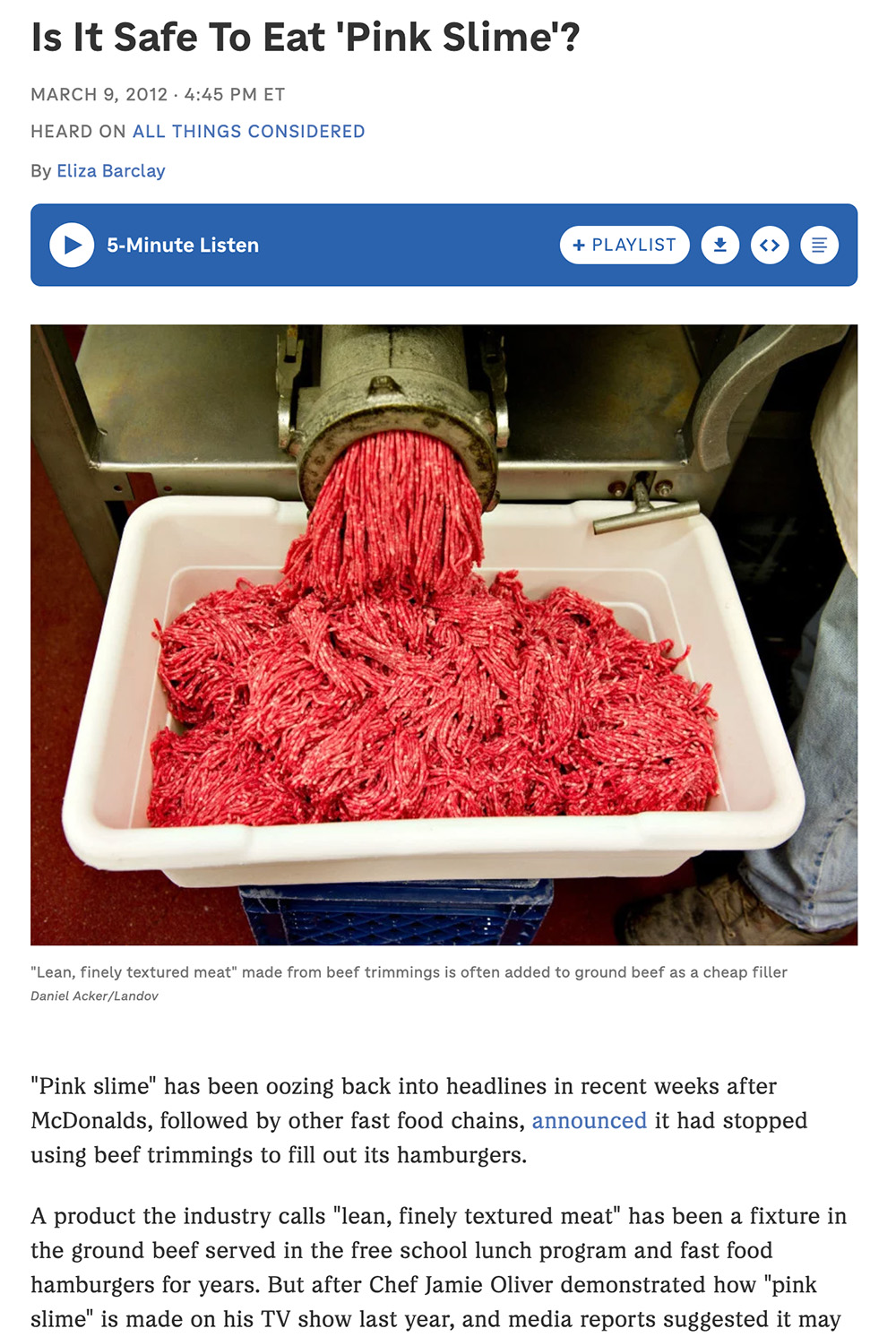
BR: Don’t Google that, for the love of God. Yeah, so part of the reason that the whole story intrigued me was that it was this huge story a few years back. For those who don’t recall, basically there was a, I would almost call it a moral panic. I mean it definitely had elements of that. Sure, sure. Certainly there was, you know, sort of a hysteria about food safety and this and that. Basically it was, call it whatever you want, its critics called it pink slime. The company that made it called it Boneless Lean Beef Trimmings. It’s basically sort of the left, it’s sort of like the version of what goes in hot dogs, more or less. It’s basically, you know, parts of the animal’s carcass that are really, they’re not dangerous, they’re not unhealthy, they’re just parts that you’re not going to get at your local supermarket.
0:16:25
CW: Yeah, right, right. And so I did a little reading into pink slime too, and they were pretty specific It’s not like they crush the bones and throw the eyeballs in there, but it’s it’s meat that they can’t quite get off the carcass through regular like hand trimming means, but when they can mechanically separate it from the bone and just get more out that way.
0:16:44
PR: Right and you’ll see that with with chicken as well, and they even call it mechanically separated chicken. It’s a very similar product.
0:16:50
BR: Yeah, and and you see that a lot in cat food and dog food. Mechanically separated, I mean it’s not, it doesn’t mean it’s bad, it just means it’s…
0:16:57
PR: Yeah, it’s not something that you can throw in a little package and you know throw on the grill, it’s just sort of a scrap of meat, you know, when you collect it and grind it up it becomes something…
0:17:11
CW: It’s the same kind of thing you eat if you throw a soup bone into your soup to have all the extra meat that’s stuck in the bone separate through boiling to have yourself a nice soup.
0:17:20
PR: Sure.
BR: Yeah, absolutely. And so as a skeptic, I was kind of annoyed, I guess would be. A lot of things annoy us as skeptics, nothing new there. But in this particular case, I was watching this, I mean, I’ll just go ahead and call it. It was basically a panic. There were parents and politicians who were outraged. There was an online petition demanding that governments keep pink slime out of school lunches.
0:17:45
CW: They succeeded, right? And the school districts in I think 47 or 48 states banned it and they couldn’t, they couldn’t use it in any school lunches except for I think two states decided to keep it.
0:17:56
BR: Yeah, yeah. I mean it was, it was a whole, it was a whole production. You know, I guess what bothered me was a lack of evidence. It was all this fear and hysteria and, oh my God, you know, won’t someone think of the children? And I’m like, okay, it’s kind of gross. I wouldn’t want to scoop it up and eat it. But number one, I probably have eaten it and I’m fine. And number two, take a step back. And before you start getting frothy at the mouth that, oh my God, the chance that your kid might eat this, so what? So what, and what? You’re feeding your kid nothing but health food the rest of the time? So, you know, I think skeptics often, as I said at the top of the show, I think one of the roles of skeptics is to help the public discern what is a real threat and what’s not a threat. And we do this all the time. We do this with cell phone scares. People get concerned that, oh, if they use a cell phone, they’ll get brain cancer. And concerns about EMFs or food additives or the safety of vaccines, GMOs. I mean, there’s many, many, many topics the skeptics can play a role in helping to calm the public’s fears and say, okay, I know you’re freaking out. I know that you’ve been watching too much Alex Jones and Food Babe, but take a step back and look at what the really is.
0:19:15
CW: In this case, I mean this one resonates with me because I got pretty ticked off about it when it all happened. In this case I think it’s not just spreading a false danger, it’s also doing some harm in the way that these lean beef trimmings, they mechanically separate it and then they use a centrifuge to separate the fat. So what you end up with a low-cost, lean, protein-rich meat product. In the lower economic sectors of our country, we have huge rates of obesity and heart disease and access to a low-fat source of protein that’s low-cost, that will help that. In a public health outlook, that will help that, but not if people are too afraid to eat it because they’ve heard scary words like ammonia. You didn’t get into the fact that ammonia is used to help kill the bacteria.
BR: That’s right. Yeah. Yeah. I forgot about that.
0:20:11
CW: People freaked out at the thought of ammonia gases being used to to quite frankly make this this beef safer. I was reading into it. And the only danger about using ammonia to kill the bacteria on this beef is if they have a lapse. If their ammonia spraying machine is broken or they don’t use as much as they need, then there’s a danger because there could be bacterial contamination that gets through. The problem would be too little ammonia. That’s the health problem you want to worry about. But people freak out because just like fears of formaldehyde and aluminum in vaccines, it’s a non-food thing. It’s something that’s used for cleaning. It’s something that’s a chemical with a capital K. So people freak out about that when, I mean, the same ammonia process is used in baked goods and puddings and Velveeta. So the news stories that broke out about how awful this pink slime was and how it’s coated with ammonia, it’s not actually coated, they just use a gas. They were neglecting that it’s in half of our food supply anyway and we of course produce it in our own bodies granted it’s secreted, it’s a waste product in our bodies but we we have it in our bodies, our bodies are good at getting rid of it so the tiny trace amounts that are left in there after it kills the bacteria that really could kill you are nothing at all to worry about and that’s been determined by the agricultural authorities and scientists all over the place, but people hear the word and they freak out.
0:21:41
PR: What you end up with is ammonium hydroxide from the gas coming in contact with the water in the meat. And then what it does is it increases the pH and damages the organisms and then it’s frozen, which punctures the organism’s cell walls and destroys it. And once…
CW: It sounds so violent.
PR: With the mechanical stress… yeah, it’s really violent. At a microscopic level, it’s very violent. And then with the weakened cell walls, the mechanical stress of the separation process actually destroys them, like physically destroys the organisms. And it ends up being at the end of the day, that the amount, the ammonia itself, at first off, it’s not pure ammonia, it’s ammonium hydroxide, which is a bonded chemical that comes from water and ammonia being coming into contact with each other and it ends up being such a trace amount that it doesn’t matter anyway, and it’s it all it does is really raise the pH of the Water in the meat and you know, so it it’s pretty it’s a pretty non thing to begin with and they wouldn’t have started using it to sanitize meats if it wasn’t already deemed to be safe before they started using it. So you know and last I heard nobody’s died from you know ammonium hydroxide related circumstances from their meat.
0:22:57
BR: Well you know I think it’s one of those cases in which there are standard industry practices that are common and unremarkable to scientists, people in industry, professionals. It’s like it’s a it’s a non thing. Yeah. Until some non expert such as the food babe or some concerned parent says hold on I google this Why in the world is there a this is this is crazy? You know this this thing you’re selling me This is found in antifreeze, what?
PR: Your stomach’s full of hydrochloric acid I mean that’s that can burn your face off.
0:23:31
CW: Yes, as I say the dose makes the poison.
0:23:39
BR: Yeah, and going back to the ick factor, and that’s one thing, I’m one of the few people that actually wrote about this at the time, not to pat myself on the back, but I just was. For Discovery News, I wrote a piece basically trying to tamp down the public’s fears about pink slime because no one else was doing it. I’m like, come on, guys. Virtually all the news coverage was how horrible this stuff was and how toxic it was. I’m like, no, no, no, it’s just, hey, I’m like the lone voice in the wilderness. This is not that bad, this is not, you know, people are freaking out because of the name and because it evokes this gross pink slimy thing. And you know, I go back to jello. You know what jello is, right? I mean, you know, jello is made from gelatin, which is collagen, and it’s found in animal tissue. It’s like basically bone cartilage and things like that. So that’s why strict vegans won’t eat it. So why is it so disgusting to give your kids boneless lean beef trimmings, but hey, that bowl of jello, hey, that’s fine.
0:24:39
CW: The historical look at the ick factor is interesting there because since you had to work so hard to get that collagen out and make gelatin, like you had to boil the hooves forever and then you can make this nice little gelatin product. Foods put into gelatin like tomato aspics and everything were always thought of as a very high class food like the rich people eat that. Oh, this is a such and such thing formed in an aspic jello mold and it was for the very high class people. And then when powdered gelatin was introduced in the 1960s or 70s, it set off this fad of people putting everything in jello. That’s where you see all these horrendous cookbooks where you can make spaghetti in a jello mold or seafood salad in a gelatin mold or like bananas and hot dogs in a gelatin mold. It’s because people were super excited about having the ability to cook with jello because prior to that it would be so expensive because it’s such a work-intensive product to get.
0:25:39
BR: Yeah, I think part of the reason for the exaggerated concern was that it was basically a primal contamination fear. People, when you look at like folkloric things and psychological things, things that alarm people, it’s contamination, contamination of the body, of, or xenophobia, I mean, you know, basically many immigrant rumors and anti-immigrant complaint they’re essentially a form of contamination rumor. It’s the idea that we live in a perfect, pure society and all these dirty, evil, nasty immigrants are going to come in and ruin our fun. And so I think understanding the sort of psychological roots of it is useful. And I think that I was trying to figure out why it was that there was so little skepticism about pink slime at the time. I did a piece that are one or two other pieces, but by and large it was largely ignored by the skeptical community. I think it was largely because it didn’t really fall into any clear niche, right? It was a sort of slippery subject. As I said before, it was right for skeptical fear of lying analysis, but it wasn’t, it didn’t really fit into any of the classic skeptical categories. It wasn’t really the paranormal. It didn’t really have anything to do with alternative medicine per se. It wasn’t really pseudoscience. It was the sort of amorphous other category that didn’t really have a clear handle where you can go to.
0:27:04
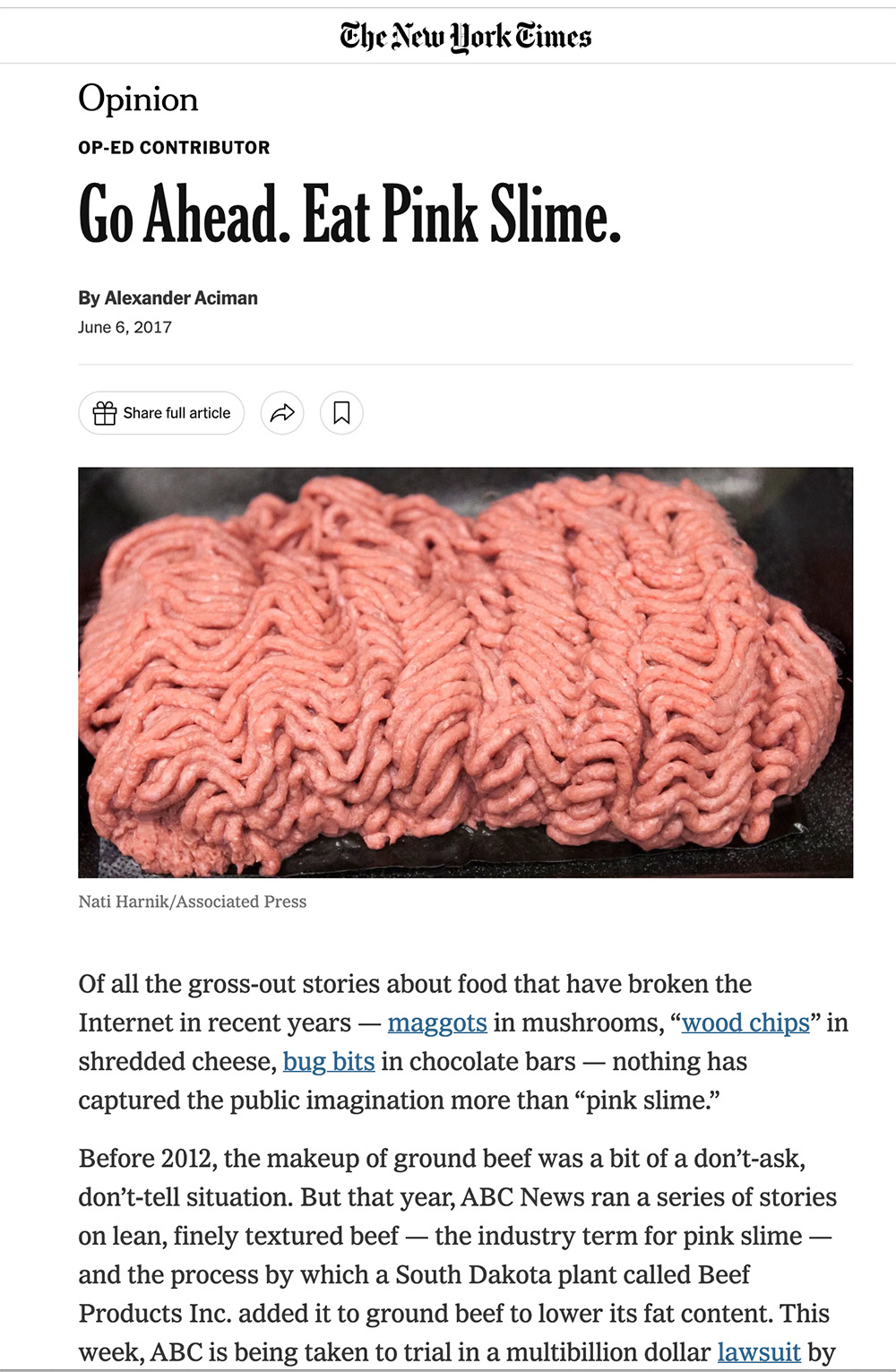
CW: And actually, I was going to tell you, the New York Times finally caught up to you and wrote a piece titled, Go Ahead, Eat Pink Slime. When do you think they published that, Ben?
0:27:15
BR: A day or two after I did?
0:27:17
CW: No, they waited years! It came out in June of 2017.
BR: Oh, on the cutting edge! Way to go, guys!
0:27:24
CW: Like five years after the big scare, they came out with a story where they pointed out that actually they were referencing the fact that the big lawsuit that was launched by the beef producers finally came to a close.
0:27:37
BR: Because ABC News, that’s right, I remember that.
0:27:40
CW: Yeah, and reading through the New York Times article, it’s an opinion piece by Alexander Aciman, A-C-I-M-A-N, it was back in June of 2017. And he points out many of the things that a good skeptic would point out, the fact that it’s very beneficial, that, I mean, according to the producer, it saves 1.5 million beef steer from getting slaughtered. You get that much more beef out of it if you go ahead and use the trimmings.
0:28:11
BR: In that sense, it’s a moral issue as well. I mean, you know.
0:28:14
PR: Yeah, I think that’s always an important consideration to make with a lot of these food myths because it’s one thing if you’re, you know, you can be a strict vegan and in a moral sense because you don’t want to enable harm to animals or whatever you believe about it, which is fine. And those aren’t the people usually arguing about pink slime. The people arguing about pink slime are usually people who do eat meat and are scared of that being in their meat or that being a threat to society somehow. And when you’re talking about trying to take the moral high ground with animal products when you consume animal products. You know, it’s a tricky, it’s a razor’s edge to walk. And when you’re putting your perceived health benefits, which there are none, in terms of that being any worse for you than any other meat, and your lack of even seeing what the benefit might be of it, you know, it’s like you actually are kind of trying to take the moral high ground from a human health standpoint, but then you’re actually going low with animal welfare because at the end of the day anything that doesn’t kill animals should be seen as a good thing, whether you eat meat or not. I mean you want to be as humane and as wasteless as possible with these things.
0:29:33
CW: Yeah, when this whole thing boiled over, I remember talking to friends about it. I wasn’t really in the skeptical movement back then. It was like 2012. But I had people talking, you know, as people do about how awful this pink slime was. And I said, well, it makes no sense to me because we’ve all heard the story of how, you know, noble the native Americans were, you know, hundreds and hundreds of years ago and how they found ways to use every part of the Buffalo. And that was seen as a good thing. And that’s exactly what these beef companies are doing. They’re finding ways to use every part of the animal, but somehow it’s evil and corporate and profit-driven, you know, like all businesses are. And so since it’s not Native Americans around a fire, it’s evil, it’s not noble.
0:30:19
BR: Right, right. We touched a little earlier on the food babe, Vani Hari. Why don’t we talk a little bit about her campaign against Subway. I remember she was frothing at the little food babe mouth, talking about how if you can’t pronounce it, you shouldn’t eat it, which I just thought was the funniest thing. I’m like, your level of diction should not dictate your diet.
0:30:43
PR: Yeah. You know how long it took me to figure out how to pronounce acai?
0:30:46
BR: So there was, you know, she had this huge campaign against Subway and she had this thing about how, oh, would you, you know, North Americans deserve to truly eat fresh, not yoga mats, because I guess there was like one chemical that is found, I think, in the bread.
CW: Adzodiacarbonamide? I should have refreshed myself on how to pronounce that, but yeah. That was another thing that pissed me off when it happened because I like Subway and they made the bread worse when they took it out.
0:31:19
BR: Do you want to talk more about that?
0:31:21
CW: No, I was just expressing my opinion. They made the bread worse when they took it out. They didn’t need to take it out.
0:31:27
BR: Well right, and of course, Food Babe, for those who aren’t familiar with the Food Babe, she’s been pretty thoroughly debunked by now. Actually, she’s had a lower profile in the past few years due to, in large part to lots of great skeptics.
0:31:41
CW: The Sci-Babe took her down several notches with a very high-profile viral article called the Food Babe is full of s***.
0:31:47
BR: And again it goes back to the whole notion of asking for evidence, right? I mean, you know, Food Babe stuff is, she has all these clickbaity titles, you know, like, are you eating this ingredient blamed for millions of deaths around the world? Probably, I don’t know. I don’t care. Go away. I mean, she has no training in nutrition or science or medicine. She is just sort of like, you know, she does the Jenny McCarthy, I’m a concerned mom.
0:32:18
PR: Right.
0:32:19
BR: I care about what goes in my body, don’t you?
0:32:23
PR: Yeah, sure, but I mean, you know, you do you, you know, but let’s not make it an international incident.
0:32:31
CW: Well, did you look into some of the scientific stuff behind this, Ben? Or because I remember a little bit I could talk about what the deal was with adzodiacarbonamide.
0:32:41
BR: I have no thing prepared in terms of digging. If you have some comments, I want to go for it.
CW: Well, Vani Hari, the food babe, really sort of promoted the idea that this stuff was being added to your food you know much like you see GMO scare tactic posters with a hypodermic needle going into an apple and injecting the dangerous science juice but that’s not how this chemical is used in bakeries and it’s used in bakeries all over the place she pointed to studies that showed that this chemical was linked to asthma and all sorts of other problems. And if you read those studies, which I did, the danger comes not from when it’s used as a food additive to help make breads, you know, fluffy and have a better texture, which is used all over the place for bakeries. Look on your grocery store aisle, half the breads are going to have this. This hadzodicarbonamide, I think I said it right that time. But the danger comes, the studies that show that it can produce a danger, that’s when it’s used in an aerosol form, when it’s being sprayed as a lubricant or as some sort of catalyst chemical to help with certain things in the factory work, then workers who are around it constantly, who are breathing it in through their lungs, that absolutely does create an asthma danger for them. But as long as you…
0:34:05
BR: But hold on, that’s the opposite of what she said. The food babe lied?
0:34:12
CW: She absolutely misrepresented the danger by… I mean, unless you want to actually breathe your Subway sub into your lungs, the azodicarbonamide should not affect you.
0:34:27
BR: Right, it’s sort of like saying, well, you know, why would you put gasoline in your car? Because if you drink it, it could kill you.
0:34:33
CW: I know!
0:34:34
BR: Right, that’s why you don’t drink it, that’s why you put it in your car.
0:34:37
PR: And on a side note, I just want to say that if you try to breathe in a sandwich, the chemicals in it are probably not what’s going to kill you.
0:34:46
CW: Yes, and you can just as easily say that water poses a huge danger to your health. You shouldn’t drink water because if you breathe water you could drown and die.
0:34:55
PR: Well, and it’s dihydrogen monoxide. If you want to get more technical with words you can’t pronounce or whatever.
0:35:06
BR: It reminds me of the egg-saturated safety fears about eggs. For those who… See, I did that. Well, here’s the thing, right? So some people have wondered why it is that here in America we refrigerate our eggs, but in Europe and many places around the world, they don’t refrigerate eggs at all. It’s not a big deal. And the reason is, it’s not that American eggs are any different than other eggs around the world. They all come from chickens, and that’s how that works. But what happened was that decades ago, Americans got scared over egg safety and there was a panic that, oh my god, there was, you know, a few people got sick. I don’t remember the exact year, but at some point decades ago, someone got sick from some eggs, which like any natural product, can be contaminated. And this led to overhauls. You could almost say maybe an overcorrection of safety. And so the way that eggs are currently produced here in the States is they’re immediately and thoroughly washed with the soap and water. Now that does a couple things. It cleans the eggs so the eggs are in fact cleaner fresh out of the chickens here in the States. The problem is that it also removes the natural lining that decreases the shelf life. And so the eggs in the United States do need to be refrigerated, but that’s only because they’ve been essentially over sanitized because it makes the shell more brittle and more porous. So again, it’s a case of where the eggs are uniformly safe across the board and in the process of trying to make our food safer, we’ve washed away the natural thing that helps keep it safe. And the only real benefit is that refrigerated eggs do last longer than non-refrigerated ones, but they’re no safer.
0:36:52
PR: I would say the one other safety benefit is that because eggs can carry salmonella, the salmonella is always on the outside of the egg, it’s never in the egg. And the fear about raw eggs is actually that if you crack an egg and the shell has salmonella on it and the contents of the egg come in contact with it, you might carry salmonella into it, which is why you want to cook it. Well, if you have a lower risk of salmonella on the outside, and here we have a very minuscule risk of salmonella on the outside of an egg.
BR: Just to begin with.
PR: To begin with. Right. And so, you actually do benefit in that eating raw eggs is very unlikely to get you sick here. I think, I don’t remember the exact number, but it’s in the tens of, one in tens of thousands, and that’s even still, you know, I think we’re just talking about microbes in general and not specifically salmonellas. So we definitely do have a pretty good safety standard, maybe a little too safe, you know.
(MUSIC)
0:37:52
BR: Well, let me expand the topic to health scares beyond that. There was a case in 2014, 2015, you all remember the Ebola scare.
PR: Oh yeah. I do. I thought I got it. I didn’t. It was a cold.
0:38:12
CW: If anybody would get it, it passed by one of you.
0:38:14
PR: I did have swine flu once. We’ll talk about that some other time.
0:38:17
BR: Badass. Whatever. I got bit by a piranha, but he got the swine flu.
0:38:21
PR: It was the same as the regular flu, actually.
0:38:28
BR: But no, in the case of the Ebola panic, it was interesting, again, watching. It was interesting and frustrating and dismaying to see the general public basically losing their minds over greatly exaggerated fears. And this is, I mean basically any time there’s a serious public menace, it’s greatly exaggerated by the news media who of course wants to make everybody panic and so on. But one of the stories that happened was that because the Ebola outbreak was mostly confined to West Africa, there were a lot of, and I’m sure you all remember this, there were huge concerns about immigrants coming from West Africa.
PR: Yeah, sure, sure.
BR: And people being attacked on airplanes and the CDC was involved and there were quarantines and all sorts of stuff. And this is not to say that Ebola was not a real threat because of course it was. I’m talking about the exaggerated threat. And so I was reading a piece in the Times here that talks about a person, a Liberian immigrant said her West African restaurant had seen business plummet since the Ebola outbreak over the summer. She’d taped a poster about Ebola near the cash register to help dispel myths about Ebola. And she’d even changed the name of her restaurant from Mama T’s African Kitchen to Mama T’s Kitchen and Deli. Did not help people. It was just Africa equals Ebola equals immigrants equals danger, threat, stay the hell out of my way. And the place ended up shutting down. And there were also concerns about the stigma of West African immigrants and their children. Several school districts said that people were not playing with kids of West African descent because they, again, there’s there’s no rational basis behind it, right? It’s just, you’re from Africa, I’m hearing bad things about Africa, stay away. And it’s really dismaying and discouraging to sort of see people buy into that. And one other tangent to that was you may recall a Dallas nurse named Amber Vinson tested positive for Ebola. She’s like one of like two or three people that ended up testing positive because she was in the hospital with the patient zero, I’ve forgotten his name. And there was a bridal shop in Ohio that closed after 30 years in business because the Dallas nurse, Vinson, had visited the shop. And she was later diagnosed with Ebola. Now it didn’t matter that no one in Ohio tested positive for Ebola. It didn’t matter that she was not contagious at the time she was there. It didn’t matter. Once people realized and found out that she had even been there, that she’d entered the premises, then there was this sort of moral taboo. It’s like that, what’s the story of the serial killer sweater? Celestia, the magical…
0:41:24
CW: Would you wear Hitler’s sweater? That’s like a trolley problem. It’s just a thought experiment is to, you’re shown a sweater, would you like to have this sweater for free? Sure, what if you found it, would you like to wear this sweater? Sure. What if you found out it was Hitler’s sweater? Oh, I don’t want to touch it.
0:41:43
PR: Yeah, well, I wouldn’t be able to fit in it anyway.
0:41:47
CW: Well, the Dallas Ebola outbreak holds a, dare I say, a fond place in my memory, because I was in Dallas when that happened. Did I ever tell you about that?
0:41:58
BR: No.
0:41:58
CW: No. Well, as you know, for part of my work, I occasionally travel to fairs and festivals, and we had just hitched up for the Dallas, the Texas State Fair, which is like a 24-day ordeal in Dallas, Texas. And I was there with some fellow caricature artists, and we were watching the news after we had set up the tent, and in great big bold red letters on the big scary news graphic, Ebola found in West Texas. And we all looked at each other and we said, oh it was North Texas and we all looked at each other and said, we’re in North Texas, aren’t we? Dallas is in North Texas, right? Yeah, it is. Okay. Dallas, hospital, and they gave us all the information about the Ebola outbreak has officially started in the US and it’s right here in Dallas and all of us in the camper immediately said, there goes our money. And we weren’t scared of catching it. Carnies tend to be a bit of a skeptical breed. But we were worried that the public was all just going to stay home and just not go to the fair. And I started hearing stories about how the swine flu epidemic cut into sales about 30 percent. And we all started getting a little bit worried about our bottom line. And to the credit of Texas fair folk, we had record numbers. It was a gangbusters fair. Everybody came out. Everybody brought their kids. And I even saw one guy by the end of the fair wearing a T-shirt. He had had somebody airbrush this T-shirt that said, I came to the Texas State Fair and all I got was Ebola.
0:43:31
BR: Wow.
0:43:33
PR: I appreciate that sense of humor for sure. It’s crazy.
0:43:37
CW: Yeah, so people definitely vary in how much they pay attention to panics and hysterias.
0:43:43
PR: It’s very common for us to overblow the risks of diseases and stuff. Now, let me say right at the top of this, Ebola is a very deadly disease if you catch it. I think it’s somewhere like 60 to 70 percent mortality rate or some just outlandish number like that. But the thing is, is that we always play up with these kind of scary foreign diseases, especially ones that have such horrible deaths. I mean, it’s a terrible way to go. But then we have the flu here in the country. Every year we have a big uptick in flu cases.
0:44:20
BR: That’s different, dude. That’s American flu.
0:44:22
PR: Yeah.
0:44:23
BR: That’s good old fashioned homebred American flu. I got no problem dying from American flu. That’s cool. That’s patriotic my friend.
0:44:31
PR: I just ain’t dying from no foraging flu.
BR: Hell no!
BR: So every year in the world, deaths vary every year obviously, but it’s up to 500,000 people a year die from the flu across the globe. Ebola, I think at its highest, its peak number of deaths, I think it was somewhere just under 15,000. So when you keep that in mind, now again, Ebola is pound for pound a much deadlier disease. However, just general spread of it, it just doesn’t spread like the flu.
0:45:11
CW: Yeah, one of the reasons why Ebola does not get a foothold like the flu, one of the reasons why it cannot spread that quickly is because it kills its host too quickly.
0:45:22
PR: Right, right. Yeah, and it also, the transmission is not as cut and dry. You don’t just cough in someone’s direction. I mean, you have to really be exposed to bodily fluids and you have to be able to get it when it’s fully, when it’s in its full kind of transmission phase and before the person dies you know and it’s it’s really tricky not tricky to get it but compared to flu it’s it’s certainly not as easy to catch and uh… again those numbers should tell you something we have a million up to half a million people a year will die of the flu and we’re worried about something that less than fifteen thousand people usually in countries where medical and sanitation just is nowhere near the standard of first world countries which Testament to that is the fact that Ebola got here and didn’t do anything.
0:46:10
CW: Yeah, well, and unlike a lot of the you know West African countries where Ebola was running around people in America tend not to prepare their own dead for burial. But a lot of people are catching it because they’re preparing their Ebola stricken dead relatives for burial.
0:46:26
PR: Most definitely.
0:46:27
BR: Yeah, that’s a good point. I’m glad you brought that up. I mean, that’s exactly right. I remember when I was reading about why the outbreak was so bad, there are a lot of customs and rituals that are specific to that region that facilitated the spread of Ebola. And it’s hard to get people to not do what they’ve always done in their custom, right? If your custom is to wash and bury your dead, then trying to get them not to do that is very difficult. And in fact, there was, there was, I remember reading there were concerns. There was almost a sort of this distrust of, of Western governments. Cause the, the number one, there were rumors going around that, that Americans specifically had created AIDS and Ebola and other diseases, and we should do a show on that at some point. But there was also a, a sense that these Western doctors or Western trained doctors were coming into these communities and saying well You know we’re smarter than you were though were the white saviors blah blah blah. We’re telling you what to do I’m like no screw you I mean you you come in here, and they were a lot of the people particularly in West Africa and Liberia, so they weren’t used to Being treated that way and not they’re being treated badly, but they were they had never seen an outbreak nearly as huge and toxic and international publicity and people dying. It was just so overwhelming. I do remember, speaking of media coverage, I remember I was living in Buffalo about 10 years ago. This was around the time of the SARS scare, if you remember, S-A-R-S, SARS scare. And I remember hearing about it, I think it was peaking right around the time I was there, and I’d seen a report on ABC News about the Toronto airport, Pearson airport, YYZ for Rush fans, and there was a report from Toronto talking about how everybody at the airport was terrified, people walking around with those masks on like Kuchisaki-Ona, right? We listened to that last episode or two, and just sort of this, the entire tone of the news story was the airport is nearly shut down, people are panicking, whatever else. And as it happened, I had to fly out of Toronto the next day. I’d forgotten where I was going, but I already had my tickets. And so I drove up to Toronto, wondering what to expect. And I got to Pearson, and everything was fine. There were no panics. I think I saw one person with one of those surgical masks on, which is about standard for that size airport anyway. But it was really interesting lesson to be learned because if I hadn’t gone to that airport the next day, and I’m sure that it didn’t change night and day. It was a long-term SARS panic. Had I just seen the TV news report, I would assume that Toronto was locked down and flights were canceled, people were dropping dead. But having gone there the next day and looking around for myself, I’m like, hold on here. This is not, and I can imagine what happened to the journalist. The journalist was probably, the news story was to go report on the health panic in Toronto Airport. So I was just picturing the journalist like waiting for like 40 minutes for that one person who has a surgical mask, wait for that person, pull them aside, get everyone else out of the flame, ask them how terrified they are, and oh, are you concerned about SARS? Oh yes, of course, ignoring the other 98% of the people behind them who are going about their ordinary business.
0:49:57
PR: Yeah, or they pull them aside and they’re like, no, actually, I have a cold, I don’t want to get anyone else sick.
0:50:03
CW: Now, you were saying, did you say that that was an ABC report you saw?
0:50:07
BR: I believe it was ABC News, yeah.
0:50:08
CW: Now, to bring this full circle, if I can harken back to our original hysteria or panic we were talking about, the pink slime, we touched on a little bit the fact that BPI, the Beef Products International Company, that was suing ABC, it was actually ABC, well Disney ABC, for the news report that they put out in 2012, which demonized pink slime in the first place and brought it into the public awareness and cost them, well according to them, it cost them billions of dollars. They had to shut down plants, their sales plummeted, they lost a bunch of contracts, and just generally their business was not the same after that. And they sued ABC for defamation, claiming that you know they’re acting like this stuff isn’t safe and of course their products are safe. So therein lies the defamation. And just in, I believe it was September, or no, it was August, the case was settled just this past year. It took that long to litigate. Disney slash ABC paid BPI a $177 million. I found one report that said that they paid a $177 million settlement. However, I found another story that said a BPI rep says that that amount does not represent what the payout was, rather that was the amount Disney was covering in litigation and that their insurance companies were covering the rest. Now BPI had asked for $5.7 billion. So who knows how much of that actual number they got, but it was decided in favor of BPI, not ABC and the news story that came out that started really the whole… I think originally there was a New York Times story in 2009 that actually I think won a Pulitzer.
0:51:52
BR: Well yeah, in general I like ABC News. I like their international coverage. I’m not bagging on them specifically, but I would hope that that might send a message to journalists and editors to dial it back a little bit and to be judicious in characterizing just how dangerous these things are, particularly when, you know, with the pink slime, as I recall, its categorization was GRAS, which is generally recognized as safe, which is what virtually all our food is. It doesn’t mean that it’s 100% safe because anything can possibly be toxic. Too much water can kill you. Contaminated vitamins can kill you. Raw eggs can kill you. Anything can kill you. So nothing is 100% safe, but there are things that are generally recognized as safe, and pink slime was one of them. And yet ABC News decided to go for the alarmist attack, and I guess they paid the price.
0:52:48
CW: Well it’s tricky because if you have a story about public health, about a potential health danger, you want investigative reporters to go after it tooth and nail, but they also need to fact check. You also need to have scientific input before you start raising alarmist concerns. And hopefully this will engender more double checking in stories before things go out on the viral news media as they say.
0:53:14
BR: I would hope so. So anyway, I just I hope that listeners sort of get a sense of some of the scope of some of these health panics and recognize that you know a lot of times the alarmist coverage that you see on the news media sometimes it’s warranted, often it’s not and you know just just be skeptical. Ask for some evidence, don’t just assume that just because some chemical in some given thing is also used in, you know, in running shoes or clocks or can be found in the environment, doesn’t mean it’s bad. And, you know, keep the threats in perspective.
0:53:48
CW: Yeah.
0:53:49
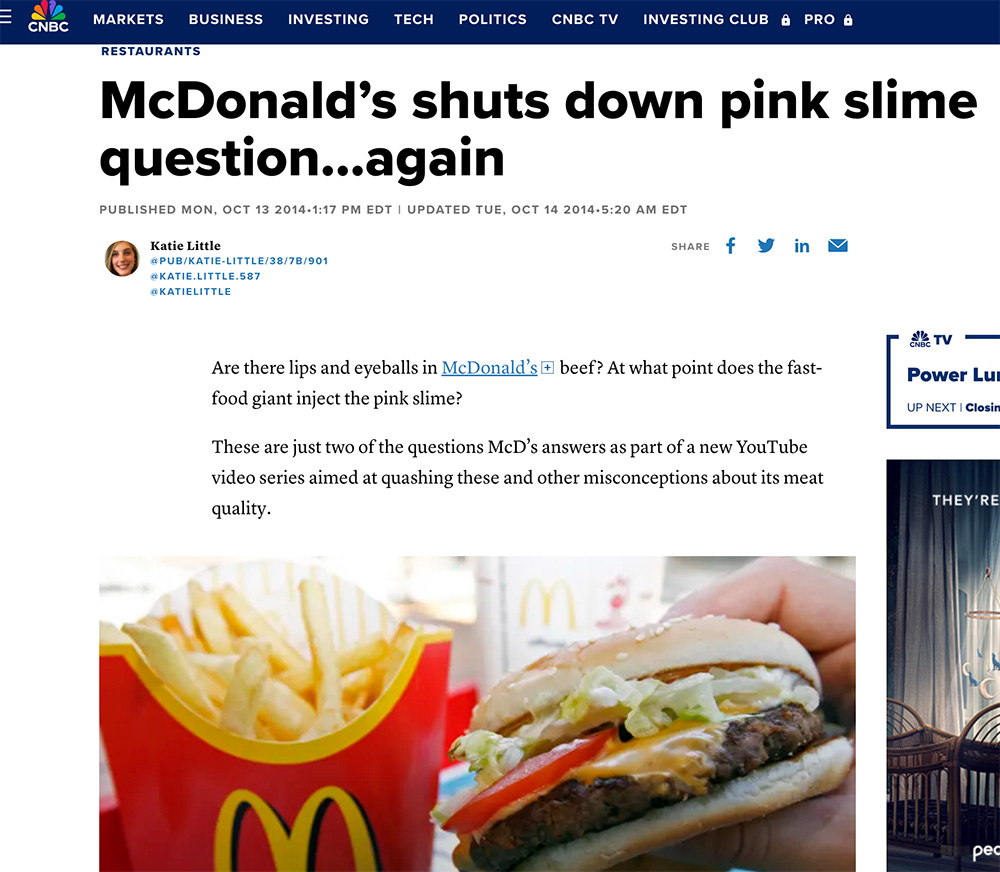
PR: And most certainly, when you’re considering things about your health, you need to look at the big picture before you start worrying about this stuff because maybe McDonald’s does use pink slime, but maybe you shouldn’t eat at McDonald’s in the first place if you’re that concerned about your health.
CW: They actually stopped. They still haven’t started using it again. McDonald’s is pink slime free.
BR: Ask for it on the side. That’s what we do here in New Mexico.
0:54:14
PR: If you’re not sure, ask for it on the side. You can test it, see what you think.
(MUSIC)
PR: So, we just want to thank our sponsor-level patrons, Dr. Angela Matt Key and Amy Freshour Kelly. If you’re wondering what that is, head on over to our Patreon page. It’s patreon.com slash squaringstrange. There’s all different levels. You can throw us some money if you think we’re worth it. $5 an episode, though, that’ll get you a Skepti-Krate every month, which is a padded envelope, not necessarily a crate, but full of little items every month that generally have to do with our episodes or something that has to do with us as individuals or just science-y, skeptical, fun stuff.
0:55:11
CW: There may be a bit of pink slime in the next one.
PR: Yeah, maybe. I don’t know, we got to look at the rules about shipping this stuff.
(MUSIC)
0:55:20
PR: But anyway, that was a really interesting topic this week. I think that there’s a lot more we can cover in that world and I feel like we could circle around to some other stuff. I had it in my head that I might try to cover MSG at some point. That’s another fun one. Which we’re not really scared of anymore, but 30 years ago, boy were we scared of MSG.
0:55:53
BR: Oh, I remember my parents going somewhere and it was a Chinese restaurant, and they were like, No MSG! And they would just yell that at you. And number one, if I’m not mistaken, MSG is naturally occurring in many things anyway.
0:56:08
CW: And it’s delicious.
0:56:10
BR: And it’s super tasty.
0:56:12
BR: It’s actually technically better for you than regular salt because it’s lower sodium. So we’ll see about that in the future. But next week, we are gonna be talking about a kind of interesting topic that we’ve sort of mentioned in passing in the past, which has to do with boogeyman stories and how they kind of act as mother’s helpers and as cautionary tales to get kids to come in at night and not play around the river and stuff.
0:56:40
CW: Folklore as babysitter, I love it.
PR: Exactly, there we go. We’ll title it something like that, I bet.
0:56:47
BR: The boogey mom.
CW: The boogey mom.
0:56:52
PR: But anyway, until next week, we’ll see ya.
0:56:58
Bye bye.
0:56:59
Take care.
0:57:00
Squaring the Strange is a production of Kronos Creative LLC. Copyright 2017. Theme music by Shriek Back. Additional music by Memory, Guitard & Feathered, and Pasquale Romero. of the world. of the world.
0:57:35
Bye!
Transcribed with Cockatoo
