
Episode Summary:
This week, our boys look into the nature of curses and what it takes to break a curse. From the cultural aspects to the practical applications, Ben’s expertise in curses takes the listener through a journey into the weird and scary world of superstition.

0:00:00
Ben Radford: Welcome to Squaring the Strange, the podcast that examines all manner of the mysterious and the mundane through a critical lens. So let’s square the strange.
(MUSIC)
0:00:11
Pascual Romero: Welcome back to Squaring the Strange. I’m Pascual and with me as always is…
BR: Across the room actually, about three feet away, Ben Radford here.
0:00:33
PR: So this week, this is episode 40. That’s a nice round number.
BR: It is.
PR: And that puts us, we’re actually on kind of the home stretch to our first full year of episodes.
BR: That’s not bad, you know. I think we recently passed what, like 40,000 or 400 million?
PR: Yeah, I think we’re in the ballpark of like 45,000 individual downloads.
BR: Awesome.
PR: Not counting the website and some of the other sources, but so it’s really exciting. I think we…
BR: Hold on a second, let me pat myself on the back. There we go.
0:01:15
PR: So yeah, no, it’s been great. The feedback has been great. Something that really, really excites me about our listenership is that it’s very global. It’s, you know, the U.S. is certainly our largest share, but we have a formidable listener base in Australia because of Richard, I’m sure, and also the U.K. and then some other, South Africa we’ve got a number of listeners and all over Europe, some Asia, few Russian listeners.
BR: No, I think it’s great. I mean, I’m really proud of the stuff that we’re doing here with you and me and Celestia and I’m really grateful for all our listeners. I mean, especially these days, there’s so many podcasts out there, skeptical podcasts, lots of great ones. Again, there’s so many demands on people’s time that for someone to take an hour out of their day or out of the week to listen to us is, you know, I take that seriously and I appreciate it.
PR: Yeah, absolutely. We really, really thank you for taking the time to listen and sharing your week with us and we will do our best to always bring you the best content we can. And this week is no exception. We’re going to be covering curses and specifically curse removal, which is an angle of looking into curses that I really think is an interesting one that very few people ever cover. Curses are already a little bit of a niche, but the removal, I mean, that’s pretty untouched territory outside of you, really.
BR: Well, that’s what I like about doing the show, is we get a chance to discuss things that are sort of off most people’s radar. Unless one happens to put curses on people or remove them. You know, bunko squads are familiar with it. But it is a curious angle into skepticism and practical skepticism.
PR: So I just wanted to quickly bring up that first off you’ve got a book coming out. We’re not going to talk about that too much but there will be a little promo during the episode that will kind of explain where to find it and what’s going on.
BR: People might hear me mention it briefly.
PR: But also one great thing is we have a lot of friends in this world who are also putting books out. What’s one that’s coming out real soon?
BR: Well there’s a new one out from Sharon Hill, our friend, of course, at Doubtful News and 15 Credibility Street podcast. And she has a new book out called Scientifical Americans, the Culture of Amateur Paranormal Research. And it’s a great book. I’ve actually just, I’ve only begun starting it, I got it right around the holidays and things were crazy busy, and so I’m only getting into it, but it’s an interesting look at, you know, exactly as it says, the culture of amateur paranormal investigators, which of course presupposes there are professional ones. And you know, it’s a curious, you know, am I a professional paranormal researcher? I mean, kind of, but not really. I mean, it’s weird, you know. In a way I am, I’ve been certainly identified that as such, but it’s, the book is an interesting look at the other 98% aside from people like her and Kenny Biddle and the Intimate Investigations group and Joe Nickell and Randi and myself, of course. I mean, there’s a fair number of people out there, but of course the vast majority of them are non-skeptical and the word amateur is used advisedly throughout the book. So anyway, it’s an interesting book. Again, I’m looking forward to tackling it. I skimmed through it and I think people are going to find it really useful in terms of getting a handle on the Bigfoot groups out there, the UFO groups, you know, how are they approaching this? What are they doing and what do they think they’re doing?
0:05:20
PR: Right. That’s awesome. From personal experience, at least in the music industry, we kind of like to refer to the difference between professional and amateur as whether or not you collected a paycheck.
0:05:31
BR: Right.
0:05:32
PR: But no, I’m looking forward to getting into that book myself and this may be something that, Sharon, if you’re listening, it would be great to maybe have you on and talk about it a little bit. But anyway, let’s get on to it.
BR: Ben Radford here. If I can have a minute of your time, I’d like to shamelessly plug my new book. It’s called Investigating Ghosts, The Scientific Search for Spirits. It examines ghost hunting and ghost investigations from a historical, cultural, and evidence-based perspective from the Victorian era to modern TV ghost hunters. It is, in a way, a follow-up to my 2010 book Scientific Paranormal Investigation, How to Solve Unexplained Mysteries. That book was more general, covering everything from psychics to crop circles to monsters and ghosts. But I realized that ghosts are a special category. Not only are ghosts the most popular paranormal pursuit, but ghost hunting also has its own set of assumptions and challenges. The book will be available soon for under $20 and is currently available as an e-book. For more information on the book and me, check out benjaminradford.com. Please check it out. Thanks.
(MUSIC)
0:06:49
PR: So this week we are talking about curses.
0:06:52
BR: Damn you! Get off my lawn!
0:06:55
PR: My favorite kind of curses. But I think that society as a whole and just humanity has this idea that, you know, especially the Western world, that, you know, we don’t, like, curses aren’t a thing, you know, and it seems like broadly accepted that that’s not true. But there’s a lot of belief that’s kind of woven into society from a cultural standpoint. At the core of any weird belief about curses, there’s still a thread of it that kind of follows, like football fans and stuff like that. But with that said, how do we break them and how do we remove them? Let’s get into that. What’s up with that?
0:07:33
BR: Yeah, I love the idea of curses. And that sounds weird to say, but from a folkloric investigative point of view and psychological point of view really. It’s fascinating to look at you know why people think that they have been cursed and what does that mean to different people. So let’s back up a bit and sort of look at the notion of curses overall. So, you know, curses are a specific form of magical thinking. There are, of course, lots of forms of magical thinking, you know, lots of fallacies based on it, you know, post hoc ergo proctor hoc, sure, after this, therefore, because of it, you know, people, you know that sort of thing. Curses are like the flip-side of blessings, people see hidden forces and deities and things around them that they believe have influence over their lives. For example, you know, luck. Luck is a form of that, right? So gamblers will wear a lucky shirt and sports people…
PR: Don’t wash the jersey for the entire season or don’t shave.
BR: I’m a big tennis fan. I remember watching some tennis players who would have all these rituals. It wouldn’t be obvious, but after you watch them play for a while, you realize that they’re not stepping on particular lines when they cross over. There’s all these little things. They dab their head with a certain towel twice. All these sorts of things, right? And I’ve written about both curses and sports curses and blessing that sort of thing before. But what’s interesting is the role that they serve. And it’s similar to the role that lucky items serve for people. A lucky penny, a rabbit’s foot, not lucky for the rabbit of course, but things like that that give people a certain psychological edge if not an actual edge. And although I joke, but of course the psychology is an important part of athletic performance.
PR: Oh yeah, sure.
BR: And so if you don’t think that you’re going to win a boxing match, you’re going to win a competition, then you psych yourself out and you probably won’t.
PR: Yeah, yeah. There’s a lot of science to back that up too in the idea that thinking, your thinking going into something can greatly affect your outcomes because just self-doubt alone is enough to sabotage yourself. And so that’s really interesting and also a great contributing factor to why people believe that stuff.
0:10:32
BR: Yeah, absolutely. And in fact, in Skeptical Inquirer magazine, one of our columnists, Stuart Weiss, has a piece on that, I think, in an upcoming issue. So people can check that out. But so one thing that magical thinking does, and this is also true for conspiracy theories, which is sort of a form of magical thinking, is that they’re appealing to people because it helps give them a sense of power and control of their lives and destinies. So for a lot of people, the idea of an entirely random world is scarier to them than one in which they can control their own destinies through supplication to deities, to go to a local magic new age shop and buy some crystals. The idea of a thoroughly random world doesn’t bother me at all. I find that kind of comforting actually. But a lot of people, they find that terrifying because it means that you are at the whim of the universe doesn’t care whether you get hit by a bus tomorrow or not.
0:11:41
BR: Right.
0:11:42
BR: Don’t care. It’s all random. It’s all you’re in the wrong place at the wrong time. And the idea that you can nudge your life towards the good or nudge just a little tiny bit towards maybe winning a lottery. People have such difficulty asserting control of their lives that anything they think they can do to, they figure, I need all the help I can get.
0:12:14
PR: Yeah, yeah.
0:12:15
BR: So help me out here.
0:12:18
PR: Sure. I think even in my own life, I’ve never been a superstitious person, but I’ve always taken is taking a little bit of comfort in the idea of lucky items and things like that. There was a hat that I used to wear on tour and I just wore it and I called it my lucky hat. I didn’t think there was anything lucky about it. I didn’t find it any more lucky than not wearing a hat. But because I just called it my lucky hat, it would make me feel odd if I didn’t have it with me on tour and it was just like a comfort thing. It was a total comfort thing. It was like a teddy bear to me. But I can see how appealing that is and how easy it is to take that one step further than, for me, just this kind of small bit of psychological comfort goes into, this hat is the reason I’m surviving 10,000 miles a month.
BR: And all your crazy tour things. No, it’s, you know, and I find that that manifests itself in my life in in sort of minor but significant ways. So for example, I’ve noticed about myself that when I turn on the TV and I adjust the volume level, I always adjust it to an even volume level – 26 or 28, and I don’t know why. If you and I did a blind test and you said, is this 23 or 24, there’s no way in the world I could tell you what it was. But something, I like even numbers. There’s something about, and I don’t know if it’s luck, superstition. I will rationalize it by saying, hey, I like even numbers, leave me alone. So I don’t have to rationalize it to myself or you or our esteemed listeners. But there is something, again, it’s minor, it’s insignificant, and we do it anyway.
0:14:15
PR: Yeah, sure, sure.
0:14:16
BR: It’s just humans, right? We’re all humans. So I think that’s just inherent in how we’re made up, right? The pattern-seeking part of our brains is always on. And skeptics can often overcome that to some degree. At the end of the day, we’re still comforted by what we’re comforted by. But anyway, so that’s one version. The one common form of the curse is the evil eye. And I think we talked about it a little bit on previous shows, but basically the evil eye is one of the more common curses. It’s nearly universal. There was a really good book by Alan Dundies, the folklorist, and he talks about his research on the evil eye. So I’ll just quote briefly from a book by folklorist Alan Dundies. He did a book called The Evil Eye, a casebook. And he says, quote, the belief is that the victim’s good fortune, good health or good looks, or unguarded comments about them, invite or provoke an attack by someone with the evil eye. Symptoms of illness caused by the evil eye include loss of appetite, excessive yawning, hiccups, vomiting, and fever. If the object attacked as a cow, for example, its milk may dry up. If a plant or tree, it may suddenly wither and die. So it’s interesting because the evil eye can also affect inanimate objects. So it’s believed, for example, if your car just suddenly dies on the side of the freeway, that could be an evil eye. It could be that somebody you cut off in traffic, and I’m not making this up, this is an actual example, that someone cuts you off in traffic and they glare at you, and I’m sure this has happened, I can’t prove it, but I’m sure this has happened in Italy somewhere. Somebody gets cut off, they give them the cold hard stare, and the person that cut the person off has a flat tire five minutes down the road and they’re like, Oh, evil eye. Yeah, that’s what that was. But you know, it’s any number of things. It’s insomnia, fatigue, depression. You basically, anything that can go wrong can be attributed to the evil eye. You see this same thing with when I was writing my book, Tracking the Chupacabra writing about the vampires in late Middle Europe, late Middle Asia, where you’ve got people, if there was something bad happening, a cow stops giving milk, there’s a stillbirth, there’s an unexplained fire, lightning, plague, illnesses, whatever, people think what’s going on, why is this happening to me?” And sometimes the answer, using scare quotes, is that it’s a vampire. Sometimes it’s the evil eye. Take your pick. But it’s always a form of a curse that is believed to be put upon a usually seemingly innocent victim. I haven’t come across too many cases where the person is like, yeah, I was cursed and I deserved it. That’s not a common thing. But it’s interesting, so you know, so there’s a couple dynamics here. One of them is that when you’re trying to prevent the evil eye, and there’s lots of things that people do, for example, the color blue is said to war off evil eye. Blue is sort of, you know, symbolizing heaven and godliness, the heavens and the skies. Charms, potions, spells, in some belief systems, garlic. Again, going back to vampires, bad things, evil eye. Some people wear garlic around their necks and around their houses. And some people believe just saying the word garlic. You also see this, for example, with exorcist rituals in Roman Catholic rites. The idea that naming something gives you power over it. This is why, for example, there’s lots of… In exorcism, if you know the name of the demon, then you can command it. You can say, I know your name, demon.
PR: Yeah, yeah, I learned that from movies.
BR: Documentaries, I think you mean.
PR: Documentaries like The Exorcist.
BR: But, so one thing that’s interesting about the evil eye is that it can be cast accidentally. You know, typically when we think of curses, we think of someone intentionally harming somebody else. That is the typical belief surrounding curses. But in the case of the evil eye, it’s believed that some people can cast an evil eye without even knowing it. Yeah, and so I actually remember I was contacted by a person that believed that was happening, and now that I think about it, this was a couple years ago, and the person said, you know, I think I am casting the evil eye, can you help me? And it was, I was like, well? And so, you know, I responded and I was like, well, why exactly do you think that you’re cursing other people without realizing it? And it’s been a while since I looked at the email. I probably had I thought about it before now, I would have printed it out and been more familiar with it. But basically, the person was saying that bad things seem to happen around them and not necessarily bad things happening to them, it was to their friends and loved ones. And a little bit later in the show I’ll talk about other people that have contacted me about curses and evil eyes, but this particular person was very concerned, because of course they were worried they were going to hurt their loved ones. I mean it was really interesting to see the psychology here. Like you know, help me not hurt people that love me and my friends. And I did the best I could. I said, well, you know, I believe the person was emailing me from the Middle East or India or I believe it was in that region. And I said, well, you know, I was trying to give some sort of, you know, skeptical, mundane explanations and reasons why perhaps bad things happen to other people without necessarily being caused by the evil eye. But anyway, so typically what happens is, you know, people who believe that they’ve been harmed by the evil eye seek out shaman, witch doctors, psychics, or others to help remove the curse. notion that things are beyond your ability to influence. People don’t complain about being blessed. Nobody goes, damn it, everything goes right for me. I inherited some money, I won the lottery, I just got a promotion. Can you help me out with this? Nobody does that. You only go to people, and in some ways the analogy of psychics is very apt, right? Because who goes to psychics? People who are seeking answers, people who have some questions, some unsolved issues. I don’t mean that in a pejorative sense, but just people who want answers and are feeling unfulfilled and feeling like they need to get a better handle on their lives and what’s going on around them, these are exactly the people that go to psychics.
0:22:08
PR: Yeah.
0:22:09
BR: Or people who are trying to reach out to loved ones. And so in all these cases you have the average person seeking spiritual and magical help self-appointed priests and shaman and witch doctors and psychics, people who claim to be better in tune with the cosmic forces, whatever that means to you. And so that’s an interesting aspect of it. So what you find in all these cases is that somebody who believes they’ve been cursed is seeking help from people who they believe or certainly purport to be more knowledgeable; priests, shaman, psychics, in some cases me. We’ll talk about that in a minute, but I’ve had people come to me for help in terms of, you know, help me remove this curse. And one thing I try to do is to empower them to remove their own curse. Which is a bit of a tricky situation. But you know, I guess it’s important to remember that the evil eye and curses, as you began the discussion, are not some dusty, antiquated, silly belief that no one adheres to. It is widely believed to this day. Maybe not here in New Mexico or in the United States, although in some places it is, but there are many parts of the world where there is a very strong magical belief element to it. And it’s also important to keep in mind that any time that you have people who believe that others are cursing them, that is dangerous. That was dangerous during the Salem witch trials. You had people who genuinely believed for all sorts of reasons and of course the Salem thing is that we could do a whole show on that. But just think about that for a minute. If you truly believe that anybody that crosses you or that you upset or offend or slight in any way socially, personally, financially, in any other way, can get back at you magically and cause you to have disease, cause your house to burn down. That’s a dangerous idea. And there are, of course, cases where people have been accused of being witches and warlocks and having caused curses and bad things to happen and been killed because of it.
(MUSIC)
0:24:55
Celestia Ward: Hey Squares and hey strangers, Celestia here with your skeptical fortune cookie. Let’s see what wisdom this one holds. Security is mostly a superstition. It does not exist in nature, nor do the children of men as a whole experience it. This rumination about the concept of security comes from someone who was certainly no stranger to adversity. Helen Keller wrote this in her 1940 work Let Us Have Faith, and it was later included in the 1957 book of selections titled The Open Door. Keller was born in 1880 and lost both her sight and her hearing to illness before the age of two. As a child, she picked up more than 60 signs with which she communicated at home, but later blossomed under the instruction of Ann Sullivan, a teacher-student relationship immortalized in The Miracle Worker. Keller moved from various schools for the blind to Radcliffe College, where she became the first blind and deaf person to earn a bachelor’s degree, thanks in no small part to Mark Twain, who introduced young Helen to benefactors who financed her education. Keller went on to become a renowned author, lecturer, activist, and global citizen. Her thoughts on security being mostly a superstition, in context, convey her religious faith, but she also goes so far as to say that God himself is not secure, having given man dominion over his works. And the notion of security as superstitious brings up some skeptical points. The drive to feel secure, to feel some sense of total security that is simply an impossibility, is what drives fearful parents to avoid vaccines. It drives what has become known as security theater at our national airports, and it even drives those individuals who see the slings and arrows of everyday, non-secure life as evidence that they are under some supernatural curse. When you crunch the real numbers, Helen Keller is right. Security is mostly a superstition. Now, let’s get you back to Ben and Pascual.
(MUSIC)
0:27:16
PR: So what are some of the real world impacts of this kind of stuff?
0:27:20
BR: Well, you know, as I said, in some cases it’s people being accused of being witches, witchcraft, because as I said, in the case of the evil eye, a person can, it is believed, cast the evil eye and curse people without knowing it. Now, think of how terrifying this would be. If you, if someone believes that you accidentally, it’s one thing to have it in for somebody. Right? It’s one thing to have it in for somebody, right? And you’re like, yeah, I hate you, you did this, XYZ, I curse you, I’m gonna do my best to ruin you. It’s another thing if you’re essentially falsely accused or even weirdly you believe that you have that power, right? Because it could be, I mean, the thing is, it’s like the person that wrote to me that I mentioned a little while ago, right? Think of how bizarre and terrifying it would be to have, you know, let’s say that your friend’s son gets killed in a car accident or something, and they believe that maybe you have something to do with it. You had nothing to do with it, but even you yourself come to believe that. Because maybe I do have the evil eye. Maybe I look at people weird and people tell me that. And so people can actually come to believe they have these powers that they actually don’t in sort of a weird way. There’s also a case of how witchcraft and cursed beliefs affect, for example, the economy. I want to talk a little bit about an article that appeared in the May 2016 Journal of Development Economics and the title is Witchcraft Beliefs and the Erosion of Social Capital, Evidence from Sub-Saharan Africa and Beyond. And I read the study, it’s really interesting. It talks about how the belief in curses and magic, witchcraft specifically, undermines economic development in Africa. And it’s not something that you intuitively say, well, Africa has lots of problems with economic development, why would witchcraft play a role?
0:29:49
PR: Right?
0:29:50
BR: It’s not obvious exactly what that is, but in fact, if you look at witchcraft and magical beliefs in in Sub-Saharan Africa There was a 2010 Gallup poll found that over half of respondents will personally believe in witchcraft in Sub-Saharan Africa.
PR: Oh, wow, so over 50% Yeah, that’s significant.
BR: That’s a hell of a lot and you’ve got you know fortune We we have good good people and skeptics for example Leo Igwe in Nigeria and others doing good skeptical outreach and shout out to Leo, he’s been doing great work over there for years. But it’s important to understand that for many Africans magic is routinely used for personal and financial gain. The idea of if a person has a business, they have cell phones or they’re selling shirts or whatever, if their business goes bad, it is not inconceivable they will assume they’ve been cursed by, for example, a rival. Some new guy opens up a store a couple blocks away and a fire breaks out in your place, it’s not suspicious, or is it? And all of a sudden you’re wondering what’s going on. So in that large-scale economic study, it was the first of its kind, it looked at the witchcraft, which was defined as the use of the supernatural to harm others or acquire wealth, which is of course what curses are, and its erosion, its role in the erosion of social capital such as trust. American University economics professor Boris Gresham examined survey data from 19 countries in sub-Saharan Africa and found quote a robust negative association between the prevalence of belief in witchcraft and multiple measures of trust. Now this is important because trust is an essential ingredient in interpersonal relationships and in economic development.
PR: Absolutely.
BR: And you know for example in the African context a business owner is unlikely to enter into contracts with someone who they don’t trust is going to repay them. So if you don’t trust people to do what they’re going to do, then you don’t sign contracts because why would you? Because it’s not worth the papers printed on. And there’s a book that I’m going to quote here. It’s titled Imagining Evil, Witchcraft Beliefs and Accusations in Contemporary Africa. A really good book, by the way, for those who are interested in that sort of thing. A professor of religion, human rights, and social change named Jerry Terhaar writes in a book titled Imagining Evil, Witchcraft Beliefs and Accusations in Contemporary Africa. He writes that witchcraft, as an ideology and as a practice, is a development issue in the sense that it hampers economic progress as people, afraid of being accused of practicing witchcraft, refrain from any activity that may make them appear to be more successful in life than others. Fear of witchcraft often inhibits people from undertaking any productive areas where this is most needed. As a result, ambitious young people will move away and start businesses elsewhere. In South Africa, for example, witchcraft accusations are often made against those who initiate development projects or otherwise try to improve their conditions of life. So that’s one of the key parts here. There’s a suspicion that if somebody is successful, if somebody is doing well, it’s not because they’re talented. It’s other factors. It’s because, well, you know, they’re connected. Their corrupt father works for the government. Or, in many cases, it’s because there’s some sort of nefarious witchcraft going on, that perhaps the person’s rivals have been cursed. So that there’s a natural suspicion of success.
PR: Which certainly isn’t isolated to those countries and cultures. I mean we kind of do the same thing even with the entertainment industry and things like that. I mean there’s a little bit of doubt as to why people are famous and things like that. And you know here it’s usually a little more practical and it’s accusations of any number of things, but it’s relatable in that sense.
BR: Well, I mean, how else do we explain the Kardashians? If that’s not a curse or some sort of magical voodoo, then I don’t know what it is. That ain’t right.
0:34:43
PR: So you said you had some personal experiences with this, and I’d love to hear about those.
0:34:50
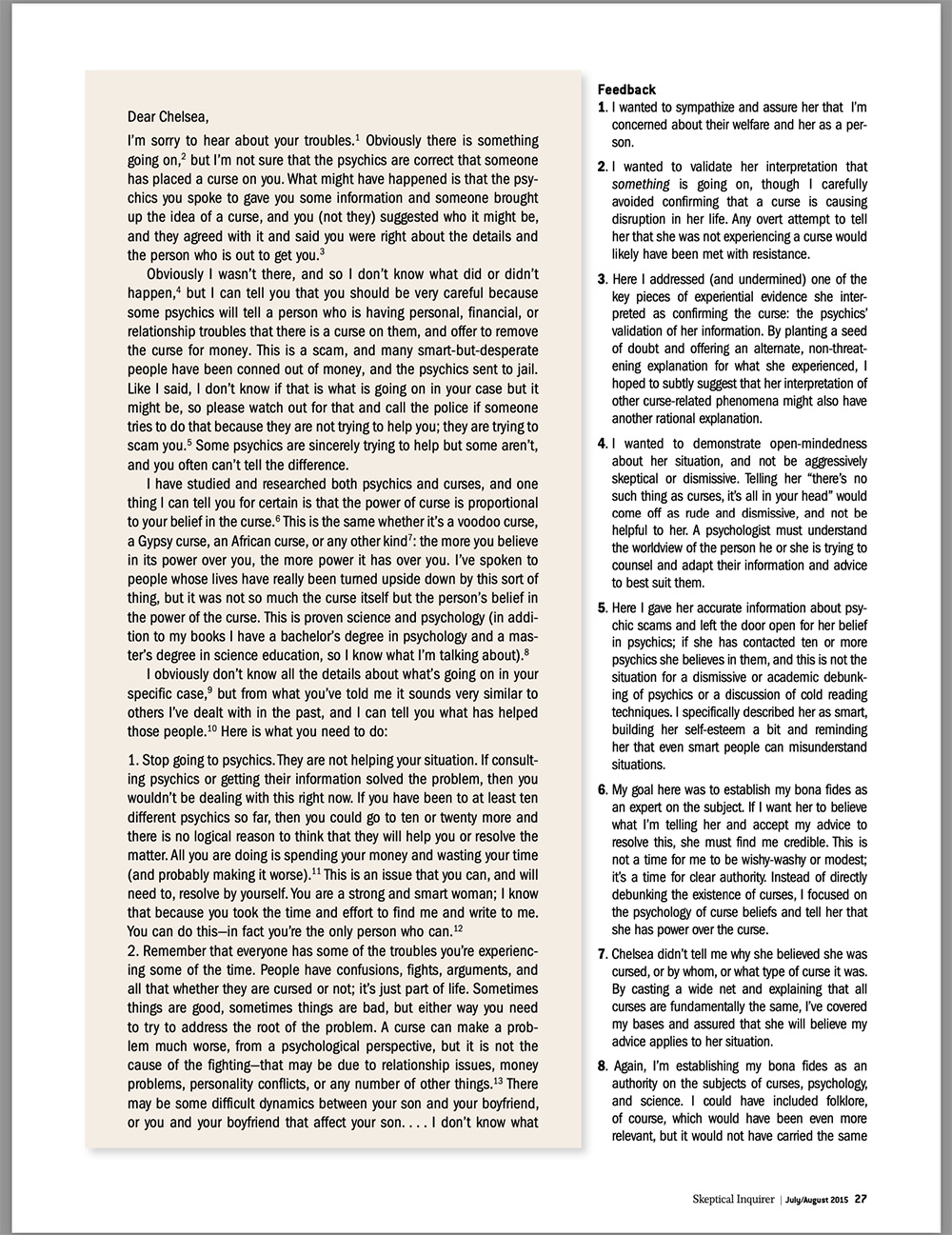
BR: Yeah, I’ll just briefly touch on a couple examples. As I mentioned I get people contacting me a few times a year who are asking for my help in well everything from exercising their house of ghosts to curse removal. I have a couple quick emails here. This is a person from a guy named Paul. Says hello Ben I read something about the evil eye, so I guess he read one of my articles on it. He says, I believe I’m going through something similar but much more intense. He says, In 1978 my father was killed in a car accident. My mother stood to gain monetarily by this accident. My father’s father was an evil man who sexually abused his daughter and this family secret is what ultimately destroyed my family, whatever was left of it. Rumor was he hated and despised me for what jealousy he had for me even at six. I’m just reading what it says, so I’m, it’s a little disjointed. It has become so strong that I have become seriously telepathic with my ex-family who wish me harm in his honor. The telepathy is so vivid that I’m able to actually record it and play it back for people. I was wondering if you knew about what remedies to get rid of these mountain goat jealous people from my life once in a mountain goat jealous that’s that’s an analogy I had not heard of thank you Paul and so again he’s asking for evil eye protection because he believes that he’s been cursed and he’s serially telepathic. I did not I did not follow up with this guy I only have so many hours in the day to contact these people. But again he’s asking me for my help. And then another case was one where I am, and this is actually printed in the Skeptical Inquirer magazine as you know I have a column there, in the July-August 2015 issue. And I’ll just read you, my column for those who don’t know and don’t read it, although you should, is in the form of a Q&A. It’s called Skeptical Inquiry and so people will write questions and I’ll respond to them. So I’ll just read the question. I’m not going to read the whole column because people can find it on their own, but here’s the question. It says, My name is Chelsea. I have a curse that was cast on me, my son, and my boyfriend. Would you know of anyone that can help us with this situation? It’s only getting worse as the days go by. It is frustrating, very stressful, and affecting our lives in major ways. I’ve had ten or more different psychic readings and was told by all that someone has been working against me. They all gave me the exact same stories of whom and what was happening. I witnessed all the changes, the distance between us, confusions, arguments, and tears in all who are involved. We were once a very close and happy family and now fights out of nowhere just keep popping up. Also, our happiness only lasts for 48 hours each time and then the fights start again.
0:37:51
PR: That’s very specific.
0:37:52
BR: Very specific, yes. 48 hours exactly. So again, when I saw this email, you know, it’s honestly these are some of the most difficult emails to get because, you know, I assume that this is not a prank. I don’t believe it is. You know, I remember a couple of issues a couple of months back, there was a question of whether I was being punked. But if you read my emails, I’m not being punked. There may be a few of them, but at this point, I have a pretty good idea of who’s actually sincerely reaching out to me for help and who’s just trolling me. And these are difficult to deal with because these are people that are genuinely afraid. They generally have something going on. Now, whether it’s a curse or not is sort of a separate issue but certainly they believe it’s a curse. And so I’ve often struggled with what to do with these cases. I mean, if I just write back and say, Ha! Curses don’t exist, silly. Yeah, what? Really? Go away.
0:38:59
PR: Yeah.
0:39:00
BR: That’s not going to help them. That’s, that’s, that’s, it’s insensitive. It’s potentially cruel. And the person has taken the time to reach out to me for help. And I feel an obligation to help them if I can. On the other hand, I’m not a psychologist. I have a degree in psychology, but I’m not a psychologist. I’m not paid to be a psychologist. I don’t know these people. I get emails from all over the world. From Libya, from Turkey, from Italy. So I can’t go there and you know and so I’m sort of torn in a bunch of different ways because I want to be helpful. On the other hand, you know, if I say something like, you know, I’m glad you reached out to me. I have greater magic than the person who cursed you. I’ll remove the curse, just, you know, hold your breath for three minutes and then, you know, and then turn around twice and the curse will be gone. That, there’s ethical problems there.
0:40:04
PR: Sure, yeah, yeah, definitely.
0:40:05
BR: Even though that, in some cases, that might actually help them. Yeah. I remember there was a, in one of Joe Nickells’ books, I think it’s Missing Pieces, he talked about going into a case with Robert Baker. There was a guy who, there’s a poltergeist in the house. And Joe was pretty sure that there was some pranking going on because oftentimes children do those sorts of pranks. Hard to believe I know.
PR: Also lending to the idea that poltergeists tend to manifest around children.
BR: Yes. One and one is what? Anyway, so I don’t want to tell Joe a story you can read in his book but he basically talks about how he soon realized that there was a pranking kid in the house and the parents, he wasn’t sure if the parents knew that or not. And so he told the parents that, forgive me for misremembering some parts of the story, but basically he told the parents that the sound would drive out the spirit. And there’s some basis for, I mean, you do see that in folklore. So as I recall he turned up, I don’t know if it was the Beatles or what it was, he’s a big Bob Dylan fan as am I. I don’t think it was Dylan. But anyway, he turned really loud and you basically sort of blasted out the spirits and told the parents that, you know, I think that it’s been taken care of. I think he sort of took the kid aside and said this is going to take care of it, right? Anyway, so there’s different ways to handle it. But in practice, as skeptics, we often deal with people who hold false beliefs. And one of the most important lessons that I’ve said, and you’ve seen this and many people as well, is that most of the time, they’re not stupid or crazy. They’re just misunderstanding, they’re misperceiving something.
0:42:06
PR: Sure, sure.
0:42:07
BR: And if we tell people they’re crazy, number one, that’s probably not true. Number two, that’s not helpful. It’ll just make them feel worse or just feel like you don’t know what you’re talking about. So, you know, the main goal, the main goal that I can try to do is to help people. And so in the case of Chelsea, I wrote back and I wrote a response. Again, I’m not going to read the whole thing. You can look at it for yourself. But basically, I wrote a response back and I annotated it. So in this column, I mean, you can see it right here, I’ll hand it to you and our listeners can picture you reading this. But basically, I wrote a piece out and trying to do a couple different things. And so I began by trying to sympathize with her. So for example, I’m sorry to hear about your troubles. And in my response to her, I threaded a needle here because I didn’t want to say, yes, of course, you’ve been cursed. Oh my God, this is horrible. Because I don’t believe that she’s been cursed. She may have been, I don’t know, but my guess is she’s not actually cursed. Certainly nothing that she’s described here is that unusual. On the other hand, had I approached her that way and said, well, you know, curses aren’t real, but blah blah blah, then she’s not gonna listen to what I’m saying. So it’s not gonna be useful to her. I’m not going to help solve her problems. And so throughout the letter I tried to do a couple things. One was I want to validate her interpretation that something was going on but avoid confirming that it was a curse. So you know I didn’t say it’s all in your head. I said I know you’re experiencing this. Maybe there’s alternative explanations. Maybe there’s another way to look at it. And so I tried to demonstrate open-mindedness about her situation, not be too skeptical or dismissive, and also give her information, for example, about psychic scams. Because I noted that in her email to me she said, I’ve had 10 or more different psychic readings and was told by all of them that someone’s been working against me. Basically, she went to psychics who confirmed she’d been cursed.
0:44:26
PR: Right.
0:44:27
BR: Which is unethical.
0:44:29
PR: Mm-hmm.
0:44:29
BR: And bullsh**.
0:44:31
PR: Yeah.
0:44:31
BR: But, and so I took the opportunity, I said, okay, well, that’s what she told me, so let’s look into that, right? So, obviously, if these psychics had helped you, you wouldn’t be contacting me.
0:44:43
PR: Right.
0:44:44
BR: So, stop going to psychics. You’ve been to psychics and problem’s still going on. What do you learn from that? Psychics didn’t help, so stop going to psychics. Thank you for contacting a skeptic and going on. Anyway, there’s other things I tried to do in there, including establishing my credentials as someone who could solve a problem. Because, again, I can’t help her if she doesn’t believe that I can help her remove the curse. Right? If I was like, oh, you’re just a skeptic who doesn’t know anything, then no matter what I say is gonna be dismissed. So again, I had to sort of walk this line between not validating her belief in curses, but working around it and trying to say, well, you know, and that’s essentially what I did. I said, well, you know, there are other explanations for this that you may have been cursed. I don’t know I wasn’t there I can only go by this two paragraphs you told me. You know I don’t know everything but based on my experience There are other explanations for why this this might be the case and for example You know in at the end of her message to me She says that that that she says she specifies that happiness only lasts for 48 hours.
0:46:02
PR: Yeah.
0:46:03
BR: So I said, okay, I can work with that. So I said, well, you know, there’s nothing magical about 48 hours. It could be 42 hours, it could be 50 hours, it could be 24 hours. I said, so I was trying to break that pattern because of course, once you have it in your head, once you’re psychologically primed to look for these patterns, you’re like, oh, every time that something happens, it blows up and we have a fight about this. People look for patterns and so by trying to get her to break that pattern, I said, don’t look for 48 hours. I said, it could only last a few hours, maybe a few minutes. I said, don’t count on that pattern because again, she’ll just see it. So I was trying to get her to look at the other things that might be causing fights. I said, people have fights all the time. I don’t know what’s going on between you and your boyfriend. I wasn’t there, I’m not in the middle of these fights, thankfully. Don’t wanna be, but you know, something is obviously coming between you, but I don’t think it’s a curse. And so, that was one of the things that I tried to do with this effort at curse removal, was to give them the tools to solve it themselves.
0:47:14
PR: Right, yeah.
0:47:16
BR: And that’s sort of where I went with it.
PR: Yeah, that’s actually, that’s pretty much like right out of the therapist’s playbook. I mean, you always, you approach a patient or a client as someone who, you know, you wanna work around their ideas about what’s happening and rather focus on correcting the behaviors that are lending to it. And I think that’s a really good way to approach anything in life when you’re trying to help people is avoid charging right into their ideas and beliefs and trying to clash with those and just work with what you know might help. And I think that I’ve kind of been skimming these annotations. And it’s really, it’s cool that you describe that first off. I think it’s cool to kind of see it broken down and so you can better understand your thinking when you respond. And it also kind of helps people get a better sense of how you deal with something like that when someone’s coming to you with an issue that maybe you’re comfortable helping them with but you aren’t really on the same page with you know their ideas of why something’s happening in your ideas and and approaching it from from a from more of a solution base, you know aspect really really helps and it’s cool because you know, you know, hopefully you would hope that these people by giving them the tools to be kind of skeptical of their own issues. They may grow a little from it, but it seems that the worst that can happen is that you’re at least getting them to identify it a little better, and that’s certainly valuable.
BR: Yeah, I mean, I’m fairly pleased with how that one turned out. I got some good feedback from it. Because again, as you began the show saying, it’s weird. Not a lot of people are asked to help with curse removals, I mean, unless you’re a witch doctor or something, but I mean, in terms of skeptics. And I really see it as being a way that practical skepticism can help real people. And that’s important to me. You know, we spend a lot of time talking about the importance of, you know, critical thinking and the importance of identifying logical fallacies and lots of sort of abstract, you know, oh, why is skepticism good? Well, you know, here’s a real world case. These are real people that need help and that are coming to me, us, for help. And hopefully some people listening to the show have sort of maybe given them some insights into different approaches. If I remember a couple episodes back, we talked about practical skepticism and living the skeptical life and what that means. And maybe somebody who listened to their show heard some advice from you or Celestia or me about talking to a relative of theirs who is a step away from going into a cult or is believing that their Restless Leg Syndrome is a ghost tagging them or whatever. So that’s one of the take-homes I think from it. So I’m sure that other skeptics may have handled the situation differently or better. I’m not saying that, I mean, I did the best I could given the information I was given and given her situation. And in this particular case with Chelsea, I got a response back, which is nice. Usually, as you know, skeptics get either ignored or they get cursed at. See what I did there? But in this case, Chelsea, wrote back. Hi, Mr. Radford, thank you so much for that advice. Maybe that is what I needed and you’re absolutely right. I’ll definitely work on that and get back to you with an update. Best advice I’ve gotten yet. I feel better already. Thanks again, best regards, Chelsea.
PR: That’s great, that’s exactly, that’s what you wanna hear after that. And I think that you’ve definitely, you know, like, the fact that she reached out to you in the first place, I think that there’s always something encouraging about that because they know who you are. And I’m sure that at least part of them knows what to expect in terms of, you know, you’re not going to come back and be like, well, you know, it is a curse. So I think they’re looking for something and credit due to people who have the intellectual honesty to go to someone that they know is not going to agree with their position. And I think that her response was certainly indicative that she was ready to seek out a more real-world application or a real-world solution to her problem.
0:52:18
BR: Yeah, and that’s vitally important. One thing we see a lot of time is in her piece, she talked about how she’d been to ten different psychics who all validated her beliefs and who all made the problem worse, and you know I’ve encountered this many times where amateur Ghost hunters, you know we talked about Sharon’s book scientific Americans and all the amateur ghost hunting groups over and over again. I have seen otherwise intelligent good well-meaning people who’ve been terrified by amateur ghost hunters who walk through their place and say, oh yeah, there’s a demon here, there’s a ghost here, with no credibility whatsoever. Right. And it really is frustrating to sort of see how much damage these people can do when they’re not being careful and not being skeptical.
0:53:10
PR: That about does it for us this week. I just want to thank Amy Freshour-Kelley for being our sponsor level patron. Thanks, Amy. And thank you to all the $5 and up subscribers who are getting the Skeptic crates every month. We’ve got a new one coming out in just probably about a week and so if you’re interested in getting into that or finding out what that is just go to our Patreon page. It’s at patreon.com forward slash squaringthestrange and you can subscribe at the five dollars and up per episode level and you’ll be sent a little subscription crate every month and people have been been raving about it’s really pretty cool Yeah, it’s it’s a pretty neat thing But you know if you can’t afford that I mean a buck helps or even just your moral support helps if you go over to iTunes And just give us a positive rating Five stars is always what we strive for and hopefully Hopefully you think we’ve earned that but and you know just share us with your friends, talk about us. It’s always great to hear that someone was referred to the show from someone else who’s been listening. So we appreciate all the help that you guys have given us so far. And like we said, if you are interested in supporting further, just head on over to our Patreon. Thanks a lot. So next week, we have kind of an interesting topic that I think is going to be really cool because it’s really an odd kind of topic. You don’t think about this sort of thing and it’s tour guide woo, which is a great topic and I have a little bit of experience with it. I was a tour guide in my hometown of Santa Fe as a teenager and I would very regularly peddle some of the local legends and ghost stories maybe not with such credulity you know but but at the same time but I I definitely took a little bit of joy in scaring the crap out of some Texans once in a while but yeah so stay tuned for that next week and we’ll see you then bye-bye. Bye-bye.
0:55:42
Bye-bye.
0:55:43
Bye-bye.
Transcribed with Cockatoo
