
Episode Summary:
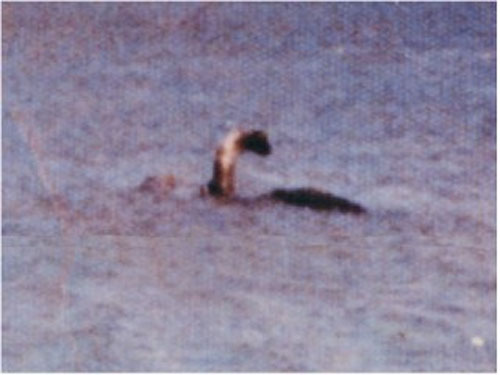
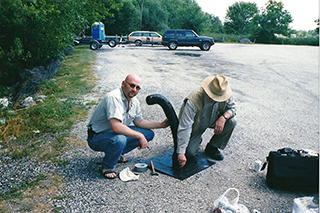
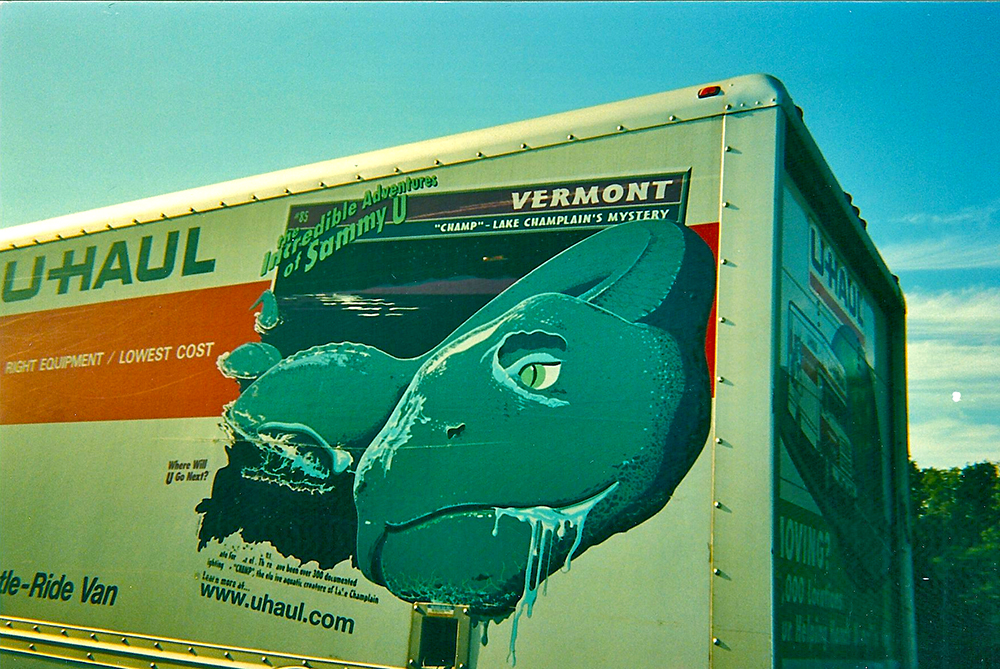
Ben first reminds us all that the History Channel still has not made good on their promise to be transparent about their Amelia Earhart research debacle, and then the guys discuss a listener question regarding “asking questions” in a leading way. Then, for our main topic, we turn to Champ, the legendary monster said to inhabit Lake Champlain, which borders New York and Vermont. The best-known report of this monster is said to be from Samuel de Champlain himself in 1609—except it’s a falsified quote. Ben draws on his personal investigations of the legend, giving us an overview of the nineteenth century’s yellow journalism, the frequency and patterns of Champ sightings, and similarities to the UFO phenomenon. The best photographic evidence for any lake monster (after the famous Nessie photo was revealed as a hoax) was the photo of Champ taken in 1977 by Sandra Mansi. Ben talks about his interview with Mansi, his analysis of her photo, and the subsequent practical investigations he did with Joe Nickell at (and in) the lake itself. As you might expect, a few things didn’t add up, and Ben walks us through the puzzle.
0:00:00
Pascual Romero: Hey strangers, Pascual here. As we all know, that special time of year is upon us. The time of year we decorate the house, put up the tree, and sing songs about that jolly old bearded fellow who goes by many names, but around Strange Studios, we prefer calling him Kronos. That’s right, friends, Bromalia season is well underway and there’s only 17 more shopping days until the sacrifice at the Temple of Saturn. If you’re thinking of interesting gifts for the skeptics in your life, why not check out our Skepticrates. We pick out at least three fun items and ship them to you or the person of your choice every month. It’s always a fun surprise to see what unique, skeptical, or just plain interesting items we send. This month is a special holiday-themed Skepticrate. To start receiving Skepticrates, just head on over to patreon.com slash squaringthestrange and pledge five dollars or more per episode. It’s as easy as that. When we ask for your address, you can just use yours or the person you’re gifting the crates to. Every dollar you pledge helps us keep this show up and running with the content and quality you’ve come to love, and we thank all of you who have taken part in supporting this show. And remember, get your orders in before December 14th to receive the December Holiday Edition of the Skepticrate.
0:01:22
Ben Radford: Welcome to Squaring the Strange, the podcast that examines all manner of the mysterious and the mundane through a critical lens. So let’s square the strange.
0:01:30
PR: Welcome back to Squaring the Strange. This is episode 35. How are you feeling? 35 is a good number.
0:01:55
BR: 35, yeah, I can think of worse numbers.
PR: Our podcast is now old enough to run for President of the United States of America. I would argue that it would be a better president than the current one.
BR: I suspect it would be. The collective intelligence, I don’t know, I’m not going to touch that.
PR: And cue the angry emails. All right, so this week, I’m really excited about this one. Growing up, I was a big fan of cryptozoology. I always got those books and the plethora of shows from…
BR: In Search Of.
PR: In Search Of, to Unsolved Mysteries, you name it. I was glued to the set for those. And this one is one of my favorites because my favorite kind of crypto creatures are lake monsters and sea monsters. The deep is such a fascinating world. This one is a homegrown American monster up in northern New York slash Vermont, right on the border, Lake Champlain, and he’s our buddy Champ. We’re going to dig into that. Like I said, I’m really excited. Let’s go ahead and jump right into it. What are you skeptical of this week, Ben?
BR: Well, this week, a couple quick things. The first one is I wanted to remind our listeners that I think four or five months ago, one of the two, there was a a show from the History Channel on Amelia Earhart, The Lost Evidence. The Lost Evidence Found, or the Stupid Evidence, I forgot the exact subtitle, but suffice it to say that it was thoroughly debunked, not just on this podcast, but on many others as well. And I just want to take a moment to remind our listeners that the History Channel, after it was shown pretty conclusively that their evidence was flawed, and basically the entire premise of their special was fatally flawed, they didn’t apologize, but they did say that they were committed to truth and would be researching exactly what this new evidence meant. And we’ve covered their response on the show. Oh, we haven’t. That’s right. We haven’t. That’s because they still as of now, again, I think four plus months on still haven’t told their viewers and the public exactly how their research went so horribly wrong. And so I’m still looking forward to it, and I’m going to keep asking, because I think that’s important to do, not just sort of like give them a pass and let it fade away like, no, you guys screwed this up. How exactly did you guys screw, were any producers fired? How does it go this far off the rails that a guy in Japan uses Google for half an hour and solves this mystery that your team of experts couldn’t quite figure out? So anyway, History Channel, if you’re listening, still waiting.
PR: Ball’s still in your court, guys.
0:05:06
BR: Exactly. But beyond that, with that little opener, I wanted to just touch briefly on a question we got from one of our listeners in response to the last episode, the one on the outrage episode, which featured everybody from Miley Cyrus to the Black Santa, Larry Jefferson. And we’ve gotten a little bit of good feedback from it. And one person asked us on Facebook, he says, I have a question regarding asking questions, asking questions being in quotes. How do you tell the difference between a genuine inquiry about something and an ideologue attempting to steer the debate in a specific direction? And of course this came up because as you’ll recall, I got a fair amount of heat from people who accused me of having ulterior motives or quasi racist motives. I still don’t entirely understand exactly what they were upset about, but I was certainly criticized for daring to just try to figure out how did this story come about. I mean, on one hand, there’s this tweet about how there’s this deluge of racism, so bad that they had to shut down the comments on a newspaper website and the next day where the same editor says that the comments were never on. So I see discrepancy there. I have no ulterior motive. I’m not trying to… I don’t have some agenda that I’m trying to promote. I’m trying to understand how these two differing stories compare and what the hell happened how I was it that this story went everywhere and of course a lot of that is my background in in journalism and media literacy yeah you know writing the book media myth-makers I mean the journalists screwing up stories is part of that’s a big part of what I do yeah and it doesn’t matter the topic I I any number of topics ranging from you know eating disorder misinformation actually the in the next issue of skeptical inquire Magazine, well, I have an article next issue talking about some of that and we’ll cover that on a future episode But again just across across the board. So for me, I’m not zeroing in on this one particular thing across the board anytime I see What what seems like sketchy journalism? I’m interested in sure. I’m trying to understand what happened. And again, across the board from homeopathies to ghost and everything else. So anyway, I just want to spend a few minutes touching that. Because it’s an interesting question. How does one parse that out? Because what you find, of course, and you know this as well as I do, that oftentimes the refrain, I’m just asking questions, is conspiracy laden. Straight down the pike, right?
PR: Yeah, that is a really tricky one because it is so common to hear it from the truthers and the birthers and stuff. And they always like to use it as a way to frame their position. You know, for one, it’s a little weasley because it gives them an out. You know, it’s like, hey, hey, I’m not judging.
0:08:24
BR: Right.
0:08:25
PR: You know, it’s like, but you, we can tell you’ve already got a notion and you’re just, what you’re doing is you’re trying to trap people.
BR: I’m not saying Obama’s not an American, but I’m just asking questions about that first certificate that I’ve seen four versions of the short form, the long form. I’m just asking questions like, no, you’re not.
PR: Didn’t have enough, the right wording or what, you know? I mean, that’s definitely something we see on the other side of the fence quite often.
BR: Yeah, and so I think there’s actually a couple ways to distinguish that. I mean, one thing you find among conspiracy theorists when they invoke the just asking questions, dude, comment, it’s usually because the problem is not that the questions themselves are inherently inappropriate or invalid. Instead, it’s that they refuse to accept the answers they’re given. I mean that’s the core distinction there. The Obama birth certificate is a perfect example. You know, like, well I’m just asking questions, okay, here’s the short form. Okay, but I’m not satisfied, give me the long form. Okay, here’s the long form. Yeah, but where’s the, no, you ask the question, it’s a fair question, here’s the answer. If you refuse to accept the answer, that’s not my fault.
PR: The goal posts went up twice and the ball sailed clear through them.
BR: Exactly. Exactly. And you see this all the time. And with, for example, 9-11 truthers love to ask questions like, you know, why did no tall steel frame buildings ever collapse due to fire before 9-11? And again, it’s not that the question is invalid. I mean, it’s a legitimate question, but certainly it’s been answered. You know, thermite can’t melt. Rocket fuel, no, it’s been answered.
PR: Yeah, we have an answer.
BR: Right, yeah, you may not accept that answer, but your refusal to accept what the experts are telling you does not mean that you’re not getting answers. It means that you’re refusing to accept those answers. So, you know, and in this case, when I was looking into the issue of the racist deluge at the Star Tribune, I mean, I was asking questions that had not been answered. I mean, nobody had, I, there was no answer until I investigated and figured out what was going on and contacted the guy and pieced it together. So it’s not as if I was asking questions and people were giving me, oh well here you go. It was like they were referring me to the same bogus, the same incorrect news stories. And it’s like no, you need to be more skeptical of that. You’re pointing me to that, that’s part of the problem. You need to dig a little bit deeper there. So that’s one distinction. And the other one is that oftentimes, you know, you have to look at the motivation And the motivation can often be determined by the sorts of questions are being asked, right?
PR: Right.
BR: So if a person is asking questions about say, you know, the journalistic basics, you know, who what where when why how that sort of thing Typically, it’s because they’re generally trying to figure out What happened they’re trying to establish the circumstances behind whatever it is, you know, an explosion, a ghost sighting, an incident, whatever it is. It’s like, no, when did it happen? That’s a… why… you know, there’s… the basics are just trying to figure out the parameters of what the incident involved. So typically I think that you can contrast that with, for example, conspiracy theorists who they’re not asking the basics. They’re asking sort of questions that are leading to an answer that they’re trying to corner you into.
PR: It’s gotcha questions and those are very common in the conspiracy world as well as with religious apologists. when I was like the time that I spoke with Ray Comfort, you know, it was his questions were exactly that at all times. It was always trying to say, you know, okay, you don’t believe in this, but will you admit that, you know, the Bible is a book? It’s like, yes, you know, but that’s not…
BR: I’ll grant you the Bible is a book.
PR: Yeah, and it’s, but those are, you know, and they use those to get you to say yes to something or to agree with them on something because they think that, well, it’s not that they think that, I mean, it is a tactic. It’s a tactic that works in some cases where getting you to agree with A will seem to infer that somehow you agree with B. And those are the kinds of questions you really have to watch out for, which are very much in that I’m just asking questions world, you know?
BR: No, exactly, and then you end up looking flustered. You’re like, yeah, but that’s not what you said. And then you look like the fool. It’s like, no, no, no, you were trapped into this. And you’re, cause, and actually that leads me to the second issue, which is of good faith, right? You know, if you think about it, I mean, a lot of times, you know, you can tell, are they asking it in good faith? I mean, do they, is the person, are they a researcher, a journalist, a skeptic, I mean a scientist? There’s all sorts of reasons why people sincerely ask questions to try and understand something. But one problem I think is that oftentimes outside of that context, the average person usually when they encounter questions, it’s within the context of people that are on social media for example Facebook and Twitter right that that they’re they’re not approaching it from a from a From a scientific skeptic on view they’re trying to lead you to get you to say something right right? They’re trying to like lock you into position. Yeah Yeah, and so I think that you know that’s I think that’s part of what happens is that you know is that when they do encounter somebody who is on the somewhat rare occasion genuinely trying to understand something, they’re so used to this knee-jerk, oh, oh you’re on the other side. You know, you’re, oh you’re, you know, you’re liberal, you’re a, you’re a conservative, you’re a libtard, you’re, they, we have all these labels like we just, oh okay, because we get our hackles raised. We get our defenses up. And so you immediately assume bad faith on the other person’s part. And I think that that’s part of the problem here. And of course, you know, they assume that the only reason that a person would question the claim is that they’re trying to discredit that claim or a larger narrative that that claim supports. But in science, that’s not true at all. Scientists routinely question ideas that they agree with.
0:15:15
PR: Yeah, oh yeah.
0:15:16
BR: You know, and so when I, like, you know, for example, when I do research, you know, when I go and talk to, you know, somebody about their ghost sighting or their psychic’s claims, you know, my goal is to try and understand what happened. My goal is to sincerely, I mean, I’m not, you know, if I ask a person who believes they’re psychic, why do you believe you’re psychic? I’m not, this is not a gotcha thing. I’m genuinely curious, like, no really, why, tell me, I’m being entirely sincere, why do you believe you’re psychic? I’m not trying to trap you in a thing, I’m not trying to get you, I’m trying to understand what the basis for your assumptions and beliefs are. And then I can work from that. So, you know, you may say it’s because X, Y, or Z, because right before a friend calls, you think of them. I mean, there’s all sorts of things. So for me, as a skeptical researcher, my goal is to try and figure out what’s going on. I’m not trying to debunk or disprove. I’m not coming at witnesses and people who believe differently than me as enemies. I’m coming at them as somebody who has had some experience that they can’t understand and I will do my best as a researcher and with my background to try and figure out what happened. And if the answer is that there really is UFO or there really is a Bigfoot or this person really can predict the future, great! That’s cool! I want to be there. I want to prove this. I want to figure this out. But again, I think that this is part of the problem. It’s a lack of charity. It’s this immediately assuming that anybody that asks you for evidence is an enemy and is out to get you and is out to undermine your position. And number one, that’s often not true. And number two, it’s a very cynical worldview. I mean if somebody comes to me and reads an article I wrote or a book I wrote or something and they ask for evidence, I’m not personally insulted. My answer is here you go. Yeah, here’s the interview. Here’s here’s my Here’s my references. I Welcome your questioning my evidence because I have come to my conclusions Based on research and thought and consideration and if I’m wrong, then great. That’s absolutely wonderful. So, you know, and that’s what I encountered in this case is where I had some people who were suggesting it was some sort of a distraction tactic as if I was trying to distract from something. And I’m like, no, I’m not. I’m not trying, no, I’m trying to figure out what happened. I’m not trying, I’m not, I don’t know what you think I’m distracting from and to, but I’m not. You know, and usually when I encounter the claims about distractions, it’s usually itself a distraction. Right? Because if I talk to somebody who has a ghost photo or a Bigfoot photo, and I’m asking them for evidence, and they’re like, that’s a distraction. No, this is not a distraction. You’re making a claim, I’m asking you for evidence, that’s not a distraction, that’s doing basic journalism, that’s doing basic research. It’s not unlike the Wizard of Oz pleading for Dorothy and her gang not to look behind the curtain. Right? I mean, if a claim is valid and factual, there’s no reason why anyone would object to researching it. I mean, there’s a Thomas Paine quote, it is error only and not truth that shrinks from inquiry.
0:18:58
PR: Right?
0:18:59
BR: There’s, if what you’re saying is true, there should be no reason in the world you would not want somebody to examine it and verify it.
PR: Yeah, no, that’s absolutely right. And I think, a good kind of thing to do, what I recommend to everyone, especially our listeners, people who might be a little more skeptic-minded, and I suspect a lot of you have done this, but get yourself familiar with the first-off debate tactics that are used by people that positions, familiarize yourself with those tactics. And also get bone up on your logical fallacies because you will find those very quickly when those lines of questioning start coming up. And you’ll see very quickly, you see a lot with these arguments in conspiracy like the 9-11 conspiracy with thermite and jet fuel and how the nature of steel beams. You know you should be asking before the question you know you’re asking about the melting temperature of steel beams or anything is is you know what is thermite or hat does the steel beam need to melt to fail? You know it does.
BR: Exactly, because there’s assumptions packed into those questions.
PR: Yeah, they’re starting from, you know, that you can tell they’ve already been fed this information and because they’re going from, you know, jet fuel can’t melt steel beams, it’s like it doesn’t matter. It doesn’t have to melt. That’s not what happened. Right. That’s, you know, your premise is false. You’re saying, you know, so that’s absolutely you know the easiest way to identify this stuff is just know when they’re when they’re starting from a point that already has an assumption underneath it and when they ask a question like you know jet fuel and steel beams it’s like you’re you’re you’re 10 steps past the questions we need to be asking first you know right or you know what is the structure of a steel beam what does it take to damage it?
BR: What does it take to doesn’t have to liquefy in order for a building to come down?
0:21:16
PR: Exactly.
0:21:17
BR: And the answer is no.
PR: Yeah, exactly. I mean, you don’t have to absolutely, you know, annihilate the walls of a house for it to fall down. I mean, you just have to compromise it. But again, it’s just getting, jumping way past where the question should be. And I think that, you know, when the Black I mean, I have to say because I am really sympathetic to the more social justice-minded people and I am a very liberal person and I make no apologies for it and even I am subject to some of those biases sometimes. And I know that feeling when the question of race comes up in a debate and you’re talking whether it’s about Black Lives Matter or something like that. You know, you get a lot of, there are a lot of people who use that kind of I’m just asking questions thing to sort of dismiss the cause that they’re, you know, that is underlying the issue. And I’ve seen that, yeah. And it feels very, you know, I know because I feel it when I see that and I’m like, you’re just, you’re doing this and it’s, and you’re just trying to kind of avoid the actual problem that’s happening by… Let’s talk about this over here. By reducing what the entire group of people or the race to this, you know. But, you know, it’s important to recognize that, you know, after doing some research, it wasn’t as bad or really at all as bad as we expected.
BR: In that case.
0:23:01
PR: In that case.
0:23:02
BR: We’re not talking about everything else.
0:23:03
PR: No one’s saying, right. We’re not talking about Black Lives Matter.
0:23:05
BR: We’re not talking about… In this particular case, which was widely reported by major news media, it did not happen. Yeah. And the number of people that protested the original report was zero.
PR: Yeah, and that’s to me, I like, I’ll take my victories where I can get them, and I’m happy to know that that was not as big of a deal as it was played out to be, and I’m glad that things ended up being, you know, and it was a pretty happy ending, and I’m really thankful for that, and you know, and that’s just again, you’ve got to know when the questioning really is genuine, honest questioning. As a skeptic, you have to be willing to take those risks, so I appreciate that.
BR: Yeah, I support exactly what you just said. I think it’s a great point. I’ll just quickly add that, again, in the context of people who had something to hide, right? We’re like, don’t ask me that question. You know, well, how do you know you’re psychic? Shut up. I’m not going to use it. And I was trying to when had I seen the this the claim of distraction tactic come up and I realized it was Trump. No, seriously, this is because again, in the context of like paranormal investigation, it comes about time but but in terms of like social issues the the the previous time that I remember seeing that was when the Access Hollywood Tape came out. Yeah, and and Trump said You know, he was defying this, you know, you hear this on tape You know you essentially admitting to to grow up in the women and his answer was well It’s just if the quote is nothing more than a distraction from the important news we’re facing today. So I mean, it’s like, yes, yes, Trump, I see exactly what you’re doing. Like, that’s a distraction. No, it’s not a distraction. You said that, that’s relevant. It’s relevant to lots of things. It is not a distraction. So it’s easy to toss around, that’s a distraction, that’s a distraction. Maybe it is, maybe it isn’t. But don’t jump to that.
0:25:10
PR: Yeah, absolutely.
(MUSIC)
0:25:11
Ian Harris: You’re listening to Squaring the Strange. I’m Ian Harris and you can check out my new comedy special, Extraordinary, on Amazon, Amazon Prime, iTunes, Google Play, pretty much any video on demand site. Dropping next Tuesday, December 12th.
(MUSIC)
0:25:51
PR: Like I said at the top of the episode, I’m really excited because this week we are talking about one of my favorite creatures in the whole world, Gene.
BR: Mine too! Mine too, mine too. We got two guys in the same room of more or less the same age, same era, and we’re, you know, childhoods in many ways identical and parallel. Both grew up in New Mexico, both grew up having a fondness for mysteries of all sorts, but particularly lake monsters.
PR: So let’s go right into it. How about you give us a quick overview of Champ and kind of the history of, you know, we’re talking about sightings and all that.
BR: Sure, sure. So basically, Champ, as we’ve discussed, is the creature alleged to live in Lake Champlain, one of many different lake monsters, of course, around the world. Many are from Canada. In fact, Canada actually has more lake monsters than any other country.
PR: I did not know that. I can attribute that. It doesn’t surprise me, because I can think of a couple right off the top of my head but Ogopogo being my favorite.
BR: We’ll do a show on him too.
0:27:05
PR: But yeah, so that is pretty interesting that I did not know that.
0:27:09
BR: Yeah, true enough. And so that was why, one of the reasons I was interested in researching the Champ case was partly because it was, as you mentioned, known as America’s Loch Ness Monster. And before I had, you know, when I was a teenager, I’d heard little things about it. I’d read books and whatever else, but I was like, I don’t really, okay, whatever. I mean, it wasn’t something that really piqued my interest. But then getting more interested in cryptozoology and monsters and Bigfoot and that sort of thing I was like, oh, let me look into this. And then when I discovered that the most famous Loch Ness monster photo was revealed to be a hoax, the surgeon’s photo and all that, then the next best evidence that was offered for any lake monster, really anywhere in the world, was for Champ. And since it was in my home country, I didn’t need to travel to Scotland to look into it. I was like, hey, let’s research this. So Joe Nickell and I, another researcher, of course, we co-authored a book called Lake Monster Mysteries. And we have a chapter on various creatures including of course Champ and Ogopogo and Memphri Magog of Memphri, etc. We went and did some investigations. We did a couple, I think we did two TV shows. One was for Learning Channel, one I think was for Discovery. And we ended up doing all sorts of original research into the best evidence for lake monsters. Again, it was a photo taken in 1977 and published in 1981 by a woman named Sandra Mansi.
0:28:55
PR: Cool, now, so you mentioned the 70s and 81 when the first photo came out. Now, when did we first start getting reports of Champ? Like, how far back does that go?
0:29:07
BR: Well, the original and best-known report of Champ dates back to, again, depending who you talk to, 1609.
0:29:20
PR: Oh, wow.
0:29:22
BR: Yeah. When Samuel de Champlain, the French explorer, who, of course, Lake Champlain is named for, was said to have encountered a mysterious, bizarre lake monster in the waters there. There was a widely circulated quote that said that he had documented a 20 foot serpent thick as a barrel and a head like a horse. Which, you know, would, let’s be honest, be a lake monster. I mean, that’s…
PR: I’d give him that.
BR: That’s, of all the things you’re describing, 20 feet long, thick as a barrel, head like a horse, that would be a lake monster.
0:30:04
PR: Yeah, that fits.
0:30:05
BR: That fits. Not a deer, not a moose, not a duck, that’s a lake monster. The problem is that that particular quote is actually a fake quote.
0:30:15
PR: Ah, okay.
0:30:16
BR: It was published, it first was circulated in the summer 1970 issue of a magazine called Vermont Life, which had a section on Champ, of course, and the writer, I don’t want to say they manufactured the quote, but it certainly did not appear before then. To be fair, I mean Champlain did describe a creature in the water, and if you look at his original description, it actually appears in a book by a guy named Michel Merger. And he describes it, he says, he’s talking about, there’s a fish called, I can’t pronounce it exactly, a traceru, which is of various lengths, but it’s between 8 and 10 feet long, and he says, I’ve seen some 5 feet long, as big as my thigh, and had a head as large as my two fists, a snout two feet and a half long, and a double row of very sharp teeth. So that’s certainly, number one, it’s nothing like a 20-foot serpent with a head like a horse, thick as a barrel. Nothing like that, but he’s certainly describing some large fish in there. And it’s almost certainly a gar or garfish, which is a pretty good description of exactly what that is, which is a known, albeit large and kind of creepy looking fish. I’m not a fisherman, but when you see stuff that fishermen pull up, man, that’s scary some of the stuff in there. Some big catfish, there’s oar fish that are, they’ll scare the hell out of you. So anyway, the original and best known is essentially a mistake. So if we disregard the 1609 report, which of course we should because there’s no good evidence for it, really the first appearances occur in the 1800’s. There was a report from 1819 ing the Plattsburgh Press Republican newspaper, which is still there today, and I went to their offices. And there was a story titled Cape and Serpent on Lake Champlain. And it discussed a sighting by a guy named Captain Crum, which sounds like a cereal.
PR: Sounds like an off-brand, store-brand Captain Crunch.
BR: Hey kids, Kroger’s Captain Crumb reported seeing an enormous serpent. It was, he said, it has this really fantastical description. It was this huge thing. It had three teeth and eyes the color of peeled onions. It had a belt of red around its neck and a white star on its forehead.
PR:Wow.
BR: Yes, a white star on its forehead because that’s what they did. There was another one in the 1880s, I think 1883, there was a guy that said he’d seen a water serpent out on the shore and it had some white spots in its mouth and it appeared to be about 25 to 30 feet in length. One thing that you find when you start researching a lot of these early reports, certainly those from say the 1800s, there’s a lot of yellow journalism going on. And I encountered this lots of times when researching so-called original reports of Bigfoot, for example, and also Thunderbirds in one of my books, Mysterious New Mexico, I have a chapter on Thunderbirds, the giant birds, pterodactyl type things in the sky. And a lot of these stories trace back to really dubious, like extraordinarily dubious, like the version of National Enquirer, but 1830. And people, newspapers of the time, and there’s all sorts of cases like this you can read. Bob Bartholomew and I did a couple books. One of them was on called The Martians Have Landed, a history of media driven panics and hoaxes. In that book we cover lots of these media stories. The Batman on the moon case. There’s all these, newspapers in the 1800s had no compunctions at all about making stuff out of thin air.
0:34:51
PR: Yeah.
0:34:52
BR: You think today’s tabloids are bad, ain’t nothing new my friends, ain’t nothing new. So they were not shy about making a mountain out of a molehill or just fabricating the molehill or the mountain for that matter. So anyway, the point is that a lot of these early ones are clearly, I won’t say bogus, but clearly suspicious. The fact is that most of the sightings that you have from say the 1800s until really the 1970s, there was a handful of them. Again, there could be of anything, a floating log, something weird in the distance. They were not particularly uniform. And they were just sort of, you know, once a lake or a body of water has a reputation for having monsters, it tends to spawn monster sightings. That’s exactly what happened.
PR: Sure, sure.
BR: In fact, it’s interesting because there’s a Champ sighting board in Port Henry, New York. And there’s, of course, the very first one is in Champlain, which has, of course, been discredited. But what’s interesting is that if you look at the pattern of the sightings, about half of the reports are from 1981 and 1982. The reason that’s significant is that 1981 was when Sandra Mansey’s photograph was first published. That is the world’s best photograph of any lake monster, never mind the one at Lake Champlain. And so what you find is that the reports of Champ were tied and correlated much more closely to the publication of the photograph, not any other sighting. Because keep in mind, there was a four year lapse. The photograph was taken in 77, it was published in 81. So if what Sandra Mansey had seen was actually the Champ Lake Monster, and Champ was being active and frolicking around above the water, you would think that there would be dozens around the 70s and late 70s and 80s. But no, it’s not until everyone talking about it and it’s a newspaper, and you’re like, oh, here’s a photo of Champ. Oh, I saw Champ. Hey, I saw Champ too. I’m Champ and so is my wife. So you have this whole really interesting effect of how you have the culture and the society fueling these sightings. And that’s very clear of the case with Champ.
PR: Yeah, that’s really common. And that’s a phenomenon that’s very trackable. You can trace it through just about any cryptozoological frenzy.
BR: Just like UFOs.
PR: UFOs are the best example I can think of really because the gap from the Roswell incident to the UFO hysteria was significant. There are certainly so-called sightings in the meantime, but the big break and the big shift in UFO culture wasn’t until a very dramatic, overblown story, sensational kind of story. So that’s definitely a common theme in any kind of mysterious thing like that.
BR: Yeah, and we talked about that in the UFO episode. You know, again, it was Roswell was literally a non-story for 30 years. Like nobody, it was not a thing. Then all of a sudden someone writes a book saying it’s a thing. People are like, I guess it’s a thing. Let’s talk about it. Suddenly there’s sightings coming out of the woodwork.
PR: People are getting abducted by aliens and everything.
BR: Exactly. So anyway, I was curious about looking into Champ, and Joe and I did research for the Learning Channel, and we hired a boat to take us out, and we did investigating, and we actually did a couple stakeouts looking for Champ. But at the end of the day, as with most of these cases, the evidence comes down to anecdotes, essentially. But in this case, it was slightly different because of course we had a photograph. And so, and not just any photograph, but a reasonably clear image of it. And so I’m assuming that many of our listeners either have seen or can Google it. I don’t know if we have the rights to actually put it up because it is copyrighted. But it’s, actually we have a drawing that I made from it. We can use that.
PR: Okay.
BR: That’s my copy. But anyway, I’m pretty sure that most cryptozoology buffs and monster buffs are no, they know exactly what the photograph looks like. We’ll put up an image on it. But basically, be because it was such a, a, because it was so widely recognized as being the best evidence. That’s why I wanted to look into it.
PR: Cool. Well, let’s take a quick break and listen to a fortune cookie and get right back to it.
(MUSIC)
0:40:05
Celestia Ward: Hey, Squares and hey, strangers. Celestia here with another skeptical fortune cookie. Let’s sit back and crack this one open. Must but verify. This simple three-word maxim was popularized in the United States by President Ronald Reagan back in the 1980s, and he used it so often that Soviet President Mikhail Gorbachev once quipped back, You say that at every meeting. Reagan simply responded, I like it. As Reagan pointed out, the phrase is actually an old Russian proverb. Davirai, no provirai. He is said to have learned it from Suzanne Massey, who had written about Russia and served as an informal messenger between Reagan and Gorbachev. She played a significant role behind the scenes in helping to end the Cold War, part of which was mentioning to the president that Russians like to talk in proverbs, and as an actor he could probably learn a few of them quickly. Trust but verify and similar mottos have since been adopted by security and defense agencies, online protection groups, programming circles, and even Bitcoin. There’s not many phrases that describe a skeptical mindset quite as concisely and quite diplomatically. This proverb begins with trust but ends with doing your due diligence. It’s skepticism with a smile and a handshake, rather than curmudgeonly cynicism. So with diplomacy, investigation, or most anything else, remember to trust, but verify. Now, let’s get you back to Ben and Pascual.
(MUSIC)
0:41:53
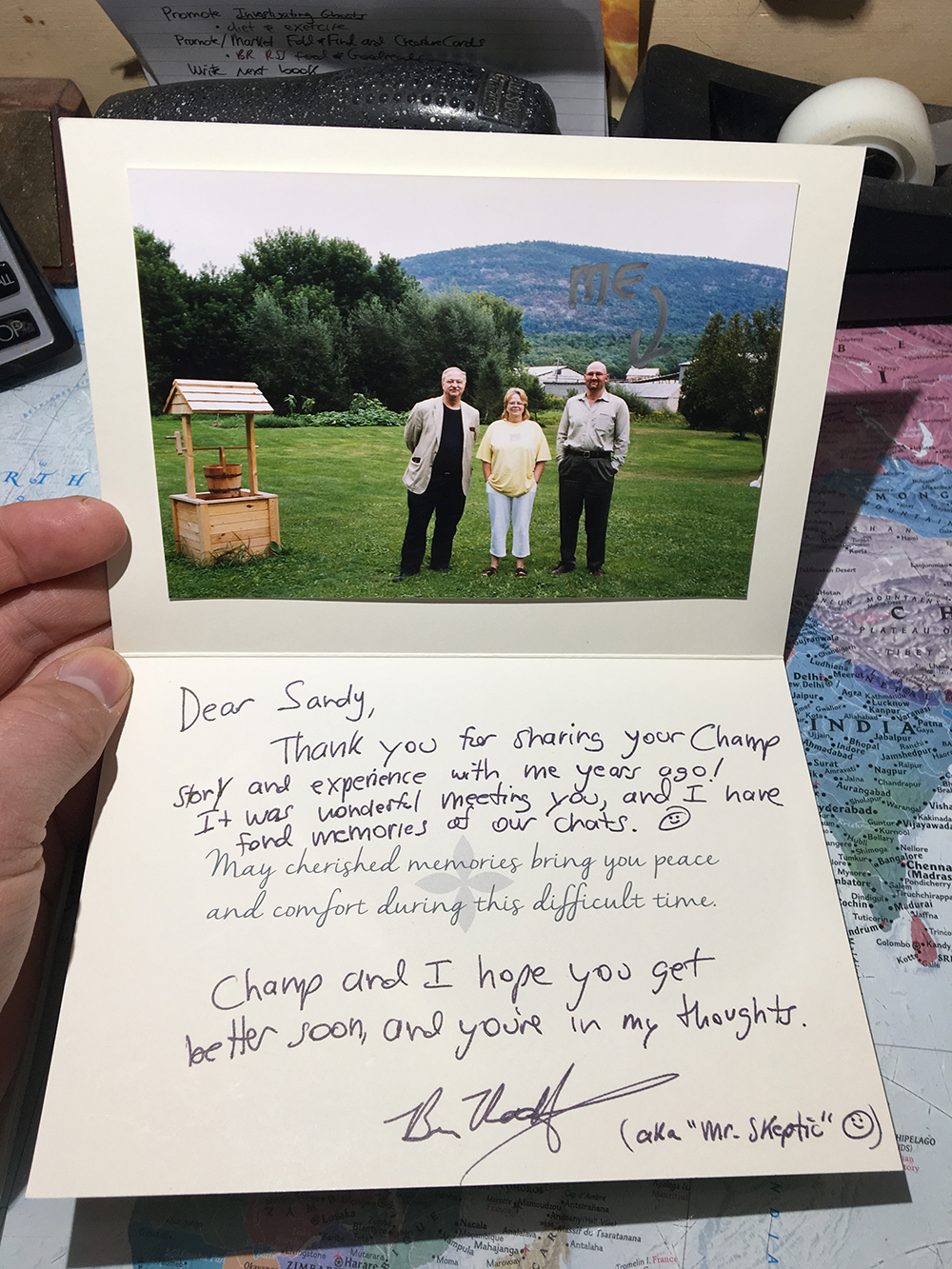
BR: For those who are interested in the history of Champ, you can see the book, The Untold Story of Champ by Robert Bartholomew, who’s a co-author of mine. It’s a really interesting book. It’s sort of the definitive history on that particular lake monster. So I would highly recommend it for those who are monster lovers such as ourselves. But anyway, back to the Mansi photograph. So as I mentioned, after the world’s best photograph of the Loch Ness monster was proven to be a hoax, at that point, and revealed to be a hoax, at that point the sole remain, the best evidence of any lake monster, regardless of citizenship, because they issue passports these days, was Champ. And so that sort of was the last man standing, so to speak. So because Manci was still alive, Joe and I decided it was important to interview her. You know, a lot of times in our investigations, we’re looking into things that may have happened 200 years ago, or, you know, 1910 or something. But in this particular case, not only was Sandra Manci still alive, so we could go and interview her and contact her but she was willing to talk to us. So it was it was I it’s always important to me as an investigator when possible to go to original sources. And not just rely on what other people have said because more often than not you know it’s a they said story. And you know I’ve I’ve encountered too many times when I’m reading an account and I look for the source and then the alleged source reads nothing like that account. And it’s been twisted around. It gets so frustrating because after you soon see that after three or four writers have gotten their hands on it, it’s worthless because details have changed and this and that. So anyway, because the authenticity of the photograph was held in such high regard by many people, it felt important to take a fresh look at it. And so rather than relying on other people’s third-hand stories, Joe and I went to Vermont to interview Sandra Manci in detail in August 2002. So I’ll just read you a brief section from my book because it sort of summarizes the circumstances pretty well.
PR: Cool.
BR: According to Manci, her family’s encounter with Champ took place on Tuesday, July 5th, 1977. Sandra and her fiancé, Anthony, along with Sandra’s two children from a previous marriage, were taking a leisurely drive along Lake Champlain. They drove by some farmland and, around noon, made their way to a small bluff overlooking the lake. The two children went out in the water while Anthony returned to the car to get a camera. As Sandra watched her children and the lake, she noticed a disturbance out in the water, about 150 feet away. She thought at first it was a school of fish, maybe then possibly a scuba diver. Then, quote, she said, the head and neck broke the surface of the water. Then I saw the head come up, and then the neck, and then the back. Nancy didn’t panic. She said, I wasn’t even scared. I’m just trying to figure out what I’m seeing. Then Tony, then when Tony came over the field, he saw it and started screaming, get the kids out of the water! The kids scrambled up the bank and headed towards the car. As Anthony helped Sandra to the bank, he handed her the camera. She knelt down, snapped one photograph, and then put the camera down to watch the creature. The Mansies estimated that the creature’s neck stood about six feet out of the water and was about 12 to 15 feet long. The sighting lasted a remarkably long time, about five to seven minutes, during which time the creature never turned to face the shore. She described the head and neck as dark in color, and she said that what we see in the photograph is as much of the creature as we saw. For example, it was important to establish that because I wanted to find out from her if she saw more, what did she see? But she said, no, what you see is what I saw. There’s no more information about that. Yeah, okay. So she said that after several minutes, the head and neck slowly sank down into the water and were gone. The Mansies then headed home and they didn’t report the sighting to anybody and they took the unfinished roll of film to a local photomat and then it was tucked away in a photo album for basically four years. So that’s the version she told me. Now, to be fair, if you look in other books, and there may be slightly different versions of the account, this is what she told me, and I have it on tape. So again, her story may have changed or not, I don’t know. But again, this is what she told me, so I can only go by what she said. And it comports more or less with the general outline of what she’s told other people as well. So that was interesting to sort of get not only her first person eyewitness account, but also comparing that to exactly what we see in the photograph. Now, there was lots of missing information about this photograph, and this is one of the problems. So for example, there was no negative.
PR: Now that’s interesting because to those of us on our side of the the generations, we are familiar with the fact that you cannot produce a duplicate of a photo in that era without a negative and and Which so negatives mattered? Yeah, you know that and that’s something that you know, we you would never see again I mean, I guess in there’s hipsters who still shoot analog analog, but a negative was your master record of any photograph. Most people, at least, you’d get the negatives cut with the photos when you got them back.
BR: Back in my day!
PR: And they’d be in a sleeve with the photos.
BR: Pepperidge Farm remembers when you used to take negatives out.
PR: So if anything, the most that would happen is you probably just would forget about the negatives, but they’d still be in the sleeve unless you took them out for some weird reason.
BR: So this is one problem was, really? You took a photo of a lake monster, probably the only one in existence, and you threw away the negative.
0:48:23
PR: Who needs a negative?
0:48:25
BR: As a researcher, my heart just sank. For whatever reason, there is no negative. At least that’s what she says. I have no reason to doubt it. But the negative could hold important information. For example, it would tell us what is before and after the photograph. Now, keep in mind, that wasn’t the last photo on the roll. So a lot of people have mistakenly assumed that she only took one photo because it last in the roll she says no there were More she just didn’t think to take more photos.
PR: Yeah, okay.
BR: So but for example. Let’s say that it was a hoax. You know seeing the the photographs just before and just after could be very important, we could see something from a different angle for example there There’s even been times when I’ve been doing investigation, and I found evidence in previous images before and after that that sort of piece helped piece together the story. So sure in any event no negative. She also couldn’t tell where the location was. So this was a little tricky because again you would think that you would remember where you saw a lake monster sure or something like that Yeah, yeah now she’s saw a lake monster or something like that. Now she’s, it’s a little, it’s not clear, she says she doesn’t remember where the photo, where it was taken. She says something to me as I was leaving that made me sort of wonder whether she didn’t want people to know. She says something along the lines of maybe I don’t want people to know because people will go there. And I think that her intention was, or her idea was, that if people knew where it was, that they would go there and try to harass or kill it. But of course, this was 2002, and the photograph was taken in 77. So I was like, Sandra, it’s long gone. I guarantee you, it ain’t there anymore. But again, I wasn’t going to argue with her, but either she doesn’t remember or won’t say where the location is. Again, this is part of the problem because when you’re analyzing the photograph, in the photograph there’s some Queen Anne’s lace in the foreground, and there’s this sort of hump figure, and then there’s the background. And determining where on the lake the photograph was taken could be very useful in terms of determining how far out it was.
0:50:59
PR: Yeah, absolutely.
0:51:00
BR: Because there’s really nothing of scale in the area. So there’s lots of information. But so, you know, that led to some people thinking that it was probably a hoax. And I’ve had arguments with fellow skeptics and cryptozoology buffs who have argued that she was faking it, it was just a hoax. And I don’t think it was a hoax. I have defended her for years and I will continue to do so, much in the same way in the Chupacabra case, Madeline Tolentino. I do not believe that she hoaxed the Chupacabra. I don’t believe that for a minute. Could she have sure anything is possible? In my research, in my investigation, I think that they’re both sincere people who genuinely just misunderstood that something they saw. So it goes back to giving people the benefit of the doubt. The principle of charity, for example. So in the case of the Mansi photo, you know, some people were saying, well, you know, did she get a lot of money from the photo, for example?
PR: Oh yeah, that definitely brings up an interesting question. What’s the kind of economic aspect of this monster? Has the region capitalized on it? Does anyone kind of own the rights to the image of Champ? Is that something we talk about?
BR: A little bit, yes. Like any self-respecting community with a lake monster around it, they’re bringing some bucks in. You know, that’s certainly the case at Loch Ness. You see it also, for example, in Lake Okanagan in British Columbia. There’s a couple different towns, including Kelowna, which, you know, they sell Ogopogo t-shirts and hats and mugs, and why wouldn’t they?
0:52:47
PR: Oh, yeah.
0:52:48
BR: You know?
PR: Cash in.
BR: Cash in. So in the case of Champ, the town of Port Henry, New York is semi-officially called the home of Champ.
PR: Oh, okay.
BR: Of course, home is where you want it to be, I suppose. And they have parades and they have t-shirts. It’s been many years since I’ve been there, but the last time I was there, I mean, they have Champ burgers and t-shirts and that sort of thing. And I think if I’m not mistaken, the local baseball team, amateur minor leagues, is called the Lake Monsters, the Vermont Lake Monsters.
PR: That’s great.
BR: So clearly a reference to Champ. So I mean, no one really owns it per se. Now of course, the Mansi photograph is copyrighted. So people can’t use that without getting permission, but of course, if you’re just talking about Champ, hey, he or she’s fair game.
0:53:42
PR: That’s really cool.
0:53:43
BR: I have been to Lake Champlain. Unfortunately, it was on tour, so I never got the chance to really partake in the fun that is looking for Champ or experiencing any of the fun souvenirs. In fact, we came, the last time I was there, it was-
BE: You and Glenn Desig were busy getting drunk instead of looking for Champ. Come on, man.
PR: No, we were coming back from Montreal to Boston, and there’s a couple of border crossings. It is kind of well-known that if you go to… There’s this little border crossing. It’s not that well-known, but in my circles, there’s a border crossing that’s actually just due north of Lake Champlain and those little side road border crossings when you’re a band they are a lifesaver because the the regular big border checkpoints they know bands they know bands like to hide merch for tax reasons and they know bands you know might carry some illicit things across the border or something, you know whatever point being the big ones the big checkpoints are where those people really are. The small ones at two in the morning are staffed by guys who are just like, hey man, just, you know.
0:54:55
BR: They’re probably high too, man.
PR: And they’re, I mean, Canadians, don’t get me wrong, they really are like the nicest people on earth. But, so yeah, we came through and anyway, long story short, we ended up coming through in the middle of the night and I was really excited to just have actually been to Lake Champlain because it’s not really on any major thoroughfare or anything. We went through the Grand Isle, it’s called, the island in the middle of the lake, and there’s bridges that just go across, and we stayed in Burlington, Vermont. I was really disappointed to find that Burlington is not quite as excited about Champ as the New York side of the lake.
0:55:30
BR: They’re not. They are not. They’re sort of like, yeah, whatever.
0:55:33
PR: Yeah.
0:55:34
BR: Yeah, move on. Yeah, that’s my story of why I’m actually curious about that because I unfortunately never found any Champ swag.
0:55:41
BR: There you go. Well, so, you know, in approaching the Champ investigation and the Mansi photos specifically, one of the first things you do is look at prior research. So I began by looking at what conclusions other people come to when they looked at it. So I’ll just briefly touch on them quickly. So one of them was a examination by a guy named Roy Frieden in 1981 and it’s published in Joe Zarzinski’s book, Champ: Beyond the Legend. And Frieden basically validated the photograph and he said that he found no evidence of photographic tampering, which I agree with. I don’t think it is tampered. What’s interesting is that he was wondering whether it was maybe taken at some part of the lake where there were shallows. Because the lake, as with all lakes or most lakes, have different depths and stuff. He was wondering whether it could have been some monster or figure or something in that was in the shallower part of the lake and therefore might have popped whatever it is up in the air instead of being deep. Anyway, his general conclusion was that it was probably and which I don’t disagree with. And then the other main research was done by a guy named Paul LeBlond from the Department of Oceanography at the University of British Columbia. And he did an interesting analysis of, he was trying to use various estimates, including the length of the waves and the various figures like that to try and estimate its height. And he decided that the creature was between 16 and 56 feet long and was almost certainly a creature. I mean, he was very much on the side of things. But here’s the thing though, is that LeBlond, if you look at his original report, which I have, he admits all along, as a scientist should, that there are lots of sources of error, lots of variables, right? So any analysis is only as good as the information you have, right? Garbage in, garbage out.
0:58:20
PR: Yep.
0:58:21
BR: So, and I’m suggesting is that if you look at LeBlond’s analysis, he very clearly admits, you know, I’m guessing on this variable, I’m guessing this variable, I mean, given all these parameters, this is about what I think. Those caveats are usually, almost always, basically stripped out. So when Monster Buffs quote LeBlanc, it’s like, well, LeBlond did a detailed analysis and he concluded that it was between 60 and 56 feet long. Like, well, he said that if variables A, B, C, D, and E are correct and they may or may not be, then that’s about the range. So to his credit, LeBlond was very forthcoming about the limitations of his research and study and just said, there’s not much we can tell from this, but if these estimates are right, then it could be about this. So, and he also, like Frieden, agreed that there was no clear evidence of any hoaxing or any superposition like that. So, that was the first thing that I did was, you know, to look and see, okay, what did other people look at when they tackled it? And so then my question was, okay, well, let me take a look at it. So the first thing that I did was to find the original. And this is very important for, again, of course, with the original, the more information you have, the better.
PR: Yeah.
BR: And if any of you have seen, or if you’ve seen the uncropped Surgeon’s photo. Not the cropped Surgeon’s photo, which looks kind of spooky and monstery. If you see the uncropped version, it looks really tiny.
PR: Yeah, you get all, you get this little foreground in it, and the waves are, the scale of the waves really changes.
BR: Like, hold on here. It’s like, why did you only want me to see like a third of it? Was there some reason for that? Because there’s information that suggests that it’s maybe not that big in the case of the Surgeon’s photo. And so, oftentimes when you look at the Mansi photograph, the image is almost always cropped. Before I had never, literally never seen the original uncropped photo. I have a photograph of it I can show you, but it’s almost never shown because people are zooming in on the mysterious part. So I wanted to see the original. And so I made arrangements with Alan Nayer, who is Sandra Manci’s lawyer, to go to his office and we went to a bank vault. And I held in my hand the original Manci photograph.
PR: Wow. That’s cool.
BR: It is kind of cool. There is no negative. I’m probably one of a handful of people in the world who have actually held up my hand and looked at the whole thing. It was really interesting. Nayer was a very nice guy. Sandra Mansi was very sweet. He just let me sit in the bank vault and stare at it for an hour or two. I took notes on it. Of course, I wouldn’t want to touch or anything. I mean, I touch it, but I’m not going to draw on it. But it was important for me to see as much information about the photograph as I could, especially given all this speculation and talking about how it’s the best evidence for it. And so I did that, and then I also looked at the morphology. And I realized that if you look closely at it, there appears to be two parts. There’s a head sticking up out of the water, and there’s sort of a horizontal-ish dark figure on the bottom part. It looks like the two are connected, but I think if you take a closer look, that connection is probably a shadow. For example, I’m pointing with my finger here at the area between where the net comes out of the water and the hump. And a lot of people have assumed that it’s all one piece, and I think if you take a closer look at it, it’s actually two different pieces. And the shadow being cast from the sun above is casting directly, essentially directly down.
1:02:47
PR: Right, right.
BR: And one thing I noticed was that the morphology is wrong. If you take a look at the image and you try to figure, okay, well, where’s the rest of the body? You have this head coming up at almost a 90 degree angle, and then you have this smooth hump going towards it. I struggled mightily to sketch out how exactly that monster’s morphology could work.
PR: That would be very awkward, contorted, twisted, painful position.
1:03:23
PR: Yeah, it’s very acute.
1:03:24
BR: Yeah, the angles just don’t match up. Now, is it possible? Sure, anything is possible.
1:03:29
Yeah.
1:03:29
BR: I guess, you know, lake monsters could have right angles. But it’s not anatomically plausible if you look at it. So that’s one thing I noticed. The other thing that struck me was that the the head and the neck have no features. It looks like it could be sort of a head shaped, but I mean there’s no eyes, no ears, no mouth, no nose.
PR: Very smooth and kind of textureless.
BR: Yeah, it’s really, again, with your imagination, you can say, yeah, well, I could see how that might be like a face turning away. But again, if you look at them more closely, there’s no bone structure to it. It’s just, could it be a monster? Sure, but it’s just not plausible. I mean, just this sort of curved form. But the other thing that jumped out at me was something that I noticed only after interviewing Mansi. And this is why it was really important to me in researching the photograph to get the photo and get her account of it. Because virtually all of the accounts, virtually all the times when you saw the Mansi photograph being discussed, it was either the photograph or her story. And I felt it was important to reconcile the two because the photograph is presumably an account of her story. It should fit into what her story is saying. It’s not separate.
PR: It’s the record.
BR: Yeah, it’s part of the record. She had this experience. She captured this split second on film and then she had the rest of the experience and this is what the the Champ Mansi photos turned into. But it was important to me to try and figure out how these things piece together. And one thing I noticed was that in talking to her, and I mentioned this briefly in passing a few minutes ago, but she said that the figure that she saw was deaf. It couldn’t hear anything. Now keep in mind, again, her story, and I have no reason to doubt it, I mean, assuming that she’s not hoaxing, and I’m assuming she’s not, she said that her kids were laughing and splashing in the water, and she said that she was about 150 feet from it, and there was a going down the bank. So the figure, whatever it was, was maybe 125 feet, 100 feet, who knows, but not that far from these two kids who were laughing and splashing in the water. And yet at no point did it turn its head to see what’s going on. And this is also with Anthony yelling, get the kids out of the water, and screaming and splashing. Any animal that’s 100 feet away, certainly any wild animal, and frankly any tame one as well, is going to turn its head to find out what’s going on behind you. What’s that noise? Is that a predator? Is that a hunter? What is that splashing going on over there? Something I can eat? So the fact that what she photographed was insensible to sound, and she said this, she told me flat out she thought it was deaf, was a clue to me. Like, whoa, that’s weird. Again, this is not animal-like behavior. Is it possible?
PR: Sure.
BR: But it’s just, it’s not plausible. So there was that. And the other part of her story, keep in mind that she said that it was essentially stationary for five to seven minutes. Now, if you research eyewitness testimony, one thing that you find is people often overestimate the length of encounters that are surprising or shocking to them. It’s like the time freezes thing. If you’ve been in an accident, in fact, I was in a car accident 20 years ago and it’s the weirdest thing because I remember being hit and the car spinning around, it seemed to take like 30 seconds. It couldn’t have. It literally took three seconds. But it just seemed to take longer. And so it’s a verified, established fact that psychologically, when we see things that surprise us or freak us out, we tend to over-exaggerate how long they occurred. So I’m not assuming that her time count of five to seven minutes, right? Let’s say it’s half that. So let’s say this creature came up out of the water, bobbed essentially stationary for two and a half to three minutes. That’s still an amazingly long time to sit there motionless. And if you look at, again, animal behavior, animals in the wild, unless they’re sleeping or eating, don’t stay in one place for that long. Certainly out in the open. If they’re in a cave or something. But it’s just, no animal in a lake just sits there for three to five minutes while just motionless. Not swimming, not sinking, not turning its head to figure out what this big splash is, what’s going on. They just sat there. So again, it was… And then again, going back to what she said, she said it basically just sank back down, like directly down. It didn’t dive forward, it came up to the surface, bobbed around for, again, many minutes, and then sank straight back down. This is not unlike… This is not like any animal. That’s not animal behavior. And so those were a couple of things that jumped out at me. So I had my hypothesis of what it could be just from her describing that. But the main thing that we needed to do at that point was to figure out how big is it, because that’s the key here.
PR: Right, right.
BR: If LBlond’s analysis is correct. And it really is, you know, 16 to 56 feet. That’s a monster! Yeah, oh yeah. Done! Mic drop, we got a monster, everybody go home. Ain’t nothing else that big, right? And, you know, keep in mind, Mansi, in Mansi’s description, you said it should be six feet out of the water and 15 to 20 feet long. Again, probably a monster. If what, if the description that she’s saying is correct, you got me. Granted, I’m going to go home, it’s probably a monster. On the other hand, if those estimates are wrong and we can prove that, then that scales back down the size and it broadens up the possibilities.
1:10:20
PR: Yeah, absolutely.
1:10:21
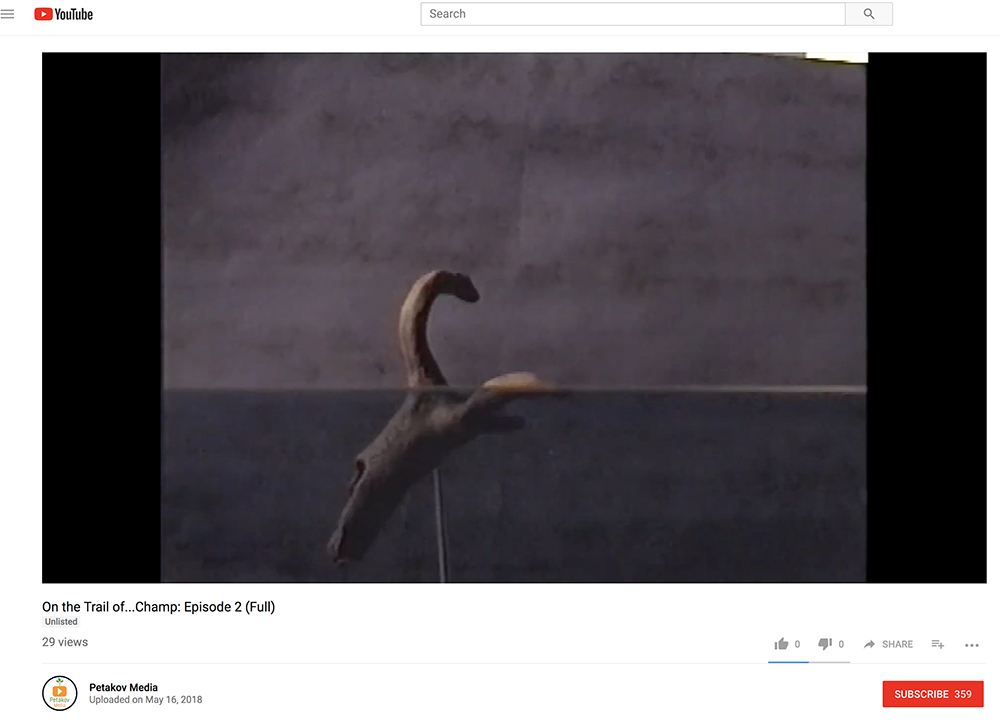
BR: So anyway, I won’t go into all the details, but basically Joe and I did some research for the Learning Channel on a show called America’s Loch Ness Monster. We got an identical camera. Mansi took the photograph with a Kodak Instamatic 110 fixed focus camera. We got an identical one to the one she used, the same type of film. I went out into the lake at the distance that she said, 150 feet. So again, we were going by what she said. So if her estimates are wrong, then her estimates are wrong. I point that out to people who are sort of saying, well, how did you arrive at this? We’re going by what she said. Now, if you think she’s wrong, then that’s fine, but then you’re saying that your witness is wrong. So we can only go by her estimates. This is what she gave us. So we did a bunch of experiments. I went out there on the lake with a couple scale models. I was out there treading water. We used a tape measure to get the exact distance. And I held up a scale and we took photographs. We determined, okay, at this distance, one foot is this size, vertically and horizontally, etc. And so using that, I also created a scale model of a champ neck. It wasn’t perfect, but it was close enough for it to work. And what we determined was that in fact, the so-called head was actually standing about three feet out of the water. And the part going across, the hump, was about seven feet across. That really opened up the possibilities, right? Because if it’s three feet out of the water, that’s a lot bigger than six feet. It’s half that size if my math holds. Okay, well, if it’s three feet out of the water, then there are animals that could have a limb three feet out of the water. Not many, but it’s certainly possible. But the real clincher is that if you look at the area, it’s heavily wooded.
1:12:32
PR: Yeah.
BR: Tree stumps, floating logs, everywhere. Not one or two, everywhere. In my book and elsewhere, I have photographs of all sorts of things. Tree stumps, they make weird shapes. They can look like a monster. They can look like any number of things.
PR: Absolutely.
BR: So what I discovered was that when you combine all the evidence, again it’s not just her photographs, it’s not just her account, it’s not just her experiments, when you pull it all together, she described what was almost certainly a floating log. It’s about the right shape. You know, a tree stump and a little head coming out. And one question that came up was, well, what about the behavior? Because it was certainly the right behavior for a log floating. Because, you know, that’s what a log would do. It would float there. It wouldn’t move around. It wouldn’t dive down. It would just float there and then sink back down. But the one thing that was remaining to answer the question was, how did it rise up in the first place?
1:13:41
PR: Yeah.
1:13:42
BR: And that took some, that was tricky, my friend. That took some work, but I figured it out. So I talked to a hydrologist and he talked about how, what happens when a piece of wood It sinks down the water as happens in lakes all over the world. As it sinks down, the gas is absorbed as it decays, for example. It lets off gases as all things that decay. All living matter does. It sinks down to the mud and the environment tends to be anoxic, that is devoid of oxygen. And so anaerobic bacteria get to work on it. And so what happens is, and again this is a known thing, I’m not making this up, what happens is that under certain conditions a log will build up air bubbles that will cause it to rise and come up to the surface. So it would come up through the thermoclines, bob at the surface, and then what happens at the surface is the bubbles pop. Because the change in atmosphere. And so when the bubbles pop, it sinks straight back down. And so you can find a hydrological, physical explanation for exactly what she described is happening. To me, the clincher was that when I asked her what the surface of the monster looked like, was it scaly like a lizard, like a dragon, whatever, and she said, no, it looks crevice-y, like bark. I said, I’m sorry, like bark, like on a tree. She’s like, yeah. Okay, then. I think I may have pieced this together. So, and actually in the year since I published that, I had two other researchers contact me saying that they had arrived at similar conclusions as well. Joe and I were the ones that went out to the lake and did research on this and that, but they said that they think it’s pretty plausible. So, as with many of the cases, I believe I solve the mystery of the Mansi photograph. Many other people do as well. It’s not that I’m the smartest guy in the world. Joe and I were out there. We did our diligence. We went there. We spent time there. We interviewed people. As with most of these cases, you just got to put in the time and the legwork. It’s not being the smartest guy in the room, it’s putting in the hours, researching it, and cross-checking things, and verifying facts, and doing that sort of thing. And when you do due diligence and do your journalistic research, oftentimes you can solve these mysteries.
PR: That’s really cool. It’s interesting that that’s your conclusion because I grew up… my mom’s family is all from Wisconsin and they’re from my grandfather. He had a cabin in northern Wisconsin on a lake and very dense woods that go right up to the shore and it’s a very common sight to see a tree sticking out of the water now and we call those dead heads. So it’s and it’s when the tree floats up from underwater and there’s a few different types of deadheads. And when I, this picture really struck me, it very quickly is being a type of deadhead in that, because it either looks like a branch or maybe a root or something. An interesting thing that happens sometimes is trees will fall on the shore. The roots will get kind of undermined by the erosion on the shore. And so the roots will actually release and the tree will fall into the water and the upper, you know, the upper majority of the tree will just be submerged for years sometimes and then maybe a storm comes or more erosion happens and the tree detaches from the shore completely and it’ll float out to the water and the root system will actually be sticking up because the woods still dry on the bottom. And so it’ll actually poke itself kind of down into the bottom of the lake and the roots will be sticking up and it looks really weird it looks like you know tentacles coming out of the water and and that’s you know I remember as a kid thinking of how like there people must have seen this at some point and been freaked out by it just because you know it’s it’s sometimes it’ll roll a little because it’s you know going in the current and stuff and and it can be a very disorienting sight you know especially because if you’re not looking for something and you see something that your brain, and our brains evolved to be very wary of the world around us, so when we don’t immediately recognize something, we could our brain will just jump to the scary thing, you know, it’s like so you know, it’s amazing to think, you know, I don’t doubt her at all. I mean, that could be a very frightening thing because your brain just wasn’t ready to see something like that. It wasn’t in the realm of things you were expecting that day.
BR: And that’s especially the case with Champ. Keep in mind that she didn’t invent Champ. The idea of Champ had been around before then. And so, of course, we’ve talked many times on the show about expected detention.
1:19:17
PR: Yeah, yeah.
1:19:18
BR: Confirmation bias, right? It’s like, any time someone sees something weird in the water at Loch Ness, it’s a monster.
1:19:26
PR: It’s a monster, sure.
1:19:27
BR: That’s what that is.
1:19:28
PR: That’s the first thing you think of.
BR: Anything weird is obviously the monster. Until proven otherwise.
1:19:31
PR: Absolutely.
1:19:32
BR: Yeah. But it’s actually interesting, in that particular case, you know, she said that the, the, because I asked her about that, I was really curious about how did the label attach itself to what she saw. And what she told me is, I described it in the thing, she didn’t know what it was, at first she said it was a school of fish or a diver or something, and she did not, she did not immediately say that’s Champ. It’s actually interesting because there’s parallels with the chupacabra, where Madeline Tolentino, she didn’t initially say that what she saw was Chupacabra. It was named later on by somebody else. In the case of Chupacabra, it was a Severio Perez, a DJ. In the case of Champ, and this is discussed in the appendix to my book, I think it’s appendix one, she talks about how she didn’t know what it was. It was just something unusual, weird, and it was cryptozoologists that later came to her and said, you photographed Champ. She’s like, I did? They’re like, yes, you did. She’s like, oh, I photographed Champ. And since that time, for the past, you know, since 81, she’s the person that photographed Champ. It’s just interesting to see at what point the label is internalized. Because for her, it was, she did not immediately identify as a Champ. It was just sort of like, someone else told her, someone else gave her the template for it and suddenly – boom, Champ!
(MUSIC)
1:20:53
PR: We would like to thank our top sponsor Amy fresh our Kelly for her long-standing support of the show. If you’re interested in becoming a sponsor or just throwing us a buck or two per episode Check out patreon.com Forward slash squaring the strange every bit helps us keep the lights on here in Strange Studios and we could not keep bringing you content without the support of our generous friends. If you’re looking to provide moral support head on over to iTunes and give us a five-star review. Every positive review helps us move up the podcast charts. Thanks again strangers.
PR: So that about does it for this week. That was a lot of fun. I really enjoyed that talk and I love delving into stuff like this. So I’m looking forward to the next time we do it. But next week, we’re actually going to dig into something that’s a really important topic for skeptics and especially for people who are trying to kind of just parse the truth behind something, especially when you’re talking about claims to the efficacy of something or just any general claim that studies show something. And that’s the importance of replication, which is being able to test and retest and come up with the same results to be sure that it’s real. And that’s kind of the bread and butter of your work almost.
BR: Yeah, it’s interesting, I mean, the role of replication pops its head up routinely, particularly, for example, in investigating photographs, like a ghost photograph or a lake monster photograph or something else. It’s always interesting to me to sort of look at, you know, sometimes replicating it can solve a mystery. When you’re like, okay, let’s recreate how the photo, oh, well, there you go. Well, when you come up with the circumstances as close as you can, then all of a sudden, you know, hey, the answer pops out at you. In other cases, for example, the Patterson-Gimlin film, the Bigfoot film from 67, you know, there are people who’ve tried to replicate it, and in some ways, the claim, well, you haven’t replicated it, hold on, you haven’t replicated it, it is it’s a bit misleading because it depends on what do you mean by replication.
PR: Yeah very cool so I’m definitely looking forward to digging into that so stay tuned for next week folks until then we’ll see you next time
1:23:29
BR: bye bye
1:23:31
squaring strange is a production of Cronos creative LLC copyright 2017 music by shriek back additional music by memory guitar and feathered and Feathered, and Pascual Romero. Content producer, Celestia Warren. Audio engineering, producing, and editing provided by Pascual Romero at Acronis Creative Studios. Additional support provided by Ashley Romero, and of course, our listeners and patrons. The views and opinions expressed in this podcast are those of Squaring the Strange and do not necessarily reflect the views and opinions of Acronis Creative, Center for Inquiry, our advertisers, or any affiliated organizations and employers. Center for Inquiry, our advertisers, or any affiliated organizations and employers.
1:24:04
Center for Inquiry, our advertisers, or any affiliated organizations and employers.
Transcribed with Cockatoo
