
Episode Summary:
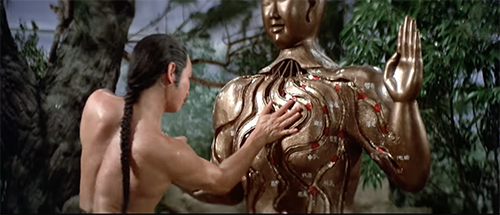
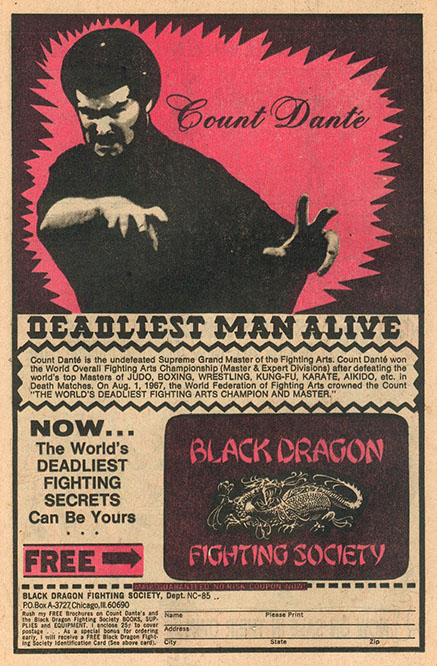
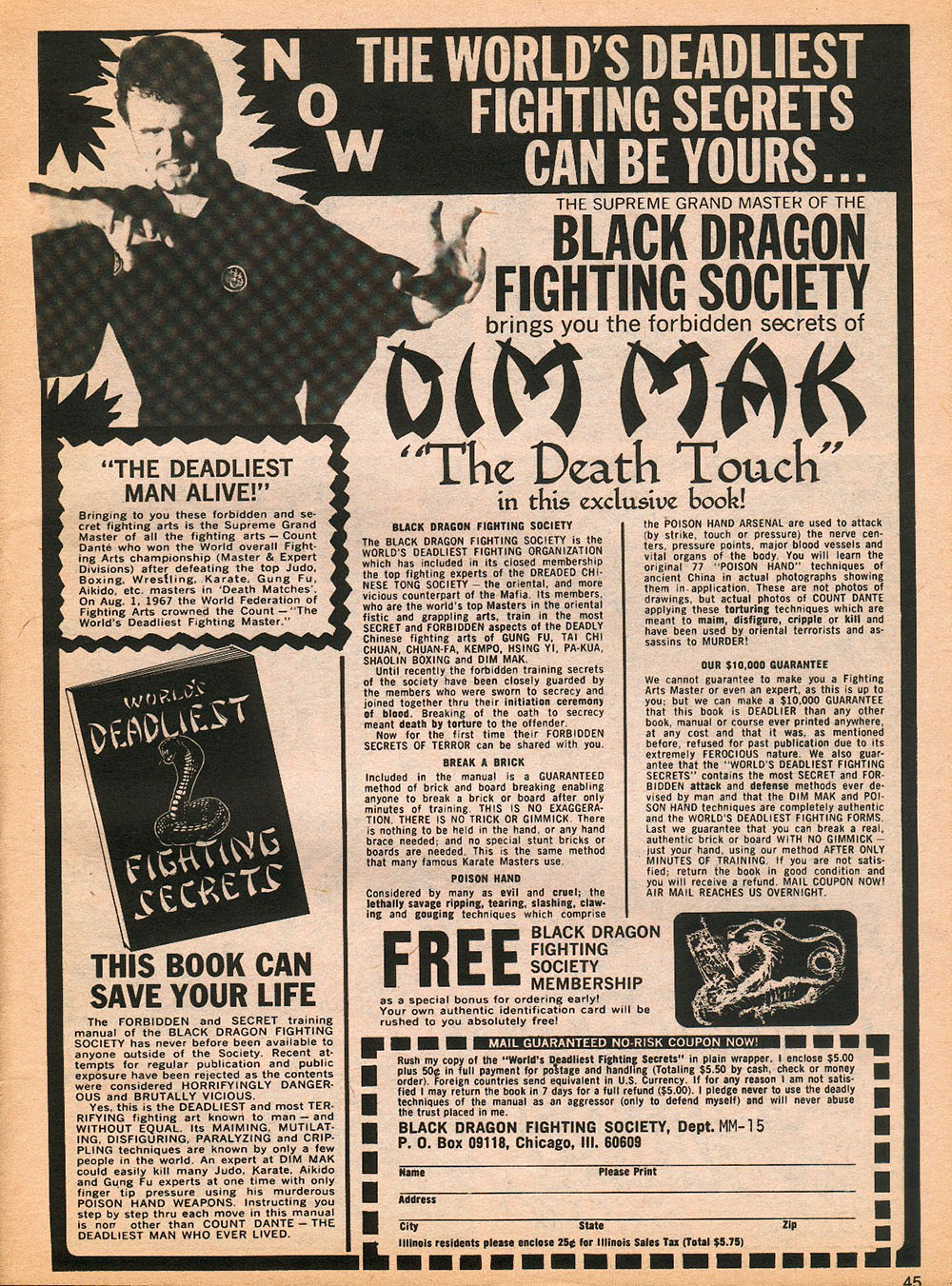
Can a human being be killed with one well-timed blow? Without question, yes. But is the secret to this fighting style held by ancient Chinese monks, or a flamboyant guy named Count Dante who advertises in the back of comic books? We look at real situations where one punch (or slap, or chiropractic adjustment) can kill a person, either immediately or after a delay. Then we bring in author, EMT and martial artist Peter Huston to discuss the legend of Dim Mak and how propaganda, marketing, Chinese culture, the allure of the ancient, Kung Fu movies and suburban American kids fit into the creation of this idea.
0:00:00
Ben Radford: Welcome to Squaring the Strange, the podcast that examines all manner of the mysterious and the mundane through a critical lens. So let’s square the strange.
(MUSIC)
0:00:10
BR: Welcome back to Squirting the Strange. This is episode 226 and I am one of your co-hosts, Ben Radford. And with me is/are…
Celstia Ward: Celestia Ward. And I’m just one person.
0:00:35
BR: Hello Celestia.
CW: Pascual’s not here. We, uh, we touched him and he vaporized.
0:00:53
BR: Or something.
0:00:54
CW: Is that enough of a clue for our topic?
BR: Probably not. That’s a little, that’s a little vague. Uh, our topic this, uh, this week is terrifying touch.
0:01:02
CW: Which is when, uh, when a ghost touches you or when, what happens?
BR: Well, I, it’s a topic that I’ve been wanting to sort of talk about for a while now. Um, and it’s kind of interesting and, uh, it’s basically, well, I don’t want to give too much away, but it’s ways in which you would not want to be touched.
0:01:21
CW: Bad touch, bad touch.
BR: Exactly.
CW: That should have been our episode title, Bad Touch. Alrighty then, well, before we get to the main topic, what’s going on with you? You’ve got some housekeeping to bring up, don’t you?
BR: Yeah, I thought I would touch on a few things. See what I did there?
0:01:35
CW: Oh.
0:01:36
BR: Yeah, it’s very clever. We should note the passing of Daniel Dennett, the noted philosopher and writer, died not too long ago. I met Dennett a couple times. I can’t claim to be a friend of his or anything. I do have a couple of his books, including Breaking the Spell: Religion as a Natural Phenomena. For critical thinkers, one of my favorite books of his is titled Intuition Pumps, and Other Tools for Thinking.
0:02:04
CW: Yes, I also met Daniel Dennett at a skeptical convention a while back. I’ve dipped into his writing a little bit, but honestly, it scared me. I like to believe that I have a consciousness. I don’t wanna be reasoned out of that.
0:02:17
BR: Do not confuse me with the facts, philosopher, sir. Wow, okay.
0:02:22
CW: He is one of the four horsemen, the four atheist horsemen, correct?
0:02:29
BR: Yes, yes. As I was gonna say, as listeners know, but they might not, because we don’t really talk about it that much. But for those who don’t know, because it is a bit murky, the organization I work for is called the Center for Inquiry, and it basically has two components. One is the more atheist, secular humanist side of things, and the other is the more skeptical side of things. I am obviously on the more skeptical side of things, although there’s a lot of crossover, which is frankly fun for me. I mean, it’s I like, you know, just as, you know, previously on shows we talked about how there’s crossover between magicians and skeptics, for example. There’s also the Venn diagram of humanists covers both of those quite a bit.
0:03:11
CW: Yeah, yeah, that honestly, if you get into the weeds with it, skeptics have a very varied history when it comes to being conflated with atheists. And we could do a whole show on that. I know the Australian skeptics don’t want their organization to be paired up with a specifically atheist group. There are people who will speak at both types of events, of course. And there’s and there are religious skeptics. You know, you and I have both brought up how the Catholic Church has got some pretty decent skeptics working for them over the ages.
0:03:45
BR: Yeah, even Martin Gardner, one of the founding skeptics, was towards the end of his life nominally religious in some ways. Yeah, there’s lots of overlap, and my position is always the more the better. As long as we find common ground, I think that it’s counterproductive to draw off bright lines in the sand. Well, if you don’t believe X, Y, and Z, this sort of gatekeeping, I think, is counterproductive to both.
CW: Yeah. Oddly enough, when I have seen skeptics disagree with being conflated with atheism or humanism, it was in the name of big tent skepticism. Like, no, no, no, if we start making ourselves known as atheists, then all the people who are not atheists won’t want to join up. So, yeah, I see it from both sides there.
0:04:33
BR: Yeah, and of course, I mean, Penn Jillette is another famous example of an outspoken, ardent, ardent atheist, also a skeptic. So again, I, as I said before, my position is if you’re for critical thinking and skepticism. We want you. I don’t care what your other beliefs are. If we can find common ground, let’s move forward from there.
0:04:54
CW: Absolutely. Now, Ben, I see another name on the notes here, Bennett Braun. And I admit I don’t recognize that name.
0:05:02
BR: So Bennett Braun was one of the highest profile proponents and promoters of the satanic panic. I have strong feelings about that, given how much damage it’s done to people and society in general.
0:05:17
CW: So, so this is sort of like noting the passing of, I don’t know, Deepak Chopra or something?
0:05:23
BR: I think Braun did more damage than than Chopra did. I don’t take any particular delight in anyone’s death, but I’m not going to shed any tears for for for Bennett Braun and I’ll explain why. He died on March 20th at age 83. And as I mentioned, he was known primarily for really espousing the satanic panic. And he was very popular in the 80s and 90s and widely quoted, partly because he was a psychiatrist. Therefore, he sort of gave the satanic panic this imprimatur legitimacy. While people were saying, oh, where’s the evidence? You had this otherwise well-respected psychiatrist going on the record saying, yes, this is real. We know for a fact that satanic abuse happens. There’s devil worshippers and recovered memories.
0:06:11
CW: And yeah, yeah, counselors, certain psychiatrists and psychologists were very complicit in the whole many of the awful things that happened during the satanic panic.
0:06:22
BR: Yeah. And Braun was was right, right there among them. He went on sensational TV shows including Geraldo and others saying again that this is science. I mean, his respected doctor says he had his patients who he through recovered memories and that’s a whole other topic, remembered being tortured by satanic cults and in some cases participating in it themselves.
CW: Did he use the hypnosis technique himself?
BR: I believe he did and he also relied heavily on other people as well. There are lots of, this guy is a real piece of work but I will just sort of give you one example, a short quote from the New York Times obituary on him. Among his clients was a woman named Patricia Burgess. After interviewing her, Dr. Braun and a colleague, Roberta Sacks, claimed not only that she was the victim of satanic ritual abuse, but that she herself was a high priestess of a cult that had raped, tortured, and cannibalized thousands of children, including her two young sons. By then, Mrs. Burgess, heavily medicated, had come to believe the doctors telling them she recalled torches, live burials, and eating the body parts of up to 2,000 people per year.
0:07:39
CW: Oh.
0:07:40
BR: Yeah.
0:07:41
CW: Did this…
0:07:42
BR: He persuaded one woman to have an abortion because he convinced her that she was the product of ritualistic incest.
0:07:51
CW: Oh my goodness. Oh my, wow.
0:07:55
BR: Yeah. So, and you know, he just dove right into this. Apparently he was a true believer. I hope that he really believed this. But yeah, it’s just horrific. This is a man of authority. This is a credentialed psychiatrist. Eventually Ms. Burgess sued Dr. Braun over claims that they had implanted false memories and they settled out of court for $10.6 million.
0:08:23
CW: Okay, that’s that’s a I wouldn’t call any of this a happy ending, but that is a satisfying ending because I was waiting for you to tell me she she jumped off a bridge or something after he convinced her that he she had a part in her own children’s death and cannibalizing children.
0:08:41
BR: This just goes to the vulnerability that people have especially in situations like this. There’s a short quote that she gave the Chicago Tribune in 1997. It’s chilling and refreshing in its skepticism. She said, quote, “‘I began to add a few things up and realized there was no way I could come from a little town in Iowa “‘be eating 2,000 people a year “‘and no one said anything about it.’”
0:09:09
CW: Oh my, it’s almost absurd. And still it happened. And I mean, it happened. I mean still she was told this and was convinced of this and many people were brought in into this whole, this whole ridiculous notion of yeah, yeah. I was adding up the caloric intake too, 2000 babies is a lot of babies.
0:09:31
BR: And not just babies, full grown people. And again, it just, it just goes to show, you know, the, the, the insular beliefs, right? If you tell the true believers, it’s like QAnon, it’s like a conspiracy. It is a conspiracy, right? If you say the numbers don’t add up, like literally this is physically impossible, they’re like, well, maybe you’re part of it, right? Or you’re part of the cover-up.
CW: You believe in math? Cheap.
BR: Yeah, a shill for big math. Fortunately, Dr. Braun lost his medical license in Illinois. He moved to Montana. He opened up a new practice and received a state license and he lost his license to practice in Montana in 2020. So fortunately, good riddance to bad rubbish.
0:10:18
CW: Okay. So, what else is going on with you, Ben?
0:10:23
BR: In fact, I wanted to mention that I am a recent guest on a BBC series called Uncanny USA.
CW: Uncanny USA. I haven’t heard of that one.
0:10:33
BR: I hadn’t either, to be quite honest with you. I got a call from a producer, actually email from a producer about a week, week and a half ago and they said, hey, you know, we see that you’ve done investigations, you wrote a book investigating ghosts and so on. on, we have the series, basically the host looks at different ghost stories each episode, and this time it’s a UK-based series, but in this case they were going to begin a series in the US. And there was a case where a guy named Marcus had an aunt die in Hurricane Katrina, and sent me the audio of their interview and asked me to come on later and and and sort of explain and talk about things like that.
0:11:19
CW: Now I’ve just looked it up, Danny Robbins takes BBC Radio 4’s smash hit podcast Stateside in new Uncanny USA. So was this a TV show, a podcast, a radio show? How did they classify it?
BR: A radio show slash podcast? I’ll be honest, I hadn’t heard of it, which I mean, there’s no reason I would. With all due respect, I like the BBC, but I don’t keep up on their programming. I had at first thought that I was going to be able to interview the eyewitness, the guy that was born in this ghost case. That was sort of my hope and expectation when they said, can you comment on it? They had pre-taped the interview with this guy Marcus and then I heard and reacted to the clips. Of course in the final show, which by the way I haven’t heard yet, it just came out this morning.
0:12:10
CW: Okay, so people can find it and see what happened. People can find and see what happens.
0:12:14
BR: I will sort of give a quick overview because it was kind of interesting to dig into. Basically this young African-American man and I think it was his cousin, keep in mind this case happened nearly 20 years ago. This was not something that I could investigate in real time. The opportunity to actually do any actual investigation was sadly lost, a point that I made to Danny. But I said, I’ll do my best. So basically, there were a couple of parts of the story. There was a Ouija board involved. The lights went out right when they used the Ouija board, which post hoc ergo proctor hoc listeners of the show will recognize that fallacy.
0:12:52
CW: Yeah.
0:12:53
BR: And so again, I was trying to be diplomatic and respectful as of course I try to do, but I was like, well, honestly, I’m seeing some holes here. But it was an interesting case. Nevertheless, I was involved again, a Ouija board, some possibly mysterious intruders, strangers, maybe ghosts, maybe not. And I like to think that I was able to bring a little investigation to it. There were a couple things that I think that Danny was thinking I’d be stumped at. I’m like, well, actually, Danny, how about this?
0:13:23
CW: I will definitely check it out. Uncanny USA.
0:13:26
BR: There you go.
0:13:27
CW: All right. Now that we’ve got like housekeeping and news out of the way, what, what, if anything, is making you skeptical this week, Ben?
(MUSIC)
0:13:37
BR: Well, I was thinking recently about the importance of making distinctions in critical thinking and in skepticism. And I was noticing patterns like when oftentimes when I’ll do investigations or when I’ll be talking with people online, oftentimes what I found, because I try to take a step back, because okay, well, you know, I try and analyze arguments and where they’re going and like, did I make a mistake? Or where’s logical fallacies that I have made, or others have made? And one thing that often comes up that I think is sort of under recognized is the importance of making distinctions between two different things. Oftentimes there will be sort of memes which will sort of compare two different things. And I look at them like this is apples and oranges. I mean, with all due respect, you’re comparing these two things that really aren’t comparable.
0:14:38
CW: Well, so you’re talking about parsing things out.
BR: Yeah.
CW: I will admit a guilty pleasure is metaphors. I love making metaphors. I think they’re very useful in human communication and in fostering empathy and understanding and clarity. But when a metaphor isn’t quite right, that’s when you need to make a distinction, correct?
0:15:04
BR: Yeah, metaphors are just other times. Again, oftentimes we’ll be discussing things, and again, I’ve done this in investigations elsewhere where it’s clear to me that if you’re going to try and understand a problem, if you’re going to try and solve a mystery, if you’re going to try to sort of bring everybody together and say, okay, let’s all agree on definitions and let’s try and work, you know, what are the areas of agreement where we disagree and so on. Oftentimes it gets frustrating to me and I’m sure other people, because I realize that they’re sort of lumping these things together and I’m trying to parse them out saying no these these aren’t the same and I Understand that it serves your argument to sort of lump them together But if we’re gonna analyze this critically you can’t do that this happens all the time I mean one example off the top of my head is a lot of times in ghost investigations. People will I’ll go into a house and they’ll say okay well, I’ll say why do you think there’s a ghost and they’ll rattle off three or four different things. Like, well, you know, the other day, you know, my cat was staring at the den. It’s something in the den that I couldn’t see. And then two days later, my car wouldn’t start and whatever else. Listening to this as an investigator, I’m realizing pretty quickly that these are unrelated incidents. There’s no logical warrant or connection between the two or three of them. But within the context, the person is lumping them together and say, this is weird, this is weird, there’s something weird going on.
0:16:29
CW: And they’re taking it all and putting it into the evidence category, so it seems like strong evidence because they’re not just one thing. I’ve had five things happen that have got to be a ghost.
0:16:41
BR: Right. And so what I would try to do is if I’ll say, okay, well, maybe you’re right. Let’s look at each one of these. And oftentimes, and if you read some of my investigations and articles, you can see how I do this. I, you know, you take them apart, you take a, you think there’s a ghost here because of these three or four things, let’s look at these individually. Well, do you agree that this could be anything? Well, yes, and that turned out to be a mistake. And pretty soon you pare it down and you’re sort of realizing there isn’t really this pattern. Another example is in my scientific current investigation book, I talk about the importance of not mistaking things for labels or experiences. So for example, I talk about how the word ghost, the word Bigfoot, it’s not explanatory. People have different ideas about what Bigfoot are and ghosts are whatever else. But if someone says they saw a ghost, that doesn’t really tell us anything because there’s a wide variety of things that are interpreted as ghosts. It’s more useful, investigatively, to recognize that those words are labels for experiences. That is, I had an experience that I couldn’t explain that most clearly fits a ghost. Or I had an experience that was weird, it was in the woods at night, I think it’s Bigfoot. And once you make that distinction, then these things are investigatable. Anyway, I don’t want to spend too much time, but it just occurred to me that a lot of times, when I’m watching the news or I’m looking at different arguments and discussions online, I’m recognizing that a lot of times there’s a basic failure for people and the public and sometimes even experts to make meaningful distinctions. Even for example, in the news today, I was reading the other day in the New York Times, they were talking about the current student protests across the country. One of the key questions is, is anti-Semitism the same thing as anti-Zionism? Some people say yes, some people say no, but again, this is an important distinction that people, that you know, honest people can disagree. Let’s all recognize that this is a distinction that needs to be parsed out, you know. Does life really begin at birth? Are bears really comparable to human males? Take your pick.
0:18:46
CW: Well, I can see from the journalistic point of view, the push from pretty much all editors is, if you can say it with more brevity, say it with more brevity. Do not use 15 words if you can use five. I can easily see how those come at cross purposes, the desire for explaining nuance and making distinctions versus getting your article to fit into the column space it needs to fit into the column space it needs to fit into. So I don’t see an easy solution except to be responsible, you know, and you know when you absolutely positively have to make the story about the distinctions.
0:19:24
BR: Right. And again, I think just just partly because so many, so many discussions, debates go nowhere because they’re not, they don’t recognize they’re not talking about the same thing. Each side, you know, if it’s a polarized topic, each side sort of has their set definition that serves their purpose, and they assume that others, you know, either are totally rejecting it or embracing it, whereas oftentimes there is some common ground, but you need to parse out distinctions. And just to sort of circle back for a second, I mean, keep in mind that fuzzy thinking thrives on ambiguity.
CW: Yes, yeah.
BR: It’s you know one of the surest ways to slip something by somebody is to make things fuzzy when there could be a sharp distinction. Let me just end this bit by recommending two books the fine line making distinctions in everyday life By Evitar Zerubavel and the other one is Hidden in Plain Sight the social structure of irrelevance Also by Evitar Zerubavel. I came across his books. He’s a, I think, an Israeli philosopher of some note. Anyway, these are older books, but they’re…
0:20:32
CW: He did some work on the importance of what is left unsaid, right?
BR: Yes.
CW: Yeah, you quoted him pretty heavily in your most recent America, The Fearful.
0:20:42
BR: I did. So anyway, if people are interested in this topic, check out Zerubavel’s work. It’s thought-provoking, it’s interesting, and I think it’s important for critical thinking.
(MUSIC)
0:20:51
CW: Cool, cool. Okay, Ben, well, we’ve got a guest today that we’re going to get to in a little while, Peter Houston, who is your resident expert on all things Eastern mythical fighting styles. What exactly is Peter Houston an expert on?
0:21:19
BR: Peter Houston is an expert on several things. He is probably best known for doing, well, he’s a couple of things. He is an EMT. He is also has a degree in Asian studies, I believe. I don’t have his bio right in front of me, so I’m sort of… He’s also a practicing martial artist, so that comes in handy in discussing the mystery of Dim Mak.
0:21:44
CW: Now, before we do anything, we have to define what we mean by Dim Mak, or death punches, or terrifying touches, and we do ask Peter for his definition later on, but from the outset, could you give a quick explainer of what we’re talking about, Ben?
0:21:58
BR: Sure. So there’s different versions of it. We’ll be talking about different versions and ideas surrounding terrifying touches. But in the case of Dim Mak, it’s the idea that a practiced expert can deliver a fatal or near-fatal touch, a specific touch to a specific place that can either cause instant death or delayed death. As we’ll talk about, it’s been implicated in the death of Bruce Lee. It was also the subject of a episode of Quincy.
CW: Quincy MD?
0:22:30
BR: Quincy MD.
CW: Oh man, my mom used to love that show.
BR: The episode aired December 2nd, 1977, and the title was Touch of Death. Sam’s cousin, Tad Kimura, is a rising young star in the genre of martial arts pictures. Unfortunately, he dies unexpectedly while filming his latest motion picture.
0:22:53
CW: So Quincy, Quincy MD was just like the Law and Order of the 70s. It was like stories ripped from the headlines.
0:23:01
BR: Exactly. So, so Celestia, I have to tell you, a lot of people think this is just a myth, but I saw something very similar to this in person.
0:23:11
CW: In person?
0:23:12
BR: Yes.
0:23:13
CW: Were you at a satanic ritual?
0:23:15
BR: No, no, no. Here’s what happened. So this happened right in front of my eyes and there were other witnesses too. I’m not making this up, true story. This was August 2023.
0:23:25
CW: This is recently.
0:23:27
BR: Yeah, late August 2023. It was a martial arts sporting event and there were, I think, three competitors and one of them walked up to another one and he hit him flush on the chest. It was almost a slap. And he just sort of slapped him flush on the chest and the guy, the victim, we’ll just call him the victim, sort of stumbled back for a second. And then the guy that hit him stepped back a few paces and the other guy dropped.
0:24:02
CW: Okay.
0:24:03
BR: Completely dropped like a sack of potatoes.
0:24:06
CW: Was he okay?
0:24:08
BR: Yes. So he got up about, I’m going to say maybe a minute or two later, but yeah, he just crumpled. And it was, again, in front of witnesses, it was well lit, I could see everything, and that’s exactly what happened.
0:24:24
CW: And they didn’t have Luchador masks on. This was not staged. There’s nothing, nothing phony about this. He just he just it took the breath out of him.
0:24:32
BR: Well, no, I mean, so it was in Atlanta, Georgia, and this is a Dragon Con.
0:24:39
CW: Now that’s some context you needed to provide.
0:24:42
BR: OK, OK. Well, yeah.
0:24:43
CW: Were there Luchador masks?
BR: Yes.
CW: Oh, oh, oh, I don’t know how I called it, but I did.
0:24:51
BR: So to be fair, this was in a pro wrestling ring.
0:24:57
CW: OK.
0:24:58
BR: But I’m telling you what I saw. He hit him. The guy dropped and then he got back up.
0:25:04
CW: So are you insinuating with this example that in some martial arts dojos around the world, maybe especially in America, there might be a little bit of phony crumpling to the ground going on?
0:25:18
BR: That’s, you know, now that you mention that, that sounds plausible to me.
CW: Is that plausible? Yeah.
BR: It’s possible I was seeing him perform it, but I tell you from where I was sitting in the crowd loved it. As I recall, the guy that feel was the hell, the bad guy. The guy that did it, I think part of his shtick was sort of like voodoo. Now that I’m saying this out loud, I think it was fake.
0:25:46
CW: Okay. Okay. All right. Well, we’ll set aside that example for now. There have been many other examples. And before listeners get the idea that we’re just going to run through a bunch of things that sound ridiculously absurd and phony, there are a few that are like deathly real and we’re going to touch on those two. I’m going to start, though, with in 2008. Did you hear about the great tantric challenge?
BR: I did. I did.
0:26:14
CW: In India. Many skeptics know about this. The Indian skeptic, Sanal, challenged a character named Surrender Sharma to kill him on live TV in India. And, you know, not using a chainsaw or something, but using his tantric powers. And now Sharma did touch Sanal, like on the head, around the face and the eyes. And he started pushing really hard on his head and the…
0:26:44
BR: Push harder, push harder!
CW: The people running the show were like, no, no, no, you have to just use your magic, please, you know. And so several hours went by and, you know, this occurred over the course of like two installments, because like the first one, after two hours, nothing had happened, except Sanal was laughing.
BR: Your laughing is blocking my magic, sir. How dare you?
CW: Then they said, okay, well, I’m going to get a bunch of my tantric buddies and we’re going to have a special ceremony that has to take place at night. So they reconvened and had a nighttime version. Still nothing happened but laughter and Sanal Itamaruku is still alive today. He is 68.
0:27:32
BR: Yeah, observant listeners may remember that we actually mentioned Sanal a few years ago in the context of an investigation he did in India about a weeping statue and the the people were so angered by his skeptical debunking he actually got death threats and he had to leave the country. I would love to have him on the show sometime I’ll reach out to him and see if he’s available.
0:27:55
CW: Yes, yes, we do have some inroads into some of the Indian skeptics so we will see what we can do. And now to a fighting style that is certainly based on mythical ideas but can do real damage. Chiropractic. So, the death by chiropractor touch is something that many skeptics, again, are aware of. We don’t have time to cover it fully now, but maybe we can do that in a future episode. I would say that it occurs with neck manipulations that end up dissecting a vertebral artery. So you put too much pressure on a certain artery in your neck and it damages it and creates a blood clot, which can then later travel up and cause a stroke. So again, Dim Mak, you have that delayed effect where you can touch somebody and then they take five steps and die, or they die the next day, you know. Very useful for assassins. I don’t recommend it for a chiropractor, but that is a way that just kind of with one touch or one move you can kill a person. So Ben, what other ways could fit under this category of terrifying touch?
0:29:06
BR: Well, there is a version of it which is certainly known in the medical literature, and that’s commotio cordis, which is probably better known today than it was, say, five years ago due to the fact that Buffalo Bill’s DeMar Hamlin suffered it live on television. I was actually watching at the time.
CW: Oh.
BR: Yeah, he, as in January 2023, he got a hit to the chest. It wasn’t a particularly hard one. I mean, it wasn’t one of those where like, oh my God, he laid out. He just, he was hit just after play and he stood up and then stumbled and then just dropped. And again, I watched it live on television because I’ve been watching the Bills game that time. You know, huge story, of course, and thankfully he was immediately surrounded by the players and there was staff to him within seconds and he made a full recovery.
0:29:57
CW: I do remember this now. Yeah, yeah. It wasn’t ringing a bell until you started telling the whole circumstances. And I do remember all of the bills fans just on the edge of their seats wondering what was going on.
BR: Yeah, if there’s any silver lining coming out of this, it sort of did raise the awareness of this. It’s a fairly rare incident. I was doing some research into different medical research on it. Basically, what we’re talking about, it’s sudden death triggered by a blunt, non-penetrating, and often innocent appearing unintentional blow without damage to the ribs or sternum. The term commotio cordis was first used in 1876. So this was recognized well over a century ago. Typically before say the 1700s, these occurred in the context of workplace accidents, for those who are familiar with pre-industrialized.
0:30:52
CW: Shifting out the workplace accidents that were like bizarrely like that was just such a light blow to that man’s chest and oh my God, those five children just lost their legs. That’s a little hard in the 1700s because like workplace accident encompassed a lot.
BR: Yes, exactly. So there was a lot as you said a lot that covered that. There was a 1996 study that found 38 deaths among youth baseball players from 1973 to 1995.
0:31:21
CW: Whoa, okay.
0:31:22
BR: And it was the single most common cause of death in youth baseball. Now that sounds kind of impressive, but actually it’s not.
0:31:32
CW: Well, I mean, youth baseball is not a deadly sport. I mean, you’re not wielding an enormous horse. You’re not in the ocean on a flimsy piece of board. So you’ve got a baseball and you’ve got people who can knock into you. The other incidences I read about were pretty much just results of horseplay, like siblings fighting each other or somebody bumping into somebody and it can kill you. I mean in weird, weirdly timed circumstances, it can kill a person.
0:32:05
BR: Yeah, I mean, most of the cases are through sports, as you pointed out. And it’s likely that the incidence is actually underreported because there’s no mandatory reporting of commotio cordis incidence. For example, if you’re in epidemiology, there’s mandatory reporting of, for example, COVID or AIDS deaths. There are certain deaths that are legally mandated to be recorded, but this is not among them. So it’s possible that there are cases where somebody just dies and it’s not recorded. Most of the cases are in baseball, just from the nature of the sport, but also hockey, football, soccer, cricket, and also karate, circling back to those.
0:32:49
CW: Yeah, martial arts, death touch. Yeah, exactly.
0:32:52
BR: Yeah. And it turns out that according to the literature, about 80 percent of the people drop instantly. They just drop like a rock, like the guy I saw at the wrestling, I guess. The other 20 percent are active for a few seconds and doing other things. And this is what we saw with DeMar Hamlin, right? He was hit. He didn’t suddenly drop, he staggered for 5-10 seconds and then collapsed.
0:33:18
CW: He took 5 steps and then fell.
0:33:24
BR: In one study that I read in the New England Journal of Medicine, again it said that most of the examples they found were sports, football, hockey, lacrosse in some cases. But there’s a category for other circumstances. So these, I’ll just list you a couple of them other circumstances.
CW: This is gonna be about sex, isn’t it?
BR: You would go there. Well, I’m wondering I’m not I don’t know. You know what TMI? Okay No, this is not about sex. Not everything’s about sex. Child kicked by horse. Okay, you’ve hit with the recoil of a gun, but while deer hunting Oh You’ve hit by tennis ball filled with coins.
0:34:04
CW: Oh, I would have rather heard about adults having naughty time. These are all kids!
0:34:11
BR: Adult received chest blow by falling into body of water.
CW: A belly flop? He death by belly flop?
BR: Yes. Oh, a child received a blow from the head of a 50 pound pet dog. Probably one of the weirdest and most tragic ones was youth receive blow intended to terminate hiccups.
0:34:35
CW: Oh, man.
0:34:36
BR: Yeah, don’t teaspoon of sugar always works for me. Don’t don’t hit him in the chest.
0:34:42
CW: Well, I dug into some of the some of the literature that you sent my way. And rather than the bizarre circumstances, I was drawn to the mechanism of this. And it was interesting how it’s really related to the timing in respect to the heart rhythm. And I’ve had an interest in irregular heart rhythms. I’ve had a little bit of one myself since I was in my 20s. And people in the family have got AFib. As you get older, most everybody gets AFib. That’s atrial fibrillation. And apparently, I’ll quote the paper I was reading here, impacts during a 2040 millisecond window of early ventricular repolarization are most susceptible to commodio cordis. It is thought that ATP-sensitive K plus channels are activated by the stretch of the chest blow which results in ventricular fibrillation. Now, I’ve even seen a TikTok showing this. Atrial fibrillation will make you a little tired. Ventricle fibrillation will make you a lot dead. So you don’t want that one.
0:35:52
BR: Depends on which way the blood’s going. If I’m remembering basic anatomy, that’s the key.
0:36:00
CW: So yeah, okay, so we’ve got that commodio cordis as another entry in the whole death by one touch or one blow. Now all of those instances we covered were of course accidental. Nobody intends to kill somebody on the football field or playing baseball or or preventing hiccups. As to killing somebody with a purposeful blow, that of course happens. There are many instances of someone ending up a murderer because they threw a careless punch. Could you say they meant it? Well, they meant to hurt the person. They maybe even meant to knock him out, but they didn’t intend necessarily to kill them. There’s actually a local connection to Las Vegas. A local fellow named Dan Rodimer, 45, who oddly enough is an ex-wrestler, Ben. I don’t think he was a Dragon Con though. And he’s also a former congressional candidate. He just recently turned himself in. He was wanted in connection with the death of a 47-year-old man after an altercation took place in a hotel room. Reports vary as to whether it was one punch or a few more than that, but the victim died of blunt force trauma to the head.
0:37:15
BR: Am I remembering the case where the victim was a journalist who had covered him unflatteringly?
CW: No, I think you’re thinking about a different politician in another western state but more north, I think that was in Montana.
BR: Okay.
CW: And I don’t think the guy died, but I think he pressed charges actually. But there are plenty of cases that have made the news. Last year a St. Paul man named Darren Duffy was charged with murder after he hit another man once from behind on the left side of the head, causing a brain bleed, according to the doctors. Jacob Dunn in 2011 was he was a 19 year old who got into lots of fights and he threw a single punch one day that resulted in his opponent falling into a coma for nine days and then dying. And in New South Wales in 2012, a young man named Kieran Loveridge was out drinking and he randomly threw one punch hitting Thomas Kelly near the nose. Kelly lost consciousness immediately and died two days later. Now the list goes on and there has been a bit of public concern, especially in Australia and the UK, where drinking laws were being scrutinized and deadly punches were being brought up as a thing that drinking laws needed to be reformed in order to prevent Not one but two British documentaries came out in 2016 One was called one punch killers and it’s a made-for-tv movie that came out in August. It involved families of the victims and a lawyer’s opinion on these killings and you can see it today on Vimeo. The other one was called One Killer Punch. So very similar, One Punch Killers and One Killer Punch. That came out in November. It is described as a shock doc from Channel 4 that explores the one punch kill phenomenon by looking at three different cases and often these result from fairly innocuous circumstances, but they have very tragic results, obviously. As far as studying this whole phenomenon goes, in 2023, a paper came out on changing trends and characteristics of one-punch deaths in Australia, 2012 to 2018. It’s available on PubMed by that title. The abstract describes these assaults as coward punches. And yeah, and that’s defined as a single severe blow to the head that makes a victim lose consciousness, and then when they fall, they have a secondary impact that results in the fatality or permanent impairment. So think Million Dollar Baby, if you’ve seen that movie, there were 80 such deaths in the span of six years that the paper examined. And almost all of them were male and almost all of them involved or a large number of them involved drinking. But these are still technically all accidental. The people who threw the punches probably could not repeat the deadly blow if they tried. But Ben, do you know of any any crossover with this in terms of Dim Mak or martial arts or somebody actually trying to do it?
0:40:27
BR: Well, sort of. There are other versions like that where intense is difficult to prove, even criminal cases. So, there was an article that I found in the International Journal of Legal Medicine titled, Commotio Cordis, a report of three cases. And it described forensic cases in which people had killed others with basically one single blow to the chest. I won’t go over all the cases, but there were a couple of things as I sort of read through them. A couple of things jumped out. Number one, in all the cases, both the victim and the assailant were men. This is not going to surprise anybody. Also in most of the cases, they were heavily intoxicated.
0:41:14
CW: That tracks too, yeah.
BR: What? Right, yes. In one case a guy was struck in the chest with a pool cue. He staggered a few yards and then collapsed. And in all these cases, it actually reminded me a bit of the chupacabra. You’re probably wondering why.
CW: A lot of things remind you of the chupacabra, Ben. I don’t know if you’re aware of this.
BR: Well, I’m not shoehorning this in. It just does. Here’s why, right? In the case of the chupacabra victims, there’s no obvious cause of death, right? So animals that were allegedly attacked by the chupacabra, they’re not torn apart, they’re not missing a head. There’s no-
0:41:51
CW: They’ve been exsanguinated, right?
0:41:54
BR: Allegedly exsanguinated. And if you look closely enough, according to some people, you’ll find two bite marks on the neck. Of course, as I explain in my book, Tracking Chupacabra, we know exactly what that is. But the point is that to somebody who just comes across it, it could look like the animal is sleeping. Usually, when we see dead animals, there’s traumatic injury, right? They’ve been hit by a car. They’re torn apart. There’s blood everywhere. And part of the mystery of chupacabra victims is they look otherwise fine. And you see the same thing with comodicardus victims, where, you know, a blow to the chest, they just drop, right? Well, why? They’re not bleeding.
0:42:32
CW: Yeah, there’s no knife in their body. There’s no bullet.
BR: And even when, and this is where it circles back, even when you do autopsies and medical examinations, oftentimes there is no clear trauma to the heart. It’s not like the spleen is dislocated or there’s no obvious head injury or things like that.
0:42:55
CW: Yeah, I think you mentioned when you brought up commotio cortis that it’s one of the defining terms is it did not cause trauma, like you’re not bruised and everything. It’s just, you just hit sweet spot, just boom.
0:43:09
BR: Right. So the main things, uh, connections here are angry drunken men and oftentimes there’s use of amphetamines.
CW: Okay.
BR: Such as cocaine, which if you think about it and you know what they do, it makes sense because typically these amphetamines will increase the heart rate, which increases the likelihood of arrhythmia.
CW: They have been known to cause irregular heartbeats, yes.
BR: So if we’re talking about a person with a preexisting condition, temporary, though maybe because they’re on on some some stimulant like that, their heart is already impaired, racing, you know, modified anyway. And in that context, a blow to the chest is is more likely to to result in in commotio cordis.
0:43:57
CW: All right. And before we get to our guest, I do have to bring in pop culture to this because that’s what I love to do. Listeners might not be aware that Dim Mak, spelled the same way, D-I-M M-A-K, is actually a clothing line by DJ Steve Aoki.
BR: I did not know that.
CW: Yeah, that complicated my searches a little bit on Google.
BR: I would imagine.
CW: I kept, because I live in Vegas and he’s a Vegas DJ, so maybe it thought I wanted that. But, um, maybe it thought I wanted that. But I can’t, can’t, can’t leave out the Vulcan nerve pinch from our discussion here.
0:44:33
BR: I was expecting you to bring it.
0:44:37
CW: Yeah, I’m bringing it. I’m bringing me some Vulcan nerve pinch. Now, the legendary move by Nimoy was first used in The Enemy Within, which was episode five of season one of the original series, and it was invented by Nimoy, by Leonard Nimoy, not the writers. He was something of a pacifist, and he suggested that the character of Spock would have a much more elegant, less brutal way of rendering people unconscious. As a scientist, he would also have a deep understanding of human anatomy and where our off switch might be in terms of our central nervous system. So I kind of like that this is sort of sci-fi reflexology being used as a plot device in service of character continuity. Boy, that’s a mouthful, but I’m all for it. Yeah, so the way that the Vulcan nerve pinch has been described over the years, there might be some telepathic influence at play, but not just Vulcans can do it. So that’s a question that’s being asked on all the Star Trek wikis. Now, for that first appearance of the Vulcan nerve pinch, Shatner seemed to understand perfectly what Nimoy wanted, and he overacted it just exactly the way it should have been done.
BR: What? Shatner overacted?
0:45:55
CW: He said he imagined the pinch was like receiving a jolt of electricity, and it just made him drop after that. So from then on, it was sold and it was used in many episodes going forward. In the show’s script, it was referred to as the FSNP, or the Famous Spock Nerve Pinch.
BR: I did not know this. Okay.
CW: Now, it’s been compared to the the famous karate chop also used not just in Star Trek but in lots of TV shows of the 1960s that just rendered people unconscious just like Spies in like the Avengers or whatever show you got Get Smart, whatever somebody had to be made unconscious just whack right to the trapezius and then they fall down.
BR: Or even sometimes just a light tap on the jaw seemed to render them.
0:46:52
CW: Or sometimes not making contact at all, depending on your fight choreographer was.
0:46:57
BR: I think I saw that in wrestling now that you bring it up.
0:47:00
CW: So other people have done the famous Spock nerve pinch, including an android, Data, Seven of Nine, who was not really an android, but a human turned to Borg and then back again. And even Voyager’s holographic doctor were all able to perform the nerve pinch successfully. So the theory behind the mechanism in Trek lore is that it blocks the blood flow up to the brain. So you have to sort of suspend your disbelief and accept the fact that in Star Trek land this causes instantaneous unconsciousness. There is a chokehold that is designed to stop blood flow to the brain and it does eventually render somebody unconscious, but it doesn’t happen in a millisecond.
0:47:44
CW: So I can speak to that. You’re far more of a Trek nerd than I am, although I do like the series. I, on fairly rare occasions, watch MMA, specifically UFC. And as you may know, there are several ways to win a UFC bout. One of them is choking out the opponent. And if a fighter is smart enough, they will tap before they go completely out of it.
CW: Yeah, yeah.
BR: Yeah, so I would say, you know, at least, well, it depends on the bout, of course, but usually once or twice a night in a series of matches, you’ll see somebody who indeed, you know, is choked out and it takes, depending on, of course, you know, the type of hold, five, 10 seconds or whatever. It’s not milliseconds, but whatever.
0:48:31
BR: Yeah, yeah, it’s apparently called a sleeper hold or a blood choke, which that’s a cool term. That’s almost Klingon. I will give you a blood choke.
0:48:42
BR: And of course, there’s different ways to do it. I mean, there’s three or four that I can think of off the top of my head, but yeah.
0:48:48
CW: Now it’s all, it’s entered popular parlance and it’s been referenced or flat out used on many other shows my favorite was on space balls where the hapless hero is trying to do it on one of the henchmen and the henchman is like, oh no It’s not right there. You got to hit the carotid right there and he like he tutors them on how to do it and then then once it’s done properly passes out. And before we leave fictional land here, we also of course have to mention, we’ve already touched on it briefly, or we’ve already made a couple of veiled references to it, the five-point palm exploding heart technique. You remember that from Kill Bill, Ben?
BR: I do, I do. When we were first researching this, I had forgotten about it. I don’t know why. I mean, it was just, but yes, when I saw, of course, Kill Bill, yes.
0:49:41
CW: Yes, it’s not just a band that Pascual knows. That is Five Finger Death Punch. But of course, they did get their name from the Exploding Heart technique from Kill Bill. As explained by Beatrix Kiddo, the heroine of our story, it is, quote, known for being the most deadly blow in all of martial arts. The move consists of a combination of five strikes with one’s fingertips to five different pressure points on the target’s body. After the target walks away and has taken five steps, their heart explodes in their body and they fall to the floor.
BR: In five different pieces?
CW: Not quite, not quite. I like how Tarantino made it very complicated where instead of just one punch. You stop the punch and points on their chest. Lots of fives there. Tarantino made it very complicated where instead of just like one punch, it was like you stop the punch right when you get to their chest, then you kind of go like you’re typing on their chest. You hit them like five times with each of your fingertips. And that like is almost like setting a combination time bomb. And so apparently Kiddo was taught the move by Pai Mei, the Eastern Master who originally trained Bill, and then she uses it on Bill. Spoiler alert at the climax of the second movie, and he does indeed take several steps and falls down dead. Now, as a plot point, it stands as an indicator that Pai Mei judged Beatrix as worthy of having that secret knowledge, because he didn’t teach this exploding heart technique to Bill or anybody else. So it is interesting in the use of five. It’s like, you know, there’s this magical numerology sort of thing going on. Five fingers, you take five steps and then you die. But hey, at least Tarantino didn’t make it five movies, he only made it two. So, now the move actually inspired a Mortal Kombat character and their finishing move. Shujinko is widely known to have been based on Pai Mei. So yeah, just a little bit of a gamer slash Tarantino trivia for you involving Dim Mak, or at least what passes for Dim Mak in Kill Bill universe.
(MUSIC)
0:51:58
BR: So I’m delighted to have Peter Houston. He is a longtime skeptic and martial artist, the author of several books, including Scams from the Great Beyond and its sequel. He also has an academic background in Asian studies and Chinese history and the complete collection, I’m told, I haven’t seen it, but I’m told, of the Marvel Comics classic Master of Kung Fu. Peter, talk to us.
Peter Houston: Hi, it’s great to be here.
0:52:41
CW: Hi, welcome.
PH: Thank you.
BR: Thanks for coming on. I’ve been looking forward to talking to you for a long time. This topic is something that has intrigued me since I was a teenager. When I was a young lad, I bought several books on ninjas. I was expecting to be a ninja at one point in my life.
0:52:58
CW: Ben, did you own numchucks?
0:53:00
BR: I did. They’re, they’re, they’re, I did. In fact, they’re nunchucks, not numchucks. And yes, I did. I did injure myself somewhat badly. I don’t need to go into the… the point here is that at one point I was gonna be a stuntman at one point I was gonna be a ninja and I bought a handful of books which I think I still have somewhere on ninja secrets of invisibility and I had probably four or five books on ninjas all in black of course.
0:53:29
PH: That’s in the Nishita Kim book. We’ll mention Nishita Kim.
0:53:31
BR: It is, it is Ashita Kim book. Anyway, so I’m reading through these deciding you know what type of ninja do I want to be? Is this really a viable career option for me? It wasn’t, spoiler, but in those books I saw a mention of this episode’s topic and I was like What? Is this is this real? This is before I was a budding skeptic. So talk to us about Dim Mak.
PH: Okay, I think you’re referring to Ninja Death Touch by Ashita Kim, but we’ll talk about it.
BR: I am, that’s exactly the book.
0:54:02
PH: Let’s just say at the moment I am not endorsing Ashita Kim and anything he wrote. Okay.
0:54:08
CW: How did you first hear about Dim Mak? Like Ben, were you like a hopeful 11-year-old ninja?
0:54:15
PH: No, no, no, no, no. Let me think. I don’t know where I first heard about it but I did not really get into these things until I was about 18. I was a weird nerdy kid who always got bullied and beaten up, but anyway, so I got interested in that, started studying some Taekwondo, started reading Black Belt Magazine, and for those who don’t know, Black Belt Magazine was for years an extremely popular, extremely influential martial arts magazine with not terribly high academic standards. Okay, so they had all kinds of things in there and they’ve just gone to complete online, no print version. I guess the first time I may have run across it, it would be tied in with the death of Bruce Lee. That’s where I first heard about it. And I know I read Ben Block’s biography of Bruce Lee when I was 18, trying to watch all the Bruce Lee movies I could find, and I did watch them all.
0:55:13
CW: We covered a little bit about the mysterious nature of Bruce Lee’s death and the rumors about it. What did you hear in terms of dim mock about that perhaps claiming Bruce Lee’s life?
0:55:26
PH: Okay, first for those who don’t know, Bruce Lee, you know the very fact that we have brought Bruce Lee’s name and assume that everybody knows it when we are talking about a man who died in the early 72, but I have to check, and made like two American movies and a bunch of Hong Kong movies, it’s a little amazing. Bruce Lee and Marilyn Monroe are two people, everybody recognizes their picture, even if they haven’t seen their movie, all over the world. Now, how does Dim Mak relate to his death? Like 30, 31-year-old movie star at the height of his popularity dies a mysterious death that is still not explained completely to this day. While he’s important, he’s a martial arts star, you need a dramatic martial arts explanation for his death. Oh, what about Dim Mak, the Kung Fu Death Touch? So that’s, I think, where that came from. But just bear with me here a second. I did write an article on that. It’s available online At my sub stack we can talk about that a little bit at the end of the show.
0:56:30
BR: I think word around the campfire was That that Bruce Lee was killed for revealing secrets his his masters didn’t want him to reveal That’s what I was told was they were very upset that he was he was not only showcasing his abilities but doing so so publicly and betraying his heritage by popularizing and Americanizing and profiting from his…
0:56:58
CW: That’s interesting, like a student gone rogue.
0:57:01
BR: Yes, well that’s what I heard.
0:57:05
PH: So Bruce Lee died when he was about 33, 32 and he became famous. So he was a young, cocky guy who often talked about Tradition being a stifling thing which is very offensive to people who had based their life on preserving and passing along traditions, you know and have this young upstart insulting them and what they did was very offensive. So the rumor is that the kung fu master somehow got to him and zapped him with the kung fu death touch Dim Mak that is that’s what I that’s the rumors I’ve heard. By the way my understanding and I could be wrong is that the first place I’ve ever seen that in print was an article in black belt magazine It was written by Masad Ayoo who is now he’s still alive. He’s now known as a very well respected defensive handgun instructor. And I actually sent him an email and said where did you get this thing about a guy with a quivering touch in Malaysia? And he never wrote back. Surprise, surprise. But I would not be surprised if he was on a deadline and just said, oh yeah, he was writing for Black Belt Magazine again.
BR: This sounds good, right.
0:58:17
PH: And said, yeah, we’ll throw this in, that’ll impress people. These days with Google, it’s much easier to fix things, to check things, and the name of the Kung Fu master in the article was there. Now, here it is. The delayed death touch, is it really just a myth? That was in Black Belt Magazine in 1974. Okay, and the May 1974 issue. Here’s one paragraph I wrote on that. Although Lee died from cerebral edema, swelling of the brain inside the skull, the cause of the edema is still debated. Explanations include hyperatremia, epilepsy, misuse of steroids and diuretics, drug overdoses and reactions, family curses, mysterious poisons, even ninjas. And more, Dim Mak is often a common and prominent part of the list. And even if we were to embrace the theory that Dim Mak caused the death of Bruce Lee, it would seem required to explain through what mechanism exactly does Dim Mak produce a cerebral edema. Okay, so we will probably never know how Bruce Lee died, but people are still trying to figure it out. There’s the one on hyperatremia, which is a kidney problem. That was in a medical journal like last year.
0:59:37
BR: So before we get too far down the path, let’s go back to the basics. So, what exactly is Dim Mak said to be and what are its characteristics?
0:59:47
PH: That’s a good question. And, as I’m sure you know, when a skeptic is trying to investigate or explain something, a mysterious claim, often the first thing you have to do is try to define it. And it’s very difficult to find a single definition that is always used. But I would say that it is the use of Chinese medical theory, including acupuncture, to produce intense damage, which could be delayed or could happen instantaneously.
1:00:20
BR: So it’s sort of in that theory. I mean, of course, as the three of us know, there’s often, you know, not one single blanket explanation. Like for ghosts, there’s a half dozen different theories. For Dim Mak, it could be different versions thereof. But in this one, I hadn’t thought about that. So it’s sort of a form of acupuncture.
CW: It’s like reverse acupuncture.
BR: Interesting.
1:00:43
PH: Well, one of the things I was thinking is I mentioned I am an experienced emergency medical technician and I’ve been doing that off and on since I was 18. People wonder at this point I am 60, that’s six zero years old. And I was thinking about ketamine. Most of us if we hear of ketamine, oh, that’s a bad thing. You can use to rape people. It can be used to cause all kinds of damage. But ketamine is a useful tool in the medical arsenal. You know, if somebody is just completely out of control and the doctors can’t get them to stop what they’re doing, they shoot them up with ketamine. Paramedics carry ketamine. You know, there was one call I was on, a woman just was completely out of control. She’d taken some drugs and we got her to the hospital without using any chemical sedatives, but afterwards the paramedic was like, if she hadn’t, I thought we were going to have to shoot her up with ketamine. And that would be just to transport her safely without wrestling with her in the back of the ambulance.
1:01:49
BR: So let’s circle back to the nature of Dim Mak. Is the delayed reaction part of the story? Tell us more about what it is we’re talking about.
1:01:59
PH: It can be, it can be, but it’s not always. You know, sometimes it’s an instant thing, and it depends, that’s the kind of thing, just getting off a little bit. You know, when I first became interested in trying to explain things, we’re talking about 1992, when I was in my late 20s, and I discovered the Skeptical Inquirer, and I wanted to run around and explain everything mysterious I’d ever heard of. And I thought, oh, Dim Mak, that could probably be explained by voodoo death. Voodoo death is a real thing. I think it’s a real thing. At the time, I believed it was a real thing. But, you know, where somebody gets so scared, eventually they just die from like, too stressed out.
1:02:37
BR: Like fright or something, yeah.
PH: Right, right, you know, hypertension, what have you. But you’d need examples of where did this happen? And it’s very difficult to find any real example of where did this happen. You know, so some claims are that you can touch someone and determine the exact time of death. Other times it would be instantaneous. You know, you can touch somebody here and they would just suddenly die. You know, which there are points on the human body where people are more vulnerable and some people have pre-existing problems, which something happens and they die, you know, like blood clots that are not floating in the system or plaque in the arteries which gets dislodged and then they have a stroke.
CW: Now thinking not from a not from a historian’s point of view but from a writer’s point of view if I were writing fiction that’s a very useful plot device if you have an assassin who can touch someone or perform some sort of alchemy on them where they will die but not immediately like the king won’t die in his bed from the assassin’s touch but he will die the next day while he’s having a meeting with his advisors. So the assassin won’t be even questioned.
1:03:58
PH: Right. I mean getting back to the death of Bruce Lee, he died, I believe he was with a movie actress, which is interesting because he was married. But he was not in a fight when he died. He was alone in a room or with this actress in her place and he died. It wasn’t like he got touched and he died. So the theory in this case would be that it was a delayed touch sort of thing. Okay, first, there’s not one school of acupuncture. There’s not one body of teachings of traditional Chinese medicine. It’s much more complicated. And you know, the Chinese Communist Party tried to unify it into a single thing, but traditionally, it’s like anything, it’s diverse. But acupuncture theory is often tied in with the Chinese calendar, which is extremely difficult to understand. But I have in my hand a book, and it’s not a well-known book, it’s not a famous book, but this is published by the Shandong Science and Technology Press in Jinan, China in 1988. I bought it in China, and it’s called Optimum Time for Acupuncture, a Collection of Traditional Chinese Chronotherapeutics.
CW: Chronotherapeutics. Okay.
BR: Sounds sciency.
PH: Yeah, well it’s very sciency and you know, but it’s not science of course. What it is, it’s a book, it’s a book of the Chinese calendar, Chinese astrology mixed in with acupuncture stuff. You know, how to use Chinese astrology to get the best acupuncture results according to the beliefs of whoever wrote this book whose name is not on it. And that’s published by Shandong Technology and Shandong Science and Technology Press.
CW: Well, were there said to be better times to kill someone?
PH: Oh yeah, yeah, yeah, yeah. Okay. And if you knew when they were born, then you could really calculate it. But this is one of those things, and it’s a pattern among unusual claims, paranormal claims, fringe claims is well, you don’t understand, you don’t believe in it because you don’t understand it because it’s very, very, very complicated.
1:06:15
BR: That’s why you don’t understand it. It’s not because it’s BS, it’s because it’s complicated.
PH: When I lived in China, I also lived in Taiwan and I’ve been to Vietnam many times. But when I lived in China, I was teaching English as a second language at the number three university in China. So my students were like some of the best and brightest that China had to offer. And they were a fun bunch of people to hang out with. They were mostly graduate students there, mostly the master’s degree students. But if I told them I was trying to understand the – I hate this term – but the five elements – that’s a bad translation of what the concept is. They would go, “Wow! You understand that?” “Well, I’m trying to understand it.” “Oh, that’s amazing.” It’s like I’m reading one book on it. Well, it’s very complicated.
1:07:02
CW: So even in Asia, this is regarded as so complicated that very few people really understand it.
1:07:10
PH: Right, exactly. And if you try to test it, well, you’ve left something out.
1:07:16
BR: So, in looking at the Dim Mak, so, of course, I mean, at the end of the day, let’s just cut to the chase here, killing people, it’s unethical, it’s illegal, it’s, you know, so, what do they do, you know, with a gun or poison or by touching them? So, what’s the practical application here, or is it just silent assassination?
1:07:38
PH: First, I would question the basic premise there, which is that, and let me explain, is killing people illegal and unethical? There’s times when it is legal and ethical, according to most of the beliefs of society.
1:07:55
BR: But I mean, if the intent, I mean, if you’re, let’s say the Dim Mak is real and you can go and kill someone by touching them. If you do this on the street corner, the law doesn’t see any difference between that if you’d stab the person or not.
1:08:12
PH: Okay, okay, that’s a valid point. And let me also say, I think one reason all this stuff fascinates me is because I got Quakers and they’re non-violent. The non-violence in my background, so it’s like all those Catholics who are fascinated by sex.
1:08:32
CW: If there’s like an astrological component to this too and there’s all this stuff that has to be learned, I can’t imagine Dim Mak being taught or visualized as a self-defense method. I can’t imagine going to a class.
PH: This is something that would be believed in and taught by Kung Fu masters, whatever, however you define a master. And I think to some extent, the ability to do this would show a great understanding of how the human body works. Now, that would be the human body as conceptualized in Chinese medicine, not in Western belief, and for the record, I believe in the Western belief because you can test it, but it would not be something that ordinary people would do. But I actually saw an interesting thing on YouTube relating to that, and there is a man named Eric Shahan. I think that’s how you say his name. I believe he’s American. He sounds like an American, he translates obscure Japanese martial arts and other texts into English, and you can buy them on Amazon. I bought five of his books last week. But I was watching this video on YouTube where he was discussing this very subject a little bit. He actually was discussing translating an Okinawan book called the Bulishi, and I said, well hold it, what is this purpose of this thing where you say you can touch somebody here and kill they’ll die in three days and he said well one thing is they put it in a public book and that scares their enemies. You know, it’s like hey, you know, we are so good we can do this and I think. So there’s a silliness to it, putting it out in public, you know, but if you get into certain martial arts, there are pressure points on the body, you know, where you can, there’s like one, about a hand’s width between the elbow and the wrist, and if you squeeze there, eventually you can find a nerve, you know, and that’ll just hurt a lot more. There’s an Aikido throw which is kind of funny. There’s several, not a throw, but a joint lock. There’s four basic joint locks in Aikido. I did Aikido for years, a lot of fun, very good, good for anger management.
1:11:06
CW: I actually, I did Aikido for two years and I enjoyed it a lot.
1:11:09
PH: Right, but there’s the ikkyo, the nikyo, the sankyo, and what’s it, yonkyo? And yonkyo is the one where you put the guy in an armbar and then squeeze that pressure point and go, ah, you know, and suddenly your arm gets numb. And which brings a whole new meaning to the word playing with yourself. But, you know, what are we doing today? We’ll throw each other on the ground and squeeze right here, ow, ow, ow. Oh, this is great, ow. But anyway, so now I’m gonna get off the mat and do it to you. Okay. Ow But anyway, and at the end you’re not your arms kind of numb So I mean a lot of that stuff is mixed in with other martial arts You know Tai Chi and Aikido and what have you.
CW: If I can if I can jump in here? I think it’s very interesting how you’ve you’ve noted that these were published almost with a propaganda slant to them to Strike fear into their heart the hearts of their enemies. And then you also have this level of expertise where you said it was done by great masters and as to showcase, I mean I can’t imagine killing somebody just to showcase your knowledge of the human body, but were there other forms that were kind of like Dim Mak light, like you were talking about the Aikido pressure point where you can numb somebody’s arm, were these great masters showing off like, well, this is a dim mock technique and I’m going to do it at a lower level that won’t kill the person but watch me incapacitate this person with barely a touch.
1:12:35
PH: Yeah, yeah, definitely. There were definitely things where, well, we can incapacitate them, you know, in the movies, we’ll touch them here and now they can’t move their arm, you know, which is in the movies are very different from real life, of course. But I did want to just mention now that you mentioned killing people to prove that you can do it. In a lot of Asian things, teachings, instead of saying, I invented something new, it’s really good, you should look at it, people will often say, oh, you know, we have this thing and it’s 700 years old and it was created by somebody very famous back long ago and here it is. So like the Yellow Emperor’s Book of Medicine which came out about 200 AD and is the book that first presented the quote five elements and other ideas. The Yellow Emperor lived about 3000 years before that and is a mythical being but it’s written as if it was his ideas.
1:13:35
CW: Those are like retroactive marketing.
PH: Right, right. And Taekwondo, anybody who really knows Taekwondo will say, oh, it came out in the 1950s. You can see kind of they mixed in with a traditional Chinese, traditional Korean high kicking. There was a weird folk game where they would try and kick each other in the head. Sarah said it was a fuggy kind of folk game. And with the Japanese martial arts and all those belts and the white, white gi, the white, so-called white pajamas, if you can put that in quotes. But if you go to a Taekwondo school, they’ll often tie this in with something in the 8th century AD. You know, it’s like, no, it had nothing to do with that, you know, the Hwarang Do were great knights and some historians told it. I think the Hwarang Do were actually a dancing troupe. And I’m not making that up. You know, nobody’s quite sure who they were. It means the flowering youth, the way of the flowering youth, they had some connection with the court. So a lot of these things are misdated, but one of the funny things I found out about is some people say, and there’s no evidence that it’s true, that Tai Chi was invented by a guy named Zhang Sanfeng, and Zhang would be the family name, Zhang being the same name as Chang, but a different pronunciation. And he, according to 19th century writings, back centuries before, had taken prisoners and tested his Dim Mak on them to see if they would die and how would they die if he touched them where. And when I saw that, I thought, hold it, hold it, hold it. That does not sound like a pre-modern Chinese way to do things. That sounds like a Chinese person who was impressed by modern science came up with that. I think if in the 17th century somebody would have said, they would have said, well, he’s awesome because he found an even older book. Yours is only 700 years old. This is 850 years old. Boom, take that well some cultures. They have this idea of diminishing knowledge back long ago There was more information than there is now, but people kept forgetting it. You know the most most interesting example I heard of is some of the Southeast Asian and Asian hill tribes like the homong the meow I think it was one of the others maybe was the Carin, but I’m not sure we’re trying to explain why can’t we read and write when the Chinese can read and write and they have a story? Well, it’s because we were running from the Chinese and our horses ate all our books.
1:16:12
CW: The equivalent of my dog ate my homework?
1:16:14
PH: Something I don’t know but that’s what they think.
1:16:18
CW: Well you’re bringing in all this fictionalization of one form or another. We’ve got the propaganda aspect, we’ve got the retroactive marketing that’s been mixed up with Dim Mak. How about just blatant 1960s TV fictionalization? We’re talking about, you know, Master of Kung Fu, the different Kung Fu movies and TV shows, and there were many, the chop suey stuff, you know. Were you into that as a kid, and what exactly did those types of entertainment do for the concept of Dim Mak?
1:16:54
PH: I really got into this stuff when I was about 18. Okay, so, you know, I did not seek that stuff out when I was a kid. You know, as a kid, the bully would always seek that out. And frankly, you know, some of that stuff. Have you ever tried to watch the Billy Jack movies lately?
1:17:10
CW: I haven’t.
1:17:12
PH: Oh, they’re set in New Mexico. Go watch the second one. It is laughably crazy.
CW: I think it’s pretty well established that there were a lot of bad Kung Fu movies around the 60s. But as far as its influence in the pop culture, the general public’s idea of what martial artists could do and their quasi-magical abilities, do you think that figured into you know the the propagation of this whole idea of Dim Mak?
PH: Oh, it definitely was formative in people’s ideas of what martial art was and should be and what one could do and what one couldn’t do You know and it’s still floating around there, you know, I You know But there’s a lot of people out there who? Get their ideas on martial arts for movies go out and try and do it and I think to some extent people have to sort of go at an angle with it if youíre trying to run a commercial martial arts school.
1:18:25
There’s an interesting Reddit thread where somebody says, Hey, I’m going to be living in China and I’d like to study Dim Mak while I’m there. Does anybody know any instructors? And the responses this guy got were pretty hilarious. One of them was like, Oh yeah, while you’re at it, you know, try this airbending school. It’s really cool. Somebody else said, Oh, well, you know, that’s complete bunk. Anybody who tries to teach you Dim Mak is a con man, but you should look into acupressure if you just really want to learn about the energy points.
1:18:55
PH: I think that that that one, I think, actually is pretty sensible, you know, look into acupressure if you want to understand what it what they’re talking about. I’m not I am not saying that I am not advocating acupressure. I don’t believe in the theories behind it. My guess is that some parts of it probably produce the effects claimed, but not for the reasons they say.
1:19:17
CW: But my question as I, you know, after I scan through some of this, have you gotten any sort of idea of how prevalent the beliefs in dim mock being real is? You said there’s a lot of loony people doing different sorts of martial arts things that they’ve just sort of cobbled together out of ignorance and wishes for being cool. So are there a number of practitioners right now who believe in Dim Mak or or even believe that they can do it?
1:19:45
PH: OK, and first, there’s several several things wrong with that idea. But if anybody is advertising, come to me, I will teach you Dim Mak. I would just stay away right there. OK, you know, if, you know, first they are assuming they can do that, which is a dangerous assumption, they’re being irresponsible. You know, it’s like, oh, yeah, yeah, come on, I’ll teach you how to kill.
1:20:12
CW: Yeah, right.
1:20:14
PH: Right. Second, you know, it’s some… we’re talking about something that it’s not proven that people can really do it. So anybody who’s offering to teach something that isn’t proven that they can do is not, that’s questionable as well. You know, and it’s also something that people gravitate to, you know, the wrong people gravitate to. You know, Ben mentioned a book Ninja Death Touch by Ashita Kim. I don’t think we’re going to get in any trouble when we say that Ashita Kim is known for making weird sensationalized claims about the things he knows and can do. You know, that’s like, what he’s known for.
1:20:53
BR: To be fair, I took my ninja books with a heavy pinch of salt. I did not assume that the dramatic, often hyperbolic claims therein were much more than that.
1:21:09
PH: Right. And, you know, I didn’t do it long, but I actually studied Chinese martial arts in Chinatown, ooh, at the Chinese Benevolent, what is it? Chinese Consolidated Benevolent Association, which is the unofficial traditional government at Chinatown, but it looked a lot like a YMCA or a JCC once you were inside. It’s like, here’s the place where the old folks sit and play ping pong, here’s the room where the kids do the painting, and upstairs there’s a classroom in the evening which had Kung Fu lessons, you know, about, I don’t know, 12 or 20 people, half of them in this class, half of them were white, half of them were Chinese or Chinese-American, you know, a lot of people were speaking Cantonese there, and it was fun. But, you know, it was like, okay, we’re doing these movements, you know, and we talked about what are these movements for? You know, that’s what we were trying to figure out. If you, like in Tai Chi, you learn these long forms. This arm goes here and then it swings over here, but they don’t tell you what it’s really for until later. Some of that you learn as you go along. You wouldn’t start any martial art lesson with Dim Mak.
1:22:17
BR: I remember I took Tai Chi for I think two or three years when I was in college. I enjoyed it. I mean it was all the way across town. I’m kind of surprised that I drove so far to take the courses. I mean it was fun. It certainly wasn’t for self-defense. It was just sort of for exercise and things like that. So I don’t regret doing it, although I haven’t picked it up in 20 years.
1:22:45
PH: Yeah, and while we’re on the subject, the whole question of what’s the relationship between martial arts and self-defense is very complicated. A good name to throw out there is someone who is well worth reading their books and studying their materials is a man named Rory Miller. And Rory Miller is a jiu-jitsu instructor with a four-year psychology degree and 20 25 years experience as a corrections officer and corrections officer trainer, you know, so he knows what works He knows what doesn’t work. He knows when and why people become violent, you know, I have this fancy degree in Asian Studies and Chinese history and for years it would fascinate me how people could Jeff, you know, they could just do terrible things to people and then five years later be a good family person and I couldn’t figure it out and you know it just made no sense then I’m reading the Rory Miller book. Oh here it is right here you know chapter 8 he explains it very well. But one of the things Rory Miller does is he says hold it if you’re gonna learn self-defense you have to learn realistic self-defense he actually gets people together and says here’s what we’re doing you guys go two over there, two over there, two over there. Pretend your drug addicts need $400 fast, come back with a plan. And then when they come back, okay, this is what we’re going to practice against. I mean, all these people that go to study, you know, a woman might be worried she’s going to be assaulted in terrible ways. So she goes to study martial arts and practices kickboxing seven times a week, but nobody ever tells her, watch your drink, somebody might drop something in it. You know, which is just not taught in Tae Kwon Do classes, but maybe it should be.
1:24:35
BR: That makes sense. Well, I think one of the first times that I saw a reference to Dim Mak specifically was in the back of comic books, along with ads for X-ray specs and sea monkeys and Charles Atlas bodybuilding courses. And one of the names that I kept seeing was someone called Count Dante. Who was he and what’s his story?
1:24:53
PH: Okay, Count Dante was born in the suburbs of Chicago with the name John Keehan. K-E-E-H-A-N. His father was a doctor. Alright, but he was a troublemaker when he was growing up. And he just got into martial arts and violence. He joined the army but didn’t last long there and told some really fanciful stories about who he was and what he’d done. And it’s important to put him and his martial arts activities in historical context. So he was out in the 60s, which is before the Bruce Lee movies, and he was just taking a little bit of this, a little bit of that, It’s unknown exactly what he got from where, you know, but at that time people would, a lower level of knowledge would enable you to teach than would now. And but he just adopted this persona of Count Dante, claimed that he’d been an anti-communist guerrilla in Cuba, which I don’t think ever happened, talked about, oh, he’d gone to East Asia and fought in all these tournaments to the death, which I don’t think ever happened. And he was just a big, flamboyant character who, this seems to be true, that he was also a Playboy Mansion hair stylist, who groomed himself very well.
BR: So his name wasn’t Count Dante, he was a hair stylist for Playboy?
PH: The Playboy Mansion at the time was in Chicago and it seems that he actually did work there as a hairstylist.
BR: Okay, so I don’t mean to interrupt, but I’m not saying you’re wrong, but what I read was that he led the Black Dragon Fighting Society, which was the deadliest, most feared fighting society ever. And he alone had these amazing powers. So what is he doing cutting hair at the Playboy Club?
1:26:55
PH: Meeting women?
1:26:56
BR: Oh, well.
1:26:58
PH: All right. But he did create a group called the Black Dragon Fighting Society, which, by the way, was later taken over. Later, Ashita Kim claimed to be head of the Black Dragon Fighting Society who were descended from Count Dante’s group, they sued him and eventually they came to an agreement. So, Ashita Kim still claims to be head of the Black Dragon Fighting Society. He has a story about he and Count Dante fighting side by side at the 1968 Democratic Convention, which as people may know, had a huge riot and lots of violence, but there’s no evidence that any of that ever happened.
1:27:41
BR: So this guy sounds like a con man through and through. What is his story? Give us more on that.
1:27:47
PH: It’s funny. Okay. First, let me say there are people out there who really admire Count Dante to this day. One of the most best known of them, and this guy is considered like the Count Dante expert out there is named Floyd Webb. For years, he’s been working on a documentary on the life of Count Dante. To put this in context, you have to understand when Count Dante was active, Chicago was a very racially segregated place, and the martial arts were very racially segregated, the whites didn’t teach the blacks and so on, and Count Dante would teach anybody, regardless of race. So at the time, Floyd Webb was a kid, probably about 10 years old, and was at some martial – I guess he and his friends had snuck into some martial arts tournament. Count Dante would organize these flamboyant martial arts tournaments, trying to claim that each one was going to be more dangerous and deadly than the one before and apparently Count Dante saw them and they were like, please don’t make us go, please don’t make… and he said, oh no, no, no, you guys can stay. In fact, if you want to have some lessons, I’ll give you some lessons later. And so Floyd Webb was thrilled to death by this and I might have a couple details wrong, but that’s the gist of the story. And you know, Floyd Webb admires him greatly. Now, you know, the African-American elders kind of approached him and said, stay away from that man, nothing good is going to come out of it. But he is sure enough, but if you go to Facebook, there’s a Count Dante discussion group, which is moderated by Floyd Webb. There’s a website run by Floyd Webb. And one evening, I spent an hour or two in a zoom meeting with Floyd Webb and a few other people and it was interesting because I have a very good biography in my hand at least I think it’s very good written by a man named Benji Feldheim and it’s called The Deadliest Man Alive, Count Dante, The Mob and the War for American Martial Arts. If you go to Amazon, you can see I think I gave it a five-star review and the picture it paints is just a guy who started to believe his own fantasies, which is a type skeptics are very familiar with, and then just went more and more out of control. And eventually he died at a, I think he was in his mid-30s of a drug overdose. But, you know, Masada Yub, the same guy who wrote the story about Bruce Lee and the Death Touch, he apparently went and visited Count Dante when he, near the end of his life, he’d basically been chased out of Chicago. It’s like, we want nothing to do with you. He moved, I believe, to New England, where he opened another martial arts school and was talking about having a super deadly martial arts tournament and had his own his own dojo. And Masada, you went to visit and said, I have never seen a dojo anywhere before or since with a fully stocked bar in the training room. Just very strange. But Count Dante, one of the funniest things that’s in this book is Count Dante at one point bought himself a lion cub, you know, African lion cub, and would walk it around on a leash when he’d go places. It’s like, here’s a well-groomed man, fancy beard, fancy name, telling crazy stories about the things he did, walking along with a lion on a leash, pretty cool. And he would tell his friends, oh, we’re having a tournament, bring the lion. Okay, sure. And his friends would get really angry because it’s like, okay, get the lion, put it in the back of my convertible, and then they get there and say, hey, your lion’s not toilet trained. Well, you can’t toilet train a lion. Well, it made a mess in my car. I don’t want to bring it next time. And at some point, this is all, go read this book. But at some point, they took the lion to, of all things, a meeting for the lion club, you know, because he wanted to be connected. Well, we’re okay to take a lion. We’re a bit a couple local politicians doing a photo op. It’s like, so finally, I think they, they had to get rid of the lion. But it was just, there’s a constant, like, out of control insanity. And in fact, this is documented. Count Dante was a suspect in an armed robbery of a, of an armored car. He, at one point, tried to blow up a rival dojo, at another point, with dynamite blasting caps. And at another, that’s documented. And at another with dynamite blasting caps. And at another, that’s documented, and at another point decided that he was tired of another dojo that was calling him names, so he and his students went over there with like medieval weapons, spears and swords and things and a big fight broke out and one of his students got killed and I assume it might have something to do with Chicago classic corruption, but the judge told them they were all crazy and let them all go.
1:32:52
CW: Why have I not seen a movie made about this man yet?
1:32:56
PH: I don’t know and just for what it’s worth. Here’s another book you can read a little bit about Count Dante. When corruption was king, how I helped the mob rule Chicago then brought the outfit down by Robert Cooley with Hill L. Levin and Robert Cooley was the lawyer who represented Count Dante in some of his legal problems.
1:33:17
CW: Interesting. Wow, there’s like so much 70s feeling going on. Very much a 70s thing.
1:33:25
PH: Oh, speaking of which, we mentioned my Kung Fu comics, you know, and I have this Marvel Comics recently released The Deadly Hands of Kung Fu, which is a black and white comic book magazine to go with their regular comic book. But it’s interesting because they got the contributors to write a foreword. And some of them are actually apologizing. You know, it’s like, I’m sorry, I wrote this. You have to understand I went to an all white high school and all white middle school. I didn’t know any black or Asian people. I wouldn’t have them talk or act that way if I wrote it now.
1:34:00
BR: Sorry.
1:34:01
CW: You know, that’s pretty enlightened of them now, and that’s… I endorse that.
1:34:09
BR: For those who haven’t seen the sorts of ads, I mean right now I’m looking at one of Count Dante’s ads, you know, the world’s deadliest fighting secrets can be yours! The supreme Grand Master of the Black Dragon Fighting Society brings he brings you the forbidden secrets. It’s just so, it is so over the top, and so, and then at the end of the ad it says, you know, our $10,000 guarantee. We cannot guarantee to make you a fighting arts master, or even expert, as this is up to you, but we can make a $10,000 guarantee that this book is deadlier than any other book, manual or course ever printed anywhere at any cost.
1:34:53
PH: What does that even mean?
1:34:56
CW: How the deadliest book is that?
1:34:59
BR: Right. Like, where do I apply for this $10,000 guarantee? I don’t know.
1:35:05
CW: There’s almanacs or there’s a reference books on poisons that might be deadlier.
1:35:10
BR: The Poisoner’s Handbook. I mean, it’s just, it’s just, I just, that’s one reasons I just love this topic and and just and and Peter. I’m glad you’re you’re telling us about this, and it’s just so…
1:35:23
PH: It’s in my hand. I have the time I have two little booklets One is the an original copy of the world’s deadliest fighting secrets. I think that usually sells for about 200 I got mine for 25 says copyright 1968, which is before the popular Bruce Lee movies in the USA, by the Black Dragon Fighting Society. But if you look at it, it’s not something, a lot of it is just vital points on the human body, it’s not designed to, how to move, how to get out of the way, how to get in where you should be and get out, that’s just not here. It’s like here’s a picture. It’s a nose-crushing eye gouge and the guy showing how to Squeeze someone’s nose and poke their eyes at the same time with a fancy hand gesture, you know…
1:36:11
CW: I learned that from three stooges ages ago
1:36:13
PH: Oh, here’s one the thumb hook the thumb is brought across the face into the mouth and the cheek is laid open Okay, so you put your thumb in somebody’s mouth and pull Okay, you know and it’s all this kind of super violent stuff that would be completely inappropriate on a school playground. And like all these Taekwondo schools, the big money in martial arts schools is suburban kids. Okay, that’s just a fact. If you want to open up a martial arts school, make a lot of money, aim it at suburban kids. What do suburban parents want? They want their kids to learn to sit down and stand in a row and be in a safe place for a couple hours, get some exercise, maybe learn how to poke people in the eyes and bang their head against a concrete wall. You know, they’re not designed to really teach intense deadly combatives. They’re martial arts for kids and there’s nothing wrong with that. You don’t want those kids to run around knowing how to kill people. You want them to stand in a line, learn how to dress well, and learn to sit still, and then get some exercise and say yes sir, no sir. That’s about it.
1:37:44
BR: Yeah, from my experience, if you start teaching seven year olds how to kill each other with a touch, you’re gonna come back in just a room full of dead kids. So don’t do that.
1:37:52
CW: Gets a little bit too Harry Potter at some point. Too Harry Potter, but anyway.
1:37:59
BR: So I think the only other question I really have about this, and by the way, this has been a fascinating conversation, so I’m so glad you came on, is, you know, we’ve talked about how Dim Mak, whether it’s real effect or not, and it’s not, spoiler, but nevertheless, you know, Count Dante didn’t invent it, so where did he get it? Where did the idea of Dim Mak come from originally? Or do we know?
1:38:17
PH: First, someday, perhaps, in a few months, we could consider talking about ninjas. Now, the Shaolin Monastery was a real thing. It did exist historically. But like Billy the Kid or King Arthur, almost everything that’s written about it is nonsense. But it did historically exist. There’s a Facebook group called Sinologists, which you’re supposed to have fancy Asian studies degrees, which I have to be a member. Although if you’re polite, they’d probably let you in. But anyway, and someone there recommended a book to me called The Shaolin Monastery, History, Religion, and the Chinese Martial Arts. And this was published by the University of Hawaii Press. And the University of Hawaii has a very good Asian studies department and press. Department and Press and it’s copyright 2008 written by Meyer Shahaar who is a Israeli professor. But it’s okay on page 117 it states okay the Ming dynasty ended in 1644 and started in 1368. All right the late Ming context of there’s a book called Hand Combat Classic in Xuanji’s Acupuncture Points, supports Cao Huan Dou’s 1784 claim that the manual he annotated had been authored more than a century earlier. It would seem that the two manuals derived from an earlier text that had been authored around the Ming-Qing transition. That would be about 1644. Further support for an earlier text had been authored by the Ming Qing, further support for this time frame as well as for the manuals Shaolin provenance is provided by the name Xuanji to which both manuals attribute their teachings a 1631 Shaolin steel. So okay, so it dates at least back to the 17th century in the Shaolin temple You know, which again could be a don’t mess with us. We can do these super-powered thing kind of things. So according to this book, The Shaolin Monastery from the University of Hawaii Press, 2008, it dates back to at least the 17th century. I’m not sure if those are the same.
1:40:37
BR: And so at that point, it could almost be sort of a boogeyman, like we talked about. It’s like, you know, it’s a useful legend, right? The way of protecting yourselves, even if you can’t actually do this, if you scare people into thinking that you can kill them with a touch, that right there is useful.
1:40:55
PH: Right, right, that right there is useful, yes. You know, I think one of the benefits of martial arts is often you’re not as scared as many people would be in certain situations, and the fact that you’re not scared keeps everything calmer. You know, as an EMT, all the time I’m around people who are a bit out of control. I’m a little too old for it now, but I have 11 years concert security experience. You walk up to the drunk, hey, that drunk’s making a lot of noise. Hey, enjoying the show? Yeah, really good, yeah, good, good. But you’re not as scared when you’re talking to the drunk, which is good, or the kooky person who’s talking about something that makes no sense because their brain chemistry is off, you know, which is something EMTs do routinely, you know, or, you know, and it just keeps you calmer and often you’re thinking a couple steps ahead, like, well, I’m going to talk to them about this and I’m going to smile and if they grab me, I will boot them. But whatever, which, you know, hopefully you don’t have to do, I haven’t had to do that for a long, long time.
1:42:03
CW: Okay, Peter, thank you so much for joining us. You have a wide breadth of knowledge on this topic, almost hard to contain. But where can for people who just can’t get enough, where can people find you?
1:42:18
PH: Okay, you know, I’ve written up there were the two scams for the great beyond books. Those were written long ago. There’s actually a third one called Scams for the Great Beyond the Presidential Edition, which gives my opinions on how Trump is so successful at the things he’s doing, which he actually is surprisingly successful at the things he’s doing. And I do not support him. He scares the heck out of me. Also, my new skeptical inquire things, you know, I have a website, hamchukwc.com, that’s h-a-m-c-h-u-c-k-w-c.com, where I put a lot of my Skeptical Inquirer and other related stuff. It’s kind of a disorganized mess. I wrote the HTML myself, which was probably a mistake. My current project is a sub-stack that’s an email newsletter, and it’s called Scattered Thoughts and Focused Investigations or STAFI. So it’s STAFI, Scattered Thoughts and Investigation. They can find that at Peter Huston at Substack. And my last name is spelled H-U-S-T-O-N, like the Maine acting family, who are no relation, but we both have roots in the state of Maine where Huston is spelled that way. There I have been writing about anything I want to. So there is a big article on the death of Bruce Lee and Dim Mak. I’m doing a lot of stuff on the history and pseudo-history of the ninjas. Oh, I just recently released a book review of a book called Legendary Masters of the Martial Arts written by Augustus Rowe. If you like what I’m saying, you should check out his book.
1:44:07
CW: Wonderful. Wonderful.
1:44:09
PH: Thank you.
1:44:10
CW: All right. Well, thanks for joining us.
1:44:12
PH: Thank you for having me. It’s been fun.
(MUSIC)
1:44:29
CW: Well, that was more than I could have ever hoped to know about killing somebody with a single touch. I can’t say I haven’t thought about it.
BR: Well, don’t.
CW: I didn’t say I’m thinking about doing it to you. I just mean, you know, we’ve all we’ve all wish we had a smite button on our keyboard at some point in time.
BR: There you go.
1:44:55
CW: All right. Well, next episode, we’re going to have something a little bit more lighthearted. Although this episode had some lighthearted moments, I enjoyed talking about the Vulcan. Lighthearted. Oh, like commotio cordis is lighthearted. Okay, that’s bad. I was going to say I enjoyed talking about Star Trek, but yeah, really all of it is interesting and makes you appreciate the life you have when you learn that there are so many ways us fragile humans can depart this mortal coil here.
BR: True enough.
CW: All right, until next time everybody, take care.
BR: Bye-bye.
We would like to extend heartfelt thanks to our top-tier sponsor-level patrons Amy Prushour-Kelly, Dr. Angela Matkey, Elizabeth Leggett, and Laura Ellis. Thank you for your continued support of our podcast. If you’re interested in becoming a sponsor, or just throwing us a buck or two, please visit Squaring the Strange on patreon.com and
1:45:50
browse our selection of patron rewards. Every bit helps us keep the lights on here, and we are grateful to our generous friends who help us bring you quality content. If you are short on cash and want to just give us moral support, remember to recommend us to a friend, mention us on social media, or give us a review on your favorite podcast dispenser. If you have comments or topics you’d like to see covered, come join our community on
1:46:14
the Squaring the Strange podcast discussion group on Facebook. Squaring the Strange is a production of Two Heads Studio, LLC. Copyright 2021. Theme music provided by Shriek Back, additional music by Memory, Keytard and Feathered, and Pasquale Romero. Additional support by Ashley Romero, Robert Sundin, and Alicia Jarvis. The views and opinions expressed on this podcast are those of Squaring the Strange and do not necessarily reflect the views and opinions of Two Heads Studio,
1:46:40
the Strange and do not necessarily reflect the views and opinions of Two Heads Studio, Kronos Creative, Center for Inquiry, our advertisers, or any other affiliated organizations and employers.
Transcribed with Cockatoo
