Episode Summary:
We have a surprise visit from Scooby fan Kenny Biddle, then speak with Mark Norman, folklorist and author of the upcoming “Zoinks!: The Spooky Folklore of Scooby Doo.” The show is beloved by skeptics, and for good reason. But did you know the show owes its existence to a panic in the 1960s about violence in kids’ shows? Between guest stars like the Harlem Globetrotters and Vincent Price, Scooby Doo also introduced kids to a wide array of cryptids, ghosts, witches and folkloric concepts like curses, mysterious mirrors, and of course haunted houses. The show itself has also become the subject of a few urban legends and modern myths, from Shaggy’s alleged drug use to the characters representing Massachusetts colleges.
0:00:00
Ben Radford: Welcome to Squaring the Strange, the podcast that examines all manner of the mysterious and the mundane through a critical lens. So let’s square the strange.
(MUSIC)
0:00:11
Kenny Biddle: Welcome back to Squaring the Strange, episode 225. I am not your host. I am Kenny Biddle, and I took over.
Celestia Ward: Kenny, get out! Get out of the control room, Kenny!
KB: No! My show!
BR: Cut him off! Cut him off!
0:00:53
CW: Well, well, Ben, hold him down and tell the listeners what we’re going to be covering for this episode.
0:01:00
BR: So this time we have an awesome show. We have a guest. Not Kenny, he’s just here for, I think, color is what you said, which…
0:01:08
CW: Kenny’s family, he’s not a guest.
0:01:13
BR: He’s something.
KB: That’s right. He’s something.
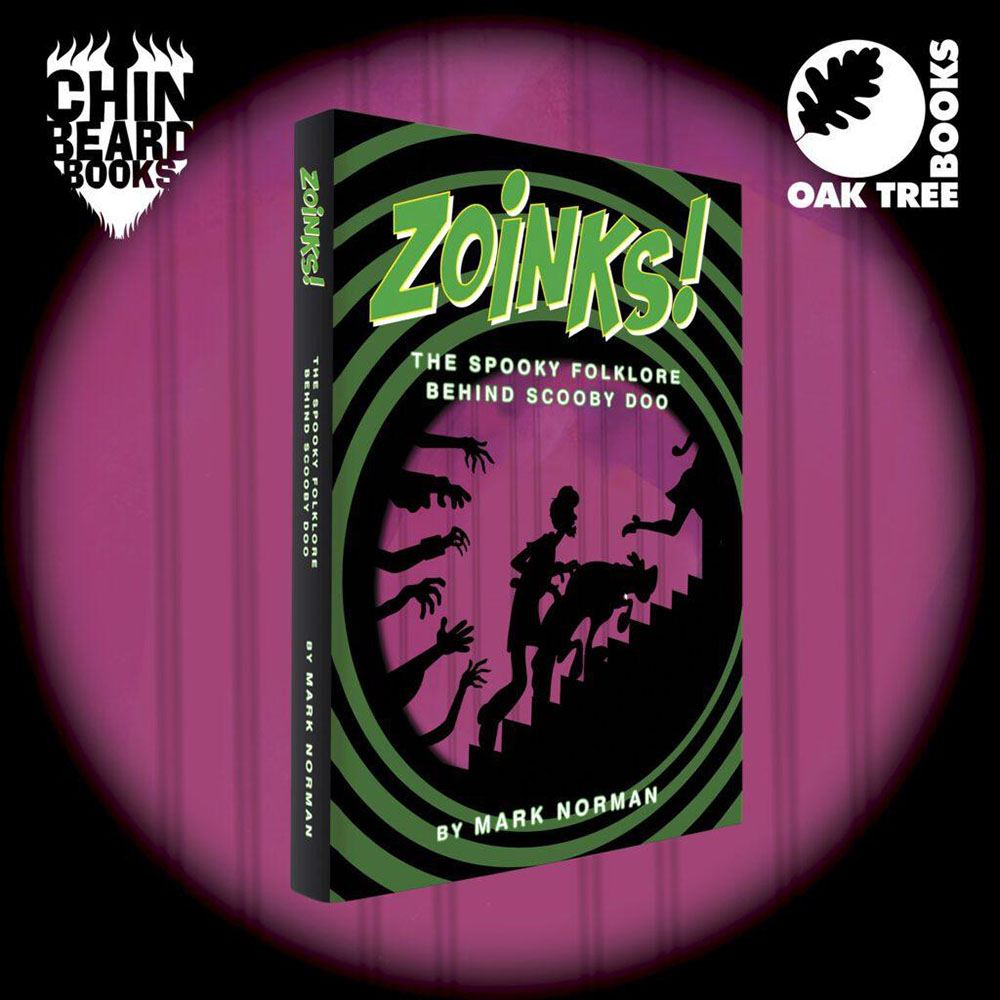
BR: Yeah. So this time we’re going to be talking about Scooby-Doo. Our guest is going to be Mark Norman, a friend and colleague of mine, a folklorist. He is host of the Folklore Podcast and author of several books, including Black Dog Folklore and perhaps most importantly, the upcoming book Zoinks, which is about the folklore of Scooby-Doo.
0:01:38
CW: Yeah. I can’t believe somebody has written a book like this. I’m very excited to talk to him. But before we get to that, we wanted to talk about, you know, I mean, we’ve been meaning to have you on, Kenny, and talk about your illustrious career, how the Eclipse Party was in Buffalo, and give us your favorite Scooby moment. Do you remember watching the show as a kid?
0:02:00
KB: I still watch it. I have the DVDs. I have the movies. I have the series. I have everything.
0:02:06
CW: What’s your favorite version? Because I mean, there’s the original and then there’s ones that came later.
0:02:10
KB: I really like the original. I’m definitely old school and the original was just the best. It was the humor, the mystery, the… you had the bookworm in the gang, which I really love and they solve the mysteries, you know, and it wasn’t as I think later versions got a little silly, especially some of the spinoffs, but I mean, I’m definitely old school.
CW: Cool, cool.
Pascual Romero: Yeah, I think the OG is the only one I’ve ever watched to some extent. I think there was some stuff in the 80s with Scrappy-Doo that I watched too, but that really just to me, like the core memory is that, you know, I think it was the late 60s to the mid-70s, like that series in particular was really, it was in heavy reruns in my childhood.
0:03:14
BR: Yeah, I’m not as big a fan as Kenny is, though I don’t think anybody is. Just with all the, you know, I watched the original series. I watched a couple of the later ones. I think I saw the first live action film, you know, so I’m certainly a fan and I do remember it being kind of influential as a kid. That and the Encyclopedia Brown book series by Donald J. Sobol about the boy detective who solved mysteries in his neighborhood. Part of what really drew me to both Encyclopedia Brown and Scooby-Doo was the lesson was that with enough research and investigation, you can actually solve the mysteries. This is solvable. It is not like, oh, we just spent 22 minutes looking for something and I guess it might be a ghost, right? It was and that really contrasted with all the other crap that was on TV and, you know, books and magazines and the Time Life series, you know, where everything was a mystery that no one will ever know because it’s beyond science and like bullshit. This is, this is…
CW: Yeah, in the, in the 1970s and 80s, I feel like we grew up in a time where a lot of the kids literature was skeptical. The kids literature, like I don’t know if I’m the only one here who read Nancy Drew and the Hardy Boys.
0:04:35
BR: Oh yeah.
0:04:36
KB: I have volumes of them on my shelf.
0:04:39
CW: Yeah. And then you got Encyclopedia Brown, you got Scooby Doo and then you go into the adult section of the library and it’s like Pyramid Power and the Bermuda Triangle.
0:04:50
KB: Eric von Donnigan, right?
CW: Aliens and Bigfoot We had kind of a things were a little topsy-turvy in the 70s and 80s.
0:04:57
KB: I think the series really spoke to me as a child because these were not Scientists, you know, it wasn’t portraying scientists or academics. That’s far from academics and I know I know but it was showing that teenagers were going around. I mean, honestly, first, the teenagers were the ones that were solving the mystery. They were getting into it, they were figuring it out, they were doing their antics, you know, they screwed up, they got caught, or they escaped and they figured it out. And usually it was like Shaggy and Scooby that did it by accident, just because they wanted some food, you know? But the big mystery to me was that these were teenagers that were traveling the country in a van. They didn’t go to school, they had no parental supervision, they were just in a van by themselves, you know, cross country.
CW: I got the idea they were at least over 17, 18. They had graduated high school. Or Shaggy probably got his GED. But…
0:05:56
BR: Daphne certainly had had past puberty.
0:06:01
KB: It’s like the original Scooby-Doo series, the characters, the original ages were Velma was 15, Daphne was 16, Fred was 17, Shaggy was 17.
CW: Oh, you looked this up. Okay. That’s what we do.
0:06:18
BR: And how old was Scoob?
0:06:22
KB: Scooby was seven.
0:06:23
BR: Okay, so in dog years that’s 49 or something?
0:06:27
PR: That’s old for a big dog, that’s for sure.
CW: I’m trying to imagine being 15 going, mom, dad, I’m gonna get in this van with a bunch of other kids and a big dog and we’re gonna travel the world.
BR: One of them might be stoned.
PR: Yeah, I was gonna say, I can relate to that a little bit. I just didn’t tell my parents was the dip paint.
0:06:51
CW: Yeah, okay. Yeah, that was probably wise.
0:06:54
BR: Well, more recently, Scooby-Doo was the reason that I pissed off Nicky Six.
0:06:59
CW: What?
0:07:00
BR: So he used to have a show called Sixth Sense, and I was on his show probably 2014, 2015 or so. I was a guest on, I think I was chatting with his co-host, Kerry Kasem. You know, I talked a little bit about whatever it was I want to talk about. And like, oh, yeah, you’re Shaggy’s daughter. Like, that must be so cool. You know, like what was it like growing up and, you know, Casey Kasem and all this. And Nicky kept like, he kept wanting to talk about Motley Crue. Hey, you guys want to talk about like my bass groove on Dr. Feelgood? I’m like, no, not really. So tell me about Shaggy. He wasn’t mean, but I can sort of get the sense that Nikki was pissed at me and I haven’t been on the show since, which is just as well because it’s been cancelled.
0:07:47
CW: See, I didn’t even – in my head, Casey Kasem and Shaggy are two entirely different entities because Casey Kasem is this like straight-laced, you know, I’m here to bring you the hits on, you know, and Scooby Doo was entirely different. In fact, we should ask Mark Norman, speaking of Sunday cartoons, because there was like a different set of cartoons on Saturdays versus Sundays. And I’m wondering if he’s preparing a book on the folklore of Johnny Quest. Oh, that’s a good one. That’s a lot of stuff on Johnny Quest that was just like bonkers. In fact, I think I think Haji did the Indian rope trick at some point.
0:08:26
KB: Yeah, I think he did. I think I remember that episode of that.
0:08:30
CW: Body parts everywhere.
0:08:32
KB: Right.
0:08:32
CW: Sorry, I’m just starting a rumor now.
0:08:34
KB: Oh, boy. Here we go.
0:08:36
BR: But no, I remember all those, and I mean, I was a big fan of, you know, but I think part of it was that Scooby Doo had more depth to it. It seemed more I mean, yeah, it was corny, and they had the jokes, and they had special guests that seemed more gimmicky than actual good investigators, you know, like Mama Cass and the Harlem Globetrotters. But still, I mean, it had a certain sort of rhythm to it. And it was, it just seemed more interesting than, you know, Captain Caveman or the Jetsons to me.
0:09:05
CW: Now, now stop me if I’m wrong. I’m wondering if this is a false memory. On the episode with the Harlem Globetrotters was there a scene where a skeleton was trying to sppok them and it’s head popped off, and did the Globetrotters dribble the skull and pass it back and forth and do tricks with it and end up making a basket with it? Or is that just my imagination?
0:09:32
KB: I don’t that’s so possible Possible. I mean because the Harlem Globetrotters were on there. We know Batman and Robin were on there, right? They had some celebrity guests. I and I remember one of my favorite episodes of supernatural was the Scooby-Doo episode
CW: I haven’t seen much of Supernatural, but a lot of my friends are like major fans of the show.
KB: It was a good, good episode. I mean, it was silly, but it was silly in the Scooby-Doo sense.
0:10:08
CW: But I like it when shows do crossovers and get like weird and have a whole lot of inside jokes.
0:10:13
KB: Yeah, yeah, it was good. I mean, overall, I mean, Scooby-Doo was is still a great show that that and I think you touched on it, Celeste, that that this taught critical thinking. I mean you had kids in front of the TV watching these shows and it would start out with a mystery. You know the kids for some reason they were staying at a mansion in a swamp that’s in the dark at night. Yeah, because that’s what teenagers do and they stumble upon a mystery and at first there’s like there’s antics because they’re scared and they’re trying to freaking out, but then they start thinking about whoa. What about this? What about that? Velma pulls out a book from somewhere because they have like a secret library in the van somewhere because she’s always got a book on something And they start figuring it out, and they start putting clues together and I and I think kids watching that caught on you know they started. This is how you think critically.
0:11:14
CW: Yeah, well, and you mentioned that these kids get scared at first, but in my recollection, Scooby and Shaggy were the only two that got scared regularly. Velma in the face of whatever ghost or whatever, and even Daphne and Fred, they were just always like, kind of like, oh, okay, whatever, let’s figure this out.
0:11:32
PR: Yeah, I think they kind of like, there were sort of archetypes to all of them that I think sort of had relatable symbolism, you know, so, you know, it may be, I don’t know if it’s super deep, but there’s sort of this thing about like how, you know, Velma is the one who will think her way through a problem and will generally approach things skeptically. And, you know, Fred always, you know, showed fearlessness, you know, he would just walk into things. And Daphne was always extremely supportive of the whole group. And Shaggy and Scooby basically screwed around until they accidentally solved something. But I think it was like, they were sort of the spirit of like, break things and figure it out, you know? So to me, there’s like a lot of like, relatable kind of elements to the group that I think are great and sort of teach some kind of, you know, maybe by accident they teach those lessons, but I think they do kind of show that everyone in the group has something to contribute and it kind of has a very wholesome kind of undertone to it.
0:12:35
CW: Yeah, I think the classic structure is Daphne is a druid and Fred is a barbarian, or a ranger. Fred is a ranger, Velma is a wizard, and Shaggy is a bard, obviously a bard.
0:12:52
KB: I’m very upset that Fred’s ascot never caught on. I do have one. That was a gift from somebody. So I do have Fred’s official ascot.
0:13:09
PR: Wow.
0:13:10
KB: And I’ve worn it. I’ve worn it a few times.
0:13:12
BR: So remind me was was I’m thinking in terms of like other cartoons that had people basically accidentally solving mysteries and things. Wasn’t that a recurring theme of Inspector Gadget?
0:13:25
CW: That was another one where yeah, where clues were left and it was a you know, it was a mystery show.
0:13:31
PR: Well, and let’s not forget that it was his niece, right? Penny?
0:13:36
CW: Yeah.
PR: She really it was kind of one of those like situations where he sort of would Mr. Magoo his way through the story, and then she would constantly be uncovering things on her own in the background and sort of like setting up the pins for him.
0:13:49
CW: Right, saving his ass, yeah.
0:13:50
PR: Yeah, so the reality is, is that a young child was actually the one solving everything.
0:13:57
CW: Yeah, I’m trying to think if there were any other like mystery shows that came up.
0:14:00
KB: Batman and Robin?
0:14:01
CW: Well yeah, Batman and Robin.
0:14:02
KB: I mean the rest of the cartoons growing up for the most part, Scooby-Doo was like a departure from the norm because you had a lot of like after-school cartoons or Saturday morning cartoons that violence was one of the core things that of the shows. You know, people were always fighting. You had G.I. Joe, you had Captain Caveman, you have Transformers, all these other cartoons, they had a lot of fighting going on.
0:14:33
CW: Even Quick Draw McGraw was El Gabon!
0:14:35
KB: Yes.
0:14:36
CW: Bash people over the head with a guitar.
0:14:38
KB: I mean, Tom and Jerry, I mean, how violent was that?
0:14:43
CW: But Tom and Jerry, it’s like, yeah, things were really violent.
KB: I think you also had the Pussycat Dolls?
0:15:13
CW: Yeah, I think we’re expanding what we consider mystery shows.
0:15:18
BR: Well, yeah, it’s, you know.
0:15:20
CW: But Scooby-Doo definitely, that was the…
0:15:22
KB: OG, right. I mean, I go back and watch the older episodes and whenever they’re aired or just happen to be on TV, I watch them because I think they’re just fun, you know, they’re looking back at a simpler time when it wasn’t I mean no cell phones. No Smartphone in any episode. I love it.
CW: I’ve heard that writers really don’t like the fact that they have to account for cell phones now And a lot of writers are using to set their stories in like the 70s or 80s just because that eliminates that whole problem right?
0:15:54
KB: Yeah makes it too easy.
PR: Yeah, there are a lot of a lot of mysteries uh would have been solved very quickly with the addition of a cell phone.
KB: Yeah, yeah, that’s how Ben does it.
0:16:11
BR: That’s how I do it, yeah.
CW: Yeah, you go, hey Kenny?
0:16:15
BR: No, no, I say, I say, hey Siri, what would Kenny do?
0:16:21
CW: Right. Kenny would buy a fifth of rum.
0:16:25
KB: I’ll have it by morning.
0:16:26
CW: Does rum even come in a fifth or am I thinking whiskey?
0:16:32
KB: I mean I don’t know, I buy it by the gallon. I go to BJ’s and get the cano size.
0:16:39
PR: It does. It’s pretty much all liquor comes in fifths, that’s the 750.
0:16:46
CW: Well Kenny, before we move on to get Mark Norman out here. How was your eclipse and how are you digging CFI and working out there as the, what is your official title, the lead investigator?
0:16:58
KB: Chief investigator, depending on who you talk to, it’s like chief investigator of paranormal claims or something like that. I don’t know. I love it. I love my job. I’m here all the time, constantly, but it’s not just investigations. I get to be involved with so many other projects with CFI and the history and what we do here at the building. I give tours when people show up because they’ve started to show up now at random times. I show up and I give tours. So it’s a lot of fun and I get to do some outreach stuff. So I’m going to be traveling a little bit this year and visiting other skeptical groups across the country and talking to them and doing presentations. So I’m loving it. As for the Eclipse event, it went really well, except for the weather.
0:17:46
CW: Oh, yeah.
0:17:47
KB: It did not cooperate. I mean, it was actually, it was better. It was a little bit better than if it was clear day, because if we had a totally clear day, yeah, we would have gotten amazing pictures, video and all that. And we would have probably gone through the day looking up going, okay, it’s there. Okay, it moved a little bit. 20 minutes later, okay, a little bit more waiting for it. But because the cloud cover was so thick, we were getting these very sparse sections that cleared up for a few seconds. And the excitement that went through the crowd, because we had about 120 some people here. And right next to us, across a small strip of grass, there’s college housing. And you could hear the college kids screaming every time we had an open space in the clouds. And all of us started screaming, like, there it is, there it is. You get some pictures real quick, and then it would go behind the clouds.
0:18:45
CW: It’s like the anticipation.
0:18:47
KB: Yes, when the clouds just cleared and we had those few seconds each time, it was just really, really cool to hear all the excitement throughout the entire area, not just at our event. So it was really good. We had a lecture, we had a documentary, we had workshops, we had a bunch of tours. I did a whole bunch of tours that day, and we had lunch and dinner. We had trivia that night. It was really good. We had a lot of people here all day. So, very successful event.
0:19:16
CW: Oh, that’s fantastic. I’ll try and make it out there for next year’s Eclipse, okay?
0:19:20
KB: Sure, sure. I put my call in, you know, I’m trying to schedule it now.
0:19:23
CW: Okay.
BR: Well, Celestia, you saw it yourself, didn’t you?
0:19:27
CW: Yeah, I threw the kid and the husband into the car and we drove to Texas. I went to Mason, Texas, which is kind of between San Antonio and Austin. It’s kind of in the middle of nowhere. And we picked right because the traffic was smooth sailing the entire time. It was a two day drive. And I stopped in Albuquerque and said hi briefly to you, Ben. Hey.
0:19:51
BR: Hey.
CW: And then we grabbed a motel and hit the road in the morning and got there just fine. Stayed overnight, saw the eclipse and then hit the road again on the way back. And really, we were we were prepared for gridlock. And I’ve my sister who saw it in Niagara Falls did endure like that 14 hours of gridlock. So I know I really got lucky and missing it because I heard about you know, Dallas and Austin and some of the bigger cities in Texas that were in the totality line did get really gummed up with traffic. But we kind of picked the back roads area for that reason. We wanted like a dark sky and it really, it got dark. Weirdly, quickly, we lucked out. They were predicting cloud cover, but it didn’t really materialize. There was like one little cloud that came in and then left like about 10 minutes before totality happened and wow, it was wild. It got cold. It was, you heard crickets. And yeah, I hope to see it again, you know, someday before I leave this mortal coil here.
0:20:55
KB: Cool.
0:20:56
CW: Pascual, did you see it? Ben, did you guys at least go outside in Albuquerque and get some glasses?
0:21:03
PR: So I still have my glasses. We actually were very fortunate last October to be smack dab right under the annular eclipse. So not quite as dramatic as a total eclipse, but we did get a perfect lineup with the ring of the sun around the outside of the shadow of the moon.
CW: Ooh, neat.
0:21:21
PR: Fantastic experience. Still had my glasses from that. So I thought, hey, why not? I’ll go out and see, because we were in the 80-something percent range over here, so it’s not nothing. And I went out and looked up at some clouds for the duration of the eclipse.
0:21:38
CW: Oh, okay. Same from your house, I assume, Ben?
0:21:42
BR: A little bit. We reached, I think it was like 86%, right around like 12, 1230, I think it was. And because it was my lunch break, I was actually out jogging. So I went out for a jog and I took my eclipse glasses with me, because as Pascual said, I still have them left over from last time. So I would jog for a bit and then I would sort of take a break and look up and and so it was overcast Now and then but I got I got more than a couple glimpses and it was pretty cool.
CW: Sweet sweet Alright, well cool Kenny. Thank you for being here for our little intro part of the podcast That was neat. We’re gonna have to have you on again.
0:22:14
KB: I agree I definitely have to have me on again and because I’m so nice I’m going to return control of your show to you guys.
CW: Thank you get him out get him out. Lock the door.
(MUSIC)
0:22:28
Hello everyone, this is Adrienne Hill from Skookum Studios in Canada here to talk to you about a great excuse to visit Calgary besides the moose maple syrup and mountains. The second annual Western Canadian Reason or Week in Reason conference is happening the weekend of May the 3rd with activities Friday, Saturday and Sunday. Talks featuring Dr. Eugenie Scott, noted pancake eating expert Richard Saunders, Jonathan Jerry, Hemis Meta, James Fell, the sweary historian, Kat McLeod and a keynote from Dr. Carasanda Maria will be held on the Saturday. Check out the website at www.weekinreason.com for more information on speakers, hotel and activities. Hope to see you there or you might be, you know, sorry.
(MUSIC)
0:23:30
BR: So today we have a great guest. He is a colleague, a friend of mine. I’ve met him at least a few times. Mark, are you there?
Mark Norman: I certainly am. And yes, we have met a few times, both in the real world and this one.
0:24:15
CW: I think now you’ve also written a handful of books here. I’m seeing Folklore of Devon, Black Dog Folklore and something about bees.
0:24:23
MN: Yes. Yes, Telling the Bees and Other Customs, which is a book about the folklore of rural crafts.
0:24:30
BR: Oh, I have it right here and I love it. It’s the cover is super cool, not to judge a book by cover, but the cover is super cool.
0:24:38
CW: Yeah, Ben I’m starting to think you only hang out with people who have written at least three or four books.
0:24:43
BR: And yet here I am with you.
0:24:45
CW: Hey, I’ve contributed to many. You have. Well, we’re here to talk about Scooby-Doo.
0:24:52
MN: Yay!
0:24:53
CW: Now, first off, you are British, I suspect, from Devon.
0:24:57
MN: That’s very true, yes.
0:24:59
CW: Okay. Scooby-Doo is an American show, so how on earth did you get to see the show as a kid? Or did you? Did you just find it as an adult?
0:25:07
MN: I saw it as a kid. We don’t live in the dark ages, just because we’re in Britain, you know. We do get TV.
0:25:15
CW: I assumed it was Benny Hill 24-7.
0:25:17
MN: Not quite, but yeah, the 1980s were not far off that, to be fair. Now we had the original seasons of Scooby-Doo, Where Are You?, as part of the kind of lineup of television, predominantly on a Saturday morning to keep kids out of their parents’ hair. So I would have seen the original seasons, you know, 20 years or so, I suppose, after 10, 20 years after they were first broadcast. Later shows, some made it here, some didn’t, which proved to be problematic when researching the book because some of them were easier to track down than others. But certainly I was brought up on some of the earlier ones.
0:26:00
CW: And for listeners who are probably frantically Googling your name and Scooby-Doo to find this book and order it, it will be out by Chin Beard Books in June. So it’s coming out soon. Can you pre-order it?
0:26:13
MN: There will hopefully be pre-orders available. I don’t know when this is going out, but by May. I’m coming over to Chicago for 10 days in May to do a few talks and things with a publisher I’m working with over in the States, and the publisher of the Scooby-Doo book will hopefully get it to pre-order before that little tour happens.
0:26:32
CW: And what is the title that you guys settled on for the title of this book?
0:26:37
MN: So the publisher settled on Zoinks, the spooky real world folklore of Scooby-Doo, or possibly the spooky folklore behind Scooby-Doo, depending on how the cover design finally comes out.
0:26:48
BR: The important part here is zoinks! So Mark, so I have read the book. You very kindly sent me an early draft and so I’ve read it and I love it and I gave you some feedback on there. One thing that I was very impressed by, I have to say, was the amount of research you did. A lot of times, you know, we see these sort of, you know, they bang out some short thing and it’s clear that they sort of, their knowledge of the topic in your case, of course, Scooby-Doo, is culled from Wikipedia and maybe a journal article somewhere. But some reading this is like, oh my God, he’s dug into Scooby-Doo in depths that I hadn’t even imagined, including, if I’m not mistaken, having watched every single episode?
0:27:40
CW:You created a database too, didn’t you?
0:27:43
MN: That’s true. I haven’t yet watched every single episode for reasons that I alluded to earlier on. Some of them are just very, very difficult to track down in the UK. Having said that, my goal is still to watch every single episode. And I have watched most of them now, purely because I will probably bring out a second edition when it reaches that stage and just tweak a few bits here and there. But yes, the spreadsheet for this particular book research is legendary. It has to be said. I’ve got it on screen. I’ll give you an idea. So it runs to currently 575 rows, which is every episode in chronological order from season one, episode one of Scooby-Doo, Where Are You? What a Night for a Knight, through to just prior to the release of Velma, which is where I drew a line on my research because you’ve got to, as you know, as an author, Ben, draw a line somewhere, otherwise books don’t come out. That was the point at which I drew mine. So my spreadsheet covers all of the episode titles, the monsters and villains that are represented, a basic plot summary of each episode and the folklore that’s drawn upon for each one. And then naturally, because it’s a spreadsheet, obviously it has to be colour coded. So it’s colour coded green and red as to whether I’ve yet watched that episode episode or not. And that spreadsheet saw me through an awful lot of viewing and writing.
0:29:19
BR: So as you know, there’s a big intersection between folklore and pop culture.
MN: Yes.
BR: That, of course, you’ve done stuff on and many of our colleagues have as well. I’m trying to think that there was one other person that I know of that I met, another folklorist, who did some work on Scooby-Doo. But other than that, I think it’s just you two, how much pre-existing literature was there on Scooby-Doo when you jumped into it?
0:29:44
MN: There’s not an awful lot approaching it from that way. There are some pop culture articles on the show but not stuff that’s particularly looking at the folklore and mythology. There’s one academic in the States who is also writing a book around the show, not in the same way as I have, we have chatted, and there’s a chapter in a recently published book on folk horror which looks at the show from a gothic perspective. That’s probably about all, I think. So for that reason, it was important for me to to try and speak to people who were involved with the show as far as possible to get that kind of first-hand knowledge on how things were constructed, how the writers did or didn’t draw on real-world stuff, or looked like they did possibly in some cases and didn’t. So I spoke to a few people who were involved with the show. John Semper Jr., who’s quite legendary in the US cartoon world, I think, as the creator of the animated Spider-Man, but he wrote for some older episodes of Scooby-Doo. And Mitch Watson, who’s written the foreword for the book, who was the showrunner and joint creator of Scooby-Doo Mystery Incorporated for Nickelodeon, which is generally considered outside of the original Where Are You to be the best version of the show there is for many reasons.
0:31:16
CW: So Scooby-Doo has an interesting place in the hearts of all skeptics, and I’m kind of straddling the line here because I have a lot of cartoonist friends who don’t care for the show. The cartooning was not state-of-the-art or anything. It was it was Hanna-Barbera, kind of bottom of the barrel for Hanna-Barbera. But skeptics love it. Many of us are drawn to the fact that, in most cases on the show, the ghost or the monster turns out to be a dude in a suit. So having done all this research, are there any other less obvious aspects to the show that would make it very appealing to skeptics?
0:31:55
MN: Sometimes it’s a girl in a suit.
0:31:57
CW: That’s true, yeah.
0:32:00
MN: Yeah. I think probably skeptics probably are drawn to the fact that it generally does have that reveal, and so it’s offering up sometimes an explanation for what may be unexplained, sometimes a suggestion of an explanation for what may be unexplained, but it ultimately, because of the nature of the show and the way that it came about, it’s looking at rationalizing things in which we might find fear or tension. And on the whole, it does that most of the time. Yeah, there are versions where the paranormal is, for want of a better term, supernatural, Those are few and far between and also they tend to be the weaker versions of the show Where the episodes don’t quite work in the same way a lot of them Involved scrappy do but I mean we don’t like to talk about that for obvious reasons and I guess one one exception is probably there was a Season called the 13 ghosts of scooby-doo, which is notable for Vincent Price providing one of the voices. The season’s a bit of a misnomer because it actually only had 12 ghosts. They had to go back and make a 13th episode to complete it much later on, and that provided a bit of a different twist. But in that, the paranormal is real, but it’s really done for comedic effect, but the versions of the show where you don’t have that reveal, where you don’t have that skeptical element, they don’t tend to work as well, in my opinion.
0:33:47
CW: Yeah, you’re making me realize now, thinking holistically about the show, because I watched it like every Sunday morning when it was in reruns as well, as a kid, and those were the more satisfying ones, where there actually wasn’t a ghost or a cryptid, you know, running around. It was, it was, oh, ha ha ha, the mystery has been solved. Like that old Tim Minchin yarn, every mystery ever solved turned out to be not magic.
0:34:13
MN: I think there’s probably a couple of reasons for that. I mean, you, you have that kind of chance to try and solve a mystery along with the other characters which for children is appealing because they are looking for clues along with the gang and they know that ultimately they’re going to find a resolution that they might get before anybody else does. So you have that chance to explore something that might be seen to be a little bit scary or a little bit exciting and then ultimately go, oh no, actually it’s all fine.
0:35:00
BR: Yeah, it strikes me like you’re saying, I mean, the problem, of course, from a narrative point of view and a structural point of view is that if the end result is magic, or God did it then sort of all bets are off. I mean it’s sort of a you know, deus ex machina.
0:35:17
CW: Well, then there’s no there’s no arc. There’s Just we have a really weird paranormal thing happening and at the end of the show Oh, it was a really weird paranormal thing, right?
BR: Like, you know, we’re trying to solve this mystery and then the end. Oh, it’s a miracle. Oh there you go. I we we solve that one. The next one might be miracle, you know. Yeah, so that’s… Yeah, just from a structural point of view.
0:35:42
CW: It kind of set us all up, I’m just, you know, saying from my own perspective here, it set us all up to want to pursue the actual reason for something and have that be satisfying at the end. Aha, we took the mask off, it’s Peters and Gimlin, you know.
0:35:57
MN: Yeah, I think the exception to the rule with this one probably is Scooby-Doo Mystery Incorporated because the two seasons of that have an overall story arc that runs for the entire length of the show. In fact, they don’t call the episodes episodes at all in that version. They call them chapters, and they do that for a very good reason, because although there is an individual self-contained story, which tends to have that resolution, you know, it was the caretaker at the fairground with a mask on or whatever. Yeah, that’s not always the case.
0:36:31
CW: Can you sort of take us through the various versions? Do a quick primer for people who I mean, many of us of my generation are only thinking about the cartoon that came out in the 70s. That was rerun perpetually in the 80s. But there have been you know, we have lamented that the movies that came out with live action actors went to the paranormal pretty quickly. You know, the character itself has gone through a lot of transformations.
MN: Yeah, I mean, it has. And it started off with the original, it was originally two seasons of Scooby Doo, Where Are You, which are the classic episodes that everybody knows and comes back to. And then there was a third season which worked in a very similar way, but it was originally broadcast under a different title. So it was part of a season of cartoons called Scooby’s All-Stars, which featured other cartoons as well. But Scooby’s All-Stars was then rebranded as Where Are You Season 3, which was one of my sticking points because that was never released on DVD in the UK. So I had to have somebody in the US go to Walmart and buy me an American DVD and mail it over so that I could watch it with the region coding turned off in order to do that. This is the kind of stuff that I had to do as work around.
0:37:57
BR: And that’s why we love the work you put into it. I have nothing but respect for your research.
0:38:02
CW: I will go to Walmart for you anytime you want, Mark. Okay?
0:38:05
MN: That’s useful to know when I reach the really difficult stages later on. Thank you. Because when my VPN Opera web browser, which allows me to watch some of the streaming American versions doesn’t cut it, then I’ll know where to come. So there were a few iterations after that that came and went. There were a couple of seasons which were, they called them the new Scooby-Doo movies. They weren’t movies as such, but they were longer episodes. And then, after a little while, we reach the kind of ill-fated Scooby-Doo and Scrappy-Doo period of time, where Scooby’s annoying nephew is brought in to try and resurrect the franchise but ultimately almost kills it off because he’s so annoying.
0:38:54
BR: Is that sort of the point in which Scooby-Doo could have said to you know have jumped the shark as they say that’s that was from like this is going downhill and hey let’s let’s bring in Scrappy and it was just such a disaster. You know I’m just going to ask you directly what the hell was with that?
0:39:14
MN: The the show was starting to flag a little bit in terms in terms of its viewership And it was thought that having a kind of you know young Excitable character like that would kind of bring young excitable viewers on board but Godzilla and Godzuki didn’t work there either certainly didn’t work with George R. Binks unavailable I mean how well George R. Binks came later but he probably probably be viewed on the same page as both Godzuki and scrappy do I think yeah ultimately was it was an experiment that didn’t work as well as they thought it would it certainly played into some later comedy in the show.
0:40:01
CW: Yeah, they lead into that later.
0:40:03
MN: Yeah, they did it in the live action films. They also did it in mystery incorporated where Velma’s parents run the Crystal Cove Spook Museum, part of which is it has an exhibition of all the costumes of characters that the gang have unmasked over the years and also has a statue of scrappy in it which they walked past at one point and Daphne tries to comment on but Fred takes her to one side and said we said we would never mention this again.
BR: Well look as a as a fan of new coke I will defend noble uh noble failures. I don’t know that this was a noble failure.
0:40:43
MN: Well I mean it was in many cases but not in every case I mean I I said earlier that I’d spoken to John Semper Jr. who was one of the writers on the show and he wrote some of the Scrappy episodes and he still feels that Scrappy is one of the strongest characters and as a writer his reasoning behind that is that no matter what you give Scrappy to do, he will always get away with it. And from a writing room perspective I can see the appeal of that. But still annoying.
0:41:17
CW: I never thought of Scrappy-Doo in that way. That sort of makes him like Buster Keaton and the luckiest character alive, kind of thing.
0:41:28
MN: Exactly. Exactly.
0:41:30
CW: Well, you mentioned in the first chapter of your book that Scooby-Doo came about in part because of the assassination of RFK. You got to explain for our listeners how is that connected?
0:41:42
MN: Okay, it’s connected because in 1968 when RFK was assassinated, we’re looking at a year prior to the start of the first season of Scooby-Doo and it’s a period of great unrest in America at that time as no doubt you and most of your listeners will be aware. And when you get these periods of unrest, you find that the tensions of life around you kind of then feed into the media as well. This means that at that time children’s TV comes under the spotlight because parental feel that it’s getting too violent and this sort of thing leads into the kind of actions such as the shooting of RFK.
CW: So we’ve covered panics on the show a few times.
MN: Exactly. Exactly. It’s you know, not unlike the video nasty satanic panic stuff all of that kind of thing So what happens is that there’s a parental group – action for children’s television who are looking into Saturday morning cartoons, and particularly when they look at the Hanna-Barbera cartoons, quite a number of them come under the spotlight as being particularly violent. As a result of their intervention, quite a few of them were cancelled. So new shows have to be developed which are kind of more friendly to those kinds of action groups, but without losing the appeal to the younger audience. And that’s where Scooby-Doo comes up, really. It’s got that kind of action appeal to it, it’s got mild threat, it’s not got anything worse than that until much later on. It’s not until the 21st century that a character in Scooby-Doo dies, for example. But you do have this kind of mild threat and peril, which is easily overcome. So you have that action element to it, but it’s all quite safe. And surprisingly, you can then bring in the realm of the supernatural within that kind of safe environment and still not cause objections. That’s why the show became so popular.
0:44:03
CW: It was more apple dumpling gang than you know jigsaw.
0:44:09
MN: Yeah well I mean the characters were based on an American sitcom which was you know fairly safe ground I think.
0:44:18
BR: Well Mark I wanted to ask you among, we’re currently talking about Zoinks and I just love saying it that way, so just deal with it. But one of your other books, which I, we’re gonna have you on another show to talk about Black Dogs and black dog folklore. Which is the title of that. I was recently rereading that book in preparation to again, talk to you about the black dog. And I saw a reference that was very Scooby-Doo-like on page 102 of your book. Basically, it was talking about the Shucks.
0:44:53
MN: Yeah.
0:44:54
BR: And it was and you know exactly where we’re going with this. And it was so interesting. So again, we’ll be talking. Don’t go too in depth because we’ll talk about it another time. But can you well, what is the Shucks?
0:45:05
CW: I haven’t read the Black Dog books. So you’re going to have to explain what the Shucks is first and how that relates to Scooby.
0:45:16
MN: So the shuck is a variant of ghostly apparitions of black dogs which is found in particular areas of the UK, also known as a bar guest in some cases, and it’s seen to be more of a hellhound. So the general feeling about black dogs to those who don’t know the subject particularly well is that they are demonic, and that’s not the case. Actually, you know, fewer than half of them have any kind of portentous element to them at all. But the shuck is this kind of, you know, red eyes wouldn’t be mistaken for a natural dog kind of figure. And so, you know, it lends itself to Scooby Doo in that sense as being a kind of villainous cryptid for want of a better term. It’s not a cryptid because it’s, you know, a spectral figure and not a flesh and bone one if you want to look at it in those terms.
CW: Well, there was that episode where Scooby and Shaggy got covered in flour or was it white paint and they looked like apparitions.
0:46:26
MN: Yeah, that’s happened more than once. And obviously all of the apparitions in Scooby-Doo are green as well, because we all know that ghosts are green.
0:46:34
CW: Yes.
BR: Obviously.
0:46:36
MN: Good folklore behind that, to be fair.
0:46:38
CW: So does the shuck kind of look like a Great Dane, usually, when it’s spotted?
0:46:43
MN: Well, it doesn’t, but it is particularly large. And Great Danes are one of the larger breeds of dogs. So there is a kind of tie-in there. The Shuck’s been parodied in Mystery Incorporated as well, although the dog in that particular episode was a robot rather than being a ghost, but hey, you know.
0:47:04
CW: I think I remember that, yeah.
0:47:06
BR: Well, just like in the Six Million Dollar Man, right? Bigfoot turned out to be a robot.
0:47:10
MN: Well, we all know Bigfoot’s a robot.
0:47:12
BR: I didn’t know that everybody knew that, but spoiler!
CW: He was an alien robot who developed sentience and started to like Earth. Come on, this is basic Bigfoot 101.
BR: Well, no, no, no, he didn’t answer, he didn’t finish answering the question, so I will introduce. So, Mark, in the context of Shucks, so in your book Black Dog Folklore, you talk about there were smugglers who were using the folklore of this ghost dog for sort of Scooby-Doo-like purposes. Can you explain?
0:47:50
MN: Yeah. So a lot of folklore, particularly around black dogs in coastal areas, has this kind of origin point to it, which is really interesting, where either smugglers are drawing on pre-existing legends, such as the black dog, and faking one, or they’re creating some kind of ghost that then enters the folklore record, but in either way the results are the same. Keep people away from the area in which you’re landing your illicit trade, or whatever else you’re doing. So smugglers are reported, for example, to have created phantom coaches by getting a coach and horses, painting it with phosphorescent paint, tying rags to the hooves of the horse so it doesn’t make any noise, but not painting the head of the horse so that it appears headless from a distance. Bingo, there you go, phantom coach, nobody goes near you.
CW: That was literally done in Scooby-Doo, painting something with fluorescent glowy paint was literally…
MN: Yeah, on many occasions, because I do argue the point in the book that what wasn’t known at the time that Victorian ghost hoaxes were operating or smugglers were operating is the carcinogenic nature of phosphorescent paint probably led to a few ghosts of its own in time.
0:49:18
CW: Oh my goodness. I swear this is mapped out in the Haunted Mansion in Disney. Now, do you know whether or not the writers drew on some of this actual folklore about the smugglers and the phosphorescent paint when they wrote the episodes, or was it just dumb luck?
0:49:38
MN: I can’t say for certain that they drew on particular folkloric stories because I haven’t had the chance to speak to them about every version that there is. But it’s certainly the case that in some cases they have drawn on real-world cryptids and so on for the show and the stories behind them. So I think it’s fair to, you know, how deeply they went into it past a Wikipedia search, depends on the writer probably, but I think it’s safe to say that there is enough good folklore in the show to demonstrate that that has happened on more than one occasion, yes.
0:50:16
BR: So Mark, one of the sort of hallmarks, I mean, you know, I also was of course a big Scooby-Doo, but of the early ones, but I have to admit, not having kids, certainly when I ran around the house, I wasn’t subjecting like, oh, here’s the latest version of Scooby-Doo. To me, Scooby is sort of frozen in time to my childhood. But of course, one of the things that really interested me was not just the skeptical lessons but also the parade of monsters, right? So this is where it intersects with cryptozoology and Bigfoot and the Abominable Snowman and scary clowns, Chupacabras and whatnot.
0:51:03
MN: There is a Chupacabra.
BR: Okay.
MN: There’s one episode with a Chupacabra. You wouldn’t like it.
0:51:10
BR: I’m embarrassed that I don’t know that.
0:51:11
MN: So it’s one of the direct to video features. So you’re excused from not knowing it, and you wouldn’t like it because it’s furry.
CW: Well, that would have been weird if Chupacabra showed up in the 1970s, because then, as you have pointed out in your book, it wasn’t around until the 1990s.
MN: That would have needed a rewrite, wouldn’t it?
0:51:29
BR: Yeah, I would have had to redo my book. So all right, that says it. But so, yeah, let’s talk a little bit about how Scooby-Doo incorporated these monsters into the canon and the stories.
0:51:43
MN: Well, I mean, in the case of Bigfoot, let’s use… Well, okay. Terminology is a problem here, so let’s go with Bigfoot for the sake of argument for a minute. The show’s had a bit of an odd view of Bigfoot over the years, and that’s mostly because it can’t quite decide what term to use. So it uses Yeti in some cases, it uses Bigfoot in some cases, it uses the Abominable Snowman more than once, but it doesn’t always use them in the right places for where those creatures are found. So obviously it will use Abominable Snowman in pretty much any episode that’s got snow in it.
CW: Yeah, I seem toremember there was like a ski lodge and then there was also like the Swiss Alps or something.
MN: Yeah, there’s been a few. So I mean, you know, Yeti, Yeti obviously comes out of Tibetan folklore, really. But but it’s it’s used in various places. There’s a direct to video movie called Chill Out Scooby-Doo, which features an expedition to find the city of Shangri-La, for example. And this uses the term abominable snowman pretty much throughout the film, although the expedition and the Sherpa that’s leading it is very obviously supposed to be Tibetan. So there is this kind of issue around terminology.
0:53:13
BR: But to be fair, the audience is I mean, I you and I would recognize why why Sasquatch shouldn’t be reported in Nepal. But the average viewer is probably like whatever it’s big and hairy.
CW: And well, and it allows the writers to come up with many different stories rather than just have it as one creature or something.
MN: Yeah, it does. And we can forgive them that, obviously, because of the audience that they’re catering to but there is some good irony in this and that’s because there is one episode which calls the Yeti by its proper name and refers to the Tibetan folklore behind it but the episode is situated in an American downtown cheese restaurant.
0:54:03
CW: We’ve done easily six episodes about Bigfoot and we have never mentioned cheese.
0:54:08
MN: Well, now it’s your job.
BR: Get back to it.
0:54:12
MN: There’s a 2015 episode of the series Be Cool, Scooby-Doo, which is, which if you haven’t seen it, I would highly recommend watching because it’s written for comedy and it’s written for comedy really well. The scripts are brilliant in this.
CW: Okay.
MN: So there’s an episode called Kitchen Frightmare and it’s set in this American cheese restaurant called Cheese Volcano.
BR: As one does.
MN: Yeah which is having, which is being troubled by a yeti. So every time this Yeti appears, the air in the restaurant becomes very cold and all the mirrors freeze and obviously it turns it into this kind of Tibetan environment. And then it covers the terminology of abominable snowman being ascribed to the Yeti really well. Velma talks all about how early 20th century explorers came across the creature and came up with this terminology which is really brilliant and then it turns out and I don’t want to give away any spoilers here but I’m going to because this one is really good what happens at the end of the episode for the reveal of this the Yeti is a costume obviously it’s a costume who was created that was created by a guy called Jack Howard. He’s the man who lives in the apartment over the top of the restaurant. And he’s really hacked off that there’s a restaurant below him because the noise keeps him up all night. So he has a habit of scaring away restaurant owners. The first restaurant that ever opened on the site was a Tibetan one, so he created this Yeti disguise and then he just couldn’t be bothered to change it for any of the other restaurants.
0:56:02
BR: I love it!
0:56:03
MN: So he uses the same suit every time.
0:56:07
BR: Because that’s the most obvious way to deal with noise coming from downstairs.
0:56:12
CW: Did they explain how did he create the cold environment? Did he have a weather changing machine too?
0:56:18
MN: If I remember rightly, I think he hacked into the air con system.
0:56:24
CW: Okay.
0:56:26
BR: Well that brings up another question. So let me ask you about some of the writers. We talked some about the skeptical themes. Do you know if in, obviously, if you’re a writer, you need to prepare, you need content, right? And so, you know, for the earlier episodes, of course, there was no internet to go to. Presumably some of the writers for these scripts looked into actual cryptozoology work by Bernard Huffman or John Green or Bigfoot researchers. I don’t know if you know or not, but can you sort of either talk or speculate about how much the script writers and screenwriters did actual research into either these monsters and or folklore and or skepticism?
0:57:10
MN: I can’t speak to it for certain with the earlier episodes, because I’ve not had the chance to speak to writers who wrote on the very early ones, but I would say, based on the representations of folklore and mythology that we have in certainly the two first seasons of Where Are You, so 1969 forwards, I would say that the representations are good enough in those seasons to suggest that they did some decent research, because you’ve got the common motifs of folklore coming up, certainly in a good enough way that I think coincidence that they hit the mark often would probably suggest there’s more to it than just sheer luck. So I suspect that they have at least looked into it a bit. Later on it becomes more obvious they have done this, you know, there are good representations in some of the later shows and from some of the writers that I’ve spoken to. In some cases they’ve certainly looked into elements, you know, the way that Mystery Incorporated uses the Nibiru cataclysm as part of its overall story arc. That’s a sophisticated piece of work, and they do it very well. It’s obvious that they haven’t just had a cursory look.
0:58:37
CW: Yeah, I always got the sense that I was kind of learning something when I watched Scooby-Doo. It wasn’t just blatant schoolyard rumors or a generic mummy walking around. They had some meat on their monster bones.
0:58:54
MN: Yeah, they do. And they use it in some cases, of course, in the way that folklore has traditionally been used over many decades. And they use it as a mechanism to teach a particular lesson or a particular story in the way that Victorians used folklore for morality issues, the show really uses it in the same way because ultimately, certainly the early seasons of the show, they’re a commentary on the American culture of that time and the folklore and the mythology and the creatures that are in there are used as a springboard to make that commentary?
0:59:37
CW: Well, one aspect of Scooby-Doo that struck me as odd, especially with all the folklore terms I’ve learned, thanks to Ben, legend tripping or ostention is a topic that we’ve covered quite a few times here. And that’s, you know, reenacting a legend, you know, ghost story tourism, that sort of thing, you know, trying to find the ghost train on the railroad tracks. And you note in the book that it’s literally what Scooby-Doo and the gang do for almost every episode.
1:00:09
MN: Yes, absolutely.
1:00:10
CW: Which is a weird meta thing to think about, because I mean, if you go to a skeptics convention, which I have, and Kenny Biddle shows up dressed as Fred, or in a version of the Mystery Machine, which he has, is he participating in legend tripping a character who legend trips? So it’s like ostentation squared any anyway. How does this how does this show? incorporate ostention?
1:00:34
MN: I’m now thinking about that whole scenario of Kenny turning up like that because…
BR: Well to be fair he’s usually drunk Can’t read too much into whatever he’s wearing or not wearing.
1:00:49
MN: Yes, urban myth. Urban myth tells you that Shaggy and Scooby are frequently stoned, but they still manage to investigate these things, you know. That is not true, by the way. That is not true. That is an urban myth. Yeah, I mean, if the hotel where the Skeptics’ Convention was reported to be haunted, and Kenny is looking into that, then that’s the ultimate meta environment because then he’s adding to the narrative of the haunted hotel whilst playing a character who’s undergoing legend tripping in a haunted venue. This could snowball forever.
1:01:25
CW: Yeah, I think we’ve just entered in inception.
1:01:28
MN: Yeah, yeah, absolutely. The whole nature of the world will fold in on itself and it’ll be his fault.
1:01:35
CW: It usually is.
1:01:39
MN: The show deals with legend tripping in exactly the way that you would expect, really, that often there is a story of a haunting or there’s a story of a creature or some other strange event happening and the gang go to investigate with that purpose in mind, to interact with that story and hopefully to solve it. That’s not always the case. Sometimes ostentation can be accidental, you know, they happen to be driving down a road, Fred gets lost, Fred gets lost quite often in some of these episodes, and they happen across a mystery, and that’s not quite the same thing. But frequently, they will know of a story and will set set out to investigate it. And obviously, in terms of legend tripping, when you interact with a narrative, then you help to shape that narrative. Now, the difference in a lot of the episodes of Scooby-Doo is that you bring a narrative to a conclusion, because a creature is unmasked as being, you know, the janitor or whatever. But you’re still interacting with that narrative and helping to shape it. Because how many times, Ben, have you debunked something only for somebody to email you in all caps and tell you why you’re wrong? Just because you debunk a narrative, that doesn’t bring an end to the narrative, but it does influence it. And that’s what the show is, you know, the characters in the show are doing often. They bring an end to a narrative, but they are still interacting with it and influencing it. You know, just because they’ve solved a mystery in a haunted house, that haunted house is still going to have a reputation for being haunted for many people. I guess we’re maybe reading a little bit more than we’re supposed to into some of these episodes, but if you compare it to the real world, that’s how it would look.
1:03:38
BR: Sure. I hadn’t thought about it that way. This is super interesting. I’m so glad we got you on to talk about this. This is super cool. So have there been any episodes, and again, had I seen some of the more recent episodes and I might know this, were there any episodes where the Mystery Inc. gang were at an allegedly haunted location and there was already a team of paranormal investigators who were at the location and in the process they sort of showed some of their faulty, you know, premises or logic or things like that. Now keep in mind, of course, with the, you know, the idea of sort of commercialized paranormal investigation, pretty ghost hunting is fairly new. I mean, it’s only in the last, you know, 20 years or so when you had the proliferation of ghost hunters and ghost adventures and all that, all that reality TV stuff. So obviously there wouldn’t have been, I mean, there was, there was Harry Price and others, you know, decades ago, but, um, were there any more recent episodes of Scooby-Doo where they were actually interacting with sort of more gullible ghost hunters and hopefully, hopefully, uh, with the, with the arch eyebrow explaining why their methods were shoddy?
1:04:51
MN: Not quite in that way. I guess the difference between Mystery Incorporated and Harry Price is that you don’t normally see Mystery Incorporated faking the stuff in the first place.
BR: Well done.
MN: But yeah, Harry Price has left us a good legacy of material. We’ll have to overlook some of that intervention, shall we say. You see a similar thing in some episodes of the show. The show hasn’t, to the best of my knowledge, dealt with the whole concept of paranormal television in quite that way, which would be fun to see. Other shows have that I can think of, you know, Supernatural had a great episode where Dean and Sam are interacting with paranormal investigators with their night vision cameras and so on. I don’t think that I can recall an episode of Scooby that does it in quite the same way. They pastiched similar. Cartoon Network ran a great promo that parodied the Blair Witch Project which dropped the Mystery Incorporated characters over live action backgrounds and that was really good. It was just a promo for the channel, it wasn’t ever an episode of anything that was intended to be seen as an episode. You can find it on YouTube and it’s part of a plot element where the long-running story arc of Mystery Incorporated sees a number of teen investigator gangs over the years being involved and they always have the same makeup. It’s always four and a dog or four and another animal, but that’s part of the plot arc for that. There’s another episode, and I can’t remember off the top of my head which one it is, where there is another team of paranormal investigators investigating, I think it’s a haunted cemetery, might be a civil war haunting at a cemetery, or some of the very obvious trope anyway, and obviously they’re then seen as being the rival investigators, and both groups spend half the time trying to interfere with the other group’s investigation by showing how they’re doing things right and the others are doing things wrong. And obviously, the moral of the story is that, you know, you have to all work together to the common goal, and everything turns out all right in the end. But again, the irony of this episode is that the other investigators don’t have an animal as a sidekick. They actually have a ghost as a sidekick. But Mystery Incorporated failed to see that it’s actually a genuine ghost and think that it’s just like being done with Pepper’s ghost or some other kind of reaction or whatever. So it’s got a nice comedic twist to it.
CW: Did the other gang have Mike Tyson in it? Because I think I’ve seen that one.
1:08:05
MN: No, I don’t think I’ve seen that one. So I’d be interested to know which one that is.
1:08:10
CW: Separate show. And they’ve got a ghost as a sidekick. Yeah. Yeah. Interesting.
1:08:15
BR: So, Mark, we’ve covered a lot of a lot of stuff from the history and the different guests and skeptical themes and things like that. Let’s let’s sort of zero in a bit more on the folkloric aspects.
1:08:26
MN: Sure.
1:08:27
BR: You talk at length in your book, and sometimes just, I love the tangents. I’m reading this book, and all of a sudden you’re talking about just broomsticks and just the Quakers, and I just love the tangents you go into in Zoinks! But so, and of course, a lot of it was familiar to me from folklore, right? So we have ghosts and mirrors and curses and one of your longest chapters is on witches. So how can you tell us some of these themes and how they sort of come up in the show and especially how the show used the concept of witchcraft?
1:09:06
MN: Sure. I mean, it was very important to me to make sure that we got a good look at all of the folklore that’s behind this show. That was my premise really of this whole book. So, you know, the obvious approach was to look at ghosts and to look at monsters and to look at all of those aspects, which is certainly one of those and an important one. I’ll come to that in a minute. But what I wanted this this to be was to also look at the folklore that’s behind some of the mundane aspects as well, because we have that in our lives every day. Everybody interacts with folklore every day, they just don’t realize it a lot of the time, whether that’s superstitions or family rituals, whatever it might be. So those things that you describe as going off as a tangent, those tangential aspects were really important because what I wanted to do was to discuss the folklore behind not just the big things that you expect to see but the little known things as well. So yes, there are obvious things to do with mirrors which would come up in the course of the book. So, you know, vampires not having a reflection in a mirror, a portal to another realm being through a mirror, that sort of thing. But what I wanted to do was to expand on that and to talk about a lot of the folklore that isn’t so well known, which is why I talk about things like the practice of covering mirrors with a cloth when somebody in the house dies, that sort of thing. It’s not a direct look at what’s happening in that episode of the show, but things within episodes of the show act as a springboard for me to be able to talk about everyday folklore that comes from those objects, and that’s what that tangential role is all about, really. But yeah, then there’s the bigger picture of how things are represented and you’re right, witches do form one of the major chapters of the book because they’re one of the characters that you would expect to and which do come up a number of times and in a number of different ways. So there was a lot of stuff to get into there really.
1:11:30
BR: Again, I didn’t use tangent in a derisive way. I was using tangent in terms of like, here’s an aspect of this, which again, drawn from folklore, appeared in Scooby-Doo, and then sort of here’s the hidden, the tip of the iceberg aspects, if you will.
1:11:49
MN: Yeah, don’t worry. That’s how I saw it.
1:11:51
CW: It occurs to me that the way you’ve written this book and the way that Scooby-Doo is a very big part of pop culture in America, there could be any number of college courses that take Scooby-Doo as the anchor and turn it into a folklore course based around Scooby-Doo, like the Folklore of Scooby-Doo 101. Do you know of any courses that are doing that right now?
MN: I’m not aware of any that specifically use pop culture in that way although I do think there would be a lot of value in doing it, to be honest, and I’d be quite happy to work with somebody to write one.
1:12:43
CW: You heard it, university professors who are listening to this show, if you want to teach a fun course next semester, get this book and you can really work a nice folklore primer into a whole semester with this.
1:12:55
MN: And it’s a good way of doing it as well because there is a kind of general feeling about folklore amongst many people which is really hard to overcome, that it’s just about old stuff and that it doesn’t have a place in modern society, that it no longer has relevance and that simply isn’t true. As I say, we interact with it every day. But Ben, you and I have both in very, very different ways appeared on the Digital Folklore podcast, for example. And Perry and Mason on that show are concentrating very much on modern folklore in a digital realm. And it’s just as valid as any of this other stuff.
1:13:37
BR: Absolutely. No, I mean, and I’m glad you brought that up. I mean, we’ve talked about it on the show, but yeah, it’s a bit frustrating, and I’m sure you’ve had this experience where you’ll mention folklore and people will, oh, you mean fairy tales.
MN: Yeah. Well, no, I don’t mean that at all.
BR: That is a small, small slice, but no, it’s out there, but yes.
MN: Yeah, it’s getting better, but there is a long way to go, and it’s still very much seen as being a difficult subject in terms of academia, because there isn’t a good approach to take for many for it, I think. You know, there are PhD candidates who are working with folklore who have just been bounced from department to department because, oh, it sits in archaeology and then archaeology go, no, it sits in anthropology and they go, no, it sits in English. By the time you’ve been around all the departments and found a supervisor, you’ve done your first two years of writing. It’s really hard.
1:14:40
CW: Again, because I mentioned this every chance possible, there should be a folklorist in every newsroom in America.
MN: Yeah.
CW: Talking about how modern news stories are influenced by folklore without people realizing it.
MN: Yeah, yeah, yeah, I agree.
CW: Well, speaking about modernizing folklore here, you’ve also looked at stories that have sprung up about Scooby Doo, the show. Theories on symbolic meanings of each character, like each one represents a type of drug or, you know, Fred is cocaine and Shaggy is weed and I forget who’s ecstasy or something, but or each one represents one of the colleges near the Boston area or in Massachusetts, like Fred is Amherst and Velma is Smith and Daphne is Mount Holyoke. I got into Smith and Mount Holyoke, by the way, I didn’t end up going to either one of those, but I could have very well been steeped in this folklore myself.
MN: You could have been in the show.
CW: I could. So it all makes more sense if you understand archetypes and folklore. So can you tell us about how the gang fits into archetypes and stereotypical roles?
MN: Yeah, there’s a number of ways that you could approach this. And actually, we could do an entire episode just on the urban myth around Scooby Doo, to be honest, because there’s so much of it. But the drug references in whatever form they take are urban myth. The five college consortium that you’ve just referred to there, that’s also urban myth. And we know that because one of the colleges didn’t exist at the time that the show was created. So we know that that’s not true.
1:16:21
CW: The mythical part, of course, being that the writers formulated it into the show.
1:16:27
MN: Yes, and I did ask one of the writers about that because I suspected that there was an episode that did reference that myth. So I got in touch with the writer and said, did you reference that myth when you wrote this episode? And bless him, he came back to me and said, no, I’d never heard of it until now. So it was pure coincidence, but it’s good to pin these things down.
1:16:51
CW: Much like conspiracy theories, you will still have people going, well, that’s just what they would say.
1:16:57
BR: That’s what they want you to think.
1:16:59
CW: Part of the cover-up.
1:17:00
MN: Yeah, exactly. But the archetypes that you’re referring to really, what you’re talking about there is the makeup of the characters, the stereotypes of the characters themselves. I mentioned earlier that the characters are based on characters from an American sitcom, Dobie Gillis. So you have those stereotypical characters in there. One of them is a leader, one of them is the intelligent one, one of them is the attractive one, and then you’ve got the comedy sidekick. You see that obviously in Scooby-Doo. Fred’s the leader of Mystery Incorporated, arguably not the best leader, but he is the leader. Velma’s the intelligent one. Daphne’s the attractive one, and Scooby and Shaggy are the clowns who bring most of the comedy to the show.
1:17:52
CW: Yeah. Ben and a number of listeners will argue with you as to whether or not Daphne was the attractive female.
1:17:58
MN: Yeah. Yeah. Many, many Velma lovers out there, including me. I am also a Velma fan. But you and I then would not stand much chance there, I’m afraid.
1:18:10
BR: No. Well, you know what? I will I will defend Velma to the to the death. But do not look at my browser history because moving on.
1:18:18
MN: Yeah. And obviously, Velma’s sexuality was a myth for a long time, but it’s not anymore.
CW: Yeah, I wanted to ask about that because rumors are part of folklore, and there has, you know, since the early days, there were rumors that Velma was definitely not into guys.
MN: Yeah, yeah, and it was just that at the beginning. It was rumor, it was conjecture, and it was not the original intent of the show, despite people thinking that perhaps they found some references to it in the early days. Velma was not a gay character when the show first came out, and that shouldn’t be any great surprise when you think about the age of the show. She did have a few love interests over time, or potential love interests at least, all of whom were male. But then there was this speculation that perhaps she was a gay character and some people started to find what they believed to be queer coding in the show to support that. So her mode of dress, her lack of interest in other characters, all of those sorts of things. But it was a myth and it was a myth until Scooby-Doo Mystery Incorporated which was, well it ran between 2010 and 2013. And they decided that they were going to make Velma canonically gay at that point. So they put her in a close relationship with another female character, Marcy Fleetch, who’s known as Hot Dog Water, very unfairly in the show because that is her perfume is supposed to resemble.
CW: I’ve got to wonder, they named her Marcy, which was also the name of the sidekick slash love interest of Peppermint Patty in Snoopy in Charles Schultz’s world.
1:20:22
MN: Yes, it was. And whether that was intentional or not, I don’t actually know because I didn’t ask that particular point. But certainly, they confirmed canonically that this was intentional in 2020 because one of the producers of the show Instagrammed an image of Velma and Marcy against a pride flag in that year and then came out and spoke about it and said yes it was intentional but it had tried to have been done before and failed. So the live action version of Scooby-Doo in 2002, the first live action movie, they tried to do it. So the writer on that show, James Gunn, he tried to write Velma as gay in the first draft but Warner Brothers felt that it was too obvious and it should be more ambiguous. And then it got cut back and cut back to nothing. And then in the sequel, she has a boyfriend. And it was a shame as they did film and remove scenes. There was a film kiss between Daphne and Velma for the original live-action version of the show.
CW: I’m torn as to whether or not that would have been cool or really obvious pandering.
BR: Sorry, I’m googling.
MN: This is going into going into Ben’s browser history as we speak. It was it wasn’t pandering it was done for comedic effect so part of it’s part of a scene which still exists in the movie. So there is a scene in the movie where all of the characters swap bodies.
CW: Freaky Friday yeah.
MN: Yeah so supernaturally all of their souls become mixed up and end up in other bodies and that whole scene is written as you would imagine for comedic effect with Fred becoming Daphne if I remember rightly and enjoying that whole experience. And part of that scene where they’re trying to realign their souls was to solve that problem by Daphne and Velma kissing, and then their two souls swapping bodies back into their rightful places. And that was originally in the film, but they did a test screening in Sacramento, had a small number of complaints from parents, which kind of brings the whole thing back full circle to the original 1968 Action for Children’s television parental group. And based on those small number of complaints that they had, they decided to pull that part of the scene. The rest of it is still in the film.
1:23:08
CW: Okay.
1:23:09
BR: So, Mark, this has been super fun. I’ve really enjoyed this. This has been a great conversation. I have one last question before we go which is you know Scooby-Doo was famous for having this broad range of guests you know from Bigfoot, Sonny and Cher, I think Mama Cass, Harlem Globetrotters, like any D-list or what would be the least D-list for celebrity monsters that were they were sort of thrown in there. What are some of the more obscure ones or ones that you especially liked?
MN: What’s obscure to me is probably different to what’s obscure to other people because obviously this is an American show.
BR: That’s true. So there will certainly be characters in there that you probably know and love and I look at and go who the hell is this?
BR: Fair enough.
MN: But there are some obvious ones I guess and they’re not always the modern ones that you would think because often they can be more annoying. I mean, for example, there is an episode of Scooby-Doo and Guess Who, which is, I think, two seasons. Yeah, two seasons of Scooby-Doo and Guess Who, which obviously have a guest star in each episode, hence the name. And there are some really good ones and there are some that are probably not quite so good. Ones that I like from that I think Penn and Teller are in one. From a skeptic’s point of view, that’s really good.
CW: I need to search that one out. I haven’t seen that.
MN: It’s great because, I’m not going to tell you because it would spoil it, but the fakery behind the ghost is really well done in that one. There’s a good one set at a summer camp, which has Al Yankovich as a guest. That one’s good.
1:25:00
CW: Oh, you are hitting my best of list here.
1:25:04
MN: There’s a really good one about Japanese yokai, which I go into in the book quite a bit, which has Mark Hamill as a guest. And that’s because Mark Hamill went to high school in Japan for part of his time because his father was in the Air Force and was stationed out there.
1:25:21
CW: Now, that’s for real, the real Mark Hamill or like in the show, that’s how they explain they got on? No, no, no, that’s the real Mark Hamill. So his actual upbringing feeds into the script of that episode. That’s a really good one. He’s been in the show three or four times. He’s in Mystery Incorporated as the voice of a creepy clown in two episodes, just to get that in for Ben.
1:25:44
CW: Mark Hamill’s got such a range for, I mean, you know, as the Joker, as everything else he’s done with his voice acting career is amazing.
1:25:52
MN: Yeah. So there’s some really good ones in that. And then there’s some that aren’t quite so good. So there’s one which features Ricky Gervais as a guest star, which is about up there with Scrappy Doo on the annoyance factor for me.
BR: But no Jar Jar Binks?
MN: No Jar Jar Binks, no. There is one that has, and this is going to probably mean much more to you than it does to me being in the UK, but there’s one that has Urkel.
1:26:20
CW: Oh, Steve Urkel shows up.
1:26:22
BR: Wow.
1:26:23
MN: Okay. That one’s quite annoying too, but it might not be annoying to US viewers.
1:26:35
BR: No, no, no, that’ even more anoying for us.
1:26:39
MN: And Laurel and Hardy are in one of the older guest star ones as well, which is quite nice.
CW: Oh!
1:26:44
MN: And the Three Stooges are in one as well, and they both work well as caricatures.
1:26:46
CW: I read in the early part of your book that Shaggy’s actual name is Norville, and that was supposed to be a tribute to Oliver Hardy, whose middle name was Norville, but spelled differently. Yes, spelled differently, Norvel, yeah, but yes, that’s true. Interesting. Also, a British fellow, Oliver Hardy originally, wasn’t he?
1:27:21
MN: Stan Laurel was British.
1:27:22
CW: Laurel was British. Oliver, yeah, Ollie was Southern. I’m getting them mixed up.
1:27:27
BR: They’re easy to mix up. They look pretty much pretty similar. Well, Mark, we have to wrap up. We’re out of time. This has just been a delight. I’ve super enjoyed reading your book. Zoinks! And talking to you about it. Tell us again where to find you and where to find the book.
1:27:47
MN: So the book will be published later this year by Chinbeard Books, which is an imprint of Andrews UK, a British publisher that should be available worldwide. You can follow me online via the Folklore Podcast, is the easiest way, at FolklorePod on Twitter slash X slash that platform, also on Facebook or on the website, the folklore podcast.com. If you follow me, you’ll get a barrage of announcements when it’s available for pre-order. Have no fear.
1:28:17
CW: Wonderful. Well, thank you so much for your time. And I look forward to catching up on Scooby Doo now.
1:28:24
MN: My pleasure.
(MUSIC)
1:28:25
CW: Well, that was awesome of Mark Norman to join us. Ben, thank you for having a bunch of folklore friends who like to research the oddest of things.
BR: You’re welcome.
CW: Speaking of odd things, you guys are back in here. Hey, Kenny.
1:28:36
KB: You’re welcome. Speaking of odd things, you guys are back in here.
1:28:41
CW: Hey, Kenny. Hey, I told you I’m not leaving. I thought we got rid of him.
KB: I gave you control of your show, but I am not leaving. I’m here to stay.
1:28:49
BR: He’s been outside the door this whole time with a cup to his ear. Celestia, I’ll have to show you where the mute button is.
1:28:54
KB: You’re clearly not using it correctly. Override.
1:29:17
CW:All right, well, what do we have cooking for next week, Ben? We’ve got a few possible topics. I think it might just end up being a surprise.
1:29:19
BR: It might be. I will give a possible topic which may or may not appear immediately, but it will in the foreseeable future, and that is mysterious and or deadly touches. I’ll just leave it at that.
1:29:34
CW: Like a touch of plague?
1:29:36
BR: No. I’m not going to spoil it for anybody.
1:29:41
CW: You know if we talk about that I’m going to be bringing up the Vulcan nerve pinch.
1:29:45
BR: I would hope so.
1:29:48
BR: All right everybody, well until next time, take care.
PR: Bye.
CW: See you.
1:29:53
KB: Never stop learning.
1:29:54
CW: Oh, that’s very nice. See, he’s outclassed all of us.
BR: Get something new, get something new.
CW: He has outclassed all of our goodbyes.
1:30:04
KB: It’s what works. Learn something, Ben.
CW: I’m going to hit stop.
1:30:14
We would like to extend heartfelt thanks to our top tier sponsor level patrons, Amy Frusciaro Kelly, Dr. Angela Matke, Elizabeth Leggett, and Laura Ellis. Thank you for your continued support of our podcast. If you’re interested in becoming a sponsor, or just throwing us a buck or two, please visit Squaring the Strange on patreon.com and browse our selection of patron rewards. Every bit helps us keep the lights on here, and we are grateful to our generous friends who help us bring you quality content. If you are short on cash and want to just give us moral support,
1:30:48
remember to recommend us to a friend, mention us on social media, or give us a review on your favorite podcast dispenser. If you have comments or topics you’d like to see covered, come join our community on the Squaring the Strange podcast discussion group on Facebook. Squaring the Strange is a production of Two Heads Studio LLC, copyright 2021. Theme music provided by Shriek Back, additional music by Memory, Keytard and Feathered, and Pascual Romero. Additional support by Ashley Romero, Robert Sandin, and Alicia Jarvis.
1:31:22
The views and opinions expressed on this podcast are those of Squaring the Strange, and do not necessarily reflect the views and opinions of Two Heads Studio, Kronos Creative, Center for Inquiry, our advertisers, or any other affiliated organizations and employers. organizations and employers.
1:31:38
and employers.
Transcribed with Cockatoo