
Episode Summary:
Ben and Celestia discuss one of the most memorable fakes in Bigfoot history. What began as a carnival side-show exhibit ended up the center of multiple origin stories, a tale about a reclusive California millionaire, and a possible homicide that attracted the attention of J. Edgar Hoover’s FBI. We learn about the showman with a block of ice who strung along two cryptid researchers for what seems like an impressively long con. We are joined by Dr. Ron Pine, who was a curator at the Smithsonian back when the Bigfoot phenomenon was starting to take off. Dr. Pine tells us about what it was like to see the Patterson-Gimlin footage as well as the Minnesota Iceman for the first time, from the point of view of a scientist reviewing “evidence” from hopeful Bigfoot enthusiasts.
0:00:00
Ben Radford: Welcome to Squaring the Strange, the podcast that examines all manner of the mysterious and the mundane through a critical lens. So let’s square the strange.
(MUSIC)
0:00:10
Welcome back to Squaring the Strange. This is episode 114. I am your co-host Ben Radford, and with me is…
Celestia Ward: Your other co-host, Celestia Ward. Hello, strangers! Ben, how’s your week been? You’ve had any exciting skeptical things that come across your radar?
0:00:46
BR: When it rains, it pours. We had the sort of coronavirus myths and things which we did in the sort of bonus episode last time. The other weird thing sweeping the country.
CW: Oh, I thought I was the only one who was allowed to make terrible puns.
BR: Number one, that wasn’t terrible. Number two, I like to use them judiciously. Anyway, yes, I am of course referring to the broom challenge.
0:01:20
CW: The NASA broom challenge.
0:01:23
BR: Yeah, so I only sort of heard about it sort of after the fact because people were posting photos on Facebook of brooms and I’m just like, I don’t even want to know what this stupid. So, but then someone’s like, oh, didn’t you know you can only balance it today because of something NASA said?
I’m like…
CW: You actually had a friend who told you that?
0:01:47
BR: Well, wrote that on Facebook, on Facebook.
0:01:49
CW: Yeah. OK, OK. But that was that wasn’t like a friend of a friend. Because I had I my feed was filled with nothing but people who were saying, I can’t believe people actually believe this stupid broom thing. I didn’t have a single person telling me it was legit.
0:02:02
BR: Well, I had a few and they were, to be fair, this was a high school friend actually. So we’re not super close, but so high school friend posted a couple of things and it was fine. I was very diplomatic and I was like, well, I don’t think this is actually true. But so for those who haven’t heard about it, somehow, why don’t you give the 10 second version on what exactly that was.
0:02:28
CW: Well, a group of frustrated women got together and tried to figure out a way to trick their husbands into picking up the damn broom. No. Doing some damn housework. No, I’m kidding. I’m kidding. Apparently, with the authority granted by NASA, a hoax went around claiming that NASA was letting people know today was a very special day and today meaning like about a week ago was a very special day the equinoxes were just right the planets were balanced the gravitational muons were just lined up just perfectly with quantum was quantuming and because of that you could stand your household broom on its bristles and it would stand straight up.
BR: Of all the useless things to do with that information, this is what they had, huh? Well, it reminded me of the egg balancing trick that we discussed on the previous episode. Just real quickly, it was a little mini investigation I did in Ecuador, the equator.
0:03:30
CW: Mini investigations, meaning you were on vacation and you sensed some bullsh**.
0:03:36
BR: I did, yeah, and the tour guide was demonstrating how only on the equator could you balance an egg on a steak with a nail on it. And I saw this and I’m like, I’m pretty sure that’s not accurate. So I won’t tell the whole story. People can go back and listen to a couple of episodes back. But it was a fun story. But the moral of the story is, anyway, the upshot is that I said to him very politely, I said, well, have you tried this anywhere else? And he’s like, well, of course not, because it only works in the equator. I said, well, how do you know it doesn’t work somewhere else if you haven’t tried it elsewhere? It’s like, oh, yeah. So I was like, let’s try this somewhere else, and sure enough.
0:04:20
CW: Well, props to the original hoax writers or meme crafters who came up with the broom challenge because that was a whole 24 hour period. They claimed it was an entire day where it would only work. So for 24 hours, people couldn’t test it otherwise.
0:04:36
BR: Right, right.
0:04:39
CW: Unless they happened to have balanced some brooms last month just for no reason.
0:04:43
BR: As you know, as one does. So anyway, that was the most recent little hubbub.
0:04:48
CW: Again, I don’t know if it’s just the makeup of my social media feed, but I’m sensing that there’s a lot of hoaxes that come down the pipeline now that make a much bigger splash with people laughing at the hoax than it ever did for people falling for the hoax. Because again, I saw so many clever little rejoinders like, ah, circus people are laughing at you, all you normals. And I clearly, you people have never tried to balance brooms and it shows, you know?
0:05:17
BR: Well, I mean, you know, I I think it’s actually symptomatic not to go too far down the tangent I think it’s pretty symptomatic of a lot of things we see on social media where you know, there’s like one random seemingly silly either seemingly or actually silly voice or Crank or contrarian that would otherwise be totally ignored. But then of course, it gets blasted on social media because everyone’s talking about it. And so they’re actually sharing the misinformation far wider than it would have gotten.
0:05:46
CW: So I believe the term you’re searching for is clap back.
BR: Something like that. Yes.
CW: Yes. All right. And I’m using little side trip down social media land. Now, getting back to reality to to real hoaxes, as it were, what are we going to be talking about this episode?
0:06:05
BR: Today we’ll be talking about the Sasquatch Sickle or the Frozen Bigfoot.
0:06:11
CW: Frozen Bigfoot.
0:06:13
BR: There’s more than one actually.
0:06:15
CW: Oh!
0:06:16
BR: Yep, yeah. It just gets weirder by the minute, folks. We’ll be talking about the most famous frozen Sasquatch and a couple ones that turned out to be hoaxes.
0:06:27
CW: Oh, there were only a couple that turned out to be hoaxes.
0:06:30
BR: Well, I was I was winking at the listeners and it doesn’t work on podcast.
0:06:36
CW: OK, so frozen Bigfoot, this is like a subgenre of Bigfootery. Do people hunt for these in the Arctic or what? What can you tell me about these things?
BR: Well, here’s the thing, right? So, it’s the big, huge elephant in the room, evidential hole in the realm of Bigfoot, and there are many of them. And that is the lack of hard evidence, right? We don’t have a body. We don’t have teeth. We don’t have bones. We don’t have a body part.
0:07:01
CW: Yeah, we don’t have poop. We don’t have effluvia. We don’t have anything.
BR: Yeah, all the corporeal physical things that real living, breathing, living, dying, pooping, sexing animals actually do and have as normal body processes, including dying, are totally absent in the case of Bigfoot.
0:07:28
CW: Man, he’d make a perfect pet. You would never have to clean up after him.
0:07:33
BR: They just leave a couple tracks, and there’s like blurry things in the corner and then they’re gone.
0:07:39
CW: I’ve got a dog that’s like 10 pounds and the thing sheds a hundred pounds of hair every gosh darn week.
0:07:46
BR: So this is it. So, you know, it’s one of the skeptics most compelling arguments, you know, where’s the beef or where’s the Bigfoot? Where’s the body, right? So the prospect of having an actual Bigfoot body has been sort of the Holy Grail for decades in much in the same way that the Patterson-Gimlin film, the 1967 famous film we’ve talked about on the show before, that’s sort of the Holy Grail of Bigfoot video and film. A Bigfoot body, live or dead, would be sort of the Holy Grail that would prove to, hey skeptics, you doubt this.
0:08:22
CW: And then yeah, a frozen body would be case closed. I would shut my skeptic mouth if you showed me a frozen body.
0:08:30
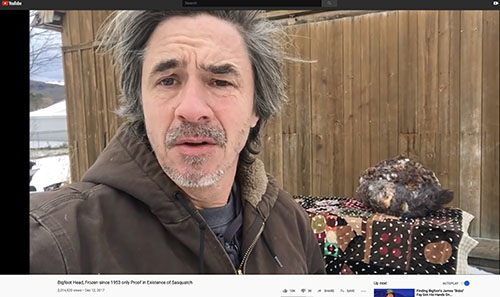
Exactly. So again, today we’ll be talking about one of the most famous Bigfoot frozen bodies allegedly. Let me go back to 2008 to another case of an alleged frozen body. So in August of 2008, there were a couple of guys in the Bigfoot community who created quite a stir, and by quite a stir I mean got international news, for having found in in northern Georgia a dead Bigfoot.
CW: I think I remember these guys, were they brothers or something and they had a big icebox?
BR: Something like that, yes. So they were named Rick Dyer and Matthew Whitten and they announced to the world that they would be revealing their Bigfoot body at a press conference in Palo Alto, California on August 15th. And it went wild, right? This is 2008, people are talking about it. It made the news, it was in the Kansas City Star, Discovery Channel was on. It was all over the place. At the time, I was asked by ABC News to look into it. I said, what do you think about this? You’ve written about Bigfoot and monsters before. And I’m like, well, I’m skeptical, but so I was like, alright, fine, I’ll look into this. So one of the first pieces of evidence was a YouTube clip. And obviously, that is the ultimate authority, right? I mean…
CW: That’s where all the frontier of all new scientific discoveries are YouTube clips.
BR: Exactly. Only the smartest, brightest people with the best evidence can make a video and put on YouTube. This is well known. Anyway, so there was an interview which featured the two guys, Witton and Dyer, talking to a taxonomist by the name of Dr. Paul Van Buren. If you just sort of skim through it, it looks all very impressive. Dr. Van Buren didn’t exist. So yeah, it turns out that that was actually Witton’s brother who was portraying a noted taxonomist.
0:10:28
CW: I knew there was a brother involved.
0:10:30
BR: Yes, yes. But they said, OK, when that came out soon afterwards, they said, OK, yeah, we faked the interview, but. That doesn’t mean we don’t have a real Bigfoot, just because we’re pulling pranks and hoaxes. No, no, no. Let that aside. We have a real Bigfoot. We’re just doing it to, quote, to give the psychos something to do over the weekend.
0:10:52
CW: You got to admire their tenacity. They’re not they’re not going to give up immediately and admit the whole thing is made up. They’re going to be OK. OK, OK, OK. You caught me in one little lie, buuuut…
0:11:03
BR: Right. Right. But we’re just doing that just to tease you because because having an actual dead Bigfoot isn’t big enough news. So then the other thing that emerged was a Bigfoot enthusiast by the name of Tom Biscardi, who I think we’ve mentioned once or twice on the show before, and is a somewhat notorious figure in the Bigfoot community, is one way to put it. He issued a press release saying, quote, extensive scientific studies will be done on the body by a team of scientists, including molecular biologists, an anthropologist, a paleontologist, and other scientists over the next few months at an undisclosed location. And, by the way, under armed guard.
0:11:43
CW: Okay.
0:11:44
BR: So, we have high security armed guards protecting these scientists, I guess what you might in Rare’s Lost Art call top men, examining this Bigfoot body, sort of like you might examine like maybe an alien autopsy at an undisclosed location. I’m just, you know, the more I’m seeing this, I’m just like, wow, okay, this is going to be a train wreck, but it’ll be interesting.
0:12:10
CW: Now, did you get to witness this train wreck? Did ABC fly you out to Palo Alto?
0:12:15
BR: They didn’t.
CW: No, there’s never any money for good Bigfoot journalism.
0:12:20
BR: Right. Well, I was actually asked by Scientific American if I’d be attending and my, I think the phrase I used was, I think I’ve seen this before. And I turned out to be right. So one thing that I forgot to mention about Biscardi is that three years earlier in 2005, he went on Coast to Coast AM with George Nouri and said that he had actually captured a Bigfoot himself.
CW: Okay.
BR: This is also in August, this is August, 2005. And he went on Coast to Coast saying he captured a Bigfoot that weighed over 400 pounds and it was 8 feet tall and that he’d be presenting photos of it. By the way, I forgot to mention he had a pay-per-view cable TV show and he was offering viewers the chance to see a Bigfoot captured live on television for $59.95.
CW: Now was this guy descended from the long line of like P.T. Barnum’s family in relation at all?
BR: I would suspect so. When the time came, instead of producing the body that Viscardi had breathlessly hyped, he showed photos of something that resembled a frozen Bigfoot in DNA samples. Later on, when the samples were analyzed, it turned out to be a human hair and a possum. This whole thing implodes as these things eventually do when you drum up that much elicity. But they stuck by this story and they said, okay, well, maybe this was a hoax, but we, you know, there’s more analysis. We have more evidence. Just you wait.
CW: So they waited three years for the heat to die down.
BR: Biscardi certainly did. So this is the context of Frozen Bigfoot. I guess you could say it’s a robust history of hoaxing.
0:14:08
CW: Yeah, the 2005-2008 incidents of the Frozen Bigfoot, those actually aren’t evidence of a history so much as a follow-up to the history you’re going to give us with the Minnesota Iceman, which goes far before that.
0:14:24
BR: Yes, yes. So, so settle in folks. Let me, let me tell you about the, the story of the Minnesota Iceman and soon we will actually have a special guest to give us more insight on it.
0:14:35
CW: All right, but this is pre-internet days. This is even pre-pay-per-view and cable days. Right. We’re talking what, the 1960s this whole thing started?
0:14:45
BR: 60s, right. So here, here’s the story. So again, against this backdrop of lots of sightings and fuzzy photographs and whatever else, you had people who were trying to prove that Bigfoot existed again back in the 60s. And keep in mind, one of the elements here was that Bigfoot exploded into the popular consciousness in 67 with the Patterson-Gimlin film, which we mentioned before, sort of the most famous Bigfoot film of all time. So this is right around that same time and that’s going to play a role in what happened.
0:15:16
CW: So Bigfoot was hot.
0:15:18
BR: Bigfoot was hot. People are talking about it, you know, it’s all over the place, people are, it’s this big huge mystery and we now have this alleged authentic footage of this thing. So in many people’s minds, the next obvious step, well, we now have footage of it, well any day now they’re actually going to find the body and this is the context in which this emerged.
0:15:37
CW: Yes, yes. Hoaxers abhor a vacuum.
0:15:41
BR: They do. So the story of the Minnesota Iceman begins in 1967. There was a zoology student by the name of Terry Cullen who saw a sideshow that was claimed to be not necessarily Bigfoot. It was called The Missing Link, The Man from the Ice Age, The What Is It, which was a common phrase for…
0:16:02
CW: Oh yes, we’ve mentioned whatsits before.
0:16:03
BR: Yeah, yeah, yeah. So it was one of those. So it wasn’t advertised as a Bigfoot. It was later later assumed to be a Bigfoot. And so Colin, who, again, is a zoology student and had some background zoology, he saw this this exhibit at a sideshow. I think he paid 25 cents or 35 cents. And he said, wow, this I think this is real. So he asked he asked experts to look into it. And the two experts that he contacted were, were two fairly well-known cryptozoologists by the name of Ivan Sanderson and Bernard Hovelmans.
0:16:35
CW: I, yeah, those names sound familiar.
0:16:38
BR: Yeah. So, so Hovelmans is sort of considered to be the grandfather of cryptozoology. He did a lot of research. He actually had a background in science. Sanderson was a little bit more of a sketchier character. He endorsed all sorts of wild ideas, the Bermuda Triangle. So this was only one of his many sort of Fortean interests.
0:16:58
CW: So would you classify these guys as more enthusiasts than experts?
0:17:03
BR: That’s a good question. I mean, they certainly put on airs of being experts. And again, certainly Huffleman’s had legitimate degrees in sciences. I’m not remembering his exact bio off the top of my head, but he did have some background in science. And certainly, they were considered to be among the most scientific and creditable experts of the day who were looking into those sorts of things. So these two, Sanderson and Hovman, went to go look for themselves, and they tracked down the guy who had exhibited the Minnesota Iceman. It was called Minnesota because that was where it was finally examined. And they met a showman named Frank Hansen. And this happened in December of 1968. The two went and met up with Mr. Hansen, who was happy to see them and wanted to show them this man from the ice age, whatever it is. Again, he didn’t call it Bigfoot, but that would soon to be the label to be put on it. And they took photos of this thing and it smelled like putrefaction. They said that they smelled what seemed to be a rotting corpse or something funky coming from it, which again, you would expect would be the case if it was actually some sort of dead rotting animal or meat inside there.
0:18:21
CW: Now, reading through some of the articles about the Minnesota Iceman, there seemed to be a bunch of supposed origins to where Hansen actually found this frozen caveman, Iceman, what’sit? Everything from Vietnam to a Russian tanker founded in the Arctic.
0:18:46
BR: So among the sea of red flags here, just the veritable rainstorm of red flags. One of them was that when they asked him, well, where did this come from? He gave several different explanations. Well, first of all, he said he didn’t own it. He said that he was displaying it on the behalf of an anonymous millionaire from California.
0:19:07
CW: Ow! Oh, sorry! I just got hit in the head with another red flag. An anonymous millionaire from California owns this thing? Really?
0:19:16
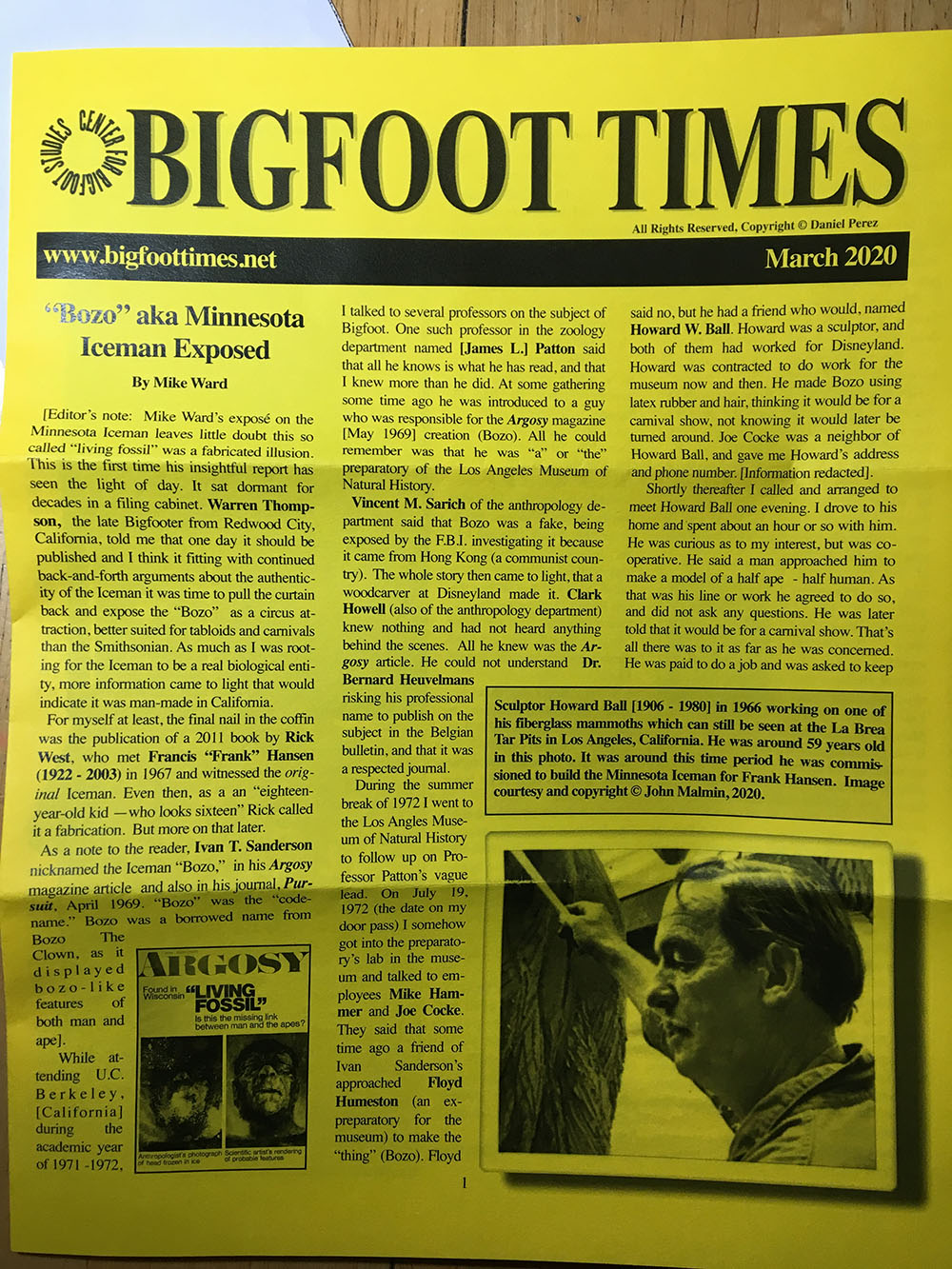
BR: Yeah. Yeah. Because of course he does. And actually, as we’ll see later, the question of who owns it and what exactly it is became very important a little bit later on. In fact, even eventually involving the FBI. Oh. So, but yeah, so Hansen told a variety of stories. He said that Japanese whalers had found it floating in a block of ice north of Japan. Hansen later said that he himself shot it in rural Minnesota. Another version he said was that it was Russian sealers, I think, someone else, he also said that he bought it from a trader in Hong Kong. So it was just sort of like, you can’t get a straight answer out of them as to where it came from. And of course provenance is really important. That’s what that is. Like, where did you get this? It fell off a truck.
0:20:03
CW: If it’s an actual specimen, you log exactly where you found it, because scientists, if they want to go find more of them, need to know where to go.
0:20:11
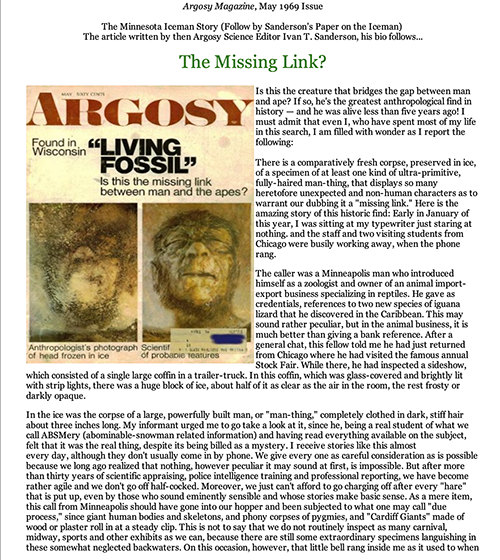
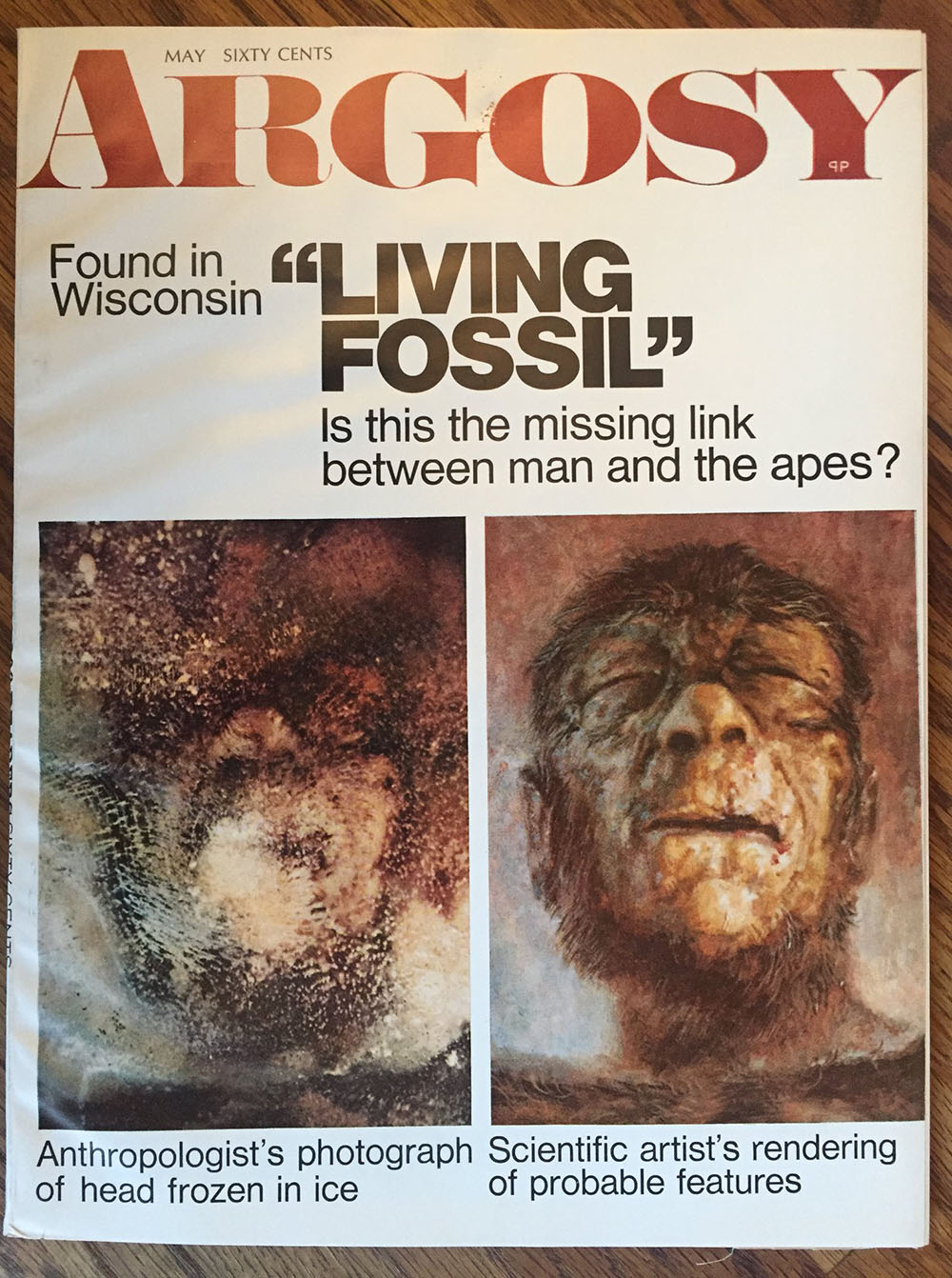
BR: Yes, exactly. So, I’ll just briefly read to you what Hufflemans wrote in his findings. Examining the Minnesota Iceman, he says, the specimen at first looks like a man, or if you prefer an adult human, of the male sex, of rather normal height, six feet, in proportions but excessively hairy. It is entirely covered with very dark brown skin, three to four inches long. Its skin appears wax-like, similar in color to the cadavers of white men not tanned by the sun. The specimen is laying on its back. The left arm is twisted behind the head with the palm of the right hand upward.” And he goes on to discuss the size of the hands, the texture of the penis and things like that. It’s important to understand the context here. So when the two were allowed by Hansen to examine the thing, they didn’t melt it, they couldn’t examine it directly. And in fact, one of the two, Ivan Sanderson later wrote an article, but they both wrote about it later on, but Sanderson wrote a piece in Argosy Magazine, which was a sort of a men’s pulp magazine, which had everything from science fiction, fantasy, you know, I met Bigfoot stories. And this is what he himself said, quote, any conclusions that follow amount, frankly, to little more than speculation, because the specimen could not be handled and had to be viewed from no closer than a foot at best through four sheets of plate glass and a varying amount of clear frosted or totally opaque ice.
0:21:41
CW: So they I mean, obviously they don’t have access to CAT scans, but X-ray technology existed back then. They didn’t take an X-ray. They didn’t melt part of it. They didn’t get a sample like it, like take at least a hot rod and like stick it through the ice to get a tissue sample or anything.
0:21:57
BR: No, no, no.
0:21:58
CW: They were they were content to portray this as being the missing link found, missing link implying of course Bigfoot, simply by looking at something through four pieces of glass and ice, which is just astonishingly indirect. I mean, thought by any standard, and even by Sanderson’s own admission. I mean, they fully admit, okay, we couldn’t get anywhere near it or, you know, nowhere near close enough to actually do any scientific research. All the best they can do is like, is sort of describe what they’re seeing through plate glass and ice and under the conditions. It’s just ridiculous.
0:22:38
CW: You know, it never fails to astound me what people will fall for. I mean, you wouldn’t buy a piece of fruit like that. If somebody said, I will sell you this apple, but you can only really see what the apple looks like behind glass and ice. No, people like to touch their fruit and see if it’s not bruised before they pay a dollar for it for crying out loud.
0:22:56
BR: Exactly. Exactly. So at one point, the two of them went to go see Hansen. They and they said that Hansen was very reluctant to have them publicize it. He was happy to show them and he wanted to sort of get some some scientific credibility to it, but he was very leery of making some big announcement that they had actually recovered a Neanderthal or Bigfoot or whatever it was.
0:23:23
CW: Don’t want real scientists finding out about this.
0:23:25
BR: No, no, no. It’s best to keep it between ourselves. But apparently, Hufflemans and Sanderson apparently bought this hook, line and sinker. record saying they believed that this was a modern Neanderthal, possibly Bigfoot, something like that, but certainly an unknown hominid. Again, they both wrote articles about it. Sanderson was sort of the more dramatic and sensational of the two. At one point, it actually came to the attention of the Smithsonian and one of the curators there, John Napier and Ron Pine, who we’ll be talking to in a bit. But meanwhile, it just sort of went away. Hansen kept touring, showing it, exhibiting it for 35 cents a pop at sideshows and circuses and trade fairs across the country.
0:24:13
CW: That’s what you do with the priceless, irreplaceable, one of a kind scientific specimen. Okay.
0:24:19
BR: Yeah. And again, Hansen had asked them specifically not to publicize it. And of course, they both they went they went ape with it. Oh another bad pun. Yes so in the resulting publicity after these articles are appearing in the media and Argosy magazine elsewhere, Hansen is sort of keeping a low profile and he stopped exhibiting it for a while. After a while he re-emerged and was showing it again and then when asked about it he said well the real one is no longer here, but the one I have here is a fake. It’s a replica.
0:24:51
CW: Wow.
0:24:52
BR: That’s strikingly similar to what happened with the two Georgia fellas you were talking about. Well, this one is fake, but the other one behind the curtain was totally real.
0:25:04
BR: Right, exactly. So hold on here. So this, of course, just confused the issue because people are saying, well, hold on, you have this Iceman Neanderthal, Bigfoot thing, where is it? And he’s like, well, I don’t know. But, you know, just for safekeeping, I guess the millionaire in California has it in cold storage or in his bathroom, who knows? But, hey, would you like to see the real, scare quotes, Minnesota Iceman? This, of course, then caused confusion because you had people claiming that not only was the original one a hoax, which it again almost certainly was, but the modern was of Hoax. And then Sanderson and Hufflemans examined it again and said, this is not the same one you looked at. They said there were like a dozen or more differences between what they had originally seen and the current one. Although many months had, you know, occurred between the two, so it’s entirely possible that they had refrozen it, they had made a different dummy. I mean, take your pick. And so in 1969, as I mentioned, Hansen went on tour with it again. He said, the original was a fake, but here’s, this is a copy of the real one. So Hansen went on the record saying that he didn’t personally authenticate the first one because he said that he was agnostic. Again, he says, I don’t own it. I didn’t look into it. So don’t blame me. So he didn’t want to go on the record as officially saying it was in fact a Neanderthal, Bigfoot, whatever else, nor did he want to go on record saying it was a dummy or hoax because why would he? You don’t earn any money by staying off the fence.
0:26:36
CW: Yeah, well this anonymous millionaire in California comes in handy because if it’s a real dead guy, well I didn’t murder the dead guy. The mysterious millionaire must have or if it’s a hoax, I didn’t pull the hoax, the mystery, it must be it’s the one-armed millionaire.
0:26:52
BR: Exactly. So, so again, keep, keep in mind the context here. So it was seen in the context of a sideshow and gaffes and fakes. That doesn’t mean that there aren’t occasionally authentic items in sideshows. I’ve spent time in sideshows. I’ve researched them. You know, I’ve talked in the, we talked about them in the episode we did a while back on shrunken heads. But a lot of what you see in side shows and carnivals and whereabouts are intentionally ambiguous. It goes back to the Fiji mermaid. We had P.T. Barnum showing this mermaid caught in Fiji, which is the top half of a monkey grafted onto the bottom half of a fish. The whole place is rife with fakery. This is a place where capybaras, these adorable knee-high…
CW: Giant rodents, yeah.
BR: Giant rodents are passed off as giant rats. I mean, I’ve spent time around carnies. They’re not known for being forthcoming about whether something is authentic or not.
0:27:52
CW: Well, see, that’s just it. I, too, have spent time in carny land, and if you have a sideshow operator who has two guys on the hook like this, he’s going to just enjoy it as long as he can. It sounds like he got to go on quite a ride with these two researchers.
0:28:09
BR: He did. So I located a follow-up interview with Hanson in 14 Times, the British magazine, number 83, 1995, and he was interviewed by a guy named Ian Simmons. And he was asked about the Minnesota Iceman. Again, this is years after the whole hubbub, and he said, quote, I say it’s a fabricated illusion, the scientists say it isn’t. Now, to be very clear, the scientists, by scientists he means Hufflemans and Sanderson, who were allowed to look at this thing from a foot away through ice, through panes of glass, right? So and when he was asked if the original Iceman is real, as I mentioned, Hansen was agnostic. He says, quote, I never did find out. I just know whatever it was, it was the greatest exhibit possible. And that was fine for me. I didn’t want to ask. So again, you know, passing the buck off to anonymous millionaires pulling the strings, who own the bodies.
0:29:13
CW: Now, if I can jump back to something you mentioned, you said the FBI at one point was involved with this. Was there rumors somehow that this may have been an actual corpse of somebody who had been murdered and put in ice?
0:29:27
BR: Well, they’re in lines of the rub, right? Because think about this for a second. This is the problem that hoaxers face when they make these claims. The problem for them is that people might actually take it seriously. People might actually investigate. So hoaxers typically, they want some level of publicity and attention, whatever ele, but they don’t want enough publicity and attention that people actually dig into their claims. They’re like, no, no, just take my word for it. Let’s not dig any deeper.
0:29:56
CW: They want attention, but not scrutiny.
0:29:58
BR: That’s exactly right. And that was the case with the Minnesota Iceman. It raises real questions, right? Because if the Minnesota Iceman truly was a large unknown creature, a human or Neanderthal or what have you, how do we know it wasn’t a human being? How do we know that it wasn’t some trapper or hunter or random person?
0:30:19
CW: Or somebody in a suit. Yeah, if the guy actually shot it himself in the back of the head, which was one of the stories you said he tried to pass along.
0:30:27
BR: Right.
0:30:28
CW: That’s, oh, can you imagine that would be a crazy, what a way to conceal a body. Shoot somebody you have a problem with, put their body in a Bigfoot suit, freeze it and then take it across the country in a sideshow. Oh, that’s the ultimate humiliation. Wow. So, so we determined or somebody determined that it was it wasn’t a human body stuffed in there. Whatever became of the Minnesota Iceman, can we see it today? Is it in the Museum of Hoaxes?
0:30:58
BR: Or well, again, if it was what it was claimed to be, then it should be in the Smithsonian. I mean, it should be scientists should be coming from all over the world to examine this thing.
0:31:08
CW: I’ve been to the Smithsonian a number of times. I would have noticed if it was there.
0:31:12
BR: It was not there. My understanding is it was sold on eBay, which is the modern version of that. 2013 or something. So, but again, you know, was it real? It’s a real thing. I mean, it’s not imaginary. So is it the Minnesota Iceman?
CW: Oh, here we go – $20,000 it fetched $20,000 on eBay by some anonymous bidder I can’t find any information on who actually bought it. So it’s whereabouts still remain unknown Maybe the California millionaire bought it back!
BR: That makes sense that makes it but,
CW: But it was advertised as the the greatest gas ever.
0:31:49
BR: And it may in fact be and part of that part of that whole gaffe or fiasco, if you will, involved the attempts to legitimize it by bringing in real scientists, because Hovman had some credibility, Sanderson had less credibility, but the real credibility was, of course, in American scientific institutions such as the Smithsonian. And speaking of the Smithsonian, we have a very special guest coming up, right, Ben? Absolutely. We’ll be talking with Ron Pine, who was a curator at the Smithsonian and actually had a role in this whole fiasco, including dealings with the FBI, who looked into it because, of course, it could have been a homicide.
0:32:30
CW:Okay.
(MUSIC)
BR: I’m delighted to have with us today Ron Pine who has lots of degrees and information in zoology and mammals and what not. For purpose of this discussion, he was a former curator of mammals at the Smithsonian and has an inside information and first-hand experience in this. So, Ron Pine, welcome to the show.
0:33:18
Ron Pine: Well, thank you for welcoming me.
0:33:22
CW: You’ve got quite an extensive background. You’ve led expeditions to faraway places and really have been working with mammals your entire life as a credentialed scientist.
0:33:35
RP: Yes.
0:33:36
BR: So, what is your background?
0:33:37
RP: Well, I got my doctorate from Texas A&M and then I got hired by the Smithsonian. And before then and since then, I’ve been traveling around the world and collecting specimens and doing research on them. And so basically that’s it.
0:33:54
BR: That’s it, he says casually. I’m sure, you know, decades of experience in zoology and whatnot. And before we get into the Minnesota Iceman, which is of course the main topic today, I understand you actually have, this isn’t the first time that you had a connection to Bigfoot. You were actually there when the Patterson-Gillen film was screened, is that right?
0:34:17
RP: Yeah, at the Smithsonian. John Napier, who of course became famous as a writer about Bigfoots and yetis and that sort of thing, was a fellow curator there, and he and I were in the same room with some other people when he and I and the other people in the room saw the Patterson Gimlin film for the first time.
CW: Wow.
BR: And so that was for those who may not remember the course the Patterson Gimlin film was shot by Roger Patterson by Gimlin in 1967 and was sort of and in some circles remains sort of the marquee film. And I guess, so they approached you and Smithsonian and Napier because they were wanting you to authenticate? Or what was the context in which you saw it?
0:35:04
RP: Well, I believe that Patterson wanted us to authenticate it. I think it had been shown maybe in Canada and at the American Museum before it came to the Smithsonian. Napier didn’t buy that movie as showing a Sasquatch. He thought it was a man in a suit. So, he didn’t get anywhere with that.
0:35:29
BR: You weren’t buying what Patterson was selling then?
0:35:31
RP: Well, I didn’t have any reason to accept the idea that it was anything other than a man in a suit.
0:35:40
BR: And what was the general tenor? I mean, I know you said that Napier wasn’t impressed. What did other people think?
0:35:46
RP: Well there was another guy there by the name of Setzer, another curator, who said that the back of this supposed creature looked really flat, like it was just a costume and he didn’t see any muscle movement. And for that reason he said it was a fake. Napier said that he didn’t see a zipper, whatever that meant. I didn’t say anything and nobody else said anything. Everybody just sort of left the room.
0:36:08
BR: So set the stage for me for a second. Was Patterson there or?
RP: No.
BR: Okay, so it was just screened. Was a representative of Patterson there or was it just sort of like, hey guys, what do you think about this?
RP: We were just told the movie was going to be shown in this particular room and we went and saw it and that’s all I know. I don’t know how it got there or anything.
0:36:27
BR: Interesting. Interesting.
0:36:28
CW: Just another interesting day at the Smithsonian.
0:36:31
RP: Well, we had no reason to think it was such a big deal, really, at the time.
0:36:35
CW: So you didn’t have any idea of how much it would blow up in popular culture?
RP: Oh, no. None of us had any idea of that. That’s the most important event in Sasquatlogy, I think.
0:36:46
CW: Wow. And you were there and didn’t even realize you were witnessing the birth of a star.
RP: That’s right.
CW: Okay.
BR: Whoever it might be and actually that that leads me to another quick question about The the very fact that the Patterson Gimel film was brought to the Smithsonian For people to look at and I’m sure in Patterson’s view hopefully authenticate so, you know Oftentimes as you well know, you always hear complaints from the Bigfoot believers that the scientists and the scientific community, they refuse to look at it. Oh, we have all this evidence, all this stuff, but those damn scientists, they’re just blind and they’re blind by scientism and they refuse to look at the evidence. But in this case, you worked at the Smithsonian, one of the most prestigious scientific institutions in the world, and you all were agreeing to look at it. It doesn’t sound like anybody said, no, this is obviously bogus, we refuse to look at your film. We were like, yeah, okay, we’ll take a look at it. So can you talk a little bit about that idea that scientists are refusing to look at good evidence?
0:37:55
RP: Well, actually, most large museums have a policy that every question from the public or any object that’s brought in for identification has to be dealt with. These museums are dependent upon public donations to survive, and PR is extremely important to them. So the idea that we won’t look at something that somebody brings in simply is not true. And I certainly did a lot of that at the Smithsonian, and it’s done routinely. A lot of times, these folks who have something they want identified will show up to a local dentist or a chiropractor or something like that and that’s the end of it. They don’t take it to scientists that might know what the heck they’ve got. We’re not going to go out and look at stick arrangements and that sort of thing.
0:38:40
BR: Twisting trees and what not, right?
0:38:42
RP: Yeah, well I mean we’ve seen enough pictures of those and they don’t really tell us anything more so but we do everything we can to try to help out.
0:38:52
CW: Well, that’s always heartwarming to me to know that our public institutions are public institutions. The museums are there for the people and fund them, enjoy them, and know that the scientists are able to answer questions.
0:39:09
BR: And are typically happy to. I mean, that’s always one of the baffling things to me. It’s sort of the opposite of what a lot of the cryptozoologists and enthusiasts and Bigfoot believers say. The problem is not that there’s all this good evidence that scientists refuse to look at. The problem is that there’s lots of weak evidence that the scientists have looked at, and there’s nothing there. So, you can’t make soup out of gruel.
0:39:36
RP: That’s true. The scientists that do look at this stuff generally are not impressed by it.
0:39:40
BR: And therein lies the problem. So anyway, let’s get back to the Minnesota Iceman. It’s a fascinating story. Celeste and I have talked a little bit about it. How did you get involved in the whole story?
0:39:53
RP: Well, when I was at the Smithsonian and I was there with Napier, Ivan T. Sanderson had seen this uh… ice man thing along with Bernard Whovelmanthese are two big these are two big-time cryptozoologist and i’ve been sanderson one of the smithsonian to get involved in this thing to see if this is the sony and could do something to show that this ice man was for real and so he contacted uh… napier who was an old buddy of his and asked me if you’re too help him out. And so Napier enlisted the Secretary of the Smithsonian, that’s really the director, S. Dillon Ripley, to look into it. And Ripley got in touch with J. Edgar Hoover, who was director of the FBI.
BR: I’m sorry? The head of the FBI got involved.
RP: Yes, yes.
CW: Wow.
RP: And so, and Hoover, young folks these days may not know, but he was a very powerful man and a feared man, and you ought to read his biography. Anyway, so all these people got involved. There was a bunch of correspondents going back and forth between Sanderson and Napier and Ripley and Hoover. And Napier let me read it all, which I did. And so I found out some things then that have not been generally known since.
BR: And this is this is a half century ago?
RP: Well, I mean back in the 1970s, you know.
0:41:20
BR: Right. Well, it’s just it’s yeah, it’s just, Yeah, it’s just it’s just neat to be able to actually talk to somebody who was there, literally in the room and has a personal role in this. So this is this is really cool So how and why did the FBI get involved?
0:41:40
RP: Well, Ripley and I guess it was probably Napier’s idea in the first place, the so-called Ice Man looked like it could be some sort of human creature. It also looked like it had been killed by having been shot. And so, if you’re going to assume that it’s sort of a human-like creature and it’s been killed by shooting, then somebody just might think that that would involve some sort of homicide. And so Hoover was brought into it to investigate it as a possible homicide.
0:42:11
CW: Wow. Again, talk about hiding a body in plain sight.
0:42:15
BR: Interesting. So, so a possible murder of maybe a Bigfoot or ape man or and then what, how was it presented to you? I mean, these days, of course, it’s often, and we’re talking about in the context of Bigfoot. But, you know, some people thought it was a Neanderthal, some people thought it was… How was it presented to you all?
0:42:37
RP: Well, I had heard about this thing before Napier shared all this information with me. I never thought that it was generally known around the public.
0:42:55
CW : Did the Smithsonian know right away that it came from a sideshow?
0:43:00
RP: Oh, yes. There was no doubt about its origin. And people who talk about the Smithsonian being involved in it, it was really that the Smithsonian was Napier, and he lassoed in the secretary and pretty much nobody else was interested in it or dealing with it.
0:43:19
BR: So just so I understand, so Ivan Sanderson who had some, I’ll just put it delicately, some weird ideas, he was friends with Napier who then roped in Ripley who’s the secretary or director of the Smithsonian but other than that, so that’s sort of the connection.
0:43:37
RP: Yeah, well that was the only Smithsonian connection, yes.
0:43:41
BR: Okay, so it’s not as if there was a big clamor of people inside the museum who were just desperate to authenticate this sideshow thing.
RP: Well, most, most, I don’t know. I would say that 99% of the people that worked there had no interest in it, had no idea that Napier was communicating with Sanderson and maybe going to help him look into it. So I mean, no, the Smithsonian as a whole didn’t care or know anything about it.
0:44:09
BR: So because this was presented to Hoover as a possible homicide, where did that go?
0:44:15
RP: Well Hoover actually got in touch, according to this, this isn’t generally known. This is one of the things that I learned from the correspondence. Hoover actually sent some people to talk to Hanson who was the guy who was exhibiting this thing at carnivals. So, Hanson actually reported that this had happened and then the FBI said that it had not denied that it had happened. And the reason for that was that initially Hoover showed more interest in this whole business and was a little bit more gullible than he should have been. I think when it turned out that this was of course a hoax, he was embarrassed that anybody should find out about it. So all of the correspondence at the Smithsonian that dealt with Hoover in any way in this whole business has disappeared or it’s not available anyway. People have looked for it and tried to get it in the Smithsonian that says they don’t have it. But Napier in some books that he wrote later made no mention of the extent to which Hoover was involved in this whole thing and made it sound like they asked Hoover for help and he more or less told them no and that was it. And also Sanderson, Hoover, Ripley, nobody else at any time since admitted that any of this had gone on with the Smithsonian. And Hoover was a very powerful and feared man. If he told everybody to burn the letters and just keep quiet, I’m sure they would have done so.
0:45:45
BR: Interesting.
0:45:46
CW: Wow. Now, as a hypothetical here, if I can ask, you said a lot of the people at the Smithsonian, besides Napier, just weren’t really interested in authenticating a sideshow gaffe. What would interest the Smithsonian in terms of a frozen specimen that may or may not be Neanderthal, that I’m assuming if there were any indication it were real, what type of indications would the Smithsonian look for as or yourself as a zoologist, as an expert?
0:46:19
RP: Well, the thing was in a big block of ice and of course the ice was there so that you can get a very good look at it and tell what it really was. I mean there’s no reason why if you’re going to be exhibiting something like that, that it should be on a big block of ice except to hide what its real nature. The only way that I or any other curator could make a judgment on something like that would have the doggone thing thought out and you know physically examine it for ourselves and see if it was a real actual creature and if it was a model.
0:46:51
CW: So step one would have been defrost the thing.
0:46:54
RP: Yeah, you get access to the thing and see what it is. Supposedly, the story is that has come out in recent years, I guess back then to a certain extent, is that the thing was made out of rubber and it had bear hairs stuck into it. And also there was apparently some dog tissue in there somewhere. Maybe it was to repair some damage to it, some dog hide, which was rotting and gave the thing an odor.
0:47:28
CW: Oh, wow. I’ve got to take my hat off to that. That’s a detailed gaff work.
0:47:38
RP: The odor was apparently quite strong and it was Sanderson and Hooverman’s that discovered it and Hanson, the owner of the thing, was not at all happy that it stunk, I guess because he was worried about what the people who paid money to see it would think.
0:47:56
BR: Add to the authenticity, right? A little icing on the cake.
RP: Well, yeah. Actually, originally, when I found out about this dog tissue, which Sanderson found out about that because Hansen told him about it. Originally, I thought maybe it was a little bit of dog tissue that had been put in there just to make it seem more realistic that didn’t smell too bad. But then later, some reading that I’ve done said that it was really quite odoriferous.
0:48:18
CW: Wow.
0:48:19
BR: And so, just to back up for a second, Hoover very likely sent out agents to Hansen’s place. And I can just imagine these FBI agents showing up at this Carney’s place, just sort of the blood draining from his face. And it’s like, so how accurate are your banners? Like, well, so I’m guessing that the FBI looked into it and it was pretty crystal clear to them that it was nothing but a gaffe and really a waste of everybody’s time, but at least Hoover was interested enough about it to warrant sending somebody out for it. Is that right?
0:48:59
RP: Initially, yes, but he was convinced that it was not on the level. The Smithsonian, including Napier, became completely convinced it wasn’t on the level and Sanderson as well. These people never told the world later that they had ever been convinced of that for sure.
0:49:17
BR: So at what point did it become or was it immediately clear that this was bogus or was there any what was the transition between here’s this thing under four sheets of glass and a block of ice good luck figuring out what the hell is in there but here’s this and everybody saying come on this is obviously fake.
RP: Well, when the FBI got involved, Hansen got very, very nervous and made it clear to the FBI and to Sanderson that this thing was bogus. But until that time, it hadn’t been established.
0:49:49
BR: But then, now there’s some question about the real Minnesota Iceman, using air quotes here, and the swapped out one, right? So, can you talk a little bit about the alleged two versions?
0:50:05
RP: Well, okay. Hanson, the guy that was exhibiting this thing, maintained that what happened when the Smithsonian got real interested and the FBI got real interested and so forth, the public story that he was putting out was that, okay, that there was an owner, a mysterious owner in California that this thing really belonged to. And this mysterious owner came and picked up the original, supposedly actual creature and took it back to California and gave to Hansen, the exhibitor, this model of it, which then went on exhibit. Well, this of course, as far as everybody was concerned, was just baloney. There was only one original model. It was bogus. There was never any guy out in California, and there was never any replacement.
0:50:57
BR: Sure. It would have been very easy to thaw the thing out, rearrange it a bit, and refreeze it.
0:51:04
RP: Well, yeah. I’m glad you brought that up because what happened was that when this thing went and supposedly was a model imitating the first thing. There were people who Sanderson and some other people looked at some photographs of it and the photographs looked a little bit different from the original. And so everybody figured, well, it was easy enough for Hansen to follow the thing out and tweak it a bit here and there and make it look like something different.
0:51:34
CW: Well, my only question for Mr. Pine here is, Ben and I became aware that in 2013 the actual gaff, the body, the Minnesota Iceman itself sold on eBay for $20,000 to some anonymous purchaser and I’d like to know if he’s in your den right now.
0:51:54
RP: No, supposedly that thing is on exhibit somewhere in Austin. And there are people who have seen it and people who have photographed it in one thing or another. And if the next time in Austin, I would surely like to go and see it myself.
0:52:11
CW: Oh, the Museum of the Weird. That’s right. I did come across that.
0:52:16
BR: I’ve been to the Museum of the Weird. I didn’t see the Iceman there. I have seen the Minnesota Iceman, or at least some version of it. It wan’t called Minnesota Iceman but that’s clearly what it was. And it was a block of ice and it looked a bit different than of course the one that’s sketched out by Sanderson in the Argosy article. But yeah.
0:52:40
CW: Right. There was actually an interesting little nugget here that kind of really helps illustrate that there’s a lot of for-profit hoaxing going on here. I was reading a Scientific American blog by Mr. Darren Nash, and he mentioned that the frustration of finding a good photograph, and here I’ll quote from him, there is strikingly little philanthropy going on as goes image sharing and so on. Everything is protected by copyright, and so he couldn’t get any photos that he could use on his blog of the Minnesota Iceman. He had to do some sketches on his own.
0:53:17
RP: Yeah, I know him by the way. We’re Facebook friends.
0:53:22
CW: Well, I enjoyed his blog very much and he did some mighty nice sketches from the versions he has seen of the Iceman.
0:53:30
BR: Darren’s books are excellent. I can recommend if people want to look at some really quality research. He does a Tetrapod blog, I think.
0:53:41
CW: Yes, and he mentioned that he flat out labeled all of his images as public domain. So we’ll grab some of them and throw them on the Facebook page.
0:53:49
BR: So, Ron, what’s your impression of Sanderson and Hovemans?
RP: I mean, I never met them. I think Sanderson died in 73. I think Hovemans died in 2001 or something. I know them by reputation. I’ve read some of their works.
0:54:04
BR: What’s your impression either at the time or since then of their mindset, their gullibility? Why would they jump into this? What’s your assessment of them?
0:54:14
RP: Well, I read some of Sanderson’s books when I was a kid and he became essentially a professional charlatan and made his living by writing all kinds of preposterous stuff. I never knew how much of what he claimed to believe he actually believed. I do know that he himself actually made up some complicated stories about supposed adventures he had had, which were complete fabrication, so he couldn’t be trusted at all. So Sanderson was just a very unreliable person. Huvelmans of course also became famous and probably got a lot of money out of all the books that he wrote about cryptozoology. I think Huvelmans was a more honest person than Sanderson and he may have just been an excessively gullible person. I’ve heard some people say that that isn’t quite so but I don’t have any details as to why they said that.
0:55:18
BR: Yeah, I honestly you’re you’ve summarized sort of my general sentiment as well Also as a teenager, I read both their works and and it was all very impressive for me at the time And then as time goes on you’re like, hold on This is this is not quite as as fact-based as I would like.
0:55:40
RP: When I was a kid reading his books, Sanderson’s that is, those were books about his collecting trips in foreign countries. They were presented and they didn’t have very much stuff in them that was obviously fabricated but a little. I didn’t know any of it was. I never bought any of his really obviously cryptozoological or woo related stuff. I never bought any of that.
0:56:06
BR: In my mind, he’s of the tradition of people like John Keel and Frank Edwards and some Forteans as well where it’s just there may be nuggets of truth in there, but it’s so amid this wash of sensational exaggerated claims that it’s hard to know what the hell is what.
0:56:24
RP: Yeah.
BR: Yep, so now so let’s go back for a second to Sanderson Hultman’s going to I’m going to try not to laugh going to a sideshow Sideshow promoters frozen Bigfoot I ate man thing in this in this farmhouse, Minnesota now. Why do you think they were so? Gullible, I mean was it just obviously in retrospect it’s easy to sit back and say, well, there’s red flags everywhere. But come on, there was red flags at the time. So was it just there? From my reading of the situation, from what I could tell, they both sincerely certainly believed it at first, and they really thought they were onto something and just ignored all these red flags. So I’m trying to understand, in some cases, as you mentioned, in both cases, they had reputation and particularly Hufflemans, you know, why would they stake their reputation on? I mean, Sanderson didn’t have much reputation because of the reasons you just mentioned. But why do you suppose it went so far?
0:57:26
RP: Well, I’m not sure that Sanderson was convinced even from the very first that the thing was real. I think that he may have just thought that this was a good thing to write about, and he could write lots of sensationalist articles about it and so it was good for him. Because if you read Sanderson’s writings about this, he’s always saying things like, well, if the thing is real, if it’s a real creature, then blah, blah, blah, blah, blah. And so him putting that if it’s real or if we, you know, in front of that makes me think he never 100% bought it. Both of them were, you know, I mean, it was a godsend for them. I mean, I don’t think it hurt their reputations at all. Hoovelmans, of course, named it and said it was a Neanderthal, a surviving Neanderthal, and he gave it a scientific name, which was unnecessary if it was a Neanderthal because Neanderthals already had a scientific name. But anyway, I think that Hoovelmans bought it hook, line and sinker. I’m not so sure that Sanderson did. But this would, of course, if it were for real. I mean, they had a lot of wishful thinking, maybe if this were for real, this would be tremendous for their careers. And so they might have been just hoping that it was for real and that overcame. And apparently the thing was pretty convincing to you anyway.
0:58:52
CW: It just belies a huge truck full of wishful thinking and credulity if you’re going to a sideshow to look for your next scientific specimen.
0:59:03
RP: Yeah.
0:59:04
BR: Well, you can find the world’s largest rat that just happens to be a capybara if you look hard enough, right?
0:59:12
RP: Yeah, yeah.
0:59:13
BR: The girl to gorilla illusion, before your very eyes. Okay, well, so just sort of, so what was the fallout after the Smithsonian and Napier sort of entertained it at least somewhat and then sort of said, yeah, we’re, you know, we’re washing our hands, we’re pretty clear this is fake. What was the reaction among the believers at that point?
0:59:38
RP: Well the believers continued to believe and there’s still some today. I mean a lot of the believers in Sasquatch and Yeti type creatures don’t, you know, have accepted the proposition that this thing wasn’t for real. But there are people today that still maintain that it is. You know, there’s a lot of conversation going on in, you know, Facebook groups about this. In fact, I’m carrying on a bit of that now, which you’ve read. So, it’s a famous story as far as Bigfootology is concerned.
1:00:14
CW: Do some of these hangers on to the theory maintain that the version that’s in Austin on display is the quote-unquote fake one?
1:00:24
RP: Yes.
1:00:25
CW: And the millionaire has the real one somewhere in California still?
1:00:28
RP: Absolutely.
1:00:29
CW: Oh, that provides just enough of a loophole. Okay.
1:00:33
BR: Isn’t there, I don’t watch much reality TV, but I know there either is or used to be a reality show about people who would auction off what’s left off in like storage containers.
1:00:48
CW: Storage wars.
1:00:49
BR: Storage wars. Oh yeah. So presumably any day now, theoretically, someone will bid on an abandoned U-Haul storage shed and open it up and there will be the real-ish Minnesota Iceman.
1:01:05
RP: That’s right. It’s entirely possible.
1:01:08
CW: Well that is just fascinating to know that controversy continues today in some online corners.
RP: It certainly does.
CW: Wow. Well, this has been a fascinating conversation, Ron. I thank you very much for giving us some of your time and telling us the tale of what happened when the Smithsonian gave the Minnesota Iceman the cold shoulder. I had to get at least one pun in. Ben got to get all the earlier ones in.
1:01:37
RP: Okay.
1:01:38
BR: Good enough. All right. Well, thank you so much for coming on. This has been fascinating. I think we’re probably going to have you on again sometime, so don’t go too far away.
RP: Well I enjoyed this.
(MUSIC)
1:01:45
CW: Well, Ben, thank you so much for knowing people like Ron Pine that we can rope into wonderful interviews like that. I can’t believe he was right there in the room where it happened.
1:02:15
BR: It’s pretty cool. You know, I’ve read about the Minnesota Iceman for, of course, many, many years, having been steeped in Bigfoot lore and whoever else. And it was always this topic I never really got a good handle on. I mean, it was always sort of this weird Bigfoot icicle hoax thing that seemed so self-evidently fake that I’m like, how did anybody pull this off? But it’s a fascinating story and I’m really glad we were able to get Pine on.
1:02:42
CW: Yes, and now I have another thing I’d like to visit someday in my life, and that’s the Museum of the Weird in Austin, so we can see it in the flesh, as it were. Now before we go, I’d like to thank our wonderful group of patrons who have continued to support Scoring the Strange. If you feel like dropping us a dollar or two each episode, please go ahead and sign up at patreon.com backslash squaring the strange. I actually got a delightful little note back from one of our $5 an episode patrons. And as you may know, people who are supporting us at that level get a special thing once a month a little Skepticrate and I sent out the last one and there was a special little thing in there that I got a nice Thank you note for here. I’ll quote from the email here. I cannot tell you how tickled I am to have a chick tract I mean, it’s horrible and hateful and makes me angry, but then I look at that smiling wish on the cover and it’s all okay again. I came across a little bundle of Halloween Chick Tracts that since we had discussed it just a few months ago, I bundled a Chick Tract into everybody’s SkeptiCrate this past mailing. So I hope everybody enjoyed those.
1:03:55
BR: Very cool. Very cool. I have not gotten mine, but then again, I’m on the show.
1:03:59
CW: Did I send you one? I thought I sent you a Chick tract. I’ll have to send you one. Special.
1:04:04
BR: Good enough. I also wanted to let listeners know, and we mentioned this on the show a show or two ago, that Shriekback, the band that does our theme song, has a new album out titled Some Kinds of Light, and you can get that at shriekback.com, somewhere around there. So check it out. It’s cool.
CW: And another reminder to listeners, if you want to participate in some discussions on topics present, past, or future of this podcast, hop on Facebook. There is a Squaring the Strange discussion group that is moderated currently by Alpha Juliet. Thank you very much, Alpha Juliet, for hosting that for us and getting it started. And there’s already quite a nice group of people on there. And I have to say they’re smart people. And then there’s me, but… Yes, there’s good conversation starting, and you too can start a conversation or throw up a piece of strangeness and ask people about it and get some educated opinions, I’m sure. In the meantime, we’ve got a number of things brewing for our next episode, and we’re not sure what we’re going to pick out of the grab bag.
1:05:08
BR: It’ll be a mystery.
1:05:10
CW: So tune in for our next mysterious topic two weeks from now and until then stay strange everybody!
BR: Bye-bye!
we would like to extend heartfelt thanks to our sponsor level patrons Amy Fruchauer Kelly dr. Angela Mattke and Elizabeth Leggett if you’re interested in becoming a sponsor or just throwing us a buck or two per episode check out patreon.com forward slash squaring the strange every little bit
1:05:37
helps us keep the lights on here and we could not keep bringing you content without the support of our generous friends. If you are short on cash but want to provide moral support, remember to recommend us to a friend. If you’re short on friends, hey, remember that each five-star review helps us get higher on the podcast charts. Squaring the Strange is a production of Two Heads Studio LLC, copyright 2018. Theme music by Shriekback. Additional music by Memory,
1:06:05
Keytard and Feathered, and Pasquale Romero. Additional support provided by Ashley Romero, Robert Sundin, and of course our listeners and patrons. The views and opinions expressed in this podcast are those of Squaring the Strange and do not necessarily reflect the views and opinions of Two Head Studio, Kronos Creative, Center for Inquiry, our advertisers, or any Studio, Kronos Creative, Center for Inquiry, our advertisers, or any
1:06:26
Center for Inquiry, our advertisers, or any affiliated organizations and employers.
Transcribed with Cockatoo