
Episode Summary:
We begin with a longer-than-usual opening segment (because gosh darn it, a lot happened). Ben recounts his latest TV appearance and chupacabra follow-up. The AlienStock / Storm Area 51 thing happened, or tried to happen. And two movies open this week that are unsettling audiences due to clown content–one of the films contains Ben! Lastly, we take a cursory look at a tabloid story that mirrors the film Orphan. Then, for the last half of the episode, Ben takes us on a deep dive into the Ica Stones, a hoax wrapped in a riddle tucked into a quaint little museum-shrine in Peru. What impressed a doctor so much that he gave up medicine to collect these peculiar little tchotchkes, believing them to be proof of aliens, or a Biblical young earth, or both?
0:00:00
Ben Radford: Welcome to Squaring the Strange, the podcast that examines all manner of the mysterious and the mundane through a critical lens. So let’s square the strange.
(MUSIC)
0:00:10
Pascual Romero: Welcome back to Squaring the Strange. This is Dr. Pascual Romero, MD, Esquire. I got my credentials online from a diploma mill, by the way. But anyway, welcome back everybody. With me is Ben and Celestia. How are you guys doing?
0:00:54
BR: Good.
Celestia Ward: Very good. Very good. Welcome back for a short time. Pascal, it’s nice to have you with us.
0:01:00
BR: He’s been busy getting degrees online.
0:01:03
CW: Your life experience as a rock star probably qualified you for all of that, right?
0:01:07
PR: Yeah. Well, the Esquire came from that, but the doctor and MD are two separate degrees, so that’s why I had to put them both on my name.
0:01:16
BR: Smart move.
0:01:17
CW: Oh man, Kenny Biddle is going to be exposing you any day now. Now Ben, you’ve had a little thing going on. You were on the TV, you were on the Intertubes and the TV airwaves recently. What’s up?
0:01:31
BR: I was, yeah, I was recently on the TV tubes. I was on Expedition Unknown, which we talked about briefly a couple episodes back. And I went to Puerto Rico. I was there with Josh Gates, the host there. And we were looking into the history of the chupacabra, my, of course, my favorite cryptid monster. And the episode finally aired. And I had a chance to look at it. And I thought that I would just get a little overview of what happened, a little behind the scenes look at it.
0:02:01
CW: Now, does it involve roaches? I’m hoping it involves lots of roaches.
0:02:05
BR: Yes, yes. Yeah, so it recently aired. It was about two weeks ago. By the time you’ll be hearing this, it was season six, episode 605, titled Hunt for the Chupacabra, and it actually turned out pretty well. I was impressed. I’m not just saying that because I was on the show. It actually did turn out pretty well. It was nicely cut together. I was especially impressed or dismayed or I’m not sure. It’s just amazing how much time and effort goes into what ends up being on the screen for 40 seconds.
PR: Yeah.
BR: And Pascual knows exactly what I’m talking about. You just watch the show and I was there when they filmed this and something that’s on the screen for literally 20 seconds I know took five hours because I was there just like just so much time and effort and these guys just you know really work hard at it but again that the show basically was I meet Josh Gates in the capital of San Juan and I told him some of the history of the chupacabras as talked about my book Trek in Chupacabra and then we go off on different things. At one point, as you mentioned, Celestia, I did end up in a cave. We met these two guys who had claimed to have seen a gargoyle, and he called it a gargoyle, gargoyle slash chupacabra, if you will. And, of course, it had to be deep inside a cave, and so we went in there, we hiked through the jungle a bit and went through this cave, and the whole scene actually is pretty cool. I remember telling Josh, you know, the only thing that could make this even better was it would be if it was pouring rain. Because I just love that sort of thing. I love jungle stuff. And he’s like, no, no. It’s like, you have no idea what a nightmare it is for the equipment and all the sound guys, all the rain. I’m like, yeah, but it’d be cool for me. And he just sort of looked at me, but.
0:03:55
CW: Did it start raining? Had you jinxed everything?
0:03:58
BR: It did not, unfortunately. I would have secretly been beaming inside, but unfortunately it stayed dry. But basically there’s this one part where we had we go into this cave and there’s the two guys and a couple guys taking us down and we go deeper and deeper looking for this particular part of the cave where this guy had seen what he described as sort of a gargoyle like chupacabra like thing and we found a bunch of other stuff in there including bats and roaches and scorpion spider and snake and things like that. But one thing that really jumps out at me is, was when we were in the deeper parts of the cave, there was one part where, where we, I mean, me and the two guys and the camera crew basically stayed behind, while Josh went ahead sort of deeper into the cave to explore another part of the cave with infrared. And so we were all standing back. And it took quite a while. I just remember being like, I was just pouring sweat and we’re just, it was, we’re, we’re, you know, in the cave and it’s a long way back. It was kind of miserable because I wanted to sit down. I’ve been standing and hiking through all this stuff and, you know, uh, spelunking. Uh, so I just, I just was really exhausted. I want to sit down. The problem was that there were roaches everywhere and I knew, cause I’d seen this, if I sat down anywhere on a rock, on the ground, I would be covered in roaches within probably 20 seconds or a minute.
CW: That’s delightful.
BR: Well, so the problem was, so I, so I’m standing there, you know, I’m, I’m, you know, pouring sweat. I’m tired. We’ve been, I mean, we were in the cave for probably, I don’t know, eight, nine hours. I mean, it was a long shoot.
0:05:32
CW: And this was, you didn’t do this like last week. This is in the middle of summer you guys filmed, right?
0:05:39
BR: Yeah, yeah. And so the problem is that I really wanted to sit down because I was, they didn’t need me because I wasn’t on camera, so I would be happy just to sit down and let Josh do his thing. So I couldn’t sit down because of the roaches and I didn’t really want to stand up because the bats were flying towards your head all the time. So it was just really, it was this sort of purgatory-like thing between roaches or bats. And I actually had a bat like hit me, I mean not knock me out, but you know fly by my head a couple times and one of the camera guys was getting really pissed it was kind of funny he’s like, “God damn it!” He was just losing it anyway, but then there was also at one point we went to Arecibo, the radio observatory there. It was interesting when we were there because there was a lot of wrangling about whether they’d even get permission to shoot. Apparently, one of the producers was—not fighting, but was wrangling back and forth—to get permission from, you know, I’m sure there’s different layers of trying to get all this. And so there was some debate in terms of, among the crew as to whether it was worth it, whether it was relevant enough to the Chupacabra story to justify spending a half a day at Arecibo getting shots of the dish. And it’s very dramatic, of course, and it’s a very cool place. But there was some question about the producers is, OK, is this is this going to serve the story? And actually, as it turned out, they integrated it pretty well, I have to say. But it was it was interesting. And the other the other thing I remember about it was that during the time when you’re shooting, usually the discussion is what you’re going to eat. It’s not whatever dramatic going on, because producers and the PAs are always trying to figure out, what are you going to have for during the next break for lunch or for dinner?
CW: And so you’re surrounded with roaches and bats flying into your head. It’s a wonder you still had an appetite.
BR: Yeah, yeah. It was just but again, it was just it was just funny to me that we’re shooting these scenes that end up being cut together for part of the story, and half the discussion among the crew is, “Okay, do you want bagels?” Mo matter what the topic was, it was always what they’re gonna eat. But it was fun. I’m glad I did it. It was a fun shoot. It ended up being very skeptical. Maybe not as skeptical as some people might have liked, but on the whole it was it was probably one of the better TV treatments and it you know talked about the explanation for the illusion of vampirism and things like that. So all in all, it went well.
0:08:12
CW: Well if they had you on as their guy then automatically their skeptical cred went up rather than some cryptid chaser with fake diplomas, you know.
BR: Yeah, well yeah it was funny. I was at one point we were sitting in a hotel in San Juan on, I think, the first day of the shoot and I was going to be, I was going over, you know, how to effectively convey dialogue to Josh and to the audience. And I was talking to the writer, Aaron, and I was like, OK, I’m just trying to, like, memorize these dates and this and that. And he’s like, he’s like, “Don’t stress about it. You wrote the book.” I know, but still, I just want to make sure that the information I’m giving them serves their narrative purpose for that scene, if you know what I mean.
0:09:00
CW: Yeah.
0:09:01
BR: But anyway, and the other, another addendum to that is that, in fact, in the current issue of Junior Skeptic, volume 24, number three, it’s the one that just came out about a week ago. It’s got Steven Pinker on the cover. Daniel Loxton has a very good concise treatment of the chupacabra. Probably the best treatment that I’ve seen short of my book. It’s just, it’s really concise, well done, and it really crystallizes a lot of information into a good piece. So if you’ve not picked up your copy of Skeptic Magazine with Junior Skeptic in it, check it out.
PR: Well, that’s really exciting, Ben. I really hope our listeners got a chance to tune in. And if you haven’t, take a look, see if you can look it up on demand or online or something. But, Celestia, I heard there were some, maybe not cockroaches, but there were some invaders in your neck of the woods. We touched base about that in a previous episode. But how did that turn out?
0:09:56
CW: That, you mean the alien stalk slash storm area 51, they can’t stop us all etc etc um yeah show as has been predicted it would be called um well as for the storming thing no uh we didn’t get to see dem aliens um authorities reported that there were seven misdemeanor arrests but no major incidents uh unless they were all covered up unless 30,000 people were shot to death and just completely hidden from view. But I’m guessing no. One guy became internet famous after the Naruto ran across an empty desert area right behind a reporter.
0:10:39
BR: I saw that! I love that! I saw that! I watched that six times. That was so awesome.
0:10:44
CW:
0:10:49
BR: Yeah, that that brave soul certainly deserves all the credit for at least giving us something out of the whole ordeal
0:10:57
CW: Yeah, it was a nice little like six second summary of the whole thing really the the attempt there’s you know, there were a ton of events and here here’s where the the spaghetti bowl of Miscommunications and marketing schemes and lawsuits starts to unravel. Attendance was hard to pin down on any of these events because you don’t know who’s telling the truth. I heard multiple reports. There were events here in Vegas. The original, you know, Mattie Roberts, Alienstock organizers took their events to Las Vegas at the last minute, like 10 days before the planned festivity, and that was in Vegas. And then there was, of course, the thing happening in Rachel, Nevada, which was still planned by the owner of the Little Alien and a couple of other people. And then there was another one at Heiko, Nevada, which is like the Area 51 base camp. And there were some more in Boulder City and everywhere. According to one report, the Rachel, Nevada event got 3,000 people. I don’t know if I really believe that. I certainly couldn’t find any photographic evidence of 3,000 people anywhere. Others were saying that only about 100 to 150 people showed up, and people were joking that, oh, well, if you have a million and a half people RSVP on Facebook and 100 show up, yeah, that tracks. That’s about the percentage you can expect. So the event in Heiko had multiple days of music planned, but they cancelled everything after the first day. The organizers of both of those events up by Area 51 itself now appear to be suing the organizers of the original Alien stock, including Matty Roberts, the original viral joke originator guy, because he announced everything was cancelled. He and his people said, don’t come, it’s all cancelled. And as we mentioned on the podcast here. That was really the smartest movie could have made.
0:12:53
BR: Well, if they think a couple lawsuits right now are bad, they should have the losses that would have come if the Fyre Fest 2.
0:13:02
CW: So yeah, they announced don’t go it’s gonna be you know dangerous that people go and they moved the event to Las Vegas and I had actually put incidentally I had actually planned to try and get down there, but I was going to be late and I’m looking at traffic reports and news reports, and it coincided with Life is Beautiful, a music festival out here. Pascual, you’ve heard of that one, right? Yeah, it’s huge, and they closed down a bunch of streets in downtown Las Vegas, and traffic is terrible and you can’t get anywhere, and I said, well, okay, if that’s happening right in the same area as it now screw that I’m not going anywhere near that. Anyway, it’s really an ironic sort of circle and I can’t help but feel bad for this roberts kid because he just made a joke It went viral and then it spiraled out of his control. He kept telling people Hey, it was just a joke and then it became a real event and then people were angry that the real event was happening. Uh, you know justifiably so the people of racial nevada were very upset at this. And now other people are angry at him and suing him because they made the event not happen or at least said it wasn’t happening. And he bailed out of that and then apparently spread a false rumor that it was canceled when there were still at least two separate organizations trying to have their own little music festivals regardless.
0:14:26
BR: Wow, who could have predicted it would be a fiasco? Oh, anybody, hold on.
0:14:32
PR: Yeah. They had covered their bases.
CW: At least it’s a different sort of fiasco than it could have been. My two cents is that it had all the ingredients of a disaster. If thousands upon thousands of people had showed up in Rachel, Nevada, yeah, there would have been a major problem. Now, Connie West, the owner of the Little Alie-Inn, says that she mortgaged her house and sunk a ton of money into prepping, getting floodlights and water and porta-potties and you name it. And I’m sure there was a magic number of attendees that would have made her event profitable, but also been safe for the people there and for the people who live in Rachel. But the odds of hitting that magic number were, I mean, who knows? It was a big, big gamble. And hey, it’s Nevada. You should know here. Sometimes when you gamble, it doesn’t pay off.
0:15:23
PR: Well, as a matter of fact, sportsbooks did actually take bets on the over-under on AlienStock.
0:15:31
CW: Really?
0:15:33
PR: Yeah. And I don’t see any information about the outcome of these bets. Because I was thinking if anyone’s going to have accurate numbers, it’s going to be a bookie. But yeah, that information is not readily available on Google, but it’s pretty interesting that they actually were taking bets on how many people would end up showing up.
0:15:57
BR: Did they take bets on how many lawsuits would ensue? I don’t think so, but they should have because I think There there were some pretty safe bets on on that side of things.
0:16:08
CW: Well, we’re gonna have a kind of an extended a segment here because we’ve got a bunch of interesting stuff going on there There’s a few things we’re skeptical of this week?
(MUSIC)
CW: The first thing we’re a little skeptical of this week is Ben. Remember, oh, I forget what episode it was. It was at least a year ago. We talked about the movie Orphan and how it was a ridiculous premise that some adoptive family would take in what they think is a child and it turns out to be a murderous dwarf?
0:16:51
BR: Yes, in fact I have a little bit of a personal issue stake in that because I wrote an article for Discovery News back when it first came out and there were actually angry protests against the film if you read closely as what they were complaining about the fear was and I’m not making this up the Fear was this horror film about this murderous dwarf posing as a young orphan, would deter potential adoptee parents from adopting children who need parents because, of course, they might believe that the film is based on a true story and that if they do happen to adopt a child, that it’s, I don’t know, possible, likely, I don’t know, whatever, that the child could actually be a homicidal, insane dwarf.
0:17:41
CW: Well, well, well, I bet you’re eating crow now, mister, because of a story on the Telegraph and the New York Post and I’m sure –
0:17:52
BR: Oh, straight from the tabloids. This should be good.
0:17:56
CW: The Daily Mail, the Daily Fail. It’s been going around recently. I’m sure you’ve seen this. Actually, I know you’ve seen it because I sent it to you.
0:18:03
BR: Yes.
0:18:04
CW: Parents named as Christine Barnett and her ex-husband Michael Barnett. Incidentally, I’ve seen some articles that call her a popular parenting author because apparently one of her other children was diagnosed with autism but is also a physics prodigy. So she wrote a book about how to raise your child with autism and have him turn into a genius. And well, I’m paraphrasing. I have not read the book. I don’t know exactly what it’s about. I’ve just read some summaries and quick little once overs about what her whole deal was. And apparently they adopted and then abandoned a girl or young woman named that’s named as Natalie. Natalie is three feet tall, but her age is in question. Now, what have you read about all this, Ben?
0:18:53
BR: I haven’t read much. I did skim over the article you sent me from a notorious British tabloid and from what I could tell they were basically claiming that the plot of Orphan happened to them.
CW: In fact, all of the articles I found mentioned Orphan. They were like, it’s uncannily like the plot of Orphan.
0:19:15
BR: Yeah, now, you know, I’m happy to eat crow when it’s appropriate. I’ve tasted crow before. I don’t like it, but I’m willing to eat more should the need arise. I am skeptical of this. I suspect that in the coming week or two, there will be more coming out about this story, and there will be less than meets the eye, but I could be wrong.
0:19:38
CW: Now, the main gist is that these parents adopted in what they call an emergency adoption situation. They adopted a girl that they were told was six or eight. The reports vary. They suspected she was much older than that. They said she had pubic hair and she was able to converse at a much higher level than a six or eight year old. And then they had a doctor verify that she was actually 22 or something and then they legally tried to have her age changed and you know in the court system and then they left her in an apartment and they went to Canada and then years later now they’re being charged with abandonment so it’s a little… but we don’t… everything I’m reading is seems like it’s coming from reports from Christine and Michael Barnett, there’s no mention or certainly no quotes from the daughter if indeed she is over 18, who knows. There’s no quotes from the authorities. There’s no quotes from the adoptive or legal system, no quotes from a doctor involved with it, no quotes from the police.
BR: Basically this is a single source story.
0:20:46
CW: Yeah, it’s a single source story that’s making the rounds in the tabloids and I had it’s not sure sure not popping up on the Washington Post or the New York Times.
0:20:55
PR: Yeah, the most I’ve come across at this point is there it so, you know they they were charged with neglect for moving to Canada without her and then an attorney named Terrence canard or kinnerd K I N N A R D is Representing them googling him. He does pop up as a family attorney out of Indiana. So there’s that. That’s about as much as, you know, as much as I’ve been able to kind of verify, though. I mean, and that’s very loosely said, because, you know, who knows even, you know, if he’s even involved with them. It’s just kind of, his name is lumped in.
0:21:32
CW: The Post is reporting that that lawyer you mentioned has filed a petition. As of September 18th, he filed a petition to get her mental health, the daughter’s mental health records unsealed. And there’s a closed hearing scheduled for October 15th. So who knows, we’ve got an episode dropping a couple days after that if something radical appears in this story, and we get more information about the daughter’s mental health records and whether or not she actually is a murderous adult person with dwarfism or…
BR: It’s possible. Wasn’t there like a Bugs Bunny cartoon that had that that cigar smoking unibrow dwarf? Remember that? That pretended to be a baby?
0:22:17
PR: Oh boy, you know I know exactly who you’re talking about.
0:22:22
CW: So this is this is art imitates art imitates or life imitates art imitating art.
BR: Yeah, we’ll see we will follow up on this one way.
CW: We’ll keep you in touch now Now speaking of murderous things Ben you had one more thing. You were skeptical of involving a movie that’s coming out this weekend.
0:22:37
BR: Yes, I wanted to touch briefly on the panic and concern over the upcoming film Joker With Joaquin Phoenix playing the titular murderous clown.
CW: I personally have had a lot of panic and concern over this namely that it’s going to suck.
0:22:56
BR: Well the trailers look good to me but of course the trailers are supposed to look good to you. That’s the whole point of a trailer.
CW: I don’t know, I’m not convinced it’s going to be any good but we’ll see.
0:23:06
BR: We’ll see. I’m not convinced either but the concern currently and apparently leading up to its release date on October 4th, this was reported today in the last couple of days, is that there’s apparently a credible potential mass shooting threat that was gathered by the FBI and passed along to an army base in Oklahoma. It’s not clear exactly what that means, but from what I can divine from a couple of news stories I read, that there was some chatter online among extremists. Of course, there are many extremists who do nothing but troll. They troll all the time.
0:23:49
CW: I was about to say, extremists or trolls? Which should we go with here?
0:23:54
BR: Take your pick. So apparently that’s the current concern. And it’s not just that, but apparently also, there’s a group of people whose loved ones were involved in the Aurora theater shooting in Colorado in 2012 that are calling on Warner Brothers, the distributor, to help combat gun violence and basically put out public service announcements to influence people to focus on gun control. This is interesting to me for a couple reasons. One is that there’s this underlying premise again, the parents aren’t demanding that the Joker film not be screened, although apparently the theater in Aurora where the shooting occurred isn’t going to be screening it. But they’re not demanding it not be screened. They’re just asking the studio to sort of put their clout behind gun control. Yeah, it’s sort of an interesting little twist to it. I don’t particularly have a problem with that. I mean, you’re certain anybody can ask any corporation to endorse whatever whatever agenda you have my what I find interesting about it is of course that is the coincidence or not coincidence behind between the you know why it is that it happens to be parents from rural Colorado and the answer of course is that the shootings by James Holmes are widely but mistakenly thought to have been inspired by the Joker.
0:25:14
CW: Yeah, the fellow with the crazy red hair that we saw on TV over and over again.
0:25:19
BR: Yeah, and I don’t have time to go into the whole thing. I wrote about this in my book Bad Clowns, but basically after the shooting, it left I think a dozen people were dead and dozens more were injured. There were these initial false news reports saying that James Holmes was killing people in imitation of the Joker and inspired by that film. But that film, The Dark Knight Rises, doesn’t actually have the Joker in it. The villain in that film is Bane. So the public speculation was based on two things. The first one was that he had dyed his hair red. The second one was that he had allegedly shouted out, I am the Joker, you know, when he was shooting people. The problem with the first item, as you may have guessed, is that the Joker’s hair isn’t red, it’s green. And always has been. So, yeah…
PR: I was about to, “well, actually,” this, you got it first.
0:26:14
CW: Was there any evidence that he was colorblind?
0:26:18
BR: That’s a good question. He was, there’s no evidence he was colorblind. So, yeah, so the idea that he dyed his hair red in imitation of the Joker is flat out wrong, because of course the Joker’s hair is green. Also, he couldn’t have been inspired by that particular movie because it hadn’t come out yet. He’s actually been planning that attack for months, so he couldn’t have seen the film and been inspired by it. And then as to the second item, apparently that was a mistaken early reporting. The initial reports that he had screened, I am the Joker before firing on people were false. In fact, the eyewitnesses said that he didn’t say anything. And even if he had, he was wearing a mask and it was in front of a screen when the movie was going. So no one would have heard him anyway. And so it was just fascinating about, you know, how the public media myth emerged that that particular shooting had been inspired by the Joker when in fact, there’s no evidence of that at all. Later on during his trial, there was no evidence that he, the Joker didn’t even come up. It was not relevant. It was just, the whole thing was basically made up out of nothing. And he was later sentenced to life in August, 2015. So that’s sort of an interesting angle to it as to why Aurora, because in the public’s mind, mostly wrongly, you know, that particular shooting is associated with Joker, but in fact, it wasn’t.
0:27:37
CW: I got to say, I’m torn here because I’m all for more activism and more gun control over these shootings, you know, which, you know, mass shootings are terrible and you don’t want any reason for anybody to be inspired to shoot anything up. But on the other hand, yeah, there’s a lot of bad information going around. And I actually saw some stuff pop up on my feed about the problematic nature of quote unquote, making this disturbed white male who goes on to, you know, mass violence look like a sympathetic character because he’s had all these, he’s had society beat him down so he has every right to go shoot everybody up and commit huge heinous acts, which is kind of the story of the Joker. which I believe is what this is based on. The Joker’s a super villain. He’s not an average guy. And he’s like possibly the most demented super villain in the whole canon. And yes, he thinks he’s like everybody else, but that’s part of his, that’s part of what makes him a super villain. His whole mantra is, I’m just one, you know, you’re just one bad day away from being just like me. And that’s part of the chilling aspect of how he views the world. It’s not, in my view anyway, it’s not a rationalization of like, oh yes, let’s make this our hero now. This Joker guy is actually our hero. No, he’s a f***ed up super villain.
0:29:04
BR: Yeah, I’ve never really put much stock in that argument that it somehow glorifies villains. I mean, there are villains that are popular all over the place. Breaking Bad, Walter White, he’s a villain. He is the face of the show, and he’s widely beloved, but he’s clearly the villain. People love villains. Darth Vader. You know.
PR: Well, and there are tons of… There’s a long history of fiction with villains you know sort of playing the antihero I mean there’s a Bill Foster from falling down and who in a lot of ways kind of has that same story that were you know you’re talking about with Joker where it’s just one bad day away from from going that route and at no point in that film there are points where the the story tries to to kind of massage you into taking his side. But at the same time, I mean, from a top-down view, you really see that nothing he’s doing is the right thing, and it ends very badly for him. And Scarface is another example I always think of, the Al Pacino one in particular, because he really never does anything redeemable the entire time, and ultimately, the moral of the story is that you know You end up like he does in the end and and really I mean there are gonna be people who sort of glorify the imagery of that stuff, but so far, you know, I Feel like it it’s just the way Hollywood is and I it never seems to really lead to anything you know as far as I mean some people might take a different view of how an anti-hero is portrayed in a film or, you know, and again, because sure, there are those people who kind of superficially idolize Scarface or, you know, I have friends I’ve gotten in arguments over whether Bill Foster was the bad guy in Falling Down. But at the end of the day, you know, it’s still just storytelling. And I don’t think, you know, there’s just any reason to be too concerned that it’s going to have any kind of influence, because, I mean, stories are told from all angles all the time.
0:31:16
CW: Yeah, it’s a fascinating, humanity has had a fascination with both sides of the coin, the good and the bad, you know, since the days of the Greek myths. And so I, yeah, anyway, due to a confluence of factors, we’ve got some extra attention on this opening of the Batman movie. So I, you know, hopefully nothing will bear out these perhaps misplaced fears of it being a mass shooting magnet. But yeah.
0:31:44
BR: Yeah. And the other thing I’ll just quickly add is that it’s not going to be a copycat of a Joker shooting because there was no original Joker shooting. So even if some unhinged person does dress up as a clown or the Joker and shoot something, it’s not a copycat because it never happened. There hasn’t been a time, that certainly wasn’t the case in Aurora and there’s other times when that’s happened.
0:32:10
CW: I don’t know, if you have a misunderstanding about what the first thing was, can you be a copycat? Can you be an original when you’re trying to be a copycat?
0:32:19
PR: It’s fan fiction.
0:32:22
BR: Fan fiction. Well, okay, but here’s the other thing is that, you know, keep in mind that in 2016, there were many threats to shoot up schools. And I wrote about this and we, you know, we talked about it where schools across the country, and in some cases, in other places around the world, there were schools that were actually on clown lockdown, because people, usually teenagers, sometimes adults, were basically trolling, they were hoaxing, they were threatening to shoot up a school you know, dressed as a clown or something and nothing came of that as Pasquale mentioned. Nothing came of that. I mean, there were multiple threats, there were school shutdown in Alabama and elsewhere and you know, a couple of people were arrested but there was never any indication that anyone was actually going to dress up as a clown and go murder somebody. So I understand why people take it seriously because you know you have to write in this day and age there are school shootings there are any mass attack is going to be you know you can’t ignore that people obviously take a better safe than sorry attitude but my guess is that the Joker will come and go and this will just be another blip in the in the scare pantheon.
0:33:35
CW: Well let’s hope yeah I guess I guess every few years the public and you know, we all just sort of need a bit of clown panic in our lives.
0:33:42
BR: Well, then we just mentioned one of the quick things speaking of scary clowns and speaking of films that are opening on October 4th, there’s a film that I’m in actually.
CW: Your big breakthrough moment. What do you play?
BR: Yes. No, I play an expert on evil clowns.
CW: Oh, I you’d be pretty good at that.
BR: Yes. It’s a role I rehearsed for. No, there’s a documentary called Wrinkles the Clown.
0:34:05
CW: I saw that in my feed. I’ve got friends who were very excited about it. Yeah, so real real quick story
0:34:11
BR: So basically about a year year and a half ago I was contacted by the the by two filmmakers and I had actually seen their previous one of their previous documentaries It was a film called welcome to Leith which is about a small town and bought a property and it later emerged that that was actually a white supremacist and they were trying to establish a white supremacist camp and basically the documentary is about how the citizens there reacted. So anyway I had seen this documentary before I’m like oh yeah I saw your doc anyway so they they told me that they were doing a documentary about this this this clown named Wrinkles in Florida who threatens kids, but he threatens kids often at the behest of their parents. She’s like a hit clown. This was right up my alley, so I was happy to talk about it. I have not seen the film yet. I know I’m in it because you can hear my voice in the trailer. I’m looking forward to seeing it. So Wrinkles the Clown, check it out.
0:35:12
CW: We’ll post the trailer on the Scoring the Strange Facebook page so people can see it. I’m curious to know if they, speaking of clowns for hire, if they managed to talk to Sugar Weasel the Clown Gigolo. I believe he worked out here in Vegas for a while.
0:35:26
BR: I wish I had interviewed him. I did interview Ouchy the S&M Clown for my book, but I didn’t get around to the Sugar Weasel. But if you know him, I’ll be happy to do a second edition in the book.
0:35:39
CW: He’s on my Instagram friends list But yeah, if you go googling sugar weasel the clown gigolo, I am NOT responsible for what you find There are some very not safe for work imagery that you might never get out of your head.
BR: Fair enough.
(MUSIC)
0:35:52
BR: So this week we’ll be talking about the Ica Stones. Is that how you say it?
0:36:06
CW: It’s spelled I-C-A, but it’s pronounced Ica?
BR: Yes.
0:36:11
CW: As in Ica. You sound like a Japanese pocket monster there. Ikachu!
0:36:19
BR: It is Ica, it is the Espanol, and in fact, of course, if Pasquale were here, he could pronounce it even better than I can. But yes, it’s called the Ica stones because the stones are from the small town on the Peruvian coast of Ica.
CW: So they are stones in Peru. And what is special about these stones because I seem to recall hearing about them, but I’m a little vague on what makes them noteworthy. What makes them noteworthy, as you said?
0:36:57
BR: Why should anybody care about the Ica stones, she asks. Well, it’s a fascinating story. Depending on who you talk to, they are evidence of ancient aliens or proof of the Bible.
0:37:08
CW: Oh, well, are they evidence that aliens wrote the Bible? I mean, is there anybody believing that?
0:37:14
BR: No, you’re just doing a genre mashup. That’s not how this works. This is not science fiction.
0:37:19
CW: You got to stick to canon. OK.
0:37:20
BR: Yes. So basically, the there, well, I’ll get into it in a second. But basically, these are these are stones that have been sort of co-opted for a variety of, shall we say, pseudoscientific purposes.
0:37:33
CW: But the stones themselves exist. They are an extant thing.
0:37:36
BR: They are a real thing.
0:37:38
CW: Well, how many of them are there? I mean, how big are they? What do they taste like? Give me all the stats you can on these stones and what makes them special.
0:37:47
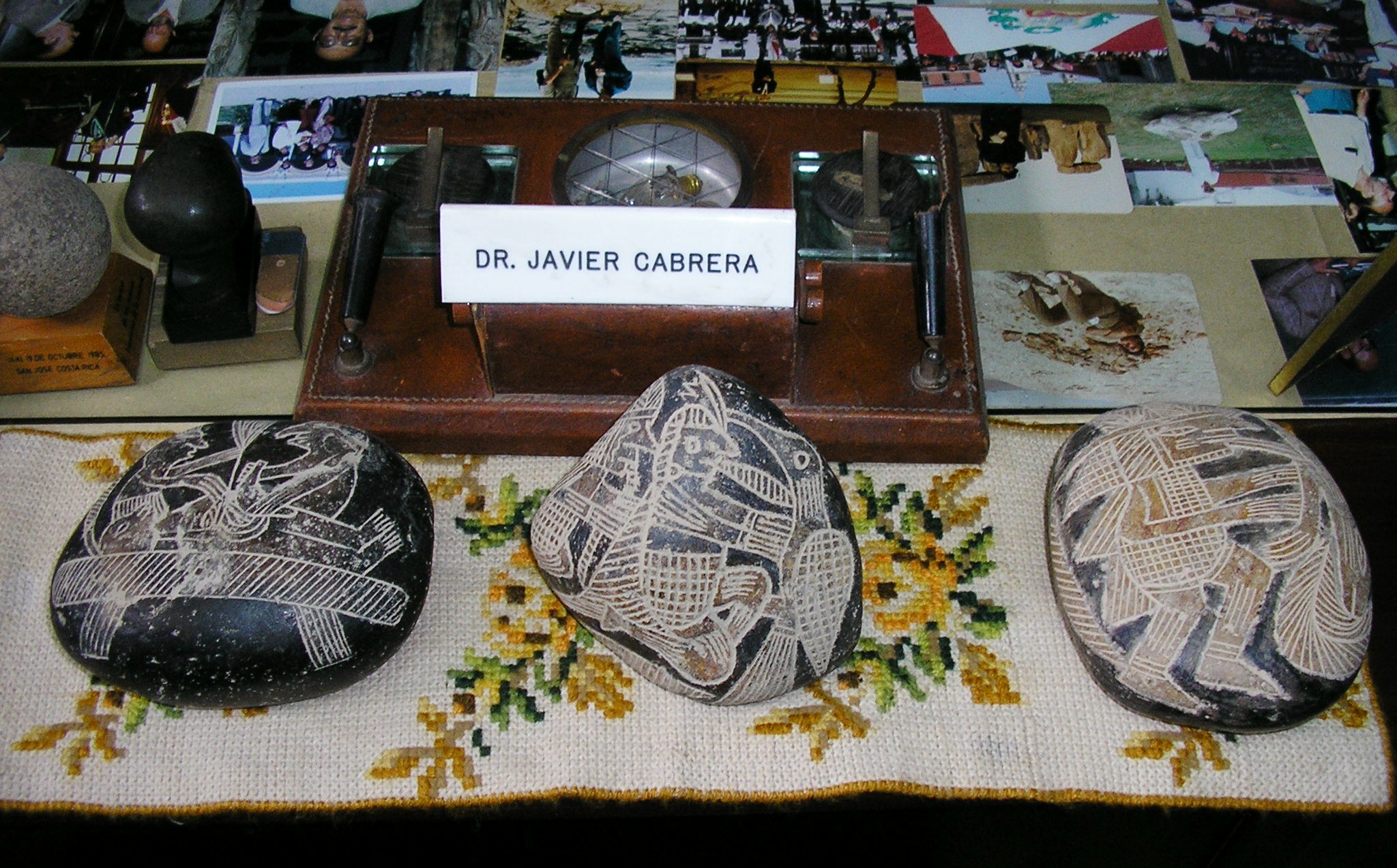
BR: Well, the story of the stones begins in the 1960s with a man named Javier Cabrera. He’s a medical doctor in Ica, Peru. For his 42nd birthday, he was given an andesite, which is a volcanic stone with a crude drawing of a fish on it.
0:38:05
CW: I think that is the traditional gift for somebody turning 42.
0:38:08
BR: That’s correct, an andesite stone with a crude drawing of a fish. But Dr. Cabrera was not merely a medical doctor, although he was that, he was also sort of an amateur, well, as it turns out, very amateur archaeologist.
CW: Unqualified, one would even say.
0:38:24
BR: Don’t get ahead of the story. So he was told it was an artifact. And to be crystal clear, there are hundreds of thousands of artifacts in South America and certainly in Peru. I’ve been to Peru several times. There’s many old civilizations. The whole country is just filled with fascinating ruins and cultures. And there’s the Chavin and there’s the Nazca and there’s all sorts of ones there. So the mere fact that an artifact from an ancient culture surfaced by itself isn’t particularly noteworthy.
0:39:02
CW: The times I seem to vaguely recall hearing about the Ica, Ica, sorry, Ica stones, seems like they were in the same paragraph as the Nazca lines, so.
0:39:12
BR: Yes, Ica and Nazca are actually not too far from each other on the southern coast of Peru. But Dr. Corbera looked more closely at it and he recognized, or he thought he recognized, the fish as an extinct species, something that had been thought to have died out a long time before.
CW: Hey, we did a whole show about an ancient fish thought to have died out years ago.
0:39:32
BR: We did indeed, the coelacanth.
CW: These are, something tells me, not representations of coelacanths, correct?
0:39:43
BR: Yes, these are not representations of coelacanths. So basically it was, you know, as with the coelacanth, what Cabrera recognized, or rather thought he recognized, was basically a living dinosaur that must have coexisted with humans because of course there’s an etching on the stone depicting this.
0:40:02
CW: Okay.
0:40:02
BR: So this would later become part of why the mystery is so well-known these days. The creationists jumped on it. Um, because…
0:40:10
CW: Well, they do tend to like things carved in stone.
0:40:13
BR: They’re big on that. That’s one of the main motifs. It’s the same reason why many creationist museums show Jesus riding a dinosaur.
0:40:21
CW: Oddly enough, that’s the one bit of crossover you will also find Jesus riding dinosaurs at atheist parades too.
BR: Well there you go. And just to sort of put it in perspective and context, so basically the the idea is that this proves a young earth. So for for those creationists who believe that the earth is only six to ten thousand years old, that means that all of earth history must have been compressed into that that amount of time, which means of course that, as in the documentary The Flintstones, humans coexist with dinosaurs and of course that would also mean that Jesus did as well.
CW: Yes, because the creation of the universe was really part and parcel with the creation of humans and we came around the very week that the universe poofed into existence thanks to the Word of God. So it’s all right there in Genesis. It makes sense if there’s, if you see something that looks like it’s evidence of a human being witnessing something prehistoric, quote unquote prehistoric according to the creationists, then yeah, it’s latched onto as evidence.
0:41:22
BR: All the answers are in the book, as I’ve been told many times. So again, this is one of many similar ideas. There was the the Paluxy prints, which allegedly show humans and dinosaur tracks together. I think it was in Texas. As it turns out, the alleged human tracks are not human at all, they’re just a variety of tracks that some of which looked human. There was also, of course, the the Cardiff Giant Hoax in 1869, which was actually perpetrated by an atheist who got annoyed at hearing Methodists talk about the alleged giants referred to in the Bible.
0:42:01
CW: Yeah, we’re just racking up all these things that we should really do future shows on.
0:42:05
BR: Yes, and of course, just to round it out, as you probably know, the chupacabra, one of my favorite beasties, also has an interesting creationist angle. There was one that was found in Blanco, Texas that ended up in a creationist museum because according to the guy that bought it, it disproved science. Because of course, if scientists were wrong that the chupacabra couldn’t exist, then of course, what else are they wrong about? Well, obviously they’re wrong about the age of the earth.
0:42:36
CW: I love that creationists latch onto these really outlandish type cryptid, fringy things as evidence scientists can be wrong. When you really just have to look at any rudimentary book about the history of science to know that it is a long, marching sequence of scientists being wrong and then learning that they were wrong and correcting and getting closer and closer to the truth. Do you really have to reach for a cryptid to prove that a scientist can be wrong?
0:43:13
BR: Well, I don’t have to, but again, I’m not John Adolphe in his creation scene. So again, this is the interesting part of the story is the motivated reasoning, right? So you have something unusual and you have people latching onto it for their own purposes. So Cabrera, who, as I mentioned, had no training in archaeology or anthropology, soon asked for more. He said, well, this is amazing because I’ve been given this gift and it’s this black or blackened stone with this obviously extinct fish on it. Give me more. Give me more. So he began offering a reward. I know, Celestia, I know that you’re you haven’t researched this as much as I have. What do you think? What do you think happened here?
0:43:57
CW: Well, you have a fellow who got a little tchotchke as a gift and he offers a reward for more of them. There’s many crafts people in Peru, I’m assuming.
0:44:07
BR: There are. Peru is not a wealthy country, and it certainly was not wealthy in the early 60s when all this happened.
0:44:15
CW: Yeah, I’m fairly sure there have been other instances in cryptozoological history where rewards have been offered for strange things and suddenly you’re just swimming in strange things like, oh I have a million fairy wings that have been brought to me because I haveasked for fairy wings.
0:44:34
BR: Exactly. So Cabrera who apparently thought he was onto something and just this amazing discovery he said, oh you know where did you get this? He started asking around and he made it he made it known. And again, this is a fairly wealthy doctor in a fairly impoverished area, particularly in southern Peru. So, of course, word gets around that Dr. Cabrera is looking for these. And in the end, he got an estimated 10 to 15,000 of them.
0:45:04
CW: 10 to 15,000?
0:45:07
BR: Over the years.
0:45:09
CW: And he didn’t, he shelled out money for each and every one of these?
0:45:12
BR: Well, some of them have been donated, but certainly most of them or the majority of them. Yeah, he bought them. I mean, there was basically a bounty on them. So they came from a variety of places. But there was one main person that kept finding these, a local campesino, a peasant fellow, a farmer named Basilio Ushuaia. And he found them and sold them to Cabrera.
0:45:38
CW: Did he say where he was finding these? Did he have like a magical hat that they kept peering out of?
0:45:44
BR: Well, there’s a couple different stories about that. I’ll get to that in a second actually.
0:45:50
CW: Okay, and until you tell me otherwise I’m going to assume it was a magic hat.
0:45:54
BR: Yes, that should be the default assumption is it came from magic hat.
0:45:58
CW: I’m sticking to it.
0:46:00
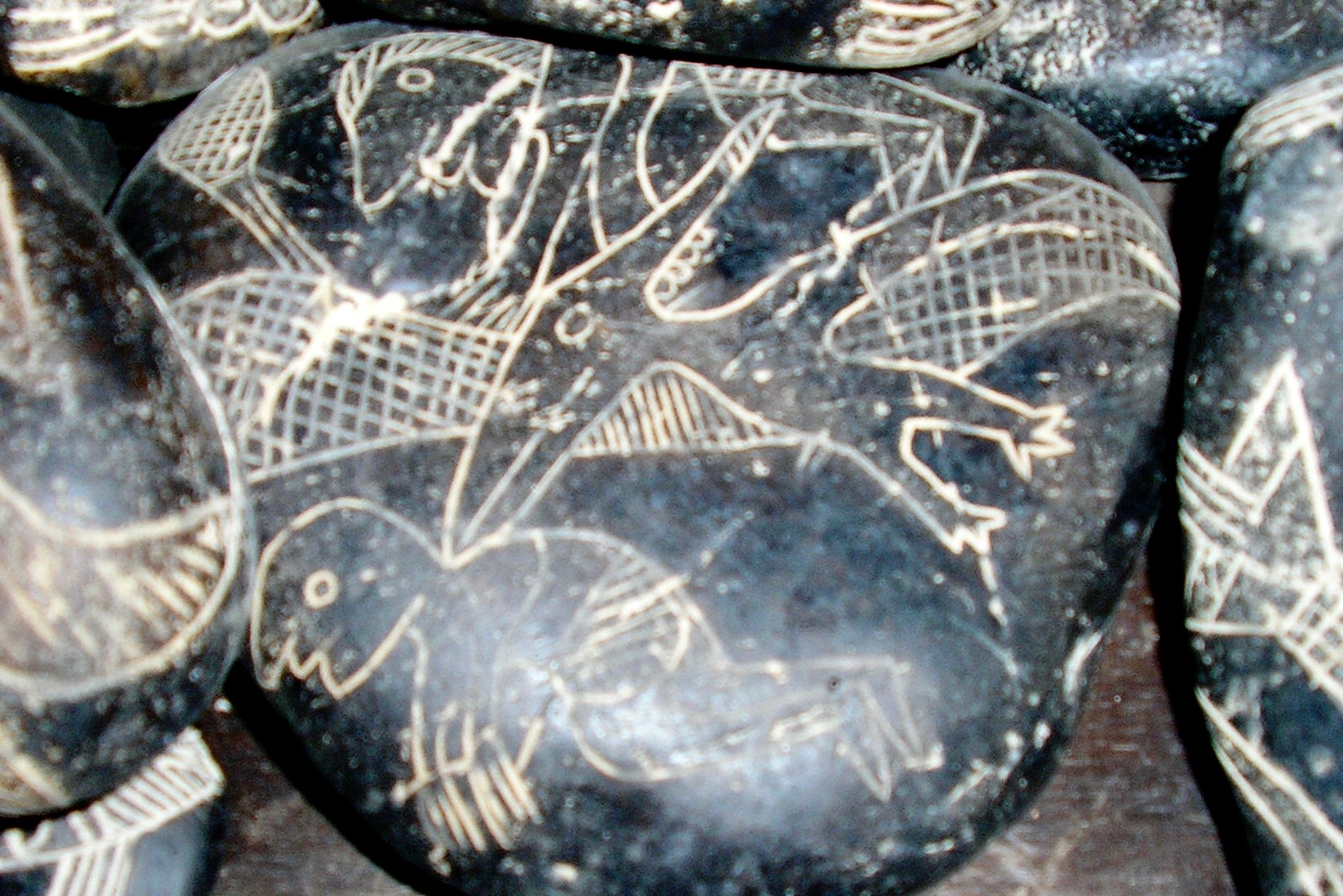
BR: So Cabrera couldn’t believe his good fortune. He was just amazed at the variety of these things. And of course, this happened over the course of many years. This wasn’t just all of a sudden he’s, you know, getting wheelbarrows full. Although I imagine at some point that did happen, especially since they ended up with over 10,000 of them. But over the years they would trickle in and as he got more and more of them, he, of course, was asking for more and more of them. Keep in mind that the first one that he saw was this sort of stylized fish. And it’s not clear how he could have identified a particular fish, much less an extinct fish, from just that. It was very rudimentary, you know, something if you ask an eight-year-old to draw what they think a fish looks like, I mean, there’s nothing really that would distinguish it from being any other fish, and certainly nothing that would distinguish it from being some presumably extinct animal. So he’s getting more and more of these rocks and there are different patterns. And so there were flowers and human figures and animal designs. And then there were dinosaurs.
0:47:04
CW: And then there were dinosaurs. I think that’s the way the Bible says it. You know, there were flowers and things and then there were dinosaurs.
0:47:09
BR: And then there were dinosaurs. Right. So not just depictions of dinosaurs, but depictions of humans with dinosaurs. So this is some land of the lost stuff. So, you know, riding dinosaurs, hunting them.
0:47:20
CW: Did one of the humans have a beard and sandals?
0:47:23
BR: I think so. You have to look close. So he’s just, Cabrera’s just amazed. I mean, this is incredible. All these things in there, these are all just being found from presumably one of the many, many archaeological sites that are in fact scattered around the region.
0:47:41
CW: And somehow all the professional non-amateur archaeologists have just missed these thousands and thousands of stones.
0:47:49
BR: Well…
0:47:50
CW: I just want to point that out. He’s good with that. He’s like, wow, I am so lucky.
0:47:56
BR: Yes.
0:47:57
CW: These have just fallen into my lap and all the legitimate people who spend their lives working in this field have totally overlooked them until now.
0:48:05
BR: It’s crazy, isn’t it? So now my understanding, and I’m guessing listeners can probably figure out where this is going, and if not, then you maybe shouldn’t be listening to our podcast, but you know, at one point there was some minor effort to, made to engage actual archaeologists. From what I can tell, they looked at it and very, very, very quickly realized this was totally bogus. It wasn’t like, oh yes, this is exciting, we’ll send it to more tests. It was like, uh, really? So, to the degree to which legitimate scientists looked at these stones, they were self-evidently bogus. This just made Corbera think that he was just sort of the, it was the classic crank, right? Well, you just don’t understand.
CW: Yeah, he’s holding tighter to his idea.
BR: Right, right. So, oh, by the way, I forgot to mention, not only did these stones depict dinosaurs, animals that were clearly extinct. So, you know, originally it was a fish that he had thought might be or was a fish that was extinct. But then soon there were dinosaurs that were clearly extinct. And these are obviously Triceratops and long-necked Ixizores, all sorts of very stereotypical dinosaurs that were not mistaken for anything else. They weren’t birds, they weren’t cats, they weren’t monkeys, they were clearly dinosaurs.
CW: Okay.
BR: Oh, he also found some of the stones depicting, for example, a figure looking through a telescope.
CW: Were these basically like ancient people’s versions of Viewmasters?
BR: Well, they did come from Magic Hat, as we’ve discussed.
CW: You just put one in front of each eye and you can see here is an ancient scientist working, looking through a telescope to find ancient aliens.
BR: Yes, so and indeed that was exactly what happened. So initially you had with the idea that there were the dinosaurs of course and you had the creationists and then once you had the addition of images of the telescopes and also the dinosaurs and also there are also some depictions of what looked to be modern medicine. So for example a heart transplant. So this of course appealed to the ancient aliens crowd. The Eric Von Donikans, the I’m not saying it was aliens, but it was aliens, type crowd. They love this stuff.
0:50:34
CW: Evidence of science or even just intelligent rock stacking in the ancient world proves aliens were visiting our ancestors.
0:50:44
BR: Right. So they were carving these things onto rocks. building pyramids in Mesoamerica and probably Saharan Africa, you know, take your picks. Obviously these ancient islands were very, very busy. So Cabrera, again, this happened over the course of many years and he basically quit his medical practice and devoted his life to them. He wrote a book about them as he got more and more of them, he would study them and he would do drawings and he would come up with these elaborate theories, again all without, for the most part, consulting any actual archaeologists or scientists.
0:51:16
CW: Now, his elaborate theories, this Dr. Cabrera, you mentioned his discoveries, and I’m making quote marks in the air as I say discoveries, were co-opted by creationists and by the ancient alien believers. Did he ever put a foot in either one of those camps himself? Did he have, or did he have completely different ideas as to what these rocks signified?
0:51:43
BR: Well, to him, it was, they were clearly evidence that dinosaurs and humans had coexisted. And he believed, in the end he believed, and again, he mentions this in his book, he believed that the stones were made by extraterrestrials. And of course, tied to him with Nazca, the Nazca Lines, which as I mentioned aren’t too far away. So it was all very convenient that it happened in Ica, in that region, and then of course not too far away is the world famous Nazca Lines, which has its own legends and myths about possible extraterrestrials and the designs in the desert that can be seen from the air and all that. So it was sort of this perfect stew of pseudoscience. It was like, well, you know, this is being seen here and, you know, obviously there’s something weird going on.
0:52:34
CW: Hmm. Okay, so he never came out and said, you know, this proves creationism, but he was pretty big on the ancient aliens thing.
0:52:43
BR: Yeah, that’s my understanding. I don’t think he was necessarily in the creationist camp. He was tied in fairly tightly, at least for a while, with Erich von Däniken, the chariot of the gods guy, who’s sort of an uber crank, if you will.
0:52:58
CW: He’s kind of the godfather of the whole ancient alien theory.
0:53:02
BR: Right, right. So again, Cabrera got in with him, and as I recall, he’s mentioned a couple times in von Däniken’s books. This fits perfectly with what von Däniken was saying. You know, it’s depictions of presumably ancient people looking through what’s obviously a telescope into the heavens. Well, there you go.
0:53:21
CW: Yeah. Can I interrupt for a second? I got to give somebody some credit here. I just want to point out, as you can find out if you go back and listen to our coelacanth episode, the young lady who discovered the, well, not living coelacanth, but the dead coelacanth specimen, which led to scientists everywhere reassessing whether or not it was extinct, was Miss Marjorie Courtenay Latimer. And she didn’t just have a drawing on a rock. She had an actual specimen, a dead coelacanth, and she was an expert in extinct fishes. So she was fairly sure what she was looking at, but still held out enough doubt to wait until she had okayed it with other people who were experts in the field before she started yelling and yammering about this being an actual coelacanth that was presumed extinct millions of years ago.
0:54:17
BR: Yes, I think the word you’re looking for is scientist.
0:54:21
CW: Yeah, so that’s the difference between double checking and checking and double checking and being an expert in the subject you’re talking about rather than saying this etching on a rock looks kind of like an extinct fish, therefore aliens.
BR: Yes, something like that.
CW: So I just wanted to point out there’s a lesson here on how to approach topics.
BR: There are actually many lessons in here. We’ll circle back to that.
CW: Okay, so tell me more about these stones. He managed to gather 10,000 to 15,000 of these. Were they pebble-sized? Were they bigger than a bread box? Were they like river stones or were they more like jagged, crunchy rocks you could find on a mountainside?
0:55:02
BR: There’s quite a variety. Some of them are about the size of your thumb. Most of them are sort of fist size. There are some boulders that are the size of a soccer ball or even bigger. So they’re really quite a broad spectrum. Most of them I would say are probably about 6 to 8 inches, maybe 10 inches in diameter. And they’re rounded. And of course they have a, this may not surprise you, most of them had a flat surface upon which one could etch.
0:55:35
CW: That would stand to reason, yes.
0:55:36
BR: Yes, so they were not perfectly round because then you’re just basically making a baseball. And they all had this sort of black patina to them. Again, these are andesite stone, which is very hard stone. So they were darkened and they were basically scratched. It’s basically sort of a reverse etching. We have black and then the white or the sort of chalky gray is pulled out from underneath it.
0:56:03
CW: So these weren’t technically just carved with some sort of implement? There was something special about the way that they were etched? Is that right?
0:56:09
BR: Yeah, in fact, that was one of the rebuttals that Cabrera had when he was confronted by skeptics who said, well, you know, are you sure these weren’t just made last month somewhere? And he said, no, the andesite is too hard to carve. And that’s true, except for the fact that the stones aren’t carved, they’re etched. And there’s a big difference between carving and etching. So these are not soft stone carvings like you might see in a stone or wood or something else. These are hard rocks with a flattish surface that have basically scratches on them that pull out the white. So it’s true that they weren’t carved, but they didn’t need to be carved.
0:56:51
CW: Okay, so just so that I can put it in my head here, like carving would be something you do with just a sharp tool and chipping away at the stone, whereas etching is something you would do with a Dremel tool, where it’s just like a scratchy, sandy sort of thing?
0:57:08
BR: Yeah, just sort of, you’re just basically scratching the surface. You’re not carving into it. You’re not really changing the form of the rock. You’re just putting designs on the rock.
0:57:25
CW: Stop me here if I’m jumping to wild conclusions, but if these rocks weren’t actually carved, if they were just etched on the surfaces, if they had been around for thousands or thousands of years, chances are that surface etching would have worn away long ago?
0:57:43
BR: You would think, yes, this might be something that even an amateur archaeologist might have gathered. And yeah, so that was one of the things that was sort of suspicious about, there are lots of red flags about this, but one of them was that most of the etchings were actually in pretty good shape. You would expect that at least some of the rocks would have been broken. I mean, just even, just in the course of archeological digs and stuff, it’s rare that you find something that’s intact. And that even applies to rock sometimes. I mean, just because it’s a rock doesn’t mean it’s not gonna be eroded or degraded by wind or rain or water or what have you. And instead you see a very, very clear lines. In fact, in some cases you can basically see cross-hatching with fine tools. And so that was one of the things that people were trying to sort out was, you know, they said, okay, well, can’t you just date the stones? Well, you can’t date stones. If you have something that’s a bone or a piece of wood, then you can do radiocarbon dating.
0:58:44
CW: Oh, you mean, yeah, organic matter, yeah.
BR: Organic matter, but these aren’t organic matter, and so these are stones, so you can’t use that. So normally what you would do is you would try and identify how old they are by the substrate, by the strata, what were they found next to?
0:59:02
CW: So you would need to know where they came from, but we already determined that these came from a magic hat.
0:59:08
BR: Well, okay, let’s return to that.
0:59:10
CW: Okay, all right, so they’re not from a magic hat.
0:59:13
BR: So they’re not from a magic hat. So, yes. So this gets into the issue of provenance. Again, there’s a couple of different stories that the main story that was circulating was that they were found in a cave. And where was this cave? Uh, no one ever really found it. Well, that’s not quite true. So Eric Von Däniken in one of his books claimed that he, he visited the cave where all these stones had apparently been kept. And I suppose this might explain their generally pristine condition, right? I mean, if they’re inside a cave, then of course, they’re protected from the elements. So in one of his books, von Däniken claimed that he and Cabrera went to this cave, that Cabrera had kept a secret from everybody else, but then Cabrera himself had denied it. He said, I never took him to the cave and then von Daniken later had to admit that well, he made that up He hadn’t really been to the cave.
CW: It’s almost like he’s okay with making things up. You know, it’s it’s leaning that way.
1:00:11
BR: So yeah, so allegedly there was a cave somewhere nearby and Cabrera Claimed that that’s that’s where these stones have been had come from now It’s entirely possible that he was believing what other people were telling him. So when he asked, were you getting these stones, to the degree that he did ask, he was told, well, there’s a secret cave, I can’t tell you where it is. But of course, that just begs the question, why wouldn’t he have gotten them all at once? If you found this cave that has all these stones in it, then presumably, they wouldn’t trickle out over the course of 20 years. You could just presumably go in there with a whole bunch of people, pull them out all at once. Keep in mind, as I mentioned, that many, if not most, of the rocks came from a man named Basilio Uchoa.
CW: Yes, is that Spanish for imaginary cave?
BR: Similar, something along those lines. So Uchoa was Cabrera’s main Ica stones getter. He wasn’t the only one, to be clear, but he was the main source and sort of as the years went on, he kept finding and finding them. This is one of the later sort of rebuttals of people say, well, you know, one man couldn’t have made all 10,000 of them. Well, in fact, he probably could. For one thing, the drawings are pretty crude. They’re pretty fast and easy to make. You could do this while watching TV. I mean, this is not…
1:01:37
CW: I am a big believer in the fact that you can make many, many, many crude drawings and earn money off of them.
1:01:48
BR: Well, see, you and Uchoa have something in common. If you go online, or, you know, we can post some photos of the stones on our Facebook page for our listeners. There is some art to it, but I mean, these are not highly detailed, difficult to create. They’re sort of childlike, they’re very stylized. It’s entirely plausible that someone could have carved thousands of these over the course of years. And of course, there’s an incentive, there’s a financial incentive to create these.
1:02:22
CW: Yeah, yeah. Looking at the images that I did pull up and take a look at. These are not Vermeers. These are quick little shapey things that as long as you have a tool, you can etch out pretty quickly.
1:02:36
BR: Yeah, so here’s what happened. So, it was Uchoa finally admitted what pretty much everybody except Cabrera suspected, which was that he was fabricating them. He was not going to some hidden cave and pulling them out of a magic hat. He was making them on his own, basically as an industry.
1:02:58
CW: And you say he admitted this at some point.
1:03:02
BR: Yes, he admitted this and in fact there was a BBC documentary where he’s interviewed and he shows how he did it. So there’s no real mystery here. So what he did was, after of course Cabrera put out this bounty for these designed rocks, he said, well, hey, I can crank those out. I can do a couple of those a day. Why not?
1:03:22
CW: : You create a market, the market’s going to get filled.
1:03:24
BR: Right. So he would take rocks from the general area and he would blacken them in a fire. So he would sometimes wrap them in animal skins or other things and basically sort of give this blackened condition to it, this patina to it. And then he would carve them usually with a dentist drill.
CW: Like a Dremel.
BR: Like a Dremel, yes. And again, this is he admitted this, he showed how it was done. Some people claim that his confession was itself faked. So there there’s there are still some believers. So to this day, and I know because I checked earlier today, to this day, there are still people that are convinced that these stones are legitimate and real and the whole thing. And one of their arguments, as weak sauce as it is, is that Estrella admitted to it because the alternative was that he had looted archaeological sites, which is illegal.
1:04:36
CW: So he was, he, it was big archaeology that was twisting his arm there saying, we’re going to throw you in jail unless you concoct some sort of story that these are actually fake.
1:04:46
BR: Right. So that was that. That is, that is the the counter, counter, counter, counter, counter argument that, well, no, he really did fine these, but he didn’t want to admit to fining them because, of course, then he’d be thrown in jail. By the way, I have to know something about it. There’s lots of archaeological looting throughout South America and certainly in Peru. Many people get away with it all the time. The chances of him being singled out and being thrown in jail over this are slim to none, but that’s the argument. In terms of the evidence for it, again, keep in mind that because he used a dentist’s dremel, you can see the markings. If you take a close look at it, they’re telltale signs. This was not carved centuries ago or millennia ago by stone.
1:05:31
CW: Yeah, well, and using a microscope, there are experts who can tell exactly what blade was used to make, you know, what little niche on a, you know, a piece of furniture or fingernail or dead body. Has any such forensic expert ever spent their time to look at these stones and give some sort of authentic report about their nature or has that never been done?
1:06:03
BR: My from my research that hasn’t really been done partly because again, it’s they’re so obviously faked. I mean, it’s I mean, I was not able to find any official peer reviewed article because, again, it’s to any serious archaeologist, it’s the whole thing is ridiculous. It’s not even.
1:06:22
CW: So this is not this episode is not about a mystery that we unravel at the last minute. This is more, this is more a psychological profile of someone who holds onto a story and just won’t let it go in the face of all countermanding evidence.
1:06:38
BR: Yes. So, you know, Uchoa, he finally admitted that he’d faked them, but Cabrera was undeterred and he kept promoting them. So even after Uchoahad said, look, you know, yes, I faked it. This is, you know, he came to me and he wanted these and he said he wanted more. And he kept buying them and I kept making them. So we why not? Yeah. So Cabrera, again, he kept promoting them. And he later admitted that some of them that he had there were faked. But he said only the ones that were for sale to tourists.
1:07:12
CW: So so not not any in his collection, just the other ones that are sold to other tourists.
1:07:18
BR: Right. And you would think that out of what, twelve, fifteen thousand, you think he could sell a couple authentic ones. But he said that basically he knew which ones were real, which ones were faked, which again is interesting because it has it has parallels to, for example, crop circles. So crop circle believers will tell you, well, yeah, some of them are faked, but these ones, these are the ones here real. And you say, well, how do you know? Well, I can tell. Well, what’s your criterion? I just know. They just, they just argue that, you know, that they’re, they’re the experts and they can tell the difference in the same case. Also the whole idea of creating a fake out of a real, out of a fake, that also has echoes of, for example, the Minnesota Iceman Bigfoot story, which I don’t think we’ve talked about on the podcast. We should do a show on that. It was allegedly a Neanderthal that had been shot and put on display as a Bigfoot. It traveled around the circuses and several people – this would actually be a great topic for Matt Crowley. We should get Matt back on to talk about it. But at one point, an analysis was done on the Minnesota Iceman, and it was determined that it was in fact just a rubber costume. And the promoter said, well, yeah, I made a fake one because I didn’t want the real one to be taken.
1:08:44
CW: Oh my god.
1:08:46
BR: Yeah.
1:08:46
CW: Oh my god. Wow. And see, I see all the little telltale signs of a pathological liar in a lot of these, but why would you have a rubber suit tested? Anyway, but the fellow Cabrera seems like he was a true believer. He wasn’t trying to forcibly hoax the world for any sort of profit. What would his profit motive be? Right. Why was he doing this?
1:09:10
BR: Well, again, this is one of the reasons I think this case study is particularly interesting is there’s these layers of hoaxes. Some people were on it, some people weren’t. Who was deceived and when? And what was the element of self-deception? So it’s pretty clear to me and I think the consensus is that Cabrera himself was the victim of a hoax. Of course, he sort of laid the path down. He did all he could to avoid confronting that. But at the same time, there’s some question, right? Because he claimed that there was a cave that had these rocks in it. Despite the fact that nobody has ever seen the cave, he’s never told anybody where it was, as far as I know, there almost certainly was never a cave. So then the question is, did he come to believe it himself? Did Uchoa tell him there was a cave and he just sort of took it on faith because he’d been buying these rocks from this guy for these years? I mean, who knows? So the story of the cave is clearly a lie. I mean, it’s clearly not true that these rocks came from the cave.
1:10:16
CW: The cave is a lie.
1:10:18
BR: Right. But again, that’s what I find fascinating, is you have somebody who is in some ways sincere but deluded, but is also perpetuating what amounts to a lie. And then another skeptical angle to it is, of course, experts going beyond their expertise. This whole thing started with a medical doctor who assumed he knew enough to authenticate not just the first stone, but the subsequent ones. It’s likely that had he gone to an actual reputable archaeologist somewhere in Peru in the mid-60s and said, hey, you know, will you look at these? And if he had actually listened to what they had to say, this whole thing could have been avoided.
1:10:58
CW: That ties back to our episode about credentials and how a degree in one thing does not mean jack s*** in another thing. That’s why you have these doctors of computer science claiming to know about climate science or or ancient biblical studies or you name it. A medical doctor, although it would give me pause to have anybody work on me as a physician if I knew they were so easily duped. But he might have been a very capable doctor but yeah, doesn’t know a darn thing about rocks.
1:11:36
BR: Right, and it’s the Dunning-Kruger effect, right? People assume they know more than they actually do. I keep saying we should do a show on it, but it would be interesting to do, I want to do a show at some point on people who have dedicated big chunks of their lives to myths, right? I mean, there’s this guy who, again, he quit his medical practice and spent many years, I think certainly over a decade, maybe two decades, dedicating himself to understanding these etchings on these rocks that were being sold to him by a forger who was cranking them out, you know, on his nights and weekends.
1:12:13
CW: Yeah, and you have to be heavily invested. I mean, you’re by the time he was in up to his neck like that, how do you come out and admit to yourself that, yeah, I was fooled. This is all a big story.
1:12:25
BR: Right, exactly. And the other aspect that I take from it, the other lesson is about how a story can be co-opted by people with agendas. And again, we saw this, we talked about this before, where these pretty self-evidently fake stones were seized upon by creationists as evidence for the story they’re trying to tell. And they were seized upon by the ancient alien folks, particularly Von Daniken, who was using it as evidence for the story they want to tell. You can go back to the Chupacabra story, where a UFO group basically co-opted the original sighting by Madeline Tolentino and spun it to their own benefit, and that’s why today, stories about the Chupacabra and its origin story are very much involved in UFOs and aliens. So it’s just fascinating how these stories get spun for different people’s agendas.
1:13:14
CW: It seems like those two camps are the ones that are quickest to co-opt any sort of strange thing. The ancient alien guys and the creationism young earth guys. Were there any other believers in the strange that rushed to look at the Ica stones as evidence in their particular pet theory?
1:13:38
BR: The creationists and the ancient aliens folks were the main ones. Ica Stones are sort of a classic mystery, or at least they were, of course, until they were pretty thoroughly debunked not too long ago. But if you look back at many of the real-life mystery books, Reader’s Digest and the sort of Frank Edwards books and the those sorts of things, particularly in the 70s and 80s, a lot of them go right to the Ica Stones as being this unexplainable, you know, explain this scientists!
1:14:14
CW: Yeah, they form part of that background noise of well science can’t know everything and I should be able to, you know, just believe whatever I want because look at all these things that are unexplained and they throw that in there, the Ica Stones and Ley Lines and all these other things that are just not even wrong, like there’s not even enough there to disprove anything because there isn’t anything that holds up even in the face of an most amateurs senses of skepticism. Now, have you, do you own any of these eco-stones? Have you ever touched them, laid eyes on them, gotten to investigate them yourself?
1:14:48
BR: I have in fact. In 2006, in late July, there was a skeptics conference in Lima, Peru.
CW: Oh, perfect.
BR: It was perfect, yeah. So I went down there along with Joe Nickell and a handful of others and we figured, hey, if we’re going to go all the way down to Peru, let’s go investigate. So we did that and we took a five-hour bus ride south of Lima to Huacachina and then we were in Ica for a while. And there’s actually quite a bit of mystery weirdness around Peru. There’s miracle mud baths in the coastal town of Chilca, allegedly curing any and all health problems. There’s also claims that pregnant women will have twins if they sit in the mud baths. And there’s allegedly a connection to flying saucers which have been seen in the area.
1:15:41
CW: It’s sort of like the Sedona of South America, isn’t it, Peru?
1:15:45
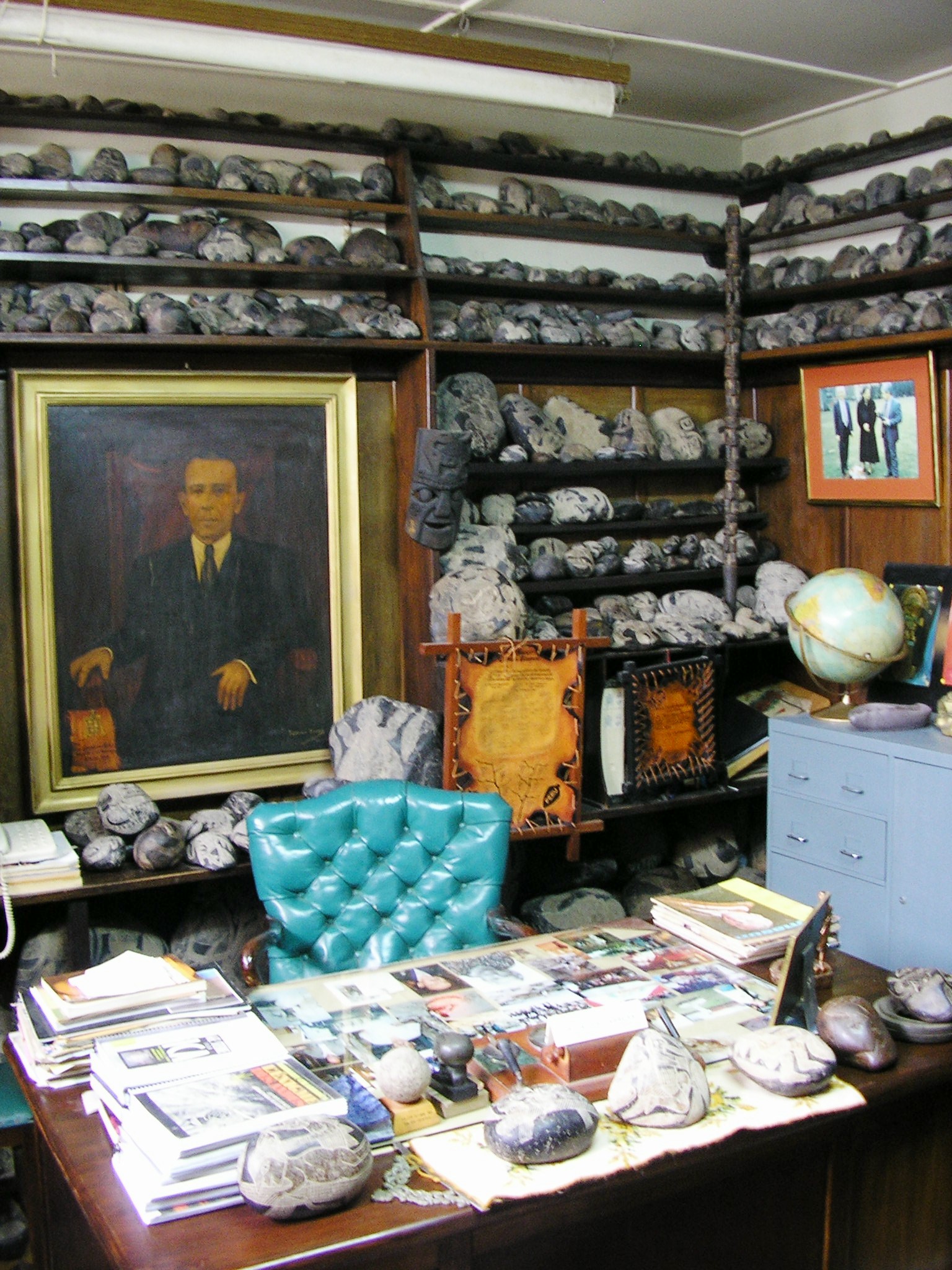
BR: It sort of is. As I mentioned, we’re actually headed down to the Nazca Lines. We wanted to go see the famous drawings in the desert and Ica was basically right along the way, so we stopped in and it was Joe and I, everyone else was staying up in Lima. I’d done some research ahead of time, and so I sort of knew where the place was. So as it happens, Cabrera’s, I think it’s his daughter, now runs it. So you can actually go to his museum. There’s a small museum, and it’s just off the Plaza de Armas in Ica, in downtown Ica. And I made a couple phone calls, and we sort of sat around this Plaza Armas, which is sort of a main plaza that you see in many Peruvian Latin American cities. We were told to go to this one place. It was just basically this huge, ornate wooden door that was probably a hundred years old or something. And we knocked on the door and it was this big, thick door. And eventually someone came around and this woman let us in. And Joe doesn’t speak any Spanish, so I translated it for us. And it was actually pretty cool. It was this small room, maybe 20 feet by 30 feet or so. And it was sort of this combination of Ica Stone’s exhibit and sort of a shrine to Dr. Cabrera. So there was, you know, all along the walls, on the ground, all over this desk, all these stones, and you can see his original desk. I mean, Dr. Javier Cabrera. There’s a photo of him on the wall, and so it’s this sort of combination of display and shrine to Cabrera. There really wasn’t much actual investigation to do at that point because the stones has already been debunked and the hoaxer had already come forward. So it was sort of like seeing the Cardiff Giant or the Hitler Diaries. I mean, of course, it’s fake, but it’s still historically interesting.
1:17:42
CW: And skeptics are drawn to stuff like that. Yeah. Now, now let me ask you in much like a Schrodinger’s cat sort of transformation. Did you purchase any of these stones? Like in the moment you purchased it, it went from being genuine to being faked.
1:17:59
BR: I tried to purchase one. I was not allowed to purchase any. The woman there was friendly, not terribly forthcoming. I mean, you know, we paid our admission and we wandered around the small room for, I don’t know, 20 minutes, half hour or so, and then we sort of left. There was nothing in the way of a tour. There were no brochures. It was just basically, call this phone number, knock on this door twice at 2.15 and if they’re back from lunch, they’ll let you in. But it was all very informed, but again, it was fascinating just sort of seeing them up close and you could pick them up and hold them in your hands. And again, there’s thousands and thousands of them and she did keep mentioning to us that there are many more that were in storage. for ourselves, the etching of the guy looking through a telescope up at the heavens and the dinosaurs that are eating each other. Just these obviously faked Ica stones that had caused such controversy for decades.
1:19:02
CW: Did you get a feel for whether or not the average Peruvian knows about the stones in the first place? And if they do know about the stones, do they, oh yeah, that’s just crap. That’s just a story. Or is there a percentage of Peruvians or local folks in the region of Ica who fully believe that these things are real?
1:19:25
BR: My sense was that most of the locals there are kind of embarrassed by it.
CW: Okay.
BR: Well, you know, prominent local doctor sees dinosaur in stylized fish and comes to believe that there’s rocks showing dinosaurs and offers a reward for him and gets 12,000 of them. It’s a weird story no matter what. But I didn’t, yeah, and again, I didn’t, we didn’t spend hours and hours there, partly because we had to get back to the hotel and we were heading down to Naska. But the sense that I got from talking to some locals was it was sort of a local curiosity. I didn’t get the sense that anybody actually believes that they were anything more than what they appeared to be.
1:20:09
CW: Yeah, although many places that are not as rich and developed as the United States tend to get this bad reputation of like, oh, the locals are very superstitious and have backward primitive beliefs about everything. So of course, they’re very gullible. In reality I think locals with anything like that tend to be pretty cognizant of things and fairly skeptical.
1:20:36
BR: Well, keep in mind there’s an element of superficial plausibility because it’s true that Peru is flooded with legitimate actual artifacts. I’ve seen many of them. There’s amazing museums, there’s pottery, there’s shards, there’s rocks, there’s petrigoats. There’s lots and lots of authentic stuff out there. And along with that, of course, you’re going to find some fraudulent stuff as well. So again, it would be even more jarring had these been discovered in some farm in New Hampshire. It would be much more out of place there. So again, when it all sort of began, there was a sort of superficial plausibility that, well, you know, there are artifacts all over the place and there’s a trade in them and, you know, people do show up with legitimate artifacts. And then when you ask where they got it, they say, oh, it fell off a truck. So these sorts of things do happen just in this particular case. What Cabrera was seeing was so outlandish and so self-evidently bogus that it all collapsed.
1:21:41
CW: Well put. All right, well, where can people go besides going on Google and just looking for some images of the stones, which is what I’ve been doing as we’ve been chatting, where can people go for more information?
1:21:52
BR: Well, there’s a variety of pretty good skeptical resources. I think Skeptoid did a good show on it. There’s the Skeptics Dictionary. There’s a variety of places. One that I would recommend is Kenny Fader, F-E-D-E-R, and he’s written several books including the Encyclopedia of Dubious Archaeology, and it has a section on the Ica Stones there. Kenny is, shall we say, not impressed. He is remarkably unimpressed by the whole thing. If you read his entry on it, you can tell he’s like rolling his eyes.
1:22:30
CW: All right. Well, listeners, let this be a little touchstone for you. If you hear somebody singing the praises of the Ika stones, that’ll let you know that they are okay talking about stuff that they have really not dug into at all.
1:22:46
BR: Yes.
(MUSIC)
1:22:47
CW: Okay, well Ben, thanks for bringing your knowledge about the Ica Stones in Peru. And Pascual, sorry you couldn’t be with us for the main segment there, but you’re back.
PR: Yeah, I was just doing a little bit of research into the coincidence that the movie Ben was in is coming out on the same day as Joker and this whole scare. Ben – that’s your fault, right?
BR: I Can’t comment on that legally it may or may not be.
PR: I Knew it was a conspiracy. So go see go see both of them. That’s what I’m gonna say.
1:23:31
CW: Yes in in succession. You should go right from one theater to the other. You should not pass go. You should not collect $200. And support all your clown-based entertainment this weekend.
1:23:44
BR: Yes, yes indeed. And in wrapping up, I just wanted to send a shout out to prominent cryptozoologist, Loren Coleman. He recently had a stroke and I think he’s okay and hopefully he’ll be getting better and we wish him a speedy recovery.
1:23:59
CW: Okay, that’s sending out some good vibes there. And next episode, we’ve got an interesting topic on the burner. Well, we’re moving from Peruvian stones to dead animals.
1:24:12
BR: We run the gamut on Squaring the Strange, folks.
1:24:15
CW: Yeah, I’d better be more specific. Scary mass deaths of animals. Now, to differentiate here, we’re not talking about populations decreasing.
1:24:26
BR: We’re not talking about chupacabra victims.
1:24:28
CW: We’re not talking about specific environmental factors that are studied and the way animals can be tracked by scientists and populations grow or shrink over time. We’re talking about mass animal deaths as a foretelling of the apocalypse, as a bad omen, or as a really bad juju, and we’re going to go into that next time on squaring the strange very good until then everybody take care
1:24:55
Bye. Bye. See ya
1:24:57
We would like to extend heartfelt. Thanks to our sponsor level patrons Amy Frusciaro Kelly dr. Angela Matt key and Elizabeth Leggett if you’re interested in becoming a sponsor or just throwing us a buck or two per episode Check out patreon.com forward slash squaring the strange Every little bit helps us keep the lights on here And we could not keep bringing you content without the support of our generous friends if you’re short on cash But want to provide moral support remember to recommend us to a friend if you’re short on friends Hey, remember that each five-star review helps us get higher on the podcast charts
1:25:30
Squaring the strange is a production of Two Heads Studio LLC, copyright 2018. Theme music by Shriekback, additional music by Memory, Keytard and Feathered, and Pasqual Romero. Additional support provided by Ashley Romero, Robert Sundin, and of course our listeners and patrons. The views and opinions expressed in this podcast are those of Squaring the Strange and do not necessarily reflect the views and opinions of Two Heads Studio, Kronos Creative, Center for Inquiry, our advertisers the views and opinions of Two Heads Studio, Kronos Creative, Center for Inquiry, our advertisers or any affiliated organizations and employers.
Transcribed with Cockatoo
Episode Summary:
Ben titled this episode. In which we speak of all the reasons why you should think twice about renting a monochrome, windowless van in unfamiliar territory. From cursed vehicles to the average person’s psychological priming that led police off the trail of the Beltway Sniper case, we look at the role vehicles have played in urban legends, dangerous rumors and real-life crime. How have the most common vehicles in our environment also become the most feared? Buckle up!
Click each image to enlarge.
0:00:00
Ben Radford: Welcome to Squaring the Strange, the podcast that examines all manner of the mysterious and the mundane through a critical lens. So let’s square the strange.
0:00:10
Welcome back to Squaring the Strange. This is Episode 190 and I am one of your co-hosts, Ben Radford. With me is/are…
Celestia Ward: Celestia Ward here and…
Pascual Romero: Pascual Romero. Hey, everybody.
0:00:36
CW: The gang’s all back.
0:00:37
PR: Woo-hoo! All here.
0:00:54
CW: Yeah. Everybody’s healthy. Everybody’s like ready to actually talk for a short while anyway.
0:00:59
BR: See what we can do. See if we can make sense.
0:01:02
CW: Now, our main topic tonight is an interesting little side branch, or should I say side road, of folklore. Ben, why don’t you explain to the audience kind of what we’re looking at this week.
0:01:14
BR: Sure. I thought we’d look into a sort of a subgenre of folklore, which would be sort of folkloric vehicles. If you spend much time in folklore and looking at different types of urban legends and even fairy tales in some cases, you find that there are certain genres, certain specific types of vehicles that appear over and over again, often in a sinister theme. So we’ve touched on those.
0:01:43
CW: Yeah, we never, sadly, we didn’t get to my mother, the car, did we? The spirit of that guy’s mother who ended up in his Chrysler or whatever it was.
0:01:53
BR: Yes, no, we didn’t get that. Not on the radar.
0:01:57
CW: So housekeeping time. Ben, you’ve got some stuff that’s come out. Tell us about what you’ve been writing.
0:02:02
BR: I’ve got a couple of things that came to fruition. One piece I wrote a long, long time ago. I’m slightly embarrassed to say I’d almost forgotten about it. When I was like, someone’s like, hey, by the way, I just published like, oh, cool. Yeah, I’m yes. I’m glad you saw that.
0:02:20
CW: How do you write a lot of stuff without actually saying you write a lot of stuff?
0:02:24
BR: Well, it’s just it’s just one of those things where, you know, as a writer, you put stuff out there and then sometimes you submit it and life happens and things happen and sometimes it may be published months or years later. In this case, I have an article in the current issue of Fortean Times Magazine, which is a British magazine. I’ve been published there several times before, including on the the Pokemon Panic and Urban Legends and the Popobawa and Chupacabra and whatnot. This time for the Christmas 2022 issue, Fortean Times 426, I have an article on my quest for Iceland’s Elf Church.
0:03:06
CW: That sounds rather Christmassy. I think it’s the perfect time to publish that.
0:03:09
BR: Yeah, yeah, I think I’ve talked some about it on previous episodes, but basically there was a what’s called an elf church, a large rock that was preventing a highway from going through on a peninsula outside of Reykjavik. And I wrote about it for Discovery News and I later on managed to actually go to Reykjavik and I only had a short time there. While I was there, I’m like, well, let me go see if I can track down this elf church and and I did.
CW: Yeah way to make the most of a layover.
BR: Basically I did on top of that. So that’s in the current issue of 40 in times which you can find Online you can also get here in the US at Barnes & Noble and other places in the current issue of skeptical choir magazine I have a my column this time is on a it’s sort of a classic cryptozoological mystery. It’s the Dover Demon case.
CW: Can you give us the elevator pitch for what the Dover Demon is?
BR: So the Dover Demon case occurred in 1977 in Dover, Massachusetts. And it’s sort of this, even within the realm of weird things, it’s sort of an unusually weird thing in that there were three teenagers, arguably four, but basically three main teenagers who claim they saw this otherworldly sort of alien-esque creature, but only once over the course of basically two nights and then it vanished. It’s sort of a classic mystery again. It’s been around since 1977 and I finally got around to taking a skeptical look at it and it is illustrated by, who’s this? Celestia Ward, I think.
0:04:51
CW: It sounds like a hack.
0:04:52
BR: Yeah, very. The art’s pretty crappy, I’ll be honest with you, but it’s the best we could do.
0:04:56
CW: So, well, as long as you didn’t pay anything for it, that’s important.
0:04:59
BR: No, no, no.
0:05:00
CW: Speaking of not paying anything for art – we did a segment about Loeb, the AI art cryptid two weeks ago in the last episode. And since that time, wow, AI art has exploded everywhere. It’s not just exploded in terms of people trying out, you know, various apps to do avatars of themselves. There’s think pieces and hot takes and large moral questions about our culture and, you know, whether or not it’s legal questions. I’d be curious to talk to Andrew Torres about this, about, I’m definitely developing a more nuanced opinion of AI art. There’s definitely questions as to whether or not it is scraping millions of different images from thousands and millions of different artists, or if it is scraping from a dozen people, which that’s, you know, I want to quote a cartoonist I know named John Bean Hastings, he posted a thing. To steal ideas from one person is plagiarism. To steal ideas from many is research. To steal from millions is AI art. And there’s the question, there’s the rub. If it’s like 12 people, then you, I think, have a pretty good case for a lawsuit. If it’s from millions of people, I don’t – anyway, these are big questions. I have a lot more to read. And after people have done some deep dives, we’ll probably have an episode about AI art, if people are interested. Pasquale, are you interested in talking about AI art further?
PR: Oh, yeah.
0:06:38
Yeah, I’ve got a lot of… you know, as you mentioned, you know, my opinions become a little more nuanced as I’ve discovered some more possibilities in that world in terms of how the art is aggregated. But AI and automation in art has always, every time someone makes a leap in that world, it always is the end of the world. It’s been happening in music since the 50s. There’s a lot of different automated things. There’s what’s called the arpeggiator, which actually is something that’s existed, I would imagine, since the 70s. And it can create arpeggios, which are runs of notes within a chord, and it can automate all these things. And music’s always been going through this. Art also has, you know, there’s a lot of techniques that have gotten a lot easier over time and
0:07:28
people using sampling.
BR: We did a show on sampling.
PR: Yeah, sampling is another great example. From a music standpoint, the legality may be a little more gray, you know, and I wonder how that may apply to visual art because in music, while it is pretty easy to win a case when you have literally lifted a sample from a previous recording, as we’ve mentioned in that episode, it gets a little tougher when you’re talking about the flavor of a song or the style of a song, or certain chord progressions being similar. So you know, this is uncharted territory, really, and it’s going to be interesting to see the legal end of it. But you know, speaking as a person who’s been in an industry of this for my entire life because it’s been automated and devalued and, you know, music is unfortunately not worth a lot as a product anymore. It’s interesting to see it on the visual arts side because on one hand I’m like, I think this is something that I’ve seen already.
0:08:34
CW: It feels a little deja vu to you.
0:08:36
PR: Yeah, and so, but that doesn’t mean it’s a good thing. I mean, again, devaluing of art is a real thing that happens when the digital commodification of it becomes so easy.
0:08:49
CW: Well, yeah, repurposing and being inspired. There’s I mean, I mean, I haven’t seen cartoonists this up in arms, you know, since Lichtenstein. And cartoonists and portrait painters and everybody are very unsettled. And there’s going to be a lot more think pieces coming out. I as part of my job in PR, I get to see little forums and places where reporters look for sources. And I’ve seen a couple of leads where they’re actively seeking, like looking for artists who have had their job disappear because of AI art or who have actively lost gigs because of AI art. So journalists are looking for artists to comment. And we’re going to see, you know, what comes down the pike here in terms of how it’s applied commercially. So, yeah, I think it’s, you know, we’re kind of launching into a shallow dive right now. But bear in mind, we’ll do a deep dive after, after the dust has settled a little bit and we have some more information to gauge things on.
PR: Yeah, absolutely. And you know, AI is already starting to take over other areas as well. Writing is affected by it. Also an area that music actually beat to the punch because even David Bowie wrote with AI back in the 90s. And we’ll cover that when we do deep dive into the topic. You know, this is to say that I think the important thing is artists just, you know, focus on just creating. Like don’t stop and, you know, accept that this is a possibility that it may uproot, you know, the way things work and it may not be for the better in the long run but at the same time, I just don’t want people to feel discouraged by this. That’s really the takeaway that I want people to have from this. It’s just do art, do it for the sake of doing it.
0:10:41
CW: Yeah. I did not know David Bowie dipped into AI back in the 90s. Now, I’m Afraid of Americans makes so much more sense.
0:10:52
It really, yeah, okay. Moving from art to politics, we also, you know, I wanted to mention, I can’t analyze it right now, but I wanted to mention that as a skeptic, and I’m sure other people in our listenership feel this way, it’s a bit unnerving to see how many Trump copycats are popping up and using conspiracy theories to generate, the kind term would be political action, the possibly more accurate term would be attempted coups around the world. We’ve got Brazil and Germany, things like that happening there.
0:11:31
BR: Yeah, I saw something on that. You had Jair Bolsonaro, the legitimately former president of Brazil who’s now been replaced by Lula, who is both the former and current president of Brazil, a leftist. It was interesting because I follow Latin American politics to some extent, and it was interesting sort of seeing what was going to be going on there because Bolsonaro was close with Trump and in many ways modeled his campaign after Trump’s. And they both have this sort of authoritarian tone to them. Both of them were to some extent COVID deniers and so on.
0:12:09
CW: Anti-science and not so big on the truth unless it served them.
0:12:13
BR: Yeah, not so big on that. So initially after Lula won, it was interesting because everyone was sort of holding their breath in Brazil because everyone’s like, okay, well, is Bolsonaro gonna do the Trump playbook of rigged elections? And he’d made moves that he hadn’t formally conceded, but he was making efforts to transition. So it was like, okay, well, I haven’t said that I’m accepting the vote, but I’m not going to explicitly hold it up. And then, of course, as you mentioned, in Germany, there was recent revelations just in the past few weeks about attempted coup and last I heard there’s actually some influences of QAnon and things like that.
0:13:02
CW: Apparently, it’s some German princes which don’t really exist anymore because there’s no royalty in Germany but these guys are distantly related and yeah, we’ll see what happens. Again, something we should be keeping an eye on and might do a deeper dive into later. So I guess this is your opener edition of, Hey, We Should Do a Show About That.
0:13:26
BR: That’s right. We have a lot of topics in store for 2023. So we’ll see.
0:13:33
CW: Not going anywhere anytime real soon. Okay.
0:13:35
BR: And before we go, this coming Friday, the 16th, is actually the anniversary of a famous case from 1997. You know what I’m talking about? I had a role in investigating it.
0:13:46
CW: I do know, but I-
0:13:48
BR: You do know.
0:13:49
CW: Let’s see if the listeners can guess before you tell them.
0:13:52
BR: Well, we did a show on it, ding, ding. Yes, this is the famous Pokemon panic that plagued Tokyo and environs on the 16th of 1997. And it was a famous case and I ended up, I actually investigated it in 2000. So it actually been about three years after it happened. I didn’t have any particular background in medicine or anything like that, but I had some experience in mass hysteria and mass osogenic illness. So I tackled it and I’m pleased to say that between myself and Bob Bartholomew, we co-authored a piece in the Southern Medical Journal and we kind of solved the case. So that’s kind of cool.
CW: 25 years ago. So you would have been in your late 20s.
0:14:35
BR: I was barely out of college. Barely out of college.
0:14:38
CW: Well, well, congratulations retroactively there.
0:14:40
BR: Thank you very much.
CW: OK, well, without further ado, let’s look at some strange vehicles in folklore.
0:14:52
BR: So today we’re talking about, well, first, let me give you a title that I’m especially proud of. I hear Celestia giggling. So today we’ll be talking about vile vans and sinister sedans, vehicular vernacular.
0:15:25
CW: Yes, and Ben, as you may or may not know, the episodes will be titled that so people will be able to read it before they even push play.
0:15:35
BR: You know, I don’t listen to our show. I don’t know if you know this or not.
0:15:38
CW: You just wanted to say that because you were so proud of coming up with that title.
0:15:43
BR: Yeah, it’s got, it’s got syncopation and all sorts of, I mean, this is a, come on, well, you could, you could sing this, right? Come on.
0:15:53
PR: Oh, yeah.
0:15:55
CW: Vehicular vernacular does have a ring to it. And I learned today that vernacular is a term often used by folklorists, correct?
BR: It is. That’s one of the folklore terms that sort of like the like the word, like the phrase urban legend. So to folklorist, it has a specific meaning to the general population. Anything, myth or misinformation, urban legend. So but yes, so that’s that’s what we’re talking about today. So a sort of medley of of mechanical mischievery.
0:16:23
CW: All right. We’ve got to move along before Ben alliterates any further here.
0:16:28
BR: Fine.
0:16:29
CW: I think we’re reaching our limit.
0:16:32
BR: Oh, you can cram all the puns you want into it. I try to squeeze a little alliteration, a little literacy into the proceedings.
0:16:39
CW: Hey, hey, puns are like clowns. You can fit a million into a car, but alliteration requires a little bit more room.
0:16:48
BR: Fine, we’ll move on.
0:16:50
CW: I’ll begin by saying I came across some vehicular folklore in the wild just recently. I was at my mechanic’s shop, and this might be something you guys are familiar with too, from your childhoods or your middle teens or whatnot. An older fellow comes into the auto mechanic, and I’m sitting there waiting for my alternator to be changed out. And he starts talking about this old car he had and how he, in order to deter potential car thieves, he wired up a really big battery to the steering wheel, which was metal as his anti-theft device. And then he said he also had a friend who came up with something involving bug spray that would be sprayed into the eyes of anybody getting into the car that was not the rightful owner. And he was 100% serious, but I was thinking back to all the tall tales I used to hear about alternatives to using car alarms or boots. I’ve heard stories about live snakes being left in the car.
BR: Mad Max, the road warriors, right there.
CW: And I looked around, I didn’t see any documentation of this type of rumor or legend or tall tale, but I did find some decals that advertise your car is protected by a black mamba.
0:18:15
BR: This isn’t some Texan’s euphemism for whatever… his unit?
CW: No.
0:18:21
BR: Okay.
CW: It’s a dangerous snake. It’s a very dangerous snake. dangerous thing. Do you guys remember anybody talking about, you know, weird ways to protect an automobile that that were a little jerry-rigged and dangerous?
0:18:35
PR: Yeah, yeah. I very distinctly remember that the one about the car battery wired to either the steering wheel or the door handle or something. Unfortunately, while batteries do have the car batteries, do you have the amps to hurt someone. It just doesn’t have enough voltage to really do anything.
0:18:53
So that myth is a little busted on its face.
0:18:57
CW: I’m remembering another one he talked about, though, putting razor blades on the underside of the car handle the door handle.
0:19:03
PR: Oh, that’s a nasty one.
0:19:04
CW: You guys heard of that one?
0:19:06
PR: That’s very urban legendy.
BR: Yeah, I mean, that’s right up there with razor blades and AIDS-infected needles and coin returns of telephones. I mean, it just seems like overkill. It’s like, you know, to get into your own car, you have to carefully de-booby trap it. I don’t, I’m not following this.
PR: The disarmed traps to get in, it’s like a-
0:19:29
CW: It always, it made for a, ooh, I heard, you know, I heard this, I heard that story of, you know, somebody really overly protective of their car. It’s willing to go through that. And we’ve also got urban legends that are way more urban legendary, like in terms of what you should watch out for as a driver. Like, oh, don’t flash your lights on anybody in opposing traffic, because there’s gang members out there that are looking for somebody that flash their, you know, they’ll drive with their lights off.
BR: The ol’ gang initiation, yes.
CW: Yeah, somebody flashes their headlights to say, hey, hey, turn your lights on. That’s who their next victim is going to be.
0:20:08
BR: I am skeptical.
0:20:10
CW: You guys had to have heard that one if you were around in the 90s, yeah.
0:20:14
BR: That is classic urban legend right there.
PR: Yeah, I think that one might have been referenced in the movie Urban Legend as a matter of fact.
BR: Those who are familiar with legends, Jan Brunvand, who I’m proud to call a friend and colleague and he’s sort of considered the godfather of urban legends or the grandfather of urban legends. He’s written more on urban legends than anybody else and he’s got just extensive stuff on that. So, if people are interested in more on this, check out Jan’s work.
0:20:46
CW: I found one more thing and then I’m going to turn it over to you, Ben, because I know you brought the serious heavy lifting when it comes to specific urban legends and scary horror folklore about cars. But I came across a story that was put on Medium in early 2020, and it manages to combine new technology in cars with ghost hunting. I was a little surprised at this. Kenny Biddle might want to check it out. Now, as with anything on the internet, there’s always the chance that this is satire or not really serious, but the whole article read like it was deadly serious. And it was posted on Medium by an author named Mykeff, and it’s just spelled M-Y-K-E-F-F. He noticed that the sensors on his car, and you may have noticed these new cars, they’ve got sensors everywhere, make sure you don’t back up over your kids bicycle, or hit the you know, hit the other car when you’re parallel parking. He turned off his back sensors, because he was putting a bicycle carrier back there. So it would have been like, you know, alarming every, every second, if he had left them on. And so he believed that the rest of the sensors much like when a blind man develops his other senses in a hyper, you know, sensitory way. He believed the other car sensors got that much stronger.
0:22:10
BR: Okay. Do tell.
0:22:11
CW: And he started noticing the front sensors would go off at odd times randomly.
0:22:15
He couldn’t find a pattern to it and there was no explanation until he figured it out. And I’ll just read this one paragraph to you here. Then one day I had a revelation. These were not false alarms at all. Rather, my car’s sensors were fulfilling their duties perfectly as originally designed and programmed to do. What I eventually understood is that my car is simply detecting invisible entities on the road. I grasp that these collision warning beeps are being triggered by the vehicle’s heightened sensitivity to invisible beings, its sensor behavior made total sense. It was also a somewhat transformative and spiritual event for me since it has opened my eyes or ears to another dimension of life on the streets.” So he does go on and explain why this is most likely ghosts and not aliens.
0:23:14
BR: I wanna make sure he got the right explanation for this.
0:23:19
CW: In case you wanted a differential diagnosis there, but yes, it’s amusing and it shows you how people really think outside the box or outside the sedan when it comes to new technology and stuff that happens.
0:23:34
PR: I just, you know, I’m a technologist for a living, so it’s really hard for me to hear something like that where, you know, disabling a sensor would increase the power of other sensors. That is not how that technology works.
CW: I knew that would bother you.
PR: If you take a wheel off a car, the other three don’t work better. So it’s definitely not the case. And also, if your sensors are going off on your car at random times, I really urge you to take it to the shop because that is a malfunctioning sensor and it could be a safety issue. So don’t jump to ghosts, I mean, unless you’re trying to become one, but you really need to get that looked at. So that’s definitely a safety issue.
0:24:16
CW: Yeah, yeah. I’m there with you there.
0:24:19
BR: I’m wondering if in his house, if he has lights on all around the house and he unscrews the bulbs on all but one light? Is it like as bright as the sun? I mean, how does this work?
PR: Yeah, I mean, that must be the case. Like, if you only plug one thing in and unplug everything else, you plug your drill in and it goes hypersonic.
0:24:41
BR: Yeah, that makes total sense, to quote him.
0:24:45
CW: It had some other hallmarks of, you know, crank writing, like, you know, other scientific discoveries have been made accidentally. So don’t discount this. And I would like I’d very much like some engineers to look at this. So, Pascual, if you want to if you want to write him, I’ll send you the link.
0:25:01
PR: I’m sure I’ve looked at it as much as I need to know that he’s wrong.
0:25:12
CW: So, Ben, what are you bringing us in terms of needy car stories? There’s some scary and there’s some weird.
0:25:19
BR: Yeah. So I just, you know, in the realm of folklore, of course, folklore covers all sorts of things from urban legends to rumors and conspiracies to folkways and, in fact, food and things like that. But really, the legends and rumors really have always fascinated me, and particularly when you sort of drill down into specific themes, ghosts, for example, or railroads or whatever. And in this case, we have cars and vehicles and the role that they play, not just in our daily lives, but in the stories that we tell. As I was going through this topic, I was thinking of some of the horror films and other films that people, you know, popular ones that people have seen that have some sort of folkloric motif to it or some connection to death. So, you know, for example, one that jumps out, it was National Lampoons, where you had the grandmother on the roof of the car.
0:26:19
Was that a European vacation or a Christmas vacation?
PR: That was just vacation, I think, when they went to the theme park.
BR: Wally World.
0:26:27
CW: Yeah. The grandmother on the top of the car. You’re not thinking of the Beverly Hillbillies?
0:26:31
BR: No, that one was still alive, I believe.
0:26:37
But yeah, so we have, so in that case, it’s played for laughs, but I mean, that is a urban legend. I mean, that idea is based on a legend. And then you have horror films, like one of the first times that I saw a scary van being depicted on film was probably the Texas Chainsaw Massacre, the original. Spoiler alert, even though the film’s been out for 40 years, the film begins with a bunch of late teens, early 20s in a van crossing through deep, wild Texas. And they-
0:27:12
CW: You’re saying the Texas Chainsaw Massacre is set in Texas and there’s a massacre?
0:27:16
BR: Crazy, right?
0:27:17
PR: And there is a chainsaw, yeah.
0:27:18
BR: And there’s a chainsaw there too, right. In some of the later sequels you see the Sawyer family who is this, you know, the Texas Chainsaw killers and they ended up making barbecue and they also use a van and grab people and abduct them. I saw the film Black Phone, which was, if I’m not mistaken, based on Joe Hill, I think is Stephen King’s son, a short novel by him. And it features a clown-like figure. He’s not actually a clown, but certainly clown-like, and he has balloons abducting people. And there’s a, do you guys ever see Jeepers Creepers?
CW: Oh yeah. It’s been a while.
PR: That’s a fun one.
BR: That was, Pascual, if I’m remembering right, it’s not a van, but it’s like a giant.
PR: Yeah, it’s almost like a, like an old school box truck or like, but the front kind of looks like
0:28:12
an old tow truck with a cattle catcher on it.
CW: Now, filmmakers are not dumb. They know that you can take a vehicle and make it look scary and looming and foreboding and, and creep people out in their movie theater seats as you have it rumbling slowly in the distance and then approaching. But the thing about that is we’ve got cars every day around us all the time. So there’s some interplay that goes on there and that creates legends and rumors and scary stuff happening in real life.
0:28:47
BR: There’s there’s something I mean, there’s something specific about vans and sedans, right? I mean there aren’t really creepy scary stories about you goes or Kia’s…
CW: But everybody everybody knows the black sedans have the government
0:29:01
You know men in black and then the vans have the child abducting clowns. It’s a clear delineation
0:29:08
BR: It’s a known thing right?
PR: Like Lincoln town cars always have mobsters in them.
BR: Right, and that’s a great example. Richie Rich drives a Rolls Royce or whatever. So that’s exactly where I’m going with it, right, is that in pop culture, in our assumptions and beliefs, we associate specific figures and specific characters and specific types of people with specific vehicles. And in the case of vans, there’s sort of two different types. One is ordinary workers. Now, Pascual, if I’m not mistaken, you spent quite a while working out of a van, right?
0:29:48
PR: Sure. Yeah. Many years as a technician out in the field driving around in a big old van. And did you ever get you sort of weird looks or anybody sort of wondering what was going on with you? Or it was clearly marked and it was clear to what you were doing?
PR: Yeah, thankfully the van I was in had company logos on the sides and ladders on the roof, so I didn’t get too many side eyes from it.
BR: Well that’s fortunate. Not everybody is as fortunate as you are, and we’ll talk about that a little bit later on, but as it happens, there are people, just ordinary lay people who have gotten a side have been gotten the side eye and in some cases have actually been chased down and in fact attacked just because they’re driving a van.
CW: It’s a whole different kind of road rage.
BR: But so before we get too far down, so let me sort of give a little hodgepodge of vile vans and sinister sedans. So one case that I wrote about a while back was, did you guys hear about the taxi drivers in Japan picking up ghosts?
0:30:54
CW: I think you mentioned that one time, but we didn’t go into detail about it.
0:30:59
BR: Yeah. So it was a strange case. So it happened about 10 or so years ago. A lot of weird things happen in Japan, no offense.
0:31:08
CW: It’s one of the charms about Japan.
0:31:12
BR: It is. You got Kushisaki-onna in every street corner. You got yokai everywhere. And in this case, you had taxi drivers in Northeastern Japan who were reporting picking up victims of the tsunami in 2011, an earthquake. So in these cases, you had people in… So these were in areas that were especially hard hit by the tsunami earthquake. So it sort of makes sense, right? Because obviously the local taxi drivers, they’re aware of what happened there. It’s very, of course, very traumatic and destroyed a lot of things, a lot of lives. And so once a ghost story sort of takes traction, it circulates. And so you had reports of taxi drivers saying that a passenger would hail them down, they would get in the back of their taxi cab and give an address. And then when they turn around to ask a question, they were gone.
0:32:04
CW: I want to know how many of these ghosts were actually clever people thinking, Aha, I know how to get out of paying a taxi fare. As soon we hit a red light, I’m out of here, you know.
0:32:15
BR: Well, you would think the tax jar would be would be queued in on that. But who really knows?
0:32:20
CW: Yeah, they’re usually pretty quick when it comes to missing fares.
0:32:27
BR: Yes, yes.
0:32:28
CW: Well, in the vein of like haunted taxi cabs or cars, we’ve also got something we mentioned briefly after you guys went to the Zach Bagans Museum. James Dean’s allegedly haunted car, or I guess you would call it a cursed car, because bad things happen to people who bought that Porsche, right?
0:32:47
BR: Yes, the parts to, I think it was Little Bastard, the car axle, which some of us waited for, what seemed like an eternity in a very hot place to see. Very dramatic and, you know, the telling the whole story and the walls come down, you’re expecting to see, you know, the lost Ark of the Covenant or something and it’s a piece of metal.
0:33:09
CW: It’s an axle, yeah. Well, I mean, that’s not the only haunted, cursed car like that. I’ve also read the the the automobile that Archduke Ferdinand was assassinated in, also, allegedly, according to some stories, was responsible for killing a few other people after the Archduke was shot in it, like rolling over onto a doctor and stuff like that. But none of these were ever actually found to be true. They’re just, you know, tall tales rise up after somebody famous dies in a car.
0:33:41
BR: Yeah, absolutely. And do you guys remember the roadside attraction called The Thing?
0:33:53
PR: Oh, I’ve been there. Well, um, so, uh, so I guess this is going to be a spoiler alert. Cause they, they seem to really work hard to, uh, keep it under wraps what it is. And it’s, you get teased along a I-10. God, it’s, it’s somewhere between, uh, Tucson and the New Mexico border. I think I can’t, I know it’s on 10 in Arizona and you just keep getting teased by these billboards… Every it seems like every few miles and it’s just like what is the thing? Come see the thing. You know, what is the secret of the thing? And so It just so happens that conveniently it’s at a gas station.
CW: So signage with that like that would so work on me. I’m all about stuff like that.
PR: I mean it worked on me the very first time. I was on tour with my band at the time in a van. So we just pulled over to gas up at this building that said, The Thing with a big giant question mark. And, yeah, we went inside to check it out. Now, I guess it is – I don’t know how much it is to see now. It was like five bucks back then or something. But when we went in to see it, it was a little underwhelming.
BR: Underwhelming? Come on.
CW: Is it one of those vehicles called a thing?
0:35:20
PR: No. So, so there is a vehicle. I think that’s the first thing I want to talk about is that the thing itself is actually supposedly a mummy. And it is in, to me, it doesn’t look like a real mummy. It’s very flat and kind of almost looks like someone made it.
0:35:44
BR: People were flat back then. Yeah. If you look at hieroglyphics, the depictions are very flat. So we know for a fact.
0:35:51
CW: You know, there’s a there’s a fake one that they swap out for the real one when the museum needs it back from the gas station. And so maybe if you went on a Tuesday, the mummy was out for cleaning.
0:36:04
BR: Just like the Minnesota Iceman.
0:36:07
PR: Yeah, so that is the thing. Spoilers. But I believe there’s also, I’ve heard it was a mother and child. The only thing I saw was just one big mummy with holding some object. I get it, which I guess is the child. But and this has been probably 20 years since I saw it But the other thing that was there was that they had a Rolls-Royce there that was supposedly Adolf Hitler’s. So that was that was in a little more interesting, but again, you know it is The claim that it’s Hitler’s Rolls-Royce is backed up by a sign next to it and I think nothing else.
BR: Now to be fair, to be fair, the sign is not hand-lettered, it’s printed.
0:36:59
PR: Yeah, someone actually paid to have the sign made. Other than that, though, that’s all I really remember from it. I know there were a few other various things, but some Western relics or I mean, it has a 1937 Rolls Royce at it, which, if nothing else, is just a pretty cool car to see in person. But whether that’s Adolf Hitler’s car or not, I feel like it’s maybe unlikely. It just seems like a gas station in Arizona is an odd place for it to end up.
0:37:39
CW: Did they have Hitler’s sweater right next to it that you could try on if you wanted to?
0:37:42
PR: Oh yeah, no, no, no, just, just the car.
0:37:45
But I think it would have been great if they just have like Hitler’s mustache, you know, frame next to it or something.
BR: There you go. Just as plausible. I mean, I, as I understand it, there, there were a couple things and, and it was like, okay, here’s Hitler’s car. The thing is we can’t prove it
0:38:06
PR: That’s the thing
0:38:10
BR: The thing is, you’re not getting your money back and we can’t prove it that’s the thing
PR: there’s no it’s just legal immunity based on semantics.
CW: That’s that’s true. There’s no promise that they’re breaking to any patrons.
0:38:29
PR: Nope. No.
0:38:34
CW: Is that just one, Ben, of the many roadside, road-associated bits of urban legendary that we can see in person?
0:38:43
BR: Yeah, there’s certainly more than just that one. Although that’s probably the best known one certainly here in the American Southwest. But, you know, it’s part of, of course, a broader tradition of the folklore and legends. And a while back we talked about the Japanese taxi drivers taking ghosts to different places. And of course, that is actually one of the most universal urban legends of all time, which is the vanishing hitchhiker story. So, oh, yeah, yeah, that’s it’s sort of the yes, it’s sort of the I mean, if any time a folklorist is asked, OK, what is an urban legend? Give me an example of urban legend. You pull up the vanishing hitchhiker because everyone’s heard it. Now, most people, they don’t know that term is legend or they they may challenge you on it. And so like, oh, you know, give me an example of urban legend. I mean, I can give you, you know, a couple hundred, but I’ll go to the vanishing hitchhiker and be like, well, yeah, but that that really happened. I mean, my cousin told me about this and, you know, you weren’t there, dude. And so suddenly you go from being the esteemed expert folklorist to being some jerk, you know, trying to pull one over on him.
0:39:59
CW: Or if the person you’re talking to is intellectually nimble, then it’s a great example to show, yeah, urban legends are all around us, and you probably know a bunch that you didn’t even know were urban legends.
BR: Yes, exactly.
CW: And The Vanishing Hitchhiker also, I know you’ve brought it up before in terms of there’s a whole lot of spawn from that urban legend. It’s like the ground zero for, it’s like the patient zero for a bunch of other tales that are similar but diverge a little bit?
BR: Yeah, I mean that’s one of the characteristics of urban legends and folklore more broadly is that it appears in different versions and variants depending on where the story is told. So urban legends will be localized. So for example here in New Mexico you may hear urban legend about an ankle slasher who’s hiding under cars at the Cottonwood Mall, which isn’t too far from my house. If it’s in Vegas, it’ll be a different mall and elsewhere. So typically, the stories are tailored and told. Keep in mind that urban legends are told as true. That’s part of their definition. So whether the teller themselves necessarily believes in it or not is no other matter, but it’s told as true.
0:41:16
It’s told as this really happened or this happened to a friend of a friend or whoever else. Anyways, I just realized we actually haven’t told the urban legend story. I’m guessing listeners will know what it is, but I’ll just give a quick outline just to set the stage. So basically, as I mentioned, there’s lots of different versions and variations all around the world. The Japanese taxi post-tsunami is one example. But basically the framework is that it’s usually on a, at nighttime and there’s a lonely road and there is a one person or sometimes a couple driving and all of a sudden they see a hitchhiker by the side of the road asking for help or has their thumb out or something. Different versions, sometimes it’s a young girl, sometimes it’s an old woman, a traveling salesman type figure, whatever else. And they, of course, pull over and because it’s a lonely road, there’s no help nearby, no convenience stations, it’s a rural area. And they say, oh yeah, get in, I’ll be happy to help you out. Where are you going? And they will oftentimes say something sort of quietly or inscrutably, not quite sure what they said. They sort of, okay, well, we’ll just go on ahead. Sometimes they’ll point to a light up ahead in the distance, suggesting that’s where they live, that’s where they’re going. So they go, don’t worry about it, we’ll get you there in no time. It’s cold outside, happy to give you a ride. And as they’re driving along, the driver and or the passenger are sort of like, the person’s being really quiet, they’re not really saying anything. Sometimes they’ll turn around and the person’s gone. The hitchhiker’s gone and they’re freaking out and they’re like, well, this is the weirdest thing. We didn’t hear the door open, what’s going on? So they will sometimes pull into the nearest house or the one that was indicated by the light ahead. And they’ll knock on the door saying, I hate to bother you, I know it’s late at night, but I had the weirdest thing happen. I had a young girl a couple of miles back in the darkness say that she lived here, we gave her a ride, do you know anything about it? And the person who opens the door says, oh yes, that sounds like my dear Susie. She died 10 years ago on this very night. And then oftentimes there’s what’s called proof. So there will be the kicker the the sort of the twist at the end is that they will go and look in the back of the car and there are some sign that the it wasn’t just a dream so
CW: The shawl or a lollipop
0:43:49
BR: Exactly. So they left I had or a shawl or and you know, take your pick and then…
PR: Hitler’s sweater
0:44:01
BR: Exactly.
0:44:02
So that’s in a nutshell, that’s a vanishing hitchhiker. But so that’s one form of sort of it’s told as a as a frightening story again it’s got a little twist to it, a little sort of mystery to it. But there are other types of urban legends that deal with more sinister things such as vampires. Have you heard about those?
CW: Having to do with vehicles.
0:44:26
BR: Yes.
BR: Is this like where you invite the vampire into your car and then you’re screwed?
0:44:30
BR: No, but that’s that’s that’s a good that’s a good guess. No. So again, sort of going back to the broad idea of vans and sedans sort of being two classic archetypes of of scary vehicles where the people who are inside those either driving around or being driven by somebody, they are powerful, they are mysterious. In a lot of cases, the vehicles are described as having tinted windows or no windows at all. They’re usually either white, black, or in some cases, red. But it’s never like blue or yellow or green. It’s always one of those.
0:45:14
CW: To me, honestly, the scariest vehicle is not a full black one or a full white one. It’s the one with 85,000 bumper stickers on it, talking about being a sovereign citizen and stuff. Those are the ones I really try to avoid.
PR: Yeah, yeah, that’s smart.
0:45:29
BR: With good reason. That is a worthy alarm bell.
CW: But yeah, I want to hear more about this vanpire.
BR: Vanpire, that’s very clever. So actually, so I’m going to I’m going to quote briefly from an excellent book by a folklorist named Louise White. And she wrote a book titled Speaking with Vampires, Rumor and History in Colonial Africa. And if you read my book, Tracking Chupacabra, I quote briefly from this book, partly because there’s connections to vampires. So White did ethnological, anthropological research in East Africa and Sub-Saharan Africa generally, in some cases going back to the 1950s. And it was fascinating because a lot of the stories that were circulating, and this actually ties in with things we’ve talked about in the show before, such as organ theft, kidney theft, and of course, vampires. So what you found is that in a lot of cases, particularly in East Africa, the vampires have careers. So they’re not just, you know, Bela Lugosi looking like a count in a in a coffin. They are sort of more mundane vampires. And these vampires, literally vampires, they’re said to suck the blood out of people. They have day jobs.
0:46:52
CW: Like, you could have Vlad the Uber driver show up?
0:46:55
BR: Vlad the Uber driver. Now, I’ve actually had an Uber driver named Vlad.
0:47:02
CW: Of course you would.
0:47:03
BR: I like to talk to Uber drivers.
0:47:06
CW: What can I say?
0:47:07
PR: I just want to mention, when I was a teenager, my buddy had a 1969 Impala and it was named Vlad the Impala.
CW: Oh, I love those.
BR: That’s pretty clever. Clever. I like that. So again, going back to East Africa, a lot of the times when East Africans talked about vampires, again, it wasn’t the sort of almost campy Western version of vampires. These were sort of everyday people who have new vampires who were working among them and were sort of threatening them under the guise of authority. So for example, oftentimes firemen were thought to be vampires. People in the local fire brigades were said to drive around in cars or vans and grab people off the street and then take them away, sometimes to be put into a pit in the local fire station and then drained of blood.
0:48:02
CW: Oh, no, that’s… I mean, you got like… Firemen are people you want to be safe and not rumored to be villainous blood-sucking, you know, goons.
BR: Yes. Yeah.
CW: That’s… I mean, I’m surprised that firemen, people who are in the fire department, were targeted this way. You’d think it would go to, like, the tax man or lawyers or something like that, rather than firemen.
0:48:29
BR: You would, but again, there’s a couple of twists here. One is that, so typically the vampires are assumed to be in positions of authority. So these would be police officers, in some cases doctors, and firemen, things like that. And when I was researching the organ theft legends, particularly in Brazil and in South America, the same thing came up where there were these rumors that were circulating that to this day the rumors are still out there. And a lot of people in the favelas, the slums surrounding Rio de Janeiro, for example, and Sao Paulo, they won’t go to the doctor because they’re afraid that if they go to a hospital, their organs will be stolen from them.
0:49:15
CW: Man, these are some harmful, harmful rumors.
0:49:19
BR: Yes, exactly. So under the auspices of, you know, of medical and police and things like that and fire, people are coming in and taking things from them. So it’s just fascinating when you dig into it. And so I talked about the different colors, usually black or white, in some cases red. And in the 1950s and 60s, there were the Europeans who lived in East Africa, they had their own rumors about whites being pulled off the roads and being beaten and killed for driving in red vans, for example. But typically, the Africans themselves were less concerned about the color of the van than things that were on it. So oftentimes in these rumors, there would be something that would set this van or vehicle, maybe sedan, apart. So there would be a cross on it or there would be a shiny metal object on it or a unique hood ornament. A second ago, Pascual mentioned the Jeepers Creepers vehicle with the very distinctive cattle guard thing.
0:50:25
CW: So flaring out your vehicle is a very bad idea in some parts of the world.
0:50:29
BR: Yes, yes, exactly. And in addition to the different ornaments and things like that, one of the telltale signs of a sinister van is a lack of windows or curtains on the windows. And, of course, you can see why, right? Because if you can’t see what’s going on inside, then it must be something mysterious and nefarious. That’s the same principle with Area 51, right? They won’t let us on there, therefore it’s aliens.
0:50:57
CW: Yeah, yeah.
0:50:58
BR: And there was one story I was reading about a district officer in Kenyanka who gave, there was a geologist who went there, a white guy, and he was given a red van to do his work. And everyone was like, no, no, no. Do not, first of all, paint that van. Number two, they actually, the local had modified the van so that you could actually see inside it. The idea being that this white geologist would be safer if anybody who wanted to could look inside his van and see that it wasn’t filled with children or body bags or whatever else. So, yeah, so that’s a real concern over there.
0:51:43
CW: See, these are things you don’t really think about if you’re going to a foreign place, but you got to be up on the local advice from when it comes to folklore.
0:51:53
BR: Yeah. And I’ll just give you one other quick example. In Kenya in 1968, there were rumors circulating that you should not hitchhike, and certainly not in accepting rides in vans and sedans, because the cars were outfitted with special back seats that could drain your blood.
0:52:14
CW: That’s interesting technology, okay.
0:52:18
BR: Yeah, the idea was that there is these, again, sinister sedans and vile vans that had seats in them that all of a sudden, you know, it’s the doors lock and your, you know your arms are clamped down and you’re drained of blood by syringes and some sort of.
CW: It is a vanpire! I love it.
0:52:42
PR: Can I stop real quick for just a quick note? I funny enough, there’s a song that I wrote about 12 years ago called Blood Diesel, that’s about a car that runs off of blood, based on a short story of one of our band members. I can make that song available, you know, just to share something when we share this episode, because it’s just funny that it’s totally about this.
0:53:08
CW: Yeah.
BR: Hells to the yes.
CW: Well, hopefully if that part remains unedited and in there, that means we have found a way to link it to people so that people can hear your song on the Squaring the Strange Facebook page.
BR: There you go.
CW: Well, Ben, knowing you, you’ve got a psychological angle on this too. Is there any psychological research or reasoning behind why vehicles can be so scary?
BR: Well, there’s a couple of things.
0:53:34
One of them, as I mentioned, is that the vehicles, they’re big enough. You can suspect some nefarious, sinister things are going on inside. And they’re powerful vehicles. They’re not tiny little motorcycles that don’t have any grumps in them and things like that.
CW: I’ve never heard any bad rumors about a tuk-tuk.
BR: No, not yet, but maybe we can start one.
0:54:06
CW: But every stranger danger story involves a guy beckoning some kids over to a van.
0:54:10
BR: Yeah, and as we talked about on the show before, this topic blends in with so many other aspects, right? It blends in with stranger danger, it blends in with the satanic panic in some ways, and it ties in with the phantom clowns and urban legends. There’s so many different angles into it, including psychological priming. So exactly as you said, I mean, when the public gets it in their heads that this type of vehicle is associated with bad things going on, and not just bad things, we’re not just talking selling stolen car stereos out of the back, we’re talking murders, we’re talking organ theft, we’re talking child abductions, right? Child trafficking rings. So these are hot button topics that of course frighten parents and they scare people and that’s one of the bases of QAnon, right? And things like that where people believe for various reasons and again, we’ve given many examples on the show before. There’s this evil thing going on and if you just share enough warnings on social media, people will be equipped to deal with it. Or to, you know, it may save one child’s life. You know, if you see that again, right? And a real life example of this happened in 2002, where, do you guys remember the DC Sniper’s case?
0:55:32
CW: Yeah, very well. I had just moved away from the Baltimore DC area and I was a little worried about my friends.
0:55:37
BR: Yeah, so for those who were too young at the time or otherwise miss it, there were several terrifying weeks in 2002 where snipers, as it turned out, there were two of them were shooting people randomly in the D.C. area on the Beltway. And it was called the Beltway sniper. I follow the case pretty closely because I was I was writing for Discovery at the time and it was a scary case, of course, as you can imagine, it made international news and it was just terrifying because it was just random attacks, there seemed to be no rhyme or reason, people were just getting shot and in the end, there were, I think, 10 people killed over the course of three weeks.
0:56:19
CW: Yeah, and there was always reports of either a van or a box truck.
0:56:24
BR: Right, exactly. And so this is where this ties in, right? Is that for virtually the entire time this was national news, for almost three weeks, the public was told to be on the lookout for a white van and or a white box truck, as you said. This was based upon several eyewitness accounts who said, yes, I heard something, and I looked over and there was a white van, so that must have been coming from there. Nobody was ever close enough to the shooters to see anything specific. It was always sort of at a distance. But in the case that there was one particular attack in Virginia, where witnesses reported seeing a white box truck speed away. So again, just all over the place, there were just day and night composite images of the vehicles saying, you know, everybody be on the lookout for a white van. And as you can imagine, there were thousands and thousands of tips. Why? Because there’s thousands and thousands of white vans and white box trucks in the Beltway area, in the DC area.
0:57:33
CW: Yeah, and oddly enough, that doesn’t make people calm down, like, oh, it’s probably nothing. It makes everybody freak out even more because they’re everywhere.
0:57:40
BR: Right. You’re seeing you can’t drive more than 20 minutes without seeing a white van or a white box truck. So, you know, if you’ve got it in your head, you’ve been told over and over and over again that this is what you should look out for, then it’s no wonder that the police were inundated with reports because, of course, they were. But there was another twist to the story, which didn’t get a lot of attention at the time. But after one of the attacks, one on October 3rd, witnesses reported seeing an older model dark automobile. At least one witness said it was a Chevy Caprice that looked suspicious or like it might be involved. This was reported to the police. But again, two weeks earlier, the narrative had been set. It’s like, no, we’re looking for a white van. White van, white van, white van, maybe a white box truck, but it’s white and it’s big and it’s boxy. That’s what we’re looking for. Well, sure enough, the two killers were eventually captured in a dark blue 1990 Chevy Caprice. It was interesting because when people went back and looked at it, like, well, hold on here. We’ve been told the entire country have been told for almost three weeks to look for a white van. And and oftentimes is a white guy in a white van. It turned out to be two black guys in a in a dark blue Chevy Caprice.
0:59:11
CW: I never thought about that case as indicative of psychological priming. But yeah, of course everybody was looking for a white van or a box truck. And my husband actually used to own a Chevy Caprice. My mother-in-law still does own a Chevy Caprice. Those cars are huge and full of metal. It’s actually not a bad choice. If you’re a deranged sniper that wants some thick metal around you and also be able to shoot people. It’s a tank, it’s a modern tank.
0:59:42
BR: And as I recall, they had actually modified the trunk to do the sniping. So anyway, it was just, it’s an interesting story. And anyway, it’s an interesting sort of case study in eyewitness testimony and reliability on one hand, and also the quickness and the tendency for people to lock onto what is a scary vehicle, what is a suspicious vehicle. Well, it’s a white van. And once you zero in on that, once that’s your frame of reference, then of course you’re going to see them everywhere due to psychological priming and confirmation bias. But it’s also going to distract you, at least in this case, from the real actual perpetrators and the real actual vehicle they were in.
CW: You know, I wonder if there are any marketing companies that do vinyl wraps for vehicles who point out it’ll make your company vehicle look great and whoever’s driving it won’t be in danger of being accused of being a murderer.
BR: That is a plus. There’s always that. There’s actually a case here in New Mexico in August of this year in Farmington, where there was a woman that had claimed that she had been abducted by two men in a black van in front of a busy car wash in Farmington. And, Pascual, you’ve been to Farmington, right? Been through there?
PR: Yeah, I was just through there a few weeks ago as of this recording, in fact.
BR: Yeah, I’ve been there a couple of times, and it’s a curious little town. It’s sort of very rural, very, how would you describe it?
1:01:17
PR: It’s like a, it’s a very small city, but it’s got a lot of farms in it and, and, and farms surrounding it. There is like a town in the middle of it and it’s, it’s just a little bigger than what I’d call a tiny town.
1:01:31
BR: Tiny plus town.
1:01:33
CW: Farming town, okay.
1:01:35
PR: Yeah, a tiny city that’s got farms around it.
1:01:38
BR: It is near the Four Corners region, for those who don’t know, and it’s also heavily Republican, for what that’s worth.
1:01:44
CW: So, Ben, would you say it’s a town where nothing ever happens, and if you hear something did, it’s probably a fake story?
1:01:52
BR: That is not a bad summary of where I was going with this. Thank you.
1:01:56
Anyway, it’s not too much of a story, but it is worth bringing up, because it is very recent and it is about this. So again, there was a woman that claimed that she was walking in front of a car wash in front of lots of people and a black van zoomed up, a door van opened and she was abducted and then taken in. And it just went, it went viral. And again, as you can imagine, you know, as it should, if it were true. So again, this was, this was early August of this year. The police heard the story, like be on the lookout for a black van with painted windows. And it’s being shared on social media, it’s being shared on Facebook and Instagram and elsewhere.
1:02:40
CW: Well, if I can jump in real quick, the rumor was started, the story was told by the woman who was allegedly kidnapped. Did she say she had managed to just get away at a light post or something?
1:02:53
CW: Yes.
CW: So it’s one of those where and I think we did a show on fake kidnappings.
BR: We did. Yes. Yeah So if people are interested in the phenomenon, I mean, it’s fascinating. There’s a whole show on that. But yes So that’s basically what happened was that she claimed she’d been abducted then she managed to get away and then she gave this description it later turned out that she had made up the whole thing and she admitted that that was the case. And interestingly, to his credit, the Farmington chief of police went on social media and number one excuriated social media for basically hurting the case. And number two, asked them to leave her alone. He said, look, this is a woman, she’s got issues going on, mental issues and otherwise. Yes, it was it was a fake abduction, but it was she didn’t mean any harm. And the police chief of all people told people to calm down and back off. So that was sort of interesting little.
CW: Oh, good for him.
BR: Yeah, I actually thought that was a good approach to take.
CW: So she had legitimate mental issues that caused her to falsify this report?
BR: Yeah, and it’s one of those things where, again, it’s a tricky situation because you don’t want to, obviously, you don’t want to discourage people who are actually abducted from reporting. And I’ve never thought that was plausible anyway. I mean, if somebody is arrested and even convicted and does a couple of weeks of jail time for falsely reporting an abduction. That’s not going to deter somebody who was actually abducted.
CW: I mean, I wouldn’t think so.
BR: Yeah. Like, well, I actually was abducted and, you know, and I’m not going to report it because this other woman who made hers up, you know…
1:04:37
CW: Well, I’m starting to run all the scenarios in my head now. And if if like an abusive partner abducted you and you wanted to report it, but then they were like, no, I’m going to tell them you’re faking it and you can do jail time. I could see how there’s there’s always a situation where somebody might be afraid of going to the police. There’s always going to be a situation. But this woman, she wasn’t because I remember you talked about some people who there is a woman you talked about that made up a story about being kidnapped by clowns because she was late for work.
BR: Yes.
CW: So it wasn’t a situation like that. This poor woman does have some mental…
1:05:18
BR: That did not happen.
CW: Okay.
1:05:20
BR: For those who are worried about it, yeah. And that’s actually tying with another one of the topics. I’m not going to get into it because we did a show on that, but yes, the phantom clowns.
1:05:30
So, yeah, as we talked about in the previous episode, there were reports in the 80s and through to this day of vans, typically white vans, being driven by child-abducting clowns. And fortunately, of course, it never actually happened. There were never any children who were abducted by clowns, but it was another example of these rumors that circulated. And keep in mind, of course, that that was, it wasn’t just that they were clowns. I mean, clowns, as we talked about, can be inherently scary. But if you’re going to claim that they’re abducting children, were they abducting them too?
CW: To the woods, obviously, but…
1:06:11
BR: Well, there’s the Hansel and Gretel thing, but yeah. So there are a couple of real-life cases. I’ll just sort of touch on one. And it’s actually a topic that I mentioned briefly in the Sueso several months back. And that was a case that happened in June of this year. Do you guys remember the man in Mexico who was abducted and tortured and killed because of the rumors?
1:06:34
CW: I remember you mentioned one from years ago that was pulled out of his utility van.
1:06:41
BR: Well, so in this case, it happened again in June of this year and it was a lawyer and political consultant from Mexico City. His name was Daniel Picano, and he was visiting his family in the rural town in the Pueblo Mountains, not too far from Mexico City. While he was there, rumors circulated on WhatsApp that he was there to abduct children, either to traffic them or to take their organs. And I touched on this briefly in a previous show, but what I didn’t tell you because I didn’t know at the time was that part of the reason that he was he was pulled out of his van and Set on fire and killed Was this there was these rumors the circulator on whatsapp who that claimed? He was a child doctor, but the other part of it was that Local children had recently claimed that a red van had scared them before Picano showed up to the town, the small town. And when police investigated, they found it was owned by somebody visiting from neighboring town. There was no child abductors. There was nothing bad going on, but the children had, for whatever reason, seen this red van and freaked out and thought that something sinister may be going on. Daniel Picasso shows up in a van into this scenario, not knowing that there was this pre-existing rumor that was circulating just, you know, just shortly before he drives in with his van and it fit the assumptions. It was like, well, here’s this stranger. He’s actually from Mexico City. He wasn’t he wasn’t from another country, but he wasn’t from the area who came in with with out of out of state plates in a van. And the rumors circulated that he was there to to abduct or kill or rape children. And that went from there and he ended up being killed. So, again, it’s in these cases, you know, I sound like a broken record, but these these rumors and conspiracy theories can have dangerous consequences sometimes.
1:08:51
CW: Well, Ben, you’re never really a bucket of sunshine when it comes to all the consequences of rumors and how they can literally be deadly. Do you have anything lighter to end on, please?
1:09:03
BR: I have something slightly lighter. So I’ll just mention that, again, obviously the case of Daniel Picano in Mexico is an outlier. It doesn’t happen all the time. It’s sort of a perfect storm of bad things. But here in the States and elsewhere, and there’s rumors that have circulated in Belgium and France, really all around the world, of these vans, and again, usually white or dark. I was reading a news article about a woman in Vernon, Michigan, named Joy Jones, who had, she had eight kids and a husband and she bought a white van and didn’t think anything of it because it fit all the kids. But soon she was getting the side eye from people in the neighborhood. People would sort of look at her weird and so she would actually be sitting in her white van outside of her school, her kids’ school, waiting to take the kids home and people would call the police because this woman is sitting in a white van outside of the school.
1:10:08
CW: That surprises me that they’d call the police on a woman in a van because usually you see that you think, oh, that’s the that’s a Sunday school driver or, you know, it’s always the the dudes in a white van that are super suspicious.
1:10:20
BR: Yeah. And again, I don’t know the details. It could have been they couldn’t actually see who was in the van. Maybe it was tinted windows, I don’t know. But again, it speaks to this sort of social assumption or framework that white vans are inherently suspicious or maybe up to no good, when in fact, of course, white vans are ubiquitous. I mean, white vans are used in utilities. I mean, they’re just all over the place. And yet, they do in just the right or the wrong framework, they can be interpreted as being something very sinister.
1:10:58
CW: Well, I do have something significantly lighter that we can end on. We do go over superstitions, many of them are dangerous, some of them are harmless. And I did manage to find one having to do with vehicles that will only cost you an omelet’s worth of effort here. If you would like to protect your car from bad luck, according to a Persian and Armenian superstition, all you have to do is place one egg in front of each tire of the vehicle. Then you get in the car, drive slowly forward and crush the four eggs, and your car will be protected from bad luck.
1:11:37
BR: Hmm.
1:11:38
CW: Results are not guaranteed.
1:11:40
BR: Yeah, I wonder if you can get a discount on your insurance if you send in the four broken eggs. See, I did it. Here’s the proof.
1:11:47
I want a 15 percent reduction. Thank you.
CW: Or at least get a coupon for a power washer so you can clean that crap off your driveway. You would think.
1:11:54
CW: Well, that was a fun topic as usual. We’re going to all get into our giant white box truck and head off into the sunset here. But we are working on plenty of topics. As we mentioned, we’ve got a… what’s the opposite of a derth? We’ve got…
1:12:29
BR: A plethora?
1:12:30
CW: We’ve got a whole basket of topics. We are, you know, we’ve got this constant list that’s just, we’re churning through. And then once we think we’re getting halfway through it, like we add 10 more topics because that’s the way the world works. So we hope everybody has a really wonderful holiday time. And, you know, you can always send us suggestions for topics. If you’re looking for a gift for us, that’s a wonderful gift. Another gift would be to visit our Patreon page and throw us a buck or two. We’ll spend it on coffee or pizza or, or donuts. Yeah, or, or a subscription to the services that we must subscribe to to get the podcast running. So take care, everybody. Have a wonderful holiday time.
Bye bye. See ya. We would like to extend heartfelt thanks to our top-tier, sponsor-level patrons, Amy Frusciaro-Kelly, Dr. Angela Matkey, Elizabeth Leggett, and Laura Ellis. Thank you for your continued support of our podcast. If you’re interested in becoming a sponsor, or just throwing us a buck or two, please please visit Squaring the Strange on patreon.com and browse our selection of patron rewards. Every bit helps us keep the lights on here, and we are grateful to our generous friends who help us bring you quality content. If you are short on cash and want to just give us moral support, remember to recommend us to a friend, mention us on social media, or give us a review on your favorite podcast dispenser. If you have comments or topics you’d like to see covered, come join our community on the Squaring the Strange podcast discussion group on Facebook. Squaring the Strange is a production of Two Heads Studio LLC. Copyright 2021. Theme music provided by Shriek Back. Additional music by Memory, Keytard and Feathered, and Pasquale Romero. Additional support by Ashley Romero, Robert Sandin, and Alicia Jarvis. The views and opinions expressed on this podcast are those of Squaring the Strange and do not necessarily reflect the views and opinions of Two Heads Studio, Kronos Creative, Center necessarily reflect the views and opinions of Two Heads Studio, Kronos Creative, Center for Inquiry, our advertisers, or any other affiliated organizations and employers.
