Episode Summary:
This week Ben and Celestia start by looking at a Newsweek headline that’s been circulating again recently, implying that one-third of Americans doubt the death toll of the Holocaust. Then we devote our main segment to an important essay that has become both style guide and etiquette manual to skeptical writers and critics. Ray Hyman, one of the original founders of CSICOP, outlined eight principles to follow when engaging in “proper criticism” of paranormal claims. “Hyman’s Proper Criticism,” as it is known, applies more broadly to any topic, really, and becoming familiar with these eight lessons will make you a better human being.

0:00:00
BR: Welcome to Squaring the Strange, the podcast that examines all manner of the mysterious and the mundane through a critical lens. So let’s square the strange.
(MUSIC)
0:00:10
Welcome back to Squaring the Strange. I am your host, Benjamin Radford. And with me is…
Celestia Ward: Hey, Celestia Ward, as almost always.
BR: Hi there.
0:00:32
CW: Well, today we’re talking about Hyman’s proper criticism for episode 84. But before we get into even what that is, Ben, is there anything that you’re skeptical of this week?
(MUSIC)
0:01:06
BR: Yeah, I thought I would touch briefly on a headline that’s been circulating quite a bit in the last couple days. We’re recording this at the end of January 2019. The headline that’s being circling it around is that one-third of Americans don’t believe six million Jews were murdered during the Holocaust.
0:01:25
CW: Yeah I have actually seen it twice today and it stuck out to me well because the Newsweek article that they are citing goes back to April of last year. But everything year but everything that inspires outrage or disgust on the internet it’s like a cat, also a popular thing on the internet, but everything like this seems to have nine lives it just keeps coming back.
0:01:50
BR: It does now in this case of course this is Newsweek a otherwise reputable publication at one point in history what a History Channel was.
0:01:58
CW: It is the Newsweek that spelled W-E-E-K not E-A-K right?
0:02:03
BR: Exactly. This is not the Alex Jones branch of Newsweek. I actually – the reason it caught my eye was that I actually wrote about this recently in a blog for the Center for Inquiry on January 7th if people are interested. I dug into that headline because it sounded dubious to me. I mean, it’s certainly possible. And, you know, as always, with confirmation bias, it’s not so much that you want to believe something is true, it’s that you already believe it’s true.
0:02:35
CW: If you think people are terrible, this appeals to you.
0:02:38
BR: Yes, this is right up your alley. And this is this is a Holocaust Remembrance Day, which is one of the reasons it’s widely circulating. And so I decided to dig into it. And I was a little surprised that nobody else had, at least as far as I could tell. And it basically made it out to sound like a third of Americans are Holocaust deniers.
0:02:56
CW: Yeah, that’s pretty much what the headline means to me.
0:03:00
BR: Yeah, which I don’t really, you know, lots of people believe weird stuff and dubious stuff and bogus stuff. You and I and our listeners know that better than most people. But it’s important to keep these things in context. And one thing that is really good for skepticism is read the study. You’re presented with a poll, a survey, a headline, read the study, find it. Usually it’s there. If it’s not there, go on the website. I would say probably at least half the time that I have actually read a study that was reported in the news, there were significant factual errors and misrepresentations in the study.
0:03:39
CW: Oh, that’s disheartening.
0:03:41
BR: And usually, of course, the headlines are alarmist. They’re sensational. They’re clickbaity, if you will. That a third of Americans are Holocaust deniers.
0:03:50
CW: Yeah, which is designed to appeal to people’s sense of cynicism and self-hatred of our own population and gets people to click. It’s this. What is the opposite of glurge? Is there even a term for that?
0:04:04
BR: Anti-glurge or something like that.
0:04:07
CW: Now when I came across this, I actually kind of threw it out for my husband, who I often use as a guinea pig for what does the average person think. And I said, hey Rob, take a look at this headline. A third of America does not believe that six million Jews were killed in the Holocaust. How do you think they got that? And he, to his credit, you know, he does think people are awful, but he kind of said, whoa, that seems really high.
0:04:34
BR: Even as horrible as people are, that seems a little sketchy to me, he said.
CW: Yeah, well, he’s a cartoonist. If you round up a bunch of cartoonists or caricature artists who work with the public on a daily basis, you do end up seeing that cartoonists in general think people are pretty horrible. But I digress. I asked him, how do you think they came up with that? And he thought for a second and he said, did they just count up all the people who voted for Trump and assume that everybody who voted for Trump was also a Holocaust denier? And I said, that’s interesting. I wouldn’t put it past some news outlet to sort of do that. That’s a whole nother aspect of bad news when you take some public official, in this case Trump, because boy, is he good for this. He’s a very good example of this. And you say this public official has this terrible, awful view or is okay with this terrible, awful thing. Therefore, every person who voted for him is also by extension okay with this.
0:05:33
BR: Right. And you see this with the debates about the MAGA hats and all this, and I’m not going to get into that. But yes, there is a, it’s very easy to just sort of adopt a binary view and say, well, if you think X, then you must think Y.
0:05:49
CW: Yeah, yeah, and that logically, that doesn’t really follow. But in this case, that’s not how they arrived at this figure. They didn’t just count up all the people who voted for somebody. How did they get this number, Ben?
0:06:00
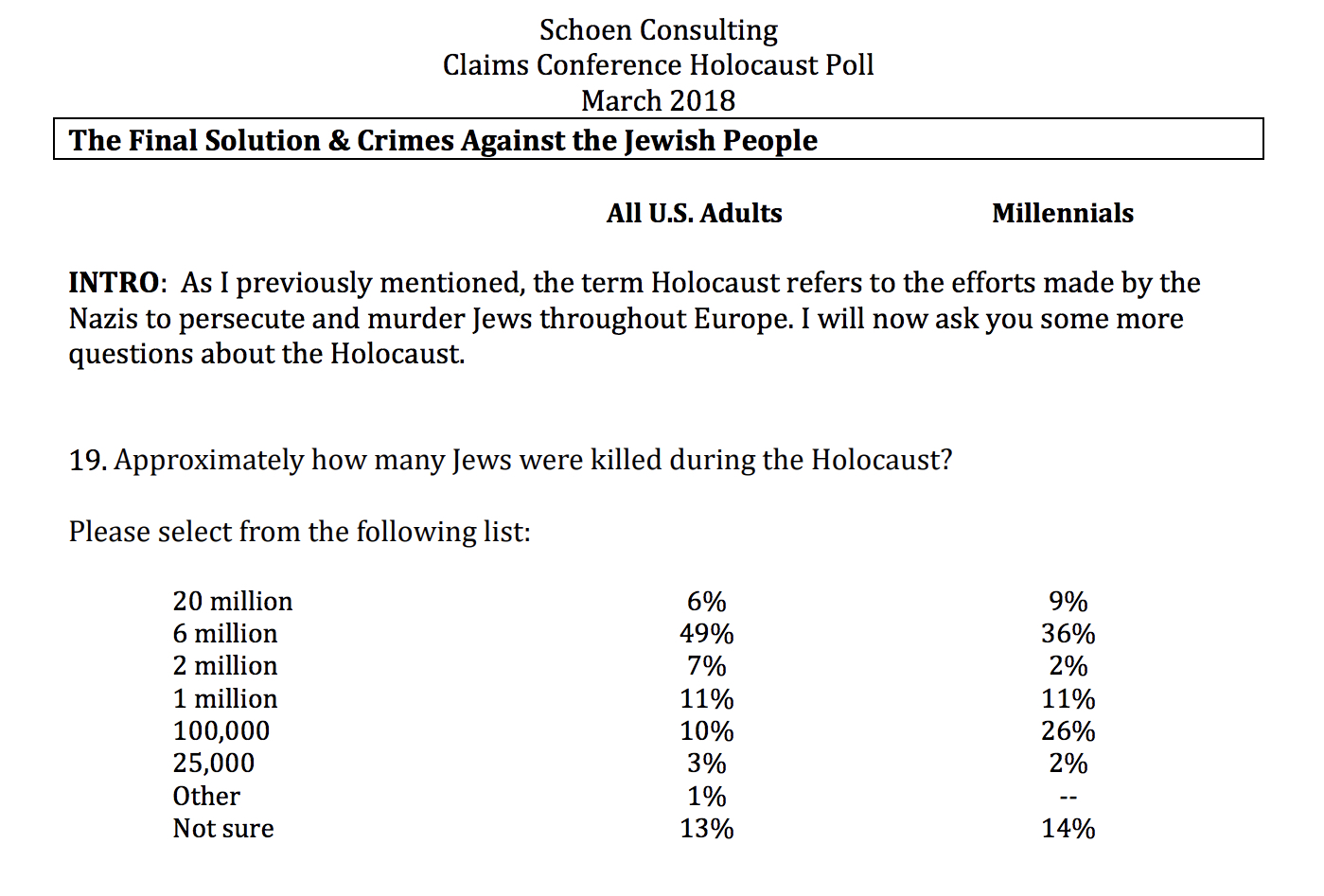
BR: Well, this, the data came from a survey by Schoen Consulting on behalf of the Conference on Jewish Material Claims Against Germany, which was released for Holocaust Remembrance Day last year, if I’m not mistaken. It was a national study of 1,350 interviews with American adults, taken almost a year ago today, in February 2018, with an error of plus or minus 3%.
0:06:25
CW: Okay, so the N equals 1,350 people.
BR: Yes.
0:06:29
CW: That’s not terrible.
0:06:30
BR: That’s not terrible.
0:06:31
BR: No, that is, you know, it is. It’s better than, you know, anecdotes. It is when we say the anecdotes aren’t evidence by themselves. This is what we’re talking about.
0:06:42
CW: I have three uncles and one of them, Uncle Frank, does not believe the Holocaust exists. Therefore, one third of Americans don’t. It’s the opposite of that.
0:06:52
BR: Exactly. So I’ll just go through this quickly. So there’s a couple things that I want to unpack here. First of all, again, the headline says one-third of Americans don’t believe six million Jews were murdered during the Holocaust. Now, don’t believe implies doubt. It implies that you are asked, you know, this is a proposition, this is a claim, this is an assertion, do you believe this or do you disbelieve it? And that you’re saying, oh, you read that to me, no, I don’t believe that, I don’t endorse that.
0:07:25
CW: And by extension, the way the headline is worded there, it seems to mean that that many people don’t believe the Holocaust took place.
0:07:33
BR: It does imply that, yes. I’m sure Newsweek would disagree, but they’re wrong. The question, which is number 19 if you want to take a look at it, didn’t ask respondents what they believe. Instead, what it said, the exact wording is, approximately how many Jews were killed during the Holocaust? And the responses were, in order, 20 million, 6 million, 2 million, 1 million, 100,000, 25,000, other, or not sure. Nobody asked them, do you believe 6 million Jews were killed in the Holocaust? That that is not a question that appears in the survey. And what you find if you go down is that and it breaks it down with adults and millennials. I’ll just go with the adults. As it happens, the vast majority of the of the individual responses, 49 percent correctly identified 6 million.
0:08:25
CW: So OK. All right. That’s that makes me feel good about America. Hey, you correctly remembered the number.
0:08:29
BR: Now, almost exactly half 49% by far the widest margin correctly said it was 6 million. The next highest is not sure. Now understand that not sure doesn’t mean it doesn’t mean you know, surely fewer than 6 million. It doesn’t mean 10. It just means that the person doesn’t know. The person is saying I’m not sure how many Jews. Responding not sure does not imply that it’s less than six million or more than six million. It just says that you’re not confident in your historical data and memory to answer the question.
0:09:07
CW: Yeah, and I want to point out that that would be my answer. I mean, my husband and I discussed this. He was remembering the figure of nine million and he said, oh wait, no, 3 million or there was a large group that weren’t specifically Jewish, you know, they executed a bunch of mentally handicapped people and gays and, you know, other groups of persecuted individuals there and he’s like, yeah, I would have gotten that poll question wrong too. I would have put not sure because I don’t know off the top of my head if it’s 5 million, 6 million, 4 million, 4.5 million, 8 million. So I would have been honest and in answering that question honestly like that from a mathematical standpoint I would have been lumped in with a Holocaust denier. That angers me. That pisses me off.
0:09:54
BR: Yeah, and keep in mind that even among experts there is no dead set answer. The best estimates are between five and six million. So, you know, ironically, even if you are highly educated about the number and you know for a fact that it’s somewhere between five and six million, if you think it’s five million, five million isn’t one of the responses.
0:10:22
CW: So the correct answer to this is not sure.
0:10:24
BR: Well, yeah, I mean, it’s again, it’s it’s it’s it’s sketchy. But so again, I’ll just go through it quickly. So forty nine percent of adults said correctly answered six million. Thirteen percent said not sure. Eleven percent said one million. Six percent said twenty million. So six percent of the respondents actually overestimated by a factor of three. The number of jews killed in the Holocaust. So for all we know that that 13 percent that was not sure, who knows what they thought? As you said, that could have been, they actually could have thought the answer was six million, but they weren’t sure.
0:11:01
CW: Yeah. So how did they get this figure then of what was it, 37 percent of Americans don’t believe that six million Jews were executed?
BR: A third, right. So, basically they added up the numbers that weren’t the correct answer.
CW: That’s so disingenuous.
BR: That is disingenuous. That is, now to be fair, I don’t think that that is necessarily a fault of the show and consulting. Oftentimes the study itself is legitimate. It is it is what it is. They’re they’re not being misleading. But in the amplification of the in the reporting of that, that’s where journalists and headline writers will twist things around.
CW: Yeah, that’s a that’s a disingenuous interpretation.
0:11:58
BR: Well, it is. And keep in mind that particularly with with big numbers, humans are not good at big numbers. No, they’re just not. There’s a mathematician, John Allen Paulos, he has a book titled Innumeracy, and you know he talks in that book about how for the average human, six million, ten million, a billion, the point here is that humans are not good at grasping and remembering large numbers just in general. Anything above a couple hundred, a couple thousand, it’s all the same. You know how far away is the planet? It’s a big way. It’s far, far than I can walk.
0:12:36
CW: Yeah. If you really do grasp the largeness of certain numbers and distances, it makes a lot of sci fi that much harder to suspend your disbelief for.
BR: Exactly true. So so so let’s bring this back down. So if we want to know how many Americans doubt the Holocaust happened, we don’t need to try and guess based on whether people accurately remember a specific number of Jews killed in the Holocaust. We can just look at question number 33.
0:13:05
CW: Oh, in the same poll.
0:13:07
BR: In the same poll, yes.
0:13:08
CW: Oh.
0:13:09
BR: Yeah, we don’t need to, we don’t, there’s much more direct ways of getting at this rather than this backward ass Newsweek way of doing it. Question 33. Some believe the Holocaust did not happen. Do you believe the Holocaust happened? 96% said yes, I believe the Holocaust happened. 1% said no, I do not believe the Holocaust happened. And 3% said I’m not sure.
0:13:32
CW: Wow. I’m surprised that 3% of people actually said they weren’t sure. That sounds high to me, but…
0:13:40
BR: Well, but again, keep in mind that they were not a very… let’s be very clear here. I agree that the answer should be 100% zero and zero.
CW: It should be. It should be.
BR: We’re all on the same page about that. But not sure does not necessarily mean doubting the Holocaust. It means not sure.
0:14:00
CW: Yeah, and and one percent is a far cry from 33 percent.
0:14:05
BR: It is right. So so suddenly the Newsweek headline is a third of Americans are basically Holocaust deniers. If you actually read the study and you take a few minutes to look at it, you find it’s closer to one percent. And if you want to lump in a few of the not sure’s, sure, take it up to two percent, which, by the way, is about the number of flat earthers in America.
0:14:28
CW: This is true. There’s a lot of people who aren’t sure about a lot of things.
0:14:31
BR: Yeah. So I’ll just add that there is a history, unfortunately, of journalists badly mangling Holocaust polls, always invariably in favor of exaggerating the Holocaust denial.
0:14:50
CW: Well, yeah, it’s a way to harvest clicks if you scratch that little outrage itch people love that Ben, tell tell people what’s the title of the article so people can search it Just google it and get it get to it real quick if they want to read it read because you did go into you go Into some other really egregious examples of a poll false magnification there.
0:15:08
BR: Yeah, the title is Holocaust denial headlines, hatred, ignorance or enumeracy. January 7th, 2019 by Benjamin Radford, whoever that clown is. But no, it’s, you know, and I think it’s important because when I saw the circulating, I tried to correct as much as I could. I can’t spend all day correcting people on the internet because God knows that’s not going to do me any good. But, you know, I’m saying, look, you know, it doesn’t benefit anyone to exaggerate the number of Holocaust deniers in America or anywhere else.
0:15:43
CW: If I were a neo-Nazi, it would kind of make my day to read a headline like that.
0:15:48
BR: Yeah. I mean, if anything, it emboldens and it comforts neo-Nazis and white supremacists who feel, wow, you know, people are actually on my side.
0:15:58
CW: Yeah. Let’s get some tiki torches and go have some fun. Everybody’s with us.
0:16:02
BR: Right.
0:16:03
CW: Yeah.
BR: Hey, a third of America, you know, subscribe to our beliefs and especially on on a topic such as the Holocaust. I mean, if there’s any topic that deserves careful, correct information, it’s the Holocaust.
0:16:18
CW: I mean, treat it with some respect. And yeah, you’re right to throw stuff around like that. And to add, there really does seem to be some willful misinterpretation going on. It really does make you complicit with some things. I’m sure these writers don’t want to be complicit with, but they are anyway.
BR: Yeah.
CW: Saying that a third of Americans are are are denying the Holocaust.
0:16:40
BR: And again, you know, the Newsweek editors would say, well, you know, you know, technically speaking, we don’t say, well, it’s it’s, you know, first of all, most as we all know, most people don’t read past the headline. Yeah. So that so the headline is one third of Americans don’t believe six million Jews were murdered during the Holocaust. That is technically true, but it’s it’s very misleading. And I find that offensive, frankly.
0:17:08
CW: Yeah. Like I said, I would have been lumped into that group, too, because I would have I would have checked the box that said not sure because I’m honestly not sure. Well, I’m more sure now than I was but as you said, even the experts are disagreeing on it.
0:17:22
BR: Yes, and also if people are interested, as you know, I wrote a book titled Media Myth Makers, How Journalists, Activists and Advertisers Mislead Us, which has some very similar critiques. Unfortunately, not that much has changed since 2003, so it’s still very relevant.
0:17:36
CW: All right. Well, keep fighting the good fight and let’s get into our main topic now.
(MUSIC)
0:17:44
CW: Well, Ben, why don’t you intro it? You know, you are very familiar with this topic.
0:18:01
BR: I am. This is actually one of my favorite pieces of skeptical guidance, if you will. It’s not specific to a given topic, of course. There’s quite a bit of skeptical information in terms of conspiracy theories or chupacabras or ghosts, whatever else, and of course more and more by the day. But in terms of overall guidance for how to properly criticize paranormal claims, but it actually applies more broadly. And I am, of course, talking about the essay, Proper Criticism, by psychologist Ray Hyman, who’s a longtime friend of mine, and hopefully familiar to all skeptics. And he was, of course, one of the original co-founders of CSICOP, later CFI.
0:18:44
CW: Yeah, I was looking a little bit into Professor Hyman’s background. I did not realize he got his doctorate at Johns Hopkins. Yay, go Blue Jays! But for our listeners, can you give a brief bio? What can you tell us about Ray? I know Disney had its famous nine old men and skepticism kind of has its grandfathers, so to speak, and Professor Hyman definitely qualifies.
0:19:11
BR: Yes, absolutely. I mean, he was one of the gang, along with Paul Kurtz, who, of course, I worked with in Buffalo, Randi, Jim Alcock, and others as well. Ken Frazier, Phil Klass was around the same time. Carl Sagan played a role in that as well.
0:19:28
CW: Isaac Asimov kind of fits a little bit as well. He did a lot of…
0:19:33
BR: Yeah. Exactly. And it’s, you know, we could do a whole show on the interesting crossovers between science fiction writers and magicians and skeptics. So in this particular case, it was a piece that Ray had written, if memory serves, it was actually published in the Skeptical Briefs newsletter, which Barry Karr and I alternatively edited until its unfortunate demise a few years back. And it was actually reprinted in the July-August 2001 issue of SI. And it is sort of the de facto, if you will, Bible for Skeptical Inquirer magazine, which is kind of kind of a good tribute and a little odd.
0:20:12
CW: But it’s a skeptic’s Bible is a fun little oxymoron.
0:20:16
BR: I like that. Well, and it’s again, it’s it’s essentially because it’s in his piece. He basically writes about the fact that there’s no official proper way to criticize paranormal claims. Again, this was written in I think 76, right around the time that CSICOP was founded. So at the time, it was like, hey, we have this cool organization. Let’s investigate paranormal claims. Okay, how do we do that? Well, I don’t know. Let’s see if we can figure this out.
0:20:46
CW: Well, that’s good to begin in the beginning and critique the way that people critique things and see how you want to move forward.
0:20:54
BR: Dr. David Morgan, Jr.: Exactly. At the time that Ray wrote it, he was just saying, Hey, there doesnít seem to be anybody sitting around actually no official rules for how to criticize these things.One of the keys to understanding why it’s important is again his background. He’s a psychologist. And it’s very useful from a perspective of psychology and skepticism because his focus is on what works, what’s effective, how can we promote skepticism. There’s lots of rules and guidance for critiquing books or critiquing logical arguments or critiquing art or performances, what have you. But there wasn’t really any formal, anybody had given much thought to, hey, if someone’s talking about UFOs or Bermuda Triangles or astrology, what’s the best practices approach to it? And that’s sort of what Ray came up with.
0:21:53
CW: I appreciated the fact that this, as a person who has had to adhere to my own Bible of sorts, the Chicago Manual of Style, the best style guide out there.
0:22:01
BR: Yeah, Chicago.
0:22:02
CW: All the AP style guide people are up in arms now. Rah, rah, rah. I don’t know.
BR: Chicago is the it’s number one, man. That’s just how it is. Just just deal with it.
CW: Anyway, having put in…
BR: Nerds fighting it out on Scoring the Strange.
0:22:21
CW: Yes. Have people are people are turning it off right now. Anyway, having put many, many hours into looking at a style guide and also understanding a little bit about psychology, psych minor, Johns Hopkins, class of 94. I appreciated how Hyman really brought together the essence of a style guide, both form and psychology, function. You want to get a point across, you want that point to resonate with people, and you want to do it in a way that is That is respectful and diplomatic and graceful and I mean that’s the reason why people use style guides I suppose to keep your writing elegant graceful and adhering to the common rules of Civilization so to speak to sound lofty and ivory tower there, but…
BR: Do you want to do that again in a British voice?
0:23:06
CW: No. I did I did want to point out that looking over the work by by Ray Hyman, I was impressed in how much it has actually seeped into just common thought. I was having a discussion with somebody on Facebook just yesterday and we were talking about books and she brought up a concept that I had recalled reading about, namely that sometimes it’s called analysis paralysis, where if you give somebody too much information or you just shotgun them with a million choices, that freezes them up and they won’t be able to make a choice or they won’t be able to make a good choice. And in looking at Ray Hyman’s work, I discovered that that is the Hick-Hyman law. He actually came up with that years and years ago. Let me see here. It’s quoted in a particular paper showing that, quote, human choice reaction time is related to the information content of an incoming signal called the Hick-Hyman law. And I believe I believe Professor Hyman was just a graduate student at the time, but he still got to put his name on the paper, which is awfully nice.
0:24:14
BR: And again, and if people aren’t familiar with Ray’s work, it’s definitely worth looking at. He’s just a real deep, skeptical thinker. One of the things and this isn’t about Ray himself, but I’ll just throw this out there. One of the things that Ray did, and he’s talked about this at conferences and elsewhere, is he was curious about the psychology of fortune-telling. And I’m sure you know the story and probably many of our listeners do as well. I think it was in college. And he was curious to know what would happen if – because he’d read up on palmistry and all the guidebooks on how to tell tell fortunes read palms and And he was curious to what would happen if he told people the opposite of what their their heart lines or love lines actually said on the palms and I don’t give too much away but much is surprised they loved it. They thought he was even more accurate than ever before Hold it here. Hold on How is it that I can read the palms exactly the wrong way from what these various guidebooks say to do, and yet they’re like, wow, you really got me. I can’t believe this is amazing.
0:25:20
CW: Yeah, a little bit of the Barnum effect and a little bit of self-deception goes a long way.
0:25:27
BR: Exactly. So for those who haven’t read up on Ray’s work, it’s well worth your time.
0:25:30
CW: Okay, well, let’s get into the content of the essay itself, Hyman’s proper criticism. He nicely put it into a list for us, didn’t he?
0:25:42
BR: He did. It was very useful. It’s got eight points to it, and we’ll touch on all of them, and I’ll wax lyrical or elucidate on some of my favorites, but let me just read briefly from the preface. He talks about, many well-intentioned critics have jumped into the fray without carefully thinking through the various implications of their statements. They sometimes displayed more emotion than logic, made sweeping charges beyond what they can reasonably support, failed to adequately document their assertions, and in general, failed to do the homework necessary to make their challenges credible.
0:26:15
CW: Asterisk, I just want to point out to people that that statement was written well before Facebook became a regular thing.
BR: Yes, exactly.
CW: So it was very prescient in how forward thinking he was because we see that every day on Facebook now.
0:26:32
BR: Yes, that is.
0:26:33
CW: Every thread.
0:26:34
BR: That was a, it’s right there. There’s nothing new under the sun. And he says, until such courses and guidebooks come into being, again, sort of saying, hey guys, this is how we do it. What can we do to ensure that our criticisms are both effective and responsible? To me, that’s really the keys here is he’s saying what works, right? Not just, you know, cheap digs at people, not just, you know, gotcha moments, but sincerely, substantively responding to claims from a reason point of view. And also not just what works, but what’s responsible, what’s ethical in terms of trying to educate people and not misconstrue them and to put them into straw man fallacies.
0:27:17
CW: Yes.
0:27:18
BR: And one of the reasons for this, and again, it’s incredibly pressing, when you realize that this was written in the mid-70s, one of the issues is that skeptics often try and sort of help out. And I’ve seen this many, many times, I’m sure you have as well, particularly with like local groups or something. And they’ll be they’ll be on TV, the sort of skeptics air quotes debunking something with with bad arguments. You know, we’ve all seen that. It doesn’t happen all the time, but it happens enough. And, you know, I’ve I’ve seen it. And Joe’s talked about it. And this is this is nothing new. But it’s really a problem. Number one, if they’re saying things that don’t don’t actually aren’t actually good arguments, then it just makes all skeptics look bad because they say, Oh, well, this skeptic was on TV saying that all UFOs are weather balloons. Like, no, no, thatís not right. And also, if they happen to meet up with a knowledgeable believer, theyre in deep water because theyíre not familiar with the arguments. Theyre not familiar with, you know, they may have, oh I have a little gotcha thing, you know, this is really this, ha ha ha, and then the believer says, well actually in this case, like, yeah.
0:28:35
CW: Yeah, or not even necessarily with a very armed believer but with an armed audience. If you have an audience of people who can tell, and I think a lot of people don’t give enough credit to the audience, it’s not just an audience of dumb people out there. There’s smart people watching and reading and consuming all this media. If the skeptic is the one that looks dumb up there because they are debunking something or explaining something, but they’re using a bad argument to do it, they could be right. But if they’re using a bad argument to be right, they appear to be wrong.
BR: Yeah, you’re exactly right. They’re shooting themselves in the foot.
0:29:18
CW: It harkens back to the episode we did on pseudo experiments. If you have a pseudo experiment that is in the name of quote-unquote proving a social ill or showing something that needs to be corrected but your methodology is all wrong, it just shoots you in the foot. It makes it look like, oh no, you’re just trying to invent a problem and the problem might be real but you just can’t approach it that way because it looks dumb.
0:29:34
BR: Right, exactly. And that’s a great analogy, the pseudo-experimentalism. I’m glad you brought that up. But part of the goal for proper criticism is to create quality criticism that will stand the test of time. And so, you know, to this day, I still read skeptical books from people like Randi, Joe, Phil Klass, and others from the 1970s and 80s because it’s it’s quality, you know, it’s it’s it’s just as relevant as it was in 1978 it stands the test of time and I would encourage people The next time you’re in a bookstore or you’re in in the library or something Look at the shelf on the New Age. Look at the shelf on angels or UFOs or take your pick miracles just look at the deluge of believer literature and it’s all the same stuff. It’s experiential, it’s anecdotes, it’s this or that, it’s using the same stuff. I like to think that the quality of skeptical work will stand the test of time and all the books, all the sort of quickie books by amateur ghost hunters or whoever else, it’s literally one in thousands, one in tens of thousands and no one’s gonna read than in 20 years from now because they’re all the same. It’s like, oh, hey, I’m the local, you know, ghost hunter for Western Oklahoma and I went to this place and this thing scared me and nobody cares. Nobody cares. It’s, you’re not, it’s not substantive. It’s not quality evidence or criticism. And so that’s, I think that’s one of the goals that Ray has here is to, is to help everybody, including believers, to up their game. I’ll just briefly quote one section here and Ray writes, If we envision ourselves as the champions of rationality, science, and objectivity, then we ought to display those very same qualities in our criticisms. Just by trying to speak and write in the spirit of precision, science, logic, and rationality, those attributes we supposedly admire, we would raise the quality of our critiques by at least one order of magnitude.
CW: Well said. Well said.
BR: Thank you. I just I just I just read it. I didn’t write it. But I meant it when I said it.
CW: Yes. OK. Well, that’s the important part. Yes. All right. Well, let’s get to what’s let’s just read them off by number. Go for it, Ben.
0:31:53
BR: OK. So number one is be prepared.
CW: No. Hey, he stole that from the Boy Scouts. I’ve seen that one before.
BR: That’s not a new one. I’m skeptical. So, Celestia, talk about how you’re interpreting that one.
0:32:11
CW: Well, don’t shoot your mouth off before you’ve done some research.
0:32:16
BR: I like it. I like it.
0:32:22
CW: Well, here he says here, try to prepare in advance effective and short answers to those questions you are most likely to be asked. That is very good advice especially as I read through his description of this, I was hearkening back to the guys on the SGU and they did a whole episode once about dealing with the media, being a skeptic, a talking head on a television show and they especially talked about Dr. Steven Novella’s appearance on the Dr. Oz show where they were just ready. Every possible thing that they could cut out or edit or just do in a sneaky way to make it look like the skeptic was stumped, they certainly tried. And part of being prepared for that was knowing what they should avoid saying, knowing how they should phrase their answers so that they couldn’t be edited down to mean the opposite of what they were trying to get across. Being prepared can mean a lot in this day and age.
0:33:25
BR: Absolutely, and part of being prepared, particularly when you’re doing investigative skepticism, and it’s sort of self-evident, but to many people it’s probably not, is the skeptics, because of the nature of what we do, we have to read the believer claims in order to assess them, right? So if someone, for example, is writing about a miracle statue or a UFO sighting or whatever else, is in order to effectively critique it, you have to read it. You have to, and you have to read it with an open mind. You have to sincerely try and understand what they’re trying to say and try to understand what are the witnesses saying, what are the claims saying, and all these sorts of things. And there’s an imbalance there because oftentimes the believers don’t feel the need or the responsibility to read the skeptical rebuttals. Over and over again you see this where ghost books or miracle books or whatever else, it’s this bubble. It’s either they’re not aware of the skeptical critiques. And oftentimes that’s the case. I mean, I’ve talked to people and they’ll talk to me about ghosts. And I’ll say, you know, people actually have made efforts to validate these things or psychics. And they’re like, what? It’s like, yeah, psychics. I mean, perfect example. I mean, people have tested psychics? Yeah, that is not a new thing to us. Welcome to our world. Yes, people have actually conducted tests of psychics and dowsers and they failed. And here’s literature you can read about. I mean, there’s all and some people, they’re just, you look in their eyes are just like, they’ve never heard of that. They’re all because all of the TV shows, all the books, all the cable shows, they don’t show that. They just show, hey, isn’t this weird? Isn’t this wacky? This is wild. And they don’t give any real service to the skeptical side. So they’re often not aware of it. And I think that’s one of the reasons why, you know, when people come up to me and talk about, you know, seeing Skeptical Inquirer magazine or coming across the podcast, and they go wow, I didn’t know that!
0:35:31
CW: I do like the notion of understanding the other side. And that’s that’s like if you’re a political candidate, candidate that’s going to go up against another political candidate, the best possible ammunition you can have. And I believe this some of this kind of got led to a brouhaha in the recent election, the best ammunition you can have is the other person’s talking points. And so, of course, if you’re a skeptic examining the talking points of a psychic or a ghost hunter or any number of other paranormal claimants, you want to understand their talking points so that you can be prepared to discuss them and rebut them and point out flaws in logic and everything. And another thing he put under the be prepared rubric was whenever possible, try your ideas out on friends and quote unquote enemies before offering them in the public arena. And I’m recalling back to a writing seminars class I took where somebody said, when you give, when you, when you send your first novel out, or you, you’re having people read your script over, you don’t want to give it to your friends, give that script to your worst enemy. Get as much criticism as you can. Again, something my mother always told me, honest criticism is a thousand times more valuable than empty praise.
0:37:06
BR: Absolutely. It’s unfortunate that oftentimes the Bigfoot believers and the ghost believers, when people like you or me or Sharon Hill or Dan Loxton or someone else critiques their work, we’re not trying to be mean. It’s not – I don’t know you. I’m not trying to be malevolent or I’m not trying to hurt your feelings. I’m trying to show you where your mistakes are and this is something that I’ve dealt with for years, particularly with my Go stuff. It’s a case of, as they say, a person who doesn’t understand the other person’s arguments doesn’t fully understand their own because you need to have that grist for it. When I was going to the University of New Mexico, I took several classes in argumentation and logic and just, again, argumentation, the idea of a warrant and a claim. And I know all this sounds very nerdy and all that, but just being engaged in that is really helpful in terms of trying to parse out, oh, this is a claim. This is – and you don’t need to diagram these like a sentence, but you need to have a grasp of what’s what. And that’s especially true because oftentimes, particularly in investigative skepticism, you find recurring arguments over and over and over again, right? Because it’s an echo chamber, right? So the Bigfoot believers, they just repeat the stuff they saw on finding Bigfoot when they haven’t found Bigfoot. Ghosts on the road. And so when you actually meet the investigators, and so for example, someone comes up to me and says, well, you know, well, you know, of course, ghosts are energy. So where’s the energy go when someone dies? And it’s like, well, I can answer that. Sure. The answer is that the energy you’re talking about is in the form of heat. So, for example, that’s why you have a body heat. And so there’s other energies as well. But, you know, the energy you’re talking about is a physical energy, it’s not some metaphysical one. There’s nutrients in your body that go into the ground as you decompose.
0:39:24
CW: You really do prepare, that’s a lot more than I think the average person would go into if they were challenged as to what happens when you die.
0:39:35
BR: It took the time to research and come up with a good answer for that specifically because I’ve been asked that several times.
0:39:43
CW: That’s what Ray Hyman says, consider the most popular questions you’re going to get and make sure you have answers at the ready.
0:39:50
BR: Exactly. So after the second or third time of being asked, okay, Mr. Skeptic, where does the energy go when someone dies? I’m like, oh, let me do, oh, okay, here you go. And I’m not trying to be mean, it’s just like, oh, well, since you asked, you know, here’s a three-minute explanation. And they just sort of, oh.
0:40:08
CW: Okay. Well, clearly, number one, be prepared, is probably our favorite.
BR: Yes.
CW: But we can’t spend this much time on all of them, so let’s move right along. Number two, clarify your objectives. Boy, that’s a sanity saver right there.
0:40:26
BR: Absolutely. Know what you’re trying to do. Understand what your role is in trying to debunk a claim. Are you trying to make someone look foolish? Are you trying to educate the public? Are you trying to win a bet? What exactly are you trying to do?
0:40:45
CW: Yeah, and also that should be informed with what do you think it’s possible to do? I mean, is it really possible to convince your great uncle Larry during Thanksgiving dinner that Obama was born in America, or do you realize that that’s just completely not a possible goal, but you still want to argue with Larry, just for fun, just to keep your chops up. If that’s your objective, make sure you’re clear on that in your own head. You know what you’re going for.
0:41:13
BR: Absolutely. And in that category, Ray also talks about trying to make it clear that you’re attacking the claim and not the claimant. And this is a constant problem where oftentimes, particularly a believer or particularly an eyewitness will be so emotionally invested in that sighting. For example, a Bigfoot sighting or a lake monster sighting in the case of Sandra Mansi or whatever else that their, their identity, and this especially happens with psychics, where they are known as, and they think of themselves as a healer, psychic, helping the spirit guides, helping this and that. When you question their claims, oftentimes they interpret it as an attack on their integrity or their sanity. And I’ve tried over and over again. I say, look, I don’t dislike you. In fact, I like you. I think you’re really neat. I just I I’m I’m questioning one specific claim. And just because I’m questioning whether you can, in fact, predict the future or talk to the dead doesn’t mean that I think you’re stupid or crazy. It just means that I I’m asking for evidence for this one thing. And, you know, Ray’s point is a very good one. And it’s often, you know, much, much harder to do in practice.
0:42:26
CW: I am definitely recalling the the notorious debate between Ken Ham and Bill Nye. And, and Bill made it clear, you know, because because people kept attacking Bill saying, Oh, yeah, he thinks he’s gonna make a dent in Ken Ham. Oh, he’s, yeah, Ken Ham is gonna walk away from this so called debate, not only proclaiming he’s won, but thinking that he’s won. And there’s no way that Bill Nye, even if he makes every point perfectly, he’s not going to actually win the debate. And Bill Nye was clear from the beginning, that’s not my objective. His objective was clear. He’s like, I’m there to talk. I’m there for the audience. I’m there for the section of the audience that is on the fence. And and I think it was a worthwhile exercise in that regard.
BR: Yeah, absolutely. So number three on the list is do your homework.
CW: I don’t want to do my homework.
0:43:15
BR: Homework.
0:43:17
CW: It’s more fun to just yell and wave my fist.
0:43:19
BR: Yes, just all caps. Oftentimes all caps is a good alternative to actually doing your homework.
CW: You know that is a good bumper sticker. All caps is not a substitute for doing your homework.
0:43:32
BR: Yes, we need to trademark that and put it on a bumper sticker and sell it through Squaring the Strange. Maybe we’ll do it as a gift for our donors, our wonderful, delightful donors.
0:43:48
CW: You hear that, audience? That right there is Ben making work for me.
0:43:52
BR: Yes. Do you hear that? Ka-ching!
0:43:55
CW: He loves doing that. Okay.
0:43:57
BR: So speaking of being prepared and making work for you, yes. You know, this goes back to the first one in terms of, you know, show up and know what you’re talking about. And be prepared. Yeah, yeah. I mean, for example, you know, before I go on a TV show to discuss a claim, I’ve often spent hours preparing for this. I don’t just go in cold. And sometimes, even if it’s something that I literally wrote the book on, like Bad Town or Chupacabra or whatever else, I’ll still spend 15 or 20 minutes just refreshing my memory just because I can’t have all the facts and stuff on the top of my head. So you really do need to go and prepare because especially if you have a potentially hostile audience, maybe a hostile interviewer or you’re the token skeptic in a bigfoot crowd, you gotta have facts at your disposal or in some cases, don’t be afraid to say, I don’t know.
0:44:51
CW: Well that brings us right to number four. Do not go beyond your level of competence.
0:44:57
BR: Yes, yes. We see this all the time. I mean, isn’t that part of the Dunning-Kruger effect, the notion that, well, you know, hey, I’m so competent.
0:45:07
CW: Well the Dunning-Kruger effect always makes me worry that I am without realizing it going beyond my level of competence.
0:45:14
BR: Well you are remarkably competent so let me just say that.
0:45:16
CW: Oh yeah so you say but I hear this all the time in in debates by people who I admire like Matt Dillahunty is one of my favorite people listen to in terms of debating and he is not afraid of just saying I don’t know that’s not my job if somebody asks him oh you don’t think there’s a God well then how did how did the whole universe come from just one single, you know, speck? Like, how did the Big Bang happen? And he just says, I’m not a cosmologist. I don’t know. I can read the theories, but I don’t know. If you want to know, you should spend 10 years going to astrophysics school.
0:45:53
BR: Right. Or, you know, one of the common ones, of course, we’ve all seen is quantum.
0:45:58
CW: Oh, quantum answers all.
0:46:02
BR: Yeah. I actually had that just in the last week or two. I was talking to somebody about ghosts and all of a sudden quantum comes in. I was like, I’m sorry, are you?
0:46:12
CW: Like it’s a mic drop. Quantum means I can drop the microphone, take that skeptic.
0:46:17
BR: Quantum! I’m like, you know, I’m not a quantum physicist. I didn’t realize you are. Tell me more about it. Well, you know, according to theories and Deepak and quantum…
CW: Did you see that Deepak Chopra talk that was on YouTube somewhere and somebody stood up in the audience raised his hand he goes, um, I am a quantum physicist, you know With with a degree in quantum physics, and I just like to explain to you and he proceeded to tell him how he was wrong about assigning all these properties to quantum physics that you just can’t. So that was delightful. Yeah, but in that case, he was not speaking beyond his competence. That was his field. And it is important to understand and to sort of just, you know, let yourself off the hook when it comes to knowing stuff, because nobody can be an expert on every single subject out there. I mean, maybe 500 years ago, when all of humanity’s knowledge could probably be contained in a library like a brick and mortar library with a hundred books. But nowadays, human knowledge is so vast that you just can’t be an expert on even half a dozen things unless you’re one of those super geniuses. So don’t try and make yourself.
0:47:33
BR: And there are certain fields that are just so deep that it’s just difficult to be an expert on anyway. I mean, one example is UFOs. I mean, I am an expert on some aspects of UFOs. I’ve researched specific crashes, for example, the Aztec crash, the Roswell crash, and a couple others. I end alien abductions, because that goes into psychology and things like that. But the UFO feeling, there’s so many aspects and intricacies and stuff like that. And so oftentimes if I’m asked by a TV producer, hey, we need something in depth on UFOs, my answer is go talk to Robert Schaeffer. Before that, Phil Klass. I mean, I know a lot about it. He knows infinitely more than I do. And I am more than happy to, and I want to direct journalists and TV producers to the best people. So if I’m being asked about the Bermuda Triangle, I’ll say, well, I can give you an overview, but you really need to talk to Larry Kush. He wrote the book on that. Or if it’s magic and deception, go talk to Banachek or Jamie Ian Swiss. Or if it’s psychic cases, maybe go talk to Richard Saunders or Gary Posner or Joe Nickell for The Shroud of Turn, things like that. Because I don’t know everything, and I would rather have people talk to people who really have the depth. And the flip side of that is oftentimes they don’t want the depth. And that’s what gets frustrating to me is when, I mean, because they’re like, look, this is great. I’m glad you’ve given me the true expert, but you know, this is going to be a three minute segment. And so we just don’t have the time to get into that sort of depth, in which case I’m like, well, all right.
0:49:11
CW: We only want the first page of Google results.
0:49:14
BR: Exactly.
0:49:15
CW: But actually, this particular one, number four, do not go beyond your level of competence and don’t be afraid to say, I don’t know. I think this is one that should be ingrained early in life. I think kindergarten teachers, parents of young kids, I remember Pasquale saying that his grandmother once praised him highly for saying, I don’t know, one time. And if you think about normal situations, if you have a bunch of kids and you’re asking them questions and a kid says, I don’t know, sometimes they’re ridiculed for saying they don’t know or they’re just like, oh, well, you don’t know. But Billy over here, he knows. No, no. The kid who says I don’t know should receive some praise for number one, being honest about it, because believe you me, you have a lot of kids lying and making crap up just because they want to have an answer rather than saying I don’t know. And that leads to adults making crap up instead of saying I don’t know. Boy, I wish Congress would just say I don’t know instead of all thinking they’re experts on climate change. And so it starts young. Tell your kid, pat them on the back when they say they don’t know something, say I’m glad you said I don’t know.
0:50:24
BR: Glad you recognize that.
0:50:25
CW: Yeah, because the first key to getting knowledge is understanding where you have an absence of knowledge. So, good on you.
0:50:32
BR: Absolutely. I actually recently wrote an article that will be published in Skeptical Inquirer magazine. It’s titled Option D. Can you guess where that comes from, probably? Because you’re smart.
0:50:47
CW: The Kobayashi Maru.
0:50:49
BR: No. Option D is usually the answer on, for example, the SATs or LSATs that cannot be determined from the information given.
CW: Oh, yes.
BR: And so, you know, here’s a question on a standardized test. Here’s three questions. Oh, by the way, if you recognize that you don’t have enough information to answer the question, it’s usually option D. And so, I don’t know when this this podcast is going to air, but if at some point you’re interested in in more on that option D.
0:51:20
CW: All right.
(MUSIC)
0:51:20
Russ Dobler: Hi, everyone. My name is Russ Dobler and I am the science editor for the website AIPT Comics. We have the most new comic book reviews every Wednesday, plus movies, gaming, cosplay and more. Including my own little fiefdom on science and skepticism and entertainment. There’s no place like it anywhere else. We’re not just about the physics of Superman, we like the methods of science too. So come for the reality behind your favorite fantasies, but stay for the critical angle on pop culture from box office to Bigfoot. And every February, to help celebrate Darwin Day, we turn the skepticism up to 11. Last year we had Ben Radford himself contrast the Scooby-Doo Gang with other TV ghost hunters who haven’t solved a single damn mystery, along with UFO investigator Kurt Collins on the reciprocal relationship between real flying saucer reports and their depictions in film, and my own article on superstition in tabletop gaming. This year we critically examine whether comic book collectors are really afflicted with obsessive compulsive disorder. We’ll take a special look at the time the Survivorman came up against Bigfoot. And we try to figure out just what it means to be skeptical in a fantastic place like the Marvel Universe. So check out AIPTComics.com or AIPTComics.com slash science for skepticism month this February. Or anytime, really. We post at least two science or skeptically themed articles every week. And you can even contribute! AIPT Science is a grassroots effort that enables anyone who wants to contribute to help bring the best skeptical research out of the echo chamber and into the rest of the world to the people who really need to see it. There may even be a review of a certain book on these scientific search for spirits this February, perfectly suitable for sharing. That’s AIPTComics.com slash science for all your skepticism in pop culture as well as all of your skepticism of pop culture.
(MUSIC)
0:53:20
CW: And moving right along, number five in Hyman’s principles here is let the facts speak for themselves. And I like that one that kind of takes the burden off of you, sort of. You have to supply the facts. You have to collect the facts, do your homework, be prepared, and then throw them out there. mentions something that’s important in anybody that’s doing public outreach skepticism where you could be Possibly sued by someone. Mm-hmm if if you want to call somebody a fraud That opens you up to quite a bit of legal Legal liability or potentially libelous actually. Yes, but if if instead of calling them a fraud you say well look Here’s this other evidence that I found. It happens to go directly against what this other person is saying. Well, everybody can see that that makes sense, that so and so is not telling the truth. And you don’t necessarily have to be the one that says that person is a liar.
0:54:40
BR: Right. For example, I mean, we might we could talk about the formerly with us convicted felon, Sylvia Brown. We could just mention that she does, in fact, have a felony conviction, or she did, she’s now dead. So, you know, does that prove that she is a fraud in her psychic readings? No. Does it prove that she has engaged in fraudulent criminal activity in the past? Yes. As decided by a court of law? Yes. Not just opinion. This is… Yes. So, you know. And Randy often has said, you know, can I prove that what, you know, so-and-so is doing is a magic trick? I can’t prove that he’s doing it by means of magic, but I can show you over here. I’ll do the exact same thing by means of Precision by means of it and I’ll show you exactly how I’m doing it this way I’m not saying that’s the way he’s doing it, but I’m saying that what he’s doing sure looks exactly like this.
0:55:38
CW: Isn’t that crazy? Let’s invoke Occam’s razor here, right?
0:55:42
BR: Yeah. And I think part of it is just assuming that your readers aren’t stupid. And that’s, you know, if you’re letting the facts speak for themselves, you’re respecting your reader’s intelligence. And you’re saying, okay, well, you know, I’ve laid all this out, you know, here it is. And that’s what I try to do in my books. I say, look, you know, I’m not saying that chupacabras cannot exist. I’m just saying that I’ve spent the last 250 pages looking at all the different aspects. You come to your own conclusion.
0:56:10
CW: Yes, yes.
0:56:11
BR: I think the next the next one is it’s kind of it’s kind of fuzzy. No, it’s be precise.
CW: Be careful how you describe that, Ben.
0:56:21
BR: It’s kind of fuzzy. It is, yes, the next one we’ll talk about is being precise. He said precisely.
0:56:28
CW: Yes, I this this one is close to my heart. Being a copy editor for so long and I’ve had discussions with my brother, who is a patent lawyer, who has to be very, very careful with the precision of language used in every in every aspect of his work. He and I have both discussed how we are unusually bothered by imprecision, even in casual conversation with like friends and family members to the point where stuff bugs us that we should really just let slide off of our backs. Imprecision is a problem.
BR: You do notice how often I’m called out for being a peed ant on social media, right?
CW: Yes, and you embrace it. We did a whole podcast in defense of pedantry.
BR: Yes, indeed. Yeah, I think that being precise is really, it’s an easily overlooked one. Like, oh, of course being precise. Like, no, no, let’s be very clear about this. This is especially true when you’re trying to establish a claim, right? And so if I’m investigating, say, a Bigfoot sighting, and someone says, well, I saw something over there and it sort of went over that way, there’s nothing I can do. I don’t know what that is. What what did you see? I mean, you may not be able to identify it was an axe, but give me I need I need precision. Was it was it light colored with a dark colored? How many feet did it have? What? Where exactly did it go? Did it go on the road? Did it go in the muddy area right next to it? Any details not just sort of vague claims?
0:57:58
CW: You’re approaching it like a police officer taking a report.
0:58:01
BR: Yeah. And the same is the same thing. You know, when we talked with Richard Saunders about the million dollar challenge and the difficulty of testing claimants and, you know, Jim Underdown and others as well have done this, where oftentimes that’s the most difficult part. He’s like, what can you do? Well, I kind of no, no. What exactly can you do and under what circumstances? Well, you know, sometimes, sometimes I get this feeling and like, no, it’s like, we can’t test that. Like, you can manipulate objects, you can predict tennis scores. I don’t care what it is, but I need you to tell me exactly what you can do, because that’s the only way we can design a test to an experiment to test that. And often it’s like pulling teeth. People aren’t used to thinking with that level of precision.
0:58:51
CW: Yeah, well, and Ray Hyman was not just talking about the precision involved in pinning down what a claimant of the paranormal might be claiming that they can do, but also the precision in making yourself understood, telling the media what you mean and what you don’t mean. And again, that goes back to, well, guarding yourself against lawsuits by making sure that you aren’t speaking beyond your competence, making sure that you aren’t overstating things yourself, all in the name of getting your point across and having the facts out there uncluttered by a bunch of your own internal emotions or something.
0:59:29
BR: Yeah. And oftentimes, and I think this is sort of the subtext to it, is that oftentimes ambiguous or fuzzy words or concepts reveal ambiguous or fuzzy thinking and obfuscation. If you’re someplace and someone is talking about holistic energies and chakras, and you raise your hand like, what energy are you talking about? Well, the body’s energy, the body’s vibrations.
0:59:56
CW: Precisely what do you mean by that?
0:59:59
BR: How do we measure those? What can you, what studies are you, can you, are there published studies that have measured these vibrations or, well it’s energy, like no, no, no, no, don’t go back to the energy. We got past that, I’m asking what specific energies, what specific, what are you talking about? And oftentimes again, it’s just sort of like fuzzy words, fuzzy language, imprecise language, it’s easily used to obfuscate and to sort of cover up the fact that they don’t know what they’re talking about.
1:00:27
CW: Yeah, or or it can be it can lead to people taking the wrong message away from any number of things I I sometimes read articles just for fun in terms. Well, not just for fun But I sometimes when I’m reading an article, I just kind of break down the language into wow that sentence means nothing that They you know, they’ve put a lot of flashy adjectives in there, but when you get down to it, there’s no precision there. It doesn’t say, this chemical has been found to be harmful by these scientists in this study, here’s the damage done and blah, blah, blah. It just says, this chemical is not found in nature.
1:01:09
BR: There you go then.
1:01:11
CW: What precisely does that mean? I mean, number one, it is in nature. It’s a chemical. We are in a natural world. It’s not a supernatural chemical.
1:01:19
BR: Check out the periodic table of the elements sometime. It’s really pretty cool. Everything’s there, literally.
1:01:24
CW: Yeah. Number two, it doesn’t tell us if it’s bad or not, if it’s just not found in nature. There’s plenty of good things that aren’t found in honeycombs in your backyard. Yeah, anyway. Precision is very necessary to have people understand what point you’re trying to get across and also having people not misinterpret you.
1:01:44
BR: And one of the problems is that in our everyday lives, at least for most of us, we speak imprecisely. We say things we don’t literally mean. Our default state of language is not precision. And when skeptics ask for that, it can seem confrontational. It can seem, well, oh yeah, I said that, but you know what I mean. Like, well, I don’t really know what you mean, and me asking you to clarify isn’t me being mean or challenging you. I just, I’m trying to understand what you’re saying.
1:02:15
CW: It has taken me the better part of 15 years to make my husband understand that I’m not trying to pick a fight when I ask him to be precise. I’m still working on it sometimes. It’s like he’ll say something I’ll be like, wait, did you mean X or did you mean Y? Well, no, wait, wait, wait, wait, wait. Did you mean are you because I’m asking if A or B or C or…
BR: Not criticizing to try to understand what you’re saying for a mutual benefit, honey.
CW: Yes, yes. So so yes, like I said, as I have told you in discussions with my brother, we have both by imprecision.
1:02:53
BR: Ah, my people.
1:02:54
CW: I’m even bothered by my own imprecision. Like this podcast drives me crazy when I listen to myself and have to edit. It’s like, oh, if I had been able to write that down, I would have been able to express that thought so much better.
1:03:08
BR: That would be that would be number one. Be prepared if you well.
1:03:11
CW: Yeah, but I can’t. That’s beyond my level of competence to adequately prepare for everything we could possibly talk about and write it down ahead of time. That’s that’s beyond my level.
BR: Fair enough. Which leads us, fortunately, to number seven, which is.
CW: Use the principle of charity.
1:03:27
BR: Yes.
CW: For for for your co-hosts and other people you run into.
BR: Yes.
CW: And they don’t mean charity like to give them money?
1:03:37
BR: Not necessarily, although this is a listener funded podcast.
1:03:42
CW: We do have a Patreon account if you do want to use the principle of charity in terms of giving us money. We’d be happy to take some of your hard earned cash every week and put it towards the making of this podcast. Maybe I will get to the point where I can write everything down. Who knows?
1:03:58
BR: You know, folks, Celestia needs pencils and pens, scrap paper, the bank of envelopes, the back of all of us, send her whatever you have later on, and she’ll put it to good use. No. So what Ray is talking about, obviously, is, I’ll just read it from him. So, being charitable to paranormal claims is simply the other side of being honest and fair. The principle of charity implies that whenever there is doubt or ambiguity about a paranormal claim, we should try to resolve the ambiguity in favor of the claimant until we acquire strong reasons for not doing so. In this respect, we should carefully distinguish between being wrong and being dishonest.
1:04:39
CW: I like this one. And just in proving that Ray Hyman’s ideas have withstood the test of time and are, you know, they’re bubbling up again in what people think are new ideas, but they’re not really new. Have you heard the phrase steel manning? It’s popped up recently.
1:04:58
BR: Oh, sounds like porn. No, I don’t think I have.
1:05:04
CW: I’ve heard it on a number of debates and podcasts where to steel man your opponent’s argument is to, It’s like the opposite of strawmanning. Instead of just casting their argument as some weaker, ridiculous form of their argument, you take their argument and you try and bulk it up to the most, you know, okay, well, how could that be correct? And you try and get into their head and say, okay, well, why do you, what’s the strongest form of this argument that there is? So that you can then argue with that version of the argument rather than strawmanning them. That is using the principle of charity. So you’re charitably thinking about, okay, what are the good parts of their argument and I’m going to assume they’re honest about it. I’m going to assume that they are not out of their head, that they just really mean this best version.
1:05:55
BR: Yeah, I think that’s good advice more broadly, of course. In this case, he’s talking specifically about paranormal claims, but I think it’s important to be charitable across the board with any arguments. And you see this all over and over again where, you know, we see bad things in the world. We see things going on with politics and with racism, this and that, and we see bad things going on, and there’s a natural tendency to attribute malice to them. To say, well, things are bad because someone wants it bad, because the shadow government or the Reptilians or the Republicans or Democrats or liberals, whoever it is, so, you know, things aren’t the way I want them to be because someone is trying to make them that way. And, you know, sometimes that’s the case, sometimes it’s not. And, you know, as they say, it’s important not to attribute malice to something that simply might just be incompetence.
1:06:48
CW: Yes, a subset of that would be looking up a source and reading an entire quote rather than just getting outraged over the five words that somebody has turned into a meme to try and make some politician look like they are a racist, be a misogynist, see a cannibal, you know, what have you. I’m not saying that those things don’t exist. Cannibalism is a big problem today.
BR: Especially these days.
1:07:19
CW: But I’m just saying, before I fully commit to the notion that this person is a so-and-so, I’d like to read the original quote. And sometimes I am disappointed in that. Yes, okay, you are a freaking cannibal. I hate you now. But sometimes it’s not.
1:07:33
BR: Yeah, I remember there was a couple years back, there was a, I think it was an actress, I’ve forgotten her name, but there was an actress who tweeted something complaining about black cab drivers. She was in London.
CW: Oh yeah, I remember that.
BR: And it was something about either complaining that black cab drivers either spoke too much or spoke too little. I think she wanted a conversation and I think he or she was on this listening to radio or something. And we put this on Twitter and we’re like, oh, you’re racist. And she’s like, they’re called black cabs in London. They’re they’re literally black. That’s the color of the cabs. That’s what they’re called in. In New York, they’re yellow. That doesn’t that’s… that’s not racist. They just happen to yell in black. And so people like, oh, OK.
1:08:22
CW: Yes, I was I was putting down a brand, not a race.
1:08:26
BR: Exactly.
1:08:27
CW: So, again, just, you know, just conveying the opponent’s position in a fair, objective and non-emotional way, saying, look, this is what they’re sincerely claiming, because oftentimes, particularly with paranormal claims, what they’re actually claiming is outlandish enough as it is. You don’t need to make it sound ridiculous, because it is ridiculous. You know, just be precise, be clear, and just say, okay, well, you know, here’s what they’re saying and just portray it fairly. And oftentimes it’ll be self-evidently dubious.
1:09:03
CW: This brings us to number eight.
1:09:05
BR: Number eight, avoid loaded words and sensationalism.
1:09:09
CW: Trying to think of something sensational to say.
1:09:11
BR: Oh yeah, boy, we’re just stumped on this one. Well, let me just read from what Ray says. All these principles are interrelated. The previous ones stated implied that we should avoid using loaded and prejudicial words in our criticisms. If the proponents happen to resort to emotionally laden terms and sensationalism, we should avoid souping to their level. We should not respond in kind. So, of course, this evokes Michelle Obama’s, you know, when they go low, we go high.
1:09:39
CW: And that’s actually become a point of contention. And I can think of a number of a number of, well, pretty popular skeptical outlets that do sometimes resort to loaded words and sensationalism because it does broaden the audience. And I’ve heard that skepticism can be a multi pronged front where you have people discussing things in a level-headed way over here, and then you have other people, perhaps at the vanguard, getting all the click-baity type, rah-rah-rah outrage machine people, sort of trying to scoop them in, being the gateway drug, so to speak. And I have to point out something I have heard from two sources I enjoy, SciBabe and South Park. There is a legal reason where you can insert a loaded word or a sensational term instead of a libelous term and thereby shield yourself from potential litigation by just saying, For example, David Avocado Wolf is the biggest asshole in the multiverse, or John Edward is the biggest douche in the universe. I’m sure you remember that wonderful episode of South Park. They had actual legal reasons to go that route, and it was entertaining. So what do you think of that sort of offshoot that goes against number eight?
BR: Yeah, I think that, you know, skepticism is a big tent, as we’ve talked about before. And Penn and Teller, of course, had their show Bullshit, which…
CW: Oh, yes, there was quite a bit of sensationalism going on there. I remember I remember they had like showgirls and sequins and it was a very sensational production.
1:11:30
BR: It was it was. And, you know, that that approach is different than than Randi’s or mine or Massimo Polidoro’s or Richard Saunders or Jim Underdown’s or yours or Sharon’s or whoever else. I mean, we all, you know, again, it’s a big tent. I personally, as you know, I avoid that sort of thing because I think that, first of all, it turns me off, to be honest with you. I…
CW: Showgirls and sequins turn you off?
1:11:59
BR: Well, let’s be clear now.
CW: I’m not going to invite you to Vegas then.
1:12:05
BR: Well, no, the sensationalism does. Um, you know, boobs are fine, but it’s, it’s not. When I see people, um, making fun, for example, of Bigfoot believers or ghost believers, uh, or a witnesses, I, I find that counterproductive. I make a point of not doing that because a lot of the people, for example, that we’re talking about, several that you mentioned, aren’t investigators. They’re show people, they’re writers, they’re looking for clicks, they’re looking for viewers. I’m not. I’m looking for results. I’m looking for investigations. I’m looking for people to be cooperative with me and to give them the respect so that I’ll get respect in return. And they’ll share their information with me. They’ll share their videos, their evidence, wherever else. And so again, we have, you know, it goes back to one of the early ones. You know, what is your goal? And if your goal is just to show how ridiculous John Edward is or David Avocado Wolf is, that’s fine. That’s that’s that’s that’s legit. But if your goal is, for example, to understand how people are conned by by psychic mediums, or if your goal is to understand what is behind this high profile ghost investigate this case or photograph overalls, then you’re going to they’re going to use different tools.
1:13:34
CW: So it’s the difference between, I guess, skeptical infotainment versus serious skeptical criticism.
1:13:40
BR: Yeah, I mean, again, it’s just I just because I wouldn’t do that. I’m not going to impose, you know, my point of view on other people. I mean, I’m not going to tell I’m not going to tell Penn and Teller, SciBabe or anyone else how they should approach skepticism. I’ll keep doing what I do and and hopefully people will will recognize my approach and if they also like the other approaches, so much the better.
1:14:03
CW: Yeah, well, I like the word you use, big tent, or as I said, multi-pronged. It’s all it’s all kind of interconnected, but there’s definitely good reasons to adhere fully to Ray Hyman’s principles here of proper criticism. If we could circle back, there was, if you read the entirety of his essay, which is very good. I hope all readers are going to go click on that CSI article and take a full read of Ray Hyman’s words himself. He does point out under clarify your objectives, number two, he says, being for rationality and reason should not force us into the position of seeming to be against academic freedom and civil liberties. He says you should avoid at all costs creating the impression that you are trying to interfere with someone’s civil liberties. Do not try to get someone fired from his or her job. Do not try to have courses dropped or otherwise be put in the position of advocating censorship. And that, if we could debate that one a little bit, that calls to mind some real conflicts of conscience there, because I’m thinking of the facilitated communication course that popped up at a university in California, where facilitated communication is a harmful, disproven practice that has led to a lot of harm to disabled individuals and often children. So yes, as a skeptic advocate, I would want to fight against that university course. I would want to write letters to the dean as a skeptic looking at, for instance, medical schools deciding that they’re going to include courses on acupuncture or homeopathy. Anybody worth their salt in the science-based medicine community would try to advocate for getting rid of those courses on the basis that they have been proven or they have never been proven as effective medicine. So how do you view that? How do you square that in terms of being a good skeptic, so to speak? Is that just not is that just the difference between being an advocate versus being a critic?
1:16:23
BR: I don’t see that as infringement on civil liberties and certainly not freedom of speech. Having your course on homeopathy or FC dropped does not infringe on your free speech. You can say whatever you want, but as a university, they can either carry your course or not, or they can have caveats or not.
1:16:47
CW: Well, to be precise here, Ray Hyman does say, his words are, do not try to have courses dropped or otherwise be put in the position of advocating censorship.
1:16:57
BR: Right. But what I’m saying is I don’t see that as censorship. I don’t. Again, if if there’s a local alternative medicine practitioner and I am interviewed by a local journalist and I say what this practitioner does, there’s no evidence for it, there’s simply nothing to it, and here’s the facts. I’m not advocating that the person not have a job, I’m not advocating the person be railroaded out of town. I’m a big believer in people making their own decisions. And my position is that as skeptics, we need to inform people, and whether the topic is bogus cancer cures or what have you. But at the end of the day, that’s their choice. You know, I can, if someone comes to me and they have questions about vaccinating their children, I’ll be happy to sit down and talk to them at length about why vaccines are safe X, Y, and Z, but I’m not going to harass them or hound them or publicly shame them if they choose not to.
1:18:01
CW: Actually, yeah, that does sort of, it circles back around to number five, let the facts speak for themselves. And I suppose if you were to write a letter to a school that is offering a course in homeopathy, that perhaps is diluting their actual medical courses, you could, you see how I did that there, the homeopathy courses. In writing a letter or organizing people to write letters with you to educate the Dean about what homeopathy is you’re essentially letting the facts speak for themselves and the academic board can then decide whether or not they want the course dropped rather than just writing and saying this course isn’t good.
1:18:46
BR: I’ll just give you one quick example. Back when I lived in Buffalo, a co-worker and I did an undercover investigation. Well I went undercover, but it was investigating a course that was offered at a Canadian university. I was alerted to it by a friend of mine and I went and I took part of the course and I got a grasp of what was being taught and it was totally bogus. And I did some more research and I ended up confronting the faculty. And I said, look, you know, I went in there, I had a meeting with the college and some of the staff, and I said, look, this is what I found. I said, I want you to – you’re formally being notified of this. This is what the instructor is saying, this is the facts, this is, you know, and he had actually also lied about having a PhD.
1:19:45
CW: Oh.
1:19:47
BR: But we’ll do a show on that at some point. But I was very careful not to say he should be fired. I said, look, this is, here’s the evidence, here’s the documentation, it’s in triplicate, everybody has a copy of this. And I made it clear that they were on notice. And if anything in the future came up, they could not say, well, we didn’t know. Like, no, no, no, no, no, you know about this. We’re having this meeting. This is documented. This is what’s going on. And it put them in a position of dealing with that. So that’s one example.
1:20:19
CW: Yeah, actually, now that I’m thinking about it, I’m trying to parse out the differences here. And again, there’s a lot of psychology behind these principles. I’m recalling a lesson I once had about complaining effectively as a consumer and this is actually from my mother. She was, if you want to meet somebody who could raise complaining to an art level and I don’t mean that the way it sounds. I mean she was really good at getting things resolved from a consumer standpoint. I recall various things she did. She wrote to a toy company one time about this play set that I had as a little girl. And she indicated all the things that she had to critique with. They sent her a brand new one. This was an enormous child’s play set just for free. They were so happy with the letter that she sent, which was essentially complaining. But yes, she would never ever attack personally or get sensational and I had a problem with an auto mechanic where I had had a very bad experience. Even to this day, it pisses me off how I was treated at this auto mechanic’s place and I was going to go in and I had an appointment to complain with the manager and my mother said, oh, don’t go in there all angry. Here’s what you have to do. We both went in, we were extremely nice. We just kind of said, here’s what happened. We said exactly what was said, exactly what transpired. And we said, we just felt like we should bring that to your attention, because we know you’re a company that does pride itself on customer service. And this guy turned around and comped about $1,000 worth of work for me.
1:21:59
BR: Wow.
1:22:00
CW: He said, I want you to know, we’ve had complaints about this guy before. But they were usually from people who were waving their fists around and getting angry. And he’s like, they were usually from people who were kind of crazy themselves. But you two are so nice. If he somehow managed to rankle you two, that’s the last straw. This guy’s out.
1:22:27
BR: I’m tempted to fly your mother out here. I had no seriously. I dealt with Bank of America’s incompetence for years and it was just I’ll spare the story, but it’ll just get my blood pressure up there. But I finally just went in there and I had a lengthy very pleasant conversation with the local manager and I just said look, I’m just being honest with you this I’ve never seen this level of incompetence. Honestly, I’m impressed. I’m impressed at how you’ve been able to screw this up at every turn. And I was being totally serious. I was like, this must be by design. Anyway, so we left on good terms, but no, I wish your mother had been there to, and she’s like, oh, well, is there something we could do? I said, no, I don’t trust you all to sharpen a pencil correctly, much less, much less sort this out.
1:23:21
CW: You may have, you may have had the nicest tone of voice, but all those words you use right there, them fighting words.
1:23:27
BR: Well. Anyway, by the way, this episode is brought to you by Bank of America.
1:23:32
CW: Well, then, well, that’s all on Ben. The opinions expressed in this episode are all Ben’s.
1:23:39
BR: Okay.
1:23:40
CW: Well, that’s about it. Do you have any closing thoughts, Ben?
1:23:44
BR: None other than please take five minutes and read Ray’s piece. It’s not long. It’s two or three pages long. It’s fairly short. It’s good advice for skeptics and really just for human beings.
1:23:58
CW: I agree. Yes, human beings everywhere will get a lot out of it if you apply it in your life. It will help you be a better person.
1:24:06
BR: Isn’t that what it’s all about anyway?
1:24:08
CW: Yes, yes. Well, go out there and be good people everybody.
1:24:12
BR: Bye-bye.
1:24:13
CW: Take care.
1:24:14
We would like to thank our sponsor level patrons, Amy Freshour-Kelly and Dr. Angela Mattke. If you’re interested in becoming a sponsor or just throwing us a buck or two per episode, check out patreon.com forward slash squaring the strange. Every bit helps us keep the lights on here in strange studios and we could not keep bringing you content without the support of our generous friends. If you’re looking to provide moral support, head on over to iTunes and give us a five star review. Every positive review helps us move up the podcast charts.
1:24:48
Thanks again, strangers.
1:24:50
♪♪
1:24:57
Squaring the Strange is a production of Two Heads Studio, LLC. Copyright 2018. Theme music by Shriekback. Additional music by Memory, Guitard and Feathered, and Pasquale Romero. Additional support provided by Ashley Romero, Robert Sundin, and of course our listeners and patrons. The views and opinions expressed in this podcast are those of Squaring the Strange and do not necessarily reflect the views and opinions of Two Head Studio, Kronos Creative, Center for Inquiry, our advertisers, or any affiliated
1:25:30
organizations and employers. organizations and employers.
1:25:32
the
Transcribed with Cockatoo
