
Episode Summary:
First, Ben brings us an interesting dustup from the BFRO involving some paranormal researcher snubbing. Then we do a deep, murky, cold-water dive into Ogopogo. This mysterious Canadian lake monster has a few incarnations, including a bloodthirsty one that demands sacrifices! We hear about Ben’s hunt for the creature at Lake Okanagan, courtesy of National Geographic. Spoiler alert: he didn’t find any monsters, but we learn about all the evidence and how to decipher it.

0:00:00
Ben Radford: Welcome to Squaring the Strange, the podcast that examines all manner of the mysterious and the mundane through a critical lens. So let’s square the strange.
(MUSIC)
0:00:10
Celestia Ward: Welcome back to Squaring the Strange, everybody. This is going to be episode 83. And this time we’re going to be talking with Ben about his investigation into Oingo Boingo, the New Wave band.
0:00:34
BR: No, no, no, no, no, no, no, no. If there’s any new wave bands we will be playing on this episode, it’ll either be Wall of Voodoo or Shriekback. Thank you.
CW: Oh, okay. Well, clearly I’ve hit some kind of nerve. What are we talking about this week, Ben?
0:00:47
BR: I believe you mean Ogopogo.
CW: Oh, you can see how I could get mistaken.
BR: No, I totally get that. And, you know, no offense to Oingo Bongo. Oingo Bongo. Well, suddenly I’m bouncing around to Dire Straits lyrics. Anyway.
0:01:17
CW: You’re thinking of DJ Maynard’s podcast.
0:01:19
BR: I know, I love Maynard. Yeah, they’re just a bunch of wack. I’ve never been to Australia, but I really want to go. It’s one of the few places that I’ve not gone. And I hope to get there one day and I have dear friends there and see everything. So anyway.
0:01:33
CW: We’re all over the map here for this introduction, but we will be rounding ourselves up and going to Canada, to what is it, Lake Okanagan?
0:01:42
BR: Lake Okanagan, yes. It’s in British Columbia. It’s Canada’s most famous lake monster. In fact, one of the odd things about Canada is that it actually has more lake monsters than any other country in the world.
0:01:59
CW: Oh, well, I look forward to hearing about this particular one then. But before we head into that, is there anything else you’re skeptical of this week, Ben?
(MUSIC)
0:02:05
BR: There is. There was something that sort of came across my radar recently and that was the BFRO. The BFRO, the Bigfoot Field Research Organization.
0:02:29
CW: I swear I feel like I have marbles in my mouth. Ogo Pogo BFRO, skip to the loo my darling.
0:02:37
BR: Yes, yes. Well, they are one of the largest, although not necessarily the most respected, Bigfoot organizations in the country run by a guy named Moneymaker.
0:02:49
CW: What does it stand for, BFRO?
0:02:52
BR: Bigfoot Field Researchers Organization. And they’ve been on my radar for quite a while. I came across some of their stuff years ago, and we’ll do a show on this at some point, but the Bigfoot butt print that was being touted by some folks in the BFRO. And it’s in fact, there’s some research that I did and also late Mike Dennett, and also a friend of the show, Matt Crowley. In fact, maybe we’ll have Matt on and we can do a bit on the Skookum cast. But anyway, I came across, I was on their radar because I was questioning this big earth-shaking discovery, and I had asked to see their evidence. Crazy talk, right? I said, so, I’m interested in your smoking gun evidence at Bigfoot, and Moneymaker’s like, no, we won’t show it to you.
0:03:55
CW: His name is actually Moneymaker?
0:03:58
BR: Matt Moneymaker. I believe that’s his real name. That’s certainly the name he goes by. Wow. Yeah. Anyway, it’s again, they’re certainly the most prominent Bigfoot researcher organization. And I wrote about them recently, actually, in the in the last issue of Skeptical Inquirer magazine, where I have a column every issue. In the January, February 2019 issue, I have the column titled, Class A Bigfoot Report Reveals Little About the Beast and Much About the Seekers. And I won’t go into the whole reveals little about the beast and much about the seekers. And I won’t go into the whole thing, but basically I did some research into a report that was made to the BFRO, because they’re basically a clearinghouse. I mean, among other things, they’re basically a clearinghouse for people to write in saying, hey, I saw something.
CW: A squatch magnet.
BR: Yeah, exactly, exactly. And so people write in, and the reports may or may not be investigated. So they collect stories and they promote themselves and they do this. Anyway, so I was recently writing about a case that they they called a class A Bigfoot report that was sort of the gold standard, if you will.
0:05:07
CW: Now, they classify them like hurricanes, like a class A. Is what what constitutes a class, a Bigfoot sighting?
0:05:14
BR: Well, it’s a little murky, actually, as a lot of things with Bigfoot are. I can tell you, I’ll read from the BFR website. It says, quote, all reports posted in the BFR’s online database are assigned the classification class A, B or class C. The difference between the classifications relates to the potential for misinterpretation of what was observed or heard. Now, I’ll just stop right there saying, I know I didn’t get too far into it, but it’s not that easy to immediately just determine what the potential for misinterpretation is.
0:05:50
CW: So, like, Class A is only sort of blurry, and Class B is, like, super blurry, and Class C is just a smudge.
0:05:57
BR: Well, right. That would be what we call the blobsquatches. Here’s what it says. Class A reports involve clear sightings in circumstances watches. He sort of says, Class A reports involve clear sightings in circumstances where misinterpretation or misidentification of other animals can be ruled out with greater confidence.
CW: So, more likely hoaxes.
0:06:19
BR: Well, what does greater confidence mean? It’s just somebody looked somebody in the eye and said, I’m sure of what I saw. It’s all very murky. Anyway, I wrote about this case a month or two back and it was came out last month. Long story short, they had this apparently really credible Bigfoot report by a firefighter that they apparently did virtually no follow-up on. It was a case that was reported to me as being here in New Mexico a couple years back. It turned out it was actually California over 10 years ago.
CW: That’s very different.
0:06:50
BR: It is. Thank you for noticing, yes. Anyway, so again, people can read it and they can find out more about it. Basically, this supposedly class A super duper high quality Bigfoot report was as far as I can tell not researched at all. All they did was they contacted the person that – and this was well over 10 years ago. I mean this is a long, long time ago.
0:07:16
CW: This is a firefighter in California.
0:07:19
BR: Yes.
0:07:20
CW: Saw something 10 years ago.
0:07:22
BR: No, no, this is actually, so it was actually the Del Loma fire in September 2003.
CW: 15 years ago!
BR: Yeah, it’s been 15 years. And as far as I can tell, and I did try to contact the BFR and ask and they ignored me, which is what they usually do. I said, hey guys, you have this class A sighting, this gold standard. Did you follow up on this? Did you, you, it’s an anonymous, by the way, big red flag, it’s anonymous. I know you’re laughing, Celestia, but to them, this is highly credible. So this anonymous firefighter said that she, it was a woman, and several other people in her company saw this thing. And from what I can tell, the BFRO made no attempt whatsoever to contact other firefighters in that group, even though she gave pretty precise locations and times and dates. So I didn’t really feel it was my job to do their work for them.
0:08:19
CW: And they wouldn’t answer any of your questions about this?
0:08:22
BR: Yes, right. So it’s a burden of proof thing. Anyway, the-
0:08:25
CW: Does BFRO stand for Ben F***ing Radford? Oh, s***.
0:08:30
BR: That’s good. That’s good.
0:08:32
CW: Don’t answer his call.
0:08:33
BR: That’s pretty much, yeah.
0:08:41
CW: Okay, I’ll stop interrupting you.
0:08:43
BR: No, no, no. As Dan Savage says, it gets better. So I noticed that there was a follow-up story by another woman, and this actually just happened just before New Year’s Eve on December 29th. I first noticed it was posted by Sharon Hill, who we’ve had Sharon on before, of course, and she does Doubtful News and she has a great Facebook page, The Group of Fort. Anyway, the piece that she linked to was titled, Kentucky Woman Takes Issue with BFR investigation that led to media outlets portrayal of creature and recent report sightings as walking tree Okay, so yeah, I’ll just read the first line or two And this is you can find it’s by Tobias Whelan December 29th 2018 And it says paranormal public figure Sarah Spencer posted the second of two videos on her YouTube channel on December 27th expressing her distaste at how a report she filed last October with the BFRO had been treated by the media. The first video was posted the day before on the 26th. According to Spencer, she was startled to see a report featured in the Lexington Herald and Coast to Coast AM, something she had not agreed to allow, when she reported her citing to the BFRO. So people can read the story. It’s sort of interesting. She was complaining. There are two main complaints here. The first one was that there was no investigation. Keep in mind, I’ll just repeat what BFR stands for. Bigfoot Field Researchers Organization. Now-
0:10:15
CW: Researchers is right in the name there.
0:10:16
BR: Yeah, researchers is the name, again, depending on what acronym you want to use, but this particular witness assumed, apparently wrongly, that the BFRO was going to actually research or investigate her claim. And now I haven’t spoken to Spencer, although I did see how she was quoted and I did look at her, I did look at a post she did on YouTube. But that’s what she says. She was disappointed that the BFRO made no attempt whatsoever, from what I can tell, from what she said, to actually research and investigate the claim.
0:10:50
CW: Okay, so she’s not some, you know, wackaloon saying, oh, they’re putting my story out there and I’m not getting any royalties and I want, you know, she’s not going the moneymaker route, so to speak. Well, she’s actually upset that they are not putting any work into it.
0:11:06
BR: Well, there’s two things. The first one is that she’s upset because the Bigfoot field research organization isn’t researching anything, or at least in her case. I mean, I don’t want to speak for other cases, but in the two cases that I’ve recently come across, they didn’t lift much of a finger to do it. But anyway, the second thing was that she was a bit peeved that they didn’t cite her research or her investigation. Apparently when her sighting was mentioned in the Lexington Herald on Coast to Coast, they stripped out her name totally. It was sort of a Kentucky woman.
0:11:37
CW: Oh, so she was she actually did some work and they just kind of quoted or misquoted her work and aren’t giving any and so they’re doing no they’re copying off her paper.
0:11:51
BR: Basically yeah that was that was again I don’t want to speak on her behalf you can check it out Sarah Spencer she’s on YouTube. She is quoted in this story and I’ll just I’ll just read it real quick. Spencer suspect that there was more at work in the incident than a simple mistake. I was also, quote, I was also hurt to see in the Lexington Herald that the representative I talked to declined to name me as the witness, she said. That made me feel as though the BFRO considered me and my online brand or my affiliation with the North American Dogman Project, I’ll get to that in a second, to be competition. It was like he didn’t mind to get some of the recognition or attention from his organization with my encounter, but he had no intention of crediting me as a fellow investigator and paranormal researcher.
0:12:33
CW: You said dog man associate. Everything you say just keeps raising more and more questions. I know.
0:12:40
BR: So, yeah. So as keep in mind that the first, the first couple of words in the, in the piece by Tobias Whelan, and this is over at the singular Forteandot com is paranormal public figure Sarah Spencer. So yes, she is. There is such a thing as dog men and maybe we’ll do a show on that at some point.
0:13:01
CW: I’m curious.
0:13:01
BR: Well, we’ll do a show on that. But that’s that’s not what we’re talking about right now. So there is a group of people that it’s sort of like werewolf sightings along those lines werewolf chupacabra-esque.
0:13:15
CW: So she’s branching out from seeing dog, like canine type creatures, and she saw Bigfoot, but she wanted to get credit for it, and she did some semblance of investigation and is angry that the BFRO didn’t do any.
0:13:30
BR: Right, stripped out her name, gave her no credit, and basically just ignored her.
0:13:35
CW: I have heard that the community of Squatchers is often rife with infighting, and you’re kind of cementing that reputation for me here.
0:13:45
BR: Oh, this is just the tip of the iceberg. We don’t have time to get into it. Anyway, so to be honest, I’d never heard of this Sarah Spencer. I mean, there are lots of people I haven’t heard of, but it turns out that she does something called Paranormally Correct. YouTube series, I think there’s four or five on. And I was curious to see because the singular Fortean piece that Sharon Hill posted has a link to it. And so I linked through it and I saw one of her pieces. And I happened to notice that she has, again, a whole series of these, and there’s some that are called Farside Fables. And these are short YouTube clips where, you know, she’s narrating something and sort of showing different things like that. And I noticed that one of them was on the Chupacabra.
CW: Don’t tell me. Wait, let me guess. Does does miss Spencer perhaps use some other researchers work without crediting him?
BR: Yeah, that’s exactly that’s exactly your psychic powers are well honed Celestia.
0:14:44
CW: Randi, give me my million dollars.
BR: So, so I, I’m like, Oh, this is interesting. Uh, Sarah Spencer did this, uh, paranormally correct. Oh, there’s something with Chupacabra. I, I know something about that. I’m curious. I mean, let me, let me click on this. And so I’m watching the, the, it’s all like maybe a four or five minute video. And there I am, uh, there at 43 seconds in to 50 seconds in is a photograph that I took of me Interviewing Madeline Tolentino the original Chupacabra witness at her home in Canovin as Puerto Rico.
CW: Is it labeled, New Mexico, man?
0:15:27
BR: It is not I’m… You will be shocked to discover that I’m not mentioned anywhere in there And so whatever, you know, it’s so I’m watching this thing just, you know, something and I’m waiting for as skeptic say or… not a word. No, no mention of me. She’s happy to use my photo, a photo that I took of me actually interviewing, actually doing work in the field, going to Puerto Rico to interview the eyewitness doing the field work that she’s bitching that the BFR doesn’t do.
0:15:59
CW: Oh, that’s rich. There’s, there’s, there’s this too much irony there. I’m going to be digesting that for a while.
0:16:06
BR: So, I’m watching this and again, you can find it. This is just a couple of days ago. You can check it out. Again, so rich in irony that she’s just apoplectic. The BFRO, number one, did no research and number two, gave no credit. And then, oh, look at that. There you go. I often see these sorts of things and I don’t mind, I understand, look, I’m a writer, I understand that in a short piece, you’ve got a thousand words, you’ve got 1,500 words, you can’t cover everything. I get that.
0:16:42
CW: Yeah, and you’re going to get ripped off left and right. You’re aware of that.
0:16:45
BR: Yeah, I understand that. That’s no problem. All I’m saying is that you can’t get everything in, invariably, every time I write a short article, a thousand words, invariably someone, you know, you didn’t address this angle. No, I didn’t, because I only had a thousand words, and I’m covering a huge topic, and I had to carefully choose. It’s not because I don’t know about it. I wasn’t intentionally avoiding your point or your pet angle to it. I just didn’t happen to cover it. In this case, she clearly, if she did any research at all, then certainly my name came up. I did notice that Loren Coleman came up and he’s quoted. And, of course, Loren is well aware of my Chupacabra book, Tracking Chupacabra, because he provided a blurb for it. And I don’t know whether Loren credited me or not. He’s not quoted. Again, I’m not mentioned anywhere on there. So it’s not that my feelings are that hurt I mean the single as of today, it only has 92 views or something…
0:17:45
CW: It’s just ironic that she’s complaining about the very thing that she’s doing. Exactly. Exactly Have fun chewing on that Ben, that’s rich.
(MUSIC)
CW: So Ben, what is Ogopogo?
0:18:13
BR: So Ogopogo is Canada’s best known lake monster and it’s probably the world’s second or third best known lake monster after, of course, Nessie and maybe Champ in Lake Champlain.
0:18:27
CW: They’re like the top three.
0:18:28
BR: They’re the, I mean, Nessie is by far and away, you know, the big dog on the block and then sort of Champ and Ogopogo sort of wrestle or rassle, as it were, for a second spot.
0:18:41
CW: When did people start seeing Ogopogo and how did it get that name?
0:18:45
BR: Well it’s a funny story. So, Ogopogo sightings really go back to about the 1920s. And as with most lake monster sightings, you find that sightings come in waves. If you’re talking UFOs…
0:19:03
CW: Sometimes they are waves.
0:19:05
BR: Oh, that’s good. That’s very clever. I’m wittier than I realized. In the case of UFOs, they’re called flaps, of course, as you said, but with monster sightings, particularly lake monster sightings, is waves. And what you find is that one high profile case will spawn others. And I especially noticed this when I was researching champ in Lake Champlain. If you look at the, there’s actually a champ sighting board. There’s in Port Henry, New York, there’s a big giant wooden sign, or at least there was last time I saw, that has many of the famous lake monster sightings. I analyzed the patterns at one point. It was interesting because you find that sightings tended to—one high-profile sighting tended to spawn other ones. For example, after Sandra Mansi’s photograph was published in 1981, the number of sightings spiked dramatically in 81-82.
0:20:06
CW: It’s almost as if human beings enjoy participating in stuff that’s popular and become hyper aware of things.
0:20:13
BR: It is. What’s especially interesting about the Mansi case is that the photo was taken in 77. Oh, you’re right. Yeah, and it was buried for a while. So how is it, he pondered rhetorically, how is it that this high profile monster sighting, it spawned other sightings only once it was publicly known, right? If what Sandra Mansey actually saw was in fact a lake monster and it was this spectacular high profile, this neck coming up out of the water, and if it was doing that in 77, you would expect that there would have been many reports in 77 that were, oh, I saw it too. I saw it too. Yet there was virtually nothing until a few years later when all ofa sudden people are saying, oh, wow, that’s in the lake. Keep it now, kids. There might be something in the lake.
0:21:01
CW: Well, before we get too deep into CHAMP, which we already covered on another episode, is there any particular photograph that is parallel to the Mansi photograph for Ogo Pogo?
0:21:14
BR: Ogopogo. There is. There was a, is actually a film taken in August of 1968 by a man named Arthur Folden. And you know, that’s one of the first things you do when you’re researching these mysteries is number one, what’s the evidence, right? What are the claims? There are a handful of photographs, but by far the Folden film from 68 is the Mansi photo, if you will, of Ogopogo. So basically what happened was that Arthur Fulden and his wife were driving along Highway 97 south of Peachland in the Okanagan Valley when he noticed something in the water and they pulled over and he, Fulden fortunately, was an eight millimeter film buff and so he had a camera with him. And he started recording what was in the water. And the video clip itself is only about 45 seconds of footage. So there’s under a minute. However, the sighting itself lasted, he estimated, as two to three minutes. So what you find if you look at the video, and it’s easily found online, is that he stopped and started because he was scared that he was going to run out of film. So you see him zooming in and watching it for a while, and then he would stop because, again, he didn’t know how much film he had left. And so this actually was a key to understanding and basically solving the mystery. It was this weird, well, it wasn’t this weird, let me clarify. It was basically this something out in the water, and it was moving across the field of water. And the main questions were, number one, is this an animal? Is it a log? Is it a wave? Is it an animal? What is it? And number two, if it is an animal, then is it a known animal? Could it be a beaver, an otter, or a deer or something? And three, you know, how big is it and how fast is it moving? These are the sorts of things we’re trying to figure out.
0:23:06
CW: So, so we do have some hard, hard evidence for this, but you know, from the 20s on, what sort of folklore has popped up about Ogopogo? What do we know about it from the legend? Tell us what the lore says about Ogopogo, and then we’ll go into the nitty-gritty of facts, figures, and stuff you can deconstruct.
0:23:27
BR: Well, Ogopogo is typically described as being dark and multi-humped. You might say, well, Ben, that’s like most of them. And in fact, in many ways it is. I mean, keep in mind that on some level, lake monster descriptions are kind of the same. Something unknown, of unknown size that is in the water and then not in the water, right? It’s, uh, they’re not square. They’re not bright yellow. They don’t fly up in the air. I mean, there’s the range is actually fairly small on the macro scale.
0:24:03
CW: Now I’d imagine anything coming out of the water, it kind of has to be a hump, because as you said, if it’s a square, it’s clear that, oh, that’s a cardboard box in the water.
0:24:13
BR: Exactly.
0:24:13
CW: If it’s not square, then it’s going to be rounded, and rounded things look like a hump.
0:24:18
BR: Exactly, you’re exactly right. And so what you find is that when you start, well, there’s two different aspects to it. The first one is that on sort of an upper level, it’s similar to most lake monsters. Again, we’re talking humps. You’re either seeing part of a snake-like hump or you’re seeing one end of it. Those are kind of the options. But within that, when you sort of take a closer look at the actual descriptions, it actually varies quite a bit. In preparing to do research investigation into it, I combed through lots and lots and lots of reports, many of which were sort of numbingly repetitive.
0:24:57
CW: Dark and humpy, dark and humpy, dark and humpy.
0:24:59
BR: But every now and then you would see something that was said that the head looked like a sheep.
0:25:04
CW: A sheep.
0:25:05
BR: Or a horse, or an alligator, or a bulldog, or a snake. Some people reported seeing horns or ears. A lot of them actually described it as sort of a featureless log that sort of lay in the water.
CW: That sounds like a log.
0:25:17
BR: It does. See, you’re really good at this, Celestia. You got the makings for a good scientific investigator.
CW: I’d make a terrible folklorist.
0:25:29
BR: It’s a log. There you go. That being said, there were two alleged up-close descriptions, and I’ll read you both of them briefly. One guy named Ernest Lording, who reported, quote, he came so close to me I could have touched him. He was within three feet of me and it wasn’t my imagination. It was definitely a scaly and greenish, like a sturgeon scales. He’s got stabilizing fins or flippers. So this is somebody that claims, again, this is an old report, I never met Mr. Loring, I have no idea how credible it is, but it was, I did find it interesting that he felt the need to add, and it wasn’t my imagination, that’s usually a red flag that he suspects it might be his imagination.
0:26:20
CW: I get that same feeling I get when I read presidential tweets, believe me, believe me when I tell you!
0:26:27
BR: Right, right, right. I wouldn’t lie to you. On the other hand, there was another report that I found coming through these many reports by Ed Fletcher and his wife Diane who claimed they saw it twice, also quite close up. They didn’t give exact number of inches, in fact, or feet, and of course there’s no way that you could really tell anyway, unless you get out of a yardstick. But they claimed that they saw it close up and the skin was smooth and brownish. There were no scales, rather like a whale skin. The back was ridged.
0:26:59
CW: So we have two descriptions of people who claim they saw it close up and they’re both very different.
0:27:04
BR: Yes, that’s exactly right. So, and this is actually a common thing that we see in many lake monster reports and frankly also Bigfoot sightings. With Bigfoot, for example, I mean, there’s a huge variety in descriptions. There’s a sort of classic, you know, big shaggy hominid figure, but there’s Bigfoot sightings with the four toes, five toes, six toes. There’s lots of descriptions. So what you find is that in these wildly divergent descriptions, you can’t just pick and choose. You can’t just say, well, I believe this one, this one, and that one, but these other eight over here, those are clearly bogus because we don’t have the criterion by which you guys mean, unless you actually, you know, go investigate each case specifically, which you should do, but in many cases, it wasn’t done. So the most logical explanation is that either they’re reporting a wide variety of different types of ogopogos, where, you know, there’s one species that has scales and ridges in the back and there’s pieces that doesn’t, in which case you’re just multiplying the number of ogopogos that you found that aren’t being found or they’re inaccurately reporting details. And that I would offer as the most likely explanation.
0:28:24
CW: OK, well, in my quick browse through here of the Ogopogo tales, T-A-L-E-S, I mean, there was some mention of it going back to Native American legends of long before Europeans ever set foot in Canada. Was there anything to that?
0:28:44
BR: Yes and no. That was one of the interesting facets of Ogopogo. And honestly, I think Ogopogo to me personally is probably the most interesting lake monster, followed probably by Champ and then Nessie and a couple others.
0:28:58
CW: Is that because it has this potential callback to ancient folklore?
0:29:04
BR: Yeah, that’s part of it. For example, Ogopogo is the only lake monster that I know of that actually allegedly has a has a reputation of of killing people.
0:29:18
CW: Oh, yeah, Nessie is not known for killing the many, many, many tourists.
0:29:22
BR: It is not. I should mention there’s a couple sort of versions of Ogopogo that are in pop culture. It was actually it was named for a 1924 English music hall song called the Ogopogo or the funny fox trot. So it was an actual there’s actually a song called the Ogo Pogo.
CW: I saw it sounded almost like a limerick. You could, uh, yeah, yeah, yeah, here it is. His mother was an earwig. His father was a whale, a little bit of head and hardly any tail. And Ogo Pogo was his name. I don’t know the tune, but that that sounds like an Irish song. You could drink too.
0:29:57
BR: It does. It sounds awesome. And, uh, it, it might, at this point, it’s probably copyright free, he said advisedly. Also by the way, Ogopogo was featured on a series of Canadian stamps in 1990 along with Sasquatch.
0:30:10
CW: Do you have any of those?
0:30:12
BR: I do. I do.
0:30:14
CW: Ah.
0:30:15
BR: I don’t have enough to send to listeners, but I have my own Ogopogo postage stamp from Canada.
0:30:21
CW: It’s pretty cool. If you send me one, I’ll edit you to sound smart on this episode.
0:30:26
BR: I may only have one. I’ll see what I can do. OK. But, you know, so so what you find in a lot of cryptozoology and it’s especially apparent in in Bigfoot, but I also found it in the Chupacabra and lake monsters as well, is there’s this tendency for believers to co-opt Native American legends and stories and myths as being evidence for these creatures.
0:30:51
CW: Oh.
0:30:52
BR: So that’s a common theme. Again, you see that a lot in Bigfoot, for example, say, well, you know, the Native Indians knew it as blah, blah, blah. I was like, well, maybe, maybe not. There’s a lot of white people wanting to sort of co-opt Native American first legends nations for their own purposes.
0:31:12
CW: Cryptozoological appropriation.
0:31:15
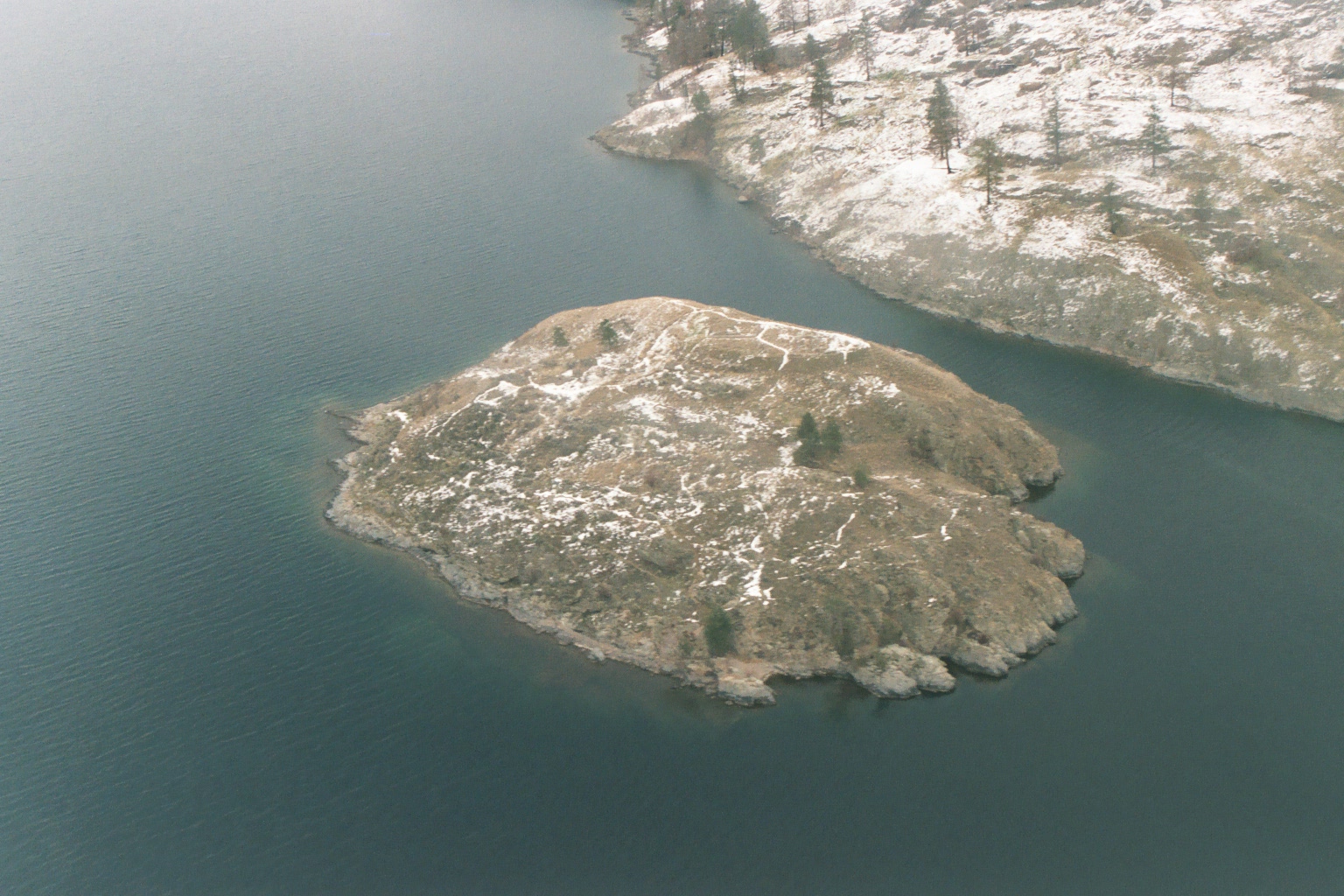
BR: There’s something going on there. That absolutely happened with Ogopogo. So when you begin researching the early sightings of Ogopogo, inevitably you’ll come up with a creature called Naitaka or Nait, and I’m sure that I mispronounced it, but it was an entity that was believed to live in the lake, specifically in Lake Okanagan. The name translates variously into Water God or Lake Demon, something like that, and it’s very common to see people referring to Ogopogo, you know, it was known back then as Naitaka or Naitic, but in fact, lumping them together really does a disservice both to First Nations and also to the cryptozoology community. So what you find is that when First Nations people in the Okanagan Valley were crossing the lake, they would, particularly near one particular island, which is called Rattlesnake Island or Monster Island, when they would go out on the canoes, they would take a sacrifice.
0:32:20
CW: Like a person?
0:32:21
BR: Well, like a really small person.
0:32:26
CW: Like a sack lunch or are they talking about their firstborn?
0:32:31
BR: Somewhere in the middle. Not a 40, not gold or tobacco, but a life sacrifice. They would take, for example, chickens or other small animals and they would kill them. They would either slit their throats or break their necks and drop them into the water to ensure a protected journey across the lake.
0:32:49
CW: I’d imagine that also might help if you’re fishing.
0:32:53
BR: I would think so. Multipurpose is actually pretty smart.
0:32:57
CW: And yeah, and isn’t the belief in water gods or you know demons that live in a body of water pretty common? I mean we talked about this with everything from La Llorona to the the ones I will never get out of my head, the Japanese water demons. Oh, the Kappa. The Kappa that will take your soul through your anus?
0:33:16
BR: Yes.
0:33:17
CW: Yeah, get that out of your head, listener, I dare you.
0:33:21
BR: She says as she repeats it. No, you’re exactly right. In fact, that’s one of the problems with interpreting these sorts of stories as actual legitimate historical sightings of cryptozoological creatures, is that the stories of Nautaka are hardly unique to Lake Okanagan or Canada or really the continent. All across North America, you would have a hard time finding lakes or rivers or streams and bodies of water that don’t have some associated lake spirit. So it’s not as if, all the other lakes, no one ever reports a water spirit, but in this one they do. It’s very common. Keep in mind that in those other lakes, in those many, many other lakes, there are not stories or assumptions and beliefs about lake monsters.
0:34:14
CW: About modern day lake monsters.
0:34:16
BR: Exactly. I did interview a woman, a curator of education at the Kelowna Museum near Okanagan. I asked her, I said, well, she’s from around there, she’s very familiar with the native stories. And I said, what is the nature of Naitaka? And she says, well, it’s not what people are looking for in the lake. It’s not a living, breathing, serpentine creature that’s, you know, that’s leaving bones and doing things like that. If you look at the stories and legends of Naitaka, it’s a spirit entity. It’s a paranormal figure. It’s not living and breathing. It was said to, for example, it would use its tail to lash the waters into a fierce storm, drowning its victims. It was said to be able to summon storms. I mean, this is X-Men stuff.
0:35:01
CW: This is kind of an overarching water, like soul of the lake kind of thing.
0:35:06
BR: Yeah, yeah.
0:35:07
CW: It had been a critter. Yeah.
0:35:08
BR: Yeah. It had command over storms and rain and the water. I mean, it was an elemental figure. It was not a lake monster of any type. So, one of the best, if people are interested in learning more about this, there’s a really good book called Lake Monster Traditions by Michelle Muger, which came out probably about 20 years or so. But very good if people are interested in the folklore of lake monsters, Lake Monster Traditions is an excellent piece.
0:35:40
CW: So what specifics can you tell us about in terms of like how big is this lake? What sort of, how often is this creature sighted?
0:35:47
BR: Well, it’s, as I mentioned, the sightings are fairly sporadic. And they’re not nearly as common, for example, as Nessie often is. But of course, part of that is because people aren’t looking for it. Psychological priming and confirmation bias and expected attention play a huge role in lake monster sightings.
CW: Well, even if there was a real monster, more eyeballs would mean more sightings.
0:36:08
BR: You would think, exactly. Okanagan, it’s actually three times longer than Scotland’s Loch Ness. Oh, wow. deep lake. It’s about 84 miles long and two to three miles at its widest. For those who are interested in geology, the Okanagan Valley was created by glaciation and it has an average depth of about 250 feet down. I think the maximum is around like 760, 780, something like that. So there actually is enough room for a breeding population, hypothetically. Yes, hypothetically, yes. And as I mentioned, there’s one particular island in the middle of the lake that is is reputed to be its home. That’s variously called rattlesnake island or monster island and it said that Number one it was said that that bones as the victims were scattered on its shores Which was which is again creepy not not something you you often hear about with that with Nessie or chance
0:37:09
CW: Are we are we absolutely sure we’re not talking about a Johnny Quest cartoon.
0:37:15
BR: Maybe we are. Who said we’re not?
0:37:17
CW: Oh, no, Bandit, we’re stuck on Monster Island.
0:37:21
BR: And Venture Brothers. But yes, it is said that that’s actually its home and that Ogopogo either came from that island or lives in caves underneath the island, so it’s closely associated with this one particular island. Again, this is where people would give sacrifices when they cross. So that’s the sort of setting here. And it’s a beautiful place. Another fun aspect is that there’s actually two towns that have been fighting over the title of Home to Ogopogo. Oh, one of them is Kelowna and the other one is Penticton. And so far, Kelowna seems to be winning. Their PR department is more on the ball with Ogo Pogo sightings in Penzington. But it’s a beautiful area there. I spent a fair amount of time there when I was doing research.
0:38:11
CW: That seems like it would certainly add fuel to the fire of sightings if you have competitionbetween two communities.
0:38:17
BR: Yeah, I mean, that’s especially true, of course, with Loch Ness and Inverness, where you can find Loch Ness monster, you know, hats and mugs and cuddly things all over the place. And that’s true to some extent with Champlain as well.
0:38:40
CW: Forget Johnny Quest. We’re now, I’m now seeping into Scooby-Doo territory where the owner of the inn is, Oh, I saw Ogopogo last week and no, that wasn’t me in an Ogopogo costume. Come stay at my inn, make me lots of money.
0:38:56
BR: Yes, there’s a bit to that. The commercialism, I think, is proportionate to its fame. So again, with Nessie being far and away the number one moneymaker and then probably Champ and Ogopogo as well, it is Canada’s most famous lake monster, but again, that’s not saying a lot. There aren’t a lot of people, I think, that are coming from afar to specifically look for Ogopogo. There are some, and I met some people there as well, and there’s a small but thriving tourist aspect to it, but I don’t think it’s getting quite the range of tourists that perhaps they might like.
0:39:37
CW: Well, they got you, right? In a little bit, we’re going to talk about your investigation.
BR: Yes.
(MUSIC)
CW: Are you fascinated by ghosts, but kind of find yourself hating ghost hunting shows? Are you interested in the history of ghost detection and the ideas behind the pursuit of the otherworldly? Are you a ghost hunter yourself who wants to up your game and make sure what you find is real evidence rather than noise mixed with adrenaline fueled hopes? Well, Ben Radford’s 2018 book, Investigating Ghosts, The Scientific Search for Spirits, is now available on audiobook Learn the common mistakes famous ghost hunters make and see how real investigation techniques can eliminate those errors winner of the 2018 New Mexico Arizona Book Award for science This volume is a great addition to your library of the strange and it would also make a great gift for any paranormal fans in your life. Available in paperback and now audiobook format on Amazon, Audible and other retailers.
(MUSIC)
0:40:35
CW: You got to have the experience of actually traveling to Canada and researching Ogopogo in person for National Geographic. How did you end up teaming up with National Geographic for that?
0:41:09
BR: That was a fun show. Basically what happened was I got a call from a producer, Noel Dockstader, a great guy, I’d love to work with him again, Noel if you’re listening, and he was working with the Nat Geo show, Is It Real, which ran I think for two or three seasons, and it’s a really good example of skeptical television and work.
0:41:46
CW: You don’t see that very often.
0:41:48
BR: I don’t. Well, I mean, it’s, you know, whenever someone comes up to me and says, oh, they can’t make good skeptical TV, you know, people won’t watch it. No, they will. They’re there. It can be done. And Is It Real is a good series. I’m not just saying that because I was on a couple of episodes, but it’s just as far as you know really cable TV Investigation series that actually you know do more than just pay lip service to the skeptical scientific aspect Is it real is one of the best ones and so I got a call from them. I think in March January March 2005 and they had actually seen an episode that Joe Nickell and I had done for the Learning Channel on Champ. And so we had gone to, we talked about this in one of the previous episodes, but we’d gone out there and investigated Sandra Mansi’s photograph of the best evidence for lake monsters and went onto the lake and actually did field research.
0:42:42
CW: So you researched one lake monster and automatically you got typecast as the lake monster researchers.
0:42:48
BR: Exactly. So initially they contacted me and said, well, we’re doing this show for Is It Real for NatGeo. Initially, they just wanted us to be talking heads. We’re like, sure, but I said, well, why not actually investigate? That’s what we do. They’re like, oh, we like that. Let me get back to you.
0:43:09
CW: Hey, well, to their credit, rather than seeing it as an extra problem or we don’t want to have to do extra work, they took you up on that.
0:43:16
BR: Exactly. Great. Yeah, I was very, very pleased with how that turned out. So they flew Joe and I out to the Okanagan Valley, I think instead of Kelowna, and yeah, it was fun. We went out there and we met up with a colleague of mine, John Kirk of the British Columbia Scientific Cryptozoology Club, and he’s one of the premier Canadian cryptozoology investigators. He wrote a book, I think, called In the Domain of Lake Monsters, if I’m not mistaken. Anyways, I don’t know, he’s more of a believer side, and of course, Joe and I are more the skeptic side. I think the TV producers were sort of wondering how it was going to work out, having us team up together, but actually, we got along great. John was awesome. Joe, you know, it was a fun time.
0:44:03
CW: So you’ve assembled the brain trust here. You’ve got you and Joe Nickel and John Kirk, all the Lake Muster experts you need. What was the first thing you guys did?
0:44:13
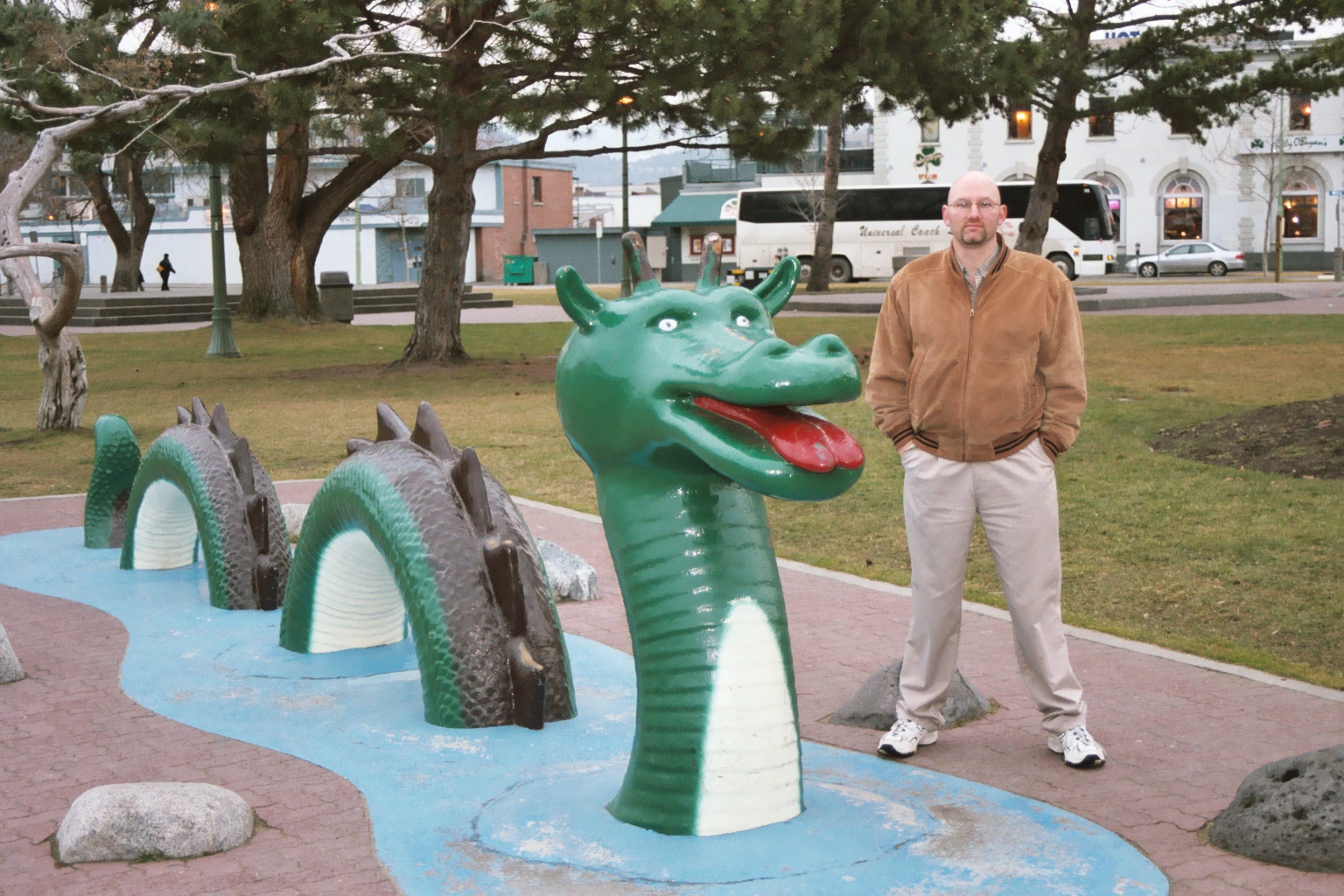
BR: Well, the first thing I did was to find this famous statue of Ogopogo in downtown Kelowna and take my photo. Like the two true tourists underneath it all. Absolutely, there’s a really cool multi-humped statue near the dock, near the harbor, and it’s cute. It’s about four or five feet tall. Anyway, that’s the first thing I did, the tourist thing. Okay. After doing the tourist thing, we met up with the producers and we wanted to do research that we could only really do on location. So oftentimes, there’s a fair amount of research that you can do ahead of time. Books, online, magazine articles, things like that, interviews, but sometimes there’s really only information that you don’t know until you get there. And so that was the first thing was to contact people in the area who were already had been following the Ogopogo and collecting information on it. In this case, the resident Ogopogo expert was a woman named Arlene Gal, G-A-L. And she’d written a book on Ogopogo. And we met up with her, lovely woman. She opened her doors to me and Joe and the camera crew, which is always the, oh, it’s not just, oh, there’s eight other people, including sound guys, great. That’s the part you don’t see on TV. But anyway, so we met up with her and she was very gracious and showed us her files, people that she interviewed, early reports, photographs, and she was just a real treasure house of information on Ogopogo. Very similar, in fact, to how Sandra Mansi was sort of the de facto treasure house of information on Champ.
0:45:52
CW: Okay.
0:45:52
BR: So Joe and I interviewed Arlene Gall and got more information about Ogopogo, and we were there for, I think we were on location for about a week. It’s been a while, but I think it was about a week or so. Maybe a little under. And so we were trying to figure out, what can we do in a couple of days? We don’t have finite resources, but on the other hand, this is National Geographic’s dime. So let’s do this, right? So the first thing we did was try and get a sort of lay of the land. And so we went on a boat with side-scan sonar. We went to different positions, vantage points, looking over the lake. At one point, we went to Rattlesnake Island, which, weirdly enough, little side note here, it now has the remnants of Putt-Putt Golf on it.
0:46:43
CW: I was going to ask if it was populated at all, but yeah, if there’s Putt-Putt Golf, something tells me people…
0:46:50
BR: Well, no, here’s the thing. It’s there’s a story right there. So apparently, uh, rattlesnake island, AKA monster island, AKA Ogopogo’s home was bought. And I may be getting the story a little bit wrong, but I think it’s basically correct. It was bought by a eccentric like millionaire. I want to say from Scandinavia at some point. And he bought the island thinking it was going to turn into like a tourist place, like with putt-putt golf and hot dogs and things like that. And the whole thing fell apart. I don’t know if, you know, he got put in jail or the money fell through or whatever it is, but to this day, if you go on Rattlesnake Island, you can get there. It’s this weird deserted remnants of like a mini golf and like…
0:47:32
CW: That just brings in all kinds of creepy. So not only do you have the notion of this being some sort of bone-filled graveyard of Ogopogo sacrifices, but you also have the creepy, abandoned Coney Island feel to it as well?
0:47:48
BR: Yes, well it’s not, to be clear, it’s not that built up. I mean, there’s a couple dilapidated buildings, it’s not really built up. It’s a rocky clot in the middle of a lake, so. But it’s not barren. I mean, from photographs from above, it doesn’t look like much. But if we actually get on the island, there are these weird remnants of this would-be aborted tourist trap. Anyway, so we went on Rattlesnake Island. We actually hired a – well, we didn’t hire, National Geographic hired, thank you, hired a plane to circle above. And that was important because oftentimes a lot of the sightings are problematic because they’re at a low angle. So usually when lake monster sightings are reported, which is understandable, they’re from shore, right? Because that’s where people are. Or sometimes they’re at a somewhat higher angle, for example, if they’re on a road above it. But in any event, usually you’re not at a high enough angle to rule out standing waves. In fact, that’s one of the explanations. We’ll get into the explanations later, but that’s one of the common explanations for Ogopogo is that there’s a particular type of wave that’s seen in Lake Okanagan that mimics a series of humps. And I saw it, and I mean, this is-
0:49:08
CW: Dark, humpy waves.
0:49:09
BR: Yeah, it’s a known thing. I’m not making this up. There actually is this wave pattern that can look very much like a living creature just under the waves.
0:49:17
CW: Well, that makes sense if you’re looking at it from an angle where there’s sort of a shadow underneath the wave crest. You could see a dark, long shape, whereas if you’re in a plane above, you’re not going to see that shadow at all.
0:49:29
BR: Exactly. So we flew around. It was me and Joe and the pilot, and then, of course, they need to have a cameraman. And it was really kind of hairy because it’s not really made for having a cameraman facing you as you’re on the… So the cameraman was hunched in this incredibly awkward position getting footage of the pilot who’s flying and me and Joe reacting and looking down. And his knee was two or three inches from the throttle.
CW: Oh!
BR: I kept just expecting any moment his knee was going to slip and like send us into a tailspin. It didn’t. It would have been great footage. But I, um, anyway, that didn’t happen. It could have happened.
0:50:12
CW: That’s okay. The History Channel would have reported you guys found safely like three years later.
BR: Exactly.
CW: And done a whole documentary about it.
0:50:20
BR: Zing! But so, so we, you know, we, and it was sort of a, you know, on a lot of these TV shoots, you’re making a compromise. On one hand, you’re trying to do actual digital investigation because that’s what I’m there for. You know, I’m happy to be the investigator, do the TV thing, but more than that, I want to investigate. That’s why I’m there. I’m trying to figure these things out.
0:50:42
And so, whenever you’re doing these shows, it’s always like on one hand, you’re having to sort of do the things they want, talk to the camera and explain things, which is fine, but you’re also saying, okay, we’ll just get them away so I can investigate. So I…
0:50:55
CW: Well, yeah, it sounds like the TV producers don’t want your investigation to get in the way of a good story, and you don’t want their storytelling to get in the way of a good investigation. So you got to kind of make it the Reese’s peanut butter cup of like, oh, you got your investigation into my story, but it’s still good.
0:51:11
BR: Again, to be fair, the Is It Real series did a much better job of that, of weighing those two concerns than most TV shows did. So we surveyed the lake in a plane, we went to different places on Rattlesnake Island and above, and they rented a houseboat and they were laden with all this, I don’t know if it was a houseboat, it was a big boat, and that was where all the camera crew and stuff was. So we were there and we went on a different boat with sophisticated side scan sonar. Basically what happened, the producers came to me and Joe and John and said, okay, well, you guys are investigators, how do you investigate? And we said, okay, well, these are the things we would do. And then we would negotiate what things they would film. Again, you know, being mindful that they’re paying for this. So we didn’t have, we didn’t have carte blanche.
0:51:59
CW: That sounds like a logical approach. You say, we’d like to do A, B, C, and D. They say we can afford A and B and B would look better. So we’re going to do B and then you move on from there. Well, I mean, you said you sonar’d the lake. That’s, that’s a pretty, uh, pretty technical, uh, bulletproof thing to do. Number one, well, I, I I’m sure if you found Ogopogo that way you would have led with that, but how much of the lake were you able to sonar? Certainly you couldn’t do the entire lake.
0:52:27
BR: No, we couldn’t get the entire lake and again this is one of the things where we’re trying to balance doing a credible investigation with very limited time using other people’s resources which is a little dicey. Keep in mind that for most investigations I do, I’m doing it on my own time and at my own dime.
CW: Yeah, yeah. So sonaring a lake is expensive even for NatGeo’s budget. Last time I sonared a lake, boy, it took quite a chunk of my bank account.
0:52:57
BR: It was a thing. Anyway, we basically had to try and pick the places that had the highest percentage of Ogopogo sightings, for example.
0:53:07
CW: Smart.
0:53:08
BR: Yeah, I mean, again, you can argue about the methodology. We were out there trying to do the best we could. If other people want to do something better, knock yourself out. But what we were trying to do was, we said, okay, well look, if there are Ogopogo in the lake, and keep in mind that as with Bigfoot, as with Chupacabra, as with Nessie and Champ, there can’t just be one of them. There has to be a breeding population. There has to be probably hundreds, maybe thousands, certainly dozens. We’re not just talking one. And the other aspect was, if there really are these Ogopogo creatures that are said to be this extensive length, then at some point they have to die, and their bones probably in the form of a snake or some snake-like figure should appear on the bottom. So that was our working hypothesis, and sure enough, at one point, we had actually found an ultralight wreck. I found out that most ultralights of that configuration have a wingspan of about 30 feet, which is considerably smaller than the average reported length of most Ogopogo sightings. So if sonar can detect and get a clear enough image of a thin frame of an ultralight at a depth of 100 feet, then where’s the bones? I mean, if it could detect that scale and something at that resolution, then it should be easy to find one or more Ogopogo skeletons that should be on the bottom of the lake.
0:54:35
CW: Yeah, that makes sense.
0:54:37
BR: Spoiler alert.
0:54:38
CW: That’s actually really cool that you had an ultralight down there to act as kind of a control.
0:54:43
BR: Exactly.
0:54:44
CW: You picked it up and that showed you that the sonar is good enough and it acted as a control to an experiment you otherwise wouldn’t have had a control for. If you just saw rocks and bumpy stuff, you have no idea if it was really accurate.
0:54:55
BR: Right. I mean, you can, you know, with sonar it’s pretty good. I mean, you can get some idea of scale, but that was an especially good find. In fact, in one of my books, I have a photograph of that image. You can sort of see just how good a resolution it is, and you can imagine how good an Ogopogo skeleton should be. At one point, I was asked by the producers if I was going to dive to go look for Ogopogo. And Joe sort of giggled that I would be Ogopogo bait.
0:55:23
CW: That’s a 250-foot depth of the lake, you said? I mean, how low can a person even safely dive?
0:55:32
BR: Well, there’s a couple of things here. Number one is that the water is pretty murky. This is not a clear lake. Very much like Loch Ness, by the way. In movies, the water is clear. Why? Because it’s a movie. Because the filmmaker has to show you. So when people actually go to these lakes thinking, oh, let me bring along my snorkel so I can plunge my face into the water and see things. Oh, look, there’s murk two inches from my face.
0:56:10
CW: Okay.
0:56:11
BR: The visibility is not good. There’s currents down there. I initially agreed to do it. So I’m scuba certified. Joe wasn’t going to go and Kirk, John wasn’t going to go in. I’m like, well. So I went and I met with the dive master there, a guy named DJ Swanson, and he’s a regular diver in the area. And so we went into a pool so I could practice cold water diving, because I’ve never done cold water diving. I’ve done open water diving. For example, in the Caribbean, where the water’s clear and it’s 85 degrees.
0:56:45
CW: And there’s cute little fishies you can like, like almost touch.
0:56:48
BR: There’s cute little fishies, and yeah. So at one point we’re in this pool in Kelowna and he’s DJ showing me the the cold water diving stuff that I’m getting on. This is it’s this sort of neoprene and metal sarcophagus. And he’s putting all this stuff on me and finally I it’s like I’m just this is insane. He’s like, well, this is cold water diving. Like, you know what? I’m out. I think, are you kidding me? So I bailed. I said, dude, you’re a hardcore man. And he sort of laughed at me, said, yeah, a lot of times, you know, people get open water certified in the Caribbean. And they, you know, they go to like Alaska or Canada. They’re like whole different thing. Anyway, so I did not do that. And I let two divers go down there and they had cameras. And so we could actually see what they were saying and sort of see unfortunately nothing nothing showed up however DJ did report back the supposed Ogopogo cave or home underneath Monster Island is not actually a cave. It’s sort of this slightly indented cliff face that is not going to hold a monster. It’s still kind of neat, but I mean, he basically said, we saw the alleged Ogopogo hidey hole and it’s like a concave, nothing’s hiding in there.
0:58:13
CW: It’s just an indent. It’s like, almost like the butt print of a really large Sasquatch.
0:58:18
BR: Exactly. Ogopogo indent doesn’t sound as exciting. point we had spent a couple days looking on the lake, above the lake, in the lake, around the lake, and not really finding any evidence of Ogopogo. So at this point, our investigation didn’t turn up any actual monsters, so we turned to the best evidence, the best photographic evidence, which is the Arthur Foden film.
0:58:44
CW: So you gave it the good old college try and Ogopogo just wasn’t out for you or wasn’t there to begin with. And then that makes sense that you just go to what other people have seen or purported to have seen.
0:58:57
BR: Right. I mean, we’ve made a legitimate effort to search for Ogopogo. You know, we didn’t spend months and millions of dollars there, but we did a sincere, legitimate effort to try and find it. We did. You know, we we made a good faith effort. And like everyone else before us, I should hasten to add, we did not find it. So that is not a failure on our part, especially if it may not be there.
CW: So it’s not your fault for not diving.
0:59:23
BR: That’s this is true. Well, you know what? If Ogopogo, if I had dived and Ogopogo had eaten my leg or something, then I might feel differently about it.
CW: Yeah, I’m not calling you out. I mean, given presented with that same opportunity, my skeptical fortitude would have shriveled up and tucked away as well.
0:59:41
BR: Such as it is. So at this point, our interest turned to trying to replicate and understand the Arthur Foden film. As I mentioned before, it was a film taken in August of 1968 by Arthur Foden and his wife from a total sighting of about two or three minutes. One thing that we noticed when we were looking at the footage, we did this with Arlene Gall and also of course John and Joe and others, was that we’re trying to figure out, okay, well, how big is this thing? Is it living? Is it not living? How fast is it moving? How big is it? Is of course the main thing. And again, this is right up our alley because Joe and I had done exactly the same thing with the Sandra Mansi photo of Champ. So again, meeting with the producers and particularly Noel, they asked me to come up with a set of experiments to see what we can glean from the Fulden film. A lot of this is sort of on the fly. I mean, we didn’t have a lot of prep time before we flew out there. So a lot of this was late nights in our hotel rooms trying to figure out what the hell we can do tomorrow that’s going to be useful and investigative and, you know, hopefully make some good footage for Nat Geo.
CW: Well, that’s got to be kind of exciting and fun. I mean, there’s a there’s definitely a sense of adventure with this.
1:01:03
BR: It is. It is. And I do look back on that investigation, that TV shoot particularly with with a particular fondness. It was a fun, high profile shoot. And I’m really glad that I did it.
1:01:15
CW: Alright, so failing anything uncovered by sonar, by divers, by airplane trip, by taking a boat around the Rattlesnake Island, you guys turned to the Folden Film then, correct?
1:01:26
BR: Yes, so you know as we did, as we’d done before, Joe and I had done before with the Mansi photo, we’re trying to figure out, okay well, what is this thing? Can we figure out, what can we determine about it? I mean, a photograph is simply a two-dimension representation of something that have three dimensions. You know, it’s a photograph of something flat.
1:01:47
CW: It can lie.
1:01:48
BR: It’s certainly deceptive. I don’t know if it’s a lie, but it’s certainly, it’s not self-evident. If these things were self-evident, then there wouldn’t be a mystery. So one of the main things we’re trying to figure out is, number one, where did the recording take place? We actually didn’t know that. It was a somewhat similar situation with Sandra Manci. In the case of Sandra Manci, she either didn’t know or wouldn’t say where she photographed it, although in the past few years, a researcher named Dick Rayner, I think, has probably located the place where Manci took the photograph. But in that case, Manco was intentionally obfuscating where the photograph was taken. In this case, we knew it was somewhere along Highway 97. So it’s not, it wasn’t too far from the road. So it wasn’t that hard to find. The second thing is we were basically bringing math to it. Keep in mind that the Fulton said the whole sighting lasted two or three minutes. So distance is crucial because an object moving across a film frame can either be huge and covering a great distance, or it’s much smaller covering a smaller distance, depending on how far away it is. So once you either know how far away it is or how big it is, or once you have one of those two variables, you can more accurately calculate the other one.
1:03:04
CW: This is sounding like a very complicated trigonometry word problem.
1:03:07
BR: It’s, I would have paid more attention to trig had it been relating to investigating lake monsters, let me tell you. But basically, we hired a surveying firm, again, on Nat Geo’s dime, thank you, Nat Geo, called Reynolds Denby, and they were located in downtown Kelowna, actually about a block away from the Ogopogo statue, which was kind of cool. And it was actually really kind of neat. We had a boat out there, and we had surveyors who were taking marks and distances at different places along the water. So, for example, we could tell, okay, at this distance, this is what three feet looks like. At this distance, this is what three feet looks like, et cetera. And it resulted in a surveyor’s map, which is kind of cool. As far as I know, it’s the only actual official surveyor’s map that was used to investigate a lake monster footage. I’ll spare you the mathematics, but basically, we determined a couple things. Number one, it was clear to all of us, including John Kirk, the believer of the group, that Arthur Foden had dramatically overestimated how far away it was. The issue was that he had estimated that whatever he had filmed was about 1,500 feet away or about 500 meters, give or take. So using that estimate that he gave, I mean, we weren’t there. We weren’t there in 1968 and all we have is his account and the footage. So using those dimensions, we were able to work with the surveyors to get readings and photographs and estimates of how far away these things were. So we essentially came down to a couple of conclusions. The first one was that we had in fact found where Arthur Foden had filmed it. It was that had never been determined before. It wasn’t hard to find, but we actually figured out where it was. Because we know that he overestimated how far away it was, he also overestimated how fast it was going. Because keep in mind, in the footage, you see it going from left to right across the frame. So it’s either something big going fast or something small going slow. In this case, it was something small going slow. We determined that, and again, this wasn’t just me and Joe, I mean all of us, including John Kirk and the NatGeo crew, who we show them, because, you know, keep in mind, these are camera guys. A lot of times you can actually use the expertise of the camera crews, which is useful to us.
1:05:34
CW: Yeah, yeah.
1:05:35
BR: And in this case, the object in the water was indeed a living creature of some sort. It wasn’t a log, it was actually moving on its own power. And that creature’s distance to the camera was greatly overestimated. Therefore, the creature is much smaller and therefore moved much less quickly as we previously thought.
1:05:56
CW: So do we have any idea what the much smaller, much slower creature might have been?
1:06:01
BR: Yeah, so if it were. If it were near to the camera and thus covered a relatively short distance, maybe about 100 yards during that two or three minutes journey, then it could have been an otter bird, something like that. I mean, even even the laziest otter or bird can go 100 yards in two minutes, so that’s that’s not that’s not a record breaking. That’s that’s that’s a rough paddle.
1:06:26
CW: Now, Ben, I noticed when you were describing Fulden’s overestimation of the distances and sizes here, you said he’s dramatically overestimated. Were you sensing, well, you didn’t meet the guy, but did you get a sense that he was purposely exaggerating what he filmed and what he saw? Or was he sincerely mistaken, much like you think Sandra Mansi was sincerely mistaken in what she saw and photographed.
1:06:53
BR: It’s pretty clear to me, and I think Joe would agree and John as well, you’d have to talk to them, but I think we all pretty much agree that that Arthur Foden, like most eyewitnesses to these sorts of things, was sincere. He genuinely saw something that he thought was strange and he just overestimated it. As you mentioned, that happened with Sandra Mansey. She overestimated how big it was and we determined that by doing experiments on the lake. So as is often the case, it’s not that nobody’s lying, it’s not that anybody’s trying to deceive anybody, it’s just that people are not good eyewitnesses. I’ll say that again. People are not good eyewitnesses and even when you have footage, you know, even when you had film footage and in this case, this is actually the beautiful part about it, was that one of the reasons that the Mansi photograph of Champ and the Arthur Foden footage of Ogopogo are so important is that we don’t just have the witnesses. We don’t just have their perceptions and their thoughts and their experiences. We also can compare that to photographic evidence and film evidence. And when you do that, when you go to the location and do actual field work and get off your ass and get off from behind your computer and actually go investigate these things, that’s when you solve these mysteries because that’s when you can apply science and trigonometry and geometry to figure out what these things could have been and what are the actual patterns that we’re seeing.
1:08:17
CW: Cool, cool. Well, so all you listeners out there who are in high school, pay attention in your trigonometry classes.
1:08:24
BR: It comes in handy.
1:08:25
CW: Or something.
BR: So, to be clear, Arthur Fulden’s film is not the only video. There are other photographs, there’s other video. It’s the highest profile and thought to be sort of the gold standard as Manci’s was as well. So, when we, I don’t want to say we debunked it, what we did was we concluded that Fulden had overestimated both its size and its speed, which is something any of us could do. Again, this is not a trick, it wasn’t a hoax, it wasn’t a publicity stunt, it was somebody who saw something weird and he filmed it and there it was.
1:09:01
CW: Okay, well we won’t say debunked it and we’ll say you took the teeth out of it. You defanged it.
1:09:06
BR: There you go. So in the case of the Folden film, it was almost certainly an otter or a beaver or a bird of some sort on the water. It’s very clearly what it was. It’s not a log, it’s some sort of animal. But certainly well within the parameters of the size of known animals and the speed of known animals. But as with all lake monsters, there’s not one specific candidate that accounts for all sightings. That’s often what happens. Someone will say, oh, well, you know, oh, you looked into Champ. Oh, what about Nessie? What’s the answer? There is no the answer. There’s not, oh, what are ghosts? There’s no single answer. It depends on the case.
1:09:51
CW: A whole wave of answers.
1:09:53
BR: A whole wave of answers. So, again, this goes back to what I was talking about before, is if you go below the surface, you’re welcome, and look at the nitty-gritty details of many of these sightings, you find that in fact, there’s quite a bit of variety. They all don’t look exactly the same. The obvious reason is because they’re not the same. People are reporting different things at different times. Somebody who sees Ogopogo in June of 1958, and somebody who sees Ogopogo in September of 2019, aren’t necessarily seeing the same thing. And that’s part of what accounts for the variety. And so, there’s a handful of Ogopogo explanations. Well, you know, as with all lake monsters, there’s a variety of things that can mimic these images. One of them, as I mentioned before, is wave patterns. Lake Okanagan’s geological features do create waves that can look exactly like the monster, even including its signature series of humps. And again, this is not a skeptical thing. This is a known thing. People around there are like, yeah, I was out there. In fact, I interviewed a woman at the Colonial Museum and she said, my husband and I see that on the lake sometimes when we’re out walking. She says, it’s not a monster, it’s a wave, no question about it. It just looks like moving humps on the water. This is a woman that lives there. She sees Ogopogo all the time, but she knows it’s a wave.
1:11:14
CW: All right.
1:11:15
BR: So, so, you know, so many of many ogopogo sightings are probably waves. Keep in mind, as I mentioned before, that that many ogopogo sightings, the eyewitnesses are describing something as, quote, log-like, a huge tree trunk or something. And they’ll say, well, I thought it was a log, but then but then it suddenly moved. Well, floating log can suddenly move.
CW: The Canadians have built a whole sport on moving logs. You get two lumberjacks, have them stand on a log and shimmy their feet around until they get the other guy to fall off because they’ve moved the log.
1:11:52
BR: That’s the thing, exactly. In fact, the log explanation, I know a lot of people, oh, the skeptics are going for the log. Oh, that’s their go-to. No, it’s our go-to when that’s the actual likely explanation. As it turns out, if you’ve been to Lake Okanagan, there’s lots of logs in there. You know why? Because it’s a logging town. There are huge log booms with thousands and thousands of floating logs in the water. I have photographs of it. We saw it. This is a known thing. And yes, some of them are in the booms, but some of them get out. If they’re waterlogged, some of the bigger ones, they can bob at or just below the surface of the water. If the water is choppy or there’s waves, it’s not hard to imagine how they could double for Ogopogo. Something dark and smooth below to the water and gluten between the waves. Again, there’s actually any number of things that could be mistaken for Ogopogo. That is the answer, however unsatisfying it may be to some people.
1:12:53
CW: Yeah, we should have we could make this a bingo game. How many things could be Ogopogo? What we got? Logs, otters, beavers, birds, ultralights. You could have an ultralight crash in there and catch a glimpse of it. Let me see here. Lumberjacks, moose, hockey players.
BR: You name it. Sturgeon, alacuno.
CW: OK, that’s right. There’s sturgeon in there.
BR: Well, there’s big there’s big fish in the lake. And that’s the other thing to keep in mind is that in a lot of these lakes, there are big fish. I mean, in Lake Champlain, for example, I mean, there’s sturgeon. And lakes in the region, they have gar and pike. And some of these are big ass fish. I mean, I’m not a fisherman, but I’ve seen these things and they’re scary. These are things bigger than your leg, bigger than me in some cases. These are not goldfish, folks.
1:13:41
CW: Everything’s bigger in Canada.
1:13:42
BR: Yeah, that’s what they say. So anyways, but the point is that there isn’t one overarching blanket explanation for Ogopogo. It depends on the sighting, it depends on the person, some are mistakes, some are logs, it depends on the specific case.
1:14:00
CW: Well there you go, folks. Ben has solved the mystery with the help of National Geographic. And by solving it, I mean kind of explain to us that there’s really no way to absolutely solve it. It’s just it could be any one of many different things.
1:14:13
BR: Well, I asked John about this. It’s interesting you bring that up. I asked John at one point, John Kirk, when we were on the boat going out towards, I think it was to Rattlesnake Island. I said, John, what would it take to convince you that there’s no Ogopogo in the lake? And yeah, this is a fairly, you know, this is a known skeptical question, right? I mean, if you believe X, it’s a totally legitimate question to ask, well, what evidence would you accept that would disprove, you know, your belief? And he said to me and Joe, he said, you’d have to drain the lake.
1:14:45
CW: Oh, wow.
1:14:46
BR: Which I thought was a very honest and insightful response, right? Because no one’s going to drain the lake. That would cost billions of dollars. It would do untold ecological damage. It’s never going to happen. And so if that’s your framework, if that’s your worldview that we’d have to drain the lake, well then no wonder people will always believe in it.
1:15:09
CW: Yeah, well, he has a point. You can’t absolutely disprove it. Just like you can’t absolutely disprove unicorns unless you have some way of searching every nook and cranny of the earth at the same time. You’d have to be able to see every nook and cranny of the lake.
1:15:25
BR: Sure.
1:15:26
CW: To be absolute about it.
1:15:28
BR: Yeah, absolutely. And I’ve never said that Ogopogo doesn’t exist. I’ve never said the ghosts don’t exist. You know, that’s not a scientifically defensible position. I don’t know. All I can tell you is that I have put a lot of time and effort, not just investigation and fieldwork and this and that, but a lot of time and effort, as have others, and the best evidence so far is that Ogopogo doesn’t exist. So, in the end, I actually found three different types of Ogopogos. And again, this is one of the things that makes Ogopogo especially interesting from a sort of cultural and folkloric perspective, right, is you have the Native American legend roped up into the Ogopogo stories. You have Nytaka.
1:16:13
CW: The water demon kind.
1:16:15
BR: The water demon that would demand life sacrifices to allow First Nations people to cross the lake. The second version that you have, the second incarnation, if you will, of Ogopogo is Ogopogo. It is the cryptological mystery that people talk about. When they’re talking about Ogopogo, they’re talking about a giant snake-like creature very similar to Nessie, very similar to Champ, etc. that is presumably not the water spirit air demon entity that the Native Americans were talking about. It’s something that’s living and breathing and apparently not leaving bones anywhere, but doing all the other things. And then in a way you have sort of a return to the legendary aspect with the ogee, the plush animal toys. It’s sort of like Nessie, right?
1:17:08
CW: Oh, like a chibi version.
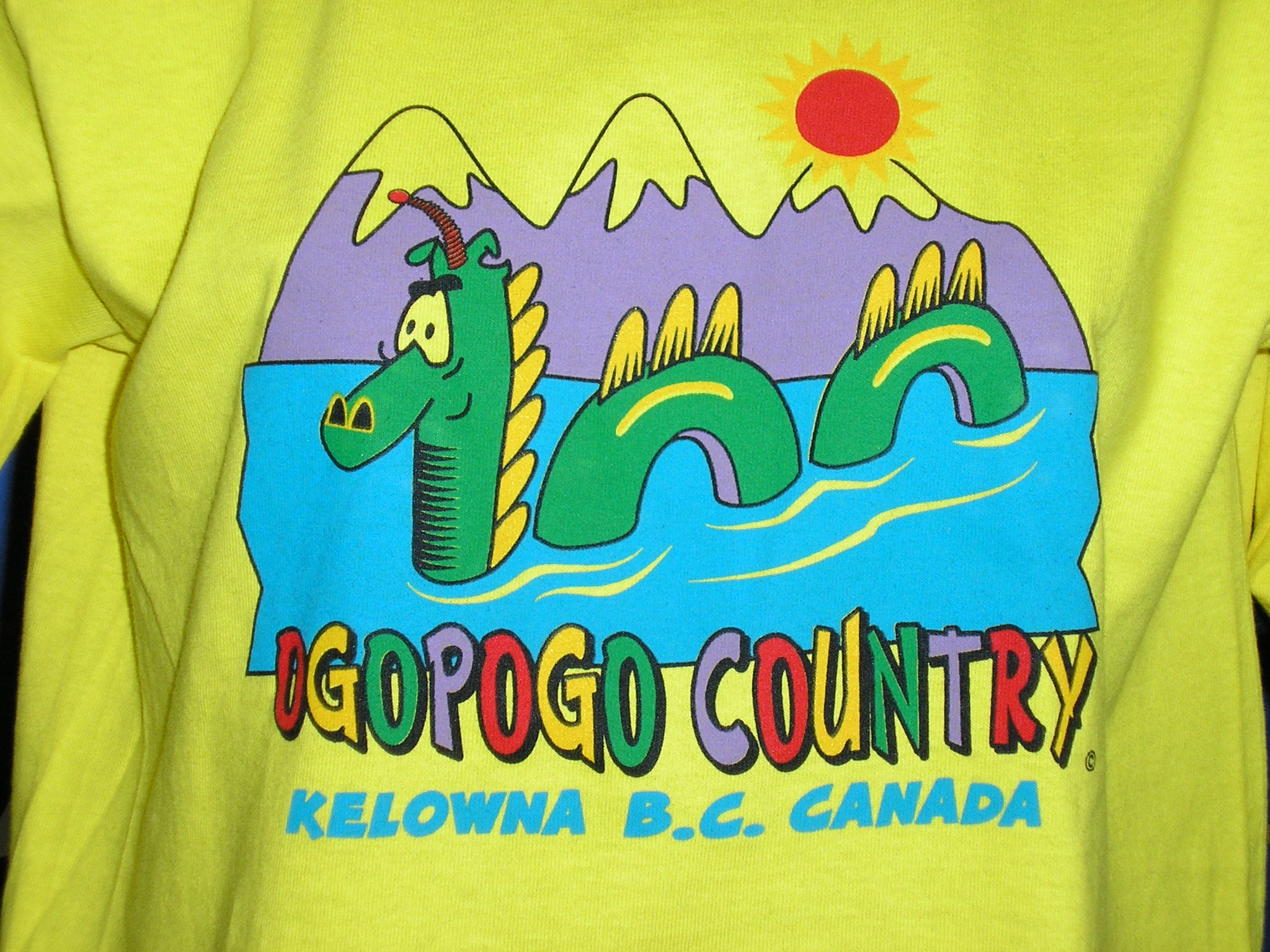
BR: So, and keep in mind that the Ogi, the O-G-I-E or O-G-Y, whatever, that’s their local mascot, right? And so, when you go to Cologne, when you go to Pententu, the Ogopogo they’re promoting that’s on the t-shirts and the hats and the mugs, it’s not killing people. That’s not what they’re promoting. This is not part of the tourist board story, right? They are promoting a cute, cuddly, messy, fun, oh hey kids, let’s look for the fun, playful little lake monster. And so, it’s interesting, it sort of began, according to some people, as this Native American legend that sort of, and then the second incarnation was the mysterious creature that is said to lurk, blah blah blah, then with the third incarnation we’re sort of back to the, the legendary kind that people don’t really take seriously.
1:18:05
CW: Well, do they sell cute little plush chickens that you can slit the chicken’s throat when you go out on the boat looking for Oki?
1:18:12
BR: That’s kind of morbid. I like it. Let’s do that.
CW: All right. We’ll make a million dollars, man.
1:18:18
BR: Well, first you’d have to explain to the kids exactly what we’re doing. So.
CW: You need to make a sacrifice, kid. We’re going to go out on a lake and look for Ogopogo.
BR: Come on, little Jennifer. We’re going to do this. Bring your sister. This is where we slit his throat. Yeah, maybe that’s not going to fly.
CW: All right. But yeah, you bring up an interesting notion of almost the transmutation in pop culture of Ogopogo as the modern and by modern, I mean from 1920s on, cryptozoological mysterious creature. And then it reaches backwards in time and messes with Native American legends of a water demon, and then it reaches forward in time and it’s turned into like a lovable, adorable, highly consumable product.
BR: Exactly.
CW: Clever. Well, where can people hear more about any of these Ogopogo incarnations you’ve talked about?
1:19:17
BR: Well, there’s a couple of places. You can, of course, pick up the 2006 book that I wrote with Joe Nickell titled Lake Monster Mysteries, which is a survey of exactly what it sounds. It’s a very self-descriptive title. We cover Ogopogo and various other creatures, particularly in North America and Canada. You can also read about the Oglebogh investigation in chapter 8 of my book, Scientific Paranormal Investigation, How to Solve and Explain Mysteries. And if you’re the kind that wants to see some reasonably accurate TV, you can see the episode, Is It Real?, from National Geographic. It was 2005, I think, season 1, episode 5, titled Monsters of the Deep. You’ll see Joe and I and John. You’ll see, of course, it’s only a small bit of what we did, but it’s a fun story. Yeah, the episode is available in a couple places online. You may need to pay a buck or two for Roku, Google Play, or Amazon or something, but it’s available. You can check it out.
1:20:18
CW: Well, cool. Fantastic. Well, Ben, thanks for taking us on that tour of one of your favorite lake monsters, Ogopogo. Ogopogo, yes. That was fun saying that this whole time. In two weeks on our next episode, what are we looking forward to hearing about?
1:20:37
BR: We’re going to be talking about Hyman’s proper criticism.
1:20:41
CW: Hyman’s proper. Now, who is the Hyman in Hyman?
1:20:43
BR: Who is the Hyman? Yes, she says advisedly. Ray Hyman, one of the founders of the Committee for Skeptical Inquiry, CSICOP, CFI, what have you back in the day, back in 76, an esteemed psychologist at the University of Oregon and an all-around brilliant guy.
1:21:02
CW: Yes, and I knew all that of course. I was just asking for the benefit of our listeners. Yes, of course. We are not familiar with Professor Hyman’s work. we’re going to go over a very useful, would you call it a principle or a guiding statement, a mission statement, what would you call it? Yeah, it’s actually really interesting.
1:21:22
BR: It’s a really short piece, it’s maybe two pages long, something like that. And it’s basically sort of a list of eight principles for proper criticism. And it was intended to be specifically for paranormal claims, although it actually applies much more broadly. But it’s just a really good sort of go-to guide. I use it regularly and I encourage others to as well. It’s just a good guide for, when you’re criticizing other people’s claims and ideas, there’s better and worse and there’s effective and less effective ways to do it. And as a psychologist, he’s coming at it trying to make it most effective and best for everybody.
1:22:07
CW: It’s sort of a little bit meta. It’s a criticism of criticism.
1:22:11
BR: Yes.
1:22:12
CW: And and we often make mention of the phrase, you know, skeptical toolbox or skeptical toolkit. And Ray Hyman is actually the one who came up with skeptical toolkit.
1:22:21
BR: Yeah, but it was a little program together. The skeptics toolbox. Yeah. And, yeah, I mean, and Ray, again, Ray’s been around for a long time. He’s, of course, long old-time friends with Randy and Joe Nickell and the late Paul Kurtz and others who were there at the founding, and it’s a good overview.
1:22:42
CW: All right, well, looking forward to it, and in the meantime, stay strange, everybody.
1:22:47
BR: Bye-bye.
1:22:48
We would like to thank our sponsor-level patrons Amy Freshour-Kelly and Dr. Angela Mattke. If you’re interested in becoming a sponsor or just throwing us a buck or two per episode, check out patreon.com forward slash squaring the strange. Every bit helps us keep the lights on here in strange studios and we could not keep bringing you content without the support of our generous friends. If you’re looking to provide moral support, head on over to iTunes and give us a five-star review. Every positive review helps us move up the podcast charts. Thanks again, strangers.
1:23:25
Squaring the Strange is a production of Two Heads Studio, LLC. Copyright 2018. Theme music by Shriekback. Additional music by Memory, Keytard and Feathered, and Pasqual Romero. Additional support provided by Ashley Romero, Robert Sundin, and of course our listeners and patrons. The views and opinions expressed in this podcast are those of Squaring the Strange and do not necessarily reflect the views and opinions of Two Head Studio, Kronos Creative, Center for Inquiry, our advertisers, or any affiliated organizations and employers.
1:24:07
He’s a funny little guy, he’s a funny little man With googly eyes and lantern jaws and old silk hat and hairy paws When I said to that sweet old chap, Why do you carry that big steel track of butterfly net and rusty drum? He replied, Listen here my darling, I’m looking for the old po-po-po The funny old po-po-po His mother was a tollywoggy, father was a whale I’m going to put little Miss Balls on his tail.
1:25:16
I want to find the yokel, Fogel, while he’s playing on his old band show. I just want to take him back home where I’ll take him, and then I will make him the sensation in a Broadway show. the the the Oh, oh, oh, oh, oh, oh, oh, oh, oh, oh, oh, oh, oh, oh, oh, oh, oh, oh, oh, oh, oh, oh, oh, Oh, oh, oh, oh, oh, oh, oh, oh, oh, oh, oh, oh, oh, oh, oh, oh, oh, oh, oh, oh, oh, oh, oh, The End
Transcribed with Cockatoo
