
Episode Summary:
This week we start with a discussion of Spike Lee’s Black Klansman movie and the notion of holding narrative movies “based on” real events to some imagined standard of full accuracy. Then all aboard for the ghost train express! Ben and Celestia discuss the lure of the locomotive (and train wrecks) in the American imagination, the flickering lights said to be distant spiritual echoes of trains, and the dangers of ghost-trainspotting on elevated trestles. Ben looks into fabled “virtual underground” trains in Russia that have sprung up as folkloric pranks. We go over the legend of Abraham Lincoln’s phantom funeral train, and Ben recounts a faked ghost train video he was tasked with examining.
0:00:00
Ben Radford: Welcome to Squaring the Strange, the podcast that examines all manner of the mysterious and the mundane through a critical lens. So let’s square the strange.
(MUSIC)
0:00:10
BR: Welcome back to Squaring the Strange, the podcast that comes to you once a week, so far anyway. This is episode 72, and today we’ll be talking about ghost trains, which as you can imagine is exactly what it sounds like, that is trains that are ghosts or spiritual or spectral in some way
0:00:50
Celestia Ward: Now, how does that differ from soul trains?
BR: That has not occurred to me. I assume they’re similar in some ways One one has a beat you can dance to it. I don’t know about the other one.
CW: Okay, well, we’ll discuss that later. For the meantime Ben, is there anything you’re skeptical of?
(MUSIC)
0:01:04
BR: Well, there’s something that sort of crossed my mind and sort of crossed my plate a little while ago, and it’s about a new film by Spike Lee that’s getting rave reviews and lots of box office called Black Kkklansman.
CW: Oh, yeah, I’ve been wanting to see that.
BR: Yes, I saw it yesterday, in fact. You know, I like some of Spike Lee’s joints, as he calls them. Very parenthetically, I saw Spike Lee at a hotel in Toronto. He’s about four feet tall. I didn’t want to go up to him, just, it would have been weird, but he was just standing there in this, and actually it was the same time, do you know that really famous, horrible mug shot of Nick Nolte?
CW: Yeah, I remember that. I think that was the same.
BR: That happened a couple of days earlier during the Toronto Film Festival.
0:02:07
CW: Oh, so you were near proximity to all of that.
0:02:10
BR: Yes, I was. I was in the middle of all that. That is entirely parenthetical what I’m talking about.
0:02:14
CW: Now, so you’ve just seen the black Kkklansman. Yes. As a white middle aged guy, is there any dialogue you can repeat to us?
0:02:23
BR: Not much. There’s lots of racial epithets which are of course era appropriate, it being set in the 1970s, and unfortunately to some degree still inappropriate. There was a critique by Boots Reily and he’s a musician and he’s the writer director behind another film which is called Sorry to Bother You which has also been getting very good reviews. I’ve not seen it but it’s on my to see list. This just came out a day or two ago.
CW: Yeah, I remember the previews for that one. Yeah.
BR: Yeah, and Riley complained in an extended piece on Twitter that Spike Lee’s film did not hue closely enough to the true actual history. That is, Black Kkklansman, as many people know, is based somewhat loosely on a true story. There actually was a police officer who infiltrated the KKK, and it’s based somewhat on true facts, as of course many, many films are.
0:03:36
CW: I think most horror films are, too.
0:03:38
BR: Well, that’s certainly what they say.
0:03:41
CW: Yeah.
0:03:42
BR: And Riley’s chief complaint was that, again, I haven’t read every word of his complaint, and you can find it online, but the thesis is that Spike Lee has glossed over some troubling aspects to some of the characters and sort of basically made them into a better film. My take on it, as somebody who loves film and has written and directed a couple short films, is that this complaint is entirely unfounded. I routinely come across films that are based loosely on true stories, and it irks me. You and I have had this discussion, and I’m sure I’ve posted things on Facebook now and then. But there’s often this. It’s not always just case. It’s not always just films that are based on on actual historical events. But that’s that’s most of the case where there will be whiners. I’ll just go ahead and say it, who’ll say, no, you got that wrong. No, no, that’s wrong. And I remember I’ll give you a couple of quick examples.
0:04:43
CW: That could be called a form of pedantry and you’re a fan of pedantry.
0:04:50
BR: I am, I am.
0:04:53
CW: And you don’t like it in this aspect.
0:04:56
BR: Well no, it’s not pedantry and here’s why.
0:04:59
CW: You’re about to pedant the pedantry.
0:05:03
BR: I am, I am. This is, I’m digging deep here. The problem here is that Black Kkklansman is not a documentary.
0:05:13
CW: This is true, it is not.
0:05:14
BR: It is not a documentary. And furthermore, even if it had been a documentary, as a fan of documentaries, I can tell you that there’s lots of choices that go into making a film. And, you know, we’ve actually talked about this on the show in the past, but the decision just where to point the camera is itself a choice that eliminates other parts of the world and focuses on one thing. that a narrative film with actors and scripts and dramatizations Doesn’t hue to the the true story is bizarre to me.
0:05:43
CW: There’s a couple different things you could consider with that number one are people going to watch the black Klansman and Come away from it thinking. Well, that must be the way it happened.
0:05:53
BR: I don’t know, you know if they do then they’re misunderstanding what a film is. It’s not, again, not a documentary. Doesn’t claim to be a documentary. If you go into a film, whether it’s The Exorcist or Black Klansman or anything else, and you are assuming, just because there’s something that says, based on a true story, or loosely based on real events, or whatever the phraseology is, if you come away from that assuming that what actually happened in there hues other than just in most general sense to actual events, then you’re misunderstanding what cinema is.
0:06:36
CW: Huh. Well, in the climate we have now with tons of media coming at us from all sides, it also provides another way for people to learn about actual historical events. When they see the movie and then have little educational snippets pop up on their Facebook feed, 10 things that I, Tanya, got wrong or 15 things such and such, you know, Civil War film got wrong. That almost strikes me as a little micro opportunity for education after the fact.
0:07:08
BR: It certainly can be. And Black Kkklansman, for example, has scenes of the film Birth of a Nation, which is a notorious Klan film. It wasn’t made by the Klan, but it certainly promoted the Klan, and it was very influential at the time.
0:07:25
CW: Wasn’t it named like the world’s most racist movie at some point?
0:07:29
BR: Yes, yes. And so the parts in the film where Spike Lee shows us that film and reactions to it, all that’s true. Nobody, no one’s disputing that. So, so obviously in any film like that, that’s based on true characters, you’re going to have some aspects that are true. And so, again, that’s not the problem. The problem is that in this case, Riley is complaining that Spike Lee’s film is flawed because it doesn’t stick to the facts. And I saw this, for example, when the movie American Sniper came out about Chris Kyle. It got a lot of publicity and I happened to do a quick search for what American Sniper got wrong. I found several dozen stories titled, Three Things American Sniper Got Right but Other Things Got Wrong. Chris Kyle, Five Things American Sniper Got Wrong. And again, it didn’t get it wrong. The film is a is a narrative film with actors reciting dialogue which may or may not have actually happened. It’s it’s in the form of a three-act script, a three-act structure, and it’s it’s it’s not intended nor claimed to be the full true story. It is about a real person, there actually was a sniper named Chris Kyle, and it hits on most of most of his his life that’s that’s you know relevant to the film, but it is not and was never claimed to be a true story. And this is, see this is where as a skeptic, I draw the line. If you tell me a ghost story as a ghost story, then that’s cool. I mean, hey, I’m there with you. I’m eating popcorn, I’m getting scared. If you tell me that this is a true story, you’ve crossed the line. At that point, then it is a falsifiable story that I’m probably going to investigate. And so to my mind, again, call me a pedant if you like, but there’s a very important distinction between a film that is claiming to provide the full, true and accurate story and one that is simply saying that, hey, there’s a real character named Chris Kyle or, for example, I, Tonya, about the Tonya Harding case. Again, there were lots and lots of news articles. What, what the movie got wrong. It didn’t get it wrong. It’s it is a, is a fictionalized account that clearly, you know, has to have a dramatic structure and scenes. And I mean, there’s, if you understand how screenwriting works, you know, you can’t easily translate a person’s biography of two months or two years or two decades in their life into a watchable narrative film.
0:10:10
CW: Incredibly boring. Yeah, that’s why that’s why people watching loses its luster after a little while.
0:10:16
BR: Or I’ll give you another example that’s not based on true story and 50 shades After 50 shades came out as you probably recall. They’re all sorts of stories. What Fifty Shades Gets Wrong?
0:10:27
CW: Well, the BDSM community was quite incensed.
0:10:31
BR: Yes. Like, what did it get right and wrong about BDSM? It didn’t claim to be an instructional video on BDSM. It is a fictional story about two fictional characters. You may or may not like the depiction of those characters and the relationship where else. That doesn’t mean that the screenwriter got it wrong. It just means that it may not hew to the standards or norms of the BDSM community. That doesn’t mean they got it wrong.
0:10:58
CW: Yeah, they had a point that it was an unhealthy relationship because it’s not fun to watch healthy relationships in a two hour movie. I don’t know if you’ve seen Beauty and the Beast, the Disney film, but that was also a very unhealthy relationship.
0:11:12
BR: It’s that that’s an excellent point. You know, like, well, yeah, the complaints that, well, this this isn’t healthy. Who wants to watch two hours of of perfectly happy people with no conflict in their lives going about their day, weeding their garden and sipping tea?
0:11:32
CW: And not to call Fifty Shades of Grey or the Black Kkklansman a romantic comedy, but that’s that’s the thing with all rom-coms. People hold them up and say, oh, this character is actually being really stalkery, and this is bad behavior to model for people who are actually looking at movies to figure out how to court another human being. And I can’t think of a single movie where, wow, I want exactly what those two characters have. I want exactly what, you know, the way that that man treated that woman. That’s what I want. You can take little aspects, but when you boil it down to a screenplay, you’re talking you’re to use one of my favorite words. It’s a caricature of a relationship. It’s never actually a relationship.
0:12:17
BR: And not only that, but it’s it’s not claimed to be anything more. It’s it’s the these films are not claimed to be, hey, everybody, this is the role model of what this relationship is supposed to be like. Hey everybody, this is exactly what the story of Chris Kyle is, or the black Kkklansman. No one’s saying that.
0:12:35
CW: Well it says based on a true story, so are you telling me Ben, that if somebody comes up to you, or if I say hey, I’ve had, there’s a ghost encounter I need to tell you about, this is based on real things that happened to me, you wouldn’t feel the need to investigate if I just said based on instead of this actually happened.
BR: Uhhhh….
0:12:54
I’ve backed him into a corner, folks.
0:12:58
BR: I don’t even know where I’d go with that. I would probably just look at them with a disgusted look like that you can’t see that I’m giving you now and just walk away.
0:13:07
CW: Okay, well, yeah, sometimes you have to just walk away. Well, now, another aspect of movies like this that are based on actual events is you’ve got different points of view from different people who’ve experienced the same thing, who’ve been in a situation. Like if you look at, if you told I, Tonya, if you told the story of the Tonya Harding, Nancy Kerrigan thing from Tonya Harding’s point of view, you’ll get one narrative movie. If you tell it from Nancy Kerrigan’s point of view, you’ll get a different story. So, I mean, have we heard anything from people like is David Duke upset about how he’s been portrayed in the Black Kkklansman? Is he like, whoa, whoa, whoa, they got that Spike Lee got that wrong.
0:13:49
BR: I think I did hear some, I think I did hear something about Duke complaining about something or other. I pretty much I haven’t paid attention to anything Duke’s ever said, so I can’t say this is any different. Certainly there’s nothing libelous in there, I wouldn’t think. I mean if it’s based enough on a true story. Now you do bring up a good point here which is that for example in the case of American Sniper, Chris Kyle is dead. Had he lived, I mean the movie wouldn’t have been made and certainly it wouldn’t have been made that way.
0:14:20
CW: Certainly it wasn’t available to be a script consultant.
0:14:22
BR: Right. Certainly not at the time, but when you involve living people, for example, I remember that in the movie Straight Outta Compton, the guy that was Jerry Heller, I think he was played by – who was the actress in Sideways?
0:14:38
CW: Paul Giamatti.
0:14:39
BR: Yeah, Paul Giamatti. Jerry Heller was not happy with how he was portrayed as the manager of NWA and Dr. Dre in Eazy-E, and I think he filed some lawsuits and in the end he ended up dying before any of that came to fruition. But again, the defense to that, that I assume the filmmakers’ lawyers point out, is that this is not a documentary. And this is based on accounts from Dre and Ice Cube and the rest, and as long as they’re not accusing them of anything that’s murder or pedophile or anything like that, then, you know, if there’s some whiff that maybe some money was skimmed, then, you know, they can fight over it.
0:15:22
CW: Yeah, I think everybody sort of edits their own narrative as they go along. So I can’t imagine any movie based on true events involving people that are still alive getting a 10 out of 10 score from everybody who remembers what actually happened.
0:15:36
BR: Yeah, and even exactly as you pointed out, I mean, you have sort of a Rashomon moment, right? Where you’ve got, you know, you can have three different people who are involved. They were all there and no one’s intentionally lying, but they just see things in different ways.
0:15:49
CW: Yeah. Or you have a filmmaker intentionally doing it. And I think the more we have these films come out, followed shortly by critiques or listicles or some kind of thing that tells people this is 12 things that this movie you think was based on an absolutely true story got wrong. Honestly, I think it helps with media literacy out there.
0:16:09
BR: Yeah, no, I agree. And you make a good point there. And as somebody who spends a fair amount of my time trying to tease out what’s true and what’s not, and what’s historical fact and what’s not, and again, you know, call me pedantic, and I’m sure people will.
0:16:25
CW: You’re pedantic.
0:16:26
BR: But the phrase that sticks in my craw is “got wrong.” It didn’t get it wrong. It is not it is not incorrect. It may not be what actually happened, but no one is claiming that’s what actually happened.
CW: So we need we need to change the title of these critiques to 10 ways that the film, The Black Kkklansman, differed from the real, less exciting story of the Black Kkklansman.
0:16:50
BR: Yes, I would. No, I’m not joking. I would be fine with that. I would I would smile widely at that. I have no problem with that. If just phrase it in such a way that you’re not making a false comparison between what happened in a fictional film to to real life.
0:17:08
CW: And I suppose that that will avoid that will avoid the whole accusatory tone of articles like that.
(MUSIC)
CW: Okay, so this week, we’re talking about ghost trains and trains have a particular set of enthusiasts that love trains and ghost story enthusiasts have a certain set of fans that love ghost stories. So it’s kind of like the intersection of two fandoms here. We’ve got people who love trains and people who love ghosts and you get people who love ghost trains.
0:17:56
BR: That’s true. That’s true in fact a cousin of my mother spent many years following trains around. He would meet up with groups and they would get together at certain locations at specific times and just watch the train come by. It sounded pretty nerdy to me, but it sounded kind of cool.
0:18:14
CW: You’ve just described kind of what the ghost train enthusiasts do, except when they get together to watch a train go by, it often doesn’t show up.
0:18:26
BR: This is true. This is true. And there’s actually a case of where someone died looking for a ghost train. I’ll talk about that later.
0:18:32
CW: Oh, when it did show up. Well, well, have you ever been on one of the ghost, the touristy sort of quote unquote ghost trains? Like we have one up in northern Nevada, the Northern Nevada Railroad. Have you heard of any of those?
0:18:46
BR: I’ve heard of a couple of them. Usually when I’ve encountered ghost train stories, it’s within the context of, for example, mystery lights. So there’s a handful of mystery lights. There’s the the Marfa lights, there’s the paladin lights and things like that, which are oftentimes said to be either UFOs or swamp gas or or ghosts. And sometimes they’re claimed to be the lights from a ghost train somewhere out in the wilderness, or sometimes even more specifically, a lantern of a conductor that was killed, you know, on these very tracks, a hundred years ago, on this very evening.
0:19:24
CW: Well, yeah, if there’s mysterious lights and it’s not a flying object, it’s like a train object in the distance, would it be like a ULO, like an unidentified locomoting object or something?
0:19:40
BR: Sure.
0:19:41
CW: We’ll go with that. Well, if anybody’s curious, there’s a lot of railroad themed little events you can do these days. I know that the the Polar Express pops up in a couple of places in the in the country where you can take your kids and and have hot cocoa and you kind of ride to the North Pole, quote unquote, have a visit with Santa and then ride back in a little, cutesy little touristy way. And the Northern Nevada up in Ely, Nevada, has a cheeky little website advertising their hour and a half long ghost ride. And they kind of, they kind of couch it in mysterious terms like, nobody knows why many of the residents disappear this time of year. And ghouls looking somewhat like those residents show up Right outside the train windows every Saturday for $40 $20 for kids, you know You too can possibly see… So yeah, if you get a chance to ride a ghost train like that, it sounds awfully fun But but you were talking about some ghost trains that weren’t so fun Ben.
0:20:42
BR: Yeah, well, there’s there’s a couple the one that jumps to my mind, and I wrote about this very briefly in my book, Investigating Ghosts, it involves a man named Christopher Kaiser, who’s a North Carolina man who was killed on August 28th, 2010 while ghost hunting. And he and several of his friends, including I think his girlfriend, a dozen amateur ghost hunters had gathered on a railway bridge over Third Creek in Airedale County, hoping to see the ghost of a Norfolk Southern Railroad train that crashed there on August 27, 1891. And it’s over a railway bridge called the Boston Bridge. And it was a true story, as many of these have a kernel of truth somewhere in there.
0:21:32
CW: Based on a true story.
BR: Based on a true story. There was, in fact, a passenger train that derailed, killing about 30 people and there were a couple dozen survivors who were injured. The belief, the ghost lore, was that on the anniversary of the tragedy at 3 a.m., sometimes midnight, sometimes 3 a.m., often times 3 a.m. is called the witching hour or the dead hour. And I looked into that at one point and there is no real clear reason why some people claim that it has something to do with the Holy Trinity and that’s something about that there’s a numerological aspect to it in terms of why ghosts are more likely to be seen then or you know somehow that the veil that separates this world and the other is thinnest at 3 a.m. So the story is that at a specific time, again take your pick, if you are not too skeptical and you’re there with your friends and maybe you’ve had a couple drink, you can hear the sounds of twisted metal and a steam train crashing and the agonized screams of terror. And some people even say that you can see the train’s baggage master, a man named HK Linster, who is sometimes seen walking along the tracks asking for the time to set his gold watch by. And of course he died in the accident.
0:23:13
BR: So surprise, it was a ghost.
CW: Huh.
BR: Anyway, so in this particular case, you had Kaiser and his friends. They were on this railway trestle at the Boston Bridge waiting for the ghost train to come along. And it didn’t, but a real one did. Norfolk Southern came around the bend heading towards them. And because they were on an elevated trestle, they couldn’t get off in time and Kaiser was killed. One story says that he he was killed pushing his girlfriend to safety. I don’t know whether that’s true or not, but certainly that’s part of the story. So it’s one of those somewhat rare but but significant cases in which belief in ghosts or certainly acting on that can have real consequences.
0:23:58
CW: Yeah, this is kind of making me worry about a domino effect where people are going to go up there looking for the ghost of Christopher Kaiser and end up having more casualties.
0:24:09
BR: No, you’re right. It’s interesting because, you know, Kaiser’s death folds into a basically it becomes part of the ghost over there as terrible and tragic as it was in its own way. It perfectly fits the the theme. Right? You have you have a real life case in in 1891, and then you have somebody who dies there 119 years later because he thinks there’s a ghost train coming around there. So you have this, it’s not really a self-fulfilling prophecy, but there’s a sort of snowballing effect of the ghost. And so there’s a couple of folkloric themes that emerge in this case.
0:24:44
BR: One of them is the sounds of the accident being replayed. And this is a common theme where you have these were called residual hauntings the idea that on the anniversary of X ship sinking or a car accident or train accident or murder you’ll hear there’ll be some some visceral sound or smell or something something that’s like an echo of the actual event exactly exactly audible echo audible echo of the actual events and then you’ll have also the notion of a bad death and people being unable to rest. And again, this is fairly common in ghost lore, the idea that people who die either being murdered or they die too young or in some tragic way, they’re especially likely to remain as ghosts, not be able to cross over. Of course, this has always been a bit puzzling to me because it assumes that there are good deaths, that is people who are happy to have dropped dead. You know, this is the right time to die. And they just keel over at that exact moment. I would expect that sort of in the in the normal course of human life, probably most deaths are untimely in some way. Even people who die maybe in their 70s or 80s, they might want another five or 10 years. It sort of sort of begs the question as to what exactly a bad death is.
0:26:03
CW: I don’t know, they could really start thinking about how they write obituaries, because usually, you know, it sounds kind of peaceful. So-and-so passed away after a long battle with an illness, surrounded by their family and loved ones. You could just tack on to there, not likely to be a ghost.
0:26:18
BR: Yeah, right.
0:26:20
CW: Had a good death.
0:26:21
BR: By the way, right, right. And the third element, folkloric element, is of course ghost haunting the location of an accident. The idea is that the ghosts wouldn’t be at their home, it would be where the whole thing occurred and that sort of provides the basis for legend tripping.
0:26:42
CW: Legend tripping, that just sounds like something your parents don’t want you to do.
BR: Probably not, especially if you’re Christopher Kaiser.
CW: Yes. Well, I mean train crashes and trains. I mean, there’s there is such a romanticism and a personification of trains and I’m not just talking about Thomas the tank engine or the little engine that could although those are two examples of personifying trains in fairytale fashion, but trains themselves have captured the imagination especially of the American West. People have adored trains since they came on the scene and just as on the other side of that coin, they have been fascinated by train crashes. I don’t know if you have you ever read about the train crash that was staged as a publicity stunt in Crush, Texas?
BR: I’ve not heard that.
CW: It was, now I didn’t go into this too thoroughly, but I’m bringing this up as a side note. Look up, if you’re curious, look up Crush, Texas. This was a temporary city. It’s almost like, imagine Burning Man, but back in like the late 1800s. People decided that, hey, some promoters decided it would be a great idea to get two old locomotives, run them as fast as they could toward each other on the same track, and just have them crash into each other.
0:28:03
BR: This is pre-YouTube?
0:28:04
CW: Yes, it was pre-YouTube, though they had a whole bunch of photographers set up and it ended up becoming a much bigger event than the promoters realized. One estimate has 40,000 people showing up for this one-time event in the temporary city of Crush, Texas. and the trains did crash into each other, but it exploded in a much more devastating way than anybody expected. And so even though people were at what they thought was a safe distance, all of the flying debris ended up killing two or three people and injuring a ton of people. And so it was…
0:28:42
BR: Shrapnel, who knew?
CW: Yeah, it was a tremendous disaster.
0:28:47
BR: It was a good time, I say. Yeah, I mean if yeah, family fun.
0:28:49
CW: So this is kind of like Burning Man put together with Coachella, you know, put together with, oh, what was that the Fyre Festival, the one that one that went horribly wrong. All right, I’m early. FYI. Yeah, so so this was not a good idea for them to do but it’s 40,000 people showed up and this is an 1896.
BR: I had not heard that. I love that story.
CW: Where did you hear about it? Oh, it crawled across my information feed at some point, and I ended up getting pretty fascinated by it, just because that’s kind of a Vegas-y thing to do. Let’s crash some locomotives into each other and see what happens. And I can imagine everybody signing waivers, but maybe that was the birth of the legal waiver, who knows?
0:29:38
BR: Probably, and I can imagine that the evil Kniev of that era who I guess would be riding a bicycle really hard or maybe a mare would want to jump the trains right as they collide. I know I would.
0:29:51
CW: Yeah, that would have been an interesting addition.
0:29:57
BR: Speaking of odd tangents, which that was, earlier this year, as I think our listeners know, I spent some time in Brussels at a folklore conference. And I was at the 36th Perspectives on Contemporary Legend for the International Society for Contemporary Legend Research. While I was there, I gave a talk on the Blue Whale Game, which I’ve spoken about on this podcast several times. But while I was there, I heard lots of fascinating presentations by people from all over the world, and one of them has to do with ghost trains.
0:30:30
CW: Oh!
0:30:31
BR: Yes, well, sort of ghost trains. Basically, it was a presentation by a woman named Darya Radchenko from Russia, and her presentation was titled Imaginary Undergrounds Between Prank and Legend. I didn’t know what an imaginary underground was, but apparently what’s happening is that many smaller cities in Russia have their own virtual undergrounds, that is metro stations and things like that.
0:30:59
CW: Virtual undergrounds?
0:31:00
BR: Well, they’re not real. They are – you can look online. I imagine most of the pages are in Russian. But you can look online and there’s official descriptions of the history and the functions of the metro stations, including the rules, the fares, the schedules, where they go, this and that, except they don’t exist.
CW: Now you’re not talking about virtual underground where like somebody puts a little like you know a gizmo over their face and they pretend they’re on a subway because they’re like watching a video screen that shows them on a subway. You don’t mean virtual that way.
0:31:35
BR: No. So what these are, it was fascinating. There’s about 50 imagined or non-existent metro systems in Russia. They were never, they never existed. They weren’t abandoned. They’re entirely fictional. And yet there are people that discuss it and they talk about their trips on the lines. And you can find tariffs and schedules. They will actually share fake photographs of the entrances to these subways that don’t exist.
0:31:59
CW: What is the purpose behind that? I mean, is it just a form of mass delusion? Or is there some reason behind people coming up with like fare charts and maps to these places?
0:32:16
BR: Well, there’s a couple reasons. One of them is that it sort of serves as sort of like Harry Potter. It’s this notion of secret tunnels. There’s something that the tourists will come and look for and ask the locals about. And Rodchenko was talking about how tourists will be wandering around saying, how do you get to the metro station? And they’ll say, we don’t have a metro station. They say, I saw it online. Here’s the photograph. Here’s the schedule, where’s your metro station? And so it’s partly sort of a prank, sort of a social media prank, sort of an in-group versus out-group, like, oh look, the Rubes, you know. Another clueless tourist wanting to ride our metro station.
0:33:06
CW: Oh, that sounds mean.
0:33:08
BR: Well, yeah, so it’s almost like a form of fan fiction. People just for the fun of it, they’ll come up with these whole stories. But there’s also an element of wanting to shame the local authorities into addressing transportation problems.
0:33:22
CW: Oh, yeah. So it’s so that’s now it’s now we’re getting into upper level satire.
0:33:29
BR: Right. Exactly. So in some cases they have they have people who will be making passing joking reference to, well, you know, our train leaves at 3:45. Oh, that’s right. We don’t have it. Or do we? And so the locals who have the local government, who, of course, have heard about it because people ask about it and there’s you can find online their sort of shame, facedly have to tell tourists, no, we don’t have a metro station. Yeah, I know. I know it says we do. But yeah, we don’t.
0:33:59
CW: It’s like a mixture between pranking and wishful thinking.
0:34:04
BR: Yes, exactly. Exactly.
0:34:06
CW: So that’s what we what people won’t come up with next. I swear.
0:34:11
BR: Fun stuff.
0:34:12
CW: Now, going all the way from Russia, all the way back to the United States, we have the most famous ghost train probably in the US is Lincoln’s Phantom Train.
0:34:23
BR: I’ve heard of that.
0:34:25
CW: Now, again, I’m fascinated in the fact that like, they don’t actually have stories about like, oh, this person died on a train. So every once in a while, you can see this person, the ghost of this person, they’re like, no, it’s a ghost of a whole bloody train. Because mechanical objects, that’s what happens to them after they’re put to pasture, I guess. Anyway, the real facts of the case for the Lincoln’s Phantom train. There was a funeral train that the body of Abraham Lincoln was put on on April 21st 1865 the train was carrying the coffin of assassinated President Abraham Lincoln and it left, Washington DC on its way to Springfield, Illinois where he would be buried on May 4th now Now, the train was carrying his body and also the body of his son, Willie, who had died not long before that. And it traveled through 180 cities and seven different states on its way to Lincoln’s home state. So it was kind of, it had all these scheduled stops, and if you look at the route, it kind of looped northward before heading west, and it hit Baltimore and Philadelphia and Buffalo and Cleveland and, you know, Indianapolis, and it ended up in Springfield. This is a big, big deal for all these cities and all these places. It was a tremendous, you know, everybody came out for this. And just recently in 2015, they had a 150-year celebration that took place, fully recreating the event and commemorating the day. Long before that though, this legend has sprung up that a ghost train of Lincoln’s Funeral Train goes through some of these same cities every anniversary of this event. I’m going to read a little bit from Sherry Granato. Have you heard of her, Ben?
BR: I’ve not heard of her.
CW: According to her internet sources, she’s an author who seems to be a professional ghost tourist. She just writes about haunted places and she goes there and she claims she and her husband both grew up in haunted houses and you know she’s just sensitive to the spiritual world.
0:36:32
BR: I have reams of books by various people.
0:36:36
CW: Yes, there’s a whole camp. She says, quote, each year the ghost train passes through 444 communities. And see that struck me as odd because I mean that the original train didn’t go through that many communities, but the ghost train does. Anyway, back to her quote. And for those people who enjoy paranormal events that involve ghosts and the unexplained, this is the event of the year. Without fail, each year the residents in Urbana, Ohio, await the arrival of the ghost train and the local citizens find it hard to deny the chilly atmosphere that encompasses the Rensailer train station in Albany, New York. Now, it’s interesting, she says, without fail, the residents show up. So she doesn’t say without fail, the train shows up.
0:37:27
BR: Well, yeah, well, yeah, it’s much easier to corral real people than ghosts.
0:37:32
CW: Yes. And, and I wasn’t, I wasn’t really able to find any indication that anybody in any of these communities ever sees the train. Now there’s, you know, people do, you know, sometimes say, oh I experienced something, there was a sound or the weather was a little odd, it was chilly, there was fog, but yeah, nothing that can actually, you know, nobody squashed a penny on the railroad tracks by the ghost train, it didn’t show up. But it’s said to show up, it’s the train is, everything I found said the train is reported. It’s said to. It is said that. It is rumored that. It is legend that. It’s supposed to pass through crewed by skeletons and it features skeletons wearing blue Civil War coats that stand guard over a flag-draped coffin, which I found was weird because if it’s a ghost train, you think Link would be like waving like an animatronic like president like hi I’m Lincoln’s ghost, but instead the ghost that shows up on the ghost train is a coffin. So so it’s it’s that…
BR: That’s sort of it’s very meta.
CW: Yeah, it’s a ghost of a coffin I mean if I’m if I’m gonna be if I’m gonna be Reanimated as a ghost. I don’t want to have to sit in a coffin as my ghost train goes by.
BR: That does sound pretty lame.
0:38:52
CW: That’s a sad way to be a ghost. I just think if you’re, you know, Lincoln, let him at least address the crowd or something. Don’t just relegate him to a coffin. He’s in the nether regions of an afterlife. Let him have a little fun. Anyway, it has become a tradition in Urbana, Ohio, to watch for the train every April 29th. The funeral train had passed through there late at night and there’s a route that apparently took the route through Urbana instead of going through Cincinnati because they wanted to avoid the possible run-ins with Civil War protesters there. So there are some urban legends around Urbana that say the train broke down there, but that didn’t actually happen according to author and native Ohioan Andrew Black. He calls the train legend, quote, a fun local story that the small town enjoys maintaining as part of its cultural heritage. And he says most ghost hunters go to the wrong place anyway to look for the ghost train. The funeral train stopped.
0:39:50
BR: It doesn’t really matter. I’ll just I’ll just say that it’s you can really take your pick. It’s there. They’re just likely to show up there as anywhere else.
0:39:59
CW: Well, maybe. Well, for any ghost hunters who do want to go to the right place, the funeral train stopped at the North Main Street station in Urbana, which no longer exists. Today, most people assume it stopped in the Miami Street Depot, which is the only station left in Urbana. Now, there’s lots of Lincoln lore and stories about Mary Todd Lincoln. It’s a go-to for anybody who sees a ghost in the White House. I believe our friend Joshua P. Warren, he didn’t, didn’t that paranormal investigator find a believe that he saw a photograph of Lincoln in the White House?
0:40:31
BR: He did, he did. I was, I was asked to comment for a Huffington Post article by David Moy about Joshua P. Warren’s claim that he uncovered a photograph of Lincoln and he pointed to a blurry, vaguely humanoid shape way in the back of a photograph of the White House that he was sure was Abraham Lincoln and I explained to the Huffington Post writer why Joshua P Warren was almost certainly wrong and I think I think I pissed off Mr. Warren.
0:41:07
CW: You sir are wrong. Well Lincoln for so many reasons he’s a go-to for ghost lore enthusiasts He’s a he’s such a pivotal president and there was so much tragedy involved in in his life You know his son dying Mary Todd Lincoln had some quirky things and she herself was rumored to be dabbling in spiritualism and many ghosts ghosts stories I hear about the The funeral train indicate that oh, she was a believer in omens and she was into spiritualism, so that’s why there’s a ghost train. I’m not sure how that follows, but it’s a way to sort of lend credence to the idea that her husband’s ghost and a whole train is now regularly crossing and recrossing the funeral route each year. They also point to the idea that Lincoln himself saw a doppelganger, oddly enough, in a mirror, which is kind of where you’re supposed to see doppelgangers.
BR: That’s where I would expect to see most images of myself.
CW: But yeah, from what I read, it’s not like he was looking at his reflection. There was something kind of in the corner of the mirror. This apparently unnerved him. And doppelgangers are sometimes supposed to be a precursor to your death. We should do a whole show on doppelgangers.
0:42:25
BR: We should.
CW: Yeah. But so anyway, back to Miss Granato, the ghost writer for the quote for the last 147 years during the mid month of April, people claim that watches and clocks stop when the ghost train passes through. And that’s reminescent of Yrui Geller and the way he claimed to stop clocks, which of course happened according to several people calling in because clocks have weird things go wrong all the time and sometimes you’ll have a clock stop and you won’t notice until you look at it because somebody tells you that their psychic powers might interfere with your clock and then you notice.
BR: There you go.
CW: So anyway, with the Lincoln Phantom train, clocks are supposed to stop for six minutes or sometimes all the way to 20 minutes. Further, leaving a window for people to assume that if their clock just happens to be a little bit slow, that’s because of the train passing by. And that is ascribed to, oh, the train broke down here for seven minutes, and so your clock stopped for seven minutes. So depending on how you hear the story, your clock is gonna end up stopping for however many minutes the train was delayed there.
0:43:37
BR: And, of course, there’s no way to know exactly about how long that is unless, of course, you had independent people who had stopwatches who all happened to experience the same thing and whose timing was coordinated.
0:43:51
CW: Yeah. Well, I mean, the way that you figure out how long the train was broken down for is you see how long your clock stopped for. That’s how you know.
0:43:58
BR: Oh, OK. Yeah, that makes sense.
0:43:59
CW: Yeah. Anyway, other signs that the Lincoln’s train is passing through are a change in the air, or hearing a distant whistle, seeing some white smoke, or seeing the train itself. I didn’t find any indications anybody saw the train. One story claiming to be a witness sighting reads like a well-described fictional account. A whole train that’s glowing blue, skeletons are there, the funeral car stopped right in front of them. The person writing it said they saw the coffin the whole nine yards, but there’s no author listed. It just seems like a little story somebody wrote. But aside from one account by another couple in a car who says that they saw a spectral train light, which again sounds like one of those ULOs, just a light in the distance, I couldn’t find anybody confirming that they’d actually ever seen a train close up.
0:44:50
BR: That’s one of the aspects of these, of these, these, these, I was going to say sightings, but in fact, a lot of them aren’t sightings, as is often the case with ghost reports in general, the signs of a ghost are very ambiguous, right? It could be a faint, what sounds like a yelling in the wind of, you know, people moaning and dying or, you know, a tinkling or, you know, a rustle or, you know, a faint light or anything. So those who are expecting a full-fledged Harry Potter-esque ghost train showing up with full CGI are going to be disappointed.
0:45:27
CW: Well, see, that’s just sort of little faint, ambiguous indications of a ghost. It would make sense. It’s like, oh, it was the ghost of my pet hamster, my little tiny rustling little hamster. But we’re talking about a locomotive.
0:45:39
BR: You would think, well, you know, it does it does raise the question, which often comes up as to why exactly a train would would have a ghost. And you see you see the same argument with clothing. Why would why would ghosts have clothing, right? If if you’re conceptualizing a ghost as the disembodied soul or spirit of a person that presumably doesn’t include their Nikes and their watch and their hoodie. Those would be other things that are not part of the person’s soul and this is this has been something that ghost believers have taken some pains to try and justify with varying degrees of success depending on how you how liberal you are being with them?
0:46:25
CW: Well, I did do some more digging and I didn’t find the source of this legendary story, but I found a guy who may have found it. There’s an author and historian named Adam Seltzer in Chicago and he leads mysterious Chicago tours and he claims to fact check and dig into the research on a lot of tales. It doesn’t look like your standard ghost tour from the website. He sounds like he’s quite on the up and up here. He says most of the descriptions of the Lincoln Phantom train come from an account published in 1872 in an Albany newspaper article titled Waiting for the Train. Now, Seltzer says of the article, quote, Lloyd Lewis quoted about 200 words of it in his seminal Myths After Lincoln. I don’t know. Do you have that book myth staffed after Lincoln?
0:47:15
BR: Um I think I do I do have a book on on myths about Lincoln specifically it may it may either be myths after Lincoln or Lincoln lies or something
0:47:24
CW: Yes, it’s been reprinted a number of times and uh seems to be the go-to source for uh myths about Abraham Lincoln I’m sure you have it but you if if you don’t your next birthday i’m gonna look for it for you. Because and anyway, back to the quote. And other sources since have been paraphrasing Lewis’s excerpt. None of them ever seemed to give the actual title or date of the article. So it took a little bit of searching, but I eventually did track it down. It turns out that the story was published in the Albany Daily Evening Times on March 23rd, 1872. 1872, not quite seven years after the actual train had rolled through. This makes for a very early source for Lincoln lore, most of which wouldn’t start to be published for a couple more decades. So anyway, I thought that was pretty amazing that it was only seven years past before somebody wrote up a very compelling narrative about a ghost train following the actual funeral train.
0:48:23
BR: They went right to work.
0:48:25
CW: Yes, they went right to it. Now, oddly enough, this comes from a newspaper in the 1870s. And I’m sure you’ve looked into the way that newspapers promoted themselves and sold papers back in the late 1800s. There was a lot of stuff that bordered on, you know, Daily World News and Bat Boy. And there was a lot of out there kind of stories that ended up in newspapers simply to move papers. Now the article itself is framed as a reporter talking to night watchmen who are working the railroads. If you’ll indulge me for a moment, get your hot cocoa and sit down. I’m going to read what we have here of the article from 1872.
0:49:04
BR: You need a spooky voice.
CW: In my spooky voice. And there are so many features that pop up in this article that that have stayed true to the legend as it’s told today. Quote, there is a supernatural side to this kind of labor, which is as wild as its excitement to the superstitious is intense. Said the leader, I believe in spirits and ghosts. I know such things exist. And if you will come up in April, I will convince you. He then told of the phantom train that every year comes up the road with the body of Abraham Lincoln. Regularly in the month of April, about midnight, the air on the track becomes very keen and cutting. On either side it is warm and still, every watchman, when he feels this air, steps off the track and sits down to watch. Soon after, the pilot engine with long black streams, and a band with black instruments playing dirges, and grinning skeletons sitting all about, will pass up noiselessly, and the very air grows black. If it is moonlight, clouds always come over the moon, and the music seems to linger as if frozen with horror. A few moments after, the phantom train glides by. Flags and streamers hang about. The track ahead seems covered with a black carpet, and the wheels are draped with the same. The coffin of the murdered Lincoln is seen lying at the center of a car, and all about it in the air, and on the train behind are vast numbers of blue-coated men, some with coffins on their backs, others leaning upon them. It seems that all the vast armies of men who died during the war are escorting the phantom train of the President. The wind, if blowing, dies away at once, and over all the air a solemn hush, almost stifling, prevails. If a train were passing, its noise would be drowned in this silence, and the phantom train would rise over it.
0:51:02
CW: Clocks and watches always stop, and when looked at are found to be from five to eight minutes behind. Everywhere on the road about the twentieth of April, the time of watches and trains is found suddenly behind. This, said the leading watchman, was from the passage of the phantom train. One informant had commenced with another story of the death engine which preceded every train to which an accident would happen, when the station man called out, Train coming! And we reluctantly came away from this garrulous watchman whose life work, both physical and spiritual, seemed a perpetual romance. And that’s the end of that, but I’m sure you picked up some of the details there, the stopping of the clocks, the skeletons, and the fact that it wasn’t Abraham Lincoln but the ghost of his coffin that passes through, and the air gets mysterious and weird. So it seems like I’m stunned at how true to this original account back in 1872, the story seems to have stayed.
0:52:04
BR: Yeah, and you know, inherent in the entire topic is, of course, you know, why would trains have ghosts? Why would Abraham Lincoln’s coffin have a ghost? Or for that matter, why would ghosts wear clothing? You know, if your premise is that ghosts are the disembodied spirit or soul of a departed person, that I mean, that makes sense in its own in its own way, I suppose. But then the question becomes, well, why why are they worn? You know, why are they seen wearing Nikes or wearing, you know, their their their overalls or what have you.
0:52:40
CW: Or even burial shrouds, for that matter.
0:52:42
BR: Yeah. Presumably ghosts would be naked or in fact, you know, it also brings up what about what about dentures? Right. I mean, that’s that’s not part of your soul. That’s not part of your body. So artificial limbs presumably wouldn’t…
0:52:56
CW: I’ve never thought about ghost dentures. I don’t think I’ve ever in my life thought about ghost dentures.
0:53:01
BR: Yeah. Anything that’s prosthetic, presumably ghosts wouldn’t be seen wearing glasses or eyeglasses. So depending on how granular you get on the definition of a ghost and what you think a ghost actually is, then that raises all sorts of questions about why ghosts would be seen in anything other than just their corporeal body. And even that, right? I mean, your body isn’t your soul, it isn’t your spirit, right? Your fingernails and your teeth and your hair, that’s presumably not what you’re, if you have a soul, that wouldn’t be what it would look like, right? And that’s just the physical bones and teeth and things like that. So again, there’s all sorts of questions that are raised, but this is a question ghost believers have struggled to answer and wrestle with for a long time. Usually they sort of gloss over it by saying, well, it’s not just the spirit, it’s also their, who they are, their substance. And substance meaning, you know, the aura around them, what have you. But again, the question is, you know, where would the ghost aspect come in? So keep in mind that we’re not just talking trains, there’s also ghost horse carriages, there’s stories of ghost cars.
0:54:17
CW: Oh God, if every car accident resulted in a ghost car, we would… I can’t even imagine the traffic, oh my gosh.
0:54:25
BR: Well, presumably they could go right through each other like they do in Ghostbusters. Or for example, of course, there’s ghost ships, the Flying Dutchman for example. So you have entire vessels of transport which are said to be ghostly.
0:54:43
CW: Those would be UFOs still because they would be unidentified floating objects.
0:54:48
BR: You would think. But there there are some that claim that no no it really does make sense That you can you can understand these these ghost carriages and trains and and cars if you understand that that they’re made by the ghosts of engineers and Fabricators and workmen who need something to do in the afterlife because they know they do they belong to a ghost union? Yeah, no, that’s the argument. That’s one of the claims about where these ghost trains and other vehicles come from is that ghostly workmen on the other side, capital O, capital S, make these, they actually fabricate these, out of ether or ectoplasm or whatever this substance of the netherworld is. And they put them together, presumably with ghostly tools and nails and rivets and machine, I don’t know. And that’s what they are.
0:55:51
CW: We’ve been trying to figure out how to get emission free transportation. And I think we may have hit on something here. If we can just all use ghost transportation, that we won’t have to worry about pollution anymore. Exactly. I’d like to make a prediction. You were talking about the the ghostly vestiges of of souls and people and how it’s curious that they show up with spectacles and clothing and or in Lincoln’s case, a whole coffin around him in the future. I think we’re going to start having ghost reports of people’s video game avatars or their D&D character. Like somebody passes away and you see this like strapping half elf with a, you know, a gauntlet of power and a shield of energy. And it’ll be like, oh, that’s that’s Joe. OK, that was always his that was his character. Well, anywhere that was that’s his character in World of Warcraft. That’s Joe. He’s going off to fight his, you know, ghost video game battle.
0:56:51
BR: That could be. That could be. I have one other tidbit of ghost train related stuff, as one does.
CW: Ooh, do tell.
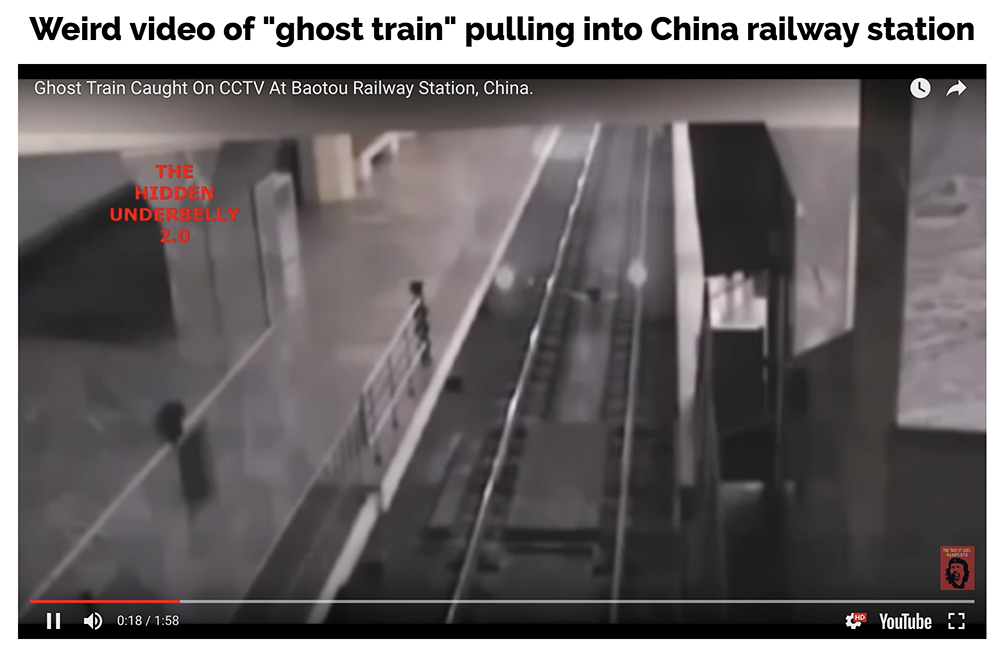
BR: I was asked by the TV show Strange Evidence, which I was on with some chagrin a year or two back. And I was asked to come back on the show and look at more allegedly mysterious ghost videos and videos of just monsters and just weird things. Basically, the premise of the show is, here’s this strange CCTV video or photograph or whatever else, what might it be? And I was presented with about a dozen different videos of different descriptions. And one of them was regarding a ghost train that was allegedly recorded in a metro station in Moscow, a real one, not a virtual one, that Daria talked about in 2013. The little nugget description I was given was, Moscow metro security cameras capture the chilling moment a ghost train pulls into the Polhevetsky station. A passenger appears to get off the old-fashioned looking train before it disappears from the tunnel, never to be seen again. It looks like a spooky scene from a horror movie, but what’s the truth behind this weird image?
0:58:12
CW: Well, tell us.
0:58:14
BR: Well, so I looked into it and you can find it online. It’s not hard to find. Just look on YouTube for Ghost Train Moscow or Ghost Train 2013 Moscow, you’ll probably find it. It’s a short little segment. There are a couple red flags. I’ll just sort of quickly describe it. So basically it’s a black and white video of what appears to be, and I don’t know, but appears to be a metro station somewhere. There’s no signs in Russian saying exactly where it is, but in one corner it does say security cam 5 in English, which I found suspicious. But yeah, but anyway, it’s a CCTV camera, security camera looking down and empty tracks and then soon thereafter, what can only be described as ghostly train arrives, it pulls in, you can tell there’s a couple of prominent lights on there and it’s transparent. It is exactly what you would imagine a ghost train looks like. Oh. It’s also suspicious, I’ll just add. Basically, it’s sort of a transparent, you can sort of see the outlines, you can see basically it’s a bunch of glowing streaks, but clearly a train-like form, again, with two prominent lights in front and then it shows up and then it stops and it pauses for about as much time as the train would and then it takes off and this is just essentially bizarre according to the the tv show it was pretty clearly faked it took me about five minutes to conclude that it was almost certainly faked i did consult a cgi uh a special effects uh friend of mine named Derek Sarah, and Derek looked into it and I said, hey, can you look at this? He’s like, yeah, fake. He’s like, yeah, fake. It was pretty straight, it was pretty clearly faked, but again, I don’t know everything and I have not investigated every bizarre thing in the world but he basically said that what it was, it was a merge of two different videos from the same fixed camera.
1:00:24
CW: Like just the way that double exposures were used back in like the like 150 years ago.
1:00:31
BR: Right. Exactly. Exactly. So basically what the person did was assuming that it’s a real I mean, I I believe it’s a real train station. I mean, I don’t think the whole the whole thing is faked. But what they probably did, which would be the simplest thing to do, would be to simply record the footage when there’s no train there and then record footage when there’s a train coming in going and then just superimpose the two and boom you’re pretty much done.
1:01:08
CW: Now was the footage of the train, the ghostly train, was there any way to track it to a particular movie or did anybody notice it?
BR: Well again that’s a good question. The answer is that no one noticed it. Now, this is a big red flag when you’re looking at mysterious ghostly videos. I keep meaning to do a show on examining mysterious videos and photographs. It’s a little harder on a podcast, obviously, because an audio medium. But that’s one of the big red flags is the fact that no one reacted to it. So on the right hand side of the screen, you can see two, three people sort of going about their business. And when this ghostly train pulls up, nobody notices it, nobody freaks out. It just, they don’t say, hey, there’s a ghostly train five feet from me. It’s just entirely ignored. That was a big red flag.
1:01:59
So it was only haunting the security camera. That was the only thing that noticed the ghost train?
1:02:03
BR: You would think, you would think. So again there were a couple red flags. One was that it has said security camera 5 in English. Now I haven’t spent a lot of time, I’ll just be honest, I spent no time in Moscow subways so I can’t tell you for sure what the security cameras in them are like. I suspect they’re probably in Russian but I could be wrong. There’s another red flag here, and this is something that when the TV producers sent me the clip to examine, they just basically sent me the clip and a couple questions, and I got the sense they didn’t really want me to do too much actual investigation, but of course, that’s what I do. So I spent some time, and apparently it turns out that that exact same footage was claimed to have been recorded in a Chinese metro station in 2018.
1:02:54
CW: Where they also have the signs in English?
1:02:57
BR: Apparently so. Well, no, no, to be clear, there’s no signs, there’s no signs visible.
1:03:04
CW: Okay, so you just mean the clip, the actual footage of the train that was, that was transparent.
1:03:09
BR: Right, so in the, in the field of view on the camera, on the video monitor it says video camera 5. So there’s no visible signs in English or Chinese or Russian that are visible in the footage itself.
1:03:24
CW: Okay.
1:03:25
BR: So, again, another red flag. Well, which is it? Did this occur in Moscow in 2013 or five years later in China? And why would there be any question about it. And of course, another big red flag was that the video was uploaded anonymously. So that was my research into a video of a ghost train. We’ll have a link for you in the notes.
1:03:53
CW: It sounds like the whole theory about that being an actual ghost train kind of went off the rails there.
1:03:58
BR: Yes.
1:04:00
CW: I’m sorry. I know you hate the puns.
(MUSIC)
1:04:07
Pascual Romero: We would like to thank our sponsor level patrons, Amy Freshour-Kelly and Dr. Angela Mattke. If you’re interested in becoming a sponsor or just throwing us a buck or two per episode, check out patreon.com forward slash squaring the strange. Every bit helps us keep the lights on here in strange studios and we could not keep bringing you content without the support of our generous friends. If you’re looking to provide moral support, head on over to iTunes and give us a five-star review. Every positive review helps us move up the podcast charts. Thanks again, strangers.
1:04:40
BR: Alright, well, thanks for listening to the latest episode of Squaring the Strange. We had fun. Hopefully you guys had fun as well.
1:04:53
CW: Yes, it was fun. And, Ben, you have an announcement, right?
1:04:58
BR: I want to let people know that I will be at Bubonicon, the local science fiction, fantasy, horror conference. It’s sort of like Dragon Con, but much smaller. I think if I’m not mistaken, the three of us were guests at Bubonicon last year.
CW: Oh yeah that was fun. I won’t be there this year and Pascual will not but you can catch Ben in Albuquerque. Which hotel is it at this year Ben?
1:05:20
BR: It is the same the same hotel it’s at the Marriott in downtown Albuquerque. That is where I don’t remember whether I’ve mentioned this before but I almost ran over George RR Martin in the parking lot. I’m not proud of it. I didn’t hit him. I would not have heard the last of it had I done that. But anyway, I’ll be speaking on Friday, August 24th, speaking at 7.45 PM on myths and mysteries of New Mexico, that’ll be wrapping up around nine. And then I’ll be on two panels the following day, Saturday, August 25th. At 11 AM, I’ll be on a panel on establishing your workflow. And at 2 PM, I’ll be discussing on panel with others talking about New Mexico as an alien world the appeal of the Southwest Talking about why there are so many weird things going on here in the here in our home state of New Mexico. So if anyone’s interested in seeing that or there’s lots of other great Artists and writers and science fiction. So it’s a it’ll be a fun time for all.
1:06:18
CW: Yeah. Yeah, I’ve been there. It’s fun. And Ben, it sounds like if they have you talking about myths and legends and how to manage your workflow and then strange alien stories of New Mexico, those are all three things right up your alley.
1:06:37
BR: They are. They are. So it’ll be fun. So you should come on out and stop in. You can get one day passes or weekend passes, whatever you want. It’s Friday through Sunday. They have an art room. There’s all sorts of great art. There’s talented writers. I am by far, by far the least talented person on the roster. I’m just being very clear about that. Last year was Ben Bova. We got George R. Martin. We’ve got Donaldson. Just a who’s who.
1:07:04
CW: But so when you see Ben, make sure you scream, Oh my God, look, it’s the least talented writer here and run right over and get your picture of him. He loves that. Yes. Take care. Bye bye. talented writer here and run right over and get your picture of him. He loves that. Yes. Take care. Bye bye.
Transcribed with Cockatoo
