
Episode Summary:
This week, Ben and Pascual kick off the first half of the “New Years Resolution” series where they look at woo in the gym. Just in time for your resolution, The Credible Hulk joins our hosts to walk us through some of the myths and misconceptions that run rampant in the bodybuilding/gym world.
0:00:00
Ben Radford: Welcome to Squaring the Strange, the podcast that examines all manner of the mysterious and the mundane through a critical lens. So, let’s square the strange.
0:00:11
Pascual Romero: Welcome back to Squaring the Strange, this is Pascual. I just wanted to jump in right at the top of this episode to issue a little bit of a correction on last week’s episode. I was talking about the baby Mozart effect and the products and different things that people are making money off of under the baby Mozart. A listener, goes by the name Digital Sorceress, mentioned to me that the statement about the study itself being done on young children was incorrect. The original study was conducted by psychologist Francis Rauscher on college-age students. So that was really what it boiled down to. It wasn’t actually done on children. I think what I was reading about was whatever the research that led to the baby Mozart stuff was done on kids, but it was never replicated. But this also was not replicated, and it was basically a very highly misunderstood study, the original study. It just said that any so-called effect was temporary at best. So anyway, I just wanted to jump in with that correction and thanks again Digital Sorceress for sending that email. Anyway, on to the episode.
(MUSIC)
0:01:55
BR: Welcome back to Squaring the Strange. We have a special guest in the hidden Square and Strange studios.
PR: Yeah, I’m really excited about this. This has been, since we first mentioned it, it’s been a while coming and I’ve been kind of excited to jump into this. Who do we have here in the studio?
0:02:30
BR: We have the credible Hulk. Yes, yes, the credible Hulk. Here to my left, there’s not much space in the studio when he’s flexing. It’s a little scary, but he’s there and he’s bringing his hard-earned knowledge on all sorts of things from science and physics and biology and bodybuilding as well.
Credible Hulk: Hi everybody!
PR: So yeah, so this episode as we teased last week is going to be about some of the kind of fitness and gym woo out there and how, you know, it kind of, how much of it, you know, is real and how much of it, you know, do we know and where’s all the gray area and everything? So we’re going to really walk into that. But first, Ben, let’s go ahead and find out what you’re skeptical of this week.
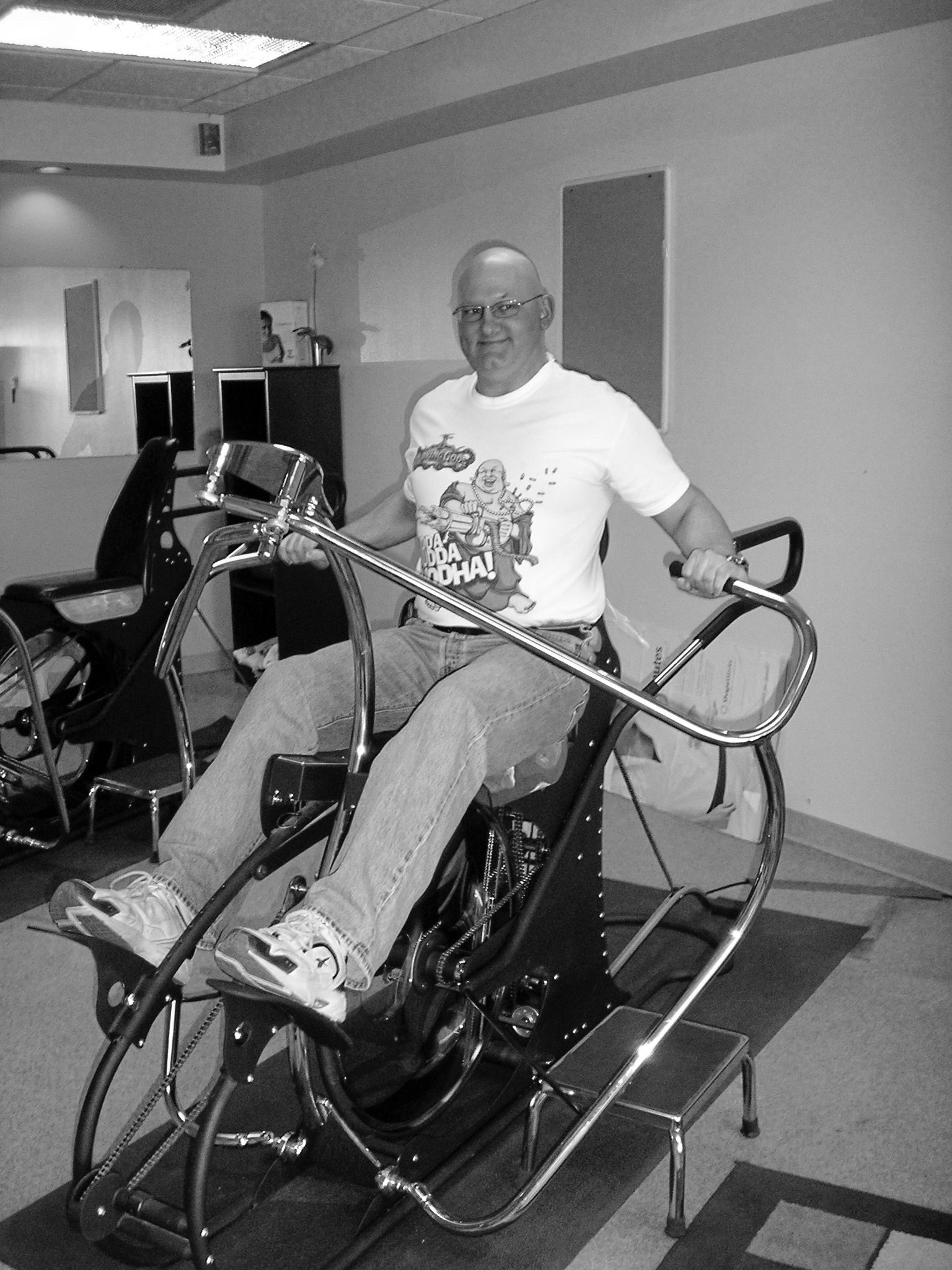
BR: So this week I’m actually going back a ways to a skepticism that first piqued my interest about 2008, 2009 or so. And I was asked about the ROM. The ROM. Yes.
PR: Read-only memory.
0:03:39
BR: Or I was thinking maybe it was like that Marvel comic, remember the cyborg robot ROM?
0:03:45
PR: Oh yeah, sure.
0:03:49
BR: Or then like, well, no, maybe it’s the Royal Ontario Museum, which I’ve been to. It’s very nice, actually. But no, no. Apparently, I was asked to look into something called the Range of Motion Machine, ROM.
0:04:01
PR: Okay.
0:04:02
BR: Which was, is, well, was. I think it’s still around. It certainly was around when I was digging into it. And it was billed as a sort of miracle exercise machine. I’ve seen a few of those in my day. So, you know, basically, as you know, I do an article, a column in Skeptical Inquirer magazine and I have people, readers write in and ask questions and sometimes I’m able to go and investigate them, sometimes not. In this particular case…
CH: You know that reminds me of this old cracked comic from years ago. This guy, he orders this robot that’s advertised as builds muscle while you relax. And so this robot takes his arms and like flapping them real fast. And then he turns around and then the robot has these bulges coming out of this robot arm.
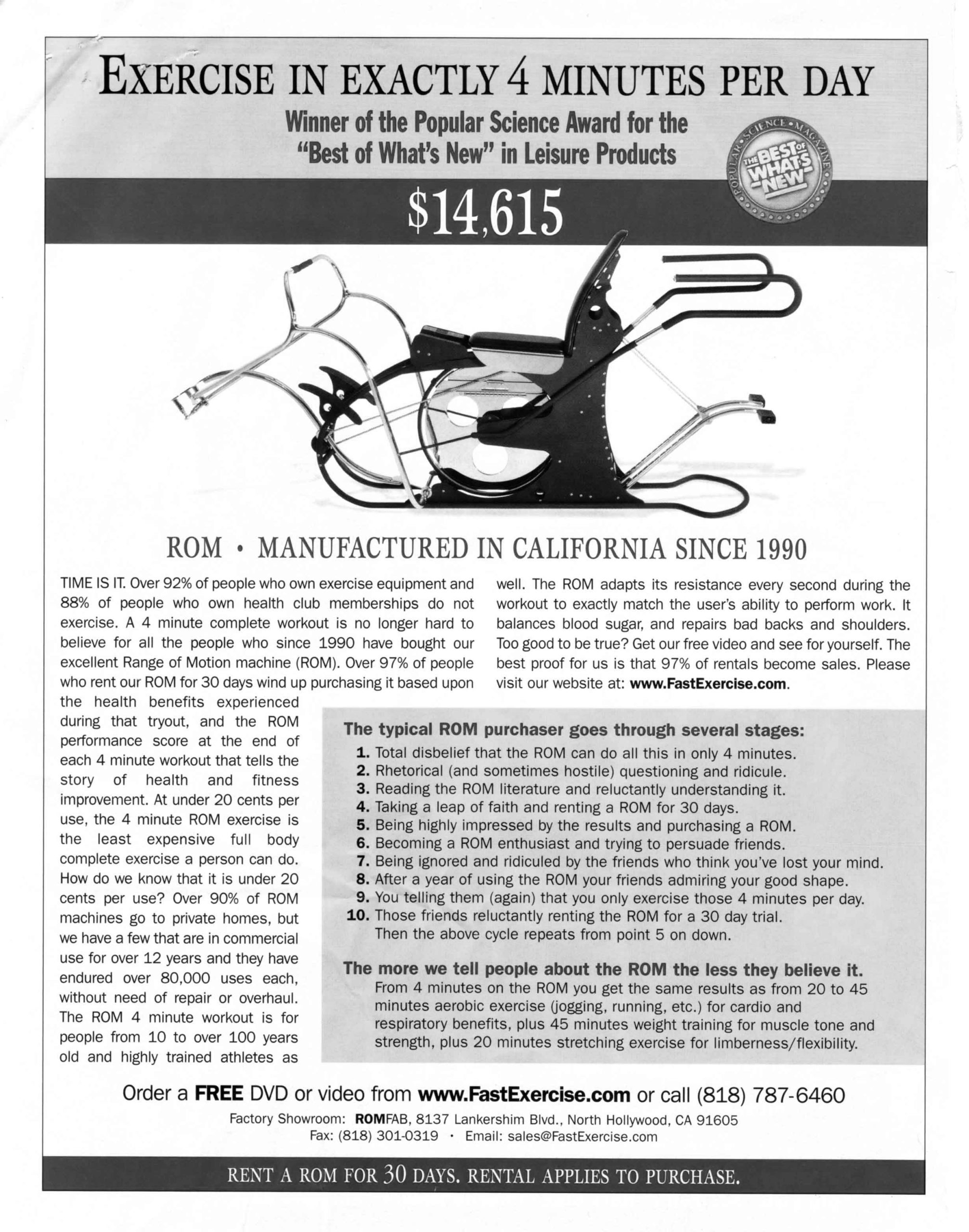
BR: Oh, you meant your muscle. No, but this is weird. And I had actually first seen in advertisements, it was in Esquire and Scientific American, Playboy, Vanity Fair, Time, Sharper Image. So it was very popular about 10 years ago. And it was this weird ad. I have the ad in front of me. It says, exercise in exactly four minutes per day. I’m thinking, four minutes per day? I can see the appeal of that because, let’s face it, I’m lazy.
0:05:34
CH: Who wouldn’t?
0:05:35
BR: Who wouldn’t, right? I mean, we all want to be fit and we all like to sleep and sit on the couch. And so there’s that dynamic tension and this would be the manna from heaven if all one needs to do is exercise for exactly four minutes. Now, this was odd because it wasn’t like three minutes, 90 seconds. It wasn’t five minutes. It was exactly four minutes. So I’m guessing maybe you pull a muscle. If it’s five, I don’t really know.
CH: You know, it reminds me of some of those energy drinks where they’re like kind of one-upping themselves. We’ve got five-hour energy. They say, oh yeah? Well, we’ve got six-hour energy.
0:06:13
PR: Right, right.
0:06:14
BR: Twelve-hour energy.
0:06:15
CH: Somebody came out with a four-minute workout. How are you going to top that? It’s like, well, yeah, we’ve got the three-minute workout. Nobody took it that far.
0:06:23
BR: But wait!
0:06:24
CH: Oh, man, you guys are nuts. You’re taking it to extremes.
BR: You also get… No, but there’s a catch, though. There’s a catch. Well, there are several catches, you can imagine. The biggest catch is the price. Credible Hulk, how much would you pay for a machine that gave you a complete body workout in only four minutes? Just ballpark here.
0:06:49
CH: Honestly, I would be a bit incredulous that that was even reasonable. You know, I’m lucky if I’m done warming up in four minutes.
BR: Okay, all right. And you’re clearly the most fit person in this room, if not in Via Rancho. So that’s good. Well, here’s the problem. The problem is the advertised price is $14,615. That’s a lot of shill bucks. So anyway, I was asked to look into this because they’re like, hey Ben, I’m a little dubious about this. So I began looking into it. And what sold me on its validity, or lack thereof, is the fact that no less than Anthony Robbins, yes, yes, Mr. Motivation Guru himself. He uses it and there’s a testimonial from him. And hey, whatever he’s selling, I’m buying, right? So I looked into this and the first thing I did was to try to figure out, okay, what exactly is the science behind this because that’s what we do. So I spent a fair amount of time digging into it and it turns out that it was actually created by a guy named John Petrie, P-I-T-R-E. And so I’m like, oh, this is interesting. I’m assuming he’s an exercise physiologist or health nutritionist. No, he’s an artist.
0:08:23
PR: Oh, okay.
0:08:25
BR: Which is fine. I’ve got nothing against artists. But being an artist doesn’t necessarily qualify you for designing the world’s most revolutionary exercise machine. I’m guessing. I could be wrong. But that was a red flag to me. This cutting edge machine was designed by a guy. And I saw his art. It’s sort of like new agey stuff like dolphins and you know nudes in forests and you know sort of…
PR: Stuff you might find on like on like one of those velvet tapestries hanging in like you know some garage where the pool table is.
0:09:01
BR: The painter of lights along those lines right? So I’m looking into it and so I actually contacted the guy and so Mr. Petrie apparently he just designed and has since moved on. So he is credited as the designer, builder. In fact, he calls himself the modern day
CH: Da Vinci. Ah, okay. I was wondering when we were going to go there because I was like, well that makes sense. You know, exercise physiologist slash artist, who knows what other things he might be a master of.
0:09:33
BR: Sure, sure. Right, well certainly self-promotion would be another thing that he’s uh… so anyway he he’s long gone but there’s another guy uh… there’s no guy who’s who’s now promoting it uh… and it’s really interesting because when i was looking at the testimonials on the ROM online the he uh… the the guys now in charge of companies really uh… really pissed off at skeptics movies he is not impressed…
CH: You have to get in line.
BR: No, but it’s interesting, because for as much as the literature on the ROM talk about science and this and that, when scientists actually look at this and discredit it, they’re like, well, those scientists don’t know what they’re talking about. It’s like, well, hold on here. It’s like you’re talking about how cutting-edge scientific your machine is, but then when actual scientists look at it and think it’s full of shit, then all of a sudden it’s like, oh, we don’t believe the science. So anyway, I won’t go too far into it, but anyways, you can find this stuff on the, and really just this, you know, it’s typo-ridden, which is the red flag, but it’s also just this like, well, anybody that criticizes the machine is out to get them, it’s part of this big conspiracy, it’s really curious. So anyway, but the big thing was, if you read the rebuttals to anyone who’s criticized Machine Sense than me, well the problem is, you just haven’t used it.
0:11:04
PR: Right.
0:11:05
BR: How dare you, sir? If you have not used my machine for four minutes, you have no, you clearly have no idea what you’re talking about
0:11:14
PR: So obviously they offered to send you a machine right?
0:11:20
CH: The fact that their opening up their sales pitch with a preemptive you know defensive response to the other no it’s inevitably going to be negative critique is suspicious to me.
BR: Yeah I would say so yes that was in fact I doctor Harriet Hall who’s it was a friend of mine and one of the great skeptics, and she’s a member of the, she’s written for Skeptic and Skeptical Inquirer magazine, of course. She did a piece on it, and he summarily dismissed her because it doesn’t matter if she has actual medical degrees, it doesn’t matter, no, no, she hasn’t used it. So I said to myself, I said, I said, self? I said Ben, because that’s my name, I said, Ben, I better go use this thing just because that is the only way that I will I will be able to experience it myself and have the credibility. So it turns out that there was there was a franchise called the Quick Gym.
CH: Yep I remember.
BR: All right all right here we go.
CH: I used to drive by them on a regular basis.
PR: On your way to the actual gym?
CH: On my way home from a real gym.
BR: So I was like, okay, this is interesting. Now, again, I can’t drop that kind of money, even with all my shill bucks. But I can-
CH: All those two macabres and ghost show bucks.
BR: Yeah, it’s not paying the bill. So I said, all right, let me stop by a quick gym, because they have these machines. And I mean, who wouldn’t want, you know, again, and if you think about the beauty of it is, right, you have people that, and so it’s four minutes for legs and arms, four minutes each for legs and arms. So it’s a total of eight minutes. Plus workout, plus the warm up, ten, fifteen minutes, right? Which is a perfect business model because they can’t afford too many machines because they’re so expensive. So in this room they have two machines, right? But as long as people are coming, turning and burning in ten or fifteen minutes. So I went in there and I met a woman named Penny Edwards, MD, who I later determined was not in fact an MD. I know that will shock you. So I talked to Penny Edwards, MD, and I said –
0:13:31
CH: Oh, those were my initials, they just call me that.
0:13:33
That’s right, I’m interested in this amazing thing designed by a modern day da Vinci, because who wouldn’t? I’m in the presence of greatness, clearly. And I said, yeah, I’d like to see a machine, I promise. And as she was showing me the machine, I was asking her about the background. I was like, no, Mr. Petrie, what exactly is his background? She’s like, oh, he’s an artist. So she points me to one of his art books on a coffee table. I’m like, really? You’re pointing me to leaping dolphins and sunsets? When I’m asking you for evidence the thing works?
CH: How else are you going to know that he knows how to make exercise equipment?
0:14:19
BR: Obviously. His use of blue is really pretty remarkable, let me tell you. So anyway, long story short, I get on this machine, and this was actually written up in the September-October 2009 issue of Skeptin Choir, if you’re interested. The title of the article is, Modern-Day Da Vinci’s ROM, Range of Motion or Rip-Off Machine? You make the call. Anyway, long story short, I tested this amazing miracle, because clearly I was the only skeptic who had, and my conclusion was that it’s just pure bullshit. To be fair, I’m not an exercise physiologist. I’m not a highfalutin scientist. I don’t have nearly as much scientific expertise as you do, for example, Credible Hulk. However, I can tell you that I did not get the equivalent of a one hour exercise workout in four minutes. So anyway, after this I went back and I contacted Mr. Temi and I said, hey, this is interesting. Your big complaint is that skeptics never try your machine. Here’s a photo of me trying your machine. I’m calling BS on this. Can you send me studies that show that it works? There’s some credibility to it. And he sent me two studies and I… it’s always funny because this happens this happens I’d say a few times a year where I’ll challenge someone’s statements, their claims, and I’ll say, can you send me evidence? And they’re like, oh no problem. They’ll send me studies and they either think that I can’t read studies or like journal articles or won’t read it or like I’m not sure which one it is but like invariably I’ll read them like yeah no that doesn’t say that.
0:16:01
CH: Right that’s not yeah that’s so common like anti-vaxxers do that yeah like constantly.
PR: Oh sure.
CH: Well there’s the ones that say oh do your research I don’t have to spoon-feed you this secret knowledge of mine. Just you know Google it you know by which they mean put in vaccines plus bad. Plus toxins and you know pick the first article has no hyperlinked studies or something yeah but the other ones they have like some of them even have like these copy paste gish gallops of a whole bunch of studies and like every single one of them will either be flawed or say something totally different than what they say it does you know and and they know that a lot of times they know because other people have already pointed that out to them, but they know that there’s a high probability that the new person is not going to go to the trouble so they can say, Ha, I showed that sheeple what was what for. You know, and it’s very similar to the tactics to see in young earth creationists. They know that their really bad arguments against evolution are wrong. They know they’re based on false premises and misrepresentations of the scientific theory, but they reuse it again anyway because, well, maybe this person doesn’t know the rebuttal.
BR: Now, just to be clear, are you accusing them of intellectual dishonesty?
0:17:34
CH: I am.
0:17:35
BR: Okay, very good. I’m glad that’s clear. Anyway, just to wrap up, so again, I did a fair amount of research on there. If you look at the research done by the American Council on Exercise and others as well, there’s just no credibility to this whatsoever. But it’s an interesting look at how a conspiracy theory can latch on to a corporate model. Right. Because again, the main defender here, who of course is selling these things for $14,615, has a vested interest in saying, don’t listen to the skeptics, don’t listen to the scientists, they don’t want you to know. It’s this whole conspiracy theory, hidden knowledge thing. And it’s rare that you see that so clearly wrapped up in this corporate model. And again, something that was advertised in Time Magazine and Scientific American and Smithsonian. I mean, I read Smithsonian Magazine and frankly, some of the ads in the back, I get it, whatever, advertisers can pay whatever they want. So it’s hard to vet. I mean, Skeptical Inquirer, for example, rarely contains ads. We just don’t. Partly because of that, because quality control. You don’t want somebody having some wild crank stuff being ostensibly promoted in your magazine. So I don’t blame them. But on their hand, this is self-evident garbage.
CH: I feel like I should just interject one caveat about that is that there are styles of resistance training that utilize high intensities for short duration. Maybe not that short, like four minutes. Not four minutes? That’s what you know it’s like the eyebrow raising. Right, yeah. And you’ve investigated it firsthand so I don’t know anything about the physiology involved in the different movements that it has to do, but just in terms of short workouts, there’s like a whole style out there called either high-intensity HIT or heavy-duty where they train a very, very small number of sets. They’ll do warm-up sets, but then once they do their working set, it’s like all out to failure and beyond with like techniques that extend the set, and some people seem to progress on those routines. To my knowledge, there’s not a whole lot of peer-reviewed literature that’s specifically investigating that style. I could be wrong. If somebody knows of some out there who’s listening to this, feel free to contact us and let us know about it. the exercise science literature uses a more straightforward style. So that in and of itself is not a reason to dismiss something just because it’s short. This is extremely short and just the claims, it’s the magnitude of the claims that should get anybody’s skeptical hat on right away. Well, but again to be fair it was created by a modern-day Davinci.
(MUSIC)
0:20:50
Celestia Ward: Hey squares and hey strangers if you enjoy our content stop by patreon.com backslash squaring the strange and drop us a dollar or two. We have more planned goodies to roll out for supporters, so keep an eye out for announcements in the coming weeks ahead. And if you can only open your heart to us right now and not your wallet, then do take a moment and leave us a kind review on iTunes, Stitcher, or your favorite podcast hub. And click like on our Facebook page to get some updates and visual content. Until next week, stay strange everybody.
(MUSIC)
0:21:40
PR: So we are back. We are here with our buddy the Credible Hulk, aka Matt. He said we could call him both.
BR: I’ll do whatever he tells me to do.
0:21:50
PR: Whatever he says goes in here. But we really wanted to kind of tackle a couple of topics at the end of the year slash beginning of the new year that kind of relate to New Year’s resolutions and things like that. Fitness is always on everyone’s mind around this time of year after they’ve been eating like crap for like 60 days straight and just lazing around the house in the cold weather. There’s a little personal vested interest in it too because I’ve struggled with my own weight for a lot of years and I’ve gone through ups and downs of really intense physical activity to bring my weight down and dieting and all that stuff. One thing that being a skeptic and going through all of this has done is just made me really kind of mind boggled by the amount of woo that sort of circulates around this stuff. So I thought we’d tackle today, physically and metaphorically tackle the topic of exercise and gym woo because that’s something that really just, I catch it all the time like you just mentioned in your swayso there’s a lot of it out there and how do we figure out what’s the best thing to do and what actually works and where science rests on this. So let’s get into it. So Hulk, what…
0:23:23
BR: What does Hulk say?
0:23:24
PR: Where should we start?
0:23:28
BR: What myth does Hulk smash?
CH: Well, I found it useful to group the different types of gym and muscle building woo into four categories. This is not the only way that you could arrange it and the categories are not necessarily mutually exclusive but I found it easy to think about it in this way whereby I have a fringe body building woo. I call it fringe stuff because it’s really not that common. It’s like the more bizarre stuff like cupping and there’s you know maybe a few people in bodybuilding who might get into acupuncture, just standard alternative medicine stuff that’s not necessarily related to the building muscle and burning fat aspect of it.
BR: But might be blended with it.
CH: Yeah, to some extent. But what I’ve found is that that’s extremely rare, and I think that the reason for that is because it’s one of those things where you have a vested interest in being a little bit more objective. You know, one thing that we always notice about rejection of science is that most people, with a very few exceptions, they don’t reject the scientific method outright. They don’t reject it in areas where it is not a threat to any core value or core belief.
PR: Right, right.
CH: So when they’re investing, and that’s also why when something is perceived as a financial threat, you know, somebody who is very pro big business, you know, they might be threatened by the conclusions of climate scientists. So they might be more likely to kind of modulate their threshold of acceptance to a level that kind of just shuts it out. Where they lower that bar of acceptance on areas that are not a threat to them or that maybe even benefit them to accept the scientific position. And I think that that’s what’s going on here, is that people work so hard to try to improve their bodies that they’re a little bit more inclined, on average, to be a little more accurate. They don’t benefit from believing bullshit. So if they’re believing something that’s counterproductive, if it’s something that’s not affecting their progress either way, it’s possible that they might conflate the correlation with causation and continue doing something that’s not really responsible for any successes and failures of the past, but there’s an incentive for them to listen to people who know. Whether that takes the form of the advice of the bro science of people who are a little bit bigger than them in the gym, or whether it takes the form of listening to exercise scientists or maybe some combination thereof. If you go on the forums and you look for cupping and bodybuilding, most of them are pretty much outright saying, no, that’s bullshit, dude, don’t waste your time. That’s not going to help your gains in the gym. So that’s why I was thinking that that can probably be de-emphasized in terms of, it’s just not as common as these three other categories. And one of those is, I’ve already mentioned, the over-reliance on anecdotes. Sometimes we refer to that as bro-science, which can be characterized as the brand of reasoning in muscle-building circles, whereby the anecdotal reports of really jacked dudes are considered to be more credible than any scientific research.
0:27:06
PR: Right, right.
0:27:08
BR: He’s obviously ripped. There you go.
0:27:10
PR: I can see the appeal of, you know, I mean it can be hard to like get your kind of primitive brain past the fact that like the person who’s exhibiting what you’re trying to achieve giving you advice. I mean like any wealthy, successful businessman, you want to ask them for their advice on how they got there. And of course there’s all these variables that they’re not going to put in there, you know, like they inherited $500 million from their dad when he died.
0:27:38
CH: Because you know that something that they do is effective.
PR: Exactly.
CH: You don’t necessarily know that they have parsed out which things that they do were responsible for the success.
PR: Exactly.
CH: So, just like with all anecdotal evidence, it is possible for people to misattribute the causes of their successes and failures because they’re not controlling for these other variables. And the other part to this that doesn’t necessarily apply to all forms of anecdotal evidence but applies here is that even if they are accurately reporting the aspects of their habits that were responsible for their success in part, it’s still not necessarily possible to replicate all of the variables that in combination led to their success because you don’t have the same genome as they do.
BR: That’s an excellent point.
PR: That’s definitely true. I think it’s like my own experience has really lent to that because I’m a person who… My body, it takes a lot of work for me to stay this fat. Let’s just put it that way. My body actually naturally builds muscle very quickly if I try. I’m a pretty big, broad guy with big shoulders. Sometimes if I just diet, I start looking muscular. I don’t really do much else. I can’t just go and be like, well, just watch what you eat, maybe cut the carbs, you know, like, because that doesn’t necessarily apply to anyone else. It’s just that my body already has a baseline that’s a little bit more muscular than, you know, some of my, you know, shorter, skinnier friends. So it’s definitely a huge factor.
BR: Yeah, I think it’s an important part that’s often missed. You know, anytime you have an expert that’s giving their opinion on, well, on anything, but particularly for example, nutrition or health. There are overall guidelines that they’re presumably giving you the best evidence to date about. But, again, that’s why they always say, ask your doctor. It’s not because there’s necessarily going to be a divergence in opinion about whether a vaccination is good or the dangers of one particular health thing. It’s that your doctor knows you specifically. And so the overall advice that’s given by the Surgeon General or some health department official is probably valid but it may not be valid for you specifically, sir. Which is why you’ve got to talk to your doctor because your doctor knows your history. Whether your uncle died of colon cancer at 30. I mean so these sort of things are always tailored around the individual person. It’s important to bridge that gap.
CH: I always figured that it was probably partly for liability purposes.
PR: I’m sure that’s a big part.
CH: But there is a caveat to that second category, though, and that is I’m not saying that people should totally discount all the advice of somebody who has been successful. That’s probably not a good idea either, especially since exercise science is in its infancy, and it’s also incredibly complicated. It’s a cross-disciplinary area that brings together physiology, neurology, and nutrition, and anatomy, and all sorts of stuff. All sorts of stuff. So, since it’s a young science, it’s not necessarily a good idea to automatically dismiss the experiences of people who I’ve been successful with. But what I think the purpose of that, or the most useful thing to get out of that, is that those can be a starting point from which to generate new questions and new hypotheses And probably, I would imagine that some of it already has been, just trying to settle age-old debates. In fact, some of those are still going. There’s still this debate about, for instance, whether or not doing your cardio fasted, like when you first wake up, is optimal for the net fat burning result. Sure, if your glycogen is depleted, then you have a chance to start oxidizing more fatty acids sooner. But does the net result throughout the day, how does that affect other factors like satiety? What about doing cardio at different intensities? How does that affect it? You know, because there’s like the big thing now is HIIT, you know, the high-intensity interval training. Well, okay, we have so many different variables to test and there’s a lot of different scenarios in which there just haven’t been studies yet. And so people should just take the advice of big dudes at the gym with a grain of salt. You know, just understand that even if they are right about what caused them to get that big, there’s no guarantee that that’s going to be optimal necessarily for you unless you are very similar to them in a lot of ways, you know, genetically. You know, so if you had like a twin brother who started lifting before you did, you know, what worked for him might work for you.
0:33:15
PR: Sure, sure.
0:33:16
BR: I think another factor of that is also, number one, I think it’s important, as you pointed out, is science is hard. As we always say, science is not easy. And so I often come across people who think, well, but we all have human bodies, why don’t we know everything about it? I mean, we’ve been in this form for, if you’re a creationist, 4,000 years, or if you’re everyone else, even longer. But I mean, there’s a sort of intuitive, like, well, this is ridiculous. How can we not know everything about the body? We have science, we have MRIs, we have all this. It’s like, no, no, no, no. Science is difficult in teasing these things out. What I was thinking when you were talking about, for example, is it better to exercise after fasting? It could be that that it is, you know, 5% better. So at some point it becomes, yes it’s different, is it meaningful? And so it’s entirely possible that in some ways it’s a 10% teapot because yes, under certain circumstances, yes, you know, for some individuals you will lose a few extra calories or you’ll build more mass in condition A as opposed to condition B. At the end of the day, it doesn’t matter. There’s so many other factors. It’s like when we’re talking about the sound, right? And the quality of the chords, right? And so yes, the fact is that yes, some audio cables conduct more than others, but if you can’t tell the difference, is a 2% difference in audio quality worth $8,000? Probably not.
CH: I’m glad you brought that up because a lot of the most contentious debates over different topics relating to success and muscle building and losing fat are really on the nuances, on the details like that little couple of percent difference in the rate of success. So people want like a simplified, that’s one of the reasons why they ask the big dude in the gym is because they want like a simplified response. They don’t want to have to take graduate courses in physiology and biochemistry to be able to understand how to structure their workout program. And they shouldn’t have to. That’s why we have an industry where there’s people who specialize in certain things. And they can tell people. They can prescribe different routines and diet programs to people based on what they know about that person and what their goals are. So a lot of it is, I mean, really like the bulk of success is just consistency. You know, being consistent in, consistently going to the gym. Sure, if you’re doing something completely bat shit crazy, you know, maybe you would still not, you know, get anywhere. But that’s the main thing is sticking with it, making it part of the lifestyle. And you don’t have to be absolutely perfectly tracking every macronutrient that you intake 365 days a year. Sure, you might want to try that at some point and get a feel for how much you’re really consuming. That’s not bad, but really the main thing is just getting sufficient nutrients and rest all the time over a long period of time and trying to progress, trying to make the workouts a little bit harder so that you’re progressing.
BR: I can just see people who are thinking about exercising, well, I saw this podcast and this TV show and those exercise physiologists, they can’t figure that out, so I’ll just sit on the couch. It’s like, no, no, no, that’s not how that works. They all agree you should get off your ass. The question is, if you’re going to… What they’re debating is whether after you get off your ass, you should run 12 miles or 14 miles. And you’re not going to do either one of them.
0:37:30
CH: Well, how do you know? How do you know the optimal amount isn’t zero?
0:37:33
BR: Exactly.
0:37:34
CH: Checkmate, scientists. Boom!
BR: Boom!
0:37:37
CH: That’s the whole thing with amplifying uncertainties. Really I think that’s a similar mentality to people not wanting to pay attention to exercise scientists. How the hell is this pencil neck geek in the lab coat know more than this guy who’s like 300 pounds and 4% body fat?
0:37:59
PR: It’s like, well, they spend as much time in the lab as that guy does in the gym So they’re the sacrifices on maybe on that side with this.
CH: And you know and the truth is that some of the people in exercise science are actually in pretty good shape You know they got into it because they they were into it.
PR: Yeah, yeah Well, it’d be hard I could imagine like the difficulty like if I walked in with like a degree in exercise science and like having people trying to take me seriously while I’m like talking about obesity or something and it’s like…
BR: You know that there was that there was a debate about five or six years ago by the Surgeon General who was overweight and there was a debate of like well how Where is her authority right and there was there was a question of like well I mean the fact is that most of most adults are overweight like 66% Either overweight or obese so it’s very, very common. We’ll be talking about more of that.
CH: Except people don’t always apply what they know.
BR: No, no, and whatever. I’m not suggesting that, you know, I’m not suggesting one way or the other.
CH: I mean, every smoker knows or has at least been told that smoking is bad for them. I’ve actually met some eccentric individuals who insist that that’s all a conspiracy and that smoking is actually good for you.
0:39:11
BR: In World War I, I was given… The Army issued cigarettes, and by God, they wouldn’t lie to me. The Army would not put me in harm’s way.
0:39:19
CH: Yeah, there was some doctor, Bigsby, or something, I forget what his name was. I think it started with a B.
BR: Bigglesworth?
CH: Oh, I’m seeing. Let’s go with that. Dr. Bigglesworth. No, I think it was Bigsby or something like that. I could be wrong about that, but he wrote a book saying, oh, well, the only evidence is correlation, which isn’t exactly true. I mean, we cross-corroborate. Yes, it’s true that epidemiological evidence comprises a lot of the basis for us figuring out that smoking increased risk of lung cancer, among other things. But it’s like the cross-corroboration of all these different data sets.
0:40:01
BR: Pretty clear.
0:40:02
CH: It’s pretty unequivocal.
0:40:03
PR: It always lands on the common thread of smoking, so there comes a point where you got to maybe be a little more aware of where the credibility lies.
0:40:13
BR: I didn’t mean to get you off track, so what was the other?
CH: Oh, well the third category, and I think this is one of the biggest ones, is simply misunderstanding misunderstanding the existing scientific literature, or over-extrapolating from a single study, misunderstanding what it means. And I wanted to give an example that was one that I actually bought into for several years. And there was some studies that made this seem credible, but it’s kind of been over-emphasized. And so it wasn’t until a couple years ago where I realized that some people have published some more recent stuff that took a more skeptical look at this idea. And the idea I’m talking about, I actually just re-posted something about it the other day, is called the anabolic window. Now in the early 2000s, this trend emerged in lifting circles based on this concept called the anabolic window. And it’s the idea that there existed a fairly narrow time frame post-workout during which one would have to consume a certain amount of protein and carbohydrates in order to optimize the results of their workout. Now it’s not 100% not every aspect of it is wrong, but that’s I think what gets to the the heart of of The the bodybuilding woo is is it’s really not Like to the extreme of like the cupping and the okay, and in the really bizarre stuff is that It turns out that it’s not really that urgent to to replenish glycogen stores You know the idea was that you want to raise your insulin because insulin has anti-catabolic properties. In fact, there are professional bodybuilders who actually take insulin who are not diabetic in order that when they mix it with human growth hormone and anabolic steroids it has this sort of synergistic effect and so they actually accelerate their muscle growth in this way. But the idea was to just spike your natural insulin by consuming carbohydrates post-workout with your protein. So the idea was that if you waited too long, then you weren’t gonna optimize the response to the exercise. Because your protein turnover rate is much higher after resistance training. It’s both proteolysis, the breakdown of protein, and protein synthesis are both heightened at that phase. And you want to minimize the proteolysis and maximize the protein synthesis post-workout.
BR: Well, let me just say, you know way more about this than I ever imagined. Anyway, go ahead.
0:43:03
CH: Okay, so what happens when you consume a carbohydrate? See, we have this stuff in our muscles and our liver, it’s called glycogen, it’s these long… long, they’re kind of structurally similar to starches, but they’re chains of glucose with these little periodic branching off of it. They call them 1,4-glycosidic linkages, and then they have these side chains that are called 1,6-glycosidic linkages.
BR: I was going to say that.
CH: And this stuff, it gets, when you’re fasting and also when you’re engaging in a lot of intense muscular contractions, these signals will tell this enzyme called glycogen phosphorylase to start breaking down your glycogen so they can undergo this process of putting it into glycolysis so that it can oxidize your glucose for energy. And so that’s fueling most of your muscle contractions because in the absence of oxygen, I mean, that’s why we call it anaerobic versus aerobic exercise, is that you’re not getting that much energy from, for instance, the Krebs cycle or oxidative phosphorylation. You know, that’s where we make the bulk of our ATP when there’s enough oxygen present is oxidative phosphorylation. And so during anaerobic exercise, instead what’s happening is the glycolysis converts glucose into pyruvate. That’s like 10 steps of reactions. And then one of the cofactors in the process needs to be replenished and that can be accomplished by converting that pyruvate into lactate, lactic acid. That’s why you get that burn in the muscle. And so that regenerates, it reoxidizes this molecule called NADH into NAD+, because it’s needed for one of the reactions. I think it’s a glyceraldehyde 3-phosphate dehydrogenase, if I remember correctly. And so you need that in order to facilitate this reaction. And so the idea is that, okay, you’ve used up all your glycogen by the end of the workout. And if you did a pretty intense workout, and it’s more than four minutes, for example, then presumably you have pretty low glycogen muscle stores. So well, it turns out that as long as your intake throughout the day is sufficient, it doesn’t really matter whether you have this high carb drink or whatever you have right after your workout. It’s not that urgent. You know? So that was one of the findings, was that you didn’t need to do that. Your glycogen is going to get replenished sooner or later anyway. But the exception to that was people who do what they call a double split routine. That’s like what Arnold Schwarzenegger used to do where he’d have two weight workouts per day. And so if you didn’t have any carbs in between those workouts the second one you’d have really low glycogen stores. So presumably you know you would want to have a high carb meal in between those workouts. But the part of it that wasn’t totally wrong was, and even this there’s some some caveats to it, is that the post-workout protein did tend to optimize protein synthesis after the workout, but this is also dependent on how recent and how large their previous protein and carb containing meal was. So all this stuff just turns out, every time we discover something, it turns out that it’s way more complicated than we first realized. And there’s all these other factors that bear upon the validity of these simple take-home messages. And that’s what a lot of people want. It’s like, just tell me what to do that’s gonna work, you know? And how can you blame them? I mean, not everybody, it’s not their path in life to become an exercise scientist. They just want to get results and everybody, ideally we’d want everybody in society to have the option of having as healthy a body as possible.
BR: For their own and for social benefit, sick individuals are costing taxpayers billions of dollars. So it’s in everyone’s best interest that people be educated about health and nutrition as well.
CH: Yeah, absolutely.
(MUSIC)
0:47:21
CW: Hey, Squares and hey strangers, Celestia here with a low calorie skeptical fortune cookie made from whey protein. Let’s crack it open. People are still grasping for miracles and unfortunately there are no miracles. If you do not exercise for a year and let your body remain dormant, you will gain weight. This sensible skeptic advice on fitness comes from Milton Teagle, who grew up battling a weight problem himself, and as a young art student, appeared alongside a cast of freak show characters in Fellini’s films Satyricon and The Clowns. But Milton did not find widespread success until later when he turned his approach on dieting and exercise into an empire and changed his name to Richard Simmons. He eschewed the fad diets of the time involving grapefruit or appetite-suppressing candy, instead promoting daily fitness routines and sensible portions, all while exuding seemingly endless joyful positivity. A staple guest to late-night and daytime programming for decades, Simmons also hosted two television shows as well as a radio program. His approach to fitness and weight loss spawned dozens of best-selling books, exercise tapes, and food plans. Wearing those signature tiny pink dolphin shorts and bedazzled tops, Simmons often refers to himself as someone who is absolutely serious about his work, but who wraps it in the trappings of a clown or a court jester, because that’s what people gravitate toward when they are in need. Richard Simmons receded from public life in 2014, and his disappearance led to a variety of speculation and conspiratorial theories. Some suspected illness. Tabloids ran stories of secret gender reassignment surgery, and others pointed fingers at a housekeeper who might be holding him hostage. A podcast called Missing Richard Simmons popped up in 2017, examining the mystery. Like many things mysterious, the outcome ended up being quite mundane. Milton Teagle had been playing an energetic court jester for most of his life, and he was just tired. Every workout needs a good cool-down period. Now, let’s get back to squaring the strange.
(MUSIC)
0:49:52
PR: So, the fourth point, what’s the fourth one?
0:50:03
CH: Well, I listed supplement woo as the fourth point, and there’s a lot of ground to cover with that, but I was going to focus on the types, some of the techniques that marketing people in the supplement industry will use. And there’s a lot of them. I’m not even going to barely scratch the surface of them. But one of the interesting techniques they’ll use is to actually cite research that supports one of the ingredients of their products, but they’ll neglect to mention some contextual consideration about that research that makes it inapplicable to most of their target customer base.
0:50:53
BR: We didn’t mention this only applies to extreme bodybuilders.
CH: Like, yeah, or people with wasting diseases.
BR: By the way, I know we’re marking it GNC to everybody, but really these results only apply to the 2% of the people.
PR: Right, right.
CH: Right. For example, they might neglect to mention that the research was on people with clinical deficiencies in a particular nutrient or metabolite thereof of a nutrient under discussion, or that the doses were a couple orders of magnitude higher than any normal person could ever afford. And another favorite of mine is not mentioning that the delivery method on which its efficacy was predicated was very different than that which they are proposing. So they can’t sell injectable products over-the-counter. And so if something had some relevant effects when injected into actual patients, they might not necessarily be orally active. For instance, a lot of stuff, for instance, most proteins are, they’re just broken down, they’re hydrolyzed in your stomach. And so you have these proteases that hydrolyze all these peptide bonds, you know, and they break them down before they ever go to anywhere where they could interact with a receptor that would help you.
BR: So a lot of it’s just going unused?
CH: Yeah, it’s just getting digested as though it was any other protein. So something that, I mean, that’s why something like insulin is usually injected. I mean, yeah, there’s a big market for coming up with delivery systems that will ameliorate the need for that, but it’s not easy to do. And so it’s like there’s some really complicated pharmacology that’s way beyond my knowledge base for that. But with supplement companies, since the Dietary Supplements Health Education Act in 1994, the supplements can be treated more or less like foods rather than as drugs. So not only do they not have to demonstrate the safety and efficacy of their product to any reasonable degree in order for the FDA to let them through, but there’s no guarantee that they’re even going to put the ingredients that are supposed to be in there in the amounts that they’re supposed to be in there. They might even spike it with something. Personally, that never made sense to me. Like when athletes say, oh, somebody spiked my supplement, my protein powder, with anabolic steroids. It’s like, why the hell would the supplement company spend that and more money to give you a product that’s going to possibly get them in trouble with the law? I mean, maybe they’re overseas, somewhere where antibiotic steroids are legal, and maybe the same factory, they’re making different supplements and drugs right next to each other. I guess it’s not impossible. Cross-contamination can happen.
BR: Well, there was a case just recently, there was a football player who tested positive for performance-hinting drugs and he blamed a ghost.
PR: Oh yeah.
BR: If I’m not mistaken.
PR: Oh, of course. It could be a ghost.
0:54:32
BR: Who knows, right? Who knows?
0:54:34
CH: I’m sure you must have seen that article not that long ago about the woman claiming she has sex with ghosts.
PR: Oh yeah, we did a whole episode on that.
CH: You did a whole episode on that?
PR: Of course!
CH: I should have guessed.
0:54:46
PR: Because of course we did. I think it was a Halloween episode. It was one of the Halloween episodes.
0:54:52
CH: Yeah, I immediately thought of you guys when I saw that.
BR: I’ll take that as a compliment, I guess. Well, let me ask you about this, because you’re talking about a lot of the powders and stuff. You can get at GNC and Costco and all these other places. There’s some people that question legitimacy of, for example, rehydrating drinks. For example, a lot of the stuff that are sold as sports drinks. When I was a kid, it was Gatorade. That was the only sports. Do you remember Gatorade gum?
PR: Yeah, I do.
BR: Yeah, it’s a lemon-lime flavored Gatorade.
PR:It was like gum with salt in it.
0:55:34
BR: But I mean, back in the day, at least, again, I wasn’t deep into physiology and exercise in my teens, but it was Gatorader, pretty much that was it. And of course, these days, you have all the fancy bogus waters, right? Electrictrolyte waters…
PR: pH-balanced water.
BR: That really it’s all water. It’s the same, what’s the one that Jennifer Aniston flogs? The smart water. There’s all these different waters and you go down the aisle, it’s just astonishing the different ways that people have found to charge $4 for a liter of water. And a lot of the stuff that I’ve read in terms of the sports nutritionists, they say, just drink water.
0:56:32
CH: Right.
BR: Yes, Gatorade has some legislation. But for most people who aren’t doing marathons, water’s fine. So my question to you is, is there a similar situation when it comes to a lot of those protein powders? Or is it a different situation because the protein powders… So obviously, protein is protein. I mean, any food you get, you’re going to get minerals, vitamins, proteins, and I don’t doubt that there is some benefit to, you know, the $80, you know, basketball-sized canister of powder, but the question is what are they selling and do you find that it’s legitimate or is it exaggerated?
CH: Well, I think its usefulness really depends on what the person is already eating. If you’re, for instance, a vegetarian, like me, I’m a lacto-ovo vegetarian, so it actually takes a lot of work to get my target amount of protein. So sometimes those drinks can come in handy. And I kind of partition these out from the rest of the supplement world, because they really are pretty much just food to me. They’re drinks. They’re supposed to be an in-between meal sort of meal. But I think it really just depends on how much protein the person is taking in already. And also, what product are we talking about? If they’re throwing a bunch of what I call the garbage pail method, where they’re just throwing in a bunch of extra ingredients to make it seem like it’s worth paying a little bit more than their competition, their competitor’s product, then that’s probably not the best way to go. There are some supplements that have been shown to have some benefit, for instance, creatine monohydrate. It’s not going to make your muscles grow huge, you know, it really just hydrates them, it draws more water into the muscle, makes them maybe look a tiny bit bigger, and there is some benefit in terms of strength, some small benefit. And then with protein, you know, I just look at it as part of the diet, you know, the protein powders, but I would stay away from the ones that are trying to get fancy to make it look like it’s really worth more money when all you really need, I mean you might want them to put some things in there to make it not taste like ass but you know, so a lot of the stuff they put in there is just so that people will actually want to drink it. Sure. Because let’s face it, I mean some of them taste pretty bad and some of the ones that taste better as you know, maybe they’re not as good for you, they have a little bit more extra calories in ways that you don’t like…
BR: Sweeteners and fillers and stuff. Yeah. Okay. Well, I was curious. That’s a useful answer.
CH: Yeah. I think the protein supplements are, for the most part, legitimate. I mentioned creatine in passing, but there are also a bunch of different types of creatine on the market, but if you look at the scientific literature, most of the stuff purporting its benefits is just using plain old cheap creatine monohydrate. So my advice to anyone considering creatine products is just go with that and don’t worry about all these fancy delivery mechanisms. Some of them don’t even work as good as creatine monohydrate. You’re paying extra for something that’s less effective, or is at least not more effective. And if it is more effective, it hasn’t been demonstrated sufficiently. So I would just save your money if you choose to take it at all. If you eat a lot of red meat, you might not even need it.
1:00:20
PR: Right, right, right.
1:00:21
CH: So you might want to avoid the ones that have extracts of tulip blossom and giraffe toenail clipping shavings and rhinoceros horn.
BR: Well let me ask you one other question because this has been something that it’s been on my mind for a while which is is the question of roid rage. I was reading a couple articles years back as when Al Azedo died and there was a really interesting in-depth piece that talked about how this person was arguing, and I’m not coming down either side of it, I’m just passing along what I read. He was arguing that in many ways the roid rage epidemic was sort of manufactured. And saying that yes, there, and again it was particularly in the wake of the death of Lyle Alzato, because he was of course jacked up.
CH: He attributed brain cancer to it.
1:01:17
BR: Which may or may not be true. Right? And we’re talking anecdotes. Probably not. Well, we’re right.
1:01:22
CH: Probably did something.
1:01:23
BR: Who knows what else? Well, who knows? I mean, CTE, there’s a lot, again, this goes back to how we began the episode, talking about there’s lots of different factors. And just because he personally believed, I mean, you saw the same thing in a lot of the scares about, for example, cell phones. One of the first people that really brought up the whole cell phone scare was a woman who believed that, if I’m not mistaken, I think it was a man who believed that his wife had developed brain cancer because of her cell phone use. And as we all know, correlation doesn’t imply causation. So again, just because that person may genuinely believe that, I mean that doesn’t mean anything, it just means that there you go. So anyways, in the case of the roid rage, the piece was arguing that the evidence for Royd Rage was a bit overblown and that yes, there are a couple of cases that might be symptomatic, but that given the widespread use of steroids, certainly at the time, and this was 10-15 years ago, and continuing today, of course, that there would more likely be more common. What’s your take on that?
CH: Yeah, that’s consistent with what I’ve read, too, is that there was never really strong evidence that it was common, and even the sources which suggested it, it was a fairly low percentage of users. And I mean, they started talking about that, if memory serves me, around the same time as the Anabolic Steroids Control Act. I think it was like 1989 or 1990 or something like that.
BR: It was like the Mark McGwire era, that sort of thing?
CH: Before that. Before that, okay. Before that. This was like right after the Ben Johnson, Canadian sprinter, he Nobody is like actually beaten that’s the time. That’s what at least from what I’ve been told He’s never nobody has beaten that time, but it didn’t count because the next day or a day or two later they he tested positive for an anabolic steroid called Winstroll and So that like ignited this debate and so With the congressional hearings that were done, my understanding is that the arguments that were being put forth were primarily not really based on the health effects of using antibiotic steroids. They were more about this idea of ethics in sports. But it became a convenient additional point of argumentation to point out, oh well, there’s evidence that they lower your good cholesterol and raise your bad cholesterol.
BR: Shrinking testicles and rage.
CH: There’s a whole series. Liver problems associated with the oral anabolic steroids which have these modifications so that they are assimilated, they survive liver degradation and whatever else they could throw. They’d just throw it in the kitchen sink. Oh, aroid rage, yeah, we’ll use that argument too. My guess is it was probably part of this larger campaign to marshal up as many talking points as possible to justify this thing because the truth is that the DEA, the Health and Human Services, American Medical Association, I think possibly even the FDA, they were all against making it a criminal issue. You know, they felt that these don’t really satisfy the criteria we normally apply to things like narcotics. But they did it anyway, and so here we are. So it gets, I think it’s schedule 3, antibiotic steroids are schedule 3. I’m not really sure about human growth hormone, but that wasn’t really a big thing back then because we had not yet developed recombinant human growth hormone. So like the people who experimented with it, they were getting cadaver extracts, which is not very safe.
BR: Did you just squeeze cadavers? How does that work?
PR: Juicing the cadaver on an orange juicer. Mmm, got pituitary gland in a blender and inject it?
1:05:42
CH: I won’t pretend to know the process.
1:05:46
PR: I don’t want to be the guy to find out.
1:05:49
CH: Yeah, and it’s like, then you get into all these rumors because there’s this taboo about it. You know, a lot of stuff that people aren’t forthcoming about. In fact, a lot of people, a lot of athletes, particularly in fitness modeling and bodybuilding and related sports, they have contracts that say that they can’t tell people if they’re using anabolic steroids because they will lose their contract because they need people to believe that their product had a significant role in their success. Interesting. In fact, there’s a documentary about a little over a decade ago called Bigger Stronger Faster.
BR: I saw that.
CH: One of the athletes actually got fired. One of the fitness models got fired because in that movie he admitted he basically said, yeah, if people are dumb enough to believe that that this muscle tech product was the only thing I took to get like this, you know, then maybe they deserve to be ripped off. He said that and it got into the final cut of the documentary and he lost his contract because he’s not supposed to admit to that.
BR: Well, good for him for coming clean. No, but it’s interesting. That was my take on it, was that the actual health threat posed by steroids has been greatly exaggerated. Not that it doesn’t exist, but it’s just that they were, like you said, they were just, it was just one more thing to throw in there about scaring kids and parents and all this.
CH: Right, yeah, and I remember feeling that way when I started reading more, because I remember in middle school being, they really do use scare tactics in middle school, like in the locker room, they’d have these posters up, here’s all the bad things that’ll happen to you if you, I probably wouldn’t even have known what steroids were if it weren’t for those after school special type of posters and what not.
1:07:43
BR: This is your brain. This is your brain on drugs. Any questions? Bacon and eggs.
1:07:51
CH: So it made me kind of take what they were telling me with a grain of salt. Okay, they are trying to get people to adopt a certain point of view. This is motivated. They’re not necessarily trying to give you, okay, here’s the pros, here’s the cons. They’re not being objective. They’re not trying to provide you with actual facts or science.
1:08:13
BR: They’re trying to scare you.
1:08:15
CH: Yeah, they were. They were definitely trying to scare us. And it worked. Well, I guess it didn’t work that good, because then not even a decade later, we have the Sammy Sosa, Mark McGuire scandals and more congressional hearings and then Jose Canseco and his book, Juice. I actually read that book. It actually wasn’t that bad. It was entertaining at least.
BR: You know, we got a local MMA guy, John Jones, who can’t piss clean, so he’s failed too so far. He used to be everyone’s homeboy here in Albuquerque.
1:08:58
CH: I think the issue becomes an ethical issue when people are in a particular organization for which that was the stipulated agreement that everyone is supposed to stay clean. So that’s it’s in the interest of a level playing field, which I’m not really sure is something that is even possible Yeah, I mean because unless you have clones on on the field right right And then it’s it’s going to be a little bit more than just who works harder, and who works smarter, right?
PR: No, yeah, absolutely. I think that that’s The the way they kind of you know I can’t remember what comedian it was that was talking about steroids, but he was just like, basically he was like, I want them to have enhanced performance.
CH: Probably Bill Burr.
1:09:45
PR: Yeah, I think it might have been him. And it was just kind of funny to me because I was thinking about it. I mean, for sure I will acknowledge that if it’s a rule and it’s agreed upon by everyone that engages in it, then it is what it is. But at what point do you draw the line on the continuum from vitamins to steroids? There’s a whole bunch of stuff that enhances your performance.
1:10:11
CH: There’s arbitrary cut-offs.
PR: Yeah, it’s like, did they drink coffee before they went in? It’s like there’s all- The Olympics, I think they’re not even allowed to take caffeine. Yeah, and that’s like, there’s so many things that affect the way you perform.
BR: Yeah, but in the case of, you look at the Russian doping scandal, where you’ve got an entire contingent, virtually all the Russians were implicated in this. You had people that were coming forth. I feel badly for them, but on the other hand, like you said, if that’s the rules. If you don’t want to participate in a sport in which you are required to not use drugs, then don’t participate in that sport.
CH: That’s when it becomes a moral issue is when people are just lying. They’re going back on their word. Some of those rules are kind of arbitrary. For instance, for increasing red blood cell count, taking EPO, which signals your body to make more red blood cells, that’s banned from the Olympics, and so is blood doping, where you freeze your own blood, and then after you’ve had time to regenerate more red blood cells, you inject them in yourself so that you have more than normal. That’s banned, the two things with needles, but if you want to use an altitude chamber, or if you want to train in the mountains, that’s totally acceptable. But physiologically, they do the same thing. When you train at high altitude, there’s this molecule, I think it’s 2,3-bisphosphoglycerate. And it changes. It actually lowers the binding affinity of your hemoglobin so that more of it will dissociate. You’re getting less oxygen at high altitude because there’s not as high of a partial pressure due to oxygen, but then if there’s a bigger gap between the binding affinities of your hemoglobin versus your myoglobin, then you can drop off a larger percentage of it into your tissues. So your myoglobin will take up more of it and so that’s like a short-term way of compensating and then you know later on you might have to produce more red blood cells. So people train at these high altitudes so that when they come back down to sea level, they have an advantage. But if you want to do that with a drug, nope, sorry, you can’t use EPO to do that. You’ve got to travel way up to bumf**k Egypt and train up in the mountains. And you can’t use your own blood.
1:12:45
BR: There’s something kind of creepy and ghoulish that I like about that. Like, I’m eating my own blood, leave me alone. I’m going to win this race, damn it.
1:12:48
CH: So it seems like the only criteria that differentiates those is that needles are involved in two of them. How arbitrary is that?
PR: Yeah, it’s kind of almost par for the course with the way we classify and treat drugs in general and things like that. But it’s very, very, I mean, it’s a whole other conversation for sure, but thanks for walking us through that and that about does it for us this week We will we’re going to be coming back next week with the second half of this kind of New Year’s resolution double feature which we’re going to be hitting diet and weight loss and talking a little bit more about some of some of the science and woo around that and and especially you know kind of bring in some of my personal experience with it which is purely anecdotal mind you but there’s there’s a few science books I read that kind of led me to where I where I went with that so well the problem was I read more books than I spent hours exercising so I mean that’s that’s a whole other conversation.
CH: Like this balancing act between acquiring knowledge and applying it.
1:14:05
PR: Right, exactly. That’s how you get those career students.
1:14:08
CH: It’s like, no, I can’t do anything until I’ve mapped out the entire theory of the entire multiverse and know everything about everything and then I can start doing stuff.
PR: Right.
BR: Well, so before we go, where can listeners find your stuff?
CH: Well, you can find me on my Facebook page. That’s facebook.com slash therealcrediblehulk. And you can also find me on Twitter, underscore credible underscore hulk underscore. And I think my Twitter, I mean, yeah, my Instagram handle is the same. It’s underscore credible underscore hulk underscore. I’m less active on Instagram and Twitter than I am on Facebook, and that’s where I have the biggest following. I think I’m up to about 189,000 subscribers now.
BR: Are we anywhere near on our MY-Space page? Are we almost there?
1:14:57
PR: Not quite yet.
1:14:58
BR: You’re way above us.
1:15:00
PR: We should be on your show.
1:15:04
CH: Oh, and also my blog. I do my blogs on crediblehulk.org. It’s kind of sporadic. I’ll do a few blogs in a burst, and then he won’t hear anything from my blog for like three or four months.
BR: Well, you’re working out. I’ll come out with two or three of them. You’re busy working your core, so what are you going to do, right?
CH: So I get these little gaps where I have a little bit more time and then I’ll write a couple of things.
1:15:29
BR: Well, this is great, man.
1:15:34
PR: Yes, I know. Probably the most well-informed episode we’ve done so far. We have to up our game now. We just bring in other people to tell us what’s correct. But anyway, thanks again for coming in and we’ll see you guys next week. Bye bye. by Shriekback, additional music by Memory, Guitard and Feathered, and Pascual Romero, content producer Celestia Ward, audio engineering, producing, and editing provided by Pascual Romero at Acronis Creative Studios, additional support provided by Ashley Romero, and of course, our listeners and patrons. The views and opinions expressed in this podcast are those of squaring the strange and do not necessarily reflect the views and opinions of Acronis Creative, the strange and do not necessarily reflect the views and opinions of Acronis Creative, Center for Inquiry, our advertisers, or any affiliated organizations and employers.
Transcribed with Cockatoo
