Episode Summary:
Part roadside attraction — and apparently also part magnetic marvel, part harmonics and Ley Line energy well, part mystical creation of a stone-singer, part love letter, and part obsession, the Coral Castle in Homestead, Florida, has baffled engineers and scientists for decades. Or so it’s been said. What was the real force behind this peculiar non-coral non-castle, exactly? Ben has written about and visited the Coral Castle and pored through the pamphlets of its builder, Latvian-American eccentric Edward Leedskalnin, to peel away the layers of mysterious woo that have been draped over this pretty nifty feat of one-man engineering. Was Leedskalnin a hopeless romantic, a hard-working fellow with just a touch of tuberculosis, a sorcerer, a crank, or an incel? Or a bit of each?
0:00:00
Ben Radford: Welcome to Squaring the Strange, the podcast that examines all manner of the mysterious and the mundane through a critical lens. So let’s square the strange.
(MUSIC)
0:00:10
Celestia Ward: Hello and welcome back to Squaring the Strange. This is Celestia Ward and with me as always is…
0:00:30
Pascual Romero: Pascual Romero.
CW: And just Pascual. Ben can’t join us for the opener here, but he will be with us in spirit and he will be with us in voice for the main segment, which is what? What are we talking about, Pascual?
PR: Uh, the very weird place in Florida, Coral Castle.
CW: Coral Castle. Castle made of coral. Now, we’re not talking about the coral castle we saw on the DVD cover of A Little Mermaid. That was a different episode, right?
0:01:13
PR: Yeah. That was a very different episode.
0:01:15
CW: All right. This is a real place. Maybe listeners have been there. I have tried to go there, but never really been able to. But before we get to the main segment, Pascual, you had a really cool thing you went to last week. Why don’t you tell us about it?
PR: Yeah. So last week I attended Zazobra, which we talked about in our effigies episode. And, uh, I had talked about how I auditioned to be the voice. So I was not selected to be the voice. Uh, however, I was told I came very close and I was given free, uh, express tickets. So it was cool. Kind of got to go to the VIP line and stuff.
0:01:53
CW: Oh, there’s like a fast pass for Zozobra.
0:01:56
PR: Yeah. I think, uh, you know, the COVID did derail it for a couple of years. One year it didn’t happen in person at all. And the next was a very limited audience. This year was pretty close to what it normally is. So I would assume there’s probably 60 to 70,000 people that showed up to it.
0:02:14
CW: That’s a lot of people. It’s just all these people are just gathered in an outdoor park.
PR: Yeah, it’s all outdoors. They actually had a vaccination booth on site, which I thought was kind of cool.
0:02:25
CW: Oh now, was it? Was it just COVID vaccinations or were they offering polio and monkey pox to keep up with everything?
0:02:32
PR: I seriously they probably next year, but this year it was just COVID. I did not partake because I am boosted, but I it was very encouraging to see them still kind of trying to promote that. So that was good and we found ourselves a nice little spot. Not too much in the crowd, kind of behind everyone, and got a great view of the show. And it was a lot of fun. So in the 10 years leading up to the 100th anniversary, we’ve been doing themed Zazobras based on the decades since Zazobra started in the 1920s. So this year was the 1990s, and we had a Zazobra with tattoos and suspenders. He kind of looked like a rude boy, like punk rock.
0:03:17
CW: Like a hipster Zazobra?
0:03:19
PR: Yeah.
0:03:21
CW: So the theme, this is hurting me, the theme was 1990s.
0:03:25
PR: Yeah.
0:03:26
CW: That makes me feel like all the music I listen to is now oldies.
0:03:31
PR: Yeah, yeah. Last year was 80s and that was fun. Definitely was a little more nostalgic for me than 90s, but they did cover some of the little bit of the alternative and grunge that I like and a little bit of that 90s rap, but it seemed real heavy on the late 90s, which I think is sort of a thing that happens to decades where people kind of remember the latter part of it more than the earlier, like the 60s are all about Jimi Hendrix and Janis Joplin and the 70s are like disco and these are all things that were towards the end of that.
0:04:03
CW: Yeah, I never really thought about that. But you’re kind of right. They do tend to get end weighted a little bit there.
0:04:08
PR: Yeah. So the 90s was a lot of Backstreet Boys and Britney Spears, which to my recollection wasn’t until probably around 98 or 99.
0:04:13
CW: Yeah, yeah. Well, and in case anybody hadn’t actually heard our burning effigies episode, Zazobra is a giant marionette that goes up in flames in Santa Fe once a year. So we probably should have said that at the outset. But so did things go off without a hitch? Did he burn down and how long did it take?
0:04:39
PR: Yeah, it was pretty cool. You know, they did – they had dancers. They had the fire dancer who comes out and kind of does the big ceremony and signals the lighting of Zazobra. He went up without a hitch and quite spectacularly, a huge fireworks show. The biggest one I’ve seen actually. They really did a good half hour of fireworks during and after.
0:05:02
CW: Oh, nice.
0:05:03
PR: Yeah, so that was a lot of fun. Really just nice to get out with the community for the first time in a while, just sort of celebrate something together. So yeah, it was really fun. It was a lot of fun. And if you haven’t heard the episode, definitely turn back a couple episodes. Actually, was it?
0:05:23
CW: Three episodes ago. It was episode 180, Burn, Baby, Burn.
0:05:28
PR: Yeah, if you want to hear kind of the details of what happens at Zazobra, but the short of it is that it’s a 50-foot marionette, very well articulated, that moans and groans and moves his arms and head and mouth and eyes and just a lot of fun. A little scary sometimes for the kids, but both my kids were there and they had a great time.
0:05:48
CW: I think it’s kind of cool and a neat little coincidence. As you were watching a giant marionette burn down, I actually was rushing to go help a marionette maker in town. We happen to have one of the world’s foremost marionette producers here in Vegas. And I got called in to do some 3D caricature console work. And that was pretty fun. So I’m creating, you’re destroying, and the cycle goes around. Now I know Zazobra has anxieties and things that you don’t like written down on pieces of paper and put into him to burn up. Did you or your family contribute anything?
PR: So we actually didn’t this year. Normally we do. I just I like to do it in person because it’s a little more fun to actually go to the box and fill it out and write it. We could have done it online I think but we just didn’t so next year I’m sure we’ll have something to do and we’ll write it down this time so that the physical piece of paper will be inside the Zazobra not just on a printed sheet somewhere.
0:06:50
CW: I think you lose something when you have to type it out on an email form.
PR: Yeah, I think gloom goes away better when it’s handwritten.
CW: Well, I should also tell listeners that last week was DragonCon, that giant event in Atlanta with all the nerds and a lot of skeptics. The Skep-Trak has been a part of DragonCon for years and years now. I don’t know what year it started, but Ben will tell you if he was here that he helped found it with Derek Colanduno. Derek still runs it, and this year he had Angie again. Dr. Angie Matkey, friend of the show was helping as a co-director there. And there were all sorts of skeptics. You could hear from Bob Novella, magician Kurt Anderson, comedian and friend of the show, Ian Harris and Leanne Lord, and other skeptics that you’ve probably heard of or talked to or seen in various other shows and conventions. Getting their jollies on over in Atlanta there and wearing funny costumes and talking about everything from flat earth theory to how the idea perpetuates that the moon landing was a hoax and other such stuff. I was unable to catch all of the live stream, but I’m going to go back and watch more. And you can too! The live stream is on YouTube. I don’t have a specific URL because of course it’s YouTube. It’s a bunch of letters and numbers all in random order, but just Google Sceptrack Dragon Con 2022 and you will find it on YouTube. And check it out, there’s like a live stream for each day and they’re all like 10 or 11 hours long. There is a lot of interstitial moments, it just kind of has the placard up telling you what’s coming next, so you can fast forward through a lot of it. But I highly recommend checking out the schedule and watching some of the talks after the fact.
0:08:51
PR: Awesome, yeah I have that on my to-do list and in the coming weeks I’m gonna go through it. I saw a lot of familiar faces in the pictures that were being posted so I got really excited to check it out.
0:09:00
CW: Yeah, we do have to go. Let’s try and make it next year.
0:09:04
PR: Fingers crossed, yeah, it’s just been such a weird couple years but that’s certainly a goal of ours. So hopefully the monkeypox stay at bay this time. We’ll squeeze in between waves of outbreaks.
0:09:17
CW: Yeah, I think we had our, we had our tickets in hand and we were ready to go last year and then the Delta variant popped up. Was it the Delta variant at that point? I’m missing my Greek letters, but it was one of the really big scary ones.
PR: Yeah, I think you’re right. I think it might’ve been Delta and ironically enough my ticket was on Delta Airlines.
0:09:39
CW: It’s your fault. You did this. Okay. All right. Well, on that note, let’s go talk about a weird fella who built a castle in Florida. And I’m not talking about Walt Disney!
(MUSIC)
PR: So today we are going to be talking about mysteries of the Coral Castle.
0:10:15
CW: Coral Castle. I remember him on NPR’s, wait, wait, don’t tell me, he was so great.
0:10:20
BR: Are you sure it’s the same one or was that oral for somebody?
0:10:23
CW: Coral Castle. No, a different one?
0:10:27
PR: Yeah, no, I’m not using a southern accent. It’s just Coral, the reef building creature.
0:10:34
CW: Oh, okay. Yeah.
0:10:36
BR: Or the Canadian tattoo artist.
0:10:39
CW: Yes, oh yes. A couple of Corals out there that are close to our hearts here.
PR: So the first time I came across the Coral Castle mystery was on one of my favorite shows as a young man, In Search Of.
0:10:53
CW: Oh, who doesn’t love In Search Of?
0:10:56
PR: Which of course is a show that, you know, by our standards set forth by our podcast is pretty much always something to be skeptical of. But we all love Leonard Nimoy and, you know, there’s something charming about their brand of pseudoscience, I suppose.
0:11:15
CW: Now, Ben, where did you first hear about the Coral Castle?
0:11:18
BR: So I first saw this, I think it was on the TV show, That’s Incredible.
0:11:23
CW: Another wonderful show, yeah.
0:11:26
BR: Dating ourselves, some of our younger listeners will wonder what exactly… What are you talking about? Is that from the 50s?
0:11:34
CW: Take our word for it, millennials, if something was on That’s Incredible and in search of it’s like right up there with like Bigfoot telekinesis yeah
BR: And real people yeah real people Stevenson and Sarah Purcell
PR: Now if you could get the trifecta of unsolved mysteries on there you really had had the absolute bunkest of the bunk but but in this case yes the the the in search of that’s incredible duo is that’s a badge for pseudoscience and skepticism.
CW: Now, I didn’t hear about the Coral Castle until fairly recently, in like in the past 10 years. I must have missed those particular episodes because I wasn’t I was a viewer, but I was working a fair in Florida. You see many mysterious things when you work fairs in Florida.
BR: This is a carny story?
CW: Kind of, when we did the Miami Dade Youth Fair, we always got like two days off, two little tiny sort of weekends, but in the middle of the week, where the fair is closed and you can go about, you know, your life and explore Florida. And you know, that that was when we’d take a tour of the Everglades or just, you know, go down to South Beach or something. And I was trying to get people to go to the Coral Castle because I had just heard about it. And I’m like, this thing sounds really cool. We should you know, we should go to the Coral Castle. And a few other carnies were interested what one of them had been the guy who told me about it. And I’m like, this is like 45 minutes away, we could go to this. But we ended up not going it’s kind of hard to round up a car and get everybody organized. But I did read about it. And the first article I turned to, according to the Google listings there, was by a guy named Ben Radford.
0:13:17
BR: Yes.. visiting it, I’d written about it before I visited because I didn’t really need to go on location. For a lot of my investigations I prefer to be on location because you can get a lot more information that way, but in some cases you can actually do a pretty good job just from the existing literature. But the Coral Castle always sort of holds a special place in my heart because I don’t get to Florida that often. I’ve only been there a handful of times, but the last time I was there, I saw the Coral Castle and then I went to go visit Randi. So it was nice, a little sort of rounding out the trip and seeing him and Davey and all that.
0:13:52
CW: Yeah, after Randi passed away, Florida got way less cool.
0:13:57
BR: Yes.
0:13:58
CW: Well, the Coral Castle, I would kind of put it in the category of kind of a roadside attraction, kind of a part of Americana or even tourism worldwide. You have these structures that people have built that are unusual just in and of themselves. I mean there’s a lot of castles. You’ve got Hearst Castle. Anybody who lives in the Death Valley area knows about Scotty’s Castle. Have you guys ever been to Scotty’s Castle?
0:14:26
BR: I’ve heard of it…
PR: I’ve never been.
BR: Maybe from you.
0:14:30
CW: It was kind of a requisite day trip thing if you lived in Las Vegas. Everybody would eventually go up to Scotty’s Castle. It was kind of like a miniature little hearse castle built on the northern side of Death Valley. So again, you had an unusual hermit who built this lavish palace in the middle of freaking nowhere. And then there’s a, Ben, I think you and I have seen a bottle house in Nevada. Do you remember that?
0:14:57
BR: Yes, I do. In fact, yes.
0:14:59
CW: Yeah, we took a gosh, Goldfield. There’s a bunch of weird things in Nevada, and I’ve seen a few of them. My friend Andy has been a great tour guide through ghost towns and everything. And they’ve got a bottle house out here, kind of on the way to Tonopah. And then they’ve got a famous bottle house in Prince Edward Island, the Edward Arsenal, and that’s basically what it sounds like. It’s a house made of bottles. And then there’s other stuff like the Paper House in Rockford, Massachusetts. There’s a beer can house in Houston. And in Panama, they’ve got a whole thing called the Plastic Bottle Village. Have you ever seen that, Ben? I know you’ve been to Panama.
BR: I have not seen the plastic bottle village. That sounds intriguing.
CW: Put that on your list. Well, what makes the Coral Castle unusual? I’m assuming it’s, well, one would assume it’s made of coral.
0:15:51
BR: You would think, yeah. I was just realizing that we’ve been talking about the Coral Castle, but we haven’t explained what the hell it is. Oh, we’ve got as far listeners as maybe getting impatient with us.
0:16:02
CW: So we got to dole out the mysteries with a little bit of syrup here. You know, you’re not just listening for cold, hard facts, machine guns to you. We got to set the stage.
0:16:11
BR: Exactly. Exactly. So, yes, for those who don’t know, the Coral Castle is, well, it’s either Coral nor a castle.
0:16:19
CW: Episode over, guys.
0:16:21
PR: Bye.
0:16:22
BR: So thanks for coming. This has been great. No, so the fact that the Coral Castle is neither made of coral nor a castle, really, it’s so fitting for this mystery. Because, in all seriousness, because it’s this sort of, you know, mystique-laden, strange, arcane name, nomenclature, that has a touch of truth to it, but is kind of kind of truth adjacent if you will.
0:16:53
CW: Oh, it’s so perfect that it’s in Florida.
0:16:56
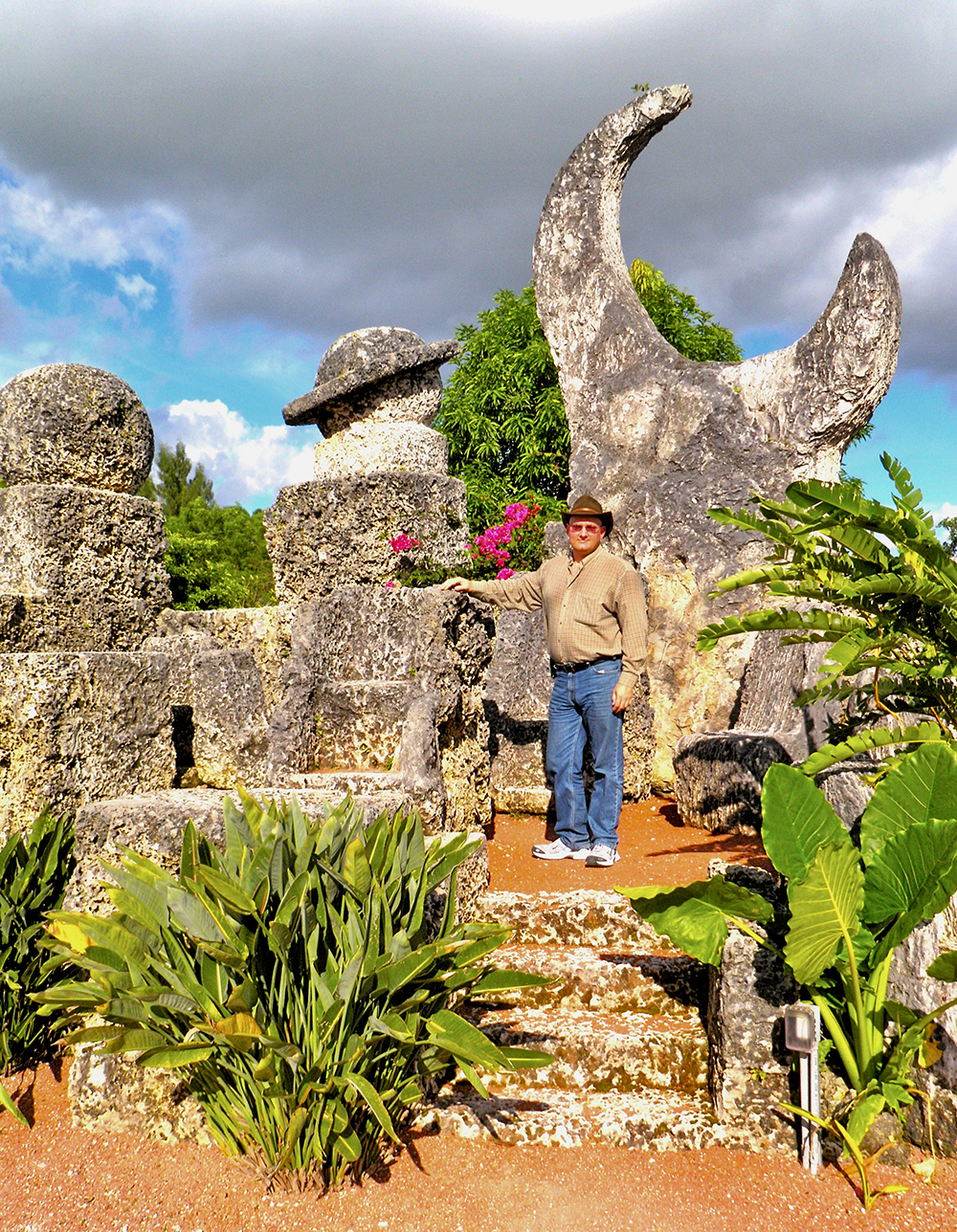
BR: Made by a Florida man the original Florida man Yeah, so basically so it’s in the town of Homestead, Florida and Homestead, Florida. It’s a tiny little town It’s not far from Miami enough off the South Dixie Highway and as I mentioned, it’s not really a castle. It is a, how do you describe, it’s sort of like a sculpture garden. It’s very impressive. I mean, just because it’s not a castle doesn’t mean it’s not impressive. It is really cool to visit there, take photos, and you can climb on things, and it’s just really cool. So it’s made of an oolite limestone and over a thousand tons of it.
0:17:36
CW: From the photos I’ve seen, and I regret to inform you that I have not yet been there in person, but it looks like a great place to slaughter Aslan the lion. It’s got this sort of druid sort of feel to it. There’s like some sculptural aspects, like you said.
0:17:53
BR: Yeah, kind of does. So basically it’s sort of laid out in a rectangle, and it has about a dozen different features. There’s a couch, a sundial, there’s a table of sorts, there’s actually chairs made out of this woodlight limestone slash coral, there’s a throne room, there’s a bedroom, there’s actually steps we can go into, living quarters, there’s a little grotto.
0:18:18
CW: The bedroom and other aspects you described which make it kind of like a home, is there a roof over these things? Could you actually live there if you wanted to?
0:18:28
BR: There is a roof over one part of it. There was this living quarters sort of in the southern part of it. There’s also a little telescope. So, but yeah, virtually all of it is exposed to the elements and outside. But of course, it’s being exposed to the elements isn’t quite as bad if it’s, you know, limestone. But yeah, so originally it was actually called Rock Gate Park, not the Coral Castle. It was built by a little Latvian guy named Edward Leedskalman.
0:18:58
CW: Now when you say little Latvian guy, you mean legitimately he was small in stature?
0:19:03
BR: Diminutive. Diminutive would be the phrase I would use. Yes, I was not belittling the Latvians, at least not this time.
0:19:12
CW: And he wasn’t a little person. I mean, this would be way more interesting if this is built by a little person.
0:19:17
BR: No, he was not. He’s not literally a little person. We’re not. Yeah, we’re not going dwarf size.
0:19:22
CW: He could have been a jockey.
0:19:25
BR: Well, you could have been the tuberculosis. But yeah. So, yes. So it was a preferred to be called Ed rather than Edward. Ed was born in Riga, Latvia in August of 1887, and he died December 7th, 1951. And during much of his life, certainly the last two thirds of it, he spent creating this coral castle, the Rockgate Park. And it opened its doors in 1923, and he basically sort of worked alone. And again, it’s just the carvings are impressive. I mean, they’re not world-class, you know, these aren’t going to be hanging in the Met or anything. But for what they are, and particularly for how small the creator was, it’s pretty remarkable. Basically, what had happened was that he moved from Latvia as a young adult, and he heard that southern Florida had a good climate, so he came to Florida sometime around 1918, 1920 or so. And this is after he was diagnosed with a touch of tuberculosis. It wasn’t it wasn’t so bad that he couldn’t breathe, but it was it was something where a healthier climate compared to Latvia was called for. So that’s basically what he did.
CW: He hears he has tuberculosis and then he decides to move tons of rock.
0:20:46
BR: Well, I didn’t say he was smart. I said, well, here’s the thing. So we’ll get a bit into his biography a bit later on, because it sort of explains much of the Coral Castle itself.
0:21:00
CW: Okay.
0:21:01
BR: But yeah, so basically that’s what it is. So he moved from Latvia to Homestead, Florida. And at one point, he actually moved the blocks from one place to another. It took him like three years. So partway through, it’s not clear exactly why he moved the most likely explanation is that that people were Building around him and he wanted privacy…
CW: Wait, so he started he started building this big rock park, then he decided you know, I don’t like it here. I’m gonna move it over there.
BR: Yes. So he originally it originally was in in Florida City and it was a homestead where he moved to. And it’s not a huge distance. I think it’s 10, 20 miles or things, but it’s, you know, it’s a big rock. So this is not something one wants to put on one’s back.
0:21:48
CW: If somebody asked me to move a huge ass rock like that, like 10 feet. I’d be like, that’s a huge distance. I’m not moving it. But okay, so this, so now we know that, because with Coral Castle, there’s all these parallels, like aspects of it are compared to the pyramids or, you know, ley lines with, you know, energy and whatnot. And now this is a new thing. I’m kind of thinking Stonehenge here because Stonehenge was also moved at one point.
0:22:13
BR: Yes.
0:22:14
CW: Okay. All right. Deeper and deeper.
0:22:17
BR: Yeah. Yeah. I mean, so that’s one thing that’s really fascinating about the Coral Castle story is that there’s lots of angles into it. So, and again, we’ll touch on this a little bit later. But wrapped up in the Coral Castle mystery is our claims about aliens and levitation and Atlantis and ley lines and just psychic abilities and all sorts of weird woo that was sort of shoehorned into the story.
0:22:44
CW: Yeah, when I was told about Coral Castles from my friend, it was definitely a spaghetti on the wall. Every sort of weird thing you’ve heard about was associated with this place.
0:22:53
BR: Yeah, and that’s actually pretty common. I mean this happens a lot with a lot of the paranormal topics. I remember when I visited the Roswell UFO Festival many years back, I assumed and I was right that it was mostly about Roswell and UFOs, but a lot of it is suddenly there’s – it’s not just UFOs and aliens, it’s aura readings and Bigfoot and crop circles and things that have no particular connection to UFOs. It’s just, if you’re into this sort of thing, then you can sell a DVD about these other weird things.
0:23:28
PR: So why did he build it?
0:23:31
BR: Why did he spend nearly, what, 20, 30 years of his life doing this? Well, therein lies a story. In fact, therein lies a song.
CW: A song?
BR: A song, yes, a Billy Idol song, in fact.
CW: Oh, thank God. I thought you were going to sing to us. Okay.
BR: I will not. You’re welcome. Sweet Sixteen is Billy Idol’s, one of Billy Idol’s many hits. And the song is literally about the the Coral Castle.
CW: I did not know that.
PR: Huh. Yeah, I know that song. I did not know that. The it’s about it’s about a candy castle.
0:24:08
BR: Yes. Yes. So in fact, if I’m not mistaken, I’ve watched the video and the video actually has a scene of the coral castle in the idol. And so the connection is that when when Ed was asked why he built it, because, you know, people would say, dude, you’ve been doing this for 20 some years now. Why? Why are you doing this? He would answer mysteriously for my sweet 16. And as it turned out, according to the story, which is probably mostly true, when he was 26, he was engaged to marry a woman named Agnes Scuffs, who was 10 years younger than he was. And he always called her his his sweet 16. And so the story goes right before their wedding, she called it off and said that he was too old for her.
CW: Well, he was. And yeah, that’s maybe in the 1920s. It was not as much of frowned upon. But but yeah.
BR: I’m just passing along this story. So he was dejected and he basically just was just horribly crushed. Frankly, I’m a little skeptical of the story because you would think that somebody would have noticed their age difference before the night of their wedding. Somebody might like this isn’t like a, you know, an online profile. It’s like this is a I mean, granted, he’s, you know, four feet tall. But still, you think that people would recognize.
CW: Well, teenagers take a little while to think things over. You know, they rush into something and then they get a talking to from their parents. And in your readings and your research about the Coral Castle, did you ever come across anything from this Sweet Sixteen girl?
0:25:47
CW: There’s a little bit about her.
0:25:48
BR: Apparently, again, there are different versions of the story. So it does seem to be true that, in fact, there was a Sweet Sixteen. In one version of the story, her name is Agnes. And again, a lot of the details vary. Some people say that it was a night of the wedding or people say that she called off some other time, but that part of the story certainly seems to be true. Anyway, just to round out the story, so the idea is that Ed was crushed by this and he left Latvia and he couldn’t bear to be in the same country as his sweet 16. And from there, the question comes, okay, well, he built it for her. Some people interpret that as being that he didn’t feel worthy of her for being 10 years older, would be one thing. But another, he didn’t feel worthy of her, and so he wanted to sort of make something of himself. He had a fourth grade education, he was not an educated man, he’d been a laborer for most of his young life, and one version of the story goes that he wanted to do something remarkable, and he did, that would, you know, draw the attention, this worldwide monument to her, and that maybe one day she would see it and regret having jilted him, you know, so many years earlier.
0:27:17
CW: Now, I’m I’m I couldn’t I can’t help but sort of see this from Agnes’s perspective and be like, OK, I don’t want to marry you because frankly, you’re a little weird. And then 30 years later, you find out that this guy has spent his entire life building a rock gate castle thingy with crescent moons and looks like you could slaughter a lion on a table there. And he’s done this to prove to you he’s worthy. I’d be like, whoa, bullet dodged. I was thinking you were a little weird, but you are a lot weird, Mister!
0:27:52
BR: Yeah, so so that’s one version of the story. Another version of the story is that that’s sort of the the mournful lost love version and this course gains a lot of traction. Again, I think that’s sort of the version that Billy Idol sings about this idea that he’s heartbroken over his lost love and he tries To do something to redeem himself.
CW: Well, you realize my job here is to poke holes into forlorn lost love stories that are I know…
BR: I would I would I would I would accept expect nothing less of you
0:28:23
CW: Of course from a sensible female perspective. No, that’s not romantic. That’s disturbed. That is creepy.
0:28:29
BR: Yes. So I came across a reference to that. There’s a booklet published, written and published by a guy named Orville Irwin, titled Mr. Can’t is Dead, the story of the Coral Castle. Mr. Cant, of course, referring to Lee Skalman and his sort of, I can do anything, you know, there is no such thing as can’t type thing. And in his in his book on page 20, he actually briefly talks about this. He says so that this guy knew Ed fairly well. And he said, quote, once I asked him about his sweet 16 because I had not heard him mention her since he had moved to his new location. So this is after it moved from Florida City to Homestead. He remarked, Oh, I left her down at Florida City and don’t talk about her anymore. It was apparent that it was all over. It was also obvious that his thoughts of her faded because at his new location, he rearranged and renamed some of the new stone areas of the castle. The original love story that he’d spent many years cutting into stone had diminished.
CW: Okay, so it’s maybe it was therapeutical for him in some way.
BR: Yeah, or just Yeah, I, again, I think it’s one of the things where the hook of it being this long lost quasi creepy testament to lost love is probably a bit overplayed.
CW: Well, did he ever remarried? I don’t want to say remarried because he didn’t marry Agnes in the first place. But did he ever find love with someone else?
BR: Oh, no, no, no, no, no, no, no, no, no, Ed was not. How do I put this? Ed was not the marrying kind, certainly after being left at the altar or left, if it was Latvia by Agnes.
CW: I can’t imagine meeting this guy and being like, oh, why don’t we go back to your place? Oh, your place is a giant weird rock castle you’re building for a 16 year old girl. OK, now I got to wash my hair.
0:30:28
BR: Yeah, so basically, so anyway, in a nutshell, that’s, that is allegedly how the Coral Castle came about and why it was actually done in the first place.
PR: So it sounds like an amazing place, but I mean, what are, what are some of these mysteries about it?
BR: So the Coral Castle is sort of this, this monument to mystery mongering in a way. When I was researching it, one of the first things I came up with was a bunch of articles that are just there’s grains of truth to them, but they’re framed in such a way to make it as mysterious and bizarre as possible. I have a couple of examples here in front of me. This one is from Mysteries Magazine, issue number 11. It’s an article written by Alexandra Diaz titled Florida’s Mysterious Coral Castle. It sort of gives some of the basic historical details that we just talked about, but it adds a couple sort of intriguing, tantalizing mystery nuggets, if you will. For example, it says, in all, he quarried, carved, and erected over 1,100 tons of coral rock from nearby tracts of land always at night. That’s partly true. And says that no one ever watched him work, but some teenagers once said they had seen him float huge blocks of coral in the air, quote, like hydrogen balloons.
0:31:51
CW: I’m remembering the ghost army that had all those inflatable tanks and wouldn’t it have been something if he had made just a few inflatable rock walls just so the neighbors could sort of see.
0:32:04
BR: That’s all you need. According to an anonymous teenager who once said, the story goes on, others swear to have witnessed a blue glow emanating from behind the castle’s walls while he worked. Still others claim that they could hear Leedskalnin singing to the stones from sunset to sunrise.
0:32:24
CW: Singing to the stones, okay.
BR: Yeah, so the article ends saying, basically the question coming up, well how did he, how did this diminutive guy move the stones, right? This is sort of one of the enduring mysteries, or one of the facets to it. And the article goes on, so how did Leedskalnin manipulate magnetism in such a way as to move heavy coral blocks.
0:32:51
CW: Well, who said anything about magnetism?
0:32:53
BR: Yeah, see, I knew you were going to catch that.
0:32:57
CW: And magnets don’t work on rock anyway. It’s not iron.
0:33:03
BR: Yeah, magnetism, I think, I mean, I’m no physicist, but my understanding is that magnetism works on ferrous materials, such as iron would be the most obvious Ferris material.
0:33:16
CW: Now I’m wondering, in addition to the Billy Idol song, was it was the insane clown posse moved to write a song about it? Was that what the whole magnet song was about?
0:33:24
BR: Yeah, so, yes, good, good catch, Celestia. Yeah. So where did the magnetism come in here? This article in in Mysteries magazine, hint, hint… We’ve grown mysteries here. It says, so some believe that Lee Scaldin may have found a way to rearrange the coral’s atoms by striking them with some instrument. I’m sorry. So as to align them with the Earth’s magnetic field. By doing so, he may have been able to levitate the heavy coral blocks.
0:34:02
CW: Okay, so in that in that little soup of a sentence there, we’ve got stuff that’s similar to alchemy, harmonics, magnetism, like every known principle…
BR: Just jumbled in there just for fun.
0:34:16
CW: Oh, my hat’s off to you, sir. Mr. Yes, mystery, mystery writer.
0:34:20
BR: For cramming totally irrelevant and tangential topics into one. So that’s part of the mystery is how did he move the stones, was it by levitation? Because here’s the thing, again, I’ve been there, and it’s an amazing place, and you can see these big, I mean they’re huge. One thing to keep in mind here is that because they’re oolite limestone, they’re big but they’re porous. There’s a lot of air in between them. I’m not suggesting they’re light by any stretch of imagination. I mean, they’re still sedimentary rock, but it’s not like we’re talking about solid granite here. So that’s one thing to keep in mind is that the slabs, although large and heavy are lighter than they might appear at first glance.
0:35:16
CW: But still, he wasn’t like toting these on his back.
0:35:19
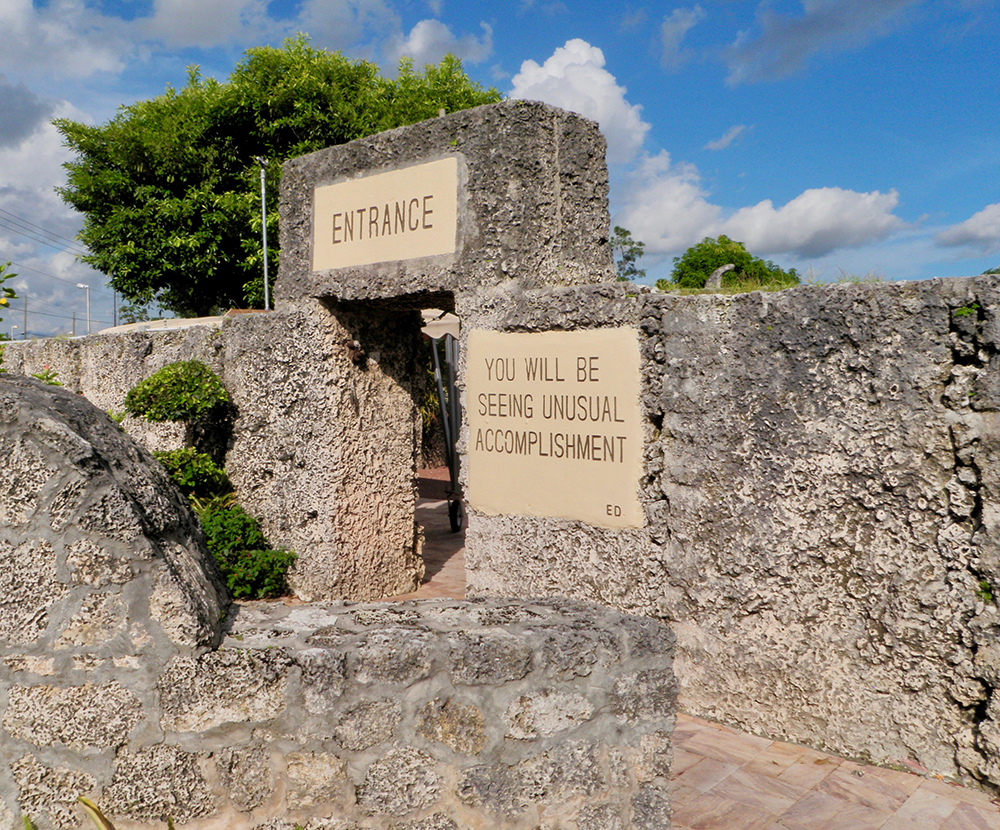
BR: He was not toting these on his back, no. And when you go to the Coral Castle, there’s a sign, it says entrance, and written by him, it says, there’s a little plaque, carving actually, it says, You will be seeing unusual accomplishment, Ed, E-D.
0:35:40
CW: Okay.
0:35:41
BR: And, you know, truth is word. It is an unusual accomplishment. What exactly is the mystery there? Maybe the bigger part of the mystery that occurs repeatedly in the articles about it is this idea that it’s somehow unexplainable, unexplained by science.
0:36:00
CW: Oh, yeah, we see that a lot on it. Was anybody did they have anybody at this castle that was baffled?
0:36:06
BR: Genuinely baffled?
CW: Genuinely baffled.
BR: You know if I were running the park the the faction I would hire an actor In a lab coat to be sitting just inside the door, and when people come in I would have him gnash his teeth and pull his hair out screaming in deep-rooted anger that he’s unable to explain this. You know, I’m baffled, I have all these degrees, I’ve got more degrees than a thermometer, I’ve been a working scientist for 85 years and I have no idea how this does. That’s what I would do.
CW: Okay.
0:36:44
BR: So and then in Fate magazine, which is either a step up or down from Mysteries magazine, depending on how you look at it. In the July 1998 issue, there’s a piece and it talks about the Coral Castle once again. And it says on page 19, modern construction engineers are at a loss to explain how such a ponderous object could have been set at such a high level of precision. And by this ponderous object, he’s talking about a gate that is fashioned from a single coral block that swivels. And this is one of the, this is actually the thing that I remember from the TV show I used to watch, which was that it had this really interesting swivel, and you could basically sort of with a light breeze, or just a touch, you could turn this, apparently, just giant slab.
0:37:34
CW: Like a fancy revolving door just made out of limestone.
0:37:37
BR: Yes. And so it was a bit of a mystery, certainly at the time that it was written, except the fact that it stopped working. At some point, this precisely balanced stone gate stopped moving. And in 1986, they actually took it down to figure out what was wrong with it. And once they did that, they found out that it rotated on a metal shaft that rested on a truck bearing.
0:38:01
CW: So the way that most revolving things revolve.
0:38:05
BR: Yes.
0:38:06
CW: It was just, I mean, it sounds like it was a feat of engineering and very good balance work.
0:38:13
BR: Yeah, I mean, it’s again, it’s I don’t, I’m not, you know, I don’t want to diminish the accomplishments here. The question is, you know, how remarkable are they and are there any sort of, you know, mystical or supernatural approach to it. I’ll just give you one other quick example of blatant mystery-mongering from Fate magazine. Again, it says, Coral Castle has attracted the international attention of professional construction engineers, astounded and mystified by the apparently impossible achievement of this diminutive wonder-worker. Now, one of the first things I did is having come across similar statements, I contacted the Coral Clastle and I said, yeah, hi, my name is Ben Radford. Apparently, your attraction there has baffled professional engineers and scientists for decades. They just cannot explain what’s going on. Can you give me their names?
0:39:06
CW: Yeah.
0:39:07
BR: Or a peer-reviewed journal article or just something, just a hint, you know, and I got no response.
0:39:18
CW: So they’ve been written up in Fate and Mysteries magazine, but not Construction Digest or Engineering Quarterly or anything like that.
0:39:28
BR: Yes, and this actually reminds me of another sort of quasi-miraculous structure I investigated, the Loretto staircase, the Miracle staircase in Santa Fe.
0:39:39
CW: Oh yeah, the feat of Carpentry.
0:39:41
BR: Yes, did we do a show on that?
0:39:43
CW: We did, yeah, it was said to be engineered by Joseph himself, the stepfather of Jesus.
0:39:50
BR: It was not, spoiler alert, but yes, so check out that episode for more on a sort of parallel mystery. And so one guy decided that he was going to explain the Coral Castle, and well, several people have done it. This one pretty guy named Bruce Cathy wrote a book titled The Energy Grid. And it is described as one of the most credible books on the subject by Fit Magazine. And make of that what you will. Quote, the site of the Coral Castle is mathematically related to the world energy grid, as are the other remarkable structures which, however, date from ancient times. Ed Leedskalnin had not moved on to the Florida site by chance. Oh no. This geometric position was extremely close to one that would be ideal for setting up harmonics related to gravity and light harmonics.
CW: Oh, there we go with harmonics again.
BR: Oh yeah, yeah. The fact that he had access to secret knowledge is much more evident in the relationship of the Coral Castle to the World Energy Grid System. Yeah, I don’t know what that means.
CW: I hasten to point out that you said this was the second location for Coral Castle and when he put the first, when he started putting the rocks together in the first location, it’s not like they all fell down and nothing worked.
0:41:28
BR: Celestia, why are you asking questions of the most credible book on the topic? Come on here!
0:41:22
CW: I’m assuming you went through this book, did he mention that this was the second location of the Coral Castle or did he seem to not know?
0:41:28
BR: It didn’t seem relevant.
0:41:29
CW: Of course not, of course not.
0:41:33
BR: Which is a big red flag to me. Like, okay, if you’re making such a, I mean, it’s like, you know, the guy that I talked to who was just crestfallen when I explained to him that the stones, the stonehenge has been moved. And all his years of careful calculations about the precise angles were irrelevant because they had no bearing on where they originally were. And it’s just like, oh. Anyway, I will wrap up the mystery mongering. So again, so far I’ve given a couple of examples from other sources. Here is one of the official little advertising cards from the Coral Castle itself. It says, The Coral Castle, a sculpture garden and tribute to lost love, which is kind of cute.
0:42:20
CW: Yeah, it sounds like a good trip advisory summary.
0:42:22
BR: Yeah, that’ll do nicely. So here’s what it says at the bottom. It says, one tiny man obsessed with his love for a young girl, creepy, labored for 28 years to build a coral rock monument to her. Incredibly, he carved and moved over one thousand one hundred tons of rock without human assistance. Did he know the secrets of the Great Pyramids? Did he have superhuman powers? Visit the Coral Castle and discover one of the world’s most incredible wonders.
0:42:51
CW: Okay, that’s fair. You know, it said he didn’t have human help. Sounds like they’re trying to imply he had like spiritual help, but I mean, did he have burrows? Did he have animal help?
0:43:05
BR: Okay, so here’s what we’re getting to the nitty gritty here. I’m trying to think of how to put this politely. We know exactly how he made the castle.
0:43:15
CW: Oh, OK. Now the episode’s over. OK.
0:43:18
PR: The end.
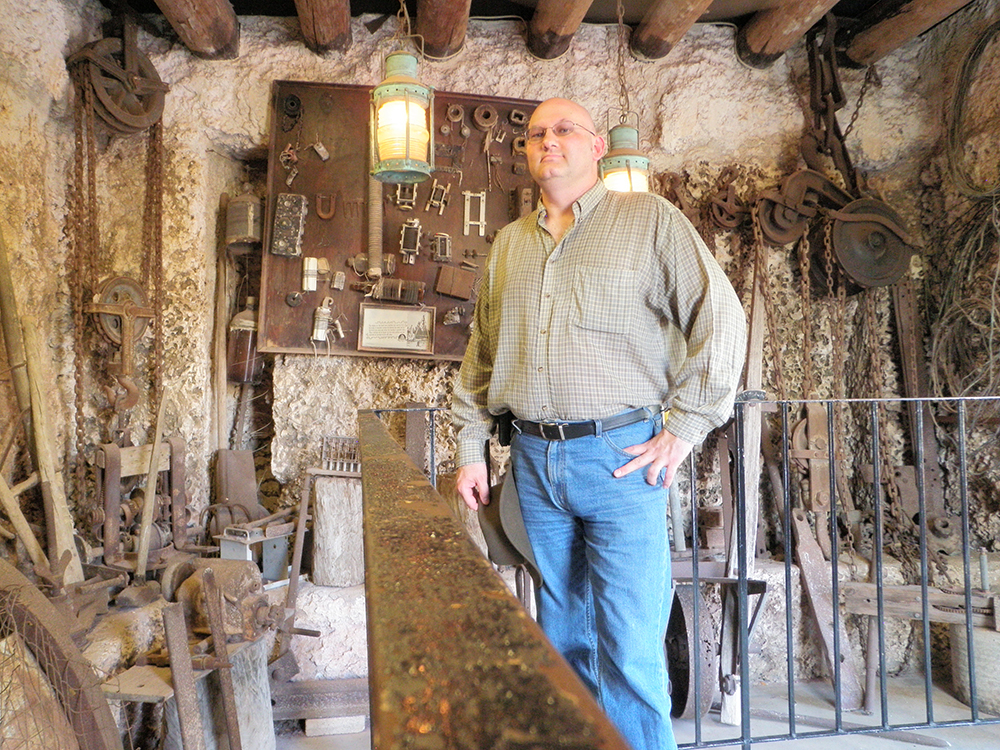
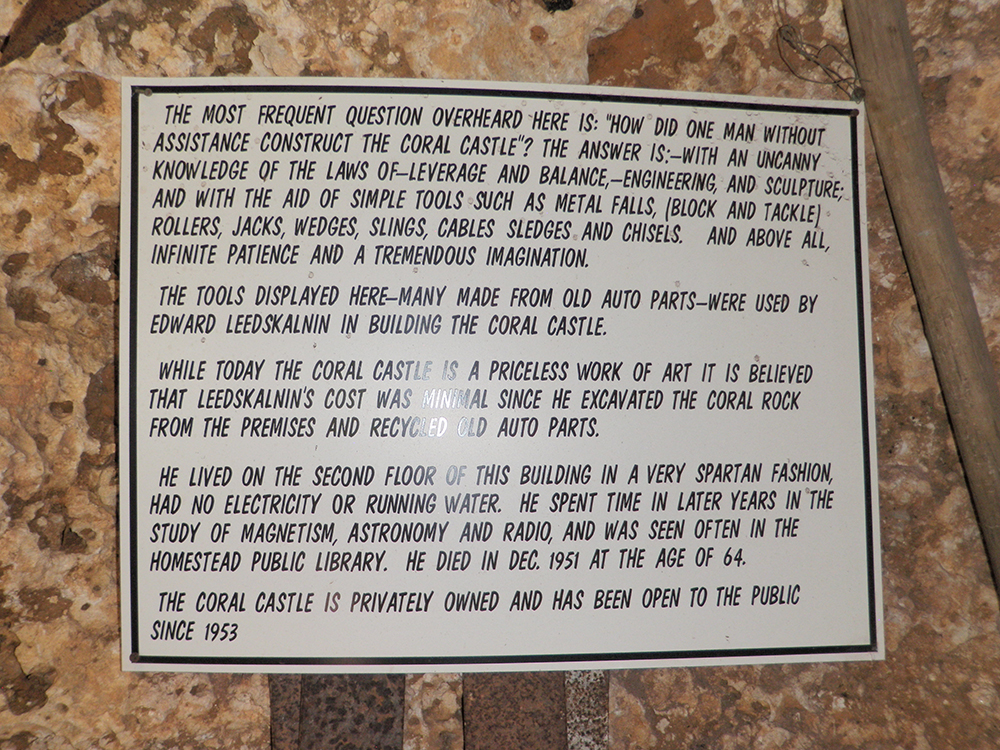
BR: No, again, this is one of the things that’s remarkable about the Coral Castle is you read all the articles about it, all the online stuff and the blog and all the blogs, and it makes it seem like this is this unexplained mystery. Scientists and engineers are baffled. No one knows how they moved it. But if you pay your admission and you walk around, it’s crystal clear how he made the castle. The tools are literally on display. You can see the tool marks on the slabs. It’s all right there. Not only do we have the photographs of the tools themselves, in fact, I’m looking at some right now. They’re all of the era, of course. There’s chains, there’s block and tackle, there are winches. It’s all, again, the materials he used to make the castle are right there. There’s a sign. There’s literally a sign saying, this is how he used to carve this. Here’s what the sign says. The most frequent question overheard here is, how did one man without assistance construct the Coral Castle? The answer is, with an uncanny knowledge of the laws of leverage and balance, engineering and sculpture, and with the aid of simple tools such as metal falls, block and tackle, rollers, jacks, wedges, slings, cables, sledges, and chisels. Above all, infinite patience and a tremendous imagination. The tools displayed here, many made from old auto parts, were used by Edward Leedskalnin in building the Coral Castle.
0:44:52
CW: Well, I mean, do they go into how he used these tools to change the harmonics of the universe? Okay, so they don’t mention that part. The vibrational, the magical aspect of these chisels and blocks and winches are not mentioned.
0:45:06
CW: See that really does sound like a bait and switch where they’re like come into the Coral Castle and see our mysterious you know unexplained baffling structure. Oh here’s how, we’ll explain it now that you’re inside and you’ve paid your you’ve paid your ten dollars let’s explain it to you.
0:45:31
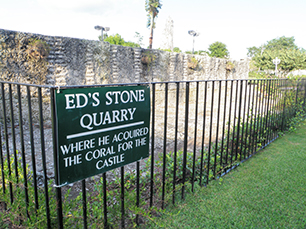
BR: Yes, here you go exactly. And so in that book I mentioned earlier, the one titled Mr. Can’t is Dead, the story of the Coral Castle, he actually has drawings and diagrams of how it was done. There are several pages of their rudimentary drawings, but it’s right there. There’s there’s literally no mystery. We we have we have we have the tools, despite some of the claims that I read that there are no tool marks on these, yeah, there are. There are tool marks all over these things. I saw them myself. I photographed them. Those are tool marks. That’s literally what they are. He had receipts. So this is where things get a little more curious, is that when you see photographs of the Coral Castle, usually what you see are the most the most dramatic parts, right? The towering parts, the nine ton gate, the throne room, the garden of the three bears, the obelisk, the tables and things like that. What you don’t see, it’s not hidden, but it’s just not usually photographed, are the areas outside the castle, just on the other side of the walls, where you can actually see where the limestone was carved and propped up and removed. So there’s huge rectangular beds that are right there. It’s no mystery where they came from. You can see where they came from because they were just propped up. And again, they’re not hidden, but they’re not usually photographed because they’re less interesting because people want to see the big towering coral instead of these rectangular missing slabs in the ground.
0:47:22
CW: Okay, so people are just choosing to ignore how the sausage is made there and pay no attention to the miniature quarries we have right there. But as far as the guy, I mean, because really I find the human element so much more compelling than, well, I mean, leverage is fun, but I’m not engineer-minded, I’m psychological-minded. What was this guy’s deal? Do we know anything more about that?
0:47:47
BR: Yes, and this actually informs a lot of why the Coral Castle was built and how it was built, frankly. Let me back up a little bit.
0:47:55
So, again, Leedskalnin was a Latvian immigrant. He had a fourth grade education. He came to the States 1918, 1920, around there, and probably due, at least in part, to the Hissuit 16, he decided to embark upon this. In the process of this, lots of rumors and stories propped up about this weird, short, Latvian dude who’s doing this thing that no one else is doing. So this is where you see a lot of the stories about how he was singing to the stones and these accounts of floating slabs in the air, which of course were never validated and things like that. But the question remains, what’s going on here? So we actually have a pretty good idea of what’s going on here because in addition to his work work on the Coral Castle, he wrote five pamphlets. So, he wasn’t really a hermit per se. So, this is one of the sort of misconceptions about the Coral Castle and Ed was that he was a sort of recluse who didn’t want anybody there and he was sort of building this thing for us. That’s not true at all. He gave tours of the place. He would offer, have people come in and see the place. In fact, that’s one of the ways he made his money. That’s you just give tours. And at one point by 1936, he had over 15000 visitors.
0:49:24
CW: So his whole lost love thing was was part and parcel with his meal ticket.
0:49:29
BR: Yeah, yeah. That was part of to this day. That’s sort of that’s one of the entries into it.
CW: But you said he wrote pamphlets and I know pamphlets are kind of the 1920s version of a Facebook manifesto screed. So I’m really curious as to what was in those.
BR: Okay I actually have three of his pamphlets here in front of me.
CW: Oh his actual personal pamphlets you you got them?
BR: I have copies of them.
CW: Okay copies.
BR: Not his original ones, the reprints. Sorry. How many do you have? Oh that’s right you don’t have any.
CW: I do have a whole drawer full of chick tracks, that’s as close as I get.
BR: Well, that’s close enough. So he wrote a couple different pamphlets, again, he wrote five of them actually. The one in front of me is titled Magnetic Current by Edward Leedskalnin, Rockgate, Homestead, Florida, USA, published in 1945. And it’s a little 19-page thing there. There’s also Mineral, Vegetable, Animal Life, Perpetual Motion Holder, which is gets a little cranky, I’ll be honest with you. But the one that really captured my interest was a book that was optimistically titled A Book in Every Home.
CW: Okay, so he was like Dolly Parton, he wanted everybody to have a book.
BR: He wanted everybody to visit his coral castle and give tours. And so it’s a interesting little book. I’m sort of flipping through it here. One thing I like about it is the preface. And I’m being sincere. He says, the author’s preface, he says, again this is titled, A Book in Every Home, copyright 1936, author’s preface, reader, if for any reason you do not like the things I see in this little book. I left just as much space as I used so you can write your own opinion opposite it and see if you can do better.
0:51:21
CW: Okay.
0:51:24
BR: And true enough, the text of this little 26-page book is only printed on the left-hand side of the page.
0:51:32
CW: What?
0:51:33
BR: The right-hand side is blank.
0:51:34
CW: That’s an interesting gimmick. Okay.
0:51:36
BR: You know, it’s one way to fill extra pages, to be honest. I should try that with my book. So reader, I know my book looks like 200 pages, but it’s 100 pages. If you disagree with me, feel free to write your own in the margin.
0:51:50
CW: He anticipated social media and said, you know, people are going to want to comment on this.
0:51:55
BR: So, right. Right. He’s that’s all you really need here.
0:51:59
CW: Maybe he was a visionary. OK.
BR: Well, you know, or something. I mean, you know.
CW: What was the gist of this book at every home? Because I’m optimistically thinking it, you know, I like the idea of books in people’s houses.
0:52:11
BR: Yes. Well, again, I he wasn’t really a hermit, and he wasn’t really a crank per se. consider some sort of sketchy thoughts. For example, he, well I’ll just read you a little bit here. This is titled, the first section is titled Ed’s Sweet 16, so he’s referring to himself in the third person here. And he explicitly says, he just lays it all out there. He’s again, he’s not being, he’s not being evasive or mysterious. He says, to those more than 15,000 people who have seen Ed’s Place, this is the 15,000 as of the publishing of this book, I told about Ed’s Sweet 16. Now I’ll tell why I did not get the girl. And he sort of, do you guys remember or read about some of the sort of moral hygiene pamphlets and articles from the 1940s and 50s?
CW: Oh, yeah, those are fun. Yeah.
BR: Yeah. So this is sort of along those lines. He writes, a girl is to a fellow the best thing in this world, but to have the best one second hand, it is humiliating.
0:53:40
CW: The best one second hand? Like an object?
0:53:44
BR: I’m just reading what’s here.
0:53:47
CW: So Ed was like one of the original incels, like, I’m not getting any, nobody should get any.
PR: Yeah, like kind of an arch incel, like not only did he just never partner up with anyone he also wrote these social hygiene bits and on top of that built an absolute monument to his his Incelness
0:54:09
BR: Yeah, well, so let me let me give you a little bit more cheese. I’m not gonna dwell too much on it. But but anyway, so all girls below 16 should be brand-new Brand-new I Want me to get through this or not?
PR: I don’t know. I don’t know if I want you to get through this now
BR: If no, I well, I I’m not saying this to be salacious of there’s a context here I’ll just read a little bit more. Okay, if a girl below 16 cannot be called a brand-new called No, I thought I had misread that I didn’t if a girl below 16 cannot be called a brand-new anymore It is not the girl’s fault. The mama is to blame. It is The mama’s duties to supervise the girl to keep those fresh boys away. And it kind of goes on that. But all the blame does not rest on the mama alone. The girls and the churches are cheapening the girls. They are arranging picnics, are coupling up the girls with fresh boys, and then they send them out to the woods, parks, beaches, and other places so they can practice in first-degree lovemaking.
CW: First-degree lovemaking?
BR: Oh, I’m glad you asked. What is that? Well, he tells you on page three. Now I will tell you what first degree lovemaking is.
CW: Do regale us Ben with your…
BR: I wish I could fake a Latvian accent.
BR: The first degree lovemaking is when the fresh boy begins to soil the girl by patting, rubbing and squeezing her. Sounds like lemony, zesty or something.
CW: Tenderizing meat.
BR: Yes. They started in that way, but soon it begins to get dull and there is no kick in it so they have to start in on the second degree and keep on and then by and by When I can’t wait to turn the page when the right man comes along and when he touches the girl when he touches her like dead flesh there is no more response in it because all the responses has been worked out with these fresh boys. Anyway, I’ll just leave that there.
0:56:25
CW: Wow. Oh my gosh. It’s like he’s like one of these far right trolls on social media is like, well, I’ve never met a heterosexual woman who enjoyed sex. Without realizing what a self-owned it is. Oh my gosh. It’s like it’s like history just repeats itself. It’s like a cycle.
0:56:46
BR: Well, and so then this next quote is actually sort of more on target for the Coral Castle. He also wrote about how the unemployed and the powerless should not have voting rights.
CW: Oh, wow. Oh, my God. And I think I wanted to go visit this place.
0:57:05
BR: This is the sort of thing you don’t get unless you actually buy up the pamphlets when they offer them to you. Buy the pamphlets. Spend the $15. Get the pamphlets. You can actually learn a lot more yourself. And again, this actually ties in with how the Coral Castle is made. So again, I’m not being salacious, I’ll bring it around. He says, it is not sound to allow the weaklings to vote. Anyone who is too weak to make his own living is not strong enough to vote because their weak influence weakens the state.
0:57:35
CW: Well, see normally I would point out how this is coming from a 100 pound, you know, Latvian immigrant guy with TB, but he did do an amazing thing by making Coral Castle. And I mean, it’s almost like these, you know, people who have pulled themselves up by their bootstraps kind of get this sense of like, well, everybody should be able to do what I did.
0:57:56
BR: And that is actually the secret to the Coral Castle. This is something that sort of, I didn’t really get this until I started reading through the materials, because it’s not obvious at first glance. But when you go through his readings and you go through the things that other people who knew him has contemporarily said about him, it’s crystal clear that he had this very, very strong, self-sufficient, independent streak. streak and he was very proud of the fact, justifiably so, that this small TB touched or riddled would take your pick, fourth grade education guy made this amazing place. And so he wanted to prove that he was smart despite his fourth grade education and that he could do something that is still talked about, is known around the world and is still talked about, you know, decades after his death as it is today. And if you read his writings over and over and over again, he makes it crystal clear that he wants the credit for it as he should get. And that it’s all about him busting his ass and coming to this country and being a hardworking immigrant and doing something that’s amazing. And this ties in with some of the mystery about the Coral Castle, because one of the things that’s often talked about is the fact that nobody helped him, right? This was all done by himself. And that’s true. But it wasn’t done by himself because he didn’t want anybody around to watch him move the stone psychically or see his magical spells or see the earth energies he was harnessing, he didn’t want any help because that would mean that he had help. Part of the whole point of the Coral Castle was that he did it himself using the technology of the day, cranes, winches, things like that by himself. It was, that was, that’s the whole point of the Coral Castle was that he didn’t, he didn’t have, he didn’t, he didn’t hire laborers. He didn’t use any electricity. In fact, there was no electricity on the site. There was a small generator that he used for a couple of things, but there was basically no electricity, so he was, he was deeply, deeply proud of the fact that he did this whole thing by himself using, you know, rudimentary tools and that’s exactly why he didn’t want help. Thatís why he didnít want people around. He wanted to be able to tell people, “Hey, welcome to my Rockgate Park, my Coral Castle. I did this.” Not, “I hired people to help me out with this.” Not, “Me and the neighbors did this.” I did this.
1:00:43
CW: This is becoming almost Shakespearean how this guy with this grandiose pathological need for accomplishment is now being robbed of that by people who are saying, oh, it’s mysterious, who knows if aliens helped him or the magnetic ley lines or something. I’m almost not mad about it now because he’s kind of a jerk.
1:01:04
BR: Well, it’s easy to look back with modern eyes. I mean, you know, his writings and his crank stuff is, you know, it’s a bit unseemly by modern standards, but I mean, keeping in mind that this was written in the 1930s by a hardscrabble Latvian immigrant, you know, that it’s, again, it’s sort of reminiscent of the mental hygiene, moral hygiene films that were ubiquitous even here in the States. So that was part of what was going on.
1:01:40
CW: It sounds like there’s many layers of complexity here.
1:01:43
BR: There are many layers. And anyway, I’m just going to briefly return to the book Mr. Can’t is Dead that I mentioned in which the author told me that said that quote, this is page 36. And again, this sort of goes back to the supposed mystery as to why, you know, because people say, oh, you know, no one ever saw him moving the stones. Well, that’s actually not true. People did see moving stones. And the reason that not many people did was because he didn’t want people around. It was like, and this is what that says. Bob told me Ed would never work until after he left. He probably didn’t want any distractions for an accident could prove fatal. Bob chuckled and said, it doesn’t need to worry about me learning any of his secrets. I’m not going into competition with them. And so there’s a, in the July 1939 issue of a local paper, the Redland District News, there’s an article about it. And in fact, it’s actually kind of cool. The article is reprinted on the last page of this book. It says, Ed is doing a colossal job of moving, but he wants no help, thank you. It described how he worked pulling and laboring at unloading some massive piece of rocks and said, quote, he will decline your neighborly gesture courteously but firmly. And again, just over and over again, it’s crystal clear that he just doesn’t, he didn’t work with other people, not because he was trying to be secretive, because he didn’t want anyone else to be able to claim that they were, they were helping out with it. And of course, you know, keep in mind this is this around the same time that Charles Lindbergh flew solo across the Atlantic, right? It was a solo flight. That was the point. Other people had flown across the Atlantic before, but none had done it by themselves. Lindbergh did his solo flight around the same time that, in fact, Ed was working on the Coral Castle. So there was a sort of real, you know, bootstraps, you know, individualistic accomplishment theme throughout all this.
1:03:35
CW: Yeah, I think I don’t know if any sociologists writing about that particular vein of American, you know, independent do-it-yourself-ism has written about the Coral Castle, but they certainly should include it if anybody does a roundup of things like that.
1:03:53
BR: Well I will just end with a quote in this book, which is entitled No Secret Method, by the way, it says that some people associate Mars, Saturn, and the Moon with magic and attribute his method of operation with some sort of mysticism. Possibly one reason for this is the younger generation became a push button society, not wanting to believe one man could do so much. And this goes back to the stonehenge and the ancient aliens, you know, ancient Egyptians couldn’t have built those pyramids. Nope, nope, far too complex for Egyptians to build a pyramid. It says back in the days when Ed started carving out his original stones, this was a generation who knew accomplishment by the sweat of the brow. It wasn’t mysticism, but hard work. This is how Ed really accomplished his massive project. One, after a careful study, he made every lick count and let practically nothing go to waste. 2. He worked out his own problems in his own way and carried out his own ideas. 3. He sought out the most efficient methods and made the most of his simple tools and equipment. 4. Time meant nothing to him. He worked without the pressure of a clock or even a calendar. Keep in mind, this is all he did. He didn’t have a day job. This is literally all he did for decades.
1:05:19
CW: Yeah, wow.
1:05:20
BR: I mean, so this was not some weekend warrior, let me go put a patio on the back. This is what the guy did. Number five, working alone, he didn’t have any associates to be concerned about or to distract him. Number six, he used a basic method of handling the multi-ton stones using a fulcrum and lever. Seven, his accomplishments were probably the best examples of proving that success is 90% perspiration. Of course, the reference to the old, I think Thomas Edison quote about success being what, 90% perspiration, 10% inspiration. And eight, he used perseverance, determination, and solid dedication by keeping his hand on the throttle and his eye on the rail. Nine, he worked very carefully and always kept his safety in mind. And 10, he lived life like he worked, conservatively and prudently.
1:06:09
CW: This guy could be a conservative hero in many ways.
1:06:12
BR: Well, see, this is why I thought this would be such an interesting episode for the show. At first glance, it’s this sort of like, you know, mystery mongering, a weird thing out there. But when you sort of dig below the layers, it kind of it all sort of comes together.
1:06:29
CW: Yeah, I did not expect to be learning so much about the nature of, you know, American immigrant thought and the experience of, you know, masculinity at the, you know, two or three decades into the 20th century. But there’s there’s a lot to contemplate there. And now I really should get myself to the Coral Castle to take a look at it firsthand.
1:06:48
BR: It is cool. And like I said, I mean, it is a remarkable achievement regardless of Ed’s politics or, you know, or sort of antiquated masculinity. And exactly as you point out, it’s ironic that all this, you know, woo-woo, you know, bullshit has been sort of layered onto this project that was… The whole point of the project was that it was not using magic. It was not using some shortcut. It wasn’t using anything mystical or weird or paranormal. He was busting his ass.
1:07:21
CW: Yeah.
1:07:22
BR: So there you go.
1:07:24
CW: Tonight I’ll have a drink to Ed and think about him as I engage in some first degree lovemaking.
1:07:29
BR: TMI, but thank you.
(MUSIC)
1:07:32
PR: Thanks to Ben for bringing that info to us and having that fascinating conversation about the Coral Castle. It was a lot of fun.
1:07:54
CW: Yeah, he has an endless bag of just weird facts about weird places and people and things. So it’s always nice to tap into that. Now we’ve got a very fun topic cooking for next episode. Pascual, what are we going to be talking about two weeks from now?
PR: Oh, we are going to be talking about pirates, matey.
1:08:16
CW: And it won’t even be for Talk Like a Pirate Week. We couldn’t sit on it for that long, but we’re going to be discussing the real ins and outs of piratry. Piratry, is that a word? Piracy, piratry. Piracy, there you go. I like piratery, though. Piratry, it sounds more… Sounds artistic.
1:08:31
All right, well, until then, everybody, take care.
1:08:35
See ya.
1:08:35
We would like to extend heartfelt thanks to our top-tier sponsor-level patrons, Amy Fruchauer-Kelley, Dr. Angela Matkey, Elizabeth Leggett, and Laura Ellis. Thank you for your continued support of our podcast. If you’re interested in becoming a sponsor, or just throwing us a buck or two, please visit Squaring the Strange on Patreon.com and browse our selection of patron rewards. Every bit helps us keep the lights on here and we are grateful to our generous friends who help us bring you quality content. If you are short on cash and want to just give us moral support, remember to recommend us to a friend, mention us on social media, or give us a review on your favorite podcast dispenser. If you have comments or topics you’d like to see covered, come join our community on the Squaring the Strange podcast discussion group on Facebook. Squaring the Strange is a production of Two Heads Studio, LLC. Copyright 2021. Theme music provided by Shriek Back. Additional music by Memory, Keytard & Feathered, and Pasquale Romero. Additional support by Ashley Romero, Robert Sandin, and Alicia Jarvis. The views and opinions expressed on this podcast are those of Squaring the Strange, and do not necessarily reflect the views and opinions of Two Heads Studio, Kronos Creative, Center not necessarily reflect the views and opinions of Two Heads Studio, Kronos Creative, Center for Inquiry, our advertisers, or any other affiliated organizations and employers.
