
Episode Summary:
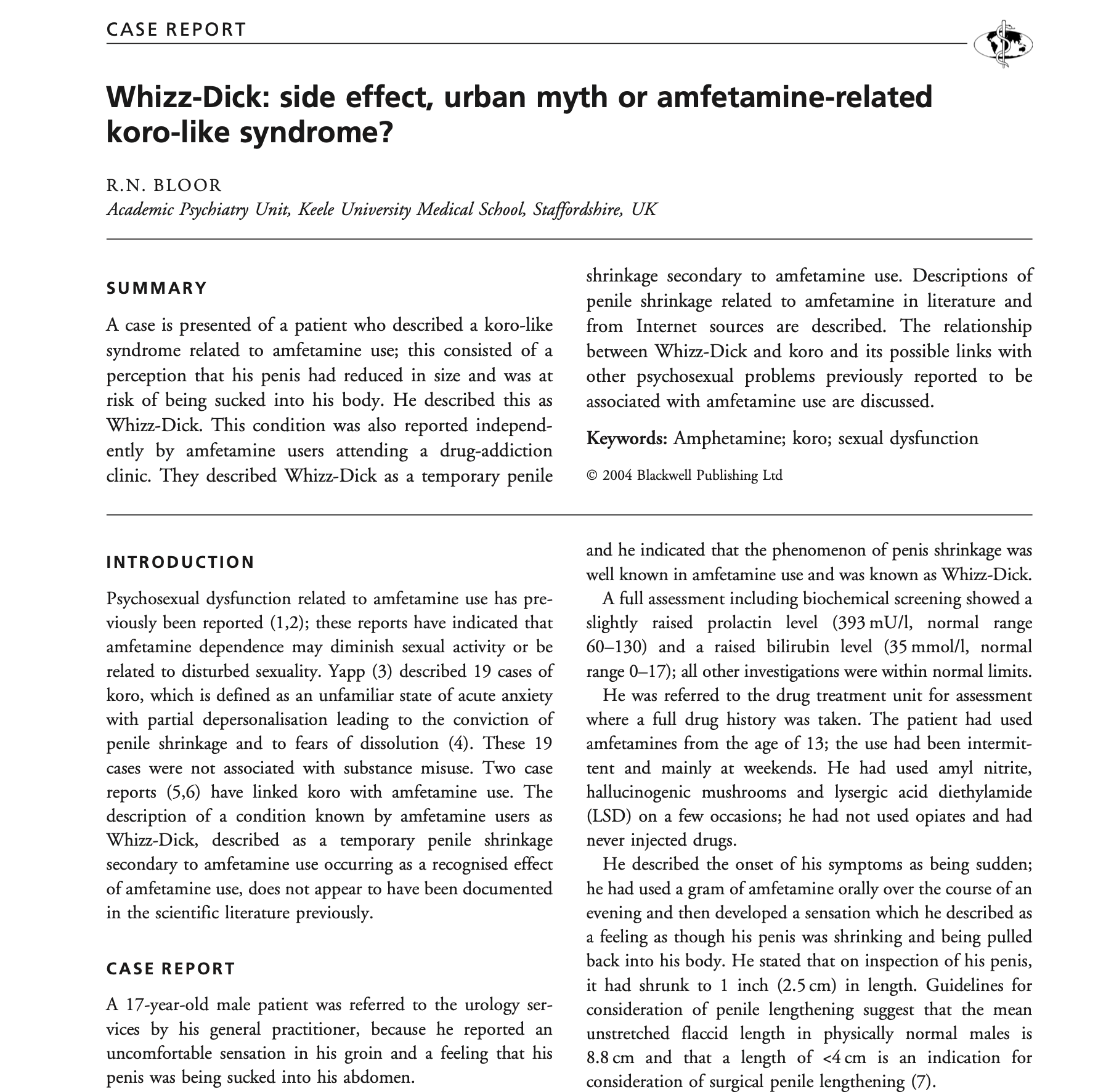
To our credit, we manage to not giggle like third-graders for most of the episode, as we discuss the strange belief that one’s penis has gone missing, become smaller, or been switched out. A peculiar mix of superstition, body dysmorphia, and curse belief, Koro has many traits of a mass sociogenic illness (MSI) and is “contagious” to a degree. When we peel back the layers, it’s not such a funny topic after all, and falls into the category of suspicious folklore that results in harm: to victims, to endangered species, and to those suspected of witchcraft.
0:00:00
Ben Radford: Welcome to Squaring the Strange, the podcast that examines all manner of the mysterious and the mundane through a critical lens. So let’s square the strange.
0:00:11
Celestia Ward: Welcome back to Squaring the Strange. This is episode 181. I am one of your hosts, Celestia Ward. With me is…
BR: Ben Radford here.
CW: And we got a little musical there. And speaking of music, Pascual will not be here this week. He’s got a bunch of things to deal with, with the start of school. So we are letting him out. Uh, and what a topic to miss. We’re going to be talking about penis theft. I know, I heard everybody out there clutching their pearls as I said that, but it’s a real thing, huh?
BR: It is a, um, is it a real thing? I’m not sure how to answer that. That’s tricky to answer.
0:01:20
CW: You’ll see what we’re talking about.
0:01:22
BR: Kind of is, kind of isn’t.
0:01:24
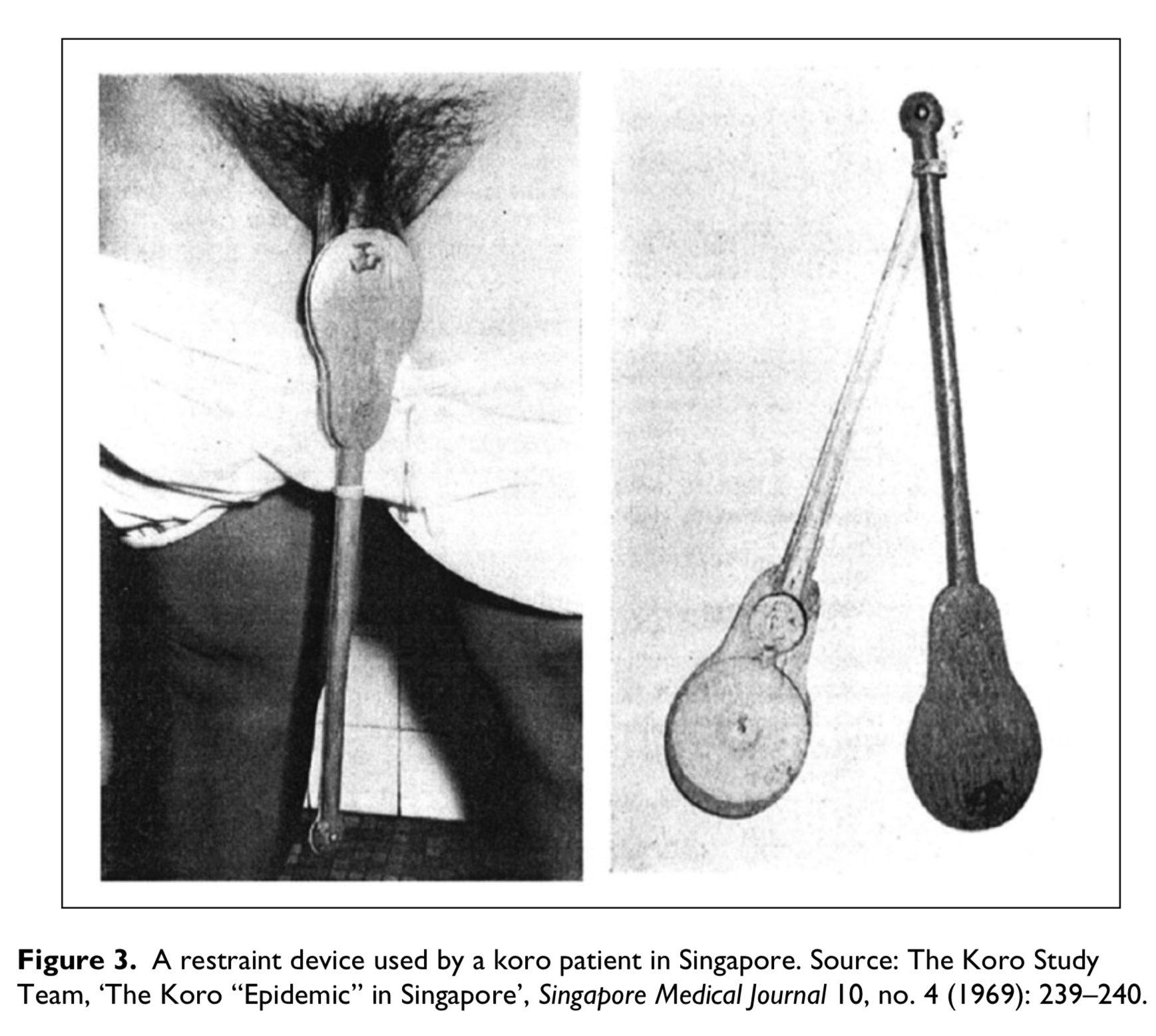
CW: Yeah, well, Ben just texted me a photograph of a device, a real device, used to help treat people suffering from penis theft. And I am a… This is used in Singapore, apparently.
0:01:44
BR: Yes.
0:01:45
CW: And it’s… Here, I’m just going to read you the figure. This will be a little teaser. Figure 3, a restraint device used by a Koro patient in Singapore. This looks like castanets with, like, a long magical wand on it you can hear clack clack clack clack clack clack as they clamped it on. Oh Lord yeah that that wouldn’t cure if I was a man that would not cure me of anything that would make me want to run far far away whoever wanted to put that on me.
BR: Well you’re clearly not a Koro sufferer so what can I say?
CW: Yes Koro or the phenomenon of vanishing penises or penises that get stolen by witches or foreigners or who Will get all into it in the main topic. So well before we get started. Do we have any housekeeping? Ben you’re always given a thousand talks or doing a thousand things what you got going on this week
0:02:41
BR: Well this week. I’m actually giving a talk on Friday for the Albuquerque Science Fiction Society on ghost sex.
0:02:50
CW: Ghost sex. This is such a naughty show. Everything is naughty we’re talking about here.
0:02:55
BR: You asked. Also, I’m delighted to mention that I was a guest on Richard Saunders’ most recent episode of the Skeptic Zone.
0:03:04
CW: Oh, we love the Skeptic Zone here. We do. Yes, our friend Richard Saunders and Down Under. I guess the seasons are changing for him too. I guess it’s becoming springtime for them.
0:03:16
BR: Yeah, I’ve never really understood the whole, you know, like Santa wearing shorts, whatever. It’s a bit weird.
0:03:24
CW: Ah, well the Tim Minchin song, White Wine in the Sun, is one of my favorite Christmas tunes. But, hello Richard, and thank you for having Ben on your show.
0:03:31
BR: Yes, I chatted about my new book, America the Fearful, so yeah, check it out.
0:03:36
CW: All right, I look forward to it. And for this week, is there anything you’re skeptical of?
(MUSIC)
0:03:52
BR: Well, the main thing that’s come across my desk here in the last week or two is the Alex Jones verdict.
0:03:58
CW: Oh, yeah, speaking about dicks, yeah. He’s finally getting some of what’s coming to him, it looks like. He’s been going through a series of defamation lawsuits and it looks like the jury in this latest one for Neil Hesslin and Scarlett Lewis who are the parents of a six-year-old Jesse Lewis who was killed at Sandy Hook, they will be getting 4.1 million in real damages and 45.2 million in punitive damages. That is as long as it goes through without any hassles about the apparently there’s a there’s a cap on how much you can get in punitive awards in Texas. So we’re kind of all kind of crossing our fingers that nothing stymies the delivery of that money, but we’ll see.
0:04:49
BR: Yeah, I mean, I’ve long argued that this is one of the ways that we can try and clean up the media and misinformation is when people are held liable. Of course, for most cases, if someone just says something that’s not true, there’s really no recourse. But in a few of the cases, for example, if somebody is defamed, there can be legal consequences. It’s a long drawn out process as legal things always are but it is a case where there are laws that can ostensibly address this. We see the same thing for example with the voting machines with Dominion and Sidney Powell and others saying, you know, you falsely claimed that our machines were, you know, helping engage in fraud, election fraud, and there was no evidence whatsoever. The lawsuits are still going on. At one point, Sidney Powell, she was one of Trump’s lawyers, one of Trump’s many, many lawyers. At one point, her own lawyers admitted that no reasonable that her statements about that topic were true or factual. So so just think about that for a second. Like, you know, all that stuff that she said, you’re idiot, if you believe that.
0:06:11
CW: Yeah. Well, what was that? I forget his name. One of the Republican senators or representatives was crowing on the news a few weeks back going, this is ridiculous. You’re if you’re a Republican, you’re not even allowed to lie to Congress. Imagine that.
0:06:27
BR: What is this world coming to when you can’t lie to Congress?
0:06:30
CW: I just, you know, we’re going down the toilet. Yes. And politics aside, although I would love to spend an hour speculating on what the FBI found at Mar-a-Lago when they raided there a few days ago. Politics aside, skeptics everywhere are hoping that this defamation case with Alex Jones will lead to other panderers of conspiracy theories to think twice before they start going off on a tirade about something that has no evidence for it, that is harming people, that it can be demonstrated to be false, that simply is for clicks or monetary gain.
0:07:11
BR: And in court, Jones literally admitted that he believed that the Sanderhook attack happened and was not a hoax or a false flag attack, which raises the question, well, hold on here. If that’s true, and of course, I wouldn’t believe anything he says, then what does that say about all those listeners that believed him? Then what about all that bluster and all the bullshit and everything else that people latched on to and you know and carried water for him?
0:07:45
CW: Well the sense I got and believe me I watched quite a bit of this was that He kind of was claiming he came around like well when I believe you know when I talked about all of this I Believed it at the time. I was asking questions because I was asking sincere questions. But then it’s hard not to talk about Alex Jones without kind of doing a terrible version of his voice. Somebody on line pointed out that he talks like he’s just in the act of gargling Manwhich right out of the can. I sincerely believed all those things, you know, who’s to say? But the judge had a really, there’s a clip going around that’s just, ah, chef’s kiss eloquent, where the judge is like, yes, you believe everything you say, but that’s not an issue here. The issue is whether or not it’s the truth. And you believing something does not make it the truth. So yeah, she had more to say than that. Go look it up. It’s one of the most highly circulated clips from the trial and has a really good skeptical point behind it.
0:08:53
BR: So other than the Alex Jones fiasco or redemptive justice, depending on how you look at it, what’s going on?
0:08:59
CW: Well, oddly enough, again, in kind of sticking with this show’s theme, a piece of sausage made the news. Did you happen to see that highly rendered image of supposedly a distant star as seen through the James Webb telescope that turned out to be a slice of chorizo?
0:09:17
BR: I did see that. I didn’t follow it closely enough to fall for it one way or the other, but I saw that, yes.
0:09:27
CW: Yeah, I didn’t know about it until after it was revealed. This really reminds me of when we had Michael Branch on talking about the joy of a good hoax, and this kind of, I mean, the joy in this was the revelation, you know. French scientist named Etienne Klein tweeted a picture of the chorizo in question. And yeah, it kind of could look like a star. It had little bits of red and orange and, you know.
BR: Can we prove it’s not?
0:09:53
CW: It was a spicy star. Well, we don’t have to prove it’s not because he came out after it got retweeted like a gazillion times. He had to let everybody know that he was just kind of trolling and joking around. And it was not in fact Proxima Centauri. It was a slice of chorizo from his lunch.
0:10:14
BR: If you believe that.
0:10:16
CW: Yeah. He’s clearly in the pocket of Big Sausage. Exactly. But speaking of Big Sausage, why don’t we get to our main topic?
0:10:25
BR: Sounds good.
(MUSIC)
0:10:25
CW: So, Ben, you’re going to talk to us about Koro attacks or missing penises. You don’t know how badly I wanted to title this episode Hot Cocks, but I’ll have to bleep that out.
0:10:55
BR: Well, you know, I defer to you in these matters.
0:10:58
CW: Okay. All right. We’re going to try and discuss this without being eighth graders. At least Ben won’t be. I can’t make any promises myself, but I will. Let’s have a scholarly look at penis theft.
0:11:10
BR: Among others. So we’ll be discussing a couple of variations of penis theft. That’s a weird phrase. I just realized that. Today in class we’ll be discussing variations of penis theft. Take note. I first heard about this many years ago and again the topic is Koro, K-O-R-O, in a book that Bob Bartholomew and I co-authored, Hoaxes and Manias, actually one of my first book, there’s a small section on this topic going way back.
0:11:47
CW: How small is it? No, I’m being an eighth grader here, but…
BR: I’ll try and keep you in line here.
CW: OK, so Koro sounds like an anime. I’m assuming it’s not. And it is theft. Just to be clear for listeners, we’re not talking about organ theft, which we have another episode on, where you wake up in a bathtub full of ice and your penis is missing and there’s like a note in lipstick on the mirror.
0:12:14
BR: Although there are connections and I’ll get into that.
CW: Oh, OK.
BR: Yes. And in fact, in fact, there’s actually connections to another topic that we covered several years ago. Do you want to guess what it is or should I just let listeners figure it out as we go along?
0:12:29
CW: Let’s save that.
0:12:32
BR: Okay. So again, this is a topic that it’s always been sort of one of those weird news topics. I think I first read about it in maybe Fortean Times magazines. And this is before I sort of was looking into the sociogenic illness aspect of it. And then I came across a piece in Pacific Standard Magazine in 2013, and a UC Berkeley anthropologist named Louisa Lombard described visiting a small town in the Central African Republic, the CAR. And during her visit, she met two men who claimed that their penises had been stolen. And as you might imagine, this was a curious claim.
CW: That would raise my eyebrow.
BR: And even for an anthropologist, it was like, okay. So she asked about it, and they said that what had happened was that the day before, a traveler visiting the town had shaken hands with a man selling tea, who immediately claimed that he had felt a shock and sensed that his penis had shrunk. And he freaked out, as you might imagine he would. And this gathered a crowd, and there was a huge hubbub. And then, as it turned out, the person next to him said, oh my god, this happened to me too. And what she’s describing is, as I mentioned, it’s something called Koro. Now, Koro, it’s not a joke, although it certainly lends itself to some snickering, but to its sufferers, it’s a very real thing. And of course, you know, this is this is nothing new I mean when we talk about people who believe that their houses are haunted or they believe they’re affected by the evil eye or curses. Right, we can sort of talk about it, you know from a skeptical point of view or folkloric point of view. But if you’re actually suffering these things it can be very real and genuinely frightening. So it’s a culture-bound specific psychiatric condition. It’s much more common in males than females, but it does occur in females.
0:14:33
CW: Now, I’ve read a little bit about this and my first instinct was, oh, it occurs in females? And I’m thinking, is this sort of some explanation for body dysphoria? Do they believe that they were once males, but in the case of females, they think that their vaginas and breasts are shrinking or receding into the body, right?
0:14:58
BR: Yes. And there are different versions of it. Again, I’ll sort of get into that. And you brought up BDD or body dysmorphic dysphoria, and I’ll touch on that as well. So basically, to set the stage, what happens is these people, for various reasons, and again, we’ll get into that, they believe that all of a sudden, oh my God, this is happening to me. And in all these cases, there is a preexisting cultural belief in Koro, right? And so it’s something that is known to happen or thought to happen or is discussed, often sort of, you know, in folkloric avenues.
0:15:38
CW: Okay, so this isn’t a thing that just pops up out of whole cloth. You hear about it happening and then one day it happens to you.
0:15:48
BR: Yes, exactly. And there’s very specific cultural conditions under which this happens. And so this is why one of the main explanations for it is mass sociogenic illness or MSI, also known as mass hysteria. And of course, we’ve talked about that on the show previously with the Bangladeshi toilet ghost, the Havana syndrome and things like that.
0:16:09
CW: And it makes me wonder if any of the government workers in Havana and the Havana syndrome reported their penises retracting into their bodies.
0:16:18
BR: No, no, they they haven’t. As far as I know..
CW: Ok, It would have been pretty meta if they did.
BR: It would have been, although as I said, it’s a culture-bound syndrome and it happens, Koro occurs most often in Chinese and East Asian populations, India and Sub-Saharan Africa. Although it’s not limited just to that. I mean, there are cases in South America, North America and Europe, but the vast majority of the cases are in those regions.
0:16:47
CW: Well, if we tell everybody in America about it, it’s going to start happening here, Ben.
0:16:51
BR: Well, yeah, ummmm.
CW: Think about what you’re doing.
BR: The power I wield.
0:16:59
CW: All right. Let’s forge on.
0:17:01
BR: Okay, forge on. So there’s a couple things going on. Well, there’s lots of things going on here. So the most obvious manifestation is being suddenly terrified and genuinely frightened that your genitals are shrinking inside you. The secondary part of this is that there’s a genuine dread of death. It’s really the process. It’s not just that, “Oh my God, my penis is shrinking and this and that, what’s going to happen?” It’s this firm belief that once it’s gone, you’ll die.
0:17:35
CW: Well, I mean the guys I know, death would be better than losing your penis. So yeah. It makes sense.
0:17:41
BR: Well, and yes, and so but there’s this, that is the framework through which they understand what’s going on. And this sort of helps to explain some of the genuine fear, right? It’s not so much that, oh my God, it’s gone, which you can imagine would be, you know, scary enough.
0:17:57
CW: Bad enough, yeah.
0:17:58
BR: But it’s like, oh my God, it’s gone. Or in some cases, if people are confronted with this, they will, you know, your penis is not gone. I mean, it’s right there. They’ll say, OK, well, yes, but this is smaller than mine.
CW: Oh, the it’s normally much bigger.
BR: Yes. Yes. And in some ways, it actually is similar to the changeling folklore in the British Isles. And I think we’ve talked about this briefly on one of the previous shows.
0:18:23
CW: Yeah, this isn’t my baby. This is a different baby.
0:18:26
BR: Yes, yes. And so it’s fascinating when you read some of these case studies. Like someone will say, yes, I understand it’s attached to my body, but it’s a fake or it’s a dummy or it doesn’t feel real to me. And they just become convinced by this.
0:18:42
BR: Oh, God, it’s like the, what is it? Which bird is it that like sticks its own egg in another bird’s nest? Is it a magpie, a mockingbird?
0:18:51
BR: It’s one of those, yeah.
0:18:52
CW: Yes, I think it starts with an M. Maybe a listener can write in and tell me which bird secrets its own offspring in and chucks the regular egg out and makes that substitution. Except instead of birds, well, we’re talking about birds.
0:19:07
BR: Okay. With that exception, yes.
0:19:09
CW: Okay. Now, they believe it’s going to kill them. Is the retraction of the penis into the body, is that a toxic thing that sort of poisons them? Or is it just a symptom of a greater curse that will eventually kill them?
0:19:13
BR: In most cases, they believe it’s a symptom of a bigger curse. So it’s not necessarily that the lack of breasts or genitals by itself will cause death, it’s that, oh my god, this is a process. Of course, they believe that it’s a supernatural process because, of course, this doesn’t really happen in the sort of westernized biomedical world. We’ll get into this more later, but in that context, if you believe in the evil eye, if you believe in curses, if you believe in black magic, then this is a very real threat, right?
0:20:05
CW: Okay, now I have many questions for this episode and I hope you’re prepared. But a question that pops up right now is, I’ve seen my fair share of penises. I have not seen a dead person’s penis. When a person dies, does the penis sort of shrink up a little bit? Is that naturally part of the muscles relaxing or whatever?
0:20:29
BR: Yes, yes. It’s yeah, I mean, basically everything contracts, all the muscles and tendons, partly through desiccation.
0:20:35
CW: So people, I mean, in many of these cultures, death is a thing that happens at home, and then you prepare the body yourself. And people will have seen a lot of dead bodies as they go through the various stages of decay before they get them buried or burned. Is that a possible… Am I reaching here? Is that a possible origin for this?
0:20:58
BR: You know, I don’t know. In my research, I didn’t come across that as a particular ideology. You know, keep in mind that, you know, this is a condition that is, that it’s a psychiatric condition. And of course, that by definition applies to living people who are, you know, you know, I don’t know that there would necessarily be this notion that, well, of course, because again, every number one, the average person doesn’t spend much time, if any, I would hope looking at dead people’s genitals.
CW: Okay. All right. Well, speak for yourself.
BR: To each his or her own, whatever floats your boat, as long as it’s legal and whatever. Anyway, we’re getting off topic here. So, let’s look at the history of Koro. So, Koro is a Malay word for the head of a turtle.
CW: That makes sense. That totally makes sense.
BR: Of course, implying the retraction of an organ in this case. And it was originally actually described in ancient China, where the condition was called shuk yang, which means shrinking manhood in Cantonese. And it was believed that a fox spirit wandered the countryside in search of male victims to remove and steal their penises. And in southern China, which is one of the places where Koro is prevalent in some areas, there’s the common belief that the ghosts of the dead steal penises to replace their own. So this sort of ties back in with this notion of the dead and sexuality and the loss of both of them, frankly.
0:22:38
CW: Okay.
0:22:39
BR: And another curious historical nugget I found in researching this is that, in fact, penis theft is mentioned in the Malleus Marificarum.
0:22:48
CW: The Malleus Marificarum. Similar to the Book of Ashanti. No, I’m thinking Marvel Universe.
0:22:56
BR: Yes, a little different. This is the infamous Hammer of the Witches, arguably one of the most destructive books, perhaps aside from Mein Kampf and the Protocols of Elders of Zion, depending on the context. So this was first published in 1487, and it was sort of a a guide to rooting out witches.
0:23:21
CW: Now, I have a question about the Malleus Malithicarum. I did a real quick scan of a bit of that book and what it says about penises.
0:23:29
BR: As one does. Only looking for the… Hold on, hold on. Where’s the index? I hope they index penises. I think it’s P9, but go ahead.
0:23:44
CW: A nest, yes, a nest of stolen organs that apparently witches would steal these and put them into a nest.
0:23:52
BR: Yes.
0:23:53
CW: And what an image. And it also led to something that really sounded like a dirty joke. Would you like to share it with the listeners or shall I? You know, why don’t you do it? I’ll be talking enough in this episode. So one of the victims goes to retrieve his stolen penis. He goes to this nest and he starts pulling out the biggest one there. And he was quickly reprimanded. No, no, no, no, no, that’s not yours. The priest has said that that one is his. So it’s not so much a lost and found as it’s like a you know, a grab bag of like, try and get the best one you can. It doesn’t have to be yours.
0:24:31
BR: A venerable bag of dicks, I suppose.
0:24:33
CW: Yeah. Yes. A nest. Go eat a nest of stolen penises.
0:24:34
BR: OK, we’ll go with that.
CW: Well, yeah. And I can’t but I can’t help but think of the song. 1992, King Missile, Detachable Penis. Have you heard that song?
BR: Not in ages.
CW: If Pascual was with us, I’m pretty sure he would have been familiar. But listeners, look up Detachable Penis by King Missile. It it’s a fun little romp of just a very sort of bland little rap about a guy and his detachable penis and the adventures they go on.
BR: So anyway, back to the mouse.
CW: Sorry, you got me talking about detachable penises.
0:25:13
BR: Clearly, clearly, yeah.
0:25:14
CW: Anyway, but so besides the fact of this weird, almost kind of dirty joke in the book, what else does the Malleus Maleficarium have to say about stolen penises and witches?
0:25:26
BR: Well, again, keep in mind it was written by Heinrich Kramer and Jacob Springer, who were part of the Inquisition. So their whole thing was, witches are real and we need to root them out and deal with them accordingly. And one of the main things is, I mean, really we should do a whole show on it. I mean, it’s such a, it’s such a, a right fascinating topic, but one of the things they were doing was in part one of the book, Kramer develops this sort of argument about whether or not witches and devils can cause penises to disappear. Is it real? Is it not real? And, or is it, is it just an illusion? Because keep in mind that part of the idea of witchcraft, certainly of that era, was that many things that are mistaken for the devils are in fact illusions, or they’re sinister illusions created by the devil to deceive people. So even many witch believers, or people who believe in witches, I guess I should say, didn’t necessarily believe that all powers attributed to witches and devils were real, although they believed that many of them were, but in some of the cases it was yes, but that’s just an illusion to make you think something’s going on.
0:26:36
CW: Okay.
0:26:37
BR: So the conclusion, in case you’re wondering, that Kramer came up with was that it was in fact only an illusion. So he, say what you will about Hendrick Kramer, he was skeptical of penis theft.
0:26:53
CW: OK, so this is like Glenda the Good Witch coming along after the whole thing and saying, your penis was with you all along.
0:27:00
BR: You just didn’t know it.
0:27:02
CW: OK.
BR: So I’ll briefly read one excerpt from from the Malleus in which he describes a wall just read to you, says an experience was narrated by a venerable father from the Dominican house of spires, well known in order for having the honesty of his life and for his learning. One day, he says, while he was hearing confessions, a young man came to me and, in the course of his confession, woefully said that he had lost his member. Being astonished at this, and not willing to give it easy credence, since in the opinion of the wise it is a mark of lightheartedness to believe too easily. I obtained proof of it when I saw nothing on the young man’s removing his clothes and showing the place. Then using the wisest counsel I could, I asked whether he suspected anyone having so bewitched him. And the young man said he did suspect someone, but that she was absent and living in the city of worms. Then I said, I advise you to go to her as soon as possible and try your utmost to soften her with gentle words and promises,and he did he did so for he came back after a few days and thanked me saying that he was whole and had recovered everything So this is a curious little story recounted in the book as factual. Where we have this notion of not just a penis theft, but but one stolen by a woman.
0:28:27
CW: Stolen by, who went to the city of worms and he had to go soften her to get his penis back. Many interesting little tongue in cheek phrasings there.
0:28:41
BR: So anyway, so I just, it’s just a curious little aside that the infamous Hammer of the Witches, as you mentioned, has several references to penis theft, including the nest of penises, as you mentioned.
0:28:55
CW: That’s going to be my next band name.
0:28:58
BR: Nest o’ Penises.
0:28:59
CW: Yes.
0:29:00
BR: So, anyway, in the real world, if we can apply that to this, the first coral epidemic was reported in southern China in 1865.
CW: Epidemic. So it becomes epidemic.
0:29:13
BR: Not just one or two.
CW: So we’re not talking about like a couple of guys losing track of their their their you know Literally, it doesn’t know where his dick is. We’re not talking about two guys like that. We’re talking about a whole wave of missing penises.
0:29:29
BR: Yes, and as is often the case with with MSI mass sociogenic illness these these things come in waves and there are patterns and clusters to them. So, it’s not just there’s one or two specific cases, it’s that one person claims penis theft or organ shrinkage and then other people hear about this and exactly in the case of mastosterias, as happened in the Pokemon case, for example, there’s this element of contagion, and one person hears about it and freaks out, and that starts getting other people to freak out. And again, we also talked about this in the Bangladesh toilet ghost case. So this is a common theme here, and it really does lend a lot of credence to a mass cultural explanation for it.
0:30:21
CW: I suppose mass is the first word in that, yeah.
0:30:24
BR: Yes, there you go. Literally is. So, Koro was actually first introduced to the West when it was defined in a 1874 Dutch dictionary by a missionary named Benjamin Frederick Mathis. And he described it as, quote, a shrinking of the penis, a sort of disease that is not unusual amongst the natives and must be very dangerous. As you can imagine, he was, you know, if you’re hearing about this and you’re a Dutch missionary or not, you’re like, well, this is a weird thing and clearly dangerous because they’re freaking out over it.
0:30:59
CW: Yeah, that’s not the kind of report you would just forget about.
0:31:03
BR: No, no. This would be very memorable, especially to a missionary. Anyway so for basically 100 and 200 years or so, it was sort of talked about, but it wasn’t really medicalized. It wasn’t seen in that context. And then by the late 1960s, Koro had actually become crystallized and codified as a mental illness. And in fact, it entered the DSM, the Diagnostic and Statistical Manual of Mental Disorders, which is sort of the Bible of psychiatry.
CW: That’s pretty legit. That was one of my questions whether or not and when this actually made it into the DSM.
0:31:34
BR: Yes. DSM is a culture-bound syndrome in 1994. And in fact, I happen to have the DSM-5 here to my left. And there on page 264 is a brief reference to Koro. And here’s what it says. Related to Dhat Syndrome, an episode of sudden and intense anxiety of the penis or the vulva and nipples in females will recede into the body, possibly leading to death.
CW: Related to Dott Syndrome. What’s Dhat Syndrome? And how do you spell that? Is that D-O-T like polka dots?
BR: Oh, you mean like the Warner Sister?
0:32:10
CW: No, it is not like that. It’s D-H-A-T. And that’s a good question. So basically it is…
0:32:16
BR: Oh! What? You’re welcome. That’s a freebie for you. Okay, so this is, again, weird tangent time, deal with it. So, like Koro, Dhat Syndrome is a culture-bound phenomena that is not uncommon in India. Basically, the idea is it’s fear of loss of semen.
0:32:49
CW: It’s like the Monty Python song? There’s so many pop culture opportunities.
0:32:56
BR: Yes, but that didn’t take place in India, now did it?
CW: No, it didn’t.
BR: Okay, here’s the thing. So again, there’s different versions of it. Basically, in one version, it’s this genuine concern that men are losing semen without wanting to do so? I’m not sure how else to phrase it that way.
0:33:18
CW: Is this like a, like it’s just disappearing or it’s being siphoned out by some sort of succubus?
0:33:26
BR: Well, you have to understand again, it’s culture-bound syndrome. So in this context, basically the idea is that losing an ounce of sperm is more debilitating to the body than losing 40 ounces of blood. So in the Vedic system, there’s different types of essential body elements. And of those, semen is thought to be the most important one. It is the male fluid that gives life and things like that.
0:33:55
CW: That doesn’t sound entirely illogical. I mean, it does debilitate a guy.
0:34:00
BR: Well, Blue Balls is a real thing as I saw that in I think it was Fast Times at Ridgemont High, a fine documentary. But yeah, so the idea is that because in the Vedic system, which of course would cover most Indians, the people that are able to preserve their semen have a happier and more harmonious life than those who lose it by any means. Now of course if you’re having sex with your wife and having a family, that’s one thing. But one of the concerns is that through passing urine, some semen leaves the body sort of unbiddingly or unwillingly. That’s what Dhat is. It’s this sort of overwhelming fear or concern about the loss of semen, including through urination.
0:34:48
CW: And that’s spelled D-H-A-T, right?
0:34:51
BR: Yes.
0:34:52
CW: Okay.
0:34:55
BR: Yeah. And again, it’s sort of like a lot of these things, it kind of makes some sense in that context. I mean, it’s sort of when you understand the cultural expectations and assumptions underlying it, it kind of makes sense in a certain way.
0:35:09
CW: And yeah, and there’s some real surface common sense explanations that if you had no other input would be totally reasonable in terms of like yes, when a man ejaculates, he does tend to become lethargic. So he’s lost his semen, it’s debilitating and so you’ll be more of a warrior if you keep it all in you, I guess.
0:35:37
BR: Yeah, and I mean, of course, there’s athletic superstitions. I mean, many athletes, you know, boxers and MMA fighters and other athletes, they won’t have sex the night before a game because they believe that it drains their vitality or what have you.
0:35:51
CW: Indeed, yeah.
0:35:52
BR: You know, again, in some ways it’s universal. It’s not restricted to, you know, the Vedic traditions or India, of course. It’s just sort of different versions of it that percolate, if you will.
0:36:02
CW: Yeah, you guys are just so wrapped up with your dicks, I swear.
0:36:05
BR: Anyway, so basically the idea here, again, is that the symptoms are often triggered by cultural myths, and it varies from place to place, right? And so in China, it’s believed that female fox spirits can take penises. And earlier we talked about the case in the Central African Republic, where the two men believe that their penises were stolen. And as I touched on, and I’ll talk about later, there’s an element of black magic and sorcery and witchcraft to it. So the causes of it are varied depending on the culture, but the concerns about it and what will happen are fairly universal. So there’s a couple of ways to understand what’s going on here, because it’s a weird thing. No matter how you cut it, it’s a strange topic. So from a medical perspective, there’s a couple things going on here. First, as was mentioned before, there’s an element of body dysmorphic disorder, which is a mental health disorder that affects about one in 50 people. And I actually came across this when I was researching anorexia, nervosa, and bulimia for my master’s thesis back in the day. And so BDD, basically, it’s an obsession over any part of the body. Most often, it’s the face, skin, hair, chest, and things like that. So the genitals is not a typical area of concern, but theoretically, it could be anywhere. And so typically, people who suffer from BDD, they’re constantly checking themselves in the mirror, trying to hide different parts of their bodies. They may think that their nose is too big or their ears are too big. They’ll get this sort of distorted image of themselves. And it’s interesting because they will look in a mirror and they will see, they will describe to you this huge grotesque nose that they see or these earlobes that they’re describing as being three inches too long.
0:38:06
CW: As a working caricature artist, I see levels of that in almost everybody.
0:38:11
BR: I’m sure you do.
0:38:12
CW: Yes. To a certain level, something becomes a syndrome or a disorder. So.
0:38:18
BR: So so it is similar in some ways to BDD. And in some cases, people will avoid social activities. They’ll be seeking reassurances from other people. So, you know, how do I look or or in some cases, they’ll avoid other people. But so BDD is a common co-symptom of this or comorbidity. But there’s also other other things, for example, depression, anxiety, obsessive compulsive disorder. And then there are more social aspects that often co-occur with Koro. Religious guilt, lack of sexual confidence, suggestibility, poor body image, which sort of ties in with BDD, and also being susceptible to superstitious beliefs, as you might imagine, right? Because if you don’t have that underlying assumption or worldview that magic exists, or black magic exists, and that penises can be stolen as a premise, then you’re not going to believe that it’s happening to you. So that again, there’s the cultural bound aspect to it.
0:39:20
CW: Yeah, is this I mean, I can’t think of that many instances in the DSM, not that I’ve read the whole thing cover to cover. But is this one of the few instances where in the psychological treatment of the thing they specifically point out superstition as one of the one of the things that needs to be present in terms of it helps bring it on.
0:39:43
BR: Well, there are several. And again, I mean, keep in mind that the DSM is specifically a psychiatric manual. So that’s their approach there. So that doesn’t preclude other approaches, but that’s the one they’re focusing on in the DSM.
0:39:57
CW: Yeah, that’s why it’s so interesting that they bring out superstition in the DSM. I wouldn’t expect to find it there.
0:40:05
BR: Well, and there’s other things too, right? So there’s a handful of studies that have looked at the demographics and characteristics of Koro sufferers. And I’ll touch on a few later on, but basically most of them, as I mentioned, are male. They’re often poorly educated. They have low sexual knowledge. So, you know, they’re not entirely sure where babies come from, you know, things like that. They may have grown up in Texas. I don’t know. Oftentimes, they suffer, as I mentioned, from anxiety and neuroticism and so on. And one particular study I came across was quite interesting. And it was looking at a population in India. And many of the, one of the commonalities was migration. And it sort of suggests that maybe the act of having to go from a homeland into another. So this is actually looking at people who had migrated from, I think, Southern India to Northern India. And there’s a pretty clear cultural divide between the two. And so that was one of the suggestions was that that may play a role in it, is having to leave your homeland, going into a new place where you’re losing your power, you’re losing your home, and you’re sort of subjected to the vagaries of the new culture.
0:41:25
CW: So sort of this stranger in a strange land sort of worries, and you end up focusing on, oh my God, my penis is gone.
0:41:34
BR: Right, exactly.
0:41:35
CW: Okay.
0:41:36
BR: So then the question comes up, well, how do you treat it? Right. How does assuming for a moment that this doesn’t actually happen, that is, penises and vulvas and nipples don’t actually suddenly disappear or retract, how do you treat something that’s not actually happening?
CW: How do you bring them out of their delusion?
0:41:53
BR: Yeah, right. Right. And of course, you know, you don’t want to frame it that way. It’s like, welcome, we’re going to bring you out of your delusion today.
0:42:03
CW: Snap out of it.
0:42:04
BR: Exactly. Come on, what’s wrong with you? So there are different processes. So in a sort of Western medical viewpoint, therapy has been shown to improve some people, cognitive therapy, REBT, rational behavioral therapy, things like that. But of course, in most of the world and in most of the places where this is occurring, they don’t have access to Western medicine. So oftentimes, particularly in Sub-Saharan Africa and India and China as well, they rely on sort of folk remedies. So there are a couple of things. Number one is they put a clamp on it.
0:42:41
CW: Oh, boy. See, I love folk remedies. Hit me with them.
0:42:45
BR: Sure, put a clamp on it.
0:42:48
CW: Tell me how to restore a missing penis with folk remedies. Okay. So you clamp, like, does the clamp like weigh it down, like a penis stretching weight or something?
0:42:59
BR: Yes. In some cases. Other times they will tie a rope or a string, depending on how big you are, I guess. And so…
CW: Just like extracting a baby tooth?
BR: I wouldn’t put it that way, but since you did go for it. Do you tie the other end of the rope to a doorknob? No, no, no, because then it’ll come off. You don’t slam the… What are you talking about?
CW: Okay.
BR: Put it on your wallet. I don’t know. You hold in your hand. I didn’t get into that part of it. So you tie it to something that is immobile or maybe tie it to your leg or something. I don’t know. Again, there are different versions of it. So in a few cases that I read about in which women were suffering from Koro, there were two particular case studies. There’s one in Hungary and one in India. The women who were suffering from it were sure that if they had sex with a man, it would be cured. So they were apparently – they weren’t sexually active and they said, you know, you know what I really need.
0:44:05
CW: Well, see, that’s the whole Koro in women thing. How do you how do you prove the absence of it’s, you know, it’s a canal. It’s I don’t want to call it a void. It’s just yeah, there you just have to prove that there’s still there.
0:44:25
BR: Well, you could say a thing about a penis. I mean, you know, it’s it’s I mean, it’s either there or it’s not. I mean, yeah, yeah. You know, so anyway, so so in terms of the folk remedies for Koro. So, again, a lot of it depends on the the the cultural and social circumstances under which you emerge.
0:44:44
CW: Well, speaking of folk remedies for this sort of thing, I hesitate to ask, but do we have the treatment of Koro to thank for poachers going after black rhinos and other endangered species to to get ingredients to restore virility and manhood? Is that a thing that goes on?
0:45:02
BR: In some cases, unfortunately, yes.
CW: Oh, man.
BR: Yeah, there is again It depends on on the worldview of the person suffering from it, right? So if they believe, for example, that their particular koro is being caused, for example, by an evil spirit, they may seek an exorcism and go to a priest or shaman or bokor or something and be exorcised, then it would be cured because, of course, that’s the belief. In some cases, yeah, in Chinese cultures, for example, which is very much involved in balancing and yin and yang and things like that, you know, they believe that that the lack of a penis can be restored using the genitals of a penis and deer and tigers and things like that, or rhino horns and things like that. So it’s yeah, unfortunately, it all sort of gets lumped together. And in some cases, indeed, your species bear the brunt of it.
0:46:04
CW: That’s unfortunate.
0:46:06
BR: Yeah, and so again, it’s just, to me it really highlights, and as you know, I try to walk the line between being respectful of different people’s belief systems and traditions and folklore and stories and legends and also trying to say, well, hold on here, but this is not actually true, and it’s harming people. It’s harming animals, it’s harming the world, it’s harming climate. I mean, take your pick. So that’s always the sort of the struggle that I see, you know, in trying to confront some of these things. And also keep in mind that the diagnosis of mass hysteria or MSI, as we’ve talked about in the show before, is controversial because typically people who are suffering from this, and not all choral cases are necessarily MSI, but many of them probably are. They don’t want to hear it because in their mind, oh, that’s mass hysteria, you’re saying I’m crazy. That’s not what that means. No one is saying you’re crazy. But it has this tarnished black mark to it, and that’s one reason why to this day Havana syndrome is still disputed. Even though it’s pretty clearly much of it is attributable to mass socioogenic illness, it’s not a palatable explanation. So people want to keep looking.
0:47:18
CW: Yeah, yeah. It’s way easier for people to believe that mass sociogenic illness is a thing that happens to other people in other cultures.
0:47:26
BR: Exactly.
0:47:27
CW: Now, we talked about the fact that it can harm endangered species if a particular culture or village or individual believes that a tiger penis will cure his koro, but are there any witches being killed over this right now or were there in the past?
0:47:42
BR: Yes, there is some of that. In these situations there’s an underlying belief in witchcraft or black magic and particularly in Sub-Saharan Africa and in India as well, belief in magic is pretty common. If that’s the context in which this emerges, then you’re going to look for supernatural explanations to try and get rid of it. And as I touched on before, I mean, that’s one reason why Koro was so rare in the West. It’s not because Westerners are any better or anything else. It’s just a matter of, for the most part, many of them don’t believe in magic. And if they do believe in magic, they don’t believe in this sort of harmful magic. They may believe in many other things such as QAnon, conspiracy theories and astrology, but this particular type of magic isn’t a common belief. And so therefore, there’s no underlying belief system that would make it plausible.
0:48:41
CW: I swore I recall a few people complaining on Facebook that the COVID vaccine made their penis go away. That’s the American expression of it.
0:48:50
BR: There you go. So anyway, there are a handful of studies. I’ll just touch on a few of them because they’re kind of interesting. There was one study in 2016 in the Asian Journal of Psychiatry. It looked at 64 patients in India and it was looking at the demographics and most of the Koro sufferers were single males, educated, the equivalent of high school, agricultural workers, and interestingly enough, in this particular set, 23% were female. So between a fifth and a quarter, which is unusual.
CW: Yeah, that’s more than I would think, yeah.
BR: Yeah, in most of the other research, the number of female chloro-sufferers are closer to 5 or 10%, but in this particular case, it was 23%. 23% and a there was a 2020 study in the Journal of Psychosexual Health examined an outbreak of Koro 13 cases there were eight males and five females and once again in Middle India as I mentioned before and Once again, you had the the death anxiety And many of them believe that Koro was contagious So not only could it be initiated by somebody doing something bad to you But if somebody near you is suffering from Koro, you might as well. You might be subject as well, which is interesting because in a way it is contagious.
CW: OK, yeah, fair point.
BR: It’s not contagious in the way they think it’s contagious, but it is arguably contagious.
CW: Now, that whole idea of contagion or being infected or even being cursed by a stranger who’s come to town because I remember you mentioning earlier that first case you’d heard about involves people coming from out of town who had not been in that place before and they were cans with somebody and all this led to all sorts of problems. murdered, beaten, the way that it’s happened for many other suspicions that we’ve talked about on this show?
BR: Yes.
CW: Oh, man.
BR: That leads us to the folklore perspective.
CW: Okay.
0:50:55
BR: So basically this is sort of the other angle that of course I’m especially interested in. So you have Koro, which again is culture-bound in specific places, but it’s not necessarily penis theft. It might be, but it’s not necessarily. It could just be shrinkage. It could be something else. In most of the cases where people have been harmed through belief in coral or penis theft, it’s usually in Sub-Saharan Africa or in India, to some degree in China as well, but it’s mostly those two places. And there’s interesting parallels here, right? Because in some ways, the penis theft accusations are tied in with organ theft rumors, which we talked about before.
0:51:45
CW: Oh, you mentioned there was a connection there.
0:51:47
BR: So there is a connection, right? So in the same way that many people believe that organs are stolen, sometimes from children, sometimes from the unwary, and sold on the black market to rich foreigners and Westerners. In some cases, for example, in Africa, the belief is that the stolen penises are used to supply illicit trade in organs. So even though medically there is no there isn’t really penis transplants, I mean it can be done, it’s not a medical life-saving, it’s not like organs.
0:52:25
CW: It’s not a cosmetic procedure you can get.
0:52:28
BR: It is not a cosmetic. Yeah, yeah. I mean, it’s not it’s there isn’t really a trade in it. I mean, it’s not like kidneys or or or corneas.
CW: That seems to sort of flip the script, though. It goes from, you know, you consider the typical guy who feels he’s been robbed of his penis and the demographic is somebody who has like low sexual self-esteem. And then you got this other guy who believes his penis is stolen because mine was so great, somebody else wanted it. This westerner came and like took it and it’s going to be like sewn on to a rich guy who wants a bigger one.
0:53:07
BR: Maybe it will appear in the phallological museum in Reykjavik, who knows?
0:53:11
CW: I didn’t see it when I was there.
0:53:13
BR: But it’s in the back room. It’s it has its own wing. I’m surprised you didn’t see it.
0:53:17
CW: But so, yeah, that’s that’s a very interesting spectrum of ways to look at that. The other part of this is that oftentimes when you look at magic belief in in Africa, particularly, it’s it’s often held that that if people are especially successful, there are some reason behind it. Right. There are some illicit, there must be on the take, there must be corruption, they must be using black magic. And so there’s this sort of, I think I talked about in the show briefly once about the economic toll.
0:53:50
CW: I remember, yeah. When Dr. Leo Igwe was on, you both talked about how this is an economic suppressor. It makes people not want to be all that successful because they might get singled out as being in league with the devil or something.
0:54:09
BR: Yeah, and in the same way, if a person is a very successful businessman, either locally or maybe from another African country, their look down was suspicion. What are they really doing? Okay, well, he’s working hard, but there must be something else he’s on the take or he’s using magic or what have you and so this is sort of the context in which these these these happen and so but there are a significant number of of penis theft and in fact there’s a whole book on it so if anybody interested check out the book the sex thieves the anthropology of a rumor by Julian Bonhomme Bone Home. It’s a little dry, to be honest with you, but it is the definitive book on the folklore of genital theft, for what that’s worth.
0:54:59
CW: Okay, all right.
0:55:01
BR: So there you go. And in the book, he talks about, there are a couple of things going on here. One of them is that, basically, the general shrinking and assumptions about theft have occurred with about 200 reported cases in the last few decades.
0:55:18
CW: 200 is a lot.
0:55:20
BR: 200 is a lot. And it’s not super, super common, but it is more than you might expect. And this is fueled by a couple of things. Number one is fueled by mass media. And this is where you bring in the media literacy hat. And so, as you might imagine, it is a sensational weird news story type thing, but again, taken very seriously in some places. And yet it’s still used as fodder, as you might imagine, for tabloids in Africa and elsewhere. So there’s often screaming red headlines on local newspapers saying, you know, penis stolen and people living in fear and all these sorts of stories that whip up people’s fear and anxieties. And that, of course, can lead to other reports, right? Because it goes to psychological priming, it goes to confirmation bias. So if you’re hearing about it going on and you’re seeing news reports about it on social media, on WhatsApp, whatever else, that lays the groundwork for these sorts of panics.
0:56:25
CW: I wonder if they’ve increased at all with the use of WhatsApp. I’m sure they have.
0:56:30
BR: That is exactly the sort of thing that would be circulating on WhatsApp is these sorts of unconfirmed rumors and stories. In the book and the research, he talks about how I’ll just give a quick quote here. He says it all starts with a point of contact between two strangers in a public place, usually a passing graze or an everyday handshake. The individual touched then experiences something akin to electric shock around his groin. The shock is followed by the impression that one’s genitals have disappeared or simply shrunk. One thing that’s curious about this is that unlike black magic, which is often sort of concealed and is synonymous with, you know, things happening in the dark and in secret at night. This happens, is alleged to happen in broad daylight in public places.
0:57:19
CW: Yeah, that’s interesting.
0:57:21
BR: And so, yeah, and so it’s sort of, so it’s an interesting little twist on it. But one thing that does, as you might imagine, is it can whip up a mob, right? Because if a person is like, is suddenly saying, oh my God, you know, my penis has been stolen. You say that in Boston or Las Vegas, you’re going to be laughed at. If you say that in Lagos or in Sierra Leone, where there is a pre-existing belief, you may not be laughed at. You may –
CW: Them frightened words, yeah.
BR: Yeah, I mean, they’re like, oh, my God. And people around you are like, oh, my God, let me help you out. And if you point to somebody who may be a passing stranger, could be a traveling, could be who knows, and you say, that person just bewitched me. That person just cursed me. This is how these witchcraft-related and co-related assaults, and in some cases, deaths, happen. So that brings us back to the element of lynching and street justice and mobs. Again, it depends on the context. So if it’s believed to be a curse by a rival and you’re in India, then you may take some steps to get your penis back. Now, you may go to a doctor, you may immerse your genitals in cold water, which I promise you will not make it any bigger.
0:58:37
CW: Okay.
0:58:38
BR: If you’re trying to solve the problem of an apparently missing penis or missing genitals, then you might try and do that through prayer, you might try and do that through attacking people. I’ll read a couple of vignettes from an article in the Public Understanding of Science because I think it sort of gives a good sense of some of the reported cases. Here’s a couple of quick quotes. Purported victims, 14 of whom were detained by police, claimed that sorcerers simply touched them to make their genitals shrink or disappear in what some residents said was an attempt to extort cash with the promise of a cure. So in this case it’s like the penis is being held for ransom.
0:59:21
CW: That’s yeah that’s a whole nother angle there.
BR: Yeah.
CW: Extortion it’s like, yeah.
0:59:27
BR: There was a case in Burkina Faso quote it all started with a fight at a restaurant between two men. One accused the other of having cast a spell on him simply by touching him. Here’s a case from the Sudan. A fabric merchant, SKA, said that a man from a West Africa tribe came into his shop to buy fabric, but an argument quickly developed between the two. Then the West African shook the store owner’s hand powerfully until the owner felt his penis melt into his body.
CW: Melt into his body, okay.
BR: The store owner became hysterical and was taken to the hospital. So we’re seeing some of the variety of claims, right? So in some cases, it’s an argument between two people that might very quickly escalate into accusations of penis theft, which may be ignored or may result in a lynching. I mean, it’s bizarre.
1:00:16
CW: If I ever travel through sub-Saharan Africa, I’m not bringing a Joy Buzzer. Give you, get you in all sorts of trouble there. And I think I’m, if I can hazard a guess here, the the thing you were going to say this is also comparable to would that be UFOs?
1:00:32
BR: No.
1:00:33
CW: Okay, because I mean, they seem to with the mass sociogenic illness angle to this, it seems like the penis thefts do tend to occur in flaps, or I guess the vagina thefts occur in flaps, the penises occur in, I don’t know, bulges?
1:00:48
BR: Yes, well, that certainly is the case, right? So, as again, it’s very characteristic of MSI, where you have an incident that creates other instances and clusters, and it reaches a peak, and then it sort of fades away after a while because people lose interest and people stop talking about it. The other topic which we talked about on the show, which I was somewhat surprised to come across, was the Popobawa.
1:01:15
CW: Oh yeah, that’s going way back to our first year, our first couple of weeks actually.
1:01:21
BR: Right, and I actually hadn’t made the connection, but as I was researching this topic, there was a couple articles that mentioned that. And sure enough, the parallels are there, right? You have this unseen entity, in the case of the Popobawa, I argued pretty professionally, I believe, that much of that is attributable to a variety of things including sleep paralysis, but also the belief in genies and jinn among the Muslims and also using black magic against enemies and things like that. When you transfer that to West Africa or really any part of Africa where again there’s this in black magic and unseen entities. And one aspect you may or may not remember about the Popobawa, you probably do because it’s memorable, is that it rapes skeptics.
1:02:10
CW: Yeah, yeah.
1:02:11
BR: So there is, again, there is a sexual aspect to Popobawa attacks. And just as there is in Koro, right, it is inherently a sexual attack using supernatural means. So that’s a little link, a little call back to the Pobobowa.
1:02:29
CW: It all circles back.
(MUSIC)
CW: Well, Ben, thank you for bringing your folklore and your knowledge about things normal people just don’t think about on a daily basis.
1:02:53
BR: Well, you know, that’s what skeptics and folklorists do. We we spend a lot of time and effort and things that most people sort of just either dismiss as ridiculous or believe wholeheartedly. And so part of our job, at least my job, is I see it as to parse it out a bit.
1:03:09
CW: You know, and I think it does a service on a number of levels. You know, we have our fair share of like giggling at stuff and making puns. But, you know, people are the same everywhere and it all depends on what your cultural context is. And so if you see some weird Internet story pop up for clicks and outrage or whatever, saying, you know, strange man in sub-Saharan Africa or, you know, East India or something believes that his penis was stolen. Just remember, he’s one of many, and there goes somebody who could very well be you if you had been born into a different cultural context.
1:03:48
BR: Or you know, you may, and in fact likely do, believe just as ridiculous beliefs, just not in that particular context.
1:03:59
CW: Exactly, exactly. Exactly. Well, we got a few topics brewing in the old topic pot for next episode and we’re going to give it a couple stirs and see what boils up to the surface. Until then, everybody, take care. Bye bye. level patrons, Amy Frusciaro-Kelley, Dr. Angela Matke, Elizabeth Leggett, and Laura Ellis. Thank you for your continued support of our podcast. If you’re interested in becoming a sponsor, or just throwing us a buck or two, please visit Squaring the Strange on Patreon.com and browse our selection of patron rewards. Every bit helps us keep the lights on here, and we are grateful to our generous friends who help us bring you quality content. If you are short on cash and want to just give us moral support, remember to recommend us to a friend, mention us on social media, or give us a review on your favorite podcast dispenser. If you have comments or topics you’d like to see covered, come join our community on the Squaring the Strange podcast discussion group on Facebook. Squaring the Strange is a production of Two Heads Studio, LLC. Copyright 2021. Theme music provided by Shriek Back, additional music by Memory, Keytard and Feathered, and Pascual Romero. Additional support by Ashley Romero, Robert Sundin, and Alicia Jarvis. The views and opinions expressed on this podcast are those of Squaring the Strange and do not necessarily reflect the views and opinions of Two Heads Studio, Kronos Creative, Center for Inquiry, our advertisers, or any other affiliated Heads Studio, Kronos Creative, Center for Inquiry, our advertisers, or any other affiliated organizations and employers.
