
Episode Summary:
It turns out the all-American fizzy sweet cola is also a veritable cornucopia of myths, rumors, urban legends and misinformation. We’re not just talking about the explosive properties of Pop Rocks or Mentos. Can a Coca-Cola douche prevent pregnancy? (It can’t, please don’t even think about it). How many mice ended up sealed into bottles of Coke? Does Santa owe his whole look to Coke’s ad agency? We go over these and many, many more tales involving the most popular carbonated beverage in the world.
0:00:00
Ben Radford: Welcome to Squaring the Strange, the podcast that examines all manner of the mysterious and the mundane through a critical lens. So, let’s square the strange.
Welcome back to Squaring the Strange. This is episode 193. And with me is/are.
0:00:43
Celestia Ward: Celestia Ward. And just Celestia Ward this time.
0:00:46
BR: Oh, okay.
0:00:47
CW: Pascual’s not with us today, but he’ll be back. And we’re going to be discussing something kind of cool today. It’s called Coke Lore. And I did not know that word before we started looking into urban legends and other myths and misinformation about Coca-Cola.
0:01:03
BR: Yes, we covered many, but there are many, many more we didn’t touch on. So if you’re a listener, you’re a supporter, or you’re with us on Facebook, if we missed your favorite Coke-related legend or myth, tell us about it.
0:01:17
CW: Yeah, when we first discussed having this as a topic, I’m like, oh gosh, I hope we can, you know, cobble together enough to fill a whole episode. And by the middle of my researching, I was like, we could do a three-part series of Coke legends. There’s so many.
0:01:30
But before we get started, Ben, I think you owe the entire state of New Jersey an apology.
BR: Yes, keen-eared listeners may have recognized, in fact we already knew it before the episode came out, but I misspoke. I didn’t intentionally mislead anyone. I misspoke about George Santos and you’re wondering, wow there’s so many things that…
CW: People usually don’t lie about George Santos. Right, that’s
0:02:00
BR: Right, that’s not a thing.
0:02:01
CW: That’s his job.
0:02:03
BR: I mistakenly said that he was represented from New Jersey, which he is not. It’s actually New York. So sorry about that. I’m also really, I’m really more sorry that he’s representative than that little flubber. But you know, that’s on you.
0:02:20
CW: I feel more sorry for New York than I do New Jersey. Sorry New Jersey for the mistake. Sorry New York for the reality. And over the past two weeks, he has continued to be a prodigious liar.
0:02:33
BR: I think we should do a show on impostors. I’ve been meaning to do that for a long time, and this would be a perfect time to do it. So maybe sometime soon.
0:02:40
CW: Maybe we can get Santos on the phone. He can be our guest interview subject. The question is, what persona will show up? And on a more somber note, we also wanted to say goodbye to Harriet Hall. Dr. Harriet Hall passed away about a week and a half ago and we got the news. It was somewhat unexpected.
0:03:01
BR: Yeah, Harriet was a long-time Skeptical Inquirer columnist and a writer for Skeptic magazine and Science-Based Medicine. I knew her pretty well. I got a chance to be on a cruise with her and her daughter many years ago with Richard Dawkins and others. Lovely woman, very smart, very capable, and just a real valiant defender of critical thinking and science, especially regarding medicine.
0:03:28
CW: Yes, she was very approachable. I got to speak with her once or twice, but I certainly couldn’t consider myself a friend of hers. I was barely an acquaintance. She was very kind and very giving with her time. And I learned a lot just listening to her on that one, that one time when I happened to be sitting next to her at a convention, but she will be missed by many.
0:03:50
BR: Well, we don’t have anything that we’re skeptical this week. So we will move right on to Coke Lore.
0:03:56
CW: So, Ben, today we’re talking about one of my favorite drinks, Coca-Cola.
BR: Yes, the great American iconic refreshing beverage.
CW: Red and white and caffeine, or actually they have caffeine-free varieties as well. In fact, that’s one of the rumors, you know, I didn’t really look into it, but I had heard from somebody that Coca-Cola had invested heavily in the Mormon Church and that’s why the Mormon Church dropped their restriction on caffeinated beverages or something. And turns out there was really nothing to that. There’s also rumors that Mormons own Coca-Cola, which is also untrue. But you’ve got a whole bag full of urban legends I know you’re going to get to later.
0:04:53
BR: Yeah, you know, it’s a there’s a whole sort of subgenre called Coke lore. So I figured I’d sort of do a dive into that.
0:05:01
CW: Yeah. And I did not know before this episode that there was a whole category in folklore called Coke lore. And I kind of love that.
BR: Yeah. You know, we as folklorists, we like our little, you know, lore suffixes. You know, there’s glurge, there’s scare lore, there’s all sorts of stuff. So there you go.
0:05:20
CW: Well, to start off with some real facts about Coca-Cola, it was invented in 1886 in Atlanta, Georgia, by a fellow named Dr. John S. Pemberton. His friend, Frank Robinson, came up with the name Coca-Cola and designed the script logo himself. Drew that out by hand, as you must in the 1800s. It’s now one of the most recognizable script styles in the world.
0:05:46
BR: And if you look closely on the trademark stuff, it has verbiage along the lines of a phrase like, distinctive white ribbon.
0:05:56
CW: White ribbon, yes.
0:05:58
BR: Very trademark-y phrase, just to make sure that, let’s just be very clear that no one’s going to name any beverage with using that font. That’s just not going to happen.
0:06:10
CW: I do have a very small print run that somebody gave me one of, not gave me, I actually purchased it at a caricature convention and it says caricature but it’s in the Coca-Cola font and it’s such a neat little pin. But yes, I’m fairly sure that was not a licensed usage of the font. Now, fast forward from 1886 to 1888, only two years later, a businessman named Asa Griggs Candler bought the recipe for $238.98 or $2,300, depending on your source. I found a lot more sources saying $2,300. So I think he did pay the larger amount, which is still a bargain at any price for the recipe for Coca-Cola. And he he formed the Coca-Cola Company and started building it into a national brand. In Atlanta on July 21st, 1899, Asa Candler sold the bottling rights to Benjamin Thomas and Joseph Whitehead. They were both lawyers from Chattanooga, and he apparently sold the rights to bottle it for a dollar, although Mr. Candler never collected the dollar. Obviously, it was a very profitable agreement for both parties. This allowed Thomas and Whitehead to begin bottling and distributing Coca-Cola within the United States. So that’s when it jumped out of the soda fountain and into the world at large.
0:07:37
BR: Just in time for the new century.
0:07:39
CW: Yes, they built their first bottling operation in Chattanooga, Tennessee, and the rest is history.
0:07:45
BR: So with that background, let’s tackle some of the myths and legends about it. So one that I heard from way back, even I don’t go back to the 1890s, was that Coca-Cola has cocaine in it, which I always thought was kind of sketchy, but I’m like, you know, whatever. So what’s the dope on that?
0:08:06
CW: What’s the dope on the cocaine? Oh, well, you are a skeptic. So by nature, when you hear anything that sounds like it might not be plausible, you wonder if it’s really plausible. The answer to whether or not Coca-Cola ever contained cocaine is yes, but it wasn’t really cocaine. it wasn’t really cocaine, it was ecgonine, if I’m pronouncing that right, E-C-G-O-N-I-N-E, ecgonine, which is a precursor to cocaine. Both of them come from coca leaves. Now there’s a lot of interesting history and sort of cultural baggage here when we talk about cocaine in the 1800s. There was cocaine everywhere. You could get it in lots of elixirs and it was kind of seen as a wonder drug that could possibly be a perfect anesthesia and keep people from dying of chlorophyll overdoses. So you’d find cocaine and morphine and heroin and all sorts of other stuff. In the 1800s, it was like the wild, wild west of stuff you could buy in a bottle. And these medicines were unregulated and frequently touted some kind of secret ingredient, which was usually cocaine or heroin or opium. The nation started turning against cocaine, though, and questions were being asked of those manufacturing things that contained it. To say it fell out of fashion would be an understatement. It was seen as dangerous pretty quickly. It went from being seen as a Victorian wonder drug to a menace long before it was actually rendered illegal in the United States in 1914. Now, you can sort of see the traces of cocaine all around the turn of the 20th century. You may have heard that Sigmund Freud was curious and then very enthusiastic about cocaine. I think that’s actually the addiction pattern is you’re curious about it and then you’re very enthusiastic about it. And he ended up becoming addicted to cocaine and fought it for a while. Some people believe that Sherlock Holmes was written as a character who was a regular user of cocaine up his nose or anything. But a lot of people who read Sherlock Holmes closely indicate that, like, the all-night work sessions, the frenetic pace of his investigations and his heightened senses were all sort of indicative of, oh, yeah, this guy’s, you know, around the late 19th century, he’s doing cocaine regularly. So one of those unsaid, but maybe assumed things.
BR: Well, to be fair, rum seems to work for Kenny Biddle, so…
CW: If Kenny can do what he does on just rum, imagine what he could do if we pumped him full of cocaine.
BR: Yeah, there you go.
CW: So so Candler, the fellow who was now operating the Coca-Cola company, he was intent on keeping the name value of Coca-Cola. And he realized that he couldn’t put cocaine in it. It would be a bad idea to keep doing that. But he felt that Coca-Cola had to remain honestly descriptive of what the product was. So even if he just kept a trace of coca leaves in there, that would do the trick to defend the notion that Coca-Cola contained coca and that’s what made it special. So I thought it was interesting that many people believe the name Coca-Cola came from the fact that there were coca leaves or cocaine in it, which was kind of true, and then after time this became true in the reverse. Suddenly it had coca leaves in it because the name was Coca-Cola. If it had been named anything else, they might have just done away with that ingredient and not had any traces of it at all. But as it is today, yes, what they call decocainized essence of coca leaves is still used in the drink. In fact, there’s a chemical company called Stepan Company and the New Jersey plant of possesses the only DEA permit to import the coca leaves and remove the cocaine from them for use in in Coca-Cola.
BR: And of course you know we should point out that the coca leaves themselves are widely used throughout Latin America. When I was in Peru last year in Cusco for example, one of the first things you get at a hotel is a bunch of coca leaves and hot water for tea because it helps to fight altitude sickness. So you can buy coca candies on every street corner, basically everywhere.
0:13:01
Coca’s everywhere, coca leaves that is.
CW: Yes, it did state that the coca leaves imported were usually brought from Peru to be turned into the extract that Coca-Cola uses. And again, when I say that they extract the cocaine from the coca leaves, Coca-Cola doesn’t use the cocaine. They use what’s left over after the cocaine is removed. You know, just to make sure I don’t give any fuel to that particular rumor. No, there’s no cocaine currently in Coca-Cola. So that rumor about cocaine being in Coca-Cola, it stands to reason, at least, you know, to some degree. Are there any urban legends you’re bringing up that maybe aren’t quite as reasonable?
BR: Reasonable and urban legends are strange bedfellows. Well you know if we can think of cocaine as not being a contaminant but you know an integral part certainly of the original Coca-Cola, there is of course a very infamous contaminant for Coca-Cola and those would be of course the mouse in the bottles.
0:14:09
CW: That was Coca-Cola because I remember hearing about a mouse ending up in some kind of a drink bottle. I thought it was beer or something but Coca-Cola?
0:14:17
BR: Well as usual with legends, there are different versions and variants. So one by far the most popular version is that it was a dead mouse in a Coca-Cola bottle. Although that particular legend has been ascribed not just to Coca-Cola, most famously, but also to has root beer, RC Cola and squirt, for example.
0:14:36
CW: Now, as I recall, when I heard about it, the question was never, did that really happen? The question that kids around the schoolyard were asking was how did the mouse get in there? Was it in there when it was a baby? Does it have no bones? Did it get squeezed in?
0:14:51
BR: Gross. It’s almost like one of those, you know, hey, how do they put those ships in those little glass bottles, right?
0:14:57
CW: Yes. Did they form the bottle around the mouse?
0:14:59
BR: Yes, that was that that’s the most logical explanation. So this is one of those contamination legends. And there are many, many contamination legends in urban legends. In fact, they’re probably one of the biggest areas and topics of urban legends. You know, contaminated food, contaminated candy. You know, when we did an episode on Halloween candy. That’s another version of it, of course. And in fact, Jan Brunvand, the godfather of urban legends, wrote a whole chapter about it in his book, The Vanishing Hitchhiker. So if any of you are familiar with his work or want to check out The Vanishing Hitchhiker. It’s an excellent book to jump into this with.
0:15:40
CW: I believe I’ve thumbed through that once or twice. And and oddly enough, I think I remember something about a thumb being a contaminant in some way.
0:15:47
BR: We should do a whole show on that. There’s a whole we could do a whole show, a whole show on non non Coca-Cola legends. But and there, of course, there’s many right. There’s there’s the KFC being passed off with a fried rat. There’s the classic about Pop Rocks killing kids. Of course, there’s the tragic example of Pop Rocks killing Mikey from the cereal.
0:16:10
CW: That involved Coca-Cola, didn’t it?
0:16:12
BR: Well, apparently it involved Mikey drinking Coca-Cola, eating Pop Rocks, and KFC chicken/rat. Depends who you talk to. Bubble Yum is supposed to cause cancer or it has spider eggs in it. Or it could be both, right? It could be there’s carcinogenic arachnid ova everywhere. Who knows?
0:16:36
CW: Spider eggs aren’t bad enough. They also have to give you cancer.
0:16:40
BR: Okay. Exactly. Exactly. So, yes, I’ll just try and, again, there’s a lot to this. I’ll try and sort of put it in bite or swallow sized pieces. So the mouse in the Coca-Cola bottle is one of the most prominent contamination legends, certainly in national brands. And so, yeah, part of the question is, how did the mouse get in there? Was it sabotaged in the factory? Was it placed in there by a hoaxer who was trying to get some money out of it? A folklorist by the name of Gary Allen Fine in the 1970s decided to dig into this. He was trying to find cases where there had been lawsuits of people who were suing Coca-Cola for finding a dead mouse in their bottles. Can you guess how many he found between 1914 and 1976?
0:17:34
CW: Oh, it’s going to be either zero or like a hundred.
0:17:40
BR: It’s almost exactly in the middle. Forty five cases.
0:17:43
CW: Oh, that’s a lot. That’s a lot of cases.
0:17:44
BR: That’s a lot of cases. So the first one that he found was in 1914. There was a case in Mississippi where a man named Harry Chapman brought a lawsuit against Coca-Cola because he found a tiny little dead mouse in his in his bottle of coke and as with all these contamination urban legends, they they follow narrative, right? And so it’s not just there’s a mouse in a coke. It’s like well, here’s the story So it begins, you know, there’s a factory worker. They’ve been working all day They’re just exhausted before they go home to the wife. They use their last quarter to to use a coke machine This is this is telling you how far back these stories were. At that point, it was actually 10 cents in 1914. Usually there’s some reason why the person didn’t see the mouse. Now of course, Coca-Cola has caramel coloring in it, so it’s not clear. But usually it was dark or they were just so thirsty, they just guzzled it. In some versions of the story, something doesn’t taste quite right. And it’s usually like halfway through the bottle. Like you don’t need to drink the whole bottle.
0:18:58
CW: I didn’t think I got the chunky Diet Coke, but apparently I did.
0:19:02
BR: Well, apparently I did. Who knew? Hold on. Let me take another couple of swigs of this to make sure it’s just as nasty and rancid as I expected it was. Sure enough, they get to the bottom of the bottle and they’re horrified to discover that there is a mouse carcass. At that point, they begin vomiting prodigiously. According to some stories, they’re in the hospital for days or weeks, which frankly seems a bit excessive to me.
0:19:29
CW: It’s not clear whether or not this is a health issue from the dead mouse is actually wreaking havoc on their stomach, or is it just the shock? Have they gotten such an emotional trauma from the sight of the dead mouse?
0:19:46
BR: Well, it’s a little bit of both, of course. And as you point out, I mean, the shock or trauma is another urban legend motif, right? The idea that, you know, tragedy makes people go insane or makes their hair go white overnight, things like that. So usually it’s, yeah, exactly right. I mean, from a medical point of view, not to justify this, but I mean, if there is a dead mouse in a otherwise sealed bottle of Coca-Cola, it’s probably pretty sterile. I mean, I’m not-
0:20:20
CW: Well, I mean, as we’ll get to later on, the highly acidic and noxious nature of the Coca-Cola will render any germs on the mouse completely dead.
0:20:31
BR: Well, there’s that.
CW: In minutes, Ben, in minutes.
BR: We will get to that, yes, we will circle back to that. But yeah, so again, usually there’s this whole, you know, horrified thing, like, oh my god, and then they’re retching and they’re vomiting and this, you know, this whole production. Oftentimes, part of the legend is the payment. So it’s not unusual for these urban legends to begin with, hey, did you see Frank bought a new car?
0:20:56
CW: Oh, so this is almost I’m seeing a parallel here between we’ve we’ve spoken with Dr. Igwe about how in some parts of Africa, when somebody seems to have a whole bunch of good fortune, it’s not like, oh, they must be a hard worker and have come into money. It’s, oh, they might be practicing black magic.
0:21:18
BR: Right.
0:21:19
CW: Whereas in America, oh, somebody has, you know, some new car and signs of wealth. It’s not like, oh, they must be working. It’s like, oh, well, they must have pulled some swift one and got, you know, sued a corporation.
0:21:31
BR: Exactly. So that’s often part of the legend is either at the beginning or the ending of the story, there is a mention of a huge cash payment. So not usually millions and millions of dollars, but hundreds of thousands of dollars, something enough to, the person is, it helps them get over the revulsion and all the heaving and puking they did. Well, I threw up for three days, but 50 grand, okay, I’m over it now.
0:21:59
CW: I’m assuming there’s not a shred of truth to any of these mouse in a bottle stories, or was there?
0:22:06
BR: Well, this is where things get tricky, right? When you start looking at the origins of these urban legends, you know, sometimes there is a grain of truth to them. There isn’t always, and when I hear people say there’s always a grain of truth, I sort of wince because that’s not logically true. Just because you hear something doesn’t logically mean that there must be a grain of truth to it. Sometimes the whole thing is totally bullshit.
0:22:29
CW: And then do they look at you and say, well, the exception proves the rule?
0:22:32
BR: Well, then I just by that time I’ve shot them down. So here’s the thing. So in Gary Allen Fiennes analysis of this, he was just looking at lawsuits. So presumably there were cases that never became lawsuits because they were settled out of court. Presumably there were cases where there may have been hoaxers, right? Lots of, it’s, I’ll just say it. People, people are hoaxers sometimes. People, it’s entirely possible, in fact, it’s, it’s, it’s probable that at least some of these cases were complete hoaxes. And, you know, people have been caught intentionally putting, you know, for example, things, foreign objects in Halloween candy and then calling the police saying how terrified they are. And of course, they’re the ones that actually did it.
0:23:19
CW: Yeah, and it’s not all it’s also not hard to believe that even a hoaxer could get a payout from a company who did not want the publicity.
0:23:30
BR: Exactly. And that’s one of the things that that’s one of the things that they trade on is like, well, you know, if you don’t want the publicity on this, let’s let’s let’s settle this out of court. So to answer your question, it’s not clear what percentage of the cases did actually find something in the Coca-Cola bottle. Now, keep in mind that Coca-Cola is the most popular carbonated beverage in the world and has been for decades and decades. The bottling plants vary in quality, certainly when you get in the 1914 and 1920s and so on. So, it’s entirely possible that at some point there was actually a mouse or some foreign object in Coca-Cola bottles. I began by mentioning that this isn’t just limited to Coca-Cola, there’s also RC Cola, Squirt, and others. And by the same token, it’s not just mice. So, in Fienn’s analysis, he found appeals court cases in which people had claimed to find roaches, maggots, worms, cigarette butts, glass slivers, concrete, safety pins, kerosene, hairpins, paint, and even a condom. Gross, huh? Inside these things. And also mice and other things have been claimed to have been in beer bottles, milk cartons, and so on. So from that perspective, from a strictly food contamination perspective, that’s certainly not unique to Coca-Cola. What is unique is how this particular urban legend has sort of attached itself to this.
0:25:05
CW: So Coca-Cola is, as you said, the most popular carbonated beverage in the world. Did Coca-Cola get saddled with this particular legend just because it’s got the deepest pockets or are there other reasons?
0:25:17
BR: Well, there’s a couple of reasons. One is that, yes, it’s an easy target. It’s a soft target, right? Soft drink, soft target. You know, why Coca-Cola? It’s the quintessential wholesome American brand, right? It’s reliable, it’s comforting. The marketing uses familiar images and stereotypes. It’s iconic. So it’s likely to sort of attract the sort of attention. And so what Gary Allen Fine argued, and I think there’s some truth to it, is when you look at the cultural context of these claims, certainly when they first began emerging, oftentimes as we’ve talked about on the show, urban legends and scares and moral panics are a response to social fears. Social fears about changing technology, social fears about changing public morals and so on. And with the bottling of Coca-Cola and other packaging, you had this sort of industrialization of America that was really unprecedented, and of course continues today. But during the time when most of these urban legends first emerged, there was lots of social concern about what is this industrialization doing? Are they taking away jobs? Is it still safe? Is it healthy? Before that, you might be buying a product or a food that was grown locally from your neighbor. Suddenly, you’re buying something from a nameless, faceless company, and you’re being given a bottle to drink that may have been sealed in another city. And you can see some of these social concerns emerging.
0:26:58
CW: Yeah, that’s a nuanced examination of why that’s popped up. And you’re right, it’s a lot more complicated than just somebody wanting some money. There’s a whole lot of different tendrils that go into folklore.
0:27:11
BR: Yeah, and I mean I didn’t even get into, for example, the legends about Tropical Fantasy soda, which for decades has been, there’s been rumors circulating in the African-American community that the soda has sterilizing ingredients, sometimes put there by the CIA or someone else, or sometimes the Ku Klux Klan, as a sort of ethnic weapon. And so even today, you see some African-Americans, even some as prominent as Will Smith and Spike Lee, who have embraced and shared some of these these conspiracy theories and urban legends about products that are marketed to the African-American community.
0:27:48
CW: Hmm. Well, you mentioned Coca-Cola or specifically that other soda. What was it? Tropical Fantasy acting as a sterilization agent along those lines. One persistent rumor, and I must apologize for even bringing up this image, conjuring this up for people, some folks have believed that douching with Coca-Cola is a viable birth control method.
0:28:16
BR: OK, I’m picturing this.
0:28:19
CW: OK, the Vagina Museum claims that this rumor arose in the 1950s and 60s when birth control was kind of hard to come by. But getting a Coke was as easy as visiting the corner drugstore. The theory behind this was that the sugar and the acid in Coca-Cola would kill any sperm that were on their way to egg town. And if anybody’s actually wondering, no, that doesn’t work. Douching in general is not great birth control.
BR: But just to be clear, jumping up and down does work, right?
0:28:50
CW: If you get the right pogo stick, maybe. But sperm don’t just sit there waiting to get power washed out by whatever you’re douching with. They migrate. It’s like their only job. They swim. Women had in the past tried douching with other stuff as a birth control method, vinegar and water was the common go-to. So stating that douching with Coca-Cola would be a birth control method was really just kind of a lateral move. It’s still ineffective, it’s just fizzy. Nevertheless, in 1985, the LA Times reported on research out of Harvard Medical School that was testing the spermicidal abilities of four different formulations of Coca-Cola. Now this is right around when New Coke came out. So the researchers themselves admitted that the project had started off mostly as a gag. I mean it took just one afternoon to complete. They had some frozen sperm on hand, they had Petri dishes, they had Coke, they went to town.
BR: That’s not how you do this. If I was going to conduct this research, it would be very, very different.
0:30:03
CW: Okay. Well, they did find variation in how the different formulations of Coke worked to kill sperm. But spoiler alert, all of them were ineffective, just to different degrees. The version that was the least effective was New Coke. When this research came to light, the CDC actually put out a statement against the research stating that even publishing such a study was a bad idea. It could lead to more rumors among teenagers that there actually was some merit to douching with Coca-Cola. The three researchers who were involved in this were not really expecting all the attention and when contacted by a reporter, the main researcher here, a Dr. Cherie Ampierre was quoted as saying to the reporter, oh my God, I hope my mother doesn’t read this.
0:30:56
BR: And by the way, this was published on April Fool’s Day.
0:30:58
CW: No, no, I don’t think it was.
0:31:00
BR: But it should have been. I’m just saying.
0:31:02
CW: Now, there’s a whole mess of reasons not to put Coca-Cola into your vagina, mainly that sugar and acid will mess with your body’s pH balance and feed bacteria, which then can cause vaginosis or yeast infections. I mean, you name it. Interestingly enough, in their little write up online, the Vagina Museum does not just stop at warning you about the sugar and bacterial danger. They go a step further and actually trade on a different kind of fear mongering about Coca-Cola. In order to warn people against douching with it, they say, and I’ll quote them, the most worrying part of this myth is the Coca-Cola itself. It is so acidic it can remove rust from metal. So imagine what it can do to your vagina. So is putting Coke up your lady parts a bad idea? Yes, don’t do it. It’s a bad idea. But the whole it can remove rust from metal is really reminiscent about the warnings that Coca-Cola can dissolve a 10 penny nail or a human tooth if you drop it in a cup of it and sit it overnight? Do you know anything about that?
0:32:11
BR: I do. I do. That was another, other than the mouse in the Coke bottle, which is again, probably the preeminent rumor about Coca-Cola. I heard this one as well as a teenager around the same time as I was told that if you swallow gum, it will stay in your stomach for, I think, three or seven years.
0:32:32
CW: Oh yeah. I remember that one too. Yeah.
0:32:34
BR: And I always was wondering like, is it three years or seven years? And does it depend on the brand of gum? And how does it get stuck for three years? There were so many questions that were raised by this. Of course, you know, I was 13. I’m like, all right, whatever.
CW: I remember thinking as a
0:32:53
teenage girl, okay, how much gum do I have to swallow so that I feel full all the time and it’ll be easy to stay on a diet? None of that worked.
BR: Bubblicious hubba bubba?
CW: Well, I didn’t want the spider eggs. I avoided those.
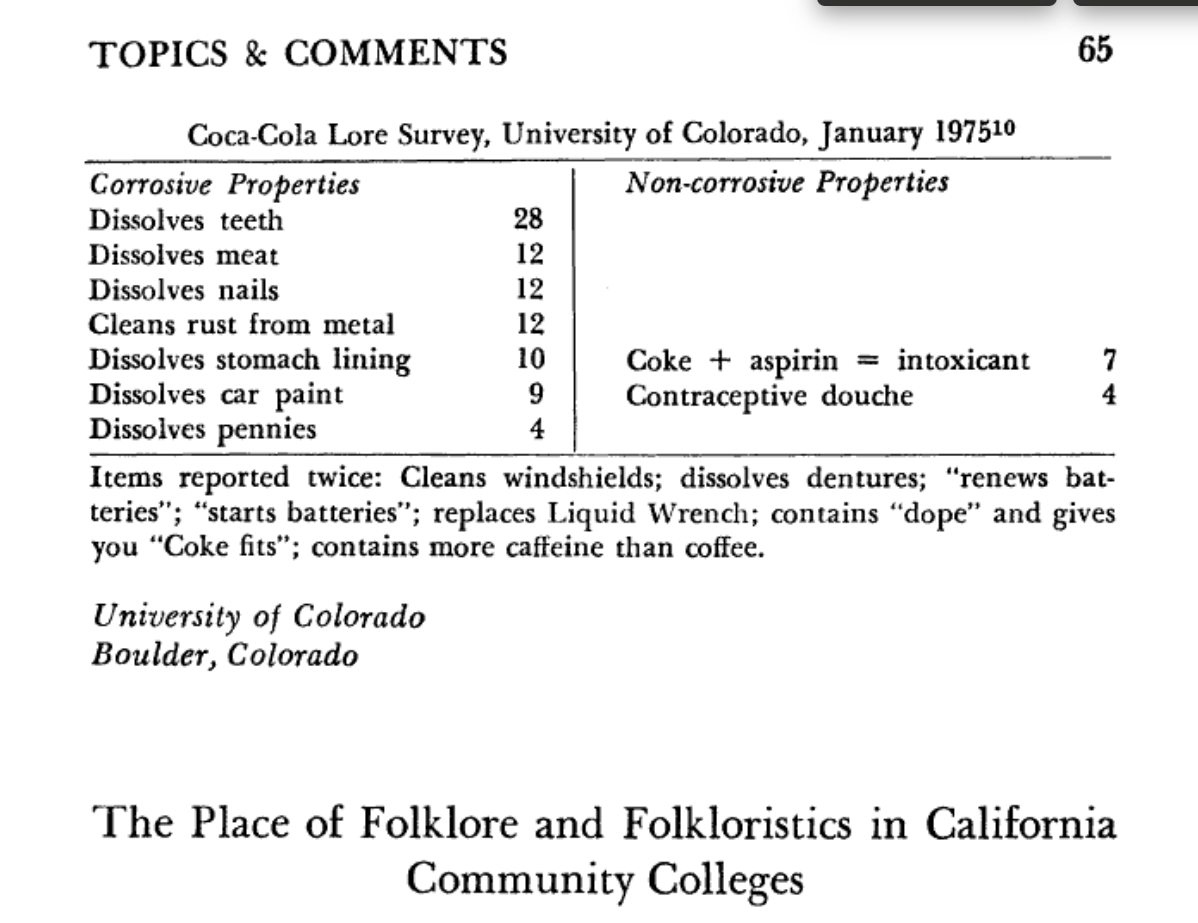
BR: Oh, well, that’s a smart move. Yeah, so that’s, again, that’s one of the well-known ones. So I dug another dive into some folklore. And this time I came up with some research done by a guy named Michael Bell. And he was a professor at Colorado State College, Boulder. And he surveyed for a folklore class, some of his undergrads, 100 undergrads. And he asked them, what have you heard about Coca-Cola and its effects? You know, just what’s – you don’t want to lead the question. You just say, okay, just tell me what you’ve heard about it. They did a quick survey. It was sort of – it wasn’t the most scientific of surveys, but it’s a legitimate survey. And I’ll just read to you the response because I can’t write any better than this. I’ll just quote.
0:34:03
CW: I can only imagine, yeah.
0:34:05
BR: So this is what the college students at University of Colorado Boulder said they heard about what Coca-Cola will do. Quote, Coke will dissolve teeth, dentures, and fillings, the linings of the stomach of humans, cadavers, and rats. Now let me just say, how one would know that it dissolves the lining of cadavers is that’s a whole other thing. Anyway, not just that nuts, bolts, pennies, nickels, spoons, the linings of aluminum containers, meat, especially hamburgers.
0:34:40
CW: Whoa whoa whoa – The linings of aluminum containers. Do you see the problem with that?
BR: Yes.
0:34:45
CW: OK.
BR: Hot dogs, steak and bacon, mice, bats, flies, and chicken bones. These are all things that Coca-Cola will dissolve. Car paint, enamel, fingernail polish, and the fingernail itself. Its own paper cup, straw and bottle, gum, marbles, barnacles, barnacles of all things, and upholstery, a block of wood, and battery casings. Not only that, it will remove battery casings.
0:35:17
CW: Designed to hold battery acid!
0:35:19
BR: It will allegedly remove rust from nails and car engines, tire rims, exhaust pipes, chrome, and water pipes. Corrosion from battery cables and terminals, grease from dirty parts and stove grills, shellac from carburetors, bugs from radiators, and tarnish from pennies. It will also clean windshields and drains.
0:35:43
CW: I had heard the one where you could use it as a drain unstopper, and I did try it once. It was disappointing. I had to go ahead and spend $8 on the liquid plumber instead.
0:35:54
BR: So just from this survey, we can see this unimaginably wide variety of really, as you point out, I mean, just if you think like, hold on, who wants to drink something that can, you know, can strip the rust off nails?
0:36:09
CW: This is clearly the most dangerous substance ever produced by man.
0:36:13
BR: Well, you would think, you would think, and some of the, some of his respondents also said that Coke mixed with aspirin will get you drunk.
0:36:21
CW: Uh, okay.
0:36:24
BR: Yeah, so neither aspirin nor Coca-Cola are alcoholic, but for some reason you mix aspirin with Coke and bam, a wild party.
0:36:36
CW: Oh man, teenagers, yeah, that would have come in handy in a lot of high school parties, but no.
0:36:42
BR: But no. So yeah, I will just nip this in the bud by saying, yeah, none of that is true, not a single thing.
0:36:51
CW: Well, to add some nuance here, none of that is true over the short term.
0:36:57
BR: Well, all right. To be fair, water will dissolve anything if you give it enough time.
0:37:06
CW: Yes, as will orange juice and lemonade and even that douche with water and vinegar. Anything with a touch of acid in it will dissolve something over a period of time.
0:37:18
BR: Hold on, I have a thought experiment. This is one of those, what if an unstoppable force meets an immovable object? So, work with me here. You have a glass of Coca-Cola, which can presumably dissolve anything, including the glass itself. Yes. And in the other hand, you have a Twinkie, which-
0:37:42
CW: Which is undissolvable and- Is undissolvable, right?
0:37:45
BR: It will last forever.
0:37:46
CW: Oh my gosh, oh, and what if there’s bubble gum in the Twinkie? Oh man, wow, this is Mythbusters era stuff.
0:37:55
BR: I don’t even know.
0:37:56
CW: We’re getting into like weapons grade snack items here.
0:38:02
Now, the other more modern twist I’m seeing on, well, there’s a twist on the Pop Rocks added to Coca-Cola thing is Mentos and Coke. Have you seen the bazillion videos of Mentos and Coke? It’s a well-known little science experiment you can do. You drop some Mentos into some Coke and it fizzes up.
0:38:24
BR: Yes, it’s, yeah, it’s kind of fun. Yeah, I’ve done it.
0:38:28
CW: It’s, you know, like just like the guys with Orbeez and all sorts of little things that they try and do backyard science with. I’ve seen a number of videos where they try to add more and more and more Mentos to the Coke and see how big of an explosion or a fizz explosion they can get. And I just stumbling around looking for Coca-Cola myths. I saw a couple of badly photoshopped images purporting to be like, boy flushes Coca-Cola and Mentos down a toilet and then it like exploded out the whole side of the building.
BR: And it killed the alligator that was lurking in the toilet. So it all it all worked out well.
CW: That was probably why he flushed in the first place to kill the alligator. Yes. And and while we’re talking about about alligators and sewers, we should also revisit subliminal imagery. Subliminal imagery. Subliminal imagery. Of course, you know about the purported images in Ice Cube illustrations of various naughty things.
0:39:28
BR: Yes, yes. That was promoted by a man who wrote the book Subliminal Seduction which was In the 19 I think 60s and 70s and he wrote this book claiming that there were these hidden images and everything from photos of ice cubes to Any number of things and sort of you know mind control conspiracy type stuff.
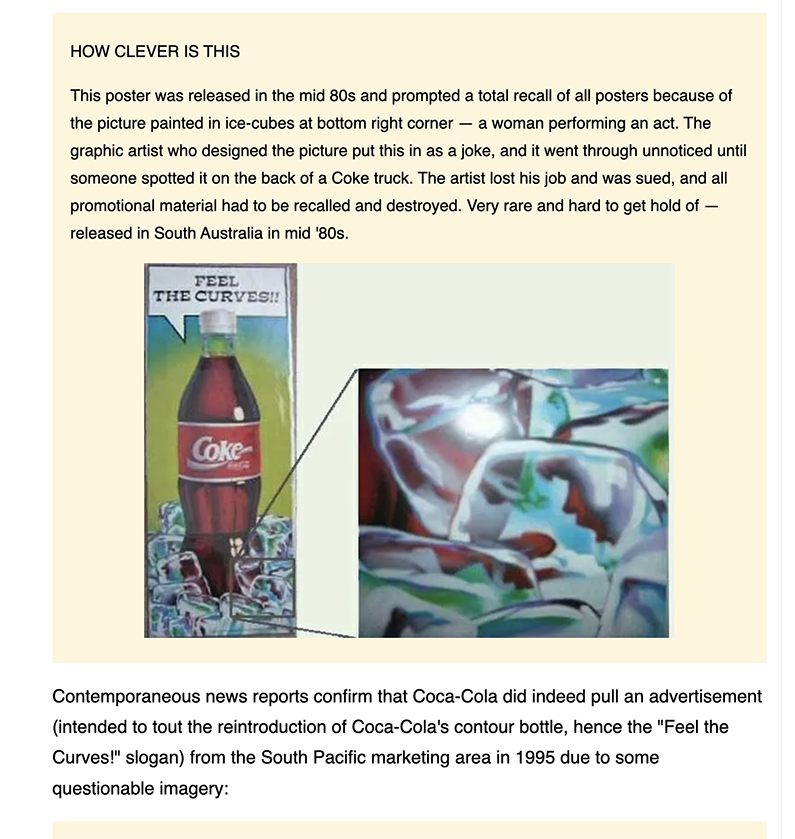
CW: Well, coca-cola did fall victim to that there was a poster released in the mid 1980s that prompted a total recall of all such posters because the picture that was painted, this is like done with airbrushes, you know, the 1980s, you know, state of the art commercial art techniques was pretty much using an airbrush. and shapes and abstract patterns on these ice cubes surrounding the bottom of a Coke bottle. And I’ll just read from here. It says, The graphic artist who designed the picture put this in as a joke, and it went through unnoticed until someone spotted it on the back of a Coke truck. The artist lost his job and was sued, and all promotional material had to be recalled and destroyed. Very rare and hard to get hold of, released in South Australia in the mid-1980s. Well, according to Snopes, yes, news reports did confirm that Coca-Cola did pull that advertisement, which was intended to tout the reintroduction of Coca-Cola’s contoured bottle. It’s, you know, the little bottle is sitting there and it says, “Feel the curves.” And that was pulled from the South Pacific marketing area in 1995 due to some, quote, questionable imagery. And they really had to enlarge the little section there that’s so-called questionable. And you can just barely make out what looks like to be a person’s silhouette of their face and maybe the tip of a microphone nearing their mouth. According to legend, this is a woman about to perform an act. Maybe they mean like a musical act. She’s going to…
BR: I’m assuming, yeah, a singer perhaps.
CW: …take the microphone toward her mouth and sing something. Yeah. But yeah, since it’s a dark silhouette, really that’s all you have to work with. But… Fair enough. Yes. But subliminally, you could read it as a whole lot more, I suppose. Now, regardless of whether Coke is trying to get naughty images in your head, or dissolve your stomach, whether while you’re alive or a cadaver, will diet Coke kill you? What do you think, Ben?
0:42:18
BR: Well, the poison makes the dose, so I would say, yes, diet Coke can kill you.
0:42:24
CW: True, yeah, clever, you pulled what I pulled on you on me. Okay. Well, if you type in the words, is diet coke into Google, the first autofill response you’re going to get is, is diet coke bad for you? So people want to know and there’s a huge amount of, it’s one of those products that’s simultaneously a best selling, widely consumed product in the United States and also widely vilified. You can’t drink a Diet Coke for very long in public without somebody coming up saying, you know, that stuff will kill you. I know this. I’ve had it happen.
0:43:00
BR: It killed me back in ‘84 and look at me now.
0:43:04
CW: I know, it killed me twice.
0:43:06
BR: I got better.
0:43:08
CW: Now, as far as the actual real medical research goes, sugared soda is definitely a problem. Even the CDC has come out and said, you know, the number one source of added sugars in the American diet is sweetened beverages. Not just Coca-Cola, but we’re talking fruit punch, energy drinks, iced tea, and so on. But what about the diet soda? Well, assuming you’re not allergic to artificial sweeteners or have any condition, you know, exacerbated by them, it’s a good way to drink a refreshing beverage without getting the sugar. But still, you have a lot of people in the medical community as well who kind of get a little bit fluffy about how they describe diet sodas. Just several months ago in Live Science, there was an article about whether or not diet sodas were good for you or bad for you or somewhere in the middle. And they quoted Sharon Fowler, an epidemiologist at the University of Texas Health Science Center at San Antonio. Now, she said diet soda is, quote, not a food at all. It’s simply a slurry of chemicals, a number of which may have deleterious effects on the body. Now, that sounds like a… okay, that’s coming from a scientist. She’s not a nutritionist. She’s an epidemiologist. But let’s examine that. I like to apply a rule sometimes I call the circus clown rule.
0:44:29
BR: I like it already.
0:44:31
CW: Which is can you take the subject of that sentence and replace it with circus clowns and the sentence is still true. All right. It’s not a food at all. OK. Circus clowns also not a food at all. It’s simply a slurry of chemicals. We’re all made of chemicals.
0:44:55
BR: To be fair, they probably have more chemicals than ordinary people do. Just the grease paint and everything else. But yes.
0:45:01
CW: Yes, yes. And a number of which may have deleterious effects on the body. Well, that’s also true of circus clowns and you and me. A number of chemicals in us right now, if we were to drink them or drink a ton of them, would have a very deleterious effect on my body. I contain traces of formaldehyde just naturally. So that sentence really makes no sense. So I can’t give any weight to that. There are a ton of studies. You could waste days, weeks, years of your life reading blogs and studies and some are based on data, but they’re not really well organized. Some are just based on feelings. Some of the bloggers, many report that drinking diet soda is linked to a higher risk of type 2 diabetes, heart disease, basically all the things that obesity is linked with. That always gets me to thinking, well, who drinks diet soda? Generally people who want to lose weight. Generally, people who want to lose weight are people who have extra weight on them. So it’s really hard for me to pull the confounding factors out of like, you’re saying that diet soda is associated with all these problems that are also associated with obesity. And again, you’ve got to figure out which way the relationship goes.
0:46:20
BR: Correlation, causation, and post hoc, ergo, proctor hoc.
0:46:24
CW: Yeah, so there’s a concern also about the caramel color in diet colas like Diet Coke, the effects on vascular health and the phosphoric acid affecting bone density in women in particular and how artificial sweeteners affect gut health. But there’s a ton of studies that don’t find those effects after they take out confounding factors. So I just I point people to an article that Psybabe wrote about five years ago Called diet coke is not killing you her name is Yvette Detremont. If you’re wondering who the Who the author is credited as although she goes by Psybabe. You’ll find the article is written by Yvette Detremont. It’s published in the outline back in 2017 and it’s a very thorough discussion about everything Diet Coke has been accused of from causing weight gain to depression and she really goes into the chemical science of it. So if you’re interested, check that out. She says a lot more than I possibly could.
0:47:27
BR: Well, all this talk of death and cadavers and bodies being consumed, do you have anything fun?
0:47:39
CW: Well in fairness you brought up the cadaver guts, but Yeah, I’ve got something more uplifting here Did coca-cola invent Santa Claus?
BR: I’m gonna say no.
CW: Well, that’s no fair. You’re a folklorist So, you know, invented the American Santa Claus and they run with it, assuming that Coca-Cola has that kind of power. Now, Santa or Saint Nick has been around as a legend since, well, fourth century Turkey or what later became Turkey, where a real person lived and died and was later canonized as Saint Nicholas. The website for Coca-Cola Australia actually has quite a long account about the legend and folklore of Santa Claus on their website. And they point out the children in the Netherlands for hundreds of years have believed in a Santa Claus who rides a donkey. And they put straw in their little wooden clogs for the donkey and wake up to find out that the straw has been replaced by presents. Now, I know, isn’t that cute? In the 1600s, that legend traveled along with the Dutch to New Amsterdam, which if you listen to They Might Be Giants, you know, became New York. So, St. Niklaus became Sinterklaas, Santa Claus, and several stories of his exploits made it into a book compiled by Washington Irving. Tales about Santa rying in a flying wagon, poems, little stories, plenty of other writers retold tales about Santa, adding their own little flair and illustrations and anglicizing things a little bit, like clogs became stockings hung by the fire with care. Long before Coca-Cola was invented in the late 1800s. In 1863, a very young Thomas Nast illustrated Santa Claus for the Harper’s Weekly, depicting him as bringing gifts to the troops who are fighting the Civil War. So, I mean, Santa Claus was around in America even when America was going through the Civil War. Now, Thomas Nast, for anybody who knows American illustration, is a brilliant illustrator, And so the Santa Claus he depicted bringing gifts to the troops became very popular and Harper’s made it a tradition. So for the next 40 years, Thomas Nast illustrated Santa Claus for that publication. He became cemented in American consciousness decades before Coca-Cola featured the Jolly Old Fellow. In the 1920s, Coca-Cola finally got on the bandwagon and they drew on these Nast images specifically to start featuring Santa in some of their ads. They had Santa Claus at a soda fountain or visiting a popular department store and it wasn’t actually paintings at first, it was a guy, it was a model dressed up as Santa Claus and photographed. But in 1931, Coca-Cola hired Darcy Advertising Agency, a very famous advertising agency in New York, and they put a painter named Haddon Sonblom to work painting Santa Claus for Coca-Cola ads. Now, you’d think Haddon Sonblom was a Jewish name. I wondered myself. I looked it up. It’s Swedish. He came from a Swedish family that was living in Michigan. So that actually seemed to lead down a rabbit hole of other rumors saying that Santa Claus was invented by Jews, which was an interesting little theory. So he’s anyway, Sonblom said that he based his illustration of Santa Claus on the Night Before Christmas by Clement Clark Moore. And yes, Santa appeared in a red coat long before Coca-Cola ever dressed him up in one. But of course, you know, Coke ads are gonna play up the aspect of the red because it goes with their branding. And at best, Coca-Cola can be credited with giving Santa a bit of a makeover. And Sonblom used a friend of his as a model, who was a retired salesman. And then long after that, as the decades went by, he started using his own face as a model for Santa Claus, just using the mirror, as many illustrators do. So people really became accustomed to that image of Santa, and they looked forward to it each year, when Coca-Cola would put out the illustrations. And so much so that when Sunblom would deviate a little bit, they would get complaints. Apparently one year, Sunblom forgot to paint a wedding ring on Santa, and it caused a scandal. Everybody wondered what happened to Mrs. Claus.
0:52:28
BR: Well, you know what? It’s what year that was, but, you know, people make their own choices, you know. Mrs. Claus was introduced to a poly lifestyle. I think that’s fine. I’m not going to judge.
CW: Yeah, yeah, it gets dull at the North Pole. I mean, Santa only gets to go around town, you know, once a year. Let him, let him, let him have a Hall Pass, God.
0:52:52
BR: Come on, yeah, really. If anybody deserves it, it’s him. I mean, all that running around and the Elves, I just…
0:52:59
CW: But aside from Santa’s secret lifestyle, what about the secret recipe for Coca-Cola, Ben?
0:53:06
BR: I know, right?
0:53:07
CW: Well, there’s a lot of rumors about the secret recipe for Coke, and how secret it is, and what lengths are taken to keep it a secret. Have you heard of this stuff?
0:53:18
BR: I’ve heard some of it.
0:53:19
So I, I recall reading a book either. It was either one of Cecil Adams straight dope columns, or maybe it was a William Poundstone. It was one of those sort of big secrets, bigger secrets, but it talked about this idea of a secret recipe. And you know, at first, again, I read this when I was a teenager. I’m like, wow, I guess, you know, another secret for the universe that I can explore. But then I’m like, well, hold on here. I mean, you know, it’s just implausible that certainly, I mean, maybe at some point it was easier to keep secrets and, you know, lists of things and, you know, two people who each have half the recipe can’t be in the same room, whatever. But, you know, with modern technology, it’s not hard to figure out what’s in something. I mean, you can do lots of chemical tests, whether it’s, you know, the batter for Kentucky Fried Chicken, whether it’s the Coke formula or any other beverage formula. I guarantee you that any chemist with enough free time can tell you exactly what’s in the Coke bottle.
0:54:26
CW: Yeah, yeah, that kind of opens up a can of Coke here in terms of what a secret formula means. Now there’s a lot of rumors and Snopes has a whole listing of them. Two men know the recipe only and those two men only know half the recipe each.
0:54:43
BR: And one of them’s dead.
0:54:45
CW: Yeah, and other rumors are actually publicized by Coke, including the recipe being locked away in a multi-million dollar vault. And I came across publicity photos of the CEO in front of the vault, holding the box that contained the secret recipe. And, you know, so Coke is in on this.
0:55:05
BR: It’s like pro wrestling. I mean, this is, you know.
0:55:07
CW: Yeah, yeah. Coke is invested in this particular myth or legend here. And those two executives who know the full recipe have to follow certain rules like they are not allowed to ride on the same airplane. You know, just in case of an airplane crash. So anybody –
0:55:28
BR: Because Coca-Cola will fold if both of them die. Okay.
0:55:33
CW: So anybody who’s eaten at KFC knows that there’s marketing value in a quote unquote secret formula. It’s a tried and true method to get people interested in your product and start believing that something is guarded and secret and it must be amazing and worth shelling out money to taste it because nobody else can make it. It’s proprietary. If she knows this, Coke knows it, and even the snake oil salesman back in the Victorian age who would tout their so-called secret formula that was really cocaine or heroin or opium, they knew it too. So it goes back to the value again of the brand name. Even if you had the secret recipe, which as you pointed out, any hardworking chemist could easily figure out, even if you had it, what would you do with it? You could make your own Coca-Cola at home, I suppose, but beyond that, what could you do with it?
0:56:33
BR: Well, knowing something about patent and trademark, nothing.
0:56:37
CW: Yes, you can’t sell it, you can’t rebrand it as a different, you know, Cola and sit and sell it. You certainly can’t sell it as Coca-Cola. And, you know, even if you were able to sell it, Coca-Cola’s got you beat there. They’ve already invested all the marketing power and the distribution chains and they’ve got everything in place to distribute this product worldwide. You aren’t that. You don’t have any powers of Coca-Cola. You didn’t invent Santa Claus. You’re just a person with a recipe and you can’t do much with that.
0:57:10
BR: Marketing, you know Ben’s version of Coca-Cola, even if it’s the real thing. Yeah, money pit.
CW: Yeah. Yeah at the best you might be able to throw it on a recipe blog and Get people to click on there and urge some earn some ad revenue. That’s about it So now nevertheless there was an attempted heist of secret information at Coca-Cola including the formula this was in 2006. A disgruntled ex-employee of Coca-Cola apparently had access to some kind of trade secrets. Reportedly, the formula was among them and wanted to sell these secrets through a middleman to a representative of Pepsi. However, the contact he had set up this big, elaborate spy meeting with turned out to not be a Pepsi executive after all, but an FBI agent and everybody involved got arrested. Because, because you see, big cola bros stick together. So when Pepsi first got solicited by this sketchy individual, they immediately told Coke, and then Coke told the FBI. And so that’s how that ended. Then fast forward to just last year in 2022, an episode of This American Life came upon what seemed to be a recipe for Coke in a 1979 clipping from the Atlanta Journal-Constitution. Now, what kind of secret is it if you’re publishing it in the newspaper?
0:58:48
BR: Celestia, to be fair, newspapers are not read that much.
0:58:53
CW: No, this is 1979. There was no Internet. All you had was the newspaper.
0:58:57
BR: But still, you you couldn’t expect more than a couple hundred thousand people might read it. I mean, seriously.
0:59:04
CW: OK, so well, so there was a little bit of digging into whether or not this was actually the recipe for Coke and a so-called Coke historian by the name of Mike Pendergrast, he said that yes, this is likely the same recipe used by Pemberton because he had done some research on that. And it was the same thing that he published himself in his 1993 book about Coca-Cola. But it doesn’t matter because that’s not the same recipe that’s used today. I mean, back when when the original inventor of Coca-Cola was around, they didn’t have high fructose corn syrup. So the recipe has changed a little bit over the years.
0:59:44
BR: It sort of reminds me of when Carly Simon was promising to sell the secret of who You’re So Vain is about.
0:59:53
CW: She promised to sell that?
0:59:55
BR: Yes, yes. I think it was about Warren Beatty or was about various other people. And I think she’s always been sort of coy about it. And I remember, I don’t know, maybe five, ten years ago, she auctioned off the, you know, she whispered in, of course, the agreement was you wouldn’t tell anybody else. But yeah, so.
1:00:23
CW: Well, I’m not sure what Alanis Morissette or Taylor Swift have done about their secret targets of their different Love Lost songs. I’m not sure I’m, not sure either one of them ever tried to sell that information.
BR: I think it’s pretty clear, right?
CW: Although my favorite version of that sort of theme is Sara Bareilles who wrote the song I’m not going to write you a love song not for an ex-lover, but for her record company Who had been badgering her to write a love song.
1:00:53
BR: Hmm. I didn’t know that.
1:00:56
CW: If you listen to it, she’s, she’s clearly singing to, uh, her manager or whoever handled her at the, at the record company. It’s, it’s quite clever. Anyway, we digress. That was a lot of Coca-Cola.
1:01:07
BR: I’m full.
1:01:08
CW: We’re going to take a break now and burp, and we’ll be right back.
1:01:31
BR: Well thanks for joining us for this episode of Scorning the Strange. We hope you enjoyed our little dive into the syrupy myths and stories about Coca-Cola.
1:01:41
CW: Yes, yes. Keep your eyes out for mice, everybody. And we’ll talk to you in a couple of weeks and have Pascual back and a fresh new topic that’s probably going to be strange, definitely going to be interesting. And we haven’t narrowed it down quite yet, but we’ve got a couple of great interviews in the future, and you’ll be hearing from us soon. Till then everybody, take care.
1:02:05
BR: Bye-bye.
1:02:05
We would like to extend heartfelt thanks to our top tier sponsor level patrons,
1:02:10
Amy Fruscioward-Kelley, Dr. Angela Matkey, Elizabeth Leggett, and Laura Ellis. Thank you for your continued support of our podcast. If you’re interested in becoming a sponsor or just throwing us a buck or two, please visit Squaring the Strange on patreon.com and browse our selection of patron rewards. Every bit helps us keep the lights on here and we are grateful to our generous friends who help us bring you quality content. If you are short on cash and want to just give us moral support, remember to recommend us to a friend, mention us on social media or give us a review on your favorite podcast dispenser. If you have comments or topics you’d like to see covered, come join our community on the Squaring the Strange podcast discussion group on Facebook. Squaring the Strange is a production of Two Heads Studio LLC copyright 2021. Theme music provided by Shriek Back, additional music by Memory, Keytard and Feathered, and Pasquale Romero. Additional support by Ashley Romero, Robert Sandin, and Alicia Jarvis. The views and opinions expressed on this podcast are those of Squaring the Strange, and do not necessarily reflect the views and opinions of Two Heads Studio, Kronos Creative, Center for Inquiry, our advertisers, or any other affiliated organizations and employers. Inquiry, our advertisers, or any other affiliated organizations and employers.
1:03:34
Bye!
