
Episode Summary:
First Pascual and Celestia examine a mysterious woman “haunting” AI art, dubbed “Loab.” Then we dip into a selection of the less famous lake monsters. There are literally hundreds. We talk about how they’ve spawned from either high-profile sightings/photos or questionable “news” stories from the period of yellow journalism. And even how some people have claimed copyright over a few of them for merchandising purposes! From Champ’s cousin George (who lives, predictably, in Lake George) and Tahoe Tessie to Lake Erie Larry and the Canadian monsters Cressie and Memphre, we’ll go over eye-witness reports and what themes emerge–and then submerge!
0:00:00
Ben Radford: Welcome to Squaring the Strange, the podcast that examines all manner of the mysterious and the mundane through a critical lens. So let’s square the strange.
0:00:11
Pascual Romero: Welcome back to Squaring the Strange. This is episode 189 and with me as always is…
Celestia Ward: Celestia! Hey everybody! We’re late this week. I apologize. I don’t know if you can still hear it in my voice but I have been under the weather with something bad It’s not Covid bad but like all the tests that I took came back negative for Covid and I took quite a few of them, but Yeah, if I got my flu shot, maybe it’s flu. Maybe it’s RSV although I hear that’s not real bad unless you’re a small small child or an old old person and I’m closer to one than the other. But how have you been, Pascual?
0:01:19
PR: Good, good. Yeah, it seems like this this week has been the perfect storm for all of us. So, you know, I’m just glad we’re getting this episode out again, apologies to everyone for being a little late, but it is a quality episode nonetheless.
0:01:32
CW: Yes. And Ben is not with us here for the opener. He will be joining us for the main topic, which is lesser known lake monsters. Like we all know Nessie and Champ. There are more than just the two, though. It seems like every small puddle or large lagoon has got some kind of critter infesting it. Where there’s water, there’s always monsters.
0:01:53
CW: But before we get to that, I know there’s something you and I are both getting a little bit skeptical of this week, right?
(MUSIC)
0:02:05
PR: Yeah, the internet is haunted, apparently.
0:02:08
CW: The internet is haunted?
PR: Yes.
0:02:11
CW: How do we possibly exercise the internet? That is a good question because it is a it is a tangled web, so to speak, pun intended.
CW: Now this is a particular entity though, right? Tell us what her name is.
0:02:33
PR: Yeah, so her name is Loab, spelled L-O-A-B.
0:02:38
CW: L-O-A-B, that’s an unsettling name. They chose an unsettling name for her.
0:02:42
PR: And you know, I mean, this’ll, I’m sure we’ll bring this up throughout this conversation, but AI has just proven time and time again to lean into the unsettling a little bit. And the name is certainly no exception to that.
0:02:59
CW: This all kind of stems out of AI art, we should preface this with. This is a creation of AI art and believe me, working in the art industry myself, I have friends with real opinions about AI art. Many people screaming that it’s just outright theft, because I mean, that’s kind of how the art is produced. They kind of scan a ton of art out there on the Internet and make some giant composite. Bingo, bango, there’s your new art, but it’s really just kind of a goulash of old art. So artists themselves are claiming that this is a textbook definition of theft. I’m not quite so believing it’s the art apocalypse and like no artist will ever work again. I think it’s an interesting tool. And really, as far as scanning a bunch of art and then regurgitating something that’s influenced by all of it. That’s what we do. That’s what artists do.
PR: Yeah. Speaking as a musician, it’s no different. If you listen to my work, I’m certain you can pick out the flavors that I’ve been inspired from. So, it’s all there.
0:04:05
CW: And as somebody who draws specifically human faces, often human faces that you find in the media, I have opinions about Loab here. So let’s talk a little bit more about her and how she popped up. The story first broke back in September and it’s been on CNET and in the Smithsonian Magazine and a bunch of other online places you can you can look her up. And by looking her up, you are actually helping participate in creating her. We’ll get to that. She is a depiction of a woman. I don’t want to call her a woman, although I guess she’s as much of a woman as La Llorona or she reminds me of a couple of folkloric images, Bloody Mary, La Llorona. Who else? Who else comes to mind?
PR: Sure, Kuchisaki Ona, who we’ve also talked about on this show.
CW: We haven’t brought up Kuchisaki Ona in a while, yeah. Ben’s gonna be mad if we’re talking about his favorite, one of his favorite cryptids, Kuchisaki Ona, and he’s not here. But yeah, she’s a depiction of a woman with really red cheeks, like some of the images have like blood dripping down her cheeks, and others just really look like she’s got rosacea.
0:05:17
PR: Yeah.
0:05:18
CW: Pardon me, I am getting healthier. And some of them just look like she has rosacea and really dark, sad, hollow eyes. She’s crying a lot. Often she’s put near grotesque imagery, kind of like a horror-themed stuff, and sometimes there’s children involved. There’s, if you go down the Twitter thread, there’s all these images that are like covered up sensitive graphic imagery blah blah blah I clicked on all of those. They’re really not…
0:05:44
PR: Yeah
0:05:45
CW: Maybe because it just looks so unreal and created by AI It doesn’t look it’s you’re not gonna see like the scene of a car crash or something. It is just weirdly gothic looking imagery
0:05:56
PR: Yeah, there’s a little bit of very surreal stuff kind of reminds me of the artist Stephen Gamow from the Scary stories to tell in the dark books.
CW: Oh, yeah. Well, it probably some of it was lifted in part or all now hers Loab herself kind of looks like a bastardization of Nancy Pelosi mixed with one of the puppets from Mr. Rogers neighborhood lady Elaine Fairchild.
PR: Oh, yeah, she was she was a little creepy.
CW: She creeped me out as a small child as well. Yeah. So picture that or you can just, you know, look up lobe and you’ll see her. She was first discovered and the word discovered is kind of doing a lot of heavy lifting there by a 31 year old woman named Steph Swanson, who lives in Sweden and she is an artist herself. She’s known online as Supercomposite, so you can find her original Twitter thread about finding Loab under Supercomposite there. Another irony, because AI art, like I said, is kind of a supercomposite of other art, and Supercomposite was the person who discovered this. They’re calling it an AI cryptid. They’re saying it’s the first AI cryptid. She’s haunting the Internet. So Ms. Swanson was using an AI generator and giving it negative prompts. Can you explain what those are?
0:07:24
PR: Sure. Yeah. So AI image generation, as it’s being used in this case, and as is being used widely on the Internet by apps that people are downloading or websites, it just uses prompts based on words that you input into the algorithm. It’s basically a giant search engine and you’re going to drop those words in and it’s going to go into the internet and just sort of skim things that it connects to those words.
0:07:53
CW: Yeah, you’ll see a lot of people on Facebook and Twitter just picking random fonts, cotton candy monster eating Kentucky Fried Chicken or something.
PR: Yeah, and my my favorite prompt that I’ve done so far was gender reveal at a funeral came out with some really hilarious images.
CW: Now, how does that differ from negative prompts?
0:08:15
PR:So negative prompts are it actually is a process of of asking for the opposite of something. So the chain she used was opposite of Marlon Brando, which generated a bland logo. And then when she asked for the opposite of that, she got four images of the same woman.
CW: Huh, I don’t know if that, see, it doesn’t make sense that that would be the opposite of a logo. Yeah. There it is. So yeah, so apparently she thought that was weird. And Swanson described the image of Loeb on Twitter That was weird. And Swanson described the image of Loab on Twitter by saying, her presence is persistent, and she haunts every image she touches. So she ran the same prompts again. And apparently, usually when you get asked for the opposite of something, you get wildly different results. But in this case, they all kind of seem like the same ish woman. And she started crossbreeding that prompt with other prompts. So you’ll see images of like Loab mixed with one of the aliens from Avatar, or mixed with Kirby from Pokemon, or various other things. And one of the times she was playing with this, the letters L-O-A-B popped up in the background of one of the images. And that’s how she got her name.
PR: Ah, yeah.
0:09:37
CW: Now, I found it interesting that Swanson does not claim anything supernatural about this. She made an effort to say, you know, I don’t think this is some sort of, you know, magical demon godlike and anything supernatural at all. Just it’s interesting in terms of a ghost in the machine kind of thing. Pundits are taking this to be some sort of sign that AI itself is trying to warn us about something, advising caution, saying, you know, don’t go down this dark alley, humanity, you don’t know what you’re doing. And, okay, yeah, you guys, I guess that would be an interesting interpretation.
PR: That kind of reminds me of our buddy, Blake Lemoine that we talked about with the Lambda AI being sentient. I think, again, people are assigning a little too much sentience to AI.
0:10:29
CW: Yeah, well not just assigning sentience. There was one article where the journalist, I forget which article this was, but the journalist quote, unquote, reached out for an interview via a different AI that produces text and language. What was it, Dahlia or something five? I forget the name of it, but it was a wholly just bland, uninteresting little snippet of obviously AI-generated text talking about why do you think you’re associated with horror type imagery? Well, I don’t know, but I wish I wasn’t.
0:11:07
PR: It was interesting and it shows that AI tends to feed back to you what you’re looking for because that’s how it’s designed.
0:11:20
CW: Yeah.
PR: And when you’re speaking to it in terms of like we saw with Lambda, you’re going to start prompting it even if it’s not super clear in the text, but as you respond to the things it gives you, you’re going to sort of coax those things out of it. So it’s going to talk to you how you want it to talk to you.
0:11:38
CW: Oh, now I want to just I want to get a psychic and put them with an A.I. like that.
PR: Oh, my God, that would be really feed off of each other. See what happens.
PR: Just a wormhole of nonsense.
CW: But again, as somebody who draws a lot of faces, every face starts looking a little bit familiar to me. Like, yeah, I’ve drawn a nose like that, like 500 times. Oh, yeah, I’ve drawn somebody with eyes kind of like that. Oh, yeah, I’ve seen this done in a magazine. And I’ve tried to draw a picture off of it, blah, blah, blah. Seeing Loab and looking at the different images, I wasn’t really shocked or surprised. I didn’t they didn’t make me jump out of my chair and say, how uncanny. I was just like, yeah, that that is what a computer would do with like a bazillion images of a sad faced supermodel. And an aging gazillion images of a sad-faced supermodel and an aging politician. I mean Nancy Pelosi might have been involved in some of these images.
PR: Who knows?
CW: You pick and choose, you know, little bits. The really other interesting turn with this is that Loab is not just created by pixels. She’s a product of PR. This original story about her, you know, went viral. People are, you know, writing all sorts of stuff. People are searching her out. And that is creating that is creating a feedback loop which the AI feeds back on. And so now she’s going to be a thing. I’ll quote him here. She was a transient locality that later versions would have erased as noise. But we’ve created a permanent Loab, engraving it permanently as the content we create about her is backfed into new training. Observing her made her real. We live in such interesting times. I love it.
PR: Very Schrodinger’s AI.
CW: Schrodinger’s AI, exactly! And this is, I mean, this is folklore sped up to the hyper speed of the 21st century. Welcome.
PR: Well, now that we’ve solved the mystery of the ghost in the internet Loab, let’s move on to our main topic of lesser known lake monsters.
(MUSIC)
BR: All right, for this episode, I thought we would return to one of my early favorites in terms of mysteries and strangeness, things regarding cryptozoology, and this would, of course, be lake monsters. We have done, I’ve done a lot of work on lake monsters. I co-authored a book with Joe Nickell titled Lake Monster Mysteries, University Press of Kentucky. And of course, previously here on the show, we’ve done deep dives, if you will. Into Champ and Ogopogo.
0:14:48
CW: Two lake monsters, not necessarily the most famous lake monster.
0:14:51
BR: Right. We actually haven’t done one on Nessie in Loch Ness. It just sort of hasn’t happened yet, but we will be circling back to it. But this time, I thought we would take a look at lesser known lake monsters around the world.
PR: Yeah, because Nessie is too mainstream, guys.
BR: Yeah, you know what? You know, it’s a couple pegs down. We don’t need to have the Kanye, the Beyonce of lake monsters. We can go with the…
0:15:22
PR: The Billy D. Williams?
0:15:23
BR: Yes, thank you. There we go. I was scrambling for something there.
0:15:26
CW: Well, we can kind of look at a lot of these as Nessie’s spawn, right? I mean, stop me if I’m wrong here, Ben, but I’m assuming lake monster sightings started just happening way more often once Nessie got popularized, yeah?
0:15:41
BR: They did in some ways, in some respects. I mean, for those who remember our episode on Champ, one of the most interesting parts about that was the sort of sociological, cultural ideology of lake monster sightings, where for example, the most famous photograph taken of a certain American lake monster, taken taken by Sandy Mancy, was published in 1981. And that was, if you, there’s a, there’s a Champ Sighting Board in Port Henry, New York, and it’s a big wooden board and it’s all, you know, it’s all ornate and kind of neat looking and has, not all of them, but has many, many of the original Champ Sightings. And if you take a close look at the board, you’ll notice that the vast majority, I think 40 or 50% of them, are dated 1981 or 1982. And of course, this correlates very closely with when the most famous photograph of Champ was published. However, it’s important to remember that the photograph was actually taken in 1977. So it was very, very clearly the publicity around the photograph, you know, being talked about and being ooed and aahed over and creating a mystery that spawned other sightings and other reports. It wasn’t the original sighting several years earlier that was basically unique at the time.
0:16:59
CW: Well I wonder if, I mean, has anybody done a meta-study, if you will, over when these lake creature sightings happen throughout the world at all these different lakes? Because I went on Wikipedia and Wikipedia lists no fewer than 95 separate lake monsters that are renowned enough to actually make the hauls of Wikipedia. So I’m wondering if anybody’s actually scanned through all the sightings for all the different monsters and found any sort of pattern in terms of worldwide coverage, national coverage, local coverage, and all that.
0:17:34
BR: That’s a good question. I don’t know anybody who has. I mean, there’s certainly people, there’s a handful of people that have sort of made lake monsters their specialty. John Kirk, for example, a British Columbia cryptozoologist who wrote a book titled In the Domain of Lake Monsters is one of them. Joe Zarzinski wrote a book just about Champ specifically. And Michelle Merger wrote Lake Monster Traditions and that’s sort of a more folkloric look at them. But the number of people that are just specifically focused on lake monsters is, I can think of two basically. I don’t know if any of them have really dug deeply into that. It would be interesting.
CW: Yeah, I count you in that group of lake monster aficionados because I mean, I’ve seen footage of you in your skivvies propping up a thing in Lake Champlain trying to recreate the photograph on National Geographic or whatever.
BR: Yes.
0:18:29
CW: So you’re clearly in that camp.
0:18:31
BR: Yeah, it’s one of the many things I have not gotten around to. There’s a list as long as my leg of things that are a good idea and I just haven’t gotten around to. But anyway, to sort of a high-profile citing report that makes the news. And we certainly saw this with Nessie and Champ. And the other thing that happened was you see a lot of reports, and Joe and I came across this in writing Lake Monster Mysteries, of newspaper accounts, often between, say, 1880s to 1920s or so. And this actually corresponds pretty clearly with a period of sort of yellow journalism where… Celestia, talk for a second about the Batman on the Moon story.
0:19:23
CW: Oh, the Batman on the Moon. Well, we did a whole segment on the Batman on the Moon hoax. It was part four of our literary hoaxes mini-series a while back. And all their naughty, naughty cavorting that was captured by telescope, the brand new technology of the time, back when the newspaper series came out. And, you know, half the people read it thinking it was real, half the people read it thinking it was like the Weekly World News. Either way, it’s strange and interesting to look back at.
0:19:53
BR: And either way, it was selling papers like hotcakes.
CW: As it was intended to, yes.
0:19:58
BR: As it was intended to, right. And so that’ll actually be, as we sort of go over some of the lesser known lake monsters, we’ll see that theme appear a few times, where newspapers, as much as people complain about bad journalism these days, there’s nothing new about people making stuff up. Just, hey, well, there’s a lake monster there, is there? Sure, why not?
PR: So which of these monsters do you want to start with?
BR: So, let’s begin, since I was just talking about Champlice, let’s begin in America and then sort of broaden it to Canada and then touch on some of the other ones worldwide. As Celestia mentioned, there’s at least 90 or 95 lake monsters on Wikipedia. If you take a sort of deeper dive into cryptozoology books, you’ll find hundreds of them. I don’t have an exact number. Certainly, I would guess over 200, maybe 300. It’s very easy to create a lake monster sighting. This is one of the lessons you learn when you do this long enough is just…
0:21:04
CW: You just need a lake and eyes.
0:21:05
BR: You need a lake and eyes and somebody who can’t quite figure out what something is for any reason whatsoever. Maybe they’re drunk, maybe it’s late at night, maybe it’s too far away. I just there’s so many reasons why somebody might see something on a lake or any body of water, in this case lakes, that they can’t identify and someone’s like, well that’s weird. And then all you need is someone else to say, not only is that weird, we got ourselves a monster.
0:21:33
CW: Let’s start printing money. Ka-ching!
0:21:39
BR: So, let me begin with George. You guys know the story of George and where George might be?
0:21:48
CW: Well, he was in New York in an apartment with Jerry and Elaine a lot.
0:21:53
BR: Different George, but good try. Oh, okay.
0:21:57
PR: So, not George Castanza, okay. No, no, no, no.
0:22:00
CW: That would be the most annoying lake monster ever. Lives with his parents.
0:22:06
BR: So this is George of Lake George. And of course, there’s a long tradition of somebody adapting the name of the lake into some sometimes cutesy monster. And so in this case, George is the obvious one.
CW: Well, it’s not really a stretch.
BR: No, this is the creativity naming Lake Monsters does not require a deep dive. It’s like, you know, Lake George, what are we going to call it? Harvey? Watchfruit?
CW: Yeah, they couldn’t have even had it called Georgie, it’s just George.
BR: It’s actually not far from Lake Champlain. So if Champ exists, then George might be a relative. Or it might be Champ, who just manages to commune between the lakes or something. And the story of George is interesting because we can actually track down the origin of George very, very specifically to a place called Hague Bay in 1904. And our story of George begins with a painter named Henry Watrous. He made a bet with a friend of his, Colonel William Mann, the editor of Town Topics, a small newspaper. And Harry and Colonel Mann had a running bet as to who could catch the biggest fish. Now you may have an inkling of where this is going.
0:23:45
CW: Is this a literal fish tale that started this?
0:23:48
BR: Yes.
0:23:49
CW: Okay.
0:23:51
BR: So specifically there was competition over who could catch the largest trout. And at one point, Colonel Mann held up what appeared to be a 30 to 40 pound trout as his boat passed that of Harry Wattrous.
0:24:05
CW: That is a seriously large trout.
0:24:06
PR: That is a big lake trout there.
BR: 40 pound trout. And he’s like, wow, this is a… And he was like, okay, you got me. And he’s like, well, hold on. So he took a closer look at it and he discovered, as I’m sure you’ve guessed it, it was a fake. A gaff. A prank, if you will.
0:24:29
CW: Was this one of those instances where the profession of model maker comes into play?
BR: Sort of, yes. So at this point, the competition between these two friends went from who could catch the biggest trout to who could outwit the other one. Of course, the subject being big things in the lake.
0:24:52
CW: Honestly, I’m starting to like these guys. They sound fun.
0:24:55
BR: Yeah, a couple of those really good old boys. So and I’m drawing some of the material here from from the chapter that Joe and I, mostly Joe, wrote in Lake Monster Mystery. So if people are interested in in more of this story and others as well, check out the book. So Watchus was quoted in 1934 and in retroactively talking about this competition, and he said, quote, while the Colonel was in New York attending to business during the week ending in June 27th, 1904, I got a cedar log and fashioned one end of it into my idea of a sea monster or hippogriff. I made a big mouth, a couple of ears, like the ears of an ass, four big teeth, two in the upper and two in the lower jaws, and for eyes, I inserted the sockets of two of the monster, two telegraph pole insulators of green glass.
0:25:45
CW: That’s a serious amount of work.
BR: It is.
CW: Well, he’s essentially carving this entire cedar log into a giant, well, not really a duck decoy, but a lake monster decoy.
0:25:56
BR: Yeah, well again, he was an artist. He was a…
0:26:02
CW: All right.
0:26:03
BR: What else do you think he’s doing in Lake Georgia in the 1900s? This is what he’s got time to do. So he says…
0:26:11
CW: This would have made an excellent TikTok, by the way. 120 years too early.
0:26:15
BR: Wah, wah. He says, I painted the head in yellow and black stripes, painted the insides of the mouth red, and the teeth white, painted two red places for nostrils, and painted the ears blue. You may be wondering, blue ears? Well, you know, people describe all sorts of weird stuff on lake monsters, as we’ll talk about soon. The log of which I fashioned the head was about 10 feet long. To the bottom of the log, I attached a light rope, which I put through a pulley attached to a stone, which served as an anchor. The pulley line was about 100 feet long and was manipulated from shore. And where I’m going with this, as you might imagine, is that this became the original sighting of George. He says, well, I went on anchor of the hippogriff close to the path which Colonel Mann’s boat would have to take from the landing to his island. I tested the monster several times, sunk it, and waited for Colonel Mann and his party to arrive on a Saturday afternoon.
CW: Oh, so he sunk it and this thing was like gimmicks to like float to the top when you release the line?
BR: Exactly.
0:27:18
CW: Oh, this guy’s clever.
0:27:21
BR: This guy’s not messing around, man. This is the real deal. The Colonel had as his guest Mr. Davies, Mrs. Bates and several other congenial spirits hidden behind a clump of bushes on shore. I watched as the launch approached, and just as it was about 10 feet away from my trap I released the monster.
CW: My money is on Mrs. Bates fainting.
BR: Well, wait to see, right? It came up nobly, the head shaking as if to rid itself of the water, and I will say that to several people in Colonel Mann’s boat it was a very menacing spectacle. Mr. Davies, who had a rather high-pitched voice, uttered a scream that must have been heard as far away as Burlington, Vermont. Mrs. Bates, unlike her husband, the master, a very trepid lady of Malaysian extraction, stood on a seat in the boat and beat the water with her parasol, shouting indistinguishable sentences in her native tongue.
CW: Okay, so she didn’t faint. She was ready to fight.
0:28:23
BR: She, uh, there was no fainting couches on this particular boat. Colonel Mann shouted, good God, what is it? Through his whiskers and kept repeating this query as long as the boat was in sight. As soon as I gave the audience a good look at the hippogriff, I pulled it down to the bottom of the lake again.
CW: Oh, that’s great.
PR: Amazing.
CW: He didn’t even let them have the, have the satisfaction of like getting close enough to find out it. And it’s perfect. It is perfect because no one’s going to jump in the water after this thing. Well, maybe Mrs. Bates.
0:29:02
BR: Well, she was maybe screaming in her native tongue. So just to wrap up, so he says, so it says, although Colonel Mann’s home was on an island, news of the sea serpent was all along the shore of the lake that night. Taking advantage of the darkness of night, I moved the monster from place to place along the lakeshore. And everybody who saw my monster had a new story to tell of its awe-inspiring appearance.
CW: Oh man, he is, he’s running with it.
BR: He is. Right. And, and I just love this story because we really should do a whole show just on cryptozoology hoaxes because that’s a whole thing.
0:29:43
CW: I feel like we’ve done several already, just not specifically titled that.
0:29:48
BR: And so then this, again, it’s artistic, it’s well done, it moves. He knew what he was doing. And there was one tale that Joe quotes in the chapter, he says, the young couple honeymoon at the hotel had gone out for a moonlight canoe ride when the monster surfaced close to their canoe, causing it to capsize. The groom, unable to keep his wits about him, swam to shore, leaving his bride to fend for herself.
0:30:13
CW: Oh boy!
0:30:14
PR: Oh no!
0:30:15
BR: She eventually made her way to shore, stormed into the hotel and packed her bags, announcing not only the end of the honeymoon, but also the marriage. It is reported that she was actually grateful to the serpent for showing her that the true monster was her soon-to-be former husband.
0:30:34
CW: Wow! Oh, this is…
0:30:38
PR: I don’t even… I really can’t feel bad for him. The whole thing just… it sounds like he really failed her on that one.
0:30:45
CW: I’m casting all of these little narratives in, like, Downton Abbey episodes. That’s how I’m picturing them.
0:30:53
PR: Yeah, I think of that whole upstate New York, you know, summer culture and just how, you know, the kind of rich, snooty people. And I don’t, yeah, you’re right. That’s like the exact kind of group of people I’m imagining here.
0:31:07
BR: Now, to be fair, some of these, obviously, Wattruse, you know, he’s telling his own story decades later. I mean, he told the story in 1934 and this happened in 1904. And of course, he’s a good old boy, Western New York. So we can’t take these tales as complete truth, but there’s probably some grain of truth to them. In any event, Henry Wattruse eventually confessed. There’s no record of just how pissed Colonel Mann was. I would have loved to be a fly on the wall when that came up.
CW: What was it – we had Michael Branch on talking about the jackalope many moons ago and he said the true beauty of a hoax is when it’s revealed. And this is such a great example of a perfect hoax. It’s got artistry, it’s got drama, it’s got an arc, it’s got a side quest involving a canoe full of honeymooningers that get broken up. This is great!
0:32:14
PR: Yeah, and it really, the thing I love, and again, it’s funny that this is even, I guess, semi-obscure by standards of Lake Monsters, but it has such a better story than most of them. I really, you know, Loch Ness, of course, has a great story when you know the entirety of it, but, you know, this one was exposed early enough that it really was just the hoax itself ended up being such a great story that it’s a shame that it’s not better known.
0:32:42
BR: Yeah, and again, this is one of the reasons I wanted to do this episode, was to sort of, you know, take a deeper dive into the lesser known ones that are in some cases just as colorful.
0:32:52
CW: Yeah, I’m keeping track, Ben. That’s like your fourth use of Deeper Dive, and I’m going to give you a demerit.
0:32:57
BR: I only do that because you use that phrase all the time, so give me something else.
0:33:04
CW: You’ll get my bill later, yeah.
PR: Maybe we should have a little, like, bubbling noise every time he says it and just make it a running joke.
CW: Anyway, on we paddle here.
BR: So there’s a couple things that happened. So one thing I want to point out was that even though most of the original eyewitness reports were when he was actually putting these out, because the story of George in Lake George became known, even though it was pretty conclusively just known as a hoax some people still occasionally saw the monster. So the fact that the the original sighting was clearly a hoax that doesn’t mean there’s an actually a monster there. You know keep that in mind.
CW: Yeah, yeah, that’s not surprising at all.
BR: Yeah, and so When Joe and I were doing research for our book, we wanted to go we visited Lake George and we wanted to actually see the original Hippogryph, of course, what he called it. We didn’t find the original. We found a copy of the original. There’s a display, in fact, if you look in the book, there’s a photograph of what you see there. It’s actually pretty cool. Given the circumstances of 1904 and how far away it was, you can see how this might scare the hell of somebody because again it’s not it was a pretty well done hoax and it was it was just it was done just right where people weren’t close enough to really tell what it was It just sort of bobbed to the surface and then back down. So we can certainly forgive Colonel Mann and his and his compatriots for…
CW: I I feel like you’re burying the lead here, you’re skipping over something in that you said this was a copy of the Lake, the original Lake Monster carving. What happened to the original? Was it spirited away somehow?
0:35:00
BR: So the original, as I understand it, is actually in the Haig Community Center. So we visited the Lake George Historical Association Museum.
0:35:11
CW: Oh, so you just went to the place that didn’t have it.
0:35:14
BR: Well, we went to the place that was open and available when we were there.
0:35:17
CW: Okay, so can you make something up about how it was like stolen? That’d be great. No? Okay.
0:35:23
BR: But yeah, so if people are interested, you can, if you go to Lake George and go to the Historical Museum and the Community Center and ask around, you too can see either the original or the copy of Wattress’s amazing George the Lake Monster.
0:35:34
PR: Wow, I have to admit that I regret never knowing this story. The number of times I’ve toured this country and actually well North America in general and I’ve passed from Montreal to New York City and that is it just goes right past Lake George. Of course it also goes right past Lake Champlain. So I’ve stopped in Burlington and bought little, you know, Champ knick-knacks, but I had no idea about Lake George, and now I’m a little sad I never went, so maybe one day it’ll be a destination trip for me.
0:36:14
CW: You’re just gonna have to go on tour again.
0:36:16
PR: Yeah, I don’t know. We’ll see.
0:36:18
BR: So, let’s see, there’s a couple other ones. Celestia, as you know, there is a alleged monster in Lake Tahoe.
0:36:27
CW: Yeah, as a Nevada resident, I can’t say I’ve ever seen Tessie. I think I remember the one time I visited Lake Tahoe, I remember seeing the children’s book. There is a children’s book, you know, that came out in the 80s when I was a child about about Tahoe Tessie, because, of course, you know, any any monster is going to be commodified and turn into a cute little thing that you can put into a kids book, or on bibs, or on baseball caps, or whatever, and sold in the gift shop. I did a little bit of digging, and there’s like YouTube videos about searching for Tessie, the Tahoe Lake monster, as recently as like last year. exactly faded into obscurity, but according to, you know, just my quick little scan here, the first person to see it was a fellow named I.C. Coggin in 1897 who apparently wrote about a first-person encounter with what he reported to be a 600-foot monster serpent in the woods near Lake Tahoe. So it wasn’t even in the lake, he spotted this on land.
BR: And it was 600 feet long?
CW: Yeah, yeah, but he was remembering from 30 years earlier.
PR: I just want to say as a person who working in the communications industry you often have to shoot from the hip on the length of a cable run. Once something is over like maybe 200 feet eyeballing it is very, very difficult. So 600 is pretty impressive.
0:38:06
CW: I’d imagine so. Yeah, that’s. Now, what do you know about Tessie? You could probably enlighten me, Ben.
0:38:10
BR: Not a whole lot. I, I, um, I know a little bit about it. I’ve been to Lake Tahoe once. Uh, and while I was there, I, uh, I did look around and ask about it. I got mostly sort of puzzled looks. A few people knew about it and were happy to sell me a mug or a t-shirt, of course. It seemed like most of the sightings dated back to the mid-1980s.
CW: Yeah, that seems to be the heyday that I saw, too. The consensus among people who aren’t monster aficionados, like true believer monster aficionados, seems to be that, Tessie, the sightings might be chalked up to sturgeon, which can get gigantic.
0:38:55
PR: Yeah they are big fish.
0:38:56
CW: Up to 12 feet and they can weigh up to 1500 pounds. And I think they’ve been the explanation, or at least the proposed explanation for a lot of lake monsters, right? They’re popular freshwater, giant bottom feeder fish.
0:39:08
BR: Yeah, absolutely. And as Pascual mentioned, I’m not a fisherman myself, but I mean, I’ve certainly done enough in this field that there’s some damn big fish that, you know, keep in mind that the nature of mysterious creature sightings on water is very different than they are on land or in the air, right? Because if something is in the air, you have a pretty good idea of the parameters of the object. It may be foreshortened, it may be behind something or else, but I mean you have, you may not know how big it is, but you have, you’re usually seeing most of it and, you know, the sky or whatever else around it, except of course in darkness. And it’s often the same thing on land, right? So when we’re looking at things on land, we have other things around it to gauge how big it is. Trees and buildings and people and horses and cars and, you know, estimating things on land is, it can still be fraught, but there’s something very specifically distinctive and difficult about estimating and identifying things in water. Much of what you’re seeing is submerged. If it was on land, then you’d see the whole thing except for whatever’s, you know, on the other side.
0:40:24
CW: Yeah, I saw a video, just you know, the quick little loopy fun videos that like Ozzy Man reviews or whatever. And you see this shark swimming and you’re like, oh look, it’s a big dangerous shark. And in your head, you’re seeing this from above, you’re like, that’s a giant shark. And then a big old fish comes and eats it. And in that moment, your brain realizes, oh, that shark was maybe seven inches long, you know.
0:40:50
PR: Yeah, and it’s an interesting thing. So I grew up spending a lot of time out on water by virtue of my mother’s family being from Wisconsin and living on lakes. And there are a lot of, you know, objects in the water that you’ll see while you’re boating or swimming or whatever. And the portion of it that’s sticking out of the water, your brain just automatically makes an inference as to what it is or how big it is. Sometimes it’s as simple as in the case of Champ in the episode that we covered on Champ. You’re seeing part of a piece of wood sticking out of the water and your brain is just like there’s a whole rest of that thing under there somewhere. It happens with downed logs and downed sticks and even just, again, fish. When a fish comes up and strikes the surface of the water, most fishermen probably will understand this, sometimes it looks a whole lot bigger than when you finally catch it or you see it in the water and you realize, oh, wow, that’s actually not big at all. You just don’t have good perspective when you’re looking at water at all.
0:41:58
BR: Yeah, that’s absolutely true. You had mentioned Champ. There was a more recent sighting of Champ. They’re not very common, but there was footage that appeared some years back called the Bodette footage. I think two guys on a small boat, and they’re on Lake Champlain, and there’s footage of something underneath the water. It looks like it’s a couple of inches below the water, and it’s clearly an animal. I mean, it’s not a log, it’s moving. And you can imagine it being huge, or you can imagine it being kind of a big fish. And it just really, and people who look at it, oh, it must be huge. Like, no, it might be huge, but we’re only seeing a small part of it. And in fact, we may be seeing all of it. That 12 or 14 inches could be pretty much all of it. You’re assuming that that’s a quarter of it and that could be 90% of it. So yes, there’s Tahoe Tessie and even the Great Lakes. I used to live in Buffalo not too far from Lake Erie. They’re said to be a creature in Lake Erie called, well, can you guys guess?
0:43:18
CW: Eerie?
0:43:20
BR: Eerie, a good try, no.
0:43:22
CW: They should have named it Ernie. You just add one letter N and Eerie turns to Ernie.
0:43:29
BR: Lake Erie Larry, come on.
PR: Erie Larry. Okay, okay. I guess I want to give them points because it’s not a perfect play on Erie, but at the same time I feel like that’s a fairly banal name for a monster.
BR: Yeah, there’s also South Bay Bessie, if you want to sort of regionalize it. So the creature in Lake Erie has been widely described as a sort of giant snake, and of course this is pretty similar for many of them. Although, like a lot of monsters, the descriptions vary pretty widely. So this is one of the things to keep in mind is that there is a sort of this prototypical, stereotypical image of a lake monster sort of just being dark and sort of slimy and snake-like in the water like an eel. And that’s certainly often the case. But many times, if you actually dig deep into the archives and look at what the eyewitnesses are describing, they come up with all sorts of stuff. So for example, in the case of Bessie, the skin is said to be black or brown or copper or smooth or it might have silver dollar-sized snake-like scales. Some monsters, for example, Champ, were described as having the head of a dog or a snake or a horse. I mean, just sort of like, you know, take your pick, right, whatever you want to do.
0:44:52
CW: Yeah, very, some of that sounds a little bit hippogriffy.
0:44:55
BR: And yes, very hippogriffy.
CW: And haven’t you noted one point when we were talking about Champ, I think that there’s, it seems to be two basic body types. It’s either a snaky eel sort of sea serpent, or it’s a plesiosaur.
BR: Yes, that’s certainly true. And if you check out Daniel Loxon and Don Prothero’s book, Abominable Science, which I highly recommend, they do an excellent job in some of the early chapters of tracing the origins of, not just the origins, but the changes in the public’s idea of what Nessie looked like. And they make a pretty convincing argument that films, particularly, for example, King Kong, which came out right around the time when the first reports of Nessie emerged, were heavily influenced by it. So there’s a very strong correlation with what people think monsters look like as depicted in films and TV, for example, and maybe, you know, images and books and what people are seeing. But anyway, so just to circle back to South Bay of Essie for a second. So, as I mentioned, many of the sightings date back to the 1800s. And again, this is when there were lots of newspaper stories to entertain and amuse and perhaps sell papers. And in the process of researching the book, we came across a newspaper article published in the Pulteneyville New York Commercial Press in 1867 about a local sea serpent, you know, as lake monsters were often called because the distinction is sort of depends on what you think it is and how close you are to the ocean. This newspaper article states that in fact a local guy owned the lake monster. He says, quote, Dr. Henry Stoll of Oswego says he owns the animal of which so much has been said, having imported him at great expense from the Humbug Islands. Perhaps P.T. Barnum sold him the creature, who knows? Stoll has him boarded during the hot weather and as soon as the weather becomes cool, he intends to skin him and have it stuffed. He’s occasionally stolen away and visited different localities about the lake and when he has been seen, has made hideous noises in imitation of the parties present.
CW: I love how they make it sound like he’s just a wayward household pet.
BR: So anyway, there’s others as well, as I said before, we don’t have time to touch on all of them, just going to hit on a couple. Let’s move on to Canadian lake monsters.
CW: Are they just like American lake monsters, but nicer?
BR: In some ways, some of them have a French accent.
0:47:41
CW: Okay.
0:47:43
BR: Allegedly. And of course, the most famous Canadian monster, we did an episode on Ogopogo in Lake Okanagan, British Columbia, but there’s actually many of them. In fact, and I may have mentioned this bit of trivia on the show before, Canada has more lake monsters than any other country.
0:47:59
CW: Do they?
0:48:00
BR: Well, allegedly monsters. Yes, yes they do. Again, we’ve already sort of touched on Ogopogo. Let me talk about Cressy in Crescent Lake near Robert’s Arm in Newfoundland. Have either of you been to Newfoundland?
0:48:15
CW: I, you know, I think I was. For my honeymoon, I took a Canadian cruise and I think one of our stops was somewhere near there.
0:48:23
PR: I’ve always wanted to go, but I have never been. I know a friend of mine who does listen to the show is out there, so hi, Luca. But yeah, I’d love to go sometime, and lake monsters are also a great reason for me to go.
0:48:38
CW: There we go.
0:48:39
BR: Absolutely. I visited Newfoundland for about a week or a week and a half for a couple of different reasons. One of them was because it is known for being a place where monsters wash up on the shore, mostly the globsters. So there’s been several.
0:48:56
CW: You guys can look at the lake monsters and the globsters and I’m going to get myself a drink and chat up some Merby’s that’s more along the line.
0:49:04
PR: I actually, I should probably look into that just because I think I could have a career in that world judging from the photos we looked at for the episode.
0:49:15
CW: Yes, if somebody’s lost while you’re listening to this at home, we mentioned it on an episode, but you can always Google what Merbys are. M-E-R-B-Y-S.
0:49:24
BR: And plus, of course, while you’re there, you have the soundtrack provided by the great Canadian man, Great Big Sea. Crescent Lake, it’s in northeastern Newfoundland, near Robert’s Arm. It’s a beautiful area and it can be super cold, especially near the shore, but it is considered to be Newfoundland’s Loch Ness Monster, again, Cressie in Lake Crescent. And as with other Canadian lake monsters, including Ogopogo, local Indian myths are often co-opted or conscripted into the story behind where the creature came from. This is part and parcel of a lot of cryptozoology. We’ve talked about on the show in terms of how oftentimes people will sort of co-opt Native American legends about entities and evil spirits and sort of recast them as eyewitness accounts of Bigfoot, for example, or eyewitness accounts of this or that. But again, it’s important to be careful and not take too many liberties with First Nations stories and myths and interpret them literally. But in the case of Cressie, it was interesting for a couple of reasons. One is that the monster has not been photographed. That’s always, you know, when I’m doing research into monsters and other things like that, you know, obviously having a photograph or video is very useful. There were, of course, famous photographs of… There’s a famous video of Ogopogo, famous photographs of Champ, as we mentioned, and of course the Loch Ness Monster, which was later debunked. But so there’s no photograph of it, and so virtually all the evidence for Cressi exists in the form of eyewitness sightings and reports. And there’s a plaque in Robert’s Arm, and I’ll just briefly read it because it gives a good sort of local flavor of it. In the local oral tradition, sightings of Cressy go back to the turn of the century, when one of Robert’s Arm’s first residents, remembered today as Grandmother Anthony, was startled from her berry picking by a giant serpent out on the lake. In another daylight sighting of the early 1950s, two local woodsmen on the shores of the lake noticed what they thought was a boom log just offshore. And of course, for those who don’t know, boom logs are logs that are brought down and when logging is done and transported by water, that they sort of help to move the logs around. Puzzled that it was drifting into the wind, the men hurriedly out in time to witness the upturned log, now huge, black, and rounded, slip beneath the waters of the lake. One of the gentlemen, Mr. Andrew Burton, long since retired, recalls that they wasted no time in regaining the shore. Burton described the object as about 25 feet long and one foot in diameter. Even though it was originally thought to be a log, Burton said it didn’t act like one, partly because it traveled against the wind, which would not be something that a log would have done. And again, there’s other examples as well. There was a sighting in 1991 and another one a little bit later of that same year when a man named Fred Parsons, who I interviewed, talked about what he saw. And this is a quote from my interview with him. He says he saw something in the water, perhaps a hundred yards out, quote, what I saw was like a long snake-like creature on the water. It was about 15 or 20 feet long, had dark brownish color. It was a long sleek body without any significant large head, basically right on the water. It was basically right level with the water, just lying there. So there’s a couple explanations of what, for example, it might be. One obvious one is it could be a log.
0:53:17
CW: Yeah, I’m sitting here thinking it’s 15, 20 feet long, dark brownish color,
BR: Laying flat in the water…
0:53:22
CW: Laying flat in the water. Okay, all right.
0:53:26
BR: Yeah, you know, so like, and keep in mind that as with all lake monster sightings, it’s a mistake to ask what is the explanation? Because there’s not the explanation, there’s not one. There’s no single blanket explanation for all of them. Different people see different things at different times. So you’re not going to find what these things are. You’ll have to look into each specific sighting and try to decipher it.
0:53:51
CW: Now, about Cressie specifically, since you mentioned this is a monster that has no photograph attached to it. Did you get the sense that Cressie was a bit more wink and a nod, tongue in cheek, like, oh yeah, we’ve got a lake monster, you know, here, you know, we’ve got stories. Or are these people like, yeah, there’s definitely something under there and it can kill you and it’s, you know, real and we’re going to hunt for it. You know, what’s the serious versus cutesy children’s book fodder?
0:54:20
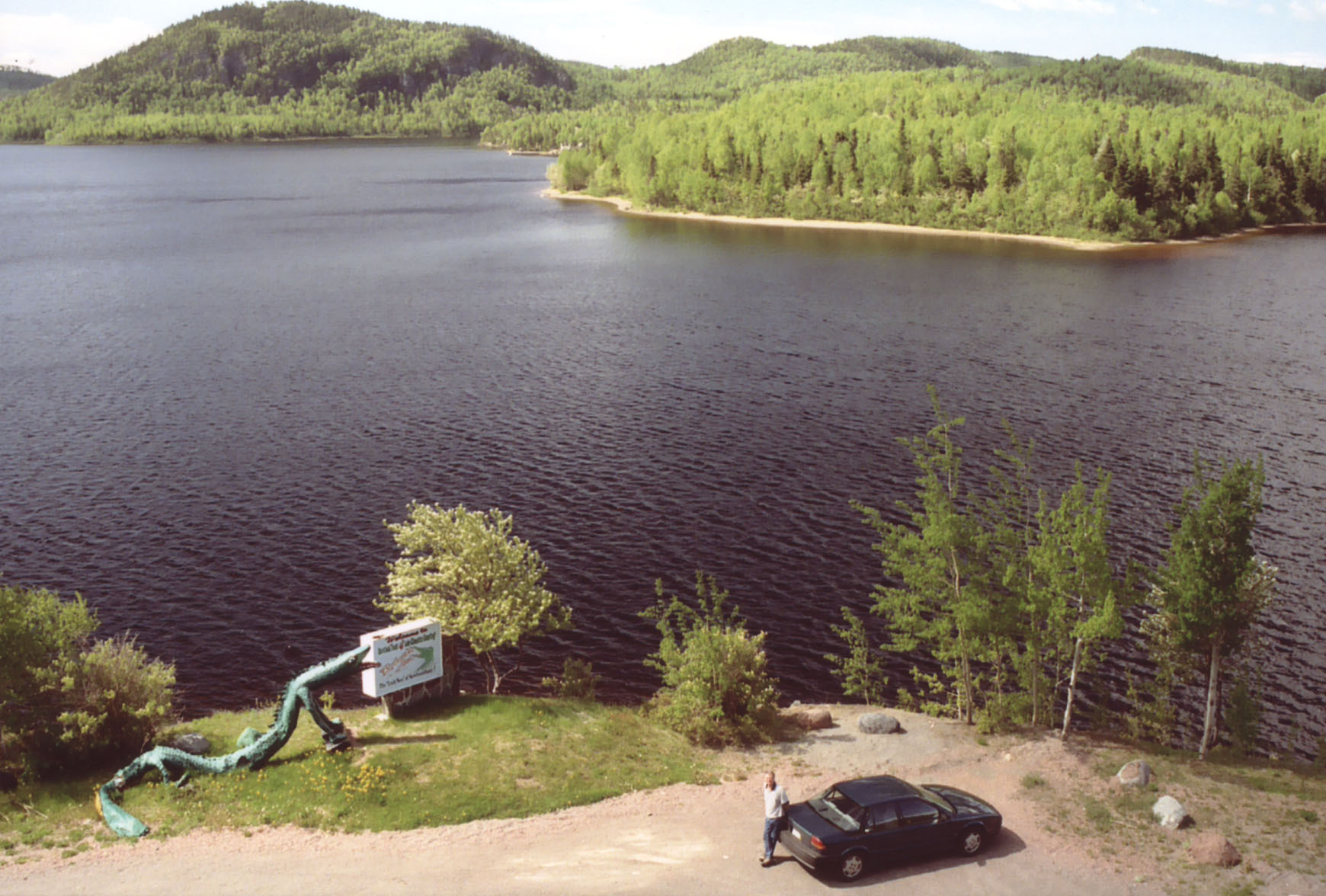
BR: Yeah, that’s, that’s a good question. It’s a little hard to parse out. Certainly, Robert’s Arm is happy to exploit their lake monster. When I was there, there was a large, I don’t know if it was metal or concrete or some mix of the two, I mean literally it says, Welcome to Robert’s Arm, home of Newfoundland’s lake monster. So, they have a giant looking, and actually the depiction of Cressie doesn’t actually match the description, but whatever. They’re showing everybody, in fact, I recently saw a more recent photograph, so apparently they took down the dragon looking monster that I saw when I was there, and I guess they now have a more sort of modern-looking lake monster thing.
0:55:13
CW: They re-branded the monster.
0:55:16
BR: Right, they re-branded the monster. So it was interesting, right? So some people sort of did it with a wink and a nod. Fred Parsons, he was sort of the local gatekeeper. This is one thing you’ll find with a lot of lake monsters is there’s often one specific person who is the sort of self-appointed guardian or information dispenser, you know, sighting collector for any given lake monster. In the case of Champ, it was typically Sandy Mansi, because of course she had the most famous sighting and photograph. In the case of Ogo Pogo, it was a woman named Arlene Gall, who Joe and I interviewed and who appears in the National Geographic TV show. In the case of Cressie, it was Fred Parsons. He had had a first-person sighting so not only was he sort of the custodian of a lot of literature and collecting clippings and reports But he was sort of the guy, you know, he’s a if you want to know about Cressie go talk to Fred This is how this works. When I asked him about about it and what he thought that he he was circumspect, so what he told me is he believes there is in fact a monster in the lake, but he concedes that the monster might in fact just be a big eel.
0:56:35
CW: Okay, well I mean if any animal gets big enough, you can call it a monster.
0:56:40
BR: Well see, this is… right. So this is exactly what happened.
0:56:43
CW: I mean if I come across a 300 pound bullfrog, that’s a monster to me.
0:56:49
BR: Yes, right. And this is part of what’s going on here. When I talked to Fred and other people there, I said, okay, well, looking through these descriptions and I’d done some research not only beforehand, but also when I got there and I was looking through his archives, which he very kindly provided to me, I said, you know, Fred, a lot of these, these descriptions sound a lot like eel. He’s like, oh yeah. I was like, well, are there, are there eel in the lake? He’s like, oh yeah, big eel, giant, huge eel. There’s the size of your thigh.
CW: Oh, okay. Well then, all right.
BR: I’m like, all right. I’m spitballing here. Do you think maybe Cressi is a giant eel? He’s like, yeah, yeah, it could be. So again, it was like, there was no inherent contradiction. Like, well, it’s a monster, but it’s a big eel.
0:57:39
CW: You know, there’s a certain wonderful intellectual honesty and just kind of, you know, I appreciate that he’s not the kind of guy who’s who wants to, like, just cling to the paranormal, supernatural, bizarre crypto explanation. Like, no, there’s no way it can be an eel. It’s something vastly, you know, that that human science has never seen before. He’s like, yeah, it could be an eel. All right.
0:58:08
BR: Yeah. And to be honest with you, that resonated with me in terms of Newfoundland culture in general. It’s a beautiful area. It’s economically depressed for various reasons, including the collapse of the cod fishing and various other things. But most Newfoundlanders, they’re fishermen. It’s a forbidding territory. There’s basically one large and by large, I mean medium-sized city on the whole island in St. John’s. And beyond that, you’re sort of in these, and I’m not knocking it, it’s just most of it is rural and there’s places with just scattered villages, fishing villages and things like that. So they tend to be a practical people, if I can generalize that. So it didn’t at all surprise me that that was sort of his explanation. There were a couple other sort of more anomalous sightings. So for example, I was given a sighting on July 15th by a guy who said that he and his wife were driving along the lake and they saw something that was at first thought to be a speedboat. It vanished and then when it reappeared, quote, it was traveling so very fast and the spray was really flying as though it was after something. It was described as being, it was quite some distance away and by the way, the guy that saw this was a World War II veteran. So he was an older guy and partly for that reason, his sighting had credibility, right? Because he’s a vet and he wouldn’t make these things up. Of course, by the same token, you might say, well, he’s a vet and maybe his eyes and ears aren’t as keen as they used to be. And he described something on the other side of the lake and quote, the sun was shining on it and the large fin looked like silver. It shone so bright. And I was given this account. And when you’re looking into lake monster sightings, you can’t just sort of pick and choose which ones to believe, right? Because on some level, they’re all as credible as the next one, right? I mean, they’re all, if someone says they saw a lake monster or some unknown creature in a given lake, you can’t just say, well, those can’t be right because who knows, right? So you have to take them in their totality and you have to look at each one individually. Now, that doesn’t mean of course that all the eyewitnesses are correct or maybe even seen the same things. But in this case, first of all, the fact that he said that it was going as fast as a speedboat, well, nothing, no animal goes as fast as a speedboat unless it’s on land as a cheetah or something. Certainly, anything that could go fast enough to kick up spray could have been like a jet ski or something.
1:00:49
CW: Yeah, knowing that there’s eels in the lake, my first question was, are there speed boats regularly on the lake or even toy speed boats? You know, people have those not quite full size, not quite tiny models that you can get out there and get going pretty good.
1:01:06
BR: Yeah, yeah, and there’s lots of stuff on the lake. And again, it’s a beautiful lake, and if you’re ever in Newfoundland, go check it out. Who knows what this thing was? This particular sighting was, first of all, super dubious. I mean, there’s really no animal that could be. I mean, either it’s some entirely unknown thing, and he admitted it was on the other side of the lake, so you take it for what it is.
1:01:32
CW: Well, besides Newfoundland, are there any other Canadian lake monsters we’re missing besides Ogopogo here?
1:01:37
BR: Yeah, there’s a couple. There’s Igo Pogo, which is not far from Toronto Lake Simcoe. And there’s another one which Joe and I investigated in Quebec, in Lake Memphremagog.
CW: Say that again?
BR: Lake Memphremagog.
CW: Memphremagog, okay.
BR: If there’s any francophones there, I don’t know what it is in French, but in English it’s called Manfrey. So let’s just go with that.
1:02:06
CW: Okay.
1:02:08
BR: And again, this is a decent sized lake in Quebec. And reports of the creature go back to about 1816, allegedly. And once again, you have stories that North American Indians in Canadian First Nations, warned early settlers not to bathe in the lake because of a mysterious monster. So, there are stories about a local hunter named Uriah Jewett. And if Uriah Jewett isn’t a great name, I don’t know what it is. He was a local fisherman and raconteur who believed that an Atlantic sea serpent had entered the lake through subterranean channels, which is a common belief, for example, in Loch Ness, but was too stupid to make its way back out. So, insulting the local lake monster, well, I’m not smart enough to retrace the steps, so there you go. So apparently, Uriah Jewett was convinced that there was this somewhat dim-witted lake monster there, and he decided to set up traps, and he was baiting it with lamb’s heads. This did not work, as you might imagine, either because there is no monster in the lake or the monster didn’t like lamb’s heads.
1:03:26
CW: Did Uriah decide to say, well, the monster is just too stupid to notice my lamb’s head?
1:03:31
BR: Right, right. If this was a smarter monster, then I would have caught it. So, no, so he eventually gave up, although in the 1850s he often regaled passengers and local boats by telling them that the bait had always been gone by morning. Even though he didn’t actually, even though the bait didn’t work in terms of, you know, finding the creature, something ate the lamb’s head, or it just sank, or whether a fish ate it.
CW: You know, what is bonafide proof that living things are in the lake and they eat stuff. Yep, exactly. So in researching Memphri, Joe and I visited a woman named Barbara Malloy and she is the head of a group called the International Dracontology Society of Lake Memphromagon.
CW: Racontology?
BR: Dracontology.
CW: Dracontology, like having to do with dragons?
1:04:28
BR: Yes.
1:04:29
CW: Oh, okay.
1:04:30
BR: Yeah. So as the head of this organization, and I don’t know whether it’s defunct or not, I expect that it is, as at least the one-time head of this organization, she claimed exclusive rights to Memphree. If any businesses wanted to sell any merchandise with Menfrey, for example, you know, t-shirts, coffee mugs, things like that, they would need to get her permission and presumably pay her some money.
1:05:01
CW: Now, see, that’s the interesting thing about Lake Monsters, because they’re tied to private property sometimes, or at least property owned by a community. They are like unique among cryptids in that some people try to claim copyright, right?
1:05:16
BR: Yes.
1:05:17
CW: That’s fascinating.
1:05:18
BR: And there’s a whole, I won’t go into the whole story, again, if people are interested in the deeper dive into Lake Memphremagog and these other creatures, they can check out Lake Monster Mysteries. But so Malloy claims actually to have seen Memphrey. She described these to me and Joe, and she actually provided a couple photographs, one of which appears in the book. So when Joe and I visited Malloy, we were interviewing her, telling her, you know, writing a book on lake monsters, and she was very gracious and let us in and shared her sightings, and described one particular 1989 sighting. And she said that, again, she’d actually seen this creature several times. Now, when you have what are called repeaters, that’s a red flag.
1:06:06
CW: If the repeaters are also trying to claim copyright over the creature, that’s a big red flag.
1:06:10
BR: That’s an even redder flag.
1:06:12
CW: I got to ask, when you were talking to her, did she explain her rationale as to why she had legal rights to this creature, or she thought she did?
1:06:19
BR: Well, it’s kind of a complicated story. And again, for details, you can read about the chapter in the book. But basically, she had begun investigations with another monster hunter and had a falling out with him. And so part of this was not only just a money-making scheme but also wanting to get back at him and trying to make sure that he didn’t get the rights to use the monster’s name.
1:06:45
CW: Okay, all right, wow.
1:06:48
BR: Yeah, there’s a whole thing.
1:06:50
CW: You just raised even more questions. Now I’m imagining some cryptozoological lovers squabble and a custody battle.
1:06:57
BR: Oh yeah. It’s, it’s, this stuff gets messy and sticky. So just, you know, just watch out for that.
1:07:04
CW: So she’s a repeat sighter. She’s seen this thing a number of times.
1:07:09
BR: Yes. And so she’s seen this several times and, and she was describing one particular sighting that she thought was especially important. And she said that she had seen two of these creatures, not just one, but two. And one was approaching from left and from the right. And when they got close to each other, they both submerged into the water. And she was on a boat with a fisherman, and the fisherman had told her that earlier nearby he had seen a beaver in the area. And she described that she had heard a slapping sound. And she said, well, if you slap the water with your hand.
CW: The same sound beavers make all the time?
1:07:48
BR: Yes, yes, that was.
1:07:51
CW: All right, okay.
1:07:52
PR: But not a beaver.
1:07:53
BR: But not, right, so like that, but different. Yeah, so Joe and I are interviewing her, and again, she seemed like a nice woman, but she was just, you know, just, wow, you know, this monster, you know, slapped the water. And the fisherman I was with told me just recently he’d seen a beaver in that area, okay? And you’re not making a connection between those two data points, because I am. So we basically wrapped up our search for Memphrey at a restaurant called La Legende, meaning the legend in French. And the restaurant sign actually has a depiction of Memphrey. I don’t know whether they paid Barbara for the rights to it or not, but it’s kind of cool. So anyway, again, there’s more Memphrey in the book and elsewhere, but let’s move on to a handful of other ones around the world.
1:08:56
CW: Cool, hit us with a super quick montage.
1:08:59
BR: Let’s just start with some of the obvious ones. So even though Loch Ness is the most famous monster haunted lake in Scotland, it’s far from the only one. There’s also one allegedly in Loch Morar on the west coast. Some people say that the first sightings date back to 1887 or 1895. If you’re ever in Scotland, there’s at least two and probably more than that, probably as many as a half dozen lakes around there that may have a monster in it.
1:09:32
CW: People sure started seeing lake monsters around the end of the 1800s, it seems like.
BR: They did. Yeah.
CW: I’m gonna have to look up, you know, what was eyeglass and binocular technology doing around then, you know?
1:09:45
BR: And did all the lenses have this little swiggly thing at the end? Yeah, in North Wales, in Lake Bala, there is a creature called Teggie, T-E-G-G-I-E, and recorded sightings of the creature date back only to about 1975, when the former warden saw an unusual form in the water. It was gray, about 8 feet long, and looked like her crocodile, the small lump. 8 feet long, looking like her crocodile? I don’t know.
1:10:15
CW: Are there crocodiles in that lake?
1:10:18
BR: I don’t think so.
1:10:21
CW: There might be sturgeon.
1:10:22
BR: There might be sturgeon, right, exactly. Exactly. In March 1995, two fishermen reported seeing a creature raising its fearsome head ten feet above the lake’s surface, which by itself is weird. Ten feet. So the head ten feet. It was like, where’s the… I’m trying to figure out how you’d even do that, right? Did the head just… I don’t know. Anyway. That’s a big-ass monster. Oh, there’s a, in my collection of Lake Monster memorabilia, I have a wooden carving of Storjo.
CW: Storjo.
BR: Storjo, which is a, is a lake monster in Sweden’s fifth largest lake, Storjon. It is said to be a snake-like animal with a dog’s head and fins. As with, as with Champ, there was a effort to protect it, whether it exists or not. So there was a court ruling in 1986 declaring it illegal to hunt, to kill, hunt, or catch the lake monster, as well as to take away or hurt the monster’s eggs, roe, or den.
PR: Oh, okay. I mean, I wouldn’t, I guess I can’t disagree with the law.
BR: Yeah, I’m fine with that.
PR: If that’s what you want to do with your legal system, great.
BR: Yeah, knock yourself out there. I will end with one particular one which deserves a bit of mention just because there aren’t too many lake monsters in South America. And this is in Argentina. The creature is called Nahuelito and it is in Argentina’s Nahuelhuapi Lake.
1:12:01
CW: I got to ask, does Nahuelito mean little narwhal? I’m hoping it does.
1:12:07
BR: It would, except for Nahuelito is N-A-H-U-E-L-I-T-O.
1:12:13
CW: Oh, okay.
1:12:14
BR: If it had been Narhuelito, then yes.
1:12:18
CW: So close!
1:12:19
BR: Allegedly, it was supposed to look like a plesiosaur, and of course, in accordance with Champ and Nessie and others as well. Actually, one investigator suggested that some of the reports might actually be of a large duck native to the area.
CW: A large duck or a goose? Because a goose can be a freaking monster.
1:12:37
BR: No, no, no. A large duck. A large duck. Apparently, the ducks have a reptilian appearance and a photograph of one looks, quote, for all the world like a submerged monster hump throwing up fountains of spray.
CW: Huh! Okay, reptilian ducks. The world has wonders that will never cease.
BR: And this is actually a quote from a fairly renowned lake monster investigator named Ulrich Magin. M-A-G-I-N. So, I have one of his books. So if Ulrich thinks that it might be a giant duck, then you know what? Maybe it is.
CW: Okay. Well, if any listeners have a particular favorite local lake monster that we didn’t cover here, because we can’t get to all of them. Like I said, there’s hundreds. Write in. Get us on our Facebook discussion board and tell us about your local lake monster and whether or not you’ve seen it or made up a story about it or carved a giant model of it and scared your friend.
BR: Absolutely
CW: Ben, thanks for bringing all that.
BR: Any chance I get to talk about cryptozoology and even lake monsters, I’m happy to do so. It is cool. I mean, in some ways, when you look at enough of these creatures, they kind of get to be the same. In some ways, it’s sort of like Bigfoot. I mean, there are regional differences, there are specific differences and you know, descriptions, but on some level they’re kind of the same, but the interesting stuff is when you’re sort of seeing themes and patterns. I hope you all enjoyed it.
1:14:13
PR: I had a great time. The lake monster is very close to my heart because I think Nessie really was my first cryptid that I sort of fell in love with as a kid, so hearing all these is just so much fun for me.
1:14:27
CW: Yeah, and I want to say that we have never had a lake monster in Lake Mead. The only thing that seems to surface there is bodies.
PR: It’s a little scarier, I guess.
CW: Yeah, I have many memories of swimming in Lake Mead as a younger person. And I can’t say I ever worried about fish or krakens or monsters. Just I didn’t want to touch a skeleton or something.
1:14:50
PR: Yeah.
1:14:50
CW: Bottom of my toes.
1:14:51
PR: That’s fair.
1:14:52
CW: But that’s a whole nother episode.
(MUSIC)
CW: Well, thanks for hanging in everybody and listening to well our ramblings about Loab, the internet ghost at the beginning, and then lesser-known lake monsters, which they all have staying power. We’ll see. I wonder if in 100 years people will be talking about Loab the way that they’ve been talking about monsters in lakes. What do you think is going to have the most staying power?
1:15:34
PR: That’s a good question. The internet creating something also probably will swallow it up with, you know, not too much time. So, I think that lake monsters being that they exist in hard copy and, you know, the books we’ve read and the shows we’ve watched.
CW: I think those bits of fascinating cryptid history will probably last a little bit more staying power than shifting sands of pixelation here. I’m mixing my metaphors way too much. I’m still kind of sick, everybody, but I’m working on getting better. I felt well enough to record today and do some editing. So, again, apologies for the late drop. We will do everything we can to make sure next episode is out on time so you’re not left hanging and until then everybody take care. See ya. We would like to extend heartfelt thanks to our top-tier sponsor level patrons Amy Frusciaro-Kelley, Dr. Angela Matkey, Elizabeth Leggett and Laura Ellis. Thank you for your continued support of our podcast. If you’re interested in becoming a sponsor or just throwing us a buck or two, please visit squaringthestrangeonpatreon.com and browse our selection of patron rewards. Every bit helps us keep the lights on here and we are grateful to our generous friends who help us bring you quality content. If you’re short on cash and want to just give us moral support, remember to recommend us to a friend, mention us on social media or give us a review on your favorite podcast dispenser. If you have comments or topics you’d like to see covered, come join our community on the Squaring the Strange podcast discussion group on Facebook. Squaring the Strange is a production of Two Heads Studio LLC, copyright 2021. Theme music provided by Shriek Back, additional music by Memory, Ketard and Feathered, and Pascual Romero. Additional support by Ashley Romero, Robert Sundin, and Alicia Jarvis. The views and opinions expressed on this podcast are those of Squaring the Strange, and do not necessarily reflect the views and opinions of Two Heads Studio, Kronos Creative, Center for Inquiry, our advertisers, or any other affiliated organizations and employers. Inquiry, our advertisers, or any other affiliated organizations and employers.
1:18:01
you
