Episode Summary:
Just in time for Halloween, when scary clowns abound, Ben takes us on a tour of the modern clown panic phenomenon . . . from bands of phantom clowns in white vans showing up in the 1980s to the “Great Clown Panic of 2016” that went worldwide, to more recent fears about effects of homicidal clowns in our media. Clown panics touch on quite a few currents of fear, from unknown assailants to viral copycats to public outrage and urban legends about tainted Halloween candy. So get out your rubber nose and floppy shoes and enjoy the show!
0:00:00
Ben Radford: Welcome to Squaring the Strange, the podcast that examines all manner of the mysterious and the mundane through a critical lens. So let’s square the strange.
(MUSIC)
0:00:10
Welcome back to Squaring the Strange. This is episode 104, and today we’re going to be talking about a short history of clown panics.
Celestia Ward: Clown panics with an S. Like plural?
0:00:32
BR: Yes. Plural clown panics, more than one.
CW: More than one. Is it like how many clown panics can you fit into this little VW bug?
0:00:56
BR: That, or how many clown panics can you talk about in a single episode of Squaring the Strange?
0:01:00
CW: Well, we’ll find out here. Okay. Well, it’s all three of us. Full crew today. This is Celestia Ward.
0:01:07
BR: I’m Ben Radford.
0:01:08
Pascual Romero: And I’m Pascual Romero.
0:01:10
CW: But before we talk about clown panics, you guys, did you want to hear about any possible updates to that mysterious, possibly murderous dwarf along the lines of the Orphan movie story?
0:01:22
BR: Absolutely. You had me at possibly murderous.
0:01:27
CW: Yes, well, it turns out, well, I can’t say it turns out because nothing is solidified and decided, but more information is coming out. And the adopted father went on Dr. Oz last week.
0:01:43
BR: Wow.
0:01:44
CW: And you know, it was the one episode I missed.
0:01:47
BR: Right. Well, you know, you can’t have him, you know, waxing on about quack medicine all the time.
0:01:55
CW: Yes. Well, apparently he admitted on the Dr. Oz show that they knew she was a child when they left, when they left for Canada. And they didn’t run away to Canada. They just had to go to Canada because their other son was a physics prodigy and he had been accepted to a university up there. So in other words, they had a perfectly good reason to run away to Canada and abandon her, I guess.
0:02:21
PR: Oh, okay.
0:02:22
CW: As we mentioned a couple episodes ago, this story was popped up in the Daily Mail, but that’s kind of a tabloidy sort of source, but it’s now been reported by some other outlets like USA Today and MSN. And this is all about a young Ukrainian girl or young-ish Ukrainian girl that was adopted. Her name is Natalia. And her adoptive parents, her first set of adoptive parents, I should say, only set so far, are under criminal investigation for abandoning her. The Barnetts are her adoptive parents, and they apparently abandoned her a couple of years ago to go up to Canada, and they are now facing…
0:03:01
BR: Uh, a couple of years? We’re heading to Canada, be back in a couple of years.
0:03:05
CW: Well, in the meantime, apparently the young girl, Natalia, has been living with a nice couple in Indiana, a pastor and his wife who took her in. I haven’t officially adopted her but there’s some legal wrangling over her actual age and the adoptive father, Michael Barnett, who again is one of the ones under criminal investigation for child abandonment, is stating that he did know she was a minor but his wife at the time, they’re now divorced, had told her to just tell everybody you’re 22. And the idea was that would help her get some mental health care that she needed. And yeah, it’s a confusing sort of story. I’m reading different accounts on different news sites, but they had sought a court decision in 2012 to re-age her and make her like 10 years older than she was supposedly. But then there, some court documents have been released. There was a probable cause affidavit obtained by DailyMail.com citing a series of bone density tests and one of them carried out in 2010 estimated she was 8 years old and the second one suggested she was 11 years old that was done in 2012. If either or both of those are correct, that still makes her a minor in 2016 when they skipped up to Canada. So… call me a little too scientific. I tend to err on the side of the bone density exam.
0:04:34
BR: Hmm.
CW: Even if the girl has a pretty good vocabulary if the bone density scan and the doctors are saying she’s a child.
BR: But what about the story about her trying to kill people? Where does that come in?
CW: Yeah, I’ve read some more accounts that go into, you know, some kind of almost funny details about these alleged plots to kill her adoptive parents. And it’s starting to sound cooked up to me because one of the three of the examples here I’ll give you, she put push pins at the top of the stairs so that they would step on, you know, tacks. Or apparently she poured some, some reports say Windex, other reports say Pine Sol into the mother’s morning coffee and said, I’m trying to poison you. And another report stated she tried to push her mother, her adopted mother, into an electric fence. So it’s starting to sound a little bit more like Home Alone, serious murder attempt. So which again would probably indicate a younger person. But…
0:05:42
BR: So to be continued.
0:05:43
CW: Yeah, and I wish… Apparently she’s doing very well with the couple in Indiana, and they say everything’s a damn shame because she can’t even go to high school right now because of the fact that the courts have re-aged her into an age that does not qualify for high school. So I’m hoping everything gets sorted out and this poor girl gets the education and the health care and the mental health care that she needs and hopefully won’t be in the news anymore.
0:06:10
PR: Yeah, fingers crossed this all works out for her because as outrageous as this story has all been, at the center of it is a child. So I really hope the best for her.
0:06:23
CW: Now Ben, what have you been up to? You had a couple of bits of news for listeners, didn’t you?
0:06:28
BR: Yeah, the main thing going on right now is that in the newest issue of Fortean Times Magazine, the British sort of, not British equivalent of Skeptical Inquirer, it’s an interesting magazine that’s been published for decades, and I’ve been publishing it several times based in the UK. And in issue 385, which is out now or soon to be, is my investigation into the Chase Vault mystery, which of course Scoring the Strange listeners got the early exclusive on, but it’s now written up. And if you’re interested, you can read it. You can find it there.
0:07:02
CW: I love that we get the early scoop on a like 200 year old mystery.
BR: The latest developments.
CW: So fresh.
0:07:12
BR: And another thing I have coming up is in the next week or two, I will be going to the audience of Teresa Caputo, the Long Island Medium.
CW: Oh, why would you go and do that?
BR: Well, the local skeptics group has paid my admission.
PR: So why don’t they like you?
BR: I reluctantly agreed to go do that. I, as you all know, you know, investigating psychics and psychic detectives is one of my wheelhouses. And I’ve never seen Teresa Caputo live. I actually haven’t really seen much of her shows. But of course, Celestia and I investigated John Edward a couple years back, and we talked about that in a previous episode. And it’ll be interesting to sort of go and be in the audience for Teresa Caputo, although I suspect that I will be either the only male there or one of the only males there, which is fine, but it may mean that I will stand out. And so I’m trying to figure out how I’m going to not stand out as the obvious male skeptic, but I’ll figure it out.
0:08:15
CW: No, middle-aged bald guys with glasses are a dime a dozen. I think you’ll be fine.
0:08:20
BR: We’ll see.
0:08:21
CW: Yes. And we’re just full of news here. I got to go to SciCon this past week and it was a sleep deprived wonderful event. It’s one of those things where when a cool conference comes to your town and it’s also the town you live in and work in and have your family in, your life doesn’t get suspended while you’re at the conference. So I was running on empty running back and forth and I got to see a lot of cool talks, got to meet a lot of cool people. I met a few listeners. I met a young lady who actually protested Sylvia Browne with you, Ben.
0:08:56
BR: Awesome.
0:08:57
CW: Yes, she was neat to talk to. And then I also ended up sitting next to one of our patrons, one of our skepticrate level patrons at breakfast one morning.
BR: Very cool.
CW: And so I was able to apologize for skepticrates being late this month, but they are going going out. I put them in the mail today. And we also got to see Brian Dunning’s, an early rough cut of Brian Dunning’s film Science Friction. And I urge listeners to go to sciencefriction.tv to check that out. And it’s a very worthy project. They are giving scientists that have been screwed over by TV producers a chance and a voice and a platform to talk about how science is misrepresented and turned on its head in the name of infotainment not even infotainment just flat-out fictional entertainment.
BR: Yes.
0:09:51
CW: Pascual, do you have any news?
0:09:53
PR: Do I?
0:09:55
CW: Maybe buying a new interface.
0:09:59
PR: Yeah, as listeners might notice my voice probably is not as clean-sounding as it normally is. Thankfully we recorded the main segment before anything went south, but I will be getting a new audio interface installed in the studio in the next week so that we can record our next topic, which we will be teasing at the end of this episode, so stay tuned for that.
BR: It’ll be cheaper than a throat replacement, right?
0:10:29
PR: Yeah, so far it seems the going rate of throat replacements in this country are a little more expensive, so.
CW: Well, maybe if you go black market, sure, yeah, but we have a whole other episode on that.
(MUSIC)
0:10:42
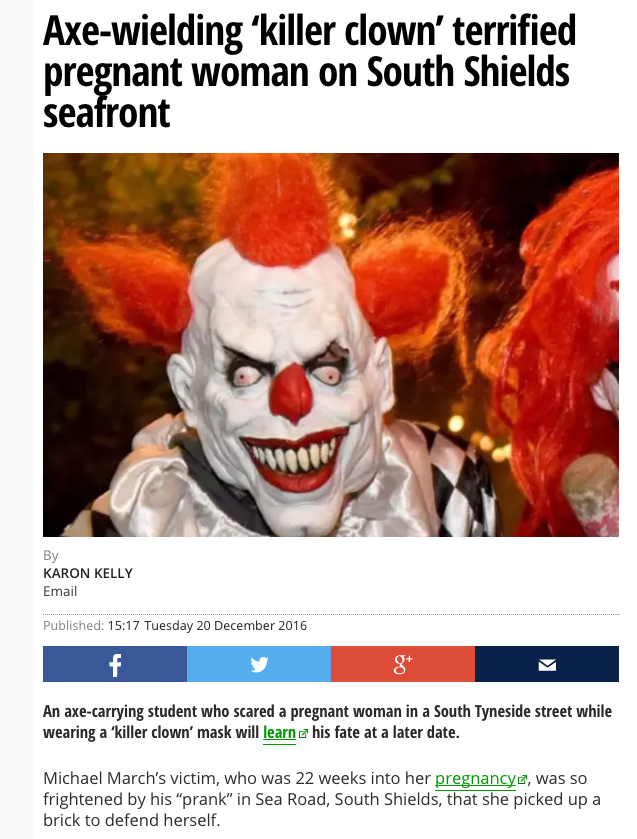
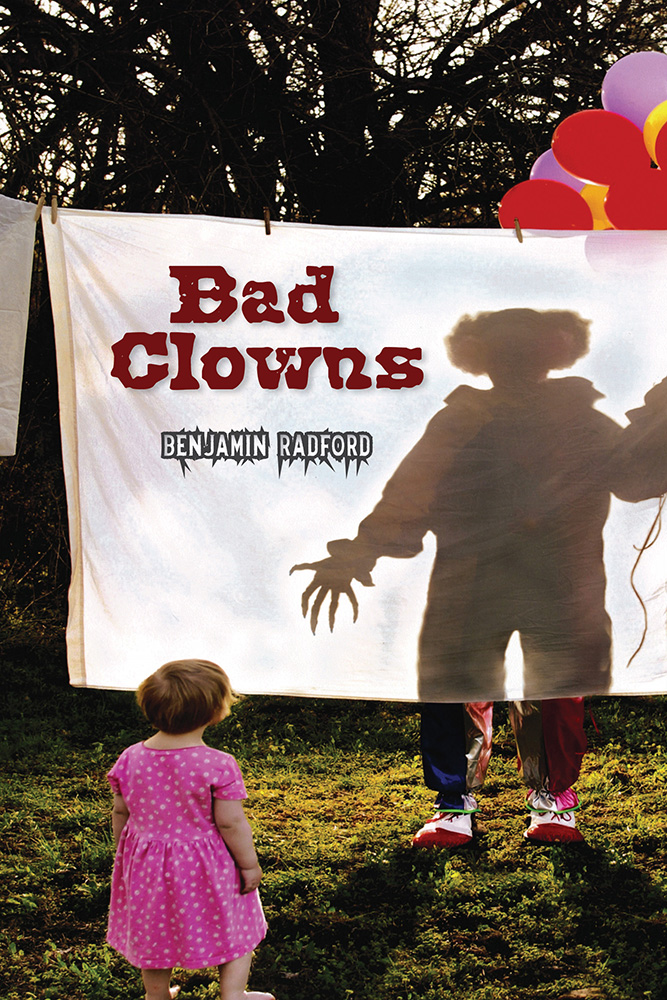
BR: Well, this is a topic that is in a weird way near and dear to my heart. Clown panics. Not panicky clowns, although there are several of those, but panics and particularly social panics that center around clowns. There’s no disco involved. This is not like clowns panicking at the disco. None of that. That’s a bridge too far, I’m afraid. So no, and again, it’s this sort of really interesting niche slice of Americana psychology, folklore, take your pick. So there’s lots of different clowns. There’s fictional, non-fictional ones. There’s the Joker. There’s John Wayne Gacy. There’s Pennywise, Stephen King’s It, things like that. But the clowns that we’re talking about are largely fictional, occasionally real and generally non-threatening when you get down to them. So I sort of break down the clown panics into four different eras. The first one is about the 1980s, 1990s and that was when there was the original Phantom Clown Panic. original phantom clown panic and we talked about this in a previous show and I talked about in my book Bad Clowns. And then fast forward to about 2013-2014 when there were a bunch of videos of scary clowns that emerged and were freaking people out. And then go ahead a couple more years to 2016 when there was the infamous scary clown panic that swept across America, in fact, even hit other places, including Europe. And then we’ll skip ahead a few more years to the present time, 2019, when there is, once again, a comparatively small, but very, very much real clown panic right now as we’re speaking.
0:12:42
CW: Wow, that’s many different types of clown panic-ery.
0:12:45
BR: Who knew, right?
0:12:46
BR: So, again, I’m gonna sort of quickly summarize the phantom clowns, because we touched about in a previous episode. So I’ll go over quickly to just sort of set the stage. So the phantom clowns, unlike real life clowns, were clowns that were allegedly seen and reported trying to stalk children on the East Coast of America in the early 1980s.
0:13:10
CW: Now, was it to jump ahead, I want to ask a question about this particular 1980s, early 1990s clown panic. Was it confined to the eastern US or did it spread?
0:13:22
BR: It was primarily in Massachusetts and Kansas City and those sorts of areas, Boston around there. So, as far as I recall, there were none, for example, in California or Anchorage or elsewhere. So it was primarily along the East Coast, at least the ones that initially made the news in the early 1980s.
0:13:44
CW: Okay.
0:13:45
BR: Pretty much the first phantom clown sighting that’s widely regarded happened on May 6th, 1981, when there were police in Brookline, Massachusetts who issued an APB for a van, because it’s always a van, right? With a broken headlight, no hubcaps, and it was full of clowns.
0:14:05
CW: Were these phantom clowns or were these real clowns? Did anybody ever find this van full of clowns?
BR: No one ever found this van full of clowns to this day.
0:14:13
CW: Disappeared into the mist.
0:14:15
PR: I feel like they could have found them at the gathering of the Juggalos.
0:14:18
BR: You would think, right?
0:14:19
CW: I mean, it was 81. Were Juggalos even a thing back then?
0:14:27
PR: No, but it took that long for them to get there.
0:14:30
BR: The proto-juggalos, they matured in large membranous sacks.
0:14:35
CW: Oh, thank you for that image.
0:14:38
BR: I thought you knew that. So yeah, so there were these clowns and they were reported again in Massachusetts, in Kansas City. And it was primarily school children that were claiming that they saw threatening clowns, clowns were driving by in vans, in some cases they were being chased by clowns and that sort of thing. As you can imagine, this freaked people out, particularly parents and police and teachers and there were APBs looking for clowns. There were patrols of officers who were out searching for these clowns weren’t that common. So it’s not like you’re on a on an LA freeway looking for a Ford or a Dodge. It’s a van of clowns. These would stand out. And there were a handful of rumors, for example, some of them were said that some people said that the clowns were handing out candy that may have been drugged.
0:15:31
CW: That was the thing in the 80s, the old drugged candy.
BR: Yeah. Well, yeah. And and we’re circling back to that. Well, we’ll come back to that shortly. In some cases, the clowns were said to they’re rumored to butcher the children and cannibalize their tender meat for sandwiches. Has either of you seen The Ice Cream Man, the horror film with Ron Howard’s brother, Clint Howard?
0:15:55
PR: Oh, yeah.
0:15:56
CW: I’ve got a vague image of Doug Jones as this real spidery ice cream man. Creepy guy. Was that from that movie?
0:16:04
BR: No, that was, now I’m forgetting, that was the one where they were isolated in a gas station or a cafe in the desert.
BR: Oh yeah, yeah, yeah, that’s right.
0:16:14
CW: Yeah, it’s the only creepy Ice Cream Man image I know of.
0:16:18
BR: Well anyway, check it out or don’t, but yes, there’s a great, Pascual, how would you summarize Ice Cream Man in a sentence or two?
0:16:28
PR: In a sentence or two? Well, it’s a Clint Howard-led movie. So, which for someone like me actually might be a good thing, but for, you know, the average person probably not so much.
0:16:41
CW: He is a god among caricature artists. I may have to check this out.
0:16:45
PR: Absolutely.
0:16:46
BR: Yes. Anyway, not to go too far afield, but these are the sorts of things that were going on. So the phantom clown stories, they appeared in newspapers, they were parental warnings, police warnings, all that sort of thing. And they followed a pretty familiar pattern where there would be children who reported seeing them, almost never adults, it was almost always kids. And usually they would have some sort of outlandish story about it. So it wasn’t just that they saw a clown, it was that a clown or several clowns, you know, approached them on a schoolyard or were coming towards them as they walked to school. One boy I remember said that he was confronted by a clown armed with an Uzi machine gun. Okay. So this clown that this young boy found, came across, had an Uzi machine gun in one hand and a machete in the other. Apparently, he’d been watching, you know, Friday the 13th. And the clown, according to this child, fired off some shots at the kid with the Uzi, but fortunately he missed him. And the boy, being a plucky young lad, threw his book bag at the clown, which frightened the clown.
0:17:54
PR: You know how I know this is fake is because he said he fired bullets at him. I mean it would have been a flag that said like, bang, bang, bang, bang, bang.
0:18:04
CW: Yeah i’m starting to wonder if these clowns are like related to unicorns and then that only only the innocent children can see them.
BR: Well in this case it was the not so innocent children or rather the imaginative children that saw them so yes spoiler alert there was never any evidence that these clowns existed they appeared only in rumors and legends primarily circulated by children and told to their parents. Again, the one of the big flags here was that no one was ever missing. So it was always that, you know, no children were actually abducted or actually harmed in any way. It was always-
0:18:42
CW: Nobody got made into a sandwich here?
BR: No, no. I’m shocking, right?
CW: Not even a couple of sandwiches?
BR: Not even a few sandwiches, right? It was always the just-missed, right, the boy with the book bag that fought off the oozy-wielding clown.
0:18:59
CW: Well, I think this whole panic, this series of panics can probably be renamed The Parents Believing Dumbass Things Their Kids Come Up With Panic.
0:19:10
BR: That’s certainly part of it.
PR: Yeah, when we eventually get to the satanic panic, we’ll have plenty of examples of that.
BR: We will circle back.
CW: Any teacher will tell you kids lie to their parents. They absolutely do. And there’s some parents who honestly believe my kid would never lie. Why would my kid make that up?
PR: I am worried about parents like that.
0:19:41
BR: So the phantom clown panic pretty much subsided by the early 1990s, although it did appear elsewhere. There were similar reports in Scotland, for example, and in Honduras in 1995.
0:19:54
CW: So even before the Internet, the clown panics in the early 90s managed to jump borders and get all the way to Honduras and Scotland?
0:20:03
BR: Yes, indeed. Yes, indeed.
PR: Did that coincide with the distribution of the original IT mini-series with Tim Curry?
0:20:15
BR: In 1990, that’s right. So, there’s all sorts of different factors there, but basically, in my book, as I explained, I sort of lumped the phantom clowns together with what I call phantom attackers. And we should actually do a show on that, because it’s a really interesting topic. But one example would be the Monkey Man panic in May 2001 that I and Bob Bartholomew and others researched, where there were reports around New Delhi of a small monkey-like human who may or may not have been wearing a space helmet jumping from rooftop to rooftop threatening people. Oh, and there’s another example, probably a better known example, would be Spring Heel Jack, who was the mysterious dark cloaked figure reported threatening and scaring people, mostly women, children in Victorian London.
0:21:06
CW: Is that where they got the moniker for Jack the Ripper or are they not connected at all?
0:21:11
BR: You know, I don’t know. I suspect that Jack is sort of an overall… that’s a good question. I suspect they are related, but I don’t know the answer to that.
CW: Okay, Jack of all trades. I mean, it’s a common thing in England to call somebody Jack, but…
BR: Yeah, sort of a generic, you know, that guy, you know, sort of a name. Anyway, so in my mind, that’s basically the phantom attackers.
0:21:41
CW: Now, unlike the people in India or England, though, we just got really outrageous with what we imagined as our attacker. We went for garish circus clowns instead of a spooky dark cloaked guy or a monkey.
BR: Yes.
CW:What does that say about us as Americans, I wonder?
0:22:02
BR: Well, actually, there’s a couple things that sort of contributed to that at the time. One of them was that there was a moral panic, as as Pascual mentioned earlier, there’s actually been continual moral panics and there are strains of them even today. And usually at the time that they’re prevalent, they’re not recognized as such. So it’s I mean, among some people, sociologists and folklorists, they will recognize moral panics at the time, but more often the people that are in the group of a moral panic won’t recognize it. To them, it’s a legitimate fear. So that’s one of the problems of that. But certainly at the time, the moral panic of the era was Satanist and you had the whole stranger danger and the satanic panic that Pascal mentioned earlier. You know, you had accounts of, you know, children claiming that they were taken to mysterious islands and assaulted and attacked by clowns and things like that. So, that’s part of the answer as to why the phantom clowns emerged when they did. Another part of it may be due to the series of high-profile child murders in Atlanta that happened between 1979 and 1981. It’s called the Atlanta Child Murders. So again, in the public’s mind, there could very likely be a connection there because there were there actually were in fact missing children, particularly in Atlanta, although of course it made the news nationally. In this in this atmosphere of uncertainty, it may be more plausible to parents and police that there are bands of clowns lurking around.
0:23:36
CW: It just makes them take what their kids are saying a bit more seriously in light of that.
0:23:40
BR: Exactly. So let’s move ahead to 2013, 2014, when you see the emergence of the viral video clowns. And these were sort of Internet based clowns that were meant to go viral. Probably the best known one was the the original one was the Northampton, England, who was seen at night shortly before Halloween 2013, just walking around his hometown of Northampton dressed as a clown. And this creeped people out because he was not going to any parties, he was not performing any tricks, he was walking around at night by himself, not talking to anyone. As you can imagine, that creeped some people out.
CW: And I’d imagine people were competing, trying to get videos of him or?
0:24:35
BR: Yes, in fact, he set up, or somebody, he used with air quotes, set up a Northampton Clown Facebook page. And so people were actually encouraged Northampton Clown Facebook page. And so people were actually encouraged to upload their photos and videos and their sightings of the Northampton Clown.
0:24:54
CW: So this sounds like somebody is trying to, like, start the panic. They’re they’re seeding the ground. They’re putting the training wheels on the story. They’re they want the panic to start happening.
BR: Yes, exactly. So that that happened. And every now and then the the people of Northampton would go to the police and the police would say, well, it’s not illegal to dress as a clown. What do you want us to do? And so the Northampton clown, uh, he had a sort of a moment in the spotlight. Again, he didn’t threaten anybody. In fact, he would sometimes pose for photos with people. So he, he never actually threatened anyone. He didn’t, he didn’t carry any weapons, but his mere presence creeped a lot of people out. He was eventually chased out of Northampton Clown by Boris the Clown Catcher who may or may not have been the Northhampton clown himself.
0:25:46
CW: I’m starting to get skeptical of this viral clown video story.
0:25:51
BR: Well, that’s good. So anyway, long story short, an intrepid reporter eventually tracked down the Northampton Clown and it was a student filmmaker who was having some fun with it. And he just basically wanted to make a scary clown video go viral. And by God, he did.
0:26:09
CW: Wow. Now, did any of these end up or or perhaps he may have even been inspired to start by creepypasta? I know creepypasta was pretty big in the 2010s.
0:26:21
BR: Yes, that’s a good question. I don’t know that Northampton Clown specifically was. And of course, Creepypasta was one of the origins of Slenderman and many other other creepy, creepypastas of that era.
0:26:36
CW: Because they kind of encouraged people to do little spooky videos and stuff and, and right, kind of crowd participation kind of things like you’re talking about exactly. Almost like they took the business model from Creepypasta.
0:26:49
BR: Exactly. Yeah. And so but one thing that’s interesting about the viral clowns of 2013, 2014 is that they were ready made for the Internet. During the original Phantom Clown panic in the 1980s, of course, there was no Internet and news and things still got around. You had Geraldo Rivera railing on and on in prime time about the Satan’s behind every tree. But it wasn’t really until the internet exploded and allowed people to share information and basically things to go viral that people, including the Northampton Clown, caught on to it and said, hey, I can do this. And that’s exactly what happened. So you see the Northampton Clown inspiring copycats. So there were other scary clowns around the same time. There was the Staten Island clown in 2014. That was later revealed to be a publicity stunt for a horror film. Around the same time, there were also scary clown photos circulating in California and in France. In fact, a colleague of mine, Aurora van der Winkle, has done some, she’s a Belgian folklorist, she’s done some really interesting stuff on the scary clown panic in France, if people are interested in that. So essentially, it was this mix of hoaxes and rumors and copycats. And people were just testing the limits of viral videos, right? And they realized that if they made a video about their cat or, you know, their brother falling on a skateboard, it may get a few video hits. But if they made a video of themselves or their friend as a scary clown, it’s blown up.
0:28:24
CW: Yeah, during that time period I was experimenting with stop-motion animation on back on Vine, if anybody remembers Vine, and apparently I was wasting my time. I should have been investing in a clown costume. It would have totally gone viral.
BR: What would your clown name have been?
CW: Oh gosh, I don’t know. Prickles? Prickles?
BR: What about you, Pascual?
PR: Boy, that’s a… they put me on the spot there.
BR: What’s your scary clown name?
PR: Strangles the Clown.
0:28:52
BR: Strangles the Clown! I think you win.
0:28:55
CW: It is creepy.
0:28:57
BR: So that’s in a nutshell, that’s the viral clowns. And then skip ahead a few years to 2016, which was when there was the proper, if you will, the proper official all hell breaks loose scary clown panic.
0:29:15
CW: Yeah, that one, if you guys do a web search, you will find a bunch of hits on the 2016 clown panic. The Verge did a thing, 10 questions asked and answered about the clown panic. Wikipedia has got a thing about the clown panic. All sorts of news outlets covered it as a thing. It was definitely a cultural movement of sorts.
0:29:39
BR: It was. And unfortunately, my book, Bad Clowns, had only come out about six months earlier. So my book came out in 2016, but it didn’t come out in time to incorporate the Scary Clown Panic, which just went wild. I mean, if I ever end up doing a second edition or an update, there’s two chapters worth of material right there.
0:29:59
CW: Well, having helped you behind the scenes with some stuff, I know how freaking hard you work on books. And so you’d probably just worked your tail off on this book. You finish it. It gets published. And then the universe says, no, Radford, you’re not done. You’re going to have to write a follow up. Here ya go!
0:30:16
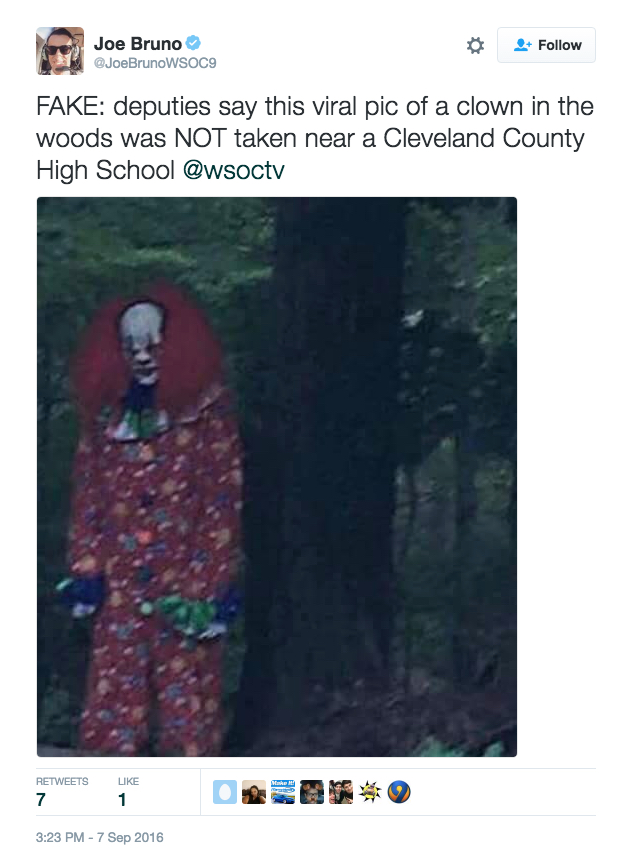
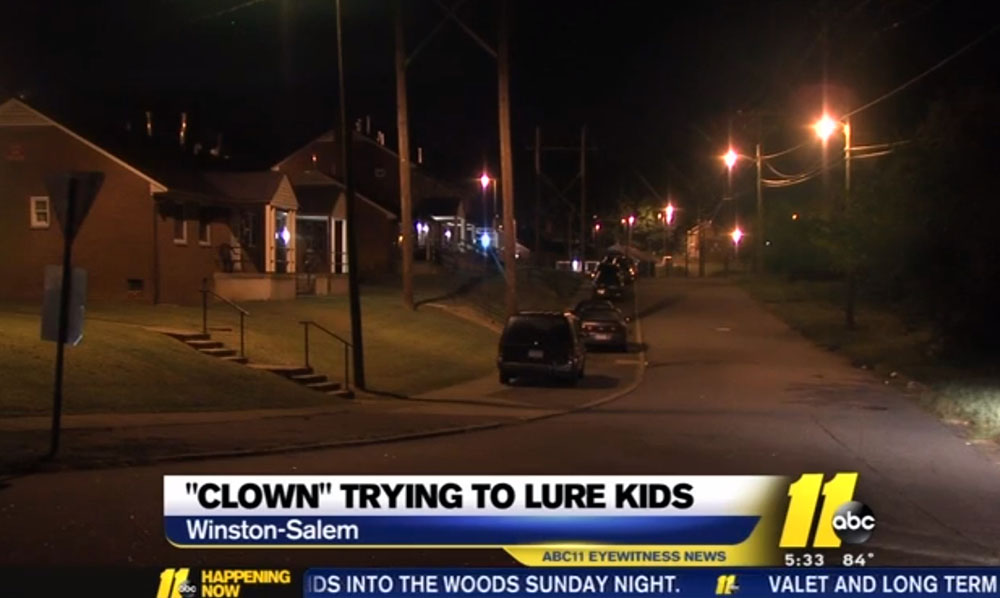
BR: Pretty much. Pretty much. So I was pretty happy with it. In fact, it was kind of funny. Some of my friends were sort of half-jokingly asking if, you know, where were you when that scary clown video happened last night? But in 2016, that clown panic began in August, when there were clowns reported in Greenville, South Carolina. Once again, they were allegedly luring children into the woods behind a block of apartments. As before, there were a handful of reports, mostly from children, in fact, almost all from children. And once again, there were no children who were actually abducted or harmed in any way. But in this particular area of Greenville, there were those trees and a wooded forest behind where these apartments were. And the rumor was that deep inside the woods, if you cross over into the woods and you follow a trail, very Hansel and Gretel like, you will come to a house and in that house lives a clown or many clowns. Now this sounds bogus on its face. Let me just say that the idea that that’s where the clowns live, that’s something that an eight-year-old would make up, but that was the story.
CW: And it strikes me that you can test this. You can go look for the house.
BR: This is this is eminently falsifiable. Yes, either either there is or there is not a house in the woods And if there is a house in the woods either there are or there are not clowns inside This is this need not be the subject of rumor. It can be tested. Uh one nbc one abc news story said quote quote, one resident said she was in front of her apartment one evening when one of her sons approached her and stated that he had seen clowns in the woods whispering and making strange noises. The resident added that she went over to the area and that her son that her son mentioned and observed several clowns in the woods flashing green laser lights before seeing them run off. Okay. Another guy, another kid said that, and this is just a fascinating urban twist to it, another kid said that he saw a clown nearby flashing wads of cash trying to get kids to come. This is, you know, you usually think of, you know, somebody handing out candy or Pokemon cards, but in this sort of inner city Greenville area, it was wads of Benjamins that were supposed to be drawing the…
0:32:50
CW: The green laser lights caught my ear, because I know that was one of those things that kids get in trouble for. They get a laser pointer, they start, you know, lasering people’s eyes. It was one of those real nuisance things for a while, and I bet a kid got in trouble for doing that. And he was like, it wasn’t me, it was the one-armed clown.
0:33:06
BR: Don’t blame me, Mom. I wouldn’t do that. It’s the clowns, obviously. So, again, it began in Greenville, South Carolina in August 2016, but as we’ve seen happen before, there were copycats. So, there was a case in Quebec where there were a pair of teenagers, a boy and a girl if I’m not mistaken, were having fun in a park basically scaring younger kids. So, they dressed as clowns and scared the hell out of local kids in Quebec and there was another case in Wisconsin where there was a clown that was wandering around and later on turned out to be part of a viral marketing campaign for a scary movie because that’s what you do. So again, you see the same pattern over and over again. You see these reports of these threatening but probably almost certainly non-existent clowns fortified in some cases by eyewitness accounts. It’s not just, you know, Jimmy said that Jane saw something. It’s, you know, my child says that he saw a clown running away or trying to snatch somebody.
0:34:09
CW: Now, one thing I noticed that seems different from what you described in the earlier clown panic, and this one is, I mean, I remember seeing all the people on the news saying, I’m going to kick that clown’s ass. I’ve got a baseball bat. We’re arming ourselves. No clowns better be caught here. There was a lot of bravado, but also a lot of danger. In other panics, were people actively fighting back, even though it was fighting phantoms?
0:34:40
BR: In some cases, yeah. For example, in Greenville, there were reports of people firing guns, shooting into the woods behind the apartment.
0:34:51
CW: That’s safe.
0:34:52
BR: Fortunately, no one was hurt. But I mean, it’s not funny. I mean, someone could have been injured or killed, either just some kid out there or maybe even some local kid playing a prank or who knows. It’s a fair point. I mean, these sorts of rumors and panics, as we’ve said many times on the show, can have real consequences. Anytime you have the public scared about something, particularly for the safety of their children, there will be people who will threaten people and threaten bodily harm.
0:35:25
CW: How did social media come into play with this latest, 2016 anyway, clown panic?
0:35:33
BR: Social media played a role in a couple of ways. One was that it allowed it to basically go international. So as I mentioned, the initial one was in August in South Carolina, but by Halloween, there were reports in England, in Scandinavia. There were reports elsewhere in Europe, and people were just seeing this. And so because it’s so easy to fake a clown sighting, right? All you need is a clown mask, or you don’t even need a clown mask, you just need face paint, right? It’s the tools to create a scary clown, or a clown in a potentially threatening or scary situation, are virtually nothing. It’s so easy to do, and it’s a high reward, low risk thing, because-
0:36:23
CW: You don’t even really need the face paint or the clown costume, you just need to say you saw a clown.
0:36:27
BR: Yeah, or just, you know, yeah, just say you saw a clown and you’re going to make the news. And in some cases, you know, you may even shut down your school. There were clown lockdowns. In fact, in Alabama, I remember there was a case of where there were threats either by students who claim to be clowns or students who put on a clown mask, saying they’re going to shoot up a school. And in these situations, of course, parents and schools and police will take a better safe than sorry approach, right?
0:37:05
CW: Well, I mean, they’re making a legit threat, which even if they hadn’t been wearing a clown mask, would have been actionable if you threatened to shoot up a school, the police are going to come talk to you. But they decided to co-opt the clown mask just to be hip and cool.
0:37:18
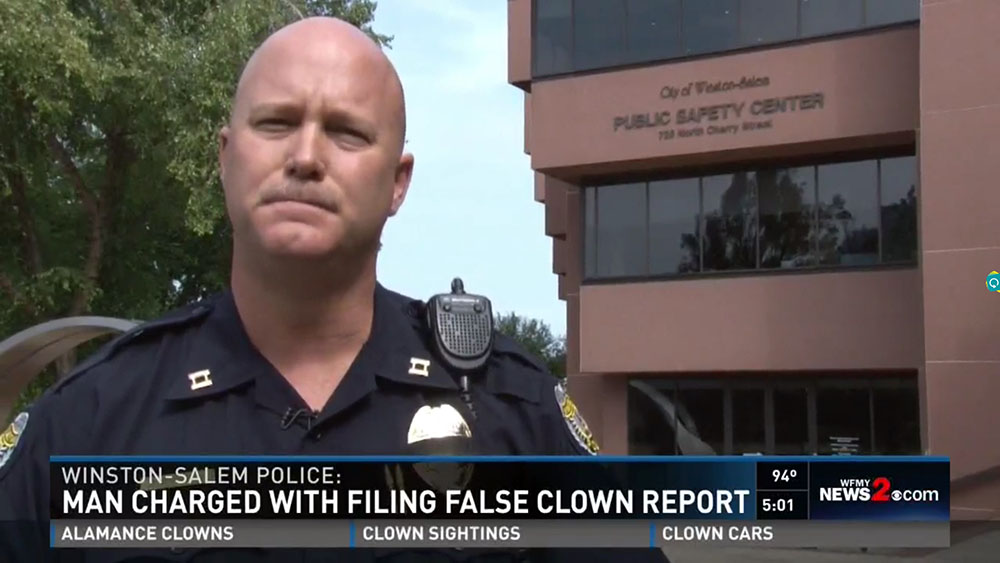
BR: Yeah, exactly. And so, again, you had this you had this this interesting mix. So, you know, some of them were outright hoaxes. There are people that claim that they saw or were threatened by a clown and they flat out weren’t. There was a guy in North Carolina claimed that a scary clown had knocked on the window at night and he was arrested for faking it. There was an Ohio woman that claimed that she was late for her work at McDonald’s, actually, because a knife-wielding clown had jumped out on her, jumped out to attack her on her way to work.
CW: This is a grown woman.
BR: And she, a grown woman, right. So this is, and yeah, again, she, she, she’s looking for a way to get out of being late to work. Right. And so some of them were outright hoaxes. Some of them were pranks. I mean, there really were cases where somebody would dress as a clown or put on a clown mask and just for the fun, just because they knew it would scare people, would drive by slowly in a Walmart parking lot at night or walk around, basically do what the Northampton clown did.
0:38:22
CW: Well, Ben, I’m pretty sure you remember this, but, Pascual, do you remember the website that popped up around this time that said clown sightings globally And it just had little like red spots pop up where clowns had been sighted.
PR: Yes. I do remember that. It was pretty recent.
CW: Yeah, yeah, were you checking to make sure your neighborhood was safe?
PR: Well, my neighborhood is never safe from clowns, but this kind of clown yeah so far.
0:38:49
CW: Okay.
0:38:50
BR: Just to sort of, anyways, so all this sort of eventually died out because that’s, there’s a particular pattern with these things where it’s a very standard predictable pattern where there will be one initial incident that will sort of spark the whole thing and then it’ll get lots of social media attention, a lot of news media attention, and it will spawn copycats, right? So people in neighborhoods nearby, in some cases, somebody who hears about it two states away or maybe across the continent or maybe maybe on another continent, they’re like, hey, that’s weird. This is a scary story. I could do that. And then eventually, as the consequences for this become greater and greater, that is that schools are actually being locked down because of this. And parents and police are saying, look, this isn’t funny. And it sort of it sort of plays itself out. It’s no longer as much fun anymore. And so it sort of fades away. And so it’s sort of the self-limiting phenomena. So that’s basically what happened in 2016. But around that same time was also Wrinkles the Clown.
CW: Oh, yeah. I was just recently able to see that documentary. Pascual, have you seen it yet?
PR: It is on my watch list right now, though, so hopefully I can see it this week. But unfortunately, unfortunately, not in time for this episode.
0:40:02
CW: Yeah, the filmmakers did a really good job. And and of course, our friend Ben here was in it. I got to pimp you out here and brag that you were in the movie. But besides Ben, there was also a really good attention to detail when it comes to they did kind of their own little synopsis of the clown panic. It was like a clown panic montage. You got to see people on the news threatening clowns and, you know, school kids running in a panic from clown scares.
BR: It was a neat little summary of what went on. It was, and, you know, as somebody who, again, wrote about it and was sort of involved in all that, I just found the whole thing fascinating. I actually learned quite a bit from it, but in a nutshell, Wrinkles the Clown was, and still is, I mean, as far as I know, he’s still around, a clown in a scary old man mask in Florida who was, again, tying in with all these, was the subject of viral videos. And I won’t give any spoilers to the film because there’s some interesting twists to it, but he was seen in a couple of videos scaring kids and families. And there’s another interesting twist where he himself was actually threatened by some of his victims. In some cases, he was encouraged to scare kids by the parents.
0:41:28
CW: That was a neat, I mean, the premise pretty much starts out showing you that Wrinkles was called upon almost like a demon in one’s service to scare the kids like a boogeyman for rent. I was really, you know, picking up shades of La Llorona and stuff like, you know, you better be careful or I’m going to call wrinkles on you. And then and then the kids turn and then the kids are making videos. I’m going to beat you up, wrinkles. And and then there’s a few twists and turns and some surprises. And Ben, I think it hit all of your special happy places, because I know you like a lot of weird things and wrinkles the clown had more weird things piled one on top of the other than you expect it to so bear that in mind as you go in and watch wrinkles the clown available for like three dollars on Amazon Prime to rent right now
BR: It has a high WTPM weird things per minute ratio I think. So anyway that was 2016 so let’s fast forward to current times, right? So we began by talking about the original phantom clown panic in the 80s, then we moved on to 2014 when you had the Northampton video clowns and the viral clowns and all that. Then you had 2016, which is sort of like the highest profile scary clown panic. And now, as we record this in mid-October 2019, there is yet another much smaller, but significant clown panic and those involve media clowns primarily
CW: Tucker Carlson?
0:42:56
BR: Not that’s no I said media clown not ass clown. No, this is a different thing so these would be for example Just in the recent month or so. We had two very high-profile horror films starring scary clowns it part two with Pennywise, and Joker starring Joaquin Phoenix as the DC Comics villain Joker.
0:43:21
CW: I have still not gotten to see that. Pascual, have you seen it?
0:43:24
PR: I have not. I’ve been, I’m sure I will get to it, but my ability to watch movies right now is very limited, but yeah.
0:43:33
CW: Kids man, oh man, same here. Ben, you don’t have any kids. Have you seen Joker yet?
BR: I have seen Joker. I felt obligated to see Joker.
CW: We’re living vicariously through you, Ben. What did you think?
BR: It was interesting. I thought Phoenix’s performance was very good. I thought he has sort of this weird, sort of rubbery face. I thought it was an interesting take on sort of the classic DC Comics villain. Of course, he’s not the only person to portray the Joker. There’s Cesar Romero and Heath Ledger and Jack Nicholson. And there’s no one right portrayal. They’re just different takes on the same character.
0:44:17
CW: Was this one, as I kind of got the notion in the trailers, was this one pretty much just falling down with clown makeup?
BR: Well, as a fan of Falling Down, I don’t think I would really make that comparison. No, it it had some similar themes to it. You know, it talked about exploitation and talked about mental illness. It talked about or there’s different sort of themes that emerge from it. You know, I in the lead up to the film coming out there was some concern about the threat it held to the public.
0:44:56
CW: Yeah, listeners will remember we covered that before one of our episodes just a week or two ago.
0:45:02
BR: Yes, that’s right. So you had ABC News reporting that according to the Fort Sills Army Base in Oklahoma, based on intelligence gathered by the FBI that there was a specific threat about a theater shooting. And of course, to many people, part of the concern was that it echoed the Aurora shootings in 2012 when a guy named James Holmes shot up a theater there at a screening of The Dark Knight Rises. And it was widely but mistakenly thought to have been inspired by the Joker. So that’s why that connection was made. In addition, there was also a group of citizens who petitioned Warner Brothers, the distributor, to not to ban the film, but to ask them to throw their influence behind gun control.
0:45:53
CW: Yeah, how did all that turn out? Did we have, because I know we discussed it, you know, a couple episodes ago, and were there any actual incidents of violence around any theaters that were playing the Joker? And did the studio actually throw their clout into any sort of gun reform?
0:46:09
BR: My understanding is that the studio, uh, they issued a, a bland, but probably predictable, uh, response just saying that they don’t support, uh, you know, any type of violence and that the Joker film does not and is not intended to glamorize violence or anything else like that. And of course, they’re anti-violence, which not only is probably true, but also is exactly what you expect them to say.
0:46:39
CW: Sternly worded letter.
0:46:41
BR: Right. Sternly worded letters always, those always work. But what’s interesting was that, again, it’s not really the fear of clowns, it’s the fear of the media, specifically entertainment media. And so it’s part of a much longer tradition of people being concerned about the effects of media on culture, and what are vulnerable people going to do if they see this film, particularly in the context of copycats. And of course, we did an episode on copycats, episode 24, the copycat effect, for those who want to check it out. It’s important to sort of see the bigger context here because, as is often the case, the fears weren’t born out in the case of Joker. It’s now been almost two weeks since the film opened, as of the time of recording this, and as of yet, as far as I’ve been able to tell, there haven’t been any mass attacks, there haven’t been any shootings, no particular violence. I think the closest I saw, I think I saw one news article about somebody who attended a Joker screening who was like laughing at inappropriate times or something but not threatening anybody.
0:47:53
CW: I remember that he got thrown out, he was drunk and every time some horrific act of violence would happen, instead of going, he’d start just laughing but Maniacally, which would run nerve people next to you. Yeah.
0:48:06
BR: Yeah, so, you know, but but you know, the FBI didn’t issue the threats on, you know, possibly drunk guys laughing At bad parts of the film that that’s not that’s not the concern. That’s not the panic So, you know as is usually the case, you know It’s another example of fears the media entertainment that are sort of hyped up and oh my God, what’s going to happen when people see this? And in most cases, the answer is nothing. People play violent video games and they don’t go out and shoot up stores. People watch porn and they don’t go out and commit sexual assaults. People listen to heavy metal and rock and they don’t go into Satanism and drug use so…
PR: Speak for yourself.
0:48:52
BR: Well, other than Pascual, but…
0:48:54
CW: Well, see, the parallel that that’s occurring to me and I might be, I might not be the first person to make this parallel, I’d be surprised if I were, but if you’re going to blame, like if you’re going to worry about what comes out of the media what sort of movies or whatever, oh, this is going to set some criminal off, this is going to this is going to cause people to do this. It almost sounds parallel to, oh, don’t you wear that short skirt? You’re going to make somebody rape you. Oh, well, what was she wearing? She obviously set him off. No, no, the criminal has to be held responsible for the criminal’s own actions. I can’t say, oh, I did that because I was inspired by the Joker or Moby Dick or, you know, name your book or movie or film or painting or any type of art, you can’t blame it on that. And if you’re worried about, Oh, this is going to cause a lot of people to get set off. I mean, yeah, that does kind of sound like the, the fashion police. Oh, you can’t have off the shoulder, you know, tops or you can’t have skirts that are above the knee. Cause it’ll, it’ll set all sorts of guys off. Well, you know, can’t we just teach the people, what is, and isn’t a crime and then you hold them responsible when they commit a crime.
0:50:07
BR: Sure. And, you know, again, this is this is part of a much longer concern. I mean, you know, in 1880s England, there was there was fear that Jack the Ripper was inspired by his crimes by seeing the stage play of Dr. Jekyll and Mr. Hyde. The book Catcher in the Rye has been associated with several killings, most prominently John Lennon and John Lennon’s killer. So, you know, there’s all sorts of books and films and music and all sorts of things out there and, you know, by sheer numbers, eventually some disturbed person is likely to experience them and they may or may not act on that. But that doesn’t that doesn’t mean that the the the piece of art of the film or the book inspired it.
0:50:48
CW: You know, I wish there was a way, there isn’t a way, but I wish there was some sort of way to calculate how many lives have been saved by artwork, books, movies, songs, because I know a lot of people who, but for the saving grace of being able to indulge in an art form or take enjoyment from it, would probably kill somebody.
BR: That’s a good point. Maybe, I wonder how many people were deterred from killing somebody by seeing Clint Howard in the Ice Cream Man.
0:51:21
CW: There’s a case to be made for heavy metal music. Gets a lot of your aggressions out. I’ve heard heavy metal fans especially say, this music saved my soul, man.
0:51:37
PR: Yeah, I think that, you know, I mean, I’m into it for mostly artistic reasons, but I think that a lot of fans really have been, you know, they’ve suggested to me that it’s gotten, you know, it’s connected with them in a way that sort of gave them an outlet, which I think is probably, you know, something I can get behind that.
0:52:00
CW: Yes, although I wouldn’t think any lives have ever been saved by the art of clowning. That’s just flat-out evil There’s no redeeming qualities to clowning whatsoever Now this this is the latest clown panic you’re saying with the two movies it part two and The Joker have there been any any strange goings on at showings of IT part two?
0:52:25
BR: Not that I know of. That’s actually a good question. I did remember, I do remember before it came out, there was a few murmurs about about IT and the movie and the scary clowns. Most of the concerns I saw were about Joker. But you know, keep in mind, this is this isn’t going to go away. Anytime there’s a new film, there’s a new film about the Joker. And you know, this won’t be the last one. The next time there’s a new Joker film or another film that features him, that character, there will be somebody out there who will wax on about pop culture and pundits and about how how dangerous it is and how it’s going to spur misogynists or miscreants or killers to do something. That’s that’s a perpetual concern and that’s that’s what they do.
CW: Clowns are just sort of tainted. They can’t ever reclaim their innocence here.
0:53:17
BR: Well, and it doesn’t help that every Halloween, you have a handful of clown associated scares, including this particular one. With this current Halloween, there’s already been concerns, for example, about contaminated candy. people are concerned that there’s going to be THC gummy bears and candy that are being sold.
0:53:43
CW: There are. You can buy them down the street from me. There’s tons of THC, but they’re expensive! Nobody’s going to give your kid those.
0:53:49
PR: That was the first thing that came to mind.
0:53:52
CW: I feel like $10 a gummy bear. Yeah, that’s not…
0:53:56
PR: I mean, it’s one thing to be the house that gives out the full-size candy bars, but THC gummy bears, those are for me and my friends.
0:54:05
CW: If there is one in my neighborhood, I would like to know which house it is so I can go a number of times and just collect them for my next party.
0:54:11
PR: Buy like five masks.
0:54:12
BR: No, that’s not me, that was the other kid, give me some.
CW: Now there’s, speaking of clowns never being able to shed their bad reputation here, I’ve just pulled up one of my favorite headlines ever from the New York Times from this year. It’s from May 10th of 2019. And the headline is Clown Giving Kids Candy from Car Meant Well, Police Tell a Relieved Town. Apparently in Clarksville, Tennessee, back in the springtime of this year, a man with his face painted and a red nose was giving giving children candy from a car and right here it says it quote brought to mind the great clown panic of 2016 when tales of clowns lurking near the woods and under streetlights ignited a national hysteria and If this article is longer, I’m sure they would have quoted you somewhere Ben probably so probably so
0:55:10
BR: But anyway, I I don’t have anything else to say about the clown panic as of now. My guess is that there will be another clown panic. It won’t be right away, but it’ll probably be in two or three years. And sure enough, we’re going to have another another clown panic. People will be freaking out and hopefully some reporter will either interview me and or buy my book.
0:55:33
CW: It’s the gift that keeps on giving.
(MUSIC)
CW: Well thanks Ben once again for bringing your knowledge about weird stuff. It seems like your well never runs dry.
0:56:04
BR: It does not. Sometimes I surprise even myself about the breadth of weird things that I’ve either researched or investigated and then I remember that I’ve been doing this for almost 20 years and it makes more sense then.
0:56:18
CW: I don’t think you just have any room in your head for normal stuff. Like if I asked you to name me the months of the year, you would be like, what?
0:56:29
BR: I get a little fuzzy on that, to be honest.
0:56:32
CW: All right. Now, now, Pascual, you are going to be pretty much heading the next episode we do about a topic that’s kind of near and dear to your whole life’s work.
0:56:45
PR: Yeah, this is this is going to be a good one. It’s maybe kind of a spiritual follow-up to Episode 9, which was Until the Light Takes Us, which was about the satanic church burnings in Norway. But this is going to be another foray into the satanic panic. And specifically, we’re going to be talking more about the pop culture angle, because there are a lot of things to unpack with the Satanic Panic and I thought that for the spooky season it would be fun to do something that isn’t the heaviest part of it or at least topically heaviest but the sound might be heavy because we’re going to be talking about the way the Satanic Panic came into play with heavy metal music and rock in the 70s through the 80s and 90s and I’ll be talking about some of the wild cases that actually went to court and you had heavy metal bands going to court. I think we’ll be bringing in some of the pop culture angles about some of the things that the Satanic Panic were born from in terms of games and toys and things like that. It’s going to be a fun episode, I think.
BR: Yeah, I mean, so, you know, we’re not going to be covering the whole topic of satanic panic because honestly, it’s probably one of the most diverse topics in skepticism. I mean, it includes subliminal messages, it includes recovered memories, it includes moral panics and false accusations. I mean, so the satanic panic per se is just a huge topic and we’ll be covering different aspects of it in other episodes, but for this particular one we’ll be focusing on the pop culture aspect.
0:58:30
CW: Yeah, yeah. It really is kind of a circular feeding loop into the culture of really when we grew up. Anybody our age, anybody who’s like in your 40s right now, you’re gonna hear a lot of stuff that hits home in terms of nostalgia and what you remember and what you might not have even thought was influenced or endangered by the satanic panic. I mean, because we got Dungeons and Dragons, we got like, you know, even illustrators like Frank Frazetta and Boris Vallejo, you know, real cool stuff going on that people really looked askance at, like, oh, there’s murderous satanists are behind all of this. And we’ll kind of tease apart that and and look at the the pop culture stuff.
BR: I can’t wait.
CW: Until then, happy happy Halloween preparations everyone.
Bye-bye. See ya. We would like to extend heartfelt thanks to our sponsor level patrons Amy Frusciaro Kelly, Dr. Angela Matkey, and Elizabeth Leggett. If you’re interested in becoming a sponsor or just throwing us a buck or two per episode, check out patreon.com forward
0:59:41
slash squaring the strange. Every little bit helps us keep the lights on here and we could not keep bringing you content without the support of our generous friends. If you’re short on cash but want to provide moral support, remember to recommend us to a friend. If you’re short on friends, hey, remember that each five star review helps us get higher on the podcast charts. Squaring the Strange is a production of Two Heads Studio, LLC, copyright 2018. Theme music by Shriekback, additional music by Memory, Keytard and Feathered, and
1:00:13
Pastel Romero. Additional support provided by Ashley Romero, Robert Sundin, and of course our listeners and patrons. The views and opinions of Two Head Studio, Kronos Creative, Center for Inquiry, our advertisers, or any affiliated organizations and employers. Okay, we could probably end there, unless somebody has something really pithy to say at the end.
1:00:46
I’m out of pith.
1:00:47
I’m good. I’m good.
1:00:48
You’ve taken the pith out of me.
Transcribed with Cockatoo