Episode Summary:
First we say a mixed farewell to Art Bell, radio host and conspiracy monger. Then we discuss the Near-Death Experience phenomenon, or NDEs. We go from Hollywood fan theories to real medical history and fear of premature burial. We touch on how children’s NDEs are shaped and exploited by adults. Then our special guest, Margaret Downey, discusses her non-religious journey of understanding her NDE. To wrap up, Celestia examines a UK nurse’s “experiment” to find evidence that patients really do sometimes float above their own bodies.
0:00:00
Ben Radford: Welcome to Squaring the Strange, the podcast that examines all manner of the mysterious and the mundane through a critical lens. So let’s square the strange.
(MUSIC)
Pascual Romero: This is episode 55. We’ve made it to a nice, nice number there. I don’t know that that number has any real meaning, but it’s one of those, any number that’s divisible by 11, I like at least before 100 because it’s always like 5-5, 6-6, 7-7. You know, numerology, man, it just runs my life.
0:00:56
BR: It’s there, folks.
0:00:58
Celestia Ward: It’s a speed limit. I can’t drive 55.
0:01:02
PR: Yeah, actually, it’s a horrible speed limit now that I think of it. Like all of the state of Wisconsin, every two-lane road is 55, and most of the northern half of the state is two-lane roads, and it drives me nuts.
0:01:16
CW: You should come to Nevada, 75 in most of our highways.
0:01:19
PR: It’s like we go visit Ashley’s family in Texas and they have really high speed limits for some reason.
BR: 105, go for it.
PR: Yeah, whatever, cool, just drive real fast, I don’t care. But anyway, Ben and Celestia are with me as you have all just heard.
0:01:33
CW: Hello.
0:01:34
BR: Just blew the secret.
0:01:35
PR: Yeah, but this week we’re going to be talking about near-death experiences, which is a pretty wild topic because there are just so many levels to it that we couldn’t even possibly get to everything in one episode, but we’re going to be doing a couple things. We’re going to touch in on a few topics and a few elements of near-death experiences, as well as we’re going to have a special guest on. We will be introducing him in the latter half of this episode.
0:02:03
BR: I can’t wait to find out who it is.
0:02:05
CW: A special guest who may have glimpsed the great beyond, or maybe not.
0:02:09
PR: Or, yeah, who knows?
0:02:10
CW: Or maybe not, yeah.
0:02:11
PR: But it’s a surprise. But anyway, let’s see what we’re skeptical of this week.
(MUSIC)
BR: So I’m skeptical, well, I’m not skeptical he’s dead, but I might be. Let me just phrase it this way. Of note, Art Bell is no longer with us. The notorious or infamous, depending on how you want to phrase it, host of Coast to Coast, or Coast to Coast AM, I think you changed its name a couple times.
0:02:46
CW: Yes, he’s my neighbor out here in Pahrump, over the hump to Parump. He lived out there with his wife and was kind of a local celebrity-ish. I mean, he was known as being a Nevada radio guy.
0:02:59
BR: Yes, and he spent many long nights opening up the forum to people calling in. I think that was his… I’ll be honest, I only heard… I probably heard his show maybe a dozen times. I was very familiar with it because people would quote it to me. Sure. Well, Art Bell said, and I’m like, okay. But I remember one time I was listening to it and it was this weird rambling thing and I kept thinking, is he not going to cut him off? This guy is clearly unhinged. And you’re like, oh, tell me more. I’m like, really?
0:03:32
PR: Yeah, Art Bell was the master at just egging people on to continue digging their weird holes. I actually spent a lot of years just up late at night in LA and you could get it on AM radio there and I’d turn it on and just listen. I was always thoroughly entertained by it because it was just so silly and ridiculous. Art Bell is one of those guys who kind of does that thing where he’s like, I’m not saying it is this, but I’m not saying it’s not that either you know and it was so it always kind of got me but you know I when news of him passing away came up you know I had that moment where I was like oh I was really entertained by his show but then you mentioned you know some of the more nefarious things that he was involved in and I really had no idea because this all happened before I ever heard him and and that was a little bit of a shock to me actually.
BR: Yeah I mean one of the things that often got glossed over in Art Bell’s biography, both when he was living and soon after his death, was his role in the Heaven’s Gate suicides. He absolutely played a role in that. I mean, it’s undeniable. I mean, you can argue how much of a role, but I won’t go into the whole Heaven’s Gate story for those who remember, that’s why we have Wikipedia. But, you know, there was this cult, in fact they have a connection here in New Mexico. There’s a Marshall Applewhite and there’s a Bo and Peep and there’s a whole weird rabbit hole there. We should do a show on that at one point. But at one point, the Heaven’s Gate cult latched onto a conspiracy theory that was promoted on Art Bell’s show. And the story went that there was a spaceship following Comet Hale-Bopp that may or may not have included Jesus. And the idea was that if Jesus was coming, then you know, coming right behind to help out. And I mean, there was no truth to the story whatsoever. To be fair, I don’t think that there’s no way that Bell could have known that this was going to happen. But he clearly played a role in promoting that particular theory, which was latched on to by Heaven’s Gate. And that was part of what spurred them, as far as we know, to kill themselves.
0:05:40
CW: Yeah, that’s real tricky laying any sort of responsibility on a radio show for something like that. I mean, we just talked recently about Alex Jones and he’s spurring a bunch of people to do horrible things to parents of survivors of school shootings. But Art Bell, man, he’s on at 2 a.m. and I know a lot of people who listen to him purely for entertainment. It’s tricky because, yeah, how would you know people are going to latch onto it and form a cult and commit mass suicide because of a spaceship behind a comet? That’s kind of hard to foresee there.
0:06:18
BR: Right. Well, I mean, you could say the same thing about, you know, I can hear Alex Jones saying, well, hey, how was I to know that, you know, somebody might go into a pizza place in Washington, D.C. and, you know, with a gun looking to rescue kids?
0:06:31
CW: I mean, yeah, well, it’s a spaceship behind a comet as opposed to a real functioning pizza business or real live people who’ve lost their children.
0:06:39
BR: Well, no there’s an actual distinction here, as there were photos posted on his website and elsewhere that were purporting to actually depict the spaceship. I heard about that. My point here is that to a lot of people, there’s not that big a leap between a conspiracy about a child sex ring tied to the Clintons in DC and photographs that may or may not, you know, what’s NASA hiding? I mean, they’re not as far apart as may first appear.
PR: I suppose just the idea of actionable information might be the big difference in that when you describe a specific place with specific people involved and a specific thing going on involving children versus like something in the tail of a comet. I mean foreseeing anyone going to the point of mass suicide because of a thing, a speck in a tail of a comet on a picture is, you know, it’s kind of like definitely the foresight thing is a little tougher on that one, but you know, but yeah, your point still stands I totally agree that you know, it’s it’s people believe it either way.
BR: I don’t hold him personally responsible, but I think that that’s one of my main criticisms of Bell was that he either didn’t know or didn’t care care about some of the very real damage that these wild conspiracies could cause.
0:08:05
PR: Yeah, yeah.
0:08:06
CW: It definitely didn’t slow him down. I mean, he was like a sociologist of the weird. He did have, I will give him props, he had a way of just making people comfortable enough to just spill every ounce of conspiracy theory they had on his show, and it was a wild, weird trip.
(MUSIC)
0:08:42
PR: So near-death experience is kind of a weird thing because it seems kind of cut and dry when you think of the definition of someone coming close to the edge of death and then experiencing being detached from their body or their spirit floating away or going to another realm. But in reality it just seems like it’s a billion different things and every single person experiences and interprets it differently.
CW: Well with some similarities because one thing that that is fascinating about near-death experiences is there is kind of a consensus of certain aspects that are reported among many different individuals, which if you talk to neurologists do coincide with what happens to your brain and what sort of hallucinations result when you are being deprived of oxygen.
BR: I believe you’re referring to anoxia.
CW: Anoxia, exactly. And it’s enough in the public consciousness that it’s sort of seeped into movies. I mean there are certainly movies that are straightforward, hit you in the face. This movie is about an altered state of consciousness. Like I’m thinking like Life of Pi or the Fight Club which are notoriously, oh this person due to a tremendous mental or physical strains is viewing their world very differently and so we’re seeing that in the movie. But then we have other movies that fans have gone and retroactively put a spin on to saying that oh well this movie could be seen as a near death experience or that last hallucination before death. I don’t know if you guys have heard about the theory about Grease.
BR: I have not.
0:10:24
CW: At the very beginning like John Travolta like saves her from drowning or something at summer camp or something. There are certain movie buffs that say that she did actually drown at the start of the movie, and the whole rest of the movie is her hallucinating as her brain gets cut off from oxygen, and it ends with her flying off in the convertible car with John Travolta. We’re seeing her dying hallucination.
PR: That’s a very morbid interpretation when you consider the music involved.
CW: Well, and a much more, I don’t want to say down to earth movie, Gravity with Sandra Bullock. There’s a cadre of people, I think Josh Dickey of The Wrap wrote about this, saying that you could really interpret the last half of the movie as her dying hallucinations as her brain loses oxygen and he goes through the different stages. First she hallucinates George Clooney. Quite frankly, personally, if I have to hallucinate somebody at the end of my life I’d rather it be George Clooney than John Travolta, but that’s just me. And she goes through various stages of, you know, the ship is rocking, the ship is burning, the ship is hitting the water, she’s gasping for air as she swims up to the surface. And those are all the stages that your body and your brain go through when it’s losing oxygen according to some of these reports. So anyway, the filmmaker himself said, no, she’s survived. But there are people who are interpreting it as, oh, that’s an incredibly sad movie. She dies up in the space capsule and the rest of it is just a hallucination and Ferris Bueller’s day off again, not really likely what John Hughes meant by the movie, but people have interpreted it as Cameron’s movie Cameron has a scene, you know the best friend, where he tries to drown himself by throwing himself in a pool and trying to drown yeah, and it’s been stated that the rest of the movie is his own hallucination and Ferris Bueller never even existed. So yeah, that’s my little quick five-minute romp through Hollywood near-death experiences that have been foisted onto existing movies.
0:12:36
BR: I’ll just add one, which is the film Jacob’s Ladder.
PR: Oh yeah, I love that movie.
0:12:43
BR: I think it was directed by Joel Schumacher. I won’t give any spoilers away, but that’s certainly one way to interpret it.
CW: Yeah, and I think I’ve heard labyrinth too. Some people have said that labyrinth was also Sarah losing her mind or dying as she raced through the labyrinth, but I think really any, you can almost do that with any movie.
0:13:03
PR: Yeah, I think I’m gonna challenge people to do that with the movie Cars. I’m sure some enterprising person will come up with a very strong theory about that.
BR: Well, one thing that I’ve always been fascinated by is the notion that there’s a clear, bright line between life and death. And we sort of assume that in our day life, right? I mean, it’s like, we, the person’s dead or not. It’s, it’s, yeah. If they’re walking around talking to us, they’re alive. And if they’re laying still and probably cold, then they’re dead. As a heuristic, that’s probably generally correct but things get much murkier when you’re looking at it from a clinical and medical perspective. And so I wanted to take a minute to sort of look at the historical line between life and death and keep in mind that throughout most of history, medical knowledge of anatomy was poor and indirect partly because there were fears and taboos about cutting people open. This is one reason why modern medicine is relatively late to the stage because people are like, don’t cut open bodies. That’s not cool. Not only were there religious prohibitions, there were other ones as well. Because of that, it took a long time for people to basically get up the gumption to say, no, we need to understand what’s inside our bodies, finding the boundary between life and death has concerned people for millennia. And you know it used to be that there were very strong fears of premature burial.
PR: Oh sure.
CW: And you know Edgar Allan Poe.
PR: Yes, the premature burial. The story was called the premature burial.
BR: There you go.
0:14:42
CW: And I’d imagine comas were not exactly very well understood back then. It would look like death to most people.
0:14:49
BR: Yeah, exactly, exactly. And so, and keep in mind that, you know, the, actually even the determination of death has become medicalized. If you think about, you know, in centuries past, most people died at home, and many people still do die at home. These days, many people, certainly in America, die in the hospital. So there’s an official cause of death, there’s a time of death. The nature of our medical system is, if you’re near dying and you’re somewhere where other people are, you’re likely to be transported to a hospital, an ambulance, et cetera.
0:15:25
PR: Sure.
0:15:26
BR: But of course, traditionally, in many places, there was no specific time of death. Grandpa was in the room and they saw him on Tuesday and they saw him on Friday and he was dead and it wasn’t that big a deal. It wasn’t urgent to determine exactly when he died and where the boundary was.
0:15:42
CW: Well, this also brings to mind all of the various rituals that many cultures and religions have, where you sit around the dead body for a while. You sit silently in respect, or you bathe them, you cleanse the body, and you don’t bury it right away.
0:15:58
BR: There’s a book by Jan Bautisten who wrote a 2001 book called Buried Alive. And it’s interesting, he talks about in 1787 there was a French doctor, François Thierry. And Thierry had this idea that he was one of the first to really suggest that maybe people who were being assumed to be dead were not in fact dead. Because there would occasionally be people who were in fact assumed to be dead and would sit up in a mortuary and creeping everybody out. And even to this day, even in 2018, every now and then you’ll hear some story. Somebody in Texas had been declared dead and someone hears a gasp. And to modern ears, it’s like, how could that happen? And so theory had this idea that the recently deceased should be laid out in rows on floors of tables and carefully watched by monitors who would basically just picture like a large rec room or like a stadium. And there’s freshly dead bodies or presumably dead bodies. And it’s someone’s job – I hope they’re well paid – it’s someone’s job to just wander up and down the putrefying bodies. And obviously when the maggots come out and the bloating happens, that’s probably a good sign that this is an ex-person. But until then, of course, people were terrified that they would be buried alive. There were all sorts of elaborate ways. In fact, there’s an interesting history of caskets that would have bells tied to them where if you happen to wake up in your casket, because of course if you’re buried six feet under, no one can hear you. And so there was a variety of devices and gadgets, sort of Rube Goldberg-esque devices, to let people know that they… Now how exactly are you supposed to find this in the dark? And you know, it’s another matter altogether. And it actually ties in with the fear of zombification and zombies. That’s one of the… We should do a show on that at some point. But no, it’s interesting because particularly for African slaves and slaves in Haiti, their lives were so difficult that in many ways death was an escape. And it was particularly horrifying to the Haitian slaves that after a life of hard labor and abuse as slaves, they would be resurrected from their, presumably from their peace, and be brought back forcibly into the world. And so there’s a whole fear of coming back to life for that reason itself in zombie lore.
0:18:42
CW: So we got fear of being buried alive and fear of being brought back to life. And then just the fear of dying, which has been a universal fear among human beings. You mentioned medicalizing death, and I think that has really started this recent, I want to call it recent, but I’m sure it’s gone on for years and years and years and years. This notion of, okay, the person’s heart has stopped. We have that confirmed by a doctor. We’re looking at the flat line on the cardiac machine. They’re clinically dead. They even use the term clinically dead. Now when a person is clinically dead for a while, be it 30 seconds or 20 minutes, and then they come back, that’s when we have what we call a near-death experience, where they sometimes have memories. They sometimes know little bits of what’s happened in the room. They sometimes have a memory of a dream state or floating above their body. And there’s a number of neurological things that go on. And so we wanted to talk a little bit about some of this stuff. You had mentioned not being completely dead. And I have heard things that I’ve read about death. I edited a fascinating book called A Midwife Through the Dying Process by Dr. Timothy Quill way back when I was working at Hopkins and it was one of the most fascinating books I had read just in terms of what the human body does as it shuts down and death is not an on-off switch. It can be seen almost as a wave where certain things just start happening to the body and I mean even right now all of us are dying a little bit cell by cell but when the whole thing dies eventually, it’s not just a snap on off switch. Even so with consciousness, after your heart stops beating, that doesn’t necessarily mean you’re not going to be able to pick up on what’s going on in the room for a little while anyway.
0:20:43
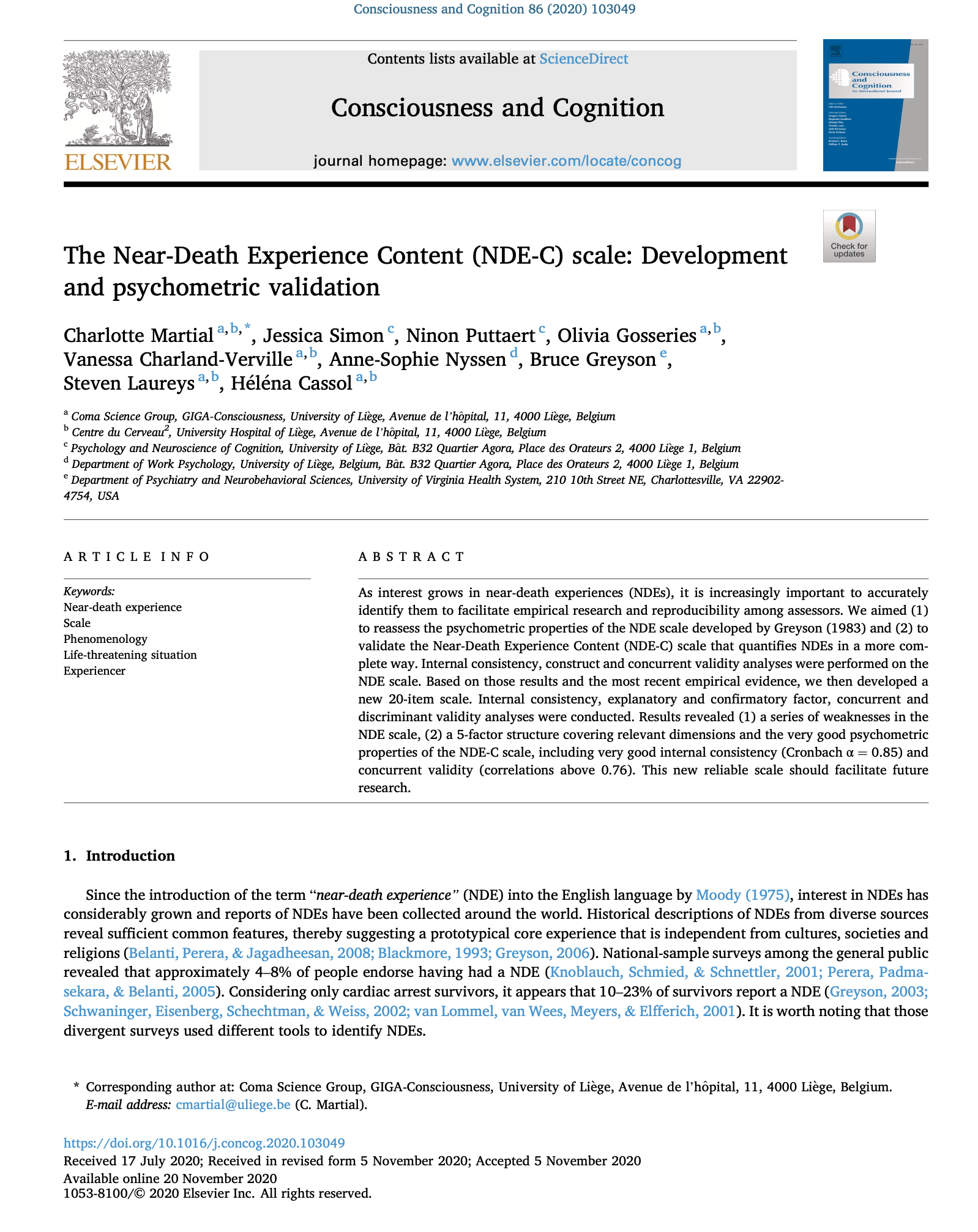
BR: No, that’s an important point, and that’s one thing that often sort of gets lost in of near-death experience is that it’s exactly what it sounds like, near death. And so these are people by definition who have not died, they have come near death. And the reason we know that is that had they actually had clinical death, that is brain death, they would be so badly brain damaged they wouldn’t be able to tell us what they experienced. They wouldn’t, I mean just severe brain damage means that you can’t say, you know, I saw the light and the hand of God and my relatives. So in all these cases, it’s a self-selecting group of cases that, keep in mind, they did not die. They may or may not have come close to dying. In fact, there’s some research that actually shows that many people who actually did come close to dying didn’t actually have near-death experiences. So there’s an interesting data set there. But anyway, I just urge people to keep in mind that near-death experience is exactly what it sounds like. Near death, not death.
0:21:47
CW: And they have produced the same type of near-death experiences reported by the patients that do report such things. They have created those similar symptoms and experiences in people artificially without having them be close to death at all. Their heart is still going, they are still breathing, but you can, with certain drugs, you can create the same sort of effects, which is interesting to me.
0:22:11
PR: And there’s an element of near-death experiences that I’ve always, or rather a category of them, that I’ve always been kind of fascinated by, which is children experiencing near-death experiences. There are a couple of really famous ones. There was a kid named Colton Burpo. He had a book called Heavens for Real. That was a few years back. And I believe they actually made a movie out of it.
0:22:34
BR: They did.
CW: I think I remember that. Yeah.
0:22:36
PR: Yeah. And then there was the other kid, a kid named Alex Malarkey. And he, ironic last name, I guess. But unfortunately, he was in a pretty serious accident and had some pretty severe physical injuries, a spinal injury, neck injuries. He’s a quadriplegic now and he suffered brain trauma and he did a book with his father called The Boy Who Came Back From Heaven. And his story is of particular note to me from a skeptical viewpoint because he and his father were, so they were in a wreck and he said he saw his father fly out the window of the car and then he was caught by an angel and carried to safety. And then he said he was out of his body when he saw that happen, and his body was taken to the hospital in an emergency helicopter. It said that he felt an angel take him through the gates of heaven. He described them, he described meeting Jesus, who appears through a quote, hole in heaven. And after he woke up in the hospital, he mentioned to his family the near-death experience. And so he and his father basically wrote the book. But it turned out a number of years later, he actually withdrew his story and said that it was made up, basically.
BR: Basically, it was ghost-written by his father?
PR: Yeah, and you know he just he said that he didn’t die, he didn’t go to heaven, he said he went to heaven because he thought it would get him attention. When he made the claims he had never read the Bible. He basically was upset that people profited from that and you know and he decided to just admit it.
BR: Good for him, that’s just a remarkable amount of integrity.
0:24:24
PR: Yeah, especially I mean after everything he went through and being a quadriplegic and being you know semi brain damaged. I mean that it takes a lot to just go through that much and still be able to put all that back together and just come forward with it. He actually since has shown a lot of recovery. He can stand upright with a frame now and do some other things. But anyway, the big thing is that what seemed to be the case was that he was being encouraged by people around him to relay this story. And this is also something that may be the case with Colton Burpo now. He never denied that this happened, but it’s a very similar kind of story. And kids tend to kind of describe the same very generic ideas, which I think makes them stand out a little bit from some of the adult near-death experiences, because I think that a lot of the, and this is just from observation, that a lot of the children’s stories of near-death experience, they differ a bit from adult stories. Not always, I mean, a child’s brain can experience this, but I think a lot of them are just that a child comes close to dying and is almost expected to have experienced something and either someone around him starts encouraging these ideas and feeding them the ideas or you know or in the case of Malarkey just kind of made it up out of thin air and you know for the attention and and I think with children you know they’re more susceptible to that as we’ve seen historically with the idea of repressed memories and you know all these different ways that people kind of try to egg kids on to make things up, you know, right almost they all they’re rewarded for making up stories, you know, they get attention and sometimes fame as these kids did.
BR: Keep in mind that this is part of a whole sub-genre of Christian books I mean, there’s probably last time I checked is like eight or ten books that are all Christian based near-death experiences I have both Burple and Malarkey’s books. I also have one called 11 Minutes in Hell. So yeah, I’ve heard about that not only are there people who claim to have gone to heaven, there’s people who claim to gone to hell. And of course they they all learned a lesson wherever they went sure and decided to come back and write a best-selling book about it
0:26:46
CW: Well, you know I sort of traipsed around the the recesses of the internet and Amazon books And found that it’s not just limited to Christian or other religious very specific religion based interpretations of a near-death experience. There are plenty of people who who put different spins on what they’ve experienced in that state of consciousness and turned it into a book. There’s even, I was struck by sort of a similarity to people who claim to have had alien abductions. Now, with NDEs, we at least have something tangible, something that people are actually experiencing, they actually had trauma and their brain is doing something. Alien abductions, that’s a whole other bag of tricks, but still, there are conventions of people who have been through this, who claim to have been through it, who talk about, some of them view it as a horrific experience that they just, you know, they want to forget about it, they didn’t like it. Some people view it as a, well, all of them that I’m reading about that bother to post their stories online view it obviously as a life-changing experience, and many of them sort of almost elevate themselves to a self-help guru after it’s happened. Just for example here, we have Sonia Guadalupe, who describes herself as a polarity practitioner, a reflexologist, a clairvoyant, and an artist, wrote a book in 2016 called Illuminated Universe, A View from the Source. And in that, she describes her, quote, life-altering journey into two separate realities where time ceased to exist, and offers practices for discovering, aligning, and transforming one’s energy, awareness, and well-being. And that’s all about her near-death experience. What qualifies her to write that book is the fact that she had a near-death experience. And then in 2017, last year, David Sunfellow published a collection of stories about near-death experiences called Love the Person You’re With, Life-Changing Insights from the most compelling near-death experiences ever recorded. And it’s advertised as shining a quote, bright light on the universal truths that are championed by NDEs and reveals in life-changing technicolor how to apply these truths to our everyday lives. And then we have a singer and bass player, Barbara Ireland, and she has a 2016 self-help book titled, How to Stop Negative Thoughts, What My Near-Death Experience Taught Me About Mind Loops, Neuroscience, and Happiness.
0:29:19
PR: Wow.
0:29:20
BR: Mind loops. I’m intrigued.
0:29:22
CW: Interestingly enough, that one opens with a disclaimer. And I mean, it’s actually a bold, it’s titled, Disclaimer in Bold Print. This author is not a licensed psychologist. The ideas in this book are not a substitute for your physician and the author is not liable for any loss or damage resulting from suggestions in this book.
0:29:44
BR: The mind loops in this book.
0:29:46
CW: Yes, and then at the same time the book is touted as based on neuroscience. Ireland’s proven 4D’s of D-looping program will show you how to detach from negative thoughts, heal and free yourself from painful memories, and literally rewire your brain.
0:30:03
PR: Literally.
0:30:04
BR: Literally.
0:30:05
CW: Literally rewire your brain, but don’t take it as a substitute for a physician.
0:30:10
BR: Right.
0:30:11
CW: Reading through all of these, in addition to the talks and the seminars and the conventions, I’m struck by the thought that these folks are being granted or sometimes granting themselves some sort of special mantle of providence because they were close to death and they came back and they want to tell us about it and that’s understandable. We as a people, we revere folks who have gone to the precipice and come back. I mean just look at some of the world’s major religions. We revere people who have come back from the dead, supposedly, but the sense of, you know, I’m special, look what I saw, look what’s happening to me, look what happened, and the life lessons I learned from being close to the abyss. That whole thing seems almost like a grab at wisdom that you don’t really necessarily need to grab for. It’s already plentifully available from a whole sector of our society. If you want to talk to somebody who’s close to death, well, talk to your grandparents, visit a nursing home. There are tons of elderly people willing to give you a perspective on life that you, as perhaps a young person not remotely thinking about death, don’t have. So, yeah, in the sense of children who are telling their stories and getting attention, and I think absolutely are being exploited by parents and publishers, you have this class of people, some of whom are potentially being exploited and also are doing some exploiting themselves. It’s a very murky, murky subject with many different angles.
0:31:50
BR: Well, speaking of angles, I think we have a special guest, don’t we?
0:31:53
PR:: We sure do.
(MUSIC)
0:31:58
CW: A good friend of the podcast and a good friend of ours as well who has personally experienced some of the things involved in what is known as a near-death experience. I’d like to introduce Margaret Downey who needs really no introduction to a lot of our listeners. She is one of the founders and the current president of the Free Thought Society, which is a national organization dedicated to protecting the Jeffersonian wall, separating religion and government. Margaret, welcome.
Margaret Downey: Thank you for having me. I really enjoy your past programs, and you do such a great job. Thank you for letting me into the team of three.
PR: Thank you for being here.
BR: Great to have you.
CW: Well, we thought about calling you because a few years ago I saw a national news segment talking about near-death experiences, and just as they have the token skeptic on many paranormal shows, they brought you in as the token atheist, someone who had been through a near-death experience and did not come to and write a book about heaven and have some sort of life-changing affirmation that there is a God and a heaven. You did not undergo that change, but tell us what you can, what are the details of what happened to you to send you into this state of oxygen depleted mind?
MD: Yes, well that was, my experience happened in 1979 and it was actually a few days after I had undergone a partial hysterectomy. Well I found myself in the emergency room needing immediate surgery to repair a broken and an actually damaged artery. So the surgery went well because I was then taken to the recovery room but I vividly recall awakening to the sound of this woman choking and I somehow was floating over the nurses station where I looked down on the scene of these three nurses chatting about a fashion magazine that they had opened on their desk. And they were laughing and talking and I was attempting to tell them that there was this woman in a bed near me and she needed help. And I looked back at the bed and I saw myself slowly dying of suffocation. The hospital was not aware that I had ingested a large lunch prior to the visit to the emergency room and my surgery. So during the recovery process it was actually me who was choking on that bed with the regurgitated food and it was I who was suffocating and it was I who was being ignored by the staff. So the next memory I have was that I was walking through this tunnel of light and at the end of the tunnel I saw was my precious adopted uncle. I adored this man. He was my childhood hero because my Uncle Floyd was the first one to teach me about researching and he’s the person I credit for teaching me critical thinking skills. And Uncle Floyd was the very first person to tell me about the philosophy of non-belief. I hadn’t even heard the word atheist until he explained that all of my questions about my religion or about his religion and my religion and other people’s religion and my lack of belief and all that supernatural garbage was actually called atheism. So when I saw Uncle Floyd at the end of the tunnel, it was so realistic. It was so, it was like he was right there in front of me and and he reached out and he said, go back, you have work to do. And at that very moment, I was being revived by a doctor and several nurses and I the tunnel left me and I suddenly became aware of this medical situation that really could have ended my life.
CW: Wow. Now that’s I mean I think many of us have that special person in our life that sort of let us know at a young age that it’s okay not to fit in. It’s okay to be one of the outsiders who doesn’t necessarily believe in everything you’re being told by a particular church or by a particular belief community. It’s okay to look into your own answers.
0:37:22
MD: Not only that, but I really loved this man for teaching me about researching. He wouldn’t answer a lot of the questions I would pose to him. He would say, I want you to go look that up and I want you to report back to me what you find out. Questions about nature, questions about science, you know all of those things. So it was my inclination to after I had experienced all this to actually start researching and to get an answer about you know what just happened to me, I knew it wasn’t heaven or a God or any type of spirituality or a soul. I just, I didn’t have the equipment to figure it all out. And back in 79, there was no internet and I had to, yeah, I had to go to the library and just sit there and try to understand what happened and there wasn’t a lot of literature about that. Even my own doctor refused to talk about it with me when I told him that I needed to find answers and he just patted me on the hand and he said, oh honey, you’ll forget about it soon enough. Everybody does, but I didn’t forget about it. I wanted answers and so years and years and years went by and I was so happy to to find more literature available and to meet neurosurgeons who wanted to talk to me about it and to this day I’m very dear friends with the neurosurgeon who actually does some panels with me about I put these panels together of other people who have had near-death experiences and we talk about our particular incident and then Dr. Newberg talks about the medical background concerning near-death experiences.
0:39:32
CW: Fascinating. Now, many of the people I read about having NDEs, a variety of emotional reactions. You obviously took to heart your uncle’s posthumous message there, you’ve got work to do, so you went headlong into the research of it. Was there any sort of other emotional reaction? Did you have nightmares or was it a euphoric feeling that stayed with you for a long time? Either or, anything in between?
MD: I was very, very happy to see my uncle again in my brain cells and because I had not seen him in so long that it shocked me to actually see him every way that I remembered him including his glasses! And that wonderful feeling of, I didn’t, I didn’t… there was no pain, there was no fear, it was more of a this is going to allow us to make that journey to death peaceful and calm and there’s chemicals that are released in the brain and there’s all kinds of wonderful ways that our body has adapted to allow us to make that particular ending happen in a very natural way, no matter the pain that’s involved. You know I’ve had people on our panels that have been in horrible automobile accidents and you’d think that they would be suffering from terrible agonizing pain, but no, they all describe the same things.
CW: That is, that strikes a chord with me too because I was mentioning earlier a book that I had the pleasure of editing called Midwife Through the Dying Process and in it Dr. Timothy Quill talks about things your brains do, including releasing palliative endorphins. Some medical procedures can actually impede this, and so it’s important to talk over your end-of-life choices with your doctor if you want certain things done and certain things not done. But just the brain’s own power to overcome a lot of the trauma and the pain that you would think would be associated with the dying process. I had an experience where I’ve only had one experience where I passed out due to pain and that was from a migraine. I think I told you this story once, Margaret, but I went from feeling utterly agonizing pain in my head to passing out and I didn’t realize I passed out. But when I came to, I was in this just, oh, I can even, I remember it so vividly, like, at least I think I do, this euphoric, like, floating, like, oh, and I opened my eyes, and I felt like I was in this, this holodeck with this grid, like this ever expansive white grid of straight lines and, and perpendicular lines. And I was just floating, like in this net grid and you know what that was?
0:43:10
MD: I remember what you told me. You tell the listeners.
CW: That was the bathroom tile. I was looking at bathroom tile sideways and it looked like I was floating in this expansive grid but it was really just white grout.
BR: Apparently heaven is like Tron.
CW: Yes, but ever since I had that experience I thought wow well if when I actually do die I get the same sort of stuff released in my brain I’ll be good with that I’ll be very good with that.
0:43:53
MD: A lot of people have told me that when I have expressed what happened to me and that death is is not as traumatic as you think it’s going to be and you know that some people have come up to me and said you know this gives me a lot of peace, this really makes me happier about what my brother is going to be going through or my mother. But we do have to be honest and we have to say that some people don’t have that. There have been cases that are reported about, in fact there’s a book out called Otherworld Journeys and some people have had near-death experiences that include fiendish tortures and dismemberments and tearing and the burning of flesh and other horrible things in their brain cells that are released that they remember seeing. And so I hope that a lot of the atheist community will not have that type of near-death experience because we don’t believe in hell and we don’t believe in torture and purgatory. So maybe atheists, most of all, will not have those experiences because you know our brain cells aren’t aren’t geared for that.
0:45:20
CW: Yeah, well we can we can hope that you know that we aren’t preconditions to fear the same sort of after life, you know tortures that somebody who perhaps has been you know mentally tortured by the fear of hell might be more predisposed to having a nightmare about that. Or I would hesitate to call it a nightmare that seems like belittling a near-death experience which sounds much much more vivid and much much more indelible than a simple passing dream.
0:45:47
BR: Yeah I really am interested in in you know where are these these experiences come from and sounds like a part of it is the the anoxia and just the you know what the what the brain experiences when it has oxygen deprivation? So this is when you see that the white fields expanding it makes it look like you’re going through a field, that sort of thing. But then also, as Margaret talked about, you also have the pre-existing cultural beliefs. And like you were saying, Margaret, if you don’t believe in a heaven and a hell and a purgatory, then you’re not going to draw upon that. media depictions and books and films and TV shows that are, it’s sort of this almost like secondary, tertiary source of information about NDEs where people, they’ll maybe see someone talking about NDEs on, you know, on a talk show or whatever else and they’ll say, oh I guess that’s what it’s like. And this is one reason I really love your story, Margaret, is that it is really gives hope to people, like you said, who aren’t drawing upon that. But my question is, had you had any previous experience to media depictions of near-death experiences, either from TV shows or movies or anything else prior to yours?
0:46:58
MD: No. Remember, this was 1979, and I was rather young, and I really hadn’t been exposed to literature of this sort or even the media hadn’t even highlighted anything that I was aware of. So I didn’t even know what to call it when I discussed it with my doctor. I just told them that I had died and I had this experience and he didn’t even use the word near-death experience. He just wanted me to forget about it. So no I don’t have, I did not have a preconceived notion of this at all. The situation was so peaceful and seeing someone that I truly loved was so rewarding that I wasn’t scared. I just wanted an explanation. And when I said that to people who, for instance, my neighbor, her young daughter died as a teenager. And she, you know, is always telling me, I hate that you don’t even believe that I’m going to see my daughter again. And I just held her hand and said, you will see your daughter again, I know you will because when people are dying, their brain cells, particularly who they miss, who they love, who they want to see again, that image will come forward. So you will see your daughter again. But from a scientific level, that’s how I believe you’ll see your daughter again.
0:48:57
CW: That’s a very fine compromise.
MD: Yes. And she always insisted that her daughter was an angel now. And I would tell her, yes, and she was my earth angel. To those listeners who would like to learn more about near-death experiences, there is a wonderful book out by Susan Blackmore called Dying to Live and I would highly recommend that for people who are interested in this subject. Also Dr. Newberg’s books all about the brain, there’s different titles that he, but just look for Dr. Andrew Newberg, a neurologist, and all of his books are just terrific. I highly recommend them if anyone is interested in how the brain works.
0:49:55
CW: Ah yes, for anybody willing to learn more about it, as Margaret’s uncle would say, you’ve got work to do.
BR: Yeah, I will second Margaret’s recommendation. Sue Blackmore’s book is really one of the best out there and it’s a very good antidote to a lot of the more believer stuff such as books by Kenneth Ring, Ian Stephenson and others who sort of fold in near-death experience with reincarnation and I mean there’s a whole sort of cluster of beliefs that are sort of often lumped together either rightly or wrongly and there is a dearth of good skeptical literature but Blackmore’s is absolutely one of the best.
MD: Yes.
CW: Well thank you so much Margaret for joining us and sharing your own personal experiences and what you have come to learn after those experiences.
MD: Well thank you for hosting me and I hope Someone out there will book me for a speech to talk about this further or to put together a panel for a conference. I’m always happy to talk about these things. It’s a subject that is hard to listen to, but it’s a needed subject when we know all of us are going to die. So we might as well learn as much as we can about that step.
PR: Absolutely, absolutely. And Margaret, where can people find you?
MD: I will be available always at my email which is margaret@FTsociety.org And we’d love to sign people up for a complimentary e-zine. We love to share our information, our events, and we enjoy hearing from people all over the nation.
0:51:53
CW: Yes. Margaret, you are a gift to the entire secular community of atheists and skeptics and like-minded folks. And you’ve opened many doors for me whenever I say I’m a friend of Margaret’s. Everybody says you’re a friend of Margaret’s, everybody says she’s my favorite person, come right in.
MD: Isn’t that how you met Ben?
CW: You were one of the first people we mentioned as somebody we knew in common, yes.
0:52:13
BR: A great connector.
0:52:14
MD: Thank you.
(MUSIC)
0:52:14
PR: So that was a really fun interview. I had a lot of fun. That was…
0:52:31
CW: Margaret’s fun.
BR: She is delightful.
PR: I did not talk hardly at all.
0:52:35
BR: We’re just sitting here listening and we’re just like, whoa, we’re nodding to each other.
PR: Absolutely riveted by that. It really was a lot of fun having her. I just had no questions for her. She’s such a thorough storyteller.
CW: Yes. I think she’s related that experience a couple of times, so she’s good at it.
0:53:06
PR: Yeah, sure, sure. Relating to what she talked about with talking to doctors about it and the science of it and the medicine of it. Celestia, you did a little bit of reading up on that angle, didn’t you?
0:53:20
CW: Well, I looked at one particular thing that I had heard of kind of anecdotally. With NDEs, I had always heard that there was this experiment where some doctor put a playing card, put various playing cards high above, like by the lights, where if a patient was actually having the out-of-body experience, as Margaret described, the out-of-body experience where she saw the nurses reading a fashion magazine, if somebody really was having that experience and they were floating above the operating room, they would be able to see the playing card. Now that’s the way I heard it anecdotally. When I dug into it, there was a bit more to it. It wasn’t a doctor. It was a woman who was a nurse at the time, Penny Sartori. Now since that time she has become a doctor but not a medical doctor. She got a PhD from her research into near-death experiences. And all over her website it actually doesn’t really mention where she got the PhD but I did some digging and it was from the University of Wales in Lampeter. Well I was getting a little, you know, because that’s one of the red flags when somebody mentions I was awarded a PhD, but they don’t mention the school. It could be anything. Dr. Penny Sartori, she was a nurse in the UK and she became fascinated with out-of-body experiences. So she undertook an experiment and is now regarded as an expert on near-death experiences, as I mentioned. Anyway, as I read through her blog, which details the research she did, it becomes pretty apparent that she is definitely slanted toward the woo side of things. And while her interpretations of her own experiment kind of reek of special pleading, nevertheless, the core idea behind the experiment, though she was pretty flawed in terms of her protocol, there was a core idea there that was pretty neatly conceived and it’s worth reviewing what she did. Now it wasn’t playing cards. It turns out it was not exactly the little type of playing cards we use. She made symbols on brightly colored paper that would be very easily seen by a patient who might be floating above the room.
0:55:34
BR: If I could just interrupt for a second. Of course, as we all know, we see through our eyes.
0:55:40
CW: Yes.
0:55:41
BR: So it’s the same thing. You quickly come into the problem, same problem with the ghost. It’s like, okay, well, if you’re no longer inhabiting your body and the senses and organs that allow you to sense the world, such as eyes and everything else the question becomes, how could the person be seeing anything if they’re, I mean, we see through our eyes, if your eyes are closed or…
0:56:07
CW: Well, that is absolutely, that is, as you and I are materialists, that’s how we observe it. But she was attempting to find an explanation for whether or not people in some non-material form, in the soul or whatnot, are indeed floating above the operating table as they claim to have remembered doing. Now I’m going to go ahead and I’ll just quote from her own write-up of the project. “Having undertaken a five-year prospective research project into NDEs, I know how difficult it is to verify the OBE component,” out-of-body experience component that is. “At the intensive therapy unit where I conducted the research, I put symbols on top of the cardiac monitor at each patient’s bedside. These monitors were mounted on the wall and were approximately seven feet off the ground. The symbols were also concealed behind ridges that sat on top of the monitor. This ensured that the only way in which the symbols could be viewed was from an out-of-body perspective.” Okay, I’m sure you see some flaws in her her statement there that the only way the symbols could be viewed was from an out-of-body perspective.
0:57:17
BR: Yeah, and she actually seems to be adopting a materialist perspective on that. I mean, if, you know, if, if, for example, we are all one and we are all part of the universe, then presumably one could know what is on the card without actually floating above it. But go on.
0:57:33
CW: In fact, you are anticipating some comments I read later down on her blog, which again some of this led me to the quick conclusion that she was very much into the woo side of things. Somebody said, well I don’t really go for the theory of eyes on the ceiling. I think really if any of the doctors in there know what the symbol is, they are obviously psychically communicating it to the patient. And she takes this into account as you know well that could be doable you know and then she also listened to a commenter who had what was clearly a memory from when he was 12 years old from a dream he had a dream when he was 12 years old but he remembers it as an out-of-body experience and man she was just like oh yes I’d like to hear more about that and not once did she just say oh well it sounds like you had a dream. She’s full-on like yeah. Yeah, tell me more. Anyway, so it it was not playing cards as I’d originally heard It was symbols on brightly colored paper and she what she did to determine the symbols is she first surveyed a hundred people and asked what symbols they would expect to see used and then she purposely did not use any of these. Now that that is clever. The un-clever part of that is, who do you think were the 100 people she surveyed? They were people who worked in the hospital. So she’s just told 100 people who work in the hospital that she’s going to be putting symbols on the tops of cardiac monitors. So that’s hardly double-blinding. She acknowledges that in her first attempt, hospital staff were really curious and some of them climbed up on ladders to see what symbols were placed there.
BR: Okay I see a problem already.
CW: And she said that could have definitely invalidated the results. So she owns up to the fact that that would invalidate results. You know, owing to patients hearing staff talk about it they might overhear something and that would have invalidated the results if there had been any results to validate. She kept them up there for five years. She redid the symbols. She changed them all, tried a second attempt, and she would have to dust and rotate these symbols each week to adhere to the standards of cleanliness for the intensive therapy unit. And while she did this, she covered them with a piece of paper to ensure that she herself would not know which symbol was where, so that she could not telepathically transmit this information to the patient. So you see there’s some attempts here at double-blinding, but it also absolutely falls short of any sort of rigorous protocol. So during the five years of her so-called experiment, eight patients in that unit reported having out-of-body experiences. And out of those, six of them reported floating to different areas or not being high enough where they could hypothetically see the hidden symbol. And out of the two who did report out-of-body experiences that would allow for seeing the symbol, neither of those two patients recalled seeing it. Now, far from taking on a skeptical tack here and saying, well, okay, maybe there’s not anything to this, or certainly not anything in the real world. I mean, it’s only a neurological illusion that you think you’re floating above your body. This did not convince her. She said, well, this just made her realize how rare out-of-body experiences are and how it will take much more time to find that magical case that will prove it to everybody.
1:01:13
BR: That’s the… Yes, that’s the correct conclusion everyone.
1:01:16
CW: Needs more research here’s Here’s how she phrased her assessment of the five-year experiment So when the results are considered at surface value it may be wrongly assumed that the OBE veridicality research is producing negative results when in fact it is not. It is simply far too early to yield good quality OBEs in sufficient quantities. I predict it could take at least 20 years of continuous research to get any satisfying results. Now, I’m sure that sounds pretty familiar to anybody who’s read a summary of a failed experiment from somebody in Psy-research.
1:01:55
BR: I’m hoping that she used research using quotes.
1:01:59
CW: Like I said, there were tremendous protocol fails here, but the core idea was pretty good. People claim that they are able to see things above their body. Well put something up there that they can see and see if they see it. That’s not a bad tack. But anyway, that hasn’t stopped her from speaking about near-death experiences and writing books like The Wisdom of Near-Death Experiences, How the Messages of NDEs Can Positively Impact the World.
1:02:33
BR: Even though she’s acknowledged that there is no data to speak of because it needs another 20 years. Am I understanding this correctly?
1:02:43
PR: Yeah.
1:02:44
CW: Well, near-death experiences, as I said, they are used by a lot of people to sort of, they’re sort of, they’re sort of like, they’re plugged into all these different possibilities, all these different narratives. We have the Christian apologists using them and using children’s stories to whoop up book sales and encourage believers to, you know, continue their faith because we have proof of heaven. Then we have a spiritualist, as I mentioned before, the string of people who are writing books about it claiming this is a self-help thing, I learned this because I almost died. And in the ad copy for Dr. Penny Sartori’s book, it says, the ongoing debates about NDEs have detracted greatly from the very important transformational effects that NDEs have, and how empowering they can be for the whole of mankind. The NDE instills knowledge in those who experience it that we are all interconnected and all part of one great whole. So in other words a lot of the people pushing the NDE narrative are saying pay no attention to the man behind the curtain folks. Let’s just think about the philosophy this can teach us. You know let’s just teach about let’s just focus on how all feel connected.
BR: We’re all one.
1:04:30
CW: And you know, I honestly, I gotta say, I don’t find anything really tremendously wrong about that motive. I mean, it would be nice to have people feel more interconnected. As Margaret pointed out, some very good things that her NDE taught her and how it definitely gave her a sense of peace about, you know, the impending death that we all face. So I have very mixed feelings about this topic, if I want to stand against these people selling books or stand with them.
1:04:34
BR: Well, it goes back to the question of what’s the harm and if people are being misled. And it’s the same thing with people argue about psychics. Well, OK, maybe the psychic isn’t really telling them anything that’s true, but does that matter if it makes them feel good? And I would argue, yes, it does matter because there’s a slippery slope there where you know woman… They’re telling you you’re gonna be a dark handsome stranger the next minute there They’re saying well, you know anything bad in your in your life is a result of a curse and so you know it’s it’s, you know to my mind much of it is you might my problem with it is people speaking beyond the evidence. If if you don’t have the evidence, you just want to say, hey, I think we’re all one and kumbaya and this is a wonderful thing, and you want to have the new aging notions, that’s fine. But it’s another thing to mislead people and saying, well, if you look at my four books and you read my seminars and you buy my tapes, I’ll tell you the deep hidden knowledge that I learned from my NDE, and they’re intentionally ignoring the the valid scientific answers or dismissing them and that’s what I find problematic.
1:05:42
CW: I guess when I said I feel sympathetic to some of the motives here, some of what I’m reading about NDE is the commonalities. Your brain reacts similarly to a loss of oxygen. My brain would react similarly to the way that your brain would and we kind of share these biological markers. It doesn’t mean absolutely 100% of people are going to have the same NDEs, but out of a group of people you get some similarities popping up and that’s kind of refreshing. That’s kind of nice. Seeing as how we all tend to think differently about so many things out there.
BR: This is true.
CW: But yeah, I guess I just have to go with Barbara Ireland’s book. Make sure they have that disclaimer in there. The author is not a licensed psychologist.
(MUSIC)
1:06:28
PR: We would like to thank our sponsor level patrons, Amy Freshour-Kelly, and Dr. Angela Mattke. If you’re interested in becoming a sponsor or just throwing us a buck or two per episode, check out patreon.com forward slash squaring the strange. Every bit helps us keep the lights on here in strange studios And we could not keep bringing you content without the support of our generous friends If you’re looking to provide moral support head on over to iTunes and give us a five-star review Every positive review helps us move up the podcast charts. Thanks again strangers
PR: So that about does it for this week. Next week, speaking of research as we just did, we are going to be talking about research. What is research and then how do you effectively research and all the kind of ins and outs that we can fit into an hour because that’s a big, big, broad topic. But yeah, I’m really looking forward to that and until next time, we’ll see you. Bye-bye. Take care.
1:07:41
♪ I’m gonna be your man ♪
1:07:43
Swearing Strange is a production of Kronos Creative LLC, copyright 2017. Theme music by Shriek Back. Additional music by Memory, Guitard and Feathered, and Pasquale Romero. Content producer, Celeste Jawara. Audio engineering, producing, and editing provided by Pasquale Romero at Kronos Creative Studios.
1:08:01
Additional support provided by Ashley Romero, and of course, our listeners and patrons. The views and opinions expressed in this podcast are those of Swearing the Strange and do not necessarily reflect the views and opinions of Cronus Creative, Center for Inquiry, our necessarily reflect the views and opinions of Cronus Creative, Center for Inquiry, our advertisers, or any affiliated organizations and employers.
Transcribed with Cockatoo
