Episode Summary:
This week, Ben and Pascual dissect the myths and misunderstandings that surround Halloween. From tainted candy to evil predators, our boys take a bite out of these spooky Halloween treats so you don’t have to!
Also in this episode, Ben brings us another tale from the road!

0:00:00
Ben Radford: Welcome to Squaring the Strange, the podcast that examines all manner of the mysterious and the mundane through a critical lens. So let’s square the strange.
(MUSIC)
Pascual Romero: Welcome back to Squaring the Strange. I’m your host Pascual Romero, with me is my other host –
BR: Ben Radford
PR: This is episode 30. That’s a good number. I remember turning 30. That’s when I felt like maybe I was finally an adult. I don’t know. Maybe.
0:00:59
BR: I’m still waiting for that. I’m glad one of us is on the ball.
PR: We’re almost old enough to run for president. But yeah, we are here at the grand finale of our four-part Halloween series. This is a big one. I’m really excited about this one. This should be a lot of fun.
0:01:20
BR: Yes, yes. We’ll be talking about various Halloween scares. Not the usual Halloween scares. Typically, when people think of Halloween, they think of haunted houses and people dressing them as ghosts and these sorts of things. I thought it would be interesting to look at more the real Halloween scares, the sort of meta-level scares that often emerge around this time of year. So it’s a subject that I and others, the Centery for Inquiryand other skeptics, sort of get recurring every year. It’s just guaranteed that… I know my phone’s ringing off the hook if it’s approaching Halloween because there’s just all manner of weirdness is coming through. So we’ll be hitting on that tonight.
PR: Cool, but first we thought we’d mix it up a little bit. We’re not going to do a Swayso this week to give ourselves a little extra time, but Ben has a tale from the road for us.
BR: Yeah, I thought I would share a fun little tale from the road. This dates back to about I think 2011 or so and I was invited to be part of a TV show called Miracle Detectives and this was on the short-lived Oprah Network.
PR: Oh sure. I remember OWN.
BR: Yeah, yeah, yeah, and you know when when when I got a call from producer from the Oprah Network You know I with all due respect to Oprah she is… Who last I heard is a at least occasional correspondent for 60 Minutes. Which I find… concerning, I’ll be honest with you. I don’t dislike her as a person, but on her various media, including TV shows, she’s peddled a lot of woo.
0:03:08
PR: Yeah, there’s a couple of quote unquote doctors in her wake that I won’t mention. But yeah, I think that she’s, well, I actually greatly respect her as a businesswoman and an entertainer, and she seems like a really nice person. I worry that she’s got a platform that allows her to push some very questionable ideas out in the world, and with Dr. Oz, and even Dr. Phil, who’s a psychiatrist, or a psychologist I guess, who’s a very, very down-home, old-school, like, you know, stuff that would have modern psychologists probably scratching their heads.
BR: Right, exactly. So anyway, so that’s why, on the other hand, you know, typically on shows like that it’s a case of where, you know, you’re damned if you do it, you’re damned if you don’t. And so it’s, you know, if you, if you refuse to be on the network so you can do that But then either they won’t have a skeptic on her at all or they’ll get some sort of no-name short shrift So, you know usually my my default answer is you know instead of preaching the choir again And there’s nothing wrong with preaching the choir. I mean –
PR: That’s what we do here!
BR: It’s actually valuable that there’s there’s value to that But so I figure well what the hell I Oprah needs to hear my voice. I grandiosely told myself and the producer who really frankly couldn’t give a ****. So anyway, I said, alright, fine. So I flew to Cleveland. Anyway, the basic setup was the Miracle Detective show. I’ll just read you the quick blurb to sort of give you a sense of what it’s about. This is from IMDB and it says, miracle detectives. Do miracles really exist? That’s the question that a believer and scientists try to answer in the series that explores the paranormal. Journalist Randall Sullivan, who believes he witnessed a miracle while working as a war correspondent in Bosnia, and Andrea Viscontes, who has a doctorate in neuroscience, travel the country speaking to people who believe they have experienced or witnessed miracles. After hearing the first-hand accounts, interviewing eyewitnesses, and conducting experiments, the journalists and scientists try to determine if it was truly a miracle. First episode date January 1, 2010. I had never heard of Randall Sullivan, although I had come across Andrea Visconses a couple times. I’d met her, I think, once at a skeptical conference. She’s also a singer. She didn’t perform, but she’s apparently a professional singer as well. Just a generally cool person and a neuroscientist. Smart as a whip. Anyway, I hadn’t met her, but I think I’d seen her at a conference sometime. So I sort of had some idea who she was. And so the premise for the show was that there was a place called Holy Love Ministries, which is in North Ridgeville, Ohio. Never heard of the place, but I looked it up and sure enough, it’s a real thing. And apparently there were a handful of claims about weeping Jesus statues, miracle photos, you know, the usual. So I was like, alright, fine. So, I asked the producer to send me a couple samples of what sort of miracles they were talking about. And she sent me, I think, two or three photos, and I looked them over and I had some sort of sense of what they probably were. Miracle was low down on the list in terms of what I suspected they were. But anyway, so I flew to Cleveland and then rented a car and went to, I think it was about 45 minutes an hour away. Beautiful countryside.
PR: Oh yeah.
BR: Yeah, just green and of course coming from the desert, everything is green. And so I was actually, the call time, I think it was a Thursday, so I flew in on, I think it was a Wednesday night, so I got in like mid-afternoon. And they didn’t really need to talk to me. I wasn’t supposed to be on camera and getting mic’d up and talking to anybody until the following day. So I, and they had arranged my hotel and everything. So I could have just gone to the hotel and crashed out and you know. Sure. But I was like, well, you know, I’m already here now. Let me, let me do a little investigating as long as I’m here, get the lay of the land. So I dorve over there, the afternoon before unstead of the next morning. I just wanted to get a look around. And so I looked around, took some notes, took some photographs, and I didn’t announce myself. I just sort of wandered in. There was a few dozen people there. Again, it wasn’t like 9 o’clock on a Sunday morning. It’s generally open to the public, but it’s it’s a you know, it’s a ministries so I walked around a little bit and and I there’s a little cafeteria in there and so because it was Late afternoon I figured let me let me get a bite to eat so I got a sandwich and a bag of chips and I just sort of sat there and I I saw the I saw the TV crew Standing, you know all the you know, there’s some of them reviewing footage some were you know, texting their girlfriends, and Andrea was across the room. You know what people do in between the…
PR: Eat M&M’s, that’s what I did most of the time.
BR: Yes, there’s a lot of M&M-ing. And so I was opening up my chips and having a sandwich, which was, you know, mediocre. It was okay, whatever. And you know, no one really questioned me, just because I was just another person coming by and, you know. So as I was eating my chips and sort of, you know, looking around, I chatted with the, one of the producers came up and said hi. So I was like, oh, hey, you know, I’m Ben Radford, glad you got in safe, everything fine. So I talked to her for a few minutes and then she shuffled off to go do something else, some B-roll or something. So I’m eating and drinking a Coke and I open up my chips and there I find what could be a miracle. And by miracle I mean a cross inside a potato chip. Now it was definitely a cross. You had to use your imagination a little bit. But it was not an X, it was a cross. It certainly depends on how you hold it, of course. And I’m looking at this potato chip in my right hand thinking, wow, I’m in a place that there have been recent miracles, that’s why we’re all here, and I’m looking at this ship, and as a little prank, I decided I’d just get excited about it, right? So I’m like, this is so cool, it’s a miracle, do you see this, do you see this? And I started walking around to the people around me. And it was like, oh, and the audio guy, he’s like, look at this, do you see the cross? Is it just me? Look at this. And he’s like, yeah. So I’m just, and I’m just playing it up. I said, go. And so then I go over to Andrea and she didn’t know who I was. So I was like, look at this. Look at, look in the chip. Do you see the cross? And she’s like, yeah. I think she was like edging away from me, like wondering for security, right? I was like, oh yeah, it’s so cool. It’s like, I’m chosen, I’m chosen. And so I just went back and I was muttering to myself. And out of the corner of my eye, I could see people like give me their eyeball. And it was just sort of fun. So then, you know, I actually saved the chip. It’s actually in my freezer.
0:11:06
PR: Wow.
0:11:07
BR: And yeah, so then I went back to my thing and sort of calmed down. I think I’ll be okay. And you know, and just sort of reading some notes And then and then the producer came and introduced me to her Andrea about an hour later, and she cracked out cuz she knew I was like this has been afters like oh So your ben Radford! it was it was it was kind of a kind of a fun, and then you know the The camera guys were chuckling about it So anyway, so we we were you know fast friends, and we we did the show together. And then of course, she and I got on well, pretty well, because of course she was the token skeptic. And she was running off and rehearsing lines and talking to whatever, and so I wandered around a bit. Then I met her co-host, Randall, who was an interesting guy, sort of a little bit of a goatee thing going on there.
PR: I feel like goatees are a prerequisite for like spooky ghost people and stuff.
BR: Yeah, yeah, exactly, exactly. And so he has something going on there. And you know, I just was, you know, he had no real particular reason to get to know me very well. I mean, I was just, you know, sort of the guest expert who they brought in to help explain the photographs. So you know we’re just chatting a bit and he was nice enough but you could tell he had a good opinion of himself and he was like, well, you know, and then at one point he’s, I mean not overbearing, but just sort of like, well, you know, and then he’s like, well, you know, yes, I’ve been doing this for a while, you know, and then I wrote a book and I just said, just one? Because I’d written three books by that point. He just sort of glared at me and was like, well, anyway. So he and I did not get off on the best foot. But it was a fun shoot. And in the end, we ended up shooting the thing and it was lots of fun. And in fact, I think if you look on YouTube, you can find the Miracle Detective show that I was on. Of course, the clip there is four minutes, and I was there for three days. But it was interesting, and I ended up being able to solve the mysteries that were put in front of me. Actually, I later used an episode from their show in my book, Mysterious New Mexico. They did an episode on the miracles at Chimayo.
PR: Oh, okay, sure.
BR: Which you know about, and I did a chapter on the so-called healing dirt of Chimayo in northern New Mexico, and they did a pretty good episode on it, and I quoted a lot of that in my book. Anyway, so I think the show only lasted, I think maybe two seasons or something and it was you know it was it was a decent show I mean it was worth watching I you know I did I’d love to have them revive it but anyway and I every now and then I run into Andrea in fact for a while she was she did a podcast with the Center for inquiry she did with the she thinks she did point of inquiry with Chris Mooney oh sure sure and then that sort of faded away. But anyways, that’s my little tale from the road.
PR: Nice, nice. And we’ll go ahead and we’ll get some links up in the show notes to the, hopefully we can find that Miracle Detectives video and then we’ll also get a picture of the chip.
BR: The holy chip.
PR: And I’ll try to find a little info on Chimayo for those interested. It’s a very interesting, beautiful little town up north here. There’s a lot of very strong Catholic belief around it, a lot of Catholic superstition and ghost stories and stuff. We’ll link that up in the show notes. But let’s get on with things.
(MUSIC)
PR: So, growing up I used to always get a lot of warnings, not so much from my parents, but at school like teachers and different adults in my life, you know, about various, you know, scary things we need to be worried about every Halloween, you know, it was razors in the apples or something, you know, in the candy. They went so far as to have the fire department check candy bags at one point, and I was always a little skeptical of that, just in that I always did my trick-or-treating in my grandparents’ neighborhood, and I knew every single person at every single house. So it was kind of an interesting thing to see just how strong that sort of idea was and how pervasive it was, and even to this day you still hear a lot of that stuff. And of course there are much bigger and more grand scares around Halloween. But let’s get into it. Let’s talk about the scary stuff that surrounds Halloween and the weird beliefs that people have about what’s going on out there this time of year.
0:16:41
BR: Yeah, yeah, definitely. Again, this is the perfect time for skeptics to be out and about, as my Canadian friends say, you know, to sort of calm people’s fears. And we’ve talked to some about this in previous episodes. And I really do think that that’s sort of an a sort of underappreciated or underrecognized role that skeptics have is helping calm the public’s fears. You know, there certainly are enough things in the world that people need to be legitimately concerned about. On the other hand, there’s also many things that the public is unnecessarily concerned about, ranging from people who think that you need to have some sort of cleansing, colon cleansing and your kenoki foot pads and fear over EMFs and cell phones. There’s all sorts of… satanists. I mean, there’s so many things out there that the media and others, you know, like to hype up and sensationalize. And again, there are legitimate concerns, but in my experience, many of them are greatly overblown and sometimes it falls to the sort of skeptic to say, okay, I understand you’re concerned about this, but take a step back. Here’s the evidence. Is this really as big a deal as you think?
0:18:05
PR: Yeah, yeah.
0:18:06
BR: So we’ll be touching on some of those today. One of the first things that I want to touch on, which comes up every Halloween, is the concern that the season is really about Satan.
PR: It is about Satan.
0:18:24
BR: Or is it?
0:18:25
PR: In this household. Hail Satan.
0:18:27
BR: Yes, well, looking at the scary tattooed bearded man in front of me. No, but it’s interesting. On one hand, you have, it’s fascinating. You look at the fundamentalists who get concerned about, for example, Christmas. Or like, put the Christ back in Christmas. Well, actually, if you go, if you look at the history of Christmas, Christ was not, that’s, Christ is a latecomer to this whole thing. There were, you know, Solstice celebrations long before that. So –
PR: I think that the original saying was shoehorn the Christ into Solstice.
BR: Right. Exactly. So, and that’s, and it’s interesting because that parallel fear often emerges among fundamentalists. It’s actually sort of the opposite fear. The concern is instead that people don’t recognize the sinister implications of Halloween. It’s like, if you just understood, if you just knew the true history, you would be terrified and you wouldn’t let your kids go because they’re dabbling in Satanism. So that’s what I find fascinating, is there’s this, again, this bizarro concern. Now, to be fair, it is in the minority. I don’t want to exaggerate, but it’s very real, and it happens every Halloween. There’s some fundamentalist, sometimes Pat Robertson, who’s been embarrassing Christians since 1982. He’s a reliable source of you
PR: To be fair. He was a hundred in 1982
BR: This is true. This is true. He’s only getting better.
PR: I think he’s a vampire by the way
BR: Well, they prop him up. You know, he and his Larry King still around
PR: He is yeah, and he’s like he’s actually a lot more more with it than than Robertson But I want to say he’s older too. It’s crazy.
BR: Yeah, we’d have to do we’d have to do Google thing Anyway, so you have both Halloween and Christmas which are heavily commercialized.
PR: Oh yeah.
BR: And you know, people, it’s interesting that the same people that complain about the commercialization of Christmas don’t complain about the commercialization of Halloween. Because their issue is, it’s like, no, no, you don’t understand, these are the sinister things going on here. It’s like, this is all a distraction. The fears associated with Halloween go far beyond fake scary ghosts into genuine spiritual warfare in the souls of the innocent. This is what a lot of the fundamentalist Christians believe. This is one of the things I was hit on, sort of, touch on the overview. And you know, basically, many people trace Halloween back to an ancient Celtic pagan celebration called Samhain, as you know. And you know, it occurred right around Halloween, the night before All Saints Day, and the idea was that it had a lot of different aspects. Basically, it was focused on the changing of the seasons. The changing of seasons and the dormancy of life and settling into the winter and storing up, these sorts of things. And the eventual rebirth of nature in summer and winter. It’s all very tied to the seasons and nature.
PR: And coincidentally, most religious holidays, or not most, but many religious holidays, line up very conveniently with these seasonal celebrations.
BR: Yeah, funny how that works. Curious, eh? Maybe God intended it that way, who knows?
PR: Oh, and I just wanted to make a note, Samhain is, the word looks totally different than it’s pronounced. It looks like it’s Sam-hain. And I just thought I’d throw that out there, because I know a few of my metal friends listen and there was a band fronted by Glenn Danzig about, oh, 25, going on 30 years ago now, called Samhain. It was a very cool band. But nobody-
0:22:40
BR: Where’s the new Sam hain CD?
0:22:41
PR: Everyone called it Sam hain.
0:22:42
BR: There you go. But what happened was that these pre-Christian practices, with their focus on nature cycles and multiple deities, of course offended the Roman Catholic Church. They’re like, no no no, no no no, dude, don’t be worshipping the God and the goddess and the trees. There’s one God and he has a son named Jesus. This is all written down in a book. You should read the book and if you believe something different then you are occult we mean satanic. Yeah. So it’s like there’s this very clear, it’s like, you’re with us, you’re against us, either you believe what’s in this book here or you’re the devil. Now I don’t really feel that way. I’m like, you know what, if you don’t believe what I do, you know, that’s all right. I’ll give you my evidence, I’ll give you what I think, but I’m not going to say if you disagree with me, if you vary two degrees off to the left or right, you’re Satan. But this is very much the belief system of the early Catholic Church. And of course, this is crystal clear. You can look at Exodus 22, 18, commands, Thou shalt not suffer a witch to live. They’re very clear about their opinion of witches and witchcraft and the occult, and the answer is death. It’s not a slap on the wrist, it’s not a little public shaming, it’s not a small fine, it’s killing somebody because you disagree with them. And of course anything that smacked of the occult was shown as evil, including divination. This is one of the reasons why a lot of fundamentalist Christians are uncomfortable with, for example, water dowsing or Ouija boards. Perfect example, tarot. Because like, well, hold on, you’re opening a door.
0:24:32
PR: Yeah, and they also are not fans of Trouble or Parcheesi, strangely enough, I don’t know.
0:24:36
BR: Funny how that works, right? And this is where it gets interesting, right? You can say, well, hold on, what’s the big deal, right? So what if your kid dresses up as Spider-Man and gets a couple Mars bars down the street. Who really, why is God interested in this? Why is the Catholic Church still up in arms about this? Well, my friend, here’s why. You’re opening the door to Satan. And again, you and I both know this. We lived through the 80s and the Satanic Panic. And this is the assumption, is that a byproduct of these putting on masks and also the notion of Halloween as evoking fear. Now of course for a lot of kids it’s a scary fear. It’s a funny fear. When you go to a horror movie, are you genuinely afraid? Not really. I mean you’re in a theater. It’s a fun fear. Yeah. And that’s what Halloween is to kids. It’s a fun fear. Yeah, occasionally you get someone who’s actually scared, but for the most part, it’s a fun fear holiday. But in the Catholic Church’s view, and many fundamentalists, it’s like, well no, you’re evoking evil and fear, and that of course is supernatural. So the belief system is that if a kid is scared by a haunted house, zombie or spooky witch costume that curiosity will lead them to learning more about it. Well hold on, why was I scared of this zombie? Well let me research that. Well, the zombie is a dead person, maybe I should kill someone and see if I can make a zombie. This is the logic. I’m only exaggerating a bit. This is the logic, right? The idea is that if you tease kids, if you entertain kids with zombies and witches and monsters, well, obviously they’re going to begin killing people and worshipping, because why wouldn’t they?
PR: And my four-year-old must just be a huge exception to the rule because he knows the difference between reality and fiction and does not believe in zombies. He loves the theme of zombies and all that. But that’s what always surprises me because now that I’m a parent of two kids now, a four-year-old is perfectly capable of creating a dividing line between fiction and reality. And to have someone say, well it opens the door to Satan, I’m just like, give my kid a little more credit than that.
BR: Well, no, to be fair, what that means is that your four year old has a better grasp of reality than say, Pat Robertson.
PR: Yeah, I’ll concede that, yeah.
BR: No, because look, because he’s, Robertson and others like him are concerned that there’s this blurred line between, you know, that they can’t tell fiction from reality. Whereas most people, including your adorable kid, who I call Chubby Cheeks, because he’s got cute chubby cheeks, can figure that out pretty easily on their own. Anyway, so again, just because a kid dresses up doesn’t mean they’re on the path to learning about witchcraft and magic. And frankly, I’d be okay with that. I mean, I have, if you go to my house, I have bookshelves about witchcraft and magic. All over the place. I’ve got fairy tales folklore. I’ve got books by Blavatsky and Crowley. And does this mean I’m worshipping Satan? No, it’s, I, but, you know, and frankly, a lot of the witches, you know, I know a few witches and they’re pretty nice folks.
PR: Yeah. Oh yeah, I grew up in Santa Fe. The many facets of witchcraft and magic with a K, it’s all very alive there, and there’s a whole plethora of beliefs there, and there’s people that range from these naturalist Wiccans to these kind of Native American spiritualists and stuff. And they’re all, I mean, I can say all the ones I know are actually really nice people. And despite the fact that we have differences in the beliefs there, we get along better than most believers that I know otherwise. Which is, you know, saying something.
BR: Yeah, yeah. I remember when I was in high school and a friend of mine was getting into Wicca and I didn’t know much about it at the time. I wasn’t scared about it. I was like, sure. So he invited me to go to a ceremony held in the Bosque along the river, on the Rio Grande. I was like, yeah, sure, whatever. So I went there and I didn’t know what to expect. I mean, I assumed a couple of sacrificed goats or children, whatever. I didn’t know.
0:29:37
PR: When in Rome…
0:29:38
BR: Yeah, you know, whatever. And, you know, I brought along an apron to wash the blood off or whatever. Oh, good. Good notion. Yeah, I came prepared. But, you know, and I mean, I was welcomed and greeted. And honestly, it was kind of boring. I mean, I don’t mean any disrespect. It was not sensational. It was nice. I mean, like, you know, they were, you know, they’re different for winds and giving due to the goddess. It wasn’t my bag, but I was like, okay, this is fine. And then we all went home and we had a Coke. So anyway, I don’t want to belabor it, but obviously this is part of a much broader concern about the decay of modern society. We saw this with the concerns about Dungeons and Dragons, and rap music, and metal music. Harry Potter books. We don’t need to go back. Even a few years ago, people were burning Harry Potter books because they were opening the door to the occult.
PR: Oh, yeah, I remember those days.
BR: Violent cartoons, violent video games. I mean, all these are evidence of moral decay leading to drug use, suicide, murder, blue whale game, whatever. And you know, underlying all this is a sort of conspiracy theory like belief that there are these hidden meanings behind everything and there’s a powerful sinister force at work trying to brainwash the innocent. I want to point that out because it really is a conspiracy theory. It absolutely is. It’s this assumption that there’s these people that are trying to lure your children in under the guise of Teenage Mutant Ninja Turtles, but what they’re really trying to do is get you to worship Satan. It’s just absurd.
PR: Which is funny because I almost wonder how much of that is just projection because the whole concept of recruitment and youth ministry and all that stuff comes from trying to entice younger people into joining the ranks. And this is how extremist groups do it, and this is how these fundamentalist churches do it, and they have this youth outreach, and they have concerts, and they do all these public events and things under the guise of being fun stuff for teenagers, and then they inject some really hardcore fundamentalism into it. It’s a bait and switch thing. I don’t know if we’re covering that at all, but the haunted houses that these churches do are just absolutely mind-boggling. It’s like, you guys are doing the thing that you think everyone else is doing. You think that these heavy metal concerts and Harry Potter are tools that people like me use to recruit the youths of America to my legions of darkness you know and it’s like no I I don’t actually I try to sell a few records I’ll give you that right I hope they come up to my show I do not want to have rituals with them I honestly don’t really even want to like know them that well I mean I appreciate the fandom but But at the same time you guys are out here doing this man on the street bait and switch stuff.
0:33:00
BR: Hey do you want to hear some fun rap?
PR: Do you like rock music?
BR: Have you heard of Striper? Guess who we have?
0:33:09
PR: So yeah, me thinks the Lady Doth protests too much.
BR: Yeah, well I mean you know, as I think the phrase goes, you know, look at the plank in your own eye. Yeah. But yeah, I mean essentially just to wrap up on that topic, I mean that you know Satanism is essentially a Christian creation. And this, and you know, Samhain and all these all these pre-Christian belief systems had nothing to do with Satan. They don’t recognize what you’re talking about. Like, Satan, like, I don’t know what you mean by that. Oh, so that thing that you created, you think that we are worshiping that thing you dreamt up. Like, no, we don’t do that. So again, they just wouldn’t recognize anything like that. So anyway, that’s that part of it. Awesome.
(MUSIC)
PR: Hey, strangers, we love sharing our podcast with you, but it takes substantial time and money to produce and release each episode. If you think our podcast is worth a buck or two, please head over to patreon.com forward slash squaring the strange and consider becoming a patron. Not only will you be helping us, but you’ll also receive some cool perks. Again, that’s patreon.com forward slash squaring the strange. Enjoy the show.
0:34:25
PR: So what’s next on the agenda? What’s our next element of the Halloween scares?
BR: The creepiness. Well now that we’ve dispensed with the bizarre and groundless myth that Halloween is based in Satanism, now that we’ve dispensed with that hopefully, let’s move on to the poison candy panics.
PR: Oh yeah.
BR: Again, you mentioned that at the top of the show.
PR: A personal favorite, just from my own memory.
BR: And I remember that too, right? I mean, we’d go trick or treating, and there was always this thing of like, do we go get an x-ray to the fire department, or the doctor’s office? I’m thinking, well, you know, if I break my arm, you’re charging me 56 bucks for an x-ray, but apparently you can x-ray Snickers bars for free for all the candy. Hold on here! That ain’t right!
PR: Bit of a damning criticism of the health care industry.
BR: Yeah, I’m not sure about this. There’s something fishy about that. But, you know, so probably one of the most familiar Halloween scares involves contaminated candy, and of course, every year, sure enough, and I track these things, because that’s just one of the things that I do. I get a Google alert for tainted candy, and so I get these stories. Typically, the notion of razors and apples is so quaint. You get an apple, you throw it through someone’s window. Here’s your *** buddy.
PR: Yeah.
0:35:56
BR: I mean, you know, in fact, when you take a closer look at the panic and the story, it’s not urban legend specifically, because urban legend means something very specific to folklore, but it’s very similar to an urban legend. And what you find is that if you actually look into it, you know, few, if any, sinister objects are found. You know, there’s email warnings, scary stories, Ann Landers columns warning them of these sorts of things. But in fact, there’s really only two confirmed cases of children being killed by poisoned Halloween candy. And the most famous one is of course the Pixie Stix case. That was the case of a guy named Ronald Clark O’Brien in Texas, I believe, in 1974, who killed his son using tainted Pixie Stix. So he killed his son for the insurance money.
PR: Yeah.
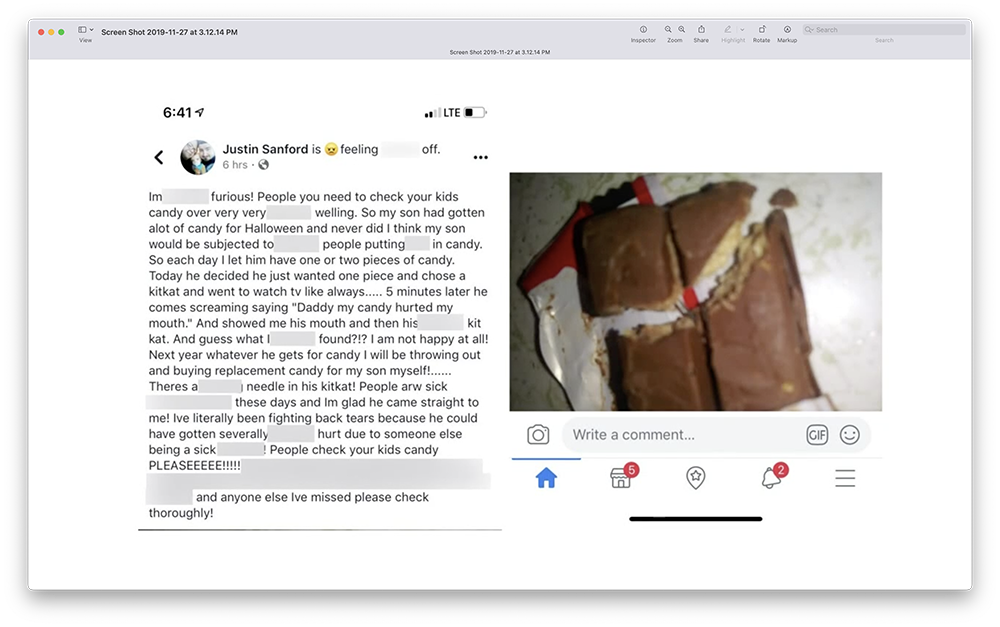
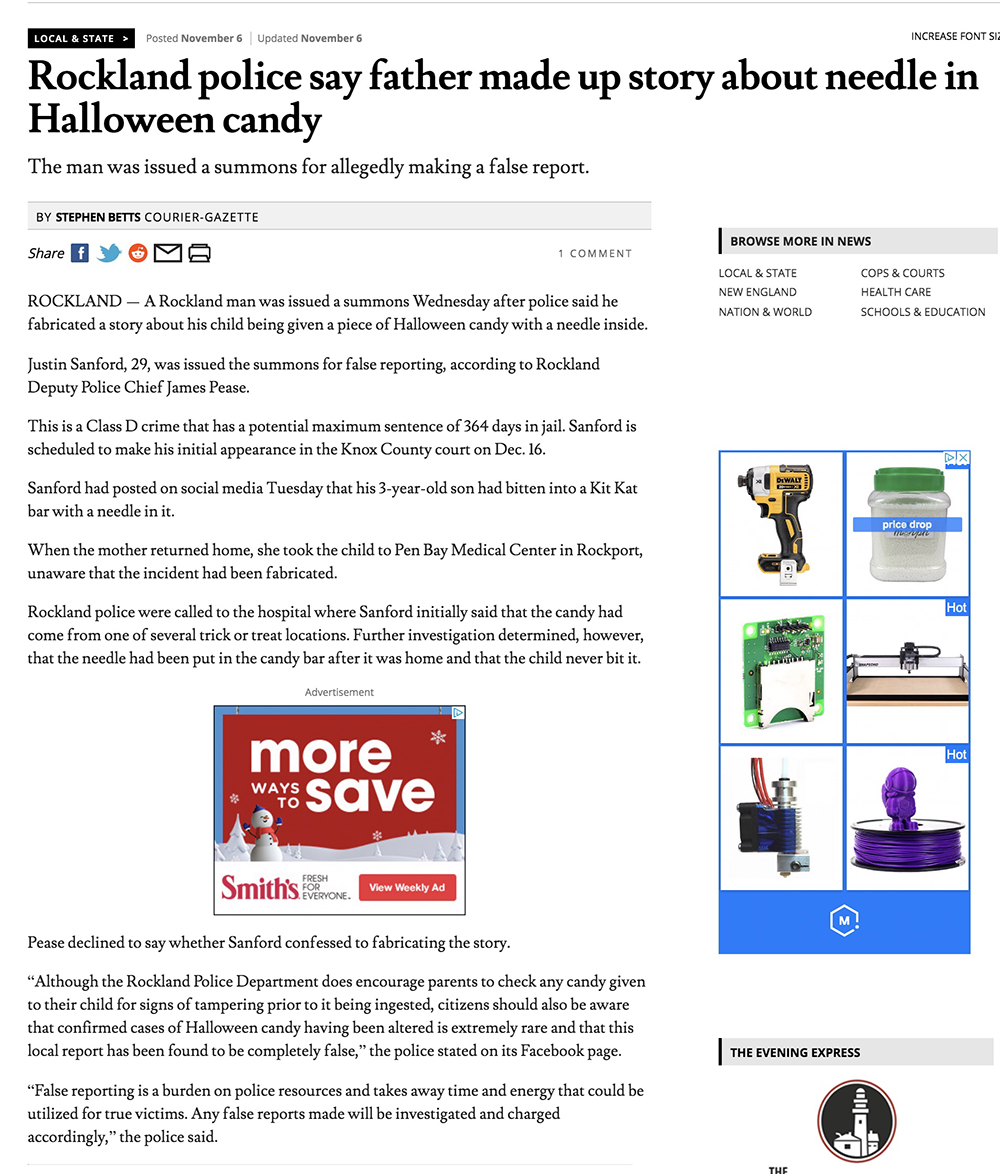
BR: And, you know, so, you know, you know, he basically used the pre-existing belief system to try and hide his crime. So, you know, and a lot of people, they don’t know, they don’t know the other side of the story. Oh, that, you know, that one thing happened that proves this case. No, it was not a stranger, it was not, a father intentionally killing his son using this method does not make the story true. But of course people jump back to that. And so it had nothing, Halloween had nothing to do with the murder, it was just used to cover it up. And yet the fear continues. And so, you know, every year there’s a handful of stories where someone will find, you know, some, usually it’s a needle in a Snickers bar, Halloween candy. And a friend of mine, Joel Best, who’s written quite a bit on it, he did research with a guy named Gerald Horiyuchi, and he examined news stories of Halloween sadists between 1958 and 1983. And he discovered that, they discovered that the fear of razor blades and apples was, was basically began in the 1970s. That was sort of when people were even worrying about these sorts of things. And again, you know, they found what I just said, which is that the, the, the, the existence of unprovoked attacks by strangers trying to poison children was non-existent. There’s no there there. But what’s happened over the last few years is that people do what’s called ostention. It’s a term where people will enact stories and lore. We talked about this, for example, in the Slenderman case. Yeah. And ghost hunting, a lot of ghost hunting and legend tripping is a form of ostentation. And what you find these days is that it’s a self-fulfilling prophecy because the news media will, of course, jump on some story of some rumored tainted candy. It’s just sort of like the first hint and the news media is all over it. It’s all over the place. And then some 11-year-old’s like, hey, I could get attention. And they do that, right? And so a couple of years ago in Philadelphia, there was a 12-year-old girl and a 11-year-old girl, 12-year-old boy, who reported finding needles in their trick-or-treat candy. And understandably, the parents were alarmed. They called the police. I mean, that means there’s some sadistic stranger trying to kill the children or injure them, right? Well, eventually they admitted that they faked it.
PR: I had a feeling.
BR: It was not a real thing. They wanted attention. They wanted to make the news. They wanted people to be concerned about them.
PR: Right, right.
BR: And they got that until, of course, they had to admit that… Because part of the problem, of course, is that just trying to research that and investigate that is very time consuming. If you really believe that there’s a tainted candy then the question is, where were you? Canvas this neighborhood, there’s a lot of, okay, there’s these houses, where are these houses? Did you exchange candy with anyone else? I mean a lot of time and effort and police investigation time can go into trying to confirm or debunk this. And then there was a guy, a 37-year-old father who claimed to have found tainted candy in his kid’s stuff. And again, another case, it made national news, you know, father finds tainted candy. Well, no. He admitted it was a hoax, and he claimed that he put the needles in his candy to, you you guessed it, teach his kids a lesson that they need to be aware of strangers trying to hurt them with candy.
0:40:57
PR: That’s a little bit of a strong lesson to teach.
BR: Yeah, yeah. And it’s just, the mentality of that is just bizarre. It’s like, okay, so you’re intentionally telling your children, you’re lying to your children, telling them that some stranger they don’t even know is trying to hurt or kill them, and you think you’re doing good? Really? Oh, I was trying to do good. I was trying to tell them to watch out for strangers. Yeah, but you’re the threat. You’re the threat, asshole. So that just pisses me off.
0:41:34
PR: Yeah, that’s really frustrating, speaking as a parent. Any of you who are contemplating becoming parents or maybe you’re new parents or you’re about to be a parent, lying to your kids is a really risky proposition in any situation. In my personal belief, even when it comes to some of the simple things like death and Santa Claus even, it’s risky. I’m not saying that you can’t do it sometimes, and I’m not saying you shouldn’t ever do it because of course there are perfectly valid reasons to do it from time to time, but the idea that lying to your kids or breaking their trust like that will ever teach them a good lesson, no, the lesson it’s gonna teach is not to trust you. And so to me that already smacks of being a very convenient excuse for what happened. Unfortunately, I just don’t know what would possess a person to do that to their children in any situation, because it’s just risky and it could hurt them. Why would you want that to even be on the table?
BR: Well, a lot of times the answer is attention. I often get asked – as you know, I investigate all sorts of weird stuff and often I’m like well why would someone do that? And the answer is for any number of reasons. Just because you wouldn’t do that or I wouldn’t do that doesn’t mean that somebody somewhere doesn’t have some self-justified rationalization for why they’re pulling some crap like that.
0:43:07
PR: Yeah, I mean Nickelback’s famous for crying out loud.
0:43:09
BR: How does that work? But I mean look, in the end, the fact is that it’s unnecessary. If you genuinely believe that some piece of candy has been tampered with, throw it out. Just throw it out. Throw it in the garbage. You don’t need to worry about it. It may be poisoned with polonium, could be cyanide, could be alien butt nuggets. I don’t know what’s in there, but you know what? If you throw it out, you don’t need to worry about it.
PR: You got an evil queen’s curse.
BR: Exactly. So at the end of the day, it’s just not that big a deal. And so, again, what I find really troubling about this, and I touched on it a second ago, is the cynical and sad mentality of the people that believe this and share this. What kind of sad cynical belief do you havethat believe this and share this. What sort of a sad, cynical worldview do you have that you generally believe that random strangers are trying to hurt or kill your children? It’s just so bizarre and sad and pathological. The fact is that, and we talked about this on the show before, by far the greatest threat to children are parents and caregivers and family. It’s not strangers. By far, strangers are far more likely to help and save any child everywhere. This is not controversial. This is self-evident fact. So the idea that you can’t trust strangers. Now, I mean, that’s sort of an inconvenient, it’s sort of a quasi-taboo thing to say, but it’s absolutely true. You don’t want kids getting into strangers’ cars. Obviously, you need to lie to children to the extent that you want to scare them a bit so that they’re not gullible and wandering into dangerous situations. But at the same time, the simple fact is that strangers, the world is not that scary I mean there are scary things in the world but on average the average stranger you might run whoever’s house you’re going to go to, they’re going to open the door, they’re going to help you out they’re going to call the police, they’re going to protect you.
PR: Oh yeah, absolutely. I think that it’s really important to get past this in that sense because you know we’ve got the statistics. It’s a safer time now to be a child than it has been, I believe, since the 50s in general. Health is better, general public health, vaccines have changed the way we view sickness, and also violent crime, kidnappings, things like that are way down. Kidnappings in particular are dramatically low as compared to what they were in the 60s. And especially by strangers. That’s something that has rolled off so much in the last 30 years or so, that we don’t even statistically consider it much of a threat. And as we know, in any AMBER alert that you come across in a given week, we’ll tell you it’s usually a relative or a parent, and most kidnappings have an element of familiarity.
BR: Non-custodial parental adoptions are by far the most common adoptions.
PR: Absolutely. I mean, just look at almost any Amber Alert you get on your phone or you see on the news. They usually are like, the children are with their XYZ parent, uncle, grandparent. It’s good to keep that stuff in mind. I mean, you want to have your kids be street smart. Don’t just trust anyone. But at the same time, I think we got a little, you know, I recall in the 80s, being that I was a kid in the 80s, people were a lot more scared of that stuff. And we had, you know, they’d fingerprint us. Oh yeah. And they’d, you know, they had like kid IDs that they’d like us to carry and stuff. And that’s not an altogether horrible idea, but it just shows that the fever was kind of creating this climate where we’re like, oh, we’ve got to, we just have to protect our kids and know everything. We have to make sure we’re totally on top of all this stuff.
BR: Yeah, I remember that. I remember being in school. I think it was in junior high. And I remember that there was somebody who, I think it was a police officer who had come to the school and he’s like, yeah, you know, we’re doing this program, it’s, you know, we’re concerned about abductions and we’re, you know, we wanna get your fingerprints and some of you may want to sign something so we can get your dental records. And I asked the cop in the classroom, I said, why would you need that? And he’s like, well, just to identify, I was like, you mean if we’re dead? I said, I just want to make sure I understand. So you’re telling a group of young kids that, you know, in case we find your dead body and we can’t identify you, we want your fingerprints and dental records. Like how disgusting and terrifying is that to have a police officer come and say, well, in case some stranger, you know, rapes and kills you, we want to make sure we got your dental records. I’m like, wow.
0:48:30
PR: Yeah, it’s just,
BR: I mean, I understand the desire to protect children, but this is just off the rails.
PR: Yeah, it is. And I recall, you know, I was a little young, I think I must have been six or seven years old when they had, they took us to the mall and the police department, you know, they had you lined up and they just fingerprinted all the kids. And it didn’t occur to me then, but just a couple years later, I recall, just feeling like, I was like, now I can’t just go around committing crimes because they have my fingerprints. But I was thinking about it, I was like, I’m in a database that they have this information. And truthfully, when you think about the hopefully rare chance, which I mean it is a rare chance, that a kid ends up going missing and is murdered or dumped in the woods somewhere, you don’t need fingerprints and dental records for that because there is going to be a missing kid and when a body turns up, it’s not going to require a major forensic project.
BR: Almost certainly.
PR: Major from a project almost you know I mean sure you know you need to ID it one way or the other but That’s the point where it’s like yeah, the parents will have the dental records like you know the parents that are missing a child will have that information when you need it right and you don’t you don’t need it now And then you know I mean we can get into the argument over privacy and and all that stuff But it is it is rather silly, and and I like to think it probably came from a well-intended place but –
BR: I’m sure it did well just is so ridiculous as did you know in in my book Media Myth-Makers I have a section on on Megan’s laws and sex offender laws yeah yeah and that’s a whole other topic we should oh yeah but we’ll move we’ll move on from now yeah so related to the to the the an interesting variation and twist on the tainted candy scare was after the 9-11 terrorist attacks there were rumors circulating around the web that two suspicious Arab men, now how exactly you would know they’re Arab men, we’ll just leave that there, had purchased $35,000 worth of candy from a New Jersey Costco. Now why would an Arab man or two of them, even more suspiciously, buy $35,000 worth of candy from Costco unless there was something sinister about it? This is the story that went around. I’ll read you the chain email. I won’t bother to loudly read the all caps, but you can imagine where they are. This is a chain email that circulated shortly after 9-11. I just personally found out through a police department that the FBI has taken over an investigation in our area. Arabs bought thousands of dollars worth of candy at a local Costco store. Well, what’s right around the corner? Halloween! Be careful! And of course the be careful was in all caps. It later turned out, and this won’t shock anyone, later turned out that in fact there was not a terrorist attack planned on American children using candy. That would probably be one of the lamest ones ever. It turned out that in fact there was a foreign individual, it’s not clear whether it was Arab or not, and it doesn’t matter. But there was in fact a, probably a non-white Caucasian fellow who bought a lot of candy. It’s not clear whether it was $35,000, because that’s quite a bit of candy, but someone did buy a lot of candy, and he was a wholesaler.
0:52:17
PR: Oh, okay.
0:52:18
BR: Because that’s what you do. That’s where you might buy your candy. You would go to Costco, you’d drop 12 grand on candy, and then resell it in your stores so the whole thing turned out to be a misunderstanding but of course it was it was in in interesting you know twist on the the the the the poison candy scare tied in with the anti-immigrant anti-muslim sure thing it in after 9-11 so is this now confluence of these two public fears.
PR: I would suspect that you would be hard-pressed to find $35,000 worth of candy in a single store even in a candy store I mean, you know, I don’t know how many of you –
BR: Have been to Ghirardelli Square? That candy is a possible man.
PR: Actually, yeah, no, that’s $35,000 every time you go there, but but the you know, but I mean, you know, I’ve worked in retail, I’m sure many of our listeners have. I used to manage the camera store at one point in my life. We did not have $35,000 worth of equipment in the store at any given time, much less candy. I mean, Costco, sure, they deal in bulk, but three tons of candy would be about $18.99, I think. But yeah, I did a little snooping, and I saw that… So they were talking about the reason that this came up was that large cash purchases are tracked by the FBI. This is true. I think it’s somewhere in the ballpark of $10,000 and up. If it’s a cash purchase, the FBI usually throws up a flag, or if it’s a cash deposit into a bank account or something.
BR: And you can see the reason for that.
0:53:58
PR: Yeah, sure. It’s reasonable. And they investigate those all the time. 99% of the time, they’re not a thing. It’s just someone bought something with cash, and they figured out where it came from. But it’s said that there was actually a guy who, the FBI reported this, that a man used cash to buy large amounts of candy from a Costco in Hackensack.
0:54:21
BR: I think it was like $15,000.
0:54:22
PR: Hackensack in Wayne, New Jersey. And it was somewhere in the ballpark of $15,000. So that’s that’s enough to Trigger a flag and he was a wholesaler So it just says we do not have any evidence that suggests that the purchase of these items was not for legitimate purposes so right and you know, there’s no mention of whether or not he was some you know, foreign national or anything I suspect not just off the top of my head but either way even if this did happen and even if they did you know two Arab guys bought $35,000 worth of candy boy –
BR: Even if that happened even what what what what what what what all right they bought a lot of candy okay –
PR: Right are you worried are you worried they’re gonna film you know fill a swimming pool with it and do a bunch of jackass stunts into it.
0:55:16
BR: If you… I mean, none of this makes sense. Even if you were trying to do something evil with candy, you don’t need $15,000 or $30,000 worth of candy.
0:55:29
PR: It just… Yeah, it’s… That all falls into the same kind of logic that I run into with conspiracy theorists when I get into these arguments. They’re like, you know, they bought $35,000 worth of candy. It’s like first off $35,000 worth of candy is a lot of candy. I mean that is a ton of candy and more than a ton literally but but the the big thing is that you know it’s like you so these two guys bought all this candy and they’re gonna sit there piece by piece and poison or Then what? And then they’re going to distribute it from their front door because you cannot go through thirty, not even, my neighborhood is a kid friendly neighborhood, that you could not possibly give out $35,000 worth of candy on Halloween. And even if they distributed it to start, I mean it’s just like you don’t know what’s going to happen and then on top of it all, I always, you know, you kind of have to use Occam’s razor with, well, with everything, but with something like this, it’s like, if you’re going to do something nefarious, what’s the easiest route to take? Figure out a way to truck $35,000 worth of candy into a warehouse and spend months loading it full of poison, or do something horrible like fly a plane into it.
BR: Making a pressure cooker bomb is so much easier than going through the… It’s just absurd. Which, just, you know, the lesson here, folks, don’t forward and share scary emails.
PR: Please don’t.
BR: I mean, every now and then, one of them will be on target. Almost never. So, take this from Uncle Ben, I make rice, you can trust me, don’t forward this crap, because it’s probably not true.
PR: Yes, please don’t. And Mark’s not going to start charging for Facebook either.
(MUSIC)
PR: All right, so what’s next on the agenda? What’s our next scare?
BR: Well the next scare is again going along the lines of the confluence between Halloween, the sort of fun scary and social genuine scares that actually create problems and sometimes get people in trouble. Sex offenders.
PR: Oh, okay.
BR: We touched on this before with Megan’s Law, right? Sure, sure. It was interesting because in the 1990s, the reputed Halloween evil took a new form in the form of sex offenders. And it tied in perfectly with Halloween because of course, you have to assume that after journalists cover yet another Halloween where the stories turn out not to be true, or some prank or hoax or copycat or garbage like that, you think after a while, like, okay, really, there’s nothing here. So sure enough, in the 1990s, people had a new thing to be afraid of, and that is sex offenders. And in many states, convicted sex offenders were required not to answer the door if trick-or-treaters came by, actually, or to report to jail overnight. There were actually, I saw news reports, there were signs that were given out by local sheriff’s departments that sex offenders were required to put in their window, saying things like, no candy here.
PR: Huh, wow.
BR: Now, if that’s not a flag, like, okay, wow, I wonder why that would be. Did they buy $35,000 worth of Costco, right? In some states, for example, Texas and Arkansas actually required offenders to report to courthouses on Halloween evening for a mandatory counseling session.
0:59:21
PR: Wow.
0:59:22
BR: Now, again, we can get into some other show we can talk about the concerns, whether they’re exaggerated or not. TLDR, yes, they are. But the idea that there’s something unique about Halloween that opens the door to increase sexual predation. That’s the premise here.
PR: Sure, sure.
BR: And it’s just wrong. I mean, the idea is that Halloween provides a special opportunity to make contact with children. And if you think about it for a second, and just a second, it kind of makes sense.
PR: Sure.
BR: It’s like, okay, Halloween, kids, candy, going house to house, okay, that makes sense. If you think about it for like three seconds, you’re like, no, hold on, hold on, that doesn’t actually make sense. Hold on.
PR: Wait a minute.
BR: Hold on. On second or third thought, that actually is total bull. So I mean, come on. The fact here is that there’s no reason at all to think that sex offenders pose any more of a threat to children on Halloween than any other time. It’s just the logic just isn’t there. In fact, a group of children dressed in costume at a sex offender’s doorway are probably safer than they would be in any other place, including in their own homes.
1:00:42
PR: Yeah, yeah.
1:00:43
BR: I mean, think about it, right? You have groups of children at a doorway, not inside a house, at a doorway, often with adults around, in costume, and you know where the house is. There’s no mystery as to where this happened. There’s the number of the house, this is the location, this is the opposite of what an actual sexual predator wants to do. They don’t want to be identified, they want this to be hidden in a way for… this is… there’s no… it just doesn’t make sense. You know, and as we discussed before, most physical and sexual attacks on children occur in their own home by somebody they know, not by some sex offender down the street, not by, you know, some pervert in the park. And again, the simple logistics of trick-or-treating make an assault very unlikely. A sex offender would have a really difficult time molesting a child in costume in his front door with other people around. It just doesn’t…
PR: It’s a very tricky proposition and there’s not a lot of precedence for it. There’s not.
1:01:57
BR: There’s not. In fact, so this was confirmed. There was a study published in the September 2009 issue of Sexual Abuse, a journal of research and treatment. And there were, I think, two researchers, and they examined 67,307 non-family sex offenses reported to law enforcement in 30 states over nine years. So huge database, and if you’re going to find patterns in when children are vulnerable, this is the database you’re going to find. Essentially, the researchers wanted to determine whether or not children are in fact at any greater risk for sexual assault around Halloween. The answer is a conclusive no. It’s not maybe, it’s not we need more research, the answer is no. The conclusion was, quote, “there does not appear to be a need for alarm concerning sexual abuse on these particular days. Halloween appears to be just another autumn day where rates of sex crimes against children are concerned.” So it’s no greater, no worse. It is exactly the same. And in fact, if anything, it’s probably less just because of stuff going on. So again, another case of where, you know, you have this, the mixing of sort of genuine fears by parents and society in general mixed in with the sort of fun fears of kids and Halloween all mixed together. And as a result, you have, you have, you know, sex offenders who are, who are being barred from, you know, trick-or-treating with their own kids. Like, like, I don’t care. I mean, I personally, I’m not, I’m not terribly concerned about the rights of sex offenders not being able to go trick-or-treating with their kids or whatever, or entering the door. That’s not my issue. I do have a bit of an issue with the wasted police time and effort. Because keep in mind, these are public services, and any police officer that is going around to sex offenders’ doors, making sure that the lights are off and they’re not there, that’s time away from doing other duties. That’s time away from investigating crimes. It’s a waste of police time and resources. And it unnecessarily creates fear among the public. And that’s my real concern.
PR: The last thing you said right there, the unnecessary fear thing, I’ve kind of found just in my own research and in my own, you know, kind of trying to kind of make sense of how we treat sex offenders and the idea of sex offenders in the community because let’s face it they they get out of jail and they become part of society again and and it is a scary thing as a parent to think of you know the the idea of some anonymous scary person that’s that’s going to do something to your kids. However, it just seems like the risk isn’t really present in the way that we tend to portray it. And the problem is that, I mean, we have to have a whole discussion over whether creating fear around sex offenders is as helpful as we’d like it to be. I understand the registries and why we might want to know that some sex offender came to the neighborhood. On the other hand, I don’t really want you knocking at my door telling me you’re a sex offender because the court told you that. I’d rather just know some other way, personally. It’s just stuff like that that bothers me. And also, I’m not defending anyone here, but there’s also a very broad category, depending on the state, where something can be considered a sex offense. And you may be unfairly targeting someone like that kid in Florida whose girlfriend was two years younger than him. He was 18, I think, and she was 16, something like that. He got convicted of statutory rape.
BR: No one wanted to press charges except for the DA. Just the DA, the witch hunt, and now the kids are sex offenders.
PR: But again, there’s nuance, and I don’t want to sound like I’m defending sex offenders, but because of all that, I don’t know how much of the scare factor needs to be there versus what a rational view of the situation is. And as we’ve seen here, the fears are pretty unfounded. Regardless of whether or not there are some scary sex offenders out there, the fears about this situation happening because you’re somehow presenting an opportunity for them to do it by having kids trick-or-treat, the numbers don’t add up. I think it’s good to be realistic about it at the very least.
BR: I’m glad you brought that up because the fact is that in all the topics we’re talking about here, is there a risk? Sure. Yeah.
1:06:55
PR: There’s always a risk.
BR: Is it possible that this Halloween, someone will actually try and put cyanide in a candy and give it to them? It hasn’t happened. Could it happen? Sure.
1:07:08
PR: Yeah.
1:07:09
BR: I mean, that’s the same thing with all these. Could there be a first time or a second time when some, I mean sure, the question isn’t could this happen, the question is, is it statistically likely to happen?
1:07:22
PR: Is it significant?
1:07:23
BR: Is it significant? Is it something that you really need to worry about or is it something that happens once in 10 million trick-or-treating time, whatever. Again, that goes back to skepticism and part of the role in putting risk in context. And risk assessment and that sort of thing is really important.
PR: Yeah. Yeah, those are really good points, and it’s a tricky conversation to have. It’s a very tricky conversation when you’re, you know, you don’t want to come in, you know, sounding like you’re defending sex offenders. But the important thing is that people realize that, yes, they’re out there. Yes, these things can happen. Do they, in these specific situations, not that we know of. It’s just not really there.
BR: Yeah and again, I think this is sort of part of a different discussion. I won’t get too far into it, but I mean part of the problem is that people don’t like having a mirror held up to the problem. I mean, it is It is uncomfortable for a parent to be told, you realize that you or your wife or husband or one of your relatives is far more likely to kill or molest your child than any stranger. You get that, right?
1:08:38
PR: Yeah.
1:08:39
BR: No parent, no one is like, oh, okay, this is suddenly getting weird. Like, okay, that’s the truth. Sorry. Sorry if that makes you weird. Sorry. Sorry if you’re uncomfortable with that. But this is the fact.
PR: Yeah. Nobody wants to think, you know, Uncle Bob might be the guy. And it’s important as a skeptic to be aware of that, because if you really want to minimize these threats and these situations, you need to have a good grasp of the reality of the situation and where the numbers are really, what they point at.
BR: Exactly.
1:09:10
PR: So what’s next?
1:09:11
BR: Let’s wrap this up with a topic we actually covered a week or two back. Scary clowns, one of my favorite topics.
PR: One of the best and one of the most appropriate Halloween topics of all time.
1:09:24
BR: Yes, indeed. So as happened over the past couple of years, in the wake of the scary clown panic, especially in 2016, although there were sort of smaller versions before that, 2014, 2015, several national stores, including Target, removed scary clown masks from their shelves. And both parents and kids were asking children to beware of people in clown costumes and not wear scary clown masks. Now, good luck with that!
PR: First off, don’t tell kids, especially don’t tell teenagers. been out in a full Bozo the Clown costume in a heartbeat had I known how freaked out people were by it.
BR: What exactly do you want me to do? Hold on, let me write this down.
1:10:06
PR: I want to make sure I take good notes so I make sure to exactly not do the things you’re saying. You said you spelled it B-O-Z-O? All right, yeah.
1:10:15
BR: What will offend and outrage you? Hold on, let me type this into my iPad. I mean, look, again, just exaggerated, over the top, all over the place. We actually touched on that. I’m not going to go too, because we talked about it last week, but several counties banned scary clown costumes. In Mississippi, the Mississippi Board of Supervisors in Kemper County voted to make it unlawful to wear a clown costume in public. Good luck enforcing that. I want to be the guy that gets arrested for what… And this is ACLU all over it.
PR: You know, don’t make ACLU’s job any harder. We don’t need to go into court with clowns. Come on, we know. We know. There’s just no arguing that you’re being unfair in this situation and that you will lose the case. It’s amazing to me that they would even try that.
BR: But sure enough, there were reports that clown masks were banned from New Jersey schools, USA Today, and other outlets reported. So again, we go from tainted candy to terrorists in tainted candy to sex offenders to evil clowns. Because, you know…
1:11:40
PR: Running the gamut.
1:11:41
BR: Right, and the cycle is going to return all over again. So anyway, again, don’t worry about the scary clowns, don’t worry about these other things. At the end of the day, keep in mind that so far there’s been no confirmed reports of children being seriously injured or abducted or killed by anybody dressed as a clown.
PR: Not since John Wayne Gacy.
BR: And not even Gacy.
PR: He painted a clown and he played a clown.
BR: Yeah, but I mean Gacy, we could talk about it, I won’t go too far into it, but I mean Gacy dressed occasionally and performed as a clown, as Pogo the Clown. But he was not a clown by trade, he was a building contractor. And he didn’t kill anybody in clown costume.
1:12:27
PR: No, no.
1:12:28
BR: Or anything like that. So in fact, it’s interesting because when people think of real life killer clowns, Gacy is of course the one they go to. But again, Gacy’s connection to clowning is actually pretty tenuous.
PR: It’s just a mild hobby with no direct correlation to the crime.
BR: Right. And in fact, a lot of the reason why he is so closely associated with it is because that’s what he wanted people to do. Gacy, after he was arrested, he went out of his way to cultivate his reputation as the killer clown. He did some portraits as Pogo the Clown. There was one on Acidbath album cover.
1:13:06
PR: When the kite string pops.
1:13:08
BR: Exactly. So, I mean, it’s sort of ironic that Gacy succeeded in cementing his reputation as a clown. that you know dc succeeded in cementing his reputation as a clown that that’s why so well knows like yet that’s what he wanted to be if you don’t want to do with the kit the serial killer wanted them then just call me see don’t bring in the clown but of course you can read it out you know –
PR: Even better just don’t use his name anymore like i do with every shooter, ever.
1:13:36
BR: Right right so anyway i mean it it is a demi just keep in mind that the real threat the real threats to children they don’t involve satanists, they don’t involve scary clowns, they don’t involve sex offenders terrorists, tampered candy it’s you know being hit by a car in the dark yeah it’s wearing a flammable costume uh… it’s choking on it’s choking on you know grandma’s you know bitter apple candy uh… or walking on curbs because they can’t walk off curb because they can’t see in the dark yeah you know and the fact is that most kids are very safe at Halloween, as they are year-round, generally. And the average child is far more likely to die of a heart attack than to be injured or killed by any of the threats we’ve talked about so far.
PR: Yeah, yeah. And it’s good to keep this stuff in mind, folks. I know we’re kind of preaching to the choir, but we always want to make sure that we are very clear that most of the stuff that society is scared of in the broad sense is usually pretty unfounded. Just be smart, be vigilant, be a good parent, but don’t get yourself too worried because I think we’re all going to be fine.
BR: Have a great Halloween.
1:14:45
PR: Enjoy. We’ll see you on the other side.
1:14:50
We would like to thank our sponsor level patrons Amy Freshour-Kelly and Dr.
1:14:54
Angela Mattke. If you’d like to find out what that is and how to become one head over to patreon.com forward slash squaring the strange patronage starts at just a buck and there are a lot of perks and bonus content just for our patrons if you’d like to lend your moral support you can head over to itunes and give us a review every five star review gets us a little more visibility on the itunes podcast charts and brings a smile to pascual’s face So that’ll do it for us this week. Next, actually we have two episodes coming up. We’re going to be doing a couple that we recorded a little while ago with Celestia and we kept them in the wings for an occasion like this where we needed to fill a couple of episodes later in the season. So we’ve got skeptic heroes coming up next week. We’re going to be talking about our favorite heroes of skepticism and then after that we’ll be talking about practical skepticism or skepticism in practice. How we apply it to things and how to to use it to sort of create your world view. So we’re excited to do that and we’ll be back to the recording week of after those two. And we hope you guys have a good week.
1:16:37
See you at episode 31.
1:16:39
Yeah, thank you everybody for listening and for the support and we very much appreciate it and keep coming back.
1:16:47
Bye bye.
1:17:13
Bye-bye. Bye-bye. Bye-bye. Bye-bye. Bye-bye. course our listeners and patrons. The views and opinions expressed in this
1:17:22
podcast are those of Squaring the Strange and do not necessarily reflect
1:17:25
the views and opinions of Cronus Creative, Center for Inquiry, our the views and opinions of Cronus Creative, Center for Inquiry, our advertisers, or any affiliated organizations and employers.
Transcribed with Cockatoo
